Black-Box Testing of Practical Movie Recommendation
Systems: a Comparative Study
?Namhee Lee1, Jason J. Jung2,4, Ali Selamat3, and Dosam Hwang2
1 School of Business Administration Sogang University, Seoul, Korea
Department of Computer Engineering Yeungnam University, Gyeongsan, Korea
{j2jung, dshwang}@ynu.ac.kr 3
Software Engineering Research Group (SERG) Knowledge Economy Research Alliance and Faculty of Computing
Universiti Teknologi Malaysia 81310 Johor, Malaysia
Universiti Malaya Kuala Lumpur, Malaysia
Abstract. Many practical recommendation systems have been studied, and also the services based on such recommendation systems have been opened in real world. The main research questions of this work arei) how these recommendation ser-vices provide users with useful information, andii) how different the results from the systems are from each other. In this paper, we propose a black-box evalua-tion framework of the practical recommendaevalua-tion services. Thus, we have designed user modeling process for generating synthesized user models as the inputs for the recommendation services. User models (i.e., a set of user ratings) have been syn-thesized to discriminate the recommendation results. Given a set of practical rec-ommendation systems, the proposed black-box testing scheme has been applied by comparing recommendation results. Particularly, we focus on investigating whether the services consider attribute selection.
Keywords:Social networks; Recommendation systems; Black-box testing; Com-parative study.
1.
Introduction
Recommendation systems have been studied for a long time. There have been a lot of recommendation schemes to provide users with the most relevant information. In the real world, we have been able to access recommendation services in various domains. Partic-ularly, movie is the most popular domain targeted by the recommendation services.
However, even though users are eager to get the recommendations from the practical systems, they have not been satisfied with the results. For example, users are consistently
?
acting with the same preferences (i.e., the same input ratings), the results from such rec-ommendation systems are completely difference from each other [3].
Users (at least system developers) want to know what kinds of recommendation mech-anisms are behind the systems. Somehow, depending on their situation, more appropriate system can be selected. Thereby, in this paper, we focus on comparing the recommenda-tion results provided from the practical recommendarecommenda-tion systems, and investigating what kinds of recommendation schemes have been exploited in these systems [6]. Especially, we want to show that the proposedblack-box testing strategycan precisely reveal the rec-ommendation schemes behind those practical recrec-ommendation systems [4]. To do this, we have synthesized a number of user models by generating user ratings. Consequently, target systems returns a set of recommendations, and the systems will be differentiated with each other [12].
The outline of this paper is as follows. In the following Sect. 2, we will address back-grounds on recommendation systems in the literature. Sect. 3 gives a research method on comparing the results obtained from a set of selected recommendation systems. Sect. 3.2 will give the description about the recommendation systems that we have selected in this work. Most importantly, Sect. 4 show how to conduct the experiments for collecting the results from the recommendation systems. In Sect. 5, we will analyze the collected rec-ommendation results, and draw a conclusion of this work, respectively.
2.
Backgrounds and Related Work
User modeling process in the recommendation systems is commonly based on analyzing various information collected by users in explicit or implicit ways [13]. Depending on the following two issues, we need to consider to build a taxonomy of user modeling in recommendation systems.
1. Recommendation systems usually ask users to explicitly input various information. First issue is what kinds of information is employed to build user models in the rec-ommendation systems.
– Demographic information – User ratings
Given equivalently synthesized users (e.g., same age, same gender, and so on), we can compare the recommendation results to realize whether they are same or different. 2. Recommendation systems somehow exploit the information collected from the users
to discover useful patterns about the users. Second issue is which recommendation strategies are applied to provide users with relevant information.
– Personalization – Collaborative filtering
Assuming that a user is interested in a certain value (e.g., “Steven Spielberg”), the recommendation results can be compared to reversely find out what kind of schemes are applied.
Table 1: Taxonomy of recommendation systems w.r.t. user modeling processes
Personalization Collaborative filtering Demographics RecP,D RecC,D
User ratings RecP,U RecC,U
Especially, in the context of attribute selection-based user modeling [9], the users can be synthesized to differentiate the results from recommendation systems. Table 2 shows an example with three users (i.e., U1, U2, and U3). With two users (i.e., U1and U2), we
can discriminate RecP,Dand RecP,Ufrom RecC,Dand RecC,UAlso, with two users (i.e., U1
and U3), we can discriminate RecP,Dand RecC,Dfrom RecP,Uand RecC,U.
Table 2: Example with three synthesized users who have rated the same movies
U1 U2 U3
Age/Gender/Country 20/Male/Korea 20/Male/Korea 60/Female/France
Rating Lincoln 5 1 Very good
War Horse 5 1 Very good
The Terminal 5 1 Very good
3.
Research method
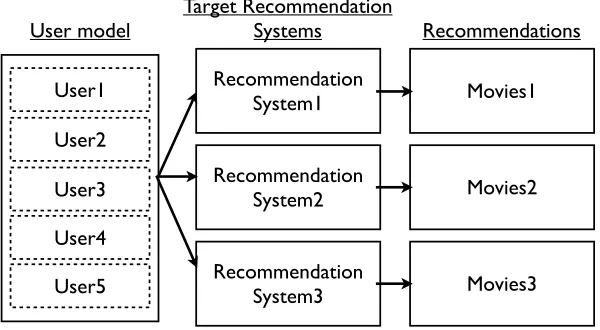
In this paper, we focus on black-box testing scheme [1], since we have no information about internal strategies of the practical recommendation systems [7]. As shown in Fig. 1, a set of users are synthesized to collect recommendations from the practical services.
3.1. Comparison of recommendation results
Once we select a set of recommendation service, recommendation results are compared with each other.
Definition 1 (Recommendation).Given a recommendation serviceRSi, the
recommen-dation resultMiis composed of a set of movies which are regarded as the most relevant
movies to user contexts. It is represented as
Mi={m1, m2, . . . , mN} (1)
whereNis the number of movies recommended by the system.
User model
User5 User4 User3 User2
User1 Recommendation
System1
Recommendation System3 Recommendation
System2
Movies1
Movies3 Movies2 Recommendations Target Recommendation
Systems
Fig. 1: Research model based on black box testing
Definition 2 (Similarity).Two recommendation resultsMi andMj from
recommenda-tion servicesRSiandRSj, similarity betweenRSiandRSjcan be measured by
Sim(RSi, RSj) =
Mi∩Mj
max(Mi, Mj)
(2)
where denominator can choose the maximum size of recommendation.
3.2. Selected practical recommendation systems
Initially, as shown in Table 3, we have tried to select 10 movie recommendation systems [14]. Out of them, 2 recommendation systems are not available for the moment.
User registration Practical recommendation systems usually ask users to input various personal information during registration, depending on their recommendation schemes. Table 4 shows the list of demographic information requested by the recommendation systems.
All systems ask Email in common. It is regarded as an unique identifier for each user. Since only two kinds of personal information (e.g., Email and username) are asked in Taste Kid and Nanocrowd, these two systems are not asking any personal information. They seem to be more focused on ratings from users. In contrast, Jinni, Criticker, IMDB and Rotten Tomatoes are asking more than five types of personal information.
Table 3: Selected recommendation systems
Recommendation systems URLs
Jinni www.jinni.com
Taste Kid www.tastekid.com
Nanocrowd www.nanocrowd.com
Clerkdogs www.clerksblog.com Not available Criticker www.criticker.com
IMDB www.imdb.com
Flixster www.flixster.com
Movielens www.movielens.org
Rotten Tomatoes www.rottentomatoes.com
Netflix www.netflix.com Not available in Korea
Table 4: User profiling during registration (#: required,4: optional)
Recommendation User Real Date of City/ Postal Marital systems Email name name Birth Gender Country State Code Status
Jinni (RS1) # # 4 4 4 # 4
Taste Kid (RS2) # # Nanocrowd (RS3) # #
Criticker (RS4) # # 4 4 4 4 4 4
IMDB (RS5) # # # # #
Flixster (RS6) # # #
Movielens (RS7) # # 4 4
Rotten Tomatoes # # # # #
(RS8)
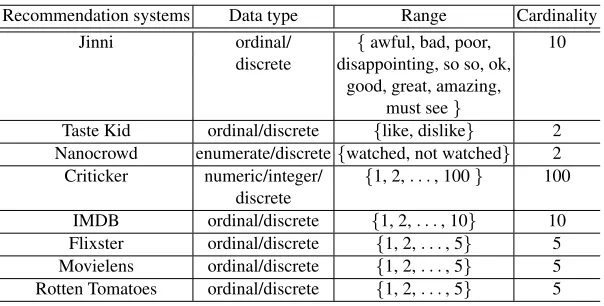
Table 5: Representation of user ratings
Recommendation systems Data type Range Cardinality
Jinni ordinal/ {awful, bad, poor, 10
discrete disappointing, so so, ok, good, great, amazing,
must see}
Taste Kid ordinal/discrete {like, dislike} 2 Nanocrowd enumerate/discrete{watched, not watched} 2 Criticker numeric/integer/ {1, 2,. . ., 100} 100
discrete
movies between 1 and 5. Jinni and IMDB are more diversified to between 1 and 10. Partic-ularly, in Criticker, users can rate the movies from 0 to 100. On the other hand, Taste Kid and Nanocrowd are making the user ratings most simplified. Interestingly, Nanocrowd is simply asking users to record the list of movies (i.e., “watched”).
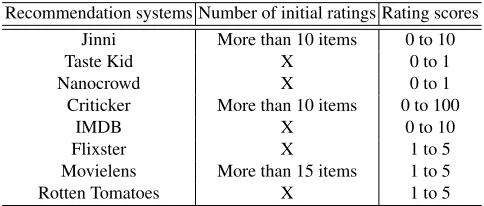
Additionally, we have to consider the requirement of initial rating step, as shown in Table 6. Jinni, Criticker, and Movielens are collecting initial ratings from users, before they provide the users with recommendations.
Table 6: Initial requirement for recommendations; X indicates ‘Not required’
Recommendation systems Number of initial ratings Rating scores Jinni More than 10 items 0 to 10
Taste Kid X 0 to 1
Nanocrowd X 0 to 1
Criticker More than 10 items 0 to 100
IMDB X 0 to 10
Flixster X 1 to 5
Movielens More than 15 items 1 to 5
Rotten Tomatoes X 1 to 5
4.
Experiments and evaluation
In this section, we want to describe how to synthesize user models and how to collect recommendation results from the practical services.
User models have been synthesized by assuming a user is interested in a certain at-tribute, as follows.
– U1: Genre “Sci-Fi”
– U2: Director “Steven Spielberg”
– U3: Actor “Leonardo DiCaprio”
– U4: Actress “Angelina Jolie”
Also, the movies can be rated in two difference ways.
– Unified rating: We need to express that a user’s interest is consistent in each attribute. – Random rating: We need to express that a user’s interest is not consistent in each
attribute.
For example, a user is assumed to be consistently interested in a genre “Sci-Fi”. As shown in Table 2, this user can be synthesized in {hm1,5i,hm2,5i,hm3,5i}. In opposite, his
random ratings can be synthesized as{hm1,5i,hm2,1i,hm3,3i}.
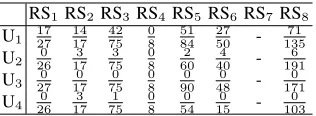
We have collected the recommendations from the practical services. Table 7 and Ta-ble 8 show evaluational results on personalization-based recommendation services. In both cases, only U1 (Genre “Sci-Fi”) has shown high matching ratio. The other three
users (i.e., U2, U3, and U4) are in the very low level. We found that the practical
recom-mendation services are not considering attribute-based personalization.
Table 7: Evaluation on attribute-based personalization with uniform ratings
RS1RS2RS3RS4RS5 RS6 RS7 RS8 U1 1727 1417 4275 08 5184 2750 - 13571 U2 260 173 753 08 602 404 - 1916 U3 270 170 750 08 900 480 - 1710 U4 260 173 751 08 540 150 - 1030
Table 8: Evaluation on attribute-based personalization with random ratings
RS1RS2RS3RS4RS5 RS6 RS7 RS8 U1 1120 1317 4275 28 3565 2450 - 5392 U2 202 172 750 08 661 506 - 984 U3 200 170 750 08 660 110 - 820 U4 200 170 750 08 660 500 - 780
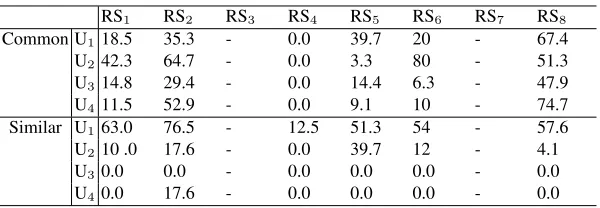
Also, Table 9 shows comparison between uniform ratings and random ratings.RS2
andRS8are showing high ratio between uniform and random ratings. It means that these
recommendation services are not considering user ratings as importantly as the other ser-vices are.
5.
Concluding Remark and future work
In this work, we have investigated what kinds of recommendation schemes have been ex-ploited in the practical recommendation services. As a conclusion, this paper has evalu-ated user modeling process in several practical recommendation systems. Black-box test-ing scheme has been applied by compartest-ing recommendation results. User models (i.e., a set of user ratings) have been synthesized to discriminate the recommendation results.
Table 9: Comparison of uniform and random ratings
RS1 RS2 RS3 RS4 RS5 RS6 RS7 RS8
Common U118.5 35.3 - 0.0 39.7 20 - 67.4
U242.3 64.7 - 0.0 3.3 80 - 51.3
U314.8 29.4 - 0.0 14.4 6.3 - 47.9
U411.5 52.9 - 0.0 9.1 10 - 74.7
Similar U163.0 76.5 - 12.5 51.3 54 - 57.6
U210 .0 17.6 - 0.0 39.7 12 - 4.1
U30.0 0.0 - 0.0 0.0 0.0 - 0.0
U40.0 17.6 - 0.0 0.0 0.0 - 0.0
Acknowledgments.This work was supported by the 2013 Yeungnam University Research Grant.
References
1. Beizer, B.: Black-Box Testing: Techniques for Functional Testing of Software and Systems. John Wiley & Sons (1995)
2. Herlocker, J.L., Konstan, J.A., Terveen, L.G., Riedl, J.T.: Evaluating collaborative filtering rec-ommender systems. ACM Transactions on Information Systems 22(1), 5–53 (January 2004) 3. Hwang, D., Nguyen, N.T., Jung, J.J., Sadeghi-Niaraki, A., Baek, K.H., Han, Y.S.: A semantic
wiki framework for reconciling conflict collaborations based on selecting consensus choice. Journal of Universal Computer Science 16(7), 1024–1035 (2010)
4. Jung, J.J.: Knowledge distribution via shared context between blog-based knowledge manage-ment systems: a case study of collaborative tagging. Expert Systems with Applications 36(7), 10627–10633 (2009)
5. Jung, J.J.: Reusing ontology mappings for query segmentation and routing in semantic peer-to-peer environment. Information Sciences 180(17), 3248–3257 (2010)
6. Jung, J.J.: Boosting social collaborations based on contextual synchronization: An empirical study. Expert Systems with Applications 38(5), 4809–4815 (2011)
7. Jung, J.J.: Exploiting multi-agent platform for indirect alignment between multilingual ontolo-gies: a case study on tourism business. Expert Systems with Applications 38(5), 5774–5780 (2011)
8. Jung, J.J.: Service chain-based business alliance formation in service-oriented architecture. Ex-pert Systems with Applications 38(3), 2206–2211 (2011)
9. Jung, J.J.: Attribute selection-based recommendation framework for short-head user group: An empirical study by movielens and imdb. Expert Systems with Applications 39(4), 4049–4054 (2012)
10. Jung, J.J.: Collaborative browsing system based on semantic mashup with open apis. Expert Systems with Applications 39(8), 6897–6902 (2012)
11. Jung, J.J.: Computational reputation model based on selecting consensus choices: an empirical study on semantic wiki platform. Expert Systems with Applications 39(10), 9002–9007 (2012) 12. Jung, J.J.: Evolutionary approach for semantic-based query sampling in large-scale information
sources. Information Sciences 182(1), 30–39 (2012)
13. Pu, P., Chen, L., Hu, R.: Evaluating recommender systems from the user’s perspective: survey of the state of the art. User Modeling and User-Adapted Interaction 22(4-5), 317–355 (2012) 14. Reisinger, D.: Top 10 movie recommendation engines (March 2009),http://news.cnet.
Namhee Leeis currently a postdoctoral researcher in Sogang University, Korea. She re-ceived her B.A. degree in Business Administration from Hongik University, Korea in 2003. She received her M.S. degree in Management Information Systems from Sogang University, Korea in 2007. She earned her Ph.D in Management Information Systems at Sogang Business School, Korea in 2013. Her primary research interests are including Service Science and Management and Information Technology Innovation.
Jason J. Jungis a visiting research professor in Universiti Malaya, Malaysia. He is an associate professor in Yeungnam University in Korea. He has been a lot of industrial experiences on web-based information systems. His main research areas include recom-mendation systems, mashup services, and social network-based services.
Ali Selamathas received a B.Sc. (Hons.) in IT from Teesside University, U.K. and M.Sc. in Distributed Multimedia Interactive Systems from Lancaster University, U.K. in 1997 and 1998, respectively. He has received a Dr. Eng. degree from Osaka Prefecture Univer-sity, Japan in 2003. Currently, he is the Dean of Research Alliance in Knowledge Econ-omy (K-EconEcon-omy RA) UTM. He is a professor at Faculty of Computer Science & IS UTM. Previously he was an IT Manager at School of Graduate Studies (SPS), UTM. He is also a head of Software Engineering Research Group (SERG), K-Economy Research Alliance, UTM. He is the editors of International Journal of Digital Content Technology and its Applications (JDCTA) andInternational Journal of Advancements in Computing Technology (IJACT). He was the conference chair of Asian conference in Intelligent In-formation and Database Systems (ACIIDS2013) and IEEE Malaysia Software Engineer-ing Conference 2011 (MySEC2011). His research interests include software engineerEngineer-ing, software agents, web engineering, information retrievals, pattern recognitions, genetic al-gorithms, neural networks and soft-computing.
Dosam Hwangis a corresponding author of this paper. He received his Ph.D. degrees in natural language processing at Kyoto University. In 1987, he was chosen the best re-searcher at Korea Institute of Science and Technology. Since 2005 he has been the Profes-sor at Yeungnam University in Korea. Currently working on natural language processing, machine translation, ontology, semantic web, and information retrieval. He has served for a number of international conferences and a technical committee for ISO.