A NEW MECHANISM FOR DATA VISUALIZATION WITH
TSK-TYPE PREPROCESSED COLLABORATIVE FUZZY
RULE BASED SYSTEM
Mukesh Prasad1, Yu-Ting Liu2,3, Dong-Lin Li2, Chin-Teng Lin2,3, Rajiv Ratn Shah4, Om Prakash Kaiwartya5
1Department of Computer Science, National Chiao Tung University, Hsinchu, Taiwan
2Department of Electrical Engineering, National Chiao Tung University, Hsinchu, Taiwan
3Faculty of Engineering and Information Technology, University of Technology Sydney, Sydney, Australia
4School of Computing, National University of Singapore, Singapore
5Faculty of Computing, Universiti Teknologi Malaysia, Skudai Johor, Malaysia
Abstract
A novel data knowledge representation with the combination of structure learning ability of preprocessed collaborative fuzzy clustering and fuzzy expert knowledge of Takagi-Sugeno-Kang type model is presented in this paper. The proposed method divides a huge dataset into two or more subsets of dataset. The subsets of dataset interact with each other through a collaborative mechanism in order to find some similar properties within each-other. The proposed method is useful in dealing with big data issues since it divides a huge dataset into subsets of dataset and finds common features among the subsets. The salient feature of the proposed method is that it uses a small subset of dataset and some common features instead of using the entire dataset and all the features. Before interactions among subsets of the dataset, the proposed method applies a mapping technique for granules of data and centroid of clusters. The proposed method uses information of only half or less/more than the half of the data patterns for the training process, and it provides an accurate and robust model, whereas the other existing methods use the entire information of the data patterns. Simulation results show the proposed method performs better than existing methods on some benchmark problems.
Keywords:fuzzy interference system, collaborative clustering, fuzzy logic, big data, data visualization
1 Introduction
Fuzzy logic has been applied successfully in various applications such as vehicle control, agri-cultural engineering, astronomy, chemistry, geol-ogy, image analysis, medical diagnosis, shape anal-ysis and target recognition, consumer products, and control of manufacturing systems etc. Fuzzy logic
such as, linear control design and purely logic-based models, require exact equations to model real-world behaviors. There are basically three types of fuzzy inference systems: Mamdani type, Takagi-Sugeno-Kang (TSK) type and logical type fuzzy inference system models. All of them contain the expert knowledge of fuzzy logic with their own problem solving capability. Traditionally, Mam-dani model [1] is widely accepted as a manner to build expert knowledge. It allows designers to de-scribe the expertise in an intuitive way. However, Mamdani-type fuzzy inference system consumes large amount of effort for computation. On the other hand, Sugeno method [2], which is known as Takagi-Sugeno-Kang (TSK) fuzzy model, is com-putationally effective and works well with opti-mization and adaptive techniques. Therefore, TSK type model is very attractive to researchers to solve control problems, particularly for dynamics non-linear systems. Logical-type represented by an S-implication would be preferred for classification problems logical-type systems or other fuzzy im-plications [3, 4]. This paper’s simulation results are based on TSK type model.
Fuzzy rule based modeling system or fuzzy control rules first extract expert knowledge from its knowledge bases, and then build expert systems. Fuzzy expert system is a combination of rules and membership function, which is generated by fuzzy c-means (FCM) clustering or some other clustering methodology [12-19]. The success of the Fuzzy expert system depends on the quality of acquired knowledge. Fuzzy control rule can be expressed in following way:
a) IF temperature is very low and pressure is nor-mal, THEN heat change would be slightly posi-tive.
b) IF it is raining and wind is fast and dark outside, THEN take an umbrella and a torch.
However, in many real situations it is not a good way to combine expert knowledge, and it is neces-sary to resort the learning system to acquire knowl-edge. There exist several methods for the learn-ing of fuzzy rules. An example as follows: sup-pose we have variety of information with the same patterns from different field applications. To get a comprehensive study of these varieties of
informa-tion, knowledge based clustering [7] and collabo-rative clustering between datasets is recommended. Pedrycz [8, 9] introduced a collaborative clustering to solve the problem when some data cannot acquire directly from the dataset due to data confidentiality. In this kind of clustering algorithm, several subsets of patterns can be processed together with an objec-tive of finding a common structure that is shared by all of them. In this study, preprocessed collabora-tive fuzzy clustering (PCFC) technique is applied to generate a number of rules to calculate the member-ship function. PCFC has the ability to extract good knowledge from the given unidentified information. We combined PCFC rule learning mechanism with TSK type model, which helps modeling system to design an accurate and robust model.
The rest of the paper is organized as follows: Section 2 gives introduction of FCM, PCFC, TSK type FIS, the proposed system, and flow diagram of the proposed system. Section 3 shows the sim-ulation results on two nonlinear dynamic system, and compares the proposed method with the Mat-lab based Genfis2 method [11]. Finally, the conclu-sions are covered in Section 4.
2
Basic Procedure and Proposed
Algorithm
2.1 Fuzzy C-Means Clustering
Fuzzy C-Means (FCM) [5, 6] is one of the most common unsupervised clustering algorithms, which is originally described first by Bezdek in 1973. Variants of FCM [21-24] have been described with modified definitions for the norm and prototypes of the cluster centroids [26-28]. FCM clusters each data point to one or more clusters, and partitions a set of dataxi∈Rd,i=1,2, . . . ,Ninto a certain
num-bercof fuzzy clusters by minimizing the following cost function
Jm= N
∑
i=1c
∑
j=1um i j
xi−vj2, (1)
where m is any real number greater than 1, ui j is
the degree of membership ofxi in the clusterj,xis
thei-th data point ofd-dimension data,vj is thed
such as, linear control design and purely logic-based models, require exact equations to model real-world behaviors. There are basically three types of fuzzy inference systems: Mamdani type, Takagi-Sugeno-Kang (TSK) type and logical type fuzzy inference system models. All of them contain the expert knowledge of fuzzy logic with their own problem solving capability. Traditionally, Mam-dani model [1] is widely accepted as a manner to build expert knowledge. It allows designers to de-scribe the expertise in an intuitive way. However, Mamdani-type fuzzy inference system consumes large amount of effort for computation. On the other hand, Sugeno method [2], which is known as Takagi-Sugeno-Kang (TSK) fuzzy model, is com-putationally effective and works well with opti-mization and adaptive techniques. Therefore, TSK type model is very attractive to researchers to solve control problems, particularly for dynamics non-linear systems. Logical-type represented by an S-implication would be preferred for classification problems logical-type systems or other fuzzy im-plications [3, 4]. This paper’s simulation results are based on TSK type model.
Fuzzy rule based modeling system or fuzzy control rules first extract expert knowledge from its knowledge bases, and then build expert systems. Fuzzy expert system is a combination of rules and membership function, which is generated by fuzzy c-means (FCM) clustering or some other clustering methodology [12-19]. The success of the Fuzzy expert system depends on the quality of acquired knowledge. Fuzzy control rule can be expressed in following way:
a) IF temperature is very low and pressure is nor-mal, THEN heat change would be slightly posi-tive.
b) IF it is raining and wind is fast and dark outside, THEN take an umbrella and a torch.
However, in many real situations it is not a good way to combine expert knowledge, and it is neces-sary to resort the learning system to acquire knowl-edge. There exist several methods for the learn-ing of fuzzy rules. An example as follows: sup-pose we have variety of information with the same patterns from different field applications. To get a comprehensive study of these varieties of
informa-tion, knowledge based clustering [7] and collabo-rative clustering between datasets is recommended. Pedrycz [8, 9] introduced a collaborative clustering to solve the problem when some data cannot acquire directly from the dataset due to data confidentiality. In this kind of clustering algorithm, several subsets of patterns can be processed together with an objec-tive of finding a common structure that is shared by all of them. In this study, preprocessed collabora-tive fuzzy clustering (PCFC) technique is applied to generate a number of rules to calculate the member-ship function. PCFC has the ability to extract good knowledge from the given unidentified information. We combined PCFC rule learning mechanism with TSK type model, which helps modeling system to design an accurate and robust model.
The rest of the paper is organized as follows: Section 2 gives introduction of FCM, PCFC, TSK type FIS, the proposed system, and flow diagram of the proposed system. Section 3 shows the sim-ulation results on two nonlinear dynamic system, and compares the proposed method with the Mat-lab based Genfis2 method [11]. Finally, the conclu-sions are covered in Section 4.
2
Basic Procedure and Proposed
Algorithm
2.1 Fuzzy C-Means Clustering
Fuzzy C-Means (FCM) [5, 6] is one of the most common unsupervised clustering algorithms, which is originally described first by Bezdek in 1973. Variants of FCM [21-24] have been described with modified definitions for the norm and prototypes of the cluster centroids [26-28]. FCM clusters each data point to one or more clusters, and partitions a set of dataxi∈Rd,i=1,2, . . . ,Ninto a certain
num-bercof fuzzy clusters by minimizing the following cost function
Jm= N
∑
i=1c
∑
j=1um i j
xi−vj2, (1)
where m is any real number greater than 1, ui j is
the degree of membership ofxi in the clusterj,xis
thei-th data point ofd-dimension data,vj is thed
-dimension of the clusterj,and||*||is any norm ex-pressing the similarity between any measured data and the center.
2.2 Procedure of FCM
1. Set up a value of c (number of cluster);
2. Select initial cluster prototype V1,V2, . . . ,Vc
from Xi, i=1,2, . . . ,N;
3. Compute the distance ��Xi−Vj�� between
ob-jects and prototypes;
4. Compute the elements of the fuzzy partition ma-trix (i=1,2, . . . ,N; j=1,2, . . . ,c)
ui j=
[ c
∑
l=1(��
xi−vj��
∥xi−vl∥
)]−1
; (2)
5. Compute the cluster prototypes ( j=1,2, . . . ,c)
Vj= ∑ N i=1u2i jxi
∑N i=1u2i j
; (3)
6. Stop if the convergence is attained or the num-ber of iterations exceeds a given limit. Other-wise, go to step 3.
2.3 Takagi-Sugeno-Kang Fuzzy Inference System
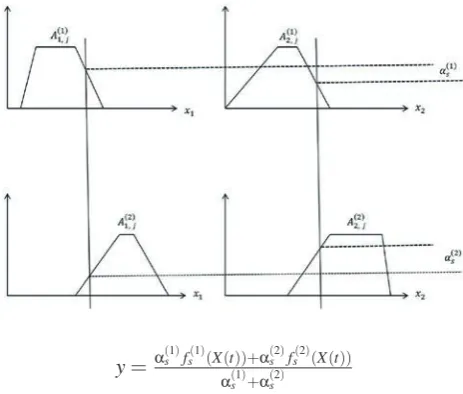
TSK fuzzy inference model proposed by Tak-agi, Sugeno, and Kang [2, 20], has been widely used in control and fuzzy modeling. The key idea of TKS is to divide input space into several fuzzy regions, and approximate each region by a simple model. All the systems can be regarded as a com-bination of a series of simple models. In general, TSK can be represented in mathematical form as
Ri: IFx1(t) =A(1i,)j AND ANDxn(t) =A(ni,)j,
THENy(si)= fs(i)(x(t)),
where Ri is i-th rule in TSK model, t denotes a
sampling instant, andXs(t) = [x1(t), ...,xs(t)]Tis
in-put vector. Each xk ∈R, where k=1, ...,s, A(ki,)j
thejfuzzy set characterized by thei-th rule corre-sponding to the inputxk,ysis the output of overall
model, and fs(X(t))is a first-order polynomial, can
be computed as
fs(X(t),bi) =∑ Ri
k=1a(si)f(i)(x1, ...,xs)
∑Ri
i=1α(si)
. (4)
Ri is the total number of rules, andα(si) is the
de-gree of matching between thei-th fuzzy and thes-th sample. f(i)(x
1, ...,xs)can be represented as
bi0,s+bi1,sx1(t) +...+bis−1,sxs(t), (5)
wherebi
k,s∈R. By above definition,Ri=2 and
α(i)
s =min{µA(i)
1,jx
′
1,µA(i)
2,jx
′
2}. (6)
Figure 1 shows the computation process of TSK inference model. Ting and Quek [21] demonstrated a more complicated TSK inference model. Typical cost function JT SK measures how the TSK model
approximates the real problem. The JT SK can be
expressed as
JT SK = N
∑
t=1D2(t), (7)
whereD(t)is the difference of output between the real system and the identified model, andN is the number of training samples.
A generic TSK inference model can be divided into four parts.
1. Partition the input space into r inference rules.
2. Identify the structure of each IF part.
3. Identify the constitution of each THEN part.
4. Calculate the predicted value.
y=α(s1)fs(1)(X(t))+α(s2)fs(2)(X(t))
α(1)
s +α(s2)
2.4 Preprocessed Collaborative Fuzzy Clustering
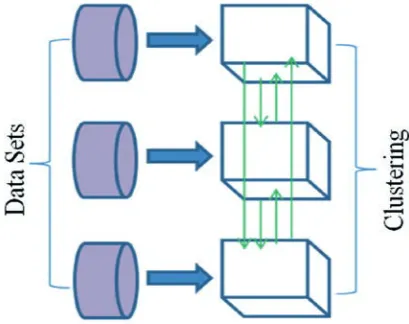
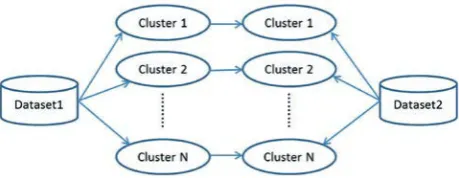
Pedrycz [8] introduced a collaborative fuzzy clustering (CFC) to find the consistency between two or more datasets. Its variants: horizontal [10] and vertical collaboration fuzzy clustering [25], also exist. Figure 2 and 3 show the general scheme of horizontal collaborative clustering and vertical collaborative clustering, respectively. The commu-nication bridge in horizontal clustering is based on through the partition matrix, where data is deal with same pattern and different features spaces. The con-fidentiality of data is kept by operating on resulting information granules (partition matrices) instead on individual patterns due to the granularity of data is far different from the original data. The commu-nication bridge in vertical clustering at the level of the prototypes (high-level representatives of data), where data is deal with different pattern but the same feature space. The confidentiality requirement of data is kept due to aggregate nature of the proto-types. Figure 4 shows the connections of matrices in order to accomplish the collaboration between the subsets of the database. Prototype and partition matrices bring the way of structural findings at the each dataset.
Figure 2. A General scheme of horizontal clustering
The minimization of objective function of CFC is defined as Eq. (8), whereβis a user defined pa-rameter based on datasets (β>0),β[l,m] denotes
the collaborative coefficient with collaborative ef-fect on datasetlthroughm,c is a number of clus-ter,l=1,2, . . . ,Pis a number of datasets,N is the
number of patterns in the dataset, urepresents the partition matrix,nis a number of features, anddis an Euclidean distance between patterns and proto-types.
Figure 3. A General scheme of vertical clustering
Figure 4. Collaborative clustering scheme for two dataset
Preprocessed collaborative fuzzy clustering (PCFC) proposed by Prasad [29] is a mapping mechanism for prototype and partition matrix be-fore collaboration phase. Since direct subtraction of uik[l] and uik[m] may lose the meaning of
dif-ference between two membership degreesuik[l] and
uik[m] under different partition matrices of one
pat-tern Xkto the same cluster, we have to find a
con-structive approach of the preprocessing in order to rearrange the rows order ofuik[l] corresponding to
the rows order of uik[m] in a rational way. The
match rows pair is determined by
r=arg min
j=1,2...,c n
∑
i=1(vki[l]−vji[m])2, (9)
wherenis the number of features. The k-th row of
v[l] and the r-th row of v[m] are considered to be matched row pair (k=1, 2, . . . , c). Similarly, this value is updated withuik[l] anduik[m].
The optimization task as shown in Eq. (8) is divided into two main parts those determine the partition matrix U[l], and v1[l], v2[l], . . . , vc[l].
sep-2.4 Preprocessed Collaborative Fuzzy Clustering
Pedrycz [8] introduced a collaborative fuzzy clustering (CFC) to find the consistency between two or more datasets. Its variants: horizontal [10] and vertical collaboration fuzzy clustering [25], also exist. Figure 2 and 3 show the general scheme of horizontal collaborative clustering and vertical collaborative clustering, respectively. The commu-nication bridge in horizontal clustering is based on through the partition matrix, where data is deal with same pattern and different features spaces. The con-fidentiality of data is kept by operating on resulting information granules (partition matrices) instead on individual patterns due to the granularity of data is far different from the original data. The commu-nication bridge in vertical clustering at the level of the prototypes (high-level representatives of data), where data is deal with different pattern but the same feature space. The confidentiality requirement of data is kept due to aggregate nature of the proto-types. Figure 4 shows the connections of matrices in order to accomplish the collaboration between the subsets of the database. Prototype and partition matrices bring the way of structural findings at the each dataset.
Figure 2. A General scheme of horizontal clustering
The minimization of objective function of CFC is defined as Eq. (8), whereβis a user defined pa-rameter based on datasets (β>0),β[l,m] denotes
the collaborative coefficient with collaborative ef-fect on datasetlthroughm,c is a number of clus-ter,l=1,2, . . . ,Pis a number of datasets,N is the
number of patterns in the dataset, urepresents the partition matrix,nis a number of features, anddis an Euclidean distance between patterns and proto-types.
Figure 3. A General scheme of vertical clustering
Figure 4. Collaborative clustering scheme for two dataset
Preprocessed collaborative fuzzy clustering (PCFC) proposed by Prasad [29] is a mapping mechanism for prototype and partition matrix be-fore collaboration phase. Since direct subtraction of uik[l] and uik[m] may lose the meaning of
dif-ference between two membership degreesuik[l] and
uik[m] under different partition matrices of one
pat-tern Xkto the same cluster, we have to find a
con-structive approach of the preprocessing in order to rearrange the rows order ofuik[l] corresponding to
the rows order of uik[m] in a rational way. The
match rows pair is determined by
r=arg min
j=1,2...,c n
∑
i=1(vki[l]−vji[m])2, (9)
wherenis the number of features. The k-th row of
v[l] and the r-th row of v[m] are considered to be matched row pair (k=1, 2, . . . , c). Similarly, this value is updated withuik[l] anduik[m].
The optimization task as shown in Eq. (8) is divided into two main parts those determine the partition matrix U[l], and v1[l], v2[l], . . . , vc[l].
These determination problems are calculated
sep-Q[l] =
N
∑
i=1c
∑
j=1u2
i j[l]di j2[l] + p
∑
m=1
m̸=l
β[l,m]
N
∑
i=1n
∑
j=1{ui j[l]−ui j[m]}2di j2[l] (8)
˜
Q[l] =
N
∑
i=1c
∑
j=1u2i j[l]di j2[l] + p
∑
m=1
m̸=l
β[l,m]
N
∑
i=1c
∑
j=1{ui j[l]−ui j[m]}2di j2[l]−λ
( c
∑
i=1ui j[l]−1
)
(10)
arately for each of the collaborating subsets of pat-terns. The Lagrange multipliers technique is used to determine the partition matrix in order to make constraint-free optimization. This takes us to solve the new objective function ˜Q[l]: Eq. (10), where
λrepresents a Lagrange multiplier. The important conditions lead us to the local minimum of ˜Q[l]
which are as follows: ∂Q¯[l]
∂ust[l]=0;
∂Q¯[l]
∂λ =0, (11) wheres=1, 2, . . . ,candt=1, 2, . . . ,N. The deriva-tive computed with respect to the partition matrix as follows: Eq. (12).
In other words, the partition matrix is calculated as:
ust[l] =
λ+2d2
st[l]∑pm=1
m̸=l
β[l,m]ust[m]
2+
dst2[l] +dst2[l]∑pm=1
m̸=l
β[l,m]
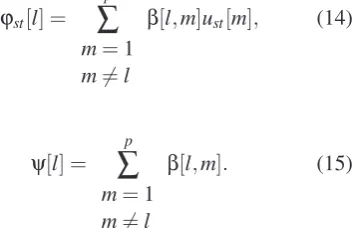
, (13) Now, we can shorten the Eq. (13) by introducing the following shorthand notation:
φst[l] = p
∑
m=1
m̸=l
β[l,m]ust[m], (14)
ψ[l] =
p
∑
m=1
m̸=l
β[l,m]. (15)
Eq. (13) is expressed in the form of the expression as shown in Eq. (16) by the constraint imposed on
the membership values∑c
i=1ui j[l] =1. c
∑
i=1λ+2di j2[l]φi j[l]
2d2
st[l](1+ψ[l])=1. (16)
Next, the Lagrange multiplier determines in the form as follows:
λ=21−
1
1+ψ[l]∑ci=1φi j[l]
∑c i=1d21
i j[l]
(1+ψ[l]). (17)
Putting this multiplier into the partition matrix for-mula as shown in Eq. (13), this gives the final ex-pression as follows:
ust[l] = φst[l]
1+ψ[l]+
1 ∑c
j=1d 2
st[l]
d2
jt[l] [
1−
c
∑
j=1φjt[l]
1+ψ[l]
]
(18) For the calculations of the prototypes the Euclidean distance is considered between the patterns and the prototypes. The necessary condition for minimizing the objective function is of the form∆v[l]Q[l] =0.
Now the objective function as shown in Eq. (19) with distance function is expressed as follow: Eq. (19).
The patterns in this expression as shown in Eq. (19) come from the l-th data set. Computing the derivative ofQ[l] with respect tovst[l] and setting it
to 0, we obtain Eq. (20).
The final expression for the prototypes after some grouping of the terms is as follows: Eq. (21)
Preprocessed collaborative fuzzy clustering partitioning is carried out through an iterative op-timization of the objective function as shown in Eq. (8) with an update of partition matrixU[l] and the prototypevi[l] as shown in Eq. (18) and (21)
∂Q¯[l]
∂ust[l]=2ust[l]d 2 st[l] +2
p
∑
m=1
m̸=l
β[l,m](ust[l]−ust[m])dst2[l]−λ=0 (12)
Q[l] =
N
∑
i=1c
∑
j=1u2i j[l] n[l]
∑
k=1(xik−vjk[l])2+ p
∑
m=1
m̸=l
β[l,m]
N
∑
i=1c
∑
j=1{ui j[l]−ui j[m]}2 n[l]
∑
k=1(xik−vjk[l])2 (19)
2.5 Procedure for PCFC
Based on the above discussions and the results, PCFC adds one more phase called phase II for map-ping procedure before collaboration process and present the refined algorithm as follows:
1. Given: subsets of patterns X1,X2, . . . ,Xp,
2. Select: distance function, number of clusters (c), termination condition, and collaboration coefficientβ[l,m],
3. Compute: initiate randomly all partition matri-ces u[1],u[2], . . .u[p]
– Phase I For each data Repeat
Compute prototype{vj[l],j=1,2, . . . ,c and
partition matrices u[l]for all subsets of
pat-terns}
Until a termination condition has been satis-fied
– Phase II Choose an approach for the pre-processing on cluster prototype and its cor-responding partition matrices to adjust row order by using(9).
– Phase III Repeat
For the matrix of collaborative linksβ[l,m]
Compute, prototype vj[l]and partition
ma-trices u[l]by using Eq.(10)and(13)
Until a termination condition has been satis-fied
Figure 5. Division of an original dataset intoN
different datasets
Figure 6. Representation ofNclasses fordataset1 anddataset2 after FCM
Figure 7. Representation ofNclasses fordataset1
anddataset2after preprocessing
∂Q¯[l]
∂ust[l]=2ust[l]d 2 st[l] +2
p
∑
m=1
m̸=l
β[l,m](ust[l]−ust[m])d2st[l]−λ=0 (12)
Q[l] =
N
∑
i=1c
∑
j=1u2i j[l] n[l]
∑
k=1(xik−vjk[l])2+ p
∑
m=1
m̸=l
β[l,m]
N
∑
i=1c
∑
j=1{ui j[l]−ui j[m]}2 n[l]
∑
k=1(xik−vjk[l])2 (19)
2.5 Procedure for PCFC
Based on the above discussions and the results, PCFC adds one more phase called phase II for map-ping procedure before collaboration process and present the refined algorithm as follows:
1. Given: subsets of patterns X1,X2, . . . ,Xp,
2. Select: distance function, number of clusters (c), termination condition, and collaboration coefficientβ[l,m],
3. Compute: initiate randomly all partition matri-ces u[1],u[2], . . .u[p]
– Phase I For each data Repeat
Compute prototype{vj[l],j=1,2, . . . ,c and
partition matrices u[l]for all subsets of
pat-terns}
Until a termination condition has been satis-fied
– Phase II Choose an approach for the pre-processing on cluster prototype and its cor-responding partition matrices to adjust row order by using(9).
– Phase III Repeat
For the matrix of collaborative linksβ[l,m]
Compute, prototype vj[l]and partition
ma-trices u[l]by using Eq.(10)and(13)
Until a termination condition has been satis-fied
Figure 5. Division of an original dataset intoN
different datasets
Figure 6. Representation ofNclasses fordataset1 anddataset2 after FCM
Figure 7. Representation ofNclasses fordataset1
anddataset2after preprocessing
Figure 5 shows a general way of dividing a huge dataset into n numbers of equal data sites. Figure 6 shows the representation of N number of
∂Q[l]
∂vst[l]=−2 N
∑
k=1u2sk[l](xkt−vst[l])−2 N
∑
k=1p
∑
m=1
m̸=l
β[l,m](usk[l]−usk[l])2(xkt−vst[l]) =0 (20)
vst[l] =
∑N
k=1u2sk[l]xkt[l] +∑p
m=1
m̸=l
β[l,m]∑Nk=1(usk[l]−usk[m])2xkt[l]
∑Nk=1u2sk[l] +∑pm=1
m̸=l
β[l,m]∑Nk=1(usk[l]−usk[m])2 (21)
(a) Clustered feature vectors ofdataset1 based on
FCM (b) Clustered feature vectors ofon FCM dataset2 based
(c) Clustered feature vectors ofdataset1 based on
FCM after mapping (d) Clustered feature vectors ofafter mapping dataset2 of FCM
Figure 9. Architecture of proposed FIS with CFCM model
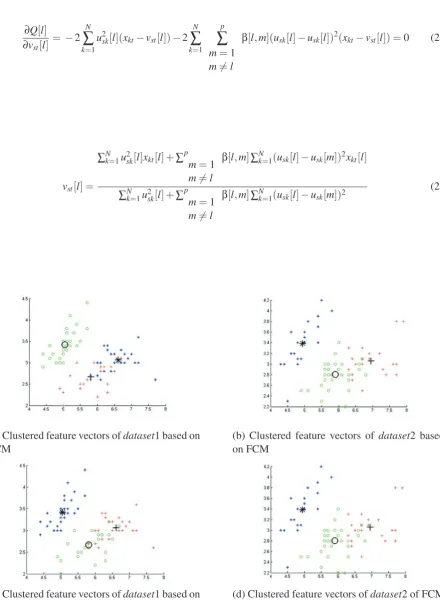
classes for two datasets: dataset1 anddataset2, af-ter FCM. Here it can easily visualize how rows pair are mismatched and the mismatch could lead the system in a different direction for analyzing the data. Figure 7 shows the correctness of N num-ber of classes matching ofdataset1 anddataset2 af-ter applying the mapping mechanism for prototypes and partition matrices. In order to verify the map-ping mechanism, the proposed method has used the paradigm of three classes, and then divided them equally into two subsets of dataset: dataset1 and
dataset2. Figures 8(a) and 8(b) are clustered fea-ture vectors ofdataset1 anddataset2, respectively. As it can be seen, in Figures 8(a) and 8(b), the first cluster (green color) ofdataset1 matches with the second cluster of dataset2, the second cluster (red color) ofdataset1 matches with the third clus-ter ofdataset2, and the third cluster (blue color) of
dataset1 matches with the first cluster ofdataset2 -which are totally mismatched with each other. Fig-ures 8(c) and 8(d) show the plotting results after the mapping mechanism, where the effect of centroid mapping for prototype and row order mapping with the partition matrix can be seen. Now, we can easily take the difference(s) between rows ofdataset1 and
dataset2, and easily do mapping between them.
Figure 9. Architecture of proposed FIS with CFCM model
classes for two datasets: dataset1 anddataset2, af-ter FCM. Here it can easily visualize how rows pair are mismatched and the mismatch could lead the system in a different direction for analyzing the data. Figure 7 shows the correctness of N num-ber of classes matching ofdataset1 anddataset2 af-ter applying the mapping mechanism for prototypes and partition matrices. In order to verify the map-ping mechanism, the proposed method has used the paradigm of three classes, and then divided them equally into two subsets of dataset: dataset1 and
dataset2. Figures 8(a) and 8(b) are clustered fea-ture vectors ofdataset1 anddataset2, respectively. As it can be seen, in Figures 8(a) and 8(b), the first cluster (green color) ofdataset1 matches with the second cluster of dataset2, the second cluster (red color) ofdataset1 matches with the third clus-ter ofdataset2, and the third cluster (blue color) of
dataset1 matches with the first cluster ofdataset2 -which are totally mismatched with each other. Fig-ures 8(c) and 8(d) show the plotting results after the mapping mechanism, where the effect of centroid mapping for prototype and row order mapping with the partition matrix can be seen. Now, we can easily take the difference(s) between rows ofdataset1 and
dataset2, and easily do mapping between them.
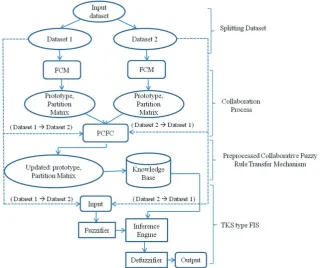
2.6 Architecture of the Proposed Model The proposed method, shown in Figure 9, com-bines the reasoning strengths of TSK type fuzzy inference system with the knowledge representa-tion ability of mapped collaborative fuzzy cluster, and gives a robust and reliable modeling system. Firstly, the given input data is divided into two or more equally sub groups of dataset, and FCM is ap-plied on each sub-groups of dataset separately to calculate prototypes and partition matrix for each dataset. Secondly, PCFC updates all partition ma-trix and prototype by collaborating each of them and gets a common feature among them, and pro-vides these features to the knowledge based sub sys-tem of fuzzy inference syssys-tem. Thirdly, the infer-ence engine uses the knowledge from the knowl-edge based sub system along with fuzzier informa-tion of given dataset. Instead of providing the en-tire data patterns, the proposed method just uses half of the data patterns for further modeling pro-cess, while other methods use the entire data pat-terns. By using just half of the data patterns, the proposed method is able to provide better or similar performance compare to methods, those use entire data patterns. The proposed method takes less com-putation time during training phase.
3 Simulation Results
This paper compares Matlab based function called Generating fuzzy inference system (Genfis2) with the proposed model in terms of RMSE values which are calculated as follows
RMSE=
√ 1
n
n
∑
i=1(yi−yˆi)2, (22)
wheren is the number of predictions,y is the true value, and y is the predicted value. The smaller RMSE is the better prediction by the proposed model.
3.1 Nonlinear Dynamics System Identifi-cation Problem-I
A nonlinear dynamics system identification problem is considered to illustrate the effect of the proposed method. The plant to be recognized is de-fined as
y(t+1) = y(t)y(t−1)[y(t) +2.5]
1+y2(t) +y2(t−1) +u(t). (23)
If a series-parallel identification model is used for recognizing the plant, the model can be defined as
ˆ
y(t+1) = f{y(t),y(t−1),u(t)}, (24)
where y(t+1) is the output and u(t)=sin(2πt/25) is the input; and this network includes three inputs and one output. The initial input values are considered as follows: y(0)=0 andy(1)=0. For each, training and testing purpose, a set of 1000 data are extracted for this system identification problem.
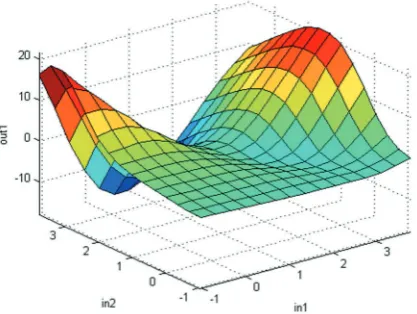
Figures 10, 11 and 12 show the output surface of given fuzzy inference system (FIS) using the first two inputs and the output of given dataset. Figure 10 shows the output surface plot of FIS of Genfis2 by using the entire data patterns. Figures 11 and 12 show the output surface plot of FIS of the pro-posed method by using just a half of the data pat-terns for each dataset. Figures 11(a) and (b) show the surface plot, when dataset1 collaborates with
dataset2 without any mapping of cluster center and with mapping of cluster center, respectively. Sim-ilarly, Figures 12 (a) and (b) show the surface plot when dataset2 collaborates with dataset1 without any mapping of cluster center and with mapping of cluster center, respectively.
3.2 Nonlinear Dynamics System
Identifi-cation Problem-II
Figure 10. Surface plot of FIS for FCM on the entire data pattern
(a) Dataset1 collaborates with dataset2 without mapping
(b)Dataset1 collaborates withdataset2 with map-ping
(a) Dataset2 collaborates with dataset1 without mapping
(b)Dataset2 collaborates withdataset1 with map-ping
Figure 12. Surface plot of FIS for CFC and PCFC forβ=0.5
The nonlinear system to be recognized is de-fined as
y(t+1) = y(t)
1+y2(t)+u
3(t), (25)
wherey(t+1) is the output andu(t) is the input sig-nal that is generated by using the sinusoidal func-tion given byu(t)=sin(2πt)/100. The inputsy(t) and
u(t) follow the uniform sample distribution in the interval [-1.5, 1.5] and [-1.0, 1.0], respectively.
For each, training and testing purpose, a set of 400 for each data patterns are generated, re-spectively. Further, training dataset is divided into two datasets: dataset1 and dataset2, those con-tain 200 patterns each. The proposed method uses the knowledge representation of 200 patterns of
dataset1/dataset2 for network training after
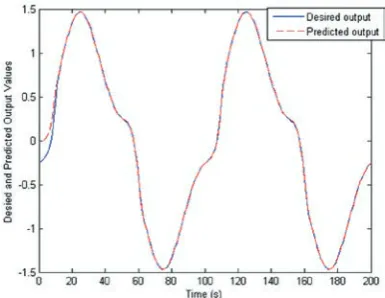
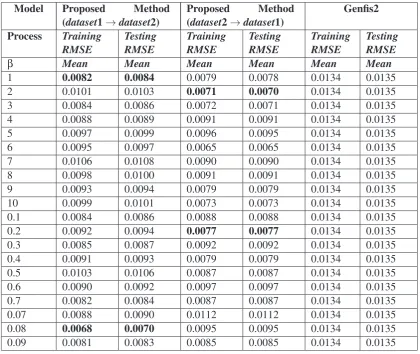
apply-ing the PCFC procedure. Table 1 shows the perfor-mance comparisons of the proposed method with different values of collaborative coefficient (β) and Matlab based Genfis2 model. Whendataset1 col-laborates with dataset2, the best average training and testing RMSE value is 0.0068 and 0.0070 for β=0.08, respectively. When dataset2 collaborates with dataset1, the best average training and test-ing RMSE value is 0.0071 and 0.0070 for β=2, respectively. While for Genfis2 model, the train-ing and testtrain-ing RMSE value is 0.0134 and 0.0135, respectively. Figures 13(a) and (b) show desired and predicted output during training and testing, re-spectively, atβ=1 whendataset1 collaborates with
dataset2. Figure 14 shows desired and predicted output during training and testing, respectively, at β=0.08 whendataset2 collaborates withdataset1.
(a) Desired and predicted outputs during training
(b) Desired and predicted outputs during testing
Figure 13. Desired and predicted outputs during training and testing atβ=1 whendataset1
(a) Dataset2 collaborates with dataset1 without mapping
(b)Dataset2 collaborates withdataset1 with map-ping
Figure 12. Surface plot of FIS for CFC and PCFC forβ=0.5
The nonlinear system to be recognized is de-fined as
y(t+1) = y(t)
1+y2(t)+u
3(t), (25)
wherey(t+1) is the output andu(t) is the input sig-nal that is generated by using the sinusoidal func-tion given byu(t)=sin(2πt)/100. The inputsy(t) and
u(t) follow the uniform sample distribution in the interval [-1.5, 1.5] and [-1.0, 1.0], respectively.
For each, training and testing purpose, a set of 400 for each data patterns are generated, re-spectively. Further, training dataset is divided into two datasets: dataset1 and dataset2, those con-tain 200 patterns each. The proposed method uses the knowledge representation of 200 patterns of
dataset1/dataset2 for network training after
apply-ing the PCFC procedure. Table 1 shows the perfor-mance comparisons of the proposed method with different values of collaborative coefficient (β) and Matlab based Genfis2 model. Whendataset1 col-laborates with dataset2, the best average training and testing RMSE value is 0.0068 and 0.0070 for β=0.08, respectively. When dataset2 collaborates with dataset1, the best average training and test-ing RMSE value is 0.0071 and 0.0070 for β=2, respectively. While for Genfis2 model, the train-ing and testtrain-ing RMSE value is 0.0134 and 0.0135, respectively. Figures 13(a) and (b) show desired and predicted output during training and testing, re-spectively, atβ=1 whendataset1 collaborates with
dataset2. Figure 14 shows desired and predicted output during training and testing, respectively, at β=0.08 whendataset2 collaborates withdataset1.
(a) Desired and predicted outputs during training
(b) Desired and predicted outputs during testing
Figure 13. Desired and predicted outputs during training and testing atβ=1 whendataset1
collaborates withdataset2
(a) Desired and predicted outputs during training (b) Desired and predicted outputs during testing
Figure 14. Desired and predicted outputs during training and testing atβ=0.08 whendataset2 collaborates withdataset1
Table 1. Training and testing RMSE of the proposed method and Genfis2
Model Proposed Method (dataset1→dataset2)
Proposed Method (dataset2→dataset1)
Genfis2
Process Training
RMSE TestingRMSE TrainingRMSE TestingRMSE TrainingRMSE TestingRMSE
β Mean Mean Mean Mean Mean Mean
1 0.0082 0.0084 0.0079 0.0078 0.0134 0.0135
2 0.0101 0.0103 0.0071 0.0070 0.0134 0.0135
3 0.0084 0.0086 0.0072 0.0071 0.0134 0.0135
4 0.0088 0.0089 0.0091 0.0091 0.0134 0.0135
5 0.0097 0.0099 0.0096 0.0095 0.0134 0.0135
6 0.0095 0.0097 0.0065 0.0065 0.0134 0.0135
7 0.0106 0.0108 0.0090 0.0090 0.0134 0.0135
8 0.0098 0.0100 0.0091 0.0091 0.0134 0.0135
9 0.0093 0.0094 0.0079 0.0079 0.0134 0.0135
10 0.0099 0.0101 0.0073 0.0073 0.0134 0.0135
0.1 0.0084 0.0086 0.0088 0.0088 0.0134 0.0135
0.2 0.0092 0.0094 0.0077 0.0077 0.0134 0.0135
0.3 0.0085 0.0087 0.0092 0.0092 0.0134 0.0135
0.4 0.0091 0.0093 0.0079 0.0079 0.0134 0.0135
0.5 0.0103 0.0106 0.0087 0.0087 0.0134 0.0135
0.6 0.0090 0.0092 0.0097 0.0097 0.0134 0.0135
0.7 0.0082 0.0084 0.0087 0.0087 0.0134 0.0135
0.07 0.0088 0.0090 0.0112 0.0112 0.0134 0.0135
0.08 0.0068 0.0070 0.0095 0.0095 0.0134 0.0135
4 Conclusions
In this paper, we proposed a new modeling strategy for a TSK type fuzzy inference system based on collaborative fuzzy rule learning with the cluster center mapping technique. The proposed method helps system modeling to find an accurate model based on given input information by using knowledge representation of PCFC. The proposed method is able to provide better or similar perfor-mance while using just half of the given data pat-terns for training and keeping the lower computa-tion time. For future work, we want to extend our work and compare with some other existing model-ing systems with real world datasets and apply this model to deal with big data issue.
Acknowledgment
The authors would like to acknowledge the funding supported in part by Ministry of Science and Technology, R.O.C. under two Grant numbers: NSC102-2622-e-009-002-cc2 and MOST104-2218-e-009-003.
References
[1] E. H. Mamdani and S. Assilian, An experiment in linguistic synthesis with a fuzzy logic controller, In-ternational Journal of Man-machine Studies, vol. 7, pp. 1-13, 1975.
[2] T. Takagi and M. Sugeno, Fuzzy identification of systems and its applications to modeling and con-trol, IEEE Transaction on System, Man, and Cyber-netic, vol. 15, pp. 116-132, 1985.
[3] L. Rutkowski and K. Cpaka, Designing and learning of adjustable quasi-triangular norms with applica-tions to neuro-fuzzy systems, IEEE Transaction on Fuzzy Systems, vol. 13, no. 1, pp. 140-151, 2005.
[4] L. Rutkowski and K. Cpaka, Flexible neuro-fuzzy systems, IEEE Transaction on Neural Networks, vol. 14, no. 3, pp. 554-574, 2003.
[5] J. C. Bezdek, Pattern recognition with fuzzy objec-tive function algorithms, Plenum Press, New York, 1981.
[6] J. C. Bezdek, R. Ehrlich, and W. Full, FCM: the fuzzy C-means clustering algorithm, Computers and Geosciences, vol. 10, no. 2-3, pp. 191-203, 1984.
[7] W. Pedrycz, Knowledge-based clustering: from data to information granules, A John Wiley & Sons, Inc., Publication, 2005.
[8] W. Pedrycz, Collaborative fuzzy clustering, Pattern Recognition Letters, vol. 23, no. 14, pp. 1675-1686, 2002.
[9] W. Pedrycz and P. Rai, Collaborative Fuzzy Cluster-ing with the use of Fuzzy C-Means and its Quantifi-cation, Fuzzy Sets and System, vol. 159, no. 18, pp. 2399-2427, 2008.
[10] C. T. Lin, M. Prasad, and J. Y Chang, Designing Mamdani Type Fuzzy Rule Using a Collaborative FCM Scheme, International Conference on Fuzzy Theory and Its Application, 2013.
[11] http://www.mathworks.com/help/fuzzy/genfis2.html
[12] R. Babuska, Fuzzy Modeling for Control, Norwell, MA: Kluwer, 1998.
[13] J. C. Dunn, A fuzzy relative of the ISODATA pro-cess and its use in detecting compact well separated clusters, Journal of Cybernetics, vol. 3, pp. 32-57, 1973.
[14] F. Hoppner, F. Klawonn, R. Kruse, and T. Runkler, Fuzzy Cluster Analysis: Methods for Classification. Data Analysis and Image Recognition, New York: Wiley, 1999.
[15] E. R. Hruschka, R. J. G. B. Campello, A. A. Fre-itas, and A. C. P. L. F. de Carvalho, A survey of evolutionary algorithms for clustering, IEEE Trans-action on System Man Cybernetics- part-c, vol. 39, no. 2, pp. 133-155, 2009.
[16] R. Xu and D. Wunsch, Survey of clustering algo-rithms, IEEE Transaction on Neural Networks, vol. 16, no. 3, pp. 645-678, 2005.
[17] R. R. Yager and D. P. Filev, Approximate cluster-ing via the mountain method, IEEE Transaction on System, Man, Cybernetics, vol. 24, no. 8, pp. 1279-1284,1994.
[18] P. R. Kersten, Implementation issues in the fuzzy c-medians clustering algorithm, In Proceeding 6th IEEE International Conference on Fuzzy Systems, vol. 2, pp. 957-962, 1997.
[19] J. F. Kolen and T. Hutcheson, Reducing the time complexity of the fuzzy c-means algorithm, IEEE Transaction on Fuzzy Systems, vol. 10, no. 2, pp. 263-267, 2002.
4 Conclusions
In this paper, we proposed a new modeling strategy for a TSK type fuzzy inference system based on collaborative fuzzy rule learning with the cluster center mapping technique. The proposed method helps system modeling to find an accurate model based on given input information by using knowledge representation of PCFC. The proposed method is able to provide better or similar perfor-mance while using just half of the given data pat-terns for training and keeping the lower computa-tion time. For future work, we want to extend our work and compare with some other existing model-ing systems with real world datasets and apply this model to deal with big data issue.
Acknowledgment
The authors would like to acknowledge the funding supported in part by Ministry of Science and Technology, R.O.C. under two Grant numbers: NSC102-2622-e-009-002-cc2 and MOST104-2218-e-009-003.
References
[1] E. H. Mamdani and S. Assilian, An experiment in linguistic synthesis with a fuzzy logic controller, In-ternational Journal of Man-machine Studies, vol. 7, pp. 1-13, 1975.
[2] T. Takagi and M. Sugeno, Fuzzy identification of systems and its applications to modeling and con-trol, IEEE Transaction on System, Man, and Cyber-netic, vol. 15, pp. 116-132, 1985.
[3] L. Rutkowski and K. Cpaka, Designing and learning of adjustable quasi-triangular norms with applica-tions to neuro-fuzzy systems, IEEE Transaction on Fuzzy Systems, vol. 13, no. 1, pp. 140-151, 2005.
[4] L. Rutkowski and K. Cpaka, Flexible neuro-fuzzy systems, IEEE Transaction on Neural Networks, vol. 14, no. 3, pp. 554-574, 2003.
[5] J. C. Bezdek, Pattern recognition with fuzzy objec-tive function algorithms, Plenum Press, New York, 1981.
[6] J. C. Bezdek, R. Ehrlich, and W. Full, FCM: the fuzzy C-means clustering algorithm, Computers and Geosciences, vol. 10, no. 2-3, pp. 191-203, 1984.
[7] W. Pedrycz, Knowledge-based clustering: from data to information granules, A John Wiley & Sons, Inc., Publication, 2005.
[8] W. Pedrycz, Collaborative fuzzy clustering, Pattern Recognition Letters, vol. 23, no. 14, pp. 1675-1686, 2002.
[9] W. Pedrycz and P. Rai, Collaborative Fuzzy Cluster-ing with the use of Fuzzy C-Means and its Quantifi-cation, Fuzzy Sets and System, vol. 159, no. 18, pp. 2399-2427, 2008.
[10] C. T. Lin, M. Prasad, and J. Y Chang, Designing Mamdani Type Fuzzy Rule Using a Collaborative FCM Scheme, International Conference on Fuzzy Theory and Its Application, 2013.
[11] http://www.mathworks.com/help/fuzzy/genfis2.html
[12] R. Babuska, Fuzzy Modeling for Control, Norwell, MA: Kluwer, 1998.
[13] J. C. Dunn, A fuzzy relative of the ISODATA pro-cess and its use in detecting compact well separated clusters, Journal of Cybernetics, vol. 3, pp. 32-57, 1973.
[14] F. Hoppner, F. Klawonn, R. Kruse, and T. Runkler, Fuzzy Cluster Analysis: Methods for Classification. Data Analysis and Image Recognition, New York: Wiley, 1999.
[15] E. R. Hruschka, R. J. G. B. Campello, A. A. Fre-itas, and A. C. P. L. F. de Carvalho, A survey of evolutionary algorithms for clustering, IEEE Trans-action on System Man Cybernetics- part-c, vol. 39, no. 2, pp. 133-155, 2009.
[16] R. Xu and D. Wunsch, Survey of clustering algo-rithms, IEEE Transaction on Neural Networks, vol. 16, no. 3, pp. 645-678, 2005.
[17] R. R. Yager and D. P. Filev, Approximate cluster-ing via the mountain method, IEEE Transaction on System, Man, Cybernetics, vol. 24, no. 8, pp. 1279-1284,1994.
[18] P. R. Kersten, Implementation issues in the fuzzy c-medians clustering algorithm, In Proceeding 6th IEEE International Conference on Fuzzy Systems, vol. 2, pp. 957-962, 1997.
[19] J. F. Kolen and T. Hutcheson, Reducing the time complexity of the fuzzy c-means algorithm, IEEE Transaction on Fuzzy Systems, vol. 10, no. 2, pp. 263-267, 2002.
[20] M. Sugeno and G. T. Kang, Structure identification of fuzzy model, Fuzzy Sets Systems, vol. 28, no. 1, pp. 15-33, 1988.
[21] C. W. Ting and C. Quek, A Novel Blood Glu-cose Regulation Using - TSK FCMAC: A Fuzzy CMAC Based on the Zero-Ordered TSK Fuzzy In-ference Scheme, IEEE Transaction on Neural Net-works, vol. 20, no. 5, pp. 856-871, 2009.
[22] J. R. Castro, O. Castillo, P. Melin, and A. Rodrguez-Daz, A hybrid learning algorithm for a class of interval type-2 fuzzy neural networks, In-formation Science, vol. 179, no. 13, pp. 2175-2193, 2009.
[23] H. Song, C. Miao, Z. Shen, Y. Miao, and B. S. Lee, A fuzzy neural network with fuzzy impact grades, Neurocomputing, vol. 72, no. 13-15, pp. 3098-3122, 2009.
[24] D. Kim and C. Kim, Forecasting time series with genetic fuzzy predictor ensembles, IEEE Transac-tion on Fuzzy Systems, vol. 5, no. 4, pp. 523-535, 1997.
[25] M. Prasad, C. T. Lin, C. T. Yang and A. Saxena, Vertical Collaborative Fuzzy C-Means for Multiple
EEG Data Sets, Springer Lecture Notes in Computer Science, vol. 8102, pp. 246-257, 2013.
[26] R. N. Dave, and K. Bhaswan, Adaptive fuzzy c-shells clustering and detection of ellipses, IEEE Transaction on Neural Networks, vol. 3, no. 5, pp. 643-662, 1992.
[27] Y. Man, and I. Gath, Detection and separation of ring-shaped clusters using fuzzy clustering, IEEE Transaction on Pattern Analysis and Machine Intel-ligence, vol. 16, no. 8, pp. 855-861, 1994.
[28] R. Krishnapuram, O. Nasraoui, and J. Keller, The fuzzy c spherical shells algorithm: a new approach, IEEE Transaction on Neural Networks, vol. 3, no. 5, pp. 663–671, 1992.
[29] M. Prasad, D. L. Li, Y. T. Liu, L. Siana, C. T. Lin, and A. Saxena, A Preprocessed Induced Par-tition Matrix Based Collaborative Fuzzy Clustering for Data Analysis, IEEE International Conference of Fuzzy Systems, pp. 1553-1558, 2014.
Mukesh Prasad received his Ph.D. degree in computer science from Na-tional Chiao Tung University, Hsinchu, Taiwan in 2015 and master degree in computer application from Jawaharlal Nehru University, New Delhi, India, in 2009. He is currently associated with National Chiao Tung University, Hsinchu, Taiwan as Post-Doctoral Researcher. His current research interests include machine learning, pattern recognition, fuzzy systems, neural networks and Wireless Sensor Networks. Dr. Mukesh has published pa-pers in international journal and conferences including IEEE Transactions, ACM, Elsevier and Springer.
Yu-Ting Liu received the B.S. degree in Department of Electrical and Con-trol Engineering from National Chiao-Tung University, Hsinchu, Taiwan, in 2010. He is currently pursuing the Ph.D. degree with the Institute of Elec-trical and Control Engineering, Na-tional Chiao Tung University, Hsinchu, Taiwan. His current research interests include fuzzy logic theory, machine learning, computer vi-sion, EEG analysis and application.
Dong-Lin Li received his Ph.D. de-gree in electrical engineering from National Chiao Tung University, Hsin-chu, Taiwan in 2013 and master degree in electrical engineering from National Chung Hsing University, Taichung, Taiwan, in 2006. He is currently as-sociated with National Chiao Tung University, Hsinchu, Taiwan as Post-Doctoral Researcher. His current research interests include
machine learning, fuzzy systems, neural networks and image processing and smart living technology. Dr. Li has published papers in international journal and conferences including IEEE Transactions, ACM, Elsevier and Springer.
Dr. Chin-Teng Lin received the B.S. degree from National Chiao-Tung University (NCTU), Taiwan in 1986, and the Master and Ph.D. degree in electrical engineering from Purdue University, USA in 1989 and 1992, respectively. He is currently the Chair Professor of Faculty of Engineering and Information Technology, Uni-versity of Technology Sydney, Chair Professor of Electrical and Computer Engineering, NCTU, International Faculty of University of California at San-Diego (UCSD), and Honor-ary Professorship of University of Nottingham. Dr. Lin was elevated to be an IEEE Fellow for his contributions to biologi-cally inspired information systems in 2005, and was elevated International Fuzzy Systems Association (IFSA) Fellow in 2012. He is elected as the Editor-in-chief of IEEE Transac-tions on Fuzzy Systems since 2011. He also served on the Board of Governors at IEEE Circuits and Systems (CAS) So-ciety in 2005-2008, IEEE Systems, Man, Cybernetics (SMC) Society in 2003-2005, IEEE Computational Intelligence So-ciety (CIS) in 2008-2010, and Chair of IEEE Taipei Section in 2009-2010. He served as the Deputy Editor-in-Chief of IEEE Transactions on Circuits and Systems-II in 2006-2008. Dr. Lin is the coauthor of Neural Fuzzy Systems (Prentice-Hall), and the author of Neural Fuzzy Control Systems with
Rajiv Ratn Shah received the M.Tech. degree in computer technology and Applications from Department of Computer Science, Delhi Technolgical University, Delhi, India in 2010. Since January 2012 he is currently work-ing towards the PhD. degree from the School of Computing, National Uni-versity of Singapore, Singapore. He worked as a Research Intern at the National Institute of In-formatics, Japan, from November, 2015 to April, 2016. His research interests include the multimodal analysis of user-generated content in the support of social media applications.
Omprakash Kaiwartya received Ph.D., M.Tech degrees in computer science from School of Computer and Systems Sciences, Jawaharlal Nehru University, New Delhi, India in 2015 and 2012 respectively. He is currently working as Post-Doctoral Fellow in Pervasive Computing Re-search Group, Faculty of Computing, Universiti Teknologi Malaysia (UTM), Johor Bahru, Ma-laysia. He served as area chair (Asia) in ICSNCS-2016. He is the reviewer of many reputed journals of communication
field including IEEE sensors, IET Intelligent Transportation
System, Adhoc Networks, etc. His research interests include Vehicular Ad-hoc Networks, Mobile Ad-hoc Networks and Wireless Sensor Networks. He is currently working in next generation vehicular networks known as `Internet of Vehi-cles (IoV)’. Dr. Omprakash has published papers in reputed International Journals indexed in SCI and Conferences with publishers including ACM, IEEE, Springer, MDPI, KIIS, In-derScience and Hindawi.
4 Conclusions
In this paper, we proposed a new modeling strategy for a TSK type fuzzy inference system based on collaborative fuzzy rule learning with the cluster center mapping technique. The proposed method helps system modeling to find an accurate model based on given input information by using knowledge representation of PCFC. The proposed method is able to provide better or similar perfor-mance while using just half of the given data pat-terns for training and keeping the lower computa-tion time. For future work, we want to extend our work and compare with some other existing model-ing systems with real world datasets and apply this model to deal with big data issue.
Acknowledgment
The authors would like to acknowledge the funding supported in part by Ministry of Science and Technology, R.O.C. under two Grant numbers: NSC102-2622-e-009-002-cc2 and MOST104-2218-e-009-003.
References
[1] E. H. Mamdani and S. Assilian, An experiment in linguistic synthesis with a fuzzy logic controller, In-ternational Journal of Man-machine Studies, vol. 7, pp. 1-13, 1975.
[2] T. Takagi and M. Sugeno, Fuzzy identification of systems and its applications to modeling and con-trol, IEEE Transaction on System, Man, and Cyber-netic, vol. 15, pp. 116-132, 1985.
[3] L. Rutkowski and K. Cpaka, Designing and learning of adjustable quasi-triangular norms with applica-tions to neuro-fuzzy systems, IEEE Transaction on Fuzzy Systems, vol. 13, no. 1, pp. 140-151, 2005.
[4] L. Rutkowski and K. Cpaka, Flexible neuro-fuzzy systems, IEEE Transaction on Neural Networks, vol. 14, no. 3, pp. 554-574, 2003.
[5] J. C. Bezdek, Pattern recognition with fuzzy objec-tive function algorithms, Plenum Press, New York, 1981.
[6] J. C. Bezdek, R. Ehrlich, and W. Full, FCM: the fuzzy C-means clustering algorithm, Computers and Geosciences, vol. 10, no. 2-3, pp. 191-203, 1984.
[7] W. Pedrycz, Knowledge-based clustering: from data to information granules, A John Wiley & Sons, Inc., Publication, 2005.
[8] W. Pedrycz, Collaborative fuzzy clustering, Pattern Recognition Letters, vol. 23, no. 14, pp. 1675-1686, 2002.
[9] W. Pedrycz and P. Rai, Collaborative Fuzzy Cluster-ing with the use of Fuzzy C-Means and its Quantifi-cation, Fuzzy Sets and System, vol. 159, no. 18, pp. 2399-2427, 2008.
[10] C. T. Lin, M. Prasad, and J. Y Chang, Designing Mamdani Type Fuzzy Rule Using a Collaborative FCM Scheme, International Conference on Fuzzy Theory and Its Application, 2013.
[11] http://www.mathworks.com/help/fuzzy/genfis2.html
[12] R. Babuska, Fuzzy Modeling for Control, Norwell, MA: Kluwer, 1998.
[13] J. C. Dunn, A fuzzy relative of the ISODATA pro-cess and its use in detecting compact well separated clusters, Journal of Cybernetics, vol. 3, pp. 32-57, 1973.
[14] F. Hoppner, F. Klawonn, R. Kruse, and T. Runkler, Fuzzy Cluster Analysis: Methods for Classification. Data Analysis and Image Recognition, New York: Wiley, 1999.
[15] E. R. Hruschka, R. J. G. B. Campello, A. A. Fre-itas, and A. C. P. L. F. de Carvalho, A survey of evolutionary algorithms for clustering, IEEE Trans-action on System Man Cybernetics- part-c, vol. 39, no. 2, pp. 133-155, 2009.
[16] R. Xu and D. Wunsch, Survey of clustering algo-rithms, IEEE Transaction on Neural Networks, vol. 16, no. 3, pp. 645-678, 2005.
[17] R. R. Yager and D. P. Filev, Approximate cluster-ing via the mountain method, IEEE Transaction on System, Man, Cybernetics, vol. 24, no. 8, pp. 1279-1284,1994.
[18] P. R. Kersten, Implementation issues in the fuzzy c-medians clustering algorithm, In Proceeding 6th IEEE International Conference on Fuzzy Systems, vol. 2, pp. 957-962, 1997.
[19] J. F. Kolen and T. Hutcheson, Reducing the time complexity of the fuzzy c-means algorithm, IEEE Transaction on Fuzzy Systems, vol. 10, no. 2, pp. 263-267, 2002.