ISSN: 1992-8645 www.jatit.org E-ISSN: 1817-3195
CUSTOMER KNOWLEDGE MANAGEMENT IN SOFTWARE
DEVELOPMENT: A DESCRIPTIVE FIELD SURVEY
1
ARASH KHOSRAVI, 2AB RAZAK CHE HUSSIN, 3BEHROUZ MINAEI-BIDGOLI
1,2
Faculty of Computing, Universiti Teknologi Malaysia, Skudai, 81310 Johor Bahru, Malaysia
3
Department of Computer Engineering, Iran University of Science and Technology, Tehran, Iran
E-mail: [email protected], [email protected], [email protected]
ABSTRACT
Customer Knowledge (CK) plays an important role in the production of high quality and innovative software products. However, there has been little comprehensive academic research on the ‘enablers’ of customer-specific knowledge. Therefore, study aims to analyze Customer Knowledge Management (CKM) ‘enablers’ for enterprise software development companies. Survey questionnaires were distributed to software companies and results showed that most firms focus their efforts more on ‘Technological Infrastructure’ and less on ‘Human’ and ‘Organizational’ CKM enablers. Results demonstrated low positive percent ratings for ‘Human Antecedents’ (Individual Competences & Skills) and ‘Organizational’ enablers (‘Customer Involvement’, CKM ‘Strategy Development’ and ‘Training’). This study contributes to the CKM domain by revealing essential elements that better enable enterprise software development firms to enhance software quality and produce innovative products. The author recommends that software companies place greater emphasis on ‘Human’ and ‘Organizational’ enablers for the successful implementation of CKM strategies.
Keywords: Customer Engagement, Customer Knowledge Management (CKM), CKM Challenges, Software Quality, Software Innovation, Enterprise Software Development
1. INTRODUCTION
Of necessity, the design and development of innovative, high quality Enterprise Software (ES) requires sufficient Customer Knowledge (CK). The lack of customer-centric strategies is problematic as it negatively affects a software development company’s support structure for end users that might otherwise share their experience with the company. Software products of numerous types have increased sharply along with competition among software companies. Moreover, user expectations have also increased along with demands for high quality and customized products. In addition, users prefer and expect to pay premiums for higher quality. Hence, the priority that commands a competitive advantage has also changed from cost to quality. To achieve higher quality, software developers must acquire and use knowledge regarding customer needs or otherwise risk software failures because they do not satisfy end users [1]. Furthermore, it is simply not enough to identify customers in terms of interests, future needs or behavior analysis regarding software use [2]. This is because, over the course of time, the
industry has acknowledged that the creation of successful innovation requires a synthesis of knowledge from various perspectives. Hence, CK has become an indispensable component for emerging product innovation [3, 4].
Developing countries are still in the initial stages of software development maturation and the rate of software project failure is high [5]. Hence, the author undertook a study to detect the key challenges for CKM enhancement with a view for the development of high quality innovative software products. The writer distributed a survey questionnaire to software companies for the purpose of analyzing matters that affect CKM enablers and processes.
ISSN: 1992-8645 www.jatit.org E-ISSN: 1817-3195
2. LITERATURE REVIEW
2.1 Customer Knowledge Management
Customer data comprises facts about consumers, both within an organization’s database and in the minds of its employees. Such data generally comprises customer contacts, interactions, feedback and complaints [6-8]. Data is considered ‘processed data’ when it is meaningfully purposed to inform us of something useful to decision making [9, 10]. When customer information is processed and disseminated within an organization it becomes customer knowledge (CK). CK can be explicitly structured information contained in databases or tacit CK that is held within the employee mindset of an organization, secondary to observations and interpretations of customer interactions [8]. In 2002, Gebert’s group classified CK into three types from an organizational perspective, namely, ‘knowledge about customers’, ‘knowledge for customers’, and ‘knowledge from customers’. Smith and McKeen [11] offered a fourth classifier, which they termed ‘co-created knowledge’. All four CK types are gathered via cooperative interactions between an organization and its customers. Customer Knowledge Management (CKM) combines Knowledge Management (KM) with the principles of Customer Relationship Management (CRM) [2]. Therefore, CKM concerns gathering, sharing and expanding knowledge that inherently dwells with product consumers/users and employees of the corporate entity. Consequently, CKM can be described as an ongoing process of generating, disseminating and using CK within an organization, as well as between an organization and its customers [12].
2.2 CKM Challenges
Developing a reliable CKM system involves several challenges. These obstacles include the lack of employee skills and competences to absorb and apply CK; the lack of an efficient reward system to motivate employees and customers to share knowledge; the lack of CRM technology infrastructure to facilitate obtaining and storing CK; and the lack of a collaborative system that can share/disseminate CK throughout an organization [13-15]. Thus, a supportive CKM infrastructure is essential to an organization’s overall business management strategy [2, 11]. Attafar, et al. [14] noted that inter-departmental conflicts also presented a significant barrier to CKM fluidity, especially as
cross-functional cooperation is crucial for optimal CKM. Consequently, organizations have been advised to develop channels that enable two-way communication systems, not only with customers but also between departments to foster cross-functional knowledge-sharing among employees [16].
Other challenges facing CKM are cultural and organizational. This is because many companies are internally focused and fail to study their clients [14, 17]. Companies so disposed typically perceive customers almost solely as a source of revenue rather than knowledge. According to Skotis, et al. [18], the lack of proper CKM motivation is a critical barrier because knowledge management is a human based activity. As such, individual motivators play an important role in the gathering and sharing of both explicit and tacit knowledge between customers and employees, as well as between employees. CKM motivators include the identification of incentives and customer rights. From a company’s perspective, firms should therefore develop capacities that help to better identify, absorb, share and deploy valuable customer knowledge [19]. Lorenzo-Romero, et al. [20] mentioned four benefits that motivate customer knowledge creation and sharing, namely: (1) learning benefits related to the acquisition of knowledge to gain understanding of the environment; (2) social integrative benefits that intensify consumer ties with relevant persons and groups; (3) personal integrative benefits that strengthen customer status and self-confidence; and (4) hedonic benefits that enhance aesthetic and pleasurable experiences [20]. Hence, acknowledging the key characteristics of these challenges helps us to identify vital elements that facilitate the development of reliable and sustainable CKM systems [15, 21].
2.3 CKM Theoretical Foundation
ISSN: 1992-8645 www.jatit.org E-ISSN: 1817-3195 require the collection, analysis, and integration of
new knowledge within the organization as well as from external sources (customers, competitors, suppliers, etc.) [23].
Mature CKM therefore represents knowledge-based capabilities that are rooted in the Knowledge-based View (KBV) as an extension of the Resource-Based View (RBV). Most prior CKM researchers have used KBV as their root theory in CKM studies [16, 24]. According to the RBV, firms are perceived as ‘‘bundles of resources’’ defined as either tangible or intangible assets that are tied to a firm in a relatively permanent fashion (Liao et al. 2009). The KBV focuses on a firm’s intangible resources while emphasizing their sustainability as a competitive advantage, which then allows for continual renewal, reconfiguration and redeployment of these same resources. In fact, prior research demonstrates that the development of better goods and services is supplemented by CKM capabilities out of necessity [25].
The KBV enables us to expect that the deployment of human, organizational and technological capabilities will improve knowledge management processes while also enhancing product and service effectiveness [23]. Its proponents argue that products and services produced by tangible resources depend on how
they are combined and applied, which is a function of the firm’s know-how. This ‘know-how’ is embedded in and carried through individual employees as well as entities such as organizational culture and identity, routines, policies, systems and documents as well as CRM technology [26]. Therefore, Human factors such as employee motivation and skills, and organizational factors such as culture and structure plus technological factors such as CRM infrastructure, altogether enable and influence CKM within an organization [27].
Lin [28] proposed a general framework for knowledge management processes that are supported by KBV (See: Figure. 1). This framework involves three aspects: ‘enablers’, ‘processes’ and ‘outcomes’ and which arrange enablers according to three categories: ‘Human’, ‘Organizational’ and ‘Technology’. Lin’s ‘enablers’ facilitate the development of individual, organizational and technological KM capabilities within an organization [28, 29]. Lin’s ‘processes’ concern collecting, sharing and applying experience, expertise, know-how and contextual information within an organization. Lin’s “outcomes” expose consequent levels of a company’s performance that depend on effective KM with respect to management performance, innovation capabilities, as well as product and service quality [28, 29].
Figure.1: General Framework for Knowledge Management Processes [28].
Salojärvi, et al. [30] followed this general framework to propose a model for CKM. Other scholars recognized that ‘human’, ‘organizational’, and ‘technological’ factors affect CKM activities differently [28, 30-32]. Orlikowski [33] proposed a theory of human-organization-technology interactions, noting that people develop the technology used by organizations whereby interactions and appropriate attributes of all three entities identify conditions that facilitate CKM[34]. Van Den Brink [35] proposed a ‘knowledge transfer’ model based on Orlikowski [33] ‘Theory of Technology’ by which he also arranged standards vis-à-vis people, organization and technology.
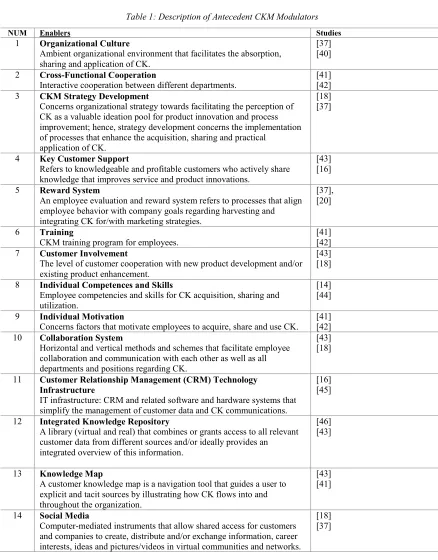
Regarding the ‘human’ dimension, scholars agree that CKM depends on characteristic human skills, experience, motivation, values and beliefs [14, 22, 32, 36]. Moreover, within the organizational domain, ambient venues should generally facilitate an efficient, innovative and supportive culture [32]. In the CKM context, different aspects of an organization’s environment also encompass critical drivers. These include ‘Cross-Functional Cooperation’ [37]; ‘reward systems’ [38]; and ‘top management support’ [39]. As for the ‘technology’ dimension, ICT can effectively facilitate CKM codification, integration, and dissemination [6, 37]. Table 1 lists CKM ‘enablers’ utilized in the present study. Table 2 defines the CKM process.
ENABLERS
DIMENSION
PROCESSES
DIMENSION
OUTCOMES
ISSN: 1992-8645 www.jatit.org E-ISSN: 1817-3195
Table 1: Description of Antecedent CKM Modulators
NUM Enablers Studies
1 Organizational Culture
Ambient organizational environment that facilitates the absorption, sharing and application of CK.
[37] [40]
2 Cross-Functional Cooperation
Interactive cooperation between different departments.
[41] [42]
3 CKM Strategy Development
Concerns organizational strategy towards facilitating the perception of CK as a valuable ideation pool for product innovation and process improvement; hence, strategy development concerns the implementation of processes that enhance the acquisition, sharing and practical
application of CK.
[18] [37]
4 Key Customer Support
Refers to knowledgeable and profitable customers who actively share knowledge that improves service and product innovations.
[43] [16]
5 Reward System
An employee evaluation and reward system refers to processes that align employee behavior with company goals regarding harvesting and integrating CK for/with marketing strategies.
[37], [20]
6 Training
CKM training program for employees.
[41] [42]
7 Customer Involvement
The level of customer cooperation with new product development and/or existing product enhancement.
[43] [18]
8 Individual Competences and Skills
Employee competencies and skills for CK acquisition, sharing and utilization.
[14] [44]
9 Individual Motivation
Concerns factors that motivate employees to acquire, share and use CK. [41] [42]
10 Collaboration System
Horizontal and vertical methods and schemes that facilitate employee collaboration and communication with each other as well as all departments and positions regarding CK.
[43] [18]
11 Customer Relationship Management (CRM) Technology
Infrastructure
IT infrastructure: CRM and related software and hardware systems that simplify the management of customer data and CK communications.
[16] [45]
12 Integrated Knowledge Repository
A library (virtual and real) that combines or grants access to all relevant customer data from different sources and/or ideally provides an integrated overview of this information.
[46] [43]
13 Knowledge Map
A customer knowledge map is a navigation tool that guides a user to explicit and tacit sources by illustrating how CK flows into and throughout the organization.
[43] [41]
14 Social Media
Computer-mediated instruments that allow shared access for customers and companies to create, distribute and/or exchange information, career interests, ideas and pictures/videos in virtual communities and networks.
ISSN: 1992-8645 www.jatit.org E-ISSN: 1817-3195
Table 2: Description of CKM Processes
NUM Processes Studies
1 Customer Knowledge Absorption
How CK is obtained from customers about and for customers
[47] [48]
2 Customer Knowledge Sharing
How CK is distributed throughout a company via different channels between individuals, groups and/or organizations.
[49]
3 Customer Knowledge Utilization
The capability of an organization to use extant knowledge ‘about’, ‘from’ and ‘for’ the customer to enhance the quality of customer relations, product innovation and customer service.
[39]
4 Customer Knowledge Discovery
The process of obtaining and/or creating new knowledge from existing CK by using text and data mining techniques.
[50]
2.4 Enterprise Software and CKM
The enterprise software (ES) market has unique characteristics that set it apart from other software markets such as personal software or traditional product markets. First off, the sales of enterprise systems include products and associated services. Product sales have always included licenses for installation, utilization and services that include customization, enhancements, maintenance (repair and updates) and training. Vendors sell, license and service these products and the combination is often inseparable. Many manufacturers/retailers for PCs and televisions, for example, also provide/sell warranty services with their products and customers usually have the option to buy extended warranties at costs much lower than that of the product. However, in the case of enterprise systems, pricing for services, including customization and maintenance, can be ‘higher than’ or at the same level of user licensing. Moreover, the value of such software products can only be realized when customers purchase access to both.
Secondly, ES installation and customization commonly needs an extended period of time before customers can fully assess the quality of a product’s premium features. Customers can generally realize the full quality of personal software such as Microsoft Office immediately after purchasing the software, since such programs do not require customization before user experience. However, enterprise systems need considerable time for installation and customization before client use. Depending on the degree of customization and size of adoption, this can actually take up to a few years.
Thirdly, two kinds of IT systems’ costs confront firms: (1) the cost of developing the
software and (2) the cost of providing services including customization and maintenance. ES comprises both; especially since software development costs affect the pricing of secondary components. If ES developer companies substantially invest in the development of packaged software, the quality of enterprise software would rise continually since better product quality reduces the cost of service delivery. For example, as flexibility, scalability and capability of the software increases, it costs less to customize an enterprise system to meet customer needs. Hence, in the enterprise software context, the provision of high quality software and service is vital for both customer and venders. In addition, software quality is not only important for the client adopter but also impacts the vendor's pricing of service provision. Therefore, the quality of a vendor's ES decision-making bears considerable financial impact on both vendor and client. This reality motivates vendors to enhance software product quality.
ISSN: 1992-8645 www.jatit.org E-ISSN: 1817-3195 reflect client “needs and demands” [53].
Al-Busaidi [54] reported that the acquisition of customer knowledge is positively linked to product performance. Therefore, the present study focused on ‘human’, ‘organizational’ and ‘technology’ CKM barriers and deficiencies that negatively affect the development of ES quality in Iranian software companies. The next section discusses this paper’s data collection methodology.
3. DATA COLLECTION AND ANALYSIS
This particular analysis of ‘Human’, ‘Organizational’ and ‘Technology’ CKM barriers
and deficiencies required familiarity with software companies within the scope of study. Tehran’s Computer Trade Organization is responsible for the validation of a firm’s hardware and software capabilities and grants licenses to companies working in this domain under the auspice of the Supreme Council of Informatics (SCI). SCI is a high-level government body that monitors and ranks all active companies in the Iranian informatics sector. Their latest available statistics (2012) listed 1,598 ICT companies as registered and active in ten major categories (See: Table 3). Each category has subcategories (for example, software has fifteen subcategories (See: Table 4)
Table 3: Major ICT Categories and Companies in Iran [55]
Row Category
1 Hardware Produce and service PC & Laptop Hardware 2 Software Develop and provide software & software solutions
3 Network Design and implement any type of network (LAN, WAN, etc.) 4 Internet ISP, ISDP, PAP, SAP Data centers, Domain & Hosting 5 Data Mining Data Processing
6 Multimedia Multimedia Learning software, Games, Websites, Business Catalogs 7 E-business E-payment, E-shops, E-advertising, Social Media
8 Education & Research E-learning 9 Counseling and
Supervision
Counseling, Supervision and Education Services for hardware & software
10 Security Security for networks, websites & software
Table 4: Subcategories for Software [55].
Row Sub Category Name Number of companies
1 Implementing and providing software solutions 82
2 Banking and insurance software 7
3 Finance and accounting software 36
4 E-Health software 3
5 Industry-specific software 16
6 Communications software and mobile software 15 7 Software for location and transport 10
8 Operating systems, databases 17
9 Support Software 66
10 Software for official automation 45 11 Software for design and engineering 6
12 Portal and Content Management 59
13 Software for production control & industrial maintenance
13
14 Enterprise Resource Planning 22
15 Security Software 31
SCI’s rankings are critical to the selection of optimally qualified bidders and developers for government projects. SCI evaluates and scores companies annually according to types of informatics activities. It then ranks them based on these scores and publishes their results through an online portal. They calculate these
scores based on three indicators: ‘human resources’, ‘annual revenue’ (preceding two years), and ‘customer satisfaction’ [56].
ISSN: 1992-8645 www.jatit.org E-ISSN: 1817-3195 necessitated a “Yes” or “No” answer. For the
present work, enablers were categorized as ‘Human’, ‘Organizational’ and ‘Technological’. Moreover, CKM processes were classified as ‘absorption’, ‘sharing’, ‘applying’ and ‘discovery’. Descriptors of CKM ‘enablers’ and ‘processes’ are listed in Tables 1 and 2. We distributed the survey questionnaire to ES development companies that presented their products at the International Exhibition of Electronic Computers and IT (ELECOMP 2014) in Tehran — a sizeable ICT annual exhibition. This event showcases electronics and software
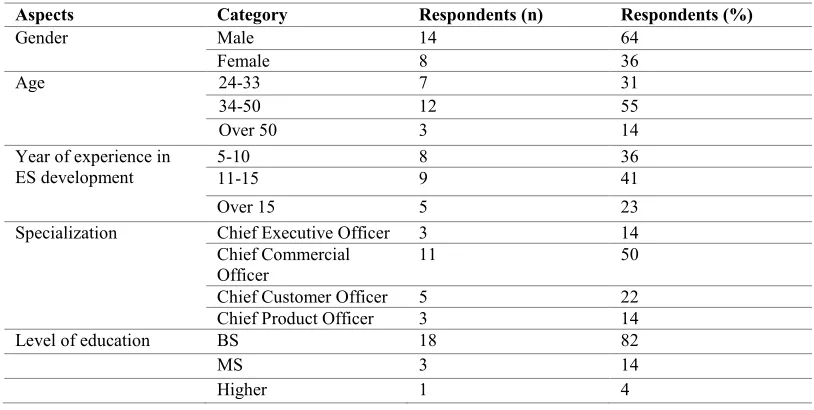
product manufacturers and retailers along with related services companies, all of which are related to the Computer Hardware & Software industry. Fifty-one ES development companies were at the exhibition. We distributed our questionnaire to each firm and subsequently collected twenty-two (43%) validated responses. Table 5 provides respondent demographic profiles, which illustrates that all respondents had >5 years of experience working in the field of software development in Iran.
Table 5: Respondent Demographic Profiles
Aspects Category Respondents (n) Respondents (%)
Gender Male 14 64
Female 8 36
Age 24-33 7 31
34-50 12 55
Over 50 3 14
Year of experience in ES development
5-10 8 36
11-15 9 41
Over 15 5 23
Specialization Chief Executive Officer 3 14
Chief Commercial Officer
11 50
Chief Customer Officer 5 22
Chief Product Officer 3 14
Level of education BS 18 82
MS 3 14
Higher 1 4
Survey results are summarized in Table 6, which shows categories, subjects and related questions and answers with metrics for each item as percent positive answers (“Yes”). Only 31% of firms had provided CKM training for their employees. Only 9% agreed that their professionals were familiar with CKM. Only 4% used social networks to exchange customer views with their companies. Only 4% employed data mining techniques for customer knowledge discovery. While 63% of respondents used CRM systems, 69% had no solutions/guidelines for gathering CK, and only 36% had solutions/guidelines for CK utilization in the
enhancement of quality outcomes for their products and services. While 59% admitted to considering customer views and opinions in the development of new products or the enhancement of existing products, 61% confessed that their software production processes were ‘product-centric’ rather than ‘customer-centric’. Furthermore, the rate of CK absorption and application (CKM) in ES was low. Only 27% of the surveyed ES development companies had a CKM strategy to increase production efficiency and provide better service to their customers.
Table 6: ELECOMP 2014 Questionnaire Results
Row Category Title Question Percent
Positive
1 Enablers (Human) Training Are your employees trained to obtain knowledge about customers?
31
2 Enablers (Human) Individual competences and skills
Do your employees have the skills required to work with CRM and use it to
ISSN: 1992-8645 www.jatit.org E-ISSN: 1817-3195 manage and integrate customer
information? 3 Enablers (Human) Individual competences
and skills
Are your company professionals familiar with types of CK and ways of acquiring and using CK?
9
4 Enablers (Human) Individual Motivation Have your employees easily shared knowledge gained from customers?
45
5 Enablers (Human) Individual Motivation Do you think your employees are motivated enough to obtain CK and use it to improve their own work?
27
6 Enablers (Organizational)
CKM Strategy development
Is a customer knowledge management strategy used in your company to increase production efficiency and provide better service to your customers?
27
7 Enablers (Organizational)
Cross-functional cooperation for CKM integration
Is CK in various sectors (marketing, sales, service, manufacturing, finance and administration) used to increase quality for internal company processes as well as for products and services?
31
8 Enablers (Organizational)
Customer Involvement Do you always meet with customers to talk about their interests, problems and needs during the software development process?
47
9 Enablers (Organizational)
Customer Involvement Do marketing personnel in your firm occasionally invite prospective customers to discuss their needs?
32
10 Enablers (Organizational)
Key Customer Management
Does your company identify and engage special customers with sufficient knowledge in product
development/production or to propose new ideas?
68
11 Enablers (Organizational)
Key Customer Management
Does your company support active customer involvement to eliminate product defects and/or in the production of new products?
54
12 Enablers (Organizational)
Organizational Culture Does your company use customer-centric strategies when producing new products?
39
13 Enablers (Organizational)
Organizational Culture Do your company executives believe that the promotion of existing products and production of new products should involve not only the knowledge from internal specialists but also the knowledge of customers?
66
14 Enablers (Organizational)
Reward System Is your system of employee evaluation and appreciation connected to the acquisition of client knowledge and its potential use to increase work efficiency in your company?
22
15 Enablers (Technological)
CRM Technology Infrastructure
Do you use a CRM system in your company?
63
16 Enablers (Technological)
Knowledge Map Does your company use a Knowledge Map to manage customer knowledge?
9
17 Enablers (Technological)
Knowledge Map Does your company have a list of qualified experts (Directory) that readily identifies experts in each specialty?
59
18 Enablers (Technological)
Collaboration System Does your company have a collaboration system for the sharing of customer knowledge within the firm?
47
19 Enablers (Technological)
Integrated knowledge Repository
Does your company use a central database to store customer transactions and customer information?
63
ISSN: 1992-8645 www.jatit.org E-ISSN: 1817-3195 (Technological) exchange of customer views and opinions
about your products and services on social networks?
21 Enablers (Technological)
Social Media Does your company use social networking such as Facebook to provide additional information about goods and services for your customers?
18
22 Process CK Absorption Capability (knowledge about and from customers)
Does your company have
solutions/guidelines for the gathering of CK?
31
23 Process CK Absorption Capability (knowledge about customers)
Does your company collect information about customers as well as customer comments and suggestions in their profiles?
27
24 Process CK Absorption Capability (knowledge about customers)
Can your customers log in to their profiles on the company’s website and edit their contact information and other related data?
13
25 Process CK Sharing
Capability (knowledge for customers)
Does your company have a website strategy to provide full product information to customers?
77
26 Process CK Sharing
Capability
Is customer information readily available to staff when they need it?
54
27 Process CK Sharing
Capability
Does your company forward relevant customer comments to the production and/or service sections?
54
28 Process Customer Knowledge Discovery
Does your company use data mining and text mining to process customer feedback and purchase transactions?
4
29 Process CK Applying
Capability
Does your company have
solutions/guidelines regarding how to use CK to increase the quality of your products and services?
36
30 Process CK Applying
Capability
Does your firm consider the views and opinions of you customers in the development of new products or in the enhancement of existing products?
59
Figure 2 shows ‘mean positive percent’ for all answers to ‘enabler’ items and demonstrates that ‘CRM Technology Infrastructure’ and ‘Integrated Knowledge Repository’ scored the highest positive percent answers, and that ‘Social Media’ along with ‘Individual Competences and Skills’ scored the lowest
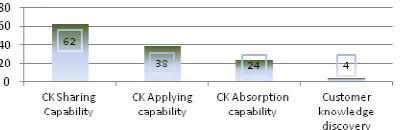
ISSN: 1992-8645 www.jatit.org E-ISSN: 1817-3195 Figure 3 illustrates ‘mean positive percent’
answers for CKM processes. Here, ‘CK Sharing Capability’ was highest while ‘CK Absorption Capability’ and ‘Customer Knowledge Discovery’ were the least positive. Therefore, we advise that vendors pay more attention to enhancing schemes for CK ‘Absorption Capability’ and ‘Discovery’ in their CKM programs.
Figure 3: Mean Positive Percent Responses For CKM Processes.
4. DISCUSSION
For purpose of this study we distributed survey questionnaires to ES development companies with a view to discover deficiencies and needs for specific CKM ‘enablers’ and ‘processes’ that enhance software and service quality as CKM outcomes. Some results concurred with previous studies while overall findings will help shape and expand CKM research for enterprise software development companies. Regarding technological infrastructure modulators, ‘CRM Technology Infrastructure’ and ‘Integrated Knowledge Repository’ scored highest among the cited enablers, indicating that a majority considered technological infrastructure more than other factors. Respondents admitted to paying less attention to human factors such as ‘Individual Competences and Skills’ and ‘Individual Motivation’. Organizational factors such as ‘Customer-Centric Culture’, ‘Customer Involvement’, ‘Cross-Functional Cooperation’, ‘CKM Strategy development’ and ‘Training’ all require more attention as indicated by this study’ results, and these are in addition to technological factors such as ‘Collaboration System’, ‘Knowledge Map’ and ‘Social Media’. These same results align with a study by Attafar, et al. [14] who investigated important CKM barriers in the manufacture of polymeric pipe in Isfahan-Iran. The reported barriers included an absence of complementary CKM skills as well as inter-departmental conflicts and a lack of cultural preparedness.
Human factors that modulate CKM such as ‘Individual Competences and Skills’ and ‘Individual Motivation’ in software companies require a development plan. People are the heart of
all knowledge management systems since individuals are responsible for the creation and sharing of knowledge. Therefore, employees require sufficient skills to successfully manage knowledge. Organizational enablers such as reward systems and training certainly encourage individuals to share and apply CK. Khodakarami and Chan [37] and Skotis, et al. [18] noted that appropriate training is needed to assure that employees acquire appropriate IT skills and expertise to effectively absorb, share and utilize CK. Triki and Zouaoui [57] reported a need for three types of customer knowledge competencies for successful CKM: customer knowledge acquisition skills, customer knowledge sharing skills, and customer knowledge use skills.
Our results also demonstrated that ‘Customer Involvement’ was a weak process in software development, even though we know that customer involvement affords valuable practical insight. Scholars have discussed four types of customer involvement in an organization [58]:
1. As an information source: employees gather information from customers and apply the information to develop products that meet customer needs;
2. As co-developers: where they help develop products with employees;
3. As innovators: where customers design their own products, which are then adopted and offered by the firm;
4. As users: who test and evaluate products and services.
ISSN: 1992-8645 www.jatit.org E-ISSN: 1817-3195 perspective [37] by infusing business processes and
routines with systematic CKM strategies that exploit the superb potential of their clientele.
With regard to CKM processes, the pooling of CK by direct absorption from customers or by knowledge discovery techniques in software companies is generally reported as weak. This indicates that the ‘CK application’ domain in support of enhanced software quality and innovation are also at low ebb, while it nonetheless appears that ‘CK sharing’ enjoys a better state. These results concur with a recent study indicating that one of the most important challenges to CKM is a lack of organizational CK ‘Absorptive Capacity’ [18]. That customers provide a very important source of knowledge is now a given [22] and that CK is mostly tacit [22] and procedural; thus providing “a recipe for action”. Tacit knowledge is far more difficult to codify and articulate in written form than explicit knowledge; consequently, it is also more difficult to transfer and reproduce. This type of knowledge is rooted and anchored in a social context [59], which is intimately attached to the ‘personal experience of the knowledge possessor’, which tremendously complicates formalization and communication processes. The transfer of tacit knowledge requires intense social interactions, observations and experience [22].
Prior CKM studies noted that most firms do not have or employ systematic processes for the management and utilization of CK [39, 47]. Moreover, CK regularly disintegrates across multiple departments and systems, and companies find it difficult to integrate CK with consistent customer profiles [39]. Despite the widespread adoption of CRM systems, studies consistently and strongly suggest that firms seem to lack the ability to absorb and classify CK with a view to enhance product and service quality as well as product innovation [30].
5. CONCLUSION
CK plays a fundaments role in the development of innovative products as well as improved product and service quality [2]. This study investigated industry players to discover deficiencies and needs regarding specific enabling factors that enhance CKM processes in the software industry. Our results reveal that 63% of the enterprise software development companies surveyed were using CRM systems. However, their majority embraced considerations for ‘Technological Infrastructure’ far more than ‘Human’ and ‘Organizational’ CKM
enablers. Furthermore, ‘Human Antecedent’ (‘Individual Competences and Skills’, ‘Individual Motivation’) and ‘Organizational’ factors (‘Customer-Centric Culture’, ‘Customer Involvement’, ‘Cross-Functional Cooperation’, ‘CKM Strategy development’ and ‘Training’) also scored lower positive percentages. Moreover, 69% of the firms surveyed had no solutions/guidelines for the harvesting of customer knowledge, while only 36% held solutions/guidelines for CK use to increase the quality of their products and services. Only 59% of our respondents considered the views and opinions of customers in the development of new products or enhancement of existing products. At the present writing it appears that, overall, CK absorption and application by software industries remains wanting. Our results demonstrate that CKM absorption and utilization require far more investment in extant CRM systems. Efficient CKM requires coordinating instruments such as collaboration systems and Cross-Functional Cooperation as well as CKM Strategy Development. In addition, top management must express an integral commitment to such programs; thus signaling to employees its high regard for CKM’s importance. Managers should therefore prepare themselves to ready available resources that appropriately establish organizational structures and systems that overtly support CKM. They are advised to allocate sufficient resources to institute customer-specific teams within their firms. With this in mind, our findings can aid the design of customer-specific strategies as well as sales processes and changes in product and service planning.
To the best of our knowledge, this is one of the first studies to attempt an analysis of CKM deficiencies and requirements based on empirical quantitative data in the domain of Iranian software firms. We hope researchers will use these results to further explore CKM enablers and outcomes. The author suggests that future studies are directed towards relationships between CKM enablers and organizational performance.
REFRENCES:
[1] G. Kannabiran and K. Sankaran, "Determinants of software quality in offshore development–An empirical study of an Indian vendor,"
Information and Software Technology, vol. 53,
ISSN: 1992-8645 www.jatit.org E-ISSN: 1817-3195 [2] A.-M. Aho and L. Uden, "Customer knowledge
in value creation for software engineering process," in 7th International Conference on Knowledge Management in Organizations:
Service and Cloud Computing, 2013, pp.
141-152.
[3] S. Zogaj and U. Bretschneider, "Customer Integration in New Product Development-A Literature Review Concerning The Appropriateness of Different Customer Integration Methods to Attain Customer Knowledge," 2012.
[4] A. Khosravi, "A Review of Customer Knowledge Management Importance," Journal of Soft Computing and Decision Support
Systems, vol. 1, pp. 45-52, 2014.
[5] h. rahgoshay, "challenges and problems of Information technology In Iran," rahavardNoor, vol. 1, pp. 40-45, 2010.
[6] M. Rollins and A. Halinen, "Customer knowledge management competence: towards a theoretical framework," in System Sciences, 2005. HICSS'05. Proceedings of the 38th
Annual Hawaii International Conference on,
2005, pp. 240a-240a.
[7] M. Garcia-Murillo and H. Annabi, "Customer knowledge management," Journal of the
Operational Research Society, pp. 875-884,
2002.
[8] H. Gebert, M. Geib, L. Kolbe, and G. Riempp, "Towards customer knowledge management: Integrating customer relationship management and knowledge management concepts," in The Second International Conference on Electronic
Business (ICEB 2002), 2002, pp. 296-298.
[9] C. J. Stefanou, C. Sarmaniotis, and A. Stafyla, "CRM and customer-centric knowledge management: an empirical research," Business
Process Management Journal, vol. 9, pp.
617-634, 2003.
[10] J. Rowley, "Eight questions for customer knowledge management in e-business," Journal
of knowledge management, vol. 6, pp. 500-511,
2002.
[11] H. A. Smith and J. D. McKeen, "Developments in practice XVIII-customer knowledge management: adding value for our customers,"
Communications of the Association for
Information Systems, vol. 16, p. 36, 2005.
[12] T. Sofianti, K. Suryadi, R. Govindaraju, and B. Prihartono, "Customer Knowledge Co-creation Process in New Product Development," in Proceedings of the World Congress on
Engineering, 2010.
[13] H. Salojärvi and L.-M. Sainio, "CRM Technology and KAM Performance : The Mediating Effect of Key Account-Related Knowledge," Journal of Business Marketing
Management, vol. 8, pp. 435-454, 2015.
[14] A. Attafar, M. Sadidi, H. Attafar, and A. Shahin, "The Role of Customer Knowledge
Management (CKM) in Improving
Organization-Customer Relationship,"
Middle-East Journal of Scientific Research, vol. 13, pp.
829-835, 2013.
[15] A. Khosravi, "Customer Knowledge Management: Development Stages and Challenges," Journal of Theoretical & Applied
Information Technology, vol. 91, 2016.
[16] A. Garrido-Moreno, N. Lockett, and V. García-Morales, "Paving the way for CRM success: The mediating role of knowledge management and organizational commitment," Information & Management, 2014.
[17] M. Gibbert, M. Leibold, and G. Probst, "Five styles of customer knowledge management, and how smart companies use them to create value,"
European Management Journal, vol. 20, pp.
459-469, 2002.
[18] A. Skotis, I. Katsanakis, A. Macris, and M. Sfakianakis, "Creating Knowledge within a C-Business Context: A Customer Knowledge Management View," in Collaborative, Trusted
and Privacy-Aware e/m-Services, ed: Springer,
2013, pp. 264-277.
[19] J. Peng, A. Lawrence, and T. Koo, "Customer knowledge management in international project: a case study," Journal of Technology
Management in China, vol. 4, pp. 145-157,
2009.
[20] C. Lorenzo-Romero, E. Constantinides, and L. A. Brünink, "Co-creation: Customer Integration in Social Media Based Product and Service Development," Procedia - Social and
Behavioral Sciences, vol. 148, pp. 383-396,
2014.
[21] S. Vaezitehrani, "Customer Knowledge Management in Global Software Projects,"
Master, NORTHUMBRIA UNIVERSITY,
Gothenburg, Sweden, 2013.
[22] H. Nagati and C. Rebolledo, "The role of relative absorptive capacity in improving suppliers' operational performance,"
International Journal of Operations &
Production Management, vol. 32, pp. 611-630,
ISSN: 1992-8645 www.jatit.org E-ISSN: 1817-3195 [23] S. S. Durmuşoǧlu and G. Barczak, "The use of
information technology tools in new product development phases: Analysis of effects on new product innovativeness, quality, and market performance," Industrial Marketing
Management, vol. 40, pp. 321-330, 2011.
[24] A. Garrido-Moreno and A. Padilla-Meléndez, "Analyzing the impact of knowledge management on CRM success: The mediating effects of organizational factors," International
Journal of Information Management, vol. 31,
pp. 437-444, 2011.
[25] W. Belkahla and A. Triki, "Customer knowledge enabled innovation capability: proposing a measurement scale," Journal of
Knowledge Management, vol. 15, pp. 648-674,
2011.
[26] I. Nonaka, G. Von Krogh, and S. Voelpel, "Organizational knowledge creation theory:
Evolutionary paths and future advances,"
Organization studies, vol. 27, pp. 1179-1208,
2006.
[27] S. M. Hammami and A. Triki, "Exploring the information technology contribution to service recovery performance through knowledge based resources," Vine, vol. 41, pp. 296-314, 2011. [28] H.-F. Lin, "Knowledge sharing and firm
innovation capability: an empirical study,"
International Journal of manpower, vol. 28, pp.
315-332, 2007.
[29] A. Khosravi, M. A. B. Ismail, and M. Najaftorkaman, "A Taxonomy Of Knowledge Management Outcomes For SMEs,",
Communications of the Association for
Information Systems, 2014.
[30] H. Salojärvi, S. Saarenketo, and K. Puumalainen, "How customer knowledge dissemination links to KAM," Journal of
Business & Industrial Marketing, vol. 28, pp.
383-395, 2013.
[31] P. Feher and A. Gabor, "The role of knowledge management supporters in software development companies," Software Process:
Improvement and Practice, vol. 11, pp.
251-260, 2006.
[32] A. Khosravi, "Using Knowledge Management to Improve Customer Relationship Management: A Systematic Literature Review,"
Journal of Soft Computing and Decision
Support Systems, vol. 3, pp. 36-43, 2015.
[33] W. J. Orlikowski, "The duality of technology: Rethinking the concept of technology in organizations," Organization science, vol. 3, pp. 398-427, 1992.
[34] A. Khosravi and M. N. Ahmad, "Examining antecedents of knowledge-sharing factors on research supervision: An empirical study,"
Education and Information Technologies, pp.
1-31, 2014.
[35] P. Van Den Brink, "Measurement of conditions for Knowledge Sharing," in Proceedings 2 nd
European Conference on Knowledge
Management, Bled, 2001.
[36] M. Al-Shammari and I. Global, Customer knowledge management: People, processes, and technology: Information Science Reference
Hershey, 2009.
[37] F. Khodakarami and Y. E. Chan, "Exploring the role of customer relationship management (CRM) systems in customer knowledge creation," Information & Management, vol. 51, pp. 27-42, 2014.
[38] A. Garrido-Moreno, N. Lockett, and V. García-Morales, "Paving the way for CRM success: The mediating role of knowledge management and organizational commitment," Information &
Management, vol. 51, pp. 1031-1042, 2014.
[39] H. Salojärvi, L.-M. Sainio, and A. Tarkiainen, "Organizational factors enhancing customer knowledge utilization in the management of key account relationships," Industrial Marketing
Management, vol. 39, pp. 1395-1402, 2010.
[40] S. Tseng, "The effect of knowledge management capability and customer knowledge gaps on corporate performance,"
Journal of Enterprise Information Management,
vol. 29, 2016.
[41] A. N. Talet, "KM Process and CRM to manage
Customer Knowledge Relationship
Management," International Proceedings of Economics Development & Research IPEDR,
vol. 29, pp. 60-67, 2012.
[42] C.-J. Shieh, "Study on the relations among the customer knowledge management, learning organization, and organizational performance,"
The Service Industries Journal, vol. 31, pp.
791-807, 2011.
[43] S. Mukherji, "A framework for managing customer knowledge in retail industry," IIMB
Management Review, vol. 24, pp. 95-103, 2012.
[44] J. Wu, B. Guo, and Y. Shi, "Customer knowledge management and IT-enabled business model innovation: A conceptual framework and a case study from China,"
European Management Journal, vol. 31, pp.
ISSN: 1992-8645 www.jatit.org E-ISSN: 1817-3195 [45] S.-M. Tseng and P.-H. Wu, "The impact of
customer knowledge and customer relationship management on service quality," International
Journal of Quality and Service Sciences, vol. 6,
pp. 77-96, 2014.
[46] A. J. Campbell, "Creating customer knowledge competence: managing customer relationship management programs strategically," Industrial
Marketing Management, vol. 32, pp. 375-383,
2003.
[47] T. H. Davenport, J. G. Harris, and A. K. Kohli, "How do they know their customers so well?,"
MIT Sloan Management Review, vol. 42, pp.
63-73, 2001.
[48] M. Xu and J. Walton, "Gaining customer knowledge through analytical CRM," Industrial
management & data systems, vol. 105, pp.
955-971, 2005.
[49] L.-R. Yang, C.-F. Huang, and T.-J. Hsu, "Knowledge leadership to improve project and organizational performance," International
Journal of Project Management, vol. 32, pp.
40-53, 2014.
[50] Y.-H. Chen and C.-T. Su, "A Kano-CKM model for customer knowledge discovery," Total
Quality Management & Business Excellence,
vol. 17, pp. 589-608, 2006.
[51] N. A. Prabhu, R. Latha, K. Sankaran, and G. Kannabiran, "Impact of knowledge management on offshore software development: An exploratory study," in Advanced Computing (ICoAC), 2011 Third International Conference
on, 2011, pp. 121-128.
[52] M. Dous, H. Salomann, L. Kolbe, and W. Brenner, "Knowledge Management Capabilities in CRM: Making Knowledge For, From, and About Customers Work," AMCIS 2005 Proceedings, p. 33, 2005.
[53] H. Nejatian, I. Sentosa, S. K. Piaralal, and A. M. Bohari, "The influence of customer knowledge on CRM performance of Malaysian ICT companies: a structural equation modeling approach," International Journal of Business
and Management, vol. 6, p. p181, 2011.
[54] K. A. Al-Busaidi, "Empowering Organizations through Customer Knowledge Acquisition: A
pilot investigation," 2013.
[55] computer-trade-organization. (2012). Main category of ICT companies in Iran. Available: http://www.irannsr.org/web_directory/774-.html?iwd_id=591
[56] S. K. Bagheri and E. Casprini, "Intellectual Property Paradoxes in Developing Countries: The Case of Software IP Protection in Iran,"
Journal of Intellectual Property Rights, vol. 19,
pp. 33-42, 2014.
[57] A. Triki and F. Zouaoui, "Customer Knowledge Management Competencies Role in the CRM Implementation Project," Journal of
Organizational Knowledge Management, 2011.
[58] A. S. Cui and F. Wu, "Utilizing customer knowledge in innovation: antecedents and impact of customer involvement on new product performance," Journal of the Academy of
Marketing Science, 2015.
[59] I. Nonaka and H. Takeuchi, The knowledge-creating company: How Japanese companies create the dynamics of innovation: Oxford
![Table 3: Major ICT Categories and Companies in Iran [55]](https://thumb-us.123doks.com/thumbv2/123dok_us/1289905.1161524/6.612.86.522.280.627/table-major-ict-categories-companies-iran.webp)