FEATURE BASE FUSION FOR SPLICING FORGERY DETECTION BASED ON NEURO FUZZY
HABIB GHAFFARI HADIGHEH
FEATURE BASE FUSION FOR SPLICING FORGERY DETECTION BASED ON NEURO FUZZY
HABIB GHAFFARI HADIGHEH
A dissertation submitted in partial fulfilment of the requirements for the award of the degree of
Master of Science (Computer Science)
Faculty of Computing Universiti Teknologi Malaysia
iii
iv
ACKNOWLEDGEMENT
A major research project like this is never the work of anyone alone. The contributions of many different people, in their different ways, have made this possible. I would like to extend my appreciation especially to the following.
All Praise For Allah, Creator Of This Universe Thanks For The Precious Iman & Islam You Blessed On Me Thanks For All The Strength And Knowledge You Granted On Me And Also Peace Be Upon The Holy Prophet Muhammad.
Prof. Dr. Ghazali Bin Sulong, for making this research possible. His support, guidance, advice throughout the research project are greatly appreciated. Indeed, without his guidance, I would not be able to put the topic together. Thanks Prof.
In particular, I would like to thank my father, Prof. Dr. Alireza Ghaffari, for his unconditional support, both financially and emotionally throw my master. His contribution and advices in the process of doing this project is undeniable.
Of course, this project would not have been possible without the participation of the subjects.
v
ABSTRACT
vi
ABSTRAK
vii
TABLE OF CONTENTS
CHAPTER TITLE PAGE
DECLARATION ii
DEDICATION iii
ACKNOWLEDGEMENT iv
ABSTRACT v
ABSTRAK vi
TABLE OF CONTENTS vii
LIST OF TABLES x
LIST OF FIGURES xi
LIST OF ABBREVIATIONS xiii
LIST OF APPENDICES xv
1 INTRODUCTION
1.1 Introduction 1
1.2 Problem Background 4
1.3 Problem Statement 7
1.4 Objectives 8
1.5 Project Scope 8
1.6 Significance of Project 9
1.7 Dissertation Organization 9
2 LITERATURE REVIEW
2.1 Introduction 11
2.2 Different Color Spaces 11
2.3 Different Image Formats 14
2.4 How Digital Cameras Work? 15
2.4.1 ColorFilterArrayInterpolation 18 2.4.2 StandardJointPhotographicExperts
viii
2.5 Different Image Forgery Types 21
2.6 Different Forgery Detection Techniques 22
2.6.1 Active Forgery Detection 22
2.6.1.1 Passive Forgery Detection 23 2.6.2 Splicing Detection Techniques 24 2.6.3 Splicing Detection Features 25
2.7 Fuzzy Logic 30
2.7.1 Fuzzy Sets 31
2.7.2 Fuzzy Logic Operations 32
2.7.3 Linguistic variables and hedges 33
2.8 Neural Network 35
2.9 Neuro Fuzzy 37
2.9.1 Fuzzy Neurons 38
2.9.2 Neuro Fuzzy Learning 43
2.9.3 Input Space Partitioning 47
2.10 Forgery detection based on fusion 48
2.11 Summary 49
3 RESEARCH METHODOLOGY
3.1 Introduction 51
3.2 Research Framework and Processes 51
3.2.1 Problem Formulation 53
3.2.2 53
3.2.3 54
55 56 57 LiteratureReview
Pre-Preparation
3.2.3.1 BenchmarkImageDataset 3.2.3.2 Readingtheimages
3.2.3.3 FeatureExtraction
3.2.3.4 BoostingFeatureSelection
63 3.2.3.5 SupportVector Machine
65 3.2.3.6 TrainingandTesting
67 3.2.4 Fusionofforgerydetectiontools 68
3.2.4.1 Converting Decision
ix
3.2.7.1 Sensitivity and specificity 72 74
3.3 75
3.4
3.2.7.2 AreaUnderROCCurve ImplementationTools
Summary 76
4 EXPERIMENTAL RESULTS AND DISCUSSION
4.1 Introduction 77
4.2 Pre-Preparation Results 77
4.2.1 DiscreteWaveletTransformCBTFE
featureextraction 78
4.2.2 Edge Image based feature extraction 81 4.2.3 N-RunLengthfeatureextraction 86
4.2.4 Discussion on the results 92
4.3 Fusion of forgery detection tools 93
4.3.1 ConvertingDecisionValueto
1SPCBCJMJUZResults 93
4.3.2 FusionbasedonNeuro-Fuzzy
*OGFSFODFSystem(NFIS)results 96
4.3.3 Discussion on the results 100
4.4 Comparisons and Evaluation 101
4.5 Discussion 102
5 CONCLUSION
5.1 Introduction 104
5.2 Dissertation Summary 104
5.3 Dissertation Contribution 105
5.4 Feature Works 106
REFERENCES
x
LIST OF TABLES
TABLE NO. TITLE PAGE
2.1 21 2.2 26 2.3 27 2.4 33 2.5 33 2.6 39 2.7 40 2.8 46 3.1 75 3.2 75 4.1 81 4.2 83 4.3 86 4.4 91 4.5 91 4.6 100
Differentimageforgerytypes
List of splicing forgery detection algorithms
Listofsplicingdetectionalgorithms ListofFuzzyLogicOperations ListofrulesapplicableforFuzzysets DifferentkindsofFuzzyneurons OutputofFuzzyLogicsystem
ListoftrainingmethodsforNeuro-Fuzzysystems ListoftheusedHardware
ListofSoftwares
DWTForgeryDetectionResults.
SampleofafeaturevectorgeneratedusingGrayLevel
EdgeBasedForgeryDetectionResults.
SampleoffeaturesvectorforN-RunLengthforgery
N-RunLengthbasedforgerydetectiontoolresults EvaluationResultsbasedonNFISfusion
CBTFEPOJMMVNJOBUJPOBOBMZTJT
$PPDDVSSFODF.BUSJYBOE#'4CZFMFNFOUMFOHUI
xi
LIST OF FIGURES
FIGURE NO. TITLE PAGE
1.1 3 1.2 5 2.1 12 2.2 13 2.3 13 2.4 16 2.5 17 2.6 17 2.7 19 2.8 20 2.9 30 2.10 35 2.11 41 3.1 52 3.2 55 3.3 55 3.4 56 3.5 58 3.6 59 3.7 61 3.8 64 3.9 67 3.10 69 3.11 71 3.12 74 :FMMPX $.:DPMPSTQBDFT BDRVJTJUJPOQJQFMJOF DPNQSFTTJPOQSPDFTTJOHTUFQT BSDIJUFDUVSFGPS4VHFOPTSFBTPOJOHNFUIPE Sampleofanimageforgery
StepsofImageSplicing LituratureReview
StandardRed,Green,Blue(RGB)andCyan,Magenta,
Hue,Saturation,Value(HSV)colorspace
Initialoptical-pathblockdiagramforadigitalcamera Single-sensoroptical-pathblockPGdigitalcamera Aschematicviewofastandarddigitalimage
ApopularCFA
StandardDiscreteCosineTransform(DCT)-Based
FuzzyLogicdiagramsdemonstration BasicNeuralNetworkSystem
Adaptive-Network-basedFuzzyInferenceSystem
ResearchFramework Pre-PreparationFramework
Sampleofimagesplicingforgeryevaluationdataset Processofimagesplicing
DWTbasedfeatureextractionpipeline PredictionContext
EdgeImagebasedfeatureextractionpipeline Run-Lengthbasedfeatureextractionpipeline Processoftraining/testingforSVM
Sampleofsigmoidalbasefunctioncurve ANFIStraining/testingprocess
xii 4.1 79 4.2 80 4.3 82 4.4 84 4.5 85 4.6 87 4.7 89 4.8 90 4.9 91 4.10 94 4.11 95 4.12 96 4.13 97 4.14 98 4.15 98 4.16 99 4.17 101 4.18 102 'PSHFSZ%FUFDUJPO5PPM #BTFE'PSHFSZ%FUFDUJPO5PPM HFOFSBUJOHBO'V[[Z*OGFSFODF4ZTUFN '*4TZTUFN SampleofthePredictionandtheErrorImages Samplesofthesubbandscalculatedforanimage ROCplotsoftheresultsprovidedbyDWTbased
SampleofedgeimagescalculatedforanOriginalimage SampleofEdgeimagesforaforgedImage
ROCplotsoftheresultsobtainedbyEdgeImage
Run-LengthHistogram(RLH)sandDiscreteFourier
RLHsandDFTcalculatedforaforgedimage. ROCcurvesofN-RunLengthresults
SigmoidfunctionsforRun1 SigmoidfunctionplotsforRun1
SigmoidfunctionsforN-RunLengthbasedforgery
Sample of distribution of input/output pairs for
GridpartitioningGraphicalUserInterface(GUI) for
StructureofinitialFIS.
SampleofanANFIStrainingprocess ComparisoninTermsofSensitivity ComparisoninTermsofSpecificity
7UDQVIRUP')7FDOFXODWHGIRUDQRULJLQDOLPDJH
EFUFDUJPOUPPMQMPUUFEGPSEJGGFSFOU3VOT
xiii
LIST OF ABBREVIATIONS
ANFIS – Adaptive-Network-based Fuzzy Inference System
AUC – Area Under Curve
AI – Artificial Intelligent
BFS – Boosting Feature Selection
BACM – Blocking Artifact Characteristics Matrix
CCD – Charged Coupled Device
CMY – Cyan,Magenta,Yellow
CF – Characteristic function
CFA – Color Filter Array
DCT – Discrete Cosine Transform
DIF – Detect Image Forgery
DFT – Discrete Fourier Transform DWT – Discrete Wavelet Transform FIS – Fuzzy Inference System
FS – Feature Selection
GPS – Geographical Positioning System GLCM – Gray Level Co-occurrence Matrix GUI – Graphical User Interface
HHT – Hilbert-Hang Transform
HSV – Hue,Saturation,Value
HSB – Hue,Saturation,Brightness
IQM – Image Quality Metrics
JPEG – Joint Photographic Experts Group
LZW – Lempel-Ziv-Welch
LDA – Linear Discriminant Analysis
MBDCT – Multi-size Block Discrete Cosine Transform
MF – Membership Function
xiv
OSF – Order Statistic Filter
PKCS – Public Key Crypto Systems RBF – Radial Basis Function
RGB – Red,Green,Blue
RLRN – Run-Length Run-Number
RL – Run length
RLH – Run-Length Histogram
ROC – Receiver Operating Curve
SVM – Support Vector Machine
TP – True Positive
FP – False Positive
TN – True Negative
xv
LIST OF APPENDICES
APPENDIX TITLE PAGE
A Purposed BFS system 113
B Grid search process 116
CHAPTER 1
INTRODUCTION
1.1 Introduction
Nowadays, so many devices exist for producing digital images. Almost, every communication device has access to the Internet and is equipped with a digital camera. Digital cameras with different qualities and capabilities which produce very high resolution digital images are available for both professionals and amateurs.
Currently, individuals spend considerable amount of time surfing the Internet and digital images appear to be an inevitable aspect of this context. The exploitation of digital images and photos taken by various smart recording devices is getting more tangible as the number of social networks such as Facebook, Twitter and Instagram increases and users tend to share every moments of their lives as well as some interesting occasions which happen in their countries, cites and neighbourhoods.
2
image in general and digital image in particular would increase abuses such as image forgery and manipulation within the realm of digital image editing and postprocessing.
Editing and postprocessing operations are no longer limited to computer science laboratories and are not restricted to the researches. Now, with not too expensive softwares like Photoshop, it becomes an easy task to make different kind of changes on photos even by the persons with limited information on image processing. Most of the devices have some sort of free image processing softwares that helps people to convert and demonstrate the taken image as they intended. Softwares like 3D-max helps to create completely virtual images independent of other real photos. Most of the times, manipulation of images is done with the aim of increasing their performance, however it sometimes could be used to transfer an untrue message or disfigure an existing fact. Figure 1.1 illustrates a very famous forged image that shows a very famous celebrity next to a politician. This image affected the Senator John Kerry’s destiny in the United State of America presidential election on 2004. The person who created this image by composting two different images was arrested and this image itself was used as a clue and proving evidence of the criminality in the court.
According to the above mentioned intentions, it is easily seen that finding the integrity of images is very important and attracted many researches to work on detecting the possible forgery on images. In general, there are two forgery detection categories, the active detection methods and the passive ones which are known as blind detection methods (Farid, 2009).
3
4
of the most daily taken images. On the other hand, it is a very hard task to remove and reinsert these information on photos (Katzenbeisseret al., 2000; Coxet al., 2003).
Unlike the active methods, passive methods use the information of the image itself to detect the forgery. For this purpose, these methods search the image to find any trace of forgery and it makes these methods more practical than the active ones because most of the images in real life is not accompanied with a watermark inside (Farid, 2009).
There are different kinds of passive methods for detecting possible forgeries and none of them claims to have 100% accuracy (Kirchner and Bohme, 2008), because forgers sometimes do it with such proficiency that makes the detection very hard and even an impossible job (Kirchner and B¨ohme, 2007; Kirchner and Bohme, 2008). There are many types of image forgery methods such as image splicing, copy-paste attack, and image retouching. It is almost impractical to use a single method for detecting different kinds of forgeries, because there should be a common characteristics or features to be used for detecting them (Avcibas et al., 2004; Hsiao and Pei, 2005). Therefore, most of the researches just focus on one type of forgery.
The main objective of image splicing is is to develop a new image from two or more images, and it is wildly used for image forgery. Image splicing detection is the main difficulty in image forensics. However, there is almost no ultimate solution for the problem(Ms. Sushama, 2014). Therefor, the current research concentrates on the splicing forgery attacks.
1.2 Problem Background
5
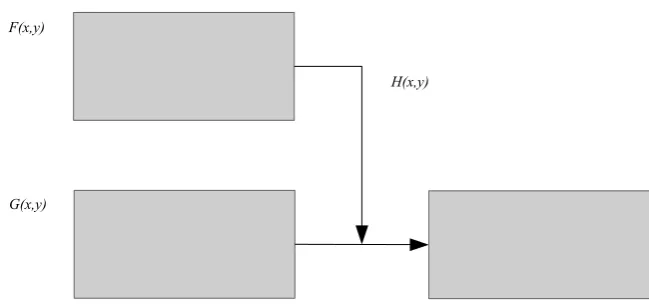
as smoothing of boundaries among adjacent fragments (Zhanget al., 2008). Figure 1.2 depicts the steps of generating a splicing forgery. F(x, y)andG(x, y)are two images andH(x, y)is a fragment ofF intended to be moved into theGand theI(x, y)is the resulted image. It is important to mention thatF andGmight be identical.
Many researches carried out on detecting the splicing forgery. First group of researches focused on detecting the possible forgery using statistical analysis of pixel information and the second group diverted their focus on detecting the inconsistency of the light directions to trace the potentially existent splicing forgery (Rediet al., 2011).
Figure 1.2: Steps of Image Splicing.
Simple splicing operation itself, even when visually masked with blending techniques, leaves its traces in the image statistics. Thus, it seems possible to use these traces for detecting the splicing forgery. This is the idea of the first group of researches.
6
to apply higher order correlations and as a result, he used bispectrum (Third-order correlation) for detecting audio signals forgery. Ng et al. (2004a) generalized the Farid (1999) idea in image processing and considered the information of pixels as a 2d signal. By using bispectrum of harmonically related Fourier frequencies of a signal, it is possible to capture quite discontinuities introduced in an image after splicing.
On the other hand, second group focused on detecting forgery using illumination analysis. The main idea is, when an authenticated image is processed for illumination direction, majority of objects in the image would have the same or very similar lighting direction. Illumination direction could be detected by processing the intensity of the colors in the neighboring pixels (Rediet al., 2011). Though modern editing tools allow to conceal the traces of splicing in a convincing way, it is not always possible for the forger even for the professional one to match the lighting conditions of the regions that make up the composite, as in the well-known case of the Kerry and Fonda photomontage(Figure1.1). Several studies are dedicated to forgery detection through the scene illumination analysis. A first attempt was proposed by Johnson and Farid (2005), in which they estimated the incident light direction for different objects in order to highlight the mismatches. Similar approaches could be find in Johnson and Farid (2007b) and Zhanget al.(2009).
Even though very good studies have been done in the area of splicing forgery detection and lots of techniques have been introduced for this purpose, it is still not an easy task to detect forgeries with reasonable accuracy. The imperfection of accuracy might happen due to performing post processing operations for hiding the traces of forgery or utilizing lossy compression formats. This is the problem that could be referred to as “Uncertainty”(Barni and Costanzo, 2012).
7
The (Fuet al., 2006; Donget al., 2009; Chetty and Singh, 2010) are the studies which use fusion of features before decision making process. On the best of our knowledge there is only one experiment that has used fusion after decision making process of forgery detection tools(Barni and Costanzo, 2012).
Using fuzzy for fusion of forgery detection tools has been remained on touched for a long time Chetty and Singh (2010); Barni and Costanzo (2012) and there is still good chance to use it in this area. The term “Fuzzy logic” was introduced in 1965 by (Zadeh, 1965). Fuzzy logic has been applied in many fields, from control theory to artificial intelligence. The main advantage of fuzzy inference systems is the ability of dealing with incomplete information. This makes fuzzy logic a good choice for solving the problem of uncertainty in forgery detection.
The problem of fuzzy logic based systems is that adjusting of Membership Function (MF) for getting accurate results is a time consuming process. The hypothesis in this study is using NFIS system instead of FIS. By fusing splicing forgery detection tools using NFIS, adjustment of MF could be done automatically and this option would decrease the time required for forgery detection. According to the provided literature, this is the first time that NFIS based approach is used for splicing forgery detection and it is anticipated that the obtained results would be better using this method.
1.3 Problem Statement
8
using the fuzzy based system is, for having better results, the MFs should be adjusted manually and different kinds of fuzzy rules should be tested which is a very time consuming process.
1.4 Objectives
Based on the problem statement, the following objectives are stated:
1. To investigate feature extraction and decision making by SVM for splicing forgery detection tools.
2. To Enhance the accuracy of detection by fusion of splicing detection tools based on DWT decompositions analysis, Edge Image analysis using GLCM and N-Run Length matrices analysis.
3. To evaluate the performance of proposed method compare to each forgery detection tool individually.
1.5 Project Scope
The dissertation is bounded to the following scopes:
1. We focus on one type of image forgery; the splicing attack.
2. DWT decompositions analysis, Edge Image analysis using GLCM and N-Run Length matrices analysis are three forgery detection tools that are used for feature extraction and fusion.
9
4. We are focusing on detecting the forgery images. Targeting the forgery location is out of our scope.
1.6 Significance of Project
One of the techniques for fusion of forgery detection tools is using fuzzy inference systems. To the best of our knowledge, there are two experiments that used this approach for fusion. Chetty and Singh (2010) relies on Fuzzy integrals applied to the features extracted by forensic algorithms and Barni and Costanzo (2012) uses Fuzzy rule-based system in which the input of system is the final decision regarding each forensic tool.
The disadvantage of using Fuzzy based system is that the MFs should be adjusted manually which is time consuming. Also, it is necessary to define good fuzzy rules in order to obtain good results. Moreover, these adjustments of MFs and defining the fuzzy rules depend on the expert idea. A Neural Network characteristic of the purposed approach helps MFs to be adjusted automatically. Also, the characteristic of grid partitioning helps the NFIS systems to define the whole FIS automatically. This will save considerable amount of time.
1.7 Dissertation Organization
10
108
REFERENCES
Adams, J., Parulski, K. and Spaulding, K.1998. Color processing in digital cameras. Micro, IEEE. 18(6), 20–30.
Avcibas, I., Bayram, S., Memon, N., Ramkumar, M. and Sankur, B.2004. A classifier design for detecting image manipulations. In Image Processing, 2004. ICIP’04. 2004 International Conference on, vol. 4. IEEE, 2645–2648.
Barni, M. and Costanzo, A.2012. A fuzzy approach to deal with uncertainty in image forensics.Signal Processing: Image Communication.
Carlsson, C. and Full´er, R.1998. Optimization with linguistic values. Technical report. TUCS Technical Reports.
Castillo, O., Melin, P., Kacprzyk, J. and Pedrycz, W.2007. Type-2 Fuzzy Logic: Theory and Applications. In Granular Computing, 2007. GRC 2007. IEEE International Conference on. Nov. 145–145. doi:10.1109/GrC.2007.118.
Chang, C.-C. and Lin, C.-J.2011. LIBSVM: a library for support vector machines. ACM Transactions on Intelligent Systems and Technology (TIST). 2(3), 27.
Chen, W., Shi, Y. Q. and Su, W.2007. Image splicing detection using 2-d phase congruency and statistical moments of characteristic function. InSociety of Photo-Optical Instrumentation Engineers (SPIE) Conference Series, vol. 6505. Citeseer, 26.
Chetty, G. and Singh, M.2010. Nonintrusive image tamper detection based on fuzzy fusion.International Journal of Computer Science and Network Security. 10, 86–90. Cox, I., Miller, M. and Bloom, J.2003. Digital Watermarking Morgan Kaufmann
Publishers.San Francisco, CA.
Curry, H. B.1944. The method of steepest descent for nonlinear minimization problems.Quart. Appl. Math. 2(3), 250–261.
109
Fang, Y., Dirik, A. E., Sun, X. and Memon, N.2009. Source class identification for DSLR and compact cameras. InMultimedia Signal Processing, 2009. MMSP’09. IEEE International Workshop on. IEEE, 1–5.
Farid, H.1999. Detecting digital forgeries using bispectral analysis.
Farid, H.2004. Creating and detecting doctored and virtual images. Implications to The Child Pornography Prevention Act, 280–291.
Farid, H.2009. Image forgery detection. Signal Processing Magazine, IEEE. 26(2), 16–25.
Fu, D., Shi, Y. Q. and Su, W.2006. Detection of image splicing based on hilbert-huang transform and moments of characteristic functions with wavelet decomposition. In Digital Watermarking. (pp. 177–187). Springer.
Full´er, R.2000. Introduction to neuro-fuzzy systems. vol. 2. Springer.
Full´er, R. and Zimmermann, H.-J.1993. On Zadehs compositional rule of inference. InFuzzy Logic. (pp. 193–200). Springer.
H´ajek, P.1998. Metamathematics of fuzzy logic. vol. 4. Springer.
Hirota, K. and Pedrycz, W.1994. OR/AND neuron in modeling fuzzy set connectives. Fuzzy Systems, IEEE Transactions on. 2(2), 151–161.
Hsiao, D.-Y. and Pei, S.-C.2005. Detecting digital tampering by blur estimation. In Systematic Approaches to Digital Forensic Engineering, 2005. First International Workshop on. IEEE, 264–278.
Hsu, Y.-F. and Chang, S.-F.2006. Detecting image splicing using geometry invariants and camera characteristics consistency. In Multimedia and Expo, 2006 IEEE International Conference on. IEEE, 549–552.
Hsu, Y.-F. and Chang, S.-F.2010. Camera response functions for image forensics: an automatic algorithm for splicing detection. Information Forensics and Security, IEEE Transactions on. 5(4), 816–825.
Hulsurkar, S., Biswal, M. P. and Sinha, S. B.1997. Fuzzy programming approach to multi-objective stochastic linear programming problems. Fuzzy Sets and Systems. 88(2), 173–181.
Ichihashi, H.1991. Iterative fuzzy modeling and a hierarchical network. InProceedings of the Fourth IFSA Congress, Vol. Engineering, Brussels. 49–52.
110
JingDong,W.W.2011.CASIATamperingDetectionDataset.RetrievableatKWWS IRUHQVLFVLGHDOWHVWRUJ
Johnson, M. K. and Farid, H.2005. Exposing digital forgeries by detecting inconsistencies in lighting. In Proceedings of the 7th workshop on Multimedia and security. ACM, 1–10.
Johnson, M. K. and Farid, H.2007a. Exposing digital forgeries in complex lighting environments. Information Forensics and Security, IEEE Transactions on. 2(3), 450–461.
Johnson, M. K. and Farid, H.2007b. Exposing digital forgeries through specular highlights on the eye. InInformation Hiding. Springer, 311–325.
Katzenbeisser, S., Petitcolas, F. A. et al.2000. Information hiding techniques for steganography and digital watermarking. vol. 316. Artech house Norwood.
Kirchner, M. and B¨ohme, R.2007. Tamper hiding: Defeating image forensics. In Information Hiding. Springer, 326–341.
Kirchner, M. and Bohme, R.2008. Hiding traces of resampling in digital images. Information Forensics and Security, IEEE Transactions on. 3(4), 582–592.
Lin, H.-T., Lin, C.-J. and Weng, R. C.2007. A note on Platts probabilistic outputs for support vector machines.Machine learning. 68(3), 267–276.
Lin, Z., Wang, R., Tang, X. and Shum, H.-Y.2005. Detecting doctored images using camera response normality and consistency. InComputer Vision and Pattern Recognition, 2005. CVPR 2005. IEEE Computer Society Conference on, vol. 1. IEEE, 1087–1092.
Liu, Q. and Sung, A. H.2009. A new approach for JPEG resize and image splicing detection. InProceedings of the First ACM workshop on Multimedia in forensics. ACM, 43–48.
Majid Valiollahzadeh, S., Sayadiyan, A. and Nazari, M.2008. Face Detection Using Adaboosted SVM-Based Component Classifier.
Malvar, H. S., He, L.-w. and Cutler, R.2004. High-quality linear interpolation for demosaicing of Bayer-patterned color images. In Acoustics, Speech, and Signal Processing, 2004. Proceedings.(ICASSP’04). IEEE International Conference on, vol. 3. IEEE, iii–485.
111
Ms. Sushama, G. R.2014. Review of Detection of Digital Image Splicing Forgeries with illumination color Estimation.International Journal of Emerging Research in Management &Technology. 3(3).
Negnevitsky, M.2005. Artificial intelligence: a guide to intelligent systems. Pearson Education.
Ng, T.-T., Chang, S.-F. and Sun, Q.2004a. Blind detection of photomontage using higher order statistics. InCircuits and Systems, 2004. ISCAS’04. Proceedings of the 2004 International Symposium on, vol. 5. IEEE, V–688.
Ng, T.-T., Chang, S.-F. and Sun, Q.2004b. A data set of authentic and spliced image blocks.Columbia University, ADVENT Technical Report, 203–2004.
Nomura, H., Hayashi, I. and Wakami, N.1992. A learning method of fuzzy inference rules by descent method. InFuzzy Systems, 1992., IEEE International Conference on. IEEE, 203–210.
Platt, J.et al.1999. Probabilistic outputs for support vector machines and comparisons to regularized likelihood methods.Advances in large margin classifiers. 10(3), 61– 74.
Qu, Z., Qiu, G. and Huang, J.2009. Detect digital image splicing with visual cues. In Information Hiding. Springer, 247–261.
Redi, J. A., Taktak, W. and Dugelay, J.-L.2011. Digital image forensics: a booklet for beginners.Multimedia Tools and Applications. 51(1), 133–162.
Shaw, S.1999. JISC Technology Applications Programme (JTAP)Overview of Watermarks, Fingerprints, and Digital Signatures.The University of Edinburgh. Shi, Y. Q., Chen, C. and Chen, W.2007. A natural image model approach to splicing
detection. InProceedings of the 9th workshop on Multimedia & security. ACM, 51–62.
Tieu, K. and Viola, P.2004. Boosting image retrieval. International Journal of Computer Vision. 56(1-2), 17–36.
Turevskiy,A.2014. Designandsimulatefuzzylogicsystems. RetrievableatKWWS
ZZZPDWKZRUNVFRPSURGXFWVIX]]\ORJLF.
Wang, W., Dong, J. and Tan, T.2009. Effective image splicing detection based on image chroma. In Image Processing (ICIP), 2009 16th IEEE International Conference on. IEEE, 1257–1260.
112
Yager, R. R. and Zadeh, L. A.1992. An introduction to fuzzy logic applications in intelligent systems. Kluwer Academic Publishers.
Yu-Feng Hsu, S.-F.2006. Columbia Image Splicing Detection Evaluation Dataset. Retrievable at KWWSZZZHHFROXPELDHGXOQGYPPGRZQORDGV
$XWK6SOLFHG'DWD6HW$XWK6SOLFHG'DWD6HWKWP
Zadeh, L. A.1965. Fuzzy sets.Information and control. 8(3), 338–353.
Zhang, C. and Zhang, H.2007. Detecting digital image forgeries through weighted local entropy. In Signal Processing and Information Technology, 2007 IEEE International Symposium on. IEEE, 62–67.
Zhang, W., Cao, X., Zhang, J., Zhu, J. and Wang, P.2009. Detecting photographic composites using shadows. In Multimedia and Expo, 2009. ICME 2009. IEEE International Conference on. IEEE, 1042–1045.
Zhang, Z., Zhou, Y., Kang, J. and Ren, Y.2008. Study of Image Splicing Detection. In Advanced Intelligent Computing Theories and Applications. With Aspects of Theoretical and Methodological Issues. (pp. 1103–1110). Springer.