ABSTRACT
DICKERSON, JEREMY GLENN. Analysis of Computing Skills and Differences Between Demographic Groups: A Basis for Curriculum Development in Computer Technology Courses at UNC-Wilmington. (Under the direction of Dr. Ted Branoff)
This study examined the entry-level computing skills of undergraduate education majors at the University of North Carolina at Wilmington during the Spring 2005
semester. This study also compared groups based on demographic categories to
investigate if certain demographics were predictors of specific skills competency. This study utilized a representative convenience sample of 186 participants. The participants were pre-tested for their ability to complete 60 computer skills in the Microsoft Office Suite using an online performance test called Skills Assessment Manager by Thomson Course Technology. The data was analyzed as a whole group performance using
descriptive statistics and analyzed for analysis between demographic groups using a non-parametric statistic test (the Mann Whitney U Test). The results yielded data that
ANALYSIS OF COMPUTING SKILLS AND DIFFERENCES BETWEEN DEMOGRAPHIC GROUPS: A BASIS FOR CURRICULUM DEVELOPMENT IN
COMPUTER TECHNOLOGY COURSES AT UNC WILMINGTON
by
Jeremy Dickerson
A dissertation submitted to the Graduate Faculty of North Carolina State University
In partial fulfillment of the Requirements for the Degree of
Doctor of Education
Department of Mathematics, Science and Technology Education
Raleigh 2005
APPROVED BY:
___________________________________ ___________________________________
___________________________________
Chair of Advisory Committee
___________________________________
DEDICATION
BIOGRAPHY
ACKNOWLEDGEMENTS
I would like to acknowledge the following people for their help and support in this endeavor.
• My daughter, Ava Dickerson and my wife, Kathleen Dickerson for being
wonderful, even when they were not given the attention they deserved while I went to school and worked on this dissertation.
• My colleagues at UNC-W for their support and for allowing me time to work on
this dissertation.
• My committee members, Bill DeLuca and Brad Mehlenbacher, for their
TABLE OF CONTENTS
LIST OF TABLES...viii
INTRODUCTION ...1
Setting: UNC-Wilmington and the Donald R. Watson School of Education ...2
Instructional technology course ...3
The problem related to student computer skills...4
Purpose and objectives of the study...6
Research questions and null hypotheses ...7
Significance of the study...9
Limitations of the study ...10
Definition if terms...11
REVIEW OF LITERATURE Needs assessment...12
Learner analysis ...15
Computer skills and college students...16
Computer competencies and teacher education majors ...19
Predictors of computing skills ...22
Age...23
Gender...26
Race, ownership and access ...27
Experience and confidence ...29
Summary of literature ...32
METHODOLOGY ...34
Introduction...34
Purpose and objectives of this study...34
Research question and hypotheses...35
Research design ...37
Instrumentation ...38
Population and sample ...42
Statistical information and methods...43
Data collections and procedures ...45
Data analysis ...46
Summary ...46
FINDINGS AND PRESENTATION OF DATA ...47
Demographic description of participants ...48
Description of whole sample scores ...50
Analysis between groups ...54
CONCLUSIONS, IMPLICATIONS, RECOMMENDATIONS, AND SUMMARY OF RESEARCH...66
Introduction...66
Statement of problem...67
Research questions and hypotheses ...68
Analyses...72
Conclusion and discussion...78
Computer skills assessment ...78
Learner analysis ...79
The role of demographics on computer skills...80
Implications for teaching courses that include computer skills ...81
Recommendations for further research...82
REFERENCES ...84
APPENDICES A...91
B...93
C...95
D...100
E ...103
LIST OF TABLES
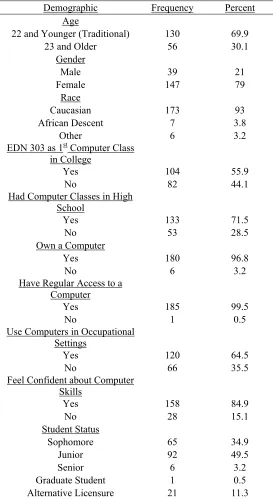
Table 4.1. Demographics of the participants as related to larger populations of interest
...48
Table 4.2. Demographics of the participants ...49
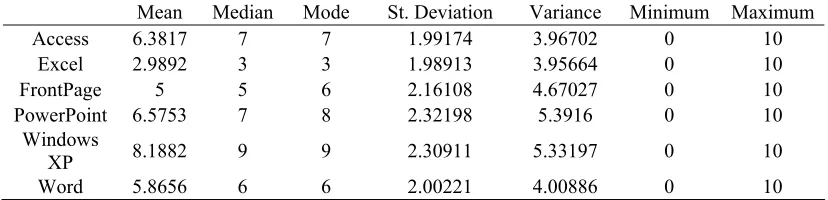
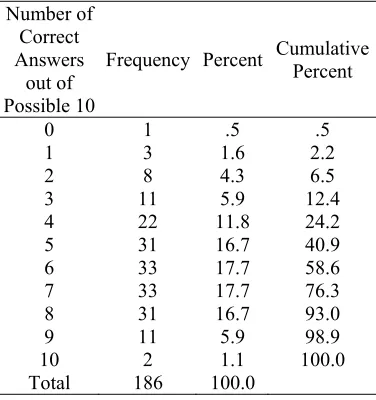
Table 4.3. Overall group performance data ...51
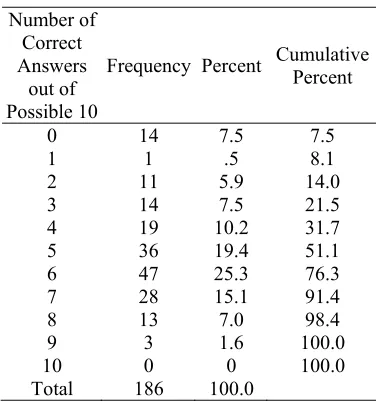
Table 4.4. Access frequency table ...51
Table 4.5. Excel frequency table...52
Table 4.6. FrontPage frequency table ...52
Table 4.7. PowerPoint frequency table ...53
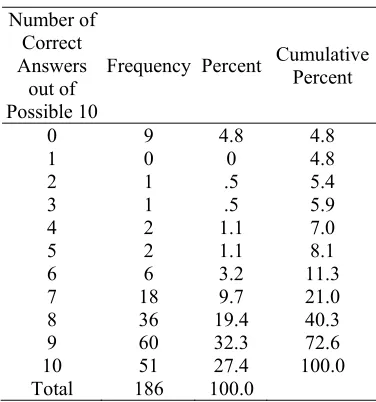
Table 4.8. Windows XP frequency table ...53
Table 4.9. Word frequency table...54
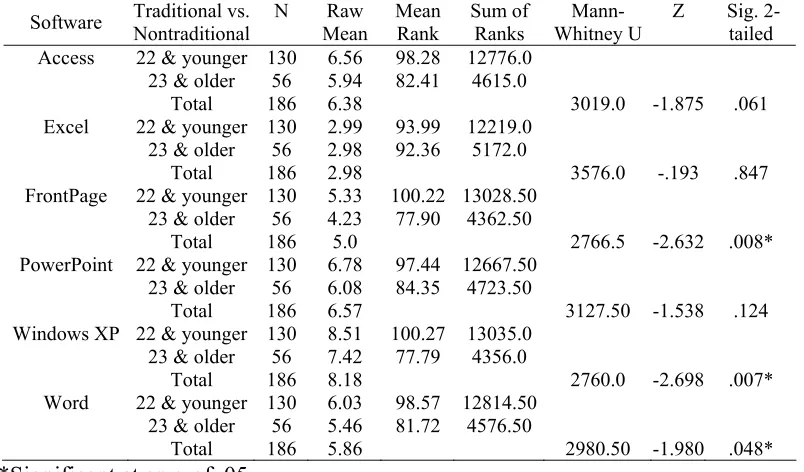
Table 4.10. Analysis between traditional and non-traditional students across all areas of the test ...55
Table 4.11. Analysis between male and female students across all areas of the test ...56
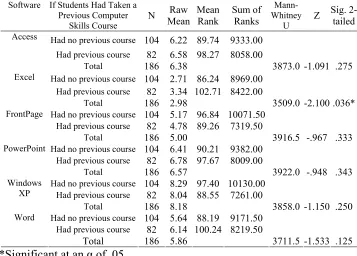
Table 4.12. Analysis between students who had previous computer skills courses in college and those who did not have such courses before EDN 303 ...57
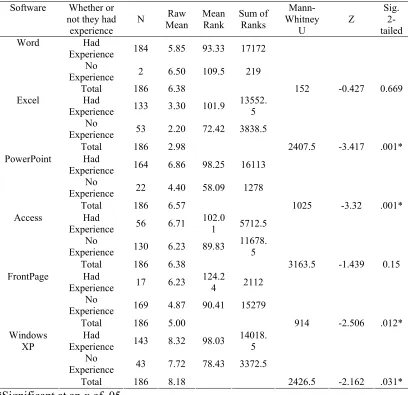
Table 4.13. Analysis between students who had experience using specific software and those who did not have experience using specific software ...58
Table 4.14. Analysis between students who had computer skills courses in high school and those who did not have such courses in high school...60
Table 4.15. Analysis between students who have used computers in their jobs and those who did not use computers in their jobs ...61
Table 4.16. Analysis between students who with a high level of confidence and those who did not have a high level of confidence in their use of technology ...62
CHAPTER 1 INTRODUCTION
The development of computer skills in university students has dramatically changed over the past ten years. Since the development and release of popular graphical user
interfaces such as Microsoft Windows operating systems, the use of personal computing has exponentially grown. Computer use is an entrenched part of our culture. The acquisition of basic computer knowledge and skills no longer occurs just in formal educational settings, but also in homes, schools, and work environments. On the contrasting side of this discussion, there is also the fact that computer use is still not universal. There are groups of people who have not been trained, taught or exposed to computers because of different reasons, therefore creating a know or do not know culture, or a digital divide (Public Broadcasting Service, 2005). The rapid diffusion of information and communication technologyin the past decade has added an important new element to the issue of educational inequality. New technologies are widely viewed as having the potential to either alleviate or exacerbate existing
inequalities (Warschauer, Knobel & Stone, 2004).
Colleges that designed computer skills courses years ago are now finding that some students come into the classrooms with computer skills prior to instruction. This is believed to exist because they have had exposure to computer resources, computer instruction or both. According many studies, certain demographic groups are generally said to have more
information should consider the differences in their learners before providing instruction so that they can develop curriculum that is appropriate in scope and sequence and driven by the learners’ prior experiences. Throughout the planning process, a guiding principle should be to consider the students at every stage. It is necessary to carefully consider the students’ maturity, needs, interests, abilities, and knowledge when planning instruction. Educating all students is and always has been a significant challenge. The increasing diversity of the student population and educators’ recognition of the importance of considering diversity when planning and teaching has added to the complexity of this challenge (Posner and Rudnitsky, 2001).
Setting: UNC-Wilmington and The Donald R. Watson School of Education
This research took place at The University of North Carolina at Wilmington in the Donald R. Watson School of Education. UNC-Wilmington is a regional university seated in southeastern North Carolina with a student population of approximately 12,000 students. The Donald R. Watson School of Education is the largest professional school at UNC-Wilmington with approximately 1,300 undergraduate students. The Watson School of Education offers programs at the undergraduate and graduate levels. Degrees are conferred in the areas of elementary education, middle grades education, secondary education, special education, school administration, instructional technology and curriculum and instruction.
number of military related students attending UNC-Wilmington changes the demographics of the student population at the university to include more non-traditional students and students with a wide variety of work and life experiences.
Instructional Technology Course (EDN 303)
Upon entering the School of Education, students are typically juniors or second semester sophomores. These students may also be seniors, post-baccalaureate students, graduate students, or students returning as “licensure-only” status via a number of alternative licensure programs already possibly having an undergraduate degree. During their first semester as a student in the School of Education, students are required to take a variety of courses that are designed to help them in the advanced classes. One of the classes that all students must take early in their course of study is Education 303, titled “Instructional
Technology.” Education 303 (EDN 303) provides students with basic computer skills as well as methods on how to effectively integrate computer technology into teaching. EDN 303 is designed to helpstudents develop an understanding of the principles and skills that underlie the design, production, and evaluation of instructional materials, computer generated
presentations, and interactive media with particular emphasis on computer skill building and effective classroom use and integration of technology into instructional units. Students develop skills in the operation of computers with Windows XP operating system, Microsoft Excel, Microsoft Word, Microsoft PowerPoint, Microsoft FrontPage, and Microsoft Access.
always been skills that were considered foundational and useful in many subsequent courses.
The Problem Related to Student Computer Skills Taught in EDN 303
There has been intense discussion by the faculty in the School of Education at UNC-Wilmington about the skills that have been taught in EDN 303. There were conversations and debate among the faculty concerning the design of EDN 303 and whether or not the skills that have been taught are redundant to many of the students who take the class. Some faculty members believed that “most” of the students already know the skills that are taught in EDN 303 when they come into the class, and that the skills portion of the EDN 303 curriculum should be eliminated or re-designed. This stemmed from the belief that students are now growing up with the use of computers as a part of their everyday life, and that computers are so entrenched in our society that everyone is getting experiences that develop skills such as those that are taught in EDN 303. On the other side of the discussion, some faculty members do not think that most students are coming into the class proficient with the computer technology skills that are needed for success in the School of Education. Further, they stated that EDN 303 had historically provided a solid foundation in terms of computer technology and should not be changed. This difference in thought is a discussion that had been on-going for several years since no data existed to resolve the issue. EDN 303 is a mandatory course for approximately 150 to 200 students each semester, and the delivery of this course affects the performance of these students throughout the completion of their degree programs.
teacher shortage of approximately 10,000 teachers per year (Hunt Praises North Carolina Study Shining Spotlight on Urgent Teacher Shortage, 2004) and a weakened economy that had caused many job cuts and layoffs in this region, there were increasing numbers of students who were currently being admitted into the Watson School of Education who were non-traditional, of various ages, and have differing life and work experiences. In addition, the growth of the Camp Lejeune military base has served as an area of growth for student population with the influx of prior service, retirees, and military dependents, all of whom have added to the level of demographic variation as opposed to the traditional student who is straight from high school. To meet this growing population, the Watson School of Education had acknowledged this population and its many differences through the creation of the Onslow Extension Program, designed to meet the needs of the diverse learners and non-traditional students who may be connected to the military (C. Thomas, personal
have, or both? Operational definitions for traditional and non-traditional students are addressed in this section under the “Definition of Terms” portion of this chapter.
The researcher concluded that there was a need for a study in order to analyze entry-level computer skills and differences in skills based on demographic factors that could be predictors of computer skills proficiency. The variety within the student population created a belief among the faculty that there were demographic variables that exist which may drive the differences in computer skills among the undergraduate students. If there were more known about the students and the possible connection between demographics and their computer skills, then changes could possibly be made in the course based on demographic data and/or skills assessment data.
Purpose and Objectives of this Study
The purpose of this study was to gather data on student computer skills in reference to the skills that are taught in EDN 303, analyze the data in an attempt to understand what EDN 303 students as a whole group know about specific computing skills that are taught in the course, and then attempt to explain the differences in skills through the analysis of
demographic factors as indicated in the literature. This data will be used to make
recommendations concerning how EDN 303 could be adapted to reflect what is known about the student population in order to better serve the students in the School of Education. In addition, this data could help other educational agencies in southeastern North Carolina such as the public school systems and Camp Lejeune military base education centers understand their student population and inform the decisions being made in reference to computer skills education.
1. Collect data that will inform the Watson School of Education on student computer skills fluency in the following areas: Windows XP, Microsoft Excel, Microsoft Word, Microsoft PowerPoint, Microsoft FrontPage, Microsoft Access.
2. Analyze data descriptively to determine how the students as a whole perform in terms of specific computer skills that are taught in EDN 303.
3. Analyze data using inferential methods based on selected demographics as discovered in the review of literature. Such demographic data includes age, gender, previous computer training, computer ownership, computer access, high school computer instruction, work history with the use of technology, feelings of confidence towards using computers, and experience with Microsoft Office and Windows XP in order to determine if differences in performance exist based on demographic information.
4. Make recommendations based on the data collection and analysis on how EDN 303 can be adapted in order to reflect the computer skills that students have upon entering the School of Education.
Research Questions and Null Hypotheses
The major research questions for this study were:
Research Question 1. What do students who enter EDN 303 already know in reference to many of the specific basic computer skills that are taught in that course?
In order to formulate an answer to this question, the following null hypothesis was proposed:
Research Question 1, Null Hypothesis: The sample as a whole will not have overall scores of 5 out of 10 or greater on all of the six areas of the computer skills test.
the School of Education when the students are divided into groups based on demographic factors?
In order to formulate an answer to this question, the following hypotheses were proposed:
Null Hypothesis 1. There will be no significant difference across all areas of the computer skills test between the traditional aged (22 and younger) group and the nontraditional students group (23 and higher).
Null Hypothesis 2. There will be no significant difference across all areas of computer skills between the male student group and the female student group across all seven areas of the computer skills test.
Null Hypothesis 3. There will be no significant difference across all areas of computer skills between students who state that EDN 303 is their first computer technology course in college and students who have had a computer course in college prior to EDN 303.
Null Hypothesis 4. There will be no significant difference between students who state that they have never used specific components of Microsoft Office and students who have used specific components of Microsoft Office.
Null Hypothesis 5. There will be no significant difference between students who state that they have never used Microsoft Windows XP and students who have used Microsoft Windows XP.
Null Hypothesis 6. There will be no significant difference across all areas of computer skills between students who received computer skills instruction in high school and students who did not receive computer skills instruction in high school.
between students who have had jobs involving the skills being tested and students who did not have jobs involving the use of the skills being tested.
Null Hypothesis 8. There will be no significant difference across all areas of computer skills between students who have a lack of confidence involving the use of computers and students who do not have a lack of confidence involving the use of computers.
Null Hypothesis 9. There will be no significant difference across all areas of computer skills between students who own computers and students who do not own computers.
Null Hypothesis 10. There will be no significant difference across all areas of computer skills between students between students who have regular computer access and students who do not own have regular computer access.
Significance of this Study
This study had a high level of importance because the Watson School of Education at UNC-Wilmington needed data in order to understand how to design the course EDN 303 to better serve the needs of the diverse student population that attends the school. Before this research, the School of Education had not been able to answer questions about what students’ skills are upon entrance into the School of Education because of the lack of data. With the completion of this study, there exists base-line data describing the skills of all of the students and data informing the question of differences of skill ability based upon demographic information affecting computing skills that some faculty believe exists. Also, the
Limitations of this Study
1. A limitation of this study was that the sample in this research was only the students who were registered for EDN 303 in the Spring 2005 semester. The variation in student
demographics may have been abnormally heterogeneous. The researcher believed that the best way to counteract this limitation would be to do future replication studies to gain a larger, more diverse sample of students.
2. A limitation of this study was that it used Microsoft Windows XP, Microsoft Office XP, and PC based computers as the medium for test questions. This was a limitation because there could have been students who are very versed in computer skills, but not familiar with these platforms. The computing platforms aforementioned were chosen because of their overwhelming popularity in the computing industry.
3. A limitation of this study was that it did not employ the use of a random sample. This study utilized a convenience sample. However, it was expected that since this study included all possible participants who were eligible and met the qualifications of the population of interest that this sample is representative of the population of interest at large. This limitation could be eliminated via replication during future semesters by comparing this sample to other samples. Also, this sample was compared demographically to the entire School of Education and to the entire population of students at UNC-Wilmington in terms of important
Definition of Terms
1. Non-traditional aged students (Metcalf, 1997; Werring, 1984) are: students with a
chronological age of more than 22 years. According to the UNC-Wilmington Dean of Students (Who are traditional students? 2005), non-traditional students (non-trads), sometimes referred to as "adult learners," are an extremely diverse group. Those who feel they do not fit the "traditional college student" profile may be considered "non-trads," including undergraduate students who entered college a year or more after high school graduation, are working to support themselves or their families, have dependents in their care, are married or divorced, are serving in the armed forces, or are veterans. For the purpose of this study, non-traditional students will be defined by their age; 23 and older. 2. Traditional students are considered students who have entered college directly after high school and exhibit traditional student characteristics that are typical of the population in question. These characteristics include same basic age group, similar high school educations and experiences and similar values, beliefs and norms. For the purpose of this study,
traditional students will be defined by their age, 22 and younger. 3. WSE – Watson School of Education
CHAPTER 2
REVIEW OF RELATED LITERATURE Introduction
A review of literature was performed in order to understand more about the topics surrounding this study. A review of literature was conducted in the areas of needs
assessment, learner analysis, computer skills and college students, computer competencies and teacher education, predictors of computer skills and computer skills assessments. The information gleaned from this review helped shape the methodology in this study and assisted in improving the researchers’ knowledge of areas that are of importance.
Needs Assessment
According to Rossett (1987), needs assessment is an umbrella term for the analysis activities trainers use to examine and understand performance problems and new
designed considering what is known about this population. According to Richey (1992), target population members must have already mastered certain entry behaviors associated with learning new goals prior to beginning instruction. Richey goes on to discuss how learner characteristics such as knowledge, experience and attitudes can also influence the outcome of instruction.
Keller (1987) suggests asking learners about their perceptions of relevance to the instructional goal and their confidence towards the said instruction, but never to assume that the learners find relevance in the material or have confidence in their abilities. When analyzing the learner, Gagne (1985) suggests that one asks what the student must already know so that a given task may be learned. According to Reigeluth (1999), in any given instructional situation, an instructor cannot teach the same thing to the whole class at the same time. The instructor needs to be a facilitator who can change instruction from standardization to customization, and from the focus of presenting material to a focus on making sure that each learners’ needs are met. According to Campbell and Monson (1994), instructors must challenge the key assumptions of traditional instruction that assert that walking all learners through the content in the same way can be effective. This is a model for efficiency,but not effectiveness.
According to Smith and Ragan (1993), needs assessment is a systemic approach to the development of instructional interventions and should drive curriculum, shaping the design, development, implementation, and evaluation decisions. This type of assessments are used when there is a need for optimal performance and an understanding of actual
performance, and are a way to help determine solutions to problems in instructional settings. Further, instructional designers conduct needs assessments to determine that there is a need for new instruction to be developed. If this step is omitted, there is a risk of developing or delivering instruction that is unnecessary or inappropriate. Instructional designers should determine the gaps between what is and what should be. (Smith & Ragan). Echoing the work of Smith and Ragan, Lan (2001) states that the role of needs assessment is to collect the information necessary to identify the strategy and action required to improve current and future practice and involves defining optimal performance, assessing actual practice and identifying the gaps separating the two.
Anglin (1995) goes on to say that needs assessments are typically conducted using some type of survey instrument. Identification of gaps between learning goals and actual learner performance may be found (Smith & Ragan, 1993). A survey is usually a device for soliciting opinions or abilities from large numbers of respondents. When properly designed and developed, surveys will yield data and findings that can be used for decision making. According to Anglin (1995), surveys can be developed with several different types of questions with items such as:
• items that ask about a perceived need
• items that ask for details of the need
• items that ask for feelings and motivation
• items that ask for cause(s) of the problem
• items that ask about the respondent
From this literature, there is a suggestion that needs assessment is an appropriate route for the previously stated research questions. Also, a survey instrument with items that ask respondents to provide evidence was the most effective type of instrument to use because this research needed items that would have the participants demonstrating skills.
Learner Analysis
John Dewey (1933) was one of the first educational researchers to draw national attention to the importance of including information about the learner in curricular decision making. Dewey’s work was a milestone in instructional design and helped refine the concept of learner analysis. Learning is a profoundly relative process, and what students learn
depends enormously on what they already know(Posner and Rudnitsky, 2001). Posner and Rudnitsky (2001) state that instructors should assess students’ level of knowledge and skills and adjust instruction carefully so students are ready to learn the material. The key to instructional design is learner analysis. This element focuses on the diversity of learner characteristics. Together with task analysis and performance objectives, learner analysis determines the resources to be selected and the instructional strategies to be implemented (Leng, 2002).
• Utilizing Pretests • Reviewing Portfolios
• Contacting Experienced Instructors • Surveying Students
• In-Class Opportunities • Out-of-Class Opportunities
A pretest is a criterion-referenced test designed to measure entry behaviors or prerequisite skills needed before instruction can begin, as well as those skills the designer intends to teach. It gives the instructional designer a basis for developing items or skills that need to be taught to ensure successful instruction (Tsapatsoulis, 2004).
The work of Dewey, Posner, Runitsky and Leng serve as a guide to understanding the importance of knowing the learner prior to instruction. Their work in learner analysis assists in bringing to light the capabilities of students before they receive instruction. Tsapatsoulis provides a variety of methods for gathering data about the learners before they receive instruction, including utilizing pre-tests and surveying students which helped guide the methodology of this study.
Computer Skills and College Students
Computer skills are a necessary part of work skills in today’s economy and an expectation of college graduates for many employers. In a survey of over 200 companies, it was found that employers felt that employees needed more mathematical skills,
in the areas of literacy, mathematics, technical knowledge, high level communication skills, customer communication skills and computer skills. They also found that computer skills utilization was the fastest growing skill set in the British workforce. According to the work of Flynn (1994), approximately 75% of business executives reported that computing skills can increase productivity, accuracy, customer service and quality. Computer technology drives almost every business and industry, from mega-corporations to small local businesses (Smith, 2001).
Drybrugh (2002), states that trial and error is the most common way that computing skills are learned in the workforce, as opposed to formal instruction. However many college students are taking computer skills courses in college and these skills are used in different academic ways. Dupin-Bryant (2004), states that prior computer training was a factor in successful completion of online courses. Many students take classes, but also have options such as computer based training while in college. Harp, Taylor and Satzinger (1998), states that research has shown that computer based training can be an effective alternative to instructor led computer training, with video-based training being perceived as less useful. A basic principle of information literacy programs is that skills needed to use computers and skills needed to find and evaluate information are two separate sets of skills (Pask, 2004). End-user computer training is strategically important as far as skill development is
concerned. Failing to provide adequate computer training will increase the difficulty of finding employees with the skills required for certain positions in the future (Gattiker, 1992). Computing skills are necessary and the development of computing skills by a population can lead to increased welfare and workforce development. For example, in Philadelphia,
Commerce to develop a city-wide computer skills training program called the International Computer Driving License (ICDL) which is a global computer skills certification program. This resulted in improved job skills and more employability for many of the citizens who participated in the program (Johnson, 2003).
Corporate leaders are putting more emphasis on recruiting individuals with an understanding of computers and information systems. In a nationwide survey of 1,481 management systems executives conducted at Cornell University, it was found that computer literacy requirements for all job levels increased dramatically over a three-year period in the early nineties, and that human resource executives found a lack of computer-literate skills in recent college graduates (Davis, 1997). As information technology tools continue their rapid rate of change, students need to understand concepts and acquire skills at a comparable rate. Various approaches have been suggested to increase the degree of information technology fluency for undergraduates, particularly non computer science majors (Dougherty, 2003).
Computer literacy courses have continued to evolve. In the early nineties, predictions were made that computer literacy courses would no longer exist by the year 2000, since students would already possess the desired skills. In addition, most students who enter computer literacy courses would already possess the skills of the students completing computer literacy courses ten years ago. However, the standard for computer literacy has shifted, and employers now desire and expect a higher level of computer competency for all employees (Edmiston & McClellend, 2001). Since the mid-nineteen nineties, many
Academic Technologies has been developed to lead the way for their colleges to change from the heavy reliance on lecture based instruction to a technology-rich learning environment. This type of environment is characterized by active, cooperative learning supported by technology so that their students can learn technology throughout their coursework (Deden, 1998). The need for computer technology has also been noted by small colleges. Miles (2004) states that when careful planning and on-going assessment take place, small liberal arts colleges can provide computer skills curriculum that supplies students with computer skills needed for their professions. Even at community colleges, computer skills are stressed in many curriculum areas. The ability to use computer technology and to evaluate electronic information has become a basic skill for community college students in both academic and occupational areas. The consistent relationships between training and computing outcomes indicates that training interventions at the university and post-secondary level, rather than at an earlier time, may be the most effective means of achieving computer skills and confidence (Bradley and Russell, 1997).
From this literature, it is evident that computer skills are a major concern for college educators and society at large. Community colleges, universities, and even major cities are putting together computer training systems so that their students or citizens can be more technologically advanced and better prepared for the workplace of the future. Computer courses are now a pervasive part of collegiate education throughout the United States.
Computer Competencies and Teacher Education Majors
computer tasks is an underlying assumption of computer education. Yet, some evidence suggests that certain introductory computer courses produce very highly specific and non-generalized skills. Scheffler and Logan (1999) used a Delphi panel to develop a survey instrument of 67 computer competencies that educators should know and/or be able to do. The use of computers during the integration of curricula and instruction was rated the highest on the list by experts, and many computer skills are necessary before these competencies can be accomplished. Donnelly (1999), states that teacher training with computers is a problem, and 70% of the teachers surveyed by Education Week Magazine stated that computer use in the classroom is difficult for a variety of reasons. Tarleton (2001), states that training teachers how to effectively use technology in instruction is at least as critical, if not more critical than their need for adequate amounts of up-to-date software and hardware, and the majority of the schools in this research did not provide the necessary instruction.
Educational technology used to refer to radio, television, filmstrips, overhead projectors, tape recorders, video cassette recorders and the use of these items in an educational setting. It has rapidly advanced, and the term now refers to a vast array of computer based technologies such as compact discs, interactive audio and video
technologies, networks, hypermedia, and telecommunications (Soska, 1994). Introductory computer literacy courses are believed to play a critical role in introducing college students to fundamental computer concepts and skills (Kim & Peterson, 1992). Ideally, students
completing such courses have sufficient computer literacy for effective use of computers, plus the ability to acquire more sophisticated computer skills in subsequent courses (Kim & Keith, 1994). To ensure that all students have received similar exposure to essential
or no relevant computer experience (Brock, Tondeur & Valcke, 1992). As computers become more and more prevalent in our society, there is an increased need for computer integration into schools and a need for teachers with computer skills.
According to Ross (2001) one way to improve the (computer) skill levels students may attain in school may hinge on improving the classroom computing skills of their school teachers. In 1995, the Office of Technology Assessment, at the request of the U.S. Congress, conducted an extensive study of technology use by K-12 teachers. They found that a
substantial number of teachers reported little or no use of computers for instruction. They also stated that teachers lack models of effective integration of computers and that helping teachers use technology effectively may be the most important step to assuring that current and future investments in technology are realized (McCoy, 2000). In March 1992, The North Carolina State Department of Public Instruction issued a document called “Computer
Competencies for All Educators in North Carolina Public Schools” (NCDPI, 1992). This document was a detailed plan that described the expectations of educators as pertaining to computing skills for teachers in the state of North Carolina. This model was developed to assist schools in coping with in-service training for existing and prospective personnel and for higher education provide training for teachers and other school personnel in computer skills education. These competencies were used as a guide for computer skills training until 2002 when the North Carolina State Department of Public Instruction adopted the
had adopted the International Standards for Technology in Education’s National Educational Technology Standards in setting their standards for educational uses of technology that are designed for school improvement in the United States (Microsoft Press Pass, 2003).
The literature reviewed in this section helped to develop an understanding of the inclusion and necessity of technology in the field of teacher education. As evidenced by this literature, technology is an assumed part of K-12 education, and the emergence of
International Standards for Technology in Education has brought clarity to the ways technology could and should be used in teacher education. Further, many states, such as North Carolina, have adopted standards for technology integration and this has facilitated the integration of technology in teacher education programs.
Predictors of Computing Skills
Jawahar (2003) states that because of the significance of end user performance to organizations, it is important to uncover factors that influence end user performance. In a study of 468 school teachers, computer use was mainly predicted by computer experience and general attitudes towards computers and their place in education. (Brock, Thomsen, & Kohl, 1992).
There has been a large amount of research in the area of computer skills and the possible predictors of computer skills. As the need for technically skillful people has
increased in the workforce, much research has been done in order to understand who or what groups in our society have computer technology skills and why. In the review of literature, many demographic variables are mentioned as predictors of computer skills fluency. The historical pattern in the search for predictors of computer learning potential has been
have been cited to influence computer skills are demographic variables (Evans & Simkin, 1989). Undeniably, the literature is rich with many demographic factors, but several factors resonate repeatedly in the literature in terms of their connections to computer skills fluency. These factors are age, gender, ownership or access, experience and confidence.
AGE
According to Chaffin and Harlow (2005) motivation is a central issue of adult learners and their acquisition of computer skills. They state that the motivation of younger adults is markedly different from older adults, who need more overt application of the skill to a future task. Impending retirement, along with age, can sometimes explain why older workers are often less skillful in computer use than prime-aged workers (Friedberg, 2003). Other points concerning adults and computer skills are that many adults grew up and were educated during a time in which computers were not a part of their lives or schooling. Many of these adults were introduced to using computers much later in life, therefore, they often have less experience with computers. Also, due to the aging process, adults’ cognitive and psychomotor abilities become slower with age, making their learning of computer skills possibly not as efficient as if they were learning computer skills when they were younger Chaffin and Harlow (2005).
1992). Due to the nature of their lives, older students are rarely involved in the college environment in the same way as younger students, due to families, full-time jobs, and competing demands on their time (Graham & Donaldson, 1999). Traditional aged and nontraditional aged college students have differences that affect their abilities. Significant differences have been found between traditional and nontraditional students in the following categories: academics, peer and social relations, family and social networks, autonomy and responsibility (Dill & Henley, 1998). These factors, coupled with the aging process, create a contrast between adult or nontraditional learners and traditional learners in terms of their acquisition of computer skills in college classes.
Studies show that many adults make less elective use of computers than younger learners. This is suspected to be due in large part because adults may have poorer attitudes towards computers and their usefulness than their younger counterparts (Kelley, Morrell & Park, 1999). Many older adults did not grow up with the computer revolution, and are less likely to have owned a computer or to have used one for many years during their adulthood. Some adults also believe that computers can be damaging to personal relationships because of the lack of face-to-face contact (Roach, 2004). Findings from most of the studies that have been conducted on computer use and older adults demonstrate that there are age related differences in the acquisition and performance of computer procedures (Echt, Morrell & Park, 1998). Most results suggest that older adults require more time than younger adults to acquire computer skills (Charness, Schuman, & Boritz, 1992).
Kluth (2004) makes a strong argument that we can better understand what students know about computers based on age. He uses age as a condition to develop strata of
computers – even giving each level their own specific name. He states that there are three distinct strata of computer users;
1. Analogues – 70% of world’s population of computer users. Usually in their forties and beyond. Often afraid and/or mystified by technology & feel inadequate with little more than cursory knowledge and skills.
2. Digital immigrants – 15% - “Thirty-Somethings” who adopted computer technology as young adults.
3. Digital natives - 15% - teenagers and young adults who have never known and can not imagine life without computer technology.
According to Smith and Necessary (1996), a study on traditional aged and
nontraditional aged students yielded that nontraditional students reported feeling inadequate about computer use but scored as well or better than younger traditional students. Klein & Knupfer (1993) state that re-entry (nontraditional) students outperformed the traditional students on computer knowledge questions, but nontraditional and traditional students did equally well on computer skills. This report is seemingly contradicted by later studies by Senter & Senter (1998) and Kluth (2004) who state that nontraditional students were less likely to be computer literate and usually need more specialized services such as tutoring.
widespread use of computers in many homes and schools, most educators conclude that students come to them with adequate computer skills. Even though newer generations of undergraduate students may be entering college with computer skills learned in high school, we should not assume that all students have had widespread exposure to computers and their applications as primary and secondary students. O’Hanlon (2002) supports the notion of non-assumption, stating that college administrators must not assume student competence, but rather should systemically assess incoming students in reference to computer technology. GENDER
computers in classrooms more than females in schools. According to Lee (2002), active consideration and management of the classroom environment is needed to ensure young females access to computer equipment.
There are many cultural factors contributing to the lack of female confidence and ability with computers. Albright (2000) notes gender discrimination, the lack of role models, and less experience for females as children are all factors that can perpetuate a difference in computer skills between males and females. Mathews (2000) performed a study in which a needs assessment was conducted in a school system. One of the objectives of the study was to find predictors of computer use. This study found that males were more highly rated in computer literacy and had greater confidence about their skills with computer technology. Other studies also show that a larger percentage of males have access to a computer, use the Internet, and rate their computer skills as excellent. Males also tend to score higher than females on general technology use tests and have more years of experience with computers (Dryburgh, 2002). The American Association of University Women Educational Foundation (AAUW, 1994) reported gender differences in the use of information technology from
synthesized results of over 1000 studies, labeling technology as the “new boys club” as males are taught to use computers very differently than females throughout society.
RACE, OWNERSHIP AND ACCESS
enter the university setting with fewer “InfoTechnology” skills than their Caucasian student peers. Hawkins and Paris purport that institutional factors may be responsible for the lack of skills because of the lack of computers in the schools in African American communities. It is possible to extrapolate from this racial aspect of the literature other factors that could be considered in the analysis. Such factors include computer ownership and exposure to computers in school, and the fact that race is a descriptor of another problem; computer ownership and access.
According to Pearson (2001), data from the Department of Commerce, Educational Testing Service, and other sources show that minority students are not only least likely to have access to computers at home, but also are the least likely to gain access at school. In addition, the Educational Testing Service found that the more students a K-12 school has belonging to a minority or low socioeconomic group, the higher the ratio of students to computers, peaking at 32:1. This is more than 7 times the recommended ratio, implying that poor minority students lacking access to computers at home are also not being given
EXPERIENCE AND CONFIDENCE
In a study on self-efficacy and computer skills, Smith & Necessary (1996) found that pre-training participants to have improved self-efficacy helped to improve success in the acquisition of computer skills with participants with physical disabilities. One could argue that this same analysis of low self-efficacy and the improvement of computing skills could be transferred to a larger population. According to Gos (1996), approximately one third of all college students suffer from some type of technophobia – and this condition is largely due to the lack of specific experience. Smith & Necessary (1996), stated that students who have more computer related experience score better on a survey of computer literacy than students with less experience. Prior learning experiences have been shown to be important,
independent determinants of both computer competence and computer anxiety (Bradley & Russell, 1997). In a survey conducted by UCLA in 2001, 77.8 percent of undergraduate women and 79.5 percent of men were using computers regularly just prior to their enrollment as first year students (Bradley & Russell, 1997). Even though these numbers are very close in range, first year undergraduate women were only half as likely as first year undergraduate men to assess their computer skills as “above average” with only 23.2 percent of women claiming to have high regard for their computer skills compared to 46.4 percent of the men. This strengthens Smith & Necessary(1996) who noted that regarding gender, a number of studies have reported that males have more positive attitudes towards computers.
large amount of experience using computers, but that experience would not prove to be applicable to scenarios that are different or do not relate to their experience.
From this literature, it is reasonable to believe that demographics can play a part in computer literacy. Gender, age, access and previous training experiences all play a pivotal part in the development of computer skills fluency. The presence of such demographics in any class or group of students can change the impact of the computer skills curriculum that is being delivered. The researcher felt that this literature creates a rationale for comparing computer skills between demographic groups to see if differences do exist in the sample used in this study.
Computer Skills Assessment
Computers play a key role in education, and the question of computer literacy is more crucial than ever. Computer technology is integrated in education at many levels and
students from kindergarten to graduate school are often using computer technology in their classes. According to Lan (2001) sufficient technology skills and knowledge is necessary to carry out the pedagogical mission and to participate in technology facilitated instructional activities. This section discusses some of the literature surrounding what is known about college students and computer skills assessment with focus on demographics, as well as other factors that pertain to assessing computer skills in college students.
was collected (Smith & Furst-Bowen, 1993). This data was used to inform the faculty at the University of Wisconsin about the skills and experience that their incoming freshmen had and how they could better design learning experiences that would assist their students in their development of computing skills. This supports Parham (2003) who states that through the analysis of individual student computer skills, one can expand conclusions about the students’ performance over time. In another study of computer skills, Yang, Shu, Ming-Sheng & Chia-Ling (2004) state that among five software programs frequently used, subjects were most knowledgeable about MS Word, and least knowledgeable about PowerPoint. This study found that computer use at work, computer training, job position, educational level and age all affected the variance in computer competence concerning the computer skills which were tested. These factors assisted the development of the demographic questionnaire that was utilized in this study.
According to Urban-Lurian & Weinshank (1999), computer literacy requires
performance based assessment. Literacy does not consist of abstract knowledge alone. The literate user is able to accomplish various tasks in the same context. Thus, the best
assessment requires the learner to demonstrate literacy in an authentic manner. In a study of computer skills by Mattheos, Schittek, Nattestad & Shanley (2005), a task orientated
questionnaire was designed aiming to quickly assess competence with the use of computers. The questionnaire consisted of distinct computer related skills, representing various
competencies in educational computer use.
assessment of the specific skills that were in the interest of this research.
Summary of Literature
After reviewing literature on needs assessment, learner analysis, computer skills of college students, computer competencies and education majors, and predictors of computer literacy, there are several important factors that shaped this research. First, needs assessment literature provided a theoretical foundation supporting the conducting of this research
because of the need to understand actual performance in order to facilitate optimal performance. The literature supported and suggested the use of surveys with items that require students to provide proof in order to determine their validity. The literature
concerning learner analysis discusses the importance of analyzing the learner and that learner analysis includes the consideration of many demographic factors.
When reviewing literature concerning computer skills and college students, the literature suggests that there is a demand for college students to have computer skills in order to meet the needs of the modern work force. More specifically, there is also a need for the integration of technology in education, thereby creating a need for education majors to be skillful in the use of technology. This is evidenced by the adoption of National Educational Technology Standards for teachers by states such as North Carolina. The literature on predictors of computer skills is widely varied. These studies chronicle a range of predictors of computer skills from many different studies. Predictors of computer fluency from the literature included:
1. Male performance are generally better than female with computer skills.
3. People who own computers are generally more skillful with computers than non-owners. 4. People who have regular access to computers generally perform better than people who do not have regular access to computers.
All of these factors will be used in the framework of this study as a means of analyzing students’ performance on specific computer skills.
In addition, the research also discusses the factor of race, but the research indicated that race can be a less informative measure as a predictor of computer skills, and that a more accurate factor is regular computer access. Access can be a more precise indicator than race in terms of computer use, because students can acquire computer skills on computers
provided in other places, such as schools, libraries, and community centers regardless of race. The literature points out the processes of needs assessment and surveys as a means to better understand learners and their abilities and as a way to help solve certain instructional problems. This assists in developing a route for methodology and data collection via survey development.
CHAPTER 3 METHODOLOGY Introduction
The review of literature led the researcher to conclude that there is a body of work that supports the explanation of differences in computer skills through the analysis of demographic data. Based on the literature, there are several areas that best assisted in the explanation of computer skills, and these areas needed to be investigated in the data collection and analysis process. Also, according to the literature, the use of an assessment instrument to collect data on computer skills is most accurately performed with the use of a demonstration-based skills assessment tool.
This chapter describes the methodology used in developing and conducting a study which collected information about demographics and computer skills and the process of analysis used to attempt to explain the differences in computer skills through analysis of demographics and skills test scores. This chapter also describes the development of a demographic questionnaire, a computer skills assessment tool, and the process of analysis that was conducted in this study.
Purpose and Objectives of this Study
The purpose of this study was to gather data on student computer skills that were taught in EDN 303, then analyze the data to attempt to discover what most students enter the course already knowing about the skills taught in EDN 303. Secondly, this research
order to better serve the students who are in the School of Education. The objectives of this study were:
1. Collect data that inform the Watson School of Education on student computer skills fluency in the following areas; Windows XP, Microsoft Excel, Microsoft Word, Microsoft PowerPoint, Microsoft FrontPage and Microsoft Access.
2. Analyze data descriptively to determine how the students as a whole group performed on specific computer skills.
3. Analyze data using inferential methods after stratification into groups based on selected demographic factors that were discovered in the review of literature. Such demographics included age, gender, previous computer training, high school computer instruction, work history with the use of the specified skills, feelings of confidence towards using computers, and familiarity of Microsoft Office and Windows XP.
4. Make recommendations based on the data collection and analysis on how EDN 303 can be adapted in order to reflect the computer skills that students have upon entering the School of Education.
Research Questions and Null Hypotheses
The major research questions for this study were:
Research Question 1. What do students who enter EDN 303 already know in reference to many of the specific basic computer skills that are taught in that course?
In order to formulate an answer to this question, the following null hypothesis was proposed:
Research Question 2. Do differences in computer skills exist between groups of students in the School of Education when the students are divided into groups based on demographic factors?
In order to formulate an answer to this question, the following hypotheses were proposed:
Null Hypothesis 1. There will be no significant difference between the traditional aged (22 and younger) group and the nontraditional students group (23 and higher) across all areas of the computer skills test.
Null Hypothesis 2. There will be no significant difference across all areas of computer skills between the male student group and the female student group across all seven areas of the computer skills test.
Null Hypothesis 3. There will be no significant difference across all areas of computer skills between students who state that EDN 303 is their first computer technology course in college and students who have had a computer course in college prior to EDN 303.
Null Hypothesis 4. There will be no significant difference between students who state that they have never used specific components of Microsoft Office and students who have used specific components of Microsoft Office.
Null Hypothesis 5. There will be no significant difference between students who state that they have never used Microsoft Windows XP and students who have used Microsoft Windows XP.
Null Hypothesis 7. There will be no significant difference across all areas of computer skills between students who have had jobs involving the skills being tested and students who did not have jobs involving the use of the skills being tested.
Null Hypothesis 8. There will be no significant difference across all areas of computer skills between students who have a lack of confidence involving the use of computers and students who do not have a lack of confidence involving the use of computers.
Null Hypothesis 9. There will be no significant difference across all areas of computer skills between students who own computers and students who do not own computers.
Null Hypothesis 10. There will be no significant difference across all areas of computer skills between students between students who have regular computer access and students who do not own have regular computer access.
Research Design
This study was an observational and comparative study with a survey design that used a computer skills competency test and demographic questionnaire to collect data. This study employed a web-based assessment instrument from which data was collected and analyzed concerning computer skills of undergraduate education majors prior to receiving instruction in EDN 303. A survey design provides a quantitative or numeric description of some fraction of the population (the sample) through the data collection process of asking
questions (Creswell, 1994). By collecting this data, the researcher was able to generalize the findings from a sample of responses to a population so that inferences could be made about the computer skills and possible demographic predictors of the population. This survey was
Instrumentation
O’Hanlon (2002) points to the caution that must be used in the development of
computer skills proficiency tests. O’Hanlon discusses how self reporting is often inflated and cannot be used as reliably as demonstration of skills. This study employed a web-based
and developed, the team performed 2 pilot tests, one with a graduate student and one with a professor, to ensure smooth operation of the instrument. The test worked well in both pilot tests. The instrument was designed to take approximately one hour in length, and took 36 and 45 minutes respectively in each of the pilot tests.
Skills assessment software is widely used in information technology courses
throughout higher education. Skills assessment software can be used as a learning tool and for standardization of skills among large groups of students. There are many different brands of skills assessment software packages available. Examples that were examined by the
researcher are SkillSoft by SkillSoft Corporation, Skillcheck by Prentice Hall Incorporated, and Skills Assessment Manager by Thomson Course Technology. The researcher also carefully considered individually assessing subjects via one-on-one observation, but came to the conclusion that this method would be too time consuming given the large number of subjects (186) utilized in this research. After review, Skills Assessment Manager software was selected by the researcher. The researcher made personal contact with several users of this software from other educational institutions and asked for their opinions and experiences using the software in order to provide some expert validity before using this software. Below is input from instructors from four other institutions concerning the use of Skills Assessment Manager (SAM) by Thomson Course Technology.
and Information Technology, used SAM for four years. Gregoryk (K. Gregoryk, personal communication, October 26, 2004) stated that SAM has allowed her department to assess skills of students, then accurately monitor and gauge progress throughout the semester. At West Texas A & M University, Professor Ron Mashburn has used SAM to meet their technology assessment needs. Both the University and the Texas Higher Education
Coordinating Board requires that all students demonstrate proficiency in using applications such as word processing, spreadsheets, presentation software, operating systems, e-mail and browsers. Professor Mashburn has been able to use SAM for assessment of student skills, stating that SAM has been extremely valuable in the logistics of giving and grading skills-based examinations (R. Mashburn, personal communication, October 25, 2004).
Microsoft Office was the software that was used as the context for the skills that were tested. Microsoft Office is the most widely used software platform in the world in terms of the skills that were being taught, making it the primary choice for use in EDN 303 and subsequently, the testing instrument.
The computing skills of interest to this research fell into several primary categories – desktop publishing, electronic spreadsheets, database manipulation, basic web page
development, electronic presentations and Windows XP operating systems. The specific software titles that were included in this assessment are Microsoft Windows XP, Microsoft Word, Microsoft Excel, Microsoft PowerPoint, Microsoft Access and Microsoft FrontPage.
computer software taught in EDN 303. There were six software areas, and ten questions in each area, ranging from easiest to most difficult as chosen by the team of experts who teach EDN 303. During the review of literature it was found that many of the studies had
evaluation instruments that were not demonstration based, but had students answer yes/no or rate themselves on a numeric scale on their own proficiency. This assessment allowed for skill demonstration which is a more accurate measurement and adds to the validity and reliability of the instrument and research. In order to take the assessment, students logged on to the Thomson Course Technology website, entered a code, their name and choose the test that had been created for them by the test development team at UNC-W. The testing
procedure cost $12.00 per student, and the cost for this license for all of the students was paid by a grant received by the researcher as a part of a grant that the Watson School of Education had received in 2004.
Demographic data was collected and used in the analysis of the testing data. The demographic factors affecting computer proficiency found in the review of literature were: 1. Age
2. Gender
3. Whether EDN 303 was the first computer skills course they had taken in college 4. Experience with specific software titles
5. Whether they had taken computer technology courses in high school 6. Whether they owned a computer
(Specific questions asked are included on the demographic questionnaire located in Appendix A.)
Population & Sample
The population in this research was all of the undergraduate students who were in the Watson School of Education at UNC-W. All students are required to take EDN 303 and to use computer technology skills while in the School of Education. The entire undergraduate education major population for spring 2005 in the School of Education was 1,395 including students who have taken EDN 303 and those who have not taken EDN 303 (C. Thomas, personal communication, April 4, 2004). Of this population, all of the students enrolled in the course during the Spring 2005 semester in sections that met live and on campus took the assessment unless they objected to being a participant. Students read and signed an
Institutional Review Board approved consent form (see Appendix B).
Individuals targeted for the study were enrolled in live, on-campus sections of EDN 303 during the Spring 2005 semester at UNC-W because they were accessible and were in a controllable testing environment. There were 186 participants in this study. This
convenience sample was similar to the population in age, gender and race, and because of the likeness of this sample to the population, it was considered to be a representative sample. The subjects were not randomly selected, which was a limitation of the study as noted in Chapter 1.
pointed out in said literature that the lesser control of the effects of the independent variables and of the research situation is sometimes compensated by greater realism and stronger effects.
The areas of measurement were based on the software skills taught in the EDN 303 course and demographic predictors as discussed in the literature. This sample yielded an N that was robust and satisfactory for statistical purposes.
Statistical Information and Methods
The independent variables for this study were the demographic factors: Below are the factors, their coding, and their level of measurement.
1. Age, (age). Exact values between 10 & 99 were collected – Interval
2. Gender, (gen). Males 1, Females 2 - Nominal
3. Race, (race). Caucasian 1, African American 2, Hispanic 3, Asian 4, Other 5 - Nominal 4. EDN 303 as first computer course (edn3031). Yes 1, No 2 - Nominal
5. Received instruction on computer technology in high school (hs). Yes 1, No 2. - Nominal 6. Have used Microsoft Office products before, (msw, mse, mspp, msa, msfp). Yes 1, No 2. - Nominal
7. Have used Microsoft Windows XP, (xp). - Yes 1, No 2. - Nominal 8. They own their own computer, (own). - Yes 1, No 2. - Nominal 9. They have regular access to a computer, (ac). - Yes 1, No 2. - Nominal
10. Have used computers in occupational settings, (work). - Yes 1, No 2. - Nominal 12. Feel confident about using computers, (conf). - Yes 1, No 2. - Nominal
1. Score on Microsoft Word, (word). Exact values between 0 & 10 - Interval 2. Score on Microsoft PowerPoint, (ppt). Exact values between 0 & 10 - Interval 3. Score on Microsoft Excel, (exc). Exact values between 0 & 10 - Interval 4. Score on Microsoft Access, (acc). Exact values between 0 & 10 - Interval 5. Score on Microsoft FrontPage, (fp). Exact values between 0 & 10 - Interval
6. Score on Microsoft Windows XP, (xpscore) Exact values between 0 & 10 – Interval Once the data was collected, a frequency distribution was performed on all
independent variables to describe the sample. There was also a frequency distribution on all of the scores for the entire sample to describe the scores as a whole across each dependent variable (skill area). The researcher also obtained the means, medians, modes, standard deviations, minimums and maximums of each dependent variable on the entire sample.
To perform inferential statistics, the researcher performed Mann Whitney U tests on each demographic factor as related to each of the six skill assessment areas to analyze mean differences. Due to the fact that this was not a randomized sample, the researcher deemed it more appropriate to use non-parametric statistics. The Mann Whitney U test is one of the more popular nonparametric tests (Roscoe, 1975). It is a suitable alternative to the t-test for two independent samples when the assumptions underlying the t-test cannot be met. This test is “almost as powerful as the t-test (about 95 percent relative power with typical research samples) and does not require homogeneity of variance nor normality of distribution”