THE INTERRELATIONSHIP
BETWEEN
SOCIAL AND COGNITIVE FACTORS
IN
SECOND/FOREIGN
LANGUAGE DEVELOPMENT.
31,1boks
,.1)!
Jacqueline R. C. Smith. Ph.D.
Erratum p.10:
"... within a wider continuum of language development..." was omitted in error.
The final sentence should therefore read as follows:
ACKNOWLEDGEMENTS:
ABSTRACT.
Foreign language pedagogy has often been influenced by findings drawn from the
area of first and/or second language acquisition with confusing results. The thesis
explores the extent to which the inter-relation of variables in foreign language learning
differs from that in natural acquisition processes and varies across a range of learning
contexts, thereby encouraging different pedagogical approaches.
Chapter one argues that some models underestimate the different variables
involved and suggests that a socio-cultural approach is more effective in identiffing and
explaining the shifting relation between context and cognition.
Chapter two seeks to situate foreign language study within a more general process
of jimctional differentiation' in the child's widening linguistic repertoire, arguing that not
only does the relation of context and cognition change between L I and L2 but also within
L2 itself.
Chapter three examines the shifting relation between context and cognition with
reference to the language programme of European Schools in general, and the one at
Culham in particular. The latter provides a basis for answering two questions: (1) is there
a correlation between success in an acquisition poor environment and the extent of the
learner's analytic competence; (2) does motivation play an increasing role in affecting
success in contexts where goals are long-term rather than immediate?
Data collected from the school are analyzed in chapter four. Response to both
questions would seem to he positive although the complexity of the learners' backgrounds
produced greater variation in the role of affective factors than anticipated.
Finally, chapter five argues that the relative success of foreign language study
from an early stage in schemes such as the European schools or the immersion
programmes depends upon a precise interplay of socio-cognitive variables which is
TABLE of CONTENTS.
AcknowledgmentsAbstract 3
Table of Contents 4
Figures, Tables and Charts 8
Introduction 9
Notes 12
Chapter One : Models of Language Acquisition / Learning
1..1 Introduction 13
1.2 Traditional models 14
1.2.1 Behaviourism 15
1.2.1.1 Habit formation 16
1.2.1.2 Meaning 17
1.2.1.3 Difference and difficulty 18
1.2.2 Mentalism 20
1.2.2.1 Learning and acquisition 24
1.2.2.2 Comprehensible input 25
1.2.2.3 Invariant route 26
1.2.3 Summary 28
1.3 Cognitive models 29
1.3.1 Language in the Piagetian model 30
1.3.2 Context-embedded and context-reduced language 33
1.3.3 Relation of first and second language 35
1.3.3.1 Surface fluency and academic proficiency 37
1.3.3.2 Empirical evidence 40
1.3.4 Implications for foreign language learning 43
1.3.5 Conclusion 44
1.4 Interactive models 45
1.4.1.1 The individual and the social 47
1.4.1.2 Language and thought 49
1.4.1.3 Biological and cultural 50
1.4.2 Cognitive and Affective Implications 52
1.4.2.1 Cognitive factors 53
1.4.2.2 Affective factors 55
1.4.3 Summary 59
1.5 Conclusion 59
Notes 61
Chapter Two : Socio-cognitive Variations within the L2 Continuum
2.1 Introduction 65
2.2 Functional differentiation. 66
2.2.1 Oral and written language 67
2.2.2 Ll and FL 70
2.2.3 Conclusion 77
2.3 Functional differentiation within SLA 78
2.3.1 Second language acquisition 78
2.3.1.1 Transfer to school 79
2.3.1.2 Subtractive bilingualism 83
2.3.2 Immersion programmes 85
2.3.2.1 Nature of competence 87
2.3.2.2 Adequate policy? 90
2.3.3 Foreign languages 92
2.3.3.1 Communicative methodology 94
2.3.3.2 Contextual constraints 96
2.4 Conclusion 99
Notes 102
Chapter Three : Language Education at the European Schools
3.1 Introduction 105
3.2 Background to the European Schools 106
3.4 Language structure 108
3.4.1 Mother tongue (L1) 108
3.4.2 Second and third language (L2 and L3) 109
3.5 Course structure 111
3.5.1 Nursery level 111
3.5.2 Primary level 111
3.5.3 Secondary level 114
3.5.4 The European baccalaureate 116
3.5.5 Conclusion 117
3.6 The European school at Culham (UK) 119
3.6.1 Language provision at Culham 120
3.6.2 Second and foreign languages at Culham 121
3.6.3 L2 in a foreign language context 124
3.7 Sources of data 126
3.7.1. Formal tests 126
3.7.2 Questionnaires 127
3.7.3 Classroom observation 128
3.7.4 Informal interviews 128
Notes 129
Chapter Four : European School : Culham.
4.1 Introduction 131
4.2 Classroom observation 132
4.2.1 Primary level 133
4.2.2 Secondary level (French as L2) 141
4.2.3 Secondary level (French as L3) 153
4.3 Learner performance 158
4.3.1 Primary level 161
4.3.2 Secondary level (French as L2) 165
4.3.3 Secondary level (French as L3) 173
4.4 Learner variables 184
4.5 Discussion 192
Chapter Five.: Conclusion : Implications for 'Early Start' Programmes
5.1 Introduction 198
5.2 The 'early start' debate 200
5.3 Relevant models? 205
5.3.1 Contextual variables 207
5.3.2 Learner variables 208
5.3.3 Pedagogic variables 209
5.4 Concluding observations 212
Notes 213
Appendices Appendix 1 : Appendix 2 : Appendix 3 : Appendix 4 : Appendix 5 : Appendix 6 : Appendix 7 :
Past Papers 215
Questionnaire Papers 220
Case Histories 228
Examples of Class Text 243
Self Assessment Skills 245
1994 Baccalaureate Results 250
Questionnaire Results 256
Figures Tables and Charts
Figure 1 : Bialystok & Ryan as adapted from Hamers & Blanc (1989:69 35
Figure 2 : As adapted from Cummins (1986b:153) 36
Figure 3 : As adapted from Skinner (1985:379) 38
Figure 4 : Academic success in L2 possible only if cognitive skills are developed
through LI first 39
Figure 5 : Language development as seen by Piaget and Vygotsky 48 Figure 6 : Hamers & Blanc as adapted from (Hamers & Blanc 1989:81) 58
Table a : Course structure at primary level 112
Table b : Course structure, secondary level 115
Table 1 : Ll and L2 (French) results in year 3, primary 162 Table 2 : Ll and L2 ( French) results in year 5, primary 164
Chart for Table 2 164
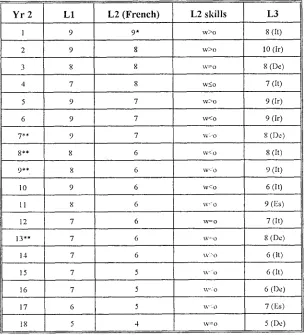
Table 3 : Ll, L2 (French) and L3 results for year 2, secondary 166
Chart for Table 3 167
Table 4 : Ll, L2 (French) and L3 results for year 3, secondary 168
Chart for Table 4 169
Table 5 : Ll, L2 (French), L3 and L4 results for year 5, secondary 170
Chart for Table 5 170
Table 6 : Ll, L2 (French), L3 and L4 results for year 6 secondary 172
Chart for Table 6 173
Table 7 : LI, L2 and L3 (French) results for year 2 secondary 174
Chart for Table 7 175
Table 8 : Ll, L2 and L3 (French) results in year 3 secondary 176
Chart for Table 8 177
Table 9 : Ll, L2 and L3 (French) results for year 5 secondary 178/179
Chart for Table 9 180
Table 10 : Ll, L2, L3 (French) for year 6 secondary 180
Chart for Table 10 181
Table 11 L I/L2 correlations 182
INTRODUCTION
The predominance of the English language internationally - and the view of many English mother tongue speakers that those who do not speak it ought to-has resulted historically in the UK in a negative attitude towards the study of foreign languages.' The traditionally grammar-translation methods that prevailed in UK schools particularly since the turn of the century both stemmed from, and in turn reinforced, this attitude since they were premised on the assumption that learners would rarely, if ever, have to use the language studied for purposes of practical communication.'` The predominant aim of foreign language learning was, as in the case of the Classics, to 'train the mind' and to
prepare learners to appreciate the literature of the foreign language in question.
Changes in the UK's socio-economic status after World War Two, however, particularly the demise of Empire and entry into the EEC, began to challenge this historical tradition.' Foreign language study gradually began to be seen, in successive HMI reports, as having less a cognitive/aesthetic than a practically communicative function, and it is noticeable that the inclusion of a foreign language as a foundation subject in the National Curriculum in 1988 was motivated by the need to enlarge the country's linguistic expertise in the areas of "... trade, tourism and international relations".`` This shift in perception of the role and value of foreign language study has, over the same period of time, been paralleled by a shift in perception of the methods needed to achieve a more skill-based goal. If, in the past, foreign language teaching had borrowed heavily from the arsenal for the teaching of Latin or ancient Greek, it now became increasingly open to research findings from the related areas of first and second language acquisition.
approach whose main objective, as argued by Brumfit and Johnson (1979) is to teach 'language in use'5 . The emphasis in this approach is placed less upon developing in learners a conscious appreciation of linguistic form than upon creating, as in a natural acquisition context, opportunities in which they can use the language for interactive purposes. Learners, it is expected, will gradually internalize the linguistic form as a result of communicative interaction and, in this process, any errors they make should be corrected only in so far as they impede the exchange of meaning.6
There is no doubt that the communicative approach has helped rectify many of the inappropriate procedures that characterized earlier foreign language study. It is to be wondered, however, to what extent its reliance upon duplicating in the classroom the process of natural acquisition models merely creates mirror-image problems from those of the past. As Barnes (1987:141) remarks:
"...it is seldom useful --and often quite misleading in the education context -- to treat both foreign and native languages as if the lessons of the one could be applied to the other".
Widdowson (1990:161), in a critical re-assessment of the communicative approach, echoes the point when arguing that the assumption that learners will simply acquire form as a by-product of functional use, as in a natural acquisition context, results in them gaining little more than an "imperfect repertoire of performance" without any "underlying competence".
language learning shares with other language processes but also what is specific to itself' Put another way, such a continuum should be able to describe the common variables involved in language development and define how the relation between these variables changes at any given stage of the acquisition-learning process.
Within this framework, the aim of the current thesis is fourfold:
* First, it seeks to critically re-examine the history of foreign language study in
order to indicate the ways in which findings from other language processes have often been used inappropriately as the basis for pedagogy;
* Second, it seeks to outline a model of language development which will examine the shifting relation of the socio-cognitive variables involved and their precise interaction in the area of foreign language study;
* Third, it seeks to illustrate the above model through a concrete analysis of language performance at the European School at Culham, UK, that is, through a process/product study of the differences between second and foreign language proficiency; and
* Fourth, it seeks to make tentative recommendations for foreign language pedagogy in the UK today at primary and secondary levels.
For the purpose of uniformity, I shall use the term LI throughout the thesis as a general term for mother tongue, first and native language, and L2 as a general term for second language acquisition/learning, using SLA, FL or any other appropriate term to refer to a precise context when the need arises.
Notes (introduction):
1. See Hawkins (1981:26).
2. As Harding (1967:4) puts it, teaching was "based on grammar and translation" and foreign languages, such as French and German, were highly valued for the "mental gymnastics".
3. Hawkins (op.cit.). Cf also Stern (1963:11,12 & 15). 4. DES report (1988:2)
The communicative approach, which assumes that the L2 learner can acquire the form through its functional use, is examined in greater details in chapter 2 (Cf also Widdowson (1990).
6. See Ready Reference Sheet 152, CILT, London, 1985. Point 7 in particular refers to the need to distinguish between an 'error' (such as 'a le bureau') which is inappropriate but which 'does not obstruct communication' and a 'mistake' (such as 'la! instead of 'les') which 'confuses the message'.
CHAPTER ONE.
MODELS OF LANGUAGE ACQUISITION /
LEARNING
1.1 INTRODUCTION.
First language acquisition is a relatively uniform process whose complexity is often minimized by the fact that almost all children reach a high level of proficiency without undue difficulty . Second language acquisition, particularly in an instructed context, on the other hand appears as much more complex in that the end product is both more differentiated and uncertain. As Kennedy (1973 :66) was to put it, referring to classroom-based instruction, only a very few learners "... ever seem to reach a very high level of proficiency".
Equally important, the results of both Ll and SLA research are often transferred to the foreign language classroom -- i.e. to a context for which they were not intended -- with serious consequences.
Obviously, in one sense, all language acquisition/learning processes involve a common set of variables, i.e. what Hickmann (1986:9) refers to as 'language, thought and social interaction'2. What is important about such variables, however, is that they interrelate in quite different ways according to the precise process involved, and attempts to transpose findings from one process to another -- without taking this into consideration -- can be counter-productive. As Widdowson (1990:26) has argued, the transfer of findings "... without regard to their particular conditions of validity" can end up by imposing on the learner a set of objectives, and a method to reach these objectives, which simply do not cohere with the needs of the situation.
The danger Widdowson was referring to is the danger of ignoring the specificity of any acquisition/learning context and a refusal to base methodology on what is specific to that context. In this chapter, we intend to examine various models of language learning from the point of view of their danger in imposing one-sided frameworks on the foreign language teaching context and, through such a critique, to delineate a more complex model which will allow us to demonstrate what foreign language pedagogy has in common, and what distinguishes it from, other language processes.
1.2 TRADITIONAL MODELS:
not so much their different starting points but their common assumptions that the process of first language acquisition is based upon learner strategies which equally apply to the second/foreign language context. Such assumptions have had serious long-term effects on syllabus design and pedagogy in second/foreign language learning.
1.2.1 Behaviourism.
Behaviourist accounts of Ll acquisition have long been in disrepute as a result of Chomsky's withering critique of Skinner's Verbal Behavior. The view that language can be treated as a purely 'behavioural' process, acquired through imitation, mimicry, repetition and reinforcement, simply cannot explain either the process of language acquisition (i.e. the fact that young children 'create' language, as illustrated through their interlanguage4) or their ability to reach adult competence. The intention here is not mainly to review behaviourist accounts as an inadequate theory for Ll acquisition but rather to examine those features of the model which assumed that there was no difference between the Ll and L2 language processes and the problems that ensued.
1.2.1.1 Habit Formation
Students, Lado (ibid.: 51) argued, must learn patterns of construction and "... establish them as habits. This is pattern practice." Such practice is developed through 'mimicry-memorization' and 'immediate reinforcement' with the reward mechanism being interpreted as praise when the learner is successful.
The idea that language acquisition or learning can be reduced to imitation alone is, of course, no longer tenable on empirical grounds. Littlewood (1984:10) refers to relatively early studies of young children's LI interlanguage (Brown, 1973) which revealed that "... the order of frequency does not correlate with the order of acquisition" and which therefore, Littlewood adds, "cannot be explained in simple habit-formation terms." Further studies in L1 and L2 (Dulay and Burt 1973) confirmed that learners appear to be actively involved in a process of rule-construction, through hypothesis-testing, and whether this is seen as due to a Language Acquisition Device (LAD) in the Chomskyan sense or not, it becomes clear that, as Littlewood (op.cit.: 16) argues
"... imitation plays a secondary, consolidating role, with the primary role being played by more creative, rulerforming processes."
Of course, to speak a language efficiently, one must acquire some automatic responses and it would be foolish to reject totally the idea of intensive practice to acquire some lower-level (habitual) skills in order to free the higher level processing devices (McLaughlin, 1987). As Belyayev (1963:28) argued, however, evidence has shown that even lower level skills are "more firmly assimilated when the process of acquiring them under the influence of practice is a sufficiently conscious one" and, he adds, in an L2 context, such consciousness would seem to be unavoidable.
1.2.1.2 Meaning
Teaching, Lado (ibid.:121) stresses, must be directly through the target language to the exclusion of the mother tongue in order to avoid 'interference'. The use of the target language should be retained even at the expense of meaning for, he argues, it is better "to let the class go without grasping the meaning of a word they have learned to pronounce rather than resort to translation."
The scant attention paid to meaning in audio-lingual theory was, again, a fairly faithful reflection of Skinner's views that LI acquisition is largely an unconscious process. As Rivers (1968:63) argues, however, in her critique of audio-lingualism, using language as a response to "formal cues rather than as an expression of personal meaning" can result in a language classified, as Hawkins (1981:210) puts it, as 'non-serious' and detrimental to the drive to learn. This view is echoed by Wilkins (1974:39) who stresses that, while there may indeed be a need at times to focus on the formal aspects of language, these are "more readily acquired when they occur in a meaningful context."
and 'personal investment' of effort by the learner.8 Students' memory, he argues quoting a study by Bower and Winzenz, "... benefits from actively searching out, discovering and depicting" as contrasted with the staple diet of audio-lingual lessons, that is, "rote repetition, sentence reading, or even generation of their own relatively unimaginative sentences." One of the reasons why greater depth leads to better memory retention for recognition and recall, he argues (ibid.:30), "may be that the meaningful context permits
more complex processing."
The psychological and cognitive criticisms of the audio-lingual treatment of 'meaning' are reflected at the pedagogic level. Insistence on sole use of the target language even when meaning is obscured simply fails, as Hawkins (1981:175) points out, to take advantage of the "the vast amount of semanticising that the pupil has accumulated already via the mother tongue." Hawkins is not arguing for frequent use of the mother tongue but is simply suggesting that the L2 child has already conceptualised the world and that L2 pedagogy has to make use of that knowledge when there is simply insufficient time to "reconceptualise his [i.e. the learner's] whole 'world view". Rivers (1964:123) makes the same point when she suggests that relying on LI conceptual knowledge to convey meaning increases memory retention, and that it is 'unrealistic' (Rivers 1964:20) to expect to re-create LI learning conditions in a classroom with L2 learners with well established habits in L I
The view behind this, as Ellis (1985:22) suggests, is that 'positive transfer' between L 1 and L2 will occur at points of similarity and 'negative transfer' at points of difference. Errors are, in this sense, seen as being caused by interference of the mother tongue and this is to be combatted by maximum use of the target language and by a syllabus design, based on contrastive analysis, which permits 'saturation drilling' at the problem areas.9
Contrastive analysis has come under criticism for a range of assumptions. It has been claimed by Ellis (1985:25), among others, that structural linguistics simply lacked the framework for comparisons to be made and that such comparisons lacked cultural validity as no common categories could embrace all languages. m There are, however, two more important points that need to be made. In the first instance, as Ellis (ibid.:26) argues, it is premised on the rather naive view "that the degree of linguistic difference corresponds to the degree of learning difficulty." Such a view tends to assume that what is an artefact of the linguistic system has psychological reality, as Littlewood (1984:19) points out:
"...'difference' and 'difficulty' are not identical concepts. The former derives from linguistic description and the latter from psychological processes, and there is no reason to believe that they should correlate with each other in a reliable way."
Studies by Larsen-Freeman & Long (1991:53-56) would seem to indicate the opposite and, as McLaughlin (1987:66) argues, contrastive analysis
"... overpredicted because it identified difficulties that in fact did not arise, and it underpredicted because learners made errors that could not he explained on the basis of transfer between languages...".
In the second place, and clearly related to the above, it was unable to grasp that errors may be systematic but may not simply be due to transference but depend upon context, age and stage of linguistic and cognitive development.
studies of Dulay and Burt (1973:249) or Baetens-Beardsmore (1986) found -- transference errors are limited in their contribution and can often be less significant than developmental errors, e.g. those of over-simplification and overgeneralization.11 As Corder (1978:85) comments:
"... we cannot immediately distinguish those erroneous mother tongue features which are a result of restructuringfrom those which are borrowings resulting from a guessing strategy of communication, but which do not derive from (are not generated by) the current state of the speaker's interlanguage grammar."
A comprehensive analysis of the weaknesses of audio-lingualism can be found in Rivers (1968), Belyayev (1963), Hawkins (1981). The aim of this brief review was mainly to highlight those of its features which assumed that the Ll acquisition process could be applied to the L2 learning process without taking into account the different socio-cognitive variables of each.
1.2.2 Mentalism
Behaviourist views of language acquisition came under serious criticism in the 1960s mainly, as already indicated, as a result of Chomsky's critique of Skinner's Verbal Behavior. The central thrust of Chomsky's critique was that mimicry, memorization and generalization by analogy were simply insufficient as mechanisms to explain the child's ability to master the adult language system. As Chomsky (1979:180) was to put it:
"...language acquisition is not a step-by-step process of generalization, association and abstraction, going from linguistic data to the grammar, and the subtlety of our understanding transcends by far what is presented in experience."
- First, he pointed out (1979:94), the data to which the child is exposed is "very limited and often imperfect" and is characterized by deviations, false starts, pauses and changes in direction. The fact that the child, in acquiring his mother tongue, manages to correctly separate the underlying rules of the language from those aspects of performance which are inessential or even misleading indicates that imitation cannot play a major role.12
- Second, he stressed, in seeking to identify and use those rules underlying performance, the child actually 'constructs' many which he could not possibly have heard. And indeed, the fact that a child can produce a tag such as 'bettern't he?', incorrectly generalizing English interrogative forms with 'should' or 'could', shows that he is not just repeating what he has heard but that he is actively seeking to discover the rule system of the language. As Wilkins (1974:27) comments:
tl
... a good deal of his language production is not imitative at all. Not only does he
have the ability to take words and phrases that he has heard and use them in new combinations, he also actually produces pieces of language that he could not have heard from the other people in his environment."
- Third, Chomsky argued (1979:98), as children construct the rule system of their language, they seem to go through identical stages en route and arrive at "... comparable grammars, indeed almost identical ones" as they reach adult competence. If, he went on, children's language development was based mainly on a response to the data to which they were exposed, differences in this data should lead to differences in both the rate and route of the child's language development for which there exists no evidence. `3
exposed, of reaching a comparable degree of linguistic competence?" The answer Chomsky gave (1979:98) was that they must be preset with "the same internal constraints which characterize narrowly the grammar they are going to construct" and which operate, to a large degree, independently of external stimuli. To the extent that children are capable of learning any language with equal ease, these constraints must underlie all languages as common base structures which can be turned into the language-specific surface structures via transformation rules.
While Chomsky's views tended to set the paradigm for first (and second) language research in the 1970s, however, it was in turn soon subjected to criticism. The major problem was, as Romaine (1984:258) argues, that Chomsky tends to see language "largely in terms of formal syntactic structures" and to ignore its socio-psychological aspect as a tool for communication. Indeed, many writers have found in Chomsky's separation of form from function almost a perverse vantage point in seeking to explain the process of language acquisition. Wardhaugh (1986:10), for instance, has criticized his "explicit rejection of any concern with the social uses of language" and Dore (1978:107) has underlined the fact that his work fails to explain "how to use sentences for purpose of communication". Chomsky's grammatical competence is, indeed, totally divorced from actual language use and communication with its richness, intricacies and cultural refinement.16
figures such as Brown may reflect an accuracy rather than acquisition order:
"Accuracy has to do with behaviour, acquisition has to do with knowledge. One cannot directly infer one from the other."
Finally, and closely related with the last point, the idea that children reach comparable degrees of grammatical competence by age five is, as Romaine (1984:78 & 79) indicates, no longer tenable. This is not only true at the level of discourse grammar but even at the level of sentence grammar where, as Bruner (1978:18) points out, the rules are not learnt 'immediately and perfectly'.
While Chomsky's nativist views have increasingly been criticized in the area of L1 acquisition, however, their impact upon second/foreign language learning has persisted particularly in the work of writers such as Krashen whose Natural Approach is a relatively faithful reflection of Chomsky's views in a pedagogical setting. In a way which is similar to Lado, Krashen (1981) sets out eight points which underpin what he refers to as a 'principled' approach to foreign language teaching. In one sense, these points are subject to the same critique directed against nativist views at the L1 level but they also, again like Lado's views, are doubly problematic in that they fail to take into account obvious differences between the L1 and L2 process. It is for this reason that the three most salient points are worth considering:
1.2.2.1 Learning and Acquisition.
hypothesis. The assumption is that, as in the L1 context, the learner's LAD will automatically seek to induce the rule system from the linguistic data to which it is exposed and that any attempt to bypass this by consciously making the learner aware of the rule system will be counterproductive. Such an assumption underpins the inductive conclusions of a range of applied linguists, such as Newmark and Reibel (1970:239), who argue that all that is required is to present the learner with "instances of meaningful use" which he can "store, segment and eventually recombine" to create personal meaning.
While such assumptions are quite common today, Krashen's emphasis upon the unconscious nature of L2 learning is probably as difficult to sustain as was Lado's. It may be that the child's acquisition of his mother tongue is largely an unconscious process, in which attention is focused on what language 'does' rather than what it 'is', but whether this can be reproduced in the formal constraints of a classroom is quite a different matter. In the first place, it is possible that since the LAD begins to fossilize in early adolescence and is replaced by -- what Ellis (1985:49) refers to as -- the 'cognitive organizer', the
second/foreign language learner has to rely upon more general cognitive strategies. In the second place, as Mclaughlin (1987:46) argues, there is no reason to believe that more conscious strategies of this kind are not as valuable as unconscious ones and, in many ways, more suited to a context in which there are few opportunities for genuine communicative interaction in which language form can be acquired as a by-product of functional use.''
1.2.2.2 Comprehensible Input.
that what the L2 learner has access to is the same sort of 'roughly-tuned' input as the L 1 child (i.e. 'motherese') or what Krashen & Terrell (1988:33) refer to as the level of 'i + 1'. The sole criterion of such input is that it should be understandable by the learners since it is comprehension above all that leads to acquisition (ibid.:32).
There is no doubt that Krashen's views on 'roughly-tuned' input have had a major influence on the current interest in 'authentic' materials in the second/foreign language classroom. As McLaughlin (1987:37) has pointed out, however, the argument is flawed in several respects above and beyond the self-evident point that it "...seems to be an
uneconomical model for language acquisition" in a classroom where limited time is available. In the first place, as McLaughlin observes, there seems to be a contradiction between Krashen's view on the value of 'caretaker-speech', based on simpler codes, and his assertion that older learners progress quicker than younger learners. In the second place, however, and somewhat more importantly as McLaughlin (1987:38) continues,
"Comprehensible input (made meaningful through extra-linguistic information) cannot, in and of itself, account for the development of the learner's grammatical system. Understanding messages is not enough. How does the learner progress .from understanding to acquisition? Here the theory is silent."
1.2.2.3 Invariant Route
Accepting as they do the concept of the invariant route, Krashen and Terrell see errors made by the learners not as transference errors but largely as inevitable stages that the learner passes through in testing out and correcting his hypotheses of the language. Since this is the case, they argue (1988:27), citing the fact that parents usually restrict themselves to correcting L 1 children's semantic rather than syntactic mistakes, "error correction in particular does not seem to help".
Again, the tendency to see errors as evidence of the learner's attempts to construct the rule system of the target language is widespread in communicative circles. It has been subject, however, to growing criticism. In the first place, there is no reason for believing that the invariant route hypothesis in the L2 context is tenable. The scanty evidence based on morpheme studies by Dulay and Burt may be, as Ellis (1985:69) admits, an 'artefact of the Bilingual Syntax Measure' used, that is, it might not correspond to any real-life acquisition order and it may not take into account the fact that L2 learners from different L1 backgrounds might process L2 differently (ibid.:63).
Equally important, as Skinner (1985:375) argues, one cannot simply infer that the process is similar even if the order were to be the same:
"Even if the sequence of acquisition for L2 were precisely identical to the sequence of acquisition for LI that does not mean, necessarily, that the ways in which those sequences may be acquired are identical. Clearly, the process ,of acquisition cannot be identical."
him avoid them.
1.2.3 Summary
In many ways, behaviourist and mentalist views would appear to contain quite different implications for the foreign language classroom. The first appears to give the priority in the learning process to environmental factors and the child's growth is measured simply as a response to the stimuli from that environment. It is no accident that such an approach prioritizes teaching rather than learning since, within this framework, it is the teacher who is responsible for selecting, preparing and inputting the data which the pupils are expected to respond to. The second approach, on the other hand, appears to see environmental factors as relatively unimportant in the development of the child whose linguistic competence is pictured primarily as a maturational process. Unlike behaviourism, therefore, mentalism would seem to favour a much more child-centred approach in which the role of the teacher is seen as that of a facilitator, that is, as providing the data on which the child's LAD gets to work".
1.3 COGNITIVE MODELS.
As indicated, behaviourist and mentalist views of language acquisition are mono-dimensional in that they seek to reduce a complex process to either repetitive imitation or maturational growth. What is common to both is the idea that this process is largely discrete and that intervening variables can, at most, exert only a secondary influence in terms of delaying or accelerating it. In exactly the same way as behaviourism proved to be inadequate in explaining such factors as linguistic creativity, however, so the nativist hypothesis was soon to be criticized by writers such as Bruner (1978:43) as "plainly insufficient." As the latter was to argue, there may be no need to posit the existence of a Language Acquisition Device (LAD) since language acquisition must be "... enormously aided by the child's pre-linguistic grasp of concepts and meanings that make it easier for him to penetrate grammatical rules."(ibid.43).21
extent that they seek to relate language development to a prior degree of cognitive growth, such models can be helpful in explaining the different reaction among learners to new linguistic demands placed upon them, particularly those related to second and foreign language learning.
1.3.1 Language in the Piagetian model
The dependency of language upon cognition finds its clearest expression in Piaget's model of the incremental development of the child's intellectual growth and in research carried out within this framework. Piaget strongly opposes Chomsky's view of an innate acquisition device22 and, as Harris (1982:31) points out, proposes the development of thought as the commanding element in language development. Two well-known main themes underpin Piaget's model: the constructive adaptation of the child to the environment and the developmental aspect of the resulting intellectual growth.
For Piaget, "all behaviour is adaptive"23 and central to his theory of adaptation is the notion of 'equilibration', that is, the ongoing attempts by the child to regulate his own behaviour in relation to the environment. Equilibration, he argues, is achieved through trial and error, through a complex alternation of 'assimilation' of new experience and 'accommodation'24, the modification of existing behaviour in the light of this experience to
"...the failure of the system in its earlier form to make appropriate (assimilatory and/or accommodatoty) adjustments initiates a self-development such that in its later form its powers are adequate to meet new situational demands."
Initially, the 'schemas' that are internalized as a result of the child's interaction with the environment are what Hawkins (1981:178) refers to as "structures of activity/ thought" but they become increasingly more complex and abstract as the child moves from the sensori-motor period, via the pre-operational and the logico-deductive, to the h othetico-deductive period. Greater decentration in action is accompanied by a similar process in thought evolution, and the child's initial egocentricity -- resulting from, Hickmann (1986:26) remarks, "his lack of decentering"25 -- gradually gives way to a greater
objectivity in thought and action. The child learns to generalize, systematize and conceptualize at higher levels of abstraction and so to operate in more decontextualized settings which are less linked to the 'here and now' and to his personal relationships. Only in the final stage of 'formal operations', i.e. at about the age of 11, can the child manipulate abstract concepts with reasonable ease.
For Piaget, the role of language in this process is quite precise. As a "system of representation like any other", as Walkerdine and Sinha (1978:153) put it, it only emerges at a given stage when thought processes have been engaged through action. In other words, as Cromer (1988:229) confirms, "nonlinguistic representation is a precursor of representational language" and the latter follows and reflects, rather than influences, the cognitive development and logical structures of the child:
"Bref, le langage est subordonne a la pence, c'est-a-dire a l'inlelligence
interiorisee, s'appuyant non plus sur l'action directe, mais sur l'evocation
symbolique." (Legendre-Bergeron 1980:127).
then the gradual decontextualization of speech, the ability for example, Hickmann (1986:17) points out, "to speak of displaced entities, events and relations among them which are not part of the here-and-now and/or to take into account the perspectives of their listeners", is dependent upon a prior cognitive decentering. Language develops from 'egocentric' to socialized speech, including the ability to think logically, as a result of a process of decentration from concrete situations.
The view of language as stemming from, and reflecting, a maturational process of cognitive development has important implications for the child's mastery of new language skills, particularly in a school context. The ability of the child to master literacy skill development, that is, his ability to handle disembedded language or language that has become its own context, depends very much upon the whether or not he has reached the stage of 'disembedded' thinking. Morever, since Piaget tends to see cognitive development as a maturational process which can only marginally be affected by social factors, there would be no point in seeking to provide the child with activities -- such as reading or writing -- for which he is not cognitively ready. As Legendre-Bergeron (1980:33) was to put it:
"Les operations de l'intelligence ne s'apprennent pas, elles se construisent".26
It is the maturational process of cognitive growth that provides the child with the ability to manipulate and control his language at an ever greater level of abstraction in a decontextualized context.
language from context-embedded to context-reduced situations, is much more sophisticated than either behaviourist or nativist alternatives. If it has a weakness, it is, as Donaldson (1978) points out, in its tendency to see the cognitive -- and therefore linguistic -- development of the child as being maturational in nature and relatively independent of social factors. As Walkerdine and Sinha (1978:152) remark, Piaget's 'dialectic' "maximizes the macro (or bio-physical) features of the environment while minimizing the micro (or culturally-determined ones)".27 For Donaldson, this tends to simplify the relationship between language and thought which is seen as one-sided rather than reciprocal. As she points out (1978:89), the fact that parents can successfully help their children to deal with abstract thinking by talking about language to them -- making them more aware of its symbolic capacity -- shows the inter-relation of thought and language.
1.3.2 Context-embedded and context-reduced language
pay attention to the way language itself, as a symbolic system, encodes meaning. As Romaine (1984:172-173) puts it:
"In spontaneous speech speakers rely less heavily on syntax to articulate semantic relations between referents or propositions."
While the young child may rely heavily on contextual clues in 'making sense' of language, however, this process changes dramatically on entry to school. The young child at school is involved in a process of extending his linguistic repertoire, of developing new language skills (particularly reading and writing) where contextual clues are considerably reduced and where accessing meaning depends much more upon understanding and manipulating the symbolic system itself As Romaine (1984:168) puts it, the young child at school must become aware that the "meaning is in the text and not in the context" or, as Cummins (1979:238) otherwise suggests, that "the written language is different from speech". He must, Cummins (1979:239) explains, learn to deal with the "ideational" function of language which "... specifies the semantic and logical relations between subject and predicate of a sentence", in other words, which stresses the importance of grammatical accuracy and precise linguistic formulation in exchanging meaning.28
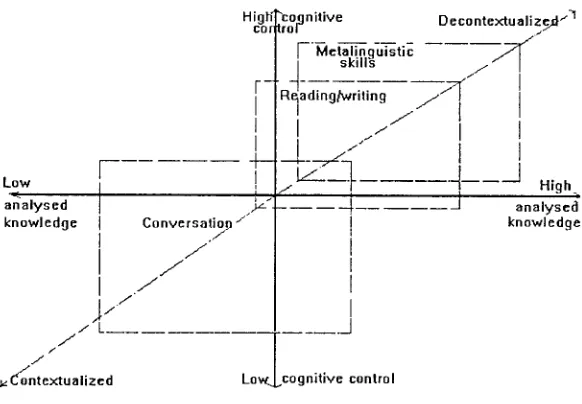
growth of the student". Bialystok's graph (figure 1),
LrV
High ognitive
CO lei DecontextualizetV1 .., FIYIetalinguistic Zr
r -I
skills
. 77--,T .."-- I Rladingiwriting ,...,
/'- I
I I -.-' i
.
,..-
I 1.Z...4_ ---.-1— —
_ J
High - '''.,14- -- -4-- ----I analysed. knowledge Low
analysed
knowledge Conversa, 7 7
i,C'Ontex-tualized Low_cognitive control
Figure 1: Bialystok & Ryan as adapted from Hamers & Blanc (1989:69).
to which Hamers and Blanc refer (1989:69), is a good illustration of the different cognitive demands placed upon a child at school. In everyday conversation, the levels of analysis and cognition needed are low and contextualization is high. In contrast, literacy skills require a certain ability to decontextualize whilst metalinguistic skills figure at the highest point of decontextualization where most academic skills reside.
It should be noted that the transition from spontaneous spoken to analytic written language is neither easy nor fast and, as Donaldson (1978:123) suggests, it "... does not happen spontaneously". Children have to be helped to make the transition since, as Hamers and Blanc (1989:66) stress, "the mere mastery of a language for everyday communication is not sufficient to guarantee that it will be used in the organization of knowledge".
1.3.3 Relation of first and second language
has featured prominently in the work of Cummins (1986b:153) who usefully differentiates between them as follows:
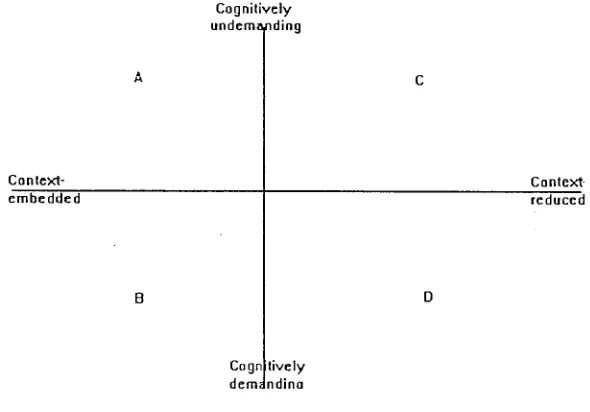
"In general, context-embedded communication derives from interpersonal involvement in a shared reality which obviates the need for explicit linguistic elaboration of the message. Context-reduced communication, on the other hancl, derives from the fact that this shared reality cannot be assumed, and thus linguistic messages must be elaborated precisely and explicitly so that the risk of misinterpretation is minimized".
Such a definition mirrors the earlier distinction in the work of Donaldson between oral and written language, the latter being more explicit and cognitively demanding. His representation of cognition along a continuum (figure 2) clearly indicates the increasing level of cognitive skills required as the child progresses through school. The skills the child has to master range from basic to highly analytic literacy skills where advanced texts are to be processed by the older student in tasks where, as Cummins (ibid.:154) puts it, "the communicative tools have not become automatized".
Cognitively undem ding
A
Context- Context-
embedded reduced
B
Cogn lively dem ndina
Figure 2: as adapted fromm Cummins (1986h:153).
language development as a continuum but that he extends this process from the Ll to the L2 context29, in particular in relation to his analysis of immigrants' poor academic attainments in the United States.
1.3.3.1 Surface fluency and academic proficiency.
In the light of the evidence in the U.S.A., Cummins argues for the need to make a distinction between two types of language proficiency, surface fluency and academic proficiency. The former he refers to as the basic inter-personal communicative skills (BICS), and the latter as the cognitive academic language proficiency (CALP) i.e. when linguistic demands require a high level of cognitive development.
Underlying Proficiency Theory'. It can be summed up in his view (1979:233) that "... the initially high level of L 1 development makes possible the development of similar levels of competence in L2".
Skinner (1985:380) negatively endorses this approach when he suggests that:
"... the lower the proficiency in LI--the greater the reliance on surface features as a means for communication-- the less potential there is for transfer".
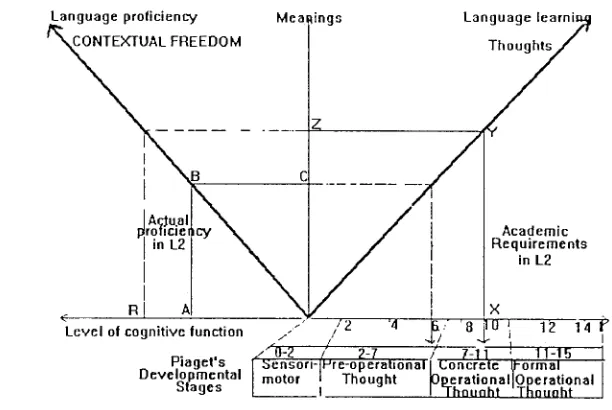
He graphically shows the outcome when a child is confronted with academic requirements in his L2 well above his level of cognitive development and 'contextual freedom'. A 'cognitive gap' is created which places the learner in "a 'no-win' situation where academic failure is the inevitable result" (ibid.378). This is exactly what happens, he and Cummins maintain, to immigrants placed in classes with L2 native speakers whose literacy skills and cognitive level are already sufficiently developed for them to deal with decontextualized, academic language (Cf figure 3).
Language proficiency Mea ings
CONTEXTUAL FREEDOM
Language learnt
Thoughts
j
rjotliael in L2RI A
Level of cognitive function
Piaget's Developmental
Stages
Academic Requirements
in L2
X
4 16, 1p 12 14T
,V0-2 (1 2-7 1 7-11 11-15 Sensory- Pre-operational loConcrete ti-ormal motor Thought erati
ahtonallOperationalThouaht Ihnu
Figure 3: as adapted front Skinner (1985:379).
academic requirements which assume a concept development level at point Y. To be able to cope with high academic requirements in L2, the child must have acquired a correspondingly high level of 'contextual freedom' in LL enabling him to transfer to L2 the cognitive skills needed to deal with decontextualized tasks.
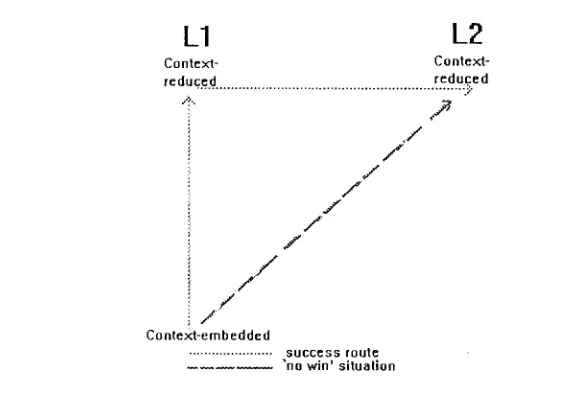
Cummins's work is of particular interest because he extends the relation between cognition and language into the L2 context. His central argument is that successful and effective acquisition of L2, particularly in terms of context-reduced academic skills, depends upon the level of cognition built up through L 1 . In other words, a L2 learner can be expected to reach a high level of proficiency in his second language only if a high cognitive level has been reached in L 1 first -- a view fully supported by Swain (1986a:101) who invokes the principle of "first things first". Cummins' model could be represented as in figure 4:
Li
L2
Context- Context-
reduced reduced
Context-embedded
success route
sno win' situation
Figure 4: academic success in L2 possible only if cognitive skills are developed through LI first
"...for children whose LI skills are less well developed in certain respects, intensive exposure to L2 in the initial grades is likely to impede the continued development of LI. This will, in turn, exert a limiting effect on the development of L2."
Cummins proposes that a first threshold, at the minimum level of cognitive development relative to basic literacy skills, must be attained in L1 before L2 can be introduced academically. Below such level, negative cognitive effects resulting in semi-bilingualism, as it occurred in the USA, are to be expected.3°
1.3.3.2 Empirical evidence
Cummins draws upon empirical evidence from a wide range of sources to back up his assertion that the development of cognitive skills in L1 is essential for attaining academic proficiency in L2. These include:
"... those who had 20% English and 80% French schooling were as good in English and had superior results in French skills than those children who received 80% of their instruction in English and 20% in French."
By contrast, Hamers and Blanc continue, Navajo children in the ESL program were "two years behind the American norms for reading skills in English at the end of Grade 6, despite an extensive teaching program of ESL". (ibid.:207)32 The latter case shows, as Cummins (1979:236) suggested, that "a loss in L1 did not result in any gains in L2 despite the increased interaction through L2" whereas the former demonstrates the benefits, for LI, of promoting LI (French) "at no cost to achievement in L2", (English).
(b) the age of arrival of immigrants where, Cummins points out (1984a:3) "... older immigrant students (10-12 years old), whose academic proficiency (e.g. literacy skills) in Ll was well-established, developed L2 academic proficiency more rapidly than younger immigrant students". An example of this is the case of Finnish children who migrated to Sweden at the age of ten and who, Cummins (1979:234) adds, "maintained a level of Finnish close to Finnish students in Finland and achieved Swedish language skills comparable to those of Swedes". Those whose age of arrival was only 7 or 8, however, experienced a number of difficulties, thereby suggesting that younger children, placed in an L2 medium of instruction, lack the necessary cognitive skills in L 1 to enable them, through cross-lingual transfers, to cope with L2 at an academic level. In other words, as Hamers and Blanc (1989:51) put it, "competence in the mother tongue had to be sufficiently established before the child could successfully acquire a second language".
yet mastered to a minimal extent at the informal level:
"...whereas there is some evidence that the communicative functions of language can develop without a full development of the cognitive functions, there is no known evidence that cognitive functions of language can develop in the absence of the communicative function. Whenever the communicative function is for some reason prevented from developing, then no language function will be able to develop."
In Ll, such criteria are generally fulfilled, thus setting the framework for a progressive de-contextualization in the use of that language. In L2 however, as Cummins suggests (1979:238) for many immigrants "it appears likely that the semantic prerequisites for literacy skills can be developed more easily through LI than through L2". Cummins therefore strongly criticizes the situation of immigrants facing totally unrealistic demands at school in (a) a language they have not yet mastered fully at the informal level, and at (b) a level of cognition they have not even reached in their own language. He refutes (ibid.:223) any suggestion that 'academic retardation' should be attributed to 'linguistic mismatch per
se' or to cognitive deficiency per se (ibid.:240)
language skills in Ontario by English-speaking pupils "remained below average until a marked improvement was noted in their English achievement scores" with considerable improvement thereafter. Such data tend to support the claim, by Swain (ibid.:105), of "the crucial role played by the first language in second language development".
1.3.4 Implications for foreign language learning
The main point argued by Cummins, within the framework of cognitive models of language acquisition, is that the ability of the learner to master decontextualized skills in the second language depends upon the level of cognition established through the first. This argument has been explored with even more urgency in relation to the even more context-reduced foreign language classroom by writers such as Hawkins.
Hawkins (1981) argues that foreign language learning within an L 1 monolingual context involves the learner in a highly decontextualized process and the ability of the learner to make sense of this process depends, even more than in a SLA context, upon the cognitive skills --including metalinguistic awareness -- that they have built up through their L I. As he was to put it (1984:181):
"... Learning to read is thus 'parasitic' upon 'awareness, that is, insight into the structure of the primary activity. In its turn, learning the foreign language under school conditions is also parasitic upon the learned skills of reading and writing and of matching sounds to symbols..."
Hawkins (1984:36) sees as lacking in such pupils are good aural discrimination skills, "insight into patterns in language; confidence in disembedding phonological patterns; practice in matching written to spoken symbols; relish for what is new and strange in language". These are, of course, precisely the sort of skills which Skehan (1988:52) indicates as being "implicated in the decontextualized component of language aptitude tests". Insight into pattern has, as Hawkins (1984:4) himself notes, long "been shown to be a key element in aptitude for foreign language acquisition".
1.3.5 Conclusion
Cognitive models have undoubtedly provided a valuable contribution in explaining language acquisition/learning. Because they view the ability of the child to access new language skills as being related to, and dependent upon, a prior level of cognitive growth, they have a much greater capacity to explain differences within child language proficiency. In particular, in so far as the ability of the child to handle decontextualized language depends upon high cognitive skills achieved through their prior language experience, they help explain differences in achievement in L2. To access a second language, the learner requires a minimum of cognitive skills corresponding to the degree of decontextualization of the learning process which can vary across a spectrum of settings, from a non-instructed SLA to an instructed FL context. Clearly, however, the higher the level of cognition developed through LI, the greater the efficiency of the L2 acquisition/learning process in any of these contexts.
the importance of social factors in language acquisition/learning.
1.4 INTERACTIVE MODELS
Cognitive models of language acquisition/learning are valuable in that they explain children's use of language as a function of the different demands placed on them in a continuum of context-embedded to context-reduced settings. Piaget's model is somewhat rigid, however, as are those of others writing in his tradition,33 in that language is seen as playing a quite subordinate role in this process, i.e. it reflects, rather than initiates, cognitive processes. As Walkerdine and Sinha (1978:153) observe, "... systems of representation do not for Piaget develop from the structures of language but from the structures of action", that is, from the schema internalized as a result of the child's ongoing interaction with his environment. Cognitively determinist views fail, in particular, to explain a number of aspects of language acquisition/learning, most notably the fact that children's linguistic competence often appears to be in advance of, rather than follow on from, their conceptual level.'` As Cromer (1988:236) remarks:
"... although the cognitive hypothesis may go some way in explaining why children in the course of language acquisition encode some concepts before others, it is certainly not sufficient on its own to describe the entire process of language acquisition."
In other words, cognitive models are oversimplistic as they can reduce language acquisition to its "cognitive underpinnings" (ibid.:245) or, as Romaine (1984:165) was to suggest, cognition may be a "pace-setter for the syntactic categories available to the learner" but this does not mean that "cognition and syntax/semantics are order-isomorphic".
cognitive ones in that they view language development as a result of a complex inter-relationship between context and cognition rather than as simply the result of the influence of the latter. An example of such a model is that of the Russian psychologist Vygotsky which, while sharing many features in common with that of Piaget, differs from the latter's in several crucial respects.
1.4.1 Social roots of language
Vygotsky's view of language as a ''social means of thought" has become increasingly influential in recent years.35 An examination of his model, in relation to that of Piaget, should help to clarify the differences between the two and to promote a deeper understanding of the acquisition/learning process. As indicated earlier, according to Piaget, language acquisition tends to follow the gradual decentering of the child's cognitive structures. This decentering allows the child to move from egocentric to social forms of behaviour and from context-embedded to context-reduced uses of language, that is, to language employed in dealing with, as Hickmann (1986:17) put it, "displaced entities, events and relations". The basic difference between Piaget and Vygotsky occurs at precisely this point since, for the latter, the relationship between language and thought is reversed. Language is not seen as simply a function of cognitive growth but as a tool of social interaction which, as it is internalized by the child, becomes a powerful stimulant in its own right to his intellectual development. In other words, it is not thought that gives rise to language but language to thought or, as Vygotsky (1986:36) argued, "... the true direction of the development of thinking is not from the individual to the social but from the social to the individual".
in so far as the child's ability to use language as an abstract, decontextualized system of signs (e.g. as in logical reasoning) is seen as the end point of a series of interim stages.36 While agreeing with Piaget on the need to adopt a development approach, however, he sees the child's growing ability to decentre as stemming not from a purely maturational process, but from his internalization of "the social means of thought, that is, language'''. He therefore disagrees with Piaget in three main areas which are worth outlining since they have important implications for second language acquisition/learning: the relation between the social and individual, between language and thought and between the cultural and the biological.
1.4.1.1 The individual and the social.
The primary function of language, Vygotsky (1986:34) argues, is "communication, social contact" and it is acquired by young children as a function of social interaction. The young child acquires the language of his speech community via the "ready-made generalizations" (ibid.:123) that are implicit in adult speech but which have the potential of transforming language into "an instrument of individual thought" (ibid.:236) Much of Vygotsky's work is essentially an analysis of the process whereby what starts for the child as a communicative tool, a means of interacting with others and bestowing meaning on such interaction, gradually becomes an internal cognitive organizer.
elaborated and, as they are internalized by the child, become the basis of the latter's intellectual development. The role of egocentric speech plays an important role in the process and is explained by Vygotsky quite differently from Piaget. Whereas, for the latter, egocentric speech is seen as a reflection of the child's cognitive decentering, that is, a transitional stage from the individual to the social, for Vygotsky, it is seen as a transitional stage "... from the social, collective activity of the child to his more individualized activity" (ibid.:228). In other words, egocentric speech is portrayed as a step forward from social speech towards 'inner speech', that is, towards conceptual thought whose development originates at the beginning of schooling and which is the basis of the child's more differentiated and individualized39 use of language (both spoken and written). This
difference between Piaget and Vygotsky in terms of this process can be seen in the following diagram.
Inner Egocentric ---- Social speech speech speech
Piaget
Vygot sky
Figure 5: Language development as seen by Piaget and Vygotsky.
1.4.1.2 Language and thought
As indicated above, the acquisition of language does not mean that the child simply internalizes the concepts embedded in adult speech. In the early stages, as Vygotsky stresses, language exists at a pre-intellectual level just as thought exists at a pre-verbal level, and it is only towards the age of two that the two interact and form the basis of verbal thought.4° The process is hardly completed at this point, however, and the child has to pass through a complex series of stages before full concept formation is reached. What is important about this process is, once more in contradistinction to Piaget, the "decisive role" (ibid.:139) played by language (or, more precisely, the 'word') and its "guiding function in the formation of genuine concepts" (ibid.:145). It is, Vygotsky argues, only by the child beginning to understand the arbitrary and categorizing function of the word that he can begin to disembed his thinking, to "view the abstracted elements apart from the totality of the concrete experience in which they are embedded" (ibid.:135).
not exist without verbal thinking".
It is through language, therefore, that the thought process of the child develops because the word is a means of "...focusing one's attention, selecting distinctive features and analyzing and synthesizing them" (ibid.:106) Word meanings, which are initially linked to the personal needs of the child in the 'here and now', evolve through primitive and complex generalizations to reach genuine abstract thought divorced from concrete experience. In the ever more complex inter-relation between language and thought', language itself initiates the process which leads to concept formation, and it is the ability of the child to reflect back upon language`'` -- to use it ever more consciously and deliberately to carry out his intentions -- that enables him to operate effectively in more context-reduced settings.
1.4.1.3 Biological and cultural
For Vygotsky, the fact that the child's cognitive growth is rooted in linguistic interaction means that, as Hickmann (1986:12 & 14) points out, it is a socio-cultural rather than biological process. Indeed, one of the main criticisms levelled by Vygotsky (op.cit.:175) against Piaget was the biological determinism of his viewpoint, i.e. that "... learning depends on development, but the course of development is not affected by learning". On the contrary, he was to argue, the fact that the origins and stimulus of our intellectual growth are social means that, even if there are points when instruction is more 'fruitful' (ibid.:189) than at others, "... by and large, instruction precedes development". (ibid. :185)
access the latter, he argues, a certain degree of development in the former is required:
"The development of a spontaneous concept must have reached a certain level for the child to be able to absorb a related scientific concept. For example, historical concepts can begin to develop only when the child's everyday concept of the past is sufficiently differentiated" (ibid: 194).
deliberately and with greater precision.46
For Vygotsky, the central task of instruction is to develop in the child greater metacognitive and metalinguistic skills, to make him "... conscious of his own mental processes" and to enable him to control them more efficiently. (ibid.:171) Admittedly, such control cannot be applied to a conceptual or linguistic vacuum since "In order to subject a function to intellectual and volitional control we must first possess it". (ibid.:168) If spontaneous concepts are an important starting point, however, it is their inter-relation with scientific concepts which is crucial to the child's overall cognitive growth. Indeed, for the higher mental processes, only the assistance of formal education can develop the ability in the child to deal with more demanding academic skills where extra-linguistic clues to meaning do not exist and language becomes its own context.
1.4.2 Cognitive and Affective Implications
As indicated, Vygotsky does not disagree with Piaget that the child is involved in a process of language use which moves from the context-embedded to the context-reduced and which requires a corresponding ability to extract meaning from linguistic form rather than from the extra-linguistic features of a given setting. Where Vygotsky disagrees with Piaget is in the idea that this process is a maturational one rather than one which will depend upon the "sociocultural experience of the child" (ibid.:94) and which can, thereby, lead to quite differentiated results. Indeed, the fact that Vygotsky (ibid.:189) sees this process as socio-cultural in nature has two important implications for the child's development. It can influence:
(b) the valorization accorded to various forms of language and, as a result, his attitude towards the increasingly academic use of language at school, including the development of reading/writing skills and second/foreign language acquisition and learning. Both points will be explored in more detail since they create a much richer framework within which second/foreign language acquisition and learning can be understood.
1.4.2.1 Cognitive factors
Language, for Vygotsky, is rooted in social inter-action and thought is promoted "not from within but from without, by the social milieu". (ibid.:108) As a result, any given child's development will depend uniquely upon the linguistic experience to which he has been subjected and Vygotsky is highly critical of Piaget for generalizing from the experience of a particular group of children in Geneva since, he points out, the conclusions drawn are "valid only for the social milieu in which his subjects live" (ibid.:56). As he was to stress, the ability of the child to develop at maximum potential depends upon the correct degree of linguistic stimulation:
"If the milieu presents no such tasks to the adolescent, makes no new demands on him, and does not stimulate his intellect by providing a .sequence of new goals, his thinking fails to reach the highest stages, or reaches them with great delay." (ibid.:108).