127
Face Acknowledgement Framework Using Hybrid
Of Genetic Algorithm And Ant Colony
Optimization Algorithm
Sanjiv Kumar Tomar, Santar Pal Singh, Akhtar Husain, Kuldeep Singh Kaswan, Krishna Tomar
Abstract: In this framework, we proposed a framework for enhancing the features of face recognition system. We are doing Image pre-processing basically for features enhancement of an input image that provides efficient image recognition. Some changes in every phase are important to improve the recognition results. A similar approach has been applied. A schema has been proposed for better face recognition system. Enhancing image contrast and then rotating the image by some degrees to get different view perspectives of the image, cropping the face in proper region for exact feature selection continued by a hybrid approach of ant colony optimization and genetic algorithm for face detection.
Index Terms: ant colony optimization, framework, face recognition, feature selection, image, genetic algorithm, pre-processing, —————————— ——————————
1.
INTRODUCTION
Facial recognition is used to identify specific individuals in the form of digital image by recognizing and comparing patterns. It is a method of acknowledgement whether two images are of same person or not. This has been one of the major challenges posed to the computers [1,2]. Assorted resolutions, lighting effects, picture quality, physical factors such as the pose, facial expressions, aging etc tend to divert the fact that the two images are alike. The ultimate aim of the computer vision is to advance the capability of computer systems to the level where they can achieve visual recognition similar as compared to human beings [3,4]. Nowadays facial recognition is highly centralized on Smartphone applications ranging from image tagging to other social networking integration purposes as well as personalized marketing [5,6]. Facebook uses facial recognition software which helps in automating user tagging in photographs. Whenever a photograph is tagged with a name its facial characteristics are recognized by the computer which is used in the next iterations of tagging. Attendance recording of a student in an academic organization plays a vital role in judging student‘s performance. Attendance Management System is used now-a-days which is based on face recognition techniques. After successful recognition of the student, system automatically updates the attendance in the excel sheet. In this paper, we proposed a new face recognition system that makes use of image processing techniques as well as two different soft computing techniques.
2 RELATED WORK
2.1 Framework of face identification system
The stages involved in face identification system are: image capturing, image processing, face detection followed by face recognition. Image pre-processing comprises of image enhancement, filtering, clipping for effective and efficient feature extraction of the image. Fig. 1 shows the stages involved in face identification system.
Once the face is detected in the image, it is cropped and clipped from the region that actually includes a face. After this a hybrid approach of ant colony optimization and genetic algorithm is applied. Edges are detected using ant colony optimization technique (ACO). Face Detection is accomplished through Genetic algorithm by employing a template matching between the best fitting image and available databases of all ————————————————
Sanjiv Kumar Tomar, Assistant Professor, Dept. of Comp. Sc.& Engg., ASET, Amity University Noida ( India)
Santar Pal Singh, Associate Professor, School of Comp. Sc.& Engg., Galgotias University Greater Noida (India) Corresponding author E-mail: [email protected] Akhtar Husain, Associate Professor, Dept. of Comp. Sc.& IT,FET,
MJP Rohilkhand University Bareilly( India)
Kuldeep Singh Kaswan, Associate Professor, School of Comp. Sc.& Engg., Galgotias University Greater Noida (India)
Krishna Tomar, Lecturer, Dept. of Electronics Engineering, MMIT Hathras ( India)
128 the images.
.
2.1.1 Image capturing and pre-processing
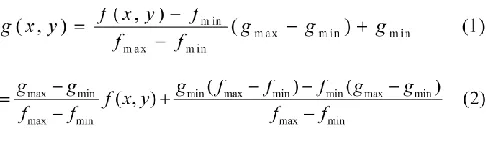
The images which are normally captured contain a lot of noise. If these images were used for face detection and recognition then results would never be coherent. Thus it is required to improve the quality of image through preprocessing of images. Yong Xu et al. have presented an algorithm to reduce the illumination influence on face [7]. Wael AbdAlmageed et al. have devised a novel image processing method for multipose influence on faces [8]. Ramus rothe et al. have presented a cross-age processing scheme for faces recognition [9]. In this work, we exploit the Haar feature based face detection method [10]. Haar features can be used in gray scale only, we first need to perform transformations to covert it from RGB to gray scale. So as to create the contrast ratio much strong and enhance the image quality, we select a simplest algorithm for image enhancement. It came to know that linear gray transform method is the simplest algorithm to enhance the images. The image with noise would give a poorer image quality and gray space range would be very precise. Thus to extend that range, we employ linear gray transform. The original image‘s pixel is assumed to be the function that is f(x,y). The target image‘s pixel value is given by g(x,y). A gray range of infant image is given by (fmin, fmax)with target range is given by (gmin, gmax) .The related graph is shown in Fig. 2. By this transform interpolation function shown in equation (1).
Wherever, we can say that (x,y) is the location of the pixel. fmin, fmax are maximum and minimum pixel‘s values of the original image. gmin and gmax are the minimum and maximum pixel value of the target image. The‘ image that we utilized usually is of 8 bit, so the minimum value of the pixel is 28=256, so the range of target image is [0,255]. It means that gmin=0 and gmax=255
The haar face detector generally exhibits bad results for the faces which rotate angles. Secondly, face only holds small area of the image. It takes long time for the detector to spot the complete area of an image. So as to overcome such difficulties a innovative pipeline was introduced by Cheng Cui, Xin Wang [2]. For the input image, after pre-processing the initial image, face detector will identify an image area, if not found then image will rotate ±10º,±20º and notice yet again to surmount the rotation face that can‘t be detected as shown in Fig.2.
For the input image, we pre-process it as well as transform RGB to gray space in addition to improve the quality. Afterward, we extract the image skin area along with detector detects merely the area that is most probably the face area. During this process, the detection speed enhanced very much. For skin extraction, we are supposed to transform the RGB to YCbCr [11, 12]. During skin transformation, an area to be detected becomes much small as compared to initial image.
2.1.2 Face cropping
After the detection of the face, the face area is cropped and used for feature extraction. Then this is compared with the feature dataset that we have and finally face is identified. We can use two approaches. First one to just crop the face area as well as resizes it to the particular size while other one to localize the eyes on the face as center in addition to enlarge to particular size all along upward, downward, rightward, and leftward.
3 PROPOSED WORK
129 ant colonies is misused in artificial ant colonies to tackle CO
issues. ACO metaheuristic used in AI is based on this behavior. We select any path and assume it to be optimum, and if we get any path having better optimization than we replace this path with that one. At the end we get a central component for ACO algorithm which is a parameterized probabilistic model, called pheromone model. The rules which are applied in ACO system are as follows:
1. Local pheromone updation rule, in which the pheromone is updated in every local search,
2. The second one is global pheromone updation rule that is useful when all ants make a solution.
A typical ant colony optimization scheme follows two basic methods which can be characterized as trail dissipation and, alternatively daemon activities, in order to ward off from boundless gathering of trails over some component. Daemon activities can be used to actualize concentrated activities those can't be carried out by single ant, for ex: we can use a local optimization process or ‗global‘ info can be updated to make a decision whether or not to bias the search procedure or not. At every progression, every ant registers a set of all the viable expansions to its present state, moreover shifts to one of them according to some probability. This computation of the probability is determined as the probability of an ant movement from state‗t‘ to state ‗n‘ relies upon two values of the move. First is the computation of the number independent runs(R) which is required for success and second is to multiply this value of R with the processing amount which is needed for each and every run. Thus, the amount of sovereign runs ‗R‘ which are mandatory to persuade ―the success predicate by generation i with‖ the probability of z that depends upon z along with the p(M,i). Here, z denotes basically the probability of fulfilling the success predicate via ith generation at least once in ‗R‘ iterations described as:
z=1-[1-P(M,i)]R (5) The ACO technique basically comprises of two main segments. First is the initialization section and the second is the main loop. Genetic process takes place in the second section. The process is described below:
Initialization
1. Initialize all the input parameters which include variables, states, functions etc.
2. Now set the initial pheromone trail value.
3. Place different ants on different initial states with an empty memory.
Main loop: While the termination condition is not met repeat, 1. Every ant constructs its own path by simply applying the
transition function 2. Apply local search
3. Check for the best tour. If any correction is required, update it.
4. Update trails: For each pheromone deposited on the road, evaporate a fixed amount of pheromone from all paths. Generate a new set of population by applying pheromone trail based operations
3.1 Genetic process
After the detection of the face, the face area is cropped and used for feature extraction. Then this is compared with the feature dataset that we have and finally face is identified. We can use two approaches. First one to just crop the face area as well as resizes it to the particular size while other one to localize the eyes on the producing generations through
Genetic process comprises of a probabilistic step. This step can most of the times winds up with either non convergence or could result in premature convergence. Premature convergence refers to the convergence to the globally sub-optimal solution. These problems can be curtailed by making independent paths of the same problem. On the off chance, each running of the GPG were fruitful in producing a good solution, the total computational exertion needed in order to get the arrangement would depend basically on 4 variables: First one is the size of population (denoted by M), second, the number of generations that are run (denoted by g), third, the measure of ‗processing‘ mandatory for measuring the fitness over all the fitness cases, and the last one is the quantify of handling mandatory for test stage. Here, we will assume that the time required for processing to measure the value of fitness of any of the individual is equivalent to its run time i.e. denoted by P. If achievement arises on the identical generation each time a solution is found, then its computational effort can be calculated by using the formula as:
E= M • g •β• e (6)
As estimation of e is very little as for different elements, we should not think of it as. Be that as it may, much of the time, achievement happens on an alternate eras in various runs, then computational effort E be figured as:
E=M•gavr•β (7) The cumulative probability of success for n number of generations ranging from 0th generation to the nth generation is denoted by P(M, i). The value of P(M, i) can be calculated by tentatively acquiring an estimation for the quick probability Y (M, i). Y (M, i) can be obtained by evaluating a particular run with M sized population. Applying logarithm on eq.The computational exertion E, is a negligible estimation of the aggregate amount of people that have to be handled to yield an answer for the issue with a probability z (for exp z = 99%): E= M•(•g + 1)•β•R (8) Wherever •g denotes the original value at which least no. of individual assessment is delivered, it is known as best era.
•g esteem is augmented by one since era
•g should likewise rush to achieve the arrangement. As of condition (8), computational exertion relies on upon the specific selections of qualities for M, G, P (M, i), exertion needed for wellness assessment, thus, the estimation of E is not really the base computational exertion feasible for an issue.
3.2 Genetic searching
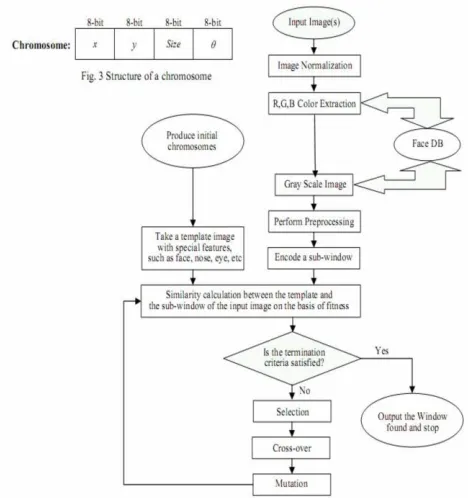
130 acquired or a given number of eras is come to. Be that as it
may, distinctive strides utilized in the GA are appeared in Fig. 3.To apply GA for face recognition, a format of the face picture acquired from averaging the degree level of pixels of various comparative looking face pictures of a few people is developed. The layout confront picture is then traveled during the entire picture to discover the area wherever the most appropriate match subsists. The GA and diverse genetic
operations are given beneath.
3.3 Fitness function
The main problem is to find out that the input picture is similar to the one whose template was provided earlier. For this reason we need to calculate the fitness of every chromosome by a appointing a function which evaluates the level of fitness for every chromosome. The fitness of a particular chromosome can be defined by the difference among the intensities of input value image and of template image assessed. With the help of this method, we can determine whether two images are of similar individual or not. Therefore, for each chromosome, the fitness function can be evaluated by using the following equation:
Where Bmax denotes the highest brightness of image, xSize & ySize represents the amount of pixels in the horizontal and vertical directions of the template image, W represents the window, f and fn,t denotes the intensity values of the infant and template image once it is vindicated for the nth position chromosome, correspondingly.
Initially a chromosome with highest fitness value is selected from a particular generation. This chromosome is copied into the next generation‘s new population.
Cross-Over: In the cross-over operation, a random point is selected in the two parent chromosomes from where they exchange their parts with each other. So the result of this is that two new offspring are being generated. These offspring contain partial not complete features of their parents.Mutation: In mutation operator, a mutant is generated in the chromosome i.e., a bit or two are randomly altered in the chromosome. Then its fitness function is evaluated. Parameters are given in TABLE 1
TABLE 1 PARAMETERS
The steps involved in GA are as:
1. Initially a population of maximum size n is generated, with crossover probability p along with mutation probability pm.
2. Fitness function is evaluated for each pair of chromosome.
3. Choose a pair of chromosome for mating. For this purpose, a number is randomly generated between‘ [0,100] ‗and one whose segment spans when a random number is chosen.
4. New offspring are produced after applying crossover operator.
5. Apply mutation operator to the populace with the mutation rate pm.
6. If a termination condition which could be the total number of generation or the fitness value is satisfied then go to step 7 else move to step 2.
7. Keep the best chromosome and stop.
4 RESULTS AND DISCUSSIONS
The viability of this scheme is legitimized by diverse pictures with diverse sorts of expressions. At the point when an intricate picture is subjected information, the face recognition result emphasizes the picture‘s facial part. For various countenances, the framework finds the overwhelming face as it were. Pictures of people are taken at their own particular working spots and at various situations both in sparkling and desolate climate. The achievement rate of the framework is around 97%. Comparison of fitness over generation over single point crossover and uniform crossover is shown in fog 4 and fig.5.The primary purpose for the disappointment of those pictures in discovering face areas is the impediment. An exchange off is constantly taken amid populace measure and the method for cross-over. Hence, this exploration receives single point cross-over by population size of 150 amid face discovery. By using this system, we have also created a method to identify multiple faces existing in the input image. This can be accomplished via extraction of the face features in the given input image and consequently make count of the no. of faces based on face feature‘s clustering.
Parameter name value
Chromosome length 4 bytes
Population size 100
Number of generations 300 Cross-over probability 0.7 Mutation probability 0.01
131 A comparison chart is revealed in the following Table 2.
given below. This compares the no. of subjects that are exercised in the algorithm and what is the efficiency of the Face Identification System that is used in this work. The results of testing the algorithm with the diverse no. of subjects and total number of images that are left unrecognized are tabulated as shown in Table 2.
TABLE 2
EFFICIENCY OF ACOGA
Subjects Success fully recognized Test
Image
Unrecognized Test Image
Efficiency (%)
5 4 1 80
10 8 2 80
15 13 2 86.6
20 19 2 95
25 24 1 96
30 27 3 90
It can be clearly seen that our system provides top results as compared to the other methods with 96% efficiency rate. This hybrid algorithm demonstrates the maximum efficiency of 96%. ―This ACOGA competence can be greater than before by using better face scanner, best procedure―of scaling and efficient scheme of edge detection as well as face image‘s feature extraction. The problems that we are facing at the time when
handling this research issue are basically the complications in detecting faces of the overlapping images and detecting various dissimilar poses of face. Henceforth, the algorithm is to be modified for diverse ways of face and illumination variations and algorithm can be extended‘ to detect faces in video as well as in live streaming, therefore we can identify faces in real time. The trial investigation demonstrates that the above techniques are more strong and reasonable.
4
CONCLUSION
Recognition of countenances and facial components utilizing machine vision procedures has numerous valuable applications. Despite the fact that people fulfill these assignments incalculable times each day, they are still extremely trying for computer vision. The majorities of the analysts assault this sort of issue with face confinement and highlight determination with frontal view faces and without outward appearances in addition to typical lighting situations in spite of the fact that the variety between the pictures of a similar face is too substantial because of outward appearance, haircut, posture variety, lighting conditions, make-up, and so forth. In this paper, confront location has been actualized utilizing Ant state advancement and genetic calculation to scan for the substance of a specific individual in a picture. The viability of the face location calculation tried together in basic and composite foundations for various sorts of face in addition to non-confront pictures of 320×240 determination. The calculation is equipped for recognizing the appearances in the pictures with various foundations. The turned human face can likewise be recognized, regardless of the possibility that the face is under shadow, wearing goggles, or under awful lighting situations.
REFERENCES
[1] E. Reinhard, M. Ashikhmin, B. Gooch, and P. Shirley, ― Color transfer between images,‖ IEEE Computer Graphics and Applications, vol.5, pp.34-41, 2001.
[2] C. Cui, X. Wang, and H. Shen. "Improving the face recognition system by hybrid image preprocessing," 2016 IEEE International Conference on Cyber Technology in Automation, Control, and Intelligent Systems (CYBER), 2016.
[3] C. Szegedy, W. Liu W, Y. Jia et al, ―Going deeper with convolutions,‖ Proc. of the IEEE Conference on Computer Vision and Pattern Recognition, pp.1-9, 2015.
[4] C. Grosan and A. Abraham, ―Hybrid Evolutionary Algorithms: Methodologies, Architectures, and Reviews,‖ Studies in Computational Intelligence, vol.75, pp.1–17, 2007.
[5] Introductory Tutorial and a Survey of Techniques & applications, Technical Report CES-475ISSN:1744-80502007, 2007.
[6] J. Zhang, Y. Yan , and M. Lades, ―Face recognition: eigen face, elastic matching, and neural nets[,‖ Proceedings of the IEEE, vol.85, no.9,pp.1423-1435, 1997.
[7] K.C. Kwa and W. Pedrycz, ―Face recognition using a fuzzy fisher face classifier,‖ Pattern Recognition, vol.38, no.10, pp. 1717-1732, 2005.
[8] X. Wang, T.X. Han , and S.Yan, ― An HOG-LBP human detector with partial occlusion handling,‖ Proc. IEEE 12th International Conference on.Computer Vision, pp.32-39, 2009.
Fig. 4. Fitness v/s generation considering single point cross-over
132 [9] Y. Xu, Z. Zhang , G. Lu et al., ―Approximately
symmetrical face images for image preprocessing in face recognition and sparse representation based classification,‖ Pattern Recognition, vol.54, pp.68-82 2016. [10] W. AbdAlmageed, Y. Wu, S. Rawls, S. Harel, T. Hassner, I. Masi, J. Choi, J. Lekust, J. Kim, P. Natarajan, et al., ― Face recognition using deep multi-pose representations,‖ In IEEE Winter Conference on Applications of Computer Vision (WACV), 2016.
[11]R Rothe, R.Timofte , and L. Gool, ― DEX: Deep EXpectation of apparent age from a single image,‖ Proc. of the IEEE International Conference on Computer Vision, pp.10-15, 2015.
[12]P. Viola and M J. Jones, ―Robust real-time face detection,‖ International journal of computer vision, vol.57, no.2, pp. 137-154, 2004.
[13]Z. Yan and C. Yuan , ― Ant Colony Optimization for Feature Selection in Face Recognition,‖ In: Zhang D., Jain A.K. (eds) Biometric Authentication. ICBA 2004. Lecture Notes in Computer Science, vol 3072, 2004.
[14] H. Kanan, K.Faez, and M.H. Aghdam, ―Face Recognition
System Using Ant Colony Optimization-Based Selected Features,‖ IEEE Symposium on
Computational Intelligence in Security and Defense Applications (CISDA) 2007.
[15] P. Sukhija, S. Behal, and P. Singh, ―Face Recognition System Using Genetic Algorithm,‖ Procedia Computer Science vol.85, pp. 410-417, 2016.
[16] H. Zhi and S. Liu, ―Face recognition based on genetic algorithm,‖ Journal of Visual Communication and Image Representation, vol.58, pp.495-502, 2019.