Journal of Asthma and Allergy 2018:11 19–27
Journal of Asthma and Allergy
Dove
press
submit your manuscript | www.dovepress.com
19
R e v i e w
open access to scientific and medical research
Open Access Full Text Article
Late-onset asthma: current perspectives
Tsunahiko Hirano
Kazuto Matsunaga
Department of Respiratory Medicine and infectious Disease, Graduate School of Medicine, Yamaguchi University, Yamaguchi, Japan
Abstract: Because the pathophysiology of asthma has diverse characteristics, to manage the disease effectively, it is important for clinicians to distinguish among the clinical phenotypes. Among them, adult-onset asthma, that is, late-onset asthma (LOA), is increasing because of the aging of the population. The phenotype of LOA is largely divided into two types according to the presence or absence of eosinophilic inflammation, T-helper (Th)2- and non–Th2-associated LOA. Especially in Th2 LOA related to rhinosinusitis, as pulmonary function at onset is poor and asthma exacerbations occur frequently, it is important to detect this phenotype in the early phase by using a biomarker of Th2-type inflammation such as fractional exhaled nitric oxide (FENO). As non–Th2-LOA is often resistant to corticosteroids, this phenotype often requires another treatment strategy such as macrolide, diet, or smoking cessation. We often struggle with the management of LOA patients due to a lack of evidence; therefore, the elucidation of the mechanism of LOA contributes to increased efficiency of diagnosis and treatment of LOA. Age-related immune system and structural changes are thought to be associated with the pathophysiology of LOA. In the former case, changes in inflammatory cell function such as variations in the innate immune response and acquisition of autoimmunity or upregulation of oxidative stress are thought to be involved in the mechanism. Meanwhile, the latter can also become triggers or exacerbating factors of LOA via enhancement of airway hyperresponsive-ness, decline in lung function, increased air trapping, and reduction in chest wall compliance. Therefore, appropriate individualized management in LOA may be possible through precisely assessing the pathophysiology based on age-related functional changes, including the immune and structural system.
Keywords: aging, immunosenescence, rhinosinusitis, obesity, phenotype, endotype
Introduction
Many patients develop asthma during childhood; however, asthma symptoms can occur
at any time in life. Several factors may make a person more likely to develop late-onset
asthma (LOA).
1–3For example, women are more likely to develop asthma after the age
of 20, and obesity also appears to increase the risk of developing asthma as an adult.
4Moreover, individuals who had asthma as a child may see asthma recur later in life.
5In any case, because of the worldwide population trend toward enhanced longevity,
clinical concerns about LOA are developing and have been increasingly recognized
by clinicians. However, the mechanisms that underlie the relationship between aging
and asthma are still unclear and the condition is frequently underdiagnosed in older
age groups.
6In this review, we discuss these issues with a focus on the
pathophysiol-ogy and treatment of LOA.
Correspondence: Tsunahiko Hirano Department of Respiratory Medicine and infectious Disease, Graduate School of Medicine, Yamaguchi University, 1-1-1 Minami-kogushi, Ube, 755-8505 Japan Tel +81 836 85 3123
Fax +81 836 85 3124 email [email protected]
Journal name: Journal of Asthma and Allergy Article Designation: Review
Year: 2018 Volume: 11
Running head verso: Hirano and Matsunaga Running head recto: Late-onset asthma DOI: http://dx.doi.org/10.2147/JAA.S125948
Journal of Asthma and Allergy downloaded from https://www.dovepress.com/ by 118.70.13.36 on 24-Aug-2020
For personal use only.
Dovepress
Hirano and Matsunaga
Clinical feature
Usually, asthma symptoms appear early in life. However,
some people develop asthma symptoms for the first time in
adulthood; their clinical status is called LOA, defined as:
“asthma with onset of symptoms in adult life in a patient with
no pre-existing, persistent respiratory symptoms,” but the
definition of age has not been clarified.
7It is reported that the
age- and sex-adjusted incidence of newly diagnosed asthma in
people older than 65 years was estimated by 0.1% per year.
8Aging itself, however, has a significant effect on the
methacholine response and has an impact on airway
hyper-reactivity.
9Therefore, higher annual declines in FEV
1
are
observed in LOA,
10–12especially among elderly people
13or
smokers of over 10 pack-years.
14,15Obesity-associated LOA
is characterized by lack of atopy, female predominance, and it
is suggested that obesity may cause LOA through changes in
the structure of the lung or in the function of the immune
sys-tem.
16–26The above risk factors are characterized by chronic
inflammation and oxidative stress, with an increase in the
mediators of innate immunity. Women are more likely to be
affected by LOA than men.
27Possible explanations for
gen-der differences in the rate of incidence of LOA may include
endogenous and exogenous hormonal factors.
28In addition,
LOA is associated with worse lung function and lower atopic
status.
10Furthermore, among some patients with LOA, being
elderly, having multi-comorbidities, polypharmacy, and poor
inhaler technique, being inactive and home alone, as well
as psychological status
(
depression, dementia, etc.
)
29,30are
beginning to be recognized as major issues. Actually, LOA is
an independent risk factor for cardiovascular disease events.
31At least 9%–15% of LOA can be attributed to
occupa-tional exposures, and one of the mechanisms may be related
to work-related stress.
32Mood disorders such as comorbid
anxiety and depression are also associated with LOA.
33Phenotype and endotype
Some studies proposed clinical sub-phenotypes of LOA
based on cluster analyses.
34,35At first, LOA was split down
the middle and phenotypes were classified into Th2-LOA
or non–Th2-LOA.
36,37Th2-LOA is associated with sinusitis,
nasal polyps, and, sometimes, aspirin-exacerbated respiratory
disease (AERD), but appears to be equally common in males
and females.
38This type is often severe from the onset and has
been recently defined as uncontrolled asthma.
39Non–Th2-LOA is associated with gender, obesity, smoking, and aging.
However, because these analyses have been done using a
cross-sectional study, the asthma variability has still not been
fully examined. Therefore, a longitudinal-study is needed to
clarify these complex phenotypes. Then, such analyses will
become useful to predict the prognosis of LOA patients and
to develop appropriate treatment strategies.
40Ilmarinen et al
identified five sub-phenotypes of LOA by using long-term
follow-up (12-year) data.
40This study suggested that
identi-fying clusters with different disease prognoses is important
for clinicians to determine the most effective treatment. In
addition, fluctuations in lung function are a characteristic of
asthma and represent a marker of brittle asthma.
41,42In this
regard, detrended fluctuation analysis (DFA) has shown that
intrinsic fluctuations in pulmonary function over time show a
complex fractal-type behavior.
43Kaminsky et al reported that
identifying patients with similar fluctuation patterns and
dis-ease stability by using DFA could be helpful for personalized
treatment.
44Some patients with Th2-LOA have been reported
to exhibit a distinct profile such as chronic rhinosinusitis
(CRS), air trapping, and male sex.
45Air trapping is
associ-ated with high computed tomography sinus scores, and this
phenotype is frequently associated with severe exacerbations,
as mentioned earlier.
46It is suggested that inflammation of
the distal airways and that of paranasal sinuses are important
predisposing factors for the development of exacerbations.
46In such cases, systemic inflammation-targeted management,
such as with monoclonal antibodies against anti-IL-5, might
be an ideal treatment to prevent future exacerbations and
lung function decline.
47In this manner, by using biological
markers in cluster analyses, we are able to explore disease
pathogenesis by analyzing endotypes based on molecular
characteristics and obtain novel guidelines for treatment
of severe asthma. Furthermore, as we discuss later, it is
assumed that age-related changes in immune function have
an impact on the airway inflammation of LOA. This change
exists in both innate and adaptive immunity cells. Especially,
type 2 innate lymphoid cells (ILC2) are intimately related to
LOA nasal polyps of patients with chronic nasal sinusitis.
48Moreover, this endotype is related to interleukin (IL)-4,
49IL-5, and IL-13.
50Pathophysiology
immune system
An increase in fractional exhaled nitric oxide (FE
NO), which
can provide noninvasive assessment of airway
inflamma-tion, was found to be associated with advancing age.
51The
increase of the values may reflect the altered distribution of
inflammatory cells or altered activity of inflammatory cells in
the airway. Such altered activity may account for differences
in clinical phenotypes between younger and older asthma
subjects.
52Th2-LOA with sinusitis is reported to be
associ-ated with ILC2.
48,53,54One of the reasons could be that these
cells represent a key factor in the mucoid innate immune
Journal of Asthma and Allergy downloaded from https://www.dovepress.com/ by 118.70.13.36 on 24-Aug-2020
Dovepress Late-onset asthma
response that boosts allergic inflammation.
55Furthermore,
these cells can be activated in an allergen-independent
man-ner by IL-25, IL-33, and thymic stromal lymphopoietin, all
of which are released from bronchial epithelial cells upon
stimulation with air pollutants.
56Actually, it is reported
that they have a greater effect on LOA than on early-onset
asthma (EOA).
57Staphylococcus aureus
enterotoxin (SE)
sensitization is known to be an independent risk factor in
asthma,
58and it is reported that SE-immunoglobulin (Ig)
E sensitization with LOA in the elderly is associated with
particularly severe eosinophilic asthma with CRS.
58–63Thus,
it is suggested that SE–IgE sensitization could represent a
clue to the pathogenesis of severe late-onset eosinophilic
asthma in the elderly.
58,64,65Matsumoto et al reported that, in
women with asthma, the cysteinyl leukotriene receptor 1 gene
(CysLTR1) variant might be associated with sensitization to
SE and age at asthma onset.
66Age-related declines in immune function, known as
immunosenescence, also play a key role in the development
of LOA. The immunosenescence process is boosted by
oxi-dative stress through the increased rate of telomere
shorten-ing as a consequence of DNA damage. The coexistence of
immunosenescence and viral infection promotes persistent
inflammation.
67The mechanism is suggested to represent
diminished B-cell function.
68In this condition, antigen
per-sistence is enhanced, especially in the elderly, and pulmonary
age-related inflammation is increased via cytokine or toll-like
receptor without infection.
69In addition, autoimmunity may
increase the affinity of T cells to self-antigens or latent viruses,
thereby promoting an autoimmune process.
70In general, with
age, naïve T lymphocytes in the thymic compartment as well
as in the periphery are thought to decrease through thymic
atrophy or loss of bone marrow function, including telomere
shortening and impaired enzymes.
71By contrast, with age, the
numbers of memory T lymphocyte are reported to increase.
72,73These phenomena diminish the efficiency of T-cell
activa-tion.
72However, when autoantibodies are increased in elderly
individuals because of increased tissue damage and
apopto-sis, thymic T-regulatory cells (Tregs) become enhanced to
regulate this autoimmunity.
74As a result, CD4
+
and CD8
+
T-cell responses are reduced, and susceptibility to infection
increases. Recurrent infection stimulates proinflammatory
cytokines, and this leads to activation of Tregs.
Consequen-tially, the production of Th17 is enhanced, leading to persistent
chronic inflammation. With increased age, total serum IgE
is known to decrease because of impaired B–cell-mediated
antibody production and specificity.
75However, it is reported
that the rate of allergen sensitization in older asthmatics is
higher than that of age-matched controls.
76The difference in
B-cell activation which has caused such a status may play a
potential role in autoimmunity. The risk of EOA and LOA is
differently influenced by the interaction between childhood
farming exposure and genetic variations.
77A genetic
varia-tion, such as on chromosome 17q21, or the C–C chemokine
regulated on activation, and normal T-cell expressed and
secreted (RANTES) could play a part in the LOA.
78,79Age
differences in the leukotriene (LT) and wingless/integrase
(Wnt) pathways during airway inflammation underlie the
differential development of airway remodeling.
80Thirty-eight
percent of asthmatics are reported to have paucigranulocytic
type disease.
81The mechanism is speculated to be derived
from abnormalities or dysfunction of structural cells, such
as airway smooth muscles and nerve. Therefore, increased
bronchomotor tone from muscarinic and adrenergic pathways
can cause symptoms, and a long-acting muscarinic antagonist
might be effective therapy.
82Bronchial thermoplasty (BT)
is an endoscopic procedure that targets primarily airway
remodeling and improves quality of life or exacerbation with
asthmatics although pulmonary function is not improved.
83–85One of the mechanisms underlying the clinical improvement
is related to alterations in different bronchial structures, such
as airway smooth muscles and neuroendocrine cells, without
any impact on eosinophilic inflammation.
86Therefore, BT
may be an option for paucigranulocytic type of severe LOA.
Furthermore, murine mesenchymal stromal cells from the
bone marrow are reported to have an impact on pulmonary
inflammation; bronchiolitis obliterans syndrome (BOS)
fol-lowing organ transplantation, stem/progenitor hematopoietic
stem cell transplantation (s/p HSCT), and immune
dysregula-tion can contribute to the pathogenesis of LOA.
87,88Pulmonary structure and function
Additional data suggest that advanced age, irrespective
of any concomitant pulmonary disease, is associated with
increased bronchial hyperresponsiveness.
9,89In a study of
148 subjects, ranging from age 5 to 76 years, age had an
independent association with bronchial
hyperresponsive-ness as measured by a methacholine challenge.
9In another
study, bronchial hyperresponsiveness to histamine challenge
was associated with increased eosinophil count and allergic
sensitization; however, older age maintained an independent
association with bronchial hyperresponsiveness, which was
more prominent in subjects with respiratory symptoms.
42In
addition to age, it is recognized that smoking and the baseline
forced expiratory volume in 1 second (FEV
1) have strong
effects on bronchial hyperresponsiveness.
90,91Furthermore,
aging is associated with a progressive decline in lung
func-tion.
92Coupled with these findings, breathing is exaggerated
Journal of Asthma and Allergy downloaded from https://www.dovepress.com/ by 118.70.13.36 on 24-Aug-2020
Dovepress
Hirano and Matsunaga
through increased air trapping and a reduction in chest wall
compliance with increased age.
93Actually, it is reported that
bronchodilators, such as long-acting beta2 agonist (LABA),
have an add-on effect to inhaled corticosteroid (ICS).
94Obesity
Obesity is characterized by chronic inflammation and
oxi-dative stress, with an increase in the mediators of innate
immunity.
95,96Obesity with and without type 2 diabetes
mel-litus (DM) is associated with an increase in the expression
of IL-4 – homologous to lymphotoxins, exhibits inducible
expression, competes with HSV glycoprotein D for
herpesvi-rus entry mediator (HVEM), which is a receptor expressed by
T lymphocytes (LIGHT; homologous to lymphotoxins,
exhib-its inducible expression, competes with HSV glycoprotein D
for HVEM, a receptor expressed by T lymphocytes), matrix
metalloproteinase (MMP)-9, and CC chemokine receptor
(CCR)-2. Following gastric bypass surgery and weight loss,
the expression of these factors falls significantly.
97In addition,
obesity may lead to abnormal nitric oxide (NO) metabolism,
with the imbalance of l-arginine and one of its methylated
products known as asymmetric dimethyl arginine (ADMA) in
obese subjects who acquire asthma after childhood. Therefore,
in LOA, the plasma ratios of l-arginine to ADMA may explain
the inverse relationship between body mass index (BMI) and
FE
NO(reduced FE
NObioavailability in obesity). This is thought
to occur because ADMA can be an endogenous inhibitor
of NO synthase (NOS) isoforms.
98Actually, these lower
l-arginine/ADMA ratios are associated with reduced lung
function and increased respiratory symptoms, and may have
a role in the pathobiology of LOA.
19As another mechanism in
the reduced value of FE
NOin obesity and asthma, it is thought
that since excessive airway oxidative stress in obesity reacts
with FE
NO, the
value
of FE
NOis apparently
low in such status.
99It has been reported that, although similar cases have occurred
among patients with chronic obstructive pulmonary disease
(COPD), excessive nitrosative stress, such as NO, is
gener-ated in the peripheral airways.
100The same can be said of the
pathophysiology of LOA, and it has been suggested that the
persistent elevation of exhaled NO in the distal airway of the
asthma
patient can be a therapeutic target.
101However, in the
actual clinical setting, ICS therapy cannot perfectly suppress
the residual nitrosative stress elevation in the distal airways of
asthmatics.
101In short, it is speculated that nitrosative stress in
the airways may be associated with actual steroid-resistance
mechanisms in some asthmatic phenotypes, such as LOA.
Therefore, it can be an option to select some drugs other than
ICS, such as low-dose theophylline, which might be useful to
reduce nitrosative stress.
102Dietary change, such as a highly
saturated meal poor in vitamin D, may contribute to the
patho-genesis of asthma in obesity.
103,104High consumption of fish
was reported to be protective, especially in the elderly.
105A
possible mechanism for the effect of fish consumption may
be derived from long-chain
ω
-3 polyunsaturated fatty acids
(PUFAs), which inhibit arachidonic acid (AA) metabolism
competitively via enzymatic pathways and suppress the
pro-duction of active inflammatory eicosanoid mediators from
AA.
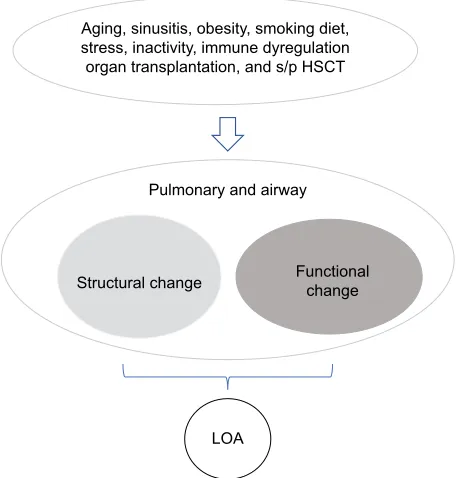
106,107A schematic view of the pathophysiology in LOA
is shown in Figure 1.
Diagnosis and treatment
It is often difficult to distinguish between LOA and COPD,
especially in the elderly, because both diseases have similar
underlying mechanisms characterized by chronic airway
inflammation and obstruction, which show analogous
pat-terns of simple spirometric parameters. It should be taken
into account that the reversibility of airway obstruction in
elderly asthmatics is often reduced because of irreversible
structural changes resulting from airway remodeling.
108Therefore, precise pulmonary function tests such as total lung
capacity or the carbon monoxide diffusing capacity of the
lungs (DL
CO) can help distinguish between these diseases.
109Alternatively, it may be better to use chest imaging. Choi et
al reported that, by using chest imaging biomarkers, LOA
Aging, sinusitis, obesity, smoking diet, stress, inactivity, immune dyregulation organ transplantation, and s/p HSCT
Pulmonary and airway
LOA
Structural change Functionalchange
Figure 1 Pathophysiology of LOA. Structural or functional changes in the airway result from many factors including aging.
Abbreviations: s/p HSCT, stem/progenitor hematopoietic stem cell transplantation; LOA, late-onset asthma.
Journal of Asthma and Allergy downloaded from https://www.dovepress.com/ by 118.70.13.36 on 24-Aug-2020
Dovepress Late-onset asthma
can be identified as an imaging-based phenotype.
110It has
been suggested that the imaging characteristics of LOA show
airway luminal narrowing, reduced lung deformation, and
increased air-trapping.
Usually, pharmacological and non-pharmacological
interventions (e.g., education) are prescribed based on the
phenotype. Non-pharmacological interventions, such as
encouraging smoking cessation and reducing body weight,
should always be pursued whenever necessary.
111–114As for
pharmacological treatments, ICS is absolutely essential for
Th2-LOA.
115–117Th2-type biomarkers such as blood
eosino-phils, FE
NO, and periostin are used extensively to differentiate
between Th2-LOA and non–Th2-LOA.
118,119Especially, for
asthma and COPD overlapping, these biomarkers are useful
for predicting the responsiveness to corticosteroids.
120–124However, when corticosteroid treatment is ineffective, the
clinician should consider the possibility of poor inhaler
technique because elderly patients with Th2-LOA often have
functional disorders.
112,125–128In such cases, assisted inhalation
therapy by a caregiver might be a more useful strategy than
self-administered ICS therapy.
128This strategy dovetails with
the result that, even when patients with LOA are elderly, their
response to treatment is similar to that in patients with EOA.
118Therefore, an upgrading strategy for poor adherence should
be encouraged.
129,130If ICS treatment is truly ineffective,
endotype target therapy should be taken into consideration.
131Compared with placebo, reslizumab which is a monoclonal
antibody against IL-5 produces greater reductions in asthma
exacerbations and larger improvements in lung function in
patients with LOA versus EOA.
132Omalizumab improves all
asthma outcomes independently of age, although the
magni-tude of the effects observed in the elderly seems to be lower
than in other age groups.
133Post hoc analyses of the anti-IgE
agent omalizumab indicate similar efficacy in both younger
and older adults. Anti-IL-5 and anti-IL-13 therapy appear to
show even more pronounced effects as targeted treatments in
late-onset disease and in asthmatic patients 65 years or older,
but evidence is lacking.
45,47,134–138As yet, for non-eosinophilic
asthma in the elderly, there is a lack of high-level evidence for
targeted therapy, but macrolides may offer a viable option.
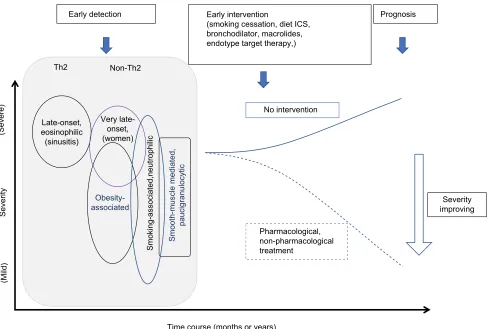
139In Figure 2, we show the time courses of LOA with or
without intervention.
Time course (months or years)
Th2 Non-Th2
Late-onset, eosinophilic (sinusitis)
Very late-onset, (women)
Obesity-associated
Smoking-associated,neutrophilic
Severity
Pharmacological, non-pharmacological treatment
No intervention Early detection Early intervention
(smoking cessation, diet ICS, bronchodilator, macrolides, endotype target therapy,)
Severity improving Prognosis
(Severe
)
(Mild)
Smooth-muscle mediated
,
paucigranulocytic
Figure 2 Time-course of LOA. The prognosis of LOA can be improved by early detection and precise intervention. Dotted and solid lines mean the time course of asthma severity by each intervention. early intervention, such as pharmacological or non-pharmacological treatment, improve severity of asthma.
Abbreviations: Th2, T helper 2; iCS, inhaled corticosteroid; LOA, late-onset asthma.
Journal of Asthma and Allergy downloaded from https://www.dovepress.com/ by 118.70.13.36 on 24-Aug-2020
Dovepress
Hirano and Matsunaga
Conclusion
Today, advances in the understanding of the phenotypes and
endotypes of asthma syndrome have helped us in managing
these diverse subtypes of the disease. Because the community
continues to age, LOA is beginning to play a larger role in
asthma. As LOA shows different phenotypes with
heterog-enous backgrounds, appropriate individual management
through estimating precisely the pathophysiology is required.
Disclosure
The authors report no conflicts of interest in this work.
References
1. Song WJ, Kim SH, Lim S, et al. Association between obesity and asthma in the elderly population: potential roles of abdominal sub-cutaneous adiposity and sarcopenia. Ann AllergyAsthma Immunol. 2012;109(4):243–248.
2. Kim YK, Kim SH, Tak YJ, et al. High prevalence of current asthma and active smoking effect among the elderly. Clin Exp Allergy. 2002;32(12):1706–1712.
3. Amelink M, de Groot JC, de Nijs SB, et al. Severe adult-onset asthma: a distinct phenotype. J AllergyClin Immunol. 2013;132(2):336–341. 4. Lv N, Xiao L, Camargo CA Jr, et al. Abdominal and general adiposity and level of asthma control in adults with uncontrolled asthma. Ann Am Thorac Soc. 2014;11(8):1218–1224.
5. Herscher ML, Wisnivesky JP, Busse PJ, et al. Characteristics and outcomes of older adults with long-standing versus late-onset asthma.
J Asthma. 2017;54(3):223–229.
6. Enright PL, McClelland RL, Newman AB, Gottlieb DJ, Lebowitz MD. Underdiagnosis and undertreatment of asthma in the elderly. Cardio-vascular Health Study Research Group. Chest. 1999;116(3):603–613. 7. Ayres JG. Late onset asthma. BMJ. 1990;300(6740):1602–1603. 8. Bauer BA, Reed CE, Yunginger JW, Wollan PC, Silverstein MD.
Incidence and outcomes of asthma in the elderly. A population-based study in Rochester, Minnesota. Chest. 1997;111(2):303–310. 9. Hopp RJ, Bewtra A, Nair NM, Townley RG. The effect of age on
methacholine response. J Allergy Clin Immunol. 1985;76(4):609–613. 10. Miranda C, Busacker A, Balzar S, Trudeau J, Wenzel SE. Distinguish-ing severe asthma phenotypes: role of age at onset and eosinophilic inflammation. J Allergy Clin Immunol. 2004;113(1):101–108. 11. Sorino C, Battaglia S, Scichilone N, et al. Diagnosis of airway
obstruc-tion in the elderly: contribuobstruc-tion of the SARA study. Int J Chron Obstruct Pulmon Dis. 2012;7:389–395.
12. Vaz Fragoso CA, Gill TM. Respiratory impairment and the aging lung: a novel paradigm for assessing pulmonary function. JGerontol A Biol Sci Med Sci. 2012;67(3):264–275.
13. Porsbjerg C, Lange P, Ulrik CS. Lung function impairment increases with age of diagnosis in adult onset asthma. Respir Med. 2015;109(7):821–827.
14. Tommola M, Ilmarinen P, Tuomisto LE, et al. The effect of smoking on lung function: a clinical study of adult-onset asthma. Eur Respir J. 2016;48(5):1298–1306.
15. Park HW, Song WJ, Kim SH, et al. Classification and implementation of asthma phenotypes in elderly patients. Ann Allergy Asthma Immunol. 2015;114(1):18–22.
16. Williams AS, Mathews JA, Kasahara DI, et al. Augmented pulmonary responses to acute ozone exposure in obese mice: roles of TNFR2 and IL-13. Environ Health Perspect. 2013;121(5):551–557.
17. Mahadev S, Salome CM, Berend N, King GG. The effect of low lung volume on airway function in obesity. Respir Physiol Neurobiol. 2013;188(2):192–199.
18. Lugogo NL, Hollingsworth JW, Howell DL, et al. Alveolar mac-rophages from overweight/obese subjects with asthma demon-strate a proinflammatory phenotype. Am J Respir CritCare Med. 2012;186(5):404–411.
19. Holguin F, Comhair SA, Hazen SL, et al. An association between L-arginine/asymmetric dimethyl arginine balance, obesity, and the age of asthma onset phenotype. Am J Respir Crit Care Med. 2013;187(2):153–159.
20. Busk M, Busk N, Puntenney P, et al. Use of continuous positive airway pressure reduces airway reactivity in adults with asthma. Eur Respir J. 2013;41(2):317–322.
21. Al-Alwan A, Bates JH, Chapman DG, et al. The nonallergic asthma of obesity. A matter of distal lung compliance. Am J Respir Crit Care Med. 2014;189(12):1494–1502.
22. Scott HA, Gibson PG, Garg ML, Wood LG. Airway inflammation is augmented by obesity and fatty acids in asthma. Eur Respir J. 2011;38(3):594–602.
23. Sideleva O, Suratt BT, Black KE, et al. Obesity and asthma: an inflam-matory disease of adipose tissue not the airway. Am J Respir Crit Care Med. 2012;186(7):598–605.
24. Peters MC, McGrath KW, Hawkins GA, et al; National Heart, Lung, and Blood Institute Severe Asthma Research Program. Plasma inter-leukin-6 concentrations, metabolic dysfunction, and asthma sever-ity: a cross-sectional analysis of two cohorts. Lancet Respir Med. 2016;4(7):574–584.
25. Dixon AE, Poynter ME. Mechanisms of asthma in obesity. Pleiotropic aspects of obesity produce distinct asthma phenotypes. Am J Respir Cell Mol Biol. 2016;54(5):601–608.
26. Bennett WD, Ivins S, Alexis NE, et al. Effect of obesity on acute ozone-induced changes in airway function, reactivity, and inflammation in adult females. PLoS One. 2016;11(8):e0160030.
27. Leynaert B, Sunyer J, Garcia-Esteban R, et al. Gender differences in prevalence, diagnosis and incidence of allergic and non-allergic asthma: a population-based cohort. Thorax. 2012;67(7):625–631. 28. de Nijs SB, Venekamp LN, Bel EH. Adult-onset asthma: is it really
different? Eur Respir Rev. 2013;22(127):44–52.
29. Ilmarinen P, Tuomisto LE, Niemelä O, et al. Comorbidities and elevated IL-6 associate with negative outcome in adult-onset asthma. Eur Respir J. 2016;48(4):1052–1062.
30. Mayor S. Adult onset asthma may increase risk of heart disease and stroke. BMJ. 2016;354:i4685.
31. Tattersall MC, Barnet JH, Korcarz CE, Hagen EW, Peppard PE, Stein JH. Late-onset asthma predicts cardiovascular disease events: the Wisconsin sleep cohort. J Am Heart Assoc. 2016;5(9). pii: e003448. 32. Eng A, Mannetje A’, Pearce N, Douwes J. Work-related stress and
asthma: results from a workforce survey in New Zealand. J Asthma. 2011;48(8):783–789.
33. Labor M, Labor S, Jurić I, Fijačko V, Grle SP, Plavec D. Mood disorders in adult asthma phenotypes. J Asthma. 2017:1–9.
34. Wenzel SE. Asthma phenotypes: the evolution from clinical to molecu-lar approaches. Nat Med. 2012;18(5):716–725.
35. Moore WC. The natural history of asthma phenotypes identified by cluster analysis. Looking for chutes and ladders. Am J Respir Crit Care Med. 2013;188(5):521–522.
36. Moore WC, Meyers DA, Wenzel SE, et al; National Heart, Lung, and Blood Institute’s Severe Asthma Research Program. Identification of asthma phenotypes using cluster analysis in the Severe Asthma Research Program. Am J Respir Crit Care Med. 2010;181(4):315–323. 37. Baptist AP, Ross JA, Clark NM. Older adults with asthma: does
age of asthma onset make a difference? J Asthma. 2013;50(8): 836–841.
38. Wu W, Bleecker E, Moore W, et al. Unsupervised phenotyping of Severe Asthma Research Program participants using expanded lung data. J Allergy Clin Immunol. 2014;133(5):1280–1288.
39. McDonald VM, Gibson PG. Exacerbations of severe asthma. Clin Exp Allergy. 2012;42(5):670–677.
Journal of Asthma and Allergy downloaded from https://www.dovepress.com/ by 118.70.13.36 on 24-Aug-2020
Dovepress Late-onset asthma
40. Ilmarinen P, Tuomisto LE, Niemelä O, Tommola M, Haanpää J, Kankaanranta H. Cluster analysis on longitudinal data of patients with adult-onset asthma. J Allergy Clin Immunol Pract. 2017;5(4):967–978. e3.
41. Ayres JG, Miles JF, Barnes PJ. Brittle asthma. Thorax. 1998;53(4): 315–321.
42. Hayata A, Matsunaga K, Hirano T, et al. Stratifying a risk for an increased variation of airway caliber among the clinically stable asthma. Allergol Int. 2013;62(3):343–349.
43. Frey U, Brodbeck T, Majumdar A, et al. Risk of severe asthma epi-sodes predicted from fluctuation analysis of airway function. Nature. 2005;438(7068):667–670.
44. Kaminsky DA, Wang LL, Bates JH, et al. Fluctuation analysis of peak expiratory flow and its association with treatment failure in asthma.
Am J Respir Crit CareMed. 2017;195(8):993–999.
45. de Groot JC, Storm H, Amelink M, et al. Clinical profile of patients with adult-onset eosinophilic asthma. ERJ Open Res. 2016;2(2). pii: 00100-2015. eCollection 2016.
46. de Groot JC, Amelink M, de Nijs SB, et al. Risk factors for frequent severe exacerbations in late-onset eosinophilic asthma. Am J Respir Crit Care Med. 2015;192(7):899–902.
47. Pavord ID, Korn S, Howarth P, et al. Mepolizumab for severe eosinophilic asthma (DREAM): a multicentre, double-blind, placebo-controlled trial. Lancet. 2012;380(9842):651–659.
48. Mjösberg JM, Trifari S, Crellin NK, et al. Human 25- and IL-33-responsive type 2 innate lymphoid cells are defined by expression of CRTH2 and CD161. Nat Immunol. 2011;12(11):1055–1062. 49. Mjöosberg J, Bernink J, Golebski K, et al. The transcription factor
GATA3 is essential for the function of human type 2 innate lymphoid cells. Immunity. 2012;37(4):649–659.
50. Miljkovic D, Bassiouni A, Cooksley C, et al. Association between group 2 innate lymphoid cells enrichment, nasal polyps and allergy in chronic rhinosinusitis. Allergy. 2014;69(9):1154–1161.
51. Olin AC, Rosengren A, Thelle DS, Lissner L, Bake B, Torén K. Height, age, and atopy are associated with fraction of exhaled nitric oxide in a large adult general population sample. Chest. 2006;130(5):1319–1325. 52. Mathur SK. Allergy and asthma in the elderly. Semin Respir Crit Care
Med. 2010;31(5):587–595.
53. Hong JY, Bentley JK, Chung Y, et al. Neonatal rhinovirus induces mucous metaplasia and airways hyperresponsiveness through IL-25 and type 2 innate lymphoid cells. J Allergy Clin Immunol. 2014;134(2):429–439.
54. Shin HW, Kim DK, Park MH, et al. IL-25 as a novel therapeutic target in nasal polyps of patients with chronic rhinosinusitis. J Allergy Clin Immunol. 2015;135(6):1476–1485. e7.
55. Dhariwal J, Cameron A, Trujillo-Torralbo MB, et al; MRC-GSK Strategic Alliance Consortium. Mucosal type 2 innate lymphoid cells are a key component of the allergic response to aeroallergens. Am J Respir Crit Care Med. 2017;195(12):1586–1596.
56. Walker JA, Barlow JL, McKenzie AN. Innate lymphoid cells--how did we miss them? Nat Rev Immunol. 2013;13(2):75–87.
57. Wu TJ, Wu CF, Chen BY, Lee YL, Guo YL. Age of asthma onset and vulnerability to ambient air pollution: an observational population-based study of adults from Southern Taiwan. BMC Pulm Med. 2016;16(1):54.
58. Bachert C, van Steen K, Zhang N, et al. Specific IgE against Staphy-lococcus aureus enterotoxins: an independent risk factor for asthma.
J Allergy Clin Immunol. 2012;130(2):376–381. e8.
59. Song WJ, Sintobin I, Sohn KH, et al. Staphylococcal enterotoxin IgE sensitization in late-onset severe eosinophilic asthma in the elderly.
Clin Exp Allergy. 2016;46(3):411–421.
60. Schmidt F, Meyer T, Sundaramoorthy N, et al. Characterization of human and Staphylococcus aureus proteins in respiratory mucosa by in vivo- and immunoproteomics. J Proteomics. 2017;155:31–39. 61. Kowalski ML, Cieślak M, Pérez-Novo CA, Makowska JS, Bachert C.
Clinical and immunological determinants of severe/refractory asthma (SRA): association with Staphylococcal superantigen-specific IgE antibodies. Allergy. 2011;66(1):32–38.
62. Huvenne W, Callebaut I, Plantinga M, et al. Staphylococcus aureus enterotoxin B facilitates allergic sensitization in experimental asthma.
Clin Exp Allergy. 2010;40(7):1079–1090.
63. Bachert C, Zhang N, Holtappels G, et al. Presence of IL-5 protein and IgE antibodies to staphylococcal enterotoxins in nasal pol-yps is associated with comorbid asthma. J Allergy Clin Immunol. 2010;126(5):962–968, 968. e1–e6.
64. Kotzin BL, Leung DY, Kappler J, Marrack P. Superantigens and their potential role in human disease. Adv Immunol. 1993;54:99–166. 65. Patou J, Gevaert P, Van Zele T, Holtappels G, van Cauwenberge P,
Bachert C. Staphylococcus aureus enterotoxin B, protein A, and lipoteichoic acid stimulations in nasal polyps. J Allergy Clin Immunol. 2008;121(1):110–115.
66. Matsumoto H, Kanemitsu Y, Nagasaki T, et al. Staphylococcus aureus enterotoxin sensitization involvement and its association with the CysLTR1 variant in different asthma phenotypes. Ann Allergy Asthma Immunol. 2017;118(2):197–203.
67. Al-Alawi M, Hassan T, Chotirmall SH. Advances in the diag-nosis and management of asthma in older adults. Am J Med. 2014;127(5):370–378.
68. Johnson SA, Rozzo SJ, Cambier JC. Aging-dependent exclusion of antigen-inexperienced cells from the peripheral B cell repertoire. J Immunol. 2002;168(10):5014–5023.
69. van Duin D, Mohanty S, Thomas V, et al. Age-associated defect in human TLR-1/2 function. J Immunol. 2007;178(2):970–975. 70. Vadasz Z, Haj T, Kessel A, Toubi E. Age-related autoimmunity. BMC
Med. 2013;11:94.
71. Linton PJ, Dorshkind K. Age-related changes in lymphocyte develop-ment and function. Nat Immunol. 2004;5(2):133–139.
72. Haynes L, Swain SL. Why aging T cells fail: implications for vaccina-tion. Immunity. 2006;24(6):663–666.
73. Ponnappan S, Ponnappan U. Aging and immune function: molecular mechanisms to interventions. Antioxid Redox Signal. 2011;14(8):1551–1585.
74. Candore G, Di Lorenzo G, Mansueto P, et al. Prevalence of organ-specific and non organ-organ-specific autoantibodies in healthy centenarians.
Mech Ageing Dev. 1997;94(1–3):183–190.
75. Meyer KC. The role of immunity and inflammation in lung senescence and susceptibility to infection in the elderly. Semin Respir Crit Care Med. 2010;31(5):561–574.
76. King MJ, Bukantz SC, Phillips S, Mohapatra SS, Tamulis T, Lockey RF. Serum total IgE and specific IgE to Dermatophagoides pteronyssinus, but not eosinophil cationic protein, are more likely to be elevated in elderly asthmatic patients. Allergy Asthma Proc. 2004;25(5):321–325. 77. Lau MY, Dharmage SC, Burgess JA, et al. The interaction between
farming/rural environment and TLR2, TLR4, TLR6 and CD14 genetic polymorphisms in relation to early- and late-onset asthma. Sci Rep. 2017;7:43681.
78. Moffatt MF, Gut IG, Demenais F, et al; GABRIEL Consortium. A large-scale, consortium-based genomewide association study of asthma. N Engl J Med. 2010;363(13):1211–1221.
79. Hizawa N, Yamaguchi E, Konno S, Tanino Y, Jinushi E, Nishimura M. A functional polymorphism in the RANTES gene promoter is associated with the development of late-onset asthma. Am J Respir Crit Care Med. 2002;166(5):686–690.
80. Dietz K, de Los Reyes Jiménez M, Gollwitzer ES, et al. Age dictates a steroid-resistant cascade of Wnt5a, transglutaminase 2, and leu-kotrienes in inflamed airways. J AllergyClin Immunol. 2017;139(4): 1343–1354. e6.
81. Demarche S, Schleich F, Henket M, Paulus V, Van Hees T, Louis R. Detailed analysis of sputum and systemic inflammation in asthma phe-notypes: are paucigranulocytic asthmatics really non-inflammatory?
BMC Pulm Med. 2016;16:46.
82. Panettieri RA Jr. Neutrophilic and Pauci-immune phenotypes in severe asthma. Immunol Allergy Clin North Am. 2016;36(3):569–579. 83. Cox G, Thomson NC, Rubin AS, et al; AIR Trial Study Group. Asthma
control during the year after bronchial thermoplasty. N Engl J Med. 2007;356(13):1327–1337.
Journal of Asthma and Allergy downloaded from https://www.dovepress.com/ by 118.70.13.36 on 24-Aug-2020
Dovepress
Hirano and Matsunaga
84. Pavord ID, Cox G, Thomson NC, et al; RISA Trial Study Group. Safety and efficacy of bronchial thermoplasty in symptomatic, severe asthma.
Am J Respir Crit Care Med. 2007;176(12):1185–1191.
85. Castro M, Rubin AS, Laviolette M, et al; AIR2 Trial Study Group. Effectiveness and safety of bronchial thermoplasty in the treatment of severe asthma: a multicenter, randomized, double-blind, sham-con-trolled clinical trial. Am J Respir CritCare Med. 2010;181(2):116–124. 86. Pretolani M, Bergqvist A, Thabut G, et al. Effectiveness of bronchial
thermoplasty in patients with severe refractory asthma: clinical and histopathologic correlations. J Allergy Clin Immunol. 2017;139(4): 1176–1185.
87. Abreu SC, Antunes MA, Xisto DG, et al. Bone marrow, adipose, and lung tissue-derived murine mesenchymal stromal cells release differ-ent mediators and differdiffer-entially affect airway and lung parenchyma in experimental asthma. Stem Cells Transl Med. 2017;6(6):1557–1567. 88. Bergeron A, Godet C, Chevret S, et al. Bronchiolitis obliterans syn-drome after allogeneic hematopoietic SCT: phenotypes and prognosis.
Bone Marrow Transplant. 2013;48(6):819–824.
89. Rijcken B, Schouten JP, Mensinga TT, Weiss ST, De Vries K, Van der Lende R. Factors associated with bronchial responsiveness to histamine in a population sample of adults. Am Rev Respir Dis. 1993;147(6 Pt 1): 1447–1453.
90. Burney PG, Britton JR, Chinn S, et al. Descriptive epidemiology of bronchial reactivity in an adult population: results from a community study. Thorax. 1987;42(1):38–44.
91. Paoletti P, Carrozzi L, Viegi G, et al. Distribution of bronchial respon-siveness in a general population: effect of sex, age, smoking, and level of pulmonary function. Am J Respir CritCare Med. 1995;151(6): 1770–1777.
92. Matsunaga K, Ichikawa T, Oka A, et al. Changes in forced expiratory volume in 1 second over time in patients with controlled asthma at baseline. Respir Med. 2014;108(7):976–982.
93. Matsunaga K, Akamatsu K, Miyatake A, Ichinose M. Natural history and risk factors of obstructive changes over a 10-year period in severe asthma. Respir Med. 2013;107(3):355–360.
94. Inoue H, Niimi A, Matsumoto H, et al. A 12-week, randomized, parallel-group, proof-of-concept study of tulobuterol patch and salmeterol inhaler as add-on therapy in adult-onset mild-to-moderate asthma. Clin Exp Pharmacol Physiol. 2017;44(1):21–29.
95. Hotamisligil GS, Shargill NS, Spiegelman BM. Adipose expression of tumor necrosis factor-alpha: direct role in obesity-linked insulin resistance. Science. 1993;259(5091):87–91.
96. Ghanim H, Aljada A, Hofmeyer D, Syed T, Mohanty P, Dandona P. Circulating mononuclear cells in the obese are in a proinflammatory state. Circulation. 2004;110(12):1564–1571.
97. Dandona P, Ghanim H, Monte SV, et al. Increase in the mediators of asthma in obesity and obesity with type 2 diabetes: reduction with weight loss. Obesity (Silver Spring). 2014;22(2):356–362.
98. Tran CT, Leiper JM, Vallance P. The DDAH/ADMA/NOS pathway.
Atheroscler Suppl. 2003;4(4):33–40.
99. Holguin F. Arginine and nitric oxide pathways in obesity-associated asthma. J Allergy (Cairo). 2013;2013:714595.
100. Hirano T, Matsunaga K, Sugiura H, et al. Relationship between alveolar nitric oxide concentration in exhaled air and small airway function in COPD. J Breath Res. 2013;7(4):046002.
101. Hirano T, Matsunaga K, Sugiura H, et al. Persistent elevation of exhaled nitric oxide and modification of corticosteroid therapy in asthma.
Respir Investig. 2013;51(2):84–91.
102. Hirano T, Yamagata T, Gohda M, et al. Inhibition of reactive nitrogen species production in COPD airways: comparison of inhaled cortico-steroid and oral theophylline. Thorax. 2006;61(9):761–766. 103. Wood LG, Garg ML, Gibson PG. A high-fat challenge increases airway
inflammation and impairs bronchodilator recovery in asthma. J Allergy Clin Immunol. 2011;127(5):1133–1140.
104. Paul G, Brehm JM, Alcorn JF, Holguín F, Aujla SJ, Celedón JC. Vitamin D and asthma. Am J Respir Crit Care Med. 2012;185(2):124–132.
105. Uddenfeldt M, Janson C, Lampa E, et al. High BMI is related to higher incidence of asthma, while a fish and fruit diet is related to a lower- Results from a long-term follow-up study of three age groups in Sweden. Respir Med. 2010;104(7):972–980.
106. Davis BC, Kris-Etherton PM. Achieving optimal essential fatty acid status in vegetarians: current knowledge and practical implications.
Am J Clin Nutr. 2003;78(3 Suppl):640S–646S.
107. Chung H, Nettleton JA, Lemaitre RN, et al. Frequency and type of seafood consumed influence plasma (n-3) fatty acid concentrations.
J Nutr. 2008;138(12):2422–2427.
108. Bousquet J, Jeffery PK, Busse WW, Johnson M, Vignola AM. Asthma. From bronchoconstriction to airways inflammation and remodeling.
Am J Respir Crit Care Med. 2000;161(5):1720–1745.
109. Sin BA, Akkoca O, Saryal S, Oner F, Misirligil Z. Differences between asthma and COPD in the elderly. J Investig Allergol Clin Immunol. 2006;16(1):44–50.
110. Choi S, Hoffman EA, Wenzel SE, et al; National Heart, Lung and Blood Institute’s Severe Asthma Research Program. Quantitative computed tomographic imaging-based clustering differentiates asthmatic sub-groups with distinctive clinical phenotypes. J Allergy Clin Immunol. 2017; 140(3):690–700. e8.
111. Eisner MD, Yelin EH, Katz PP, Shiboski SC, Henke J, Blanc PD. Predictors of cigarette smoking and smoking cessation among adults with asthma. Am J Public Health. 2000;90(8):1307–1311.
112. Gibson PG, McDonald VM, Marks GB. Asthma in older adults. Lancet. 2010;376(9743):803–813.
113. Park HW, Kim TW, Song WJ, et al. Prediction of asthma exacerbations in elderly adults: results of a 1-year prospective study. J Am Geriatr Soc. 2013;61(9):1631–1632.
114. Westerhof GA, Vollema EM, Weersink EJ, Reinartz SM, de Nijs SB, Bel EH. Predictors for the development of progressive severity in new-onset adult asthma. J Allergy Clin Immunol. 2014;134(5):1051–1056. e2. 115. Sin DD, Tu JV. Inhaled corticosteroid therapy reduces the risk of
rehospitalization and all-cause mortality in elderly asthmatics. Eur Respir J. 2001;17(3):380–385.
116. Slavin RG, Haselkorn T, Lee JH, Zheng B, Deniz Y, Wenzel SE; TENOR Study Group. Asthma in older adults: observations from the epidemiology and natural history of asthma: outcomes and treatment regimens (TENOR) study. Ann Allergy Asthma Immunol. 2006;96(3):406–414.
117. Haughney J, Aubier M, Jørgensen L, et al. Comparing asthma treatment in elderly versus younger patients. Respir Med. 2011;105(6):838–845. 118. Matsunaga K, Akamatsu K, Hirano T, Ichinose M. Response to
treatment in individuals with late-onset asthma. J Am Geriatr Soc. 2012;60(8):1587–1588.
119. Matsusaka M, Kabata H, Fukunaga K, et al. Phenotype of asthma related with high serum periostin levels. Allergol Int. 2015;64(2):175–180. 120. Akamatsu K, Matsunaga K, Sugiura H, et al. Improvement of airflow
limitation by fluticasone propionate/salmeterol in chronic obstructive pulmonary disease: what is the specific marker? Front Pharmacol. 2011;2:36.
121. Kunisaki KM, Rice KL, Janoff EN, Rector TS, Niewoehner DE. Exhaled nitric oxide, systemic inflammation, and the spirometric response to inhaled fluticasone propionate in severe chronic obstructive pulmonary disease: a prospective study. Ther Adv Respir Dis. 2008; 2(2):55–64.
122. Zietkowski Z, Kucharewicz I, Bodzenta-Lukaszyk A. The influence of inhaled corticosteroids on exhaled nitric oxide in stable chronic obstructive pulmonary disease. Respir Med. 2005;99(7):816–824. 123. Ferreira IM, Hazari MS, Gutierrez C, Zamel N, Chapman KR. Exhaled
nitric oxide and hydrogen peroxide in patients with chronic obstructive pulmonary disease: effects of inhaled beclomethasone. Am J Respir Crit Care Med. 2001;164(6):1012–1015.
124. Kupczyk M, Haque S, Middelveld RJ, Dahlén B, Dahlén SE; BIOAIR Investigators. Phenotypic predictors of response to oral glucocortico-steroids in severe asthma. Respir Med. 2013;107(10):1521–1530.
Journal of Asthma and Allergy downloaded from https://www.dovepress.com/ by 118.70.13.36 on 24-Aug-2020
Dovepress
Journal of Asthma and Allergy
Publish your work in this journal
Submit your manuscript here: https://www.dovepress.com/journal-of-asthma-and-allergy-journal
The Journal of Asthma and Allergy is an international, peer-reviewed open access journal publishing original research, reports, editorials and commentaries on the following topics: Asthma; Pulmonary physi-ology; Asthma related clinical health; Clinical immunology and the immunological basis of disease; Pharmacological interventions and
new therapies. This journal is included in PubMed. The manuscript management system is completely online and includes a very quick and fair peer-review system, which is all easy to use. Visit http://www. dovepress.com/testimonials.php to read real quotes from published authors.
Dove
press
Late-onset asthma
125. Turan O, Turan PA, Mirici A. Parameters affecting inhalation therapy adherence in elderly patients with chronic obstructive lung disease and asthma. Geriatr Gerontol Int. 2017;17(6):999–1005.
126. Wieshammer S, Dreyhaupt J. Dry powder inhalers: which factors deter-mine the frequency of handling errors? Respiration. 2008;75(1):18–25. 127. Melani AS, Bonavia M, Cilenti V, et al; Gruppo Educazionale Associ-azione Italiana Pneumologi Ospedalieri. Inhaler mishandling remains common in real life and is associated with reduced disease control.
Respir Med. 2011;105(6):930–938.
128. Matsunaga K, Yamagata T, Minakata Y, Ichinose M. Importance of assistance by caregivers for inhaled corticosteroid therapy in elderly patients with asthma. J Am Geriatr Soc. 2006;54(10):1626–1627. 129. Ulrik CS. Late-onset asthma: a diagnostic and management challenge.
Drugs Aging. 2017;34(3):157–162.
130. Burdon J. Adult-onset asthma. Aust Fam Physician. 2015;44(8):554–557. 131. Skloot GS. Asthma phenotypes and endotypes: a personalized approach
to treatment. Curr Opin Pulm Med. 2016;22(1):3–9.
132. Brusselle G, Germinaro M, Weiss S, Zangrilli J. Reslizumab in patients with inadequately controlled late-onset asthma and elevated blood eosinophils. Pulm Pharmacol Ther. 2017;43:39–45.
133. Sposato B, Scalese M, Latorre M, et al. Effects of omalizumab in severe asthmatics across ages: a real life Italian experience. Respir Med. 2016;119:141–149.
134. Rubinsztajn R, Chazan R. Monoclonal antibodies for the management of severe asthma. Adv Exp Med Biol. 2016;935:35–42.
135. Piper E, Brightling C, Niven R, et al. A phase II placebo-controlled study of tralokinumab in moderate-to-severe asthma. Eur Respir J. 2013;41(2):330–338.
136. Ortega HG, Liu MC, Pavord ID, et al; MENSA Investigators. Mepoli-zumab treatment in patients with severe eosinophilic asthma. N Engl J Med. 2014;371(13):1198–1207.
137. Bel EH, Wenzel SE, Thompson PJ, et al; SIRIUS Investigators. Oral glucocorticoid-sparing effect of mepolizumab in eosinophilic asthma.
N Engl J Med. 2014;371(13):1189–1197.
138. Gevaert P, Van Bruaene N, Cattaert T, et al. Mepolizumab, a human-ized anti-IL-5 mAb, as a treatment option for severe nasal polyposis.
J Allergy Clin Immunol. 2011;128(5):989–995. e1–e8.
139. de Roos EW, In ‘t Veen JC, Braunstahl GJ, Lahousse L, Brusselle GG. Targeted therapy for older patients with uncontrolled severe asthma: current and future prospects. Drugs Aging. 2016;33(9):619–628.
Journal of Asthma and Allergy downloaded from https://www.dovepress.com/ by 118.70.13.36 on 24-Aug-2020