Towards an EU Asylum Policy:
"Protection" for Whom?
Ingrid Boccardi
University College London
Faculty of Laws
All rights reserved
INFORMATION TO ALL USERS
The quality of this reproduction is dependent upon the quality of the copy submitted.
In the unlikely event that the author did not send a complete manuscript and there are missing pages, these will be noted. Also, if material had to be removed,
a note will indicate the deletion.
uest.
ProQuest U642522
Published by ProQuest LLC(2015). Copyright of the Dissertation is held by the Author.
All rights reserved.
This work is protected against unauthorized copying under Title 17, United States Code. Microform Edition © ProQuest LLC.
ProQuest LLC
789 East Eisenhower Parkway P.O. Box 1346
Ab s t r a c t
ABSTRACT
This thesis focuses on the gradual development o f EU asylum co-operation over the last fifteen years, following a historical/evolutionary approach that concentrates on two main
aspects. On the one hand, this work attempts to explain the reasons fo r the rise since 1985 o f a common interest among EU Member States in co-ordinating their national asylum policies. It also attempts to assess whether such asylum coordination has been characterised by an identifiable pattern o f evolution, fo r instance in the choice o f priorities or o f an overall strategy, and to ascertain whether these initial efforts have finally developed into a fully fledged EU asylum policy. On the other hand, this research has concentrated on the impact o f these initiatives on the levels o f refugee protection in the E U and in particular on whether they have been compatible with previous international refugee and Human Rights obligations. This work also suggests ways in which enhanced levels o f refugee protection could be integrated into the development o f an efficient EU asylum policy
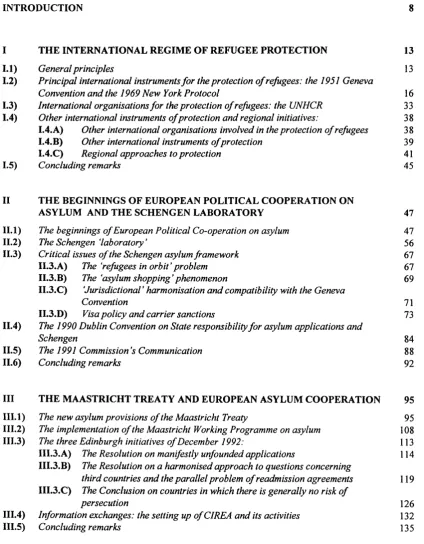
TABLE OF CONTENTS
TABLE OF ABBREVIATIONS 5
ACKNOWLEDGEMENTS 7
INTRODUCTION 8
I THE INTERNATIONAL REGIME OF REFUGEE PROTECTION 13
1.1) General principles 13
1.2) Principal international instruments fo r the protection o f refugees: the 1951 Geneva
Convention and the 1969 New York Protocol 16
1.3) International organisations fo r the protection o f refugees: the UNHCR 33
1.4) Other international instruments o f protection and regional initiatives: 38
1.4. A) Other international organisations involved in the protection o f refugees 38 1.4. B) Other international instruments o f protection 39
1.4.C) Regional approaches to protection 41
1.5) Concluding remarks 45
II THE BEGINNINGS OF EUROPEAN POLITICAL COOPERATION ON
ASYLUM AND THE SCHENGEN LABORATORY 47
11.1) The beginnings o f European Political Co-operation on asylum 47
11.2) The Schengen ‘laboratory’ 56
11.3) Critical issues o f the Schengen asylum framework 67
11.3.A) T h e ‘refugees in orbit’problem 67
11.3.B) The'asylum shopping’phenomenon 69
11.3.C) ‘Jurisdictional ’ harmonisation and compatibility with the Geneva
Convention 71
11.3.D) Visa policy and carrier sanctions 73
11.4) The 1990 Dublin Convention on State responsibility fo r asylum applications and
Schengen 84
11.5) The 1991 Commission’s Communication 88
11.6) Concluding remarks 92
III THE MAASTRICHT TREATY AND EUROPEAN ASYLUM COOPERATION 95
111.1) The new asylum provisions o f the Maastricht Treaty 95
111.2) The implementation o f the Maastricht Working Programme on asylum 108 111.3) The three Edinburgh initiatives o f December 1992: 113 111.3.A) The Resolution on manifestly unfounded applications 114
111.3.B) The Resolution on a harmonised approach to questions concerning
third countries and the parallel problem o f readmission agreements 119
111.3.C) The Conclusion on countries in which there is generally no risk o f
persecution 126
111.4) Information exchanges: the setting up o f CIREA and its activities 132
Ta b l e o f Co n t e n t s
IV ASYLUM CO-OPERATION BETWEEN MAASTRICHT AND AMSTERDAM 138 IV. 1) The 1994 Commission Communication on asylum and immigration 138 IV.2) Visa Regulations and their impact on asylum co-operation 142 IV.3) Implementation measures o f the Dublin Convention 145 IV.3.A) Means o f p ro o f in the framework o f the Dublin Convention 145
IV.3.B) Harmonisation o f expulsion policies 147
IV.4) The Council Resolution on minimum guarantees fo r asylum procedures 150 IV.5) The Joint Position on the harmonised application o f the definition o f the term
‘refugee ’ in Art. I o f the Geneva Convention 158
IV.6) Burden-sharing initiatives and issues o f temporary protection 164 IV. 7) New priorities fo r co-operation: an assessment o f the Third Pillar working structures
and the new 1996 JHA Working Programme 169
IV.8) Concluding remarks 173
V THE ICC AND THE AMSTERDAM TREATY 176
V .l) The beginning o f the IGC negotiations on the Third Pillar 176
V.2) The Dublin Proposal o f December 1996 183
V.3) The Amsterdam Treaty provisions on asylum: 191
V.3.A) The new Part III, Title IV o f the EC Treaty 191
V.3.B) The Protocol on asylum fo r nationals o f Member States o f the European
Union 202
V.4) Flexibility and closer co-operation measures: their impact on the asylum field 206 V.4. A) The general provisions on ‘closer co-operation ’ 207 V.4.B) The Protocols on the position o f the United Kingdom, Ireland and
Denmark and the Schengen Protocol 211
V.5) Final considerations 218
VI AFTER AMSTERDAM: TOWARDS AN EU ASYLUM POLICY? 222
VI. 1) The Austrian Strategy Paper on migration and asylum policy 222 VI.2) The new Action Plan on establishing an area o f freedom, security and justice 230 VI.3) The new challenges: temporary protection and burden-sharing in the light o f the
Kosovo crisis 234
VI.4) The Tampere European Council: towards a ‘Common European Asylum System ’ 246 VI.5) The European Refugee Fund and the Temporary Protection Directive 255 VI. 6) The draft Directive on minimum standards fo r granting and withdrawing refugee
status 261
VI. 7) The reforms o f the Nice Treaty 271
VI.8) The EU Charter o f Fundamental Rights and refugee protection 277 VI. 9) Towards a comprehensive EU asylum policy: searching fo r a long-term action plan 280
VII CONCLUSIONS: EU ASYLUM COOPERATION AND THE FUTURE OF
REFUGEE PROTECTION IN EUROPE 284
VII.l European asylum harmonisation: a true EU policy? 285 VII.2 European refugee initiatives, international asylum obligations and human rights
protection in the EU: the balance between ‘protection ’ and 'control ’ 2 91
VII.3 Building an effective EU asylum policy while ensuring refugee protection:
harmonisation and the way forward 297
ANNEX 302
BIBLIOGRAPHY 309
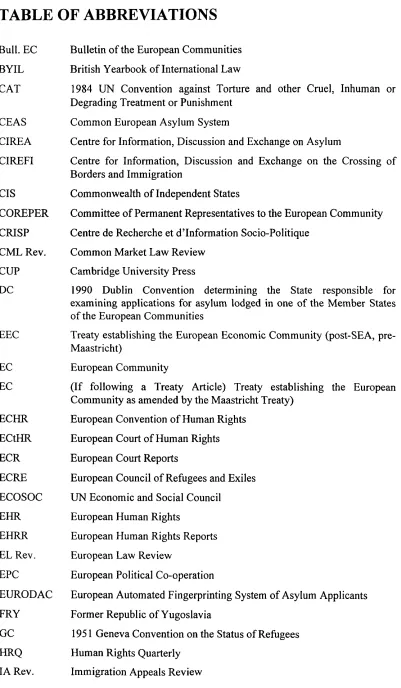
TABLE OF ABBREVIATIONS
Bull. EC Bulletin o f the European Communities
BYIL British Yearbook o f International Law
CAT 1984 UN Convention against Torture and other Cruel, Inhuman or Degrading Treatment or Punishment
CE AS Common European Asylum System
CIREA Centre for Information, Discussion and Exchange on Asylum
CIREFI Centre for Information, Discussion and Exchange on the Crossing o f Borders and Immigration
CIS Commonwealth o f Independent States
COREPER Committee o f Permanent Representatives to the European Community
CRISP Centre de Recherche et d ’information Socio-Politique
CML Rev. Common M arket Law Review
CUP Cambridge University Press
DC 1990 Dublin Convention determining the State responsible for examining applications for asylum lodged in one o f the Member States o f the European Communities
EEC Treaty establishing the European Economic Community (post-SEA, pre-M aastricht)
EC European Community
EC (If following a Treaty Article) Treaty establishing the European Community as amended by the Maastricht Treaty)
ECHR European Convention o f Human Rights
ECtHR European Court o f Human Rights
ECR European Court Reports
ECRE European Council o f Refugees and Exiles
ECOSOC UN Economic and Social Council
EHR European Human Rights
EHRR European Human Rights Reports
EL Rev. European Law Review
EPC European Political Co-operation
EURODAC European Automated Fingerprinting System o f Asylum Applicants
FRY Former Republic o f Yugoslavia
GC 1951 Geneva Convention on the Status o f Refugees
HRQ Human Rights Quarterly
Ta b l e o f Ab b r e v i a t i o n s
ICCPR International Covenant o f Civil and Political Rights
ICJ International Court o f Justice
ICLQ International and Comparative Law Quarterly
ICRC International Committee o f the Red Cross
IGC Intergovernmental Conference
ILPA Immigration Law Practitioners Association
IJRL International Journal o f Refugee Law
INLP Immigration and Nationality Law and Practice
lO M International Organisation for Migration
JCMS Journal o f Common M arket Studies
JHA Justice and Home Affairs
NQHR Netherlands Quarterly on Human Rights
NGOs Non-governmental Organisations
OAS Organisation o f American States
OAU Organisation o f African Unity
OJ Official Journal o f the European Communities
OUP Oxford University Press
QUANGO Quasi Non-Govem mental Organisation
SC 1990 Schengen Convention
SIS Schengen Information System
TEC Treaty establishing the European Community as amended by the Amsterdam Treaty
TEU Treaty on the European Union
TP Temporary Protection
UNGA United Nations General Assembly
UNHCR United Nations High Commissioner for Refugees
ACKNOWLEDGEMENTS
The writing of the thesis took a considerable length of time due to the major changes in the EU asylum field introduced by the Amsterdam Treaty and its aftermath. I had the privilege to be supervised in this research project by a distinguished expert in this field, Professor David O’Keeffe. I am much indebted to him for his strong encouragement, invaluable advice, unfaltering dedication and constant support throughout many difficult moments.
My gratitude also goes to Professor Klaus Nanz, Mr Jon Payne and Dr Valeria Galandini for their valuable insights into the way Germany, Britain and Italy respectively have contributed to EU asylum co-operation. Many thanks also to James Michael for his help with issues relating to the European Convention o f Human Rights and to Dr Danesh Sarooshi for sharing his insight into questions concerning the United Nations.
I owe a special debt of gratitude to Belén Martinez Carbonell and Angela Martini for their invaluable help in tracking down and supplying me with EU sources and documentation. Many thanks also to ECRE (London), UNHCR (Brussels) and the British Refugee Council for letting me access their documentation centres and supplying me with important research material. I am also indebted to the Italian Centre for National Research (CNR) and the UCL Postgraduate School for their generous financing of this project.
In t r o d u c t i o n
8
INTRODUCTION
‘The twentieth century saw the developed world descend into a paroxysm of ideological violence, as liberalism contended first with the remnants of absolutism, then bolshevism and fascism, and finally an updated Marxism that threatened to lead to the ultimate apocalypse o f a nuclear war. But the century that began full of self-confidence in the ultimate triumph of Western liberal democracy seems at its close to be [...] the end o f history as such: that is, the end point o f mankind’s ideological evolution and the
universalisation o f Western liberal democracy as the final form of human
government’.'
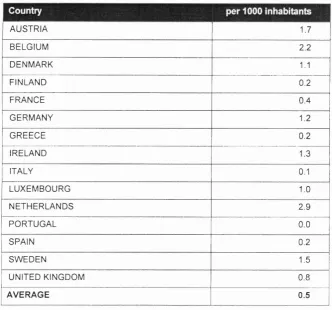
Back in 1989 the ‘new world order’ rising from the ashes of the Cold War might well have seemed the ‘end of history’, but it certainly did not mean the end of the refugee cycle. Throughout the world liberal democracies based on the respect for fundamental Human Rights have remained a privilege for the few. Refugee crises have, without a doubt, been one o f the most tragic occurrences of the 20"’ Century, a terrible phenomenon that looks set to continue well into the next one. In the five decades following the end of the Second World War, the global refugee population experienced a tenfold increase. The UNHCR estimated that on the eve of the third millennium there were 22.3 million refugees in the world.^ One tenth of them were in Europe. During the last decade heated political discussions about asylum trends dominated national agendas across the EU, despite the fact that refugees only represented on average 0.07 per cent of the total population.^ Following the end of the Cold War’s polarisation and the ensuing proliferation o f localised conflicts, the number of asylum applications in Europe has risen steeply since the middle of the 80s. The pressure on national asylum systems was further enhanced by the restrictive immigration policies EU Members introduced in the aftermath of the 70s economic
‘ F. Fukuyama, ‘The end of history?’ (1989) 16 The National Interest, p. 3.
^ In 1951 the UNHCR estimated the existence of 2,116,200 refugee worldwide. This figure had grown to 22.3 million by 31 December 1999. See UNHCR, The state o f the w orld’s refugees, 2000.
slump. Most Member States, in an attempt to stem the asylum flows, repeatedly tightened their national refugee admission policies and progressively looked to the EU for a comprehensive regional solution.
This research has focused on the gradual development of a co-ordinated EU response to the pressing asylum issues that have affected most Member States in the past two decades. This EU involvement in the asylum field has been analysed following a historical/evolutionary approach that has concentrated on two main aspects. On the one hand, the analysis has attempted to monitor the rise since 1985 of a common interest among EU Member States in co-ordinating their national asylum policies. It has focused on explaining the reasons for this rise and the shape this asylum co-ordination has progressively taken. It has also attempted to assess whether such asylum co-ordination has been characterised by an identifiable pattern of evolution, for instance in the choice of priorities or of an overall strategy. Most importantly, this analysis has tried to ascertain whether these initial efforts have developed effectively into a fully-fledged EU asylum policy. On the other hand, this research has concentrated on the impact o f these initiatives on the levels of refugee protection in the EU. In particular, it has tried to assess whether European initiatives in the asylum field have been compatible with previous international refugee and Human Rights obligations. Finally, this thesis has attempted to suggest ways in which enhanced levels of refugee protection could be integrated in the development of an efficient EU asylum policy.
INTRODUCTION
10
asylum legislation and their related practices. Therefore, this research will limit itself to analysing asylum initiatives undertaken at intergovernmental and EU level. Whenever possible, reference to national asylum policies has been made for the purpose o f clarifying both the background and the implications of EU intervention. This thesis reflects the law as it stands on 31 January 2001, but occasionally, where possible, more recent material has been added.
The beginning of this thesis sets the general framework for this research by outlining the international foundations of refugee protection such as the 1951 Geneva Convention, the 1967 New York Protocol and the UNHCR, and the way they have evolved in the last four decades. At the same time it outlines other examples of regional refugee protection initiatives, such as the African and South American ones, as well as Human Rights instruments that have had important implications for refugee protection in Europe. Particular attention is given in this respect to the far- reaching jurisprudence of the European Court of Human Rights. This research then concentrates on its main focus by shifting to the European regional dimension and analysing the initial attempts of EC countries to co-ordinate their asylum measures through the burgeoning European Political Co-operation as well as the reasons behind the need for such co-ordination. The role played by parallel asylum initiatives, adopted by a smaller number of EC Members within the Schengen framework, is also examined as an important precursor to subsequent EU developments.
The Maastricht Treaty was of fundamental importance for the enhancement of EU asylum co-operation. This thesis analyses the nature of the Third Pillar provisions on asylum, the operating structures set up for asylum co-ordination and the resulting patterns of interaction between Member States and the Union’s institutions. The Third Pillar codification of an intergovernmental asylum co operation framework led to the adoption o f a number of asylum initiatives, mostly relating to the implementation of the 1990 Dublin Convention on the criteria assigning State responsibility over asylum applications. However, these measures presented several problems of effectiveness and implementation, as well as indicating a gradual shift of asylum objectives by the mid-90s.
opt-In t r o d u c t i o n 12
outs, restricted jurisdictional controls and finally the possibility of enhanced co operation among a smaller number of Member States. The roles played by the subsequent Tampere European Council and the recent Nice Treaty are also explored as they provided both a development path and a fine-tuning of decision-making processes of the new EU asylum co-operation. Finally, attention is given to the possible impact that the EU Charter of Fundamental Rights, approved at Nice, might have on strengthening the Human Rights dimension o f asylum in future EU action.
CHAPTER I
THE INTERNATIONAL PROTECTION OF REFUGEES
I.l) General principles
All the asylum initiatives undertaken by Community Member States in the past fifteen years did not happen in a situation o f legal vacuum. In this respect, Member States were bound by a series o f pre-existing international obligations arising both from specific asylum provisions and from other Human Rights instruments. Moreover, other countries in the world had adopted their own regional approaches to refugee protection. The purpose o f this Chapter is to outline the various ways in which the concept of refugee protection has been developed in the international context and thus to set a useful background for better understanding the evolution of EU asylum co-operation that will be analysed in the following Chapters.
‘Refugees’, in the broader sense of the term are by no means a twentieth century phenomenon. However, only at the end o f the First World War did the Western world focus its attention on the plight of people obliged by adverse circumstances to flee their own homes and seek refuge elsewhere. Thus began a slow process o f legal definition that eventually led to the drafting of universal international instruments such as the 1951 Geneva Convention on the Status of Refugees (GC) and the creation of organisations such as the UN High Commissioner for Refugees (UNHCR).
This lengthy process started with the numerous special arrangements concluded under the auspices of the League of Nations to protect Russian, Armenian and later German refugees.' These Treaties were characterised by the adoption of a
C h a p t e r I
— — - - j j
‘group’ or ‘category’ approach, in so far as they protected people defined on the basis o f ethnic or nationality criteria. Contemporary legal commentators already highlighted the shortcomings of such an approach, insofar as it lacked an abstract and general definition of the term ‘refugee’.^ It was only after the Second World War that more precise criteria emerged and ‘in a little more than five years the preferred approach to refugee definition moved from a basis in flexible or open groups and categories to an apparently more closed and legalistic one’.^
One of the most pressing issues at the end o f the Second World War was the necessity of dealing with the millions o f people that had been displaced by the conflict. The International Refugee Organisation (IRO), was bom out of such necessity and later became the UNHCR. The IRO Covenant constituted the first attempt to codify the term ‘refugee’ as well as the type of protection such people should be afforded. Refugees thus came to be termed as individuals being ‘persecuted’ on a certain number of grounds,"* mainly concerning race, nationality and political or religious beliefs and as being unable to avail themselves o f the protection o f their country of nationality.^
But as the world’s post-war geopolitical asset edged more and more towards a bipolar framework. Western States became increasingly concerned by the necessity
^ See for instance J.H. Simpson, The refugee problem (Royal Institute o f International Affairs, OUP, 1939), who stressed that the ‘essential quality’ o f refugees was the fact that political events made it impossible for them to stay in their own country (at p. 28 et seq.).
^ G. S. Goodwin-Gill, The refugee in international law (2nd edn. Clarendon Press, Oxford, 1996), p. 6.
"* On such grounds see further in 1.2. The definition of these grounds was clearly linked with the parallel ongoing discussions on the definition of universal Human Rights. On these links and for an in-depth analysis of how these grounds came to be included in the IRO definition see L. W. Holbom, The International Refugee Organisation: a specialised agency at the United Nations. Its history and work 1946-52 (OUP, Oxford, 1956).
of narrowing down the definition of the term ‘refugee’.^ Thus, they focused on a strictly legalistic concept of protection and persecution that was rooted in the parallel international codification of universal Human Rights. The Statute of the UNHCR, the 1951 GC and the 1967 Declaration on Territorial Asylum became the fundamental texts in which refugee protection was to be encoded.’ However, the implementation o f the latter two was left to the practice of individual States and therefore national applications differed widely. Therefore, outlining a truly international refugee regime without referring to its specific national applications becomes very difficult. It is nonetheless essential for the purposes of this research to briefly analyse the basic foundations of refugee protection as it is laid down in international law, both in the form of conventions and in the evolving mandates o f specific organisations.
^ The main concern derived from the fear that a broad obligation of assistance to persecuted people would have proven impossible and potentially politically explosive in the context of the precarious Cold War equilibrium.
C h a p t e r I 16
1.2) Principal international instruments for the protection o f re fusees: the 1951 Geneva Convention and the 1969 New York Protocol
The five years that followed the end of the Second World War were of pivotal importance for the development of the current international refugee regime. The establishment of the United Nations marked the beginning of a new era in the globalisation of international law issues such as the respect of Human Rights. The 1948 Universal Declaration of Human Rights represented the first impressive step in this direction. Art. 14.1 stated that ‘everyone has the right to seek and to enjoy in other countries asylum from persecution’. Although powerful, this statement concealed the enormous differences of opinion that had begun to emerge between UN Members, some of whom were increasingly worried about the potential liabilities of having to protect large numbers of refugees. It transpired from the travaux
préparatoires that the majority of States had no intention of assuming any moral or
legal obligation on these matters. The granting of asylum was perceived as an entirely discretionary exercise of States’ sovereignty. Only the duty to respect the decision to grant asylum was seen as an international obligation.* In the end, the only right effectively being recognised was the right to flight, rather than the one to asylum.^
The 1951 Geneva Convention on the Status of Refugees was the direct result of a recommendation by the newly established UN Commission on Human Rights.'^
® Any suggestion to substitute the expression ‘to enjoy [...] asylum from persecution’ with the one ‘to be granted asylum from persecution’ was quickly dismissed, as well as the idea that the power to decide on matters o f refugee protection should be delegated to the IRO. See the original draft of Art. 14: UN Doc. A/C.3/285/Rev.l and the UK objections in UN Doc. A/C.3/SR.121, pp. 4-6. See also P. Weiss, The travaux préparatoires o f the 1951 Geneva Refugee Convention, UN Documentation series, XII/1995.
^ In this sense refugees were entitled to leave their country to escape persecution, but were not necessarily given any guarantees o f protection in law.
By then it had become obvious that the old IRO definition of refugee - still based on a ‘category’ approach - needed updating." However, no overall consensus had yet been built on the scope to be given to the legal definition of a refugee.'^ In the end, after intense negotiations, a compromise was reached whereby a rather general definition of the term ‘refugee’ was accompanied by a restrictive temporal clause, limiting the application of the GC only to those who acquired refugee status as ‘a result of events occurring before 1 January 1951’ (Art. l.B .l). Furthermore, there was the optional possibility of geographically limiting ‘events’ to those ‘occurring in Europe’ prior to 1951 (Art. l.B .l.a )." In order to overcome these draconian limitations a Recommendation was added to the GC (n° E) inviting Member States to extend protection to refugees within their territory beyond the contractual scope of the Convention. Many States actually relied on this Recommendation to broaden their national refugee protection regimes until 1967, when these restrictions were officially lifted.
rights, in order to understand the transition from a ‘category’ definition of refugees towards a more general one. In principle, all Human Rights were considered of equal importance. However, some particular rights could never be the subject of any derogation (see, for instance, the 1966 UN ICCPR, where derogation from the freedoms granted was allowed in cases of life-threatening public emergencies, with the exception of seven fundamental rights - incidentally, the same limited derogation appeared in the ECHR). Such freedoms were the right to life (Art. 6), the protection against torture and cruel or inhuman treatment (Art. 7), the prohibition of slavery and servitude (Art. 8), the right not to be submitted to retroactive criminal penalties (Art. 15), the right to recognition as a person before the law (Art. 16) and the freedom o f thought, conscience and religion (Art. 18). These fundamental freedoms became in turn the very grounds on which the international regime of protection from persecution came to be based (see further).
” The definition had already been updated when the Statute of the UNHCR was drafted (see later Chapter 1.3).
The United States expressed concerns that too vague a definition would inevitably result in lengthy interpretation disputes and too many unforeseeable responsibilities. The United Kingdom tried to introduce a more wide-ranging definition that focused on the situation where a person, having been persecuted - or fearing persecution - was unable or unwilling to return to his country of origin. See G. Goodwin-Gill, supra 3, p. 18.
C h a p t e r I
— —
The 1951 Geneva Convention dealt with the recognition of refugee status by StatesT It was widely accepted that such a formal recognition was merely o f a ‘declaratory’ nature, since anybody became a refugee as soon as they fulfilled the definition.'^ According to Art. 1, ‘Convention’ refugees were characterised by four elements: a) they had fled their country o f origin; b) they were unable or unwilling either to return to it, or to avail themselves of its protection; c) this impossibility was due to past persecution or to a well-founded fear of possible persecution; d) they feared persecution on the grounds of race, religion, nationality, political opinion or membership o f a particular social group. The assessment o f such elements was entirely remitted to Member States and their national adjudication systems and, in the absence of any international control, their application or interpretation differed widely.'^
The term ‘persecution’, for instance, was not defined by the GC nor by any other international convention,leaving States with a wide margin of appreciation. This in turn resulted in a very disparate national jurisprudence. Art. 1 GC established, however, a clear link between persecution, or the mere fear o f it, and the absence of protection.'* In this context the notion o f fundamental Human Rights could be
Also the UNHCR can ‘recognise’ refugees, see Chapter 1.4.
Problems obviously arose when, for instance, the recognition by a State and by the UNHCR didn’t coincide or if States declined to even ‘initiate’ the procedure for determining refugee status (see further on the Schengen and Dublin Conventions, Chapters II and III).
It is impossible in the framework of this research to examine all the different national refugee determination procedures implemented following Art. I GC. This analysis will restrict itself to general problems of interpretation and application. Likewise, the provisions relating to the juridical status o f ‘recognised’ refugees, their benefits and travel arrangements, shall be only briefly examined in so far as they have not proven particularly controversial.
See G. Goodwin-Gill, supra n° 3, p. 66.
assumed as an effective base for assessing the existence of persecution.’^ ‘Means’ of persecution also proved difficult to assess since they assumed so many different historical forms. Therefore, its interpretation had to rely on an ill-defined concept of proportionality.^® The assessment of persecution was further complicated by the fact that the oppression was often not carried out directly by the State itself, but the State in question was unwilling or unable to provide protection to the individual.^'
The level of proof required by the GC to sustain a claim of persecution (or the fear of it) was equally left open to States’ interpretation. Given the gravity of the issues at stake (the possibility, for individuals, of being left without protection against their own State and the denial of their most fundamental freedoms) the burden o f proof could reasonably be expected to be in favour o f the refugee.^^ Furthermore, it would be unfair to apply the standard of proof required for criminal cases, because it would be very difficult for someone who has been the object of persecution to present the level o f proof necessary to make his case ‘beyond any reasonable doubt’. However, the question remained of whether the ‘balance of
See supra n° 10. Since the preservation of these rights was intrinsically connected with the dignity and integrity of the human being, any measure that would threaten the life (and physical/mental integrity), freedom and recognition as a person of an individual would necessarily have amounted to persecution.
The notion of when the nature and severity of a measure becomes oppressive and persecutory was by definition open to infinite interpretations. However, some guidance could be found in the principle of non-discrimination, whereby any measure that could, even indirectly, lead to the singling out of an individual with the purpose of oppression could be considered paramount to persecution (on non discrimination as a principle of general international law, see the Barcelona Traction case, ICJ Rep.
1970 3, at p. 32). For a comprehensive review of all the different interpretations of the term ‘persecution’, see D. J. Steinbock, ‘The refugee definition as law: issues o f interpretation’ in F. Nicholson and P. Twomey (eds). Refugee rights and realities, (CUP, Cambridge, 1999), p. 13.
The last 50 years of international history have been full of such tragic circumstances spanning the entirety o f the globe. Unfortunately, for a refugee the formal existence o f a State can sometimes mean the difference between recognition and rejection. Some countries - notably, within Europe, France and Germany - do not recognise the principle of ‘non-State agent’ persecution. In the past, for instance, Algerians targeted by the Islamic Front (FIS) have failed to obtain refugee status in some countries even though it was clear that their own government was unable to protect them. Somalis too have often been rejected because no clear government was identifiable. This responsibility-based approach did not, however, appear to be in conformity with the actual GC. Assessment in such cases should not have focused on whether it was possible to establish the ‘responsibility’ o f the State in the international meaning of the sense, but whether there was a likely risk o f persecution for the refugee
C h a p t e r I
20
probability’ test could be usefully applied to a future speculation of fear of persecution/^
Problems of proof were further complicated in cases where persecution had not actually taken place but the applicant was claiming a ‘well-founded fear’ of persecution. National jurisprudence seemed to have diverged remarkably on the value to be given to subjective fear.^"* The UNHCR clearly stated on a number of occasions its belief that a fear o f persecution had to be founded on an objective situation that could reasonably give rise to concerns about future oppression.^^ In general, most national Courts endorsed the principle that the level of proof required should be assessed on a case-by-case basis. This individual approach was justified by the fact that ‘fear’ in itself could not be objectively quantified, whereas the real subject of the judicial assessment was in fact the degree of the ‘risk of persecution’ involved.
Interpretation of the grounds for persecution listed by the GC was equally controversial. ‘Race’ and ‘religion’ gave rise to the least divergence, having been widely defined in other international texts.^^ ‘Nationality’ in the context of the GC was always interpreted rather broadly as including membership of a community
On this point see the interesting ‘theory of the three scales’ by J. Y. Carlier, ‘The Geneva refugee definition and the ‘theory of the three scales” , in F. Nicholson and P. Twomey (eds), supra n° 20, p. 37.
See, on this point, M. Gibney, ‘A well-founded fear o f persecution’ (1988) 10 HRQ, p. 109 et seq.
25
See UNHCR, Handbook on procedures and criteria fo r determining refugee status, para. 42, where it states that ‘[I]n general the applicant’s fear should be considered well-founded if he can establish, to a reasonable degree, that his continued stay in his country of origin has become intolerable for him for the reasons stated in the definition, or would for the same reasons be intolerable if returned there’.
characterised by particular ethnic, religious, cultural and linguistic ties.^^ There were frequent and inevitable overlaps between these grounds of persecution in the way they were applied by Member States, and sometimes this cumulation actually resulted in a strengthening of the applicant’s claim.
Persecution on grounds of ‘political opinion’, although quite precisely described in international texts, gave rise to an ample display o f different interpretations. Art. 19 of the Universal Declaration of Human Rights stated that ‘everyone has the right to freedom of opinion and expression; the right includes freedom to hold opinions without interference and to seek, receive and impart information and ideas through any media and regardless of frontiers’.^* Typically, a ‘refugee’ within the GC meaning would be someone persecuted by his government or other national agents on account o f opinions that could be perceived as threatening to the institutions, political programme or objectives of the latter. In this context, it would be irrelevant whether the political opinion in question constituted an actual threat or merely a perceived one, or if the opinion was wrongly attributed to the refugee. It was primarily the subjective perception of the persecutor that gave rise to the oppressive measures.^^
A useful reference in this respect can be found in Art. 27 o f the 1966 ICCPR with respect to the rights o f minorities (which are defined on ethnic, religious or linguistic grounds). On this point see also A. Grahl-Madsen, The status o f refugees in International Law (Sijthoff, Leiden, 1966, vol. 1 & 11), vol. 1, pp. 218-219.
Art. 19 o f the 1966 ICCPR echoed this wording, although a derogation was allowed for ‘special duties and responsibilities’. This represented a further evolution in the field of Human Rights whereby certain opinions were no longer regarded as acceptable, as, for instance, all those in favour of racial discrimination.
Ch a p t e r I 2 2
Finally, the most controversial point of interpretation proved to be the ‘membership o f a particular social group’ clause. The travaux préparatoires offered no insight into the reasons why such definition came to be included. It was highly likely that the drafters were concerned by the ‘restructuring of societies’ that were taking place at the time in the socialist States, where entire classes o f citizens were being targeted by the State and persecuted. The UNHCR Handbook (para. 78) justified the inclusion on the grounds that ‘membership of a particular social group may be at the root of persecution because there is no confidence in the group’s loyalty to the government or because the political outlook, antecedents or economic activity o f its members, or the very existence o f the social group as such, is held to be an obstacle to the government’s policies’. Formulating a widely accepted definition of ‘social group’ across national interpretations would prove impossible. In most instances, particular attention was given to the presence of linking factors of a cultural, ethnic or economic nature, to shared backgrounds, values and visions of life. However, the notion lent itself to a virtually endless evolution and was stretched to include very different circumstances.^® Again, actual membership of the group was not essential if it could be demonstrated that the individual was perceived as being a member o f the group by the persecutor.
Only Art. 1 of the GC closely concerned the attribution of refugee status. Most o f the rest of the Convention dealt with the status itself and the benefits and obligations that it entailed.^^ The overall spirit o f such provisions was inspired by the wish to afford recognised refugees a treatment as similar as possible to the State’s
In a world where the roots of the refugee phenomenon had undergone a dramatic change in the last three decades, the concept o f ‘social’ group was often seen as a ‘catch-all’ for adjusting to the evolving historical context. On the whole, Courts leaned towards a characterization o f the individual based on traits that were innate or unchangeable (such as, for instance, ‘gender’). Other times they found admissible associations dictated by reasons of fundamental human dignity (for example Human Rights associations). For a review o f national Jurisprudence on these characteristics, see G. Goodwin- Gill, supra n° 3, pp. 356-66.
own nationals. Thus, numerous articles regulated the refugees’ juridical status, the conditions o f their employment,^^ welfare, administrative assistance, freedom of movement, identity and travel papers, fiscal charges and transfer of assets.
A special provision was made for ‘refugees unlawfully in the country of refuge’ (Art. 31 GC) in the instance that they were fleeing directly from somewhere where their life or freedom was at risk. Provided that they alerted the authorities to their presence and the reasons for their illegal entry, no penalties could be applied to them. The drafting of this provision proved quite controversial as Member States tried to balance the necessity of guaranteeing protection with their efforts to thwart abuses of the asylum institution.^^ As a consequence the scope o f application o f Art. 31 varied considerably. Countries who were mostly concerned with restricting their alternative immigration channels imposed a very narrow definition of the ‘transit time’ refugees were allowed in other countries in the course of their flight and also developed a wide-ranging notion of the ‘country of first asylum’.^'*
Interestingly, in the case of employment, refugees were only granted ‘the most favourable treatment accorded to nationals of a foreign country in the same circumstances’ (Art. 17.1), although in respect to labour legislation and social security they were to be treated as a national o f that host country (Art. 24). The same discrepancy appeared in other provisions such as non-elementary education (Art. 22.2).
” In the travaux préparatoires, the High Commissioner for Refugees strongly pointed out that flight very rarely happened in a straight path and that most of the time transit through other countries was inevitable. The actual wording of the article represented a compromise between countries such as France, who wanted to restrict the application o f this provision only to refugees coming directly from the country o f origin and others who favoured a more liberal approach. This wording should have also covered instances o f transit through countries where refugees would still be at risk of persecution or where they could not be afforded adequate protection. On these points, see G. Goodwin-Gill, supra n° 3, pp. 88-91.
C h a p t e r I —
According to the second part of Art. 31 GC, the movements of refugees coming directly from the territory o f persecution should be restricted as little as possible and only until either their status has been regularised or they have obtained admission into another country. Also in this instance the scope of application has varied considerably. In most EU countries imprisonment - in special detention camps or in regular jails - was normally imposed on asylum seekers during at least some of the stages of their assessment by the asylum authorities and justified by the possibility that they might abscond into the host country and thereby bypass immigration requirements.
The provisions regulating expulsion and the return of refugees were undoubtedly the ones that generated the most varied and extensive body of national practices and jurisprudence.^^ Art. 32 GC dealt with the expulsion of refugees lawfully resident in a Member State (‘recognised’ refugees), whereas Art. 33 GC contained broader clauses concerning the minimum protection against forcible returns to be granted to all asylum seekers present on the national territory. According to Art. 32 no refugee ‘lawfully in their territory’ could be expelled by the Contracting States except for reasons of national security or public order. The decision should be reached in ‘accordance with the due process of law’ and the refugee should be granted all the minimum judicial guarantees.^^ Additionally, refugees should be given the option to seek admission into another country.
Although the GC definition of ‘refugee’ was quite limited, all prospective asylum seekers who were in the territory of a Member State were protected by these provisions. This lead to a large volume of national jurisprudence.
Art. 33 GC affirmed the principle of the prohibition of refoulement.^^ In broad terms this could be defined as the prohibition on returning refugees to countries where they would be likely to face persecution. This principle was generally interpreted as covering all people seeking protection and present in the territory of a Contracting State, regardless of whether they had been recognised as refugees or whether they had gained illegal entry. Since the application of this provision necessarily relied upon an assessment of a risk (the possibility o f persecution), national implementations varied considerably.^^ Furthermore, the magnitude of such protection did not coincide with the narrow definition of Art. 1 GC. Thus, the application o f non-refoulement led to vast numbers of people - seeking protection on grounds outside of Art. 1 GC - being allowed to remain on the territory of Contracting States under a multitude of legal statuses, unfortunately often under very inadequate conditions.^^
The principle of non-refoulement was relatively recent. It was introduced in an international text only after the First World War, but adhesion to this instrument was still very limited."*” Only after 1945 did the principle appear to have been more widely accepted"** and it was finally incorporated into Art. 33 GC. Its wording gave
The term derives from the French were it was used in the military sense of an enemy being repelled or thrown back from one’s own line of defense. In the immigration controls context it has come to indicate both the act of forcibly escorting someone to the border with the purpose of expelling them or the refusal to admit people without proper documentation.
These discrepancies were largely the same as those encountered in setting national standards for the ‘well-founded fear o f persecution’ prescribed by Art. 1 GC. Most States drew a parallel between Art. 1 and Art. 33 and applied the same standard o f proof (such as a likely risk o f persecution rather than a clear probability of it) to both instances.
These people have come to be termed in the last two decades as ‘de facto refugees’. Although they would be allowed to remain their conditions were often very harsh (no benefits, no working rights and no social services). The need to devise some international instruments to cover these cases - often the result o f civil wars - was constantly stressed by the UNHCR and other relevant organisations. Some efforts have since been undertaken at the EU level (see Chapters IV.6, VI.3 and VI.5).
Art. 3 o f the 1933 Convention relating to the International Status of Refugees prohibited refoulement for reasons other than national security or public order. But only eight countries ratified it and some with considerable limitations on this principle.
C h a p t e r I
rise to numerous controversies on the extent of its scope, namely regarding both the recipients o f protection against refoulement and the value of this principle in general international law. The fact that officially ‘recognised’ refugees were certainly covered by the provision was never disputed. The main issue concerned the extent to which other asylum seekers were to be protected against refoulement and sometimes a distinction was drawn between people already present in the territory of the Contracting State and those seeking admission at the border.'*^ In practice, most Contracting States adopted a broad interpretation of the non-refoulement principle and allowed large numbers o f asylum seekers to cross their borders and to remain in their territories until a solution to their plight could be found. Similarly, the UNHCR consistently supported this broad interpretation''^ and although its Conclusions did not have legally-binding force they certainly influenced the way Member States viewed their obligations in this respect. The correctness of this interpretation was further backed by other international texts, such as the Declaration on Territorial Asylum adopted unanimously by the UN General Assembly in 1967.''''
charged with resettling thousands of European refugees that could not be returned to their homes. See G. Goodwin-Gill, supra n° 3, p. 119.
It emerged from the travaux préparatoires that a number of States were concerned that the prohibition of refoulement would implicitly mean an obligation for the Contracting Parties to automatically admit people claiming persecution into their territory. This could have made any national immigration control completely redundant, especially in the case o f mass migrations (G. Goodwin-Gill, supra n° 3, p. 122). Therefore, the wording of Art. 33 was arguably left deliberately vague, so as to hide this lack of consensus.
See, for instance. Executive Committee Conclusions n° 6 (1977); n° 19 (1980); n° 22 (1981) and n° 65(1991).
However, the protection against refoulement was not absolute. Art. 33.2 GC recognised that a refugee ‘whom there are reasonable grounds for regarding as a danger to the security of the country [...] or who, having been convicted by a final judgment of a particularly serious crime, constitutes a danger to the community of that country’ could be exempted from protection against refoulement. The wording of the provision and the travaux préparatoires seemed to indicate that the assessment of both the risk posed by the refugee to the community and of the eventual seriousness of the crime committed was left to the judgment of the Contracting States. Different national perceptions inevitably entailed different uses of this discretionary power, although most Western countries always relied on principles such as proportionality, natural justice and the possibility of judicial review in assessing individual cases.
The two exceptions contained in Art. 33.2 GC were by no means unique. They were part of the wider context of exception clauses to the granting of refugee status established by Art. l.F.'*^ The provision excluded the possibility of claiming refugee status for those who had committed ‘a crime against peace, a war crime, or a crime against humanity’ (Art. l.F.a), those who had ‘committed a serious non political crime outside the country of refuge prior to his admission to that country as a refugee’ (Art. l.F.b), and those who had ‘been guilty of acts contrary to the purposes and principles of the United Nations’ (Art. IF.c).
The idea to exclude war criminals or other criminals from availing themselves of the asylum institution typically asserted itself immediately after the end of the Second World War. The 1946 International Refugee Organisation (IRQ) constitution
The 1967 UN Declaration on Territorial Asylum reinforced this exception by authorizing a further exception in the case o f situations o f mass influx (Art. 3).
Ch a p t e r I 2 8
already included such a clause. Similarly, the 1948 Universal Declaration of Human Rights excluded people who committed non-political crimes or acts against UN principles.'*’ The exceptions provided by Art. 1 .F.a GC - war crimes, crimes against peace and crimes against humanity - could only be defined on the basis of the relevant international instruments. To this purpose, national practice constantly relied on an ever-widening body of international Treaties, such as the 1949 Geneva Conventions and the 1977 Additional Protocols,'** or the 1948 UN Convention on the Prevention and Punishment of the Crime o f Genocide.'*^ In the case of crimes against peace their definition relied more on the international widespread interpretation of other texts, such as the UN Charter and the above-mentioned Conventions.^® In all cases the criteria of ‘individual responsibility’ was always applied, even in the case of individuals allegedly carrying out superior orders.^*
Art. 14.2 states that ‘[t]his right [to invoke asylum] may not be invoked in the case of prosecutions genuinely arising from non-political crimes or from acts contrary to the purpose and principles of the United Nations’.
These Conventions dealt with the treatment of prisoners of war, o f the wounded or shipwrecked, of the civilian population and their property etc. Any breach of such Conventions or of the customs of war would be considered a ‘war crime’. Additionally, the 1946 London Charter for the Establishment o f the International Military Tribunal included relevant indications in the field of war crimes (see specific crimes listed under Art. VI).
The crime o f genocide is similar in essence to war crimes, but committed on a larger scale. Art. II of the Genocide Convention defines it as the commission of certain enumerated acts, such as killing, maiming or imposing oppressive measures ‘with the intent to destroy, in whole or in part, a national, ethnical, racial or religious group, as such’. Typical recent examples o f the exercise of such jurisdiction have been the 1993 International Tribunal on Yugoslavia and the 1994 International
Tribunal o f Rwanda.
For a very comprehensive overview see I. Brownlie, International law and the use o f force (Clarendon Press, Oxford, 1963).
Art. l.F.b raised a few difficulties of interpretation, although its introduction was by no means a novelty.^^ Firstly it was not made clear whether such a non political crime was to be a permanent impediment to claiming asylum, or if other circumstances^^ might attenuate such an impediment. In this respect State practice appeared to have followed an approach based on the consideration of each individual case.^"* Secondly, the wording ‘serious’ and ‘non-political’ crime was inevitably open to very different interpretations. With regards to the ‘seriousness’ of the crime, the French version of the GC offered some enlightenment,^^ since it stated that each State was entitled to weigh the crime in question against its own standards. The majority of national jurisprudence seemed to indicate that ‘serious crimes, above all, are those against physical integrity, life and l i b e r t y T h e term ‘non-political’ crime was equally hard to define. A steady evolution in international law meant that certain violent crimes, committed in the name of political or ideological ideals and greatly disproportionate to their objectives were eventually categorised as ‘terrorist acts’ because o f their cruel or horrifying n a t u r e . T h e overall States’ practice seemed to
” See the above mentioned Art. 14.2 o f the 1948 Universal Declaration and the 1946 IRQ Constitution which excluded ordinary criminals extraditable by treaty.
Such as, for instance, having been prosecuted and already served the relevant sentence, the passing o f considerable time, an amnesty or a pardon. The UNHCR Handbook at para. 149 specifies that all of the above should be taken into account and that if these conditions were to be fulfilled the exclusion clause should no longer be applicable, unless it could be proven that the ‘applicant’s criminal character still predominates’. This ample national discretion was justified by the fact that it was paramount to protect the community and this was precisely the reason why the exception clause of Art. l.F was inserted in the first place.
However, the transposition of this principle in some o f the EU asylum initiatives has been riddled with controversies (see later Chapter III.3 on the 1992 Edinburgh Initiatives).
The French version reads crime grave de droit commun'.
Ch a p t e r I
“ “ 3 0
indicate a case-by-case approach where considerable leeway was exercised in the definition o f what was to be considered ‘political’, with the result that application has been very inconsistent.
The exclusion from refugee status based on acts contrary to the purposes and principles of the UN provided by Art. IF.c GC was based on Art. 14.2 o f the 1948 Universal Declaration of Human Rights. Although these principles and purposes were already clearly stated in the first two articles of the UN Ch a r t e r , t h e y were subsequently considerably developed especially in the Human Rights field. The Universal Declaration of 1948, the 1966 ICCPR and another dozen Conventions in different Human Rights areas greatly enlarged the scope for ‘acts contrary to the principles and purposes on the UN’. As in the other exclusion clauses of Art. l.F, the definition o f the boundaries of individual responsibility remained an open question. The main issue in this case concerned whether responsibility was limited to those in a position o f authority or whether it also regarded relationships between individuals.^^ The UNHCR interpreted this provision strictly in the context of the other two exclusion clauses, therefore limiting individual responsibility only to those in a position of authority.^® National practices were, however, at times inclined to extend the scope o f individual responsibility.^' During the first two decades o f the GC this
” The same problem o f interpretation arose in respect to the definition of persecution on ‘political’ grounds (as mentioned earlier in this paragraph).
The UN main objectives were, in broad terms, the maintenance o f peace, the upholding o f Human Rights and justice, the promotion o f social progress, better standards of life and greater freedom. To achieve these aims the principles and purposes of the UN included collective action to preserve peace; respect for equal rights and the self-determination of peoples; international co-operation in all fields; and promotion and encouragement o f Human Rights.
The question was of particular importance as most o f the acts that could give rise to exclusion from refugee status under Art. IF.c GC were generally Human Rights violations This was further demonstrated by the creation of International Tribunals such as the Yugoslav or Rwandan ones.
UNHCR Handbook, para. 162-163.
exclusion was very rarely invoked. Recently, its use has become more frequent, probably as a direct consequence of the expansion of the purposes of the UN.^^
Art. 1 of the 1951 GC subjected the definition of ‘refugee’ to two limitations, the most important one being the historical dateline of fearing persecution because of ‘events occurring before 1 January 1951’ (Art. 1.A.2). The GC also offered the option o f further restricting such provision with a geographical clause, whereby the above events had to have occurred in ‘Europe’ before 1951 (Art.l.B.a). By the end of the Sixties in a world plagued by the Cold War regional confrontations and the legacy o f the post-colonial conflicts the strain of such limitations was becoming increasingly apparent. Many States had relied on Recommendation n° E to the 1951 GC to enlarge the scope of their asylum obligations, but time for an amendment to the GC finally seemed ripe.
Although the 1967 New York Protocol relating to the Status of Refugees was always referred to as an ‘amendment’ to the 1951 GC, it was in fact a totally independent international instrument. It was not necessary to be a party to the GC to accede to the 1967 Protocol. In ratifying it. Contracting States agreed to apply the 1951 GC, but without the temporal or optional geographical limitations contained in Art. 1.*^ Small differences between the two texts meant that there were some advantages in acceding only to the 1967 Protocol in respect of arbitration. According to Art. 36 of the 1951 GC the International Court of Justice had jurisdiction over any disputes arising from the Convention, and no reservations were allowed on this point.
reviewed have, however, kept in line with the UNHCR theory of responsibility, such as, for instance, the French denial o f asylum to Mr Duvalier, Haiti’s former dictator.
Human Rights aside, the UN has also become involved in totally new fields, such as the fight against the trafficking o f drugs and international crime, which has inevitably given rise to new individual responsibilities.
Ch a p t e r I
n
The parallel provisions in Art. IV of the Protocol instead allowed for reservations and a number of countries took advantage of this possibility.^"*
1.3) Refugee protection throush international orsanisations: the UNHCR
International bodies for the protection of refugees were an initiative of the 20th Century. In the period between the two World Wars numerous so-called High Commissioners for Refugees were nominated to deal with refugees fleeing different sources of persecution.^^ In 1938 32 States convened at the Evian Conference and decided to create the Intergovernmental Committee on Refugees, but unfortunately its operational abilities were severely hampered by the onset of the Second World War.^^ As soon as the UN structure was put into place ECOSOC prompted the institution of the International Refugee Organisation (IRQ) whose tasks included identification and repatriation; protection, care and assistance; and transport and resettlement of war refugees.^^ As the IRQ mandate was limited to war refugees it was clear that a more permanent institution had to be created. The main issues under discussion were the definition of the subjects for protection and the ways in which to ensure it. The High Commissioner for Refugees and the Statute of the UNHCR embodied the outcome of this debate.
The mandate of UNHCR comprised two main aims. Firstly, to provide international protection to those in need as defined by the Statute and secondly to seek permanent solutions to the plight of refugees, either by voluntary repatriation or by assimilation in countries of refuge. The office of the High Commissioner was to
In the same way that the evolution of the concept of ‘refugee’ was characterised by an initial ‘category’ approach, likewise the various High Commissioners were appointed specifically to deal with one particular group of persecuted people. In 1921 Dr Nansen was appointed by the League of Nations High Commissioner for the Russian Refugees and his mandate was later extended to cover Armenian refugees. In 1933 another High Commissioner’s Office was established for German refugees and finally in 1938 all these posts were unified in one single mandate for ‘all’ refugees.
^ Some o f its work was effectively taken over in 1943 by the UN Relief and Rehabilitation Administration (UNRRA) which was to cope with the millions o f people displaced by the conflict.
The IRQ carried out its tasks remarkably well considering the storm of accusations it was subjected to in the few years o f its existence. These accusations stemmed mainly from members o f the Soviet block who were increasingly accusing it of exploiting refugee issues for the purpose o f ideological confrontation.
Ch a p t e r I 3 4
be of ‘an entirely non-political character; it shall be humanitarian and social and shall relate, as a rule, to groups and categories of refugees’ (Art. 2). Several ways were identified to provide protection, but they mainly focused on: a) promoting the conclusion o f international conventions in the refugee field, supervising their application and proposing amendments to them, or bringing them up to date;^^ b) promoting co-operation with States in order to improve the situation of refugees; and c) promoting the admission of refugees (Art. 8). According to Art. 2 of the Statute the UNHCR should have dealt mainly with a ‘group’ approach. However, the greatest caseload to date has consisted mainly of individual cases and no national objection to this practice has ever been recorded.
The UNHCR was attributed the legal status o f subsidiary organ of UNGA, following of Art. 22 of the UN Charter, and its mandate was renewable every five years. It was to follow policy directives formulated both by UNGA and by ECOSOC and it enjoyed international p e r s onal i t y. Thi s personality assumed particular importance in the context of States’ obligations towards refugees. Unfortunately, individuals were never considered subjects of international law and therefore they could not enforce their rights against a State. The UNHCR international legal personality allowed it to act on behalf of the disempowered individual. In the event of difficult situations, the High Commissioner could request the opinion of the Executive Committee of the High Commissioner’s Programme.^'
The UNHCR actively encouraged and participated in the revision of the 1951 GC that lead to the adoption o f the 1967 New York Protocol. See V. Turk, ‘The role o f UNHCR in the development of international refugee law’ in F. Nicholson and P. Twomey (eds), supra n° 20, p. 153, at pp. 161-164.
Its personality could be traced to the UN overall legal personality. On this issue see the 1949 Corfu Channel Reparations case, ICJ Rep. 1949 174, at pp. 178-79. Following on from the conclusions of the Court, the UNHCR was entitled to carry out its protective function on the basis of a ‘universal jurisdiction’ (p. 184). Specific authority was also granted to the UNHCR by the 1951 GC and the 1967 Protocol. According to Art. 35 GC, for instance. Member States pledged to cooperate with it and to facilitate its supervision of the application of the Convention.