IJEDR1402197
International Journal of Engineering Development and Research (www.ijedr.org)2528
Application of Taguchi Approach for Optimization
Roughness for Boring operation of E 250 B0 for
Standard IS: 2062 on CNC TC
1
Mihir Patel,
2Vivek Deshpande
1Lecturer, 2Associate Professor 1Mechanical Engineering Department,
1B & B Institute of Technology, Vallabh Vidyanagar, India.
1[email protected], 2[email protected]
________________________________________________________________________________________________________
Abstract—In this research paper, E 250 B0 as per IS: 2062 steel material are turned on computer numeric controlled
(CNC) turning center by using Chemical Vapor Deposition (CVD) coated cemented carbide inserts of 0.8 mm and 1.2 mm. This paper discusses an investigation of effect of process parameters (speed, feed, depth of cut & nose radius) on responding quality parameter (boring operation). This study utilizes a mixed L16 orthogonal array for determining the
optimum quality parameters, with an applied noise factor. Excel and Minitab 16.0 software are used for analysis purpose. Analysis of variance (ANOVA) suggested that speed, nose radius and feed are the most significant parameters for boring operation and its percentage contribution 74.92, 11.09 & 11.12 respectively. Mathematical modeling and predication of surface roughness is accomplished by using the regression analysis. The predicted values are conformed by using validation experiments.
Index Terms— ANOVA, IS: 2062, Mix Orthogonal Array, Optimization, S/N Ratio, Taguchi
________________________________________________________________________________________________________
I.INTRODUCTION
In the challenge of modern machining industries around the world constantly strive for lower cost solutions with reduced lead time and better surface quality in order to maintain their effectiveness. Automated and flexible manufacturing systems are employed for that purpose along with computerized numerical control (CNC) machines that are capable of achieving high accuracy with very low processing time. In the CNC machining, determining optimal cutting conditions or parameters under the given machining situation is challenging in practice. Conventional way for selecting these conditions such as cutting speed and feed rate has been based upon data from machining handbooks and/or on the experience and knowledge of the part of programmer. As a result, the machine is not run in optimal condition due to such a traditional process parameters selection. The quality of the surface plays a very important role in the performance of dry/wet turning in CNC TC because a good quality turned surface surely improves fatigue strength, corrosion resistance and creep life. Surface roughness also effects on some functional attributes of parts such as, contact causing surface friction, wearing, light reflection, ability of distributing and also holding a lubricant, load bearing capacity, coating and resisting fatigue etc. (Mihir et. al., 2014).
From the literature review [1-25] we found that for steel alloy material the speed, feed & nose radius are the most affecting parameters for surface roughness and DOC is the least affecting parameters on surface roughness. Most of researches taken input parameters are speed, feed and depth of cut for surface roughness.
II.PROBLEM DESCRIPTION
As we know in actual machining, there are many factors which affect the surface roughness i.e. cutting conditions, tool variables and work piece variables. In CNC turning center, Cutting conditions include speed, feed and depth of cut and also tool variables include tool material, nose radius, rake angle, cutting edge geometry, tool vibration, tool overhang etc. and work piece variable include hardness of material and mechanical properties. It is very difficult to consider all the parameters that control the surface roughness. This study would help the operator to select the cutting parameters with optimal cutting condition. In this research, Taguchi robust design is used to design parameters in order to increase the quality of surface finish and decreasing the cost of equipment for boring operation.
III.EXPERIMENTAL DESIGN METHODOLOGY
There are various methodologies by which a given process can be optimized. There are different methodologies that are used to improve the quality of product and process. Some widely used approaches in product/process development are (Srinivas Athreya et. al., 2012)
1.
Build-Test-Fix2.
One Factor at a timeIJEDR1402197
International Journal of Engineering Development and Research (www.ijedr.org)2529
Build-Test-Fix
The ―Build-test-fix‖ is the most primitive approach which is rather inaccurate as the process is carried out according to the resources available, instead of trying to optimize it. In this method the process/product is tested and reworked each time till the results are acceptable.
One factor at a time
The ―one factor at a time‖ approach is aimed at optimizing the process by running an experiment at one particular condition and repeating the experiment by changing any other one factor till the effect of all factors are recorded and analyzed. Evidently, it is a very time consuming and expensive approach. In this process, interactions between factors are not taken in to account.
Design of Experiment
The Design of Experiments is considered as one of the most comprehensive approach in product/process developments. It is a statistical approach that attempts to provide a predictive knowledge of a complex, multi-variable process with few trials. Following are the major approaches to DOE:
Full Factorial Design Taguchi Method
The Taguchi Method is a multi-stage process, namely, (1) Systems Design/Concept Design, (2) Parameter Design, and (3) Tolerance Design. The following sections delineate the three-stage process (Nikhil Kumar, 2010) suggested by Dr. Taguchi to achieve desirable product quality.
The Full Factorial Design requires a large number of experiments to be carried out as stated above. It becomes laborious and complex, if the number of factors increase. To overcome this problem Taguchi suggested a specially designed method called the use of orthogonal array to study the entire parameter space with lesser number of experiments to be conducted. Taguchi thus, recommends the use of the loss function to measure the performance characteristics that are deviating from the desired target value. The value of this loss function is further transformed into signal-to-noise (S/N) ratio. Usually, there are three categories of the performance characteristics to analyze the S/N ratio. They are: nominal-the-best, larger-the-better, and smaller-the-better.
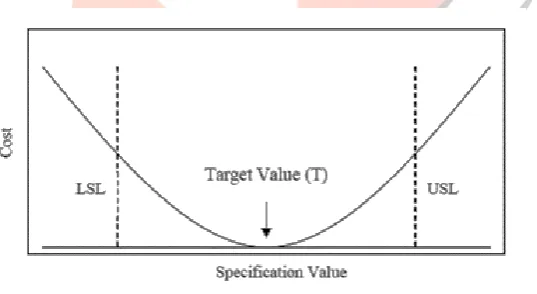
Taguchi proposed a mathematical formula called the loss function for estimating the monetary loss caused by lack of quality. The loss function estimates loss even if parts are made within specification limits. This is necessary to allow for the fact that a company that makes all parts within specification limits still has warranty and customer complaints. That is, there is some loss associated with a population of parts no matter how well they are produced. As long as any parts differ from the target specifications, there is some loss. The shape of the Taguchi loss function is shown in fig.1
Figure 1 Taguchi Loss Function
This loss function value is further converted into a signal-to-noise (S/N) ratio. Basically, the performance characteristic has following three categories of the S/N ratio (Ross, 2005);
The Lower-the-Better The Larger-the-Better The Nominal-the-Better 1. The Lower-the-Better
This category of S/N ratio is selected when the performance characteristic like surface roughness, power consumption, circularity etc. are required to minimize. For ideal case desired value of S/N ratio is zero. The general formula for calculating the S/N ratio is as follows;
[ ]
2. The Larger-the-Better
This case is opposite to the smaller the best case and it is obtained by taking the reciprocals of measured data. This category of S/N ratio is selected when objective function like ―Material Removal Rate‖ is required to maximize. The general formula for calculating the larger the better S/N ratio is as follows;
[ ]
IJEDR1402197
International Journal of Engineering Development and Research (www.ijedr.org)2530
This case arises when a specified value is most desired, meaning that neither a smaller nor a larger value is desirable. The general formula for calculating the nominal the better S/N ratio is as follows;[ ]
The S/N ratios for each level of process or product parameters are calculated depending upon the S/N analysis results. Not taking account of the class of quality characteristic of interest, a larger S/N ratio of the parameters is selected for better quality characteristic of interest. Therefore, the best level of the product or process factors is the level which has the highest S/N ratio.
IV.EXPERIMENTAL DETAILS
Machine Tool
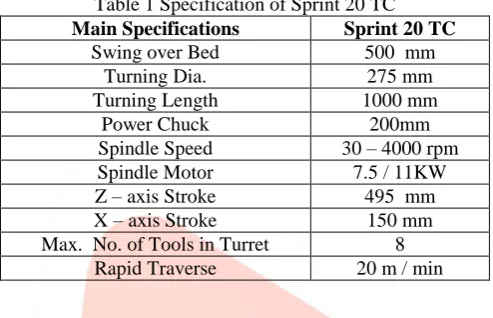
The CNC machines play a very important role in modern industries to enhance the product quality as well as productivity (M. Kaladhar, 2010). Batliboi make CNC turning center is used to carry out the experimentation. The specification of machine is as below:
Table 1 Specification of Sprint 20 TC Main Specifications Sprint 20 TC
Swing over Bed 500 mm
Turning Dia. 275 mm
Turning Length 1000 mm
Power Chuck 200mm
Spindle Speed 30 – 4000 rpm
Spindle Motor 7.5 / 11KW
Z – axis Stroke 495 mm
X – axis Stroke 150 mm
Max. No. of Tools in Turret 8
Rapid Traverse 20 m / min
Work Material
The work piece material used for present work was E 250 B0 of standard IS: 2062. There are three grade of E 250 steel as per IS: 2062: Grade A, Grade B & Grade C. IS: 2062 standard materials have varieties of industrial application some of them are Rolling Mill Stand, Power Press, Injection Moulding, Plywood Sun Mica Mill & Plastic Die, Plastic Moulding Dies, Machine Parts, Hydraulic Machinery Parts, Hospital furniture, Steel Structures, Large dia. meter pipes, Storage Tanks, Boilers, Pressure Vessels etc. The chemical composition & mechanical properties of E 250 B0 of standard IS: 2062 (BIS-IS: 2062, 2011) is given Table 5.2 & 5.3 respectively.
Table 2 Chemical composition of E 250 B0 of standard IS: 2062
Grade Quality C % Mn % S % P % Si C. E. %
Max. Max. Max. Max. Max. Max.
E 250 B0 0.22 1.5 0.045 0.045 0.4 0.41
Table 3 Mechanical Properties of E 250 B0 of standard IS: 2062 Grade Quality Tensile Strength
Min, MPa
Yield Stress, Min MPa % Elongation at gauge length
<20mm 20-40mm >40mm
E 250 B0 410 250 240 230 23
Cutting Tool Material & Tool Holder
Coated carbide tools have shown better performance when compared to the uncoated carbide tools. For this reason, commonly available Chemical Vapor Deposition (CVD) of Ti (C, N) + Al2O3 coated cemented carbide inserts of 0.8 and 1.2 mm as nose radius are used in the present experimental investigation. The tool & tool holder details are as below:
Cutting Inserts: CNMG 12 04 08 PF & CNMG 12 04 12 PF (Sandvik, made) Tool material: CVD coated cemented carbide
Tool holder: MCLNL 25 25 M 12.
Measurement of Surface Roughness
IJEDR1402197
International Journal of Engineering Development and Research (www.ijedr.org)2531
Figure 2 Mitutoyo Surftest SJ-301 surface roughness testerSelection of Process Parameters for Quality Characteristics
Following process parameters may affect the quality of the turned parts: Cutting parameters: cutting speed, feed rate, and depth of cut (DOC). Environment parameters: wet, dry.
Cutting tool parameters: tool geometry, tool material. Work piece material: hardness, Metallography
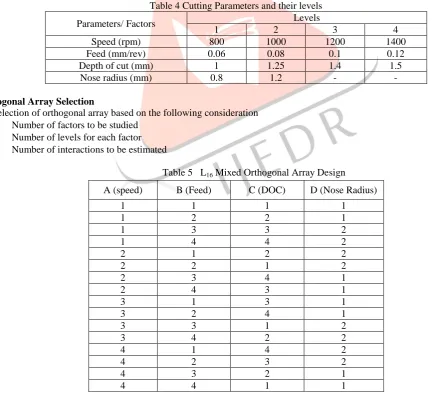
The controllable factors and their levels were decided for conducting the experiment, based on a ―brain storming‖ that was held with a group of people and also considering the guide lines given in the operator’s manual provided by the manufacturer of the lathe machine and tool inserts company. The factors and their levels are shown in table 4.
Table 4 Cutting Parameters and their levels
Parameters/ Factors Levels
1 2 3 4
Speed (rpm) 800 1000 1200 1400
Feed (mm/rev) 0.06 0.08 0.1 0.12
Depth of cut (mm) 1 1.25 1.4 1.5
Nose radius (mm) 0.8 1.2 - -
Orthogonal Array Selection
The selection of orthogonal array based on the following consideration Number of factors to be studied
Number of levels for each factor Number of interactions to be estimated
Table 5 L16 Mixed Orthogonal Array Design
For above mentioned parameters/factors and their levels for single interaction
A (speed) B (Feed) C (DOC) D (Nose Radius)
1 1 1 1
1 2 2 1
1 3 3 2
1 4 4 2
2 1 2 2
2 2 1 2
2 3 4 1
2 4 3 1
3 1 3 1
3 2 4 1
3 3 1 2
3 4 2 2
4 1 4 2
4 2 3 2
4 3 2 1
IJEDR1402197
International Journal of Engineering Development and Research (www.ijedr.org)2532
Degree of freedom (DOF) for Speed = (4-1) = 3Degree of freedom (DOF) for Feed = (4-1) = 3 Degree of freedom (DOF) for Depth of cut = (4-1) = 3 Degree of freedom (DOF) for Nose radius = (2-1) = 1
The total degree of freedom = 3 + 3+ 3+1= 10
Therefore Minimum number of experiment = Total DOF for parameters +1 = 10 + 1
= 11
For a above mention situation minimum 16 experiments are required to perform. So, L16 mixed orthogonal array of Taguchi is selected. L16 mixed orthogonal array designed as shown in table 5.
V.EXPERIMENTAL DETAILS
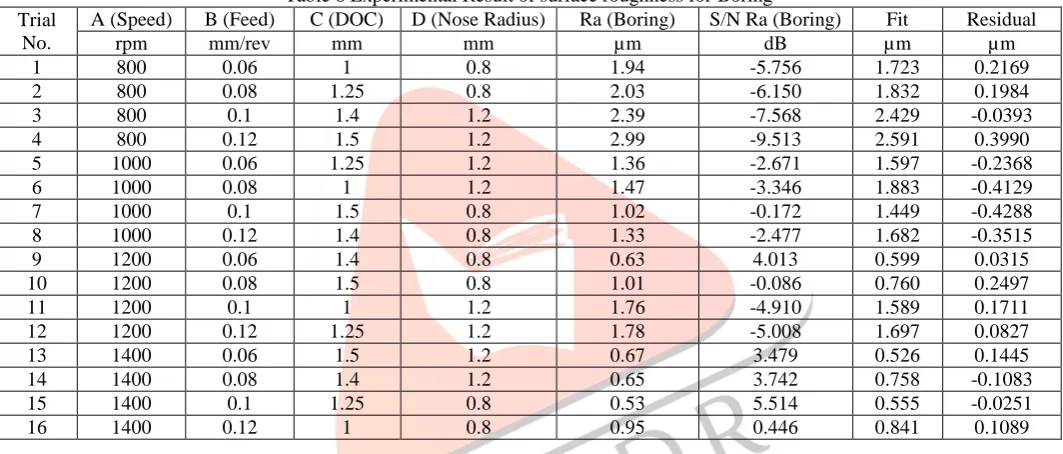
The present paper gives the application of the Taguchi experimental design technique. The scheme of carrying out experiments was selected and the experiments were conducted to investigate the effect of process parameters on the surface roughness in boring operation. The experimental results surface roughness for boring operation is given in Table 6. In present study used mixed L16 orthogonal array in which 16 experiments were conducted on CNC TC. In the present study all the designs, plots and analysis have been carried out using Minitab statistical software.
Table 6 Experimental Result of surface roughness for Boring Trial
No.
A (Speed) B (Feed) C (DOC) D (Nose Radius) Ra (Boring) S/N Ra (Boring) Fit Residual
rpm mm/rev mm mm µm dB µm µm
1 800 0.06 1 0.8 1.94 -5.756 1.723 0.2169
2 800 0.08 1.25 0.8 2.03 -6.150 1.832 0.1984
3 800 0.1 1.4 1.2 2.39 -7.568 2.429 -0.0393
4 800 0.12 1.5 1.2 2.99 -9.513 2.591 0.3990
5 1000 0.06 1.25 1.2 1.36 -2.671 1.597 -0.2368
6 1000 0.08 1 1.2 1.47 -3.346 1.883 -0.4129
7 1000 0.1 1.5 0.8 1.02 -0.172 1.449 -0.4288
8 1000 0.12 1.4 0.8 1.33 -2.477 1.682 -0.3515
9 1200 0.06 1.4 0.8 0.63 4.013 0.599 0.0315
10 1200 0.08 1.5 0.8 1.01 -0.086 0.760 0.2497
11 1200 0.1 1 1.2 1.76 -4.910 1.589 0.1711
12 1200 0.12 1.25 1.2 1.78 -5.008 1.697 0.0827
13 1400 0.06 1.5 1.2 0.67 3.479 0.526 0.1445
14 1400 0.08 1.4 1.2 0.65 3.742 0.758 -0.1083
15 1400 0.1 1.25 0.8 0.53 5.514 0.555 -0.0251
16 1400 0.12 1 0.8 0.95 0.446 0.841 0.1089
IJEDR1402197
International Journal of Engineering Development and Research (www.ijedr.org)2533
4 3 2 1 2.5 2.0 1.5 1.0 0.5 4 3 2 1 4 3 2 1 2.5 2.0 1.5 1.0 0.5 2 1 A (Speed) M e a n o f M e a n s B (Feed)C (DOC) D (Nose Radius)
Main Effects Plot for Means for Ra (Boring) Data Means 4 3 2 1 2 0 -2 -4 -6 4 3 2 1 4 3 2 1 2 0 -2 -4 -6 2 1 A (Speed) M e a n o f S N r a ti o s B (Feed)
C (DOC) D (Nose Radius)
Main Effects Plot for SN ratios for Ra (Boring) Data Means
Signal-to-noise: Smaller is better
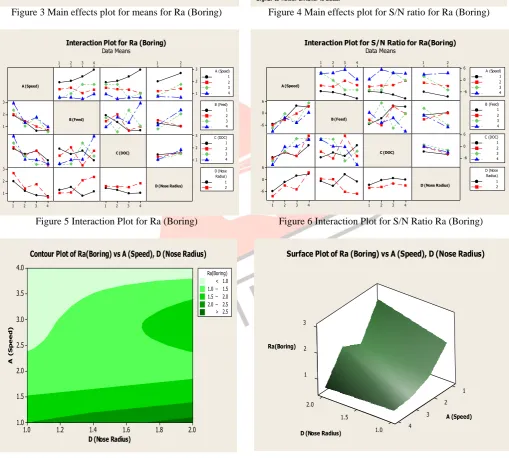
Figure 3 Main effects plot for means for Ra (Boring) Figure 4 Main effects plot for S/N ratio for Ra (Boring)
4 3 2
1 1 2
3 2 1 3 2 1 3 2 1 4 3 2 1 3 2 1 4 3 2 1 A (Speed) B (Feed) C (DOC)
D (Nose Radius)
1 2 3 4 A (Speed) 1 2 3 4 B (Feed) 1 2 3 4 C (DOC) 1 2 Radius) D (Nose
Interaction Plot for Ra (Boring) Data Means
4 3 2
1 1 2
6 0 -6 6 0 -6 6 0 -6 4 3 2 1 6 0 -6 4 3 2 1 A (Speed) B (Feed) C (DOC)
D (Nose Radius)
1 2 3 4 A (Speed) 1 2 3 4 B (Feed) 1 2 3 4 C (DOC) 1 2 Radius) D (Nose
Interaction Plot for S/N Ratio for Ra(Boring) Data Means
Figure 5 Interaction Plot for Ra (Boring) Figure 6 Interaction Plot for S/N Ratio Ra (Boring)
D (Nose Radius)
A ( S p e e d ) 2.0 1.8 1.6 1.4 1.2 1.0 4.0 3.5 3.0 2.5 2.0 1.5 1.0 > – – – < 1.0 1.0 1.5 1.5 2.0 2.0 2.5 2.5 Ra(Boring)
Contour Plot of Ra(Boring) vs A (Speed), D (Nose Radius)
2 1 1 2 2.0 3 3 1.5 4 1.0 Ra(Boring) A (Speed)
D (Nose Radius)
Surface Plot of Ra (Boring) vs A (Speed), D (Nose Radius)
Figure 7 Contour Plot of Ra (Boring) vs. Speed, Nose Radius Figure 8 Surface Plot of Ra (Boring) vs. speed, Nose radius
IJEDR1402197
International Journal of Engineering Development and Research (www.ijedr.org)2534
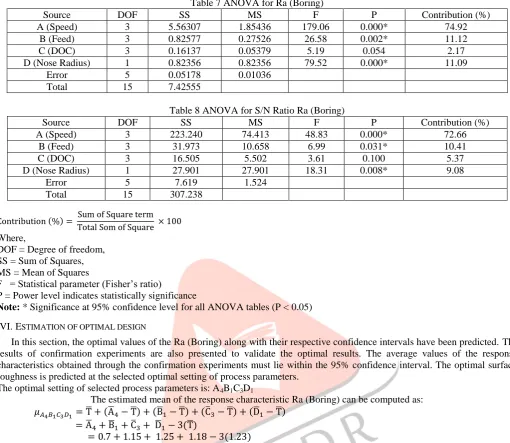
Table 7 ANOVA for Ra (Boring)Source DOF SS MS F P Contribution (%)
A (Speed) 3 5.56307 1.85436 179.06 0.000* 74.92
B (Feed) 3 0.82577 0.27526 26.58 0.002* 11.12
C (DOC) 3 0.16137 0.05379 5.19 0.054 2.17
D (Nose Radius) 1 0.82356 0.82356 79.52 0.000* 11.09
Error 5 0.05178 0.01036
Total 15 7.42555
Table 8 ANOVA for S/N Ratio Ra (Boring)
Source DOF SS MS F P Contribution (%)
A (Speed) 3 223.240 74.413 48.83 0.000* 72.66
B (Feed) 3 31.973 10.658 6.99 0.031* 10.41
C (DOC) 3 16.505 5.502 3.61 0.100 5.37
D (Nose Radius) 1 27.901 27.901 18.31 0.008* 9.08
Error 5 7.619 1.524
Total 15 307.238
( )
Where,
DOF = Degree of freedom, SS = Sum of Squares, MS = Mean of Squares
F = Statistical parameter (Fisher’s ratio)
P = Power level indicates statistically significance
Note: * Significance at 95% confidence level for all ANOVA tables (P < 0.05)
VI.ESTIMATION OF OPTIMAL DESIGN
In this section, the optimal values of the Ra (Boring) along with their respective confidence intervals have been predicted. The results of confirmation experiments are also presented to validate the optimal results. The average values of the response characteristics obtained through the confirmation experiments must lie within the 95% confidence interval. The optimal surface roughness is predicted at the selected optimal setting of process parameters.
The optimal setting of selected process parameters is: A4B1C3D1
The estimated mean of the response characteristic Ra (Boring) can be computed as: ̅ ( ̅ ̅) ( ̅ ̅) ( ̅ ̅) ( ̅ ̅)
̅ ̅ ̅ ̅ ( ̅)
( )
Similarly we can find out estimated mean of the response characteristic S/N Ratio for Ra (Boring):
Where,
̅ = Overall mean of response parameter
̅ ̅ ̅ ̅ = Average value of response for parameter A for level 4, B for level 1, C for level 3 and D for level 1 respectively
Estimation of Confidence Interval:
For estimated average of a treatment condition used in a conformation experiment to verify predication the confidence interval can be calculated as below (Ross, 2005)
√ (
)
Where,
= F ratio at confidence interval of ( ) against DOF 1, degree of freedom of error fe
N = Total number of results,
R = Sample size for conformation of experiments; Ve = Error variance
( ) =
Then,
√ (
IJEDR1402197
International Journal of Engineering Development and Research (www.ijedr.org)2535
The 95 % confidence interval of the predicted optimum means is:( ) ( )
Similarly for 95 % confidence interval of the predicted optimum S/N ratio is: ( ) ( )
VII.CONFORMATION OF EXPERIMENT
The confirmation experiment is the final step in confirming the conclusions drawn based on Taguchi’s parameter design approach. The optimum conditions are set for the significant factors and a selected number of tests are run under constant specified conditions. The average of the results of the confirmation experiment is compared with the anticipated average based on the parameters and levels tested. The confirmation experiment is a crucial step and is highly recommended by Taguchi to verify the experimental conclusions (Ross, 2005). Four confirmation experiments were thus conducted at the optimal settings of the turning process parameters recommended by the investigation. The average value of Ra (Boring) while turning E 250 B0 of Standard IS: 2062 material with CVD -coated carbide inserts was found to 0.54 µm. This result was within the 95% confidence interval of the predicted optimal value of the selected responding characteristic Ra (Boring). Hence the optimal settings of the process parameters, as predicted in the analysis, can be implemented.
VIII.LINEAR MODEL ANALYSIS
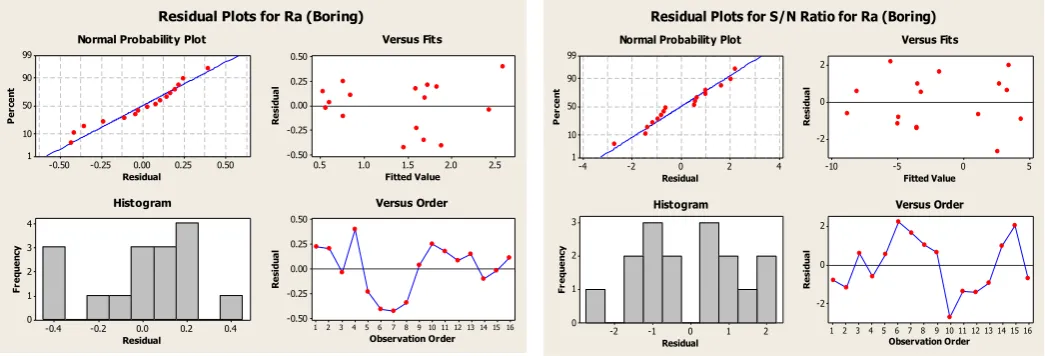
Taguchi for Ra (Boring) has been applied at 95% confidence, so all factors and their interactions having p (probability) value less than 0.05 will be statistically significant for Ra (Boring) and must be further taken care of. Refer Table 9 & 10 the analysis of variance (ANOVA) results very clear support that speed, nose radius and feed have significance influence on Ra (Boring). Residual plots are used to evaluate the data for the problems like non normality, non-random variation, non-constant variance, higher-order relationships, and outliers. It can be seen from Figures 9 and 10 that the residuals follow an approximately straight line in normal probability plot and approximate symmetric nature of histogram indicates that the residuals are normally distributed. Residuals possess constant variance as they are scattered randomly around zero in residuals versus the fitted values. Since residuals exhibit no clear pattern, there is no error due to time or data collection order. Again, the R-square and R-square adjusted are both above 85%, and hence, the model is moderately a good fit. The regression equation is as follows.
Regression Equation
Ra (Boring) = 2.54418 - 0.00245625 A (Speed) + 9.8625 B (Feed) – 0.355286 C (DOC) + 1.13438 D (Nose Radius) Summary of Model
S = 0.290089 R-Sq = 87.53% R-Sq(adj) = 83.00%
Table 9 Analysis of Variance for Ra(Boring) for Regression analysis
Source DOF SS MS F P
Regression 4 6.49987 1.62497 19.3100 0.000062*
A (Speed) 1 4.82653 4.82653 57.3550 0.000011*
B (Feed) 1 0.77815 0.77815 9.2470 0.011229*
C (DOC) 1 0.07163 0.07163 0.8513 0.375992
D (Nose Radius) 1 0.82356 0.82356 9.7865 0.009606*
Error 11 0.92567 0.92567
Total 15 7.42554
Regression Equation
S/N Ratio Ra (Boring) = -13.5845 + 0.0161471 A (Speed) - 60.1867 B (Feed) + 4.61211 C (DOC) - 6.60272 D (Nose Radius) Summary of Model
S = 1.64320 R-Sq = 90.33% R-Sq(adj) = 86.82%
Table 10 Analysis of Variance for S/N Ration for Ra (Boring) for Regression analysis
Source DOF SS MS F P
Regression 4 277.536 69.384 25.6967 0.0000157*
A (Speed) 1 208.584 208.584 77.2499 0.0000026*
B (Feed) 1 28.980 28.980 10.7327 0.0073850*
C (DOC) 1 12.072 12.072 4.4708 0.0581299
D (Nose Radius) 1 27.901 27.901 10.3334 0.0082384*
Error 11 29.701 29.701
Total 15 307.238
IJEDR1402197
International Journal of Engineering Development and Research (www.ijedr.org)2536
0.50 0.25 0.00 -0.25 -0.50 99 90 50 10 1 Residual P er ce nt 2.5 2.0 1.5 1.0 0.5 0.50 0.25 0.00 -0.25 -0.50 Fitted Value R es id ua l 0.4 0.2 0.0 -0.2 -0.4 4 3 2 1 0 Residual Fr eq ue nc y 16 15 14 13 12 11 10 9 8 7 6 5 4 3 2 1 0.50 0.25 0.00 -0.25 -0.50 Observation Order R es id ua lNormal Probability Plot Versus Fits
Histogram Versus Order
Residual Plots for Ra (Boring)
4 2 0 -2 -4 99 90 50 10 1 Residual P e rc e n t 5 0 -5 -10 2 0 -2 Fitted Value R e si d u a l 2 1 0 -1 -2 3 2 1 0 Residual F re q u e n cy 16 15 14 13 12 11 10 9 8 7 6 5 4 3 2 1 2 0 -2 Observation Order R e si d u a l
Normal Probability Plot Versus Fits
Histogram Versus Order
Residual Plots for S/N Ratio for Ra (Boring)
Figure 9 Residual Plots for Ra (Boring) Figure 10 Residual Plots for S/N Ratio for Ra (Boring) The experiment was conducted at the optimum conditions and the average of the response parameter was 0.59 µm. The error in the predicted optimum value and conformation experimental value is only 8.47%.
Responding Parameters Optimal setting Predicted value
(µm) Conformation value (µm)
Boring A4B1C3D1 0.59 0.54
IX.CONCLUSION
In present study, optimization of process parameters during boring operation has been carried out. The surface roughness value Ra has been analyzed through Taguchi and ANOVA approach. In summary, the following conclusion has been drawn:
The Surface roughness is mainly affected by spindle speed nose radius and feed rate. With the increase in feed rate the surface roughness also increases & as the cutting speed decreases the surface roughness increases.
From ANOVA analysis, parameters making significant effect on surface roughness are speed and feed with contribution of 74.92%, 11.04% and 11.12% respectively.
The optimal process parameters in CNC TC are: speed of 1400 rpm, feed of 0.6 mm/rev, depth of cut of 1.4 mm and nose radius of 0.8 mm.
The developed model from regression analysis are reasonably accurate and can be used for predicted surface roughness. The error in predicted optimum value and conformation experimental value is less.
X.REFERENCES
[1] A.M.Badadhe, S. Y. Bhave, and L. G. Navale, ―Optimization of Cutting Parameters in Boring Operation”, Journal of
Mechanical and Civil Engineering, pp. 10-15.
[2] Ajay Mishra, Anshul Gangele and Mohammad Israr, ―Application of Taguchi Approach in the Optimization of Roundness of Cylindrical Bars of AISI 1045 Steel”, International Journal of Basic and Applied Science, Vol. 02, No. 01, July 2013, pp. 186-194.
[3] Aman Aggarwal, Hari Singh, Pradeep Kumar, & Manmohan Singh,‖ Optimizing power consumption for CNC turned parts using response surface methodology and Taguchi’s technique—A comparative analysis‖, Elsevier Journal, Journal of materials processing technology 200, 2008, pp. 373–384.
[4] Ashish Bhateja, Jyoti Bhardwaj, Maninder Singh and Sandeep Kumar Pal, ―
Parameters i.e. Surface Roughness, Tool Wear Rate & Material Removal Rate with the Selection of Various Process Parameters Such as Speed Rate, Feed Rate, Specimen Wear, Depth Of Cut in CNC Turning of EN24 Alloy Steel – An Empirical Approach‖, The International Journal of Engineering And Science, Volume 2, Issue 1, 2013, pp. 103-113. [5] Ashish Yadav, Ajay Bangar, Rajan Sharma and Deepak Pal, ―Optimization of Turning Process Parameters for Their
Effect on EN 8 Material Work piece Hardness by Using Taguchi Parametric Optimization Method‖, International Journal of Mechanical and Industrial Engineering, Volume-1, Issue-3, 2012, pp. 36-40.
[6] Dr. G.Harinath Gowd, M. Gunasekhar Reddy, Bathina Sreenivasulu & Rayudu Peyyala, ―Experimental Investigations on the Effects of Cutting Variables on the Material removal rate and Tool wear for AISI SI steel‖, International Journal of Applied Research‖, Volume 3, Issue : 5, May 2013, pp. 212-213.
[7] Hari Singh & Pradeep Kumar, ―Optimizing feed force for turned parts through the Taguchi technique‖, Sadhana, Vol. 31, Part 6, December 2006, pp. 671–681.
[8] Hari Singh and Pradeep Kumar, ―Optimizing multi-machining characteristics through Taguchi’s approach and utility concept‖, Journal of Manufacturing Technology Management, Vol. 17 No. 2, 2006, pp. 255-274
IJEDR1402197
International Journal of Engineering Development and Research (www.ijedr.org)2537
[10] Harsimran Singh Sodhi, Dhiraj Prakash Dhiman, Ramesh Kumar Gupta and Raminder Singh Bhatia, ―Investigation ofCutting Parameters For Surface Roughness of Mild Steel In Boring Process Using Taguchi Method‖, International Journal of Applied Engineering Research, Volume 7, 11,2012.
[11] Ilhan Asilturk, & Harun Akkus, ―Determining the effect of cutting parameters on surface roughness in hard turning using the Taguchi method‖, Elsevier Journal, Measurement, 44, 2011, pp.1697–1704
[12] Jakhale Prashant P, Jadhav B. R., ―Optimization Of Surface Roughness Of Alloy Steel By Changing Operational Parameters and Insert Geometry in The Turning Process‖, International Journal of Advanced Engineering Research and Studies, II/ IV, July-Sept 2013, pp. 17-21.
[13] Jitendra Verma, Pankaj Agrawal & Lokesh Bajpai, ―Turning Parameter Optimization for Surface Roughness of ASTM A242 type-1 Alloys Steel by Taguchi Method‖, International Journal of Advances in Engineering & Technology, March 2012, pp. 255-261.
[14] Kanase Tanaji. S and Jadhav D. B., ―Enhancement of Surface Finish for CNC turning Cutting Parameters by Using Taguchi Method‖, Indian Journal Of Research, Volume : 3, Issue 5, June 2013, pp. 88-91.
[15] Krishankant, Jatin Taneja, Mohit Bector & Rajesh Kumar, ―Application of Taguchi Method for Optimizing Turning Process by the effects of Machining Parameters‖, International Journal of Engineering and Advanced Technology, Volume-2, Issue-1, October 2012, pp. 263-274.
[16] M. Kaladhar, K. V. Subbaiah, Ch. Srinivasa Rao & K. Narayana Rao, ―Application of Taguchi approach and Utility Concept in solving the Multi-objective Problem when turning AISI 202 Austenitic Stainless Steel‖, Journal of Engineering Science and Technology 4,1, January 2011, pp. 55-61.
[17] M. Kaladhar, K. Venkata Subbaiah & Ch. Shrinivasa Rao, ―Determination of Optimum Process Parameter during turning of AISI 304 Austenitic Stainless Steels using Taguchi method and ANOVA‖, International Journal of Lean Thinking, Volume 3,Issue 1, June 2012, pp. 1-19.
[18] M. Kaladhar, K. Venkata Subbaiah, Ch. Srinivasa Raoand K. Narayana Rao and K. Narayana Rao and H. Gokkaya, ―Optimization of Process Parameters in Turning of AISI 202 Austenitic Stainless Steel‖, ARPN Journal of Engineering and Applied Sciences, Volume. 5, No. 9, September 2010, pp. 79-87.
[19] M. Kaladhara , K. Venkata Subbaiah & Ch. Srinivasa Rao, ―Parametric optimization during machining of AISI 304 Austenitic Stainless Steel using CVD coated DURATOMICTM cutting insert‖, International Journal of Industrial Engineering Computations‖, 3,2012, pp. 577–586.
[20] M. Nalbant, H. Go¨kkaya & G. Sur, ―Application of Taguchi method in the optimization of cutting parameters for surface roughness in turning‖, Elsevier Journal, Materials and Design, 28, 2007, pp. 1379–1385.
[21] Mihir Patel and Vivek Deshapnde, ―Optimization of Machining Parameters for Turning Different Alloy Steel Using CNC – Review‖, International Journal of Innovative Research in Science, Engineering and Technology, Vol. 3, Issue 2, February 2014, pp. 9423-9430.
[22] Neeraj Sharma and Renu Sharma, ―Optimization of Process Parameters of Turning Parts: A Taguchi Approach‖, Journal of Engineering, Computers & Applied Sciences, Volume 1, No.1, October 2012.
[23] Rahul Davis & Mohamed Alazhari, ―Optimization Of Cutting Parameters In Dry Turning Operation Of Mild Steel, International Journal of Advanced Research in Engineering and Technology (IJARET), Volume 3, No. 2, July-December 2012, pp. 104-110.
[24] Srinivas Athreya and Dr Y.D.Venkatesh, ―Application Of Taguchi Method For Optimization Of Process Parameters In Improving The Surface Roughness Of Lathe Facing Operation‖ International Refereed Journal of Engineering and Science, Volume 1, Issue 3, Nov.2012, pp.13-19.
[25] Suleiman Abdulkareem, Usman Jibrin Rumah & Apasi Adaokoma, ―Optimizing Machining Parameters during Turning Process‖, International Journal of Integrated Engineering, Vol. 3 No. 1, 2011, pp. 23-27.
[26] Er. R.K. Jain, Engineering Metrology; 1st Edn; Khanna Publication, New Delhi, 1971.
[27] BIS, Hot Rolled Medium And High Tensile Structural Steel — Specification, 7th Edn; Bureau of Indian Standard, New Delhi, 2011
[28] Ronald E. Walpole, Raymond H. Myers, Sharon L. Myers and Keying Ye, Probability & Statistics for Engineers & Scientists; 9th Edn; Prentice Hall, 2010.
[29] Ross Philip J, Taguchi Techniques for Quality Engineering; 2nd Edn; Tata McGraw -Hill Publication Limited, New Delhi, 2005.