A Systematic Way to Cloud Server Optimization
Using Orthogonal Recursive Bisection Technique
for Cloud Migration
Kamalpreet Kaur#1 and Vanita Rani*2
#1,
M.Tech, CSE Department, Indo Global College of Engineering, Mohali, India
*2
Assistant Professor, CSE Department, Indo Global College of Engineering, Mohali, India
Abstract - From past years, Cloud computing become need as it provides online hardware and software services over internet to accomplish our task in a seem less way. Due to its usage it suffers from many problems like overloading, migration, resources utilization, energy management, server consolidation etc. Biggest issues to this all problems are load balancing and migration, which is division of workload to all servers equally for delivering faster service to gain high user satisfaction and to handle load balancing migration is a key point to move data from one server to another but still cloud manager face extreme problem at the time of migration. So, in this paper, we have implemented and compared one load balancing strategy called orthogonal recursive bisection algorithm to group server nodes into a balanced tree and then migrate resources so to keep the tree balanced. After that we computed the results of Pre Migration and Post Migration in terms of best and worst server virtual machines. We have taken initially 500 virtual machines for migration. We also analyzed the behavior of migrated virtual machines through different parameters like energy consumption’s, load factor, migration time for all resources.
General Term - Cloud server optimization using orthogonal recursive bisection technique
Keywords- Virtual machines, Cloudsim, Pre-migration, Post-migration, Cloud computing, Data centers.
I.INTRODUTION
Cloud computing is a latest and progressive technology that brought up the concept of providing computing resources over the internet [4]. In cloud computing, user does not worry about configuration of services as it available on pay per scheme. It stores data and application on remote server and accesses them via internet rather than save on personal computer as it reduces capital cost. For instance Gmail, users can access their email in the cloud from any electronic gadget with a browser and internet connection regardless of what kind of platform and infrastructure is on that particular device.
II.CLOUD MIGRATION
Cloud computing features are attractive to many organizations due to its scalability, ease of management and low costs. Cloud migration makes easier the adoption of flexible cloud computing.
Cloud migration is the method in which we move data, application and other business related concepts from organization computers to cloud or from one cloud to another cloud [4]. Cloud migration can shows many challenges and raise security level, but cloud computing can help to company by providing profit of data portability, platform scalability, high availability, improve accessibility and effective resource allocation, reduce capital cost that cloud-based computing offers to cloud users.
The migration of applications to cloud computing must be done in a systematic manner. Current enterprise applications must be thoroughly determine which workloads can profit most from early migration to the cloud. While migration different parameters need to be keep into mind that are costs of migration, application redesign, application performance and availability, security and privacy requirements and regulatory requirements.
A. Application migration and Clouds
Application migration [12] is the process in which legacy application or programs that is not used from long period is moved on new platforms, environment, and infrastructure and makes run able with new technology. The process involves the mount of the new environment before the actual cutover and requires coordination of IT teams at the time of cutover. If the migration is on an adaptable and suitable platform, the application does not need to be assembled.
platform. To identify applications for migration to a cloud it is important to know the business and technical factors for the migration. Business agility and significant financial saving are typical business factors for application migration to clouds. Cloud computing can provide significant cost savings because of the increased utilization of resources on internet and the standardization and automation required for cloud services.
Fig. 1: Procedures for Application Migration
B. Migration Roadmap
As customers passing their applications and data to cloud computing, it is important that the level of service provided in the cloud environment match to the service provided by their traditional IT environment. If application failed to migrate to cloud computing ultimately result in higher costs and loss of business, thus canceling any of the potential benefits of cloud computing.
This section describes series of steps that cloud users should need to know during successful migration of existing applications to cloud computing [10]:
1) Assess your Applications and Workloads 2) Build the Business Case
3) Develop the Technical Approach 4) Use a Flexible Integration Model
5) Address Security and Privacy Requirements 6) Manage the Migration
C. Why Migration to Cloud is complicated and error – prone
There are some reasons [11] that make the migration process to Cloud complicated, error-prone and expensive.
1) The computing environmental changes show many environment dependent configurations invalid. For example, when database server is migrated from local data center to the Cloud, its IP address is changed and sometime other component does not impose that IP address this cause problem in whole system.
2) The deployment of today’s enterprise system consists of large number of different components. For example, for load balancing purpose, the system consists of multiple web servers and application servers. Thus the dependencies among the components are complicated and can be damaged very easily in the migration process. To make dependency in application takes much time than migration.
3) There are enormous hidden controlling settings which may be broken suddenly in the migration process. For example, the access controls of different components may be mess up, which confront the system to the security threats.
4) The human itself makes migration process difficult with many careless errors which are very difficult to identify.
Overall, the complicated deployments on new platform, the massive dependencies, and the lack of control make the migration process difficult and error-prone.
D. Virtual Machine Migration
Virtual machine migration is the mechanism of moving virtual machine from one physical host to other host without disturbing others.
Migration of VM can be divided into two categories:
1) Off-LINE VM migration: Off-line VM migration process stops the VM and transfer all the states of VM to target host then finally resume the VM in the new host. The advantage is simple procedure and disadvantage is long downtime [6].
2)
Live VM migration: In live VM migration stateof VM is transferred with minimum service
failure from one host to other host. The Key
advantage of live VM migration is user-invisible
downtime with fast network.
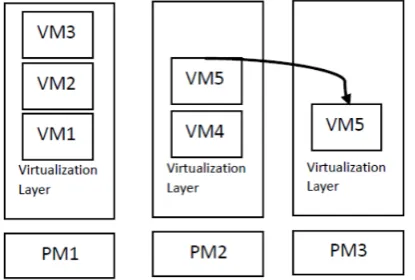
Fig 2. describes live virtual machine migration. Three physical Machines with virtualization layer host five instances of operating systems (with one being migrated between PM 2 and PM 3).
Live virtual machine migration consist of following performance metrics [7].
1) Total migration time: Total time taken to migrate a virtual machine from its host machine to the selected machine.
2) Down time: Down time is defined as the period of time for which services are not ready for use to the users.
3) Amount of migrated data: During the Live migration how much data is transferred from one host to another host.
4) Migration overhead: Migration overhead consists of system resource utilization.
5) Application degradation: The extent to which migration slows down the applications executing within the migrating VM.
III.PROPOSED WORK
In the previous base paper, Dynamic compare
and balance algorithm is used that work on two
conditions that is overloaded or under loaded
according to that further steps are taken. If the
server load is overloaded that is more than the
predefined upper threshold value, we have to
apply load balancing algorithm for transferring
extra load of this host to another host machine to
support load balancing. In another case, when
host load is less than the predefined lower
threshold value. In this case, host is considered as
under loaded. So we have to apply server
consolidation algorithm for transferring the load
of this host to another host machine and make
this host switch off to save energy to support
server consolidation and decrease the services
cost of cloud. In both cases virtual machine
migration is performed to balance the load.
In this research work, we will implement and compare one load balancing strategy called orthogonal recursive bisection algorithm to group server nodes into a balanced tree and then migrate resources so to keep the tree balanced. After that we computed the results of Pre Migration and Post Migration in terms of best and worst server virtual machines. We have taken initially 500 virtual machines for migration. We also analyzed the behavior of migrated virtual machines through different parameters like energy consumption’s, load factor, migration time for all resources.
A. Objective of the Research
The key objective of this research work is to optimize the performance of the cloud architecture for higher efficiency and user satisfaction.
Objectives for this research work are:
1) To optimize the performance of cloud architecture. 2) To study the CloudSim toolkit for simulateions. 3) To implement and simulate the orthogonal recursive bisection algorithm On CloudSim to group server nodes into a balanced tree.
4) To Migrate resources to keep the tree balanced. 5) To analyse the behavior of the cloud migration algorithm using following parameters:
No. of CPU Speed
Pre-migrations Migration Time Energy consumption Resource Utilization
B Steps to Perform for the Methodology
Cloud Migration and Implementation is the process of moving applications from traditional on-premise data centers to a cloud environment that is managed by a services provider. The cloud platform provider assumes the responsibility to maintain, secure, and update the server infrastructure and offer a simplified solution to scale capacity to the needs of the users.
1) Input: - Required parameters for cloudlets and virtual machine are taken from user.
2) Output: - Improves load balancing at cloud with better response time, data processing time and throughput.
IV. RESULTS AND DISCUSSIONS
All migration techniques are putting great efforts to reduce total migration time and down time. In the following section describe various migration techniques, which are used for reducing total migration time and down time.
Types of VM Migration techniques are:
1) Pre-copy: In pre-copy migration first transfer the memory contents to the target machine. After completing the memory transfer processor states are transferred to destination.
2) Post Copy: In post copy memory data are transferred after the processor states transfer.
A. Orthogonal Recursive Bisection:
A simple method which cuts the graph into two by a vertical cut, then cuts each half into two by a horizontal cut, then each quarter is cut vertically, and so on.
1) ORB is good in partition the domain by subdividing it into equal parts of work by successively subdividing along orthogonal coordinate directions.
2) It also cutting direction varied at each level of the recursion. ORB partitioning is restricted to p=2k
processors
B. Simulations Steps and Results
First we have to configure the server for Migrations task.
Step1. Configure the server using TOMCAT-
BASE\webapps\Migration\WEB-INFserver_config.XML
Step2. Start the server and use url http:\\ localhost:8080/Migration/
There are three buttons to perform migration process:
1) Reset: This button reset the virtual machine after migration to again generate virtual machine.
2) Generate virtual machine: This button generates virtual machine for migration.
3) Migrate: This button migrate the virtual machine resources to balance the load factor
Fig. 4: Shows the result of local server startup process for Migrations
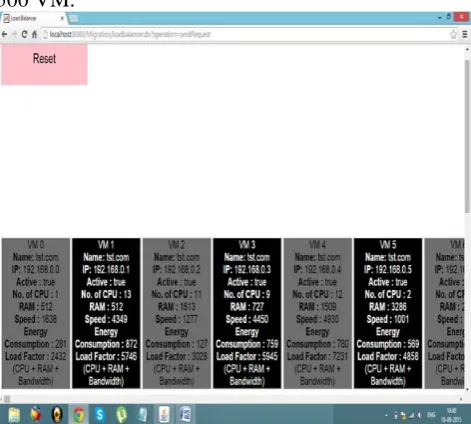
Step3. when we click on generate virtual machine it display list of Virtual machines for migration that is 500 VM.
Fig. 5: Shows the list of VMs after pressing on Generate VMs button
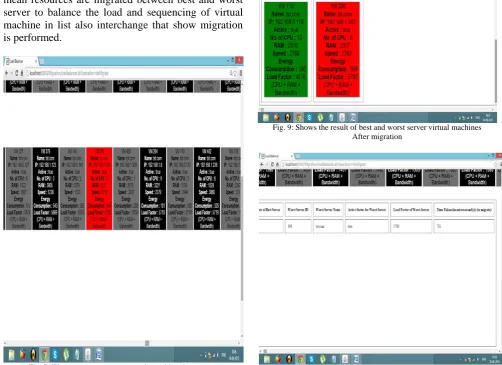
Fig. 6: Shows the best and worst server virtual machines before migration
Step4: when we click on the migrate button it shows the post migration results of virtual machines that mean resources are migrated between best and worst server to balance the load and sequencing of virtual machine in list also interchange that show migration is performed.
Fig. 7: Worst server resources are migrated into best server
Fig. 8: Shows the screen shots of the best server after migration
Fig. 9: Shows the result of best and worst server virtual machines After migration
C. Output Table for comparison
The table shows the results of migrations in terms
for best server and worst server migrations. The
best server has consumed less energy and fewer
loads as compared to the worst server virtual
machine. And we have also computed the total
time taken to migrate the 500 virtual machines.
TABLE1
COMPARSION OF BEST AND WORST SERVER WITH DIFFERENT PARAMETERS
D. Graphical Charts for Comparison of Results
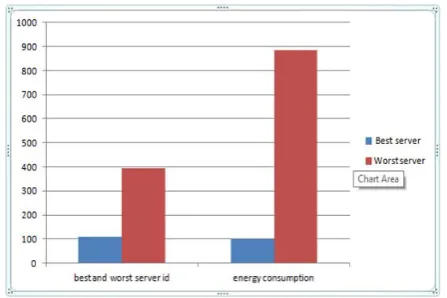
The graphical charts shows that the results after the migrations of virtual machines. The energy consumptions, load factor of the best server are less than the worst server. So the virtual machine id 110 gives optimized results after migrations.
Fig. 11: Shows the graphical analysis of the virtual machine id and energy consumptions of the best and worst server
Fig. 12: Shows the graphical analysis between the energy consumptions and load factor
V. COMPARISON IN BASE PAPER AND PROPOSED
WORK
All results are performed in cloudsim simulator that is clearly shown in above figures. Dynamic and compare balance algorithm just simply allocates virtual machine to server and after some predefined time interval its checks load of the server up to that server become overloaded. So, it fails due to number of migration and maximum down time.
Results clearly tells proposed algorithm is better than previous one as it computed the results in terms of Pre Migration and Post Migration that shows the best and worst virtual machine among the 500 virtual machine and perform migration between them to optimize the cloud server and to manage load factor to increase its performance and group the server node into balanced tree.
VI. CONCLUSION
Cloud Migration is one of much conversed point where cloud managers face extreme problems at the time of data migration from a company’s server to a server that forms cloud elsewhere. Why they face troubles let’s find out. As I know, cloud behaves as an interface through which organizations can access data in a virtual environment. Thus, smooth functioning of it depends primarily on how well groomed and knowledgeable cloud providers are in this area. Moreover, if data migration is not done systematically and properly, it can give rise to problems concerning data and cloud security of company’s assets that primarily comprise of data. Thus, hiring cloud providers having sound experience about the field with ample knowledge and skill sets becomes vital for managing cloud more effectively and efficiently. In this research work, we have implemented and compared one load balancing strategy called orthogonal recursive bisection algorithm to group server nodes into a balanced tree and then migrate resources so to keep the tree balanced. After that we computed the results of post migration in terms of best and worst server virtual machines. We also analyzed the behavior of migrated virtual machines through different parameters like energy consumptions, load factor, and total time taken to migrate all resources.
VII. FUTURE WORK
cloud-based computing offers. We can also proposes a framework to facilitates the migration process of legacy applications into cloud computing. In migration, we can move legacy application into a new state and a new platform without changing its core business logical processing. Hence with the migration, cost of development and bugs occurrences can be minimized.
ACKNOWLEDGMENT
I would like to thanks and express gratitude and warmest appreciation to all teachers of our college Indo Global College of Engineering, Mohali India for help, support and giving ideas in my research work without their knowledge this work will not reach to the success point.
REFERENCES
[1] Yatendra Sahu, R.K. Pateriya, Rajeev Kumar Gupta “Cloud Server Optimization with Load Balancing and Green Computing Techniques Using Dynamic Compare and Balance Algorithm” in the 5th International Conference on Computational Intelligence and Communication Networks, IEEE 2013.
[2] Muhammad Shiraz “A lightweight active service migration framework for computational offloading in mobile cloud computing” Published in Springer Science+Business Media New York, 14 January 2014.
[3] Virendra Singh Kushwah, Aradhana Saxena “ A Security approach for Data Migration in Cloud computing” in the International Journal of Scientific and Research Publications, Volume 3, Issue 5, May 2013.
[4] Rashmi Rao, Pawan Prakash “ Improving security for data migration in cloud computing using randomized encryption technique” in the IOSR Journal of Computer Engineering, volume 11, Issue 6, May. - Jun. 2013.
[5] Gulshan Soni, Mala Kalra “ Comparative Study of Live Virtual Machine Migration Techniques in Cloud” in the International
Journal of Computer Applications (0975 – 8887) Volume 84 – No 14, December 2013.
[6] Anju Bala, Inderveer Chana “VM Migration Approach for Autonomic Fault Tolerance in Cloud Computing” in the Int'l Conf. Grid & Cloud Computing and Applications , GCA'13.
[7] Rashmi, Dr.Shabana Mehfuz, Dr.G.Sahoo “ A five phase approached for the cloud migration” in the International Journal of Emerging Technology and Advanced Engineering, Volume 2, Issue 4, April 2012.
[8] Neetika Gupta,Jyoti Kataria, Abhay Bansal “ A Survey on Cloud Providers and Migration Issues” in the International Journal of Computer Applications, Volume 56– No.14, October 2012. [9] Rakhi k Raj, Getzi Jeba Leelipushpam.P “Live Virtual Machine
Migration Techniques” A Survey in the International Journal of Engineering Research & Technology (IJERT), Vol. 1 Issue 7, September – 2012.
[10] Ali Khajeh-Hosseini, Ian Sommerville, Jurgen Bogaerts, Pradeep Teregowda “ Decision Support Tools for Cloud Migration in the Enterprise” in the in the International Journal of Computer Applications, 2012.
[11] Sujit Tilak 1, Prof. Dipti Patil “A Survey of Various Scheduling Algorithms in Cloud Environment” in the International Journal of Engineering Inventions, Volume 1, Issue 2 , PP: 36-39, September 2012.
[12] Yuanjun Laili & Fei Tao & Lin Zhang & Bhaba R. Sarker “A study of optimal allocation of computing resources in cloud manufacturing systems” in the Int J Adv Manuf Technol, 63:671–690, 2012.
[13] Klaithem Al Nuaimi, Nader Mohamed, Mariam Al Nuaimi and Jameela Al-Jaroodi “A Survey of Load Balancing in Cloud Computing: Challenges and Algorithms” in the IEEE Second Symposium on Network Cloud Computing and Applications, 2012. [14] Qian Zhu, Gagan Agrawal “Resource Provisioning with Budget
Constraints for Adaptive Applications in Cloud Environments” in the IEEE transactions on services computing, vol. 5, no. 4, october-december 2012.
[15] Luiz F. Bittencourt, Edmundo R. M. Madeira, and Nelson L. S. da Fonseca, University of Campinas “Scheduling in Hybrid Clouds” IEEE Communications Magazine • September 2012.