Virtual Smart Cards:
How to Sign with a Password and a Server
Jan Camenisch, Anja Lehmann, Gregory Neven, and Kai Samelin
IBM Research – Zurich {jca, anj, nev, ksa}@zurich.ibm.com
Abstract. An important shortcoming of client-side cryptography on consumer devices is the poor protection of secret keys. Encrypting the keys under a human-memorizable password hardly offers any protection when the device is stolen. Trusted hardware tokens such as smart cards can provide strong protection of keys but are cumbersome to use. We consider the case where secret keys are used for digital signatures and propose a password-authenticated server-aided signaturePass2Sign pro-tocol, where signatures are collaboratively generated by a device and a server, while the user authenticates to the server with a (low-entropy) password. Neither the server nor the device store enough information to create a signature by itself or to perform an offline attack on the pass-word. The signed message remains hidden from the server. We argue that our protocol offers comparable security to trusted hardware, but with-out its inconveniences. We prove it secure in the universal composability (UC) framework in a very strong adaptive corruption model where, un-like standard UC, the adversary does not obtain past inputs and outputs upon corrupting a party. This is crucial to hide previously entered pass-words and messages from the adversary when the device gets corrupted. The protocol itself is surprisingly simple: it is round-optimal, efficient, and relies exclusively on standard primitives such as hash functions and RSA. The security proof involves a novel random-oracle programming technique that may be of independent interest.
1
Introduction
Mobile devices such as smart phones and tablets are used more and more for security-critical tasks such as e-banking, authentication, and signing documents. However, they can be infected by malware and, due to their mobility, the devices are easily lost or stolen. Keeping cryptographic keys safe in such an environment is challenging. Typically, they are simply encrypted with a human-memorizable password. If a device is lost, stolen, or compromised by malware, the password-encrypted keys are usually easily recovered through an offline dictionary attack. Such attacks are extremely effective on modern hardware, especially given the low entropy in human-memorizable passwords [25].
as smart cards, SIM cards or trusted platform modules (TPMs) for extra pro-tection. The hardware tokens offer interfaces to interact with the keys, e.g., to compute digital signatures on messages provided by the host, while the signing key never leaves the confined environment. Usually, a password or PIN code is added as a second layer of protection. Offline attacks on the password or PIN are infeasible as the token blocks after too many failed attempts. In case a hardware token is compromised, it can additionally be rendered useless by revoking its public key.
The protection is not perfect though; without a dedicated display, malware on the host machine may instruct the plugged-in token to sign more or differ-ent messages than the user intended to sign. Also, side-channel attacks such as differential power analysis only become more powerful with time. In other words, what is considered tamper-proof hardware today, may not be so anymore tomorrow [31]. Additionally, trusted hardware suffers from poor usability and high deployment and maintenance costs. Users find it inconvenient to carry a hardware token for each security-sensitive application. Desktop and laptop com-puters rarely come with built-in smart card readers and not all consumer-grade machines have TPMs. External USB card readers are available, but supporting drivers and browser plug-ins on several platforms simultaneously requires a con-siderable effort. Using trusted hardware in combination with mobile devices is even more problematic, as they often lack connectivity to interact with external tokens.
So the question is, can we somehow realize similar security guarantees as hardware tokens, but avoid their practical inconveniences? Software obfuscation may come to mind, but does not help at all: leaking an obfuscated signing algo-rithm to an adversary is just as bad as leaking the signing key itself. As network connectivity is far more ubiquitous than trusted hardware in consumer devices, how about relying on the assistance of an online server to create signatures? A solution must protect the keys as long as at least one of the device or the server is not corrupted. Moreover, we want the user to remember at most a potentially weak password or a PIN code, while offering protection against offline password guessing attacks. Involving an online server in the signing process enables addi-tional control of the use of the signing key, as the server can block the account or involve a second authentication factor when too many signing requests are made.
the wrong hands, or if the device is compromised by malware, then the attacker must still perform anonline guessing attack before it can generate signatures. When the server detects too many failed password attempts or signing requests per time period, it can take appropriate action such as blocking the account or requiring additional authentication. The server neither learns the message that is being signed, nor does it learn the user’s password (or password attempts). This not only protects the user against malicious servers, but also protects the password in case the server is broken into by hackers.
Malware running on the device can of course capture both the device keys and the password, enabling the adversary to sign any messages it wants, but only by interacting with the server for each new signature. The server can therefore implement additional security measures on top of our protocol, e.g., a logic which detects abnormal signing behavior, or a secondary communication channel via which the server informs the user about his account activity. When suspicious transactions are detected, the server can block the user’s account to ensure that no further signatures can be created, and in case the activity indeed turns out to be malicious, revoke the user’s public key.
The resulting security level is almost identical to the protection offered by trusted hardware tokens, but without their inconveniences. Only few smart card readers feature integrated trusted keypads and displays; built-in secure elements such as SIM cards or TPMs never do. Malware running on the host system can therefore also capture the user’s PIN code and have different messages signed than what is shown on the screen. The main security guarantee of trusted hard-ware tokens is therefore that no more signatures can be generated after unplug-ging the token—which can actually be quite cumbersome or even impossible for SIM cards and TPMs. In the same way, our protocol prevents further signatures from being generated when the user’s account is blocked by the server. When the device is lost, our solution even offers better protection than hardware: while it may be possible to extract the keys from a compromised token, the only in-formation that an adversary can extract from a corrupted device is a useless key share.
Strong security notion and corruption model. We define the security of a Pass2Signscheme in the universal composability (UC) framework [15]. The main goal of our protocol is to guarantee protection of the user’s password and signing key in the event of device or server compromise. We therefore propose a very strong corruption model that, unlike standard corruptions as defined in the UC framework, does not hand all past inputs and outputs to the adversary when a party is corrupted. In case the device gets corrupted, these inputs include the user’s password and all previously signed messages, which obviously goes directly against our security goals. Clearly, it is impossible to achieve such a strong corruption model without secure erasures: if the device cannot even erase the entered password, then there’s no way to hide it from an adversary when the device is corrupted later.
tradi-tional game-based notions [14]. In particular, by letting the environment generate all passwords and password attempts, UC formulations correctly model arbitrary dependencies between passwords. For example, their game-based counterparts fail to provide any security guarantees when honest users make typos while enter-ing their passwords, a rather frequent occurrence in real life. Also, by absorbenter-ing password guessing attacks inside the functionality, secure composition with other protocols is guaranteed to hold; this is much less clear for game-based notions that tolerate a non-negligible adversarial success probability.
Efficient protocols. One might expect that meeting such stringent security stan-dards comes at a considerable cost in efficiency. Indeed, similar protocols involve a factor 4–10 in performance penalty to protect against (standard) adaptive corruptions [11], while generic techniques to obtain adaptive security at least double the number of communication rounds [37]. Blindness for signed messages is another feature that is notoriously expensive to achieve in the UC frame-work [30]. It is therefore even more surprising that our protocol is refreshingly simple, round-optimal, and efficient. Generating a signature requires only three modular exponentiations on the device and two on the server, plus a few hash function evaluations, with only one protocol message from the device to the server and back. We also describe two simpler variants of our protocol for the setting where message blindness is not required. Our first variant exposes the message only to the server, a second variant does not hide the message at all.
New proof technique. In spite of its simplicity, the security proof of the proto-col is actually quite intricate. The many cases triggered by adaptive corruptions (which are allowed even during setup and arbitrarily interleaved signing sessions) and the mixture of passwords, encryption, and signatures require very careful bookkeeping, especially of the random-oracle responses during simulation. We employ an interesting and, to the best of our knowledge, novel technique to reconcile the seemingly contradictive requirements that the simulator must be able to determine the value of each signature, but without learning the message being signed. We avoid typical blind signature techniques and the associated “one-more”-type security assumptions [5] by letting the device and the server both contribute to the randomness of the signature, and by programming the random oracle “just-in-time” at the moment that the signature is verified, not when it is created. This technique is of independent interest, and may find ap-plications in other scenarios as well.
2
Related Work
The idea of distributing signing keys over two separate entities dates back to Boyd [10], and was later generalized to threshold signatures [18, 36, 22, 9, 2]. Threshold signatures assume that all parties somehow agree on the messages to be signed, i.e., there is no “main entity” that can trigger a signing protocol and thus also no authentication to ensure that only the “main entity” can do so. Bellare and Sandhu [7] present two-party RSA signature protocols between a client and a server. However, in their protocols the server cannot be corrupted and requires no client-authentication.
Server-assisted signatures with additional password protection have been pre-sented in the literature as well. Ganesan [21] proposes a protocol where the client’s signing exponent is derived from his password. This is similar to Gjøsteen and Thuen [24, 23] who propose password-based signature schemes where the se-cret signing key is shared between different entities, but where one share only depends on the password. A server knowing the high-entropy part of the signing key can mount offline attacks by creating a signature based on a guessed pass-word (from which the low-entropy key share is derived) and verifying it under the public key. Hence, the above approaches assume that the server cannot be corrupted. He et al. [28] propose a related idea where a password is used to authenticate to a server, which, in turn, signs the message for the user. The scheme offers much weaker security guarantees than ours: the server can mount offline attacks against the user’s password and sign messages in the name of the user, as it knows the signing key. Both is not possible in our scheme. Xu and Sandhu [38] present two server-assisted threshold signature schemes for a closely related setting where a user can generate the signatures with the help of his device and a threshold of multiple servers. Their constructions do not yield single-server instantiations as a special case, however, because in their setting a collusion of servers larger than the threshold can perform an offline attack on the user’s password, without access to the user’s device.
Another line of work are the schemes by Mannan and van Oorschot [33], and Damg˚ard and Mikkelsen [17], which assume a trusted, yet resource-contrained device and aim at securely outsourcing parts of the device’s computation to an untrusted entity. However, our goal is not to reduce the computational com-plexity for the trusted device, but to fully remove the assumption of trusted hardware.
sessions, and can actually perform an offline dictionary attack on the password based on the information it sees during the signing protocol (but the last problem is easy to fix).
Our protocol is the first to support fully adaptive corruptions of the server as well as the device in the UC model. One could of course evaluate the signing algorithm using generic adaptively UC-secure multiparty computation (MPC), but this comes at great cost: evaluating even a single multiplication gate in the most efficient two-party computation protocol secure against adaptive cor-ruptions [12] incurs computation and communication costs that are orders of magnitude larger than our direct construction.
A more remotely related primitive is password-authenticated secret sharing (PASS) [3]. A PASS-scheme allows a user to share a secret among a set of servers that it can later recover based on a password. In a sense, one could consider storing a secret signing key using a two-out-of-two PASS scheme, where the user’s device plays the role of one of the servers. This does not fulfill our requirements, though, as the device would need to locally reconstruct the signing key in order to compute a signature. Moreover, once the signing key is reconstructed, the device can as many messages as it wants to without any interaction.
3
Preliminaries
Here we introduce the building blocks for our construction. These include RSA-FDH signatures (DSIGRSA), non-committing encryption (NCE), trapdoor
one-way permutations (TDP), and three UC-functionalities: FCA providing a PKI,
FD→R
RO modeling random-oracles, andFAuth providing authenticated channels.
Notation. We use τ ∈N as our security parameter. 1τ is the string ofτ ones. All algorithms receive 1τ as an implicit input.a←r S denotes thatais assigned a random element chosen uniformly from the setS. IfAis a PPT algorithm we writey←r A(x;r) to denote thaty is assigned the output ofAwith inputxand external random coinsr. If we dropr, the random coins are drawn internally. For deterministic algorithms, we writey←A(x). A function:N→Ris negligible if(τ) =τ−ω(1). By|m|we denote the binary length of a messagem.|S|denotes the cardinality of the setS. If an argument is a list, we assume that the list has an injective encoding which allows to decode each element again.
Ideal Functionality FCA. We assume a public-key infrastructure where servers
can register their public keys, modeled by the ideal functionalityFCA[13]. These
keys can be retrieved by any party using the entity’s identity for which the public key is requested. A formal definition ofFCAis given in Figure 7 in the Appendix.
Ideal Functionality FD→R
RO . A random oracle can be seen as an idealized hash
function that consistently maps inputs from domainDto random values in range
R[6]. It is adjusted for our notation, as we parametrize it with domain Dand rangeR. We sometimes use more than one random oracle with the same rangeR
to FD→R
RO . To distinguish different random oracles, we assume that each call is
prefixed with a unique identifier. The formal definition ofFD→R
RO is based on [29]
and given in Figure 6 in the Appendix.
Ideal Functionality FAuth. The FAuth functionality provides authenticated (but public) channels between parties [15, 13]. For our protocol, we can use the sim-plified version of [15], which allows to send a single authenticated message to the designated receiver. The formal definition ofFAuthis given in Figure 8 in the Appendix.
RSA Problem and RSA Assumption. Let (N, e, d, p, q) ←r RSAGen(1τ) be an RSA-key generator returning an RSA modulus N = pq, where p and q are random distinct primes, e > 1 an integer coprime to ϕ(N), and d ≡e−1mod ϕ(N). The RSA Problem associated toRSAGenis, given N,e, and y←r Z∗N, to findxsuch thatxe≡ymodN. The RSA Assumption now states that for every PPT adversary A, Pr[(N, e, d, p, q) ←r RSAGen(1τ), y ←r Z∗N, x
r
← A(N, e, y) : xe≡ymodN]≤(τ) for some negligible function.
RSA-FDH Signatures. We use a RSA Full-Domain Hash (FDH) signature scheme DSIGRSA = (SKGenRSA,SignRSA,VerifyRSA) associated to RSA-key
gen-erator RSAGen defined as follows. The key generation algorithm (spk,ssk) ←r
SKGenRSA(1τ) runs (N, e, d, p, q)
r
←RSAGen(1τ) and outputsssk = (d, p, q) and spk = (N, e). It also requires a hash functionHRSA:{0,1}∗ →
Z∗N, modeled as a random oracle. To sign a messagem∈ {0,1}∗ with keyssk= (d, p, q),Sign
RSA
computes σ ← (HRSA(m))d modN. To verify if a signature σ is valid for a message m∈ {0,1}∗ andspk = (N, e),Verify
RSAoutputstrueif 0< σ < N and HRSA(m) =σe modN, else it outputsfalse. RSA-FDH signatures are strongly unforgeable against chosen message attacks in the random-oracle model if the RSA assumption holds [16].
Trapdoor One-Way Permutations. Let (f, f−1, Σ) r
←TFGenf(1τ) be the instance
generator for a function f : Σ → Σ defining a permutation over Σ, with an inversion function f−1 : Σ → Σ, such that we have 1) for all x ∈ Σ, all τ ∈
N, and for all (f, f−1, Σ) ←r TFGenf(1τ), we have x = f−1(f(x)), and 2) for
all PPT adversaries A we have Pr[(f, f−1, Σ) ← TFGen f(1τ), x
r
← Σ : x =
A(f, f(x), Σ)]≤(τ) for some negligible function. We also require that we can efficiently sample fromΣ. An RSA-key generatorRSAGenyields a trapdoor one-way permutation under the RSA assumption with Σ =Z∗N,f(x) =x
emodN
andf−1(y) =yd modN [6].
ExperimentExpIND−NC−ideal NCE,A,SIMNCE(τ): epk←r SIMNCE(publickey,1τ)
Q ← ∅
stateA← Ar OH(·),OEnc(·,·),ODec(·,·) (epk) whereOEnc(·,·)
on input (mi, `i):
Ci r
←SIMNCE(encrypt,|mi|, `i) Q ← Q ∪ {(Ci, mi, `i)}
returnCi
whereODec(·,·)on input (C j, `j):
if (Cj, mj, `j)∈ Q, returnmj
else, returnmj←SIMNCE(decrypt, Cj, `j)
whereOH(·)on inputq k:
returnhk r
←SIMNCE(roquery, qk) esk←r SIMNCE(keyleak,Q)
returnAOH(·)
(esk,stateA)
ExperimentExpIND−NC−real NCE,A (τ): (epk,esk)←r EKGen(1τ) stateA← Ar OH(·),OEnc(·,·),ODec(·,·)
(epk) whereOEnc(·,·)on input (m
i, `i):
returnCi r
←Enc(epk, mi, `i)
whereODec(·,·)on input (C j, `j):
returnmj←Dec(esk, Cj, `j)
whereOH(·)on inputq k:
returnhk r ← H(qk)
returnAOH(·)
(esk,stateA)
Fig. 1.ExperimentsIND-NC-idealandIND-NC-realfor our IND-NC Definition.
the ciphertexts decrypt to some concrete plaintext. This is related to the “se-lective de-commitment problem” [4]. The notion of non-committing encryption that we require is stronger than some that were proposed in the literature [19, 27] and weaker than others [35]. To minimize the security assumptions for our protocol and leave open the possibility for more efficient instantiations, we in-troduce our own definition here and provide a non-interactive construction in the random-oracle model.
A labeled non-committing encryption scheme NCE= (EKGen,Enc,Dec) con-sists for three algorithms: a key generation algorithm (epk,esk)←r EKGen(1τ) outputting a public and secret key, where the public key specifies a finite message space M, an encryption algorithmC ←r Enc(epk, m, `) computing a ciphertext C on input a public keyepk, a messagem∈ M, and a label`∈ {0,1}∗, and a decryption algorithm m0 ←Dec(esk, C, `) that takes as input a secret keyesk, a ciphertextCand a label`and outputs either a messagem0 or⊥if decryption failed. We require the usual correctness properties to hold. Sometimes we need to explicitly talk about the random choices of the encryption algorithm. To this end, letΣ be the space of these choices.
We now define the IND-NC security property that a labeled non-committing encryption scheme needs to satisfy in our context.
Definition 1 (IND-NC security). An encryption scheme NCE =
(EKGen,Enc,Dec) is IND-NC-secure iff for all PPT adversaries A there exists a stateful PPT simulator SIMNCE such that
Pr[Exp
IND−NC−real NCE,A (τ) = 1]−Pr[ExpINDNCE−,A,NCSIM−ideal
NCE(τ) = 1]
≤ (τ) for some negligible function and the
experiments of Figure 1.
the adversary cannot tell in which of the two experiments it is run, even if it can adaptively query for new encryptions and decryptions and receive the secret key at a later point. In both experiments, the adversary gets oracle access to the random oracleHand the encryption and decryption algorithms. At the end of both experiments, the adversary is handed the secret key used to encrypt all ciphertexts. The crucial difference is that in the ideal game the adversary gets handed simulated ciphertexts instead of real ones, which are computed by a sim-ulator on input only the length of the plaintext. Only at the end of the game the simulator learns the plaintexts to which it produced the simulated ciphertexts. With that knowledge, the simulator then has to provide the adversary with the secret key such that the provided ciphertexts indeed decrypt to the messages that the adversary queried to the encryption algorithm.
Compared to the definition given by Fehr et al. [19], our adversary A is allowed adaptive queries and receives the secret keyesk at the end of the exper-iment, while the definitions given in [27] only consider a single (randomly sam-pled) message per secret key, which is not enough for our protocol. Nielsen [35] gives a formulation of non-committing encryption—in the sense of secure mes-sage transmission—in the UC framework. Nielsen’s functionality is stronger than what we need, however, because it also requires that the randomness used during encryption is simulatable, which we can avoid using secure erasures.
Analogously to [19], we show that our definition implies standard IND-CCA2 security. The proof of the following theorem is given in Appendix B, where we also recall a definition of IND-CCA2 security derived from [34].
Theorem 1 (IND-NC =⇒ IND-CCA2).Every scheme which is
IND-NC-secure, is also IND-CCA2-secure.
Instantiation.We now give a concrete instantiation for an encryption scheme that achieves IND-NC security. We modify the CCA2-secure encryption scheme introduced in [6] to include labels and handle arbitrary-length messages. Let
G : {0,1}∗ → {0,1}τ and K : {0,1}∗ → {0,1}τ denote two hash functions, modeled as random oracles. Letec:{0,1}∗→({0,1}τ)+be an injective encoding function and let dc : ({0,1}τ)+ → {0,1}∗ denote the corresponding decoding function that returns⊥if no valid pre-image exists. We require that the output length ofeconly depends on the length of its input.
EKGen(1τ) : Generate a random trapdoor one-way permutation, i.e., (f, f−1, Σ) r
← TFGenf(1τ). The message space M is {0,1}∗. Output
the public keyepk = (f, Σ), andesk =f−1as the secret key.
Enc(epk, m, `) : Let (m1, m2, . . . , mk) ←ec(m). Draw x
r
← Σ, compute C1 ← f(x),C2i ← G(i, x)⊕mi fori= 1, . . . , k, andC3← K(x, k, m, `) and output the ciphertextC:= (C1,(C21, . . . , C
k 2), C3).
Dec(esk, C, `) : Parse C as (C1,(C21, . . . , Ck
0
2 ), C3) for some k0 ≥ 1. Compute x0 ← f−1(C
1) and m0i ← G(i, x0) ⊕C2i for i = 1, . . . , k0. Let m0 ←
dc(m01, . . . , m0k0). If m0 = ⊥ or C3 6= K(x0, k0, m0, `), output ⊥, else
The above construction fulfills perfect correctness. We prove that the scheme described above achieves our notion of IND-NC-security in Appendix C.
Theorem 2. The construction above is IND-NC-secure, ifGandKare modeled
as random oracles and TFGenf(1τ)is a secure TDP generator.
4
Ideal Functionality
We now formally define password-authenticated server-aided signatures (Pass2Sign) by describing its ideal functionality in the universal composability (UC) framework [15].
First, recall the high-level goal of ourPass2Sign scheme: signatures on mes-sages should be derived collaboratively between two parties, a device D and a server S, meaning that a valid signature can only be obtained if both parties agree to the generation. Access to the server’s signing operation is protected by a user passwordpwd that is chosen at setup and needs to be provided for every signing request. The server then verifies whether the password is correct and also whether the request came from the correct device, which has the additional advantage that an attacker cannot block an honest user’s account by swamping the server with false login attempts. The protocol must be secure against of-fline attacks on the password used during setup and on the password attempts during signing. That is, as long as at least one party remains honest, the adver-sary does not learn anything about the used passwords. In particular, the server learns only whether a password attempt in a signing request was correct or not, but not the actual password attempt itself. The server also does not learn the messages being signed. (If this blindness feature is not required, we discuss how it can easily be removed in Section 8.) Security must be guaranteed for adaptive corruptions in order to protect against the main threat, namely the user losing his device. Note that we subsume the user of the device into the environment to have a more readable functionality. How this maps to real-life scenarios is discussed at the end of this section.
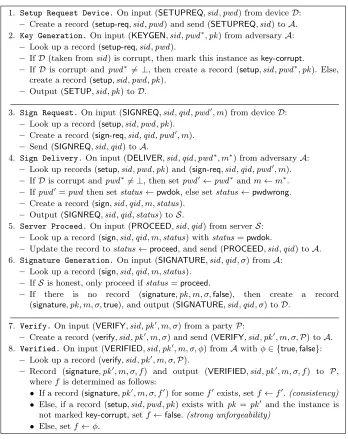
The detailed description of our ideal functionality FPass2Sign for password-authenticated server-aided signatures is given in Figure 2. When describing our functionality, we use the following writing conventions to reduce repetitive no-tation:
– For the SETUPREQ and KEYGEN interfaces, the ideal functionality only considers the first input for each sid. Subsequent inputs to the same inter-face for the same sid are ignored. For theSIGNREQ, DELIVER, PROCEED, SIGNATUREinterfaces the functionality only considers the first input for each combination ofsid andqid.
– At each invocation, the functionality checks that sid = (S,D,sid0) for some server identity S, device identifier D and sid0 ∈ {0,1}∗. Also, whenever we say thatF receives input from or provides output to S or D, we mean S or
1. Setup Request Device.On input (SETUPREQ,sid,pwd) from deviceD: – Create a record (setup-req,sid,pwd) and send (SETUPREQ,sid) toA. 2. Key Generation.On input (KEYGEN,sid,pwd∗,pk) from adversaryA:
– Look up a record (setup-req,sid,pwd).
– IfD(taken fromsid) is corrupt, then mark this instance askey-corrupt.
– IfDis corrupt andpwd∗ 6=⊥, then create a record (setup,sid,pwd∗,pk). Else, create a record (setup,sid,pwd,pk).
– Output (SETUP,sid,pk) toD.
3. Sign Request.On input (SIGNREQ,sid,qid,pwd0, m) from deviceD: – Look up a record (setup,sid,pwd,pk).
– Create a record (sign-req,sid,qid,pwd0, m). – Send (SIGNREQ,sid,qid) toA.
4. Sign Delivery.On input (DELIVER,sid,qid,pwd∗, m∗) from adversaryA: – Look up records (setup,sid,pwd,pk) and (sign-req,sid,qid,pwd0, m). – IfDis corrupt andpwd∗6=⊥, then setpwd0←pwd∗ andm←m∗. – Ifpwd0=pwdthen setstatus←pwdok, else setstatus←pwdwrong. – Create a record (sign,sid,qid, m,status).
– Output (SIGNREQ,sid,qid,status) toS.
5. Server Proceed.On input (PROCEED,sid,qid) from serverS: – Look up a record (sign,sid,qid, m,status) withstatus=pwdok.
– Update the record tostatus←proceed, and send (PROCEED,sid,qid) toA. 6. Signature Generation.On input (SIGNATURE,sid,qid, σ) fromA:
– Look up a record (sign,sid,qid, m,status). – IfSis honest, only proceed ifstatus=proceed.
– If there is no record (signature,pk, m, σ,false), then create a record (signature,pk, m, σ,true), and output (SIGNATURE,sid,qid, σ) toD.
7. Verify.On input (VERIFY,sid,pk0, m, σ) from a partyP:
– Create a record (verify,sid,pk0, m, σ) and send (VERIFY,sid,pk0, m, σ,P) toA. 8. Verified.On input (VERIFIED,sid,pk0, m, σ, φ) fromAwithφ∈ {true,false}:
– Look up a record (verify,sid,pk0, m, σ,P).
– Record (signature,pk0, m, σ, f) and output (VERIFIED,sid,pk0, m, σ, f) to P, wheref is determined as follows:
• If a record (signature,pk0, m, σ, f0) for somef0exists, setf←f0.(consistency) • Else, if a record (setup,sid,pwd,pk) exists withpk =pk0and the instance is
not markedkey-corrupt, setf ←false.(strong unforgeability) • Else, setf←φ.
Fig. 2.Main Interfaces of our FunctionalityFPass2Sign.
– When we say that the functionality “looks up a record”, we implicitly under-stand that if the record is not found, the functionality ignores the input and returns control to the environment.
9. Corruption.On input (CORRUPT,sid,P, Σ) from adversaryA: – Look up a record (setup,sid,pwd,pk) and initialize a listL ← ∅.
– If P = S, then assemble L containing (qidi, ci) for all existing records
(sign-req,sid,qidi,pwd0i, mi), where ci ← pwdok if pwd = pwd0i and ci ← pwdwrongotherwise.
– If now both D and S are corrupt, then mark this instance as key-corrupt and complete the abandoned sign requests: For all (qidi, σi) ∈ Σ, look up
mi from record (sign-req,sid,qidi,pwd 0
i, mi). If there does not exist a record
(signature,pk, mi, σi,false), then create a record (signature,pk, mi, σi,true).
– Send (CORRUPT,sid,P,L) toA.
10. Password Guessing.On input of (PWDGUESS,sid,qid,pwd∗) from adversaryA: – If not bothDandSare corrupt, then ignore this input.
– Ifqid=⊥then look up a record (setup-req,sid,pwd). – Ifqid6=⊥then look up a record (sign-req,sid,qid,pwd, m). – Setc←pwdok, ifpwd∗=pwdandc←pwdwrongotherwise. – Send (PWDGUESS,sid,qid, c) toA.
Fig. 3.Corruption-Related Interfaces of our FunctionalityFPass2Sign.
including the concatenation of both in the identifiers. We also assume that honest parties drop any inputs with session or query identifiers to which they did not contribute.
– When we say that an instance is “marked”, we mean that the specified label is associated with the instance of the functionality with the currentsid. This does not affect other instances of the functionality with a differentsid.
We now describe the behavior of all interfaces in a somewhat informal manner to clarify the security properties that our functionality provides.
Setup. The setup-related interfaces allow the device Dto create an account in
F that is protected with a passwordpwd and associated with the serverS.
1. TheSETUPREQ interface allows the deviceD to register with the server S, whereDandS are the identities as included in the session identifier. 2. TheKEYGENinterface allows the adversary to complete the setup by
deter-mining the public key pk under which messages in this instance are signed. If the deviceDis corrupt at the time of key generation, then we say that the instance iskey-corrupt, meaning that the adversary may know the signing key and may therefore be able to sign any messages it wants. A corrupt device
Signature Generation. Once setup is completed, the signature-related interfaces allow the deviceDto obtain a signatureσon a messagem, but only if the pro-vided password attemptpwd0is correct and the serverSagrees to the signature generation. Signing requests can be done in parallel; the unique query identifier qid identifies different signing sessions.
3. TheSIGNREQinterface allows the device Dto submit the messagem to be signed, and a password attemptpwd0. Only the deviceDincluded insid can perform signing requests, so without compromising the device, the adversary cannot even perform an online attack against the setup passwordpwd. 4. The DELIVER interface lets the adversary notify the server of an incoming
signing request. The notification only includes whether the submitted pass-word is correct, but not the passpass-word attempt itself. A corrupt deviceDcan overwrite the original passwordpwd0and messagemfrom theSIGNREQinput (that may have been provided whenDwas still honest) with a new password pwd∗ and messagem∗.
5. The PROCEED interface allows the server to indicate whether it wants to proceed with the signing request. This models the opportunity for an external throttling mechanism to refuse the signing request. An honest server can only proceed if the password was correct, but corrupt servers can proceed regardless of whether the passwords matched. If the server is honest, then the adversary only (implicitly) learns whether the password was correct when the server agrees to proceed.
6. The SIGNATUREinterface allows the adversary to determine the valueσ of the signature and have it delivered to the requesting device. If the server is honest, then a signature can only be established if the server previously agreed to proceed. A corrupt server can choose to ignore an incorrect password. The functionality creates a signature record (signature,pk, m, σ,true) that will allow successful verification of the signature.
The above interfaces follow a similar approach to Canetti’s signature func-tionality [13] where the adversary determines the signature value, with the im-portant difference that the adversary doesnot learn the message being signed. This models a weak form of blindness: it ensures that a corrupt server does not learn the message, but it does not provide unlinkability as blind signatures do. A full blindness notion would let the functionality generate the signatures by running an algorithm provided by the adversary [20]. Achieving such a notion is interesting, but would almost certainly come at a considerable overhead, as is the case for standard (UC-secure) blind signatures [20, 30].
Signature Verification. With the verification interfaces, any party can check whether a signatureσis valid for messagemand public keypk0.
7. The VERIFY interface allows any party P to ask for the verification of a signatureσon messagemand under public key pk0.
φ for adversarially controlled keyspk0. Here, adversarially controlled means that either pk0 is different from the key pk registered in the functionality, or the instance for pk is key-corrupt. The ideal functionality enforces that responses are consistent, meaning that verification of the same signature for the same message and public key always returns the same result.
For a non-adversarially-controlled keypk, the functionality guarantees strong unforgeability, meaning that even if the message m was signed before with signature σ, the adversary cannot come up with a different valid signature σ0 6=σfor m. For regular unforgeability, one should add the condition that there does not exist a record (signature,pk0, m, σ0,true) forσ06=σ. We opt for strong unforgeability because it offers more application scenarios and implies regular unforgeability.
Corruptions. Our functionality supports adaptive corruptions, i.e., the environ-ment can, at any time, decide to corrupt any initially honest party. It isnot a standard-corruption functionality as defined by the UC framework [15] where the adversary, upon corruption of a party, obtains all the past inputs and outputs of that party. Such a corruption model is clearly unsuitable our setting, as it would hand the user password to the adversary as soon as the device gets corrupted. In fact, even when both the device and server are corrupted, we do not want to give away the passwords immediately. Instead, our functionality then offers an interface modeling offline attacks against the passwords.
9. TheCORRUPTinterface allows the adversary to dynamically corrupt an ini-tially honest device or server. When the device is corrupted after setup was complete, the adversary obtains the possibility to perform signing requests, but he still needs to provide the correct password. We stress that the adver-sary doesn’t receive any passwords attempts or messages from past or even ongoing signing protocols.
device and server can inherently complete abandoned queries, so we have to model it here as well.
10. ThePWDGUESSinterface allows the adversary to perform offline attacks on the stored password and on previous password attempts, but only becomes available when both the device and the server are corrupt. For the stored pass-word, offline attacks cannot be avoided, as the device and the server together must store some information that allows them to decide whether a password attempt was correct. For previous password attempts, this could in principle be avoided, but would make our protocol considerably less efficient, because new cryptographic material would have to be generated at each request and securely deleted afterward.
If the device is already corrupt at the time of setup, we consider the instance as key-corrupteven though the server might still be honest. A stronger security notion, requiring only slight changes to the functionality, would be achievable where the instance is only considered key-corrupt when both the device and server are corrupted. However, this would mean that in the realization, the key generation be done distributively between the server and the device. This is possible but for RSA rather inefficient [1, 26] and seems to offer little added security; hence we chose not to do this.
Discussion. Let us discuss how real-world attack scenarios map to our ideal functionality. If a user loses his device, we assume that the adversary is able to extract all the data from the device, so the device becomes corrupted. As long as the server is not corrupted, though, the adversary controlling the device still has to make online password guesses to be able to sign, but does not obtain the (full) signing key. To protect against online password guessing, the server should implement some kind of throttling on top of our protocol, such as refusing to serve further queries after too many failed password attempts.
If the device becomes infected by malware, we also capture the worst case scenario: it may getall the data from the device and hence the device becomes corrupted. In contrast with the scenario above, the malware may also learn the (correct) password of the user if he’s unaware of the infection and continues to use the device. This behavior is subsumed into the environment; we model this correctly by letting the environment provide the correct password to the adversary. Some protection against this kind of attack can be implemented on top of our protocol by adding intrusion detection logic on the server’s side, e.g., by stopping to serve requests if they become too frequent. This situation is actually quite similar to that of a smart card inserted in an infected device: the device could intercept the PIN code and sign any messages it wants until the card is removed.
into the environment. More advanced models where applications can observe other applications (e.g., their running times) are beyond the scope of this paper.
5
Our
Pass2Sign
Protocol
The core idea of our protocol is fairly simple: an RSA secret key d = dD · dS modϕ(N) is split between the device and the server who then jointly perform the signing operation for each messagem. To hide the message from the server, the device “blinds” it with randomness r as hm ← H(r, m) and lets the server sign it as σS ← hdmS. The device completes the signature as σ ← σ
dD
S . For each signing request, the user authenticates towards the server using a salted password hashhp← H(k,pwd), where the saltkis stored on the device.
Our corruption model and the need for secure erasures. The main challenge is to maintain this simplicity while achieving the strong security properties that we envisage. Most often, security against adaptive corruptions in the UC model comes at a considerable price in terms of computation and communication, and our corruption model is even substantially stronger. In particular, recall that we want to protect the user’s password and previously signed messages in case the device is lost or stolen. The “standard corruption” model in the UC frame-work [15] hands all previous inputs and outputs of a party to the adversary upon corruption of that party, which in case of the device would include all previous passwords and messages. It is quite obvious that standard corruption does not suffice for our purposes, and also that our model cannot be achieved without se-cure erasures, as there would be no way to sese-curely erase previous inputs. Given the usual difficulty of achieving even standard UC corruption, it is surprising that our protocol remains refreshingly simple, round-optimal, and efficient.
Achieving blindness. Achieving blind signatures against adaptive corruptions in the UC model is notoriously hard: the only scheme is due to Kiayias and Zhou [30] and requires six rounds of communication and several zero-knowledge proofs. We decided to strike a reasonable compromise between security and ef-ficiency by dropping the unlinkability requirement, i.e., the property that the signer cannot link a signature to a previous signing transcript, but focusing en-tirely on hiding the message from the signer. We describe a new “just-in-time” programming technique for the random oracle that inserts the correct entries into the oracle when signatures are verified, rather than when they are created. We thereby obtain an efficient and round-optimal construction without having to rely on one-more-type assumptions that are typical for full-domain-hash blind signatures [5, 8].
established when the signature is verified, which we call “just-in-time” program-ming. Namely, whenever a random oracle query H(r0,H(r, m)) is made where r, r0 were previously used in a simulated blind signature, the simulator verifies whether (m, σ) is valid with the help of the ideal functionality. If so, the simu-lator programs the random oracle to map the messagem it just learned to the randomly chosenh0m that was signed asσ.
Non-committing communication and state. As we allow corruptionsduringsetup and signing sessions, we have to take special care that messages sent by the device and server do not commit the simulator to values that it might not know at that time in the proof. We achieve this by employing non-committing encryption for the passwords hashes hp ← H(k,pwd) and each password attempt h0p ← H(qid,H(k,pwd0)) that the device sends to the server. At a first glance that might seem unnecessary since we also assume secure erasures. However, secure erasures are not sufficient as an adversary can intercept the ciphertexts and later corrupt the server to learn the decryption key. He then expects all ciphertexts to open to the proper password hashes (that in the security proof might be unknown when the ciphertexts are generated). The non-committing encryption gives us exactly that flexibility. To determine the correct password hashes hp and h0p upon server corruption we use different random oracle programming techniques, eventually also reying on the password guessing interfaces of the ideal functionality (if both parties are corrupted).
We have to take similar care for the intermediate state-records that the device keeps during interactive protocols. After sending a signing request, the device cannot store the message m, or even the randomness r and the message hash hm← H(r, m), as the simulator does not learnm upon corrupting the device. Nevertheless, the device must be able to verify whether the server’s contribu-tion is correct. Therefore, when sending the message hash hm, the device also sends a value t ← H("MAC",qid, k, hm) that acts as a message authentication code (MAC) forhm. This allows the device to check that the server signed the correct message upon receiving the signature share, but without requiring state information that depends onm.
Authentication of participants. As already mentioned earlier, the session identi-fiersid contains the identities of the deviceDand the serverS. This means that
5.1 Protocol Description
We now present the detailed protocol for ourPass2Sign scheme and give a sim-plified presentation in Figures 4 and 5. We assume that a server has a key pair (epk,esk) for a non-committing encryption scheme (EKGen,Enc,Dec), generated byEKGen on input the security parameter 1τ. We also assume a public-key in-frastructure, where devices and servers can register their public keys, modeled by the ideal functionality FCA [13], and authenticated message transmission, modeled by FAuth. In the protocol description we denote inputs to and outputs from them informally to make the protocol more readable (e.g., we will write that S sends m to D via FAuth instead of an explicit call to FAuth with sub-session IDs etc.). We further assume that parties check the correctness of sub-session and sub-session IDs in all inputs. Moreover, we use Hand HRSA as shorthand notations for two random-oracle functionalitiesFRO{0,1}∗→{0,1}τ andF{0,1}∗→Z∗N
RO ,
respectively. Note that these are single-instance functionalities; one can obtain a secure multi-instance implementation by prefixing each call to them withsid. Our protocol further makes use of an RSA-key generatorRSAGen.
As discussed earlier, secure erasures are necessary to achieve our security guarantees. We thus assume that after each protocol step all variables are deleted except unless we explicitly state that a variable is stored.
Finally, we assume that whenever a check performed by the server or device fails, the checking party will abort the protocol.
Device Server
encryption keyepk decryption keyesk
on input (SETUPREQ,sid,pwd): ((N, e),(d, p, q))←r RSAGen(1τ),
dD←r Z∗ϕ(N),dS←d·dD−1modϕ(N) k← {r 0,1}τ,h
p← H(k, pw)
C←r Enc(epk,(dS, hp),(sid,(N, e)))
sid,(N, e), C −−−−−−−−−−−−−−−−−→
(dS, hp)←Dec(esk, C,(sid,(N, e))) store (setup,sid, hp,dS,(N, e))
sid
←−−−−−−−−−−−−−−−−−
store (setup,sid, k,dD,(N, e)) and output (SETUP,sid,(N, e))
Fig. 4.Setup Protocol(simplified).
Setup Protocol. The setup procedure is the following protocol that a deviceD
runs on input (SETUPREQ,sid,pwd) with serverS, wheresid = (S,D,sid0).
Setup – Step 1. Device generates account data:
a) Upon input (SETUPREQ,sid,pwd), retrieve the encryption key epk for S
b) Generate RSA key material as (N, e, d, p, q) ←r RSAGen(1τ) and share the secret exponent d by choosing a random dD
r
← Z∗
ϕ(N) and setting dS ← d·dD−1modϕ(N), wheredS is encoded as an|N|-bit string.
c) Compute a “salted” password hash as hp ← H(k,pwd) for a randomk ←r {0,1}τ.
d) Encrypt the RSA key sharedS and the authentication informationhpunder epkand with the label (sid,(N, e)). That is, computeC←r Enc(epk,(dS, hp), (sid,(N, e))).
e) Store the record (setup-temp,sid, k,dD,(N, e)) and send the message m = (sid,(N, e), C) to the serverS usingFAuth.
Setup – Step 2. Server registers account:
a) Upon receivingm= (sid,(N, e), C) fromD viaFAuth, check thatsid is not registered yet.
b) Decrypt C as (dS, hp) ← Dec(esk, C,(sid,(N, e))). If decryption succeeds, store (setup,sid, hp,dS,(N, e)).
c) Acknowledge the created account by sending (sid) toDviaFAuth.
Setup – Step 3. Device completes registration:
a) Upon receiving a message (sid) from S via FAuth, check that a record
(setup-temp,sid, k,dD,(N, e)) for sid exists.
b) Store (setup,sid, k,dD,(N, e)) and end with output (SETUP,sid,(N, e)).
Device Server
encryption keyepk decryption keyesk
setup record (setup,sid, k,dD,(N, e)) setup record (setup,sid, hp,dS,(N, e))
on input (SIGNREQ,sid,qid, m,pwd0): h0p← H(qid,H(k,pwd
0
)), r← {r 0,1}τ,
hm← H(r, m), t← H(“MAC”,qid, k, hm)
C0←r Enc(epk,(hp0, hm, t),(sid,qid))
sid,qid, C0
−−−−−−−−−−−−−−−−−−−→
(h0p, hm, t)←Dec(esk, C0,(sid,qid)) ifH(qid, hp) =h0pthenc←pwdok elsec←pwdwrong
output (SIGNREQ,sid,qid, c)
on input (PROCEED,sid,qid) and ifc=pwdok:
r0← {r 0,1}τ,σ
S← HRSA(sid,qid,H(r0, hm))dS
sid,qid, hm, t, r0, σS
←−−−−−−−−−−−−−−−−−−−
abort ift6=H(“MAC”,qid, k, hm)
σRSA←(σS)dD, abort if (σRSA)e=6 HRSA(sid,qid,H(r0, hm)) setσ←(σRSA,qid, r, r0) and output (SIGNATURE,sid,qid, σ)
Signing Protocol. The signing protocol starts when the device D receives an input (SIGNREQ,sid,qid, m,pwd0), where sid = (S,D,sid0), upon which he runs the following protocol with the server S. Recall that we assume that both parties have previously agreed upon a common and globally unique query identifierqid. All messages sent between the device and server also contain the qid as prefix, and only those messages with the corresponding qid are further processed.
Sign – Step 1. Device sends signing request:
a) Upon input (SIGNREQ,sid,qid, m,pwd0), retrieve the record (setup,sid, k, dD,(N, e)) for sid.
b) “Blind” the message by drawingr← {r 0,1}τ and computinghm← H(r, m). c) Compute the (re-)authentication valueh0p← H(qid,H(k,pwd0)).
d) Compute a “MAC”tofhmas t← H("MAC",qid, k, hm).
e) Generate a non-committing encryption of h0p, hm, and t under the public keyepk and with label (sid,qid) asC0←r Enc(epk,(h0p, hm, t),(sid,qid)). f) Store the record (sign,sid,qid, r) and send (sid,qid, C0) toS viaFAuth.
Sign – Step 2. Server verifies information:
a) Upon receiving (sid,qid, C0) from D via FAuth, retrieve the record
(setup,sid, hp,dS,(N, e)) for sid.
b) DecryptC0 to (h0p, hm, t)←Dec(esk, C0,(sid,qid)).
c) Check the password by verifying whetherH(qid, hp) =h0pand setc←pwdok if so andc←pwdwrong otherwise.
d) Store the record (sign,sid,qid, hm, t, c) and output (SIGNREQ,sid,qid, c).
Sign – Step 3. Server creates its signature share:
a) Upon input (PROCEED,sid,qid), retrieve (sign,sid,qid, hm, t, c) forqid and abort ifc6=pwdok.
b) Compute the signature share σS ← HRSA(sid,qid,H(r0, hm))dS modN for a randomr0← {r 0,1}τ.
c) Send (sid,qid, hm, t, r0, σS) toDviaFAuth.
Sign – Step 4. Device completes the signature:
a) Upon receiving (sid,qid, hm, t, r0, σS) fromS viaFAuth, retrieve the signing
record (sign,sid,qid, r) forqid and setup record (setup,sid, k,dD,(N, e)). b) Verify thatt=H("MAC",qid, k, hm).
c) Complete the signature by computingσRSA ← (σS)dD modN. Verify that (σRSA)e=HRSA(sid,qid,H(r0, hm)) modN holds, i.e., that the server’s
sig-nature share was correct.
d) Setσ←(σRSA,qid, r, r0) and end with output (SIGNATURE,sid,qid, σ).
Signature Verification. On input (VERIFY,sid, m, σ,pk), parsepk = (N, e),σ= (σRSA,qid, r, r0) and set M ←(sid,qid,H(r0,H(r, m))). If σRSA is a valid RSA
signature on M, i.e., if 0 < σRSA < N and HRSA(M) = σRSAe modN, output
6
Security
The full proof of the following theorem is given in Appendix D, we give a sketch below.
Theorem 3. ThePass2Sign scheme described in Section 5 securely implements
the ideal functionality FPass2Sign defined in Section 4 in the (FCA,FRO,FAuth) -hybrid model with secure erasures if the RSA assumption associated to RSAGen holds and(EKGen,Enc,Dec)is an IND-NC secure encryption scheme.
Using the IND-NC secure encryption scheme proposed in Section 3, which is an extension of the Bellare-Rogaway CCA2 encryption scheme, and instantiated with the RSA trapdoor permutation, we get the following corollary:
Corollary 1. The Pass2Sign scheme described in Section 5 and instantiated as
described above, securely implements the ideal functionality FPass2Sign defined in Section 4 in the(FCA,FRO,FAuth)-hybrid model with secure erasures if the RSA assumption associated withRSAGenholds.
Proof (Sketch).The proof of Theorem 3 is done by providing a simulator and a sequence of games. The initial game is the real experiment and the final game (Game10) runs the simulator given only the information that is also available to the adversary when interacting with the ideal functionality. We now give a rough sketch of the game sequence, the detailed description as well as the description of the simulator is given in Appendix D.
Game1 through andGame2 abort when collisions occur in random-oracle outputs, or if the adversary “predicts” random-oracle outputs.Game3 replaces all ciphertexts sent by an honest device to an honest server with simulated “dummy” ciphertexts. It uses the decryption simulation to decrypt ciphertexts that were not sent by the honest device, and uses the key-leakage simulation to obtain the secret keyesk in case the server is corrupted.
In Game 4 and Game 5, the simulator aborts when a valid signature is verified that did not originate from the device or the server, whichever is still honest. Interestingly, the case for an honest device can be reduced from the unforgeability of RSA-FDH, but for an honest server we have to reduce straight from the RSA assumption (similar as in [7]).
The subsequent games are all about making the setup and signing protocol simulations independent of the actual values of the passwords and messages being signed.Game 6 and Game 7 make the setup and signing protocol simulations independent of the actual value of the password and password attempts. When the server is corrupt, instead of derivinghp andt from the device secretk and the real passwords, the simulator uses random values. For h0p,i it either uses
actual passwords pwd and pwd0i are queried. In the final simulation with the ideal functionality this is done with the help of the password guessing interface that becomes available as soon as both, the device and the server, are corrupted.
If both entities are initially honest and the device gets corrupted first, the simulation is different though. Then we keep hp, h0p,i unassigned and only fix their values when the server gets corrupted too. This is sufficient as the device never stores the hash values and sends them only in encrypted form to the server (which are dummy ciphertexts since Game 3). However, as soon as the server gets corrupted, the adversary learns the secret key of the encryption scheme and thus all previous dummy communication between the device (sent by the simu-lator whenDwas still honest) and the server must decrypt to the correct hash values. Here we cannot assign random values tohp, h0p,ithough. This stems from the fact that the device got corrupted first, and thus the adversary knows the device secretkand could have already computedhporh0p,ifor the correct pass-word valuespwd,pwdi. Thus, in order to ensure consistency, we check whether a previously answered random oracle query contained an actual passwordpwd or pwd0i (when switching to the ideal world, this is done via the password guessing interface). If such a query is found, we simply reuse the previously given ran-dom oracle response forhporh0p,i and assign random values otherwise. We then use the keyleak-simulator of the non-committing encryption scheme to obtain a key esk that decrypts the dummy ciphertexts fromGame 3 to the just deter-mined hash values. In fact, this case is the reason why we need non-committing encryption, as in the ideal world the passwords pwd or pwd0i are unknown to the simulator (even when the device gets corrupted), and the password guessing interface only becomes available when both entities got corrupted.
Game 8 and Game 9 make the signing process independent of the mes-sage m, with an interesting technique that programs the relevant random-oracle entries only when the signature is verified, not when it is created. In Game 8, an honest device interacting with a corrupt server chooses random valuesrand hm and, if the server behaves honestly, computes the signature as σRSA=HRSA(sid,qid,H(r0, hm))dSdD modN, which it can compute because it
knows the keys dS and dD from the time they were generated. The simulator stores the resulting signatureσ= (σRSA,qid, r, r0) as valid for min its records;
7
Implementation of Our
Pass2Sign
Scheme
In this section we give a short summary of our prototypical implementation of the Pass2Sign scheme. A more detailed description is given in Appendix E. We measured our protocol with three different RSA-moduli sizes, 1,024, 2,048 and 4,096Bit to account for different security requirements. The key size is used for both the signing key and the trapdoor permutation in the non-committing encryption scheme. To instantiate the random oraclesK,G, andHwe use SHA-512 and prefix each call accordingly. The instantiation of the full-domain hash
HRSA is based on the construction given in [6], and uses rejection sampling
to uniformly map into Z∗N. The communication partners send messages using standard TCP-Sockets.
Our implementation uses Java 8 without any optimization. Our server is a laptop with a 2.7GHzprocessor and 16GB RAM, while the device is a Nexus 10 tablet with 1.7GHz, 2GB RAM and Android 5.1.1.
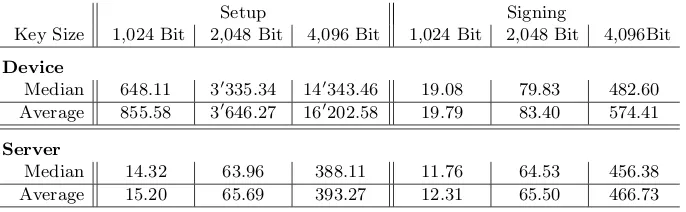
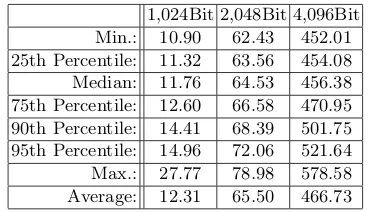
Table 1 depicts the average time for the setup and signing protocol, split between the device and server part, and based on measurements of 100 inde-pendent protocol runs. The figures do not include network latencies though, as they strongly depend on the actual location setting. However, assuming a round-trip time takes 100ms, a full signing protocol with 2,048Bit keys then requires roughly 250ms in total.
Setup Signing
Key Size 1,024 Bit 2,048 Bit 4,096 Bit 1,024 Bit 2,048 Bit 4,096Bit
Device
Median 648.11 30335.34 140343.46 19.08 79.83 482.60 Average 855.58 30646.27 160202.58 19.79 83.40 574.41
Server
Median 14.32 63.96 388.11 11.76 64.53 456.38 Average 15.20 65.69 393.27 12.31 65.50 466.73
Table 1.Overview of our measurements. All values are in ms.
8
Non-Blind Signatures
The Ideal Functionality. The ideal functionalityFPass2Sign∗can be obtained from
the one for Pass2Sign by simply including the message m in the output to the server. That is, when the server learns about a signature request, we augment the output to contain the message m provided by the device: in the <4.Sign Delivery>interface, the serverS now receives (SIGNREQ,sid,qid,status, m).
Note that so far the message still remains confidential between D and S, disregarding the length the message. If the message is supposed to be entirely public, thenmmust also be included in the output (SIGNREQ,sid,qid,D, m) to the adversaryAin the<3.Sign Request>interface.
The Protocol. We now sketch how our Pass2Sign realization can be modified to one that realizes FPass2Sign∗ with entirely public messages. First note that
only the signing protocol needs to be changed. In a nutshell, one simply drops all its steps that aim at providing message blindness, such as the hashing of the message including r and r0. More precisely, when requesting a signature, the device drops the blinding Step 1b) where hm← H(r, m) is computed for a randomr, and the “MAC” Step 1d) which aims at ensuring message consistency without having to storem on the device. Instead, the device now simply keeps the message in its sign record. Depending on whether one aims at the confidential or public message setting, the message is sent either encrypted or in plain toS. For the latter, one has to ensure that the adversary cannot tamper with the message during delivery, and thus we would have to include m in the label of the ciphertext. That is, for the public message setting, the device sends toSthe tuple (sid,qid, C0, m) withC0 becomingC0←r Enc(epk, h0p,(sid,qid, m)).
The changes to the server’s computation are similar: in Step 3b) the server drops its randomness r0 and double-hashing contribution and simply signs the (slightly augmented) message (sid,qid, m) based on the received messagem. The server then returns (sid,qid, σS) to the device.
Finally, in Step 4c), where the device completes the signature toσRSA, the
verification ofσRSAis adapted accordingly and, in Step 4d), the full signature is
set to σ= (σRSA,qid). Verification of a signatureσ on messagem is simplified
to a standard RSA-FDH verification ofσRSAfor message M ←(sid,qid, m).
It is easy to see that the proof of the simplified non-blind schemePass2Sign∗ can be derived with minor modifications from the proof of ourPass2Signscheme. Roughly, we have to adapt the games for the reduction to the RSA assumption, and drop all simulation that stems from the message blinding, such as the sim-ulation of the tags t or the “late-programming” of the random oracle upon a signature verification request (as the messages are now known to the simulator).
9
Conclusion
the server are required to be tamper-resistant in any form, yet our protocol offers comparable security to trusted hardware, but without its inconveniences.
The UC-formulation guarantees that our protocol remains secure even in ar-bitrarily chosen contexts. Our protocol is secure against adaptive corruptions, which properly models our main threat where the device gets lost or stolen. Our model of corruption is even stronger than the existing standard: the simulator does not learn any previous inputs. The ideal functionality also provides a re-alistic way how password guesses are handled. Namely, even if both the device and the server are corrupted, the adversary does not immediately learn the pass-words, but can only mount an offline attack. Thus, if strong passwords are used, the adversary might still not be able to guess them, despite having corrupted both entities.
The protocol is round-optimal and very efficient, as it only requires few ran-dom oracle calls and three full-size modular exponentiations for each signature generation. Furthermore, we sketched how to lift the blindness property from our functionality and protocol, yielding an even more efficient scheme.
Possible extensions include achieving full blindness with unlinkability of the resulting signature, an instantiation in the standard model, and extensions to more than one server.
References
1. J. Algesheimer, J. Camenisch, and V. Shoup. Efficient computation modulo a shared secret with application to the generation of shared safe-prime products. In
CRYPTO 2002, pages 417–432, 2002.
2. J. F. Almansa, I. Damg˚ard, and J. B. Nielsen. Simplified threshold RSA with adaptive and proactive security. InEUROCRYPT 2006, pages 593–611, 2006. 3. A. Bagherzandi, S. Jarecki, N. Saxena, and Y. Lu. Password-protected secret
sharing. InCCS 2011, pages 433–444, 2011.
4. D. Beaver and S. Haber. Cryptographic protocols provably secure against dynamic adversaries. InEUROCRYPT 1992, pages 307–323, 1992.
5. M. Bellare, C. Namprempre, D. Pointcheval, and M. Semanko. The one-more-rsa-inversion problems and the security of chaum’s blind signature scheme.Journal of Cryptology, 16(3):185–215, 2003.
6. M. Bellare and P. Rogaway. Random oracles are practical: A paradigm for designing efficient protocols. InCCS 1993, pages 62–73, 1993.
7. M. Bellare and R. S. Sandhu. The security of practical two-party RSA signature schemes. IACR ePrint, 2001/060, 2001.
8. A. Boldyreva. Threshold signatures, multisignatures and blind signatures based on the gap-diffie-hellman-group signature scheme. InPKC 2003, pages 31–46, 2003. 9. D. Boneh, X. Ding, G. Tsudik, and C.-M. Wong. A method for fast revocation of
public key certificates and security capabilities. InUSENIX 2001, 2001.
10. C. Boyd. Digital multisignatures. InCryptography and Coding 1989, pages 241– 246, 1989.
11. J. Camenisch, R. R. Enderlein, and G. Neven. Two-server password-authenticated secret sharing uc-secure against transient corruptions. IACR ePrint, 2015/006, 2015.
13. R. Canetti. Universally composable signature, certification, and authentication. In
CSFW 2004, pages 219–233, 2004.
14. R. Canetti, S. Halevi, J. Katz, Y. Lindell, and P. D. MacKenzie. Universally composable password-based key exchange. InEUROCRYPT 2005, pages 404–421, 2005.
15. Ran Canetti. Universally composable security: A new paradigm for cryp-tographic protocols. Cryptology ePrint Archive, Report 2000/067, 2000. http://eprint.iacr.org/.
16. J.-S. Coron. On the exact security of full domain hash. InCRYPTO 2000, pages 229–235, 2000.
17. I. Damg˚ard and G. L. Mikkelsen. On the theory and practice of personal digital signatures. InPKC 2009, pages 277–296, 2009.
18. Y. Desmedt and Y. Frankel. Threshold cryptosystems. InCRYPTO 1989, pages 307–315, 1989.
19. S. Fehr, D. Hofheinz, E. Kiltz, and H. Wee. Encryption schemes secure against chosen-ciphertext selective opening attacks. In EUROCRYPT 2010, pages 381– 402, 2010.
20. M. Fischlin. Round-optimal composable blind signatures in the common reference string model. InCRYPTO 2006, pages 60–77, 2006.
21. R. Ganesan. Yaksha: augmenting kerberos with pkc. InNDSS 1995, pages 132–143, 1995.
22. R. Gennaro, T. Rabin, S. Jarecki, and H. Krawczyk. Robust and efficient sharing of RSA functions. Journal of Cryptology, 13(2):273–300, 2000.
23. K. Gjøsteen. Partially blind password-based signatures using elliptic curves.IACR ePrint, 2013/472, 2013.
24. K. Gjøsteen and Ø. Thuen. Password-based signatures. InEuroPKI 2011, pages 17–33, 2011.
25. J. M. Gosney. Password cracking HPC. Passwordsˆ12 Conference, 2012.
26. C. Hazay, G. L. Mikkelsen, T. Rabin, and T. Toft. Efficient rsa key generation and threshold paillier in the two-party setting. InCT-RSA 2012, pages 313–331, 2012. 27. C. Hazay, A. Patra, and B. Warinschi. Selective opening security for receivers.
IACR ePrint, 2015/860, 2015.
28. Y.-Z. He, C.-K. Wu, and D.-G. Feng. Server-aided digital signature protocol based on password. InCCST 2005, pages 89–92, 2005.
29. D. Hofheinz and J. M¨uller-Quade. Universally composable commitments using random oracles. InTCC 2004, pages 58–76, 2004.
30. A. Kiayias and H.-S. Zhou. Equivocal blind signatures and adaptive UC-security. InTCC 2008, pages 340–355, 2008.
31. O. K¨ommerling and M. G. Kuhn. Design principles for tamper-resistant smartcard processors. InWOST 1999, 1999.
32. P. D. MacKenzie and M. K. Reiter. Networked cryptographic devices resilient to capture. Int. J. Inf. Sec., 2(1):1–20, 2003.
33. M. Mannan and P. C. van Oorschot. Using a personal device to strengthen pass-word authentication from an untrusted computer. InFC 2007, pages 88–103, 2007. 34. M. Naor and M. Yung. Public-key cryptosystems provably secure against chosen
ciphertext attacks. InSTOC 1990, pages 427–437, 1990.
35. J. B. Nielsen. Separating random oracle proofs from complexity theoretic proofs: The non-committing encryption case. InCRYPTO 2002, pages 111–126, 2002. 36. T. Rabin. A simplified approach to threshold and proactive RSA. In
37. M. Venkitasubramaniam. On adaptively secure protocols. In SCN 2014, pages 455–475, 2014.
38. S. Xu and R. S. Sandhu. Two efficient and provably secure schemes for server-assisted threshold signatures. InCT-RSA 2003, pages 355–372, 2003.
A
Functionalities
Here, we formally introduce the formal UC-definitions for the random oracle functionalityFD→R
RO (Figure 6), the certification authority FCA(Figure 7) and
the authenticated channel functionalityFAuth(Figure 8).
1. Query.Upon input (QUERY,sid, m),m∈ D, from a partyP do: – If there is a tuple (m,ˆh)∈ Lfor some ˆh, leth←ˆh.
– Else, draw ˆh← Rr , add (m,ˆh) toL, and seth←ˆh. – Output (RESPONSE,sid, m, h) toP.
Fig. 6.Random Oracle FunctionalityFD→R
RO , whereLis an initially empty list.
1. Registration.Upon input (REGISTER,sid, v) from a partyP:
– Send (REGISTER,sid, v) to A. Upon receivingok fromA, and if sid =P, and this is the first request fromP, record (sid, v).
2. Retrieve.Upon receiving a message (RETRIEVE,sid) from a partyP0: – Send (RETRIEVE,sid,P0) toA. Upon receivingokfromA:
• If a record (sid, v) exists, output (sid, v) toP0. • Else, output (sid,⊥) toP0.
Fig. 7.Certificate Authority FunctionalityFCA.
1. Send.Upon input (SEND,sid,S,R, m) from a partyS: – Check thatsid = (S,R,sid0).
– Send public delayed output (SEND,sid,S, m) toR, if R has not received any output yet.
2. Corrupt.Upon receiving a message (CORRUPT,sid, m0) fromA: – Check thatsid = (S,R,sid0).
– IfSis not corrupt, ignore.
– Output (SEND,sid,S, m0) toR, ifRhas not received any output yet.
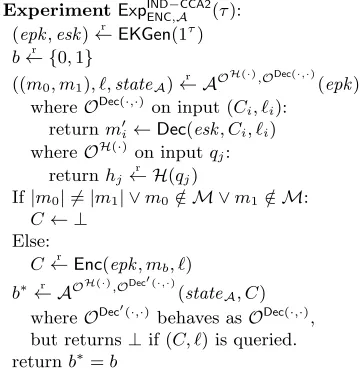
ExperimentExpIND−CCA2 ENC,A (τ): (epk,esk)←r EKGen(1τ) b← {0r ,1}
((m0, m1), `,stateA)
r
← AOH(·),ODec(·,·)
(epk) whereODec(·,·) on input (C
i, `i):
returnm0i←Dec(esk, Ci, `i)
whereOH(·)
on input qj:
returnhj
r
← H(qj)
If|m0| 6=|m1| ∨m0∈ M ∨/ m1∈ M:/ C← ⊥
Else:
C←r Enc(epk, mb, `) b∗← Ar OH(·),ODec0(·,·)
(stateA, C) whereODec0(·,·)behaves asODec(·,·),
but returns⊥if (C, `) is queried. returnb∗=b
Fig. 9.Labelled IND-CCA2 for messages with arbitrary length.
B
Proof of Theorem 1 (IND-NC =
⇒
IND-CCA2)
In this section we provide the proof of Theorem 1 that our IND-NC security as specified in Definition 1 implies IND-CCA2 security. For the sake of completeness we first recall the notion of IND-CCA2 security and give our proof afterwards.
Definition 2 (IND-CCA2 security [34]). An encryption scheme ENC =
(EKGen,Enc,Dec)for arbitrary length messages with labels is IND-CCA2-secure, if for all PPT adversaries A, |Pr[ExpIND-CCA2ENC,A (τ) = 1]−1/2| ≤ (τ) for some negligible function and the experiment given in Figure 9.
Proof. Intuitively, the proof formalizes the following idea: if an adversary can decide which message a given ciphertext contains, then it can decide whether a given ciphertext contains any information at all.
Assume an (efficient) adversaryAthat guesses the bit b in the IND-CCA2 game with probability at least 12 +. We can then construct an (efficient) ad-versary B such that the probability that it outputs 1 in the two experiments IND-NC-realandIND-NC-idealdiffers at least by. The proof is straightforward. Essentially, the reduction feeds the ciphertexts to Aand ifAguesses correctly, then it must be the real experiments as the ciphertexts in the ideal experiments are unrelated to the challenge message. More precisely, the reduction is as fol-lows. Initially,Breceives a public keyepk of the encryption scheme, oracle access toEnc,Dec, and a random oracleH. Thus,BrunsAon inputepk. WheneverA