ISSN 2286-4822 www.euacademic.org
Impact Factor: 3.4546 (UIF)
DRJI Value: 5.9 (B+)
The Learner and The Acquirer
AMIR KHABIR SATTI HAMED
Assistant Professor Elnaser Technical College, Omdurman Ministry of Higher Education and Scientific Research
Republic of Sudan
Abstract
This paper aims to presenting the difference between the learner and the acquirer. It puts the process of second language Acquisition under focus. It sheds light and it draws highlight of variations among second language Acquisition learners. And the study makes a comparison research between a learner of a language as a second language Acquisition and the Acquirer of the language. At the present time it is realized that half of the world population are either multil lingual or bilingual individuals. It is inevitable in present globalization to know more than one language. In this study we cast an interview with Black African American Citizen. Who comes to see his relatives in the Sudan. The researcher picks up from him a colloquial expressions. According to that Black African American, these speech, is from his location Columbus, Ohio, United States of America. The researcher jots down his words in table (1) and compared. It with a learner of second language Acquisition of English language. The researcher makes analysis of Acquirer speech in tables and compared it with a learner. The results is there is a vast difference between a learner and the acquirer.
Key words: second language, learner, Acquirer, Acquisition,, English
INTRODUCTION:
((25/9/2019, 7:30 p.m , pdf. Files "http,://opus4 kobv.de, language Acquisition: it's A good Way to learn second language, 2015, Reena Mittal)). Argue that language Acquisition a challenge. Because it is the process in which the little children acquired their "L1" first language. Almost the majority of Man Kind have innateness ability and capability to learn languages. A newly born child when he comes in the stage of acquiring or learning language he might be adopted to on or two language. Speculate a little child who learns mother tongue at the age of one up to three years, but whenever, he comes in direct contact of the outside glob, these children adopt their language too. For example, X is a regional language and the second language is English language. When the child starts going in plays groups or kindergarten them, or schools, he takes few months only to devour and dygest the second language. This language acquisition becomes strong still until the age of 10 to 12 years old of age. Due to this time or after this brain becomes little hard wired to adopt language by default. Thus individual has to work hard for second language acquisition. Children do not learn second language, but they pick it up very quickly and spontaneously.
First Language Acquisition:
Language learning in compared to the acquisition is the process when human being learn all language other than mother tongue. Man kind has a natural ability to learn 4-5 languages easily and they can make the difference without any confusion as human learns 6-7 subjects easily. But second language can be learn intensively with a lot of instructions language learning requires implicit and explicit instructions in speaking and hearing. Fore instance, a child can speak flawless English as his first language is English language but he has no idea of the rules of grammar, he only speaks simultaneously and spontaneously. He speaks fluently and pronounced correctly. But when that child learns a second language, he learns it with the rules of grammar and semantics also. So second language becomes or a little bit of an exercise of the brain. There are four major things which work on language acquisition:
Sudanese black African wants to learn English language. To get English as target language, parents allow their children to study in a school where medium of instruction is English. Initially, child may face problems but eventually he will cope up one day and achieve his TL at its best.
2. Second language Acquisition- Even though L2 can be achieved through many learning programmes and computer basic online course but sometimes they fail due to lack of atmosphere. Thus Acquisition theory works well. A linguistic atmosphere with everyone using the same language works really well.
3. Treatment of the second language: 3.A.Major rules of second language Acquisition:- The Theory of National Approach "created by Krashen connects well with second language acquisition. He gives major five rules:
(1) The Input Method – means to understand a piece of language structure in language teaching process and learner converts it with similar situations as use of tenses. (2) The effective Method- where the learner has to learn and connect with faster use of language such as listening music, songs of the second language and connecting and understanding with them.
(3) The Acquisition Method – when a language is taught with the help of grammar, vocabulary and culture and learner should use it.
(4) The Monitor Method – when a learner has knowledge of second language but he has to practice and use language correctly.
(5) The Natural Approach – to introduce basic of second language and wait for sometimes and it is speculated that by passing of time and continuous use of primary second language will make one understand all about L2.
stages in second languages learning as first language Acquisition:-
1. Pre-speech – attention to intonation. 2. Babbling – utterance of speech.
3. Holophrastic stage- when a learner tries to speak words. 4. Started speaking unerringly with some corrections. 5. Combining words-sentence without proper constructions. 5. Connections Languages:- there are some facts concerning the
first language as comes naturally to everyone and second language comes with some efforts. But present situation bilingualism or multilingualism has become the need for the hour. It is observed that children sometimes understand two languages very easily and speak too, but they normally feel force to communicate in the language. They listen in the linguistic environment. But in present universal are a bilingualism or multilingualism has become mandatory as it opens:
New career opportunities. More travelling options.
Communications behind the borders. Further studies options in Universities. 6. Language Acquisition and learning.
Due to survey in 1990 reveals that language acquisition gives a positive effect on brain development. It tells that if a child is given an opportunity at the age of 3 he may be able to grab 2 languages simultaneously and very easily. So parents are also entitled to provide the conductive atmosphere and learning environment for multiple language acquisition. Second language acquisition has many benefits such as:
1- Academic benefits – Naturally, learning a second language will open a new shutters for reading, writing and verbal skills in L2. One can go around the world and acquire education in an interested field.
can learn elementary L2. currently the beginning of their speaking exposure. It will expose them to second language and hesitation of speaking will be removed from their personality. 3- Personal benefits:- It is obvious to all of us that a person
versatile in two or more languages will always grab a lot of understanding human and humanity as a whole will increase.
Objectives and Motives:
Eventually a learner is not as an acquirer. A learner learns a second language through education and schooling. H/She learns standard language. He covers the rules that govern it is grammatical structure. He learns the liner order of sentence construction of second language. Hence that is due to syntactic, morphological, phonological and semantic view point and knowledge. But H/She has not got pretty enough notion about the culture of second language. That fore a language can not be learned within isolation of its society.
H/She learns and acquire the second language. And at certain stage have linguistic competence. Which is the background knowledge of language. This process is as input. While the output is performance. Thus in accordance to tiredness, fatigue and exhaustion. He might make a tongue slip. Still H/She has not idea of colloquial or slang of that language. H/She has not got a sufficient knowledge. As it is speculated. Whenever a learner wants to learn a word it should be learned in a context. Here appears learning process and contextualization. Some learners of L2. is affected by their mother tongue. For example A femal at Sudanese Secondary School level is asked to do writing task of a composition. She quoted that in her writing the following: the husband quarlled with his spouse and he gave her three shots. She meant to say that he gave his wife the final divorce. Another examples of Primary School Pupils who writes the following sentence: Ahmed cut the road. He meant to say Ahmed crosses the road.
Some post graduate students who used to have a scholarship a broad for study. They intend to live with a native speaker family. In order to acquire L2.
Londoners work class dialect, which is ((cockney)). Black African American thought to feel proud such as I speak like a white man in broklin and New York as it is stated by some Black African American. For example if you argue this statement to a second language learner. He may not understand it. Such as: they hit the street. In standard American English language is that they have a demonstration. Another Example:- I wana fag. (Black American English ((I want a cigarette)). Further more Example: ((I was gona come)) I standard American English: It is programmed or suppose that I should come but that did not take place.
An acquirer is fully grasb language compared to a learner of second language. The acquirer is impact with the language society more than the learner. As it is thought.
Consider the following statement of social class. That affect the acquirer digestion of target language:-
A. He kicked the basket. [[working class]] B. He passed a way. [[Middle class]] C. He joined Heavenly choir [[upper class]] This as is thought UK. English.
Eventually the differences between the learner and the acquirer of the target language is a controversial issue.
An acquirer is fully informed with L2. that involves the L2. and its society. It concerns L2. and its culture. It dives deeply in L2. and its dialect. It covers a pretty enough of its accent. That is lacked in the linguistic competence of the learner of L2. A learner of L2. might make a wrong sequence of grammatical tense when He /She constructs on L2. Statement. While the acquirer may fully grasp L2. without full idea of its grammatical structure you may inquire after grammatical rules such as the unreal past from an acquirer. Still He uses this grammatical rules in a well constructed sentence although He /She have no idea of such a rule.
Literature Review:-
of research on second language acquisition. In this account the authors outline four analytical approaches – contrastive, error, performance, and discourse analysis –trace the shifts among these approaches, and demonstrate the advantages and disadvantages of each. They also show how the different approaches reflect changing conceptions of language and the nature of the learners. The authors give special emphasis to the influence of first language-acquisition research on studies of second language acquisition, and they speculate on future research trends.
Language provides one of the most readily accessible windows into the nature of the human mind. How children acquire this complex system with such apparent ease continuous to fascinate the student of human language. The last quarter of a century in particular has witnessed a qualitative leap in our knowledge of the language acquisition process in young children. In recent years researchers have begun extending their scope of inquiry into the problem of second language acquisition. The motivation underlying this new endeavor is two-fold: first, it provides an added perspective on human language, and second, interest in second language teaching and bilingual education has resulted in a greater need to understand the mechanisms underlying second-language acquisition.
(such as negatives and interrogatives) and look for both the distributional characteristics of errors and correct usage of those structures. Or, we could look not just at linguistic structure but at discourse structure as well.
For example, we could ask how linguistic forms might be derived from the way in which they are used in conversation.
Over the past thirty years second – language – acquisition research has passed through the four phases outlined above: contrastive analysis, error analysis, performance analysis, and discourse analysis. (For a review of earlier studies in this area see Mclaughlin, 1977). In this article, we summarized and critically review. from one form of analysis to the next, particularly that due to the influence of first language –acquisition research.
(25/9/2019, 7:42, pdf.‹http://www-birmingham. ac.UK, Input Process in second language Acquisition: A Discussion of four Input Processing Models, Yayun Anny Sun. Teachers College, Colombia University) claims that; the importance of input has been a widely recognized concept in the field of second language Acquisition. Much research has been conducted to examine how input is processed, the various facilitative attributes of Input, and the effectiveness of pedagogies that directly manipulate input. Among these domains of Input related research, it is critical to first understand the very nature of Input-Processing. Hence in this paper, forward different models of Input-Processing are examined and compared side – by – side. The discussion aims to disambiguate discrepancies in terminologies, further research on the role of attention/ consciousness in Input-Processing.
may facilitate or hinder acquisition (e.g., frequency, saliency, and transparency); and (4)Instructional methods that may enhance input to promote acquisition (e.g., various types of Input enhancement, recasts, and processing instruction). The above four domains of inquiry have led to a plethora of studies. However, before one can logically approach the issues related to application, as in the latter three debates, there must first be an overall understanding of how input is in fact in corporated into the inter language grammar, as highlighted in the first issue. Decades of discussion on input processing have produced useful insights but also diverging terminologies and models. It is pertinent to understand them holistically in order to further the discussion in a more organized and efficient manner. Hence, in this paper, I will first seek to clarify the definitions of four input processing models proposed above.
Current Consensus in Input:
Corder (1967) made a significant observation in his seminal paper about how input is perceived in the process of L2. Acquisition. His insight later became one of the cornerstones in input – related research. He discussed the notion of intake:
The simple fact of presenting a certain linguistic form to a learner in the classroom does not necessary qualify it for the status of input, for the reason that input is "what goes in not" what is available for going in, and we may reasonably suppose that it is the learner who controls this input, or more properly his intake (P.165).
The fact that not all the available data in the learner's environment can be absorbed and used in building the learner's IL grammar presents one conundrum, and the condition that would enable the conversion of input into intake has been a central point of research.
mechanisms and subprocesses are responsible for the input – to – intake conversation.
The models described below will provide some insights into this question.
Another basic understanding for SLA researchers is that, as input is converted into intake, learners make use of this material for dual purposes, namely, comprehension and acquisition. Drawing this distinction is important for both theory – making and empirical investigations (Farech & Kasper, 1980; Washen, 1982, Sharwood Smith, 1986, Swain, 1985; Van Patten, 1996). Learners have the natural indination to decode linguistic input of meaning to achieve successful communication. But the type of intake derived from processing – for – meaning is not equivalent or sufficient to that which is needed for acquisition, which entails the creation of new or revised mental structures. Swain's (1985) study of French immersion program revealed that, based on communicative and comprehensible input alone learners may achieve nature – like proficiency in their comprehension. But their proficiency and accuracy in production lags behind that, based on speakers despite years of exposure. Swain's study provides support that comprehensible input does not necessarily lead to acquisition. At the same time, it is also true that, without comprehensible input, learners would not be able to make the necessary from – meaning connection for acquisition to occur; the reasons for this will become apparent in the discussion of the models (Krashen, 1982, 1985; Van Patten & Cadierno, 1993). This distinction between processing for comprehension, and acquisition is another concept that is commonly accepted in the field of SLA research.
(25/9/2019, 8:10 PM. https://www.Pedr.com, The Process of Second Language Acquisition And its Implication for Teaching, (2002), Ludmilla Mame Lina). Argue that, the progress of learners in the acquisition of a new language (L2.) is often measured by standards set for teaching in the 1950's by behaviorism. According to this view, the learner's language is considered to be an incorrect version of the target language and mistakes are explained in terms of lack of practice.
This approach was proved inaccurate by later language acquisition theories and research.
development under the influence of many factors with formal instruction being only one of them. The L2 development depends on how the brain process information, the cognitive maturity of the learner, previous linguistics experience, time limitations, the individual's psychological characteristics and the social circumstances of learning.
(25/9/2019, 8:15 P.M., Second Language Acquisition: the interface between theory and practice, Oct. 2002- Jan. 2003., Edited by Martin Hamak – Hammer L. David New by.) argue that:
*Creative construction theory or the Naturalistic Approach:
This approach is based on the assumption that language acquisition is innately determined and that we are born with a certain system of language that we can call on later. Numerous linguists and methodologists support this innateness hypotheses. Chomsky, who is the leading proponent, claims that each human being possesses a set of innate properties of language which is responsible for the child's mastery of a native language in such a short time (cf. Brown 2002: 24). According to Chomsky, this mechanism, which he calls the "Language Acquisition Device" (LAD), "governs all human language, and determines what possible form human language may take" (Dulay, Burt, Krashen 1982: 6ff).
1-Krashen's Input Hypothesis:-
This hypothesis by Stephen Krashen is one of the most controversial theoretical perspectives in second language acquisition. It is based on a set of five interrelated hypothesis that are listed below:
A. The Acquisition – learning Hypothesis:
As mentioned above, Krashen claims that there is a different between acquisition and learning. Acquisition is "a subconscious and intuitive process of constructing the system of language, not like the process used by a child to 'pick up' a language". Learning is a conscious process in which "learners attend to form, figure out rules and are generally aware of their own process" (Brown 2002: 278).
B. The Monitor Hypothesis:
The monitor has nothing to do with acquisition but with learning. The learned system acts only as an editor or "monitor" making min or changes and polishing what the acquired system has produced. According to Krashen, three conditions are necessary for monitor use: 1.suffiient time 2.focuss on form 3. Knowing the rules. (cf. light bown, Spada 1995: 27).
C. The Input Hypothesis:
This hypothesis states that it is important for the acquire to understand language that is a bit beyond his or her current level of competence. This means, if a learner is an a level i the input he gets should be i+1. This means that the language that learners are exposed to should be just for enough beyond their current competence that they can understand most of it but still is challenged to make progress (cf. Brown 2002: 278).
D. The Affective Filter Hypothesis:
This hypothesis states that it is easier for a learner to acquire a language when he/she is not tense, congery, anxious, or bored. According to Dulay and Burt, performers with optimal attitudes have a lower affective filter. A low filter means that the performer is more open to the input language. (cf. Krashen, Terrell 1983:38).
Saragi, Nation and Meister (1978), who asked adult native speakers of English to read A clockwork Orange, a novel containing 241 slang words of Russian origin, called "nadsat" words. Subjects were not told to try to learn or remember the nadsat words, but were only told that after they finished the book they would be given a test of literary criticism and comprehension based on A clockwork Orange. The dictionary of nadsat words that is published all the end of A clockwork Orange was removed from the copies the subjects read. A few days after they finished the book, subjects were given a multiple choice test covering go nadsat words. There was a significant amount of nadsat word learning: the lowest score on the multiple choice test was about 50% correct and the average score was about 76% correct.
Ferris (1988) recently showed that university level students of English as a second language can also increase their vocabulary reading. In her study, students read George Orwell's novel Animal Farm and were given a multiple choice test before and after reading the book, covering words from Animal Farm that students at their level typically do not know.
The students made significantly better gains on the test than control students who did not read the book.
In this respect, we report on a study in which students of English as a second language were asked to read two chapters of A clockwork Orange and were tested on their acquisition of nadsat words. An avantage of using this test is that nadsat words are not found in subject's first language, eliminating transfer as a possible source of vocabulary knowledge. Any gain after reading A clockwork Orange would be, most likely, due to reading the text.
Our goals were to confirm that second language acquires could acquire vocabulary incidently from reading, and to see whether vocabulary acquisition in second language acquires could occur with a more difficult text, and with a slightly different, group of students.
METHOD:
Vocabulary Measure: Thirty nadasat words were selected for the post-test, with frequencies ranging from 1 to 27. For each target word, multiple choice test item was constructed. The distracters were chosen in such a way as to render partial answer. Each distracter was used only one: To insure that subjects knew the vocabulary test and administrated to a group of ESL students at a lower level from the target group. Only distracters known by this group were used.
((https://www.researchgate.net/publication/328492845, the Impact of Exposure to English Language on language Acquisition, Jan.2018, Samer Al Zoubi, Ajloun National University)). Claims that; the main purpose of this study is to investigate the impact of exposure to English language on language acquisition. The participants of this study were 42 EFL students chosen random from the Department of English Language and literature at Ajloun National University, Jordon. The students were given five sets of likert scale type of questionnaire as the instrument of this study that consisted of 22 items. The result yielded the following results: Firstly, there was a strong impact of exposure to English Language on language acquisition as the overall means was high reached (3.72). Secondly, there is a statistically significant correlation between exposure to language and developing the four language skills since the P value is (0.228), which is greater than the significant level (p>0.05). Finally, the researcher recommended that movies and program, surfing the internet, listening to radio, reading English books, magazines, newspaper, all these above mentioned elements should be adopted by the learners. Moreover, they should practice English language with native speakers, on the daily basis to encourage acquiring English language. Moreover, teachers and parents should raise learners awareness towards the importance of learning English language through exposure to the language daily using different techniques that can enhance second language acquisition.
command of English is the stepping stone to better educational, and job opportunities, and a higher social status (Charise, 2007). With the intention of equipping the younger generation with the English communication skills required for higher education and career opportunities, public and private schools in the Arab world introduced ESL/ EFL in their educational system. Language learning may be difficult and exciting task, particularly for those who learn a language as their second or foreign language. Considering the importance of English language, the Ministry of Education in Jordan has outlined English as a foreign language that should be acquired by the students. It has received more attentiveness in Jordan especially in the educational field. Generally, basic education at the elementary level in Jordan consists of series often years of continuous teaching. Secondary education comes after this ten years period for two years. Although secondary education, which typically starts at age 16, is not compulsory, it indicates a two year track of sequential study in which students can join either academic or vocational programs. When this two years educational program ends, students can take a general specialty. The students who complete the test with a passing score are granted a special certificate. As soon as students complete this full educational system, they are qualified to obtain admission to universities. (English General Guides and curricula for Secondary stage MOE, 1983).
interaction), using English language in real life situations, sucfing the internet using English language as well as, reading English books, magazines and newspapers.
It is believed that learning English language needs to be encouraged and developed in the classroom and out the classroom through appropriate techniques. Such techniques help students be come better able to improve their English language and express themselves in the target language. Nevertheless, in teaching English language to learners, the researcher is not talking about writing stories or plays, which require creative gifts and power of imagination, to judge that the learners are really weak in English language. Educator simply look forward to enabling their students to express themselves in simple correct and acceptable level of English through exposure to English language.
In fact, there is a general consensus among researchers in language acquisition that exposure to language plays an essential role in language acquisition, where learners are liable to learn languages easily, and more successfully. Basically, exposure to a language is considered successful when the learner can produce the language since learning can take place any where and in any time. If learners only focus on a classroom activities, they will not acquire the second or foreign language probably. Many learners learn English inside the classroom but if they do not get the chance to practice it outside the classroom they will not learn it appropriately. It should be emphasized that exposure can directly improve a target language so that language proficiency may be a result of social interaction with speakers of the target language. [Peregoy & Boyle, 2005]. Nevertheless, an insufficient exposure to the target language can be influenced by the learner's anxiety and self-effiicacy, mainly in speaking and writing. For instance, a learner studying in a country where English is spoken as a first language has a lot of exposure consequently, more chances to acquire the language. As an experienced speaker of the language, the teacher can supply learners with practical models of language and can also use natural input from CDs, television, video, web sites, magazines, and books.
the classroom. Learners recognize when they are being taught when they are at school, and they may concentrate on what the teacher is presenting. But when they sit on their computers at home, watching a film or playing a game, they might learn words and phrases and use them in real life situation. This is called incidental learning (d' Ydewalle, G., & De Bruycker, W., 2007). Thus, formal classroom learning is one way to perform and learn a new language skills, although multitudes of opportunities for learning a new language can be presented outside of the classroom. Multimedia (internet, social media, television, radio, video games), group work and projects may assist learners to develop the target language appropriately.
Generally speaking, students' weakness in learning English language has its roots in the method of teaching, lack of motivation, the teacher, practice and interest and in the curriculum design. Though, in spite of Jordan's high profile global image and continual appearance in national land international contexts, little research has been conducted or published on exposure to English language and language acquisition.
For most students of Jordan who do not get enough exposure to authentic English speaking environmental or chances to interact using English, they could only learn to improve in classes through intensive training. Many learners have studies English at school but they did not use it outside the classroom. They have many problems in learning English language because they do not have the courage to speak in English confidently.
*THE CORE OF THE TOPIC:-
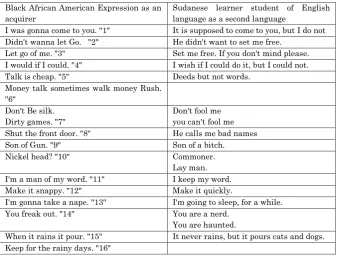
to that of a learner expression from Sudanese student learners of English language as a second language.
Table (1):
Black African American Expression as an acquirer
Sudanese learner student of English language as a second language
I was gonna come to you. "1" It is supposed to come to you, but I do not Didn't wanna let Go. "2" He didn't want to set me free.
Let go of me. "3" Set me free. If you don't mind please. I would if I could. "4" I wish if I could do it, but I could not. Talk is cheap. "5" Deeds but not words.
Money talk sometimes walk money Rush. "6"
Don't Be silk. Dirty games. "7"
Don't fool me you can't fool me Shut the front door. "8" He calls me bad names Son of Gun. "9" Son of a bitch.
Nickel head? "10" Commoner.
Lay man. I'm a man of my word. "11" I keep my word. Make it snappy. "12" Make it quickly.
I'm gonna take a nape. "13" I'm going to sleep, for a while. You freak out. "14" You are a nerd.
You are haunted.
When it rains it pour. "15" It never rains, but it pours cats and dogs. Keep for the rainy days. "16"
Table "1" above item number (1), show that the expression of the acquirer has a different equivalent to the learner of second language acquisition in the Sudan, which is as follows: It is supposed to come to you, but I didn't.
Table "1" above item number (2), show that the expression of the acquirer has a different equivalent to the learner of second language acquisition in the Sudan, which is as follows: He didn't want to set me free.
Table "1" above item number (3), show that the expression of the acquirer has a different equivalent to the learner of second language acquisition in the Sudan, which is as follows: Set me free. If you don't mind please.
Table "1" above item number (5), show that the expression of the acquirer has a different equivalent to the learner of second language acquisition in the Sudan, which is as follows: Deeds but not words.
Table "1" above item number (6), show that the expression of the acquirer has a different equivalent to the learner of second language acquisition in the Sudan, which is as follows: Money is the basic thing in life.
Table "1" above item number (7), show that the expression of the acquirer has a different equivalent to the learner of second language acquisition in the Sudan, which is as follows: Don't fool me. You can not fool me.
Table "1" above item number (8), show that the expression of the acquirer has a different equivalent to the learner of second language acquisition in the Sudan, which is as follows: He calls me bad names.
Table "1" above item number (9), show that the expression of the acquirer has a different equivalent to the learner of second language acquisition in the Sudan, which is as follows: Son of a bitch. Table "1" above item number (10), show that the expression of the acquirer has a different equivalent to the learner of second language acquisition in the Sudan, which is as follows: Commoner. Lay man. Empty head.
Table "1" above item number (11), show that the expression of the acquirer has a different equivalent to the learner of second language acquisition in the Sudan, which is as follows: I keep my word.
Table "1" above item number (12), show that the expression of the acquirer has a different equivalent to the learner of second language acquisition in the Sudan, which is as follows: Make it quickly.
Table "1" above item number (13), show that the expression of the acquirer has a different equivalent to the learner of second language acquisition in the Sudan, which is as follows: I'm going to sleep for a while.
Table "1" above item number (15), show that the expression of the acquirer has a different equivalent to the learner of second language acquisition in the Sudan, which is as follows: It never rains, but it pours cats and dogs.
Table "1" above item number (16), show that the expression of the acquirer has a different equivalent to the learner of second language acquisition in the Sudan, which is as follows: You should keep it, for difficult days and hard times.
CONCLUSION:-
It is a fact that the present world population is either multi lingual or bilingual. It certain that there is a great difference between the learner and the acquirer. Since the acquirer have a direct exposure to the language. And the acquirer can communicate without being well informed with grammatical structure that governs the language. While the learner may have the linguistic competence, but He/ She can not bridge the gap of performance.
REFERENCES:-
1. Barcraft, J.Nov.2005. Language Acquisition: It's A good way to learn second language. Pdf.files https://opus4 Kobv.de 2. David Newby. Oct.2002-Jan.2003. Second Language
Acquisition: The interface between theory and practice. University of Graz, Austria.
3. KENJI HAKUTA.1977. Trends in Second Language Acquisition Research. Harvard University. Pdf.https://www.leland.stanford. edu.
4. Lumilla Mame Lina.2009. The process of Second Language Acquisition And its implication for teaching. https:// www.ipedr.com.
6. Samer Al Zoubi, Jan.2018. The Impact of Exposure to English Language on language Acquisition. Ajloun National University.
{htt[s://www.researchgate.net/publication/328492845.} 7. Yayun Anny Sun, 2001, Input Process in Second Language