An efficient FHE proposal based on the hardness of solving systems of
nonlinear multivariate equations (II)
G´erald Gavin Laboratory ERIC
University of Lyon, France
Email: [email protected]
Abstract. We propose a general framework to develop fully homomorphic encryption schemes (FHE) without using Gentry’s technique. Initially, a private-key cryptosystem is built overZn (n being an RSA modulus). An encryption ofx∈Zn is a randomly chosen vectoresuch thatΦ(e) =xwhereΦ is a secret multivariate polynomial. This private-key cryptosystem is not homomorphic in the sense that the vector sum is not a homomorphic operator. Non-linear homomorphic operators are then developed. The security relies on the difficulty of solving systems of nonlinear equations (which is aN P-complete problem). While the security of our scheme has not been reduced to a provably hard instance of this problem, its security is globally investigated.
1 Introduction
The theoretical problem of constructing a fully homomorphic encryption scheme (FHE) supporting arbi-trary functionsf, was only recently solved by the breakthrough work of Gentry [3]. More recently, further fully homomorphic schemes were presented [7],[8],[1],[4] following Gentry’s framework. The underlying tool behind all these schemes is the use of Euclidean lattices, which have previously proved powerful for devising many cryptographic primitives. A central aspect of Gentry’s fully homomorphic scheme (and the subsequent schemes) is the ciphertext refreshingRecryptoperation. Even if many improvements have been made, this operation remains very costly [6], [5].
In [2], authors have presented a general framework to develop FHE without using the Gentry’s tech-nique. They first proposed a very simple private-key cryptosystem where a ciphertext is a vectorewhose components are in Zn,nbeing an RSA modulus chosen at random. Given a secret multivariate
polyno-mial Φ, an encryption of x∈Zn is a vectorechosen at random such that Φ(e) =x. In order to resist to
a CPA attacker, the number of monomials of Φ should not be polynomial (otherwise the cryptosystem can be broken by solving a polynomial-size linear system). In order to get polynomial-time encryptions and decryptions, Φ should be written in a compact form, e.g. a factored or semi-factored form. By con-struction, the generic cryptosystem described above is not homomorphic in the sense that the vector sum is not a homomorphic operator. This is a sine qua non condition for overcoming Gentry’s machinery. Indeed, as a ciphertext e is a vector, it is always possible to write it as a linear combination of other known ciphertexts. Thus, if the vector sum is a homomorphic operator, the cryptosystem is not secure at all. So, in order to use the vector sum as a homomorphic operator, noise should be injected into the encryptions as is done in all existing FHE. To overcome this, the authors propose developing ad hoc nonlinear homomorphic operators. The public key contains these operators and public encryptions while the secret key contains the multivariate polynomialΦ.
Our contribution. Our construction is strongly inspired by [2] where security was related to the
difficulty of solving nonlinear equations inZn. While the underlying ideas are the same, the construction
C of [2]. This result provides a formal framework for the cryptanalysis by restricting the set of possible attacks. The main modifications with respect to [2] are provided in the construction of the homomorphic operators. The construction is no longer probabilistic1 and is much more natural, allowing us to prove Lemma 2 and proposition 9. These results strongly suggest the non-existence of attacks by linearization in a relaxed but natural setting. The security in a real life setting is discussed in Section 6.3. but we have not provided formal results. The FHE presented in this paper is extremely simple, and potentially very efficient compared to other existing FHE.
2 A basic private-key cryptosystem
Let m, δ∈N∗ and nbe an RSA modulus. All the computations of this paper will be done in Zn.
– The set of all square m-by-m matrices over Zn is denoted by Zmn×m.
– Throughout this paper, a vector →w= w...1
wm
can be also denoted by w or (w1, ..., wm).
– Given a∈Zn and two vectors w and w′ of Zmn:
• w.w′ =w1w′1+...+wmw′m denotes the inner product of these vectors.
• w×w′= (w1w1′, ..., wmwm′ ).
• wa= (w1a, w2..., wm).
– A vector b is said to be basic if b is a δ-vector, i.e. (b1, ..., bδ)∈Zδn and if δ
∏
i=1
bi= 1
Throughout this paper, basic vectors will be denoted with (small) capital letters.
– Let w1, ..., wt be t vectors of size m, (w1, ..., wt) denotes the concatenation of these vectors, i.e.
(w1, ..., wt) = (w11, ..., w1m, ..., wt1, ..., wtm).
– Given a vector w and a matrix S, |w|S = Sw. Note that |w|S could be denoted by |w| when S is
implicitly known.
First, we define a private-key cryptosystem where the plaintext space is Zn and where the secret key
contains ϑ randomly chosen invertible matrices Sz of Zn2κδ×2κδ. For κ = 1, a valid encryption e of x is
composed of ϑvectors c1, ..., cϑ defined by
cz=Sz−1 (azxz,bz)
where az,bz are randomly chosen basic vectors and the xz are randomly chosen values satisfying x1+
...+xϑ=x. A decryption consists of evaluating aδ-degree multivariate polynomial Φ,
Φ(e) =
ϑ
∑
z=1
δ
∏
i=1
szi.cz =x
whereszidenotes theithrow ofSz. One should notice that the expanded representation ofΦis
exponential-size providedδ=Θ(λ): this is fundamental in the security analysis of the scheme. One can remark that the
basic vectorsbzare not useful yet. They can be regarded as a stock of randomness useful for homomorphic
operators to generate new encryptions. The role of the parameter ϑ will be explained in Section 6. We let the reader see why the scheme cannot be semantically secure with ϑ = 1 (an attacker could easily decide if an encryption encrypts 0 or not). The parameterκ is artificially introduced in order to provide symmetry properties, which are fundamental in the proof of Proposition 8.
Definition 1. Let λ be a security parameter. The functions KeyGen1, Encrypt1, Decrypt1 are defined as follows:
1. KeyGen1(λ). Let η, κ, δ, ϑ be positive integers indexed by λ. Let n be a η-bit RSA modulus chosen at random and (Sz)z=1,...,ϑ be ϑinvertible matrices of Zn2κδ×2κδ chosen at random. The ith row of Sz is
denoted by szi. For anyl∈ {1, ..., κ}, Φl:
( Z2κδ
n
)θ
→Zn denotes the δ-degree multivariate polynomial
defined byΦl(w1, ..., wϑ) =
∑ϑ z=1
∏
i∈Ilszi.wz withIl ={2(l−1)δ+ 1, ...,2(l−1)δ+δ}. Output
K={(Sz)z=1,...,ϑ}
2. Encrypt1(K, x∈Zn). Randomly choose 2κϑ basic vectors2 (azl,bzl)(z,l)∈{1,...,ϑ}×{1,...,κ} and κϑ values
(xzl)(z,l)∈{1,...,ϑ}×{1,...,κ} belonging to Zn such that for alll= 1, ..., κ,x1l+...+xϑl=x. Let(cz)z=1,...,ϑ
be the ϑ vectors defined by:
|cz|Sz = (az1xz1,bz1,az2xz2,bz2, ...,azκxzκ,bzκ)
Output e= (c1, ..., cϑ).
3. Decrypt1(K, e∈(Z2nκδ)ϑ. Choose l∈ {1, ..., κ} arbitrarily and output
x=Φl(e)
3 Operators Q
The operators Q are the main tool of this paper. The homomorphic operators only consist of applying a polynomial number of such operators. Letκ, m∈N∗andS, S′, S′′be three invertible matrices ofZκm×κm
n .
The ith row of S, S′, S′′ is respectively denoted by si, s′i, s′′i. An operator Q inputs two vectors (or only
one, see Remark 1) w′, w′′ and outputs a vector wwithout revealingS, S′, S′′ such that each component of |w|S is a two-degree polynomial defined over |w′|S′ and |w′′|S′′.
Definition 2. (Operators Q). A κ-symmetric family of polynomials p1, ..., pκm:Zκmn ×Zκmn →Zκmn with
respect to S, S′, S′′ is a family of 2-degree polynomials defined by
∀(i, l)∈ {1, ..., m} × {0, ..., κ−1}, pi+lm(w′, w′′) = αi ∑
j=1
aij
(
s′u′
ij+lm.w
′) (s′′
u′′ij+lm.w′′
)
where αi ∈N∗, aij ∈Zn, u′ij, u′′ij ∈ {1, ..., m}.
The function QGen inputs S and a κ-symmetric family (with respect to S, S′, S′′) of polynomials (pi)i=1,...,κm and outputs the expanded representation of the polynomials q1, ..., qκm defined by
(q1, . . . , qκm) =S−1(p1, . . . , pκm)
The operator3 Q ←QGen(S, p1, ..., pκm) consists of evaluating the expanded representation of the
polyno-mials qi and outputting Q(w′, w′′) = (q1(w′, w′′), ..., qκm(w′, w′′)). 2
Recall a basic vector is aδ-vector such that the product of its components is equal to 1.
3 also denoted byQGen(S, S′, S′′,(aij, u′
Remark 1. In the construction of our FHE, several operatorsQare one-operand operators, i.e. they input only one vector w′. The construction of such operators is exactly the same: it suffices to consider that
w′′ = w′ and S′′ = S′. The only difference is that the number of monomials of the polynomials pi(w′)
and thus qi(w′) is approximatively divided by 2 (the monomialswi′w′′j and w′jw′′i can be regrouped), i.e.
QGen outputs a number of monomial coefficients approximatively divided by 2.
Let Q ← QGen(S, S′, S′′,(aij, u′ij, u′′ij)i=1,...,m;j=1,...,αi) and w ← Q(w′, w′′). By denoting Sw (resp.
S′w′,S′′w′′) by |w|(resp.|w′|,|w′′|),
|w|i+lm def
= ρi+lm(|w′|,|w′′|) = αi ∑
j=1
aij|w′|u′ij+lm|w′′|u′′ij+lm
It should be noticed that the polynomial ρi+lm (l > 0) can be deduced from the polynomial ρi (this
explains why it suffices to consider the case κ = 1 in our construction). Higher degree polynomials ρi
could be considered but this would lead to very costly operators Q: the running time of such operators is exponential in the degree ofρi.
Given a matrix M ∈Zκmn ×κm, we denote byM[1] the firstm rows ofM,M[2] themnext rows... and
M[κ] the m last rows of M. Given a permutation σ of {1, ..., κ}, we denote by Mσ the matrix obtained
by permuting the blocks M[1], ..., M[κ]according to σ. We easily check that
QGen(S, S′, S′′,(aij, u′ij, u′′ij)i=1,...,m;j=1,...,αi) =QGen(Sσ, Sσ′, Sσ′′,(aij, uij′ , u′′ij)i=1,...,m;j=1,...,αi) These symmetry properties lead to privacy properties encapsulated in Proposition 8.
Proposition 1. Let (pi)i=1,...,κm be a κ-symmetric family of polynomials. The computation of Q ←
QGen(S, p1, ..., pκm) requires O(κ4m4) modular multiplications and the computation of w ← Q(w′, w′′)
requires O(κ3m3) modular multiplications.
Proof. (Sketch.) The number of monomials of eachpi isO(κ2m2).
4 Homomorphic operators
In order to simplify notations, our construction will be presented forκ= 1: the extension to the general
case κ >1 is straightforward according to Definition 2.
Throughout this section,S, S′, Rwill denote three arbitrary invertible matrices ofZ2nδ×2δ andw, w′ ∈
Z2δ
n will denote two vectors such that|w|S = (ax,b) and|w′|S′ = (a′x′,b′) wherex, x′ ∈Znanda,b,a′,b′
are basic vectors.
All the matrices considered in this section belong toZ2nδ×2δ.
4.1 Overview
Let e = (cz)z=1,...,ϑ and e′ = (c′z)z=1,...,ϑ be two encryptions of x and x′. We wish to develop a public
algorithm which computes a valid encryption e′′ = (c′′z)z=1,...,ϑ of x+x′ or xx′ only using operators
Q. Intuitively, the Q allow manipulating the components of |cz| = Szcz and |c′z| = Szc′z by computing
2-degree polynomials. By combining these operators, (almost) arbitrary polynomials can be computed. Thanks to the constraints introduced inEncrypt1, it is possible to define the components of|c′′z|=Szc′′z as
polynomials of the components of |c1|, ...,|cϑ|and |c′1|, ...,|c′ϑ|: it follows that it is possible to implement
4.2 Operator Rand
This simple operator is fundamental in the security analysis of our scheme (see proof of Lemma 2).
Definition 3. Let σ1, σ2 be two permutations of {1, ..., δ}. The procedure RandGen(R, S, σ1, σ2) outputs
the operator Q←QGen(R, p1, ..., p2δ) where (pi)i=1,...,2δ :Z2nδ→Z2nδ are the polynomials defined by
pi(w) =
{ (si.w)
(
sσ1(i)+δ.w
)
if i∈ {1, ..., δ}
(si.w)
(
sσ2(i−δ)+δ.w
)
if i∈ {δ+ 1, ...,2δ}
The operator Rand←RandGen(R, S, σ1, σ2) simply consists of applying Q, i.e. Rand(w) =Q(w).
Proposition 2. Let Rand←RandGen(R, S, σ1, σ2) and v←Rand(w). It is ensured that
|v|R= (σ1(b)×ax, σ2(b)×b)
where σi(b) is the basic vector obtained by permutating the components of b according to σi.
Proof. By definition of operatorsQ.
4.3 Operator Substitute
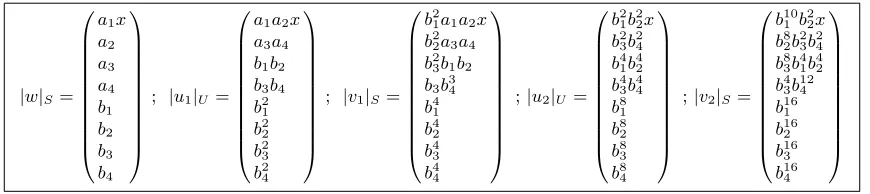
The operator Substitute, for instance applied to the vector w, allows to progressively replace the basic vectors aby a basic vector only depending on b.
|w|S=
a1x
a2 a3 a4 b1 b2 b3 b4
; |u1|U=
a1a2x
a3a4
b1b2
b3b4
b2 1
b22
b23
b2 4
; |v1|S=
b2 1a1a2x
b22a3a4
b2 3b1b2
b3b34
b4 1
b42
b43
b4 4
;|u2|U=
b2 1b22x
b23b24
b4 1b42
b43b44
b8 1
b82
b83
b8 4
;|v2|S=
b10 1 b22x
b82b23b24
b8 3b41b42
b43b124
b16 1
b162
b163
b16 4
Fig. 1. Simulation of the execution ofSubstitute(w) (with the toy parameterδ = 4) where the vectorv2 is output. One
should notice that|v2|S= (cx,d) wherecanddare basic vectors only depending onb.
Definition 4. Let S be an invertible matrix. The procedure SubstituteGen(S) consists of executing the two following issues:
1. Generate the operators Q and Rand as follows:
– Choose at random an invertible matrix U.
– Rand←RandGen(S, U,Id,Id) (whereId is the identity).
– Q ←QGen(U, p1, ..., p2δ) where (pi)i=1,...,2δ :Z2nδ→Z2nδ are the polynomials defined by
pi(w) =
{
(s2i−1.w) (s2i.w) ifi∈ {1, ..., δ}
2. Output the operator Substitute←SubstituteGen(S) defined as follows: Substitute(w) :
v0←w
for i= 1 to ⌈log2δ⌉ ui ← Q(vi−1)
vi←Rand(ui)
Output v⌈log2δ⌉
Proposition 3. Let Substitute←SubstituteGen(S). The vector v←Substitute(w) satisfies
|v|S= (cx,d)
where cand d are basic vectors only depending of b.
Proof. It suffices to check that at each stepi,|vi|S= (cix,di) whereci,diare basic vectors. We conclude
by noticing that the basic vectors ci and di only depend ofb (and not of a) providedi≥ ⌈log2δ⌉.
4.4 Operator Add
The operatorAddis fundamental in the construction of both homomorphic operators. Roughly speaking, it allows to add the hidden values x, x′ associated to the vectors w and w′.
Definition 5. Leta, a′∈Zn. The procedureAddGen(R, S, S′, a, a′)consists of executing the two following
issues:
1. Generate the operators Q1,Q2,Q3 and Substitutedefined as follows
– Randomly choose an invertible matrix U. Let (pi)i=1,...,2δ, (p′i)i=1,...,2δ,(p′′i)i=1,...,2δ be polynomials
Z2δ
n ×Z2nδ→Z2nδ defined by
pi(w, w′) =
{ (si.w)
(
s′i+δ.w′) if i∈ {1, ..., δ}
(si.w) (s′i.w′) if i∈ {δ+ 1, ...,2δ}
p′i(w, w′) = {
(si+δ.w) (si′.w′) if i∈ {1, ..., δ}
(si.w) (s′i.w′) if i∈ {δ+ 1, ...,2δ}
p′′i(w, w′) =
a(u1.w) (u1+δ.w′) +a′(u1+δ.w) (u1.w′) if i= 1
(ui.w) (ui+δ.w′) if i∈ {2, ..., δ}
(ui.w) (ui.w′) if i∈ {δ+ 1, ...,2δ}
– Substitute←SubstituteGen(U)
– Q1 ←QGen(U, p1, ..., p2δ), Q2 ←QGen(U, p′1, ..., p′2δ) and Q3←QGen(R, p′′1, ..., p′′2δ)
2. Output the operator Add←AddGen(R, S, S′, a, a′) defined by: Add(w, w′) :
(a) w1 ← Q1(w, w′) and w′1← Q2(w, w′).
(b) w2 ←Substitute(w1) andw′2 ←Substitute(w1′).
Proposition 4. Let Add←AddGen(R, S, S′, a, a′). The vector v←Add(w, w′) satisfies
|v|R= (c(ax+a′x′),d)
where c, d are basic vectors.
Proof. By construction,|w1|S = (a×b′x,b×b′) and|w1|S= (a′×bx′,b×b′). Consequently, thanks to
Substitute, |w2|U = (hx,g) and |w′2|U = (hx′,g) where h and g are functions of b×b′. It follows that
|v|R= (h×g(ax+a′x′),g×g).
4.5 Operator Mult
Definition 6. The procedure MultGen(R, S, S′) outputs the operators Q ← QGen(R, p1, ..., p2δ) defined
by
pi(w, w′) = (si.w)
(
s′i.w′)
The operator Mult←MultGen(R, S, S′) consists of applying Q, i.e. Mult(w, w′) =Q(w, w′).
Proposition 5. Let Mult←MultGen(R,S,S’). The vectorv←Mult(w, w′) satisfies
|v|R= (a×a′xx′,b×b′)
Proof. Straightforward.
4.6 Homomorphic operators
LetK = (Sz)z=1,...,ϑ ←KeyGen(λ) ande= (cz)z=1,...,ϑ,e′ = (c′z)z=1,...,ϑ be two valid encryptions ofxand x′, i.e.
– |cz|Sz = (azxz,bz)
– |c′z|Sz = (a′zx′z,b′z)
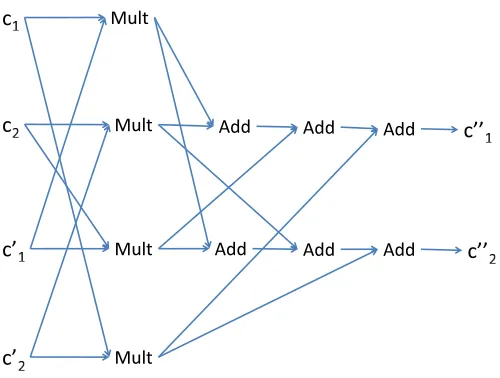
Each homomorphic operator can be represented by an Add/Multcircuit (see Fig. 2): ⊕ requires O(ϑ2) operators Addwhile ⊙requires O(ϑ2) operatorsMultand O(ϑ3) operatorsAdd.
Operator ⊕. This homomorphic operator can be built by only using operatorsAdd(thus only operators
Q).
Definition 7. The procedureOplusGen(K) consists of executing the two following issues: 1. Generate the operators Addzz′ as follows:
– Let (σz)z=1,...,ϑ be ϑ arbitrary permutations of {1, ...,2ϑ} s.t. σz(1) = 2z−1. – Randomly choose a family (azz′)z=1,...,ϑ;z′=1,....,2ϑ of elements of Zn such that
∑ϑ
z=1azσ−1z (z′) = 1 for all z′ = 1, ...,2ϑ.
– Randomly choose a family (Rzz′)z=1,...,ϑ;z′=2,....,2ϑ−1 of invertible matrices.
– State Rz1 =Sz, Rz,2ϑ=Sz , bz1 =az1 and bzz′=2,...,2ϑ−1 = 1 for all z= 1, ..., ϑ.
– Addzz′ ←AddGen(Rzz′, Rz,z′−1, S⌊σz(z′)+1
2 ⌋
2. Output the operator ⊕ ←OplusGen(K) defined as follows:
e⊕e′
for z= 1 to ϑ
w2z−1 ←cz and w2z ←c′z
for z= 1 to ϑ c′′z ←wσz(1)
for z′= 2 to 2ϑ c′′z ←Addzz′
(
c′′z, wσz(z′))
Output (c′′1, ..., c′′ϑ)
Proposition 6. The operator ⊕ ← OplusGen(K) inputs two valid encryptions e, e′ of x and x′ and outputs a valid encryption (c′′1, ..., c′′z) =e⊕e′ of x+x′ satisfying
|c′′z|S′′z = (a
′′
zcoz(x1, ..., xϑ, x1′, ..., x′ϑ),b′′z)
where coz are linear combinations chosen at random4 in OplusGen(K) satisfying ϑ
∑
z=1
coz(x1, ..., xϑ, x1′, ..., x′ϑ) =x+x′
Proof. (Sketch) Our construction ensures that |c′′z|S′′z = (a′′zcoz(x1, ..., xϑ, x′1, ..., x′ϑ),b′′z). The equalities
∑ϑ
z=1azσz−1(z′)= 1 for all z
′ = 1, ...,2ϑensures that ∑ϑ
z=1coz(x1, ..., xϑ, x′1, ..., x′ϑ) =x+x′.
Operator⊙. This homomorphic operator can be built by only using operatorsAddandMult(see Fig. 2). The operators Multallow to buildϑ2 vectors hiding the productsxix′j. The encryptione⊙e′ is obtained
by summing these products withϑ(ϑ2−1) operatorsAdd.
Definition 8. The procedureOdotGen(K) consists of executing the two following issues: 1. Generate the operators Multzz′ and Addzz′ defined as follows:
– Let (σz)z=1,...,ϑ be ϑ arbitrary bijections from{1, ..., ϑ2} into{1, ..., ϑ}2 such thatσz(1) = (z,1). – Randomly choose a family(azz′)z=1,...,ϑ;z′=1,....,ϑ2 of elements of Zn such that
∑ϑ
z=1azσ−z1(z′z′′)= 1 for all (z′, z′′)∈ {1, ..., ϑ}2.
– Randomly choose a family (Tzz′)(z,z′)∈{1,...,ϑ}2 of invertible matrices – Multzz′ ←MultGen(Tzz′, Sz, Sz′)
– Randomly choose a family (Rzz′)z=1,...,ϑ;z′=2,....,ϑ2−1 of invertible matrices – State Rz1 =Tz1, Rzϑ2 =Sz, bz1 =az1 and bzz′=2,...,ϑ2 = 1 for all z= 1, ..., ϑ.
– Addzz′ ←AddGen(Rzz′, Rz,z′−1, Tσz(z′), bz,z′−1, azz′) for all z= 1, ..., ϑ andz′= 2, ..., ϑ
2.
2. Output the operator ⊙ ←OdotGen(K) defined as follows:
e⊙e′
wzz′ ←Multzz′(cz, c′z′) for all z, z′ ∈ {1, ..., ϑ}2
for z= 1 to ϑ c′′z ←wσz(1) for z′ = 2 to ϑ2
c′′z ←Addzz′
(
c′′z, wσz(z′))
Output (c′′1, ..., c′′ϑ).
Fig. 2.Representation of the operator⊙as aMult/Addcircuit (forϑ= 2) where (c′′1, c2′′) = (c1, c2)⊙(c′1, c′2).
Proposition 7. The operator ⊙ ← OdotGen(K) inputs two valid encryptions e, e′ and outputs a valid encryption (c′′1, ..., c′′z) =e⊙e′ of xx′ satisfying
|c′′z|S′′z = (a
′′
zcoz(x1x′1, ..., xixi′′, ...xϑx′ϑ),b′′z)
where coz are linear combinations chosen at random in OdotGen(K) satisfying
ϑ
∑
z=1
coz(x1x′1, ..., xix′i′, ...xϑx′ϑ) =xx′
Proof. Similar to the proof of proposition 6.
OpGen(K) outputs ⊕ ← OplusGen(K) and ⊙ ← OdotGen(K). The whole number of operators Q involved in ⊕and ⊙isO(ϑ3logδ).
5 The FHE
The private-key encryption scheme of Section 2 can be transformed in an FHE by publishing the homo-morphic operators ⊕,⊙ and m encryptions (ev)v=1,...,m of public values xv ∈ Zn: for instance xv = 2v
mod n.
Definition 9. Let λ be a security parameter.
– KeyGen(λ). Let K = {(Sz)z=1,...,ϑ} ← KeyGen1(λ), {⊕,⊙} ← OpGen(K) and for all v = 1, ..., m, ev ←Encrypt1(K, xv).
sk={(Sz)z=1,...,ϑ} ; pk={⊕,⊙,(ev)v=1,...,m}
– Evaluate(C, e1, ..., em). To evaluate C(e1, ..., em), it suffices to compute each gate with the public
ho-momorphic operators⊕ and ⊙.
– Encrypt(pk, x∈Zn).It consists of evaluating a secret circuitC over the encryptions(ev)v=1,...,m such
– Decrypt(sk, e).Exactly follows Decrypt1.
The internal randomness of KeyGencan be decomposed in three parts:
– The internal randomness of KeyGen1andOpGenis calledstructural randomness. For concreteness, by invokingKeyGen1,KeyGengenerates theϑinvertible matricesS1, ..., Sϑofsk. By invokingOpGen(K),
KeyGenrandomly generatesO(ϑ3) other intermediate invertible matrices denoted bySϑ+1, ..., SΥ and O(ϑ3) valuesazz′ used to build O(ϑ3) operatorsAdd. In the following of this paper, theith row ofSu
is denoted bysui.
– The internal randomness of Encrypt1 used to build the public encryptions (ev)v=1,...,m can be
decom-posed into two independent randomnesses:
• The first one satisfying multiplicative constraints, called multiplicative randomness, comes from the choice of the basic vectorsavzl,bvzl for each encryptionev ∈pk.
• The second one satisfying additive constraints, calledadditive randomness, comes from the choice of the values xvzl for each encryption ev ∈pk.
In Section 6, we will see that the independence of these three sources of randomness is important in the security analysis of the FHE. We define the following sets of polynomials (indexed by structural randomness meaning that each monomial coefficient is a function of the coefficients of (Su)u=1,...,Υ):
– SP: the set of multi-variate polynomials ϕ:(Z2κδ n
)r
→Zn defined by
ϕ(w1, ..., wr) = γ
∏
t=1
sutit.wkt
whereγ, r∈N∗,it∈ {1, ...,2κδ},ut∈ {1, ..., Υ}and kt∈ {1, ..., r}. – SPγ: the set of polynomials ofSPof degree equal to γ, i.e.
SPγ={ϕ∈SP|deg(ϕ) =γ}
Security naturally deals with these polynomials because they allow computing polynomials over the components of |wk|Su. For instance, the decryption polynomials Φl (see Definition 1) are a sum of ϑ polynomials ofSPδ. A representationRϕof an arbitrary polynomialϕis said to be effective if its storage
is polynomial and if it allow to evaluatingϕ in polynomial time.
Proposition 8. Let γ ∈ N∗ such that γ is not a multiple of κ. Let ϕ ∈ SPγ and Rϕ be an effective
representation of ϕ. By assuming the hardness of factorization, recovering Rϕ only given pk is difficult.
Proof. Because the private-key cryptosystem is exactly the same as in [2] and the homomorphic operators are also built by only using operators Q, the proof can be found in Appendix C of [2].
Corollary 1. By assuming the hardness of the factorization, the secret matrices (Su)u=1,...,Υ cannot be
polynomially recovered only given pk.
these two polynomials is exponential-size and thus cannot be recovered. Besides, according to Proposition 8,it is difficult to find any of its natural effective representations, i.e. sum of products ofsmall polynomials of SP. This analysis suggests that such polynomials (having an exponential-size expanded representation) cannot be recovered. But maybe polynomial-size polynomials ϕ(having polynomial numbers of monomi-als) could be used to break semantic security. Moreover, by considering the monomial coefficients of such polynomials as independent variables, they could be recovered by solving a linear system. Such attacks, called attacks by linearization, will be extensively studied in the next section.
6 Attacks by linearization
The public key pk can be naturally regarded as a system (Sys) of nonlinear equations. Proposition 8 tends to show that the resolution of (Sys) is quite intractable. However, this does not prevent our scheme against attacks by linearization. For instance, the most natural linearization attack consists of solving the linear system
ϕ(ei) =xi
where (ei)i=1,...m is a family of encryptions of (xi)i=1,...,m and ϕis a multivariate polynomial5 of degree δ such that its monomial coefficients are the variables of the linear system. Provided m is sufficiently large, its resolution provides a linear combinationϕ∗ of the decryption polynomials (Φl)l=1,...,κ. However,
provided δ = Θ(λ), this attack fails because the number of monomials of ϕ is exponential. Because of the introduction of homomorphic operators, new polynomial relations leading to new efficient attacks by linearization could appear.
6.1 General framework
In the following of the paper, Ω denotes the set of valid encryptions, i.e. the output space of En-crypt16. Given r ∈ N∗ and e ∈ Ωr, we naturally extend the function Decrypt by writing Decrypt(e) =
(Decrypt(e1), ...,Decrypt(er)).
Let us consider an arbitrary efficient public procedure Hpk which inputs a polynomial-size tuple of
encryptions e∈Ωr and outputs a polynomial-size tuple y∈Zm
n, i.e.y ←Hpk(e).
Definition 10. (Efficient non-trivial linearization attack). Let ϕ :Zmn → Zn be a polynomial. Given a
tuple x∈Zrn, we define the subsets Ωx, Ω(ϕ) of Ωr by:
– Ωx ={e∈Ωr |Decrypt(e) =x} – Ω(ϕ) ={e∈Ωr |ϕ(Hpk(e)) = 0}.
We say that there exists an efficient non-trivial linearization attack relative to ϕ,Hpk and x if
1. The number of monomials of ϕis polynomial
2. |Ωx|\ΩΩx(|ϕ)| is negligible
3. |Ωr|\ΩΩr(|ϕ)| is non negligible
The two first properties ensure that the expanded representation of ϕ can be found by solving a linear system. The third property means thatϕ(Hpk(e)) = 0 is nottrivially satisfied, i.e., for anye∈Ωr. It could
mean that ϕ(Hpk(e)) = 0 is satisfied with higher probability whether e encrypts x rather than x′ ̸= x
giving an advantage to the attacker for distinguishing between Decrypt(e) = x and Decrypt(e) = x′. If
5 having the same monomials as the decryption polynomialsΦl. 6
this property is not satisfied, such advantages cannot be derived fromϕand we say that the linearization attack is trivial.
Before to analyze our scheme against such attacks in real life setting, we will consider the natural relaxed setting where Hpk is constrained as follows:
Setting 1.Hpk inputs e∈Ωr, computes new encryptionse′1, ..., e′r′ and outputs all the vectors considered
in this computation (e, e′1, ..., e′r′ and all intermediate vectors output by operatorsQ).
For instance,Hpkcould simply consists of computing⊙, i.e.Hpk(e1, e2) outputs all the vectors considered
in the computation of e1⊙e2. The procedure Hpk can be represented by a Add/MultcircuitCHpk.
6.2 Linearization attacks in Setting 1
In order to simplify our analysis (and the task of the attacker), throughout this section, nis assumed to be a large prime instead of an RSA modulus and we modify KeyGen as follows:
– According to Lemma 1 in [2], if there exists a linearization attack for κ > 1 then there exists a linearization attack for κ= 1. Thus, it suffices to consider the caseκ= 1.
– The matrices Su are assumed to be all equal to the same matrix S chosen at random. In particular,
all the secret matrices (Sz)z=1,...,ϑ of sk are equal toS. Given a vector w,Swwill be simply denoted
by |w|(instead of |w|S).
Let x = (x1, ..., xr)∈ Zrn and e= (e1, ..., er) uniformly drawn over Ωx. Each encryption ei is a tuple of
vectors (ciz)z=1,...,ϑ defined by|ciz|= (aizxiz,biz) whereaiz,biz are basic vectors andxi1+...+xiϑ=xi.
The set of all the values xiz is denoted byX and the set of the components of the basic vectors aiz,biz
is denoted byC. According to Encrypt1,
C⊥X
Lety= (w1, ..., wt)←Hpk(e) be the concatenation of the vectors outputs byHpk. We define the auxiliary
functions Hepk(e),Hpk+(e) andHpk∗ (e) as follows: – Hepk(e) outputs the tuple ye= (|w1|, ...,|wt|). – Hpk+(e) outputs the tuple (pk)k=1,...,2δt defined7 by
pk=
{ e
yk...yek+δ−1, ifk mod 2δ= 1
1 Otherwise.
– Hpk∗ (e) outputs the tuple (πk)k=1,...,2δt whereπk=yek/pk.
Lemma 1. Let y←Hpk(e), ye←Hepk(e), p←Hpk+(e) andπ ←Hpk∗ (e) andϕ∈SP.
1. ϕ(y) is a product of degϕ components ofye,
2. Each component of π is a product of elements of C and each component of p is a polynomial defined over X.
Proof.
1. By definition of SP.
2. By induction on the size ofCHpk.
Corollary 2. If e is uniformly drawn over Ωx,
π⊥p
7 or equivalentlypk=
{
|w1+⌊(k−1)/2δ⌋|1...|w1+⌊(k−1)/2δ⌋|δ, ifkmod 2δ= 1
Role of the parameter δ
Let us show thatϕ(y) depends on the multiplicative randomness for any ”small” polynomialϕ∈SP. In order to simplify our analysis (and the task of the attacker), we slightly modify Encrypt1 such that the basic vectors aiz and biz are all equal to the same basic vectorc= (c1, ..., cδ) chosen at random, i.e. aiz =biz =c. In other words, it is assumed that the encryptions (e1, ..., er) input inHpk were built only
using the basic vector c, i.e. C≃c.
Lemma 2. For any d∈Z, the product cd
1...cdδ of components of cis said to be trivial8. Let π ←Hpk∗ (e).
Any product πk1...πkt is a non-trivial product of components of cprovided t < δ/4. Proof. (Sketch.) Let us define the setΠe′,e≥e′ as follows:
Πe′,e ={ce ′
i0ci1...cie−e′ |i0, ..., ie−e′ ∈ {1, ..., δ}}
By construction, πk ∈Πek,ek (ek being a power of 2) provided k−1 mod 2δ ≥δ. Moreover, thanks to the operator Rand, it is ensured that
∀k= 1, ..., m πk ∈Πek/4,ek (1)
Let β =πk1...πkt be an arbitrary product of tcomponents of π and e∗ = maxi=1,...,t(eki) . According to (1), β is a productca11 ...caδ
δ of components of csuch that maxi=1,...,δai ≥e∗/4. It follows thatβ should
be a product of at least δe∗/4 components of cin order to be trivial, i.e. t
∑
i=1
eki ≥δe
∗/4
As te∗ ≥∑ti=1eki, we obtaint≥δ/4.
Remark 2. Letα = ci11...ciδ
δ be an arbitrary non-trivial product of components of c assumingi1 ≤i2 ≤ ... ≤ iδ. It follows that α = ci22−i1...c
iδ−i1
δ is independent of c (i.e. α = 1) if and only if i2 −i1 ≡ ... ≡ iδ−i1 ≡0 mod λ(n)/2. Asnis randomly chosen, α is independent of cwith negligible probability.
Role of the parameter ϑ
Each component of p= (pk)k=1,...,m ← Hpk+(e) is a polynomial function defined over X. These
poly-nomials depend on the values azz′ chosen in OplusGen(K) andOdotGen(K). These values are chosen at
random ensuring some relations of the form
ϑ
∑
i=1
pki =f(x1, ..., xr)
wherefis a multivariate polynomial. Is there a non-trivial polynomial relation involvingt < ϑcomponents of p? The following conjecture says that such relation can occur but only with negligible probability over the choice of the values azz′.
Conjecture 1. Let t < ϑ, k∈ {1, ..., m}t, x= (x1, ..., xr)∈Zrn be arbitrarily chosen. Let ν :Ztn→ Zn be
a polynomial-size polynomial such that degν =O(λ). The set Ω(ν) refers to the set of e∈Ωr such that
ν(pk1, ..., pkt) = 0 where p←H
+
pk(e). We sayν is not trivial relatively to k, x if 8 It is equal to 1 because
– |Ωx\Ω(ν)|/|Ωx|is negligible – |Ωr\Ω(ν)|/|Ωr|is non negligible.
There exists a non-trivial polynomial ν relatively to k, x with negligible probability over the choice of
(pk, sk)←KeyGen(λ).
Roughly speaking, this conjecture says that if ν(pk1, ..., pkt) = 0 is satisfied by (almost) all tuples
e ∈ Ωx then this relation is trivial9 in the sense that ν(pk1, ..., pkt) = 0 is also satisfied by (almost) all tuples e∈Ωr. This conjecture is discussed in AppendixA for the case ϑ= 2.
Put it all together
We prove here the main result of this section. This result proves the non-existence of linearization at-tacks by assuming that vectors input inAddorMultare randomized. We will then discuss this assumption in order to see how to overcome it.
Proposition 9. Let us consider an oracleORwhich inputs a vectorwsuch that|w|S = (ax,b), generates
two basic vectors c,d at random and outputs v defined by |v|S = (cx,d). Let us modify Mult or Add in
the following way: each input vector w is first randomized by OR. Let x ∈ Zrn and ϕ be an arbitrary
polynomial-size linear combination of polynomials of SP, i.e. ϕ = a1φ1+...+aγφγ with ai ∈ Z∗n and φi ∈SP. Assuming Conjecture 1, there exists an efficient non-trivial linearization attack relative to ϕ, x
with negligible probability provided δ=Θ(λ) and ϑ=Θ(λ).
Proof. Given a tuple of encryptions e ∈Ωr, y = (w1, ..., wt) ← Hpk(e), ey = (yek)k=1,...,m=2δt ← Hepk(e), π ← Hpk(e)∗ and p ← Hpk(e)+. Let us partition the set {1, ..., m} with the disjoint subsetsKu ={k ∈
{1, ..., m}|yk is computed at theuth node ofCpk}.
For sake of simplicity, we assume thatϑ=δ=Θ(λ) and that the degree of each polynomialφi is equal
tod, i.e. degφi =dfor all i= 1, ..., γ. According to Lemma 1, there exists a family (kij)i=1,...,γ;j=1,...,d of
elements of {1, ..., m}such that
ϕ(y) =
γ
∑
i=1
ai d
∏
j=1
e
ykij =
γ
∑
i=1
ai d
∏
j=1
πkijpkij (2)
Let us assume the existence of an efficient linearization attack relative to ϕ and x ∈ Zrn. If d ≥ δ/5, the linearization attack is not efficient (because the number of monomials is exponential) implying that
d < δ/5. According to Lemma 1, each productπki1...πkidis a product of elements ofC. At first, we assume
that these products are equal10, i.e.
πk11...πk1d =...=πkγ1...πkγd (3)
Thus, according to Definition 10, for eache∈Ωx(except maybe for a negligible subset of Ωx),psatisfies the following equation,
ν(p)def=
γ
∑
i=1
ai d
∏
j=1
pkij = 0 (4)
Note thatν is a polynomial-size polynomial with degν =d=O(λ)
According to Lemma 2, any sub-product ofπki1, ..., πkid is a non-trivial product of elements ofC. By introducing OR in our construction, Lemma 2 holdsa fortiori.
9
For instanceν(pk1, ..., pkt) =pk1−pk1.
As vectors are assumed to be randomized byORbefore to be input inAddorMult, it is ensured that πk⊥πk′ providedkand k′ do not belong to the same set Ku. Because of (3) and Lemma 2,
∃(i, j) s.t.kij ∈Ku ⇒ ∀i∈ {1, ..., γ},∃j∈ {1, ..., d}s.t. kij ∈Ku (5)
Our construction ensures that each set Pu = {pk|k ∈ Ku} contains at most 4 elements11. Thus,
according to (4) and (5), the set P ={pkij |i= 1, ..., γ;j = 1, ..., d} contains at most t≤ 4d≤4δ/5 <
δ =ϑelements denoted by pk1, ..., pkt. It follows that ν(p) only depends on pk1, ..., pkt.
According to Corollary 2,p⊥π. Thus, it suffices thatν(p) = 0 to ensure thate∈Ω(ϕ). Consequently, according to Conjecture 1,|Ω(ϕ)|/|Ωr| ≥1−ϵ(λ) whereϵ(λ) is negligible. It implies that this linearization attack is trivial.
Now, let us consider the general case where the equality (2) is no longer satisfied. Let R be the equivalence relation defined over {1, ..., γ} defined by iRi′ if and only if πki1...πkid = πki′1...πki′d (for all the choices of C). The equivalence classes of R are denoted by I1, I2, ..., Iτ. By regrouping the products πki1...πkid which are equal,ϕ can be written as a sum ofτ polynomialsϕv, i.e.ϕ=ϕ1+...+ϕτ with
ϕ(y) =
τ
∑
v=1
∑
i∈Iv
ai d
∏
j=1
pkij Πv
where Πv is a product of components of C. Fixing p, ϕ(y) can be seen as a multivariate polynomial
defined over C (the Πv being the monomials). As ϕ(y) = 0 for all encryptionse ∈Ωx, this polynomial
is identically equal to 0 (at the beginning of this section, nwas assumed to be a large prime). It implies that for each e∈Ωx,p←Hpk+(e) satisfies
∀v= 1, ..., τ, ∑
i∈Iv
ai d
∏
j=1
pkij = 0
Thus, the previous analysis can be done τ times leading to τ sets Ωv(ϕv) satisfying |Ω(ϕv)|/|Ωr| ≥
1−ϵv(λ). As
∩τ
v=1Ωv(ϕv)⊆Ω(ϕ) and|
∩τ
v=1Ωv(ϕv)|/|Ωr| ≥1−(ϵ1+...+ϵτ)(λ), the linearization attack
is still trivial.
Proposition 9 does not prove the non-existence of efficient non-trivial linearization attacks. However, it allows us to argue in favor of the fact that even if such an attack exist, a polynomial attacker can recover it with negligible probability.
• RemovingOR.The use ofORensures that (3)⇒(5). Roughly speaking, assertion (5) implies that the
number of nodes ofCHpk involved
12in the linearization attack should be small, i.e.O(d). But, Conjecture
1 ensures that any linearization dealing with less thanϑ/3 nodes ofCHpk is surely trivial. Thus, ifd=◦(ϑ), the linearization attack is trivial provided ϑ=Θ(λ). Conversely, if d=Ω(λ) the linearization attack is not efficient.
What happens if OR is removed? Can we still guarantee that the number of nodes of CHpk involved in the linearization attack is small? To see this, let us consider two arbitrary sets of vectors W1, W2
computed indistant sets of nodes ofCHpk. We denoteΠ1 andΠ2 the sets of components ofπ ←Hpk(e)∗ associated to respectively the sets W1 andW2. The use of ORensures that Π1 andΠ2 are independent.
11 Pucontains 1, qu(X), ru(X), qu(X) +ru(X) wherequ, ruare polynomials, ifAddis computed at theuthnode ofCpkor 1, qu(X), ru(X), qu(X)ru(X) if it isMult.
To prove Proposition 9 without OR, one needs a result establishing thatsmall products of components
of Π1 cannot be equal tosmall products of components of Π2. This seems intuitively true. Nevertheless,
to get a formal result, one should quantify to notion of distant sets and small products.
Moreover, one can imagine several ways to emulate OR keeping Lemma 2 true. For instance, the
operator Rand (where the permutations σ and σ′ would be randomly chosen) could be applying several times on each vectorwinput inAddorMult. In our opinion, it should be possible modify our construction in this sense in order to extend Proposition 9 without considering OR.
• Arbitrary ϕ. Proposition 9 assumes that ϕ is a polynomial-size linear combination of polynomials of
SP. As the polynomials ϕki(w1, ..., wr) =wki can be written as a polynomial-size linear combination of
polynomials of SP1, any polynomial ϕ of degree d = O(1) can be written as a polynomial-size linear combination of polynomials of ∪dt=0SPt. However there are polynomial-size polynomials ϕ (e.g. ϕ(y) =
y1....yδ) of degree d̸=O(1) which cannot. Proposition 9 does not exclude the existence of linearization
dealing with such polynomials. However, provided δ=Θ(λ), the number ofd−degree monomials defined over the components of at least one vector w computed by Hpk, is not polynomial. It implies that some
of them should be eliminated to get a polynomial attack. Intuitively, these monomials play a symmetric role and we do see how an attacker could choose some of thema priori.
Conjecture 2. Assuming δ =ϑ=Θ(λ), an attacker can find an efficient linearization attack in Setting 1 with negligible probability (randomness being the internal randomness of KeyGen).
6.3 Linearization attacks in real-life setting
In this (short) section, Hpk is not constrained anymore: it can use pk arbitrarily. Here, we list possible
weaknesses of our scheme. While deeper investigations have been done, we did not get formal results. This section can be seen as a guideline for deeper cryptanalysis.
• In Setting 1, it was assumed that Hpk uses the public operators Q as required by ⊕ and ⊙. Can an
attacker get any advantage by inputting arbitrary vectors in operators Q? For instance, it would be the case ifU ←S instead of being randomly chosen inSubstituteGen. Indeed, in this case, the operatorRand
could be removed from the construction (the loop would just consist of applying the operator Q) leading to an efficient linearization attack from this13. As U and S are independently drawn, it seems irrelevant to input ui inQ. Roughly speaking, the information contained inui is associated to the matrix U while
Q works on the information associated to S14. As each vector computed in ⊕ or ⊙ is associated to a unique matrix, it can be assumed that vectors are not interchangeable in our construction.
• New operatorsQ could be polynomially derived from pkleading to efficient linearization attacks. Let us shortly argue against this (see Appendix B for a more detailed discussion about this):
– Proposition 8 ensures that it is not possible to recover the coefficients (or products ofγ < κcoefficients) of the matrices (Su)u=1,...,Υ involved in the public operators Q.
– Randomness can be arbitrarily introduced in any public operator Q without altering the security analysis of the previous sections. This is detailed in Appendix K of [2]. By doing this, the system of equations derived from public operators Qbecomes widely unknown.
7 Efficiency
The computation of an operator Q requires O(κ3δ3) multiplications in Zn. Moreover, ⊕ requires the
application of O(ϑ2logδ) operators Q and O(ϑ3logδ) for ⊙. Thus, denoting by M(n) the runtime of
13
We let the reader find it.
multiplications in Zn, the running time per addition gate is O(ϑ2κ3δ3logδM(n)) and the running time
per multiplication gate is O(ϑ3κ3δ3logδM(n)). The running time of decryption is O(ϑκδ2M(n)). A ciphertext contains ϑ 2κδ-vectors in Zn, implying that the ratio cipher size/plaintext size is equal to
2κϑδ. In terms of storage, the biggest part of the public key is the operator Q, containing O(κ3δ3)
elements of Zn, which leads to a space complexity in
O(|n|ϑ3κ3δ3logδ)
Attacks (in particular attacks by linearization) should be better quantified in order to propose instantia-tions of the parameters. Moreover, we think that the operators⊕and⊙could be defined with respectively
ϑ and ϑ2 (instead of ϑ2 and ϑ3 operators Add) while remaining true Conjecture 1 and thus Proposition 9. The parameter κ was only introduced to prove Proposition 8. However, this parameter is not useful for protecting the scheme against attacks by linearization. Can we chooseκ= 1? Similarly,nis assumed to be an RSA modulus. Can n be chosen prime? small prime?
8 Discussion and open questions
In this paper, a very simple FHE based on very simple tools was developed. Its security is linked to the difficulty of solving nonlinear systems of equations. By using arguments of symmetry, it was shown that the resolution of the system of equations (derived frompk) is intractable. However, it is not sufficient to ensure security against attacks by linearization. The main obstacle proving security consists of showing that all linear attacks are exponential. We argue in this sense but further investigations should be made. Moreover, improvements of our scheme deal with important open questions:
– The symmetry properties related to the parameter κ provide formal security guarantees but this parameter is not useful for protecting the scheme against attacks by linearization. Can this parameter be fixed to 1?
– the resolution of systems of nonlinear equations is N P-complete in Zn even if the factorization of n
is known. Thus, one can wonder whethern can be chosen as a large prime? a small prime?
A positive answer to these questions would lead to an efficient FHE competitive with other classical (even not homomorphic) cryptosystems.
References
1. Jean-S´ebastien Coron, David Naccache, and Mehdi Tibouchi. Public key compression and modulus switching for fully homomorphic encryption over the integers. InEUROCRYPT, pages 446–464, 2012.
2. G´erald Gavin. An efficient fhe based on the hardness of solving systems of non-linear multivariate equations. Cryptology ePrint Archive, Report 2013/262, 2013. http://eprint.iacr.org/.
3. Craig Gentry. Fully homomorphic encryption using ideal lattices. InSTOC, pages 169–178, 2009.
4. Craig Gentry, Shai Halevi, and Nigel P. Smart. Fully homomorphic encryption with polylog overhead. InEUROCRYPT, pages 465–482, 2012.
5. Craig Gentry, Shai Halevi, and Nigel P. Smart. Homomorphic evaluation of the aes circuit. InCRYPTO, pages 850–867, 2012.
6. Kristin Lauter, Michael Naehrig, and Vinod Vaikuntanathan. Can homomorphic encryption be practical? IACR Cryp-tology ePrint Archive, 2011:405, 2011.
7. Damien Stehl´e and Ron Steinfeld. Faster fully homomorphic encryption. InASIACRYPT, pages 377–394, 2010. 8. Marten van Dijk, Craig Gentry, Shai Halevi, and Vinod Vaikuntanathan. Fully homomorphic encryption over the integers.
A What about Conjecture 1 ?
In this section, we wish testing Conjecture 1. In our experiments, Hpk inputs only one encryption e =
(cz)z=1,...,ϑ where |cz|Sz = (azxz,bz). Hpk(e) consists of computing new encryptions, e.g. e⊕e, e⊙e, (e⊕e)⊙e,....To validate Conjecture 1, it is required to show that there does not exist non-trivial polynomial relation between strictly less than ϑ components ofp ← Hpk(e)+. It is important to note that it is not
required to really compute homomorphic operators ⊕ and ⊙ to getp = (pk)k=1,...,m: the components of p only depend of the valuesazz′ used in OdotGenand OplusGen.
By renaming the valuesazz′ by a, b, c, ..., we list (by using Maple) the components ofp expressed as
polynomial functions of x1 and x=x1+x2. The components ofp belong to this set
{1, x1, ax1+b(x−x1), ax1+b(x−x1) +cx1, ax1+b(x−x1) +cx1+d(x−x1),
x−x1,(1−a)x1+ (1−b)(x−x1),(1−a)x1+ (1−b)(x−x1) + (1−c)x1,
(1−a)x1+ (1−b)(x−x1) + (1−c)x1+ (1−d)(x−x1),
x21,(x−x1)2, x1(x−x1), ex21+f x1(x−x1), ex21+f x1(x−x1) +g(x−x1)(x−x2),
(a2−2ab+ac−ad+b2−bc+bd−4b)x1+ (ab+ad+ 2b−b2−bd)x, ...
}
By checkingat the hand each component ofp, we see there does not exist constant components which only depend on x. Each component can take an exponential number of values. It means that there does not exit a small polynomial ν ensuring ν(pk) = 0 for any15 k= 1, ..., m. It suggests that Conjecture 1 is
true for ϑ= 2.
B Informal discussion...
One could imagine that new operators Q can be polynomially derived from pk leading to efficient lin-earization attacks. Let us informally argue against this.
First, let us see that there does not any exist general method to achieve this, by considering the simple operator Q ←QGen(S, p1, ..., pm) whereS is an arbitrary invertible matrix of Zmn×m (m >2) and pi(w′) = siw′ ×siw′ for all i = 1, ..., m. Let σ, σ′ : {1, ..., m} → {1, ..., m} be two arbitrary functions
such that σ ̸= Id or σ′ ≠ Id and p′i(w′) = sσ(i)w′ ×sσ′(i)w′. By exploiting Proposition 1 of [2], one
easily shows that recovering the operator Q′ ←QGen(S, p′1, ..., p′m) only givenQis difficult (assuming the hardness of factorization). Indeed, it suffices to note that the monomial coefficients of Q can be written as m-symmetric polynomials of the tuples (s1, ..., sm) (where si is the ith row of S) while the monomial
coefficients of Q′ are not m-symmetric.
In our construction, public operatorsQencapsulate “more randomness” because they involve two or three invertible matrices chosen at random. This intuitively makes our problem more complex. Let Q0 be
a public operator dealing with three matrices S, S′, S′′ chosen at random. Our construction ensures that there do not exist other operators Q dealing with the same triplet16 of matrices S, S′, S′′. Each (public) monomial coefficient qj1j2j3 ofQ0 is a sum of products of coefficients of T =S−1,S′ and S′′, i.e.
qj1j2j3 =
2κδ
∑
i=1
tj1is′u′ij2s′′u′′ij3
15
except ifpk= 1, but in this case, the relation is trivial.
whereu′iand u′′i are parameters17belonging to{1, ...,2κδ}. Let us focus on the possibility of recovering a
new operator18Q′0. Fortunately, Proposition 8 ensures that it is not possible to recover the coefficients of
S, S′, S′′, implying thatQ′0cannot be directly built. The construction of this operator requires computing the coefficients qj1j2j3′ , which are sums of products of the coefficients ofT =S−1,S′ and S′′. Some of the
involved products do not appear in any public value related to the public operatorsQ(because Q′0 ̸=Q0
and the other operators Q do not deal with the same triplet of matricesS, S′, S′′). It follows thatq′j1j2j3
cannot be obtained by computing linear combinations of these values. Moreover, it is difficult to imagine expressingq′j1j2j3 as polynomials (or ratios of polynomials) of these values. Nevertheless,a priori, nothing excludes public encryptions (ev)v=1,...,m being able to build Q′0. However, these vectors depend on the
randomness introduced in Encrypt1. This randomness is independent of the matrices (Su)u=1,...,Υ used to
build the Q. Efficient linearization attacks in Setting 1 would allow removing this randomness, giving values depending only on the coefficients of the matrices (Su)u=1,...,Υ involved in the public operators
Q. According to Conjecture 2, such attacks do not exist. This suggests that this randomness cannot be removed and thus public encryptions (ev)v=1,...,m cannot be used to recoverqj1j2j3′ .
Furthermore, without altering the security analysis of the previous sections, randomness can be in-troduced in the choice of any public operatorQ, making the system of equations derived from operators
Q widely unknown. The simplest way to achieve this consists of adding free (not involved in constraints) componentsi= 2κδ+1, ...and choosing polynomials (pi)i=2κδ+1,...(see Section 3) at random: an arbitrary
number (eachpiprovidesΘ(δ2) new variables) of new variables19are introduced in the equations induced
by each operator Q. Another one is presented in detail in Appendix K of [2].
17 To simplify, the coefficientsαiare assumed to be equal to 1 (see Definition 2). 18
still assumingαi= 1 for alli= 1, ...,2κδ.