Practical Attribute-Based Encryption: Traitor Tracing,
Revocation, and Large Universe
Zhen Liu1 and Duncan S. Wong2
1 City University of Hong Kong, Hong Kong SAR, China [email protected]
2 Security and Data Sciences, ASTRI, Hong Kong SAR, China [email protected]
Abstract. In Ciphertext-Policy Attribute-Based Encryption (CP-ABE), a user’s decryption key is associated with attributes which in general are not related to the user’s identity, and the same set of attributes could be shared between multiple users. From the decryption key, if the user created a decryption blackbox for sale, this malicious user could be difficult to identify from the blackbox. Hence in practice, a useful CP-ABE scheme should have some tracing mechanism to identify this ‘traitor’ from the blackbox. In addition, being able to revoke compromised keys is also an important step towards practicality, and for scalability, the scheme should support an exponentially large number of attributes. However, none of the existing traceable CP-ABE schemes simultaneously supports revocation and large attribute universe. In this paper, we construct the first practical CP-ABE which possesses these three important properties: (1) blackbox traceability, (2) revocation, and (3) supporting large universe. This new scheme achieves the fully collusion-resistant blackbox traceability, and when compared with the latest fully collusion-resistant blackbox traceable CP-ABE schemes, this new scheme achieves the same efficiency level, enjoying the sub-linear overhead of O(√N), where N is the number of users in the system, and attains the same security level, namely, the fully collusion-resistant traceability against policy-specific decryption blackbox, which is proven in the standard model with selective adversaries. The scheme supports large attribute universe, and attributes do not need to be pre-specified during the system setup. In addition, the scheme supports revocation while keeping the appealing capability of conventional CP-ABE, i.e. it is highly expressive and can take any monotonic access structures as ciphertext policies.
We also present the analogous results in the Key-Policy Attribute-Based Encryption (KP-ABE) set-ting, where users’ description keys are described by access policies and ciphertexts are associated with attributes. We construct the first practical KP-ABE which possesses the three important properties: (1) blackbox traceability, (2) revocation, and (3) supporting large universe. The scheme is highly ex-pressive and can take any monotonic access structures as key policies, and is efficient, namely, enjoys the sub-linear overhead ofO(√N) while supporting fully collusion-resistant blackbox traceability and revocation, and does not need to pre-specify the attributes during the system setup. The scheme is proven selectively secure in the standard model.
Keywords: Attribute-Based Encryption, Traitor Tracing, Revocation, Large Attribute Universe
1 Introduction
In some emerging applications such as user-side encrypted cloud storage, users may store encrypted data on a public untrusted cloud and let other users who have eligible credentials decrypt and access the data. The decryption credentials could be based on the users’ roles and do not have to be their identities. For example, a user Alice wants to encrypt some documents, upload to the cloud, and let all PhD students and alumni in the Department of Mathematics download and decrypt.
this application. In a Ciphertext-Policy ABE (CP-ABE) [12,3] scheme3, each user possesses a set of attributes and a decryption key, the encrypting party can encrypt the documents using an access policy (e.g. a Boolean formula) on attributes, and a user can decrypt if and only if the user’s attributes satisfy the policy. Hence in this example, Alice can encrypt the documents under “(MathematicsAND(PhD StudentORAlumni))”, which is an access policy defined over descriptive
attributes, so that only those receivers whose attributes satisfy this policy can decrypt.
Among the recently proposed CP-ABE schemes [3,8,11,31,17,25,13,19], one of the latest works is due to Lewko and Waters [19,20]. Their scheme achieves high expressivity (i.e. can take any monotonic access structures as ciphertext policies), and is provably secure against adaptive adver-saries in the standard model. The scheme is also efficient and removes the one-use restriction that other comparable schemes have [17,25]. As of the current Public Key Infrastructure which mandates the capabilities of key generation, revocation, and certified binding between identities and public keys, before the CP-ABE being able to deploy in practice, we should provision a practical CP-ABE scheme with three important features: (1) traceability, (2) revocation, and (3) large universe. Very recently, a handful of research works have been done on each one of these while the fundamental open problem remains is the existence of an efficient scheme which supports these three features at once.
Traceability / Traitor Tracing. Access policies in CP-ABE do not have to contain any
receivers’ identities, and more commonly, a CP-ABE policy is role-based and attributes areshared
between multiple users. In practice, a malicious user, with attributes shared with multiple other users, might leak a decryption blackbox/device, which is made of the user’s decryption key, for the purpose of financial gain or some other forms of incentives, as the malicious user has little risk of being identified out of all the users who can build a decryption blackbox with identical decryption capability. Being able to identify this malicious user is crucial towards the practicality of a CP-ABE system.
Given a well-formed decryption key, if the tracing algorithm of a CP-ABE scheme can identify the malicious user who created the key, the scheme is called Whitebox Traceable CP-ABE [22]. Given a decryption blackbox, while the decryption key and even the decryption algorithm could be hidden inside the blackbox, if thetracing algorithm can still find out the traitor whose key has been used in constructing the blackbox, the scheme is called Blackbox Traceable CP-ABE [21]. In this stronger notion, there are two types of blackboxes: key-like decryption blackbox and policy-specific decryption blackbox. A key-like decryption blackbox has an attribute set associated and can decrypt encrypted messages with policies being satisfied by the attribute set. A policy-specific decryption blackbox has a policy associated and can decrypt encrypted messages with the same policy. Liu et al. [23] formally proved that if a CP-ABE scheme is traceable against policy-specific decryption blackbox then it is also traceable against key-like decryption blackbox, and proved that the CP-ABE scheme in [21] is fully collusion-resistant traceable against policy-specific decryption blackbox in the standard model with selective adversaries. The scheme in [21] is highly expressive, and as a fully collusion-resistant blackbox traceable CP-ABE scheme, it achieves the most efficient level to date, i.e. the overhead for the fully collusion-resistant traceability is inO(√N), whereN is the number of users in the system. Note that fully collusion-resistant traceability means that the number of colluding users in constructing a decryption blackbox is not limited and can be arbitrary. Another recent blackbox traceable CP-ABE scheme is due to Deng et al. [9], but the scheme is
3
only t-collusion-resistant traceable, where the number of colluding users is limited, i.e., less than a parametert, and the scheme’s security is proven in the random oracle model.
Revocation. For any encryption systems that involve many users, private keys might get
compromised, users might leave or be removed from the systems. When any of these happens, the corresponding user keys should be revoked. In the literature, several revocation mechanisms have been proposed in the context of CP-ABE. In [28]4, Sahai et al. proposed an indirect revocation mechanism, which requires an authority to periodically broadcast a key update information so that only the non-revoked users can update their keys and continue to decrypt messages. In [1], Attrapadung and Imai proposed a direct revocation mechanism, which allows a revocation list to be specified directly during encryption so that the resulting ciphertext cannot be decrypted by any decryption key which is in the revocation list even though the associated attribute set of the key satisfies the ciphertext policy. The direct revocation mechanism does not need any periodic key updates that an indirect revocation mechanism requires. It does not affect any non-revoked users either. In direct revocation, a system-wide revocation list could be made public and revocation could be taken into effect promptly as the revocation list could be updated immediately once a key is revoked. In this paper, we focus on achieving direct revocation in CP-ABE.
Large Attribute Universe. In most CP-ABE schemes, the size of the attribute universe is
polynomially bounded in the security parameter, and the attributes have to be fixed during the system setup. In a large universe CP-ABE, the attribute universe can be exponentially large, any string can be used as an attribute, and attributes do not need to be pre-specified during setup. Although “somewhat” large universe CP-ABE schemes have been proposed or discussed previously [31,17,1,26], as explained by Rouselakis and Waters [27], limitations exist. The first “truly” large universe CP-ABE construction, in which there is no restriction on ciphertext policies or attributes associated with the decryption keys, was proposed in [27].
1.1 Our Results
We propose the first practical CP-ABE scheme that simultaneously supports (1) traceability against policy-specific decryption blackbox, (2) (direct) revocation and (3) “truly” large attribute universe. The scheme’s traceability is fully collusion-resistant, that is, the number of colluding users in constructing a decryption blackbox is not limited and can be arbitrary. Furthermore, the traceability is public, that is, anyone can run the tracing algorithm. The scheme is also highly expressive that allows any monotonic access structures to be the ciphertext policies.
The scheme is proven selectively secure and traceable in the standard model. This is comparable to the policy-specific blackbox traceability of the fully collusion-resistant traceable CP-ABE [23] and also to the security of the “truly” large universe CP-ABE [27]. The selective security is indeed a weakness when compared with the full security of [19,21], but as discussed in [27], selective security is still a meaningful notion and can be a reasonable trade off for performance in some circumstances. Furthermore, in light of the proof method of [19] that achieves full security through selective techniques, we can see that developing selectively secure schemes could be an important stepping stone towards building fully secure ones.
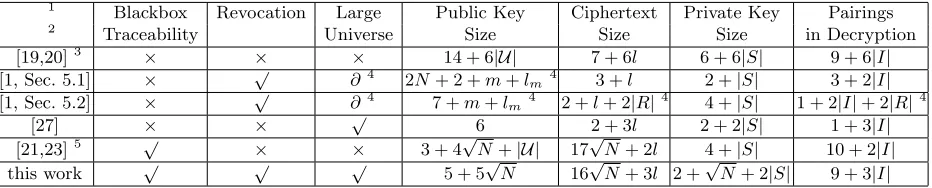
Table 1 compares this new scheme with the representative results in conventional CP-ABE [19], blackbox traceable CP-ABE [21], revocable CP-ABE [1], and large universe CP-ABE [27], all of
4
1
Blackbox Revocation Large Public Key Ciphertext Private Key Pairings
2 Traceability Universe Size Size Size in Decryption
[19,20]3 × × × 14 + 6|U | 7 + 6l 6 + 6|S| 9 + 6|I|
[1, Sec. 5.1] × √ ∂ 4 2N+ 2 +m+lm 4 3 +l 2 +|S| 3 + 2|I|
[1, Sec. 5.2] × √ ∂ 4 7 +m+lm4 2 +l+ 2|R|4 4 +|S| 1 + 2|I|+ 2|R|4
[27] × × √ 6 2 + 3l 2 + 2|S| 1 + 3|I|
[21,23]5 √ × × 3 + 4√N+|U | 17√N+ 2l 4 +|S| 10 + 2|I|
this work √ √ √ 5 + 5√N 16√N+ 3l 2 +√N+ 2|S| 9 + 3|I|
1All the six schemes are provably secure in the standard model and highly expressive. 2
LetN be the number of users in the system,|U |the size of the attribute universe,l the number of rows of the LSSS matrix for an access policy, |S|the size of the attribute set of a decryption key, and |I| the number of attributes for a decryption key to satisfy a ciphertext policy.
3The efficiency evaluation here is based on the prime order construction in [20], which is the full version of [19]. 4
The CP-ABE schemes in [1] are not “truly” large universe, as some limitations are imposed and some correspond-ing parameters have to be fixed durcorrespond-ing the setup. Letmbe the maximum size of an attribute set associated with a key,lmthe maximum number of rows in the LSSS matrix of a policy, and|R|the number of revoked users in a revocation listR.
5The construction in [21,23] is on composite order groups where the group order is the product of three large
primes, and the efficiency evaluation is based on the composite order groups. As a result, the actual sizes of public key and ciphertext in [21,23] are larger than that of this work, and the encryption and decryption in [21,23] are slower than that of this work.
Table 1.Features and Efficiency Comparison
which are provably secure in the standard model and highly expressive. The scheme’s overhead is inO(√N), where N is the number of users in a system, and for fully collusion-resistant blackbox traceable CP-ABE, this is the most efficient one to date. Furthermore, when compared with the existing fully collusion-resistant blackbox traceable CP-ABE scheme in [21], at the cost of √N
additional elements in private key, our construction achieves revocation and “truly” large universe. For achieving better performance, this new scheme is constructed on prime order groups, rather than composite order groups, as it has been showed (e.g. in [10,16]) that constructions on composite order groups will result in significant loss of efficiency.
Paper Outline. In Sec. 2, we propose a definition for CP-ABE supporting policy-specific blackbox
traceability, direct revocation and large attribute universe. As of [21], the definition is ‘functional’, namely each decryption key is uniquely indexed byk∈ {1, . . . , N}(N is the number of users in the system) and given a policy-specific decryption blackbox, the tracing algorithmTracecan return the index k of a decryption key which has been used for building the decryption blackbox. On direct revocation, in our definition, the Encrypt algorithm takes a revocation list R ⊆ {1, . . . , N} as an additional input so that a message encrypted under the (revocation list, access policy) pair (R,A)
would only allow users whose (index, attribute set) pair (k, S) satisfies (k /∈R)∧(S satisf ies A)
to decrypt.
On the construction, we refer to the ‘functional’ CP-ABE in Sec. 2 as Revocable CP-ABE (or R-CP-ABE for short), then extend the R-CP-ABE to a primitive called Augmented R-CP-ABE (or AugR-CP-ABE for short), which will lastly be transformed to a policy-specific blackbox traceable
R-CP-ABE. More specifically, in Sec. 3, we define the encryption algorithm of AugR-CP-ABE as
EncryptA(PP, M, R,A,k¯) which takes one more parameter ¯k∈ {1, . . . , N+1}than the original one
k∈ {1, . . . , N}and associated with an attribute setS, only if (k /∈R)∧(S satisf ies A)∧(k≥¯k).
On the security, we formalize and show that a message-hiding and index-hiding AugR-CP-ABE can be transformed to a secure R-CP-ABE with policy-specific blackbox traceability.
In Sec. 4, we propose alarge universeAugR-CP-ABE construction, and prove its message-hiding and index-hiding properties in the standard model. Combining it with the results in Sec. 3, we obtain a large universe R-CP-ABE construction, which is efficient (with overhead size inO(√N)), highly expressive, and provably secure and traceable in the standard model.
To construct the AugR-CP-ABE, we borrow ideas from the CP-ABE constructions in [21,27] and Trace&Revoke scheme in [10]. However, the combination is not trivial and may result in inefficient or insecure systems. In particular, besides achieving the important features for practicality, such as traitor tracing, revocation, large universe, high expressivity and efficiency, we achieve provable security and traceability in the standard model. As we will discuss later in Sec. 4, proving the blackbox traceability while supporting the large attribute universe is one of the most challenging tasks in this work. As we can see, the proof techniques for blackbox traceability in [21] are no longer applicable for large universe, while that for large universe in [27] are only for confidentiality rather than for blackbox traceability.
Following a similar route, we also present the analogous results in Key-Policy ABE setting, as shown in Sec. 5.
2 Revocable CP-ABE and Blackbox Traceability
In this section, we define Revocable CP-ABE (or R-CP-ABE for short) and its security, which are based on conventional (non-traceable, non-revocable) CP-ABE (e.g. [19,27]). Similar to the traceable CP-ABE in [21], in our ‘functional’ definition, we explicitly assign and identify users using unique indices. Then we formalize traceability against policy-specific decryption blackbox on R-CP-ABE.
2.1 Revocable CP-ABE
Given a positive integern, let [n] be the set{1,2, . . . , n}. A Revocable Ciphertext-Policy Attribute-Based Encryption (R-CP-ABE) scheme consists of four algorithms:
Setup(λ, N) →(PP,MSK). The algorithm takes as input a security parameter λand the number of users in the system N, runs in polynomial time inλ, and outputs a public parameterPPand a master secret key MSK. We assume thatPPcontains the description of the attribute universe U5.
KeyGen(PP,MSK, S) → SKk,S. The algorithm takes as input PP, MSK, and an attribute set S,
and outputs a secret key SKk,S corresponding toS. The secret key is assigned and identified by
a unique index k∈[N].
Encrypt(PP, M, R,A)→CTR,A. The algorithm takes as input PP, a messageM, a revocation list
R ⊆[N], and an access policy AoverU, and outputs a ciphertextCTR,A. (R,A) is included in
CTR,A.
Decrypt(PP, CTR,A,SKk,S)→M or⊥. The algorithm takes as inputPP, a ciphertextCTR,A, and
a secret key SKk,S. If (k∈[N]\R)AND (S satisf iesA), the algorithm outputs a messageM,
otherwise it outputs ⊥indicating the failure of decryption.
5For large universe and also in our work, the attribute universe depends only on the size of the underlying group
Correctness. For any attribute set S ⊆ U, index k ∈[N], revocation list R ⊆[N], access policy
A, and message M, suppose (PP,MSK) ← Setup(λ, N), SKk,S ← KeyGen(PP,MSK, S), CTR,A ←
Encrypt(PP, M, R,A). If (k∈[N]\R)∧(S satisfiesA) thenDecrypt(PP, CTR,A,SKk,S) =M.
Security.The security of the R-CP-ABE is defined using the followingmessage-hiding game, which
is a typical semantic security game and is similar to that for conventional CP-ABE [19,27] security.
GameMH. Themessage-hiding game is defined between a challenger and an adversaryAas follows:
Setup.The challenger runsSetup(λ, N) and gives the public parameter PPtoA.
Phase 1. For i = 1 to Q1, A adaptively submits (index, attribute set) pair (ki, Ski) to ask for secret key for attribute set Ski. For each (ki, Ski) pair, the challenger responds with a secret key
SKki,Ski, which corresponds to attribute setSki and has indexki.
Challenge. A submits two equal-length messages M0, M1 and a (revocation list, access
pol-icy) pair (R∗,A∗). The challenger flips a random coin b ∈ {0,1}, and sends CTR∗,
A∗ ←
Encrypt(PP, Mb, R∗,A∗) to A.
Phase 2. For i =Q1+ 1 to Q,A adaptively submits (index, attribute set) pair (ki, Ski) to ask for secret key for attribute set Ski. For each (ki, Ski) pair, the challenger responds with a secret key SKki,Ski, which corresponds to attribute setSki and has indexki.
Guess. Aoutputs a guess b0 ∈ {0,1}forb.
Awins the game if b0=bunder therestrictionthat none of the queried{(ki, Ski)}
Q
i=1 can satisfy
(ki∈[N]\R∗)AND(Skisatisf iesA
∗). The advantage ofAis defined asMHAdv
A =|Pr[b0 =b]−12|.
Definition 1. An N-user R-CP-ABE scheme is secure if for all probabilistic polynomial time
(PPT) adversaries A, MHAdvA is negligible in λ.
We say that anN-user R-CP-ABE scheme isselectively secure if we add anInitstage beforeSetup
where the adversary commits to the access policyA∗.
Remark: (1) Although the KeyGen algorithm is responsible for determining/assigning the index of each user’s secret key, to capture the security that an adversary can adaptively choose secret keys to corrupt, the above model allowsAto specify the index when querying for a key, i.e., for i= 1 toQ,A submits pairs of(ki, Ski) for secret keys with attribute sets corresponding to Ski, and the challenger will assign
kito be the index of the corresponding secret key, whereQ≤N,ki∈[N], andki6=kj ∀1≤i6=j≤Q (this is to guarantee that each user/key can be uniquely identified by an index). (2) Forki6=kj we do not requireSki 6=Skj, i.e., different users/keys may have the same attribute set.
Remark: (1) The R-CP-ABE defined above extends the conventional definition for non-revocable
CP-ABE [19,21,27], where the revocation list R is always empty. (2) When the revocation list R
2.2 Blackbox Traceability
Apolicy-specific decryption blackboxDis described by a (revocation list, access policy) pair (RD,AD)
and a non-negligible probability value(i.e.= 1/f(λ) for some polynomialf), and this blackbox D can decrypt ciphertexts generated under (RD,AD) with probability at least . Such a blackbox
can reflect most practical scenarios, which include the key-like decryption blackbox for sale and decryption blackbox “found in the wild”, which are discussed in [21,23]. In particular, once a blackbox is found being able to decrypt ciphertexts (regardless of how this is found, for example, an explicit description of the blackbox’s decryption ability is given, or the law enforcement agency finds some clue), we can regard it as a policy-specific decryption blackbox with the corresponding (revocation list, access policy) pair (which is associated to the ciphertext).
We now define the tracing algorithm and traceability against policy-specific decryption blackbox.
TraceD(PP, RD,AD, )→KT ⊆[N].Traceis an oracle algorithm that interacts with a policy-specific
decryption blackbox D. By given the public parameter PP, a revocation list RD, an access policy
AD, and a probability value, the algorithm runs in time polynomial inλ and1/, and outputs an
index set KT ⊆[N] which identifies the set of malicious users. Note that has to be polynomially
related to λ, i.e. = 1/f(λ) for some polynomial f.
Traceability. The followingtracing gamecaptures the notion offully collusion-resistant
trace-ability against policy-specific decryption blackbox. In the game, the adversary targets to build a
decryption blackboxDthat can decrypt ciphertexts under some (revocation list, access policy) pair (RD,AD).
GameTR. Thetracing game is defined between a challenger and an adversaryA as follows:
Setup.The challenger runsSetup(λ, N) and gives the public parameter PPtoA.
Key Query. For i= 1 toQ,A adaptively submits (index, attribute set) pair (ki, Ski) to ask for secret key for attribute set Ski. For each (ki, Ski) pair, the challenger responds with a secret key
SKki,Ski, which corresponds to attribute setSki and has indexki.
Decryption Blackbox Generation. A outputs a decryption blackbox D associated with a
(revocation list, access policy) pair (RD,AD) and a non-negligible probability value.
Tracing. The challenger runsTraceD(PP, RD,AD, ) to obtain an index setKT ⊆[N].
Let KD ={ki|1≤i≤Q} be the index set of secret keys corrupted by the adversary. We say that
A wins the game if the following two conditions hold:
1. Pr[D(Encrypt(PP, M, RD,AD)) = M] ≥ , where the probability is taken over the random
choices of messageM and the random coins ofD. A decryption blackbox satisfying this condition is said to be auseful policy-specific decryption blackbox.
2. KT =∅, orKT 6⊆KD, or ((kt∈RD) OR(Skt does not satisf y AD) ∀kt∈KT). We denote by TRAdvA the probability thatA wins.
Remark: For a useful policy-specific decryption blackbox D, the traced KT must satisfy (KT 6=
∅)∧(KT ⊆ KD)∧(∃kt ∈ KT s.t. (kt ∈ [N]\RD) AND (Skt satisf ies AD)) for traceability. (1) (KT 6=∅)∧(KT ⊆KD) captures the preliminary traceability that the tracing algorithm can extract
decryption ability corresponding to (RD,AD), i.e. whose index is not in RD and whose attribute
set satisfies AD. We refer to [15,21] on why strong traceability is desirable.
Note that, as of [6,7,10,15,21], we are modeling a stateless (resettable) decryption blackbox – such a blackbox is just an oracle and maintains no state between activations. Also note that we are modeling public traceability, namely, theTracealgorithm does not need any secrets and anyone can perform the tracing.
Definition 2. An N-user R-CP-ABE scheme is traceable against policy-specific decryption
black-box if for all PPT adversariesA, TRAdvA is negligible in λ.
We say that an N-user R-CP-ABE is selectively traceable against policy-specific decryption black-box if we add anInit stage beforeSetupwhere the adversary commits to the access policyAD.
In the traceable CP-ABE of [21], given a decryption blackbox, it is guaranteed that at least one secret key in the blackbox will be traced. But in the traceable R-CP-ABE above, it is possible to trace all the active secret keys in the blackbox. In particular, given a decryption blackbox D described by (RD,AD) and non-negligible probability , we can run Trace to obtain an index set KT so that (KT 6=∅)∧(KT ⊆KD)∧(∃kt∈KT s.t.(kt∈[N]\RD)AND(Skt satisf iesAD)). Then, we can set a new revocation list R0D =RD∪ {kt∈KT |(kt∈[N]\RD) AND (Skt satisf ies AD)} and test whetherDcan decrypt ciphertexts under (R0D,AD). IfDcan still decrypt the ciphertexts
with non-negligible probability 0, we can run Trace on (R0D,AD, 0) and obtain a new index set K0T, where (K
0
T 6=∅)∧(K 0
T ⊆KD)∧(∃kt∈K 0
T s.t. (kt∈[N]\R 0
D) AND (Skt satisf ies AD)). By repeating this process, iteratively expanding the revocation list, until Dcan no longer decrypt the corresponding ciphertexts, we have finished finding out all the active malicious users of D.
3 Augmented R-CP-ABE
As outlined in Sec. 1.1, we now define Augmented R-CP-ABE (or AugR-CP-ABE for short) from the R-CP-ABE above, formalize its security notions, then show that a secure AugR-CP-ABE can be transformed to a secure R-CP-ABE with blackbox traceability. In Sec. 4, we propose a concrete construction of AugR-CP-ABE.
3.1 Definitions
An AugR-CP-ABE scheme has four algorithms: SetupA, KeyGenA, EncryptA, and DecryptA. The setup algorithmSetupA and key generation algorithmKeyGenA are the same as that of R-CP-ABE. For the encryption algorithm, it takes one more parameter ¯k∈[N+ 1] as input, and is defined as follows.
EncryptA(PP, M, R,A,¯k)→CTR,A. The algorithm takes as input PP, a message M, a revocation
list R ⊆[N], an access policy A, and an index ¯k ∈ [N + 1], and outputs a ciphertextCTR,A.
(R,A) is included in CTR,A, but the value of k¯ is not.
The decryption algorithmDecryptA is also defined in the same way as that of R-CP-ABE. However, the correctness definition is changed to the following.
Correctness.For any attribute setS ⊆ U, indexk∈[N], revocation list R⊆[N], access policyA
KeyGenA(PP,MSK, S),CTR,A←EncryptA(PP, M, R,A,¯k). If (k∈[N]\R)∧(S satisfiesA)∧(k≥¯k) thenDecryptA(PP, CTR,A,SKk,S) =M.
Note that during decryption, as long as (k∈[N]\R)∧(S satisfiesA), the decryption algorithm
outputs a message, but only whenk≥¯k, the output message is equal to the correct message, that is, if and only if (k∈[N]\R)∧(S satisfiesA)∧(k≥¯k), canSKk,S correctly decrypt a ciphertext
under (R,A,¯k). If we always set ¯k = 1, the functions of AugR-CP-ABE are identical to that of
R-CP-ABE. In fact, the idea behind transforming an AugR-CP-ABE to a traceable R-CP-ABE, that we will show shortly, is to construct an AugR-CP-ABE with index-hiding property, and then always sets ¯k= 1 in normal encryption, while using ¯k∈[N+ 1] to generate ciphertexts for tracing.
Security. We define the security of AugR-CP-ABE in two games. The first game is a
message-hiding game and says that a ciphertext created using indexN + 1 is unreadable by anyone. The
second game is anindex-hiding gameand captures the intuition that a ciphertext created using index ¯k reveals no non-trivial information about ¯k.
GameAMH. The message-hiding game GameAMH is similar to GameMH except that the Challenge phase is
Challenge. A submits two equal-length messages M0, M1 and a (revocation list, access
pol-icy) pair (R∗,A∗). The challenger flips a random coin b ∈ {0,1}, and sends CTR∗,
A∗ ←
EncryptA(PP, Mb, R∗,A∗, N + 1) to A.
A wins the game ifb0 =b. The advantage ofA is defined as MHAAdvA =|Pr[b0 =b]− 12|.
Definition 3. AnN-user Augmented R-CP-ABE scheme is message-hiding if for all PPT
adver-saries A the advantage MHAAdvA is negligible in λ.
GameAIH. In the index-hiding game, we require that, for any (revocation list, access policy) pair (R∗,A∗), an adversary cannot distinguish between a ciphertext under (R∗,A∗,¯k) and (R∗,A∗,¯k+ 1)
without a secret key SK¯k,S¯
k such that (¯k∈[N]\R
∗)∧(S ¯
k satisf iesA∗). The game takes as input
a parameter ¯k∈[N] which is given to both the challenger and the adversary. The game is similar toGameMH except that theChallenge phase is
Challenge. A submits a message M and a (revocation list, access policy) pair (R∗,A∗). The
challenger flips a random coin b∈ {0,1}, and sendsCTR∗,
A∗ ←EncryptA(PP, M, R∗,A∗,k¯+b) toA.
A wins the game if b0 = b under the restriction that none of the queried pairs {(ki, Ski)}
Q i=1
can satisfy (ki = ¯k)∧(ki ∈ [N]\ R∗) ∧(Ski satisf ies A
∗). The advantage of A is defined as IHAAdvA[¯k] =|Pr[b0=b]−12|.
Definition 4. AnN-user Augmented R-CP-ABE scheme is index-hiding if for all PPT adversaries
A the advantagesIHAAdvA[¯k] for ¯k= 1, . . . , N are negligible in λ.
3.2 The Reduction of Traceable R-CP-ABE to Augmented R-CP-ABE
LetΣA = (SetupA,KeyGenA,EncryptA,DecryptA) be an AugR-CP-ABE, defineEncrypt(PP, M, R,A) =EncryptA(PP, M, R,A,1), thenΣ = (SetupA,KeyGenA,Encrypt,DecryptA) is a R-CP-ABE derived fromΣA. In the following, we show that ifΣA is message-hiding and index-hiding, thenΣis secure (w.r.t. Def. 1). Furthermore, we propose a tracing algorithm Trace for Σ and show that if ΣA is message-hiding and index-hiding, then Σ (equipped withTrace) is traceable (w.r.t. Def. 2).
3.2.1 R-CP-ABE Security
Theorem 1. If ΣA is message-hiding and index-hiding (resp. selectively index-hiding), then Σ is
secure (resp. selectively secure).
Proof. First we need a slightly more elaborate message-hiding game for ΣA. In addition to N, λ,
this extended game, denoted as GameAEMH, takes as input a parameter ¯k ∈ [N + 1] which is only given to the challenger. GameAEMH is similar to the original GameAMH except that the Challenge
phase is
Challenge. A submits two equal-length messages M0, M1 and a (revocation list, access
pol-icy) pair (R∗,A∗). The challenger flips a random coin b ∈ {0,1}, and sends CTR∗,
A∗ ←
EncryptA(PP, Mb, R∗,A∗,¯k) toA. This is the only place where ¯kis used in the game.
The adversary A wins the game if b0 = b under the restriction that none of the queried pairs {(ki, Ski)}
Q
i=1 can satisfy (ki ∈ [N]\R ∗)∧(S
ki satisf ies A
∗). The advantage of A is defined as EMHAAdvA[¯k] =|Pr[b0 =b]− 12|.
When ¯k = 1, the game above, including the restriction, is exactly identical to the message-hiding game GameMH for Σ, thus we have EMHAAdvA[1] =MHAdvA. When ¯k =N + 1, we have
that EMHAAdvA[N + 1]≤MHAAdvA, since GameAMH is identical to GameAEMH for ¯k =N + 1, but
there is no restriction in GameAMH. In the following proof sketch, we will make use of the facts that
ΣA is message-hiding and index-hiding to show thatEMHAAdvA[1] is negligible, which implies that MHAdvA is negligible (i.e. Σ is secure w.r.t. Def. 1).
Suppose that Σ is not secure, i.e. MHAdvA > for some adversary A and non-negligible . MHAdvA > implies that EMHAAdvA[1] > . As ΣA is message-hiding, MHAAdvA is negligible
(for simplicity, say MHAAdvA = 0), thus EMHAAdvA[N + 1] = 0. Then, by the standard hybrid
argument there exists a ¯k∈[N] such that
|EMHAAdvA[¯k]−EMHAAdvA[¯k+ 1]|> /N.
In other words, with non-negligible probability,Ais able to distinguishEncryptA(PP, M, R∗,A∗,¯k)
fromEncryptA(PP, M, R∗,A∗,k¯+ 1) for some M and (R∗,A∗). But then Acan directly be used to
win the index-hiding game GameAIH.
More specifically, by reduction (the details are given in Appendix A) where an adversary B in
GameAIH with input ¯k makes use of an adversaryA through simulatingGameAEMH, we show that for any A, there existsB such that for all ¯k= 1, . . . , N, we have
|EMHAAdvA[¯k]−EMHAAdvA[¯k+ 1]| ≤2·IHAAdvB[¯k]. (1)
Then we have
≤
N
X
¯ k=1
|EMHAAdvA[¯k]−EMHAAdvA[¯k+ 1]| ≤2 N
X
¯ k=1
IHAAdvB[¯k].
But since ΣA is message-hiding and index-hiding, we have that MHAAdvA (≥EMHAAdvA[N+ 1])
andIHAAdvB[¯k] for ¯k= 1, . . . , N are negligible for any PPT adversary. Therefore,EMHAAdvA[1] is
negligible. The selective case is similar.
3.2.2 R-CP-ABE Traceability
We now propose a tracing algorithm Trace, which uses a general tracing method previously used in [5,24,6,7,10,21], and show that equipped with Trace,Σ is traceable (w.r.t. Def. 2).
TraceD(PP, RD,AD, )→KT ⊆[N]: Given a policy-specific decryption blackbox Dassociated with
a (revocation list, access policy) pair (RD,AD) and probability >0, the tracing algorithm works
as follows:
1. For k= 1 to N + 1, do the following: (a) Repeat the following 8λ(N/)2 times:
i. SampleM from the message space at random. ii. Let CTRD,AD ←EncryptA(PP, M, RD,AD, k).
iii. Query oracleD on inputCTRD,AD, and compare the output of D withM.
(b) Let ˆpk be the fraction of times that D decrypted the ciphertexts correctly.
2. Let KT be the set of allk∈[N] for which ˆpk−pˆk+1≥/(4N). OutputKT.
Theorem 2. If ΣA is message-hiding and index-hiding (resp. selectively index-hiding), then Σ is
traceable (resp. selectively traceable).
Proof. We show that if the blackbox output by the adversary is a useful one then KT will satisfy
(KT 6=∅)∧(KT ⊆KD)∧(∃kt∈KT s.t. (kt∈[N]\RD)∧(Skt satisf ies AD)) with overwhelming probability, which implies that the adversary cannot win GameTR, i.e., TRAdvA is negligible. The
selective case will be similar.
LetDbe the policy-specific decryption blackbox output by the adversary, and (RD,AD) be the
(revocation list, access policy) pair describing D. Define
p¯k= Pr[D(EncryptA(PP, M, RD,AD,k¯)) =M],
where the probability is taken over the random choice of message M and the random coins ofD. We have that p1 ≥ and pN+1 is negligible (for simplicity let pN+1 = 0). The former follows
from the fact that D is useful, and the latter is because ΣA is message-hiding in GameAMH. Then there must exist somek∈[N] such thatpk−pk+1 ≥/(2N). By the Chernoff bound it follows that
with overwhelming probability, ˆpk−pˆk+1 ≥/(4N). Hence, we haveKT 6=∅.
For anyk∈KT (i.e., ˆpk−pˆk+1≥ 4N ), we know, by Chernoff, that with overwhelming probability
pk−pk+1 ≥/(8N). Clearly (k ∈ KD)∧(k ∈ [N]\RD)∧(Sk satisf ies AD) since otherwise, D
can directly be used to win the index-hiding game for ΣA. Hence, we have (KT ⊆ KD)∧((k ∈
4 An Efficient Augmented R-CP-ABE
We propose an AugR-CP-ABE scheme which is highly expressive and efficient with sub-linear overhead in the number of users in the system. It is also large universe, where attributes do not need to be enumerated during setup, and the public parameter size is independent of the attribute universe size. We prove that this AugR-CP-ABE scheme is message-hiding and selectively index-hiding in the standard model.
Combining this AugCP-ABE with the results in Sec. 3.2, we obtain a large universe R-CP-ABE which is selectively secure and traceable, and for a fully collusion-resistant blackbox traceable CP-ABE, the resulting R-CP-ABE achieves the most efficient level to date, with sub-linear overhead.
To obtain this practical CP-ABE scheme supporting traitor tracing, revocation and large uni-verse, we borrow ideas from the Blackbox Traceable CP-ABE of [21], the Trace and Revoke scheme of [10] and the Large Universe CP-ABE of [27], but the work is not trivial as a straightforward com-bination of the ideas would result in a scheme which is inefficient, insecure, or is not able to achieve strong traceability. Specifically, by incorporating the ideas from [10] and [27] into the Augmented CP-ABE of [21], we can obtain a large universe AugR-CP-ABE which is message-hiding, but prov-ing the index-hidprov-ing property is a challengprov-ing task. The proof techniques for index-hidprov-ing in [21] only work if the attribute universe size is polynomial in the security parameter and the parameters of attributes have to be enumerated during setup. They are not applicable to large universe. The proof techniques in [27] are applicable to large universe, but work only for message-hiding, while not applicable to index-hiding. To prove index-hiding in the large universe setting, we introduce a new assumption that the index-hiding of our large universe AugR-CP-ABE can be based on. In particular, in the underlying q-1 assumption of [27] on bilinear groups (p,G,GT, e), the challenge
term T ∈ GT is e(g, g)caq+1 or a random element, and such a term in the target group could be used to prove the message-hiding as the message space is GT. To prove the index-hiding, which
is based on the ciphertext components in the source group G, we need the challenge term to be
in the source group G so that the simulator can embed the challenge term into these ciphertext
components. Inspired by the Source Group q-Parallel BDHE Assumption in [20], which is a close relative to the (target group) Decisional Parallel BDHE Assumption in [31], we modify the q-1 assumption to its source group version where the challenge term is gcaq+1 or a random element in
G. Based on this new assumption and with a new crucial proof idea, we prove the index-hiding
property for our large universe AugR-CP-ABE. We prove that this new assumption holds in the generic group model.
4.1 Preliminaries
Linear Secret-Sharing Schemes (LSSS).An LSSS is a share-generating matrix Awhose rows
are labeled by attributes via a functionρ. An attribute setSsatisfies the LSSS access matrix (A, ρ) if the rows labeled by the attributes in S have the linear reconstruction property, namely, there exist constants {ωi} such that, for any valid shares {λi} of a secret s, we have Piωiλi =s. The
formal definitions of access structures and LSSS can be found in Appendix E.
Bilinear Groups. Let G be a group generator, which takes a security parameter λ and outputs
(p,G,GT, e) where p is a prime, G and GT are cyclic groups of order p, and e : G×G → GT
∃g∈Gsuch that e(g, g) has orderpinGT. We refer toGas the source groupand GT as the target
group. We assume that group operations in Gand GT as well as the bilinear mapeare efficiently
computable, and the description ofGand GT includes a generator of Gand GT respectively.
Complexity Assumptions. Besides the Decision 3-Party Diffie-Hellman Assumption (D3DH)
and the Decisional Linear Assumption (DLIN) that are used in [10] to achieve traceability in broadcast encryption, the index-hiding property of our AugR-CP-ABE construction will rely on a new assumption, which is similar to the Source Group q-Parallel BDHE Assumption [20] and is closely related to theq-1 assumption in [27]. We refer to it as the Extended Source Groupq-Parallel BDHE Assumption. Here we only review this new assumption, and refer to Appendix F for the details of the D3DH and DLIN.
The Extended Source Group q-Parallel BDHE Assumption Given a group generator G
and a positive integer q, define the following distribution:
(p,G,GT, e) R
←− G(λ), g←−R G, a, c, d, b1, . . . , bq R
←−Zp,
D= (p,G,GT, e), g, gcd, gd, gda
q
,
gai, gbj, gaibj, gai/b2j, gcdbj ∀i, j ∈[q],
gai/bj ∀i∈[2q]\ {q+ 1}, j∈[q],
gaibj0/b2j ∀i∈[2q], j, j0 ∈[q]s.t. j0 6=j,
gcdaibj0/bj, gcdaibj0/b2j ∀i∈[q], j, j0 ∈[q] s.t. j 6=j0 ,
T0 =gca
q+1
, T1 R
←−G.
The advantage of an algorithm A in breaking the Extended Source Group q-Parallel BDHE
As-sumption is AdvG,Aq (λ) :=|Pr[A(D, T0) = 1]−Pr[A(D, T1) = 1]|.
Definition 5. G satisfies the Extended Source Group q-Parallel BDHE Assumption if AdvG,Aq (λ)
is a negligible function of λfor any PPT algorithm A.
This new assumption is closely related to theq-1 assumption in [27], except that the challenge term
gcaq+1 remains in the source group, all the input terms (in D) replace c with cd, and additional
input termsgdand gdaq are given to the adversary. The relation between this assumption and the
q-1 assumption is analogous to that between the Source Group q-Parallel BDHE Assumption [20] and the Decisional Parallel BDHE Assumption [31], i.e. the challenge term changes from a term in the target group (i.e. e(g, g)caq+1) to a term in the source group (i.e. gcaq+1), and the input terms are modified accordingly (i.e. replacing c with cd, and adding gd). The main difference is that in this new assumption, there is an additional input term gdaq. Note that giving the term
gdaq does not pose any problem in the generic group model. Intuitively, there are two ways that the adversary may make use of the term gdaq: (1) pairing gdaq with the challenge term: since the pairing result of any two input terms would not be e(g, g)cda2q+1, the adversary cannot break this
new assumption in this way; (2) pairing the challenge term with another input term whose exponent contains d: however, the result could be a random element or one of { e(g, g)c2daq+1,e(g, g)cdaq+1,
e(g, g)c2dbjaq+1,e(g, g)c2daq+1+ibj0/bj, e(g, g)c2daq+1+ibj0/b2j}, and as there is no input term which can be paired withgdaq to obtain any of these terms, the adversary cannot break this new assumption
It is worth mentioning that Liu et al. [23] modified the Source Groupq-Parallel BDHE Assumption [20] by addinggdaq to and removing gaq+2, . . . , ga2q from the input terms.
Notations.Suppose that the number of usersN in the system equals tom2for somem. In practice, ifN is not a square, we can add some “dummy” users until it pads to the next square. We arrange the users in an m×m matrix and uniquely assign a tuple (i, j), where i, j ∈ [m], to each user. A user at position (i, j) of the matrix has index k = (i−1)∗m+j. For simplicity, we directly use (i, j) as the index where (i, j) ≥ (¯i,¯j) means that ((i >¯i)∨(i = ¯i∧j ≥ ¯j)). Let [m, m] be the set {(i, j)|i, j ∈ [m]}. The use of pairwise notation (i, j) is purely a notational convenience, as k = (i−1)∗m+j defines a bijection between {(i, j)|i, j ∈ [m]} and [N]. For a given vector
v = (v1, . . . , vd), bygv we mean the vector (gv1, . . . , gvd). Furthermore, forgv = (gv1, . . . , gvd) and
gw = (gw1, . . . , gwd), bygv·gwwe mean the vector (gv1+w1, . . . , gvd+wd), i.e.gv·gw=gv+w, and by
ed(gv, gw) we meanQk=1d e(gvk, gwk), i.e.ed(gv, gw) =e(g, g)(v·w), where (v·w) is the inner product
ofvandw. Given a primep, one can randomly chooserx, ry, rz ∈Zp, and setχ1= (rx,0, rz),χ2=
(0, ry, rz), χ3=χ1×χ2 = (−ryrz,−rxrz, rxry). Let span{χ1,χ2}={ν1χ1+ν2χ2|ν1, ν2 ∈Zp} be
the subspace spanned byχ1andχ2. We can see thatχ3 is orthogonal to the subspacespan{χ1,χ2}
and Z3p = span{χ1,χ2,χ3} = {ν1χ1 +ν2χ2+ν3χ3|ν1, ν2, ν3 ∈ Zp}. For any v ∈ span{χ1,χ2},
(χ3·v) = 0, and for randomv ∈Z3p, (χ3·v)6= 0 happens with overwhelming probability.
4.2 Augmented R-CP-ABE Construction
Now we propose a large universe Augmented R-CP-ABE, where the attribute universe isU =Zp. SetupA(λ, N =m2)→(PP,MSK).The algorithm calls the group generatorG(λ) to get (p,G,GT, e),
wherepis the prime order ofGandGT andeis the bilinear map, and sets the attribute universe
toU =Zp. It then randomly picks
g, h, f, f1, . . . , fm, G, H ∈G, {αi, ri, zi ∈Zp}i∈[m], {cj ∈Zp}j∈[m],
and outputs the public parameter PPand master secret key MSKas
PP=(p,G,GT, e), g, h, f, f1, . . . , fm, G, H,
{Ei=e(g, g)αi, Gi=gri, Zi =gzi}i∈[m], {Hj =gcj}j∈[m]
,
MSK=α1, . . . , αm, r1, . . . , rm, c1, . . . , cm
.
A counter ctr= 0 is implicitly included inMSK.
KeyGenA(PP,MSK, S ⊆Zp)→ SK(i,j),S. The algorithm first sets ctr =ctr+ 1 and computes the corresponding index in the form of (i, j) where 1≤ i, j ≤ m and (i−1)∗m+j =ctr. Then it picks random exponents σi,j ∈ Zp, {δi,j,x ∈ Zp}∀x∈S, and outputs a secret key SK(i,j),S =
(i, j), S, Ki,j, Ki,j0 , Ki,j00 , {K¯i,j,j0}j0∈[m]\{j},{Ki,j,x, Ki,j,x0 }x∈S
where
Ki,j =gαigricj(f fj)σi,j, Ki,j0 =gσi,j, K 00 i,j =Z
σi,j
i , {K¯i,j,j0 =fσi,j
j0 }j0∈[m]\{j},
{Ki,j,x=gδi,j,x, Ki,j,x0 = (Hxh)δi,j,xG −σi,j}
EncryptA(PP, M, R,A = (A, ρ),(¯i,¯j)) → CTR,(A,ρ). R ⊆ [m, m] is a revocation list. A = (A, ρ)
is an LSSS matrix where A is an l×n matrix and ρ maps each row Ak of A to an attribute
ρ(k)∈ U =Zp. The encryption is for recipients whose (index, attribute set) pairs ((i, j), S(i,j))
satisfy (i, j)∈[m, m]\R
∧ S(i,j) satisf ies(A, ρ)
∧ (i, j)≥(¯i,¯j)
. Let ¯R= [m, m]\R and for i∈ [m], ¯Ri ={j0|(i, j0) ∈R¯}, that is, ¯R is the non-revoked index list, and ¯Ri is the set of
non-revoked column index on the i-th row. The algorithm randomly chooses
κ, τ, s1, . . . , sm, t1, . . . , tm ∈Zp,
vc, w1, . . . ,wm ∈Z3p,
ξ1, . . . , ξl∈Zp, u= (π, u2, . . . , un)∈Znp.
In addition, it randomly chooses rx, ry, rz ∈ Zp, and sets χ1 = (rx,0, rz), χ2 = (0, ry, rz),
χ3 =χ1×χ2= (−ryrz,−rxrz, rxry). Then it randomly chooses
vi ∈Z3p ∀i∈ {1, . . . ,¯i},
vi ∈span{χ1,χ2} ∀i∈ {¯i+ 1, . . . , m},
and computes a ciphertexthR,(A, ρ), (Ri,R0i, Qi, Q0i, Q00i, Ti)mi=1,(Cj,C0j)mj=1, (Pk, Pk0, P 00 k)lk=1i
as follows:
1. For each rowi∈[m]:
– if i <¯i: randomly chooses ˆsi ∈Zp, and sets
Ri=gvi, R0i =gκvi, Qi =gsi, Q0i= (f
Y
j0∈R¯i
fj0)siZti i f
π, Q00
i =gti, Ti =Eisˆi.
– if i≥¯i: sets
Ri =Gsiivi, R0i =G κsivi
i ,
Qi=gτ si(vi·vc), Q0i= (f
Y
j0∈R¯i
fj0)τ si(vi·vc)Zti
i fπ, Q 00
i =gti, Ti =M ·Eτ si(vi ·vc)
i .
2. For each columnj∈[m]:
– if j <¯j: randomly chooses µj ∈Zp, and sets Cj =H
τ(vc+µjχ3)
j ·gκwj, C0j =gwj.
– if j≥¯j: setsCj =Hjτvc·gκwj, C0j =gwj.
3. For eachk∈[l]: setsPk=fAk·uGξk, Pk0 = (Hρ(k)h)−ξk, Pk00=gξk.
DecryptA(PP, CTR,(A,ρ),SK(i,j),S)→M or⊥. For ciphertextCTR,(A,ρ)=hR,(A, ρ),(Ri,R0i, Qi, Q0i,
Q00i, Ti)mi=1, (Cj,C0j)j=1m , (Pk, Pk0, Pk00)lk=1i and secret key SK(i,j),S =
(i, j), S, Ki,j, Ki,j0 , Ki,j00 ,
{K¯i,j,j0}j0∈[m]\{j}, {Ki,j,x, Ki,j,x0 }x∈S
, if (i, j) ∈ R or S does not satisfy (A, ρ), the algorithm outputs⊥, otherwise:
1.Since S satisfies (A, ρ), the algorithm can efficiently compute constants {ωk∈Zp}such that
P
ρ(k)∈SωkAk = (1,0, . . . ,0), then compute
DP =
Y
ρ(k)∈S
e(Ki,j0 , Pk)·e(Ki,j,ρ(k), Pk0)·e(K 0
i,j,ρ(k), P 00 k)
= Y
ρ(k)∈S
e(gσi,j, fAk·uGξk)·e(gδi,j,ρ(k),(Hρ(k)h)−ξk)·e((Hρ(k)h)δi,j,ρ(k)G−σi,j, gξk)ωk
= Y
ρ(k)∈S
e(gσi,j, fAk·u)ωk =e(gσi,j, f)
P
ρ(k)∈Sωk(Ak·u) =e(gσi,j, f)π.
Note that ifS does not satisfy (A, ρ), no such constants {ωk∈Zp}would exist. 2. Since (i, j)∈R¯(= [m, m]\R) impliesj ∈R¯i, the algorithm can compute
¯
Ki,j =Ki,j·(
Y
j0∈R¯i\{j}
¯
Ki,j,j0) =gαigricj(f fj)σi,j·(
Y
j0∈R¯i\{j}
fσi,j
j0 ) =gαigricj·(f
Y
j0∈R¯i
fj0)σi,j.
Note that if (i, j) ∈ R (implying j /∈ R¯i), the algorithm cannot produce such a ¯Ki,j. The
algorithm then computes
DI =
e( ¯Ki,j, Qi)·e(Ki,j00 , Q00i)
e(Ki,j0 , Q0i) ·
e3(R0i,C0j)
e3(Ri,Cj)
.
3.ComputesM =Ti/(DP·DI) as the output message. Suppose that the ciphertext is generated
from message M0 and encryption index (¯i,¯j), it can be verified that only when (i > ¯i) or (i= ¯i∧j ≥¯j),M =M0. This is because fori >¯i, we have (vi·χ3) = 0 (sincevi ∈span{χ1,χ2}),
and for i = ¯i, we have that (vi ·χ3) 6= 0 happens with overwhelming probability (since vi is
randomly chosen from Z3p). The correctness is given in Appendix B.
4.3 Augmented R-CP-ABE Security
The following theorem states that the AugR-CP-ABE proposed above is message-hiding. Then in Theorem 4, we state that the AugR-CP-ABE is also selectively index-hiding.
Theorem 3. No PPT adversary can winGameAMH with non-negligible advantage.
Proof. The argument for message-hiding inGameAMHis straightforward since an encryption to index
N+1 (i.e. (m+1,1)) contains no information about the message. The simulator simply runsSetupA
andKeyGenA and encryptsMb under the challenge (revocation list, access policy) pair (R∗,A∗) and
index (m+ 1,1). Since for alli= 1 tom,Ti=Eiˆsi contains no information about the message, the
bitb is perfectly hidden and MHAAdvA= 0.
Theorem 4. Suppose that the D3DH, the DLIN and the Extended Source Groupq-Parallel BDHE
Assumption hold. Then no PPT adversary can selectively winGameAIH with non-negligible advantage,
provided that the challenge LSSS matrix’s size l×n satisfiesl, n≤q.
Proof. It follows Lemma 1 and Lemma 2 below.
Lemma 1. If the D3DH and the Extended Source Groupq-Parallel BDHE Assumption hold, then
for¯j < m, no PPT adversary can selectively distinguish between an encryption to(¯i,¯j)and(¯i,¯j+1)
inGameAIH with non-negligible advantage, provided that the challenge LSSS matrix’s sizel×nsatisfies
Proof. InGameAIH with index (¯i,¯j), let (R∗,(A∗, ρ∗)) be the challenge (revocation list, access policy) pair, the restriction is that the adversary A does not query a secret key for (index, attribute set) pair ((i, j), S(i,j)) such that (i, j) = (¯i,¯j)
∧ (i, j)∈[m, m]\R∗∧ S(i,j)satisf ies(A∗, ρ∗)
. Under this restriction, there are two ways for Ato take:
Case I: In Phase 1 and Phase 2,A does not query a secret key with index (¯i,¯j).
Case II: In Phase 1 or Phase 2, A queries a secret key with index (¯i,¯j). Let S(¯i,¯j) be the
corre-sponding attribute set. Case II has the following sub-cases: 1. (¯i,¯j)∈/ [m, m]\R∗,S(¯i,¯j) satisfies (A∗, ρ∗).
2. (¯i,¯j)∈/ [m, m]\R∗,S(¯i,¯j) does not satisfy (A∗, ρ∗).
3. (¯i,¯j)∈[m, m]\R∗,S(¯i,¯j) does not satisfy (A∗, ρ∗).
If A is in Case I, Case II.1 or Case II.2, it follows the restrictions in the index-hiding game for Augmented Broadcast Encryption (AugBE) in [10], where the adversary does not query the key with index (¯i,¯j) or (¯i,¯j) is not in the receiver list [m, m]\R∗.Case II.3 captures the index-hiding requirement of Augmented R-CP-ABE in that even if a user has a key with index (¯i,¯j) and (¯i,¯j) ∈/ R∗, the user cannot distinguish between an encryption to (R∗,(A∗, ρ∗),(¯i,¯j)) and (R∗,(A∗, ρ∗),(¯i,¯j+ 1)) if the corresponding attribute set S(¯i,¯j) does not satisfy (A∗, ρ∗). This is
the most challenging part of proving the index-hiding when we attempt tosecurely intertwine the tracing techniques of broadcast encryption (e.g. [10]) into the large universe CP-ABE (e.g. [27]). Compared to the proof of [21], the challenge here is to prove the index-hiding in the large universe setting, as discussed previously.
To prove this lemma, we flip a random coin c ∈ {0,1} as our guess on which case that A is in. In particular, if c = 0, we guess that A is in Case I, Case II.1 or Case II.2, and make a reduction that uses A to solve a D3DH problem instance, using a proof technique similar to that of [10]. Actually, in this proof, we reduce from our AugR-CP-ABE to the AugBE in [10]. Ifc= 1, we guess that A is in Case I,Case II.2 or Case II.3, and use A to solve an Extended Source Groupq-Parallel BDHE problem instance, which is where the main novelty resides among all the proofs in this work. Please refer to Appendix C for details.
Lemma 2. If the D3DH, the DLIN and the Extended Source Groupq-Parallel BDHE Assumption
hold, then for 1 ≤ ¯i ≤ m, no PPT adversary can selectively distinguish between an encryption
to (¯i, m) and (¯i+ 1,1) in GameAIH with non-negligible advantage, provided that the challenge LSSS matrix’s size l×n satisfiesl, n≤q.
Proof. Similar to the proof of Lemma 6.3 in [10], to prove this lemma we define the following hybrid
experiment:H1: encrypt to (¯i,¯j =m);H2: encrypt to (¯i,¯j =m+ 1); andH3: encrypt to (¯i+ 1,1).
This lemma follows Claim 1 and Claim 2 below.
Claim 1. If the D3DH and the Extended Source Group q-Parallel BDHE Assumption hold, then
no PPT adversary can selectively distinguish between experiment H1 and H2 with non-negligible
advantage, provided that the challenge LSSS matrix’s size l×n satisfiesl, n≤q.
Proof. The proof is identical to that for Lemma 1.
Claim 2. If the D3DH and the DLIN hold, then no PPT adversary can distinguish between
Proof. Note that (¯i, m+ 1) ∈/ [m, m] implies that for any revocation list R∗ ⊆ [m, m], we have (¯i, m+ 1)∈/ R¯∗(= [m, m]\R∗), i.e, the adversaries for distinguishingH2andH3will not be inCase
II.3. Thus, similar to that of case c= 0 in the proof of Lemma 1, in this proof we reduce from our AugR-CP-ABE to the AugBE in [10].
In the proof of index-hiding for an AugBE scheme ΣAugBE in [10, Lemma 6.3], two hybrid experiments were defined and proven indistinguishable via a sequence of hybrid sub-experiments.
– H2AugBE: Encrypt to (¯i, m+ 1), (i.e. H2 in [10])
– H3AugBE: Encrypt to (¯i+ 1,1), (i.e. H5 in [10])
By following [10, Lemma 6.3], if the D3DH and the DLIN hold, no PPT adversary can distinguish
between H2AugBE and H3AugBE for ΣAugBE with non-negligible advantage. Suppose there is a PPT
adversary A that can distinguish between H2 and H3 for our AugR-CP-ABE scheme with
non-negligible advantage. We can build a reduction, which is similar to that of case c= 0 in the proof of Lemma 1 (i.e. the reduction ofCase Ain Appendix C), to useAto distinguish betweenH2AugBE
and H3AugBE forΣAugBE with non-negligible advantage.
5 KP-ABE Analog
We have obtained the first practical CP-ABE scheme that simultaneously supports (1) public and fully collusion-resistant traceability against policy-specific decryption blackbox, (2) (direct) revo-cation and (3) “truly” large attribute universe, and is also highly expressive (i.e. supporting any monotonic access structures) and efficient (i.e. enjoying the sub-linear overhead of O(√N) while supporting fully collusion-resistant blackbox traceability). The scheme’s security and traceability are proven against selectively adversaries in the standard model. Our techniques also yield an analogous Key-Policy ABE (KP-ABE) scheme, i.e. the first practical KP-ABE scheme that simul-taneously supports (1) public and fully collusion-resistant traceability against attributes-specific decryption blackbox, (2) (direct) revocation and (3) “truly” large attribute universe, and is also highly expressive (i.e. supporting any monotonic access structures) and efficient (i.e. enjoying the sub-linear overhead ofO(√N) while supporting fully collusion-resistant blackbox traceability). Es-sentially, KP-ABE is like CP-ABE with the roles of keys and ciphertexts reversed: in KP-ABE, keys are associated with access policies and ciphertexts are associated with sets of attributes. In the setting of KP-ABE, attributes-specific decryption blackbox, which can decrypt ciphertxets gener-ated under some specific attribute set, reflects more general and practical applications than key-like decryption blackbox which functions like a private key with certain access policy. Our techniques readily adapt to KP-ABE and attributes-specific decryption blackbox, and the definitions, construc-tions and proofs are very similar to the CP-ABE case. The details can be found in Appendix G, Appendix H, and Appendix I. In Appendix G we present the definition for KP-ABE supporting traceability against attributes-specific decryption blackbox, direct revocation and large attribute universe, and call it Revocable KP-ABE (R-KP-ABE). In Appendix H we extend the R-KP-ABE to a primitive called Augmented R-KP-ABE (or AugR-KP-ABE for short), then formalize a message-hiding game and an index-message-hiding game, and show that an AugR-KP-ABE scheme satisfying the message-hiding and the (selective) index-hiding can be transformed to a (selectively) secure R-KP-ABE scheme with (selective) attributes-specific blackbox traceability. In Appendix I we propose a
large universeAugR-KP-ABE, and prove that it is message-hiding and selective index-hiding in the
1
Blackbox Revocation Large Public Key Ciphertext Private Key Pairings
2 Traceability Universe Size Size Size in Decryption
[1, Sec. 4.1] × √ ∂ 3 2N+ 2 +m3 3 +|S| 2l 2 + 2|I|
[1, Sec. 4.2] × √ ∂ 3 6 +m3 2 +|S|+ 2|R|3 2 + 2l 2|I|+ 2|R|3
[27] × × √ 5 2 + 2|S| 3l 3|I|
this work √ √ √ 5 + 5√N 1 + 16√N+ 2|S|2 +√N+ 3l 9 + 3|I|
1All the four schemes are highly expressive, i.e. supporting any monotonic access structures. 2
Let N be the number of users in the system,l the number of rows of the LSSS matrix for an access policy,|S|the size of the attribute set of a ciphertext, and|I|the number of attributes for a ciphertext to satisfy a key policy.
3
The KP-ABE schemes in [1] are not “truly” large universe, as some limitations are imposed and some corresponding parameters have to be fixed during the setup. Letmbe the maximum size of an attribute set associated with a ciphertext, and|R|the number of revoked users in a revocation listR.
Table 2.KP-ABE: Features and Efficiency Comparison
any monotonic access structures as policies), selectively secure and selectively attributes-specific blackbox traceable in the standard model.
Table 2 compares this new ABE scheme with the representative results in revocable KP-ABE [1] and large universe KP-KP-ABE [27]. The scheme’s overhead is in O(√N), where N is the number of users in a system, and for fully collusion-resistant blackbox traceable KP-ABE, this is the most efficient one to date. It is worth mentioning that the traceable Predicate Encryption (PE) scheme by Katz and Schr¨oder [15] implies an expressive KP-ABE scheme with fully collusion-resistant blackbox traceability, but the scheme’s overhead is linear in N, and it does not support revocation or “truly” large universe.
6 Conclusion
In this paper, we proposed the first practical CP-ABE and KP-ABE that simultaneously support (1) traitor tracing, (2) revocation and (3) large universe. Both schemes are highly expressive in supporting any monotonic access structures. Besides achieving fully collusion-resistant blackbox traceability, and direct revocation, they are also efficient with the overhead in O(√N) only. Fur-thermore, they support large attribute universe and do not need to fix the values of attributes during the system setup. The CP-ABE (resp. KP-ABE) scheme was proven selectively secure and selectively traceable against policy-specific (resp. attributes-specific) decryption blackbox in the standard model.
References
1. Attrapadung, N., Imai, H.: Conjunctive broadcast and attribute-based encryption. In: Pairing. pp. 248–265 (2009) 2. Beimel, A.: Secure Schemes for Secret Sharing and Key Distribution. Ph.D. thesis, Israel Institute of Technology,
Technion, Haifa, Israel (1996)
3. Bethencourt, J., Sahai, A., Waters, B.: Ciphertext-policy attribute-based encryption. In: IEEE Symposium on Security and Privacy. pp. 321–334 (2007)
4. Boneh, D., Boyen, X., Goh, E.J.: Hierarchical identity based encryption with constant size ciphertext. In: EU-ROCRYPT. pp. 440–456 (2005)
5. Boneh, D., Franklin, M.K.: An efficient public key traitor tracing scheme. In: CRYPTO. pp. 338–353 (1999) 6. Boneh, D., Sahai, A., Waters, B.: Fully collusion resistant traitor tracing with short ciphertexts and private keys.
7. Boneh, D., Waters, B.: A fully collusion resistant broadcast, trace, and revoke system. In: ACM Conference on Computer and Communications Security. pp. 211–220 (2006)
8. Cheung, L., Newport, C.C.: Provably secure ciphertext policy ABE. In: ACM Conference on Computer and Communications Security. pp. 456–465 (2007)
9. Deng, H., Wu, Q., Qin, B., Mao, J., Liu, X., Zhang, L., Shi, W.: Who is touching my cloud. In: ESORICS, Part I. pp. 362–379 (2014)
10. Garg, S., Kumarasubramanian, A., Sahai, A., Waters, B.: Building efficient fully collusion-resilient traitor tracing and revocation schemes. In: ACM Conference on Computer and Communications Security. pp. 121–130 (2010) 11. Goyal, V., Jain, A., Pandey, O., Sahai, A.: Bounded ciphertext policy attribute based encryption. In: ICALP (2).
pp. 579–591 (2008)
12. Goyal, V., Pandey, O., Sahai, A., Waters, B.: Attribute-based encryption for fine-grained access control of en-crypted data. In: ACM Conference on Computer and Communications Security. pp. 89–98 (2006)
13. Herranz, J., Laguillaumie, F., R`afols, C.: Constant size ciphertexts in threshold attribute-based encryption. In: Public Key Cryptography. pp. 19–34 (2010)
14. Katz, J., Sahai, A., Waters, B.: Predicate encryption supporting disjunctions, polynomial equations, and inner products. In: EUROCRYPT. pp. 146–162 (2008)
15. Katz, J., Schr¨oder, D.: Tracing insider attacks in the context of predicate encryption schemes. In: ACITA (2011),
https://www.usukita.org/node/1779
16. Lewko, A.B.: Tools for simulating features of composite order bilinear groups in the prime order setting. In: EUROCRYPT. pp. 318–335 (2012)
17. Lewko, A.B., Okamoto, T., Sahai, A., Takashima, K., Waters, B.: Fully secure functional encryption: Attribute-based encryption and (hierarchical) inner product encryption. In: EUROCRYPT. pp. 62–91 (2010)
18. Lewko, A.B., Okamoto, T., Sahai, A., Takashima, K., Waters, B.: Fully secure functional encryption: Attribute-based encryption and (hierarchical) inner product encryption. IACR Cryptology ePrint Archive 2010, 110 (2010) 19. Lewko, A.B., Waters, B.: New proof methods for attribute-based encryption: Achieving full security through
selective techniques. In: CRYPTO. pp. 180–198 (2012)
20. Lewko, A.B., Waters, B.: New proof methods for attribute-based encryption: Achieving full security through selective techniques. IACR Cryptology ePrint Archive 2012, 326 (2012)
21. Liu, Z., Cao, Z., Wong, D.S.: Blackbox traceable CP-ABE: how to catch people leaking their keys by selling decryption devices on ebay. In: ACM Conference on Computer and Communications Security. pp. 475–486 (2013) 22. Liu, Z., Cao, Z., Wong, D.S.: White-box traceable ciphertext-policy attribute-based encryption supporting any
monotone access structures. IEEE Transactions on Information Forensics and Security 8(1), 76–88 (2013) 23. Liu, Z., Cao, Z., Wong, D.S.: Traceable CP-ABE: how to trace decryption devices found in the wild. IEEE
Transactions on Information Forensics and Security 10(1), 55–68 (2015)
24. Naor, D., Naor, M., Lotspiech, J.: Revocation and tracing schemes for stateless receivers. In: CRYPTO. pp. 41–62 (2001)
25. Okamoto, T., Takashima, K.: Fully secure functional encryption with general relations from the decisional linear assumption. In: CRYPTO. pp. 191–208 (2010)
26. Okamoto, T., Takashima, K.: Fully secure unbounded inner-product and attribute-based encryption. In: ASI-ACRYPT. pp. 349–366 (2012)
27. Rouselakis, Y., Waters, B.: Practical constructions and new proof methods for large universe attribute-based encryption. In: ACM Conference on Computer and Communications Security. pp. 463–474 (2013)
28. Sahai, A., Seyalioglu, H., Waters, B.: Dynamic credentials and ciphertext delegation for attribute-based encryp-tion. In: CRYPTO. pp. 199–217 (2012)
29. Sahai, A., Waters, B.: Fuzzy identity-based encryption. In: EUROCRYPT. pp. 457–473 (2005)
30. Shoup, V.: Lower bounds for discrete logarithms and related problems. In: EUROCRYPT. pp. 256–266 (1997) 31. Waters, B.: Ciphertext-policy attribute-based encryption: An expressive, efficient, and provably secure realization.
In: Public Key Cryptography. pp. 53–70 (2011)
A AugR-CP-ABE Implies Secure R-CP-ABE
To prove that the R-CP-ABE scheme Σ in Sec. 3.2 is secure it remains to prove that Equation (1) holds for all ¯k= 1, . . . , N. Consider a specific ¯k ∈ [N]. Adversary B plays the index-hiding game