Comparing HMMs and Bayesian Networks for Surface Realisation
Nina Dethlefs
Heriot-Watt University Edinburgh, Scotland [email protected]
Heriberto Cuay´ahuitl
German Research Centre for Artificial Intelligence Saarbr¨ucken, Germany
Abstract
Natural Language Generation (NLG) systems often use a pipeline architecture for sequen-tial decision making. Recent studies how-ever have shown that treating NLG decisions jointly rather than in isolation can improve the overall performance of systems. We present a joint learning framework based on Hierar-chical Reinforcement Learning (HRL) which uses graphical models for surface realisation. Our focus will be on a comparison of Bayesian Networks and HMMs in terms of user satis-faction and naturalness. While the former per-form best in isolation, the latter present a scal-able alternative within joint systems.
1 Introduction
NLG systems have traditionally used a pipeline ar-chitecture which divides the generation process into three distinct stages. Content selection chooses
‘what to say’ and constructs a semantic form.
Ut-terance planning organises the message into
sub-messages and surface realisation maps the seman-tics onto words. Recently, a number of studies have pointed out that many decisions made at these distinct stages require interrelated, rather than iso-lated, optimisations (Angeli et al., 2010; Lemon, 2011; Cuay´ahuitl and Dethlefs, 2011a; Dethlefs and Cuay´ahuitl, 2011a). The key feature of a joint archi-tecture is that decisions of all three NLG stages share information and can be made in an interrelated fash-ion. We present a joint NLG framework based on Hierarchical RL and focus, in particular, on the sur-face realisation component of joint NLG systems.
We compare the user satisfaction and naturalness of surface realisation using Hidden Markov Models (HMMs) and Bayesian Networks (BNs) which both have been suggested as generation spaces—spaces of surface form variants for a semantic concept— within joint NLG systems (Dethlefs and Cuay´ahuitl, 2011a; Dethlefs and Cuay´ahuitl, 2011b) and in iso-lation (Georgila et al., 2002; Mairesse et al., 2010).
2 Surface Realisation for Situated NLG
We address the generation of navigation instruc-tions, where e.g. the semantic form(path(target=
end of corridor)∧(landmark = lif t∧dir =
lef t)) can be expressed as ‘Go to the end of the corridor’, ‘Head to the end of the corridor past the lift on your left’ and many more. The best realisa-tion depends on the space (types and properties of spatial objects), the user (position, orientation, prior knowledge) and decisions of content selection and utterance planning. These can be interrelated with surface realisation, for example:
(1) ‘Follow this corridor and go past the lift on your left. Then turn right at the junction.’
(2) ’Pass the lift and turn right at the junction.’
Here, (1) is appropriate for a user unfamiliar with the space and a high information need, so that more in-formation should be given. For a familiar user, how-ever, who may know where the lift is, it is redundant and (2) is preferable, because it is more efficient. An unfamiliar user may get confused with just (2).
In this paper, we distinguish navigation of
des-tination (‘go back to the office’), direction (‘turn
left’), orientation (‘turn around’), path (‘follow the
corridor’) and straight’ (‘go forward’) in the GIVE corpus (Gargett et al., 2010). Users can react to an instruction by performing the action, performing an
undesired action, hesitating or requesting help.
3 Jointly Learnt NLG: Hierarchical RL
with Graphical Models
In a joint framework, each subtask of content selec-tion, utterance planning and surface realisation has knowledge of the decisions made in the other two subtasks. In an isolated framework, this knowledge is absent. In the joint case, the relationship between hierarchical RL and graphical models is that the lat-ter provide feedback to the former’s surface realisa-tion decisions according to a human corpus.
Hierarchical RL Our HRL agent consists of a hierarchy of discrete-time Semi-Markov Decision Processes, or SMDPs, Mji defined as 4-tuples < Sji, Aij, Tji, Rji >, where iand j uniquely identify a model in the hierarchy. These SMDPs represent generation subtasks, e.g. generating destination in-structions. Sji is a set of states, Aij is a set of ac-tions, andTjiis a probabilistic state transition func-tion that determines the next states′
from the current statesand the performed actiona. Rij(s′, τ|s, a)is
a reward function that specifies the reward that an agent receives for taking an actionain states last-ingτ time steps. Since actions in SMDPs may take a variable number of time steps to complete, the ran-dom variableτrepresents this number of time steps. Actions can be either primitive or composite. The former yield single rewards, the latter correspond to SMDPs and yield cumulative rewards. The goal of each SMDP is to find an optimal policyπ∗that
max-imises the reward for each visited state, according toπ∗i
j(s) = arg maxa∈AQ∗ij(s, a),whereQij(s, a)
specifies the expected cumulative reward for execut-ing actionain statesand then followingπ∗. Please
see (Dethlefs and Cuay´ahuitl, 2011b) for details on the design of the hierarchical RL agent and the inte-gration of graphical models for surface realisation.
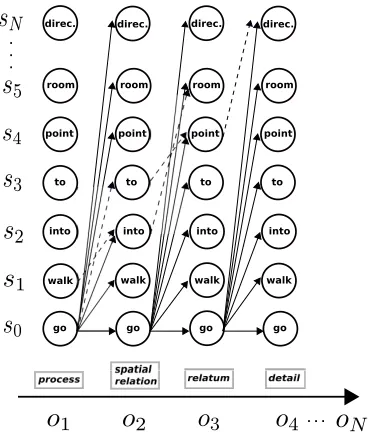
Hidden Markov Models Representing surface re-alisation as an HMM can be roughly defined as the converse of POS tagging. While in POS tagging we map an observation string of words onto a hidden sequence of POS tags, in NLG we face the
oppo-. . .
go walk into to point
room room room room
point point point
to to to
into into into
walk walk walk
go go go
process spatial relation relatum detail
[image:2.612.332.520.56.273.2]. . . direc. direc. direc. direc.
Figure 1: Example trellis for an HMM for destination instructions (not all states and transitions are shown). Dashed arrows show paths that occur in the corpus.
site scenario. Given an observation sequence of se-mantic symbols, we want to map it onto a hidden most likely sequence of words. We treat states as representing surface realisations for (observed) se-mantic classes, so that a sequence of statess0...sn
represents phrases or sentences. An observation se-quence o0...on consists of a finite set of semantic
symbols specific to an instruction type. Each symbol has an observation likelihoodbs(o)tgiving the
prob-ability of observingoin statesat timet. We created the HMMs and trained the transition and emission probabilities from the GIVE corpus using the Baum-Welch algorithm. Please see Fig. 1 for an example HMM and (Dethlefs and Cuay´ahuitl, 2011a) for de-tails on using HMMs for surface realisation.
Bayesian Networks Representing a surface re-aliser as a BN, we can model the dynamics between semantic concepts and their realisations. A BN mod-els a joint probability distribution over a set of ran-dom variables and their dependencies based on a di-rected acyclic graph, where each node represents a variableYjwith parentspa(Yj). Due to the Markov
condition, each variable depends only on its parents, resulting in a unique joint probability distribution p(Y) = Πp(Yj|pa(Yj)), where every variable is
Destination Verb Destination
Direction
Values: {left/right,
straight, empty} Values: {go, keep going,
walk, continue, return, get, you need, you want, empty, ... }
Information
Values: {high, low}
Destination Preposition
Values:{into, in, to, towards, until, empty, ...}
Destination Relatum
[image:3.612.94.272.60.194.2]Values:{landmark, room} Need
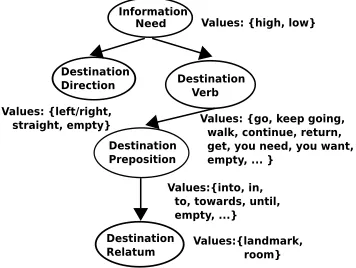
Figure 2: BN for generating destination instructions.
p(Yj|pa(Yj)). The meaning of random variables
corresponds to semantic symbols. The values of ran-dom variables correspond to surface variants of a se-mantic symbol. Figure 2 shows an example BN with two main dependencies. First, the random variable ‘information need’ influences the inclusion of op-tional semantic constituents and the process of the utterance (‘destination verb’). Second, a sequence of dependencies spans from the verb to the end of the utterance (‘destination relatum’). The first de-pendency is based on the intuition that more detail is needed in an instruction for users with high infor-mation need (e.g. with little prior knowledge).1 The second dependency is based on the hypothesis that the value of one constituent can be estimated based on the previous constituent. In the future, we may compare different configurations and effects of word order. Given the word sequence represented by lex-ical and syntactic variables Y0...Yn, and
situation-based variablesYn+1...Ym, we can compute the
pos-terior probability of a random variableYj. The
pa-rameters of the BNs were estimated using MLE. Please see (Dethlefs and Cuay´ahuitl, 2011b) for de-tails on using BNs for surface realisation within a joint learning framework.
4 Experimental Setting
We compare instructions generated with the HMMs and BNs according to their user
sat-isfaction and their naturalness. The
learn-1
This is key to the joint treatment of content selection and surface realisation: if an utterance is not informative in terms of content, it will receive bad rewards, even with good surface realisation choices (and vice versa).
ing agent is trained using the reward function Reward =U ser satisf action×P(w0. . . wn)×
CAS.2 U ser satisf action is a function of task success and the number of user turns based on the PARADISE framework3 (Walker et al., 1997) and CAS refers to the proportion of repetition and variation in surface forms. Our focus in this short paper is onP(w0. . . wn) which rewards
the agent for having generated a surface form se-quence w0. . . wn. In HMMs, this corresponds to
the forward probability—obtained from the For-ward algorithm—of observing the sequence in the data. In BNs,P(w0. . . wn)corresponds toP(Yj =
vx|pa(Yj) =vy), the posterior probability given the
chosen values vx and vy of random variables and
their dependencies. We assign a reward of−1 for each action to prevent loops.
5 Experimental Results
User satisfaction Our trained policies learn the same content selection and utterance planning be-haviour reported by (Dethlefs and Cuay´ahuitl, 2011b). These policies contribute to the user
sat-isfaction of instructions. BNs and HMMs however
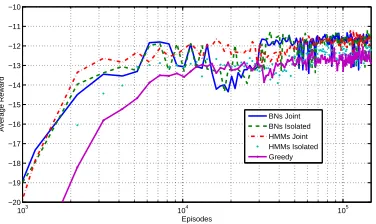
differ in their surface realisation choices. Figure 3 shows the performance in terms of average re-wards over time for both models within the joint learning framework and in isolation.4 For ease of comparison, a learning curve using a greedy policy is also shown. It always chooses the most likely surface form according to the human corpus with-out taking other tradeoffs into account. Within the joint framework, both BNs and HMMs learn to gen-erate context-sensitive surface forms that balance the tradeoffs of the most likely sequence (accord-ing to the human corpus) and the one that best cor-responds to the user’s information need (e.g., using nick names of rooms for familiar users). The BNs
2This reward function, the simulated environment and
train-ing parameters were adapted from (Dethlefs and Cuay´ahuitl, 2011b) to allow a comparison with related work in using graph-ical models for surface realisation. Simulation is based on uni-and bigrams for the spatial setting uni-and Naive Bayes Classifica-tion for user reacClassifica-tions to system instrucClassifica-tions.
3See (Dethlefs et al., 2010) for evidence of the correlation
between user satisfaction, task success and dialogue length. 4
103
104
105
−20 −19 −18 −17 −16 −15 −14 −13 −12 −11 −10
Average Reward
Episodes
[image:4.612.89.277.64.176.2]BNs Joint BNs Isolated HMMs Joint HMMs Isolated Greedy
Figure 3: Performance of HMMs, BNs and a greedy base-line in conjunction and isolation of the joint framework.
reach an average reward5 of −11.53 and outper-form the HMMs (average −11.64) only marginally by less than one percent. BNs and HMMs improve the greedy baseline by6%(p < 0.0001,r = 0.90). While BNs reach the same performance in isola-tion of the joint framework, the performance of HMMs deteriorates significantly to an average re-ward of−12.12. This corresponds to a drop of5%
(p < 0.0001,r = 0.79) and is nearly as low as the
greedy baseline. HMMs thus reach a comparable
performance to BNs as a result of the joint learning architecture: the HRL agent will discover the non-optimal behaviour that is caused by the HMM’s lack of context-awareness (due to their independence as-sumptions) and learn to balance this drawback by learning a more comprehensive policy itself. For the more context-aware BNs this is not necessary.
Naturalness We compare the instructions gener-ated with HMMs and BNs regarding their human-likeness based on the Kullback-Leibler (KL) diver-gence. It computes the difference between two prob-ability distributions. For evidence of its usefulness for measuring naturalness, cf. (Cuay´ahuitl, 2010). We compare human instructions (based on strings) drawn from the corpus against strings generated by the HMMs and BNs to see how similar both are to human authors. Splitting the human instructions in half and comparing them to each other indicates how similar human authors are to each other. It yields a KL score of1.77 as a gold standard (the lower the better). BNs compared with human data obtain a score of2.83and HMMs of2.80. The difference in
5
The average rewards of agents have negative values due to the negative reward of−1the agent receives for each action.
terms of similarity with humans for HMMs and BNs in a joint NLG model is not significant.
Discussion While HMMs reach comparable user satisfaction and naturalness to BNs in a joint system, they show a5%lower performance in isolation. This is likely caused by their conditional independence assumptions: (a) the Markov assumption, (b) the stationary assumption, and (c) the observation inde-pendence assumption. Even though these can make HMMs easier to train and scale than more structured models such as BNs, it also puts them in a disadvan-tage concerning context-awareness and accuracy as shown by our results. In contrast, the random vari-ables of BNs allow them to keep a structured model of the space, user, and relevant content selection and utterance planning choices. BNs are thus able to compute the posterior probability of a surface form based on all relevant properties of the current situa-tion (not just the occurrence in a corpus). While BNs also place independence assumptions on their vari-ables, they usually overcome the problem of lacking context-awareness by their dependencies across ran-dom variables. However, BNs also face limitations. Given the dependencies they postulate, they are typ-ically more data intensive and less scalable than less structured models such as HMMs. This can be prob-lematic for large domains such as many real world applications. Regarding their application to surface realisation, we can argue that while BNs are the best performing model in isolation, HMMs represent a cheap and scalable alternative especially for large-scale problems in a joint NLG system.
6 Conclusion and Future Work
Acknowledgements This research was funded by the European Commission’s FP7 programmes under grant agreement no. 287615 (PARLANCE) and no. ICT-248116 (ALIZ-E).
References
Angeli, G., Liang, P. and D. Klein (2010). A simple domain-independent probabilistic approach to gener-ation , Proceedings of the Conference on Empirical
Methods in Natural Language Processing (EMNLP) .
Cuay´ahuitl, H., Renals, S., Lemon, O. and H. Shimodaira (2010). Evaluation of a Hierarchical Reinforcement Learning Spoken Dialogue System, Computer Speech
and Language 24.
Cuay´ahuitl, H., and N. Dethlefs (2011a). Spatially-Aware Dialogue Control Using Hierarchical Rein-forcement Learning, ACM Transactions on Speech
and Language Processing (Special Issue on Machine Learning for Robust and Adaptive Spoken Dialogue Systems 7(3).
Dethlefs, N. and H. Cuay´ahuitl, 2011. Hierarchical Re-inforcement Learning and Hidden Markov Models for Task-Oriented Natural Language Generation, In Proc.
of the 49th Annual Meeting of the Association for Computational Linguistics (ACL-HLT).
Dethlefs, N. and H. Cuay´ahuitl, 2011. Combining Hi-erarchical Reinforcement Learning and Bayesian Net-works for Natural Language Generation in Situated Dialogue, In Proceedings of the 13th European
Work-shop on Natural Language Generation (ENLG).
Dethlefs, N., Cuay´ahuitl, H., Richter, K.-F., Andonova, E. and J. Bateman, 2010. Evaluating Task Success in a Dialogue System for Indoor Navigation, In
Proceed-ings of the Workshop on the Semantics and Pragmatics of Dialogue (SemDial).
Gargett, A., Garoufi, K., Koller, A. and K. Striegnitz (2010). The GIVE-2 Corpus of Giving Instructions in Virtual Environments, Proc. of the 7th International
Conference on Language Resources and Evaluation.
Georgila, K., Fakotakis, N. and Kokkinakis, G. (2002). Stochastic Language Modelling for Recognition and Generation in Dialogue Systems. TAL (Traitement
au-tomatique des langues) Journal, Vol. 43(3).
Lemon, O. (2011). Learning what to say and how to say it: joint optimization of spoken dialogue management and Natural Language Generation, Computer Speech
and Language 25(2).
Mairesse, F., Gaˇsi´c, M., Jurˇc´ıˇcek, F., Keizer, S., Thom-son, B., Yu, K. and S. Young (2010). Phrase-based statistical language generation using graphical models and active learning, Proc. of the 48th Annual Meeting
of the Association for Computational Linguistics.
Walker, M., Litman, D., Kamm, C. and A. Abella (1997). PARADISE: A Framework for Evaluating Spoken Di-alogue Agents, Proceedings of the Annual Meeting of