NAACL-HLT Workshop on the Induction of Linguistic Structure, pages 16–22,
Capitalization Cues Improve Dependency Grammar Induction
Valentin I. Spitkovsky
Stanford University and Google Inc. [email protected]
Hiyan Alshawi
Google Inc., Mountain View, CA, 94043 [email protected]
Daniel Jurafsky
Stanford University, Stanford, CA, 94305 [email protected]
Abstract
We show that orthographic cues can be helpful for unsupervised parsing. In the Penn Tree-bank, transitions between upper- and lower-case tokens tend to align with the boundaries of base (English) noun phrases. Such signals can be used as partial bracketing constraints to train a grammar inducer: in our experiments, directed dependency accuracy increased by 2.2% (average over 14 languages having case information). Combining capitalization with punctuation-induced constraints in inference further improved parsing performance, attain-ing state-of-the-art levels for many languages.
1 Introduction
Dependency grammar induction and related prob-lems of unsupervised syntactic structure discovery are attracting increasing attention (Rasooli and Faili, 2012; Mareˇcek and Zabokrtsk´y, 2011, inter alia). Since sentence structure is underdetermined by raw text, there have been efforts to simplify the task, via (i) pooling features of syntax across languages (Co-hen et al., 2011; McDonald et al., 2011; Co(Co-hen and Smith, 2009); as well as (ii) identifying uni-versal rules (Naseem et al., 2010) — such as verbo-centricity (Gimpel and Smith, 2011) — that need not be learned at all. Unfortunately most of these tech-niques do not apply to plain text, because they re-quire knowing, for example, which words are verbs. As standard practice shifts away from relying on gold part-of-speech (POS) tags (Seginer, 2007; Pon-vert et al., 2010; Søgaard, 2011b; Spitkovsky et al., 2011c, inter alia), lighter cues to inducing linguistic structure become more important. Examples of use-ful POS-agnostic clues include punctuation bound-aries (Ponvert et al., 2011; Spitkovsky et al., 2011b;
Briscoe, 1994) and various kinds of bracketing con-straints (Naseem and Barzilay, 2011; Spitkovsky et al., 2010b; Pereira and Schabes, 1992). We propose adding capitalization to this growing list of sources of partial bracketings. Our intuition stems from En-glish, where (maximal) spans of capitalized words — such asApple II, World War I,Mayor William H. Hudnut III,International Business Machines Corp. and Alexandria, Va— tend to demarcate proper nouns.
Consider a motivating example (all of our exam-ples are from WSJ) without punctuation, in which all (eight) capitalized word clumps and uncased numer-als match base noun phrase constituent boundaries:
[NP Jay Stevens]of[NP Dean Witter]actually cut his per-share earnings estimate to[NP $9]from[NP $9.50] for [NP 1989] and to [NP $9.50] from [NP $10.35] in [NP 1990] because he decided sales would be even weaker than he had expected.
and another (whose first word happens to be a leaf), where capitalization complements punctuation cues:
[NP Jurors]in[NP U.S. District Court]in[NP Miami] cleared [NP Harold Hershhenson], a former executive vice president; [NP John Pagones], a former vice presi-dent; and[NP Stephen Vadas]and[NP Dean Ciporkin], who had been engineers with[NPCordis].
Could such chunks help bootstrap grammar induc-tion and/or improve the accuracy of already-trained unsupervised parsers? In answering these questions, we will focus predominantly on sentence-internal capitalization. But we will also show that first words — those capitalized by convention — and uncased segments — whose characters are not even drawn from an alphabet — could play a useful role as well.
2 English Capitalization from a Treebank
Count POS Sequence Frac Cum
1 27,524 NNP 44.6%
2 17,222 NNP NNP 27.9 72.5
3 4,598 NNP NNP NNP 7.5 79.9
4 2,973 JJ 4.8 84.8
5 1,716 NNP NNP NNP NNP 2.8 87.5
6 1,037 NN 1.7 89.2
7 932 PRP 1.5 90.7
8 846 NNPS 1.4 92.1
9 604 NNP NNPS 1.0 93.1
10 526 NNP NNP NNP NNP NNP 0.9 93.9
[image:2.612.76.296.69.203.2]WSJ +3,753 more with Count≤498 6.1%
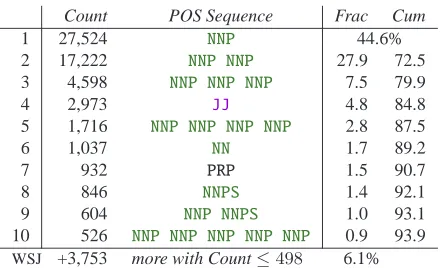
Table 1: Top 10 fragments of POS tag sequences in WSJ.
sentence-initial) consecutive sequences of words that each differs from its own lower-cased form. Nearly all — 59,388 (96.2%) — of the 61,731 frag-ments are dominated by noun phrases; slightly less than half — 27,005 (43.8%) — perfectly align with constituent boundaries in the treebank; and about as many — 27,230 (44.1%) are multi-token. Table 1 shows the top POS sequences comprising fragments.
3 Analytical Experiments with Gold Trees
We gauged the suitability of capitalization-induced fragments for guiding dependency grammar induc-tion by assessing accuracy, in WSJ,1of parsing con-straints derived from their end-points. Following the suite of increasingly-restrictive constraints on how dependencies may interact with fragments, intro-duced by Spitkovsky et al. (2011b, §2.2), we tested several such heuristics. The most lenient constraint,
thread, only asks that no dependency path from the
root to a leaf enter the fragment twice; tear requires any incoming arcs to come from the same side of the fragment; sprawl demands that there be exactly one incoming arc; loose further constrains any out-going arcs to be from the fragment’s head; and strict — the most stringent constraint — bans external dependents. Since only strict is binding for single words, we experimented also with strict′: applying
strict solely to multi-token fragments (ignoring
sin-gletons). In sum, we explored six ways in which dependency parse trees can be constrained by frag-ments whose end-points could be defined by capital-ization (or in other various ways, e.g., semantic
an-1
We converted labeled constituents into unlabeled depen-dencies using deterministic “head-percolation” rules (Collins, 1999), discarding any empty nodes, etc., as is standard practice.
markup punct. capital initial uncased thread 98.5 95.0 99.5 98.4 99.2
tear 97.9 94.7 98.6 98.4 98.5
sprawl 95.1 92.9 98.2 97.9 96.4
loose 87.5 74.0 97.9 96.9 96.4
strict′ 32.7 35.6 38.7 40.3 55.6 strict 35.6 39.2 59.3 66.9 61.1
Table 2: Several sources of fragments’ end-points and %-correctness of their derived constraints (for English).
notations, punctuation or HTML tags in web pages). For example, in the sentence about Cordis, the
strict hypothesis would be wrong about five of the
eight fragments: Jurorsattaches in; Court takes the second in; Hershhenson and Pagonesderive their ti-tles, president; and (at least in our reference) Vadas attaches and, Ciporkin and who. Based on this, we would consider strict to be 37.5%-accurate. But
loose — and the rest of the more relaxed constraints
— would get perfect scores. (And strict′ would re-tract the mistake about Jurors but also the correct guesses aboutMiamiandCordis, scoring only 20%.) Table 2 (capital) shows scores averaged over the entire treebank. Columns markup (Spitkovsky et al., 2010b) and punct (Spitkovsky et al., 2011b) indicate that capitalization yields across-the-board more ac-curate constraints (for English) compared with frag-ments derived from punctuation or markup (i.e., an-chor text, bold, italics and underline tags in HTML), for which such constraints were originally intended.
4 Pilot Experiments on Supervised Parsing
To further test the potential of capitalization-induced constraints, we applied them in the Viterbi-decoding phase of a simple (unlexicalized) supervised depen-dency parser — an instance of DBM-1 (Spitkovsky et al., 2012,§2.1), trained on WSJ sentences with up
punct.: thread tear sprawl loose none: 71.8 74.3 74.4 74.5 73.3
capital:thread 72.3 74.6 74.7 74.9 73.6
tear 72.4 74.7 74.7 74.9 73.6
sprawl 72.4 74.7 74.7 74.9 73.4
loose 72.4 74.8 74.7 74.9 73.3
[image:2.612.314.540.69.153.2]strict′ 71.4 73.7 73.7 73.9 72.7 strict 71.0 73.1 73.1 73.2 72.1
[image:2.612.314.541.582.674.2]CoNLL Year Filtered Training Directed Accuracies with Initial Constraints Fragments & Language Tokens/Sentences none thread tear sprawl loose strict′ strict Multi Single
German 2006 139,333 12,296 36.3 36.3 36.3 39.1 36.2 36.3 30.1 3,287 30,435
Czech ’6 187,505 20,378 51.3 51.3 51.3 51.3 52.5 52.5 51.4 1,831 6,722
English ’7 74,023 5,087 29.2 28.5 28.3 29.0 29.3 28.3 27.7 1,135 2,218
Bulgarian ’6 46,599 5,241 59.4 59.3 59.3 59.4 59.1 59.3 59.5 184 1,506
Danish ’6 14,150 1,599 21.3 17.7 22.7 21.5 21.4 31.4 27.9 113 317
Greek ’7 11,943 842 28.1 46.1 46.3 46.3 46.4 31.1 31.0 113 456
Dutch ’6 72,043 7,107 45.9 45.8 45.9 45.8 45.8 45.7 29.6 89 4,335
Italian ’7 9,142 921 41.7 52.6 52.7 52.6 44.2 52.6 45.8 41 296
Catalan ’7 62,811 4,082 61.3 61.3 61.3 61.3 61.3 61.3 36.5 28 2,828
Turkish ’6 17,610 2,835 32.9 32.9 32.2 33.0 33.0 33.6 33.9 27 590
Portuguese ’6 24,494 2,042 68.9 67.1 69.1 69.2 68.9 68.9 38.5 9 953
Hungarian ’7 10,343 1,258 43.2 43.2 43.1 43.2 43.2 43.7 25.5 7 277
Swedish ’6 41,918 4,105 48.6 48.6 48.6 48.5 48.5 48.5 48.8 3 296
Slovenian ’6 3,627 477 30.4 30.5 30.5 30.4 30.5 30.5 30.8 1 63
Median: 42.5 46.0 46.1 46.0 45.0 44.7 32.5
[image:3.612.85.531.70.273.2]Mean: 42.8 44.4 44.8 45.0 44.3 44.6 36.9
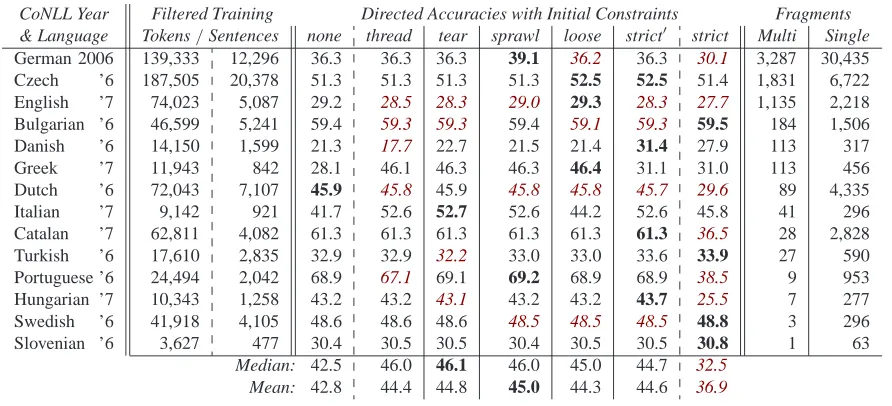
Table 4: Parsing performance for grammar inducers trained with capitalization-based initial constraints, tested against 14 held-out sets from 2006/7 CoNLL shared tasks, and ordered by number of multi-token fragments in training data.
to 45 words (excluding Section 23). Table 3 shows evaluation results on held-out data (all sentences), using “add-one” smoothing. All constraints other than strict improve accuracy by about a half-a-point, from 71.8 to 72.4%, suggesting that capitalization is informative of certain regularities not captured by DBM grammars; moreover, it still continues to be useful when punctuation-based constraints are also enforced, boosting accuracy from 74.5 to 74.9%.
5 Multi-Lingual Grammar Induction
So far, we showed only that capitalization informa-tion can be helpful in parsing a very specific genre of English. Next, we tested its ability to generally aid dependency grammar induction, focusing on sit-uations when other bracketing cues are unavailable.
We experimented with 14 languages from 2006/7 CoNLL shared tasks (Buchholz and Marsi, 2006; Nivre et al., 2007), excluding Arabic, Chinese and Japanese (which lack case), as well as Basque and Spanish (which are pre-processed in a way that loses relevant capitalization information). For all remain-ing languages we trained only on simple sentences — those lacking sentence-internal punctuation — from the relevant training sets (for blind evaluation). Restricting our attention to a subset of the avail-able training data serves a dual purpose. First, it al-lows us to estimate capitalization’s impact where no other (known or obvious) cues could also be used.
Otherwise, unconstrained baselines would not yield the strongest possible alternative, and hence not the most interesting comparison. Second, to the extent that presence of punctuation may correlate with sen-tence complexity (Frank, 2000), there are benefits to “starting small” (Elman, 1993): e.g., relegating full data to later stages helps training (Spitkovsky et al., 2010a; Cohn et al., 2011; Tu and Honavar, 2011).
Our base systems induced DBM-1, starting from uniformly-at-random chosen parse trees (Cohen and Smith, 2010) of each sentence, followed by inside-outside re-estimation (Baker, 1979) with “add-one” smoothing.2 Capitalization-constrained systems dif-fered from controls in exactly one way: each learner got a slight nudge towards more promising struc-tures by choosing initial seed trees satisfying an ap-propriate constraint (but otherwise still uniformly).
Table 4 contains the stats for all 14 training sets, ordered by number of multi-token fragments. Fi-nal accuracies on respective (disjoint, full) evalua-tion sets are improved by all constraints other than
strict, with the highest average performance
result-ing from sprawl: 45.0% directed dependency accu-racy,3on average. This increase of about two points over the base system’s 42.8% is driven primarily by improvements in two languages (Greek and Italian).
2
We used “early-stopping lateen EM” (Spitkovsky et al., 2011a,§2.3) instead of thresholding or waiting for convergence.
3Starting from five parse trees for each sentence (using
6 Capitalizing on Punctuation in Inference
Until now we avoided using punctuation in grammar induction, except to filter data. Yet our pilot exper-iments indicated that both kinds of information are helpful in the decoding stage of a supervised system. We took trained models obtained using the sprawl nudge (from§5) and proceeded to again apply con-straints in inference (as in§4). Capitalization alone increased parsing accuracy only slightly, from 45.0 to 45.1%, on average. Using punctuation constraints instead led to more improved performance: 46.5%. Combining both types of constraints again resulted in slightly higher accuracies: 46.7%. Table 5 breaks down our last average performance number by lan-guage and shows the combined approach to be com-petitive with state-of-the-art. We suspect that further improvements could be attained by also incorporat-ing both constraints in trainincorporat-ing and with full data.
7 Discussion and A Few Post-Hoc Analyses
Our discussion, thus far, has been English-centric. Nevertheless, languages differ in how they use capi-talization (and even the rules governing a given lan-guage tend to change over time — generally towards having fewer capitalized terms). For instance, adjec-tives derived from proper nouns are not capitalized in French, German, Polish, Spanish or Swedish, un-like in English (see Table 1:JJ). And while English forces capitalization of the first-person pronoun in the nominative case,I(see Table 1:PRP), in Danish it is the plural second-person pronoun (also I) that is capitalized; further, formal pronouns (and their case-forms) are capitalized in German (SieandIhre, Ihres...), Italian, Slovenian, Russian and Bulgarian.
In contrast to pronouns, single-word proper nouns — including personal names — are capitalized in nearly all European languages. Such shortest brack-etings are not particularly useful for constraining sets of possible parse trees in grammar induction, however, compared to multi-word expressions; from this perspective, German appears less helpful than most cased languages, because of noun compound-ing, despite prescribing capitalization of all nouns. Another problem with longer word-strings in many languages is that, e.g., in French (as in English) lower-case prepositions may be mixed in with con-tiguous groups of proper nouns: even in surnames,
CoNLL Year this State-of-the-Art Systems: POS-& Language Work (i) Agnostic (ii) Identified
Bulgarian 2006 64.5 44.3 SCAJ5 70.3 Spt Catalan ’7 61.5 63.8 SCAJ5 56.3 MZNR Czech ’6 53.5 50.5 SCAJ5 33.3∗MZNR Danish ’6 20.6 46.0 RF 56.5 Sar Dutch ’6 46.7 32.5 SCAJ5 62.1 MPHel English ’7 29.2 50.3 SAJ 45.7 MPHel German ’6 42.6 33.5 SCAJ5 55.8 MPHnl
Greek ’7 49.3 39.0 MZ 63.9 MPHen
Hungarian ’7 53.7 48.0 MZ 48.1 MZNR Italian ’7 50.5 57.5 MZ 69.1 MPHpt Portuguese ’6 72.4 43.2 MZ 76.9 Sbg
Slovenian ’6 34.8 33.6 SCAJ5 34.6 MZNR Swedish ’6 50.5 50.0 SCAJ6 66.8 MPHpt
Turkish ’6 34.4 40.9 SAJ 61.3 RFH1
Median: 48.5 45.2 58.9
[image:4.612.313.541.71.270.2]Mean: 46.7 45.2 57.2∗
Table 5: Unsupervised parsing with both capitalization-and punctuation-induced constraints in inference, tested against the 14 held-out sets from 2006/7 CoNLL shared tasks, and state-of-the-art results (all sentence lengths) for systems that: (i) are also POS-agnostic and monolingual, including SCAJ (Spitkovsky et al., 2011a, Tables 5–6) and SAJ (Spitkovsky et al., 2011b); and (ii) rely on gold POS-tag identities to (a) discourage noun roots (Mareˇcek and Zabokrtsk ´y, 2011, MZ), (b) encourage verbs (Ra-sooli and Faili, 2012, RF), or (c) transfer delexicalized parsers (Søgaard, 2011a, S) from resource-rich languages with parallel translations (McDonald et al., 2011, MPH).
the German particlevonis not capitalized, although the Dutchvanis, unless preceded by a given name or initial — henceVan Gogh, yetVincent van Gogh.
7.1 Constraint Accuracies Across Languages
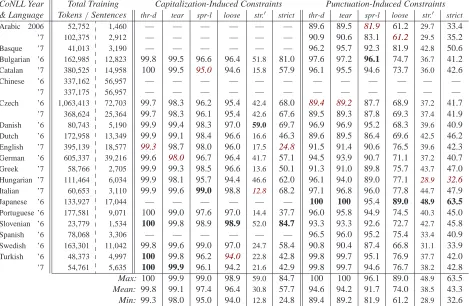
Since even related languages (e.g., Flemish, Dutch, German and English) can have quite different con-ventions regarding capitalization, one would not ex-pect the same simple strategy to be uniformly useful — or useful in the same way — across disparate lan-guages. To get a better sense of how universal our constraints may be, we tabulated their accuracies for the full training sets of the CoNLL data, after all grammar induction experiments had been executed.
partic-CoNLL Year Total Training Capitalization-Induced Constraints Punctuation-Induced Constraints & Language Tokens/Sentences thr-d tear spr-l loose str.′ strict thr-d tear spr-l loose str.′ strict
Arabic 2006 52,752 1,460 — — — — — — 89.6 89.5 81.9 61.2 29.7 33.4
’7 102,375 2,912 — — — — — — 90.9 90.6 83.1 61.2 29.5 35.2
Basque ’7 41,013 3,190 — — — — — — 96.2 95.7 92.3 81.9 42.8 50.6
Bulgarian ’6 162,985 12,823 99.8 99.5 96.6 96.4 51.8 81.0 97.6 97.2 96.1 74.7 36.7 41.2
Catalan ’7 380,525 14,958 100 99.5 95.0 94.6 15.8 57.9 96.1 95.5 94.6 73.7 36.0 42.6
Chinese ’6 337,162 56,957 — — — — — — — — — — — —
’7 337,175 56,957 — — — — — — — — — — — —
Czech ’6 1,063,413 72,703 99.7 98.3 96.2 95.4 42.4 68.0 89.4 89.2 87.7 68.9 37.2 41.7
’7 368,624 25,364 99.7 98.3 96.1 95.4 42.6 67.6 89.5 89.3 87.8 69.3 37.4 41.9
Danish ’6 80,743 5,190 99.9 99.4 98.3 97.0 59.0 69.7 96.9 96.9 95.2 68.3 39.6 40.9
Dutch ’6 172,958 13,349 99.9 99.1 98.4 96.6 16.6 46.3 89.6 89.5 86.4 69.6 42.5 46.2
English ’7 395,139 18,577 99.3 98.7 98.0 96.0 17.5 24.8 91.5 91.4 90.6 76.5 39.6 42.3
German ’6 605,337 39,216 99.6 98.0 96.7 96.4 41.7 57.1 94.5 93.9 90.7 71.1 37.2 40.7
Greek ’7 58,766 2,705 99.9 99.3 98.5 96.6 13.6 50.1 91.3 91.0 89.8 75.7 43.7 47.0
Hungarian ’7 111,464 6,034 99.9 98.1 95.7 94.4 46.6 62.0 96.1 94.0 89.0 77.1 28.9 32.6
Italian ’7 60,653 3,110 99.9 99.6 99.0 98.8 12.8 68.2 97.1 96.8 96.0 77.8 44.7 47.9
Japanese ’6 133,927 17,044 — — — — — — 100 100 95.4 89.0 48.9 63.5
Portuguese ’6 177,581 9,071 100 99.0 97.6 97.0 14.4 37.7 96.0 95.8 94.9 74.5 40.3 45.0
Slovenian ’6 23,779 1,534 100 99.8 98.9 98.9 52.0 84.7 93.3 93.3 92.6 72.7 42.7 45.8
Spanish ’6 78,068 3,306 — — — — — — 96.5 96.0 95.2 75.4 33.4 40.9
Swedish ’6 163,301 11,042 99.8 99.6 99.0 97.0 24.7 58.4 90.8 90.4 87.4 66.8 31.1 33.9
Turkish ’6 48,373 4,997 100 99.8 96.2 94.0 22.8 42.8 99.8 99.7 95.1 76.9 37.7 42.0
’7 54,761 5,635 100 99.9 96.1 94.2 21.6 42.9 99.8 99.7 94.6 76.7 38.2 42.8
Max: 100 99.9 99.0 98.9 59.0 84.7 100 100 96.1 89.0 48.9 63.5
Mean: 99.8 99.1 97.4 96.4 30.8 57.7 94.6 94.2 91.7 74.0 38.5 43.3
[image:5.612.79.548.74.380.2]Min: 99.3 98.0 95.0 94.0 12.8 24.8 89.4 89.2 81.9 61.2 28.9 32.6
Table 6: Accuracies for capitalization- and punctuation-induced constraints on all (full) 2006/7 CoNLL training sets.
ularly special about Greek or Italian in these sum-maries that could explain their substantial improve-ments (18 and 11%, respectively — see Table 4), though Italian does appear to mesh best with the
sprawl constraint (not by much, closely followed by
Swedish). And English — the language from which we drew our inspiration — barely improved with capitalization-induced constraints (see Table 4) and caused the lowest accuracies of thread and strict.
These outcomes are not entirely surprising: some best- and worst-performing results are due to noise, since learning via non-convex optimization can be chaotic: e.g., in the case of Greek, applying 113 con-straints to initial parse trees could have a significant impact on the first grammar estimated in training — and consequently also on a learner’s final, converged model instance. We expect the averages (i.e., means and medians) — computed over many data sets — to be more stable and meaningful than the outliers.
7.2 Immediate Impact from Capitalization
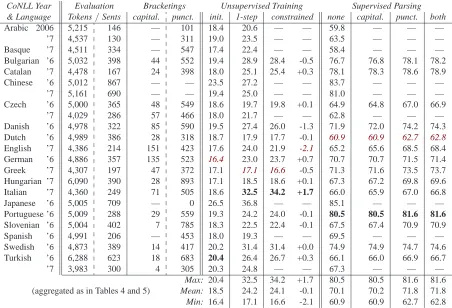
Next, we considered two settings that are less af-fected by training noise: grammar inducers
immedi-ately after an initial step of constrained Viterbi EM and supervised DBM parsers (trained on sentences with up to 45 words), for various languages in the CoNLL sets. Table 7 shows effects of capitalization to be exceedingly mild, both if applied alone and in tandem with punctuation. Exploring better ways of incorporating this informative resource — perhaps as soft features, rather than as hard constraints — and in combination with punctuation- and markup-induced bracketings could be a fruitful direction.
7.3 Odds and Ends
CoNLL Year Evaluation Bracketings Unsupervised Training Supervised Parsing & Language Tokens/Sents capital. punct. init. 1-step constrained none capital. punct. both
Arabic 2006 5,215 146 — 101 18.4 20.6 — — 59.8 — — —
’7 4,537 130 — 311 19.0 23.5 — — 63.5 — — —
Basque ’7 4,511 334 — 547 17.4 22.4 — — 58.4 — — —
Bulgarian ’6 5,032 398 44 552 19.4 28.9 28.4 -0.5 76.7 76.8 78.1 78.2
Catalan ’7 4,478 167 24 398 18.0 25.1 25.4 +0.3 78.1 78.3 78.6 78.9
Chinese ’6 5,012 867 — — 23.5 27.2 — — 83.7 — — —
’7 5,161 690 — — 19.4 25.0 — — 81.0 — — —
Czech ’6 5,000 365 48 549 18.6 19.7 19.8 +0.1 64.9 64.8 67.0 66.9
’7 4,029 286 57 466 18.0 21.7 — — 62.8 — — —
Danish ’6 4,978 322 85 590 19.5 27.4 26.0 -1.3 71.9 72.0 74.2 74.3
Dutch ’6 4,989 386 28 318 18.7 17.9 17.7 -0.1 60.9 60.9 62.7 62.8
English ’7 4,386 214 151 423 17.6 24.0 21.9 -2.1 65.2 65.6 68.5 68.4
German ’6 4,886 357 135 523 16.4 23.0 23.7 +0.7 70.7 70.7 71.5 71.4
Greek ’7 4,307 197 47 372 17.1 17.1 16.6 -0.5 71.3 71.6 73.5 73.7
Hungarian ’7 6,090 390 28 893 17.1 18.5 18.6 +0.1 67.3 67.2 69.8 69.6
Italian ’7 4,360 249 71 505 18.6 32.5 34.2 +1.7 66.0 65.9 67.0 66.8
Japanese ’6 5,005 709 — 0 26.5 36.8 — — 85.1 — — —
Portuguese ’6 5,009 288 29 559 19.3 24.2 24.0 -0.1 80.5 80.5 81.6 81.6
Slovenian ’6 5,004 402 7 785 18.3 22.5 22.4 -0.1 67.5 67.4 70.9 70.9
Spanish ’6 4,991 206 — 453 18.0 19.3 — — 69.5 — — —
Swedish ’6 4,873 389 14 417 20.2 31.4 31.4 +0.0 74.9 74.9 74.7 74.6
Turkish ’6 6,288 623 18 683 20.4 26.4 26.7 +0.3 66.1 66.0 66.9 66.7
’7 3,983 300 4 305 20.3 24.8 — — 67.3 — — —
Max: 20.4 32.5 34.2 +1.7 80.5 80.5 81.6 81.6 (aggregated as in Tables 4 and 5) Mean: 18.5 24.2 24.1 -0.1 70.1 70.2 71.8 71.8
[image:6.612.81.533.71.379.2]Min: 16.4 17.1 16.6 -2.1 60.9 60.9 62.7 62.8
Table 7: Unsupervised accuracies for uniform-at-random projective parse trees (init), also after a step of Viterbi EM, and supervised performance with induced constraints, on 2006/7 CoNLL evaluation sets (sentences under 145 tokens).
phenomenon and found that in 16 of the 19 CoNLL languages first words are more likely to be leaves than other words without dependents on the left;4 last words, by contrast, are more likely to take de-pendents than expected. These propensities may be related to the functional tendency of languages to place old information before new (Ward and Birner, 2001) and could also help bias grammar induction.
[image:6.612.85.535.72.380.2]Lastly, capitalization points to yet another class of words: those with identical upper- and lower-case forms. Their constraints too tend to be accurate (see Table 2: uncased), but the underlying text is not par-ticularly interesting. In WSJ, caseless multi-token fragments are almost exclusively percentages (e.g., the two tokens of10%), fractions (e.g.,1 1/4) or both. Such boundaries could be useful in dealing with fi-nancial data, as well as for breaking up text in lan-guages without capitalization (e.g., Arabic, Chinese
4
Arabic, Basque, Bulgarian, Catalan, Chinese, Danish, Dutch, English, German, Greek, Hungarian, Italian, Japanese, Portuguese, Spanish, Swedish vs. Czech, Slovenian, Turkish.
and Japanese). More generally, transitions between different fonts and scripts should be informative too.
8 Conclusion
Acknowledgments
Funded, in part, by Defense Advanced Research Projects Age-ncy (DARPA) Machine Reading Program under Air Force Re-search Laboratory (AFRL) prime contract FA8750-09-C-0181. Any opinions, findings, and conclusions or recommendations expressed in this material are those of the authors and do not necessarily reflect the views of DARPA, AFRL, or the US gov-ernment. We also thank Ryan McDonald and the anonymous reviewers for helpful comments on draft versions of this paper.
References
J. K. Baker. 1979. Trainable grammars for speech recognition. In Speech Communication Papers for the 97th Meeting of the
Acoustical Society of America.
E. J. Briscoe. 1994. Parsing (with) punctuation, etc. Technical report, Xerox European Research Laboratory.
S. Buchholz and E. Marsi. 2006. CoNLL-X shared task on multilingual dependency parsing. In CoNLL.
S. B. Cohen and N. A. Smith. 2009. Shared logistic normal dis-tributions for soft parameter tying in unsupervised grammar induction. In NAACL-HLT.
S. B. Cohen and N. A. Smith. 2010. Viterbi training for PCFGs: Hardness results and competitiveness of uniform initializa-tion. In ACL.
S. B. Cohen, D. Das, and N. A. Smith. 2011. Unsupervised structure prediction with non-parallel multilingual guidance. In EMNLP.
T. Cohn, P. Blunsom, and S. Goldwater. 2011. Inducing tree-substitution grammars. Journal of Machine Learning
Re-search.
M. Collins. 1999. Head-Driven Statistical Models for Natural
Language Parsing. Ph.D. thesis, University of Pennsylvania.
J. L. Elman. 1993. Learning and development in neural net-works: The importance of starting small. Cognition, 48. R. Frank. 2000. From regular to free to mildly
context-sensitive tree rewriting systems: The path of child language acquisition. In A. Abeill´e and O. Rambow, editors, Tree
Adjoining Grammars: Formalisms, Linguistic Analysis and Processing. CSLI Publications.
K. Gimpel and N. A. Smith. 2011. Concavity and initialization for unsupervised dependency grammar induction. Technical report, CMU.
M. P. Marcus, B. Santorini, and M. A. Marcinkiewicz. 1993. Building a large annotated corpus of English: The Penn Treebank. Computational Linguistics, 19.
D. Mareˇcek and Z. Zabokrtsk´y. 2011. Gibbs sampling with treeness constraint in unsupervised dependency parsing. In
ROBUS.
R. McDonald, S. Petrov, and K. Hall. 2011. Multi-source trans-fer of delexicalized dependency parsers. In EMNLP. T. Naseem and R. Barzilay. 2011. Using semantic cues to learn
syntax. In AAAI.
T. Naseem, H. Chen, R. Barzilay, and M. Johnson. 2010. Using universal linguistic knowledge to guide grammar induction. In EMNLP.
J. Nivre, J. Hall, S. K¨ubler, R. McDonald, J. Nilsson, S. Riedel, and D. Yuret. 2007. The CoNLL 2007 shared task on de-pendency parsing. In EMNLP-CoNLL.
F. Pereira and Y. Schabes. 1992. Inside-outside reestimation from partially bracketed corpora. In ACL.
E. Ponvert, J. Baldridge, and K. Erk. 2010. Simple unsuper-vised identification of low-level constituents. In ICSC. E. Ponvert, J. Baldridge, and K. Erk. 2011. Simple
unsuper-vised grammar induction from raw text with cascaded finite state models. In ACL-HLT.
M. S. Rasooli and H. Faili. 2012. Fast unsupervised depen-dency parsing with arc-standard transitions. In
ROBUS-UNSUP.
Y. Seginer. 2007. Fast unsupervised incremental parsing. In
ACL.
A. Søgaard. 2011a. Data point selection for cross-language adaptation of dependency parsers. In ACL-HLT.
A. Søgaard. 2011b. From ranked words to dependency trees: two-stage unsupervised non-projective dependency parsing. In TextGraphs.
V. I. Spitkovsky, H. Alshawi, and D. Jurafsky. 2010a. From Baby Steps to Leapfrog: How “Less is More” in unsuper-vised dependency parsing. In NAACL-HLT.
V. I. Spitkovsky, D. Jurafsky, and H. Alshawi. 2010b. Profiting from mark-up: Hyper-text annotations for guided parsing. In
ACL.
V. I. Spitkovsky, H. Alshawi, and D. Jurafsky. 2011a. Lateen EM: Unsupervised training with multiple objectives, applied to dependency grammar induction. In EMNLP.
V. I. Spitkovsky, H. Alshawi, and D. Jurafsky. 2011b. Punctu-ation: Making a point in unsupervised dependency parsing. In CoNLL.
V. I. Spitkovsky, A. X. Chang, H. Alshawi, and D. Jurafsky. 2011c. Unsupervised dependency parsing without gold part-of-speech tags. In EMNLP.
V. I. Spitkovsky, H. Alshawi, and D. Jurafsky. 2012. Three dependency-and-boundary models for grammar induction. In submission to EMNLP.
K. Tu and V. Honavar. 2011. On the utility of curricula in unsupervised learning of probabilistic grammars. In IJCAI. G. Ward and B. J. Birner. 2001. Discourse and information