Combining Word-Level and Character-Level Representations for
Relation Classification of Informal Text
Dongyun Liang, Weiran Xu, Yinge Zhao,
PRIS, Beijing University of Posts and Telecommunications, China
{dongyunliang, xuweiran}@bupt.edu.cn [email protected]
Abstract
Word representation models have achieved great success in natural language process-ing tasks, such as relation classification. However, it does not always work on infor-mal text, and the morphemes of some mis-spelling words may carry important short-distance semantic information. We pro-pose a hybrid model, combining the mer-its of word-level and character-level rep-resentations to learn better reprep-resentations on informal text. Experiments on two dataset of relation classification, SemEval-2010 Task8 and a large-scale one we com-pile from informal text, show that our model achieves a competitive result in the former and state-of-the-art with the other.
1 Introduction
Deep learning has made significant progress in natural language processing, and most of ap-proaches treat word representations as the corner-stone. Though it is effective, word-level represen-tation is inherently problematic: it assumes that each word type has its own vector that can vary in-dependently; most words only occur once in train-ing data and out-of-vocabulary(OOV) words can-not be addressed. A word may typically include a root and one or more affixes (rock-s, red-ness, quick-ly, run-ning, un-expect-ed), or more than one root in a compound (black-board, rat-race). It is reasonable to assume that words which share common components(root, prefix, suffix)may be potentially related, while word-level representa-tion considers each word separately. On the other hand, new words enter English from every area of life, e.g. Chillaxing- Blend ofchillingand relax-ing, represent taking a break from stressful activ-ities to rest or relax. Whereas the vocabulary size
of word-level model is fixed beforehand, the lack of these word representations may lose important semantic information.
Especially on informal text, the problems of word-level representation will be amplified and hard to ignore. Recently, character-level repre-sentation, which takes characters as atomic units to derive the embeddings, demonstrates that it can memorize the arbitrary aspects of word orthogra-phy. Parameters of these simple model are less, and it will be not ideal when processing long sen-tence. Combining word-level and character-level representations attempts to overcome the weak-nesses of the two representations.
We utilize a Bidirectional Gated Recurrent Unit (Bi-GRU) (Chung et al., 2014) and Convolu-tional Neural Networks(CNN) to capture two-level semantic representations respectively. While character-level information is likely to be drowned out by word-level information if simply con-nected, we adopt Highway Networks ( Srivas-tava et al., 2015) to balance both. To evaluate our model, we evaluate on a public benchmark: SemEval-2010 Task8. This dataset is small and restricted in their relation types and their syn-tactic and lexical variations, and it is still un-known whether learning on the range of the spe-cific relation transfers well to informal text. As such, we introduce a large-scale dataset based on the corpus and queries of TAC-KBP Slot Fill-ing Track (Surdeanu and Ji,2014) between 2009 to 2014, which contains 48k relation sentences, called KBP-SF481.
TAC-KBP corpus comes from newswire, Web, post and discussion forum documents actually comprised of informal content, including language mismatch and spelling errors. We extract sen-tences from slots and fillers of Slot Filling
Evalua-1https://github.com/waterblas/KBP-SF48
tion with position indicators to keep the same for-mat as SemEval-2010 Task8. For instance, the fol-lowing sentence with two nominals surrounded by position indicators belong toorg:founded by rela-tion:
Bharara’s office brought insider trading charges against <e1>Raj Rajaratnam <e1/>, the co-founder of hedge fund <e2>Galleon Group<e2/>.
2 Related Work
Some works (Mikolov et al., 2013; Pennington et al., 2014) started to learn semantic representa-tions of word by unsupervised approaches. Re-cently, relation classification has focused on neu-ral networks. Zeng et al. (2014) utilized CNN to learn patterns of relations from raw text data to make representative progress, but a potential problem is that CNN is not suitable for learning long-distance semantic information. Santos et al. (2015) proposed a similar model named CR-CNN, and replaced the cost function with a ranking-based function. Some models (Xu et al., 2015; Cai et al.,2016) leveraged the shortest dependency path(SDP) between two nominals. Others (Zhou et al., 2016;Wang et al., 2016) employed atten-tion mechanism to capture more important seman-tic information.
Working to a new dataset KBP37, Zhang and Wang (2015) proposed a framework based on a bidirectional Recurrent Neural Network(RNN). However, all these methods depend on learning word-level distributed representation without uti-lizing morphological feature.
Recent work captures word orthography using character-based neural networks. dos Santos and Zadrozny(2014) proposed a deep neural network to learn character-level representation of words for POS Tagging. Zhang et al. (2015) demonstrated the effectiveness of character-level CNN in text classification. Kim et al. (2015) employed CNN and a highway network to learn rich semantic and orthographic features from encoding characters. There were some models (Ling et al.,2015; Dhin-gra et al.,2016) based on RNN structures, which can memorize arbitrary aspects of word orthogra-phy over characters.
Our model uses multi-channel GRU units and CNN architecture to learn the representations of word-level and character-level, and project it to a softmax output layer for relation classification.
3 Model
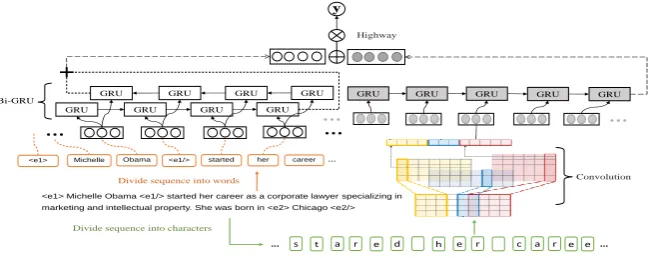
As shown in Figure 1, the model learns word-level and character-word-level representations respec-tively, and combines them with interaction to get the final representation.
3.1 Word-level
Given a relation sentence consisting of words
w1, w2, ..., wm, each wi is defined as a one hot
vector 1wi, with value 1 at index wi and 0 in
all other dimensionality. We multiply a matrix
PW ∈Rdw×|V|by1wito project the wordwiinto
its word embeddingxi, as with a lookup table:
xi =PWwi (1)
wheredw is the size of word embedding andV
is the vocabulary of training set.
Then input thex1, x2, ..., xm sequence to a
Bi-GRU network iteratively. Each Bi-GRU unit apply the following transformations:
rt=σ(Wrxt+Urht−1+br)
zt=σ(Wzxt+Uzht−1+bz)
ht= (1−zt)ht−1+zteht
eht= tanh(Whxt+Uh(rtht−1) +bh)
(2)
whereztis a set of update gates, rtis a set of
re-set gates andis an element-wise multiplication.
Wr, Wz, Wh and Ur, Uz, Uh are weight matrices
to be learned, andeht is the candidate activation.
We use element-wise sum to combine the forward and backward pass final states as word-level rep-resentation:hw
m= [−→hm+←h−0].
3.2 Character-level
To capture morphological features, we use convo-lutions to learn local n-gram features at the lower network layer. As character-level input, origi-nal sentence is decomposed into a sequence of characters, including special characters, such as white-space. We first project each character into a character embeddingxiby a lookup table whose
mechanism is exactly as Eq.1.
Given thex1, x2, , xnembedding sequence, we
compose the matrixDk∈Rkdc×nto execute
con-volutions with same padding:
Ck= tanh(Wconk Dk) (3)
wheredcis the size of word embedding and each
s t a r e d h e r c a r e
… e …
Divide sequence into words
Divide sequence into characters
Michelle Obama <e1/> started her career <e1> …
<e1> Michelle Obama <e1/> started her career as a corporate lawyer specializing in marketing and intellectual property. She was born in <e2> Chicago <e2/>
GRU GRU GRU GRU
… …… …
GRU GRU GRU GRU GRU Bi-GRU
GRU GRU GRU GRU
Convolution
y
[image:3.595.139.466.63.192.2]Highway
Figure 1: Hybrid model combining word-level and character-level representation.
vectors (i.e. k embeddings centered at the i-th character),Wk
conis a weight matrix of convolution
layer, and Ck ∈ Rc×n is the output of the
con-volution withc filters. We usep groups of filters with varying widths to obtain n-gram feature, and concatenate them by column:
C=Ck1⊕Ck2 ⊕...⊕Ckp (4)
The next step, ci, ..., cn denoted by the column
vector ofCare fed as input sequence to a forward-GRU network(Eq.2), and we pick up final states activationhc
nas character-level representation.
3.3 Combination
Instead of fully connected network layer, we uti-lize Highway Networks to emphasize impact of character level. Highway can be used to adap-tively copy or transform representations, even when large depths are not required. We apply this idea to retain some independence of word and character when merging with interaction. Let h∗
be the concatenation ofhw
mandhcn, The
combina-tionzis obtained by the Highway Network:
z=tg(WHh∗+bH) + (1−t)h∗
t=σ(WTh∗+bT) (5)
wheregis a nonlinear function (tanh),tis referred to as the transform gate, and(1−t) as the carry gate.WT andWH are square weight matrices, and
bT andbH are bias vectors.
3.4 Training
Training our model for classifying sentence rela-tion is a processes to optimizing the whole param-etersθof network layers. Given a input sentence
Xand the candidate set of relationY, the classifier returns outputyˆas follows:
ˆ
y= arg max
y∈Y p(y|X, θ) (6)
We let the combination vector z through a softmax layer to give the distribution y = softmax(Wfz+bf).
The training objective is the penalized cross-entropy loss between predicted and true relation:
J(θ) =−N1 XN i=1
m
X
j=1
ti,jlog(yi,j) +λkθk2F (7)
whereN is the mini-batch size,mis the size of re-lation set,t∈Rmdenotes the one-hot represented
ground truth, yi,j is the predicted probability that
the i−th sentence belongs to class j, and λ is a coefficient ofL2 regularization.
4 Experiments 4.1 Dataset
We evaluate our model on two dataset. SemEval-2010 Task8 dataset contains 9 direc-tional relations and an Other class.
There exist dataset derived from TAC-KBP for relation classification, such as KBP37(20k example for evaluation) collected by (Zhang and Wang, 2015). Based on this and more public corpus of resent years, we introduce a new larger scale dataset, called KBP-SF48. There are 48,340 anno-tated examples distributed among 40 rela-tions(excludingno relationandorg:website), including 33,838 sentences for training that consists of 102 unique characters, 9,668 for testing and 4,834 for validation.
be-longs to these relations can be filled in spe-cific slots. There exists non-directional and the directional corresponding relations (e.g. per:children & per:parents and org:members & org:member of).
4.2 Results
Model F1
SVM (Rink and Harabagiu,2010) 82.2 CNN (Zeng et al.,2014) 82.7 SDP-LSTM (Xu et al.,2015) 83.7 Att-BLSTM (Zhou et al.,2016) 84.0 BRCNN (Cai et al.,2016) 86.3
[image:4.595.308.526.62.230.2]Ours 84.1
Table 1: Comparison on SemEval-2010 Task8.
Table1compares our model with other pre-vious state-of-the-art methods on SemEval-2010 Task8 dataset. Rink and Harabagiu
(2010) built a SVM classifier on a variety of handcrafted features, and achieved an F1-score of 82.2%. Xu et al. (2015) achieved an F1-score of 83.7% via heterogeneous information along the SDP. BRCNN (Cai et al.,2016) combined CNN and two-channel LSTM units to learns features along SDP, and made use of POS tags, NER and WordNet hypernyms. Att-BLSTM (Zhou et al., 2016) only operated attention mechanism on Bidi-rectional Long Short-Term Memory(BLSTM) units with word vector.
Our model yields an F1-score of 84.1%, and outperforms most of the existing com-peting approaches without using any human-designed features and lexical resources.
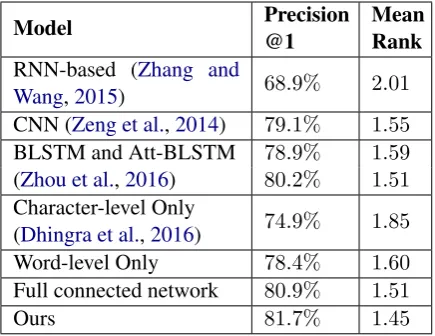
On KBP-SF48 benchmark, we evaluate our model by top 1 precision, and mean rank of correct relation because of the existence of non-directional relations,
We reproduce the results on our own to show the performances of the other systems with the same train/dev/test splits, and ab-late different aspects of the proposed model to show the impact of every component of our architecture. As is seen from Table 2, our model achieves a state-of-the-art result on KBP-SF48 dataset. Our model has al-ready outperformed the RNN-based (Zhang and Wang,2015) model of the KBP37 dataset,
Model Precision@1 MeanRank RNN-based (Zhang and
Wang,2015) 68.9% 2.01 CNN (Zeng et al.,2014) 79.1% 1.55
BLSTM and Att-BLSTM
(Zhou et al.,2016) 78.9%80.2% 1.591.51
Character-level Only
(Dhingra et al.,2016) 74.9% 1.85 Word-level Only 78.4% 1.60
Full connected network 80.9% 1.51
Ours 81.7% 1.45
Table 2: Comparison on KBP-SF48
a small scale dataset based on TAC-KBP Slot Filling Track. We compare our results against some state-of-the-art methods (Zeng et al., 2014; Zhou et al., 2016) of SemEval-2010 Task8, and our model achieves a bet-ter result by combining characbet-ter feature into word-level representation. Then, we illustrate Bi-GRU architecture of Tweet2Vec (Dhingra et al., 2016), a pure character-level compo-sition model, to show the effectiveness of character-level representation. Next, we get rid of the impact of characters to do word-level only experiment, and replace the high-way with a fully connected layer. These clean comparisons demonstrate that the character-level and Highway network help to learn a better representation for classification.
5 Conclusion
[image:4.595.76.289.162.267.2]References
Rui Cai, Xiaodong Zhang, and Houfeng Wang. 2016. Bidirectional recurrent con-volutional neural network for relation clas-sification. In Proceedings of the 54th An-nual Meeting of the Association for Com-putational Linguistics. pages 756–765. Junyoung Chung, Caglar Gulcehre,
KyungHyun Cho, and Yoshua Bengio. 2014. Empirical evaluation of gated recurrent neural networks on sequence modeling. arXiv preprint arXiv:1412.3555 .
Bhuwan Dhingra, Zhong Zhou, Dylan Fitz-patrick, Michael Muehl, and William W Cohen. 2016. Tweet2vec: Character-based distributed representations for social media. arXiv preprint arXiv:1605.03481.
C´ıcero Nogueira dos Santos and Bianca Zadrozny. 2014. Learning character-level representations for part-of-speech tagging. InICML. pages 1818–1826.
Yoon Kim, Yacine Jernite, David Sontag, and Alexander M Rush. 2015. Character-aware neural language models. arXiv preprint arXiv:1508.06615.
Wang Ling, Tiago Lu´ıs, Lu´ıs Marujo, Ram´on Fernandez Astudillo, Silvio Amir, Chris Dyer, Alan W Black, and Isabel Tran-coso. 2015. Finding function in form: Compositional character models for open vocabulary word representation. arXiv preprint arXiv:1508.02096.
Tomas Mikolov, Kai Chen, Greg Corrado, and Jeffrey Dean. 2013. Efficient estimation of word representations in vector space. arXiv preprint arXiv:1301.3781.
Jeffrey Pennington, Richard Socher, and Christopher D Manning. 2014. Glove: Global vectors for word representation. In EMNLP. volume 14, pages 1532–43. Bryan Rink and Sanda Harabagiu. 2010. Utd:
Classifying semantic relations by combin-ing lexical and semantic resources. ACL 2010page 256.
Cicero Nogueira dos Santos, Bing Xiang, and Bowen Zhou. 2015. Classifying relations by ranking with convolutional neural net-works. arXiv preprint arXiv:1504.06580. Rupesh K Srivastava, Klaus Greff, and J¨urgen
Schmidhuber. 2015. Training very deep networks. In Advances in neural informa-tion processing systems. pages 2377–2385. Mihai Surdeanu and Heng Ji. 2014. Overview
of the english slot filling track at the tac2014 knowledge base population evalu-ation. In Proc. Text Analysis Conference (TAC2014).
Linlin Wang, Zhu Cao, Gerard de Melo, and Zhiyuan Liu. 2016. Relation classifica-tion via multi-level attenclassifica-tion cnns. In Pro-ceedings of the 54th Annual Meeting of the Association for Computational Linguistics. pages 1298–1307.
Yan Xu, Lili Mou, Ge Li, Yunchuan Chen, Hao Peng, and Zhi Jin. 2015. Classify-ing relations via long short term memory networks along shortest dependency paths. InProceedings of Conference on Empirical Methods in Natural Language Processing. Daojian Zeng, Kang Liu, Siwei Lai,
Guangyou Zhou, Jun Zhao, et al. 2014. Relation classification via convolutional deep neural network. In COLING. pages 2335–2344.
Dongxu Zhang and Dong Wang. 2015. Rela-tion classificaRela-tion via recurrent neural net-work. arXiv preprint arXiv:1508.01006. Xiang Zhang, Junbo Zhao, and Yann LeCun.
2015. Character-level convolutional net-works for text classification. In Advances in Neural Information Processing Systems. pages 649–657.