Dialogue-Oriented Review Summary Generation for Spoken Dialogue
Recommendation Systems
Jingjing Liu, Stephanie Seneff, Victor Zue MIT Computer Science & Artificial Intelligence Laboratory
32 Vassar Street, Cambridge, MA 02139 {jingl, seneff, zue}@csail.mit.edu
Abstract
In this paper we present an opinion summari-zation technique in spoken dialogue systems. Opinion mining has been well studied for years, but very few have considered its appli-cation in spoken dialogue systems. Review summarization, when applied to real dialogue systems, is much more complicated than pure text-based summarization. We conduct a sys-tematic study on dialogue-system-oriented review analysis and propose a three-level framework for a recommendation dialogue system. In previous work we have explored a linguistic parsing approach to phrase extrac-tion from reviews. In this paper we will de-scribe an approach using statistical models such as decision trees and SVMs to select the most representative phrases from the ex-tracted phrase set. We will also explain how to generate informative yet concise review summaries for dialogue purposes. Experimen-tal results in the restaurant domain show that the proposed approach using decision tree al-gorithms achieves an outperformance of 13% compared to SVM models and an improve-ment of 36% over a heuristic rule baseline. Experiments also show that the decision-tree-based phrase selection model can achieve ra-ther reliable predictions on the phrase label, comparable to human judgment. The pro-posed statistical approach is based on do-main-independent learning features and can be extended to other domains effectively.
1 Introduction
Spoken dialogue systems are presently available for many purposes, such as weather inquiry (Zue et al., 2000), bus schedules and route guidance
(Raux et al., 2003), customer service (Gorin et al., 1997), and train timetable inquiry (Eckert et al., 1993). These systems have been well developed for laboratory research, and some have become commercially viable.
The next generation of intelligent dialogue sys-tems is expected to go beyond factoid question answering and straightforward task fulfillment, by providing active assistance and subjective recom-mendations, thus behaving more like human agents. For example, an intelligent dialogue sys-tem may suggest which airline is a better choice, considering cost, flight duration, take-off time, available seats, etc.; or suggest which digital cam-era is the most popular among teenagers or highest rated by professional photographers; or which res-taurant is a perfect spot for a semi-formal business meeting or a romantic date.
Luckily, there are enormous amounts of reviews published by general users on the web every day. These are perfect resources for providing subjec-tive recommendations and collecsubjec-tive opinions. If there exists a systematic framework that harvests these reviews from general users, extracts the es-sence from the reviews and presents it appropriate-ly in human-computer conversations, then we can enable dialogue systems to behave like a human shopping assistant, a travel agent, or a local friend who tells you where to find the best restaurant.
learned with statistical models (Snyder and Barzi-lay, 2007; Titov and McDonald, 2008b; Baccia-nella et al., 2009). These approaches are all very effective, and the review databases generated are well presented.
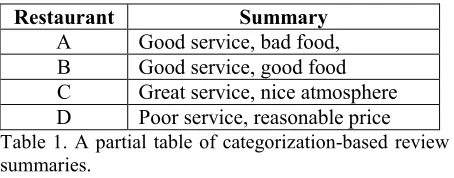
So the first thought for developing a recom-mendation dialogue system is to use such a cate-gorized summary in a table-lookup fashion. For example, a dialogue system for restaurant recom-mendations can look up a summary table as exem-plified in Table 1, and generate a response utterance from each row: “Restaurant A has good service and bad food; restaurant B has good ser-vice and good food; restaurant C has great serser-vice and nice atmosphere; restaurant D has poor service and reasonable price.”
Restaurant Summary
A Good service, bad food,
B Good service, good food
C Great service, nice atmosphere
D Poor service, reasonable price
Table 1. A partial table of categorization-based review summaries.
Such a dialogue system is, however, not very informative. First of all, there is too much redun-dancy. Long utterances repeated in the same pat-tern on the same topic are quite boring, and the information density is very low. Second, such a summary is too coarse-grained to be helpful. A user querying a restaurant recommendation system expects more fine-grained information such as house specials, wine selections and choices on desserts rather than just general ‘good food.’
In contrast to a ‘text’ summarization system, the textual space in a dialogue turn is often very li-mited. Speech is inherently serial, and it cannot be skipped and scanned easily. A dialogue system which speaks long diatribes in each single conver-sation turn would likely not be well received. We believe that the best unit of review summary for dialogue purposes is short succinct phrases (e.g., ‘amazing sauce’ and ‘romantic ambiance’) which are catalogued into categories to answer high-level questions such as “How is the food at this restau-rant?” or “What about the atmosphere?” Also, domain-specific phrases are greatly needed to generate correct answers to specific queries, such as “Which restaurants have fresh sushi?” and
“Show me restaurants that serve fantastic cock-tails.”
Thus, the generally used correlated topic mod-els, although very effective in text-based systems, are not quite suitable for interactive dialogue sys-tems. The missing piece is an HCI-oriented ( hu-man computer interaction), fine-grained, informative yet concise review summarization. A good recommendation system should be able to provide sufficient yet specific information to help users choose a restaurant, a movie or a consumer product. Figure 1 shows an example of a conversa-tion with a good recommendaconversa-tion system, which 1) provides a generalized yet high-density review summary in human-friendly dialogue; 2) provides both a coarse-grained summary (e.g., ‘authentic food’) and fine-grained information such as house specialties.
U: Are there any French restaurants in Cambridge? S: There are five French restaurants in Cambridge.
Most of them are on Backbay Street. And most of them have attentive service.
U: Show me the ones that have nice ambiance. S: Two of them have nice ambiance, Pierrot Bistrot Francais and Coriander.
U: How about the food?
S: Pierrot Bistrot Francais has authentic food, fresh salad, and absolutely delicious spaghetti carbonara. The food at Coriander is below aver-age. It has very greasy chicken tikka masala and dry bread.
Figure 1. Example of a conversation with a good rec-ommendation dialogue system (‘U’ denotes the user and ‘S’ denotes the dialogue system. The responses to the user queries are produced by our system and the actual dialogue was an illustration of system capacities).
Therefore, the task of developing recommenda-tion dialogue systems is decomposed into three problems: 1) how to extract context-related phras-es, both coarse-grained and fine-grained, from online reviews; 2) how to select a representative set from the extracted phrases to create an infor-mative yet concise dialogue-oriented summary database; 3) how to generate human-friendly di-alogue responses from the review summary data-base.
[image:2.612.72.299.274.363.2]re-view phrase extraction. In this paper, we address the second problem: dialogue-oriented review summary generation. We propose an automatic approach to classifying high/low informative phrases using statistical models. Experiments con-ducted on a restaurant-domain dataset indicate that the proposed approach can predict phrase labels consistently with human judgment and can gener-ate high-quality review summaries for dialogue purposes.
The rest of the paper is organized as follows: Section 2 gives an overview of the three-level framework for recommendation dialogue systems. In Section 3, we explain the proposed approach to dialogue-oriented review summary generation. Section 4 provides a systematic evaluation of the proposed approach, and Section 5 gives a further discussion on the experimental results. Section 6 summarizes the paper as well as pointing to future work.
2 System Overview
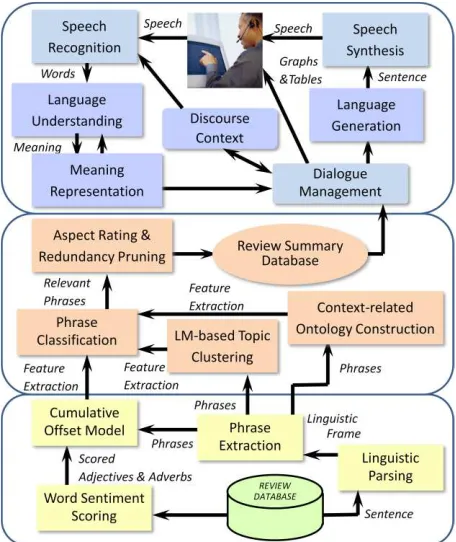
The three-level framework of a review-summary-based recommendation dialogue system is shown in Figure 2. The bottom level is linguistic phrase extraction. In previous work (Liu and Seneff, 2009), we employed a probabilistic lexicalized grammar to parse review sentences into a hierar-chical representation, which we call a linguistic frame. From the linguistic frames, phrases are ex-tracted by capturing a set of adjective-noun rela-tionships. Adverbs and negations conjoined with the adjectives are also captured. We also calcu-lated a numerical score for sentiment strength for each adjective and adverb, and further applied a cumulative offset model to assign a sentiment score to each phrase.
The approach relies on linguistic features that are independent of frequency statistics; therefore it can retrieve very rare phrases such as ‘very greasy chicken tikka masala’ and ‘absolutely delicious spaghetti carbonara’, which are very hard to derive from correlated topic models. Experimental results showed that the linguistic paradigm outperforms existing methods of phrase extraction which em-ploy shallow parsing features (e.g., part-of-speech). The main contribution came from the linguistic frame, which preserves linguistic structure of a sentence by encoding different layers of semantic dependencies. This allows us to employ more
so-phisticated high-level linguistic features (e.g., long distance semantic dependencies) for phrase extrac-tion.
However, the linguistic approach fails to distin-guish highly informative and relevant phrases from uninformative ones (e.g., ‘drunken husband’, ‘whole staff’). To apply these extracted phrases within a recommendation dialogue system, we have to filter out low quality or irrelevant phrases and maintain a concise summary database. This is the second level: dialogue-oriented review sum-mary generation.
Figure 2. Three-level framework of review-based rec-ommendation dialogue systems.
[image:3.612.312.540.223.494.2]help-ful for users to make a decision. Surprisingly, al-though this is a difficult and subjective problem, the judgment from the two annotators is substan-tially consistent. By examining the annotations we observed that phrases such as ‘great value’ and ‘good quality’ are often treated as ‘uninformative’ as they are too common to be representative for a particular product, a restaurant or a movie. Phrases with neutral sentiment (e.g., ‘green beans’ and ‘whole staff’) are often considered as uninforma-tive too. Phrases on specific topics such as house specialties (e.g., ‘absolutely delicious spaghetti carbonara’) are what the annotators care about most and are often considered as highly relevant, even though they may have only been seen once in a large database.
Driven by these criteria, from each phrase we extract a set of statistical features such as uni-gram/bigram probabilities and sentiment features such as sentiment orientation degree of the phrase, as well as underlying semantic features (e.g., whether the topic of the phrase fits in a domain-specific ontology). Classification models such as SVMs and decision tree algorithms are then trained on these features to automatically classify high/low informative phrases. Phrases identified as ‘good’ candidates are further pruned and cata-logued to create concise summaries for dialogue purposes.
After generating the review summary database, the third level is to modify the response generation component in dialogue systems to create genera-lized and interactive conversations, as exemplified in Figure 1. The utterance from users is piped through speech recognition and language under-standing. The meaning representation is then sent to the dialogue management component for re-view-summary database lookup. A response is then generated by the language generation compo-nent, and a speech utterance is generated by the synthesizer and sent back to the user. The dialogue system implementation is beyond the scope of this paper and will be discussed later in a separate pa-per.
3 Dialogue-oriented Review Summary Generation
Given an inquiry from users, the answer from a recommendation system should be helpful and relevant. So the first task is to identify a phrase as
‘helpful’ or not. The task of identifying a phrase as informative and relevant, therefore, is defined as a classification problem:
= ̅ ∙ #̅ =∑&%=1 %#% (1)
where y is the label of a phrase, assigned as ‘1’ if the phrase is highly informative and relevant, and ‘-1’ if the phrase is uninformative. #̅ is the feature vector extracted from the phrase, and ̅ is the coefficient vector.
We employ statistical models such as SVMs (Joachims, 1998) and decision trees (Quinlan, 1986) to train the classification model. For model learning, we employ a feature set including statis-tical features, sentiment features and semantic features.
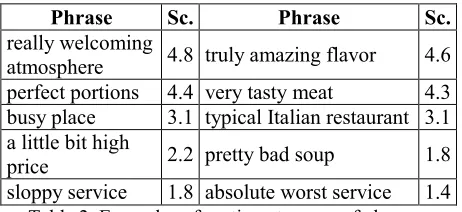
Generally speaking, phrases with neutral senti-ment are less informative than those with strong sentiment, either positive or negative. For example, ‘fried seafood appetizer’, ‘baked halibut’, ‘ elec-tronic bill’ and ‘red drink’ do not indicate whether a restaurant is worth trying, as they did not express whether the fried seafood appetizer or the baked halibut are good or bad. Therefore, we take the sentiment score of each phrase generated from a cumulative offset model (Liu and Seneff, 2009) as a sentiment feature. Sentiment scores of phrases are exemplified in Table 2 (on a scale of 1 to 5).
Phrase Sc. Phrase Sc.
really welcoming
atmosphere 4.8 truly amazing flavor 4.6
perfect portions 4.4 very tasty meat 4.3
busy place 3.1 typical Italian restaurant 3.1 a little bit high
price 2.2 pretty bad soup 1.8
[image:4.612.309.540.438.544.2]sloppy service 1.8 absolute worst service 1.4
Table 2. Examples of sentiment scores of phrases. We also employ a set of statistical features for model training, such as the unigram probability of the adjective in a phrase, the unigram probability of the noun in a phrase, the unigram probability of the phrase and the bigram probability of the adjec-tive-noun pair in a phrase.
they should certainly not be treated as the same. To capture the semantic meanings of phrases, we first cluster the topics of phrases into generic se-mantic categories. The language-model based al-gorithm is given by:
'(()| (%) =∑+ ∈.'(()|+) ∙ '(+|(%)
= ∑ '(+,())
'(+) ∙ '(+,(%)
'((%)
+∈.
= 1
'((%)
∑ 1
'(+)∙ '(+,()) ∙ '(+,(%)
+∈. (2)
where A represents the set of all the adjectives in the corpus. We select a small set of initial topics with the highest frequency counts (e.g., ‘food’, ‘service’and ‘atmosphere’). For each of the other topics tc (e.g., ‘chicken’, ‘waitress’ and ‘décor’), we calculate its similarity with each initial topic (% based on the bigram probability statistics. For those topics with conditional probability higher than a threshold for an initial topic (%, we assign them to the cluster of (%. We use this as a semantic feature, e.g., whether the topic of a phrase belongs to a generic semantic category. Table 3 gives some clustering examples.
Category Relevant Topics
food
appetizer, beer, bread, fish, fries, ice cream, margaritas, menu, pizza, pasta, rib, roll, sauce, seafood, sandwich, steak, sushi, dessert, cocktail, brunch
service waiter, staff, management, server,
hostess, chef, bartender, waitstaff
atmosphere décor, ambiance, music, vibe, setting,
environment, crowd
[image:5.612.307.539.355.592.2]price bill, pricing, prices
Table 3. Topic to semantic category clustering. This language-model-based method relies on bigram probability statistics and can well cluster highly frequent topics. Categories such as ‘service’ and ‘atmosphere’ contain very limited related to p-ics, most of which have high frequencies (e.g., ‘waiter’, ‘staff’, ‘ambiance’ and ‘vibe’). The cate-gory ‘food’, however, is very domain-specific and contains a very large vocabulary, from generic sub-categories such as ‘sushi’, ‘dessert’ and ‘sandwich’ as shown in the examples, to specific courses such as ‘bosc pear bread pudding’ and ‘herb roasted vermont pheasant wine cap m u-shrooms’. These domain-specific topics have very
low frequencies, yet they are very relevant and valuable. But many of them are discarded by the clustering. It would be a similar case in other do-mains. For example, consumer products, movies and books all have domain-independent semantic categories (e.g., ‘price’ and ‘released date’) and domain-specific categories (e.g., technical features of consumer products, casts of movies and authors of books).
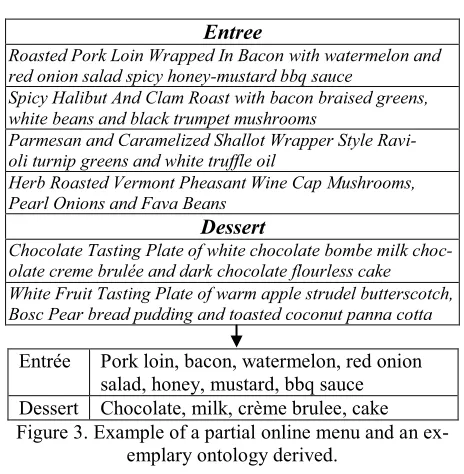
To recover these context-relevant topics, we employ domain context relations such as a con-text-related ontology. A context-related ontology can be constructed from structured web resources such as online menus of restaurants, names of ac-tors and actresses from movie databases, and spe-cifications of products from online shops. An example of a partial online menu of a restaurant is shown in Figure 3. From these structured web re-sources, we can build up a hierarchical ontology, based on which a set of semantic features can be extracted (e.g., whether a phrase contains a course name, or an actress’s name, or a dimension of technical features of a consumer product).
Entree
Roasted Pork Loin Wrapped In Bacon with watermelon and red onion salad spicy honey-mustard bbq sauce
Spicy Halibut And Clam Roast with bacon braised greens, white beans and black trumpet mushrooms
Parmesan and Caramelized Shallot Wrapper Style Ravi-oli turnip greens and white truffle oil
Herb Roasted Vermont Pheasant Wine Cap Mushrooms, Pearl Onions and Fava Beans
Dessert
Chocolate Tasting Plate of white chocolate bombe milk choc-olate creme brulée and dark chocchoc-olate flourless cake White Fruit Tasting Plate of warm apple strudel butterscotch, Bosc Pear bread pudding and toasted coconut panna cotta
[image:5.612.71.294.389.522.2]Entrée Pork loin, bacon, watermelon, red onion salad, honey, mustard, bbq sauce Dessert Chocolate, milk, crème brulee, cake Figure 3. Example of a partial online menu and an
ex-emplary ontology derived.
After the classification, phrases identified as ‘highly informative and relevant’ are clustered into different aspects according to the semantic category clustering and the hierarchical ontology. An average sentiment score for each aspect is then calculated:
+/0(1() =∑3 ∈4 123 |41|
where 1( represents the aspect s of entry t (e.g., a restaurant, a movie, or a consumer product), 41 represents the set of phrases in the cluster of as-pect s, and 23 represents the sentiment score of phrase j in the cluster.
The set of phrases selected for one entry may come from several reviews on this single entry, and many of them may include the same noun (e.g., ‘good fish’, ‘not bad fish’ and ‘above -average fish’ for one restaurant). Thus, the next step is multi-phrase redundancy resolution. We select the phrase with a sentiment score closest to the average score of its cluster as the most repre-sentative phrase on each topic:
5=+265%&3 ∈4%(|23 − +/0(1()|) (4)
where +/0(1() represents the average sentiment score of aspect 1, 4% represents the set of phrases on the same topic % in the cluster 1, and 23 represents the sentiment score of phrase 3.
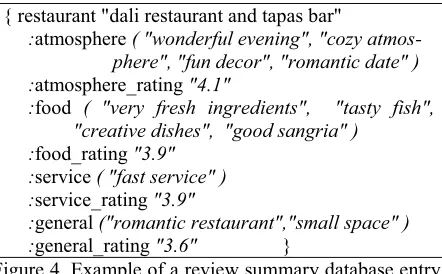
This sequence of topic categorization, ontology construction, phrase pruning and redundancy eli-mination leads to a summary database, which can be utilized for dialogue generation in spoken rec-ommendation systems. A review summary data-base entry generated by the proposed approaches is exemplified in Figure 4.
{ restaurant "dali restaurant and tapas bar"
:atmosphere ( "wonderful evening", "cozy atmos- phere", "fun decor", "romantic date" ) :atmosphere_rating "4.1"
:food ( "very fresh ingredients", "tasty fish", "creative dishes", "good sangria" )
:food_rating "3.9" :service ( "fast service" ) :service_rating "3.9"
[image:6.612.76.297.431.568.2]:general ("romantic restaurant","small space" ) :general_rating "3.6" }
Figure 4. Example of a review summary database entry generated by the proposed approaches.
4 Experiments
In this project, we substantiate the proposed ap-proach in a restaurant domain for our spoken di-alogue system (Gruenstein and Seneff, 2007), which is a web-based multimodal dialogue system allowing users to inquire about information about restaurants, museums, subways, etc. We harvested a data collection of 137,569 reviews on 24,043
restaurants in 9 cities in the U.S. from an online restaurant evaluation website1. From the dataset, 857,466 sentences were subjected to parse analysis; and a total of 434,372 phrases (114,369 unique ones) were extracted from the parsable subset (78.6%) of the sentences.
Most pros/cons consist of well-formatted phras-es; thus, we select 3,000 phrases extracted from pros/cons as training data. To generate a human judgment-consistent training set, we manually la-bel the training samples with ‘good’ and ‘bad’ l a-bels. We then randomly select a subset of 3,000 phrases extracted from review texts as the test set and label the phrases. The kappa agreement be-tween two sets of annotations is 0.73, indicating substantial consistency. We use the two annotation sets as the ground truth.
To extract context-related semantic features, we collect a large pool of well-formatted menus from an online resource2, which contains 16,141 restau-rant menus. Based on the hierarchical structure of these collected menus, we build up a context-related ontology and extract a set of semantic fea-tures from the ontology, such as whether the topic of a phrase is on category-level (e.g., ‘entrée’, ‘dessert’, ‘appetizers’, ‘salad’), whether the topic is on course-level(e.g., ‘Roasted Pork Loin’, ‘Sp i-cy Halibut and Clam Roast’), and whether the to p-ic is on ingredient-level (e.g., ‘beans’, ‘chicken’, ‘mushrooms’, ‘scallop’).
We employ the three types of features as afore-mentioned to train the SVMs and the decision tree models. To select the most valuable features for model training, we conducted a set of leave-one-feature-out experiments for both the SVMs and the decision tree models. We found that all the fea-tures except the adjective unigram probability contribute positively to model learning. From fur-ther data analysis we observed that many phrases with popular adjectives have context-unrelated nouns, which makes the adjective unigram proba-bility fail to become a dominant factor for phrase relevance. Using the adjective unigram probability as a learning feature will mislead the system into trusting an adjective that is common but has a poor bigram affinity to the noun in the phrase. Thus, we eliminate this feature for both the SVMs and the decision tree learning.
1
http://www.citysearch.com 2
To evaluate the performance of the classifica-tion models, we take a set of intuitively motivated heuristic rules as the baseline. Figure 5 gives the pseudo-code of the heuristic rule algorithm, which uses variations of all the features except the uni-gram probability of adjectives.
If(sentiment score of the phrase exists)
if(sentiment score is within neutral range) label=-1; else
if(phrase appeared in the training data)
if((3<frequency of phrase < 100)) label = 1; else
if(frequency of phrase >= 100) label = -1; else if(topic belongs to ontology) label = 1; else label = -1;
else
if(topic belongs to ontology) label = 1; else label = -1;
else
if(phrase appeared in the training data) if((3<frequency of phrase < 100))
if(topic belongs to ontology) label = 1; else label = -1;
else
if(frequency of phrase >= 100) label = -1; else
if(topic belongs to ontology) label = 1; else if(frequency of noun > 100) label = 1; else label = -1;
else
[image:7.612.313.539.112.163.2]if(topic belongs to ontology) label = 1; else if(frequency of noun > 100) label = 1; else label = -1;
Figure 5. Pseudo-code of the heuristic rule algorithm. The performance of classification by different models is shown in Table 4. Although the heuris-tic rule algorithm is complicated and involves hu-man knowledge, the statistical models trained by SVMs and the decision tree algorithms both out-perform the baseline significantly. The SVM mod-el outperforms the basmod-eline by 10.5% and 11.9% on the two annotation sets respectively. The deci-sion tree model outperforms the baseline by 16.4% and 23.2% (average relative improvement of 36%), and it also outperforms the SVM model by 5.9% and 11.3% (average relative improvement of 13%).
The classification model using the decision tree algorithm can achieve a precision of 77.9% and 74.5% compared with the ground truth, which is quite comparable to human judgment (the preci-sion of one annotation set based on the other is
74%). This shows that the decision tree model can predict phrase labels as reliably as human judg-ment.
Baseline SVM Decision tree Annotation 1 61.5% 72.0% 77.9% Annotation 2 51.3% 63.2% 74.5%
Table 4. Precision of phrase classification using the heuristic rule baseline, the SVM model, and the deci-sion tree algorithm.
To gain further insight on the contributions of each feature set to the decision tree learning, Table 5 gives the experimental results on leaving each feature out of model training. As shown, without semantic features, the precision is 70.6% and 65.4% on the two annotation sets, lower by 7.3% and 9.1% than the case of training the model with all the features (77.9% and 74.5%). This shows that the semantic features significantly contribute to the decision tree learning.
Feature set A1 A2
all features 77.9% 74.5%
without bigram probability of adjective-noun pair
56.6% (-21.3%)
63.9% (-10.6%) without unigram probability
of the phrase
57.6% (-20.3%)
64.3% (-10.2%) without unigram probability
of the noun
59.8% (-18.1%)
67.8% (-6.7%) without sentiment score of
the phrase
63.4% (-14.5%)
66.6% (-7.9%) without underlying semantic
features
70.6% (-7.3%)
65.4% (-9.1%)
Table 5. Performance of the decision tree model by leaving each feature out of model training (‘A1’ and ‘A2’ represent the annotation set 1 and 2 respectively).
The experimental results also show that the fea-ture of bigram probability of the adjective-noun pair contributes the most to the model learning. Without this feature, the precision drops by 21.3% and 10.6%, reaching the lowest precision among all the leave-one-out experiments. This confirms our observation that although a single adjective is not dominant, the pair of the adjective and the noun that co-occurs with it plays an important role in the classification.
[image:7.612.71.298.147.466.2] [image:7.612.311.541.346.515.2]drops to 63.4% and 66.6% respectively on the two annotations, decreasing by 14.5% and 7.9%. This shows that the sentiment features contribute sig-nificantly to the classification.
5 Discussions
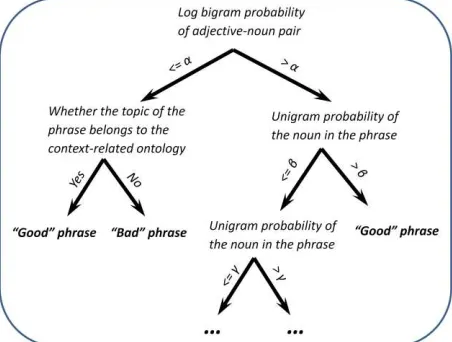
Experimental results show that the decision tree algorithm outperforms the SVMs on this particular classification problem, and it outperforms the heu-ristic rule baseline significantly. Thus, although the identification of informativeness and relevance of phrases is a rather subjective problem, which is difficult to predict using only human knowledge, it can be well defined by decision trees. Part of the reason is that the decision tree algorithm can make better use of a combination of Boolean value fea-tures (e.g., whether a topic belongs to a context-related ontology) and continuous value features. Also, as the phrase classification task is very sub-jective, it is very similar to a ‘hierarchical if-else decision problem’ in human cognition, where de-cision tree algorithms can fit well. Figure 6 shows a partial simplified decision tree learned from our model, which can give an intuitive idea of the de-cision tree models.
6 Related Work
Sentiment classification and opinion mining have been well studied for years. Most studies have fo-cused on text-based systems, such as document-level sentiment classification and sentence-document-level opinion aggregation (Turney, 2002; Pang et al., 2002; Dave et al., 2003; Hu and Liu, 2004; Popes-cu and Etzioni, 2005; Wilson et al., 2005; Zhuang et al., 2006; Kim and Hovy, 2006).
There was a study conducted by Carenini et al. in 2006, which proposed a combination of a sen-tence extraction-based approach and a language generation-based approach for summarizing eva-luative arguments. In our work, we utilize a lower-level phrase-based extraction approach, which uti-lizes high level linguistic features and syntactic structure to capture phrase patterns.
There was also a study on using reviews to gen-erate a dictionary of mappings between semantic representations and realizations of concepts for dialogue systems (Higashinaka et al., 2006; Higa-shinaka, 2007). They also used the association between user ratings and reviews to capture se-mantic-syntactic structure mappings. A set of
fil-tering rules was manually created to eliminate low-quality mappings. In our approach, we use an automatic approach to classifying high/low infor-mative phrases. The learning features are domain-independent with no hand-crafted rules, and can be extended to other domains effortlessly.
7 Conclusions
In this paper we proposed a three-level framework for review-based recommendation dialogue sys-tems, including linguistic phrase extraction, dialo-gue-oriented review summary generation, and human-friendly dialogue generation. The contribu-tions of this paper are three-fold: 1) it identified and defined the research goal of utilizing opinion summarization for real human-computer conversa-tion; 2) it formulated an evaluation methodology for high-density review summary for dialogue purposes; 3) it proposed an approach to automatic classification of high/low informative phrases us-ing a decision tree model. Experimental results showed that the decision tree model significantly outperforms a heuristic rule baseline and the SVM model, and can resolve the phrase classification problem comparably to humans consistently.
[image:8.612.313.539.489.660.2]Future work will focus on: 1) applying the sen-timent scoring model to noun/verb sensen-timent as-sessment; 2) application of the review summary generation approach in other domains and other languages; 3) data collection on user engagement with our dialogue systems involving review-summary evaluation.
References
Stefano Baccianella, Andrea Esuli, and Fabrizio Sebas-tiani. 2009. Multi-facet Rating of Product Reviews.
In Proceedings of European Conference on
Informa-tion Retrieval.
S.R.K. Branavan, Harr Chen, Jacob Eisenstein, and Regina Barzilay. 2008. Learning document-level semantic properties from free-text annotations. In
Proc. of ACL.
Giuseppe Carenini, Raymond Ng, and Adam Pauls. 2006. Multi-Document Summarization of Evaluative Text. In Proceedings of the Conference of the Euro-pean Chapter of the Association for Computational Linguistics.
Kushal Dave, Steve Lawrence, and David M. Pennock. 2003. Mining the peanut gallery: opinion extraction and semantic classification of product reviews. In
Proceedings of the International Conference on
World Wide Web.
W. Eckert, T. Kuhn, H. Niemann, S. Rieck, A. Scheuer, and E. G. Schukat-talamazzini. 1993. A Spoken Di-alogue System for German Intercity Train Timetable Inquiries. In Proc. European Conf. on Speech Tech-nology.
Alexander Gruenstein and Stephanie Seneff. 2007. Re-leasing a Multimodal Dialogue System into the Wild: User Support Mechanisms. In Proceedings of the 8th SIGdial Workshop on Discourse and Dialo-gue, Antwerp, pages 111-119.
A. L. Gorin, G. Riccardi and J. H. Wright. 1997. “How may I help you?” Speech Communication, vol. 23, pp. 113–127.
Ryuichiro Higashinaka, Rashmi Prasad and Marilyn
Walker. 2006. Learning to Generate
Naturalistic Utterances Using Reviews in Spoken Dialogue Systems. In Proceedings of COLING-ACL. Ryuichiro Higashinaka, Marilyn Walker and Rashmi
Prasad. 2007. An Unsupervised Method
for Learning Generation Dictionaries for Spoken
Di-alogue Systems by Mining User Reviews.
Journal of ACM Transactions on Speech and Lan-guage Processing.
Minqing Hu and Bing Liu. 2004. Mining and summa-rizing customer reviews. In Proceedings of the 2004 ACM SIGKDD international conference on Know-ledge Discovery and Data mining.
S.M. Kim and E.H. Hovy. 2006. Identifying and Ana-lyzing Judgment Opinions. In Proc. of HLT/NAACL.
Jingjing Liu and Stephanie Seneff. 2009. Review Sen-timent Scoring via a Parse-and-Paraphrase Para-digm. In proceedings of EMNLP.
Qiaozhu Mei, Xu Ling, Matthew Wondra, Hang Su, and ChengXiang Zhai. 2007. Topic Sentiment Mix-ture: Modeling Facets and Opinions in Weblogs. In
Proc. of WWW.
Bo Pang, Lillian Lee, and S. Vaithyanathan. 2002. Thumbs up? Sentiment classification using machine learning techniques. In Proceedings of EMNLP.
A.M. Popescu and O. Etzioni. 2005. Extracting product features and opinions from reviews. In Proceedings
of EMNLP.
JR Quinlan, 1986. Induction of decision trees. Machine learning, Springer-Netherlands.
A. Raux, B. Langner, A. Black, and M. Eskenazi. 2003. LET'S GO: Improving Spoken Dialog Systems for the Elderly and Non-natives. In Proc. Eurospeech. Benjamin Snyder and Regina Barzilay. 2007. Multiple
Aspect Ranking using the Good Grief Algorithm. In
Proceedings of NAACL-HLT.
Ivan Titov and Ryan McDonald. 2008a. Modeling On-line Reviews with Multi-Grain Topic Models. In Proc. of WWW.
Ivan Titov and Ryan McDonald. 2008b. A Joint Model of Text and Aspect Ratings for Sentiment Summari-zation. In Proceedings of the Annual Conference of the Association for Computational Linguistics. Peter D. Turney. 2002. Thumbs up or thumbs down?
Sentiment orientation applied to unsupervised classi-fication of reviews. In Proceedings of the Annual Conference of the Association for Computational Linguistics.
T. Joachims. 1998. Text categorization with support vector machines: Learning with many relevant fea-tures. In Proc. of ECML, p. 137–142.
T. Wilson, J. Wiebe, and P. Hoffmann. 2005. Recog-nizing Contextual Polarity in Phrase-Level Senti-ment Analysis. In Proc. of HLT/EMNLP.
Victor Zue, Stephanie Seneff, James Glass, Joseph Po-lifroni, Christine Pao, Timothy J. Hazen, and Lee Hetherington. 2000. JUPITER: A Telephone-Based Conversational Interface for Weather Information. In
IEEE Transactions on Speech and Audio Processing,
Vol. 8 , No. 1.