1.0 2.0
3.0
4.0
5.0
6.07.0
8.0 9.0 10.0Scheduling, Forks and Program Interaction Input/Output
Teletypes Memory
String Processing Numbers
Miscellaneous
System Command BRS's
1.1 Program Interrupts
1.1.1 78 Arm/Disarm Software Interrupts
1.1.2 79 Cause Specified Software Interrupts 1.1.3 49 Determines Which Software Interrupts
are Arm
1.1.4 BE+12 Arm Timing Interrupt 1.2 Control of the Escape Key
1.2.1 90 Declare a Fork for Escape 1.2.2 46 Turn Escape orf
1.2.3 47 Turn Escape On
1.2.4 26 Skip if Escape Waiting 1.3 Activation of Forks
1.3.1 9 Open Fork
1.3.2 57 Guarantee 16ms Computing 1.4 Interrogation of a Fork
1.4.1 30 Read Status of a Lower Fork 1.4.2 107 Read Status of all Lower Forks 1.5 Temporary Suspension of Forks
1.5.1 45 Dismiss on Quantum Overflow 1.5.2 72 Executive Dismissal
1.5.3 81 Dismiss for Specified Amount of Time 1.5.4 31 Wait for Specific Fork to Cause a
Panic
1.6.1 10 Terminates the Calling Fork
1.6.2 22 Terminates all Forks Lower to the System Exec
1.6.3 32 Terminates a Specified Lower Fork 1.6.4 73 Terminates a Specified Number of
LO\'ler Forks
1.6.5 108 Terminate all Lower Forks 2.0 INPUT/OUTPUT
2.1 Direct Control of Peripherals
2.1.1 1 Open a File of a Specific Device 2.1.2 110 Read Device and Unit
2.1.3 2 Close a File
2.1.4 20 Close A Tape File 2.1.5 8 Close All Files
2.1.6 66 Delete DSU File Data
2.1.7 67 Delete DSU File Index Block 2.1.8 82 Switch Sequential File Type 2.1.9 87 Read DSU File Index Block
2.1.18 BE+7 Test a Breakpoint Switch 2.1.19 BE+l ReQd DSU
2.1.20 BE+2 Write DSU
2.2 Control of Files Via File Names 2.2.1 15 Rea.d Input File Name
2.2.2 16 Open Input File in File Directory 2.2.3 17 Close All li'iles
2.2.4 18 Read a File Name and Look It Up in the File Directory
2.2.5 19 Open Output File Located in File Directory
2.2.6 48 Look Up Input/Output File Name 2.2.7 60 Laale Up I/O File Name and Insert
in File Directory if Not Found 2.3 I/O Operations
2.3.1 CIO Character Input/Output 2.3.2 WIO Word Input/Output
2.3.3 BIO Block Input/Output
2.3.4 CTRL Input/Output Control (Tape) 3.0 TELETYPE OPERA~IONS
3.1 Linking and Attaching
3.1.1 23 Link/Unlink Specified TTY 3.1.2 24 Unlink All TTY's
3.1.3 25 Set Teletype to Accept/Refuse 3.1.4 27 Attach TTY to Calling Program
4.0
3.1.7 BE+6 Turn a Teletype Line On or Off 3.2 Input/Output Operations
3.2.1 11 Clear the Teletype Input Buffer 3.2.2 Clear the Output Buffer
3.2.3 12 Declare Echo Table 3.2.4 40 Read Echo Table
3.2.5 13 Test Input Buffer for Empty
3.2.6 14 Delay Until the TTY Output Buffer is Empty
3.2.7 85 Set Special TTY Output 3.2.8
86
Clear Special TTY Output3.2.9 BE+ll Ignore Line Feed or Carriage Return When Followed by Carriage Return or Line Feed Respectively 3.2.10 TCI Teletype Character Input 3.2.11 TCO Teletype Character Output 3.2.12 IST Input from Specific TTY 3.2.13 OST Output to Specific TTY 3.2.14 STI Simulate TTY Input MEMORY OPERATIONS
4.1 Private Memory
4.1.1 4 Release a Page of Memory
4.1.2 121 Release Specified Page from PMT 4.1.3 120 Acquire a New Page
4.1.7 117 Set User Relabeling 4.1.8 122 Simulate Memory Panic 4.1.9 56 Make Page Executive 4.1.10 80 Make Page Read Only
4.1.11 BE+4 Read/Write One Word in the Monitor 4.2 Shared Memory
4.2.1 68 Make Pseudo-·Page Shareable 4.2.2 69 Get SMT Block to PMT
5.0 STRING PROCESS 5.1 String I/O
5.1.1 33 Read String 5.1.2 34 Output Message 5.1.3 35 Output String
5.1.4 BE+14 Input String with Edit 5.1.5 CIT Character Input and Test 5.2 Hash Table Search
5.2.1 5 Look Up String in Hash Table 5.2.2 37 General String Look Up
5.2.3 6 Insert String in Hash Table 5.3 String YIanipulation
5.4.1 GCI Get Character from Beginning of String and Increment Beginning Pointer 5.4.2 WCI Put Character on End of String and
Increment End Pointer
5.4.3 GCD Get Character from End of String and Decrement End Pointer
5.4.4 WCD Put Character on Beginning of String and Decrement Beginning Pointer
5.4.5 WCH Write Character to Memory by Table 6.0 NUMBER OPERATION
6.1 Number I/O
6.1.1 36 Output Number to Specified Radix 6.1.2 38 Input Number to Specified Radix 6.1.3 52 Formatted Floating Point Input 6.1.4 53 Formatted Floating Point Output 6.1.5 SIC String to Internal Conversion 6.1.6 ISC Internal to String Conversion 6.2 Arithmetic Operations
6.2.1 50 Conversion from Floating Point to Fixed Point
6.2.2 51 Conversion from Fixed Point to Floating Point
6.2.3 21 Floating Point Negate 6.2.4 FAD Floating Point Addition 6.2.5 FSB Floating point Subtract
7.1 95 Dump Program and Status on File
7.2 96 Recover Program and Status from File 8.0 MISCELLANEOUS OPERATIONS
8.1 42 Read Real-Time Clock
8.2 91 Read Date and Time into a String 8.3 88 Read Execution Time
8.4 41 Return from I/O Subroutine
8.5 III Return from Exec BRS (Exec Only)
8.6 112 Turn Ofr Teletype Station (Exec Only) 8.7 71 Skip if Executive
8.8 BE+5 Set Disc Bit Map
NAME: SAIR
FUNCTION: .i~rm/lJisal'"'m Soft~'lape Interrupt s STATC"S: User
CALLING SEQUENCE: LDA M BRS 78
M is the complete new interrupt mask.
DESCRIPTION: The new interrupt mask is substituted for the old one. A user may arm interrupts 1-10. An exec fork may arm interrupt 11 also. Interrupt 1 is in bit
4 of the mask word. The ~:nterrupts are as follows: 1 Interrupt if Program Panic (BRS 10 or Escape) 2 Interrupt if Memory Panic
3
Interrupt if Lower Fork terminates~ Interrupt if any I/O condition occurs which sets a flag bit (0,7 or 8 in file number word) 11 Interrupt if DSU error
5 through 10 interrupts on condition set by user Location 200 octal plus the interrupt number must be set to point to a routine to process the interrupt. When the interrupt occurs an SBRM* is executed to the location pointed to. If it is desired to return to the point in the program interrupted, the user must BRR to the location where the return was saved.
Example: SET
LDA =ESCAPE STA 201B
I~~TERRuprr ROUTINE ESCAPE ZRO ESCRTN
REGISTERS AFFECTED: None
NAME: SIIR
FUNCTION: Cause Interrupt STATUS: User
CALLING SEQUENCE: LDA N BRS 79
N
=
Interrupt number. N has the range of 5 to 10. DESCRIPTION: Parallel forks in the structure areNAME: SRIR
FUNCTION: Read Interrupts Armed STATUS: User
CALLING SEQUENCE: BRS
49
DESCRIPTION: Reads the interrupt mask into the A regis-ter. Bit 4 corresponds to interrupt number 1, 5 to num-ber 2 and etc. There are 11 programmable interrupts. See also BRS 78 (1.1.1).
NAME: TIMINT
FUNCTION: Interrupts a fork after a specified period of time.
STATUS: User
CALLING SEQUENCE: LDA M LDB T LDX N BRS BE+12 NORMAL RETURN M is the new interrupt mask.
T is the time in milliseconds after which the fork will be interrupted.
N is the interrupt number.
DESCRIPTION: The fork issuing this BRS will be inter-rupted after the delay if the interrupt specified by N is armed at that time. (Exception: The interrupt
will be ignored if the fork is dismissed on a BRS 9 (1.3.1) at the time of the interrupt.) If a fork gives this
NAME: DFR
FUNCTION: Declare a Fork for "Escape" STATUS: User
CALLING SEQUENCE: BRS 90
NAME: NROUT
FUNCTION: Turn Escape Orf STAT1S: System
CALLING SEQUENCE: BRS
46
DESCRIPTION: This BRS will set up to remember an escape interrupt, but not allow the program to be interrupted. It will stack the first escape occurring and ignore any subsequent ones.
A program running with escape turned off cannot be ter-minated by a higher fork.
NAME: SROUT
FUNCTION: Turn Escape On STATTJS: System
CALLING SEQUENCE: BRS
47
DESCRIPTION: This BRS reverses BRS
46
(1.2.2); that is, reactivates the escape interrupt. If an escape in-terrupt was stacked (remembered) while in an Off condi-tion, the interrupt will occur.NAME: SKROUT
FUNCTION: Skip if Escape Waiting STATJS: System
CALLING SEQUENCE: BRS 26
EXCEPTION RETURN NORMAL RETURN
DESCRIPTION: Checks for a stacked escape for this program and if there is one, transfers control to the tlnormal return" or to the "exception return" if there is not an escape stacked. Significant only after BRS
46
(1.2.2).NAME: FKST
FUNCTION: Open Fork STATTJS: User
CALLING SEQUENCE: LDA T BRS 9
T
=
Address of a "Panic Table"Bits 0 through 4 of register A have the following significance:
0
=
1=
2
=
3
=
4
=
5
=
Make fork system if current fork is system. Set fork relabeling from panic table.
Otherwise use current relabeling.
Propogate escape assignment to fork (See BRS 90, 1.2.l).
Make fork fixed memory. It is not allowed any more memory than it started with.
Make fork local memory. New memory will be assigned to it independent of the con~
trolling fork.
Make fork privileged if current fork is privileged.
DESCRIPTION: BRS 9 is used to create dependent entries in the PAC table. The panic table indicated by register A must not be the same for two fork~ of the same fork or overlap a page boundary; if it is, BRS 9 is illegal. BRS 9 creates a new fork as a fork of the fork creating it, which is called the controlling fork. The fork is lower in the hierarchy of forks than the controlling fork. The controlling fork may itself be a fork of some still higher fork. For more detailed information see Document No. 30.10.31.
When BRS 9 is executed by a user fork, the user fork is dismissed until the lower fork terminates. This has the same effect as issuing a BRS 31 (1.5.4) immediately after a BRS
9.
A user may not have more than eight forks in his fork structure. This includes the system fork and one fork for each system BRS that is active. Only one system BRS can be active.NAME: CQO
FUNCTION: Guarantee 16ms Computing STATUS: User
CALLING SEQUENCE: BRS 57
DESCRIPTION: This BRS guarantees to the user upon re-turn at least 16 msec. of uninterrupted computation. This is done by dismissing the user if less than 16 msec. remain in "his time quantum.
N Al\IE : FKRD
FUNCTION: Read Fork STATUS: User
CALLING SEQUENCE: LDA P BRS 30 P
=
Panic Table AddressDESCRIPTION: Reads the current status of a lower fork into the panic table indicated by the A register. It does not influence the operation of the fork in any way.
NAME: FKRA
FUNCTION: Read All Fork Statuses STATUS: User
CALLING SEQUENCE: BRS 107
DESCRIPTION: The status of all lower forks is recorded in the appropriate panic tables.
NA~~: SQO
FUNCTION: Dismi~s on Quantum Overflow
STA~~S: User
CAL~ING SEQUENCE: BRS
45
DESCRIPTION: This BRS causes the user to be dismissed as though he had overflowed his quantum. It guarantees
th~t th8 next time he is started he will have a complete short time quantum. See BRS
57
(1.3.2) to guaranteeJ.6 msec.
NAME: EXDMS
FUNCTION: System Fork Dismissal CALLING SEQUENCE: LDX N
BRS 72
N
=
The number of the queue that the fork is to be put on.DESCRIPTION: Dismisses a system fork and puts it on the specified queue. Returns to call +1 when recalled.
o =
Teletype queue 1=
I/O queue2
=
Short time quantum queueNAME: WREAL
FUNCTION: Dismiss for Specified Amount of Time STATUS: User
CALLING SEQUENCE: LDA T BRS 81
T
=
Dismissal time in milliseconds.NAME: FKWT
FUNCTION: Wait for Fork to Cause a Panic STATUS: User
CALLING SEQUENCE: LDA P BRS 31 P
=
Panic Table AddressDESCRIPTION: Causes the controlling fork to be dismissed until the lower fork,or forks, causes a panic. When
it does, the controlling fork is reactivated at the in-struction following this BRS, and the panic table con-tains the status of the fork on its dismissal. The
status is also put into the X register. The panic table address is put into the A register.
NAME: FKWA
FUNCTION: Wait for Any Fork to Terminate ST1\'YUS: User
CALLING SEQUENCE: BRS 106
DESCRIPTION: Fork is dismissed until some lower fork terminates. Whan a lower fork terminates, the panic table address will be left in A.
NAME: DMS
FUNCTION: Dismiss STATUS: User
CALLING SEQUENCE: BRS 109
NAME: : PP AN
FUNCTION: Programmed Panic. Terminates a Fork.
CALLING SEQUENCE: BRS 10
BRS 10 terminates the fork that issues i t and re-turns control to the higher fork.' It is just like typing Ilescape" on the teletype.
DESCRIPTION: Terminates a lower fork. This condition can be distinguished from a panic caused by the escape key only by the fact that in the former dase the program counter in the panic table points to a word containing BRS 10. This BRS would normally be used to terminate a fork when it is finished. The information in the
panic table would, therefore, only be useful to a higher fork or to this fork only if interrupt 4 has been 2rmed by tht~, fork.
NAME: FKTM
FUNCTION: Terminate a Fork STATUS: User
CALLING SEQUENCE: LDA P BRS 32 P = Panic Table
DESCRIPTION: Causes a lower fork to be unconditionally terminated and its status to be stored into the panic table. The X register contains the status word upon . return.
NAME: EPPAN
FUNC'J.1ION: Economy Panic sir J\.rl.l:J S : User
CALLING SEQUENCE: LDA N BRS 73
N
=
Number of forks to terminate.DESCRIPTION: This is like doing a BRS 10 for each of the forks specified. Forks are terminated going up until the system fork is reached or until N forks have benn terminated.
NAME: FKTA
FUNCTION: Terminates All Forks STATUS: User
CALLING SEQUENCE: BRS 108
DESCRIPTION: All lower forks are terminated and their status read into the corresponding panic tables.
NAME: TliONOPN
FUNCTION: Open ~ File of a Specific Device STATUS: System
CALLING SEQUENCE: LDA ±I LDX D BRS 1
EXCEPTION RETURN NORMAL RETURN
File number will be in register A on Normal Return. I
=
The relative address (DSU Address MOD 4) ofthe file's Index Block for DSU files, or unit number for magnetic tape, otherwise anything. - - Make the file read only.
+
=
Make the file read/write. D=
Device number.Avo.:i.lJ.ble device numbers are as follows:
1. Paper tape input.
2. Paper tape output 3. Card input.
4.
Magnetic tape input. 5. Magnetic tape output.7.
Printer.8.
Seqnential DSU input 9. Sequential DSU output.10. llandom DSU
DESCRIPTION: The "qpen file" BRS is used to condition a file for input or output processing. If the file is successfully opened, control is transferred to the nor-mal return; otherwise control is transferred to the
ex-cepJcion l'eturn. Exception conditions are. as follows:
1. Device in use or not available. 2. File in use.
A file may be opened for input any number of times for the purpose of multiple user access or multiple proces-sing by a proces-single user. A file that is opened for out-put cannot be opened again until it is closed. See also, BR S T S : 2, 3, 20, 8 2 .
NAME: RDU
FUNCTION: Read Device and Unit STATUS: User
CALLING SEQUENCE: LDA =FILE No. BRS 110
NORMAL RETURN
DESCRIPTION: Output X = device number. A = Unit number.
CALLING S~QUENCE: LDA N ERS 2
NOnrvlAL RETURN
N ~ ~ile nunilier (obtained when file was opened). DESCRIFTIOI'J: Thc II clo;-3e f11e" ERS jos used to indicate
to the: SystOlll all processing is completed on this file. All ncce~sary termination processing will be completed and c0~trol will be transferred to the normal return.
022 ~lGJ~ BRSls I, 8, and 82.
NAME: CFILE
FUNCTION: Close a File STATUS: User
CALLING SEQUENCE: LDA N BRS 20 N
=
File NumberNAME: IOH
STA'I'JS: User
CALLING SEQUENCE: BRS 8
NORMAL RE'l'URN
DE,sCRIPTION: The I.Iclose all files" BRS is used to in-dicate to the system all processing is completed on all f:Lles. Th2 system vlil1 complete all necessary ter-mination processing on all files and transfer control
to the normal return. BRS 8 is always executed when control returns to th8 system. This BRS will not close
m2~netic tape files correctly. See also, BRS 1 (2.1.1),
NAME: DFDL
FUNCTION: Delete DSU File Data STATUS: User
CALLING SEQUENCE: LDA N BRS
66
NORMAL RETURN N
=
File NumberDESCRIPTION: This BRS will return to available storage all DSU blocks which are assigned to the indicated file and clear the index block of DSU addresses.
nA~TE: DFER
FUNCTION: Delete a Specified Block of the DSU srrATUS:- System
CALLING SEQUENCE: LDA D DRS
67
NORMAL RETURN D ~ Address of the DSU block.
DESCRIPTION: This BRS will return the DSU block indi-cated by the address in register A to available storage and trnnsfers control to the normal return. This BRS should be used to delete Index Blocks. The BRS does not clear the Index Block address from the Customer File Directory.
NAME: SWSF
FUNCTION: Switch Sequential File Type STATUS: User
CALLING SEQUENCE: LDA N LDB C BRS 82 N
=
File numberC
=
a
will make the file an input file. C = 1 will make the file an output file.NAME: DFRX
FUNCTION: Read DSU File Index Block STATUS: System
CALLING SEQUENCE: LDA D LDX W BRS 87
NORMAL RETURN
D
=
DSU address of the index block (MOD 4) W=
Core address into which the block is to beread.
DESCRIPTION: Reads the specified block into the given core location and transfers control to the normal return. The block read is the size of' the currently defined in-dex block. The size of an index block varies with the assembly.
NAME: RSYB
FUNCTION: Read a Page from the ·RAD STATUS: System
CALLING SEQUENCE: LDA C LDB R BRS 104 C
=
Core AddressR
=
RAD AddressDESCRIPTION: Reads one page from the RAD starting at the address R into a page in core. C may be any loca-tion in that page. The data will start in the first word of the page.
NAME: WSYB
FUNCTION: Write a Page on the RAD STATUS: System
CALLING SEQUENCE: LDA C LDB R BRS 105 NORMAL RETURN
DESCRIPTION: Writes one page on the RAD star~ing at the address R from a page in core. C may be any loca-tion in that page. The data will start in the first word of the page.
NAME: DFCD
FUNCTION: Compute File Size of a DSU File STATUS: User
CALLING SEQUENCE: LDA =File Number BRS DFCD
NORMAL RETURN
DESCRIPTION: Adds the number of data words (in multiples of
255)
in the file to the number in the X register.NAME: MTDI
FUNCTION: Turn
orr
Run-away Magnetic Tape STATUS: SystemCALLING SEQUENCE: BRS MIDI NORMAL RETURN
NAME: TGET
FUNCTION: Allocate Magnetic Tape Unit STATUS: System
CALLING SEQUENCE: LDA =Tape Number BRS 118
EXCEPTION RETURN NORMAL RETURN
DESCRIPTION: Assigns tape requested to the user. If tape is already busy with someone else the execption return is executed.
Nj\J·1E: TREL
FUNCTION: De-Allocate Magnetic Tape Unit STATUJ: System
CALLING SEQUENCE: LDA =Tape Number BRS 119
NORMAL RETURN
DESCRIPTION: Releases the tape specified. Releases regardless of who had it.
NAME: RDSYB
FUNCTION: Read DSU Page STATUS: System
CALLING SEQUENCE: LDA C LDB R BRS BE+9 C
=
Core AddressR
=
RAD AddressDESCRIPTION: Use like 104. Can only be called by the system exec. BE+l (2.1.19) can be used to perform this function.
NAl'-1E: WDSYB
FUNCTION: Write DSU Page
CALLING SEQUENCE: LDA LDB BRS C
=
Core Address R =-= RAD Addre s sC R BE+10
DESCRIPTION: Use like 105 (2.1.11). Can only be called by the system exec. BE+2 (2.1.20) should be used to
NAME: BPTEST
FUNCTION: Test a Breakpoint Switch STATUS: System
CALLING SEQUENCE: LDX =Switch Number BRS BE+7
SWITCH UP RETURN SWITCH DOWN RETURN
DESCRIPTION: Tests the breakpoint switch (1,2,3,4) indicated in X. If the switch is down, the BRS skips on return.
NAME: ARD
FUNCTION: Read DSU
CALLIEG SEQUENCE: LDA =Core Address IClIU LDB =Disc Address ?'. {; I (. c
LDX =Number of \vords 2. 0 l':J
BRS BE+l NORMAL RETURN
DESCRIPTION: Reads from the disc as specified. Errors result in an instruction trap, or programmed interrupt 11 if it is armed. No two forks that are to run simul-taneously should both use this BRS.
NAME: AvID
FUNCTION: Write DSU STATUS: System
CALLING SEQUENCE: LDA LDB LDX BRS
=Core Address =Disc Address =Number of vlords BE+2
DESCRIPTION: Like BE+l (2.1.19). The number of words must be a multiple of
64
and greater than O.NAME: GFN
FUNCTION: Reads Input File Name from a Command File and Looks up the File Name in the User's File Dir1ectory.
STATUS: User
CALLING SEQUENCE: LDA N' BRS 15
EXCEPTION RETURN NORMAL RETURN N
=
Command File NumberDESCRIPTION: The routine ignores leading spaces, leading multi-blanks, and leading car~iage return characters. It then uses the BRS 37 (5.2.2) to look up the file name in the user'E file directory hash table.* It returns
in the registers for both returns exactly what the BRS 37 puts there, which is:
Exception Return: X: Pointer to the input
file name string pOinters. A & B: Input file name string
pOinters.
Normal Return: A: Pointer to the string pointers of the desired file in the file directory hash table.
B: The value word of the hash table entry. X: Clobbered.
~';'Thc; e~:c·:;ption return is taken if the input file name strin~ cannot be located in the file directory.
NOTE: 'rhe information contained in the registers cannot be used directly by the user since the addresses are in the T.S. Block; this BRS is normally followed by the BRS 16.
If the input file name string begins with a left paren, or with the full quote, the file name will be located in
another user's file directory or in the public file direc-tOl'lY:; respectively; in these cases, the input command file must be the teletype. Since the BRS 37 is not used in this case, the information in the registers is of
no practical use to the user, and the BRS MUST be followed by the BRS 16 (2.2.2) as indicated under the BRS 16.
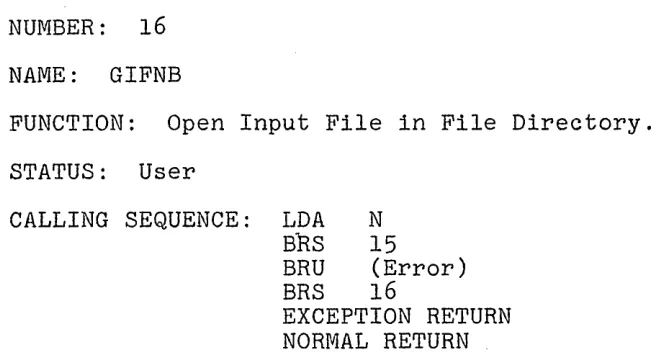
NAME: GIFNB
FUNCTION: Open Input File in File Directory. STATUS: User
CALLING SEQUENCE: LDA N BRS 15
BRU (Error) BRS 16
EXCEPTION RETURN NORMAL RETURN
N
=
File Directory Pointer AddressDESCRIPTION: Opens an input file located in the user's file directory. The BRS requires in A, the location of the first word of the entry in the file directory
hash table. The exception return is taken if the pointer in A is not pointing to a proper location in the hash table, or if the file cannot be opened for any reason, such as a physical device that cannot be an input file. The file directory pointer may be obtained from a BRS 15 or a BRS 18.
Exception Return: Normal Return: A:
B: X:
All registers clobbered. File Number
NAME: UABORT
FUNCTION: Close all Files (Including Mag T~pe)
STATUS: User
CALLING SEQUENCE: BRS 17
DESCRIPTION~ If mag tape has been used, the last record will be terminated and if output, the End of File will be written; in either case the tape will be positioned at the start of the next file. The tape is then closed and the unit is de-allocated. See also, BRS 8 (2.1.5). All registers are clobbered.
NAME: GOFNA
FUNCTION: Reads File Name from a Command File and Looks Up the File Name in the User's File Directory. The Command File Must Be an Input File.
STATUS: User
CALLING SEQUENCE: LDA N BRS 18
EXCEPTION RETURN NORMAL RETURN N
=
Command File NumberBit 1
=
1 of A Register=
Assume a file name is correct and does not type "OLD FILE" or "NEW FILE". DESCRIPTION: The routine ignores leading spaces, leading multi-blanks, and leading carriage return characters. If the string begins and ends with a single quote or a slash, the string is terminated for look-up with this character and the string is looked up in the user's file directory using the BRS 5 (5.2.1). A confirming carriage return must followtthe quote or slash before the string is looked up. The exception exit is taken if the charac-ter is not a carriage return. If the string is found in the file directory hash table, the message "OLD FILE" is typed, otherwise the message "NEW FILE" is typed. If a confirming line feed, carriage return, or period is then next in the input string, the normal return will be taken, otherwise the exception return. In the case of a new file, the file name is inserted conditionally into the file directory.If the string begins with a character other than a single quote or a slash, the string is looked up in the user's file directory using the BRS 37 (5.2.2). If the string is not located, the error exit is immediately taken caus-the exception return. The exception return will also be caused if the file is read only as indicated by the flag in the file directory.
Exception Return: All clobbered.
Normal Return: A - Location of the file in the directory hash table.
B - Confirming character in case of a quote or slash file; otherwise, the file directory hash table value word.
NJ\ME: GOFNB
FUNCTION: Open Output File Located in File Directory STArrus: User
CALLING SEQUENCE: LDA Nl
LDB N2 (For Tape Files Only) LDX NJ
BRS 19
EXCEPTION RETURN NORMAL RETURN
Nl - Information supplied in A by BRS 18 (2.2.4) (location in the file directory).
N2 File Size (as supplied in X by BRS 16) for tape files only.
N3 - File Type (as supplied in B by BRS 16).
DESCRIPTION: Opens an output file locatee in the user's file directory. The information required in the
regis-~2rs is indicated above. The word in A is checked for legality. If it is now a valid pOinter, the exception return is taken. The exception return is also taken if the file cannot be opened for any reason, such as a physical device that cannot be used for output. In the caS8 of a new file, the file directory entry is com-pleted. If the new file is a DSU fil~ and it cannot be opened, the messaGe! "NO ROOM" is typed. The message "PILE rrYPE WRONG" is typed as appropriate.
Exception Return: All clobbered. Normal Return: A - File Number.
NAME: GSFN
FUNCTION: Look up Input/Output File Name STATUS: User
CALLING SEQUENCE: LDP N BRS
48
EXCEPTION RETURN NORMAL RETURN
N
=
String pOinters for the file name.DESCRIPTION: The file name is looked up in the file directory hash table using the BRS 5 (5.2.1). If it is not there, the exception return is taken.
Exception Return: A & B - No change. X - Clobbered.
Normal Return: A
&
B - Location in file directory hash table. Can beNAI,lE: GSFI
FUNCTION: Look Up Input/Output File Name and Insert if New.
srrf .. TUS: User
CALLING S~QUENCE: LDP N BRS 60
EXCEPTION RETURN NORMAL RETURN
N ~ String painters for the file name.
DI:~:::'CRIPTION: The file name is looked up in the file directory hash table using the BRS 5 (5.2.1). If it is not there, it is inserted in the hash table. The exception return is talcen if it cannot be inserted in
~h0 case of a full directory.
E:i:ception Return: A [: B - No change. X - Clobbered.
Normal Return: A
&
B - String pointer to loca-tion in file directory hash table.FUNCTION: Character Input/Output STATUS: User
CALLI~G SEQUENCE: LDA
CIa N C (Output Only)
C 0 - 8 bit data character right justified.
N - Address of word containing a file number. DESCRIPTION: CIO is used to input or output a single character from, or to, a file from the A register. On input an End of Record or End of File condition will set bits 0 and 8 or bits 0 and 7 in the file number and return a 1348 or 1378 character, respectively. If in-terrupt 4 is armed (see BRS 78, "1.1.1"), it will occur. The End of Record occurs on the next input operation after the last character of the record has been input and the End of File condition occurs on the next input operation after the End of Record which signals the last record of the file. If an error occurs, bits 0 and
6
will be set in N and interrupt
4
will occur if it is armed.FUNCTION: Word Input/Output STATUS: User
CALLING SEQUENCE: LDA
WIO D (Output Only) N D
=
Data word to be writtenN
=
Address of word containing a file number. DESCRIPTION: WIO is used to input or output a word of data to or from the A register. On input an End of Record condition returns a word of three 1348 characters andsets bits 0 and 8 in the file number word. If interrupt 4 is armed (see BRS 78, "1.1.1"), it will occur. An
End of File condition returns a word of three 1378 charac-ters and sets bits 0 and
7
in the file number word.If interrupt 4 is armed, it will occur. If an End of Record or File condition occurs with a partially filled out word, the word is completed with 1348 or 1378 charac-ters. If an error occurs, bits 0 and 6 are set in N. If interrupt 4 is armed it will occur.
CIO and WIO should not be mixed to read or write a given file.
FUNCTION: BJ.ocked Input/Output STATUS: User
CALL~NG SEQUENCE: LDA W
I
-LDX I BIO N
EXCEPTION RETURN NORMAL RETURN Starting memory address.
\~
"'T
h
=
-Number of words to be read or written. Address of word containing a file number. DESCRIPTION: BIO is used to input a block of words to memory or output a block of words from memory. The A register will contain the first memory location not read into or out of at the end of the operation. If the oper-ation is completed successfully, control will be trans-ferred to the normal return, otherwise control will be transferred to the exception return.
On input an End of Record or End of File condition will
S3t bits 0 and 8 or 0 and 7 in the file number. An error will set bits 0 and 6. Interrupt 4 will occur if armed when any of these bits are set.
Exception conditions are: 1. End of Record 2. End of iJile 3. P'.·ll Hoeord
FUNCTION: Input/Output Control (only tape is implemented) STATUS: System
CALLING SEQUENCE: LDA C CTRL N C
=
Control number N=
File numberDESCRIPTION: CTRL provides the following control func-tions for tape files:
Control # 1. 2 . 3 • 4 .
5.
6. 7 · 8. DescriptionWrite end of record on output. Record count not used.
Backspace physical block. Forward space physical block. Backspace file.
Erase tape (output only) (3. inches). Rewind.
NAME: LNKS
FUNCTION: r,Jnk/Unl:Ln~;~ 1"1'Y -.. Not lmplemented STATD3: User
CALLING SEQUENCE: LDX T LDl\. A LDB C BRS 23 T -- Teletype number
A _. Addl'ess of a list of teletype numbers terminated 1'Lo :~h -2.
C -- Control vlord. The bits of this word are as follows:
Bit 0 -- 0 - Output LCW, 1
=
Input LCW. B:i.t 1 .. - 0=
Cleal1 all links first, 1=
Do notc12Cli" links first.
Bit 2 - 0 = Set link bits for TTY whose numbers arE:: in the table.
Bit 2 -- -j
=
Clear linle bits for TTY whose num-bers are in the table.DEj~Clu_f~'ION: This BRS is used to set the link bit for TTY T in the LCW. Associated with each TT1 are two words called ~he absolute input and absolute output link con-trol words (LCW:s). Each of these words contain one bit for each TTY in the system (maximum of 24). Also aS30ciated with each TTY are relative LCW's for input and output. The bits in these LCW's are set by this BRS. F:::-'om the old rclo.-ci ve LC;-r and the information sup-plied in tIle calJ.1ng seql~cnce a new relative LCW is created. Each time any relative LCW is changed, the 2bsolute LCW's are all recomputed.
NA~'IE: LNKC
FUNCTION: Unlink - not implemented STATUS: System
CALLING SEQUENCE: LDX T BRS 24 T
=
Teletype NumberDESCRIPTION: This BRS is used to clear all links, input and output, to or from TTY T.
NAME: MSGS - Not implemented
FUNCTION: Set Accept Mersages and Set Accept Input In-dicators.
STATUS: System
CALLING SEQUENCE: LDX T LDA I BRS
25
T
=
Teletype number (must be controlling TTY or an attached TTY).I
=
Bit 23 on to set "Accept Messages" Indicator. I = Bit 24 on to set "Accept Input" Indicator.NAME: ASTT - not implemented
FUNCTION: Attach TTY to this program STATUS: System
CALLING SEQUENCE: LDA T BRS 27
EXCEPTION RETURN NORMAL RETURN T
=
Teletype NumberDESCRIPTION: To give total control over a TTY to the requesting program. If the indicated TTY is free, it is attached to the requesting program and transfers con-trol to the "normal return". If it is not free, control is transfBrred to the lIexception return".
NAME: RSTT - not implemented YUNCTION: Release TTY
CALLING SEQUENCE: LDA T BRS
28
T ~ Teletype NumberDESCRIPTION: Returns to a free status the TTY indicated by the A register. If the TTY was not attached to the requesting program a "panic" will be executed.
NAME: CARRY
FUNCTION: Test for Carrier Presence STATUS: System
CALLING SEQUENCE: LDA =LINE # BRS BE+3
EXCEPTION RETURN - No Carrier NORMAL RETURN - Carrier Present DESCRIPTION: This BRS gives a skip return, if the car-rier signal is present on the line identical in A. No carrier signal - no skip.
NAME: TTYON
FUNCTION: TUrns a Teletype Line On or Off.
STATU~: System
CALLING SEQUENCE: LDA =TTY #
LDB =0 (off) or -1 (on) BRS BE+6
NORMAL RETURN
DESCRIPTION: Issues the EOM and POT commands which cause the line to be turned off (hung up) or made ready to
NAME: CIB
FUNCTION: Clear the Teletype Input Buffer STATUS: User
CALLING SEQUENCE: LDX T BRS 11
T
=
Teletype number (-1 is used to indicate the controlling teletype).DESCRIPTION: Sets the buffer painters to indicate there are no characters in the TTY input buffer.
NAME: COB
FUNCTION: Clear the Output Buffer STATUS: User
CALLING SEQUENCE: LDX T BRS 29
T = Teletype Number (-1 indicates the controlling TTY)
DESCRIPTION: Sets the buffer pointers to indicate there are no characters in the TTY output buffer.
NAME: CET
FUNCTION: Declare Echo Table STATL"S: User
CALLING SEQUENC~: LDX T LDA R .BRS 12
T = Teletype number (-1 is used to indicate the controlling TTY).
R
=
±
1, 2, or3
to indicate the proper echo table If the sign bit of R is set, each 8 bit char-acter read from the teletype is transmitted unchanged to the user's program. No echoes are generated while in this special 8-level mode. Teletype output is not affected. DESCRIPTION: BRS 12 sets the echo table for the TTY indicated by Register X. Echo tables are as follows:o
=
Echo each character just as it was received and break on all characters.1 = Same echo as 0 but all characters except letters, digits and spaces are break characters.
2
=
Same echo as 0, but the only break characters are control characters (including carriage re-turn and line feed).3
=
No echo for any character and break on all characters.NAME: RDET
FUNCTION: Read Echo Table STATUS: User
CALLING SEQUENCE: LDX T BRS 40 T
=
Teletype numberDESCRIPTION: Reads the echo table number (0,1,2,3) into the A register.
NAME: SKI
FUNCTION: Test Input Buffer for Empty STATU3: User
CALLING SEQUENCE: LDX T BRS 13
EXCEPTION RETURN NORMAL RETURN
T
=
Teletype number (-1 is used to indicate the contpolling TTY)DESCRIPTION: This BRS tests for the presence of input characters in the buffer. If the buffer is empty, con-trol is transferred to the "normal returnll
• If there
are any characters in the input buffer, control is trans-ferred to the lIexception return".
NAME: DOB
FUNCTION: Dismiss Until the Teletype Output Buffer is Empty.
STATUS: User
CALLING SEQUENCE: LDX T BRS 14
T
=
Teletype number (-1 is used to indicate the controlling TTY).DESCRIPTION: Dismiss this fork until the teletype out-put buffer indicated is empty. It is dismissed only
until the last character is transmitted. This fork might be restarted before the last character interrupt has
NAME: SET8p
FUNCTION: Set Special Teletype Output STATUS: User
CALLING SEQUENCE: LDX T BRS 85
T
=
Teletype number (-1 is used to indicate control-ling TTY).DESCRIPTION: Sets teletype to 8-level output mode. The teletype specified must either be the controlling teletype or an attached teletype. Eight-level is trans-mitted to the teletype exactly as it is received from the user program.
NAME: CLR8p
FUNCTION: Clear Special Teletype Output STATUS: User
CALLING SEQUENCE: LDX T BRS 86
T
=
Teletype number (-1 is used to indicate con-trolling TTY).DESCRIPTION: Puts the teletype output back into normal mode. The teletype specified must either be the con-trolling teletype or attached.
NAME: CRSW
FUNCTION: To Allow the User to Ignore Line Feed or Carriage Return when it Follows a Carriage Return or Line Feed.
STATUS: User
CALLING SEQUENCE: LDA =0 (ignore) =-1 (do not ignore) BRS BE+1I
NORMAL RETURN
FUNCTION: Teletype Character Input STATUS: User
CALLING SEQUENCE: TCI M M
=
Memory location.DESCRIPTION: This SYSPOP reads the character from the teletype input buffer and places it into the location
M right justified. The remainder of location M is cleared. The character is also placed in the A register right
justified.
FUNCTION: .Teletype Character Output STATUS: User
CALLING SEQUENCE: TCO M M
=
Memory address.DESCRIPTION: This SYSPOP outputs the character from the right-most eight bits of location M to the control-ling teletype. In addition to the ordinary ASCII-char-acters, all teletype output operations will accept 1358 as a multiple blank character. The next character will be taken as a blank count, and the indicated number of blanks will be typed.
FUNCTION: Input From Specified Teletype STATUS: User
CALLING SEQUENCE: 1ST T T = Teletype number
DESCRIPTION: 1ST is used to input a character from an attached teletype. The character will be right justi-fied in the A register upon return.
FUNCTION: Output to Specified Teletype STATUS: User
CALLING SEQUENCE: OST T T
=
Teletype numberDESCRIPTION: OST is used to output a character in the A register to a specified teletype. This instruction is used for output to an attached teletype. It's accept message bit must be set or an illegal instruction panic will be generated.
FUNCTION: Simulate Teletype Input STATUS: User
CALLING SEQUENCE: STI T T
=
Teletype numberDESCRIPTION: This BRS is used to simulate teletype input. It puts the character in the A register into the input buffer of the specified teletype. It is legal for a user fork only if T equals the controlling TTY or -1.
NAME: MPT
FUNCTION: Release a Page of Memory STATUS: User
CALLING SEQUENCE: LDA N BRS 4
.~ ~ Contains any address in the page to be released. DESCRIPTION: The PMT entry for the block is removed
and in any other fork which has this PMT byte in its relabeling, the byte is cleared to O.
NAME: DPMTE
FUNCTION: Release Specified PMT Entry STATUS: User
CALLING SEQUENCE: LDA R BRS 121 R
=
Relabeling byteDESCRIPTION: Releases the specified page from the PMT. It is exactly like a BRS 4 (4.1.1) except that it takes a byte number instead of an address.
Instruction Trap:
1) Byte not in PMT.
NJU·1E: APMTE
FUNCTION: Assign PMT Entry STATU0: System
CALLING SEQUENCE: LDA R BRS 120 R
=
Relabeling byteDESCRIPTION: Obtains a new page for the relabeling byte specified. This BRS is used only in the recover routine in the exec.
Instruction Trap:
1) PMT entry is already assigned.
NAME: RDRL
FUNCTION: Read Pseudo-Relabeling STATUS: User
CALLING SEQUENCE: BRS
43
DESCRIPTION: Reads the current pseudo-relabeling regis-ters into regisregis-ters A and B.
NAME: STRL
FUNCTION: Set Pseudo-Relabeling
STArru~: User
CALLING SEQUENCE: LDA Rl LDB R2 BRS
44
Rl & R2
=
Relabeling factorsDESCRIPTION: This BRS takes the contents of regist~rs
A and B and stores them into the current pseudo-relabel-ing registers. It also causes the real relabeling to be reset to correspond to the new pseudo-relabeling. This BRS will result in an instruction trap for any of the following reasons:
1) Swapping in the new pages was not completed. (Usually because of a RAD failure.)
2) The user tried to relabel over a system page. 3) The user tried to relabel over a page he did
not have. (This is not the way to obtain more memory. )
NAME: RURL
FUNCTION: Read User Relabeling STATU3: System
CALLING SEQUENCE: BRS 116
DESCRIPTION: Puts the program relabeling into A and B. This is what the system executive uses as program re-labeling. It is kept in the TS block.
NAME: SURL
FUNCTION: Set User Relabeling STATU3: System
CALLING SEQUENCE: LDA RLl LDB RL2 BRS 117
RLl and RL2 are the new values for the program relabeling.
DESCRIPTION: Sets the program relabeling as specified. This BRS is used by the system. User programs should use BRS
44
to set relabeling for a fork.Instruction Trap:
NAME: MPAN .
FUNCTION: Simulate Memory Panic STATes: System
CALLING SEQUENCE: LDA A BRS 122 A
=
Core addressDESCRIPTION: This BRS gets new memory for a class 3
BRS. If it succeeds the new memory is put into the relabeling of the calling program. Can be issued from a class 3 BRS only.
NAME: MBEX
FUNCTION: Make Page System STATUS: System
CALLING SEQUENCE: LDA P BRS 56
P
=
Pseudo-Relabeling byte for page.If bit 0 of A
=
1, page will be made system. If bit 0 of A=
0, page will be made not system. DESCRIPTION: Sets the use mode of a page depending on the value of bit 0 in the A register.Bit 0 of A is set to 1 if page was formerly system or
o
if it was not.NAME: MBRO
FUNCTION: Make Page Read Only STATU3: User
CALLING SEQUENCE: LDA P BRS 80 P
=
PMT/SMT numberIf bit a of A
=
1, make page read only. If bita
of A=
0, make page read-write.DESCRIPTION:. Sets the read-write status of the entry according to the value of A. An SMT entry can only be changed by a system fork. The former status of the entry is returned in A.
Instruction trap:
NAME: PEBRS
FUNCTION: Reads or Sets One Word in the Monitor STATUS: System
CALLING SEQUENCE: LDA V
LDB 0 or -1
LDX =Location in Monitor Relabeling BRS BE+4
RETURN
v
= New value for word if it is to be set.The contents of the location are returned in the. A register.
If B is positive, the word is read.
If B is negative, the word is changed and the old value returned in A.
DESCRIPTION: Allows a system program to read or set the contents of any location in the monitor relabeling. The original contents of the location are always returned in the A register.
NUMBER: 68 NAME: EBSM
FUNCTION: Enter Block in SMT - Not implemented. STATUS: System
CALLING SEQUENCE: LDA B BRS 68
NAME: GBSM
FUNCTION: Get SMT Block to PMT STATUS: Subsystem
CALLING SEQUENCE: LDA S BRS 69 S
=
SMT numberDESCRIPTION: Puts the SMT entry into the first free PMT entry. The PMT entry number is returned in A. Instruction trap:
1) A user program tries to relabel a system SMT entry.
2) The SMT number is not valid. Memory trap:
FUNCTION: Read St~ing
CALLING SEQUENCE: LDA A LDB T LDX T BRS 33
A - Address of string pointer T - Terminal character
F - File number
Bit 0 of t on ~ The string is taken as null with tIle; scccnd pointer equal to the first.
NAME: OUTMSG
FUNCTION: Output :'Iessage STATUS: User
CALLING SEQUENCE: LDX F LDA W LDB C BRS
34
F
=
File numberW
=
Beginning word address C=
Character count or -1DESCRIPTION: This BRS outputs C consecutive characters starting with the first character of the specified word. If B = -1, characters are output until a / is encountered;
the character $ is interpreted as a carriage return and line feed.
NAME: OUTSTi-{
FUNCTION: output String STA'rU8: User
CALLING SEQUENCE: LDX F LDA P LDB P+l BRS
35
F == File number
P, P+l
=
A string pointer pairNAME:
FUNCTION: Input String with Edit STATUS: User
FUNCTION: ChQracter Input and Test STATUS: User
CALLI~JG SEQUENCE: LDA N CIT F
EXCEPTION RETURN
NOR~1AL RETURN N
=
Character to be tested.F = File Number (see CIO) (Input Only)
DESCRIPTION: The character in the A register is compared against the next character in the input file. If it
compares, the normal return is taken and the character is removed from the input buffer. If it does not com-pare, the character is left in the input buffer and is returned in A.
Exception Return: A - The next character in the input buffer. B
&
X - No changeNAME: SSCB
FUNCTION: Look Up String in Hash Table STATUS: User
CALLING SEQUENCE: LDA P LDB P+l LDX If
BRS 5
EXCEPTION RETURN NORMAL RETURN
P and P+l ~ String pointers for a string to be looked up.
I-T = I\.ddress of a three vTord table of the form: ZRO Hash Table Beginning Address
ZRO Hash Table End Address ZRO 0
DESCRIPTION: BRS
5
(5.2.1) searches the hash table for a string to match the string indicated by A and B regis-ters. If successful it returns in register B the ad-dress of the hash table string pointers, and in register A, the string "value" and executes the "normal" return. Otherwise, it executes the "exception" return with regis-ters A, B and X unchanged and the address of the next free hash table entry in word 3 of the table is painted to by register X. (Word 3 will be -1 if the table is full.) The "value" is the hash image for this string. See BRS 6 (5.2.3)NAME: GSLOOK
FUNCTION: General String Lookup STATUS: User
CALLING SEQUENCE: LDA F LDB S LDX T BRS 37
EXCEPTION RETURN NORMAL RETURN F
=
Input file numberS
=
Address of string pointer pair.T = Address of the Hash Table Control Table. DESCRIPTION: The hash table is scanned for a string to match the given one. If none is found but the given string matches the initial part of some hash table string characters from the input file are appenqed until the string is long enough either to determine a unique hash table string, with a matching initial part, or for no
match to be possible. In the former case, more characters are taken from input until an exact match is obtained
or no match is possible; in this latter case, the match is still valid, and the last character (which caused the mis-match) is left in the input file.
Exits are as follows: (1) The exception return is taken on the no-match condition with a string pointer in A, B to the string so far collected. X is undisturbed.
(2) The normal return is taken on a match with the ad-dress of a hash table string pointer in A and the string
"value'.' in B. X is undisturbed.
The uvalueu is the hash image for the string.
N1UJIE: SSIN
FUNCTION: Insert String in Hash Table STATUS: User
CALLING SEQUENCE: A,B,
&
X must have the output from BRS 5BRS 6
DESCRIPTION: BRS 6 inserts the string pointer into the hash table at the point determined by the last BRS 5
(5.2.1) which did not find a match. If the hash table is full (word 3 of the table pointed to by X is -1) an
1I~':llegal Instruction" trap results. BRS 6 is intended
for use in conjunction with BRS
5.
It should be used only after BRS ;..:'. has failed to find a match. Further-more, string pointers should not be placed in the hash table in any manner other than with BRS 6 (otherwise the sc[.:-:ning algorithm used in BRS 5 may cause undesired results) .ERS 6 does not physically move the string to which regis-ters A and B point. On return, register B contains
the address of the first word of the new hash table en-tr;y and register A containing the Jlval ue " word of the entry.
FUNCTION: Store Pointers STATUS: User
CALLI~G SEQUENCE: STP A
A
=
Address of a string pointer pair.DESCRIPTION: This SYSPOP is generally used in conjunc-tion with LDP. It stores the contents of the A and B registers into the string pointers indicated in the calling sequence.
FUNCTION: Load Pointers STATUS: User
CALLING SEQUENCE: LDP A
A
=
Address of a string pointer pair.DESCRIPTION: This SYSPOP loads the string pOinters indicated in the calling sequence into the A & B registers.
FUNCTION: Skip on String Equal STATUS: User
CALLI~G SEQUENCE: LDA B
A -B ::
E
--LDB E SKSE A
EXCEPTION RETURN NORMAL RETURN
Address of a string pointer pair. Beginning string pointer.
End string pointer.
FUNCTION: Skip on String Greater STATUS: User
CALLING SEQUENCE: LDA B LDB E SKSG A
EXCEPTION RETURN NORMAL RETURN B
=
Beginning string pointer E=
End string pointerA
=
Address of a string pointer pair.DESCRIPTION: The SYSPOP compares the string indicated by A and B registers with the string indicated by A of the calling sequence, character by character and termin-ates with the first unequal character. The numerical internal code representation of characters is used to determine inequality. If the strings are unequal for the entire length of the shorter one, the longer one is indicated as greater. If the contents of the string addressed by the A and B registers is greater than the contents of the string addressed by A, control will be transferred to the normal return. Otherwise, control is transferred to the exception return.
FUNCTION: Get Character and Increment STATUS: User
CALLI~G SEQUENCE: GCI A
EXCEPTION RETURN NORMAL RETURN
A
=
Address of a string pointer pair.FUNCTION: Write Character and Increment STATUS: User
CALLING SEQUENCE: WCI P
P
=
Address of string pointer pair.DESCRIPTION: WCI writes the character in the A regis-ter on the end of the string addressed by the end string pointer. The end string pointer is incremented by 1.
FUNCTION: Get Character
&
Decrement STATUS: UserCALLING SEQUENCE: GCD P
EXCEPTION RETURN NORMAL RETURN
P
=
Address of a string pointer pair.DESCRI?TlON: A GCD is, in every way, similar to GCl except that the character is taken from the end of the specified string.
FUNCTION: 'Write Chatacter ' I i . STATUS: User
CALLING SEQUENCE:LDAC: 'WCH T
C
=
A charact~r':right-Justified' in' the A register.T
=
The addr~~sof ~ th~e~ word:~able. The tableis as follows: " '. " '.
, Word 0= A character'~adcLress
Word' 1 ~,A' char~citer1add~~~s
,
vlor~2
~'A trahsfer' ~~~ress'D~§CRI~TION,:
;.'rrh:Ls,
S~SPOt):~rie~ t() i\~~~te'a
?haracter,ihtothe a~ea, defiried: by, the' character~ddresses' irithe table ~' Provided 'that' the, second address in' the' 'tabie ' is greater thari!~helrlrstaddres~, 0CH'witl ~riteth~
charabter in A re~i~te~ into the ch~racterposition
indicated by the firsb character address plus one and will inc~ement: the fi~st character address in the' table. If ,the first character address is equal tb or gre'at'er than ,the second character in the table ~he character is not written and control is transferred to the third
~ord'of the tabl~ with A and X registers undisturbed
ari1~ "the ::,Cl,9:dress of the HCH in the B register. The
ad-~~ei~ in the third word of the table can be an exit to
a~To~ti~e whicha11oc~tes>more memory or garbage
col-1~6t~ tb~ ~e~aini~i.~~~~a~ters.
':,', ',,:;':',.' , t'",'
R'EGISTERS 'AFFECTED:, None
FUNCTION: Writes Character and Decrement STATUS: User
CALLING SEQUENCE: WCD P
P
=
Address of a string pointer pair.DESCRIPTION: This SYSPOP writes the character in the A register on the beginning of the string and decrements the beginning.string pointer.
NAME: OUTNUM
FUNCTION: Output number STATU3: User
CALLING SEQUENCE: LDX F LDA N LDB R BRS
36
F
=
File numberN
=
Number to be output R = RadixDESCRIPTION: Outputs a number in the radix R. The number will be output as an unsigned 24 bit integer. If the radix is less than 2, an instruction trap will be given.
NAME: GETNUM
FUNCTION: Read Number STATUS: User
CALLING SEQUENCE: LDX F LDB R BRS 38 F
=
File numberR = Radix
NAME: FFI
FUNCTION: Formatted Input STATUS: User
CALLING SEQUENCE: LDX BRS BRU
FORMAT 52 X
DESCRIPTION: This routine reads characters from a file specified in the format work, FORMAT. FORMAT also
specifies the format of the input. Free form input from the teletype results when FORMAT
=
O. A skip return is generated if and only if (1) the input is free form, and (2) the input is floating point. The internal trans-lation of the input file is stored in A,B.NAME: FFO
FUNCTION: Formatted Output STATUS: User
CALLING SEQUENCE: LDX BRS
FORMAT 53
DESCRIPTION: The integer in A or the double word floating point value in A,B is output to the file ac-cording to the file number and format specified in FORMAT.
FUNCTION: String to Internal Conversion STATUS: User
CALLING SEQUENCE: LDX SIC BRU BRU
FORMAT POINTER INTEGER FLOATING
DESCRIPTION: See String Processing System documents. FORMAT describes the type of conversion to be done.
The contents of POINTER point to the character immediately preceding the character string. POINTER+l contains the character address of the last character of the string. INTEGER and FLOATING are routines that handle the con-verted input. Error flags, if applicable, are in the index register A, double word value corresponding to the string is in A,B upon return.
FUNCTION: Converts Internal Numbers to Formatted Out-put Strings
STATUS: User
CALLING SEQUENCE: LDP LDX ISC
M FORMAT POINTER
NAME: FFIX
FUNCTION: Conversion from Floating Point to Fixed Point. STATUS: User
CALLING SEQUENCE: BRS 50
DESCRIPTION: Fixes the double word floating point value in (A,B). The integer part is left in A. The fractional part is left adjusted-in B.
NAME: FFLT
FUNCTION: Conversion from Fixed Point to Floating Point STATUS: User
CALLING SEQUENCE: BRS 51
DESCRIPTION: The integer in A is converted to a normal-ized floating point value in A,B.
NAME: FNA
FUNCTION: Floating Negate STATUS: User
CALLING SEQUENCE: BRS 21
DESCRIPTION: The double word floating point value in the A and B registers is negated.
FUNCTION: Floating Point Addition STATUS: User
CALLING SEQUENCE: FAD N
DESCRIPTION: SYSPOP FAD (A,B)+(M,M+l)
A floating addition is performed to the contents of memory location M and M+l and the A and B registers. The results are left in the A and B registers.
FUNCTION: Floating Point Subtraction STATUS: User
CALLING SEQUENCE: FSB N DESCRIPTION: (A,B) - (M,M+l)
The contents of memory locatio