R E S E A R C H
Open Access
A novel ULA-based geometry for improving AOA
estimation
Shahriar Shirvani-Moghaddam
1*and Farida Akbari
2Abstract
Due to relatively simple implementation, Uniform Linear Array (ULA) is a popular geometry for array signal processing. Despite this advantage, it does not have a uniform performance in all directions and Angle of Arrival (AOA) estimation performance degrades considerably in the angles close to endfire. In this article, a new
configuration is proposed which can solve this problem. Proposed Array (PA) configuration adds two elements to the ULA in top and bottom of the array axis. By extending signal model of the ULA to the new proposed ULA-based array, AOA estimation performance has been compared in terms of angular accuracy and resolution threshold through two well-known AOA estimation algorithms, MUSIC and MVDR. In both algorithms, Root Mean Square Error (RMSE) of the detected angles descends as the input Signal to Noise Ratio (SNR) increases. Simulation results show that the proposed array geometry introduces uniform accurate performance and higher resolution in middle angles as well as border ones. The PA also presents less RMSE than the ULA in endfire directions. Therefore, the proposed array offers better performance for the border angles with almost the same array size and simplicity in both MUSIC and MVDR algorithms with respect to the conventional ULA. In addition, AOA estimation
performance of the PA geometry is compared with two well-known 2D-array geometries: L-shape and V-shape, and acceptable results are obtained with equivalent or lower complexity.
Keywords:array processing, antenna array geometry, ULA, L-shape, V-shape, AOA, DOA, MUSIC, MVDR
Introduction
Signal processing using an array of sensors provide more capability than a single sensor through analysis of wave-fields [1]. An array of sensors is exploited to collect sig-nals impinging on the array sensors which may be anten-nas, microphones, hydrophones and etc. These signals, which have little difference in amplitude and phase, are processed and signal parameters such as Direction of Arrival (DOA), Time of Arrival (TOA), Time Difference of Arrival (TDOA), polarization, frequency, and number of signal sources or a joint of these cases [2,3] can be esti-mated. Therefore, array signal processing can be utilized in various fields such as radar, sonar, navigation, geophy-sics, acoustics, astronomy, medical diagnosis and wireless communications.
DOA or Angle of Arrival (AOA) is an important signal parameter which may be used for source localization or
source tracking by determining the desired signal location or may be exploited to reduce the unwanted effects of noise and interference. AOA estimation plays a key role in enhancing the performance of adaptive antenna arrays for mobile wireless communications. It can improve the sys-tem performance by helping the channel modeling and suppression of undesirable signals like multipath fading and Co-Channel Interference (CCI). In adaptive array antennas or smart antenna systems, AOA estimation algo-rithms provide information about the system environment for an efficient beamforming or for providing location-based services such as emergency services [4-9]. Therefore, great lines of research have been accomplished about AOA estimation during last recent decades. Various AOA estimation methods have been proposed in the literature. These methods differ in technique, speed, computational complexity, accuracy and their dependency on the array structure and signal as well as channel characteristics. Dif-ferent methods have been suggested to enhance the per-formance of available algorithms including increasing the accuracy and resolution of AOA estimation algorithms.
* Correspondence: [email protected]
1Digital Communications Signal Processing (DCSP) Research Lab., Faculty of
Electrical and Computer Engineering, Shahid Rajaee Teacher Training University (SRTTU), Tehran, Iran
Full list of author information is available at the end of the article
Most of efforts tried to use statistical approaches to achieve more accuracy. This manner may lead to extra complexity and additional computations.
Beside the algorithms, location of the elements in an array strongly affects the AOA estimation performance. A considerable amount of work has been done on design of arrays to achieve or optimize the array perfor-mance that include terms such as cost, space, variance of error or resolution limits [10]. The investigation of antenna arrays is often based on Uniform Linear Array (ULA) geometry because of simple analysis and imple-mentation. However, this topology has some drawbacks. For example, the ULA is 1-D and so it is capable for AOA estimation in one-dimensional applications, how-ever, today’s applications interest in multi-dimensional (M-D) AOA estimation. Thus, planar arrays and 3-D arrays are needed to be exploited. Another drawback of the ULA is that it does not have uniform performance; the AOA estimation performance degrades considerably close to endfire directions. This major drawback can be resolved by employing other array geometries.
Some array configurations have been suggested to improve the performance of AOA estimation and beam-forming process in the literature. Uniform Circular Array (UCA) is a most nonlinear investigated configuration [11,12]. A combination of linear arrays can be used for M-D AOA estimation or improving the performance of the ULA. Some topologies such as, one L-shape and two L-shape arrays for AOA estimation in planar and volume mode have been examined [13-15]. Y-shaped distribution of elements is also used to achieve uniform AOA detec-tion performance [16]. The array with a V-shape struc-ture, which is suitable for 120 degrees sectored cellular systems, is proposed for 2-D [17] and 3-D DOA estima-tion [18]. In addiestima-tion, ref. [19] shows DOA estimaestima-tion improvement in uniform and non-uniform arrangements. In ref. [20], different types of array structures for smart antennas (ULA, UCA and Uniform Rectangular Array (URA)), AOA estimation and beamforming performance have been examined. Another research has concentrated on arrays that have uniform performance over the whole field of view and isotropic AOA estimation [10]. Some other known geometries such as, different circular arrangements and hexagonal configuration have been also examined for smart antenna applications [21], but many of these geometries may lead to further complexity of array structure and calculations, and array aperture may become larger. Thus, it is desirable to develop sim-ple array configurations which perform uniform in all directions. In this regard, Displaced Sensor Array (DSA) is such a configuration which has presented equally improved performance for all azimuth angles [22].
In this article, it is attempted to present another sim-ple ULA-based arrangement which improves the AOA
estimation performance in comparison with the simple ULA configuration. Proposed Array (PA) adds two ele-ments to the ULA in top and bottom of the array axis. This article focuses on smart antenna applications, but the utilization can be extended to other fields of sensor array processing. The accuracy and resolution threshold of two well-known AOA estimation algorithms, MUlti-ple SIgnal Classification (MUSIC) and Minimum Var-iance Distortionless Response (MVDR), are compared to evaluate the performance of the simple ULA, PA, L-shape and V-shape arrays. Simulation results show higher resolution of both algorithms in new proposed array with respect to the conventional ULA. The PA also performs better than the L-shape array in boresight directions. It also presents near results to the V-shape array with lower complexity and computational cost. This arrangement only adds two elements to the linear array in the vertical direction. Therefore, complexity and size of the proposed array does not increase too much.
The rest of article is organized as follows. ‘Smart antennas’ section describes smart antenna systems, briefly. Signal model for the ULA and the proposed array are stated in ‘Signal model for the ULA and PA configurations’section. Consequently, ‘AOA estimation methods’section provides a brief overview of AOA esti-mation methods and describes the MUSIC and MVDR algorithms. In ‘Simulation results’ section, simulation results using the MATLAB are presented. These results include the effect of number of data snapshots, effect of different SNRs considering boresight and endfire direc-tions and comparison of the array configuradirec-tions (ULA, PA, L-shape and V-shape arrays) in AOA estimation performance, estimation accuracy as well as resolution, and also their computational complexity. Finally, conclu-sion remarks are given in‘Conclusions’section.
Smart antennas
The fast growth of wireless communication networks has made an increasing demand for spectrum and radio resources. Smart antennas or adaptive array antennas are effective techniques for improvement of wireless sys-tems performance. A smart antenna system merges an antenna array and a signal processing unit to combine the received signals in an adaptive manner and reach to the optimum performance for the system.
adaptive beamforming algorithms in order to optimize the performance of antenna system respect to the signal environment.
Signals are propagated from different sources and multipath fading provides different paths for them. For adaptive beamforming, the system needs to separate the desired signals from interferences. Therefore, either a reference signal or direction of signal sources will be required [7]. Various methods of beamforming and AOA estimation are available which differ in accuracy, computational complexity and convergence speed.
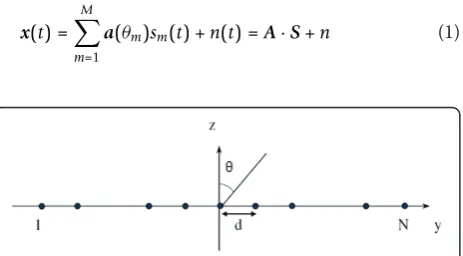
Antenna array consists of a set of antenna sensors, which are combined together in a particular geometry which may be linear, circular, planar, and conformal arrays commonly [5]. ULA is the most common geome-try for smart antennas because of its simplicity, excellent directivity and production of the narrowest main lobe in a given direction in comparison to the other array geo-metries [22]. In a ULA, as it is seen in Figure 1, the ele-ments are aligned along a straight line and with a uniform inter-element spacing usuallyd=l/2, wherel denotes the wavelength of the received signal. Ifd<l/2, mutual coupling effects cannot be ignored and the AOA estimation algorithm cannot generate desired peaks in the angular spectrum. On the other hand, ifd>l/2, then the spatial aliasing leads to misplaced or unwanted peaks in the spectrum. As so,d=l/2 is the optimum inter-ele-ment spacing in the ULA configuration.
However, as mentioned before, the ULA does not work equally well for all azimuth directions and the AOA estimation accuracy and resolution are low at array endfires. In this section, a simple ULA-based is proposed to improve AOA estimation accuracy at end-fire angles. This configuration is illustrated in Figure 2.
Signal model for the ULA and PA configurations Received signals can be expressed as linear combination of incident signals and zero mean Gaussian noise. The incident signals are assumed to be direct line of sight and uncorrelated with the noise. The input signal vector denoted byx(t) can be written as:
x(t) =
M
m=1
a(θm)sm(t) +n(t) =A·S+n (1)
whereM shows the number of incident signals on the array. sm(t) is the waveform for the m-th signal source at direction θmfrom the array boresight and Sdenotes the M× 1 vector of the received signals.a(θm) is theN × 1 steering vector or response vector of the array for direction of θm, where N is the element number. Furthermore, Ais a N×M matrix of steering vectors, which is named manifold matrix.
A=a(θ1) a(θ2) . . . a(θM)
(2)
The spatial correlation matrix of the received signals, Rxx, is defined by:
Rxx=E[x(t)·xH(t)] (3)
where E[.] is the expectation operator and H is the conjugate transposition operator. Substituting (1) into (3),Rxxcan be written as:
Rxx=E[A·s(t)·sH(t)·AH] +E[n(t)·nH(t)] (4)
And finally the spatial correlation matrix can be expressed as:
Rxx =ARssAH+σn2I (5)
Rss shows theM ×M signal correlation matrix. sn2 andI are variance of noise and identity matrix, respec-tively. Since the antennas cannot receive DC signals, the mean values of arriving signals and noise are zero and so, the correlation matrix obtained in (5) is referred as covariance matrix [22]. This matrix is used for many beamforming and AOA estimation algorithms such as MUSIC and MVDR.
The array configuration, affects steering vectors and dimension of signal vector. In order to investigate the proposed array performance in AOA estimation of nar-rowband signals, a ULA with Nelements and PA with
N + 2 elements, as depicted in Figures 1 and 2, are compared. Both of the arrays are assumed symmetric around the origin. Therefore, Nis assumed to be an odd number. The manifold matrix of the ULA and PA have dimensions ofN×Mand (N+ 2)×M, respectively.
If aULA(θm) represents the steering vector for each of the input signals on the linear array, then for the
Figure 1Uniform linear array (ULA) geometry.
symmetrical linear array,aULA(θm) can be written as aN × 1 vector expressed as:
aULA(θm) =
⎡ ⎢ ⎢ ⎢ ⎢ ⎢ ⎢ ⎢ ⎢ ⎢ ⎢ ⎢ ⎢ ⎢ ⎣
e−j
N−1
2 k.dsinθm e−j
N−2
2 k.dsinθm ..
.
ej
N−2
2 k.dsinθm ej
N−1
2 k.dsinθm ⎤ ⎥ ⎥ ⎥ ⎥ ⎥ ⎥ ⎥ ⎥ ⎥ ⎥ ⎥ ⎥ ⎥ ⎦ (6)
wheredis the inter-element space and k= 2π/l. Steering vector for the proposed array is represented with aPA(θm) that is a (N+ 2) × 1 vector and it can be written as:
aPA(θm) =
⎡ ⎢ ⎢ ⎢ ⎢ ⎢ ⎢ ⎢ ⎢ ⎢ ⎢ ⎢ ⎢ ⎢ ⎢ ⎢ ⎢ ⎢ ⎣
e−j
N−1
2 k.dsinθm e−j
N−2
2 k.dsinθm ..
.
ej
N−2
2 k.dsinθm ej
N−1
2 k.dsinθm ejk.dcosθm e−jk.dcosθm
⎤ ⎥ ⎥ ⎥ ⎥ ⎥ ⎥ ⎥ ⎥ ⎥ ⎥ ⎥ ⎥ ⎥ ⎥ ⎥ ⎥ ⎥ ⎦ (7)
The firstN rows ofaPA(θm) are related to the linear part of the array and two remained rows show the effect of the top and bottom elements in the proposed array.
AOA estimation methods
AOA estimation algorithms are classified into four cate-gories; Conventional, Subspace-based, Maximum Likeli-hood-based and Subspace fitting techniques. The two first methods are spectral-based methods that rely on calculating the spatial spectrum of the received signals and finding the AOAs as the location of peaks in the spectrum. The third and fourth approaches are called parametric array processing methods that directly esti-mate AOAs without first calculating the spectrum. The parametric algorithms have higher performance in terms of accuracy and resolution. The cost for this perfor-mance improvement is higher complexity and more computations.
In each class of the above-mentioned four categories of AOA estimation approaches, various algorithms have been presented which differ in modeling approach, com-putational complexity, resolution threshold and accuracy [7,8]. The conventional techniques are based on beam-forming where the array weights are adjusted and the
spectrum presents maximum amounts at angles that the output power is maximized. Therefore, by searching the spectrum for location of peaks, signal sources are detected. The MVDR is a well-known conventional algorithm. These methods are easy to apply and need fewer calculations than the other methods, but they can-not provide a high resolution and accuracy. On the other hand, subspace-based techniques produce the spa-tial spectrum by using Eigen-decomposition of the cov-ariance matrix of input signals, from which AOA is estimated. The MUSIC is a very common subspace-based algorithm [8].
In this article, two spectral-based algorithms, MVDR and MUSIC, are investigated. Related on the array structure and algorithm capability, AOA can be esti-mated in one or more dimensions. In order to compare the array accuracy in different directions for AOA esti-mation applications, AOA will be investigated in the plane= 0°.
MUSIC algorithm
The Eigen-vectors of the covariance matrix belong to either of two orthogonal signal or noise subspaces. IfM
signals arrive on the array, theM Eigen-vectors asso-ciated with M larger Eigen-values of the covariance matrix span the signal subspace and theN -M Eigen-vectors corresponding to theN-M smaller Eigen-values of the covariance matrix span the noise subspace. The
M steering vectors that form the manifold matrixAare orthogonal to the noise subspace and so the steering vectors lie in the signal subspace.
The MUSIC algorithm estimates the noise subspace using Eigen-decomposition of the sample covariance matrix and then the estimate of AOAs are taken as thoseθthat give the smallest value of AH(θ)·Vn, where Vndenotes the matrix of Eigen-vectors corresponding to the noise subspace. These values ofθresult in a steering vector farthest away from the noise subspace and as orthogonal to the noise subspace as possible [4,7-9]. This is done by finding the M peaks in the MUSIC spectrum defined by:
PMUSIC(θ) = 1
AHV nVnHA
(8)
MVDR algorithm
In the MVDR approach, it is attempted to minimize the power contributed by noise and undesired interferences, while maintaining a fixed gain in the look direction, usually equal to unity. This is written as:
Using Lagrange multiplier technique, the weight vec-tor that solves this equation is given by:
w= Rxx
−1A
AHRxx−1A
(10)
The MVDR angular spectrum is defined by:
PMVDR(θ) = 1
AHRxx−1A
(11)
The peaks in the MVDR spectrum occur whenever the steering vector is orthogonal to the noise subspace, so the AOAs are estimated by detecting the peaks in the spectrum [7,23].
Simulation results
Comparison of the PA and conventional ULA
To compare the accuracy of the MUSIC and MVDR algorithms in both ULA and PA geometries, a ULA withN= 15 elements is assumed and therefore, the pro-posed array consists ofN= 17 elements. Inter-element spacing is maintained d=l/2. The signal to noise ratio is SNR = 10 dB and the interior signals are assumed uncorrelated. Also, the number of data snapshots is K= 100.
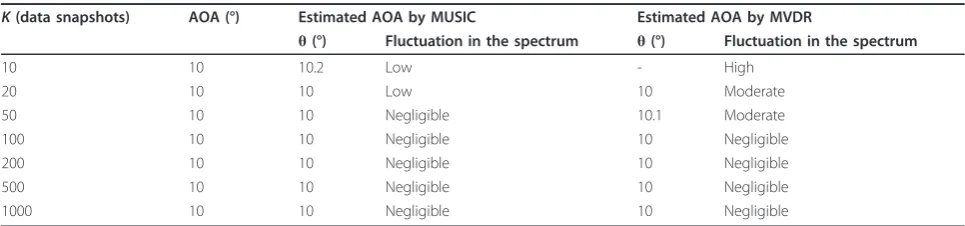
Both of arrays are simulated and compared in identi-cal situations. Table 1 shows the effects of different number of data snapshots on AOA estimation accuracy. The MUSIC works appropriately with few snapshots. The MVDR needs more snapshots to work accurately, but this amount is not very high. It can be concluded that a proper accuracy can be achieved using lower number of data snapshots. Simulation results show that
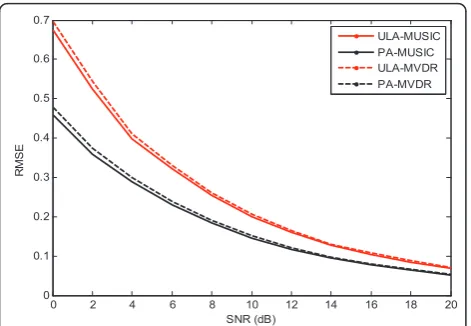
K≥ 100 leads to accurate and reliable results in AOA estimation through both the MUSIC and MVDR meth-ods. Figures 3 and 4 depict RMSE diagrams in degree for AOA estimation of signal sources located at 10° and 85° with respect to SNR changes. As the SNR increases, RMSE of the estimated AOA decreases in both arrays. The PA has lower RMSE and therefore better accuracy than the ULA at endfire directions.
Figures 5 and 6 show the spatial spectrum in both ULA and PA at endfire angles (-85°, 85°) for the MUSIC and MVDR algorithms, respectively. Simulation results depict sharp peaks at the location of signal sources while the ULA spectrum shows ambiguity at the endfire directions that means AOAs have been missed. As a result, the drawback of the ULA at endfire directions is eliminated by using the new array geometry.
Figure 7 shows the MUSIC spectrum of both arrays to detect two close sources which are assumed around the array boresight at (-2°, 2°). The PA is capable to distin-guish two close sources as well as the ULA and both arrays can generate separate peaks in the spatial spec-trum for each of the assumed sources. Therefore, an identical accuracy and resolution can be achieved for the PA at boresight angles, where the ULA performs well.
The resolution threshold of the array is obtained with decreasing the angular difference between two close angles and investigating the array ability to form the correct peaks in the spectrum. In order to compare the arrays capability during AOA estimation algorithms, Monte Carlo approach is used to achieve more accurate
Table 1 Effect of the number of data snapshots on the accuracy of AOA estimation algorithms.
K(data snapshots) AOA (°) Estimated AOA by MUSIC Estimated AOA by MVDR
θ(°) Fluctuation in the spectrum θ(°) Fluctuation in the spectrum
10 10 10.2 Low - High
20 10 10 Low 10 Moderate
50 10 10 Negligible 10.1 Moderate
100 10 10 Negligible 10 Negligible
200 10 10 Negligible 10 Negligible
500 10 10 Negligible 10 Negligible
1000 10 10 Negligible 10 Negligible
0 2 4 6 8 10 12 14 16 18 20
0 0.01 0.02 0.03 0.04 0.05 0.06 0.07
SNR (dB)
RM
S
E
ULA-MUSIC PA-MUSIC ULA-MVDR PA-MVDR
results. Each algorithm has been simulated 1000 times and final results have been calculated via averaging.
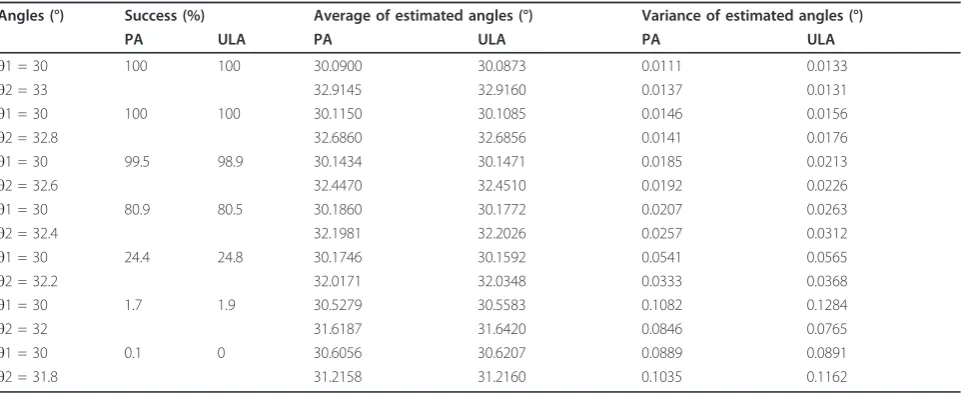
In Table 2, MUSIC resolution is investigated for two adjacent sources, assumed at middle of the spectrum. The sources are made so close together that the algo-rithm cannot distinguish them. This angle can be evalu-ated as the resolution threshold of the algorithm. Numerical results confirm similar accuracy and resolu-tion of both arrays in detecresolu-tion of close sources at the middle of the spectrum.
A similar comparison is done for the MVDR. Figure 8 shows the capability of both array configurations in dis-tinguishing close sources at middle of the spectrum. In Table 3, the resolution threshold of both arrays is com-pared via the MVDR algorithm. The peaks generated in the MVDR spectrum, aren’t as sharp as the MUSIC spectrum, so the MVDR resolution is lower than the MUSIC.
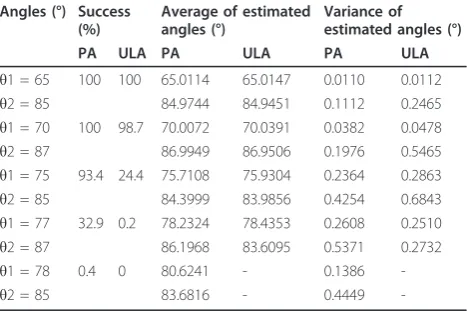
Performance of the ULA and PA at endfire AOAs is seen in Figure 9 and Table 4, for resolving two closely sources. The PA presents higher accuracy and resolution than the ULA at endfires. It seems that both arrays have similar ability for resolving middle angles but as expected, the ULA has less accuracy than the proposed array for the angles located in both sides of the spectrum. Figure 10 and Table 5 show similar results obtained via the MVDR algorithm at the endfire source locations. Spectral and numerical results confirm the higher accu-racy and resolution of the proposed array configuration than the ULA, for AOAs located at border sides of the spectrum. Since lower resolution of the MVDR, the PA strength is better seen here.
In general, the complexity of the MUSIC and MVDR algorithms are of the orderN3, for Eigen-decomposition and inversion of input correlation matrix, respectively [24-26]. Therefore, adding two elements to the array
0 2 4 6 8 10 12 14 16 18 20
0 0.1 0.2 0.3 0.4 0.5 0.6 0.7
SNR (dB)
R
M
SE
ULA-MUSIC PA-MUSIC ULA-MVDR PA-MVDR
Figure 4 RMSE of the ULA and PA with respect to SNR variations at endfires (AOA = 85°),K= 100.
-90 -75 -60 -45 -30 -15 0 15 30 45 60 75 90
-35 -30 -25 -20 -15 -10 -5 0
Angle (degree)
Re
la
tiv
e P
owe
r (
dB
)
ULA PA
Figure 5MUSIC spectrum for the ULA and PA geometries at endfire AOAs (-85°, 85°), SNR = 10 dB,K= 100.
-90 -75 -60 -45 -30 -15 0 15 30 45 60 75 90
-30 -25 -20 -15 -10 -5 0
Angle (degree)
Re
la
tiv
e P
owe
r (d
B
)
ULA PA
Figure 6MVDR spectrum for the ULA and PA geometries at endfire AOAs (-85°, 85°), SNR = 10 dB,K= 100.
-90 -75 -60 -45 -30 -15 0 15 30 45 60 75 90
-35 -30 -25 -20 -15 -10 -5 0
Angle (degree)
Re
la
tiv
e P
owe
r (
dB
)
ULA PA
causes that the computational load rise to order (N+ 2)3. The size of the ULA aperture affects the resolution thresh-old, especially at boresight directions. Hence if two ele-ments at both ends of PA be lessened, computational cost remains the same, while the PA still performs well at end-fire directions. Simulation results show that in this situa-tion the resolusitua-tion threshold may be a little decreased. Therefore, the increase in computational cost prevents the changes of resolution threshold in boresight directions.
Comparison of the PA and two other array geometries
Simulation results demonstrated better performance of the PA in detection and separation of signal sources located at array endfires with respect to the ULA. Similar compari-son between the PA and other geometries can be investi-gated. In this work, two considerable arrangements, the
L-shape and V-L-shape arrays, are applied for 1-D AOA esti-mation and their performance is compared with the PA. In the literature, planar L-shape array has shown good accuracy [13] and the V-shape structure with specified design has demonstrated isotropic and uniform perfor-mance in all directions [27].
For simulation, three planar arrays, PA, L-shape and V-shape arrangements, with equal element numbers are assumed. The L-shape and V-shape structures are illu-strated in Figures 11 and 12. Steering vector for these arrays can be written as (12), (13), respectively.
aL−shape(θm) =
⎡ ⎢ ⎢ ⎢ ⎢ ⎢ ⎢ ⎢ ⎢ ⎢ ⎢ ⎢ ⎢ ⎢ ⎢ ⎢ ⎢ ⎢ ⎢ ⎢ ⎢ ⎢ ⎢ ⎣ ej
N−1
2 k.dcosθm
ej
N−3
2 k.dcosθm ..
. ejk.dcosθm
1 ejk.dsinθm
.. .
ej
N−3
2 k.dsinθm
ej
N−1
2 k.dsinθm
⎤ ⎥ ⎥ ⎥ ⎥ ⎥ ⎥ ⎥ ⎥ ⎥ ⎥ ⎥ ⎥ ⎥ ⎥ ⎥ ⎥ ⎥ ⎥ ⎥ ⎥ ⎥ ⎥ ⎦ (12)
aV−shape(θm) =
⎡ ⎢ ⎢ ⎢ ⎢ ⎢ ⎢ ⎢ ⎢ ⎢ ⎢ ⎢ ⎢ ⎢ ⎢ ⎢ ⎢ ⎢ ⎣ e−j
N−1
2 √
3 2
k.dsinθm.ej
N−1
2
1 2 k.dcosθm
e−j
N−3
2 √
3 2
k.dsinθm.ej
N−3
2
1 2 k.dcosθm ..
.
ej
N−3
2 √
3 2
k.dsinθm.ej
N−3
2 1
2 k.dcosθm
ej
N−1
2 √
3 2
k.dsinθm.ej
N−1
2
1 2 k.dcosθm
⎤ ⎥ ⎥ ⎥ ⎥ ⎥ ⎥ ⎥ ⎥ ⎥ ⎥ ⎥ ⎥ ⎥ ⎥ ⎥ ⎥ ⎥ ⎦ (13)
Table 2 Accuracy of MUSIC algorithm in the case of narrowband sources at the middle of the spectrum, SNR = 10 dB,
K= 100.
Angles (°) Success (%) Average of estimated angles (°) Variance of estimated angles (°)
PA ULA PA ULA PA ULA
θ1 = 30 100 100 30.0900 30.0873 0.0111 0.0133
θ2 = 33 32.9145 32.9160 0.0137 0.0131
θ1 = 30 100 100 30.1150 30.1085 0.0146 0.0156
θ2 = 32.8 32.6860 32.6856 0.0141 0.0176
θ1 = 30 99.5 98.9 30.1434 30.1471 0.0185 0.0213
θ2 = 32.6 32.4470 32.4510 0.0192 0.0226
θ1 = 30 80.9 80.5 30.1860 30.1772 0.0207 0.0263
θ2 = 32.4 32.1981 32.2026 0.0257 0.0312
θ1 = 30 24.4 24.8 30.1746 30.1592 0.0541 0.0565
θ2 = 32.2 32.0171 32.0348 0.0333 0.0368
θ1 = 30 1.7 1.9 30.5279 30.5583 0.1082 0.1284
θ2 = 32 31.6187 31.6420 0.0846 0.0765
θ1 = 30 0.1 0 30.6056 30.6207 0.0889 0.0891
θ2 = 31.8 31.2158 31.2160 0.1035 0.1162
-90 -75 -60 -45 -30 -15 0 15 30 45 60 75 90
-25 -20 -15 -10 -5 0 Angle (degree) Re la tiv e P owe r ( dB ) ULA PA
Steering vectors for the PA, L-shape and V-shape arrays are N× 1 vectors.Nthat represents the number of elements is assumed 15 in this section. Angle of ULAs in the L-shape and V-shape arrays are assumed 90° and 120°, respectively. Figures 13 and 14 show the MUSIC and MVDR spectrums for detection and separa-tion of signal sources placed at closed angles to the array endfires, respectively. The L-shape array presents sharper peaks at the source locations and higher ability in resolving close sources placed near to the endfires in comparison with other structures. The V-shape array and the PA also have detected and resolved the signal sources at endfires accurately.
In Figures 15 and 16, the MUSIC as well as the MVDR spectrums are shown for AOA estimation in the middle of the spectrum. Simulation results show that despite the high resolution of the L-shape array at
border angles, this array does not present a well resolu-tion in the middle of the spectrum. Therefore, the L-shape array does not have a uniform performance at all directions. Simulation results also show that the V-shape array and PA with equal element number, present almost similar results in the middle of the spectrum.
Computational complexity of AOA estimation algo-rithms includes two parts: steering vector calculations and matrix inversion in the MVDR or Eigen-decomposi-tion in the MUSIC calculaEigen-decomposi-tions. With equal element numbers, computational cost for AOA estimation algo-rithms is equivalent in the PA and L-shape arrays. How-ever, steering vector for the V-shape array is obtained with more complexity and computational cost than the PA and L-shape arrays (compare Equations 7, 12 and 13). The PA also occupies less space than the V-shape array for utilization in base stations. In addition, the
Table 3 Accuracy of MVDR algorithm in the case of narrowband sources at the middle of the spectrum, SNR = 10 dB,
K= 100.
Angles (°)
Success (%)
Average of estimated angles (°) Variance of estimated angles (°)
PA ULA PA ULA PA ULA
θ1 = 30 100 100 30.3378 30.3813 0.0150 0.0179
θ2 = 33.6 33.2452 33.2077 0.0159 0.0183
θ1 = 30 99.8 97.7 30.4297 30.5000 0.0237 0.0296
θ2 = 33.4 32.9558 32.8870 0.0240 0.0290
θ1 = 30 92.7 83.9 30.5642 30.6317 0.0416 0.0543
θ2 = 33.2 32.6238 32.5564 0.0338 0.0487
θ1 = 30 55 35 30.7901 30.9372 0.1381 0.1601
θ2 = 33 32.2243 32.0572 0.0918 0.1494
θ1 = 30 10.7 3 31.1459 31.2665 0.1678 0.1226
θ2 = 32.8 31.6801 31.5318 0.1645 0.1225
θ1 = 30 0.1 0 31.2599 - 0.0619
-θ2 = 32.6 31.3259 - 0.0611
--90 -75 -60 -45 -30 -15 0 15 30 45 60 75 90 -35
-30 -25 -20 -15 -10 -5 0
Angle (degree)
R
el
at
iv
e P
ow
er
(dB
)
ULA PA
Figure 9MUSIC spectrum for the ULA and PA geometries at endfire AOAs (76°, 86°), SNR = 10 dB,K= 100.
Table 4 Accuracy of MUSIC algorithm in the case of narrowband sources at the border of the spectrum, SNR = 10 dB,K= 100
Angles (°) Success (%)
Average of estimated angles (°)
Variance of estimated angles (°) PA ULA PA ULA PA ULA
θ1 = 65 100 100 65.0114 65.0147 0.0110 0.0112
θ2 = 85 84.9744 84.9451 0.1112 0.2465
θ1 = 70 100 98.7 70.0072 70.0391 0.0382 0.0478
θ2 = 87 86.9949 86.9506 0.1976 0.5465
θ1 = 75 93.4 24.4 75.7108 75.9304 0.2364 0.2863
θ2 = 85 84.3999 83.9856 0.4254 0.6843
θ1 = 77 32.9 0.2 78.2324 78.4353 0.2608 0.2510
θ2 = 87 86.1968 83.6095 0.5371 0.2732
θ1 = 78 0.4 0 80.6241 - 0.1386
--90 -75 -60 -45 -30 -15 0 15 30 45 60 75 90 -25
-20 -15 -10 -5 0
Angle (degree)
Re
la
tiv
e P
owe
r (
dB
)
ULA PA
Figure 10MVDR spectrum for the ULA and PA geometries at endfire AOAs (72°, 86°), SNR = 10 dB,K= 100.
Table 5 Accuracy of MVDR algorithm in the case of narrowband sources at the border of the spectrum, SNR = 10 dB,K= 100
Angles (°) Success (%)
Average of estimated angles (°)
Variance of estimated angles (°) PA ULA PA ULA PA ULA
θ1 = 50 100 99.9 49.9988 49.9992 0.0022 0.0021
θ2 = 87 87.0151 87.0319 0.0767 0.2806
θ1 = 55 100 99.7 54.9965 54.9999 0.0033 0.0026
θ2 = 87 87.0311 87.0608 0.0826 0.2612
θ1 = 60 100 98.4 60.0015 59.9963 0.0050 0.0049
θ2 = 87 86.9832 87.820 0.1049 0.3894
θ1 = 65 100 97.1 65.0621 65.686 0.0128 0.0133
θ2 = 87 86.8584 86.5803 0.1482 0.5512
θ1 = 70 99.5 18.7 70.5040 70.6565 0.0568 0.0801
θ2 = 87 86.4340 85.5583 0.2573 0.3105
θ1 = 75 8 0 76.8038 - 0.0494
-θ2 = 87 85.6822 - 0.2908
-Figure 11L-shape uniform array.
Figure 12V-shape uniform array.
-90 -75 -60 -45 -30 -15 0 15 30 45 60 75 90
-35 -30 -25 -20 -15 -10 -5 0
Angle (degree)
R
el
at
iv
e P
ow
er (d
B
)
L-shape V-shape PA
Figure 13Comparison of MUSIC spectrum in the PA, L-shape and V-shape geometries at endfire AOAs (72°, 88°), SNR = 10 dB,K= 100.
-90 -75 -60 -45 -30 -15 0 15 30 45 60 75 90 -25
-20 -15 -10 -5 0
Angle (degree)
Re
la
tiv
e P
owe
r
(d
B
)
L-shape V-shape PA
angle between the V-shape sub-arrays affects the perfor-mance of this array. Therefore, the PA is an appropriate and simple geometry for AOA estimation and can mod-ify the performance of the conventional ULA in AOA estimation. This structure may provide the ability of 3-D AOA estimation that can be followed in future works.
Conclusions
The conventional ULA is the most common array geo-metry for smart antenna systems and array signal pro-cessing. Beside great advantages, the ULA does not perform uniform for all angles in the spatial spectrum and cannot detect or resolve close sources located at endfires, accurately. In this article, new ULA-based array
geometry is proposed and presented which can remove this drawback by keeping the simplicity in implementa-tion and analysis. Spectral and numerical evaluaimplementa-tion is done on the resolution of both ULA and PA geometries via two well-known AOA estimation algorithms, MUSIC as well as MVDR. Simulation results show that the pro-posed array resolves narrowband signal sources located at close angles to the array endfire accurately, while hav-ing a good resolution in other directions. In addition, to improve the performance of the conventional ULA, the PA presents better accuracy and resolution than the L-shape array in boresight directions. The PA also pre-sents near accuracy to the V-shape array with equal
ele-ment numbers while having less complexity,
computational cost and array aperture size.
List of abbreviations
AOA: Angle of Arrival; CCI: Co-Channel Interference; DOA: Direction of Arrival; DSA: Displaced Sensor Array; MUSIC: MUltiple SIgnal Classification; MVDR: Minimum Variance Distortionless Response; PA: Proposed Array; RMSE: Root Mean Square Error; SNR: Signal to Noise Ratio; TDOA: Time Difference of Arrival; TOA: Time of Arrival; UCA: Uniform Circular Array; ULA: Uniform Linear Array; URA: Uniform Rectangular Array.
Acknowledgements
This work has been supported by Shahid Rajaee Teacher Training University (SRTTU) under contract number 316 (16.1.1390). We would like to thank anonymous reviewers for their careful reviews of the article. Their comments have certainly improved the quality of this article.
Author details
1
Digital Communications Signal Processing (DCSP) Research Lab., Faculty of Electrical and Computer Engineering, Shahid Rajaee Teacher Training University (SRTTU), Tehran, Iran2Electrical Engineering Department, Tehran South Branch, Islamic Azad University, Tehran, Iran
Competing interests
The authors declare that they have no competing interests.
Received: 15 November 2010 Accepted: 10 August 2011 Published: 10 August 2011
References
1. H Krim, M Viberg, Two decades of array signal processing research. IEEE Signal Process Mag.July, 67–94 (1996)
2. F Ji, S Kwong, Robust and computationally efficient signal-dependent method for joint doa and frequency estimation. EURASIP J Adv Signal Process. 1–16 (2008)
3. X Zhang, Y Shi, D Xu, Novel blind joint direction of arrival and polarization estimation for polarization-sensitive uniform circular array. Progress Electromagn Res.PIER 86, 19–37 (2008)
4. LC Godara, Application of antenna arrays to mobile communications. part ii: beamforming and direction-of-arrival considerations. Proc IEEE.85(8), 1195–1245 (1997). doi:10.1109/5.622504
5. F Gross,Smart Antennas for Wireless Communications with MATLAB (McGraw Hill, New York, 2005)
6. M Chryssomallis, Smart Antennas. IEEE Antennas Prop Mag.42(3), 129–136 (2000). doi:10.1109/74.848965
7. SW Varade, KD Kulat, Robust algorithms for DOA estimation and adaptive beamforming for smart antenna application. inSecond International Conference on Emerging Trends in Engineering and Technology, ICETET-09, 1195–1200 (2009)
8. LC Godara,Handbook of Antennas in Wireless Communications(CRC Press LLC, New York, 2002)
-90 -75 -60 -45 -30 -15 0 15 30 45 60 75 90
-35 -30 -25 -20 -15 -10 -5 0
Angle (degree)
Rel
at
iv
e P
owe
r (
dB
)
L-shape V-shape PA
Figure 15Comparison of MUSIC spectrum in the PA, L-shape and V-shape geometries at boresight directions (-2°, 2°), SNR = 10 dB,K= 100.
-90 -75 -60 -45 -30 -15 0 15 30 45 60 75 90
-25 -20 -15 -10 -5 0
Angle (degree)
Re
la
tiv
e P
owe
r
(d
B
)
L-shape V-shape PA
9. RM Shubair, MA Al-Qutayri, JM Samhan, A setup for the evaluation of MUSIC and LMS algorithms for a smart antenna system. J Commun.2(4), 71–77 (2007)
10. U Baysal, RL Moses, On the geometry of isotropic arrays. IEEE Trans Signal Process.51(6), 1469–1478 (2003). doi:10.1109/TSP.2003.811227
11. P Ioannides, CA Balanis, Uniform circular arrays for smart antennas. IEEE Antennas Prop Mag.47(4), 192–206 (2005)
12. M Lin, L Yang, Blind calibration and DOA estimation with uniform circular arrays in the presence of mutual coupling. IEEE Antennas Wireless Prop Lett.5, 315–318 (2006)
13. Y Hua, TK Sarkar, DD Weiner, An L-Shaped array for estimating 2-D directions of wave arrival. IEEE Trans Antenna Prop.39(2), 143–146 (1991). doi:10.1109/8.68174
14. N Tayem, HM Kwon, L-Shape 2-dimensional arrival angle estimation with propagator method. IEEE Trans Antenna Prop.53(5), 1622–1630 (2005) 15. F Harabi, H Changuel, A Gharsallah, Direction of arrival estimation method
using a 2-L shape arrays antenna. Prog Electromagn Res.PIER 69, 145–160 (2007)
16. SW Ellingson, Design and evaluation of a novel antenna array for azimuthal angle-of-arrival measurement. IEEE Trans Antenna Prop.49(6), 971–979 (2001). doi:10.1109/8.931156
17. WG Diab, HM Elkamchouchi, A deterministic approach for 2D-DOA estimation based on a V-shaped array and a virtual array concept. inIEEE 19th International Symposium on Personal, Indoor and Mobile Radio Communications, 1–5 (Sept. 2008)
18. DT Vu, A Renaux, R Boyer, S Marcos, Performance analysis of 2D and 3D antenna arrays for source localization. inEUSIPCO-2010, 661–665 (Aug. 2010) 19. T Filik, TE Tuncer, Uniform and nonuniform V-shaped isotropic planar arrays. in5th IEEE Sensor Array and Multichannel Signal Processing Workshop, 21–23 (July 2008)
20. L Jin, L Li, H Wang, Investigation of different types of array structures for smart antennas. inInternational Conference on Microwave and Millimetre Wave Technology (ICMMT2008), April 2008, pp. 1160–1163
21. F Gozasht, GR Dadashzadeh, S Nikmehr, a comprehensive performance study of circular and hexagonal array geometries in the LMS algorithm for smart antenna applications. Prog Electromagn Res.PIER 68, 281–296 (2007) 22. RM Shubair, RS Al Nuaimi, Displaced sensor array for improved signal
detection under grazing incidence conditions. Prog Electromagn Res. PIER79, 427–441 (2008)
23. MA Al-Nuaimi, RM Shubair, KO Al-Midfa, Direction of arrival estimation in wireless mobile communications using minimum variance distortionless response. inSecond International Conference on Innovations in Information Technology (IIT’05), 1–5 (Sept. 2005)
24. HC So, Y Wu, Fast algorithm for high resolution frequency estimation of multiple real sinusoids. IEICE Trans Fundam.E.86-A(11), 2891–2893 (2003) 25. M Rubsamen, AB Gershman, Direction-of-arrival estimation for nonuniform
sensor arrays: from manifold separation to Fourier domain MUSIC methods. IEEE Trans Signal Process.57(2), 588–599 (2009)
26. P Stoica, Z Wang, J Li, Robust capon beamforming. IEEE Signal Process Lett. 10(6), 172–175 (2003). doi:10.1109/LSP.2003.811637
27. T Filik, TE Tuncer, Design and evaluation of V-shaped arrays for 2-D DOA estimation. inIEEE International Conference on Acoustics, Speech and Signal Processing, 2008, (ICASSP 2008), pp. 2477–2480
doi:10.1186/1687-6180-2011-39
Cite this article as:Shirvani-Moghaddam and Akbari:A novel ULA-based geometry for improving AOA estimation.EURASIP Journal on Advances in
Signal Processing20112011:39.
Submit your manuscript to a
journal and benefi t from:
7Convenient online submission 7Rigorous peer review
7Immediate publication on acceptance 7Open access: articles freely available online 7High visibility within the fi eld
7Retaining the copyright to your article