Volume 2006, Article ID 94287, Pages1–13 DOI 10.1155/ASP/2006/94287
Cram ´er-Rao-Type Bounds for Localization
Cheng Chang and Anant Sahai
Electrical Engineering and Computer Sciences, University of California, Berkeley, CA 94720, USA
Received 31 May 2005; Revised 10 November 2005; Accepted 1 December 2005
The localization problem is fundamentally important for sensor networks. This paper, based on “Estimation bounds for local-ization” by the authors (2004 © IEEE), studies the Cram´er-Rao lower bound (CRB) for two kinds of localization based on noisy range measurements. The first is anchored localization in which the estimated positions of at least 3 nodes are known in global coordinates. We show some basic invariances of the CRB in this case and derive lower and upper bounds on the CRB which can be computed using only local information. The second is anchor-free localization where no absolute positions are known. Although the Fisher information matrix is singular, a CRB-like bound exists on the total estimation variance. Finally, for both cases we dis-cuss how the bounds scale to large networks under different models of wireless signal propagation.
Copyright © 2006 Hindawi Publishing Corporation. All rights reserved.
1. INTRODUCTION
In wireless sensor networks, the positions of the sensors play a vital role. Position information can be exploited within the network stack at all levels from improved physical layer communication [1] to routing [2] and on to the application level where positions are needed to meaningfully interpret any physical measurements the sensors may take. Because it is so important, this problem of localization has been studied extensively. Most of these studies assume the existence of a group of “anchor nodes” that have a priori known positions. There are three major categories of localization schemes that differ in what kind of geometric information they use to estimate locations. Many, such as those of [3–7], use only the connectivity information reflecting whether nodeican directly communicate with node j or anchor k. Such ap-proaches are attractive because connectivity information is accessible at the network layer due to its use in multihop routing.
The second category uses both ranging and angular in-formation for localization. Such schemes are studied in [8–
10]. These are useful when there is a line of sight and antenna arrays are available at the sensor nodes so that beamforming is possible to determine the angles.
The third category is localization based solely on rang-ing measurements among nodes and between nodes and an-chors. In [11,12], the schemes for estimating ranges are dis-cussed. References [13, 14] estimate the positions directly based on such node-to-anchor ranging estimates. In
con-trast, [15,16] first estimate positions in an anchor-free co-ordinate system and then embed it into the coco-ordinate sys-tem defined by the anchors. In this paper we also focus on localization using ranging information alone.
The Cram´er-Rao lower bound (CRB) [17] is widely used to evaluate the fundamental hardness of an estimation prob-lem. The CRB for anchored localization using ranging infor-mation has been studied in [18–20]. The expression for the CRB was derived in [18]. In [20], a comparison of the CRB with the simpler Bayesian bound has been studied. In [19], simulation is used to study the impact of the density of the anchors and the size of the sensor network on the CRB.
As far as anchored localization goes, our additional con-tribution is giving a geometric interpretation of the CRB and deriving local lower and upper bounds on the CRB. The lower bounds imply that local geometry is critical for lo-calization accuracy. The corresponding upper bounds show through simulation that the errors are not a lot worse if only thenearbyanchors or nodes are involved in the position es-timation of a particular node. These results show that dis-tributed localization schemes are promising.
1.1. Outline of the paper
After reviewing some basics in this introduction,Section 2
studies bounds for anchored localization. Assuming the ranging errors are i.i.d. Gaussian, we give an explicit expres-sion for the FIM solely based on the geometry of the sensor network and show that the CRB is essentially invariant under zooming, translation, and rotation. Using matrix theory, we give a lower bound on the CRB that is determined by only local geometry. This converges to the CRB as the local area is expanded. We also give a corresponding local upper bound on the localization CRB. Finally we study the wireless situa-tion in which the noise variance on the range measurements depends on the inter-sensor distance. Simulation results val-idate our intuition that the faster the signal decays, the less the CRB benefits from faraway information. A heuristic ar-gument reveals the basic scaling laws involved.
Section 3studies the bound for anchor-free localization. The rank of the FIM for M nodes is shown to be at most 2M−3. The corresponding modified CRB is interpreted as a bound on the sum of the estimation variances. We observe that the per node bound in simulations appears to be pro-portional to the average number of neighbors and conjec-ture that the total estimation variance scales with the total received signal energy.
1.2. Cram´er-Rao bound on ranging
Since range is our basic input, we first review the CRB for wireless ranging. The distance between two nodes is ctd, where c is the speed of light andtd is the time of arrival (TOA). TOA estimation is extensively studied in the radar literature. IfTis the observation duration,A(t) is the pulse,1
andN0is the noise power spectral density, then for any un-biased estimate oftd[22],
Etd−td
2
≥T N0 0
∂A(t)/∂t 2dt. (1)
Notice that0T(∂A(t)/∂t)2dtis proportional to the energy in
the signal with the proportionality constant depending on the pulse shape. Because of the derivative, we know that hav-ing a pulse with a wide bandwidth is beneficial. Callhav-ing that proportionalityτ2
r, we have
Etd−td
2
≥ τ2r
SNR. (2)
The CRB on ranging is a fundamental bound coming only from the Gaussian thermal noise in the received signal. In re-ality, there are other sources of small ranging errors including interference, multipath spreading, unpredictable clock drifts,
1Notice that ranging estimates can be obtained from any pulse whose shape
is known at the receiver. This includes data carrying packets that have been successfully decoded as long as we know the time they were supposed to have been transmitted. In a wireless sensor network, we are thus not restricted to use a dedicated radio for ranging.
Rvisible
Figure1: A sensor network. Solid dots are anchors; circles are nodes with unknown positions. The rangedi,jis estimated for sensor pairs i,js.t.di,j≤Rvisible.
operating system latencies, and so forth. These can cause the ranging error to be non-Gaussian even near the mean. More significantly, these ranging errors do not scale with SNR. We ignore all these other sources of error in this paper.
1.3. Models of localization
We idealize the localization problem by assuming all the sen-sors are fixed on a 2D plane. We have a setSofMsensors with unknown positions, together with a setFofNsensors (an-chors) with known positions. Because the size of each sensor is assumed to be very small, it is treated as a point.
Each sensor generates limited-energy wireless signals that enable nodeito measure the distance to some nearby sensors in the set adj(i), as illustrated inFigure 1. We assume j ∈ adj(i) if and only ifi ∈ adj(j) for symmetry. Throughout, we also assume high SNR2and so are free to assume that the
distance measurements are only corrupted by independent zero mean Gaussian errors.
1.3.1. Anchored localization
If there are at least three nodes with positions known in global coordinates (|F| ≥ 3), then it is possible to estimate such global coordinates for each node using observationsD
and position knowledgePF:
D= di,j|i∈S∪F, j∈adj(i)
,
PF=
xi,yi
T |
i∈F. (3)
Our goal is to estimate the set
PS=
xi,yi
T |
i∈S. (4)
2Suppose that we are estimating the propagation time by looking for a peak
(xi,yi) is the position of sensori. The measured distance between sensorsiand j is di,j =
(xi−xj)2+ (yi−yj)2+ i,j, wherei,j’s are modeled as independent Gaussian errors ∼N(0,σ2
i j).
1.3.2. Anchor-free localization
If|F| =0, no nodes have known positions. This is an appro-priate model whenever either we do not care about absolute positions, or if whatever global positions we do have are far more imprecise than the quality of measurements available within the sensor network. However, local coordinates are not unique. IfPS= {(xi,yi)T |i∈S}is a position estimate, thenPS = {R(α)(±xi,yi)T + (a,b)T |i∈S}is equivalent to
PSwhere the±represents reflecting the entire network about theyaxis andR(α) is a rotation matrix:
R(α)=
cos(α) −sin(α) sin(α) cos(α)
. (5)
Thus, the performance measure for anchor-free localization should not bei(xi−xi)2+ (yi−yi)2. The distance between equivalence classes should be used instead. Since the FIM for anchor-free localization is singular [9], the bound will be de-veloped using the tools provided in [21].
2. ESTIMATION BOUNDS FOR ANCHORED LOCALIZATION
The Cram´er-Rao bound (CRB) can be derived from the FIM.
2.1. The anchored localization FIM
In [18–20], expressions for the localization FIM were de-rived. The derivations are repeated below for completeness and furthermore, we observe that the FIM for localization is a function of the angles between nodes and anchors. As illus-trated inFigure 2, the angleαi j∈[0, 2π) from nodeitojis defined as
cosαi j
= xj−xi
xj−xi
2
+yj−yi
2 =xjd−xi
i j ,
sinαi j
= yj−yi
xj−xi
2
+yj−yi
2 = yjd−yi
i j .
(6)
Letxi, yi be the (2i−1)th and 2ith parameters to be estimated, respectively,i=1, 2,. . .,M. The FIM isJ2M×2M.
Theorem 1 (FIM for anchored localization). For all i =
1,. . .,M,
J2i−1,2i−1=
j∈adj(i)
cos2α
i j
σ2
i j
, (7)
J2i,2i=
j∈adj(i)
sin2αi j
σ2
i j
, (8)
J2i−1,2i=J2i,2i−1=
j∈adj(i)
cosαi j
sinαi j
σ2 i j . (9) y x i j
(xi,yi) αi j
(xj,yj)
Figure2:αi jillustrated.
For nondiagonal entriesj=i, ifj∈adj(i),
J2i−1,2j−1=J2j−1,2i−1= −
1
σ2
i j cos2α
i j
,
J2i,2j=J2j,2i= − 1
σ2
i j
sin2αi j
,
J2i−1,2j=J2j,2i−1=J2i,2j−1=J2j−1,2i
= − 1
σ2
i j sinαi j
cosαi j
= − 1 2σ2
i j
sin2αi j
.
(10)
Ifj /∈adj(i), the entries are all zero.
Proof. We have the conditional pdf3
pd|xM1 ,y1M
=
i< j,j∈adj(i)
e−(di j−di j)2/2σi j2
2πσi j2
. (11)
The log likelihood is
lnpd|xM1 ,y1M
=C−
i< j,j∈adj(i)
(di,j−di,j)2 2σ2
i j
, (12)
and so
J2i−1,2i−1=E
∂2lnpd|xM
1 ,y1M
∂x2
i
=
j∈adj(i)
1
σ2
i j
⎛ ⎜
⎝ xj−xi xj−xi
2
+yj−yi
2 ⎞ ⎟ ⎠ 2 =
j∈adj(i)
cos2α
i j
σi j2 ,
(13)
and similarly for other entries ofJ.
3d= {d
i,j |i < j,j∈adj(i)}is the observation vector.xM1 =(x1,x2,. . .,
2.2. Properties of the anchored localization CRB
Given the FIM, the CRB for any unbiased estimator is4
Exi−xi
2
≥J2−i−11,2i−1,
Eyi−yi
2
≥J−1 2i,2i.
(14)
Corollary 1 (the FIM is invariant under zooming and
translation). J({(xi,yi)})=J({(axi+c,ayi+d)})fora=0.
Proof. The anglesαi jand noiseσi jare unchanged and so the result follows immediately.
Corollary 2. The CRB for a single node is invariant under
ro-tation and reflection: letA=J({(xi,yi)}),B=J({R(xi,yi)}),
whereRis a2×2matrix, withRRT =I2×2. ThenA−1 2i−1,2i−1+ A−2i1,2i=B−2i−11,2i−1+B−2i1,2i, for alli=1, 2. . .,M.
Proof. Going through the derivation of the FIM, we find that
B=QAQT, whereQis a 2M×2Mmatrix with the following form:
Q2i−1,2i−1 Q2i−1,2i
Q2i,2i−1 Q2i,2i
=R (15)
with all other entries ofQbeing 0. ObviouslyQTQ=QQT =
I2M×2Mand soB−1=QA−1QT. Write
A(i)=
A−1
2i−1,2i−1 A−2i−11,2i
A−1
2i,2i−1 A−2i1,2i
(16)
and similarly for B(i). Then B(i) = RA(i)RT. Since Tr(XY) =Tr(YX), we haveB−2i−11,2i−1+B2−i1,2i =Tr(B(i)) = Tr(RA(i)RT) = Tr(RTRA(i)) = Tr(A(i)) = A−1
2i−1,2i−1 + A−1
2i,2i.
2.3. A lower bound to the anchored localization CRB
In order to invert the FIM and thereby evaluate the CRB, we need to take the geometry of the whole sensor network into account. In this section, we derive a performance bound for nodel that depends only on the local geometry around it. This has the potential to be valuable to “local” algorithms that try to do localization without performing all the com-putations in one center.
First we review a lemma for estimation variance.
Lemma 1(submatrix bound). Let the row vector θ = (θ1,
θ2,. . .,θN) ∈ RN; for all M, 1 ≤ M < N, write θ∗ = (θN−M+1,. . .,θN); then for any unbiased estimator forθ,
Eθ∗−θ∗Tθ∗−θ∗≥C−1, (17)
whereCis the(N−M)×(N−M)matrix:
J(θ)=
A B BT C
, (18)
4We write (A−1)
i,jasA−i,j1for a nonsingular matrixA.
whereJ(θ)is the nonsingular, and hence positive definite, FIM forθ.
Proof. Write the inverse ofJ(θ) as
J(θ)−1=
A B BT C
. (19)
J(θ) is positive definite, thenTheorem 5inAppendix A guar-antees
C≥C−1. (20)
The CRB theorem then givesE((θ∗−θ∗)T(θ∗−θ∗))≥
C≥C−1.
Notice that for any subset of M nodes, we can always reorder them to get indicesN −M+ 1,. . .,N. By directly applyingLemma 1we get the following.
Theorem 2(a lower bound on the CRB). Writeθl=(xl,yl)T
and write
Jl= 1
σ2
J(θ)2l−1,2l−1 J(θ)2l−1,2l
J(θ)2l,2l−1 J(θ)2l,2l
. (21)
Then for any unbiased estimatorθ,E((θl−θl)(θl−θl)T)≥Jl−1.
This means we can give a bound on the estimation of (xl,yl) using only the local geometry around sensorl.
Corollary 3. Jlonly depends on(xl,yl)and(xi,yi),i∈adj(l).
Proof. Jlin (7) only depends on (αl j,σl j), j ∈ adj(l). These only depend on (xl,yl) and (xi,yi).
Assume that the ranging errors are i.i.d. Gaussian with zero mean and common varianceσ2and define the
normal-ized FIMK =σ2J. This is similar to the geometric dilution
of precision (GDOP) in radar [23] since K is dimension-less and only depends on the anglesαi j’s. LetW = |adj(l)| with sensors ∈ adj(l) being l(1),. . .,l(k),. . .,l(W). Using elementary trigonometry and writingαk=αl,l(k), we have
Jl= 1
σ2 ⎛ ⎜ ⎜ ⎜ ⎝
W
2 +
W
k=1cos
2αk
2
W
k=1sin
2αk
2
W
k=1sin
2αk
2
W
2 −
W
k=1cos
2αk
2
⎞ ⎟ ⎟ ⎟ ⎠.
(22)
The sum of the estimation variance
Exl−xi
2
+yl−yi
2
≥J−1
l 11+Jl−122
= 4Wσ2
W2− W
k=1cos
2αk
2
− W
k=1sin
2αk
2
≥4σ2
W
0 2 4 6 8 10 12 14 16 18 20 Index of nodes
0 0.1 0.2 0.3 0.4 0.5 0.6 0.7 0.8 0.9
N
o
rmaliz
ed
estimatio
n
bounds
CRB 2-hop
1-hop 4 adj (l)
Figure3: Bounds for 20 randomly chosen nodes indexed with de-creasing adj(i).
with equality whenWk=1sin(2αk)= 0,
W
k=1cos(2αk) = 0. This happens if the centroid of the unit vectors (cos(2αk), sin(2αk)) is the origin. A special case is when the angles 2αk’s are uniformly distributed in [0, 2π).
Above, we usedone-hopgeometric information around nodeito get a lower bound on the CRB. This bound can be interpreted as the CRB given perfect knowledge of the po-sitions ofallother nodes.5We can use more information to
tighten the bound. The lower bound using two-hop informa-tion is the CRB given the posiinforma-tions ofallnodes j,j /∈adj(i), and similarly for multiple hops. The larger the local region we use to calculate the CRB is, the tighter it is. We define the CRB on such an estimation problem as theN-hop bound for that particular node. Obviously, theN-hop bound is nonde-creasing withN, and the ∞-hop bound is the same as the CRB for the original estimation problem.
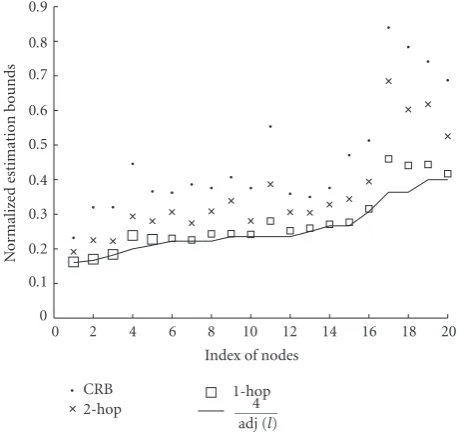
In our simulation, we have 200 nodes and 10 anchors all uniformly randomly distributed inside the unit circle,
j ∈adj(i), if and only ifdi·j ≤0.3. InFigure 3, we plot the bounds for 20 randomly chosen nodes.
2.4. An upper bound to the anchored localization CRB
The CRB inTheorem 1gives us the best performance an un-biased estimator can achieve givenallinformation from the sensor network, including the positions of all anchors and all the available ranging information di,j. This bounds the performance of a centralized localization algorithm where a central computer first collects all the information and then estimates the positions of the nodes.
5It is equivalent to knowing the positions of all the neighbors.
0 1 2 3 4 5 6 7
x 0
1 2 3 4 5 6 7
y
C4 C3
C1 C2
B4 B3
B1 B2
A4 A3
A1 A2
Figure4: The setup of the sensor network anchors are shown as squares, nodes are shown as dots, nodes inside the central grid are shown as black dots.
In a sensor network, distributed localization is often pre-ferred. In this “local” estimation problem only a subset of the anchorsFl⊆Fand a neighborhood of the nodesl∈Sl⊆S may be taken into account. The CRBV(xl) andV(yl) of this local estimation problem computed from the 2|Sl| ×2|Sl| FIM is an upper bound on the CRB for the original prob-lem because strictly less information is used for estimation.6
In this section, the two bounds are compared through simu-lation.
The wireless sensor network is shown inFigure 4. An-chors are on the integer lattice points in a 7×7 square re-gion. There are 20 nodes with unknown positions uniformly randomly distributed inside each grid square. Sensorsiand
jcan see each other only if they are separated by a distance less than 0.5.
We compute the normalized CRBs (Vi = Vix + Viy,
i=1, 2,. . ., 20) for localization of the nodes inside the cen-tral gridA1A2A3A4in 4 different cases corresponding to in-formation from within the squares: A1A2A3A4, B1B2B3B4,
C1C2C3C4, and the whole sensor network. As shown in
Figure 5,Vi(A)≥Vi(B)≥Vi(C)≥Vi(ALL),i=1, 2,. . ., 20. We observe thatVi(C) (squares inFigure 5) is extremely close toVi(ALL) (the curve inFigure 5). More surprisingly, we ob-serve thatVi(B) is much smaller thanVi(A).
To explore further, we gradually increase the size of the square region and compute the average CRB forA1A2A3A4.
6In [18], a rigorous proof is given for the equivalent proposition that the
0 2 4 6 8 10 12 14 16 18 20 Index of nodes inside the central grid
0 0.5 1 1.5 2 2.5 3 3.5 4 4.5
N
o
rm
aliz
ed
estimation
bounds
Estimation bounds using the information insideA1A2A3A4
Estimation bounds using the information insideB1B2B3B4
Estimation bounds using the information insideC1C2C3C4
Estimation bounds using all the information
Figure5: Cram´er-Rao bounds.
As shown in Figure 6, the average CRB decreases as the network size increases. After first dropping significantly, the upper bound levels offonce we have included all the nodes directly adjacent to our neighborhood. This bodes well for doing distributed localization—distant anchors and ranging information do not significantly improve the estimation ac-curacy.
2.5. CRB under different propagation models
In the previous discussion, the ranging information was as-sumed to be corrupted by i.i.d. Gaussian errors. The ranging CRB, (2), implies that the varianceσ2
i,jof the additive noise on the distance measurement should depend on the distance
di,jbetween two nodesi,j, because the received wireless sig-nalA(t) attenuates as a function ofd. We assumeσ2
i,j=σ2dai,j,
whereσ2 is the noise variance whend = 1.7Furthermore,
we assume a range estimate is available between all sensors, though it may be bad if they are far apart. Interference is ig-nored. This is reasonable only when there is no bandwidth constraint for the system as a whole, or if the data rates of communication are so low that all nodes can use signaling orthogonal to each other.
DefineK =σ2Jto be the normalized FIM. Just as in the
case wherea =0, translations of the whole sensor network do not change the FIM. Rotation does not change the CRB on any nodeK−1
2i−1,2i−1+K2−i,21i. However, zooming does have an effect on the FIM.
Corollary 4 (the normalized FIM K is scaled under
zooming). If the propagation model isda, a ≥ 0, and the
7Earlier, we had a hybrid model witha=0 locally anda= ∞at a great
distance since the range is only available for sensor pairi,j, ifdi,j< Rvisible.
1 1.2 1.4 1.6 1.8 2 2.2 2.4 2.6 2.8 3 Size of the sensor network
0 0.2 0.4 0.6 0.8 1 1.2 1.4
A
ver
age
n
or
maliz
ed
estimation
b
ound
CRB using information from local network CRB using whole network
Figure6: Average CRB versus sensor network size.
whole sensor network is zoomed by a zooming factorc > 0, K({c(xi,yi)})=(1/ca)K({(xi,yi)}),c=0.
Proof. Zooming does not change the anglesαi,jbetween sen-sors. If the zooming factor is c, then the decaying factor changes to (cdi,j)a = cadai,j. Substituting the new decaying factors into the FIM as inTheorem 1, we getK({c(xi,yi)})= (1/ca)K({(x
i,yi)}).
The CRBσ2K−1
i,i changes proportional toca, if the whole sensor network is zoomed up by a factorc.
Next, we have a simulation in which we fix the node density and examine the average CRB for differenta’s as we vary the size of the sensor network. The sensor network is the same as inFigure 4and the sizes are taken at 1×1, 3× 3,. . ., 13×13. We calculate the average CRB inside the central square and plot the average estimation bound in 10 log10 scale inFigure 7.
The average CRB decreases as the size of the sensor net-work increases. This is expected since there is more informa-tion available and no interference by assumpinforma-tion. Asymptot-ically, the CRB decreases at a faster rate for smallerasince the noise variance increases more slowly with range.
Heuristically, the localization accuracy for node i is mainly determined by the total energy received by it. Sup-pose that the distance between nodes is≥rm, and the nodes are uniformly distributed. We approximate the total received energyPRcoming from sensors within distanceRas
PR=β
2π
0 R
rm
ρ−aρ dρ dθ=2βπ R
rm
ρ1−adρ
=
⎧ ⎪ ⎪ ⎨ ⎪ ⎪ ⎩
2βπ
2−a
R2−a−r2−a m
ifa=2,
2βπln(R)−lnrm
ifa=2.
(24)
1 1.5 2 2.5 3 3.5 4 4.5 5 5.5 6 Size of the sensor network
−8 −7 −6 −5 −4 −3 −2 −1 0
A
ver
age
estimation
b
ounds
(10
log
10
scale,
aft
er
alig
n
ment)
a=1 a=2 a=3
Figure7: Average CRB in the central grid for differenta. Circle: a=1, dot:a=2, cross:a=3.
network and then turning down the transmit power in such a way as to keep the position accuracy fixed.But in the physi-cally relevant case ofa >2,PRconverges to(2βπ/(a−2))rm2−a
and local measurements should be good enough.This heuristic explanation is a qualitative fit with simulations as illustrated inFigure 7.
3. ESTIMATION BOUNDS FOR ANCHOR-FREE LOCALIZATION
For anchor-free localization, only the inter-node distance measurements are available. The nature of anchor-free localization is very different from anchored localization, in that the absolute positions of the nodes cannot be deter-mined. We first review the singularity of the FIM using the treatment from [17].
Lemma 2(rank of the FIM). Let dbe the observation
vec-tor, and letθbe then-dimensional parameter to be estimated. Write the log likelihood function asl(d| θ)=ln(p(d| θ)). The rank of the FIMJisn−k,k≥0, if and only if the expec-tation of the square of directional derivative ofl(d|θ)atθis zero forkindependent vectorsb1,. . .,bk∈Rn.
Proof. The directional derivative ofl(d|θ) atθ, along direc-tionbiisτ(bi)=(∂l/∂θ1,∂l/∂θ2,. . .,∂l/∂θn)bi.
Eτbi
2
=EbTi
∂l/∂θ1,. . .,∂l/∂θn
T
∂l/∂θ1,. . .,∂l/∂θn
bi
=bT
iJbi.
(25)
Ifkindependent vectorsb1,. . .,bkmakebiTJbi=0, the rank ofJisn−k, sinceJis ann×nsymmetric matrix.
The FIM for anchor-free localization is given inTheorem 1, just with no anchors. With the above lemma, we can prove that the rank of this FIM is deficient by at least 3. This is intuitively clear since there are 3 degrees of freedom coming from rotation and translation.
Theorem 3. For the anchor-free localization problem, withM
nodes, the FIMJ(θ)is of rank2M−3.
Proof. The log-likelihood function of this estimation prob-lem is
ld|θ
=ln
p
di,j, 1≤i, j≤M, j∈adj(i)
|
"# xi−xj
2
+yi−yj
2
, 1≤i, j≤M, j∈adj(i)
$
=
1≤i,j≤M,j∈adj(i)
ln
p
di,j|
#
xi−xj
2
+yi−yj
2
.
(26)
The last equality comes from the independence of the mea-surement errors. The directional derivative of each term in the sum is 0 along the vectors b1,b2,b3 ∈ R2M.
b1 = (1, 0, 1, 0,. . ., 1, 0)T,b2 = (0, 1, 0, 1,. . ., 0, 1)T,b3 = (y1,−x1,y2,−x2,. . .,yM,−xM)Twhereb1andb2span the 2D space inR2Mcorresponding to translations andb3is the in-stantaneous direction when the whole sensor networks ro-tates.
Since the FIM is not full rank, we cannot apply the stan-dard CRB argument becauseJ−1does not exist. Instead, the
CRB is the Moore-Penrose pseudo-inverseJ†[21].
3.1. The meaning ofJ†: the total estimation bound
When the FIM is singular, we cannot properly define the parameter estimation problem in Rn. However, we can es-timate the parameters in the local subspace spanned by allk
orthonormal eigenvectorsv1,. . .,vkcorresponding nonzero eigenvalues of J. In that subspace, the FIMQ is full rank. WriteV =(v1,. . .,vk),V is ann×kmatrix andVTV =Ik; thenQ=VTJV, andQ−1=VTJ†V; thusJ†is the intrinsic CRB matrix for the estimation problem. The total estima-tion bound for the estimaestima-tion problem in thek-dimensional subspace is Tr(Q−1), and Tr(Q−1) = Tr(J†) by elementary matrix theory.
Unlike the anchored case, we cannot claim the estimation accuracy of a single node to be bounded by
Exi−xi
2
+Eyi−yi
2
≥J2†i−1,2i−1+J2†i,2i (27)
to make the estimation of node iperfectly accurate. How-ever, the total estimation bound constrains the performance of anchor-free localization since the trace is invariant.8
Definition 1. Total estimation boundVtotal(J) on anchor-free localization9is as follows:
Vtotal(J)= M
i=1
J2†i−1,2i−1+J2†i,2i
=TrJ†. (28)
By the definition we know thatVtotal(K) is invariant un-der rotation, translation, and zooming.
Theorem 4 (total estimation bound Vtotal(J) on an
an-chor-free localization problem). Vtotal(J) =
2M−3
i=1 (1/λi),
whereλi’s are nonzero eigenvalues ofJ.
Proof. The correctness follows the fact that the eigenval-ues ofJ† are 1/λ1, 1/λ2,. . ., 1/λ2M−3, 0, 0, 0. And so Tr(J†)= 2M−3
i=1 (1/λi).
3.1.1. Total estimation bound on 3-node anchor-free localization
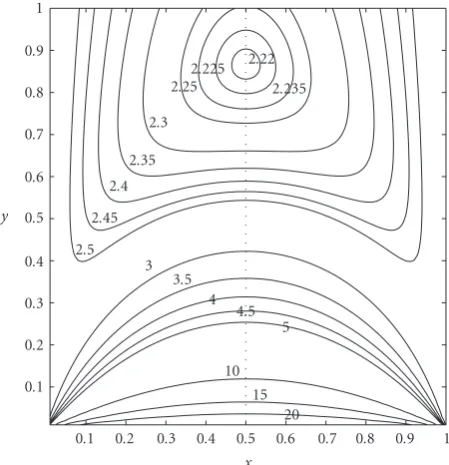
UsingTheorem 4, we can give the total lower bound on any geometric setup of an anchor-free localization. The simplest nontrivial case is when there are only 3 points. We fix two points at (0, 0), (0, 1). We plot the contour of the total esti-mation bound as a function of the position of the 3rd node ∈[0, 1]×[0, 1].
The result shows that the total estimation bound is re-lated to the biggest angle of the triangle. The larger that angle is, the larger the total estimation bound is. FromFigure 8, we find that the minimum total estimation bound is achieved when the triangle is equilateral, where the 3rd node is at (0.5,√3/2).Figure 9(b)shows what is happening around the minimum.
3.1.2. Total estimation bound for different network shapes
The shape of the sensor network affects the total estimation bound. We illustrate this by a simulation with M sensors randomly and uniformly distributed in a region with all the pairwise distances measured. We plot the average normalized total estimation bound of 50 independent experiments.
Figure 10reflects a rectangular region with dimension
L1×L2,L1 ≥ L2. Since the zooming does not change the total estimation bound, only the ratioR=L1/L2matters and
8A geometric interpretation of this total estimation is as follows. Imagine
that the estimation is done in the (2n−3)-dimensional subspace which is orthogonal to the 3-dimensional space spanned byb1,b2,b3. Then the
expectation of the square of the error vector will be upper bounded by Tr(J†).
9For anchored localization,Jis nonsingular. ThusJ−1=J†. It is immediate
from the definition of the CRB thatiE((xi−xi)2+(yi−yi)2)≤Tr(J−1)= Tr(J†).
0.1 0.2 0.3 0.4 0.5 0.6 0.7 0.8 0.9 1 x
0.1 0.2 0.3 0.4 0.5 0.6 0.7 0.8 0.9 1
y
20 15 10
5 4.5 4 3.5 3 2.5
2.45 2.4
2.35 2.3
2.25 2.225
2.235 2.22
Figure8: The contour shows the total estimation bound in 10 log10
scale for the 3rd node at (x,y).
0 1 2 3 4
y 0
5 10 15 20 25 30 35
10
log
10
(v)
(a)
0.5 0.7 0.9 1.1 1.3 y
2.2 2.25 2.3 2.35 2.4 2.45 2.5 2.55 2.6 2.65 2.7
10
log
10
(v)
(b)
Figure9: The total estimation bound. The 3rd node is at (0.5,y) along the dotted line inFigure 8.
it turns out that the normalized CRB increases asRincreases, or as the rectangle becomes less and less square.10However,
once the number of nodes had gotten large enough, the total estimation error bound did not change with more nodes. The error was reduced per-node in a way that simply distributed the same total error over a larger number of nodes.
10In [24], we also studied the total estimation bound for an annular region.
LetR =rinner/routerbe the ratio of the radius of the inner circle over
10 20 30 40 50 60 70 80 90 100 Number of nodes
6 8 10 12 14 16 18 20 22 24 26
10
log
10
(v)
R=1 R=2 R=4 R=8 R=16 R=32
Figure 10: The normalized total estimation lower bound versus number of nodes. Rectangular region (R=L1/L2).
3.2. Why not set a node at(0, 0)and another node
on thexaxis
It is tempting to eliminate the singularity of the FIM by just setting some parameters. If we fix node 1 at posi-tion (x1,y1), node 2 with y-coordinate 0, it is equiva-lent to doing the estimation in the subspace through point (x1,y1,. . .,xM,yM) perpendicular toc1 =(1, 0, 0, 0,. . ., 0)T,
c2=(0, 1, 0, 0,. . ., 0)T,c3=(0, 0, 1, 0,. . ., 0)T. In general, the subspace generated byc1,c2,c3is not the same as that gener-ated byb1,b2,b3and so the choice of which nodes we choose to fix can impact the bounds!
3.3. Comparison of anchored and anchor-free
localization
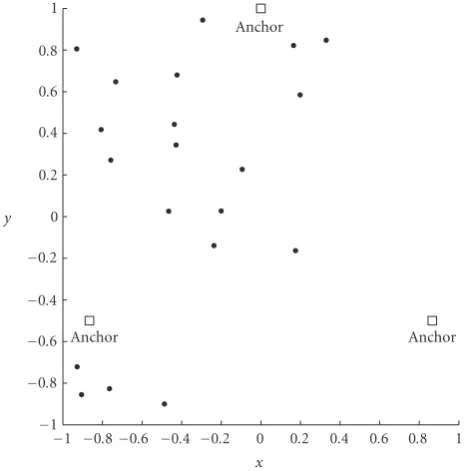
Sometimes a bad geometric setup of anchors results in bad anchored estimation, while the anchor-free estimation is still good! As such, it is not useful to view the anchor-free case as an information-limited version of the anchored case. Af-ter all, in the anchored case, we also have a more challeng-ing goal: to get the absolute positions correct, not just up to equivalency. InFigure 11, we have a sensor network with 3 anchors very close to each other; the total estimation bound for anchored localization is 195.20; meanwhile the total esti-mation bound for anchor-free localization is 4.26.11
3.4. Total estimation bound under different
propagation models
It can be easily seen that just as in the anchored localization,
Jis invariant under translation andVtotal(J) is invariant un-der rotation as well. Just as in anchored localization, the total estimation boundVtotal(J) changes proportional toca, if the whole sensor network is zoomed up by a factorc.
11As a result, we suggest that algorithm designers avoid fixing the global
coordinate system unless they are confident on the setup of the anchors.
−1 −0.8−0.6 −0.4 −0.2 0 0.2 0.4 0.6 0.8 1 x
−1 −0.8 −0.6 −0.4 −0.2 0 0.2 0.4 0.6 0.8 1
y
Anchors Nodes
Figure11: A bad setup of anchors.
1 2 3 4 5 6 7 8 9 10 11 12
Size of the sensor network −12
−10 −8 −6 −4 −2 0
A
ver
age
estimation
b
ound
(10
log
10
scale,
aft
er
alig
n
ment)
a=1 a=2 a=3
Figure12: The average normalized total estimation lower bound versus size of the sensor network for differenta.
In simulation, we study the effect of the size of the sensor network on the average estimation bound in different prop-agation models, that is, for differenta’s using the same setup asFigure 4.
determined by the received power and so the heuristic expla-nation for the anchored case also fits the simulation results we have for the anchor-free case.
4. CONCLUSIONS AND FUTURE WORK
In this paper, we studied the CRB for both anchored and anchor-free localization and gave a method to compute the CRB in terms of the geometry of the sensor network. For an-chored localization, we derived both lower and upper bounds on the CRB which are determined by only local geometry. These showed that we can use local geometry to predict the accuracy of the position estimation that bodes well for dis-tributed algorithms. The implication of our results on sensor network design is that accurate position estimation requires good local geometry of the sensor network. For anchor-free localization, the singularity of the FIM was overcome by computing the total estimation bound instead. Finally, we considered the implications of wireless signal propagations and found that if the signals propagate very well, then there are potentially significant gains by using larger networks and doing estimation in a manner that uses this information. However, such path-loss models are unphysical and so prac-tical schemes should work fine with only local information.
So far, we have only computed the CRB. For the de-sign of algorithms, it would also be good to know the sen-sitivityof the bound to individual observations. It might be very helpful in localization if one can identify the bottle-necks of the problem, that is, figure out which distance mea-surement could help to increase the localization accuracy the most. With the knowledge of the bottlenecks, it may be pos-sible to allocate the energy or computation in a smart way to improve localization accuracy. Finally we do not know if we can approach the bound with distributed or centralized localization.12
APPENDICES
A. PROOF OF(20)
The lemmas and the theorem in the appendix can be treated as corollaries of the results in [25]. We prove all the lemmas and the theorem here for self completeness.
Theorem 5. For a positive definiteN×NmatrixJ,
J=
A B BT C
, (A.1)
whereAis anM×Msymmetric matrix,Cis an(N−M)× (N−M)symmetric matrix, andBis anM×(N−M)matrix, if we write
J−1=
A B BT C
, (A.2)
12InAppendix B, we compare the CRB of anchored localization with the
biased-localization scheme proposed in [24] to illustrate another impor-tant caveat.
whereAandAhave the same size,Band Bhave the same size, so doCandC. C−C−1is positive semidefinite.
First we need several lemmas.
Lemma 3. Ais positive definite.
Proof. For allx∈RM,x=0. Lety=(x,0)T, where0 is the 1×(N−M) all 0 vector,yis anN-dimensional vector. Then
xTAx=yTJy >0.
The last inequality is true becauseJ is positive definite, andy=0.xis arbitrary, soAis positive definite.
SimilarlyCis positive definite, and thusA,Care nonsin-gular.
Lemma 4. A−BC−1BT is positive definite.
Proof. First notice that for a positive definite matrixJ,Jcan be written asJHTJH, whereJHis anN×Nnonsingular matrix. WriteJH =(S R), whereSis anN×Mmatrix andRis an
N×(N−M) matrix. Then
A=STS; B=STR; C=RTR; (A.3)
Cis nonsingular, soRhas full rankN−M. The singular value decomposition ofRisR=UΛV, whereUis anN×N ma-trix,UTU=UUT =I,V is an (N−M)×(N−M) matrix,
VTV=VVT=I, andΛis anN×(N−M) matrix.
Λ=
diagλ1,. . .,λN−M 0M×(N−M)
(A.4)
λi>0 becauseRhas full rankN−M. Now
A−BC−1BT
=STS−STRRTR−1RTS
=STI−RRTR−1RTS
=STI−(UΛV)(UΛV)T(UΛV)−1(UΛV)TS
=STI−UΛVVTΛTΛV−1VTΛTUTS
=STI−UΛVVTΛTΛ−1
VTVΛTUTS
=STI−UΛΛTΛ−1ΛTUTS
=STUI−ΛΛTΛ−1ΛT
UTS=STUΔUTS, (A.5)
where Δ = diag(δ1,δ2,. . .,δN), where δi = 0, i = 1, 2,. . .,N −M andδi = 1,N−M < i ≤ N. Obviously
A−BC−1BT is positive semidefinite. Suppose ∃x ∈ RM,
x = 0, butxTSTUΔUTSx = 0. Then we have UTSx = (y1,y2,. . .,yN)T =yandyN−M+1,. . .,yN all equal to 0. Now
Sx=Uy, and from the fact thatyN−M+1,. . .,yN all equal to 0, we haveΛ(ΛTΛ)−1ΛTy=y. Writez=VT(ΛTΛ)−1ΛTy, thenSx=Uy=UΛVz=Rz, wherex=0. This contradicts the fact that (S R) is full rank.
−1 −0.8−0.6 −0.4 −0.2 0 0.2 0.4 0.6 0.8 1 x
−1 −0.8 −0.6 −0.4 −0.2 0 0.2 0.4 0.6 0.8 1
y
Anchor Anchor
Anchor
Figure13: Setup of the sensor networkM=20.
Lemma 5. (C−BTA−1B)−1=C−1BT(A−BC−1BT)−1BC−1+
C−1.
Proof. Notice that bothAand (A−BC−1BT) are full rank; then,
C−1BTA−BC−1BT−1BC−1+C−1C−BTA−1B
=I+C−1BTA−BC−1BT−1B−C−1BTA−1B
−C−1BTA−BC−1BT−1BC−1BTA−1B
=I+C−1BTA−BC−1BT−1
−A−1
−A−BC−1BT−1BC−1BTA−1B
=I+C−1BTA−BC−1BT−1
×A−BC−1BTA−1−A−1B=I.
(A.6)
Lemma 6. J−1If we write
J=
A B BT C
, J−1=
A B BT C
, (A.7)
thenC=(C−BTA−1B)−1.
Proof. Given the form of J−1, we have BTB + CC =
I(N−M)×(N−M)andAB+BC =0. From the latter equation,
we getB= −A−1BC. Substitute into the first equation to get −BTA−1BC+CC=I(
N−M)×(N−M). Since the dimensions of
the matrices all match, we get the desired result.
Now we can give the proof ofTheorem 5.
0 2 4 6 8 10 12 14 16 18 20
Index of nodes 0
0.5 1 1.5 2 2.5 3×
10−3
Sq
uar
e
er
ro
r
CRB
Estimation variance
Figure14: Comparison of CRB and estimation variance of a sim-ple localization algorithm. Nodes are indexed by their estimation variance.
Proof. C=(C−BTA−1B)−1, followingLemma 6. Then from Lemma 5, we know that (C −BTA−1B)−1 = C−1BT(A−
BC−1BT)−1BC−1 + C−1. Thus C −C−1 = C−1BT(A −
BC−1BT)−1BC−1=C−1TBT(A−BC−1BT)−1BC−1. The
sec-ond equality follows sinceCT =C. Finally, (A−BC−1BT)−1
is positive definite byLemma 4.
Definition 2(upper-left submatrix). 1≤n≤m, the upper-leftn×nsubmatrix of anm×mmatrixAis ann×nmatrix
B, s.t.B(i,j)=A(i,j), for all 1≤i≤n, 1≤j≤n.
Corollary 5(monotonically increasing matrices). For a
posi-tive definiteN×NmatrixJ, let1≤n1≤n2≤ · · · ≤nM=N,
letAbe the upper-leftni×nisubmatrix ofA, and letBibe the
upper-leftn1×n1submatrix ofA−1
i . Then
A−1
i =B1≤B2≤B3≤ · · · ≤BM. (A.8)
Proof. Notice that an upper-left submatrix of a positive def-inite matrix is still positive defdef-inite as shown in Lemma 3. Repeatedly applyingTheorem 5gives the desired result.
B. A CASE STUDY OF A LOCALIZATION ALGORITHM
The CRB only applies for unbiased estimators. To see why this is important, consider the simple localization scheme based on laceration and averaging that was proposed in [24]. To compare the CRB with the average estimation vari-ance of our localization algorithm, we set up the sensor network as follows. All the sensors are located inside the unit circle. Three anchors are located at (0, 1), (√3/2,−1/2), (−√3/2,−1/2). Twenty nodes with unknown positions are uniformly distributed inside the unit circle as shown in
Figure 13.
scheme.Rvisible = 2 and the additive Gaussian errors have
σ =0.05. The estimation variance for some nodes is smaller than the CRB for unbiased estimators because our localiza-tion scheme is biased.
REFERENCES
[1] C. Chang and A. Sahai, “Object tracking in a 2D UWB sen-sor network,” inProceedings of the 38th Conference on Signals, Systems and Computers (Asilomar ’04), vol. 1, pp. 1252–1256, Pacific Grove, Calif, USA, November 2004.
[2] K. Seada, A. Helmy, and R. Govindan, “On the effect of local-ization errors on geographic face routing in sensor networks,” inProceedings of 3rd International Symposium on Information Processing in Sensor Networks (IPSN ’04), pp. 71–80, Berkeley, Calif, USA, April 2004.
[3] L. Doherty, K. S. J. Pister, and L. El Ghaoui, “Convex position estimation in wireless sensor networks,” inProceedings of IEEE 20th Annual Joint Conference of the IEEE Computer and Com-munications Societies (IEEE INFOCOM ’01), vol. 3, pp. 1655– 1663, Anchorage, Alaska, USA, April 2001.
[4] C. Savarese, J. Rabaey, and K. Langendoen, “Robust posi-tioning algorithms for distributed ad-hoc wireless sensor net-works,” inProceedings of the General Track Annual Technical Conference (USENIX ’02), pp. 317–327, Monterey, Calif, USA, June 2002.
[5] N. Bulusu, J. Heidemann, and D. Estrin, “GPS-less low-cost outdoor localization for very small devices,” IEEE Personal Communications, vol. 7, no. 5, pp. 28–34, 2000.
[6] D. Niculescu and B. Nath, “Ad hoc positioning system (APS),” inProceedings of IEEE Global Telecommunications Conference (Globecom ’01), vol. 5, pp. 2926–2931, San Antonio, Tex, USA, November 2001.
[7] R. Nagpal, H. E. Shrobe, and J. Bachrach, “Organizing a global coordinate system from local information on an Ad Hoc sen-sor network,” inProceedings of 2nd International Workshop In-formation Processing in Sensor Networks (IPSN ’03), vol. 2634 ofLecture Notes in Computer Science, pp. 333–348, Palo Alto, Calif, USA, April 2003.
[8] K. K. Chintalapudi, A. Dhariwal, R. Govindan, and G. Sukhatme, “Ad-hoc localization using ranging and sectoring,” inProceedings of 23th Annual Joint Conference of the IEEE Com-puter and Communications Societies (INFOCOM ’04), vol. 4, pp. 2662–2672, Hong Kong, March 2004.
[9] R. L. Moses and R. Patterson, “Self-calibration of sensor net-works,” inUnattended Ground Sensor Technologies and Appli-cations IV, vol. 4743 ofProceedings of the SPIE, pp. 108–119, Orlando, Fla, USA, April 2002.
[10] R. L. Moses, D. Krishnamurthy, and R. Patterson, “A self-localization method for wireless sensor networks,”EURASIP Journal on Applied Signal Processing, no. 4, pp. 348–358, 2003. [11] J. Hightower, R. Want, and G. Boriello, “SpotON: an indoor 3d location sensing technology based on RF signal strength,” Tech. Rep. UW CSE 00-02-02, University of Washington, Seat-tle, Wash, USA, February 2000.
[12] L. Girod and D. Estrin, “Robust range estimation using acous-tic and multimodal sensing,” inProceedings of IEEE/RSJ Inter-national Conference on Intelligent Robots and Systems (IROS ’01), vol. 3, pp. 1312–1320, Maui, Hawaii, USA, November 2001.
[13] A. Savvides, C.-C. Han, and M. B. Strivastava, “Dynamic fine-grained localization in Ad-Hoc networks of sensors,” in
Pro-ceedings of the 7th Annual International Conference on Mobile Computing and Networking (MOBICOM ’01), pp. 166–179, Rome, Italy, July 2001.
[14] C. Savarese, J. M. Rabaey, and J. Beutel, “Location in dis-tributed ad-hoc wireless sensor networks,” inProceedings of IEEE International Conference on Acoustics, Speech, and Signal Processing (ICASSP ’01), vol. 4, pp. 2037–2040, Salt Lake City, Utah, USA, May 2001.
[15] S. Capkun, M. Hamdi, and J.-P. Hubaux, “GPS-free position-ing in mobile ad-hoc networks,” in Proceedings of the 34th Annual Hawaii International Conference on System Sciences (HICSS ’01), pp. 3481–3490, Maui, Hawaii, USA, January 2001.
[16] X. Ji and H. Zha, “Sensor positioning in wireless ad-hoc sensor networks using multidimensional scaling,” inProceedings of 23th Annual Joint Conference of the IEEE Computer and Com-munications Societies (INFOCOM ’04), vol. 4, pp. 2652–2661, Hong Kong, March 2004.
[17] S. T. Smith, “Intrinsic Cram´er-Rao bounds and subspace esti-mation accuracy,” inProceedings of the IEEE Sensor Array and Multichannel Signal Processing Workshop (SAM ’00), pp. 489– 493, Cambridge, Mass, USA, March 2000.
[18] N. Patwari, A. O. Hero III, M. Perkins, N. S. Correal, and R. J. O’Dea, “Relative location estimation in wireless sensor net-works,”IEEE Transactions on Signal Processing, vol. 51, no. 8, pp. 2137–2148, 2003.
[19] A. Savvides, W. Garber, S. Adlakha, R. L. Moses, and M. B. Strivastava, “On the error characteristics of multihop node lo-calization in ad-hoc sensor networks,” inProceedings of 2nd International Workshop Information Processing in Sensor Net-works (IPSN ’03), vol. 2634 ofLecture Notes in Computer Sci-ence, pp. 317–332, Palo Alto, Calif, USA, April 2003.
[20] H. Wang, L. Yip, K. Yao, and D. Estrin, “Lower bounds of local-ization uncertainty in sensor networks,” inProceedings of IEEE International Conference on Acoustics, Speech, and Signal Pro-cessing (ICASSP ’04), Montreal, Quebec, Canada, May 2004. [21] P. Stoica and T. L. Marzetta, “Parameter estimation problems
with singular information matrices,”IEEE Transactions on Sig-nal Processing, vol. 49, no. 1, pp. 87–90, 2001.
[22] A. Dersan and Y. Tanik, “Passive radar localization by time dif-ference of arrival,” inProceedings of Military Communications Conference (MILCOM ’02), vol. 2, pp. 1251–1257, Anaheim, Calif, USA, October 2002.
[23] V. S. Chernyak,Fundamentals of Multisite Radar Systems, Gor-don and Breach Science, Australia, 1998.
[24] C. Chang, “Localization and object-tracking in an ultrawide-band sensor network,” M.S. thesis, EECS Department, Univer-sity of California Berkeley, Berkeley, Calif, USA, 2004. [25] K. Hoffman and R. A. Kunze,Linear Algebra, Prentice-Hall,
Englewood Cliffs, NJ, USA, 1992.
Anant Sahai received the B.S. degree in 1994 from UCB, the M.S. degree in 1996 from MIT, and the Ph.D. in 2001 from MIT. He joined the Department of Elec-trical Engineering and Computer Sciences at the University of California, Berkeley, in 2002 as an Assistant Professor. He is a Mem-ber of the Berkeley Wireless Research Cen-ter and the Wireless Foundations CenCen-ter. In 2001, he spent a year as a research scientist