Volume 2006, Article ID 63409, Pages1–13 DOI 10.1155/ASP/2006/63409
Rate Control for H.264 with Two-Step Quantization Parameter
Determination but Single-Pass Encoding
Xiaokang Yang,1Yongmin Tan,1and Nam Ling2
1Institute of Image Communication and Information Processing, Shanghai Jiao Tong University, Shanghai 200030, China 2Department of Computer Engineering, Santa Clara University, Santa Clara, CA 95053-0566, USA
Received 1 August 2005; Revised 27 June 2006; Accepted 16 July 2006
We present an efficient rate control strategy for H.264 in order to maximize the video quality by appropriately determining the quantization parameter (QP) for each macroblock. To break the chicken-and-egg dilemma resulting from QP-dependent rate-distortion optimization (RDO) in H.264, a preanalysis phase is conducted to gain the necessary source information, and then the coarse QP is decided for rate-distortion (RD) estimation. After motion estimation, we further refine the QP of each mode using the obtained actual standard deviation of motion-compensated residues. In the encoding process, RDO only performs once for each macroblock, thus one-pass, while QP determination is conducted twice. Therefore, the increase of computational complexity is small compared to that of the JM 9.3 software. Experimental results indicate that our rate control scheme with two-step QP determination but single-pass encoding not only effectively improves the average PSNR but also controls the target bit rates well.
Copyright © 2006 Hindawi Publishing Corporation. All rights reserved.
1. INTRODUCTION
H.264/MPEG-4 AVC is the latest international video cod-ing standard developed by Joint Video Team (JVT) of ISO Motion Picture Expert Group and ITU-T Video Coding Expert Group [1–5]. As in other video standards such as MPEG-2 [6] and H.263 [7,8], rate control remains as an open but important issue for H.264/AVC. A rate control scheme that is able to maximize the video quality and at the same time meets the rate constraints is much desired for H.264/AVC.
In comparison with other video standards, there are sev-eral challenges for rate control in H.264 [9–12], due to its unique features. The first one is the well-known chicken-and-egg dilemma in the rate-distortion optimization (RDO) process [10], which is briefly described as follows. In H.264, quantization-parameter- (QP-) dependant RDO technique is adopted in the process of best prediction mode selection [11,13]. To perform RDO, QP should be decided first. But in order to perform rate control, QP can only be obtained according to the coding complexity and number of target bits that are calculated by motion-compensated residues af-ter RDO mode decision. This imposes a big problem for rate control in H.264. Secondly, due to more delicate pre-diction modes adopted in H.264 than those in previous stan-dards, the number of header bits fluctuates greatly from Inter 16×16 to Inter 4×4 [11,12]. Thus, a good overhead model
is necessary for accurate rate control. Thirdly, better mode selection in H.264 often leads to small motion-compensated residues [11]. As a result, a large number of macroblocks will be quantized to zero.
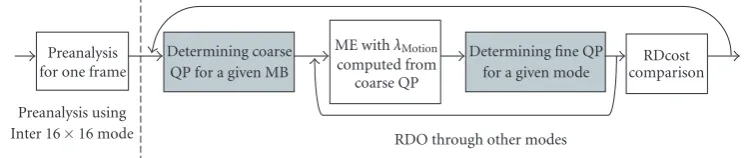
Preanalysis for one frame Preanalysis using Inter 1616 mode
Determining coarse QP for a given MB
ME withλMotion computed from
coarse QP
Determining fine QP for a given mode
RDcost comparison
RDO through other modes
Figure1: Illustration of the basic ideas for the proposed rate control scheme.
the target bit rate accurately, the PSNR improvement is in-significant. In [16–18], a PSNR-and-MAD-based frame com-plexity estimation is proposed to allocate the bits more accu-rately among frames. Two special cases of scene change and small texture bits are taken into account when determining QP at frame layer. A frame skipping decision is also used to proactively drop a simple frame in order to make room for the later more complex frames. However, this rate control scheme does not pay much attention to QP determination at the macroblock layer. In [19], a frame-layer rate control scheme is presented, which computes the Lagrange multi-plier for mode decision by using a quantization parameter which may be different from that used for encoding.
In this paper, we propose an RDO-based rate con-trol scheme for H.264 with two-step QP determination but single-pass encoding in order to maximize the video quality by appropriately determining QP for each mac-roblock, which is based on our previous work [11]. To break the chicken-and-egg dilemma resulting from QP-dependent rate-distortion optimization (RDO) in H.264, a pre-analysis phase is conducted to gain the necessary source information, and then the coarse QP is decided for R-D estimation. After QP-dependant motion estimation (with coarse QP), we fur-ther refine the QP of each mode based on the obtained actual standard deviation of motion-compensated residues. Using the actual standard deviation, each possible mode’s QP can be calculated. Thus, these QPs are used in the comparison of each mode’s rate-distortion (RD) cost (RDcost). The encoder chooses the mode having the minimum value. Thus, care-fully selected QPs can ensure accurate bits allocation to indi-vidual MBs according to their actual needs. The introduction of QP refinement process is helpful to achieve a good video quality given the bit budget. In addition, the header bits and coefficient bits are separately estimated so that the rate con-trol accuracy is further enhanced. In the encoding process, RDO only performs once for each macroblock, thus one-pass, while QP determination is conducted twice. Therefore, the increase of computational complexity is small compared to that of the JM 9.3 software. Experimental results indicate that our rate control scheme not only effectively improves the average PSNR but also controls the target bit rates well.
The rest of this paper is organized as follows. InSection 2, we derive models for bit rate and distortion estimation. In
Section 3, our proposed rate control algorithm is presented
in detail, including the solutions to the aforementioned diffi -culties and the two-step QP decision with single-pass
encod-ing. Section 4gives experimental results. Finally, Section 5
concludes the paper.
2. MODELING RATE AND DISTORTION
Figure 1shows the basic ideas of the overall rate control
pro-cess of our algorithm, which comprises of two major steps. Firstly, pre-analysis is performed to break the chicken-and-egg dilemma, thus obtaining the source information, which is used in determining the coarse QP for QP-dependent mo-tion estimamo-tion. Secondly, RDO mode decision is conducted at the macroblock layer to select the best prediction mode for individual macroblock. The refined QP of each possible mode is determined and used in the RDcost comparison. Af-ter RDO, current macroblock is encoded with the selected mode and its corresponding refined quantization parameter. To determine QP, an R-D model usually estimates the rate and distortion based on some measurements of frames or macroblocks. In this paper, we choose the R-D model of our previous work [11] in which the header bits, the coefficient bits, and distortion of each macroblock are estimated. They are briefly described as follows.
2.1. Preanalysis using Inter16×16mode header bits estimation
Pre-analysis phase is performed by motion estimation for In-ter 16×16 mode. To break the chicken-and-egg dilemma in order to get the required information, all MBs in cur-rent frame are preencoded before the RDO mode decision. Among the possible seven modes (i.e., Intra 4×4, Intra 16×16, Skip, Inter 16×16, Inter 16×8, Inter 8×16, and Inter 8×8), we choose the simplest Inter 16×16 to per-form preanalysis. After this preanalysis, the source inper-forma- informa-tion, such as the standard deviations of motion-compensated residues, RDcost of each macroblock for Inter 16×16 mode, is obtained. These measurements are used in the R-D model to decide the number of target bits for every frame and the coarse QP for individual macroblock.
inter-predicted frames, the average QP from all MBs of the previously inter-predicted frame is used to preanalyze cur-rent frame.
2.2. Header bits estimation
Most existing R-D models only consider the transform co-efficient bits in the estimation of the rate for a macroblock. Header bits are simply represented by a constant value. This is a reasonable simplification for previous standards such as MPEG-2 and H.263, because the header bits are relatively few in number due to the simplicity of prediction modes in these standards. However, header bits form a significant portion of H.264/AVC bitstream [11]. Therefore, the number of header bits needs to be estimated separately from coefficient bits for accurate rate estimation. In this paper, we use the following simple but effective model to estimate the number of header bits for one macroblock:
Hi=C×comi (1)
with
comi= ⎧ ⎪ ⎪ ⎨ ⎪ ⎪ ⎩
Htrd
C , σi2≤σtrd2 ,
logσ2
i2, else,
(2)
whereHiis the number of header bits for theith macroblock in the current frame.σiis the predicted standard deviation of motion-compensated residues for Inter 16×16. In the following, we refer to the standard deviation of the motion-compensated residue obtained in the pre-analysis phase as
predicted standard deviationsince it may be different from the
actual standard deviationif RDO selects other mode rather
than the Inter 16×16 mode as the prediction mode.Htrdand σ2
trdare the averages of all recordedHiandσi2, which are ex-plained below.Cis a constant that implies the linear relation betweenHiand comi, which is used to separate the following two situations so that (1) looks more compact.
Two situations are considered in our header bits model. (1) When encoding the previous frame, we record Hi and σ2
i of the MBs whoseHi is smaller than a predefined con-stant (=11). After encoding the previous frame, we calcu-late the averages of all recorded Hi andσi2, which are re-ferred to asHtrdandσ2
trd, respectively. During the encoding of current frame, if σ2
i ≤ σtrd2 for a macroblock, we then conclude that this macroblock will produce a small num-ber of header bits and Hi is directly estimated by Htrd. (2) Otherwise, the number of header bits of a macroblock is linear to [log(σ2
i)]2. Furthermore,Cis adaptively updated macroblock by macroblock during the encoding process to make the model more robust, which is discussed below. Fur-ther explanation of (1) and (2) is given as follows.
We use Inter 16×16 mode in the pre-analysis to compute the motion-compensated residues. A good prediction of the MB by Inter 16×16 will result in a small predicted standard
deviation. So the chances are that Inter 16×16 will be selected as the best prediction mode. In contrast, a large predicted standard deviation implies a bad prediction and RDO may quite possibly select other modes such as Intra 4×4 or Inter 8×8 to do the prediction. In this sense, the prediction mode selected by RDO is, to some extent, dependent on the pre-dicted standard deviation. On the other hand, as we know, in H.264, the number of header bits strongly depends on its pre-diction mode (e.g., Inter 16×16 has only one motion vector while Inter 8×8 may have up to 16 motion vectors). From the above analysis, we can say that the number of header bits de-pends on the predicted standard deviation as well. The larger the predicted standard deviation, the higher the possibility that header-bits-expensive modes, such as Inter 8×8, will be used. In other words, the number of header bits increases with the predicted standard deviation, as is suggested by (2).
2.3. Coefficient bits estimation
The rate-quantization model proposed in [21] is used to es-timate the coefficient bits estimation:
Fi=AK σi2 Q2
i, (3)
where Fi denotes the bit required for encoding the DCT coefficients ofith macroblock; σi denotes the standard de-viation of motion-compensated residues; Qi is the quanti-zation step size; A is the number of the pixels in a mac-roblock (i.e., 16×16 = 256); K is a constant and can be set toe/ln 2 if the DCT coefficients are Laplacian distributed and independent [21]. However, since the DCT coefficients may not follow the Laplacian distribution strictly, it is bet-ter to adaptively update the value ofK, macroblock by mac-roblock and frame by frame. More details are discussed in the
Section 3.3.
2.4. Distortion estimation
The following well-known distortion-quantization model [15] is used to measure the distortion of encoded mac-roblocks:
D=N1 N
i=1 α2
iQ 2 i
12, (4)
whereN is the total number of macroblocks in one frame; αi is distortion weight of ith macroblock, which can be used to incorporate the importance or weight of that mac-roblock’s distortion. However, in this implementation, these weights are used to reduce the bit overhead caused by recording each macroblock’s QP individually at low bit rates.
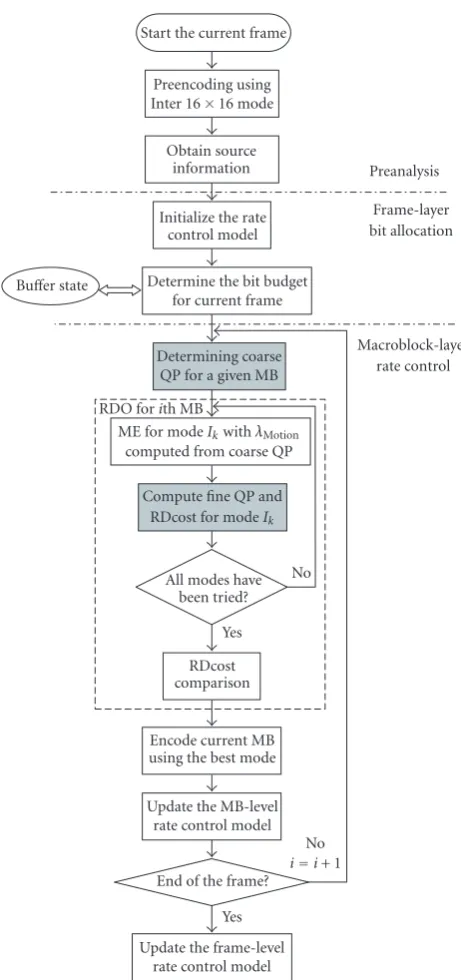
Start the current frame Preencoding using Inter 1616 mode
Obtain source information Initialize the rate
control model Determine the bit budget
for current frame
Preanalysis Frame-layer bit allocation
Buffer state
Determining coarse QP for a given MB
Macroblock-layer rate control RDO forith MB
ME for modeIkwithλMotion computed from coarse QP
Compute fine QP and RDcost for modeIk
All modes have been tried?
RDcost comparison
Encode current MB using the best mode Update the MB-level rate control model
End of the frame?
Update the frame-level rate control model
Yes Yes
No
No i=i+ 1
Figure2: A flowchart of the proposed rate control scheme.
significant at low bit rates. We therefore try to control the dynamic range of QP by simply setting the values ofαi. At lower bit rates,αiis determined from the respective standard deviation of residuesσiby the method proposed in [15]. At higher bit rates (above 0.5 bits/pixel), all ofαiare set to 1.
3. OUR PROPOSED RATE CONTROL SCHEME
Figure 2 shows the flowchart of the proposed rate control
scheme. The three major steps are the above-mentioned
pre-analysis, frame-layer bit allocation, and macroblock-layer rate control.
3.1. Pre-analysis
3.2. Frame-layer bit allocation
In [9], a fluid flow traffic model was proposed to compute the target bit for the current coding frame. Although this model can achieve accurate bit-rate control, it only considers the buffer states (or rate) but without the consideration of distortion, thus may limit the quality improvement. In our previous work [11], we proposed a frame-layer bit allocation scheme by integrating both rate-distortion cost and target bit rate. The scheme can be divided into two steps.
First, we determine the number of target bits for current frame without considering the buffer state using the follow-ing equation:
B= 1 +P−Pn 2
×Jcur −Jprev,0
J−Jprev,0 × R
f, (5)
whereRis the available channel bandwidth. f is the frame rate.Jcuris the RDcost of current frame, which is defined as the sum of the RDcost of all the MBs in the current frame. It is noticed that macroblock-layer rate control is still not en-abled at this moment. Remembering that in the pre-analysis stage we use Inter 16×16 mode for pre-encoding, soJcuris actually the RDcost of current frame under the Inter 16×16 mode.Jis the average RDcost of the encoded frames in the group of pictures (GOP), the GOP size is 100 frames.Jprev,0 is the sum of RDcost of all the zero-coefficient macroblocks in the previous frame. Zero-coefficient macroblock refers to a macroblock whose coefficients are all quantized to zeros af-ter the transform and quantization.Pnis the average PSNR of the recentnframes, which is computed using a sliding win-dow (length is 8) method.Pis the average PSNR of the en-coded frames again in the GOP.
Second, the target number of bits for a frame is further adjusted according to the buffer state in a similar way to the fluid flow traffic model [11,20]:
B= ⎧ ⎪ ⎪ ⎪ ⎪ ⎨ ⎪ ⎪ ⎪ ⎪ ⎩ R f +λ1
B−Rf
, B > Rf&L >0.2M,
R f +λ2
B−R
f
, B < Rf&L <0.2M, (6)
whereM is the buffer size and Lis the currently observed buffer fullness. The strength of the restriction depends on the parameters ofλ1andλ2, which are determined from the nor-malized buffer fullness (L/M) via
λ1= 0−1
1−0.2×
L
M −0.2
+ 1
0.2≤ML ≤1
,
λ2= 1−0
0.2−0×
L
M −0.2
+ 1
0≤ML ≤0.2
. (7)
As we can see,λ1andλ2linearly range from 0 to 1 accord-ing to the current buffer state. The two functions converge at point (0.2, 1), which means that there is no constraint im-posed when L/M is 0.2. On the other hand, stronger restric-tion is imposed when the buffer level is extremely high or low. It should be noticed that these controlling points of lin-ear function can be adjusted to meet the variant requirement and buffer condition.
3.3. Macroblock-layer rate control
3.3.1. Determining coarse QP
We mainly focus our discussion on the low delay situation where the macroblock-layer rate control is more critical. We consider the IPPP. . . GOP structure. The most crucial task of macroblock-layer rate control is to determine the QP for every individual macroblock. ForIframe, the method in the JM 9.3 reference software is also used to determine the QPs in this implementation. In the following, we only discuss the QP determination forPframes.
The optimized quantization step sizeQ∗i forith MB can be determined by minimizing the overall distortionDsubject to a given bit budgetB, namely, minimizing the RDcost as follows:
cost=D+λ
N
i=1
Fi+Hi−B
=N1 N
i=1 α2
iQ 2 i 12 +λ
N
i=1
AK σi2 Q2
i +C×comi
−B
.
(8)
This kind of optimization problem can be solved by La-grangian optimization technique [21]:
Q∗ i =
AKi−1 Bi−CiNj=icomj
σi αi
N
j=i
αjσj. (9)
It is noticed thatσiin the equation is the standard devi-ation of motion-compensated residues of the Inter 16×16 mode in the pre-analysis phase. Formula (9) is used to com-pute the coarse QP of each macroblock. The parametersKi−1 andCiare recursively updated (MB by MB) during the en-coding of the successive macroblocks; more details are given
inSection 3.3.5.
From (9), we can see that ifαiapproachesσivery closely, the term σi/αi becomes 1 and thus all of the quantization steps in one frame are approximately equal. The range of QP is then reduced. So it gives a good explanation to the afore-mentioned distortion weights determination.
3.3.2. Motion estimation
The resultantQCoarse(i.e.,Qi∗) andλMotion=0.85×2(QCoarse−12)/3
are used in motion estimation to search for the best motion vectors for each macroblock under a certain mode.
3.3.3. Quantization parameter refinement
FromSection 2, we know that the coefficient model is based
their high bit rates because there are fewer chances for Inter 16×16 to be selected in such situation.
We observe that for modeIk, the standard deviation of motion-compensated residuesσi∗(Ik) can be obtained easily after motion estimation (ME) in the loop of the RDO pro-cess. Then, the QP of each mode, denoted as QPIk, can be calculated using (9), where we just replaceσiwithσi∗(Ik). Af-ter all modes are checked by RDO, the encoder uses QPIkin the comparison of RDcost to choose a best prediction mode (Ibest) for the current macroblock.
3.3.4. Encoding of MBs using the best mode
To encode theith macroblock with the best mode Ibest, we defineSi=Nj=iαjσj,Ti=Nj=icomjand rewrite (9) as fol-lows:
QiIbest=
AKi Bi−CiTi
σ∗
i
Ibest
αi Si, (10) whereBiis the unused number of target bits for the remain-ing macroblocks fromith toNth in the current frame.Kiand Ciare the updated values of R-D model parametersKandC after encoding the first (i−1) macroblocks. In this way, we can compute the QPs of each macroblock via updating the required parameters macroblock by macroblock when the macroblocks are processed sequentially in one frame.
3.3.5. Updating some parameters of R-D model
(1) UpdatingBi
Bi+1is updated as follows:
Bi+1=
B−
i
j=1 bj
×NN−i+ N j=i+1Jj
i
j=1Jj
×
i
j=1 bj
×Ni ,
(11)
whereJj is the R-D cost of jth macroblock obtained in the pre-analysis stage;bj is the actual number of encoding bits used for jth macroblock. We adopt the weighted average method to improve the accuracy and robustness of bit al-location. On the right-hand side of the equation, the first term indicates the unused bit budget for the remaining mac-roblocks to be encoded while the second term is to update the bit allocation according to the actual R-D cost of the mac-roblocks. Such updating according to the actual encoding re-sults is necessary during the scan over all macroblocks.
(2) UpdatingKi
(a) Compute the Ki after encoding the current mac-roblock:
K
i =Fi×
Q∗
i2 256σ2
i . (12)
(b) IfKi>0 andKi≤4.5, compute the averageKof the macroblocks encoded so far:
Ki= Ki−1(l−1) l +K
i
l , (13)
wherelis the number of macroblocks encoded so far whoseKiis within [0, 4.5].
Otherwise, we regard the current value ofKi as an ineffective estimation and just skip this step. So Ki remains unchanged after encoding the current mac-roblock in this situation.
(c) Find the weighted average of the initial estimate K1 withKi:
Ki=KiNi +K1(N−i)
N , (14)
whereK1is the averageK of the previous frame. It is used to improve the accuracy of the estimation ofK, since when only the first few macroblocks in the cur-rent frame have been encoded (i.e.,iis small),Kiis the average of only a few values and hence is not a robust estimate ofKfor the current frame. Then the updated Kiis used in (9) and (10).
(3) UpdatingCi
(a) Compute the Ci after encoding the current mac-roblock:
C
i=
i
j=1
bj−Fj
i
j=1comj
, (15)
whereij=1(bj−Fj) is the total number of header bits used for encoding the firstimacroblocks.
(b) Find the averageCi of all the encoded macroblocks in the current frame:
C
i =Ci−1× i−1
i +Ci×1i . (16) (c) Find the weighted average of the initial estimate C1
withCi:
C
i =Ci×Ni +C1×NN−i, (17)
whereC1is the averageCof the previous frame. This method of weighted average is used for the same rea-son as (14). Then the updatedCiis used in (9) and (10).
3.3.6. Implementation issue related to RDO options
When our scheme was integrated into the JM 9.3 software, two different situations were considered: RDO on and RDO off(whether to apply RDO technique in mode decision pro-cess or not), which led to a little difference in the realization of our algorithm.
(1) RDO off
transform was set) for each mode were compared to select the best prediction mode. Therefore, we just examined the standard deviation of motion-compensated errors for the best mode and updated its QP.
(2) RDO on
It was more complicated when the RDO option was switched to on. The mean absolute difference (MAD) for each mode should be calculated in order to perform QP refinement. Firstly, motion estimation was performed. All modes were checked in order. Motion estimations for Inter 16×16, 8×16, and 16×8 were performed in one loop, then Inter 8×8 with transform size 8×8, and lastly Inter 8×8 with transform size 4×4 (8×8, 8×4, 4×8, 4×4 partitions). The motion vec-tors and reference frames of each mode were decided in the motion search process. We used them to obtain the MAD of each mode. Then, the QP of each mode was easily calculated according to our algorithm. Secondly, RDcost value compar-ison was performed to get the best macroblock mode, where we used each mode’s refined QP instead of coarse QP.
It was noticed that RDO technique was already used in the loop over 8×8 subpartitions with transform size 4×4. For all four 8×8 subblocks in a 16×16 macroblock, the best block mode should be decided among modes 4, 5, 6, and 7 (8×8, 8×4, 4×8, 4×4) through the comparison of RDcost value. After that, some variables were updated if the best mode had been changed. Therefore we also applied our algorithm here. Similarly, we obtained the MAD of 8×8 subblock and then introduce the small-sized refined QP for RDcost comparison. For QP refinement, the QP range was restricted in a reasonable range, that is, the coarse QP±4 to prevent too high QP fluctuation between neighboring mac-roblocks.
Another issue was how many parameters of the rate con-trol model in (9) should be updated with different modes. In fact, many model variables were associated with the stan-dard deviation of motion-compensated residuesσi∗(Ik). But we believed that there was no need to modify them because they were less dominative thanσi∗(Ik) in deciding the refined QP. Another reason was that most of these variables were in-troduced in the pre-analysis phase at the frame layer, such as the number of target bits and the number of header bits. Though these parameters had some errors if we did not recal-culate them, it was also unsuitable to update them at the mac-roblock layer during the encoding process. Hence we only traced the change of each mode’s MAD and ignored other pa-rameters that had indirect relations with the standard devia-tions of motion-compensated residues. So in our implemen-tation, the only difference between (9) and (10) isσi∗(Ik).
In the encoding process, the QP calculation is conducted twice in all. First, coarse QP is obtained to compute the Lan-grange multiplier parameter for motion estimation. Second, QPs are further refined for different modes, which are used for R-D cost comparison in the RDO process. The final QP of the macroblock (i.e., the best mode’s corresponding re-fined QP) becomes more accurate and conforms to the ac-tual R-D performance of the macroblock for more effective
Table1: Test sequences.
Test sequence Size Framerate QPrangeSequencelength FramesencodedFrametype
Carphone QCIF 30 20–44 382 100 IPPP
News QCIF 30 20–44 300 100 IPPP
Foreman QCIF 30 20–44 300 100 IPPP
Silent QCIF 30 20–44 300 100 IPPP
Mother daughter QCIF 30 20–44 300 100 IPPP
Salesman QCIF 30 20–44 449 100 IPPP
Paris CIF 30 20–44 1065 150 IPPP
Stefan CIF 30 20–44 300 150 IPPP
City D1 30 20–44 300 100 IPPP
Table2: Test conditions.
MV resolution 1/4 pel
Hadamard ON
RDO OFF/ON
Search range 16
Restricted search range 2
Reference frame 5
Symbol mode CABAC
Slice mode OFF
Frame skip 2
and accurate rate control. The RDO process does not need to be performed again like that in JVT-F086 [22], hence we call it two-step QP determination but single-pass encoding.
3.3.7. Computational complexity analysis
The possible computational complexity overhead of our method may come from the pre-analysis stage where the In-ter 16×16 mode is performed to obtain the source infor-mation. However, since the results obtained in pre-analysis can be stored for use in the following RDO process, there is no need to implement Inter 16×16 again during the RDO. Thus, pre-analysis will only change the algorithm flow and the overall computational complexity has only a possi-bly negligible increase when RDO option is switched on. As for the RDO offsituation, the encoding complexity increases about 30% in terms of the total encoding time.
4. RESULTS AND DISCUSSIONS
Table3: Performance comparison (QP for FQP is 44 and the firstIframe QP for rate control schemes is 40, RDO on).
Test Sequence Scheme PSNR-Y (dB) QP R (bps) GAIN (dB) ΔR (%)
Carphone
JM 9.3 FQP 26.46 44 7430 — —
JM 9.3 RC 26.88 40 7540 0.42 1.48%
PRC w/o QP refinement 27.06 40 7520 0.6 1.21%
RC with QP refinement 27.36 40 7620 0.9 2.56%
News
JM 9.3 FQP 25.45 44 5890 — —
JM 9.3 RC 26.12 40 5960 0.67 1.19%
PRC w/o QP refinement 26.64 40 5820 1.19 −1.19%
RC with QP refinement 26.81 40 5920 1.36 0.51%
Silent
JM 9.3 FQP 25.92 44 5050 — —
JM 9.3 RC 26.94 40 5090 1.02 0.79%
PRC w/o QP refinement 26.9 40 4890 0.98 −3.17%
RC with QP refinement 27.11 40 5130 1.19 1.58%
Mother daughter
JM 9.3 FQP 27.85 44 2600 — —
JM 9.3 RC 28.09 40 2580 0.24 −0.77%
PRC w/o QP refinement 28.39 40 2590 0.54 −0.38%
RC with QP refinement 28.59 40 2640 0.74 1.54%
Salesman
JM 9.3 FQP 25.55 44 2800 — —
JM 9.3 RC 26.1 40 2800 0.55 0.00%
PRC w/o QP refinement 26.22 40 2840 0.67 1.43%
RC with QP refinement 26.46 40 2890 0.91 3.21%
Foreman
JM 9.3 FQP 26.01 44 9990 — —
JM 9.3 RC 25.89 40 10060 −0.12 0.70%
PRC w/o QP refinement 26.01 40 9830 0 −1.60%
RC with QP refinement 26.22 40 9920 0.21 −0.70%
Paris
JM 9.3 FQP 24.15 44 28630 — —
JM 9.3 RC 25.2 40 28790 1.05 0.56%
PRC w/o QP refinement 25.02 40 28210 0.87 −1.47%
RC with QP refinement 25.23 40 28320 1.08 −1.08%
Stefan
JM 9.3 FQP 24.14 44 72080 — —
JM 9.3 RC 24.13 40 72270 −0.01 0.26%
PRC w/o QP refinement 24.17 40 71840 0.03 −0.33%
RC with QP refinement 24.33 40 72130 0.19 0.07%
City
JM 9.3 FQP 26.16 44 68680 — —
JM 9.3 RC 25.69 40 69000 −0.47 0.47%
PRC w/o QP refinement 25.16 40 67510 −1 −1.70%
RC with QP refinement 25.44 40 68030 −0.72 −0.95%
simulation, we first encoded the sequence using fixed quan-tization parameter to determine the target bit rate. Then the same video was encoded once again using the rate control scheme in JM 9.3 and our rate control algorithm, respec-tively. The obtained PSNRs and the bit rates are compared.
We adopt the method in [20] to determine the starting quantization parameter QP0. It is predefined based on the available channel bandwidth and the GOP length. In our im-plementation, the QP for the firstIframe is 4 lesser than that for the fixed-QP scheme. The same starting QP is used in the JM 9.3 rate control scheme for a fair comparison of PSNR.
Tables 3 to 6 list the comparison of the experimental results among JM 9.3 rate control (RC), the proposed rate
Table4: Performance comparison (QP for FQP is 36 and the firstIframe QP for rate control schemes is 32, RDO on).
Test sequence Scheme PSNR-Y (dB) QP R (bps) GAIN (dB) ΔR (%)
Carphone
JM 9.3 FQP 31.5 36 21790 — —
JM 9.3 RC 31.64 32 21930 0.14 0.64%
PRC w/o QP refinement 31.91 32 21730 0.41 −0.28%
RC with QP refinement 32.09 32 21750 0.59 −0.18%
News
JM 9.3 FQP 30.95 36 16300 — —
JM 9.3 RC 30.98 36 16400 0.03 0.61%
PRC w/o QP refinement 31.91 32 16030 0.96 −1.66%
RC with QP refinement 31.98 32 16050 1.03 −1.53%
Silent
JM 9.3 FQP 30.63 36 14990 — —
JM 9.3 RC 31.5 32 15060 0.87 0.47%
PRC w/o QP refinement 31.49 32 14680 0.86 −2.07%
RC with QP refinement 31.63 32 14790 1 −1.33%
Mother daughter
JM 9.3 FQP 32.44 36 7660 — —
JM 9.3 RC 32.17 32 7730 −0.27 0.91%
PRC w/o QP refinement 32.38 32 7590 −0.06 −0.91%
RC with QP refinement 32.49 32 7740 0.05 1.04%
Salesman
JM 9.3 FQP 30.1 36 9600 — —
JM 9.3 RC 30.67 32 9680 0.57 0.83%
PRC w/o QP refinement 30.79 32 9390 0.69 −2.19%
RC with QP refinement 30.96 32 9500 0.86 −1.04%
Foreman
JM 9.3 FQP 30.86 36 24940 — —
JM 9.3 RC 30.69 32 25010 −0.17 0.28%
PRC w/o QP refinement 30.68 32 24390 −0.18 −2.21%
RC with QP refinement 30.82 32 24660 −0.04 −1.12%
Paris
JM 9.3 FQP 29.6 36 96880 — —
JM 9.3 RC 30.34 32 97390 0.74 0.53%
PRC w/o QP refinement 30.62 32 95640 1.02 −1.28%
RC with QP refinement 30.82 32 96210 1.22 −0.69%
Stefan
JM 9.3 FQP 29.22 36 279360 — —
JM 9.3 RC 29.08 32 279380 −0.14 0.01%
PRC w/o QP refinement 29.19 32 278920 −0.03 −0.16%
RC with QP refinement 29.38 32 279840 0.16 0.17%
City
JM 9.3 FQP 30.54 36 197580 — —
JM 9.3 RC 29.86 32 198490 −0.68 0.46%
PRC w/o QP refinement 29.86 32 189680 −0.68 −4.00%
RC with QP refinement 30.08 32 192870 −0.46 −2.38%
functionality in JM 9.3 in terms of PSNR in most cases. The average PSNR improvement is 0.63 dB over JM 9.3 FQP, and 0.28 dB over JM 9.3 RC for the 36 experiments when RDO was on, while the bit rate inaccuracy is less than 2%. Be-sides, we can also obviously see the significant effect of QP refinement step adopted in our scheme. The average gain is
Table5: Performance comparison (QP for FQP is 28 and the firstIframe QP for rate control schemes is 24, RDO on).
Test sequence Scheme PSNR-Y (dB) QP R (bps) GAIN (dB) ΔR (%)
Carphone
JM 9.3 FQP 36.91 28 69054 — —
JM 9.3 RC 37.34 24 69340 0.43 0.41%
PRC w/o QP refinement 37.23 24 68010 0.32 −1.51%
RC with QP refinement 37.32 24 68560 0.41 −0.72%
News
JM 9.3 FQP 36.84 28 45350 — —
JM 9.3 RC 37.12 24 45520 0.28 0.37%
PRC w/o QP refinement 37.56 24 44360 0.72 −2.18%
RC with QP refinement 37.82 24 44544 0.98 −1.78%
Silent
JM 9.3 FQP 35.83 28 44238 — —
JM 9.3 RC 37.2 24 44350 1.37 0.25%
PRC w/o QP refinement 37.15 24 43050 1.32 −2.69%
RC with QP refinement 37.3 24 43190 1.47 −2.37%
Mother daughter
JM 9.3 FQP 37.63 28 25615 — —
JM 9.3 RC 37.62 24 25820 −0.01 0.80%
PRC w/o QP refinement 37.64 24 25440 0.01 −0.68%
RC with QP refinement 37.79 24 25560 0.16 −0.21%
Salesman
JM 9.3 FQP 35.6 28 30067 — —
JM 9.3 RC 36.51 24 30190 0.91 0.41%
PRC w/o QP refinement 36.7 24 29880 1.1 −0.62%
RC with QP refinement 36.96 24 30590 1.36 1.74%
Foreman
JM 9.3 FQP 36.08 28 68941 — —
JM 9.3 RC 36.35 24 68970 0.27 0.04%
PRC w/o QP refinement 36.05 24 67840 −0.03 −1.60%
RC with QP refinement 36.17 24 68050 0.09 −1.29%
Paris
JM 9.3 FQP 35.61 28 297250 — —
JM 9.3 RC 36 24 298330 0.39 0.36%
PRC w/o QP refinement 36.74 24 293120 1.13 −1.39%
RC with QP refinement 36.97 24 294440 1.36 −0.95%
Stefan
JM 9.3 FQP 35.33 28 951880 — —
JM 9.3 RC 35.2 24 951570 −0.13 −0.03%
PRC w/o QP refinement 34.94 24 944390 −0.39 −0.79%
RC with QP refinement 35.18 24 947620 −0.15 −0.45%
City
JM 9.3 FQP 35.77 28 854440 — —
JM 9.3 RC 35.53 24 854750 −0.24 0.04%
PRC w/o QP refinement 35.24 24 829920 −0.53 −2.87%
RC with QP refinement 35.48 24 840530 −0.29 −1.63%
presented in this paper to save the page space. Figures3and4
show frame-by-frame PSNR curve comparison in the encod-ing process for “Salesman” and “Paris” in the case of “RDO on.”
Interestingly, our scheme is relatively more effective for the sequences tested with low bit rates and low motion
Table6: Performance comparison (QP for FQP is 20 and the firstIframe QP for rate control schemes is 16, RDO on).
Test sequence Scheme PSNR-Y (dB) QP R (bps) GAIN (dB) ΔR (%)
Carphone
JM 9.3 FQP 42.83 20 172570 — —
JM 9.3 RC 42.65 16 172710 −0.18 0.08%
PRC w/o QP refinement 42.42 16 172590 −0.41 0.01%
RC with QP refinement 42.64 16 173210 −0.19 0.37%
News
JM 9.3 FQP 42.95 20 106360 — —
JM 9.3 RC 43.07 16 106420 0.12 0.06%
PRC w/o QP refinement 43.24 16 103370 0.29 −2.81%
RC with QP refinement 43.4 16 104560 0.45 −1.69%
Silent
JM 9.3 FQP 42.2 20 105620 — —
JM 9.3 RC 43.01 16 105730 0.81 0.10%
PRC w/o QP refinement 43.07 16 103490 0.87 −2.02%
RC with QP refinement 43.24 16 104210 1.04 −1.33%
Mother daughter
JM 9.3 FQP 43.4 20 74480 — —
JM 9.3 RC 43.15 16 74600 −0.25 0.16%
PRC w/o QP refinement 43.33 16 73150 −0.07 −1.79%
RC with QP refinement 43.58 16 74030 0.18 −0.60%
Salesman
JM 9.3 FQP 42.06 20 80570 — —
JM 9.3 RC 42.58 16 80880 0.52 0.38%
PRC w/o QP refinement 42.86 16 78720 0.8 −2.30%
RC with QP refinement 43.02 16 79660 0.96 −1.13%
Foreman
JM 9.3 FQP 42.05 20 176710 — —
JM 9.3 RC 41.81 16 176730 −0.24 0.01%
PRC w/o QP refinement 41.46 16 171370 −0.59 −3.02%
RC with QP refinement 41.7 16 173450 −0.35 −1.84%
Paris
JM 9.3 FQP 41.78 20 743400 — —
JM 9.3 RC 41.88 16 743610 0.1 0.03%
PRC w/o QP refinement 41.66 16 732880 −0.12 −1.42%
RC with QP refinement 41.87 16 735820 0.09 −1.02%
Stefan
JM 9.3 FQP 41.59 20 2224480 — —
JM 9.3 RC 41.1 16 2223810 −0.49 −0.03%
PRC w/o QP refinement 40.67 16 2192330 −0.92 −1.45%
RC with QP refinement 40.96 16 2204640 −0.63 −0.89%
City
JM 9.3 FQP 41.43 20 3668610 — —
JM 9.3 RC 41.2 16 3665000 −0.23 −0.10%
PRC w/o QP refinement 40.96 16 3599590 −0.47 −1.88%
RC with QP refinement 41.28 16 3642920 −0.15 −0.70%
also improved. In our future work, we may try to use Inter 8×8 mode for preencoding to obtain more accurate source information for the sequences.
5. CONCLUSION
We have presented a novel RDO-based rate control algo-rithm for H.264. The major difficulties in H.264 rate control
100 90 80 70 60 50 40 30 20 10 0
Frame 33
34 35 36 37 38 39 40
PSNR
-Y
(dB)
Salesman at 30 070 bps
RC in JM 9.3 Proposed RC RC (refined QP)
Figure3: PSNR comparison frame-by-frame of “Salesman,” num-ber of target bits=30 070 bps (RDO on).
150 100
50 0
Frame 31
32 33 34 35 36 37
PSNR
-Y
(dB)
Parris at 176 800 bps
RC in JM 9.3 Proposed RC RC (refined QP)
Figure4: PSNR comparison frame-by-frame of “Paris,” number of target bits=176 800 bps (RDO on).
needs. As shown by the test results, our proposed rate control scheme significantly outperforms the original JM 9.3 with fixed QP and the existing rate control scheme in JM 9.3 in terms of PSNR improvement, while maintaining the bit ac-curacy.
ACKNOWLEDGMENTS
This work was supported by National Natural Science Foundation of China under Grants no. 60332030 and no. 60502034, and Shanghai Rising-Star Program under Grant no. 05QMX1435.
REFERENCES
[1] ISO-IEC/JTC1/SC29/WG11, Information technology—coding of audio-visual objects—part 10: advanced video codingFinal Draft International Standard, ISO/IEC FDIS 14 496-10, De-cember 2003.
[2] T. Wiegand, “Draft ITU-T recommendation and final draft in-ternational standard of joint video specification (ITU-T Rec. H.264 — ISO/IEC 14496-10 AVC),” inJoint Video Team (JVT) of ISO/ICE MPEG and ITU-T VCEG, VT-G050, Pattaya, Thai-land, March 2003.
[3] T. Sikora, “Trends and perspectives in image and video cod-ing,”Proceedings of the IEEE, vol. 93, no. 1, pp. 6–17, 2005. [4] T. Wiegand, G. J. Sullivan, G. Bjontegaard, and A. Luthra,
“Overview of the H.264/AVC video coding standard,”IEEE Transactions on Circuits and Systems for Video Technology, vol. 13, no. 7, pp. 560–576, 2003.
[5] G. J. Sullivan and T. Wiegand, “Video compression—from concepts to the H.264/AVC standard,”Proceedings of the IEEE, vol. 93, no. 1, pp. 18–31, 2005.
[6] ISO-IEC/JTC1/SC29/WG11, “Generic coding of moving pic-tures and associated audio information: video,” ISOIEC 13818-2, November 1994.
[7] ITU-T Study Group 15, “Draft of recommendation H.263: video coding for low bitrate communication,” Tech. Rep., ITU-T, Geneva, Switzerland, May 1996.
[8] P. H. Hsu and K. J. R. Liu, “A predictive H.263 bitrate control scheme based on scene information,” inProceedings of the IEEE International Conference on Multimedia & Expo (ICME ’00), pp. 1735–1738, New York, NY, USA, July–August 2000. [9] S. W. Ma, W. Gao, P. Gao, and Y. Lu, “Rate control for advance
video coding (AVC) standard,” inProceedings of the IEEE In-ternational Symposium on Circuits and Systems (ISCAS ’03), vol. 2, pp. 892–895, Bangkok, Thailand, May 2003.
[10] S. W. Ma, W. Gao, F. Wu, and Y. Lu, “Rate control for JVT video coding scheme with HRD considerations,” in Proceed-ings of the IEEE International Conference on Image Processing (ICIP ’03), vol. 3, pp. 793–796, Barcelona, Spain, September 2003.
[11] P. Li, X. K. Yang, and W. S. Lin, “Buffer-constrained R-D model-based rate control for H.264/AVC,” inProceedings of the IEEE International Conference on Acoustics, Speech and Signal Processing (ICASSP ’05), vol. 2, pp. 321–324, Philadelphia, Pa, USA, March 2005.
[12] J. F. Xu and Y. He, “A novel rate control for H.264,” in Proceed-ings of the IEEE International Symposium on Circuits and Sys-tems (ISCAS ’04), vol. 3, pp. 809–812, Vancouver, BC, Canada, May 2004.
[13] T. Wiegand, H. Schwarz, A. Joch, F. Kossentini, and G. Sulli-van, “Rate-constrained coder control and comparison of video coding standards,”IEEE Transactions on Circuits and Systems for Video Technology, vol. 13, no. 7, pp. 688–703, 2003. [14] Z. G. Li, F. Pan, K. P. Lim, et al., “Adaptive frame layer rate
[15] H.264/AVC reference software JM 9.3, http://ftp3.itu.int/ av-arch/jvt-site.
[16] M. Jiang and N. Ling, “On enhancing H.264/AVC video rate control by PSNR-based frame complexity estimation,”IEEE Transactions on Consumer Electronics, vol. 51, no. 1, pp. 281– 286, 2005.
[17] M. Jiang, X. Yi, and N. Ling, “Frame layer bit allocation scheme for constant quality video,” inProceedings of the IEEE International Conference on Multimedia & Expo (ICME ’04), vol. 2, pp. 1055–1058, Taipei, Taiwan, June 2004.
[18] M. Jiang and N. Ling, “Low-delay rate control for real-time H.264/AVC video coding,”IEEE Transactions on Multimedia, vol. 8, no. 3, pp. 467–477, 2006.
[19] M. Jiang and N. Ling, “On lagrange multiplier and quan-tizer adjustment for H.264 frame-layer video rate control,” IEEE Transactions on Circuits and Systems for Video Technol-ogy, vol. 16, no. 5, pp. 663–669, 2006.
[20] Z. G. Li, W. Gao, F. Pan, et al., “Adaptive rate control with HRD consideration,” inJoint Video Team of ISO/IEC and ITU, JVT-H014, 8th Meeting, pp. 23–27, Geneva, Switzerland, May 2003. [21] J. Ribas-Corbera and S. Lei, “Rate control in DCT video cod-ing for low-delay communications,”IEEE Transactions on Cir-cuits and Systems for Video Technology, vol. 9, no. 1, pp. 172– 185, 1999.
[22] S. W. Ma, W. Gao, Y. Lu, and H. Lu, “Proposed draft descrip-tion of rate control on JVT standard,” in Joint Video Team (JVT) of ISO/IEC MPEG & ITU-T VCEG, JVT-F086, 6th Meet-ing, Awaji, Japan, December 2002.
[23] A. M. Tourapis, K. S¨uhring, and G. Sullivan, “H.264/MPEG-4 AVC reference software enhancements,” in Joint Video Team (JVT) of ISO/IEC MPEG & ITU-T VCEG. (ISO/IEC JTC1/SC29/WG11 and ITU-T SG16 Q.6), JVT-N008, 14th Meeting, Hong Kong, China, January 2005.
Xiaokang Yang received the B.S. degree from Xiamen University, Xiamen, China, in 1994, the M.S. degree from Chinese Academy of Sciences, Shanghai, China, in 1997, and the Ph.D. degree from Shanghai Jiao Tong University, Shanghai, China, in 2000. From September 2000 to March 2002, he worked as a Research Fellow in Centre for Signal Processing, Nanyang Technolog-ical University, Singapore. From April 2002
to October 2004, he was a Research Scientist in the Institute for Infocomm Research (I2R), Singapore. He is currently an Associate Professor and the Director Assistant of the Institute of Image Com-munication and Information Processing, Department of Electronic Engineering, Shanghai Jiao Tong University, Shanghai, China. He has published over 70 refereed papers, and has filed 6 patents. His current research interests include networked multimedia process-ing, media retrieval, perceptual visual processprocess-ing, digital television, and pattern recognition. He received the Microsoft Young Pro-fessorship Award 2006, the Best Young Investigator Paper Award at IS&T/SPIE International Conference on Video Communication and Image Processing (VCIP2003), and awards from A-STAR and Tan Kah Kee foundations. He is currently a Senior Member of IEEE, and a Member of Visual Signal Processing and Communications Technical Committee of the IEEE Circuits and Systems Society. He is the Special Session Chair of Perceptual Visual Processing of IEEE ICME2006. He is currently the Technical Program Cochair for IS-CAS ’07 and the Program Cochair for SiPS ’07.
Yongmin Tan received the B.S. degree in electronic engineering from Shanghai Jiao-tong University, Shanghai, China, in 2005. He is currently working toward the M.S. degree in the Institute of Image Commu-nication and Information Processing, De-partment of Electronic Engineering, Shang-hai Jiao Tong University, ShangShang-hai, China. His current research interests include scal-able video coding, video processing, and rate control.
Nam Lingreceived the B.Eng. degree (elec-trical engineering) from the National Uni-versity of Singapore, and the M.S. and Ph.D. degrees (computer engineering) from the University of Louisiana at Lafayette, USA. He is currently a Full Professor with the Department of Computer Engineering and the Associate Dean (Graduate Studies and Research) for the School of Engineering at Santa Clara University, California, USA. He