Volume 2008, Article ID 682528,14pages doi:10.1155/2008/682528
Research Article
A TOA-AOA-Based NLOS Error Mitigation Method for
Location Estimation
Hong Tang,1Yongwan Park,1and Tianshuang Qiu2
1Mobile Communication Laboratory, Yeungnam University, kyongsan, kyongbuk 712-749, South Korea 2School of Electronic and Information Engineering, Dalian University of Technology, Liaoning 116024, China
Correspondence should be addressed to Yongwan Park,[email protected]
Received 28 February 2007; Revised 21 July 2007; Accepted 31 October 2007
Recommended by Sinan Gezici
This paper proposes a geometric method to locate a mobile station (MS) in a mobile cellular network when both the range and angle measurements are corrupted by non-line-of-sight (NLOS) errors. The MS location is restricted to an enclosed region by geometric constraints from the temporal-spatial characteristics of the radio propagation channel. A closed-form equation of the MS position, time of arrival (TOA), angle of arrival (AOA), and angle spread is provided. The solution space of the equation is very large because the angle spreads are random variables in nature. A constrained objective function is constructed to further limit the MS position. A Lagrange multiplier-based solution and a numerical solution are proposed to resolve the MS position. The estimation quality of the estimator in term of “biased” or “unbiased” is discussed. The scale factors, which may be used to evaluate NLOS propagation level, can be estimated by the proposed method. AOA seen at base stations may be corrected to some degree. The performance comparisons among the proposed method and other hybrid location methods are investigated on different NLOS error models and with two scenarios of cell layout. It is found that the proposed method can deal with NLOS error effectively, and it is attractive for location estimation in cellular networks.
Copyright © 2008 Hong Tang et al. This is an open access article distributed under the Creative Commons Attribution License, which permits unrestricted use, distribution, and reproduction in any medium, provided the original work is properly cited.
1. INTRODUCTION
Wireless location for a mobile station (MS) in a cellular net-work has gained tremendous attention in the last decade due to support from the Federal Communication Commis-sion (FCC) and wide range of potential applications using location-based information. Accurate positioning is already considered as one of the essential features of third generation (3G) wireless systems in winning a wide acceptance. Most location techniques depend on the measurements of time of arrival (TOA), received signal strength (RSS), time difference of arrival (TDOA), and/or angle of arrival (AOA) [1–5]. For TOA location methods, the TOA measurement provides a circle centered at the base station (BS) on which the MS must lie. The MS location estimate is determined by the intersec-tion of circles; at least three BSs are involved in the locaintersec-tion process to resolve ambiguities arising from multiple cross-ing of the positioncross-ing lines. The RSS-based location has the same trilateration concept if the propagation path losses are transformed into distances. For TDOA location methods, the distance differences of the MS to at least three BSs are
mea-sured. Each TDOA measurement provides a hyperbolic lo-cus on which the MS must lie and the position estimate is determined by the intersection of two or more hyperbolas. For AOA location methods, the angle of arrival of the MS to the BS is measured by multielement antenna array or multi-beamforming antenna. A line from the MS to the BS can be drawn according to each AOA measurement and the position of the MS is calculated from the intersection of at least two lines. High accuracy can be derived from these methods with the assumption of line-of-sight (LOS) propagation. However, location errors will inevitably increase greatly as the assump-tion is violated by NLOS.
data. Mathematical programming techniques were adopted in [5,8–10] to evaluate the NLOS propagation effect. No prior knowledge was required in [8–10], but the variance of measurement noise was required in [5]. A method to de-termine and identify the number of line-of-sight BSs based on a residual test was proposed in [11]. In [12], a geomet-ric location method was proposed. It can suppress NLOS er-ror to some degree. Scattering-model-based methods were proposed to classify propagation environments via moment matching, expectation maximization, and Bayesian estima-tion in [13]. The bias of time measures in NLOS environment was tracked with Kalman filter in [14], and the evaluation of the approach was carried out in real scenarios.
From the basic principle of the time-based location methods [8–12], we know that they are valid only when at least three BSs can support the location process. However, this requirement may not always be met at all times because of the hearability limitation of an MS, that is, the ability of a mobile to listen to a BS. The field trials in [6] conducted in a GSM network showed that over 92% of the time in ur-ban environments and 71% of the time in rural environ-ments, three or more BSs can be received by the MS. How-ever, for two or more BSs, the corresponding percentages are 98% and 95%, for each environment. This means that about 6% of the time in urban environments and 24% of the time in rural environments only two BSs can support an MS. Or in some cases, more BSs can support an MS, but only two BSs have high reliability for location purpose. Or some-where, the BSs are sparse and only two BSs may be avail-able. Thus the time-based location methods will suffer from ambiguity.
Hybrid location methods by combining time measument and angle measuremeasument can reduce the number of re-ceiving BSs and improve the coverage of location-based ser-vice in cellular network simultaneously. The reference [4,15– 19] proposed hybrid location methods which can be applied when only two BSs are involved. The AOA data fusion in [4] combined TOAs and AOAs into a group of linear equa-tions. In [15], by taking advantage of two TOAs seen at the two BSs and AOA seen at home BS, the author proposed geometry-constrained location estimation (GLE) method to estimate the MS position. In [16], hybrid lines of position (HLOP) method were proposed, which combined the lin-ear lines of position (LOP) generated by differencing pairs of squared range estimates and the linear LOP given by the AOA. In [17], two equations were built. One equation was built from TDOA and the other was built from AOA. Be-cause closed form solution of the two equations is quit com-plex, a new coordinate system was constructed to simplify the two equations. Reference [18] focused on AOA-based lo-cation method which selected the two most reliable AOAs among the whole set of AOA measurements. The TOA-based historical data was used in [19] to resolve location ambi-guity and Kalman filter was adopted to track trajectory. We note that these methods [15–17] only take advantage of the AOA seen at home BS. Other hybrid location methods can be found in [20–22]. And all of them [4,15–22] seldom consider the temporal-spatial characteristics of the radio propagation channel.
This paper proposes an NLOS mitigation method mo-tivated by the temporal-spatial characteristics of the radio channel. The geometric explanation of the method is pre-sented in Section 2, including the temporal-spatial chan-nel models, TOA, and AOA measurements. The mathematic model is given in Section 3, including the constraints de-rived from TOAs, AOAs, and angle spreads, and the construc-tion of objective funcconstruc-tion. The soluconstruc-tion and analysis to the model are presented in Section 4, including the Lagrange-based solution and estimation quality in terms of “biased” or “unbiased.” The case of three BSs is discussed inSection 5. And the numerical solution is presented inSection 6. Com-puter simulation results are presented inSection 7to show the performance, and remarks and conclusions are provided
inSection 8.
2. GEOMETRIC EXPLANATION TO
THE PROPOSED METHOD
2.1. The temporal-spatial channel models of the propagation channel
D
Base station
Mobile Scattering region
+ +
+ +
+ + +
+
Figure1: Circular scatter geometry for a macrocell.
the delay spread can be described by an exponential distribu-tion. Further discussion about angle spread can be found in [25] and the references therein. The temporal-spatial charac-teristics of the propagation channel derived in [24] tend to be consistent with the results in [23,25].
The other models are used to study delay spread is the ring of scatters model (ROSM) [13,26] and the distance-dependent model (DDM) [10,27]. The ROSM is also a classi-cal model to describe macrocellular environments where the scatters are uniformly distributed on a ring which is centered about the MS. In the DDM, the delay spread is taken to be proportional to the LOS distance. The paper [27] cited mea-surement results from Motorola and Ericsson that report a relationship between the mean excess delayτmand the root-mean-square (rms) delay spreadτrmsof the formτm=kτrms,
wherekis proportionality constant. The observation and re-sults from [28] also suggested that NLOS errors may increase with distance.
2.2. The measurements on TOA and AOA in cellular network
The scheme to perform range measurement may be diff er-ent in different systems. In the TDMA system, the time delay between the MS and the serving BS must be known to avoid overlapping time slots. This is called timing advance (TA). For example, TA is available in GSM and TD-SCDMA. TA can be used to approximate the distance between the serv-ing BS and the MS. In the CDMA system, time delay can be estimated by coarse timing acquisition with a sliding corre-lator or fine timing acquisition with a delay loop lock (DLL). The later is better suited for a location system, as illustrated in [29]. Round trip delay (RTD) is a general method to de-termine the distance between the transmitter and receiver, which needs a time stamp when the signal is transmitted and a time stamp when the signal is received. The range is ap-proximated by the time difference of the two time stamps. So, it is technically easy to approximate the distance between the MS and the serving BS. In this paper, it is firstly assumed that only two BSs can support the MS, that is, BS1 and BS2 as shown inFigure 3. BS1 is the serving BS. In order to get the distance to the other BS, the so-called “force handover” could be a good choice [6]. When the locating is to be done, the net-work will force the MS to make a handover attempt from the serving BS to the other BS. Usually the other BS is the clos-est neighbor BS. The neighbor BS will measure the TA
argu-ment in the TDMA system or the time delay in the CDMA system (or other techniques are taken to perform range mea-surement) and then reject the handover request. The range measurementribetween an MS to the BSiis expressed as
ri=c·
td,i+te,i
, i=1, 2, (1)
where cis the speed of light, td,i is the LOS path delay to the BSi, andte,iis the excess delay caused by NLOS. The two TOA measurements provide two circles. Becausete,iis always a positive number, the MS position must be in an area over-lapped by the two circles, as shown inFigure 3.
With the introduction of smart antenna array into wire-less communication networks, the AOA of each MS can be estimated. Usually the subspace-based AOA estimation algo-rithms have good accuracy and resolution, such as the MU-SIC [30] and ESPRIT algorithms. Multibeam antennas re-ported in [31] were also used to estimate AOA of an MS. For example, in TD-SCDMA technical specification [32], the precision of AOA for location purposes was required to be 15 degrees. In the NLOS environment the transmitted signal could only reach the receiver through reflected, diffracted, or scattered paths. Thus the AOA observed at the BS is not the exact LOS path AOA. The AOA measurement mainly consists two parts, which can be expressed as
θi=θd,i+φi, i=1, 2, (2)
whereθd,i is the LOS path AOA andφi is the angle spread caused by NLOS propagation, which can be accurately de-scribed by a Gaussian random variable in a macrocell or out-door environment. The standard deviation of the Gaussian distribution can be predicted by theoretical model or cal-culated from experimental data. Therefore, it is possible to know the angular bounds from the statistics of the AOA dis-tribution of a given NLOS environment. That is, the LOS path AOA must be in an interval with a certain high con-fidence level. It is assumed thatθmin,iandθmax,i are corre-sponding upper and lower bounds. Then the following in-equality holds (or holds with a sufficiently high confidence level):
θmin,i≤θd,i≤θmax,i, i=1, 2. (3)
For example, if the angle spread seen at BSi is modeled as a Gaussian distributionN(0,σ2),θ
d,imust be in the inter-val [θi−2σ,θi+ 2σ] with confidence level 95.4%, whereσ is the standard deviation. Therefore, the MS position is fur-ther constrained to a small enclosed region overlapped by the two circles and the angular bounds, as illustrated inFigure 3, that is, the estimated MS position must satisfy the following restrictions:
rd,i≤ri, i=1, 2,
θmin,i≤θd,i≤θmax,i, i=1, 2,
(4)
whererd,iandθd,i are the estimates of LOS range and LOS AOA between the BSiand the MS, respectively.
0 0.002 0.004 0.006 0.008 0.01 0.012 0.014
P
robabilit
y
d
ensit
y
0 0.5 1 1.5
TOA spread (μs) (a)
0.2 0.4 0.6 0.8 1 1.2 1.4 1.6 1.8 2
×10−3
P
robabilit
y
d
ensit
y
−15 −10 −5 0 5 10 15 AOA spread (deg)
(b)
Figure2: The temporal-spatial characteristics of the propagation channel in a macrocell where the distance from the MS to the BS is 1000 meters and the scatter radius is 200 meters. (a) The marginal TOA pdf and (b) the marginal AOA pdf.
W X
Y V
U
BS1 BS2
MS
Figure3: Geometry constraints from the temporal-spatial channel show that the MS lies in the overlapped region.
have large spread over [0, 2π]. Fortunately, the cell coverage is small in a microcell environment and more than two BSs may be received. The time-based location methods will not suffer from ambiguity.
3. MATHEMATICAL MODEL TO THE MS
POSITION ESTIMATION
3.1. Constraints from TOA measurements
The location process is considered in a two-dimensional (2D) space and two BSs are involved. Let (x0,y0) be the MS
position to be determined and let (xi,yi) be the coordinate of BSi, wherei = 1, 2.riis the range measurement. In the NLOS propagation environment,riis always larger than the LOS range. The following inequality must hold:
x0−xi
2
+y0−yi
2
≤ri, i=1, 2. (5)
In order to change the inequality (5) into equality, let the variableαibe the scale factor ofri.αimust be constrained to
ηi≤αi≤1, (6)
whereη1=(R−r2)/r1andη2=(R−r1)/r2.Ris the distance
between the two BSs. We get
x0−xi
2
+y0−yi
2
=αiri, i=1, 2. (7)
Define the 2D functiondi(x,y) which expresses the distance between the position (x,y) and the BSi:
di(x,y)=
x−xi
2
+y−yi
2
, i=1, 2. (8)
If (xs,ys) is an approximation position of the true MS posi-tion, the functiondi(x,y) can be expanded in Taylor’s series:
di(x,y)≈di
xs,ys
+∂di(x,y) ∂x
x=xs
y=ys
x−xs
+∂di(x,y) ∂y
x=xs
y=ys
y−ys
.
In (9), only the terms of zero-order and first-order are kept. Letω0 = [x0,y0]T andC(ω0) = [d1(ω0),d2(ω0)]T be the
distance vectors. According to (9),C(ω0) can be written as
Cω0
≈Cωs
+Hωs
ω0−ωs
(10)
H(ωs) is the gradient matrix
Hωs = ⎡ ⎢ ⎢ ⎢ ⎢ ⎣
xs−x1
d1(ωs)
ys−y1
d1(ωs)
xs−x2
d2(ωs)
ys−y2
d2(ωs) ⎤ ⎥ ⎥ ⎥ ⎥
⎦. (11)
From (7) and (10), an equality that describes a linear range model incorporating NLOS errors can be expressed as
Hωs
·ω0−L=H
ωs
·ωs−C
ωs
, (12)
where L = [α1r1,α2r2]T is the corrected distance vector.
Equation (12) can be rearranged as ⎡ ⎢ ⎢ ⎢ ⎢ ⎢ ⎣
xs−x1
d1
ωs
ys−y1
d1
ωs
−r1 0
xs−x2
d2
ωs
ys−y2
d2
ωs
0 −r2
⎤ ⎥ ⎥ ⎥ ⎥ ⎥ ⎦ ⎡ ⎢ ⎢ ⎢ ⎣ x0 y0 α1 α2 ⎤ ⎥ ⎥ ⎥
⎦=H
ωs
·ωs−C
ωs
.
(13)
3.2. Constraints from AOA measurements
It is assumed that the two BSs and the MS are in a coor-dinate system as shown inFigure 4. AOA seen at BS1 isθ1
and the corresponding angle spread isφ1. AOA seen at BS2 isθ2and the corresponding angle spread isφ2. From the
ge-ometry relationships shown inFigure 4, it can be found that the equation CB=CA−BA holds where CB=rd,1sin(φ1),
CA=x0sin(θ1), and BA=y0cos(θ1). We obtain the
follow-ing equation:
x0sin
θ1
−y0cos
θ1
=rd,1sin
φ1, (14)
whererd,1is the LOS distance between the MS and BS1. It can
be rewritten asrd,1 =α1r1. Therefore, (14) can be modified
to
x0sin
θ1
−y0cos
θ1
−α1r1sin
φ1=0. (15)
Similarly, the equation ED = EA−DA holds, where EA = (x2 −x0)sin(π −θ2), DA = y0cos(π −θ2), and ED =
α2r2sin(φ2). The following equation holds:
x0sin
θ2
−y0cos
θ2
−α2r2sin
φ2=x2sin
θ2
. (16)
Combining (15) and (16) gives
sinθ1
−cosθ1
−r1sin
φ1 0
sinθ2
−cosθ2
0 −r2sin
φ2 ⎡⎢ ⎢ ⎢ ⎣ x0 y0 α1 α2 ⎤ ⎥ ⎥ ⎥ ⎦ = 0 x2sin
θ2 . (17) BS1 BS2 MS C B A D E
φ1 φ2
θ1 θ2
y0
rd,1 rd,2
x0
x2
R−x0
Figure4: Constraints from AOA measurements.
3.3. MS position estimation
Combining (13) and (17) into a single matrix-vector form gives
A4×4ω4×1=b4×1, (18)
where
A4×4=
⎡ ⎢ ⎢ ⎢ ⎢ ⎢ ⎢ ⎢ ⎢ ⎢ ⎢ ⎣
xs−x1
d1
ωs
ys−y1
d1
ωs
−r1 0
xs−x2
d2
ωs
ys−y2
d2
ωs
0 −r2
sinθ1
−cosθ1
−r1sin
φ1
0
sinθ2
−cosθ2
0 −r2sin
φ2 ⎤ ⎥ ⎥ ⎥ ⎥ ⎥ ⎥ ⎥ ⎥ ⎥ ⎥ ⎦ , ω
4×1=
x0 y0 α1 α2
T
b4×1=
B1 B2 0 x2sin
θ2
T
,
(19)
whereB1denotes (xs−x1/d1(ωs))xs+ (ys−y1/d1(ωs))ys− d1(ωs),B2denotes (xs−x2/d2(ωs))xs+ (ys−y2/d2(ωs))ys− d2(ωs). Equation (18) is a closed-form equation of the MS position, TOAs, AOAs, and angle spreads. Now perform in-verse operation onA. We can estimate the MS position and scale factors as
ω=A−1b. (20)
The estimated position by (20) is very accurate if the angle spreads are sufficiently small or the angle spreads are prior known. However,φ1 andφ2are independent random vari-ables in nature as well asα1andα2because the two BSs are
spatial separately by large distance, and the propagation envi-ronments experienced by the emitted signals from the MS are totally different. So, it is impossible to know the angle spreads accurately. For example,φ1andφ2have probability density
overlapped by the two circles and angular bounds, as shown
inFigure 3;
Jω0
=
K
j=1
ω0−λj2
(21)
is subject to
Aω=b, ηi≤αi≤1, (22)
whereλj =[xj,x,yj,y]T is the coordinate of the end points (points U, V, W, X, and Y inFigure 3).Kis the total num-ber of all endpoints and·is the 2-norm operator. From the geometry explanation inSection 2, we know that the end points U, V, W, X, and Y are, indeed, the nearest points to the MS. So, it is reasonable to restrict the MS position by using the objective function. It must be noted that the total num-ber of all end points of the enclosed region is not fixed. It is a variable depending on TOA measurements and angular bounds.
4. SOLUTION AND ANALYSIS
4.1. The solution by using the technique of Lagrange multiplier
The objective function (21) can be modified to
Jω=ωT
Mω+bT
mω+ K
j=1
x2
j,x+y2j,y
, (23)
where
M=
⎡ ⎢ ⎢ ⎢ ⎣
K 0 0 0 0 K 0 0 0 0 0 0 0 0 0 0 ⎤ ⎥ ⎥ ⎥
⎦,
bm=
−2K j=1xj,x −
2K j=1yj,x
0 0
T
.
(24)
The constrained problem can be solved by using the tech-nique of Lagrange multipliers and the Lagrangian to be min-imized is
L(ω,ρ)=J(ω) +ρ(Aω−b)T(Aω−b) =ωT
M+ρATAω+bT
m−2ρbTA
ω, (25)
where ρ is the Lagrange multiplier to be determined. The derivative of an estimate ofL(ω) with respect toωis
∂L(ω) ∂ω =2
M+ρATAω+bTm−2ρbTA
T
. (26)
Let the derivative equal zero. We obtain
ω=2M+ρATA−1bm−2ρATb. (27)
At the same time,ωmust meet the constraintAω=b, that is,
Aω−bTAω−b=0. (28)
Substituting (27) into (28) yields
f(ω,ρ)=A2M+ρATA−1bm−2ρATb−bT
·A2M+ρATA−1bm−2ρATb−b.
(29)
Therefore,ωandρmust be the root of (29). We use an iter-ative method to solveωandρas follows.
(i) Guess an initial position [x0(0), y0(0)] and calculate
α1(0) and α2(0). Let ω(0) = [x0(0) x0(0) α1(0) α2(0)]T
andk=0.
(ii) Combineω(k) and (27), we getωρ(k), whereφiinA isφi=θi−tan−1[(yi−y0(k))/(xi−x0(k))].
(iii) Substituteωρ(k) into (29), we get f(ω(k),ρ). Find a ρ(k) which makesf(ω(k),ρ(k))< T, whereTis a threshold.
(iv) Substituteρ(k) into (27), we getω(k+ 1). (v) Repeat steps (ii) and (iv) untilω(k) converges. [x0(0),y0(0)] can be randomly selected in the enclosed
region formed by U, V, W, X, Y, and Z, as shown in
Figure 3. It is impossible to find aρ(k) that can exactly make
f(ω(k),ρ(k)) = 0 because the position in each iteration contains error. So, we set up a threshold T. The simula-tion shows thatρ(k) is a relative large number at the begin-ning. With the iteration going on,ρ(k) becomes smaller and smaller.
4.2. Estimation quality
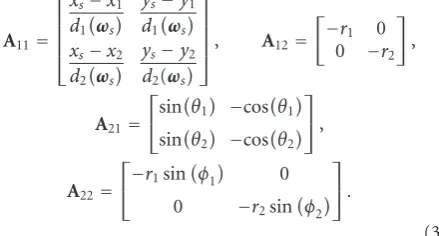
The proposed method is investigated in term of “biased” or “unbiased” in this subsection.A is divided into subblocks A= A11A12
A21A22
.A11,A12,A21, andA22 are the corresponding
subblocks ofA:
A11=
⎡ ⎢ ⎢ ⎢ ⎣
xs−x1
d1
ωs
ys−y1
d1
ωs
xs−x2
d2
ωs
ys−y2
d2(ωs
⎤ ⎥ ⎥ ⎥
⎦, A12=
−r1 0
0 −r2
,
A21=
⎡
⎣sin
θ1
−cosθ1
sinθ2
−cosθ2
⎤
⎦,
A22=
⎡
⎣−r1sin
φ1 0
0 −r2sin
φ2
⎤
⎦.
(30)
The matrix inverseA−1can be inverted blockwise by using
the following analytic inversion formula:
A11 A12
A21 A22
−1
=
Q1 Q2
Q3 Q4
, (31)
whereQ1denotesA−111+A−111A12(A22−A21A−111A12)−1A21A−111,
Q2 denotes −A−111A12(A22−A21A−111A12)−1, Q3denotes
− (A22 − A21A−111A12)−1A21A−111, and Q4 denotes (A22−
A21A−111A12)−1. If φ1 andφ2 are sufficiently small and have
BS1 BS2 MS
O1 O2
Figure5: MS location estimation when the angle spreads are suffi -ciently small.
shown inFigure 5. Note that (A21A−111A12)− 1
=A−1 12A11A−211.
According to (31), the expectation ofA−1can be arranged as
EA−1=
⎡
⎣02×2 E
A−1
21
A−1
12 −A−121A11E
A−1
21
⎤
⎦. (32)
From (20), we know E(ω)=E(A−1b). Substitute (32) into
this equation and note that E(θ1) =θd,1 and E(θ2) =θd,2,
the expectation of (x0,y0) can be expressed as follows:
Ex0
= 1
−sinθd,1cosθd,2+ cosθd,1sinθd,2
x2cosθd,1sinθd,2
= 1
−sinθd,1−θd,2
x2cosθd,1sinθd,2,
Ey0
= 1
−sinθd,1cosθd,2+ cosθd,1sinθd,2
x2sinθd,1sinθd,2
= 1
−sinθd,1−θd,2
x2sinθd,1sinθd,2.
(33)
We note that (33) is also the exact intersection of the lines drawn byθd,1andθd,2, that is,
Ey0
=y0, E
x0
=x0. (34)
This means that the estimator is unbiased as long as the angle spreads are sufficiently small with zero mean and sin(θd,1−
θd,2)=0.
When sin(θd,1−θd,2)=0, the MS position must be on
O1O2as shown inFigure 6. According to the objective
func-tion, the estimate of the MS positionx0is the center of GH:
x0=O1O2−r2+r1
2 =
R−rd,2−re,2+rd,1+re,1
2 , (35)
wherere,iis the NLOS error seen at BSi. The true MS position isx0=rd,1. So, the location error is
x0−x0= R−rd,2−re,2+rd,1+re,1
2 −rd,1=
re,1−re,2
2 . (36)
BS1 BS2
G H
O1 O2
x0 x0
Figure6: Location estimation when sin(θd,1−θd,2)=0.
Note thatR=rd,1+rd,2, then the expectation of the location
error is
Ex0−x0
=1 2
Ere,1
−Ere,2
=1 2
∞
−∞re,1p1
re,1
dre,1
−
∞
−∞re,2p2
re,2
dre,2
,
(37)
where p1(·) and p2(·) are NLOS error probability density
function observed at BS1 and BS2, respectively.
Therefore, we conclude that the proposed estimator is
(i) unbiased if sin(θd,1−θd,2)=0,
(ii) unbiased if sin(θd,1−θd,2)=0 andp1(·)=p2(·),
(iii) biased if sin(θd,1−θd,2)=0 andp1(·)=p2(·), and the
bias is (1/2)(E(re,1)−E(re,2)),
while the angle spreads are sufficiently small and have zero mean.
4.3. Selection of the approximate position
In the solution procedure, the approximation position ωs must be predefined. A simplest choice is the position defined by TOA and AOA measurements seen at BS1 in a polar coor-dinate system where the origin is the position of BS1:
xs=r1cos
θ1
, ys=r1sin
θ1
. (38)
Besides this choice, there are some other choices, such as the intersection of lines drawn byθ1andθ2, the AOA data fusion
in [4], and so forth.
5. THE CASE OF THREE BASE STATIONS
position O(x0,y0) is the MS location. The range
measure-ment and angle measuremeasure-ment at BS3 arer3andθ3,
respec-tively. From the geometry found in Figure 7, we find that GF =GO3−FO3, where FO3 = rd,3cos(θ3+φ3−π/2) =
α3r3cos(θ3+φ3−π/2), GF= y0, and GO3=y3, that is, we
get the following equation:
y0=y3−α3r3cos
θ3+φ3−π
2
. (39)
Similarly, GH=GO1−HO1where GH=rd,3sin(θ3+φ3−
π/2)=α3r3sin(θ3+φ3−π/2), GO1=x3, and HO1=x0, that
is,
x0=x3−α3r3sin
θ3+φ3−
π 2
. (40)
Combining (39) and (40) yields
1 1 r3
sin
θ3+φ3−
π 2
+ cos
θ3+φ3−
π 2 ⎡ ⎢ ⎣ x0 y0 α3 ⎤ ⎥ ⎦
=x3+y3.
(41)
Combining (41) and the angular constraints from BS1 and BS2, that is, (17), yields
⎡ ⎢ ⎣
sinθ1
−cosθ1
−r1sin
φ1 0 0
sinθ2
−cosθ2
0 −r2sin
φ2 0 1 1 0 0 V ⎤ ⎥ ⎦ ⎡ ⎢ ⎢ ⎢ ⎢ ⎢ ⎣ x0 y0 α1 α2 α3 ⎤ ⎥ ⎥ ⎥ ⎥ ⎥ ⎦ = ⎡ ⎢ ⎣ 0 x2sin
θ2
x3+y3
⎤ ⎥
⎦,
(42)
whereVdenotesr3(sin(θ3+φ3−π/2) + cos(θ3+φ3−π/2)).
For the case of three BSs, the constraints from TOA measure-ments (13) can be directly extended to
⎡ ⎢ ⎢ ⎢ ⎢ ⎢ ⎢ ⎢ ⎢ ⎣
xs−x1
d1
ωs
ys−y1
d1
ωs
−r1 0 0
xs−x2
d2
ωs
ys−y2
d2
ωs
0 −r2 0
xs−x3
d3
ωs
ys−y3
d3
ωs
0 0 −r3
⎤ ⎥ ⎥ ⎥ ⎥ ⎥ ⎥ ⎥ ⎥ ⎦ ⎡ ⎢ ⎢ ⎢ ⎢ ⎢ ⎣ x0 y0 α1 α2 α3 ⎤ ⎥ ⎥ ⎥ ⎥ ⎥ ⎦ = ⎡ ⎢ ⎢ ⎢ ⎢ ⎢ ⎢ ⎢ ⎢ ⎣
xs−x1
d1
ωs
ys−y1
d1
ωs
xs−x2
d2
ωs
ys−y2
d2
ωs
xs−x3
d3
ωs
ys−y3
d3 ωs ⎤ ⎥ ⎥ ⎥ ⎥ ⎥ ⎥ ⎥ ⎥ ⎦ xs ys − ⎡ ⎢ ⎢ ⎣ d1 ωs d2 ωs d3 ωs ⎤ ⎥ ⎥ ⎦. (43)
Combining (42) and (43) into a single matrix-vector form yields
A6×5ω5×1=b6×1, (44)
BS1 BS2 BS3 MS H G F O O1 O2 O3 φ3 θ3 y0 y3
x0 x3
Figure7: The constraint from AOA measurement with BS3.
where
A6×5=
⎡ ⎢ ⎢ ⎢ ⎢ ⎢ ⎢ ⎢ ⎢ ⎢ ⎢ ⎢ ⎢ ⎢ ⎢ ⎢ ⎢ ⎢ ⎢ ⎣
sinθ1
−cosθ1
−r1sin
φ1 0 0
sinθ2
−cosθ2
0 −r2sin
φ2
0
1 1 0 0 N
xs−x1
d1
ωs
ys−y1
d1
ωs
−r1 0 0
xs−x2
d2
ωs
ys−y2
d2
ωs
0 −r2 0
xs−x3
d3
ωs
ys−y3
d3
ωs
0 0 −r3
⎤ ⎥ ⎥ ⎥ ⎥ ⎥ ⎥ ⎥ ⎥ ⎥ ⎥ ⎥ ⎥ ⎥ ⎥ ⎥ ⎥ ⎥ ⎥ ⎦ , ω
5×1=
x0 y0 α1 α2 α3
T
b6×1=
0 x2sin
θ2
x3+y3 D1 D2 D3
T
,
(45)
whereNdenotesr3
sinθ3+φ3−π/2
+ cosθ3+φ3−π/2
; D1denotes ((xs−x1)/d1(ωs))xs+((ys−y1)/d1(ωs))ys−d1(ωs), D2denotes ((xs−x2)/d2(ωs))xs+((ys−y2)/d2(ωs))ys−d2(ωs), andD3denotes ((xs−x3)/d3(ωs))xs+ ((ys−y3)/d3(ωs))ys− d3(ωs).
Equation (44) is the closed-form equation of the MS po-sition, TOAs, AOAs, angular spreads. The least-squares inter-mediate solution of (44) is
ω=ATA−1ATb. (46)
As we discuss in former sections, the solution space of (46) is large due to the unknown angle spreads. The Lagranged-based solution can be still applied here.
If either the AOA measurement or the TOA measurement is not available at BS3, the constraint (41) or the constraint from the TOA measurement will be absent. Equation (44) is reduced to
A5×5ω5×1=b5×1. (47)
If more than three BSs are involved in the location pro-cess, TOA and AOA can be available at each BS. Let the num-ber of BSs ben(n >3). Equation (44) can be extended to
A2n×(2+n)ω(2+n)×1=b2n×1, (48)
whereω(2+n)×1=[x0 y0 α1 · · · αn]T.A2n×(2+n)andb2n×1
are the corresponding matrixes that can be obtained in a sim-ilar manner. The least-square solution is
ω
(2+n)×1=
AT
2n×(2+n)A2n×(2+n)
−1
AT
2n×(2+n)b2n×1. (49)
In more than 2 BSs scenario, the time-based NLOS miti-gation methods will not suffer from ambiguity. However, it is apparent that combing different types of the measurements can improve location performance. The computer simula-tions inSection 7will show performance improvement with angle.
6. NUMERICAL SOLUTION
With the number of BSs increasing in the location process, the matrix Ain (48) may be large, and (27) and f(ω,ρ) become complex. It may be not easy to operate the matrix and perform theρfinding algorithm. A numerical solution is proposed to be an alternative to resolve the MS position, which is summarized in the following steps.
Step 1. The all-angle spreads fromφ1toφnare simulated by
independent random variable sequences that satisfy the pre-defined distributions. The solution space of (49) can be de-noted as a data setΠ1= {ωm, 1≤m≤M}.Mis the length of the sequence.
Step 2. If we constrainΠ1byηi≤αi≤1, we get another data setΠ2.
Step 3. ω
opt is the one inΠ2 that minimizesJ(ω0), that is,
ωopt=minω∈Π2{J(ω)}.
In Step1, each element in the solution space is a candi-date of the MS position. In Steps2and3, one of the candi-dates inΠ1, which can both meet the constraintηi≤αi≤1 and minimizeJ(ω0), is considered as the optimal position.
The numerical solution is motivated by the constraints (18) or (48) and objective function.
From the numerical solution process, we know that most of the computation load happens in Step1, and there are two factors that can affect the computation load. The first is the matrix inverse operation in (20) or (49). The second is the size of the solution space in Step1, which is dependent on M. The computation load will linearly increase withM. As an example, the Gaussian elimination algorithm is used to calculate the matrix inverse, approximately 2L3/3 operations
are needed, that is, the complexity of the matrix inverse is O(L3) whereLis the matrix size,L=2nandnis the
num-ber of BSs involved in the location process. Simulations show that the position estimate by the numerical solution can be close to the position estimate by using the Lagrange-based solution, whenMis up to 100.
For the Lagrange-based solution, both matrix multipli-cation and matrix inverse are needed in (27) in each itera-tion. The complexity of each iteration is also O(L3) if matrix
multiplication is carried out naively and findingρis not con-sidered. Simulations show that the total iteration number is usually 100. Therefore, we can conclude that the complex-ity of the numerical solution is comparable with that of the Lagrange-based solution.
7. COMPUTER SIMULATIONS
7.1. TOA and AOA measurements
When range measurements are performed in a system, other factors also can contribute range error, such as system de-lay, synchronization error, timing error, measurement noise, and so forth. System delay means that the system has to take time to process the received signal and prepare for the trans-mitting signal. For RTD measurement, system delay must be considered. For TOA measurement and time difference mea-surement, synchronization has great influence on range esti-mation. Cyclic synchronization is usually used to keep syn-chronization error in an acceptable level. For example, in the TD-SCDMA system, the technical specifications [33,34] point out that synchronization resolution for location pur-poses should be limited within half chip, that is, about 100 meters. The timing error is caused by the uncorrected clock. With consideration of these factors, the TOA range measure-ment in the simulations is given as
ri=rd,i+vi+ nlosi, (50)
whereviis the range error caused by these factors.viis as-sumed to be a positive Gaussian random variable with mean 100 meters and standard variance 30 meters. nlosiis the ex-cess distance due to NLOS propagation. The radius of the scatters of CDSM is assumed to be 200 meters, that is, nlosi are positive random variables having support over [0 400] meters. The NLOS range error models are shown inFigure 6. The other two models are reverse CDSM and uniform distri-bution. The reverse CDSM is used to study the performance in a high NLOS environment. If the probability density func-tion (pdf) for CDSM is f(λ), the pdf of the reverse CDMS is
f(400−λ).
The angle spread is modeled as Gaussian random vari-ables. The standard deviation of the angle spread is 6 degrees, determined by the CDSM. The AOA measurement is as (2), and the angular bounds are as (3) which are selected with a confidence level of 95.4%.
7.2. Scenario 1: 2 BSs
In this scenario, the performance of the proposed method will be examined with 2 BSs. The cell layout is shown in
Figure 3. Let the coordinates of the two BSs be (0, 0) and
0 0.002 0.004 0.006 0.008 0.01 0.012 0.014
0 50 100 150 200 250 300 350 400 NLOS error (m)
CDSM Reverse CDSM Uniform
Figure8: Probability density functions (pdfs) for the NLOS error models.
TDOA/AOA in [17]. The average location errors (ALEs) of these methods are shown inFigure 9. From the pdfs of the NLOS error models, we know that the reverse CDSM has a large probability with high NLOS error, that is, the reverse CDSM means a high NLOS environment, and vice versa for the CDSM. Uniform means medium NLOS error. As a result, it can be found that the ALEs of all the methods are smaller on the CDSM and the ALEs are larger on the reverse CDSM. The simulations show that the proposed method can eff ec-tively deal with NLOS error with two BSs.
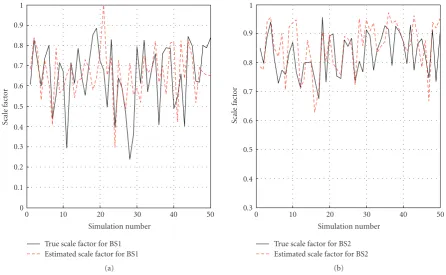
The scale factorαialso can be resolved by the proposed method. The scale factor reflects the approximation of range measurement to the LOS range. A high-scale factor means that the range measurement is close to the LOS range. A low scale factor means that the radio channel suffers from heavy NLOS propagation. The true scale factor of the range measurement seen at BSi is defined as αi = c·td,i/ri. It is assumed that the MS position is uniformly distributed in the serving cell with radius over [0, 0.5R] and angle over [−π/2,π/2]. As an example, NLOS errors are generated ac-cording to the CDSM. We run the proposed method 50 times independently.Figure 10shows the true scale factors and es-timated scale factors for the two BSs. From this figure, we know that the estimated scale factors by using the proposed location method are consistent with the true scale factor to some degree. The estimated scale factor for BS2 is closer to the true scale factor, as shown inFigure 10(b). It is reason-able to use the estimated scale factors to evaluate the level of NLOS propagation.
The AOA of an MS in this paper is estimated from the uplink signal at BSs. So, the proposed method is network based. Once the MS position is determined, AOA seen at BSs may be further corrected. The corrected AOA can be used in downlink beamforming to help the antenna array to dis-tribute power to the MS more accurately. The corrected AOA is also useful to track MSs while they are moving in the
cellu-0 50 100 150 200 250 300 350
A
ver
age
location
er
ror
CDSM Reverse CDSM Uniform
AOA data fusion in [4] GLE in [14]
HLOP [15]
Hybrid TDOA/AOA [16] The proposed method
Figure9: The average location errors with scenario 1 on the CDSM, the reverse CDSM, and the uniform NLOS models.
Table1: The standard deviation of the corrected AOA error (in de-grees).
CDSM Reverse CDSM Uniform
Δθ1 5.49 6.09 5.99
Δθ2 4.33 5.25 4.87
lar network. In this simulation, the MS position is assumed to be located at (500, 866) in meter, angle spread is modeled as a Gaussian distribution and the corresponding standard deviation is about 6 degrees, determined by the CDSM. Let Δθ1 andΔθ2 be the standard deviations of corrected AOA
error. Each standard deviation is calculated from 1000 inde-pendent runs.Table 1shows the performance of AOA correc-tion. It is found thatΔθ1is almost equal to 6 degrees, butΔθ2
is smaller than 6 degrees. That is, the corrected AOA seen at BS1 does not experience any improvement nor degradation, but the corrected AOA seen at BS2 improves.
0 0.1 0.2 0.3 0.4 0.5 0.6 0.7 0.8 0.9 1
Scale
fact
o
r
0 10 20 30 40 50
Simulation number True scale factor for BS1 Estimated scale factor for BS1
(a)
0.3 0.4 0.5 0.6 0.7 0.8 0.9 1
Scale
fact
o
r
0 10 20 30 40 50
Simulation number True scale factor for BS2 Estimated scale factor for BS2
(b)
Figure10: The true scale factor and the estimated scale factor on the CDSM.
a global minimum and two local minima exist. The position A is the global minimum; positions B and C are the two lo-cal minima. If look-up tables can be constructed based on these special properties, it is possible to predict location es-timation accuracy when the MS location is roughly known. Simulations show that the ALE contour is dependent on the NLOS error model. The positions of these minima may vary depending on the NLOS model.
7.3. Scenario 2: 3 BSs
The cell layout of the three BSs scenario is shown in
Figure 12. The coordinates of BS1, BS2, and BS2 are (0,0),
(R,0), and (R/2,√3R/2), respectively, whereR=2000 meters. The MS position is assumed to be uniformly distributed in the region formed by the points O1, I, J, and K. This
assump-tion is reasonable because the range measurements are con-sidered only from the three nearest neighbor BSs. If the MS is outside this region, another neighbor BS, not considered here, will be closer. Computer simulations are performed to access the performance of these methods, including the GLE in [15], the HLOP in [16], the hybrid TDOA/AOA method in [17], AOA data fusion in [4], TOA data fusion in [4], the method in [9], and the proposed method. For the hybrid TDOA/AOA method, range difference is directly calculated by TOA range measurements, that is,ri1=ri−r1.Figure 13
shows the ALEs of these methods. The TOA data fusion in [4] is a well-known TOA location method and the method in [9] is a modified TOA location method by quadratic pro-gramming technique. Both of the two purely TOA methods are used as benchmarks to show performance improvement
with angle. Again, we find that ALEs of all the methods are larger on reverse CDSM. The AOA data fusion has excellent performance and is easy to implement. It is found that the proposed method outperform the others.
8. REMARKS AND CONCLUSIONS
Motivated by the temporal-spatial characteristics of the ra-dio propagation channel, an effective NLOS error mitigation method is proposed in this paper. The MS position is con-strained to a patch overlapped by TOA range measurements and angular bounds. The closed-form equation of the MS position, TOAs, AOAs, and angle spreads is built. The so-lution space of the closed-form equation becomes large be-cause the angle spreads are random variables in nature. A constrained objective function is constructed to further limit the MS position. A Lagrange-based solution and a numer-ical solution are proposed to resolve the MS position. It is observed that the proposed method is characterized by the following features.
40 60 80 100 120 140 160 180
A
ver
age
location
er
ror
(m)
1000 800
600 400
200
0 −100
−50 0
50 100
(a)
60 60
60
70 70
70
70 70
80
80
80 80 80
80
80 80
80
80 80 80
80 90
90
90
90
90 90 90
90 90
100
100
10
0
100
100 100
11
0
110
110
110 120
12 0
120
120 130
130
130
130
140
140
140
140
150 150 150
160
60
100 200 300 400 500 600 700 800 900
R
an
gef
ro
mM
St
oh
o
m
eB
S(
m
)
−50 0 50
Angle of arrival (deg) B
A
C
(b)
Figure11: The performance dependence on the MS position on the CDSM. The horizontal axis of (a) is the LOS AOA seen at BS1 and the vertical axis is the LOS distance to BS1.
O1 O2
O3
BS3
BS1 BS2
I J K
Figure12: The cell layout for scenario 2.
(ii) The angular bounds θmin,iandθmax,iare the only re-quired prior knowledge. They can be determined by the statistics of AOA distribution from a theoretical model or determined by experimental test data in a real environment. Even the sector information may be considered as a substitute for the angular bounds. However, the methods in [15–19] need more prior knowledge, such as the covariance of TOA (TDOA) measurements, the standard deviation of AOA mea-surements, and the variance of measurement noise. In a macrocell environment as shown inFigure 1, the angular bounds can be definitely determined by (3).
0 50 100 150 200 250 300 350 400 450
A
ver
age
location
er
ror
(m)
CDSM Reverse CDSM Uniform
GLE in [14] HLOP in [15]
Hybrid TDOA/AOA in [16] AOA data fusion in [4]
TOA data fusion in [4] The method in [9] The proposed method
Figure 13: The average location errors with scenario 2 on the CDSM, reverse CDSM, and uniform models.
(iii) TOA and AOA measurements in this paper are ob-tained at BSs. So the proposed method is network based. This means that no modification is needed on MSs but software update is required at BSs.
(iv) The smart antenna array is standard equipment at each BS in the TD-SCDMA network [34]. AOA of each MS can be estimated by the uplink beamforming tech-nique. So, the proposed method is attractive for MS location in the TD-SCDMA network. It is also possible to realize the location method in other cellular systems if the azimuth can be obtained.
The performance improvements of the proposed method compared to other hybrid methods are examined by com-puter simulations. The scale factor can be estimated by the proposed method, which is useful to evaluate NLOS level. The corrected AOA seen at BS1 does not experience any improvement nor degradation. But the corrected AOA seen at BS2 improves. The location accuracy of the proposed method is not only dependent on the MS position but also dependent on NLOS error models.
Finally, we must mention that the proposed method is mainly based on the joint geometric constraints of excess de-lay and angle spread and does not make full use of the pdf information about them. So, the method is suboptimal—not an optimal statistical one.
ACKNOWLEDGMENTS
The authors are very grateful to the anonymous reviewers for their useful comments. This work was supported, in part, by the coresearch project of KOSEF/NSFC (Korea Science and Engineering Foundation, the National Natural Science Foun-dation of China), Korea University ITRC (Information Tech-nology Research Center) project, and the Daegu Gyeongbuk Institute of Science and Technology (DGIST).
REFERENCES
[1] J. Caffery Jr. and G. L. St¨uber, “Overview of radiolocation in CDMA cellular systems,”IEEE Communications Magazine, vol. 36, no. 4, pp. 38–45, 1998.
[2] K. Axel.,Location-Based Services: Fundamentals and Opera-tion, John Wiley & Sons, Hoboken, NJ, USA, 2005.
[3] F. Gustafsson and F. Gunnarsson, “Mobile positioning using wireless networks: possibilities and fundamental limitations based on available wireless network measurements,”IEEE Sig-nal Processing Magazine, vol. 22, no. 4, pp. 41–53, 2005. [4] A. H. Sayed, A. Tarighat, and N. Khajehnouri, “Network-based
wireless location: challenges faced in developing techniques for accurate wireless location information,”IEEE Signal Pro-cessing Magazine, vol. 22, no. 4, pp. 24–40, 2005.
[5] K. W. Cheung, H. C. So, W.-K. Ma, and Y. T. Chan, “A con-strained least squares approach to mobile positioning: algo-rithms and optimality,”EURASIP Journal on Applied Signal Processing, vol. 2006, Article ID 20858, 23 pages, 2006. [6] M. I. Silventoinen and Rantalainen, “Mobile station
emer-gency locating in GSM,” in Proceedings of the IEEE In-ternational Conference on Personal Wireless Communications (ICPWC ’96), pp. 232–238, New Delhi, India, February 1996.
[7] M. P. Wylie and J. Holtzman, “Non-line of sight problem in mobile location estimation,” inProceedings of the Annual Inter-national Conference on Universal Personal Communications— Record, vol. 2, pp. 827–831, Cambridge, Mass, USA, Septem-ber 1996.
[8] X. Wang, Z. Wang, and B. O’Dea., “A TOA-based location algorithm reducing the errors due to the non-line-of-sight (NLOS) propagation,”IEEE Transactions on Vehicular Technol-ogy, vol. 52, pp. 112–116, 2003.
[9] W. Wei, X. Jin-Yu, and Z. Zhong-Liang, “A new NLOS error mitigation algorithm in location estimation,”IEEE Transac-tions on Vehicular Technology, vol. 54, no. 6, pp. 2048–2053, 2005.
[10] S. Venkatraman, J. Caffery Jr., and H.-R. You, “A novel ToA location algorithm using LoS range estimation for NLoS envi-ronments,”IEEE Transactions on Vehicular Technology, vol. 53, no. 5, pp. 1515–1524, 2004.
[11] Y.-T. Chan, W.-Y. Tsui, H.-C. So, and P.-C. Ching, “Time-of-arrival based localization under NLOS conditions,”IEEE Transactions on Vehicular Technology, vol. 55, no. 1, pp. 17–24, 2006.
[12] J. Caffery Jr., “New approach to the geometry of TOA loca-tion,” in Proceedings of the 52nd IEEE Vehicular Technology Conference (VTC ’02), vol. 4, pp. 1943–1949, Boston, Mass, USA, September 2000.
[13] S. Al-Jazzar, J. Caffery Jr., and H.-R. You, “Scattering-model-based methods for TOA location in NLOS environments,” IEEE Transactions on Vehicular Technology, vol. 56, no. 2, pp. 583–593, 2007.
[14] M. N´ajar, J. M. Huerta, J. Vidal, and J. A. Castro, “Mobile lo-cation with bias tracking in non-line-of-sight,” inProceedings of the IEEE International Conference on Acoustics, Speech and Signal Processing (ICASSP ’04), vol. 3, pp. 956–959, 2004. [15] C.-L. Chen and K.-T. Feng, “An efficient
geometry-constrained location estimation algorithm for NLOS environments,” inProceedings of the International Conference on Wireless Networks, Communications and Mobile Computing (IWCMC ’07), vol. 1, pp. 244–249, Las Vegas, Nev, USA, June 2005.
[16] S. Venkatraman and J. Caffery Jr., “Hybrid TOA/AOA tech-niques for mobile location in non-line-of-sight environ-ments,” inProceedings of the IEEE Wireless Communications and Networking Conference (WCNC ’04), vol. 1, pp. 274–278, March 2004.
[17] C. Li and Z. Weihua, “Hybrid TDOA/AOA mobile user loca-tion for wideband CDMA cellular systems,”IEEE Transactions on Wireless Communications, vol. 1, no. 3, pp. 439–447, 2002. [18] E. Grosicki, K. Abed-Meraim, and R. Dehak, “A novel method
to fight the non-line-of-sight error in AOA measurements for mobile location,” inProceedings of the IEEE International Con-ference on Communications (ICC ’04), vol. 5, pp. 2794–2798, June 2004.
[19] M. S. Cugno and F. Barcelo-Arroyo, “WLAN indoor position-ing based on TOA with two reference points,” inProceedings of the IEEE 4th Workshop on Position, Navigation and Communi-cation, pp. 23–28, Hannover, Germany, March 2007.
[20] N. Iwakiri and T. Kobayashi, “Joint TOA and AOA estimation of UWB signal using time domain smoothing,” inProceedings of the 2nd International Symposium on Wireless Pervasive Com-puting, pp. 120–125, San Juan, Puerto, February 2007. [21] H. Tang and Y. Park, “Location tracking of mobile stations in
[22] A. J. Weiss, “Direct position determination of narrowband radio frequency transmitters,”IEEE Signal Processing Letters, vol. 11, no. 5, pp. 513–516, 2004.
[23] R. B. Ertel and J. H. Reed, “Angle and time of arrival statistics for circular and elliptical scattering models,”IEEE Journal on Selected Areas in Communications, vol. 17, no. 11, pp. 1829– 1840, 1999.
[24] K. I. Pedersen, P. E. Mogensen, and B. H. Fleury, “A stochas-tic model of the temporal and azimuthal dispersion seen at the base station in outdoor propagation environments,”IEEE Transactions on Vehicular Technology, vol. 49, no. 2, pp. 437– 447, 2000.
[25] 3GPP/3GPP2 joint spatial channel modeling Ad-hoc (SCM-128—Motorola), “Circular angle spread,” in Teleconference, March 2003.
[26] M. J. Gans, “Power-spectral theory of propagation in the mobile-radio environment,” IEEE Transactions on Vehicular Technology, vol. 21, no. 1, pp. 27–38, 1972.
[27] Y. Jeong, H. You, and C. Lee, “Calibration of NLOS error for positioning systems,” inProceedings of the IEEE Vehicular Tech-nology Conference (VTC ’01), vol. 4, no. 53, pp. 2605–2608, May 2001.
[28] L. J. Greenstein, V. Erceg, Y. S. Yeh, and M. V. Clark, “A new path-gain/delay-spread propagation model for digital cellular channels,”IEEE Transactions on Vehicular Technology, vol. 46, no. 2, pp. 477–485, 1997.
[29] J. J. Caffery Jr. and G. L. St¨uber, “Subscriber location in CDMA cellular networks,”IEEE Transactions on Vehicular Technology, vol. 47, no. 2, pp. 406–416, 1998.
[30] I. Jami and R. F. Ormondroyd, “Joint angle of arrival and angle-spread estimation of multiple users using an antenna ar-ray and a modified MUSIC algorithm,” inProceedings of the IEEE Vehicular Technology Conference (VTC ’01), vol. 1, pp. 48–52, May 2001.
[31] S. Sakagami, S. Aoyama, K. Kuboi, S. Shirota, and A. Akeyama, “Vehicle position estimates by multibeam antennas in multi-path environments,”IEEE Transactions on Vehicular Technol-ogy, vol. 41, no. 1, pp. 63–68, 1992.
[32] “Service provided by the physical layer,” Version 3.0.0, China Wireless Telecommunication Standard (CWTS) Work-ing Group 1 (WG1).
[33] “Physical Layer—Measurements,” Version 2.0.0, China Wire-less Telecommunication Standard (CWTS) Working Group 1 (WG1).