Copyright2000 by the Genetics Society of America
Usefulness of Single Nucleotide Polymorphism Data for
Estimating Population Parameters
Mary K. Kuhner, Peter Beerli, Jon Yamato and Joseph Felsenstein
Department of Genetics, University of Washington, Seattle, Washington 98195-7360 Manuscript received October 15, 1999
Accepted for publication May 22, 2000
ABSTRACT
Single nucleotide polymorphism (SNP) data can be used for parameter estimation via maximum likeli-hood methods as long as the way in which the SNPs were determined is known, so that an appropriate likelihood formula can be constructed. We present such likelihoods for several sampling methods. As a test of these approaches, we consider use of SNPs to estimate the parameter⌰ ⫽4Ne(the scaled product of effective population size and per-site mutation rate), which is related to the branch lengths of the reconstructed genealogy. With infinite amounts of data, ML models using SNP data are expected to produce consistent estimates of⌰. With finite amounts of data the estimates are accurate when⌰is high, but tend to be biased upward when⌰ is low. If recombination is present and not allowed for in the analysis, the results are additionally biased upward, but this effect can be removed by incorporating recombination into the analysis. SNPs defined as sites that are polymorphic in the actual sample under consideration (sample SNPs) are somewhat more accurate for estimation of⌰than SNPs defined by their polymorphism in a panel chosen from the same population (panel SNPs). Misrepresenting panel SNPs as sample SNPs leads to large errors in the maximum likelihood estimate of⌰. Researchers collecting SNPs should collect and preserve information about the method of ascertainment so that the data can be accurately analyzed.
M
ODERN population genetics methods require constant effective population sizeNe. At each site, selec-large samples of population level genetic infor- tively neutral mutations occur with probability per mation to answer questions about population size, mi- generation.gration, selection, and other factors. Many researchers This parameter is estimated using the Metropolis-Has-have recently begun collecting single nucleotide poly- tings method ofKuhner et al.(1995), which samples morphism (SNP) data in the hope of addressing these among possible coalescent trees describing the relation-questions, as well as for their applications in gene map- ship among the sampled sequences according, in part, ping (for an overview, see Syvanen et al. 1999). This to their likelihood under a given model of sequence article examines methods for analyzing SNP data in a evolution. The information about⌰is found specifically maximum likelihood (ML) framework. in the branch lengths of the sampled trees: therefore, Appropriate analysis of SNPs depends on knowing estimation of⌰indirectly tests the ability of a SNP likeli-how they were collected. Critical pieces of information hood model to accurately estimate branch lengths. include the following: We test the effect of both unacknowledged and
ac-knowledged recombination on the accuracy of these 1. Were candidate sites chosen from completely linked,
estimates, since SNP data often come from a context partially linked, or unlinked regions of the genome?
where recombination is possible. 2. Were sites defined as SNPs on the basis of their
poly-The use of SNP data to estimate parameters not morphism in the sample at hand, a panel drawn from
closely related to branch length, such as tree topology the sample population, or a panel drawn from a
and map order, will be considered in a future article. different population?
It seems likely that SNP data will be more powerful for such parameters than they are for branch lengths; As one possible measure of the usefulness of SNP
data, we consider the estimation of the parameter⌰ ⫽ however, the pitfalls found here will probably be found 4Ne, four times the product of the effective population in those areas as well.
size and the neutral mutation rate. We look at the simple case of a single random-mating diploid population of
METHODS
Likelihood framework for SNPs: The estimation of
Corresponding author:Mary K. Kuhner, Department of Genetics,
Uni-phylogenies by maximum likelihood from DNA
se-versity of Washington, Box 357360, Seattle, WA 98195-7360.
E-mail: [email protected] quences (Felsenstein 1981) computes, for each site,
TABLE 1
Road map of SNP analyses: SNP data categorized by region of origin
Region is Conditional likelihood method Reconstituted DNA method
Fully linked Yes, Equation 1 Yes, Equations 3–4
Partially linked No Yes, Equation 6
Linked chunks May be possible Yes, Equations 3–4
Unlinked Yes, Equation 2 Yes, Equation 5
Equations referenced are in the current article.
the probability of that site on a given phylogeny: this tion at all is available on the number of sitesnotselected we call the site likelihood. The likelihood of the entire as SNPs. Some methods of data collection—for exam-data set on the given phylogeny is the product of the ple, using anonymous probes to detect SNPs—will not site likelihoods. give us any information on how many “unobserved” To analyze SNPs using this approach, several aspects sites were in the region of interest. Other methods—for of the way the SNPs were collected must be taken into example, choosing SNPs from a region of known consideration: this is analogous to considering ascer- length—will allow us to determine this. As is shown, if tainment of individuals in a case/control disease study. this information is available it allows us to use alternative In the first section, we consider the question of methods of constructing the likelihood, and in the case whether the SNPs were gathered from a single com- of recombination it allows analysis of otherwise intracta-pletely linked region, from various unlinked locations, ble data.
or from a linked region with some internal recombina- We first consider the case where information is avail-tion. In the following section, we consider the question able only on the SNPs themselves. Here, we modify the of whether the SNPs were defined on the basis of poly- usual DNA likelihood model by conditioning on the morphism in the sample or in a panel. These sections site being a SNP (by whatever criteria are in use), an define a toolkit from which SNP corrections for many event with probability P(SNP|G). The difference be-specific cases can be constructed. Tables 1 and 2 give tween the analysis of linked and unlinked SNPs lies in an overview of the issues and the appropriate means of the choice of genealogies to consider. This approach is analysis for each set of conditions. referred to as the “conditional likelihood” method.
Linkage considerations: At one extreme, candidate The conditional probability of observing fully linked sites could be drawn from a single, nonrecombining SNPs depends on the distribution of SNP and non-stretch of DNA and evaluated to find SNPs. In this case, SNP sites across a single shared genealogy, since in the all of the SNPs, as well as the unobserved sites around absence of recombination all sites must derive from the them, would have the same underlying coalescent gene- same genealogy. This probability can then be computed alogy. We call this case “fully linked SNPs.” At the other as the sum, over all possible genealogies, of the probabil-extreme, candidate sites could be chosen at random ity of observing a particular site configuration (necessar-from a recombining genome in such a way that
succes-ily a SNP) divided by the probability that a given site is sive draws represent completely independent coalescent
a SNP. The product is over all SNP sites: genealogies (“unlinked SNPs”). Between these
ex-tremes, successive candidates represent correlated, but
L(⌰)⫽
兺
G
P(G|⌰)
兿
s
P(Ds|G)
P(SNPs|G). (1) not always identical, coalescent genealogies: this is the
case for long sequences taken from a genome with
re-(The derivation of this equation is given in more detail combination, and we call it “partially linked SNPs.”
An additional consideration is whether any informa- in theappendix.)
TABLE 2
Road map of SNP analyses: SNP data categorized by reference population
SNPs defined by Analysis method
Sample Regular MCMC on sample
Same-population panel MCMC with panel incorporated into sample Different-population panel MCMC with migration or divergence (hypothetical)
Unknown panel No method known
The conditional probability of observing unlinked it essentially tries to reconstruct the original DNA se-quence. For fully linked data, the reconstituted DNA SNPs, in contrast, depends on the distribution of SNP
method can be expressed as follows (where the subscript and non-SNP sites across all possible genealogies. The
s refers to the observed SNPs, and u to the unobserved observed SNPs will tend to come from underlying
gene-sites), alogies that are longer than average (shorter
genealo-gies are less likely to have undergone a mutation
yield-L(⌰)⫽
兺
G
冤
P(G|⌰)
冢
兿
s
φP(Ds|G)
冣冢
兿
u[1 ⫺φP(SNP|G)]
冣冥
, ing a SNP). It would be incorrect to consider them onlyin the context of their longer-than-average genealogies; (3) to correctly assess⌰, we must consider the context of
which can be reduced to the entire distribution of genealogies. Thus, two
summa-tions over all genealogies are needed, one assessing
L(⌰)⫽
兺
G
冤
P(G|⌰)
冢
兿
s
φP(Ds|G)
冣
(1⫺φP(SNP|G))u冥
.probability of the observed site pattern given that the
site is a SNP, and one assessing the overall probability (4) of obtaining a SNP:
For unlinked SNPs,
L(⌰)⫽
兿
s
RGP(G|⌰)P(Ds|G)
RGP(G|⌰)P(SNPs|G)
. (2) L(⌰)⫽
兿
s
冤
兺
GP(G|⌰)φP(Ds|G)
冥
(The derivation is given in theappendix.) ⫻兿
u
冤
兺
GP(G|⌰)(1⫺φP(SNP|G))
冥
. (5) The direct calculation of these likelihoods is notpossi-ble because of the summations over all genealogies, For partially linked SNPs, the summation becomes but they can be approximated by importance sampling more complex. In the presence of recombination, each methods such as the Metropolis-Hastings sampler (cf. site has an individual site tree, but successive sites may
Kuhneret al.1995;BeerliandFelsenstein1999; for have distinct, although correlated, site trees. The data an alternative approach to this type of importance sam- set as a whole is represented by a recombinant geneal-pling, see the method ofGriffithsandTavare´1993). ogy, which is a collection of these site trees. LetGistand Equation 1 can be implemented as a single sampler, for the site tree (contained in the full recombinant assessing both numerator and denominator on the same genealogy G) for site i. The sum over G for partially set of genealogies. One straightforward way to imple- linked sequences is over all possible recombinant gene-ment (2) as a Metropolis-Hastings sampler would be to alogies, that is, all possible combinations of one or more make two independent sampler runs, one sampling (up to the number of sites) site treesGi.The term␦ois from the numerator, one from the denominator. There 1 if the site is observed and 0 if it is unobserved. Note may be a more economical approach where a single that with partially linked SNPs it is not enough to know sample of genealogies is adequate to estimate both nu- the total number of unobserved sites: we must know the merator and denominator. number of unobserved sites between each successive The case of partial linkage, where successive sites have pair of SNPs so that we can accurately take into account correlated genealogies, is more difficult. It may in fact the probability of recombination between SNPs: be impossible to solve without information about the
L(⌰)⫽
兺
G
P(G|⌰,r)
兿
i
[␦oφP(Di|Gi)
number and location of unobserved sites. The difficulty is that the unobserved sites are drawn from a
distribu-⫹(1⫺ ␦o)(1⫺φP(SNP|G))]. (6) tion that is correlated with, but not identical to, the
distribution of the observed SNPs. Without knowing The reconstituted-DNA method, relying on informa-this distribution, we cannot construct an appropriate tion about the unobserved sites, allows us to analyze correction. partially linked SNPs, which are intractable under the A more complete analysis can be made if we have conditional-likelihood method. This approach can be additional information: the number u of sites not se- incorporated into a recombination-aware Metropolis-lected as SNPs (“unobserved sites”) and the probability Hastings sampler (Kuhner et al.2000). The resulting φthat a potential SNP site will actually be detected as search among genealogies considers both the site trees such. Ifφis less than 1, the unobserved sites will be a that actually yielded SNPs and other site trees, inter-mixture of SNPs that were missed during sampling and spersed among them, that did not.
combination of Equation 4 (within chunks) and the Panel SNPs:Here the genealogyGmust be widened to include relationships not only among the sampled logic for combining multiple unlinked loci in a Markov
chain Monte Carlo (MCMC) sampler described in individuals but among the panel individuals and be-tween panel and sample individuals. We assume that as
Kuhner et al. (1995), as long as the length of each
chunk is known. long as a site is found to vary in the panel, it will be included in our calculation even if it proves not to vary The conditional-likelihood approach could also be
used if the number of SNPs sampled from one chunk in the sample, since this will generally not be known until after the data are collected. The method can were independent of the density of SNPs in that chunk
(for example, if the researcher examined each chunk readily be modified to cover the case where sites that prove to be invariant in the sampled individuals are until five SNPs were found and then stopped). However,
in the more usual case, where all SNPs in the chunk discarded, but this should be avoided if at all possible as it loses information unnecessarily.
are reported, straightforward application of the
condi-tional-likelihood approach leads to a bias. Chunks with a We call the data for a given site in the actual sample
Ds and the data for that site in the panel Dp. If Dp is deep genealogy produce many SNPs, and the likelihood
curves from such chunks are therefore well defined. known, we should merge panel and sample together and use a modified form of the analysis given below. Chunks with a shallow genealogy produce few SNPs and
a relatively flat likelihood curve. The deeper genealogies Usually all we know is that Dp was not invariant. The termP(D&SNP|G) can then be written as the probability thus dominate the combined estimate, leading to an
overestimate of⌰. It may be possible to overcome this of observing Ds given that the site is variable in the panel, which is equal to the probability ofDsminus the effect with an appropriate conditioning on the number
of SNPs in each chunk, but the reconstituted-DNA ap- probability of cases in which the panel was invariant:
P(Ds|G) ⫺ P(Ds&Ip|G). This is somewhat cumbersome proach seems simpler—in effect it does the necessary
conditioning automatically. to bookkeep in a Metropolis-Hastings context, but pre-sents no theoretical difficulties. It will, however, slow
Methods of defining a SNP: The next question of
interest is how a candidate site is determined to be a such an analysis by increasing the size of the search space, sinceGmust now include the possible genealogy SNP once it is drawn. There are at least three
possibili-ties. The site might be classified as a SNP because it is of the panel as well as the sample.
Different-population panel SNPs:This case is more polymorphic in the actual sample under consideration
(“sample SNPs”); because it is polymorphic in a panel demanding, as the genealogyGthat relates sample and panel must take into account the relationship between drawn from the same population (“panel SNPs”); or
because it is polymorphic in a panel from a different, the two populations. If this relationship is basically that of two static populations undergoing migration, an ap-though presumably related, population
(“different-pop-ulation panel SNPs”). propriate method would be to use the logic of Migrate (BeerliandFelsenstein1999) to construct a Metropo-We consider a site to be polymorphic if at least one
nucleotide difference is seen. More restricted defini- lis-Hastings sampler across multipopulation genealogies with migration. These migration genealogies could then tions, such as “a site is polymorphic if the frequency of
the most common allele is less than 0.95,” can in princi- be used in the same types of equations as for same-population sample SNPs. Such an analysis would be ple be handled by modifications of these approaches.
The terms we need to consider are the sitewise data much more effective ifDpwere known, but would have some power even if it were unknown, since tests of likelihoodsP(D&SNP|G) (the probability that a site of
a given configurationDwill be obtained as a SNP) and Migrate have shown that is has some ability to infer parameters from a subpopulation for which no data are
P(SNP|G) (the probability that a site will be a SNP). It
is useful to defineIas an invariant site,Ipas a site that given (P. Beerli, unpublished results). We are in the process of developing such a sampler. Migrate can ana-is invariant in the panel, andIsas a site that is invariant
in the sample. lyze multiple subpopulations so that in theory a complex relationship between panel and sample subpopulations
Sample SNPs:Here the data contain only
polymor-phic sites by definition, and the data likelihoodP(D& could be accommodated, although a large amount of data might be required. The closer the relationships SNP|G) reduces toP(D|G) since the conditional
proba-bility that the observed site is polymorphic is 1. This among the subpopulations, the more informative such data will be.
likelihood can be calculated as a standard DNA
likeli-hood (Felsenstein1981) on the site’s genealogy. The If the relationship between the two populations is common descent from an ancestral population, a Me-term P(SNP|G) can most readily be calculated as 1⫺
P(Is|G), whereIsis the sum of the probabilities that the tropolis-Hastings sampler incorporating this relation-ship could also be constructed. There is currently no site has all A’s, all C’s, all G’s, or all T’s on the given
genealogy. An analogous correction was used by practical experience to tell us how much power would be available to such a sampler, though unless the
separa-Felsenstein (1992) for restriction fragment length
the mutations causing the SNPs, many of the SNP sites needed, but more is available since classesxxy,xyx, and
yxxcan now be distinguished. defined on the panel may be uninformative on the
It should be noted that if the model of DNA evolution sample.
used to derive the site-class expectations is not identical It is clear that if the approach used to define the SNPs
to the one that governed the actual generation of the is not known, there is not enough information available
data, there is no guarantee that the maximum likelihood to construct a full likelihood method.
estimate will be consistent. (This is not a flaw in
likeli-Consistency of estimation with SNPs:In this section,
hood analysis: no method can be expected to be consis-we investigate whether SNP data can be used to make
tent if it is based on an incorrect model.) However, as a consistent ML reconstruction of the tree, since if the
long as three or more sequences are sampled, properly coalescent tree can be reconstructed consistently, a
con-conditioned maximum likelihood analysis of SNPs sistent estimate of⌰will naturally follow.
should be consistent under the same conditions as maxi-Maximum likelihood phylogeny reconstruction from
mum likelihood analysis of the underlying DNA data. DNA data can be shown to be consistent when a correct
Bias of estimation with SNPs:It would be natural to model of sequence evolution is used (Chang 1996).
ask whether estimation of ⌰ using finite amounts of Consistency means that the estimate converges to the
SNP data is biased: that is, what is the expectation of the correct solution (both topology and branch lengths) as
estimate with finite data? Surprisingly enough, however, the amount of data becomes infinite. Since the
SNP-the mean bias is infinite for both SNP data and full likelihood model is derived from the full DNA model,
DNA data. For both SNPs and full DNA data, there exist it may also be consistent, but we must consider whether
possible data configurations for which the estimate of loss of information about the non-SNP sites causes
in-⌰is infinite. Thus the expectation is a mean over terms, consistency.
some of which are infinite, and the mean bias must be It is immediately apparent that the
conditional-likeli-infinite. hood approach will fail in some cases where DNA (or
At first this seems very alarming. However, the cases reconstituted DNA) estimation would succeed.
Con-that give an infinite estimate are extremely unlikely with sider unlinked sites from two individuals and a
Jukes-reasonably sized data sets (⬎5–10 sites), and for the vast Cantor model (JukesandCantor 1969) of sequence
majority of data sets a good estimate is produced. This evolution. The full DNA model can consistently estimate
suggests that if we want practical guidance as to whether the branch length separating the two individuals, but
the method is working well in a particular case, simula-to do so it relies on comparing the frequency of invariant
tions are still relevant, even though we expect that if sites (sites of patternxx) with the frequency of variable
enough simulations were performed, the mean estimate sites (patternxy). To make SNP data we discard all sites
would be infinite. of patternxx, leaving ourselves with no information: the
Even in the absence of infinitely large estimates, we remaining xysites are expected with probability 1 for
expect an upward tendency in the results of estimations any nonzero value of the branch length. (If the branch
using SNPs. In the tree of three tips, all of the informa-length were zero, we would have come back
empty-tion is in the ratio ofxxytoxyzsites. Sites of thexyzclass handed from our search for SNPs.)
are rare for reasonable values of⌰(cases where they However, with three or more individuals, sufficient
are not rare are unlikely to come up in biological prac-information is available with SNP data even if the
num-tice, since they would represent DNA so divergent that ber of unobserved sites is not known. For unlinked SNPs,
homology and alignment would become problematic). three individuals allow the possibility of site classesxxy
Since they are rare, their frequency will be poorly esti-andxyz(for unlinked SNPs, possibilities such asxyxare
mated by small data sets. The relationship betweenf(xyz) equivalent toxxy). Using the Jukes-Cantor model, we
and the estimate of⌰is nonlinear, with upward devia-can derive (by taking the expectation of the multinomial
tions in f(xyz) producing a much larger effect than sampling probability over the distribution of allele
fre-downward ones. If we estimate f(xyz) with error that quencies in a symmetrical four-allele model, as in
Watt-is symmetrically dWatt-istributed around the true value, we
erson1977) an expression for the proportion of xxy
expect an upward tendency in our results. The full DNA sites as a function of⌰:
model is not as vulnerable to this effect because it is not solely dependent on f(xyz) for its information: the
Pxxy Pxxy⫹ Pxyz
⫽3⫹3⌰
3⫹5⌰. proportion of sites that arexxxis also informative, and since they are common, much more information is avail-This function is monotonically decreasing in ⌰and able.
thus any value of the ratio corresponds to a unique In the simulation section, we provide some empirical estimate of⌰. We believe, although it is difficult to show exploration of the amount of SNP data needed to get analytically, that the same is true for linked SNPs where an accurate estimate.
given values of ⌰ and r were made using a program (The Recombine program would move toward an esti-mate of zero, but would encounter problems such as provided by Richard Hudson (personal
communica-tion). DNA data were simulated on these trees using a arithmetic underflow before actually arriving there.) To test whether the presence of some recombination modification of the program treedna (J. Felsenstein,
unpublished results), which uses the Kimura two-param- in the sequences disrupts the estimate, we created se-quences with various levels of recombination and ana-eter model (Kimura1980). We set the
transition/trans-version ratio to 2.0, representing a moderate transition lyzed them with and without coestimating recombina-tion.
bias, such as might be expected from the nuclear DNA of mammals.
To create sample SNP data, we simulated trees
con-RESULTS taining the desired number of tips (sequences) and
recorded all polymorphic sites generated. To create We did not explore the case of unlinked SNPs. The Metropolis-Hastings sampler is overkill on such data, panel SNP data, we simulated trees containing a number
of tips equal to the sum of panel and sample sizes and since single unlinked sites do not provide enough infor-mation for any kind of tree estimate. An analytic solution then chose the panel out of these tips at random. The
panel was used to determine which sites to sample, and may be possible if the mutational model is not too com-plex.
these sites were then sampled from the remaining tips,
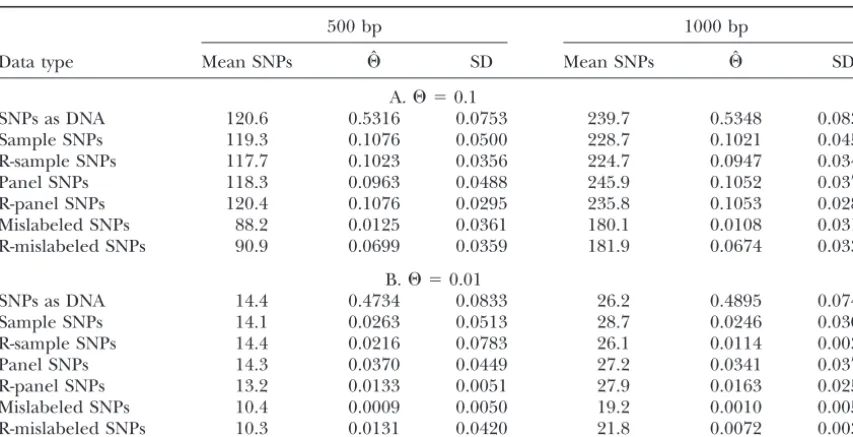
even if they were not polymorphic among those tips. As expected, representing SNPs as DNA leads to dras-tic overestimation of⌰(Table 3, A and B, line 1). Data from the panel individuals were then discarded.
This method is appropriate because a coalescent tree For fully linked SNPs, when⌰was quite high (0.1), both sample SNPs and panel SNPs gave estimates close generated for a given number of individuals is
statisti-cally indistinguishable from one generated for the en- to the truth and had similar standard deviations (Table 3A, lines 2 and 4). The standard deviations were about tire population and then subsampled to give that
num-ber of individuals. twice as high as observed inKuhneret al.(1998), using the full DNA model for a similar case (although that The parameterφ(the chance that, if a site were
eligi-ble to be a SNP, it would be detected as one) was set case involved estimation of growth rate as well as ⌰). Use of reconstituted DNA led to standard deviations to 1.
Estimates of⌰were made using the program Recom- nearly as good as those from the full DNA model (Table 3A, lines 3 and 5).
bine from the LAMARC package (http://evolution.
genetics.washington.edu/lamarc.html). Recombine is When panel SNPs were misrepresented as sample SNPs, the estimates were approximately 10-fold too low an extension of Coalesce (Kuhner et al. 1995). For
analysis of completely linked SNPs, we fixed the value (Table 3A, line 6). In this high-⌰case, both sample and panel SNPs can be successful at recovering⌰, but only of the recombination parameterr(equal toC/, where
Cis the recombination rate per site per generation and if the method of ascertainment is correctly specified. Why is incorrect specification so disastrous? Mislabeling
is the mutation rate per site per generation) at zero;
for analysis of partially linked SNPs, we tested the pro- panel SNPs as sample SNPs forces us to discard sites that are found to be invariant in the sample, reducing gram both with and without coestimation of r. Like
Coalesce, Recombine samples over a variety or trees in the amount of available data, but this is not the main reason for the poor results; if it were, results with 1000 proportion to how well they fit the data and uses these
trees to make an overall estimate of its parameters. In bp of DNA and mislabeled SNPs (yielding an average of 180 analyzable sites) should be superior to results this case, the distribution of branch lengths among the
sampled trees is used to make a maximum likelihood with 500 bp of DNA and panel SNPs (yielding an average of 118 analyzable sites). In fact, they were much inferior. estimate of⌰and, optionally,r.
The program runs a series of Markov chains that The fundamental problem is that panel SNPs are de-pleted for variable sites arising from mutations in tip-sample these coalescent trees. From the tip-sample of trees
in each chain, a new estimate of the parameters is made: ward branches, since such sites will not be shared be-tween panel and sample members: analyzing them as this estimate in turn provides a starting point for the
next chain. Finally, a longer chain is run to produce sample SNPs ignores this depletion, leading to misinter-pretation of the data.
the final estimate. In this study, for each estimation we
ran 10 short chains of 500 trees each and 1 long chain Use of reconstituted DNA reduced the size of this error, leading to estimates that wereⵑ60% of the true of 10,000 trees, sampling every 20th tree. The program
was provided with the correct nucleotide frequencies value (Table 3A, line 7).
For our lower value of⌰ (0.01), which is still quite and transition/transversion ratio for the DNA model
used. high by biological standards, the results (Table 3B) were less encouraging. Even with correct labeling, sample Some data sets did not contain any variable sites.
TABLE 3
⌰estimates based on SNPs
500 bp 1000 bp
Data type Mean SNPs ⌰ˆ SD Mean SNPs ⌰ˆ SD
A.⌰ ⫽0.1
SNPs as DNA 120.6 0.5316 0.0753 239.7 0.5348 0.0839
Sample SNPs 119.3 0.1076 0.0500 228.7 0.1021 0.0459
R-sample SNPs 117.7 0.1023 0.0356 224.7 0.0947 0.0341
Panel SNPs 118.3 0.0963 0.0488 245.9 0.1052 0.0377
R-panel SNPs 120.4 0.1076 0.0295 235.8 0.1053 0.0280
Mislabeled SNPs 88.2 0.0125 0.0361 180.1 0.0108 0.0315
R-mislabeled SNPs 90.9 0.0699 0.0359 181.9 0.0674 0.0338
B.⌰ ⫽0.01
SNPs as DNA 14.4 0.4734 0.0833 26.2 0.4895 0.0748
Sample SNPs 14.1 0.0263 0.0513 28.7 0.0246 0.0303
R-sample SNPs 14.4 0.0216 0.0783 26.1 0.0114 0.0038
Panel SNPs 14.3 0.0370 0.0449 27.2 0.0341 0.0379
R-panel SNPs 13.2 0.0133 0.0051 27.9 0.0163 0.0259
Mislabeled SNPs 10.4 0.0009 0.0050 19.2 0.0010 0.0051
R-mislabeled SNPs 10.3 0.0131 0.0420 21.8 0.0072 0.0030
Each entry gives the mean and standard deviation of 100 replicates. For sample SNPs, 10 sequences were used, and all sites polymorphic within those sequences were taken as the data set (the mean number of SNP sites generated is given as “Mean SNPs”). Panel SNPs were defined based on a panel of 10 sequences and ascertained on a sample of 10 sequences drawn from the same population. Mislabeled SNPs were ascertained as panel SNPs but analyzed as sampled SNPs. SD, standard deviation. The prefix R indicates the reconstituted-DNA approach.
times higher than would have been obtained with use of that it cannot make accurate estimates ofron such short sequences.)
the full DNA model (compare with Table 1 ofKuhneret al.1995). Reconstituted DNA improved the sample-SNP estimates, as did increasing the number of base pairs:
DISCUSSION with 1000 bp of reconstituted DNA, the estimate was
nearly correct. When⌰is relatively low, estimates based on SNP data The results with mislabeled data at the lower⌰were will be inaccurate because site patterns other than the again drastically too low, and, again, reconstituted DNA most common one will be very infrequent, and thus appeared to improve the situation but not to produce their frequency will be poorly estimated. In such cases, a correct estimate. The high result for the case with 500
bp and R-mislabeled SNPs is the mean of many results
TABLE 4
lower than the truth and a single extremely high
esti-mate and probably does not indicate a repeatable up- Estimates of⌰in the presence of ward tendency. unacknowledged recombination
Table 4 shows the result of ignoring recombination
r Mean SNPs ⌰ˆ SD
when it is present. The higher the recombination
parameter r, the more severe the upward bias in ⌰. 0.0 120.6 0.1073 0.0427 Between-site inconsistencies that are introduced by re- 0.0002 120.9 0.1099 0.0513 combination must, in a no-recombination model, be 0.001 116.5 0.1107 0.0509
0.002 116.3 0.1334 0.0650
interpreted as multiple mutations, inflating the
esti-0.01 116.9 0.1423 0.0863
mate.
0.02 118.5 0.1609 0.0856
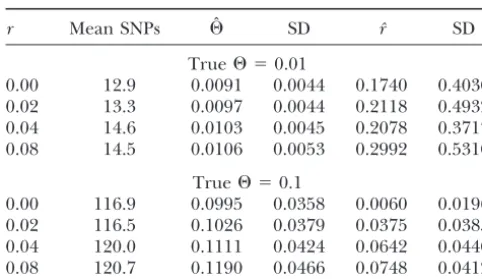
Table 5 shows that when recombination is explicitly
1.0 118.1 0.3478 0.0857
modeled, only a slight upward bias in ⌰ remains. It
Each entry gives the mean and standard deviation of 100 is especially striking that allowing for recombination
replicates. The parameterris the ratio of per-site recombina-improves the estimate of⌰(compare Tables 4 and 5)
tion rate to per-site mutation rate. Data consisted of 10 se-even when there is clearly insufficient information to quences of length 500 bp; SNPs were defined based on the allow a good estimate of the recombination parameter sample and analyzed with the conditional-likelihood
ap-proach.
TABLE 5 nation. The reconstituted-DNA approach appears pref-erable whenever a reasonable guess can be made about
Estimates of⌰andr
the frequency of SNPs in the unobserved sites. An important additional question is whether SNPs
r Mean SNPs ⌰ˆ SD rˆ SD
will be fully informative for gene mapping by coalescent-True⌰ ⫽0.01 based methods. On theoretical grounds, we believe that 0.00 12.9 0.0091 0.0044 0.1740 0.4030
an accurate SNP-likelihood model will be important in 0.02 13.3 0.0097 0.0044 0.2118 0.4932
obtaining good gene-mapping results: while use of an 0.04 14.6 0.0103 0.0045 0.2078 0.3717
inaccurate model may produce a mapping curve with 0.08 14.5 0.0106 0.0053 0.2992 0.5310
the same peaks, it will distort the heights of the peaks True⌰ ⫽0.1
and thus lose information about the reliability of the 0.00 116.9 0.0995 0.0358 0.0060 0.0196
map. The distortion arises because, in the absence of 0.02 116.5 0.1026 0.0379 0.0375 0.0385
accurate branch lengths, the program will incorrectly 0.04 120.0 0.1111 0.0424 0.0642 0.0440
0.08 120.7 0.1190 0.0466 0.0748 0.0412 weigh the competing alternatives of recombination and multiple mutations. We plan to test this by simulation Each entry gives the mean and standard deviation of 100
as mapping algorithms become available. replicates. Data consisted of 10 sequences of length 500 bp;
Information about the makeup of the panel is crucial SNPs were defined based on the sample and analyzed with
the reconstituted-DNA approach. if an accurate likelihood estimate is to be made from panel SNPs. The panel is not just preliminary work: it is a key part of the final data set and must be treated a method that assumes an infinite-sites model and esti- as such. In some cases, incorrectly specifying the means mates a per-locus rather than per-site 4Ne, such as the by which SNPs were determined can change the results methods ofWatterson(1975),GriffithsandTavare´ by ⬎10-fold. Anyone considering publishing a set of (1993), orR. Nielsen(personal communication), may SNP probes for general use should, at a minimum, in-be preferable. Sampling greater numin-bers of SNPs will clude the source and number of individuals sampled slowly improve this situation, but for low values of ⌰, and the criteria for deciding which sites were considered extremely large numbers of SNPs will be required. to be SNPs: ideally, full haplotypes of the entire panel However, when⌰is relatively high, accurate estimates should be made available. If the SNPs are to be used are possible, though at some loss of efficiency compared in a population other than the one from which they were to use of the full DNA model. In cases where SNP data sampled, details of the population structure, including is less expensive to collect than full DNA data, this trade- subpopulation membership of each panel individual, off may be worthwhile. Somewhat surprisingly, a panel are also important.
of 10 individuals appears sufficient, in the high-⌰case, Finally, the more divergent the population on which to give results nearly as good as those obtained by choos- SNPs are defined is from the population under study, ing SNPs from the sample itself. the more analytic power is likely to be lost; and the more Intuitively one might expect that considering only complex the procedure by which SNPs are defined, the the “informative” variable sites from a piece of DNA more difficult and time-consuming the analysis is likely would preserve most of its information value. While this to be. Ad hoc rules for accepting or rejecting a site as may be true for estimation of tree topology, it is not a SNP may be attractive in the laboratory, but they will true for estimation of ⌰or other parameters that are hamper analysis of the resulting data.
based on branch lengths. Much of the lost information We thank Richard Hudson for providing the tree-generating pro-can be recovered by the reconstituted-DNA approach, gram and Maynard Olson for information on how SNPs are ascer-tained in practice. Discussions with Lindsey Dubb contributed
substan-though this will be subject to errors if the estimate of
tially to our understanding of the SNP likelihoods. The analysis in
φ is incorrect or the SNPs are for some reason not
Table 3 was suggested by Elain Fu. Two anonymous reviewers provided
characteristic of the sequence in which they are
em-useful comments. This work was supported by National Institutes of
bedded. Health grants R01 GM51929 and R01 HG01989, both to J.F. If there is any chance that recombination is present, a
Note added in proof: The correction we use for conditional-likelihood
model that allows for recombination will produce more
SNPs is related to one first developed by W. J. Ewens for RFLP data
accurate estimates of⌰than one that denies it; the gain
(W. J. Ewens, R. S. SpielmanandH. Harris, 1981, Estimation of
due to better matching of model to reality appears to genetic variation at the DNA level from restriction endonuclease data. easily offset the cost of estimating an additional param- Proc. Natl. Acad. Sci. USA78:3748–3750).
eter.
Of the two models we present,
conditional-likeli-hood and reconstituted DNA, the conditional-likeli- LITERATURE CITED hood method is simpler and requires less additional
Beerli, P.,andJ. Felsenstein,1999 Maximum likelihood
estima-information, but it appears to be less accurate and can- tion of migration rates and effective population numbers in two
populations using a coalescent approach. Genetics152:763–773.
recombi-Chang, J.,1996 Full reconstruction of Markov models on evolution- L(⌰)⫽ Prob(D|⌰)⫽
兺
G
P(G|⌰)P(D|⌰).
ary trees: identifiability and consistency. Math. Biosci.137:51–73. Felsenstein, J.,1981 Evolutionary trees from DNA sequences: a
maximum likelihood approach. J. Mol. Evol.17:368–376. We condition on the fact that only SNPs are observed Felsenstein, J.,1992 Phylogenies from restriction sites: a maximum
likelihood approach. Evolution46:159–173.
⫽
兺
G
P(G|⌰)
兿
s
P(Ds|G,SNP)
Griffiths, R. C.,andS. Tavare´,1993 Sampling theory for neutral alleles in a varying environment. Proc. R. Soc. Lond. Ser. B344: 403–410.
Jukes, T. H.,andC. R. Cantor,1969 Evolution of protein mole- ⫽
兺
G
P(G|⌰)
兿
s
P(Ds&SNP|G)
P(SNP|G)
cules, pp. 21–132 in Mammalian Protein Metabolism, edited by H. N. Munro.Academic Press, New York.
Kimura, M.,1980 A simple model for estimating evolutionary rates and for the case of SNPs ascertained from the sample, of base substitutions through comparative studies of nucleotide
P(Ds&SNP|G) is simplyP(Ds|G)
sequences. J. Mol. Evol.16:111–120.
Kuhner, M. K., J. Yamatoand J. Felsenstein,1995 Estimating effective population size and mutation rate from sequence data
⫽
兺
G
P(G|⌰)
兿
s
P(Ds|G)
P(SNP|G).
using Metropolis-Hastings sampling. Genetics140:1421–1430. Kuhner, M. K., J. YamatoandJ. Felsenstein,1998 Maximum
likeli-hood estimation of population growth rates based on the
coales-cent. Genetics149:429–434. 2. Unlinked SNPs (Equation 2):
Kuhner, M. K., J. YamatoandJ. Felsenstein,2000 Maximum likeli-hood estimation of recombination rates from population data.
L(⌰)⫽ Prob(D|⌰)⫽
兿
s
冤
兺
GP(G,Ds|SNP,⌰)
冥
.Genetics156(3) (in press).
Syvanen, A. C., U. Landegren, A. Isaksson, U. GyllenstenandA. Brooks,1999 Enthusiasm mixed with scepticism about single
In this case, we cannot assume that the genealogyG
nucleotide polymorphism markers for dissecting complex
disor-ders. Eur. J. Hum. Genet.7:98–101. that generated the SNP is the same genealogy that would Watterson, G. A.,1975 On the number of segregating sites in have generated putative non-SNP sites, so we need two
genetical models without recombination. Theor. Popul. Biol.7:
independent summations,
256–276.
Watterson, G. A.,1977 Heterosis or neutrality? Genetics85:789– 814.
⫽
兿
s
冤
RGP(G,Ds,SNP|⌰)
RGP(G|⌰)P(SNP|G)冥
Communicating editor:G. A. Churchill
and for the case of SNPs ascertained from the sample,
P(Ds&SNP|G) is simplyP(Ds|G): APPENDIX
We present here the derivation of Equations 1 and 2.
⫽
兿
s
冤
RGP(G|⌰)P(Ds|G)
RGP(G|⌰)P(SNP|G)冥