!
The AMES Network in the 5th EURATOM Framework Program
F. Sevini 1), L. Debarberis 1), B. Acosta 1), R.Gerard 2)
1) European Commission - Joint research Centre, Institute for Advanced Materials, Petten, The Netherlands 2) Tractebel/Belgatom, Brussels, Belgium
ABSTRACT
The AMES (Ageing Materials Evaluation and Studies) network started its activity in 1993 with the aim of studying the ageing mechanisms of nuclear reactor structural materials. Together with ENIQ, NESC, EPERC, it forms the so-called "Structural Integrity of Industrial Components" cluster of European networks operated by the Joint Research Centre- Institute for Advanced Materials of the European Commission.
Main areas of interest of the AMES network are non-destructive monitoring techniques for thermal and neutron irradiation ageing, dosimetry, survey of regulatory requirements, irradiation embrittlement, mitigation procedures and re- embrittlement.
Several projects co-funded by the 4 th EURATOM Framework P r o g r a m - Fission Safety key action involved network members. An overview of the outcome of the projects is given.
With the entry of Finland into the European Union and the foreseen one of the selected countries, AMES network's research subjects started to deal more with the still open issues of former-Soviet type WWER reactors.
A link with CEECs has been established with the recent entry of Hungary and Czech Rep. representatives into the AMES network Steering Committee, while collaboration with NIS is being established via EPLAF (European Plant Life Assessment Forum), the Eastem arm of AMES.
As a consequence, some of the projects proposed by AMES members for the 5 th EURATOM Framework Program deal also with WWER ageing issues. The projects selected for funding focus on the influence of chemical composition (namely phosphorus and nickel content), on the irradiation embrittlement of reactor pressure vessel materials, on the improvement of surveillance temperature measurement, on the validation of the Master Curve approach and on ND techniques to monitor ageing of irradiated steels. An overview of the new projects' goals is given in the paper.
THE AMES N E T W O R K
The AMES (Ageing Materials Evaluation and Studies) network was set up to bring together the organizations in Europe having the greatest expertise on nuclear reactor materials assessment and research, with the following objectives: o Provide information and understanding on neutron irradiation effects in reactor materials in support of designers, operators, regulators and researchers
o Establish and execute AMES projects on key subject areas o Act as European Review Group
o Provide technical support to regulatory bodies, General Directorates of the EC and provide a basis for development of common European standards.
o Participate in collaborative programs with the New Independent States (NIS) and the Central and East European Countries (CEEC)
O Promote the integration of national programs, the validation of techniques, the definition of European Standards and the validation and establishment of safe limits for mitigation measures.
For more information about the network organization refer to [ 1,2].
AMES STRATEGY
The first phase of the strategy started in 1993: the members organized the partnership, identified the network goals and the missing state-of-the-art information in the field of irradiation and thermal ageing and annealing of Reactor Pressure Vessel (RPV) materials. Three AMES in-kind projects were started and carried out; among them the AMES 1G for example has produced the so called "Action Plan n. 1" on VVER RPVs, which is now the basis of the EPLAF initiative, the European Plant Life Assessment Forum involving AMES and Russian organizations [3].
The AMES Steering Committee has then identified subjects that must be considered of high priority for the development of a plant life management program in relation to ageing. These subjects were organized into six drivers addressing specific technical aspects and particular domains of competence where new project proposals must fit:
1. Target Identification
Object of this driver is to identify the areas most critical to an efficient plant life management. The Reactor Pressure Vessel (RPV) is by far the most critical component, being irreplaceable and safety related, therefore most of the studies must be focussed on its integrity assessment and embrittlement level evaluation.
• Metallic components (RPV, Internals, Pressurizer, Piping) • Irradiation embrittlement
• Thermal ageing
2. Mechanisms understanding Main point are:
• Correlation between fracture toughness and impact energy test results • Development of understanding of thermal ageing phenomena
• Development of understanding of environmental effects on RPV steel embrittlement
• Improvement of the understanding of the embrittlement consequences of P segregation to internal boundaries of RPV steel, including synergistic effects with Cu and Ni
• Re-embrittlement models validation
• Mechanisms of hardening and segregation in grain boundaries leading to embrittlement and/or corrosion of steels in core internal structures due to high fluence neutron irradiation and irradiation assisted stress corrosion cracking • Role of hydrogen in in-service cracking of material used in PWR and BWR
3. Development of techniques
Considering the conclusions of the State of the Art reports, the techniques available, and the results obtained, the following are the generic domains where more effort is needed or new development is required:
• New Material testing methods, sampling techniques • Damage detection techniques
• On-line ageing monitoring techniques and procedures: development and validation of new non-destructive techniques
• Methodologies and tools for neutron dosimetry: development of reference dosimeters for a common radiation damage indexation
• Improved materials specifications,
• Validation of RPV ageing mitigation methods
• Improvement of VVER surveillance representativeness by direct temperature measurement
4. Industrial validation
The AMES Steering Committee has identified the following priority items:
• Validation of fracture toughness based trend curves using the Master Curve approach [4] in irradiated materials • Validation of specimen reconstitution techniques
• Validation of non-destructive techniques to monitor irradiation ageing
5. Information bases and management platforms
The information generated on the status of the ageing component has to be efficiently stored and made accessible. This involves therefore the elaboration and maintenance of user friendly databases and intelligent systems for the transfer, management and access to monitoring results and materials data, in combination with the information coming from the operation of the plant (first element to be considered in an ageing management scheme).
6. Training and transfer of know-how
An aspect often not considered, but of growing importance, is the continuous training of operators. This may be caused by the 'ageing' of their initial training in relation with obsolete instrumentation, logic schemes of maintenance management, and degradation mechanisms not considered as essential at the time of the design and construction of the plant. It is also important to make sure that the operator is able to acquire and digest all the information he/she is now receiving from instrumentation to be used in relation with ageing.
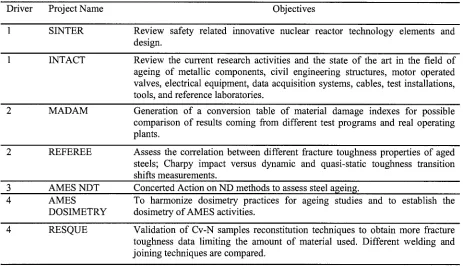
To tackle the strategy, AMES members carried out an exhaustive review of the state-of-the-art in the field of ageing, as well as several projects co-financed by the Nuclear Fission Safety Programme of the European Commission.
Table 1 - List o f AMES related Shared Cost Actions under the 4 th E U R A T O M FWP
Driver Project Name Objectives
SINTER Review safety related innovative nuclear reactor technology elements and design.
INTACT Review the current research activities and the state of the art in the field of ageing of metallic components, civil engineering structures, motor operated valves, electrical equipment, data acquisition systems, cables, test installations, tools, and reference laboratories.
MADAM Generation of a conversion table of material damage indexes for possible comparison of results coming from different test programs and real operating plants.
REFEREE Assess the correlation between different fracture toughness properties of aged steels; Charpy impact versus dynamic and quasi-static toughness transition shifts measurements.
AMES NDT AMES DOSIMETRY
Concerted Action on ND methods to assess steel ageing.
To harmonize dosimetry practices for ageing studies and to establish the dosimetry of AMES activities.
4 RESQUE Validation of Cv-N samples reconstitution techniques to obtain more fracture toughness data limiting the amount of material used. Different welding and joining techniques are compared.
N E W P R O J E C T S F O R T H E
5 thE U R A T O M F R A M E W O R K P R O G R A M M E
To progressively fulfil the strategy, several new project proposals have been endorsed by the AMES Steering Committee and are in currently on-going in the 5 th EURATOM Framework Program 1999-2002. A list of these projects follows, with the corresponding driver.
Driver 2
O PISA: Phosphorus influence on RPV steel irradiation embrittlement experimental study
o COBRA: Improvement of VVER surveillance representativeness by direct temperature measurement (COPERNICUS Program)
O MODEL ALLOYS" Parametric study on the influence of Nickel, Copper and Phosphorus on irradiation embrittlement of Fe-based alloys
Driver 3
O LIRES" Development of state-of-the art Light Water Reactor (LWR) Reference electrodes
o CASTOC: Optimization of monitoring and control of erosion-corrosion affecting carbon-steel piping systems Driver 4
O GRETE: Round Robin exercise on non-destructive techniques. To assess and or monitor degradation of steels by irradiation embrittlement and thermal fatigue
o FRAME: Fracture Mechanics Based Trend Curves
P I S A
This programme has the objective of improving the understanding of irradiation embrittlement by segregation of phosphorus to internal grain boundaries and reducing the impact of brittle intergranular failure mechanism on the properties of the Reactor Pressure Vessel.
The range of the RPV steels to be considered includes the MnMoNi steels employed in European PWRs; the mild steels used in UK Magnox (steel) RPVs; and the steels employed in VVER 440s. Intergranular fracture and/or P segregation are considered to be important in these three reactor types.
Two CEEC AMES members are involved in the program for their qualified experience on VVER's: NRI (Czech Republic) and AEKI (Hungary).
unaffected by these segregation processes. The necessary understanding will be developed through focussed experimental investigations of irradiated steels and model alloys, with associated modelling studies.
The project major elements are:
a) Specimen provision of both unirradiated steels and model alloys for an irradiation program and provision of relevant pre-existing irradiated material by the partners
b) Post-irradiation examination to determine the microstmctural and mechanical property changes in materials (both steels and model alloys) either irradiated as part of this project or pre-irradiated materials supplied by the partners. c) Evaluation of the level of segregation on the grain boundaries at the start-of-life, which has potentially an important
influence on the effect of any irradiation-induced segregation on the subsequent embrittlement. Studies will be carried out on the consequences of post-weld heat treatment and thermal ageing.
d) Development of improved mechanistic understanding. This will be primarily through modelling of the segregation process and the effect of such segregation on the mechanical properties.
MODEL ALLOYS
This program is being carried out by the JRC-IAM as 'enabling action' task of the PISA project in collaboration with the Kurchatov Institute of Russia.
The project is focussing directly on VVER and will integrate and compare results already obtained in Russia. To study the individual and common influence of phosphorus, copper, and nickel on irradiation embrittlement, a set of thirty-three model alloys with parametric variation of their chemical composition is under investigation.
The program foresees impact and non-destructive (STEAM) testing of miniCharpy specimens, followed by irradiation in the HFR LYRA rig [6] (Fig. 1), post-irradiation impact testing and non-destructive evaluation.
Preliminary results are currently under investigation [7]. The application of the STEAM technique based on Seebeck- Thompson voltage drop measurement has proved to be effectively able to monitor the effects of irradiation embrittlement at high Ni content and low Phosphorus, i.e. when the main embrittlement mechanism is matrix damage rather than phosphorus segregation at grain boundaries.
COBRA
This project will tackle the open issue given by the uncertainty in measurement of the correct irradiation temperature to which surveillance capsules are subjected. Non-homogeneous neutron and gamma flux distribution determines a temperature gradient along the capsule, and possible overheating as compared to the real conditions of the reactor pressure vessel. The latter phenomenon would produce non-conservative surveillance data.
A special direct temperature measurement system by thermocouple will be implemented in Kola NPP in order to prove the feasibility of the solution to the problem.
The consortium will include Russian, Armenian and, European institutions.
FRAME
The project is concerned with fracture mechanics based trend curves for PWR and VVER RPV materials. This has the scope to validate the use of the Master Curve approach, as compared to the usual increase of ductile-to-brittle transition temperature assessed by Charpy impact testing.
GRETE
The project is aimed at carrying out a Round Robin exercise on non-destructive techniques to assess and monitor degradation of steels by neutron irradiation and thermal fatigue. The techniques studied are besides others based on thermo-electric and magnetic effects. The results will be of interest for RPV surveillance programs, because a validated non-destructive measurement of surveillance specimens could provide an alternative to destructive testing and therefore allow sparing of surveillance samples.
Other Projects Involving NIS countries
AMES members are currently involved in two Tacis PCP (Technical Assistance to the Community of Independent States - Partnership and Coordination Programme) projects, in collaboration with the Institute for Materials Strength of Kiev (Ukraine) and Kurchatov Institute (Russia).
To fulfil driver 6 of the strategy, the ENUKRA project was just completed, whose aim was to transfer western knowledge and experience to Ukrainian and Russian engineers related to reactor pressure vessel residual life-assessment and surveillance programs of the RPV.
IRLA project is still on-going and is aimed at fracture mechanics testing applied to RPV metal condition assessment in Ukraine.
THE N E W AMES TASK GROUPS
Besides the projects so far described, mainly co-financed by the 5th EURATOM Framework Program, the AMES Steering Committee in its last meeting in Feb. 2001 has defined seven so-called Task Groups, two strategic and five technical-scientific, which will have the goal of carrying on focussed in-kind studies on open issues. The elaboration of existing data and the task group meetings of experts sent by the member organisation, integrated by open workshops, will allow a broad state-of-the-art review of subjects not yet dealt with, i.e. re-embrittlement, IASCC, and the definition of further experimental campaigns.
The new AMES task groups are the following:
A B C D E F G
Linking National and AMES strategies
Linking AMES Strategy with Eastern Europe (EPLAF)
Master Curve implementation f or fracture toughness assessment Annealing and re-embrittlement issues
Radiation embrittlement understanding Ageing mechanisms: influence and synergism
Watch-and-alert on open issues (IASCC, NDT, ...)
C O N C L U S I O N S
AMES is a well-established European Network on the subject of neutron irradiation embrittlement of RPVs and core components and its mitigation methods. The added value given by AMES and the other networks to Safe Plant Operation issues resides in the strongly enhanced interaction among the most important national research institutions and suppliers, which have an opportunity to meet regularly and coordinate common actions, as well as tune independent ones in accordance with actions progressing in parallel elsewhere.
Key projects on the field of irradiation embrittlement have been started with the aim of understanding the influence of mechanisms affecting especially VVER RPVs. Important results will come from PISA and Model Alloys actions.
The AMES JRC laboratory provides the availability of the LYRA irradiation rig, specifically designed for irradiation embrittlement studies, and develops ND techniques for ageing monitoring.
R E F E R E N C E S
,
0
F. Sevini, L. Debarberis, L. M. Davies, "The AMES Network- Background and developments of the European strategy on Materials Ageing", Proceedings PLIM-PLEXInt. Conf., Madrid, 1999;
F. Sevini, L. Debarberis, U. von Estorff, L. M. Davies, "The European Network on Ageing Materials Evaluation and Studies - AMES", Proceedings IAEA Specialist Meeting on Irradiation Embrittlement and
Mitigation, Madrid, Spain, April 26-29, 1999;
Davies, L.M., Crutzen, S., von Estorff, U., van Duysen, J.C. and Sycamore, D., " E P L A F - European Plant Lifetime Assessment Forum: An AMES/EC-DGXVII Initiative", Proceedings 5 th Int. Conference on Materials
Issues in Design, Manufacturing and Operation of Nuclear Power Plants Equipment, St. Petersburg, 7-14 June
1998;
Wallin, K., "Master Curve Analysis of Ductile to Brittle Transition Region Fracture Toughness Round Robin Data (The Euro Fracture Toughness Curve)", VTT Technical Document 367.58P, Espoo, Finland, 1998;
The AMES Reports:
No. 1 Irradiation Embrittlement Mitigation - EUR 16072 EN
No. 2 State-of-the-art Review on Thermal Annealing - EUR 16278 EN
No. 3 Comparison of the Scientific Basis of Russian and European Approach for Evaluating Irradiation Effects in RPVs - EUR 16279 EN
No. 4 Survey of National Regulatory Requirements - EUR 16305 EN
No. 5 Survey of Existing, Planned and Required Standards - EUR 16313 EN
No. 6 A Review of Formulas for Predicting Irradiation Embrittlement of Reactors Vessel Materials - EUR 16455 EN
No. 7 AMES Reference Laboratory JRC-IAM/ECN Petten - EUR 16409 EN
No. 8 Dosimetry and Neutron Transport Methods for RPVs - EUR 16470 EN
No. 9 Methodology for Characterising Materials - EUR 17328 EN
No. 10 A Comparison of Western and Eastern Nuclear RPV Steels EUR 17327 EN
No. 11 Effect of Irradiation on Water Reactors Internals - EUR 17634 EN
No. 12 Dosimetry and Irradiation Programmes of AMES European Network EUR 17744 EN
No. 13 Conversion Table of Material Damage Indexation for all Different European Reactor Types - EUR 18693 EN
No. 14 Ageing Materials and Studies by non-destructive techniques (AMES-NDT)- EUR 19675 EN
No. 15 Proceedings of the AMES Workshop on Reactor Pressure Vessel Life Predictions, EUR 19638 EN
G. Sordon, " L Y R A - HFR Irradiation Facility for the European Network AMES (Ageing Materials Evaluation and Studies)", European Commission Joint Research Centre, Technical Note HFR/96/4329, 1997;
"Experimental Studies of Copper, Phosphorus and Nickel effect on RPVModel Alloys at two different fluences", L.