Copyright 0 1987 by the Genetics Society of America
Isolation and Characterization
of
a 1.7-kb Transposable Element from a
Mutator Line of Maize
Loverine P. Taylor’ and Virginia Walbot
Department of Biological Sciences, Stanford University, Stanford, California 94305
Manuscript received February 13, 1987 Revised copy accepted July 9, 1987
ABSTRACT
We have cloned and sequenced a 1.7-kb M u element from a Mutator line of maize and compared
its structure to M u l , a 1.4-kb element. With the exception of a 385-bp block of DNA present in the 1.7-kb element, these transposable elements are structurally similar, sharing terminally inverted and internal direct repeated sequences. Derivation of 1.4-kb elements from the 1.7-kb class via deletion
of internal sequence is suggested by the finding that a portion of the extra DNA in Mu1.7 is part of a truncated direct repeat sequence in the 1.4-kb element. An abundant poly(A)+ RNA homologous to a portion of this extra DNA is present in several tissues of both Mutator and non-Mutator lines. Analysis of transcripts from an unstable mutant bronzel ( b r ) allele containing a M u l . 7 element inserted in an exon of the gene detects three species of poly(A)+ RNA that hybridize to a Bzl (Bronze) gene probe: the largest contains the entire Mu1.7 element in the Brl gene transcript; another appears to
be a spliced, chimeric transcript; the smallest is normal size Bzl mRNA. The latter is most likely encoded by the normal-size alleles detected by Southern analysis of tissue expressing purple pigment, suggesting that normal gene function is restored by excision of the M u l . 7 element.
OBERTSON’s Mutator stocks of maize are char-
R
acterized by a 50-fold increase in the overall frequency of visible mutations. Genetic analysis of the Mutator trait by ROBERTSON (1978) showed that about one-third of the mutations are phenotypically unsta- ble, suggesting the presence of insertion sequences. A new transposable element family was defined by anal- ysis of an unstable Alcohol dehydrogenase 1 ( A d h l ) allele arising in a Mutator line of maize (STROMMER et a l .1982). Sequence analysis showed that the M u 1 ele-
ment recovered from the mutant Adhl-S3034 allele is
1376
bp
in length and is flanked by 9-bp direct repeatsof insertion site DNA; the element has terminal in- verted repeats (TIR) of 2 15 and 2 13 bp and internal direct repeats of 104 bp (BARKER et a l . 1984). Tran- scription studies of the Adhl-S3034 allele show that the presence of the 1.4-kb element in the first intron affects the elongation of A d h l mRNA but that proc- essing appears to be normal (ROWLAND and STROM-
MER 1985; VAYDA and FREELINC 1986). T h e mutant
produces normal sized A d h l mRNA at steady state levels about twofold lower than that produced by the nonmutant progenitor allele and contains no detect- able M u 1 sequences.
In other well-characterized transposable element systems an important regulator of transposition activ- ity involves the presence of two distinct classes of
’
Present address: Department of Plant Biology, Camegie Institution of The sequence data presented in this article have been submitted to the Washington, 290 Panama Street, Stanford, California 94305.EMBL/Genbnk Data Libraries under the accession No. Y00603.
Genetics 117: 297-307 (October, 1987)
transposable elements. Relying solely on genetic anal- ysis, McClintock identified the two components of the Ac-Ds system almost 4 decades ago (MCCLINTOCK,
1949). Molecular and genetic analyses of the Ac-Ds
system and other mobile element systems, e.g., Spm(En) and the P elements of Drosophila, have iden- tified nonautonomous members which are deletion derivatives of the corresponding autonomous ele- ments (FEDOROFF, WESSLER and SHURE 1983; O’HARE and RUBIN 1983; PEREIRA et a l . 1985). Analysis of these deletion derivatives has permitted identification of sequences crucial for activity of the autonomous transposable element (KARESS and RUBIN 1984;
DOONER et al. 1986). While genetic evidence for au- tonomous and nonautonomous classes of M u elements is not established, it is intriguing that Mutator stocks contain two major size classes of M u elements: a larger element of approximately 1.7 kb (BARKER et a l . 1984;
WALBOT, CHANDLER and TAYLOR 1985; TAYLOR, CHANDLER and WALBOT 1986) in addition to the 1.4-
298 L. P. Taylor and V. Walbot
MATERIALS AND METHODS
Plant material: The RMGHl and RMGHZ stocks cor- respond to D. ROBERTSON lines 71-9268-7"/8269-1 and 71- 9266-7n/8266-9. They were the result of a cross involving 1966 and 1968 Mutator seed, respectively. The bz2-mu1 lineage is described in WALBOT, BRICGS and CHANDLER (1 986). In this report individuals from the (2230-8 family and subsequent generations were tested for the presence of Mul. 7. The derivation of the bzl-mu2 and bz2-mu1 alleles is described in TAYLOR, CHANDLER and WALBOT ( 1 986) and in CHANDLER and WALBOT ( 1 986), respectively. All alleles tested by Northern analysis were isolated from plants con- taining t h e B ( b z l - m u 2 ) or B and PI (bzl and B z l ) genes. Non-Mutator lines were obtained from E. H. COE and M.
G . NEUFFER (University of Missouri), the Maize Genetics Stock Center, and from M. FREELING (University of Califor- nia, Berkeley).
DNA isolation, hybridization analysis and radiolabel- ing of probes: All methods are exactly as previously de- scribed (TAYLOR, CHANDLER and WALBOT 1986). Recon- structions are calculated on the basis of 6 X 10' bp per haploid genome and consist of the appropriate plasmid digest added to 5 pg of Eco RI-digested salmon sperm DNA as carrier.
RNA isolation and Northern blot analysis: Total RNA
was extracted from maize tissues using guanidinium isothio- cyanate according to SETZER et al. (1980). Poly(A)+ R N A was isolated using oligo-dT-cellulose, separated on a 1.4% agarose gel containing 2.2 M formaldehyde (MANIATIS, FRITSCH and SAMBROOK 1983) and transferred to a nylon membrane (Nytran; Schleicher & Schuell). Hybridizations were performed sequentially with B z l and Mu probes as described and washed at 60" (Bzl) or 65" (Mu) in 0.1X SSPE, 0.1 % SDS. Probe removal was accomplished by agi- tating the membrane in 0.1X SSPE, 0.1% SDS at 95", for three 15-min rinses.
Lanes 1 through 4 of Figure 6 are from an APT filter kindly provided by J. CALLIS. They contain total R N A from Efron S (1, 2) and Super Gold Pop (3, 4), maize lines described in WOODMAN and FREELING (1981). Lane 5 of Figure 6 contains total RNA from Black Mexican Sweet suspension culture cells described in FROMM, TAYLOR and WALBOT (1986).
Restriction mapping and DNA cloning: Restriction en- zymes were obtained from Bethesda Research Laboratories and New England Biological Laboratories and used accord- ing to suppliers' instructions. Genomic cloning is described in TAYLOR and WALBOT (1985). The H z n f f fragment of
M u 1 was used as a probe to screen for Mu-containing phage. Subclones were prepared using directional cloning where possible into pBR322 or pUC8 (VIEIRA and MESSING 1982). When directional cloning was not possible, the fragment was isolated and the termini treated with T 4 DNA polym- erase in the presence of four deoxyribonucleotides (EN-
GLUND 1971) and blunt-end ligated into the SmaI site of pUC8. pMuLft ( M l u I to BstEII sites in M u l ) and pSD2
(SmaI to DdeI sites in Mu1.7, Figure 2 ) were prepared in this manner. The bronze1 probe pD3MS9 is described in SCHIEFELBEIN et al. (1985); pD3S3 consists of a SmaI frag- ment of a B z l allele cloned into pUC8. Bronze1 plasmid pMBzP17 is the source of fragments for the 3' probe (see map, Figure 4A) and reconstructions. The location of this plasmid is described in TAYLOR, CHANDLER and WALBOT (1986). Mu probe pAB5 is described in CHANDLER and WALBOT (1986). T h e Mul-containing plasmid pMJ9, de- scribed in BENNETZEN et al. (1984) was used as the sources
of the full length M u 1 element for restriction fragment comparisons.
DNA sequence analysis: DNA sequencing reactions were performed by the dideoxy chain termination protocol using M 13 as vector (SANGER et al. 1980) or using double-stranded plasmid as the template (CHEN and SEEBERG 1985). DNA sequence analysis employed computer programs available from the BIONET National Computer Resource for Molec- ular Biology (RR-0 1685-03) or developed by RICHARD PAT- TIS.
RESULTS
Distribution of the two major size classes of Mu- tator elements: Restricting DNA from Mutator stocks with a n enzyme which cuts external to the Mu ele- ments a n d hybridizing the resulting Southern blot with a Mutator probe results in an array of fragments each representing a n element located a t a unique genomic location. Digesting genomic DNA with en- zymes which cut within t h e terminal inverted repeat sequence, reduces all Mul-size elements t o a single band a n d consequently any heterogeneity in size classes of elements will be detected. H i n f l recognition sites a r e located -35 b p from either e n d of t h e T I R s a n d digestion of t h e cloned representative of t h e 1.4-
kb size class, M u l , with this enzyme generates a 1.3-
kb fragment. Active Mutator lines analyzed in this manner showed a second major size class of element approximately 1.7 kb in size (BARKER et al. 1984;
TAYLOR, CHANDLER a n d WALBOT 1986).
T o determine t h e range a n d ubiquity of t h e two major size classes of Mu elements, we performed H i n f l
digestions a n d
Mu
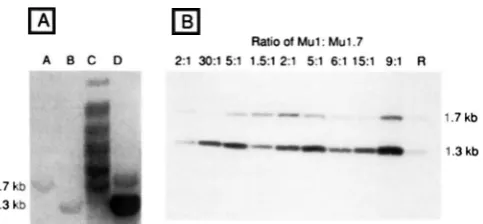
hybridizations o n active Mutator stocks as temporally a n d genetically separated as were available, in addition to analyzing closely related in- dividuals. T h e earliest extant Mutator lines available a r e RMGH 1 a n d 2, which were produced from genetic crosses involving identified Mutator lines iso- lated in 1 9 6 6 a n d 1968, respectively (gift of D. ROB- ERTSON, Iowa State University). Hinfl-digested DNA from plant RMGH 1 (Figure l A , lane D) shows a characteristic pattern of two major fragments, about1.3- a n d 1.7-kb in size, hybridizing t o pAB5, a probe which contains t h e internal portion of t h e cloned M u 1 element (Figure 2). As is t h e case in most Mutator lines examined to date (BENNETZEN et al. 1984; WAL-
BOT, CHANDLER a n d TAYLOR 1985; CHANDLER a n d
WALBOT 1986), the 1.3-kb fragment represented by t h e cloned Mu1 element is the most prevalent. I n addition t o t h e 1.4- a n d 1.7-kb
Mu
size classes, H i n f l -digested DNA from plant RMGH 2 (lane C) shows
larger fragments indicative of
Mu
elements in which one o r both of t h e H i n f l restriction sites are modified(WALBOT, CHANDLER a n d TAYLOR 1985; CHANDLER
a n d WALBOT 1986). Digestion of RMGH 2 DNA with
Tth 11 1-1, a n enzyme which digests methylated DNA
shows a pattern of two Mu1 homologous bands a t 1 .O-
I .7-kb Mu Element of Maize 299
Ratio Ot Mul: Mu1.7
A B C D 2:l 303 5:l 1 5 1 2:l 5:l 6:l 151 9:l R
-
1.7kb1.7 kb 1.3 kb
FIGURE I .-tBotli major size classes of Mu elements are present in widely divergcttt lines but their absolute number and ratio vary, even between closely related plants. (A) Immature cob DNA (IO
pg) from t w o of the earliest identified Mutator stocks available was digested with H i n f l , size-fractionated on a I % agarose gel. blotted
t o APT paper (SEED 1982) and hybridized with the 1.5kb H i n f l
fragment from Mul. Lanes C and D contain genomic DNA from KXIGH2 and RMGH I , respectively. (.See M A r E i t i A i s A N D METHODS lor RORERTSON’S original nomenclature for these stocks.) lanes A
and R are reconstructions of H i n f l digested plasmids containing
.Hu1.7 and M u l . respectively, at an equivalent of one copy per haploid genome. Fragment sizes are indicated on the left in kilobase pairs. (B) Nine siblings from a cross between an active Mutator plant ((230-8. used as male) containing the bz2-mu1 allele and a iioti-Mutator bz2 tester (K55/W23) were analyzed. An aliquot of 5
pg of total genomic seedling DNA was digested with H i n f l , a Southern blot prepared and hybridized to the Mutator probe, pAB5 (see Figure ‘I for map of Mutator probes). The resulting hybridi- iation pattern was scanned in a LKB densitometer. and the ratio of
Mu/.4:Mu1.7 was determined. T h e s e data are shown above each lane. The blot was washed free of Mutator probe and reprobed with a Pstl fragment from the coding region of the Bronze1 gene of maize to normalize for variation in the amount of DNA per lane. These data were used to estimate the absolute copy number of each element wehen compared to a single genome equivalent reconstruc- tion (line R). The molecular mass in kilobases (kb) is on the right.
M u l . 7 elements (data not shown). T h i s finding sug- gests that t h e potential for DNA modification and suppression o f Mutator activity regulation is not a recently acquired
property.
We have also examined t h e
Hinfl
pattern of indi- viduals grown from 1983 stocks in which Mutator activity is monitored by observation of a n unstable allele of bronze2 (bz2-mul) in the aleurone layer of the kernel. Molecular and genetic analysis over several generations of this lineage (family C230-8) shows that the Mutator system remains highly active as evidenced by a consistent pattern of uniform, small revertant sectors in the aleurone (WALROT, BRIGGS a n d CHAN-DLER 1986; CHANDLER and WALROT 1986). In addi-
tion we have surveyed several individuals from 4 generations of stocks carrying A d h l S alleles contain- ing M u 1 elements (STROMMER et al. 1982): again, all of these lines show the presence of both size classes of elements (data not shown). Although t h e early Muta- tor lines, the bz2-mu1 lineage and the A d h l S stocks tested were descendants of t h e same original Mutator stock, they a r e as temporally separate as available, and have been maintained in different laboratories and out-crossed to widely different lines.
Ninety percent o f the progeny of a cross between a Mutator a n d a non-Mutator plant can inherit the Mutator trait (ROBERTSON 1978).
T o
explain this level of genetic transmission, multiple copies of autono- mous elements must exist. If maize lines could be derived which segregate active a n d inactive Mutator progeny in the 1 : 1 ratio expected for t h e segregation o f a single autonomous element, a genetic definition of the autonomous element would be possible. How- ever, to date w e have screened more than 300 Muta- tor individuals maintained for 5 or 6 generations of outcrossing to non-Mutator lines and have found that all lineages maintain multiple copiesof both t h e M u 1 . 4 a n d M u 1 . 7 elements(L.
P.
TAYLOR, V. L. CHANDLER a n d V. WALROT, unpublished data). A representative Southern blot ofHinfl
digested DNA from nine sib- ling kernels from a n active mutator stock containing the br2-muI allele was probed with the entire M u 1 . 4 element (Figure 1 B). Fragments of approximately I .7- a n d 1.4-kb a r e present in all specimens: additionally the 1.7-kb fragment in all individuals hybridized topSD2, a probe specific for the larger class of element (data not shown). Although they contain both major size classes of M u elements, t h e ratio a n d copy number vary widely, even though these individuals a r e closely related. Densitometric scanning showed that in these nine plants the ratio of M u l . 4 M u l . 7 varies over a 20-
fold range from 30:l to 1.5:l. By comparing t h e hybridbation intensity of both sizes of M u fragments in each individual with a 3 copy ( M u l ) and a I copy ( M u l .
7 )
reconstruction, a n d correcting for loading differences, the absolute number of M u l . 7 elements was shown to vary from 10 copies (lane 9:l) to - 1copy
(lane 30: 1)per
haploid genome.T h e presence of the M u 1 . 7 element in early Muta- tor stocks a n d its persistence through repeated out- crossing, even though it is commonly found in lower copy number than t h e 1.4-kb size class, indicates that
it may play a n important role in the Mutator system. In a n effort to more clearly define that role w e un- dertook a structural analysis of a M u 1 . 7 element.
Restriction map and DNA sequence of the
1.7-kb
3 0 0 I,. P. Taylor and V. Walbot
-.
p A E 5---__
__M U T A T O R
PROBES ~-
-
.
---
pMu L f l pSD2
Sm
H T A B E E E A A B sr DI I T n
Mu1.7
.
I I I 1-
I 1 I I1 1 I I- * *- __
C
1C
4Mu1.7 ORFs I 1
ti T N A B E E E D I I DT H I I I l l I I 1 I l l / I I Mu1
____) L L
&ful is almost entirely the result of a block of DNA
in the right half of the element as oriented in Figure
2.
The Mu1.7 element consists of 1745 bp and isflanked by a 9-bp direct repeat (Figure 3); this re- peat presumably represents the host sequence dup- lication created at the insertion site. A compari-
son of the duplicated sequence flanking Mu1.7
(CTCGTGCCT) with the 9-bp duplication flanking
iZlul in the AdhI-S?0?4 allele (TTTTGGGGA) (BEN-
NETZEN et al. 1984) indicates no similarity in insertion
sites. Within the approximately 1.35 kb shared be- tween the two elements there are 37 single base changes. Transitions are more prevalent than trans- versions, representing 25 out of 37 (70%) of the altered bases; these are equally divided between A-G and C-T. These changes are scattered throughout the
1.7-kb
element; one of these single base changes, a C to T transition, accounts for the lack of a Not1 site inMuZ.7 at position 321. In the left TIR 3 out of 215
bases are changed when compared to M u l , while the right T I R is more diverged with 13 out of
2
13 bases changed. However comparison of the left with the right T I R of M u l . 7 shows that they are 97% homol- ogous.I n addition to the single base substitutions there are additions and deletions of sequence in M u l . 7 as com- pared to M u l . An 8-bp sequence (ACGGCAGC) near the internal junction of the left T I R (nucleotide 223)
is not present in M u l . 7 . At nucleotides 436 and 437 there are two additional bases (CG) present in M u l . 7.
I n the right portion of the M u l . 7 element, there is an area containing two single base changes and two small insertions in Mu1.7 relative to M u l . One of the single base changes, an A to G transition creates a BstNI site at position 1448, 55 bp away from a BstNI site at position 1393 (Figure 3 ) . Although there is only a single BstNI site in the published sequence of M u 1 at nucleotide 1027, the cloned M u l . 7 and M u 1 elements both generate an approximately 60-bp fragment upon digestion witli this en7yme (data not shown), suggest-
---
100 hu
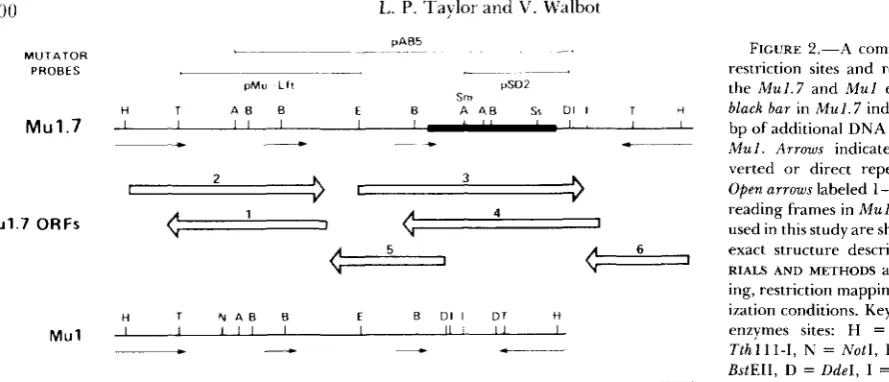
FIGURE 2.-A comparison of the restriction sites and repeat units in the Mu1.7 and Mu1 elements. T h e black bar in Mu1.7 indicates the 385 bp of additional DNA not present in Mul. Arrows indicate terminal in- verted or direct repeat sequences. Open arrows labeled 1-6 are the open reading frames in Mu1.7. Mu probes used in this study are shown and their exact structure described in MATE- RIALS AND METHODS as are subclon- ing, restriction mapping, and hybrid- ization conditions. Key to restriction enzymes sites: H = H i n f I , T =
Tthl 11-1, N = N o t l , B = Bgll, E =
BstEII, D = DdeI, I = BstNI, Sm =
S m a l , Ss = Sstl, A = AvaI.
ing that the published sequence of M u 1 in the region around nucleotide 1085 may be in error.
T h e most prominent difference between the two elements is a segment of DNA unique to M u l . 7 in the right half of the element. This sequence contains single sites for several enzymes which do not restrict
the M u 1 element, including SmaI, SstI, and SphI. This
novel DNA in M u 1 . 7 is 385 bp long and is bounded by the trinucleotide GCC in direct orientation. Over- all, the GC content (69%) of the DNA sequences unique to Mu1.7 is comparable with that of the flank- ing DNA found in M u l .
One of the most intriguing features of this segment of DNA unique to M u l . 7 is its relationship to the 104- bp internal direct repeats which are found in both
M u l . 7 and M u 1 (Figure 2). T h e extra DNA in M u l . 7
is located immediately adjacent to the external ter- minus of the right direct repeat with the trinucleotide GCC which bounds the extra DNA forming the final 3 bases in the 104-bp direct repeat. The first 34 bp of the extra sequence in Mu1.7 (position 960-994) are identical to the 34 bp adjacent to the internal terminus of the direct repeat in the left portion of both M u l . 7 and of M u 1 (Figure 3). T h e net result is that the direct repeats in M u l . 7 are 138 bp long and 98% homologous instead of 104 bp and 96% honiol- ogous as in M u l . Therefore only the left direct repeat of Mu1 but not the right is 138 bp, identical to the direct repeats of M u l . 7. The length and orientation of the major open reading frames (ORFs) of M u l . 7
are indicated in Figures 2 and 3. The numbering convention follows that of M u 1 except for ORFs 5 and 6, two small reading frames not found in M u l .
Analysis of a Mul.7-induced mutation in bronzel:
1.7-kb Mu Element of Maize
T C T T G T C T C C GTCGCCGCGC TCTACGGCGG TGCTGGCGTC CGTGCTGTAC TCCGCGCCGG CAGAGGCCGC GCGCGCGTCG CCCGCGGACG GCGCCACGCC I I I I I , I I I * I I I I I I I I I I , " " " ' ' A I I , I I I I I I I I I . I I I I I I I I * I I I . I , I I IIIIIIIIII IIIII*I,I, A , , , , , ' , , ,
& 2 s c 8 a
GCTCCACCTC GCCGCGGCCG TGCACATCCT CCTCGCCGCG GGCGCGTCCG TGGACGCGCG CGCCTTCTCG GGCCTCCGCG CCGGGGACCT CCTCCTCCCG
I I I I I I I , I I I I,I I I I I I I C ' , I I I I ' I I I I I I I I I I I I p., I I a I I I I I C ' I I I I I I I I I I I I I , I * I I I I I I I I I * U ' IIIIIIIIII I I I I I I I I I I
- 2 t i 5.
TACAGCTGTC CTAGCACTAA TTACTCCTAA ATTCATCATA CACCAAAGTT TCAATTAGTA AAAGGTTTTG GTATTATTTT CTTTACAAGA CTAAAAGCAT
' c " c " " ' IIIII I3III I I I I I I I I I I I I I S I I I I I I 3II Itt IIII I I I I I I I I I I I I I I I I I I I ' I I I * I I I I I I I I I I I I I I I I I I I I I I I I I I
3 j B s t E I I
CCACTCGTAT TTGCCATGGA AATATTGCCA AAATGGTTAC CGAAGAACCA ATGAAAAATG GCGGTATCCG TCCACCTGTA ACTTGTCCAA GGCTCTTCCA
IIIItIIIII I I I ' I I I , I I IIIIIIIIII I I I I I I I I I I I I I I I I I I I I I I I I I I I I I I III4IIIIII I I I I I I I I I I G " " " ' l ' 1IIIIIIIII
I
a .
c5
S m a I
GCTTCAAGGT GAAGCCCTGC TCCCGCACCT ACTCGCACAA CTGGACCGAG TGCCCTTCGT GCACCCGGGC GAGAACGCGC GGCGCCGTGA CCCGCGCGTA
T a q I
CTCCTACAGC TGCGTGCCCT GCCCCGAGTT CCGCAAGGGC CGGCGCTGCC GCAAGGGCGA CGGCTGCGAG TACGCGCACG ACGTCTTCGA GTGCTGGCTC
sst I
CACCCCGGCG CAGTACCGGA CGCGCCTCTG CAAGGACGAG GTGGGCTGCG CGCGCCGCAT CPGCTTCTTC GCGCACAAGC GCGAGGAGCT CCGCGCCGTC
DdeI B s t N I
AACCCCTCCG CGGTGTTCGT CGGCATGCAG ATGCAGCC CACCGTGTCGCC GCCGCCGCCC AACGGCCTCG GCGACATGCT CAGCCCGGCG GCCTGGCCCT
IO IItIIIItII I I I I I I I , I , IIII~IIIIII I I I I I I I I I , " " ' A " ' I,III~IIII
6 . - 3 B s t N I t 4 T a q i
CCTCCCCCGC GAGCAGGCTC AATAAGGCCG CGCTCGGCGG CCGGGACCTG GACCAGTACC AGCACATGTT GTTCGACAAG GTGTCGTCGC CGAGGGCCAG
8!IIIIIII, I I I I I , I , I I " C " , " " I I I I I I I I I I , - , , , I I I I I ~ I I I I I,IIIIIIaI , " " " " T ~ , , I I , , I , ,
CGG TAGACC
T t h I
TTGGAGACAA GAAGAGTACG CGTGACGGAG ATGCGACGGA GAAAAAGGGT ACGCGTGACG GCGTCTGCAC ACGGGAACGG TAAACGGGGA CAGAAAACTA
' A " " " " IIIIII 4I II , " " ' T " ' IIIII~IIIII I I I I I I I , I I I I I I I I , I I I , , , , , # - , , I,I,I,,III " " T ' A ' " ~ " G " " "
ATACCTGTTT ACGCAGCCCC AAGTGCTGTC TCGTATCCGT TTTGGAGTTT GGCTGTCGCG TGCGTCTCCA AAACAGAGAA GCCAACGCCA ACGCCTCCAT
, " A " , , ' , I I I I I I , , , , , , , , , , , , , , , T , , G , , , , , , , , A , , , , , , I I I I I I I I I I ' A " " " T ' I I I I I I I I I I I I I I I I I I I I , " " " T "
T a q I
H i n t 1 t 6
TTCGTCGAAT CCCCTTCCCT CTTCGTCCAT AATGGCAATT ATCTC c t c g t g t t c
IS,, I I , , , , " G " " T " I , , , , I , , , , I I I I I I I I I I # I , , ,
30 1
100
3 0 0
5 0 0
7 0 0
9 0 0
1100
1 3 0 0
1 5 0 0
1700
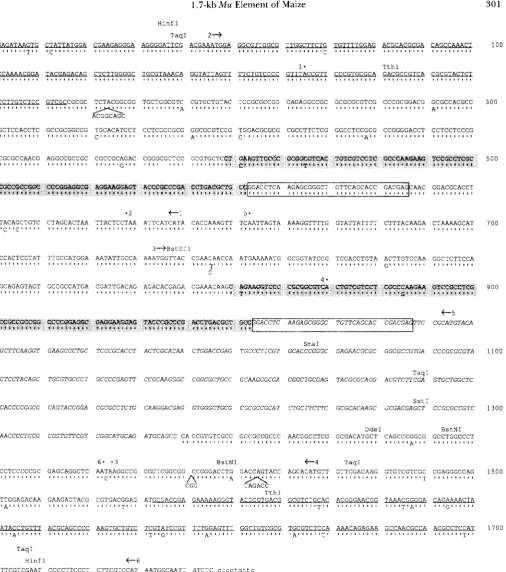
FIGURE 3.-Nucleotide sequence of Mu1.7 and comparison to M u l . The 1745 bp of M u l . 7 , plus flanking sequences, was determined by the procedures described in MATERIALS A N D METHODS. In the figure the sequences of M u l . 7 (top h e ) is aligned to the relevant sequence of
M u 1 (bottom line) taken from BARKER et al. (1984). The large block of extra DNA present in M u 1 . 7 is in italics and some relevant restriction sites are indicated. Single base substitutions, deletions and insertions of sequence between the two elements are indicated; nucleotide homology is indicated by a vertical bar (I). Terminal inverted repeats are underlined and the 104-bp internal direct repeats are shaded with the 34-bp extension boxed. The initiation codons and direction of ORFs 1-6 are indicated with an arrow and a (.) indicates the stop codons.
ORFs 1 and 2 are about the same size in both Mu1.7 and M u 1 elements and have identical 5' and 3' ends. However, the deletion of 8 bp and the addition of 2 bp at positions 2 2 3 and 435, respectively, cause the -200-bp segment of Mu1.7 DNA between them to be in a different frame with respect to M u l . The increase in size of reading frames 3 and 4 reflect the incorporation of all the Mu1.7 novel DNA into both
302
L.
P. Taylor and V. Walbotery of a mutable allele of bronzel, o n e o f the genes required for anthocyanin biosynthesis in maize. This allele ( b z l - m u 2 ) contains a 1.7-kb Mul-homologous insertion and displays somatic instability consisting o f many fine revertant sectors, a pattern shared with many Mu-induced mutable alleles (WALROT, BRIGCS a n d CHANDLER I 986). Preliminary genomic mapping of bzl-mu2 using Southern analysis showed that a 1.7-
kb Mul-homologous sequence was inserted into a 650-
bp
RstEII/SstI
fragment in the middle of a functionalRzI
allele (TAYLOR, CHANDLER and WALROT 1986).T h e sequence of cDNA clones of the
Bzl
transcript shows that a100-bp
intron lies within this fragment. the only intervening sequence in the gene (FURTEK1986). To date all
M u
element insertions associatedwith a n unstable phenotype that have been analyzed a t the molecular level have been located in either a n intron or the 5' untranslated region of the affected gene (BENNETZEN et al. 1984; ROWLAND a n d STROM-
MER 1985; FREELING a n d BENNETT 1985). In order
to determine the orientation of Mu1.7 within the 650
RstEII/SstI
fragment and whether it has inserted within the bronze1 intron, a detailed restriction map of the bzl-mu2 mutant was undertaken using probes specific for Mu1.7 (pSDP),Bzl
(pD3MS9 and pD3S3), and the left half ofMu
elements (pMuLft). T h e loca- tions of theBzl
probes
a r e indicated on t h e map of the bzl-mu2 allele in Figure 4 A a n dMu
probes a r e shown in Figure 2. Mu1.7 elements have a single Rsf El I site and a single Ssll site as shown in Figures 2 and 3, and n oXholl
sites within the element. T h e 650-bpBstEII/SstI
fragment of theBzl
gene has aXholl
site 175bp
from theSstl
site (Figure 4A). T h e placement and orientation of the Mu insert in b z l - mu2 can therefore be determined by double digests usingBstEII/Sstl
andBstEII/XhoII.
If the element has inserted to the left of theXholl
within theBstEII/Sstl
fragment (Figure 4A), then
Bst
ElI/Xho
I Idigested bzl-mu2 DNA should generate a fragment larger than the 500-bp wild-type fragment that will hybridize toBzl
probe pD3S3. If t h e insertion site is to the right (downstream) of theXhoII
site, then the probe will hybridize to the wild typeBstEII/Xholl
fragment of approximately 500bp.
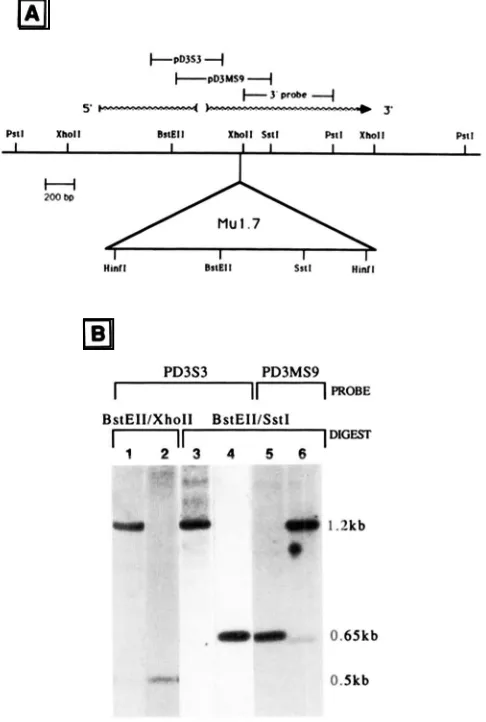
Figure 4B lane I shows a prominent band a t I .2 kb which hybridizes to pD3S3 indicating that the element is to the left or upstream of t h e
Xholl
site as oriented in Figure 4A. Referring to the orientation o f Mu1.7 shown in Figure 2 as A and the opposite orientation as B, a right and left half can be designated using theRstEII site as the approximate center of the element. T h e direction of the B z l transcript relative to the 650-
bp
BstElI/SstI
fragment is indicated in Figure 4A(DOONER et al. 1985). In orientation A that half o f M u l .
7
containing pSD2 sequences would be nearer the Sstl site a t the downstream end of theBzl
frag-PSI1 X b o l l Dnnlll X b l l 511 RI1 Xboll pnl
I I I I I I I I
I
= A
Mu 1.7Hlnll Bstell 5111 Hlnll
= A
Mu 1.7Hlnll Bstell 5111 Hlnll
PD3S3 PD3MS9
-
n
"EBstElllXholl BstElIlSstl n - l D l G e s f
' 1 2 1 1 3 4
-
--
5 6 Ie
1.2kb0
I)- 0 . 6 5 k b
0 . 5 k b
FIGURE 4.--Genomic restriction mapping localizes the insertion site o f a rMul.7 element within b r o n u l sequences. (A) T h e restric- tion map of the bzl-mu2 allele containing a Mu1.7 element inserted adjacent to Xholl site. Information o n the length and direction of a R r l transcript, including a 100-bp intron (indicated by brackets)
was supplied by FURTEK ( I 986) and H. WNER (personal commu- nication). T h e location of the B r l probes used in this study are shown o n the map. Mutator probes a r e shown in Figure 2. (B) Hybridimtion data used to confirm the location of t h e Mu1.7
element. An aliquot of 5 r g of genomic DNA from brl-mu2 im- mature cobs was double digested with BsfEll plus Ssfl or BsfEll
plus Xholl. electrophoresed through a I % agarose gel and trans- ferred to a nylon membrane (Genetran. Plasco) by the method of
.SOUTHERN (1975). DNA from fully pigmented nonmutant sibling kernels, taken from the same e a r o n which the mutant kernel arose, were used as the source of the parental B r l allele. RsfEII/Xholl
digested DNA from bzl-mu2 (lane I ) and o n e of its nonmutant siblings (lane 2) were probed with the Brl probe pD3S3. RstEll and
Sstl digest of brl-mu2 (lane 3) D N A was probed with B z l probe, pD3S3. After removing the previous hybridimtion signal. the blot
was probed with the R r l probe pD3MS9 to detect downstream sequences. Lane 6 is brl-mu2 and lane 5 is the nonmutant sibling. Lane4 isa 5copyreconstructionofaRsfEII/Ssll digestofpMBzP17 that contains the 2.2-kb fstl fragment which encompasses most of the transcribed region of the bronze1 gene (see Figure 4A). T h e size of fragments is given in right margin.
I .7-kb Mu Element of Maize 303
homologous fragment from Bst El I/SstI digested bzl- mu2 DNA while orientation
B
would generate a frag- ment of -900 bp. In Figure4B
lane 3, a single 1.2-kb band hybridizes to pD3S3 indicating insertion of ,Mu 1.7 has occurred in orientation A. To confirm that the digestion and transfer were complete and that other fragments are present as predicted, the pD3S3 signal was removed and the lane probed with plISMS9. As expected in addition to the I .2-kb frag- ment, an -630-bp fragment is detected by this probe (Figure
4,
lane 6). This fragment is composed of bronze1 sequences downstream of the insertion site rind rMu1.7 sequences rightward of the Sstl site within the element.All blots were probed with Mu probes pMuLft and pSD2 and the resulting hybridiiation patterns con- firmed that the expected size fragments were present and contained the appropriate sequences (data not shown). These fragment sizes and hybridi7ation pat- terns are onlv consistent with the insertion of the 1.7-
kb element within .50 bp upstream from the XhoII site in the 6.50-bp BstEII/Sstl fragment of the bronze1 gene (Figure
4A).
This site is 2 17 bp downstream of the 3' splice site of the intron. The orientation of the element relative to the direction of transcription of the bronze1 gene is the same as that found for the Mu1 element in the Adh133034 allele (BENNETZEN etal.
1984)
and in another bronze1 mutant, bzl-mu1(TAYLOR, CHANDLER and WALROT 1986).
Analysis of transcripts of the brl-mu2 allele: In combination with the appropriate genetic factors ( B
or R plus P I ) anthocyanin pigmentation and high level expression of
U
DPg1ucose:fl;ivonol 3-0-glucosvltrans- ferase, the product of the bronze1 locus, occur in maize leaf and stem tissue (COE and NEUFFER 1977). The husks of plants containing the bzl-mu2 allele in a B background show a pattern of dark purple streaks ona light green background, indicating that some Bzl function is occurring in these plants. An analysis of the poly(A)+ R N A produced in the husk tissue of plants containing the bzl-mu2, b z l recessive or Bzl wild-tvpe alleles is shown in Figure 5A. The Bzl allele produces a single 1.9-kb R N A (Figure 5A. lane 3) while the recessive b z l allele has a single R N A (lane
2)
about 350 bp smaller. This stable allele is associated with a 0.34-kb deletion within the coding region (DOONER et al.1986).
In contrast, the bzl-mu2 allele produces 3 R N A species hybridizing to a B z l gene probe (lane 1). A 3.6-kb transcript which hybridizes to both B z l and the iMul.7-specific probe pSD2 (Fig- ure .5, lanes I and4).
is the major species. This size is the sum of the entire Mu1.7 element plus the 1.9-kb tiiiiture B z l message. Two less abundant species that hvbridize to the Bzl probe (pDSMS9) are also present. 'I'he 1.9-kb class co-migrates with the nonmutant, parental B z l message but does not hybridize to the4.3
3.5
2.0 1.9
1.6 1.4
FIGURE 5.-Northern and Southern Blot analysis of nucleic acids from bzl-mu2. b r l . and B z l husk risque. (A) Three micrograms of polv(A)+ R N A from husks of each genotype were electrophoresed through ii I .4% formaldehyde gel. blotted to nylon membrane and
probed first with the R r l probe pD3MSS (bzl-mu2. b z l . and B z l in
lanes 1-3, respectively; lane 1 is a 72-hr exposure, lanes 2 and 3 are 3.6 hr). That signal was removed, and the blot rehybridized with the Mul.7 specific probe, pSD2 (lanes 4-5). L i n e 4 shows the hybridiwtion patterns using m R N A from the unstable mutant allele, brl-mu2. iind lane 7 is a 3 times longer exposure h a t lane. Lane 5 and 6 contain m R N A from the recessive br tester allele and the parental U z l allele respectively. Lanes 8- IO are a 24-hr expo- sure of the pD3MSS hybridimtion pattern shown in lanes 1-3.
Lanes 11-13 iire from another Northern blot of mRNA from the three alleles hybridized with a D N A fragment from the 3' portion of the R z l transcript. .See map Figure 4 A for probe location. Denatured EcoRI/Hindlll digested lambda D N A provided t h e sire markers in the leftmost lane. (B) A Southern blot of UsfEII/Ssfl-
digested DNA isolated from identical husk tissue used for t h e R N A
aniilvsis in Panel A and probed with pDSS3, a B r l probe. Lane I ,
contains D N A from the mutant bzl-mu2 and lane 2. D N A from wild type R r l husk; Lane R is a 1 copy reconstruction from BstEII/
Ssfl digested pMBzPI5. a brl plasmid containing the relevant sequences.
MuI.7-specific probe (lane 4); this class of m R N A is probably produced in the purple sectors of husk tissue, as a result of the excision of the Mu1.7 element from the gene. The third species is about 800 bases larger than the Bzl parental R N A but does not hvbridize to the Mul.7-specific probe (pSD2) (Figure 5A. lane 7, a longer exposure of lane
4).
I t does however hybridize to Bronze1 sequences downstream of the insertion site of Mu1.7. AnXhoII/Pstl
fragment (see map, Figure304 L. P. Taylor and V. W a l h t
dation to this
probe
including the 2.7-kb class (Figure5A. lane 12). To further define the Mu1.7 sequences present in this transcript, hybrid-selected Bzl-homol- ogous R N A was electrophoresed through a 1.4% formaldehyde gel and probed with pAB5 (see map, Figure 2). Both the 3.6-kb and 2.7-kb species hybrid- ize to this probe which is composed of sequences leftward of the unique region in Mu1.7 (data not shown). These results would indicate that the 2.7-kb class of poly(A)+ RNA contains most if not all of the Bronze1 transcript but only sequences from the left- ward portion of the Mu1.7 element as oriented in Figure 2.
T h e mutation in bzl-mu2 appears to reduce the level of the Bzl homologous RNA (Figure 5A. lanes 8-10). A densitometric scan of both the Northern blot containing
poly(A)+
RNA and a similar blot con- taining total RNA (data not shown) indicates that the relative abundance of Bzl homologous RNA in b r l - mu2 is about 10% that of the wild type allele. Approx- imately one-half of the RNA present is the 3.6-kb species. In fact, this level of expression of bzl-mu2 (ina
B background) relative to the Bzl allele (in a B plusPI
background), agrees closely with the observation that B z l activity and anthocyanin production in leaf sheaths of plants with only the B gene is about one- tenth that produced by plants having both B andPI
present (GERATS et al. 1984). To determine whether the mutation in bzl-mu2 has any small effects on the amount of mRNA produced, it will be necessary to
determine the expression from the allele in a B plus
PI
background.T h e conclusion that the normal size Bzl mRNA arises from somatic reversion in tissues of the unstable bzl-mu2 stock is supported by the results of Southern analysis (Figure 5B). DNA isolated from the same plant material used for RNA analysis was doubly digested with BstEII and S s t l , fractionated by gel electrophoresis, transferred to nylon membrane and probed with the Bzl probe pD3S3. Insertion ofMu1.7 into the 650-bp BstElI/SstI bronze1 fragment gener- ates a unique 1.2-kb fragment when bzl-mu2 DNA is digested with these enzymes (Figure
4B,
lane 3). Rea- sonably precise excision of the element should restore the parental 650-bp fragment (Figure4B,
lane 5). Indeed, the bzl-mu2 DNA extracted from the purple streaked husk tissue consists of two fragments (Figure5R,
lane 1). a major band of 1.2 kb and a weaker hvbridizing fragment of 650 bp which co-migrates w'ith the non-mutant Bzl parental allele shown in lane2.
This smaller fragment is presumably the result of excision of the element from the 650-bp BstEII/SstI bronze1 fragment. These data indicate that the high frequency of somatic reversion seen in the bzl-mu2 allele results from the perfect, or near perfect excision of the Mu1.7 element, restoring approximately wildr=l
pSD2
' 1 2 3 4 5 ' 6 7
3700
I
1900
1650
a
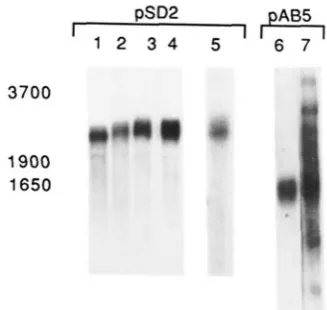
FIGURE 6.-Mul.7 homologous RNA is found in diverse maize tissues. Selected lanes from two Northern filters containing rota1 RNA from immature embryos (lanes I and 4). roots (banes 2 and 3) or suspension culture cells (lane 5) %'ere probed with the Mu1.7 unique region probe, pSD2. Lanes 1 through 4 contain 9 rg o f RNA and lane 5 is the amount o f RNA extracted from approxi- mately I x cells. .%MATERIALS AND METHODS for the listing o f these non-Mutator lines o f maize. Lanes I I and I 2 o f the Northern filter in Figure 5A were hybridized with pAR9 (see map. Figure 2) which detects Mu sequences surrounding the unique region o f Mul.7. T h e non-Mutator line containing the b r l allele is in lane 6 and lane 7 contains the Mutator line with the brl-mu2
allele. The size markers on the left represent the position o f hybrid- iilrtion for the ribosomal DNA probe (3700 and 1900 bases) and
Adh I (1 6.50 bases).
type
size DNA fragments, normal mRNA size, and sufficient glucosyltransferase activity to create dark purple sectors in the husk tissue.An abundant transcript homologous to Mu2.7 se-
quences: In addition to the 3.6-kb species, poly(A)+ KNA from bzl-mu2 contains a 2.2-kb transcript which hybridizes to the Mu 1.7 unique region probe (pSD2). Likewise the non-Mutator line carrying the b z l allele and the Mutator line carrying the Bzl allele have an identical size transcript at approximately the same abundance (Figure SA, lanes
4-7).
T h e distribution of this transcript was tested by probing Northern blots of total RNA from developing embryos (20-30 days after pollination), roots and maize suspension culture cells. T h e tissue from these non-Mutator lines all have a single species of R N A approximately 2.2 kb that hybridizes to the Mu1.7 unique probe (Figure 6, lanes 1-5). To determine whether other Mu sequences are represented in this transcript, the Northern blot in Figure 5A was probed with pAB5 which mainly detects sequences to the left
1.7-kb Mu Element of Maize 305
diverse tissues from both Mutator and non-Mutator lines is intriguing. It is not ribosomal RNA; in addition to being the wrong size it does not hybridize to an rDNA probe (data not shown).
It may derive from a sequence found in all maize lines that is closely homologous to the internal region
of Mu1.7, including the pSD2 sequences, but with a
large internal deletion and no M u termini. This se- quence has recently been cloned along with flanking sequences which show no homology to M u sequences (L. TALBERT and V. CHANDLER, personal communi- cation). We probed our Northern blots with these flanking sequences and find hybridization to the 2.2- kb species (data not shown).
DISCUSSION
Properties of Mu1.7: In an attempt to determine the factors required to produce and maintain an active Mutator system, we have cloned and analyzed a large
M u element found in Mutator lines. T h e Mu1.7 ele-
ment has the structural features of an active transpos- able element, including TIRs and host sequence du- plication at its site of insertion; recovery of a M u l . 7 -
induced mutation in bronzel indicates that it can trans- pose. Structurally the two major elements in the Mu- tator stocks are nearly identical (97% homologous) in regions common to both elements. T h e major differ- ence is a block
of
385 bp of extra DNA in M u I . 7which could be the result of an insertion maize DNA into a M u 1 element. In favor of an insertion model, the 385-bp block is bounded at both ends by the trinucleotide GCC in direct orientation. This trinu- cleotide is present at the same location in M u 1 in a single copy; however, it is not clear that the second
GCC in Mu1.7 arose as a direct duplication from
insertion of a transposable segment because the GCC
motif is repeated >20 times in this region of M u l .
Another possibility for generating a M u l .
7
element from a M u 1 element would require at least two steps: duplication of the 34 bp present at the internal ter- minus of the left direct repeat and insertion of 351bp of unique DNA.
Alternatively, comparison of the internal direct re- peat sequences in both types of elements suggests a single step deletion relationship between M u 1 and
M u l . 7 . T h e two copies of the 138-bp internal direct
repeat of the larger element are not preserved in the smaller M u 1 element. Only a single 138-bp copy is present in the left half of M u 1 while in the right portion of the element the repeat is only 104 bp. We propose that deletion of 385 bp of DNA from the right half of the M u I . 7 element, including 34 bp of the right direct repeat, generated a M u 1 size class from a M u l . 7 element (Figure 3 ) . However, it is also possible that both M u 1 and M u 1 . 7 were derived in- dependently from a larger precursor; such an ele-
ment, if present in a low copy number, might not be detected until it causes a mutation in a cloned gene.
Somatic excision of Mu1.7: By SOUTHERN analysis (Figure 5B) it appears that -10% of the bzl-mu2 gene copies in husk tissue of a b z l - m u 2 homozygote have reverted during somatic growth to yield an approxi- mately wild-type size bronzel gene. This level of re- version matches the phenotypic appearance of the husks, which contain numerous purple stripes on a green background. This is the first evidence that excision of a M u element is associated with the pres- ence of gene structure and function indistinguishable from wild type.
It was of interest, consequently, to determine the kinds of B z l transcript in this tissue. Three major size classes of poly(A)+ RNA were detected (Figure 5A).
T h e largest size is the major species and is the size predicted if the entire 1.7-kb M u element is included in the full length B z l transcript; the fate of this RNA is unknown. Because there is purple tissue, some RNA encoding a functional gene product must also be present. Such an RNA could arise either from M u
excision in somatic revertants or by a splicing event removing the M u element from the full length tran- script of the b z l - m u 2 gene. Based on hybridization analyses (Figure 5A), the 1.9-kb RNA detected by B z l
but not by M u probes is the same size as the wild-type mRNA and could result from either mechanism. However, because of the high level of somatic rever- sion detected by Southern analysis, we favor the hy- pothesis that this RNA is transcribed from revertant gene copies.
A third species of RNA of approximately 2.7 kb is 800 bases larger than the wild-type mRNA, however, it does not hybridize to pSD2, which is composed of sequences from the right portion of the M u l . 7 ele- ment. It hybridizes to Bronze1 probes 5’-ward (pD3MS9) and 3’-ward of the insertion site of M u l . 7
and to a M u probe (pAB5) which detects sequences in the left portion of M u l . 7 . It does not hybridize to pSD2 which is composed of sequences in the right portion of the Mu1.7 element.
Although sequencing of cDNA clones from the b z l -
m u 2 allele will be required to determine the exact
306 L. P. Taylor and V. Walbot
The transcription termination effect of M u I on the
AdhI-S3034 allele (ROWLAND and STROMMER 1985;
VAYDA and FREELING 1986) is not seen in the b z l -
mu2 allele. Thus transcription termination is not a general effect of
Mu
element insertion in transcribed regions. The mechanism underlying the effect of Muon transcription in the AdhI-S30?4 allele is unknown and could be specific to a particular site of element insertion within the locus. It should be noted that not only are the types of
Mu
elements and target genes different in these two examples but insertion in an exon ( M u l .7
in b z l - m u 2 ) may place far different con- straints on gene expression than when the insertion occurs within an intron ( M u 1 in Adhl-S3034).Nature of revertant alleles: Sequence analysis of excision products generated by transposable elements in plants has demonstrated a physical basis for the diversity noted in revertant alleles (SAEDLER and NEV-
ERS 1985). It would be predicted that the frequency of recovery of phenotypically normal or near-normal revertants would depend on element type and inser- tion location, the propensity for precise excision events, and the impact of amino acid changes on the protein product. Studies of Bz’ (purple seeds indica- tive of bronze1 gene function) revertants recovered from other transposable element systems indicate that
the bronze1 gene product can be subsequentially al-
tered and still produce phenotypically wild-type tissue. T h e same 650-bp BstEIIISstJ fragment of the bronzel
gene analyzed in this study is the site of insertion for two other transposable elements from which several stable Bz’ derivatives have been recovered. Six of seven Bz’ derivatives of br-mI3 ( d S p m inserted 33 bp downstreani of the exon:intron junction (FEDOROFF et
al. 1984; SCHIEFELBEIN et al. 1985; FURTEK 1986); had lower glucosyl transferase activity than the wild type progenitor allele, Bz-McC (NELSON and KLEIN
1984; V. RABOY and J. SCHIEFELBEIN, personal com- munication). DOONER and NELSON ( 1 979) showed that in 15 stable Bz’ derivatives of bz-m2(DZ)
[Ds
element is inserted -80 base pairs upstream of the XhoII site described in this study (DOONER et al. 1985; E. RAL-STON and H. DOONER, personal communication)], two- thirds showed alterations in at least one of three criteria: enzyme specific activity, thermal stability or electrophoretic mobility. The other one-third were indistinguishable from the wild-type protein of the Bz-
McC allele. T h e two classes may reflect alternative molecular events during excision from the bronzel
locus. In this regard, precise excision of M u l . 7 could generate a bronzel gene product containing three additional amino acids resulting from the 9-bp host sequence duplication. However, detailed analysis of cDNAs of mRNA from tissue containing the b z l - m u 2
allele will be required to determine the full spectrum of revertant events present after M u l . 7 excision and
to demonstrate whether an alternative splicing event removing part of the M u element is responsible for an aberrant RNA product in some cases.
Role of Mu1.7 in the mutator phenomenon: In the
Mutator transposable element system u p to 90% of the progeny of a Mutator parent can inherit the characteristic high level of mutation. This frequency dictates that multiple copies of autonomous elements must be transmitted to or be generated within each generation. We have maintained two independent lines of Mutator stocks that have been repeatedly outcrossed to non-Mutator lines. All of the >300
progeny we have tested for the presence of Mutator elenients have contained both 1.4- and 1.7-kb size classes. Active Mutator lines originally containing a total of 10 copies or less of both size classes still maintain these elements even after 5 or 6 generations of outcrossing to non-Mutator lines. ALLEMAN and
FREELINC ( I 986) have reported an active Mutator line apparently devoid of M u l . 7 elements; it will be in- formative to test these lines for pSD2 homologous sequences.
Elucidation of M u l . 7 functions and interaction with other elements in the Mutator system is difficult by genetic techniques or molecular analysis. One way to test the activities of the various Mu elements that have been isolated is to introduce j u s t one type of element into a non-Mutator line of maize. The introduction of
DNA into maize protoplasts via electroporatjon
(FROMM, TAYLOR and WALROT 1985) and the subse- quent regeneration of stably transformed callus
(FROMM, TAYLOR and WALBOT 1986) offers a new approach to testing Mutator function. Experiments are in progress to follow the number and position of
such introduced elements to document transposition. Once it has been established that a particular class of element is competent to transpose, mutated forms can be introduced to determine which nucleotide se- quences are necessary for transposition. Assays to detect transcripts from the introduced copies or to recover excision products could then be performed.
W e appreciate the continuous encouragement o f J. BENNETZEN
of Purdue University and V. CHANDLER of the University of Oregon and thank H. DOONER, D. FURTEK and J. SCHIEFELBEIN for Bzl plasmids and communication of results prior to publication. We thank R . REDFIELD, C. THUMMEL and N. CRAWFORD for critical reading of the manuscript and A . BLOOM for help in its preparation. L . T . wishes to acknowledge G. TAYLOR for help with computer- aided graphics, and I.. KEDES and members of his laboratory for
assistance with the DNA sequencing programs. Supported by Na- tional Institutes o f Health grant GM 32422 to V.W. L.P.T. was a trainee in Cancer Biology United States Public Health Service training grant, CA 09302.
L I T E R A T U R E CITED
1.7-kb M u Element of Maize 307
BARKER, R. F., D. V. THOMPSON, D. R. TALBOT, J. SWANSON and J. L. BENNETZEN, 1984 Nucleotide sequence of the maize transposable element M u l . Nucleic Acids Res. 12: 5955-5967.
BENNETZEN, J. L., J. SWANSON, W. C. TAYLOR and M. FREELING,
1984 DNA insertion in the first intron of maize A d h l affects message levels: cloning of progenitor and mutant A d h l alleles. Proc. Natl. Acad. Sci. USA 81: 4125-4128.
DNA modification of a maize transposable element correlates with loss of activity. Proc. Natl. Acad. Sci. USA 83: 1767-1771.
Supercoil sequencing: a fast and simple method for sequencing plasmid DNA. DNA 4 165-1 70.
T h e genetics of corn. pp. 135-148. In: Corn and Corn Improvement, Edited by G. F.
SPRAGUE. American Society of Agronomy, Madison, WI. Heterogenous fla- vonoid glucosyltransferases in purple derivatives from a con- trolling element-suppressed bronze mutant in maize. Proc. Natl. Acad. Sci. USA 76: 2369-2371.
DOONER, H. K., E. WECK, S. ADAMS, E. RALSTON, M. FAVREAU and
J. ENGLISH, 1985 A molecular genetic analysis of insertions in the bronze locus in maize. Mol. Gen. Genet. 200: 240-246.
A single genetic unit specifies two transposition functions in the maize element Activator. Science 234: 2 10-2 1 1 .
Analysis of nucleotide sequences at 3’ termini of duplex deoxyribonucleic acid with the use of the T4 deoxyribonucleic acid polymerase. J. Biol. Chem. 2 4 6 3269- 3276.
Isolation of the transposable maize controlling elements Ac and Ds. Cell
35: 235-242.
FEDOROFF, N. V., M. SHURE, S. KELLY, M. JOHNS, D. FURTEK, J.
SCHIEFELBEIN and 0. E. NELSON, JR., 1984 Isolation of Spm
controlling elements from maize. Harbor Symp. Quant. Biol.
4 9 339-345.
Maize A d h l . Annu. Rev. Genet. 19: 297-323.
Expression of genes transferred into monocot and dicot plant cells by electroporation. Proc. Natl. Acad. Sci. USA 82: 5824-5828.
FROMM, M. E., L. P. TAYLOR and V. WALBOT, 1986 Stable transformation of maize after gene transfer by electroporation. Nature 319: 791-793.
Cloning and sequence analysis of the bronze
locus of maize: location of transposable element insertions and comparison of two wild type alleles. Ph.D. thesis, University of Wisconsin-Madison.
GERATS, A. G. M., J. BUSSARD, E. H. COE, JR. and R. LARSON,
1984 Influence of B and PI on UDPG:flavonoid-3-O-gluco- syltransferase in Zea mays L. Biochem. Genet. 22: 1161-1 169.
KARESS, R. E. and G . M. RUBIN, 1984 Analysis of P transposable element functions in Drosophila. Cell 38: 135-146.
MANIATIS, T., E. F. FRITSCH and J. SAMBROOK, 1982 Molecular Cloning: A Laboratory Manual. Cold Spring Harbor Laboratory, Cold Spring Harbor, N.Y.
MCCLINTOCK, B., 1949 Mutable loci in maize. Carnegie Inst. Wash. Year Book 48: 142.
MOUNT, S. M., 1982 A catalogue of splice junction sequences. Nucleic Acids Res. 1 0 459-472.
NELSON, 0. E. and A. KLEIN, 1984 Characterization of an Spm-
CHANDLER, V. L. and V. WALBOT, 1986
CHEN, E. Y. and P. H . SEEBURG, 1985
COE, E. H., JR. and M. G. NEUFFER, 1977
DOONER, H . K. and 0. E. NELSON, JR., 1979
DOONER, H., J. ENGLISH, E. RALSTON and E. WECK, 1986
ENGLUND, P. T., 1971
FEDOROFF, N. V., S. WESSLER and M. SHURE, 1983
FREELING, M. and D. C. BENNETT, 1985
FROMM, M. E., L. P. TAYLOR and V. WALBOT, 1985
FURTEK, D. B., 1986
controlled bronze-mutable allele in maize. Genetics 106: 769- 779.
Structures of P transposable elements and their sites of insertion and excision in the Dro-
sophila melanogaster genome. Cell 3 4 25-35.
PEREIRA, A., 2s. SCHWARZ-SOMMER, A. GIERL, I. BERTRAM, P. A. PETERSON and H. SAEDLER, 1985 Genetic and molecular analysis of the enhancer (En) transposable element system of
Zea mays. EMBO J. 4: 17-23.
Characterization of a mutator system in maize. Mutat. Res. 51: 21-28.
Insertion of an unstable element in an intervening sequence of maize A d h l
affects transcription but not processing. Proc. Natl. Acad. Sci.
SAEDLER, H. and P. NEVERS, 1985 Transposition in plants: a molecular model. EMBO J. 4: 585-590.
SANGER, F., A. R. COULSON, B. G. BARRELL, A. J. H. SMITH and B. A. ROE, 1980 Cloning in single-stranded bacteriophage as a n aid to rapid DNA sequencing. J. Mol. Biol. 143: 161-1 78.
SCHIEFELBEIN, J., V. RABOY, N. V. FEDOROFF and 0. E. NELSON, JR., 1985 Deletions within a defective suppressor-mutator
element in maize affect the frequency and developmental tim- ing of its excision from the bronze locus. Proc. Natl. Acad. Sci. USA 82: 4783-4787.
Diazotizable arylamine cellulose papers for the coupling and hybridization of nucleic acids. Nucleic Acids Res.
10: 1799-1810.
SETZER, D. R., M. MCGROGAN, J. H . NUNBERG and R. T. SCHIMKE,
1980 Size heterogeneity in the 3’ end of the dihydrofolate reductase messenger RNAs in mouse cells. Cell 22: 361-370.
Detection of specific sequences among DNA fragments separated by gel electrophoresis. J. Mol. Biol. 98:
STROMMER, J. N., S. HAKE, J. BENNETZEN, W. C. TAYLOR and M. FREELING, 1982 Regulatory mutants of the maize A d h l gene caused by DNA insertions. Nature 3 0 0 542-544.
TAYLOR, L. P. and V. WALBOT, 1985 A deletion adjacent to the maize transposable element Mu-1 accompanies loss of A d h l
expression. EMBO J. 4: 869-876.
Insertion of 1.4-kb and 1.7-kb Mu elements into the Bronze1 gene of Zea mays. Maydica 31: 31-45.
VAYDA, M. E. and M. FREELING, 1986 Insertion of the Mu1 transposable element into the first intron of maize A d h l inter- feres with transcript elongation but does not disrupt chromatin structure. Plant Mol. Biol. 6: 441-454.
T h e pUC plasmid, an M 13 mp7- derived system for insertion mutagenesis and sequencing with synthetic universal primers. Gene 19: 259-268.
WALBOT, V., C. P. BRIGGS and V. CHANDLER, 1986 Properties of mutable alleles recovered from mutator stocks of Zea mays L. pp. 1 15-1 42. In: Genetics, Development, and Evolution, Edited by J. P. GUSTAFSON, G. L. STEBBINS and F. J. AYALA. Plenum Publishing, New York.
WALBOT, V., V. L. CHANDLER and L. P. TAYLOR, 1985
Alterations in the mutator transposable element family of Zea mays. pp. 333-342. In: Plant Genetics, UCLA Symposium on Molecular and Cellular Biology, Vol. 35, Edited by M. FREELING. Alan R. Liss, New York.
WOODMAN, J. C. and M. FREELING, 1981 Identification of a ge- netic element that controls the organ-specific expression of
A d h l in maize. Genetics 98: 357-378.
Communicating editor: B. BURR O’HARE, K. and G. M. RUBIN, 1983
ROBERTSON, D. S., 1978
ROWLAND, L. J. and J. N. STROMMER, 1985
USA 82: 2875-2879.
SEED, B., 1982
SOUTHERN, E., 1975
503-517.
TAYLOR, L. P., V. L. CHANDLER and V. WALBOT, 1986