Division V
SOIL-STRUCTURE INTERACTION: PROJECT GAINS THROUGH USE
OF HIGH-PERFORMANCE COMPUTING
Ben Kosbab1, Julio Garcia1, Wei Li1, Huy Tran2, Iman Talebinejad2, Asad Bassam2, and Kaniel Tilow2
1 Principal Engineer, SC Solutions, USA 2 Senior Engineer, SC Solutions, USA
ABSTRACT
Continued advances in the fields of structural and geotechnical engineering, and increasing expectations for fidelity and refinement of seismic analysis models, has caused the popular System for Analysis of Soil Structure Interaction (SASSI) and its derivatives to become a computational bottleneck in the design and evaluation of nuclear plant structures. For these reasons, modern enhanced solution algorithms have been incorporated into the traditional SASSI framework to efficiently take advantage of modern high-performance computing (HPC) and therefore drastically reduce analysis run-time and increase permissible model sizes (i.e. larger number of interaction nodes). These expanded SASSI capabilities allow more accurate and streamlined treatment of considerations that have traditionally been treated indirectly or in limited detail. This paper provides a variety of recent project examples highlighting how enhanced solutions algorithms coupled with HPC capabilities have allowed SASSI to be efficiently used, resulting in gains such as improved accuracy, reduced uncertainty, and accelerated schedules.
INTRODUCTION
For decades, the System for Analysis of Soil Structure Interaction (SASSI) program (Lysmer et al., 1981) and its improved derivatives has been an accepted and favoured analysis tool for treatment of seismic soil-structure interaction (SSI) effects on nuclear facilities. With continued advances in the fields of structural and geotechnical engineering, and increasing detail and refinement of analysis models, SASSI has become a computational bottleneck in the design and evaluation of nuclear plant structures, and may not provide the fidelity and detail expected in modern engineering. Gross model simplifications are commonplace to ensure reasonable analysis schedules, necessitating numerous assumptions, sensitivity studies, and qualitative evaluations to address specific nuances and details of SSI phenomena.
Fortunately, enhanced solution algorithms have become available since the development and widespread adoption of SASSI, and have been incorporated into the SASSI framework to efficiently take advantage of modern high-performance computing (HPC) with dramatic results, such as in the commercial code SC-SASSI (SC Solutions, 2017). HPC enhancements also complement and extend other useful evolutionary SASSI refinements. SASSI HPC enhancement is generally accomplished by (a) integrating modern solvers that allow the critical impedance inversion to be in-place for each frequency, and discretized for handling in parallel and network-distributed computer hardware; (b) minimizing the number of hard disk input/output operations in favour of in-memory computation and interim storage; and (c) altering the data structure of intermediate results passed between modules to streamline as direct binary input/output.
PROJECT GAINS VIA LARGE SSI MODELS
HPC enhancements to the SASSI framework allow much larger SSI models (i.e. greater number of interaction nodes) to be analysed than was possible with traditional SASSI. The large models now allow direct treatment of SSI phenomena that previously required gross simplification and/or compromise. The examples outlined below demonstrate gains achieved by use of large models.
Deep Embedment Coupled with Soft Soil and High-Frequency Hazard
Recent probabilistic seismic hazard assessments for many nuclear power plant sites reflect relatively high-frequency energy content, such as in the Central and Eastern United States (CEUS) (USNRC, 2014). This increases the required passing frequency of SSI models, which in turn decreases the maximum soil mesh size. For plants with even moderately deep embedment and/or relatively soft soils, SSI model sizes become large enough to be considered unwieldy for traditional SASSI without resorting to gross simplifications (such as neglecting embedment, compromising on accuracy in high-frequency, and/or resorting to the use of the subtraction method). However, use of SASSI with HPC can eliminate the need for such simplifications by allowing direct consideration of these compounding effects and the resulting SSI models with large numbers of interaction nodes.
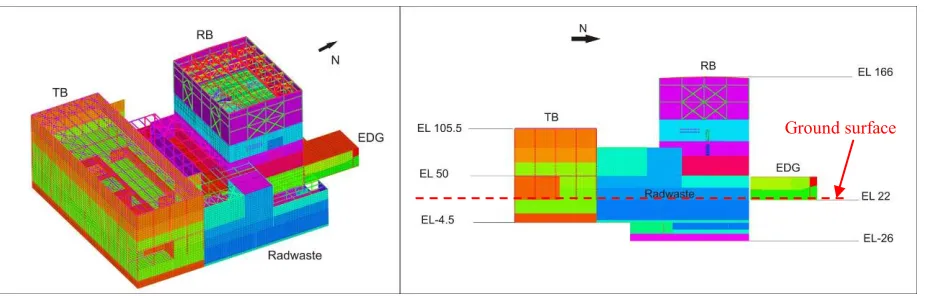
The structural model associated with an extreme example demonstrating the need for very large SSI models is illustrated in Figure 1 below (Kosbab et al., 2016). Here, a boiling water reactor (BWR) building is embedded in nearly 50ft of fill with degraded best-estimate shear wave velocity as low as 570 fps, above approximately 35ft of glacial outwash with shear wave velocity of approximately 1800 fps. The uniform hazard spectral shape at this site does not begin to descend until above 35Hz, typical of CEUS sites. Furthermore, close proximity of different soil-founded structures having different foundation elevations, with the potential for various structure-soil-structure interaction effects and/or building-to-building impact, made it important to include several major buildings in the same SSI model. To ensure a passing frequency of at least 50Hz, the combined model had over 91,000 interaction nodes for the direct method (nearly 46,000 interaction nodes for the reactor building alone). Using distributed computing and parallel processing, this model was successfully analysed with direct method in just a few hours per frequency, and ultimately used to perform probabilistic SSI analysis to support seismic probabilistic risk assessment (SPRA) applications.
By avoiding gross over-simplifications in SSI models and corresponding bounding analyses, refined in-structure response spectra (ISRS) were generated which minimized unnecessary and unintended conservatisms via enhanced realism, thus assisting in demonstrating plant seismic safety.
Structure-Soil-Structure Interaction
Nuclear power generating sites typically have multiple structures located in close proximity to one another which each house components critical to the safe operation of the facility. The SSI behaviour of one structure can affect the SSI behaviour of an adjacent structure, referred to as structure-soil-structure interaction (SSSI). Direct consideration of SSSI for multiple large structures has been impractical with traditional SASSI, necessitating the use of 2D “slice” SSSI models, or “cascade analysis” techniques (Roy et al., 2011). These simplifications seek to reduce the number of interaction nodes in a single model, and/or avoid excessive computer run-times.
In contrast, SASSI with HPC provides efficiency to include multiple structures in the same SSI model, thus directly capturing SSSI effects. In these direct SSSI models, entire multi-building nuclear island complexes can be incorporated into a single analysis run regardless of separation distance, soil properties, foundation depths, etc. The benefits of direct treatment of SSSI effects include: (a) captures full 3D effects of SSSI behaviour on adjacent structures and spatially variable amplitude of SSSI effects; (b) captures two-way feedback between adjacent structures; (c) minimizes the number of separate sensitivity study models to generate and maintain; and (d) allows more streamlined calculation of relative displacements between adjacent structures.
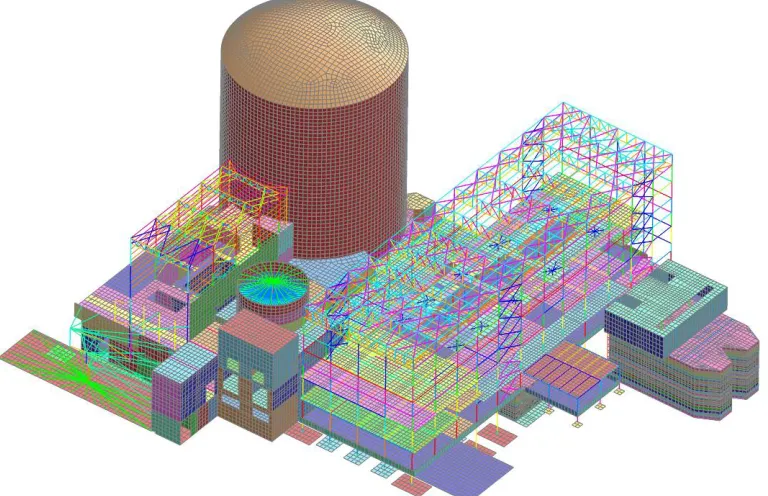
An example multi-building finite element (FE) model for direct consideration of SSSI effects in SASSI is illustrated in Figure 2. This PWR complex combines separate containment building, auxiliary building, radwaste building, turbine building, and intake structures into a single model. In addition to traditional SSSI effects, the combined model allows for consideration of partially shared load paths between adjacent structures (namely vertical), shared foundations despite separate super-structures, and relative movement between adjacent structures (for building impacts and for commodities spanning across seismic joints).
Combined High-Fidelity Model for Coupled Structural Stress Analysis and Seismic Analysis
For design of modern nuclear power plants, there has been a commonly perceived need to have two “compatible” versions of the structural analysis model: one high-fidelity structural “stress model” for local stress analysis of each of the structural elements under different global load combinations, and another more simplified “seismic model” for dynamic analysis to identify the global seismic demands for input to the stress model. This practice originated largely due to computational restrictions that limited dynamic analysis, especially for soil-structure interaction, to fairly simple models.
However, incorporation of HPC capabilities into SASSI allows very large models to be efficiently analysed, thereby allowing a single combined high-fidelity model to be used as both the “stress model” and the “seismic model” congruently. Use of a single model allows for a more streamlined design process by: (a) lowering model maintenance effort and re-alignment updates; (b) eliminating global-to-local data translation of seismic demands; (c) increased realism in seismic demands with fewer sensitivity studies required; (d) more design control of capacity margin via transparency between demand and capacity; and (e) potentially fewer regulatory questions.
An example of a high-fidelity nuclear power plant structural model used as both a “stress model” for detailed design and as a “seismic model” for soil-structure interaction analysis (Tabatabaie et al., 2011 and Richter et al., 2015) is depicted in Figure 3. This model, having over 45,000 interaction nodes (direct method), was successfully analysed in SASSI with HPC as part of design certification efforts for a suite of generic and site-specific soil cases and ground motions. Example results are shown in Figure 4. All analyses were performed and documented under rigorous QA processes, including software control.
Figure 3: High-Fidelity Structural Model of Modern Nuclear Power Plant (Richter et al., 2015)
PROJECT GAINS VIA RAPID SSI ANALYSIS
HPC enhancements to the SASSI framework also allow much faster SSI analysis run-times than was possible with traditional SASSI. The rapid analysis now possible allows more rigorous treatment of considerations that previously were handled via sensitivity study or assumptions of bounding cases. The examples outlined below demonstrate gains achieved by use of rapid analysis.
Probabilistic SSI Analysis
Probabilistic SSI analysis is advantageous over more traditional deterministic methods since it can directly address the inherent uncertainties related to the seismic input motion, soil and structural material behaviour, and modelling assumptions. These uncertainties are directly addressed in the probabilistic SSI through randomization of the seismic input motions as well as soil and structural stiffness and damping. However, a drawback in probabilistic SSI analysis is the number of SSI models that are needed to obtain stable and reliable results, and the perceived computational effort associated with analysis of these various models. For example, generation of at least 30 randomized SSI models are needed when using Latin Hypercube Sampling (LHS) method. For this reason, traditionally, nuclear power plant structures have been either analysed using a deterministic approach, or have been overly simplified for probabilistic analysis in order to achieve reasonable computational run time. Use of HPC can mitigate this drawback by significantly reducing the analysis run time, thus making it feasible to utilize detailed models for probabilistic analysis.
The case described below provides an example where probabilistic SSI analyses were used to obtain realistic responses for the purpose of fragility analysis of structures, systems and components (SSCs) in a nuclear power plant. The probabilistic SSI analysis for this project involved four major steps:
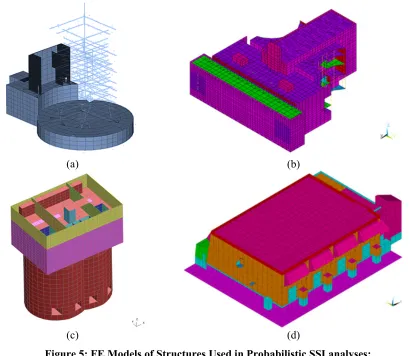
1) Development of median-centred structural 3D FE and SSI models – The structural models that were analysed for this project varied greatly in size and complexity. Figure 5 provides a schematic of the main FE structural models used in SSI analyses.
2) Development of a suite of earthquake ground motions – The variability of the ground motions was considered through variability in selecting different seed motions for development of each set of time histories, and also through variability of directionality factors.
3) Randomization of soil and structural stiffness and damping – The soil and structural stiffness and damping were sampled through LHS approach. The soil properties were varied through randomizing the shear wave velocity, damping, etc. within the hazard-consistent distribution of soil properties reported from site response analysis aspects of probabilistic seismic hazard analysis. The structural properties were varied about the best estimate of stress state in the structure, including applicable concrete cracking. Sampling via LHS was automated with constraints included to ensure resulting randomized properties maintained appropriate physics.
4) SSI analysis, post processing and generation of ISRS – Each of the 30 probabilistic SSI cases were run for each model. For each model, all 30 SSI cases were run in less than one day. From these analyses, 30 ISRS were generated for each of the selected locations, and the median and 80thpercentile spectra were directly extracted. The response spectra variability (βRS), which often
(a) (b)
(c) (d)
Figure 5: FE Models of Structures Used in Probabilistic SSI analyses; (a) Reactor Building + Valve Room, (b) Auxiliary Control Building,
(c) Emergency Raw Cooling Water Pumping Station, (d) Diesel Generator Building
Multiple Configurations and/or Alternate Boundary Conditions
Nuclear facilities must often be designed to accommodate various configurations or uncertain boundary conditions representing various operational or life-cycle states that they will experience over the course of time. Often, the seismic response of various potential configurations or boundary conditions is different. Examples include: (a) the support conditions of PWR reactor internals are a function of thermal loading, which is unknown at the time of a postulated earthquake; (b) actual boundary conditions of free-standing assembled components can be unknown, such as fuel and racks in spent fuel pools where initial gaps between sub-components are highly variable due to necessary tolerances for installation and loading; and (c) spent fuel storage where the amount of fuels stored changes with time. It is difficult to ascertain which configuration(s) may govern without a series of sensitivity studies. In these cases, it is desirable to consider all possible configurations in seismic analysis. Rapid analysis made possible by HPC capabilities in SASSI allows large numbers of configurations to be efficiently analysed, thus minimizing inherent risk in having to assume governing cases.
A specific example of having to analyse models for a number of structural configurations is in the seismic SSI analysis of Independent Spent Fuel Storage Installation (ISFSI) concrete pads. Because an ISFSI pad is not loaded with all storage casks at the same time, but rather with an increasing number over time, the design of such pads must consider multiple cask loading configurations. Figure 7 illustrates 4 ISFSI storage cask loading configurations that envelope typical and a-typical loading conditions, ranging between 4 and 24 storage casks. Considering 3 soil profiles (i.e. centred on best-estimate site-specific soil properties), 3 earthquake ground motions, and these 4 configurations, a total of 36 SSI analysis cases are performed. An example ISRS plot from all cases is provided as Figure 8. Through the use of SASSI with HPC, each analysis case could be accomplished quickly and in parallel to complete all analysis cases in less than 2 days. The time savings gained by use of SASSI with HPC allowed for more detailed output resolution to evaluate the overturning potential and sliding friction demand for each individual storage cask for each possible combination of soil condition, earthquake motion, and load configuration to support the pad design (response at 184 casks). This analysis refinement minimized the number of follow-on sensitivity studies necessary to demonstrate seismic safety of the ISFSI pad and casks.
Figure 7: ISFSI Storage Cask Load Configurations
Multiple Hazard Levels
One important criterion for SSI analysis, especially for equivalent-linear analysis such as is performed by SASSI, is ensuring that the soil and structure material properties modelled are compatible with the seismic hazard range of interest. For seismic risk assessment, this is complicated by the fact that the hazard range of interest is related to the fragility capacity and therefore not known prior to performance of the SSI analyses. A common current practice to avoid performing SSI analyses at multiple hazard levels is to estimate a “best guess” hazard range of interest (or “reference earthquake”) based on preliminary risk insights, and then perform a single set of SSI analyses with soil and structure properties compatible with that hazard range that can be linearly scaled. The compromise with this approach is that if the preliminary risk insights are incorrect or incomplete, then there may be incompatibility between properties modelled and hazard range of interest, and sensitivity studies and/or iteration are necessary to assess the effect of such incompatibility. However, a more direct approach is to perform SSI analyses at multiple hazard levels a priori, which can be performed efficiently using SASSI with HPC. In addition to avoiding potential iteration, this approach can result in reductions of unnecessary conservatisms.
An example where consideration of multiple hazard levels resulted in demonstration of significant risk reduction is described here. An SPRA study was being conducted for a nuclear power plant in CEUS, and SSI analyses were performed at two different hazard levels. Initial risk calculations were based on SSI analyses and fragility evaluations anchored to a site-specific reference earthquake, which demonstrated that the plant risk governed by earthquakes with a PGA almost 3 times that of the initially assumed reference earthquake. Several of the controlling components were located in the Diesel Generator Building, which is founded on soil. Because SSI analyses were performed at multiple hazard levels, the final fragilities for these controlling components were able to be based on the SSI response at a hazard level consistent with their contribution to risk, exhibiting greater damping and reduced stiffness. The equivalent seismic demand at this hazard level was as much as 20% lower than the linearly scaled demand from the initially assumed hazard level, thus resulting in significantly lower risk contribution and meaningfully refined risk insights.
The use of SASSI with HPC allowed SSI analyses to be completed at multiple hazard levels, each considering multiple soil profiles and multiple ground motions, rather than having to rely on conservative linear scaling from an initially assumed reference earthquake.
Ground Motion Incoherency Effects
Consideration of the effects of ground motion incoherency in SSI analysis enhances realism of predicted structural response, and generally results in a reduction of high-frequency response. The relative significance of this refinement depends on a number of factors, including the high-frequency energy content of the foundation input motion and size of the foundation footprint (EPRI, 2007). Inclusion of ground motion incoherence in SASSI requires additional computational effort versus coherent ground motion. A common approach in the industry to minimize the additional computational effort is to limit the number of coherency modes in the analysis to some minimum number of modes which is still able to capture realistic SSI behaviour. However, there is industry debate regarding how many modes is sufficient under different conditions (Ghiocel, 2013). HPC capabilities in SASSI mitigate the computational penalty for maintaining a large number of coherency modes, thus allowing consideration of many modes even for large and complex structures.
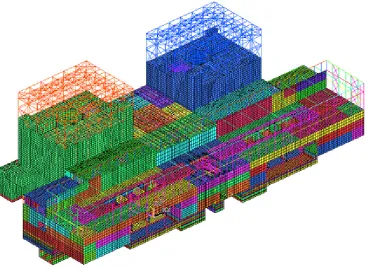
response for SPRA purposes, SSI analysis with incoherency effects was performed considering 100 incoherent modes, taking advantage of the full foundation footprint of approximately 192,400 square feet. ISRS comparison of coherent versus incoherent response for a typical location is provided in Figure 10, demonstrating a reduction of high-frequency response amplitude by as much as 45%. By using SASSI with HPC, performing such refined SSI analysis for the purpose of capturing ground motion incoherency effects was a viable and economical approach to ensure realism and accuracy for risk assessment.
Figure 9: Nuclear Power Block FE for SSI with Ground Motion Incoherency
Figure 10: Example ISRS Comparison from Coherent vs. Incoherent Ground Motion Input
CONCLUSIONS
Expanded SASSI capabilities via HPC functionality allows two primary advantages that lead to project gains: (1) large increases in permissible model sizes (i.e. larger number of interaction nodes); and (2) drastically reduced analysis run-time. These two primary advantages allow direct and rigorous treatment of SSI phenomena that previously required gross simplification, compromise, sensitivity studies, and/or overly conservative assumptions. More specifically, SASSI with HPC allows project improvements in areas such as (a) deep embedment with soft soil and high-frequency hazard, (b) structure-soil-structure interaction, (c) combined high-fidelity models for coupled stress analysis and seismic analysis, (d) probabilistic SSI analysis, (e) multiple configurations and/or alternate boundary conditions, (f) multiple hazard levels, and (g) ground motion incoherency effects.
Project examples illustrated herein demonstrate that HPC capabilities in SASSI allow treatment of complex SSI phenomena more rigorously and realistically than traditional SASSI approaches, at the same time as being faster and more efficient. When implemented to their maximum potential, HPC enhancements in SASSI can lead to project gains by reducing cost, schedule, and risk.
ACKNOWLEDGEMENTS
The examples cited in this report were partially supported by project collaboration with Entergy Nuclear, Exelon Corporation, Tennessee Valley Authority, AREVA Inc., Waste Control Specialists, Facility Risk Consultants, and Enercon Services, Inc. The authors acknowledge and are grateful for their support.
REFERENCES
EPRI (2007). “Program on Technical Innovation: Effect of Spatial Incoherence on Seismic Ground Motions,” Electric Power Research Institute, Palo Alto, USA, 1015110.
Ghiocel, D.M. (2013). “Comparative Studies on Seismic Incoherent SSI Analysis Methodologies,”
Transactions of the 22nd International Conference on Structural Mechanics in Reactor Technology,
San Francisco, California, USA.
Kosbab, B., Li, W., Stewart, M., and Drake, R. (2016). “Probabilistic Soil-Structure Interaction Analysis of Nuclear Power Plant Structures for Seismic Probabilistic Risk Assessment,” U.S. Department of
Energy (DOE) Natural Phenomena Hazards (NPH) Workshop, Germantown, Maryland, USA.
Lysmer, J., Tabatabaie, M., Tajirian, F., Vahdani, S., and Ostadan, F. (1981). “SASSI – A System for Analysis of Soil-Structure Interaction,” Report No. UCB/GT/81-02, Geotechnical Engineering,
Department of Civil Engineering, University of California, Berkeley, USA.
Richter, T., Wong, C., and Loseke, B. (2015). “Seismic SSI Analysis of US EPRTM Nuclear Island Using
Direct Method,” Transactions of the 23rd International Conference on Structural Mechanics in
Reactor Technology, SMiRT, Manchester, United Kingdom.
Roy, C., Eggers, D., and Bolourchi, S. (2011). “A cascade analysis to account for structure-soil-structure interaction effects,” Transactions of the 21st International Conference on Structural Mechanics in
Reactor Technology, SMiRT, New Delhi, India.
SC Solutions (2017). “System for Analysis of Soil-Structure Interaction”, SC-SASSI version 2.1.14, Sunnyvale, California, USA.
Tabatabaie, M., Sumodobila, B., Wong, C., Fisher, D.B., and Oswald, T. (2011). “Detailed Finite Element Modeling of US EPRTM Nuclear Island for Seismic SSI Analysis,” Transactions of the 21st
International Conference on Structural Mechanics in Reactor Technology, SMiRT, New Delhi,
India.