ISSN: 2319-8753
I
nternational
J
ournal of
I
nnovative
R
esearch in
S
cience,
E
ngineering and
T
echnology
(An ISO 3297: 2007 Certified Organization)
Vol. 3, Issue 7, July 2014
Copyright to IJIRSET www.ijirset.com
14880
Sound Velocity, Densities and Excess Parameter
Studies on 1, 4-Dioxane with 1-Hexanol at the
Temperature T= (298.15 To 318.15) K
Anil Kumar K
1, Dr Srinivasu Ch
2Assistant Professor, Department of Physics, Sri Vani School of Engineering, Chevuturu, A P, India1
Reader in Physics, Department of Physics, Andhra Loyola College, Vijayawada-8, A P, India2
ABSTRACT: Sound velocity, densities of binary mixture of 1,4-dioxanewith 1-hexanol has been measured over the entire range of composition using Anton Paar at (T=298.15, 303.15, 308.15, 313.15 & 318.15) K. The Excess parameters viz., deviations in isentropic compressibility (∆Ks), excess molar volumes (VmE), excess free length (LfE), excess acoustic
impedance (ZE) , excess sound velocity (uE) are deduced from experimental values and discussed intermolecular interactions present in the mixture. At the end, all the parameters have been fitted to Redlich-Kister equation and their coefficients are obtained.
KEY WORDS: Sound velocity; Densities; Excess parameters; 1,4-dioxane ; 1-hexanol
I. INTRODUCTION
Day to day knowledge of thermodynamic and transport properties liquid/liquid mixtures are essential for the proper design of any chemical industrial processes. 1,4-dioxane is used in polymerization processes is a cyclic ether, an excellent solvent very often used in the manufacture of special chemicals, pesticides, bulk drug intermediates and 1-hexanol is a substance heavily used in the pharmaceutical industry as a solvent, an extraction agent, in processes that produce medicine flavors and
in wastewater treatment [1,2]. According to Lagemann and Dunbar et al [3] pointed out the sound velocity approach for the
qualitative estimation of interaction in liquids. A parallel measurement of sound velocity, density of liquid mixtures allows one to obtain information about their excess compressibility, volume, free length, acoustic impedance, internal pressure and changes in their properties. Complex formations, formation of hydrogen bond, Dipole – dipole, dipole- induced dipole interactions in solutions and their effect in physical properties of the mixture have received much attention. Also, Romero
et al [4] measured speeds of sound of the binary mixtures of 1,3-dioxolane (or 1,4-dioxane) + cyclopentane (or
cyclohexane, or benzene) at 283.15, 298.15, and 313.15 K. The excess isentropic compressibilities were calculated from experimental data and fitted with a Redlich-Kister polynomial function. Results were analyzed taking into account molecular interactions and structural effects in the mixtures.
In this paper, sound velocity, density of binary mixture 1,4-dioxane with hexnaol have been measured at (T=298.15, 303.15, 308.15, 313.15 & 318.15) K over the entire range of composition using Anton Paar DSA 5000M. From the experimental values, deviations in isentropic compressibility (∆Ks), excess molar volumes (VmE), excess free length (LfE),
ISSN: 2319-8753
I
nternational
J
ournal of
I
nnovative
R
esearch in
S
cience,
E
ngineering and
T
echnology
(An ISO 3297: 2007 Certified Organization)
Vol. 3, Issue 7, July 2014
Copyright to IJIRSET www.ijirset.com
14881
II. EXPERIMENTAL
Materials & Measurements: The measurements were performed using the sound analyzer incorporated in the Anton Paar
device, model DSA 5000M, equipped with the machine sampler SP-1m (Anton Paar; carousel with 24 vials, 55 cm3 each).
All controls, adjustments, and checks were done using manufacturer‟s software system put in within the device. A laptop connected to the U tube densimeter enabled us to read the raw data from the device memory and to perform the ensuing analysis. Mole fractions of these samples were determined by measuring the mass of each component with a precision balance (Sartorius, model CP 225D, +/-0.01mg).
1,4-dioxane and 1-hexanol with mass fraction purities >0.998 were purchased from Aldrich Chemical Co. the chemicals were kept in airtight stopped glass bottles were performed in an isothermal mode; that is, the measurements of all prepared solution were done at the similar explicit temperature, then the temperature was changed and the measurements were perennial. The instrument in calibrated with the double distilled water (as suggested by Anton-Paar) for sound velocity and density at room temperature. The accuracy of density measurements was 5*10−6 g·cm−3, and also the temperature of the equipment was maintained constant to within ± 0.01 K.
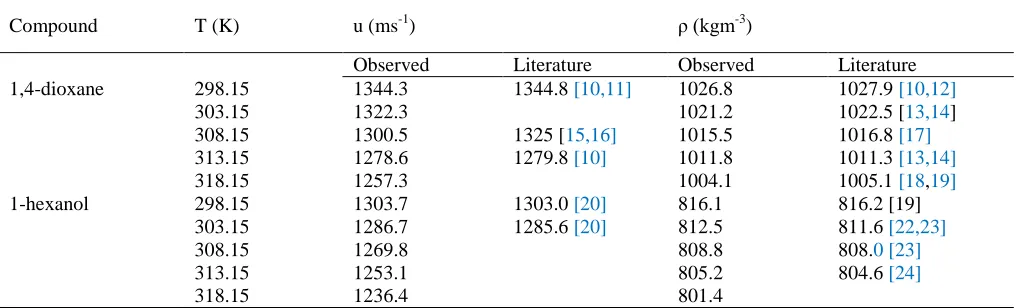
Table 1 Comparison of Experimental sound velocity, density of Pure Liquids with Literature values at (298.15, 303.15, 308.15, 313.15, and 318.15) K
III. THEORY
Using the measured values of data, we can calculate the various thermo acoustical parameters such as Isentropic
compressibility Ks = 2
1
U
(1)Molar volume
V
M
(where1 1 2 2
MM X M X ) (2)
Free length
1 2
f ad
L
K
(where K is Jacobson‟s constant) (3)
Compound T (K) u (ms-1) ρ (kgm-3)
Observed Literature Observed Literature
1,4-dioxane 298.15 1344.3 1344.8 [10,11] 1026.8 1027.9 [10,12]
303.15 1322.3 1021.2 1022.5 [13,14]
308.15 1300.5 1325 [15,16] 1015.5 1016.8 [17]
313.15 1278.6 1279.8 [10] 1011.8 1011.3 [13,14]
318.15 1257.3 1004.1 1005.1 [18,19]
1-hexanol 298.15 1303.7 1303.0 [20] 816.1 816.2 [19]
303.15 1286.7 1285.6 [20] 812.5 811.6 [22,23]
308.15 1269.8 808.8 808.0 [23]
313.15 1253.1 805.2 804.6 [24]
ISSN: 2319-8753
I
nternational
J
ournal of
I
nnovative
R
esearch in
S
cience,
E
ngineering and
T
echnology
(An ISO 3297: 2007 Certified Organization)
Vol. 3, Issue 7, July 2014
Copyright to IJIRSET www.ijirset.com
14882
Specific acoustic impedance Z = U ρ (4)
The strength of interaction between the component molecules of binary mixtures is well reflected in the deviation of the excess functions from ideality. The excess thermodynamic properties such as ∆Ks, VmE, LfE, ZE and uE have been calculated
using the following equation
)
(
x
1y
1x
2y
2Y
Y
mixE
(5)
where x1 and x2 are mole fractions of 1,4-dioxane and 1-hexanol respectively.
Further, the excess parameters also fitted to Redlich – Kister polynomial equation to estimate the adjustable parameters.
n i i i Ex
a
x
x
Y
0 21
(
1
2
)
(6)
by the least-squares regression method, the co-efficients ai were obtained by fitting above equation to the experimental
values. The optimum number of coefficients is ascertained from an examination of the variation in standard deviation (σ)
2 / 1 2 exp
)
(
)
(
n
N
Y
Y
Y
t calc
(7)(N is the number of data points and n is the degree of fitting i.e., number of coefficients)
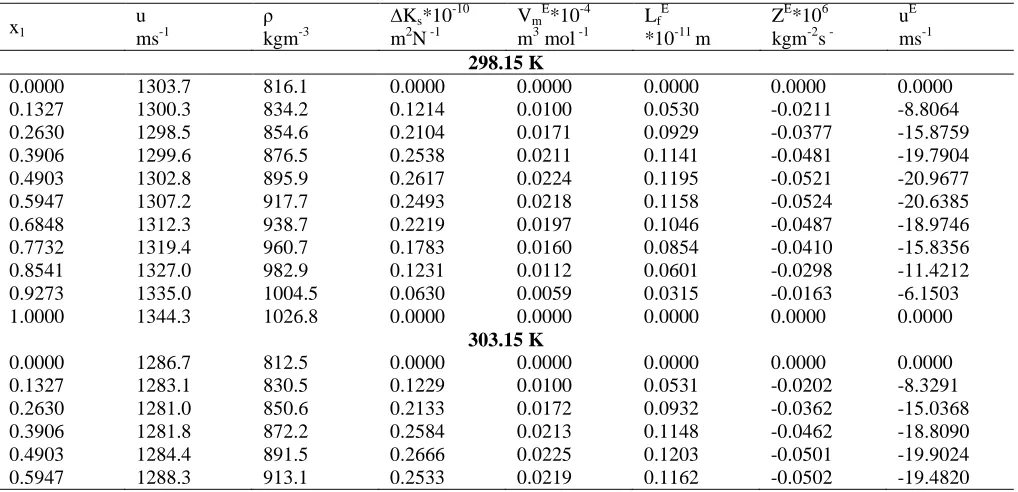
Table 2(a)
Sound velocity (u), Densities (ρ), deviations in isentropic compressibility (∆Ks), excess molar volumes (Vm E
), excess free length (LfE), excess acoustic impedance (ZE) and excess sound velocity (uE) at 298.15 to 318.15 K for 1,4-dioxane
(1) +1-hexanol (2) system
x1
u ms-1
ρ kgm-3
∆Ks*10-10
m2N -1
VmE*10-4
m3 mol -1
LfE
*10-11 m
ZE*106 kgm-2s
-uE ms-1
298.15 K
0.0000 1303.7 816.1 0.0000 0.0000 0.0000 0.0000 0.0000
0.1327 1300.3 834.2 0.1214 0.0100 0.0530 -0.0211 -8.8064
0.2630 1298.5 854.6 0.2104 0.0171 0.0929 -0.0377 -15.8759
0.3906 1299.6 876.5 0.2538 0.0211 0.1141 -0.0481 -19.7904
0.4903 1302.8 895.9 0.2617 0.0224 0.1195 -0.0521 -20.9677
0.5947 1307.2 917.7 0.2493 0.0218 0.1158 -0.0524 -20.6385
0.6848 1312.3 938.7 0.2219 0.0197 0.1046 -0.0487 -18.9746
0.7732 1319.4 960.7 0.1783 0.0160 0.0854 -0.0410 -15.8356
0.8541 1327.0 982.9 0.1231 0.0112 0.0601 -0.0298 -11.4212
0.9273 1335.0 1004.5 0.0630 0.0059 0.0315 -0.0163 -6.1503
1.0000 1344.3 1026.8 0.0000 0.0000 0.0000 0.0000 0.0000
303.15 K
0.0000 1286.7 812.5 0.0000 0.0000 0.0000 0.0000 0.0000
0.1327 1283.1 830.5 0.1229 0.0100 0.0531 -0.0202 -8.3291
0.2630 1281.0 850.6 0.2133 0.0172 0.0932 -0.0362 -15.0368
0.3906 1281.8 872.2 0.2584 0.0213 0.1148 -0.0462 -18.8090
0.4903 1284.4 891.5 0.2666 0.0225 0.1203 -0.0501 -19.9024
ISSN: 2319-8753
I
nternational
J
ournal of
I
nnovative
R
esearch in
S
cience,
E
ngineering and
T
echnology
(An ISO 3297: 2007 Certified Organization)
Vol. 3, Issue 7, July 2014
Copyright to IJIRSET www.ijirset.com
14883
0.6848 1293.3 933.8 0.2245 0.0197 0.1046 -0.0466 -17.8088
0.7732 1299.4 955.7 0.1801 0.0160 0.0852 -0.0392 -14.8252
0.8541 1306.4 977.7 0.1250 0.0112 0.0602 -0.0285 -10.7420
0.9273 1313.8 999.1 0.0649 0.0059 0.0318 -0.0156 -5.8670
1.0000 1322.3 1021.2 0.0000 0.0000 0.0000 0.0000 0.0000
308.15 K
0.0000 1269.8 808.8 0.0000 0.0000 0.0000 0.0000 0.0000
0.1327 1266.0 826.6 0.1253 0.0101 0.0536 -0.0194 -7.9554
0.2630 1263.5 846.5 0.2173 0.0172 0.0939 -0.0348 -14.3064
0.3906 1263.9 868.0 0.2636 0.0213 0.1157 -0.0444 -17.8884
0.4903 1266.0 887.1 0.2724 0.0226 0.1214 -0.0482 -18.9430
0.5947 1269.4 908.5 0.2593 0.0220 0.1175 -0.0483 -18.5630
0.6848 1273.9 929.0 0.2302 0.0198 0.1058 -0.0449 -16.9819
0.7732 1279.4 950.7 0.1849 0.0161 0.0863 -0.0377 -14.1427
0.8541 1285.8 972.4 0.1285 0.0113 0.0609 -0.0274 -10.2479
0.9273 1292.6 993.7 0.0667 0.0059 0.0322 -0.0150 -5.5961
1.0000 1300.5 1015.5 0.0000 0.0000 0.0000 0.0000 0.0000
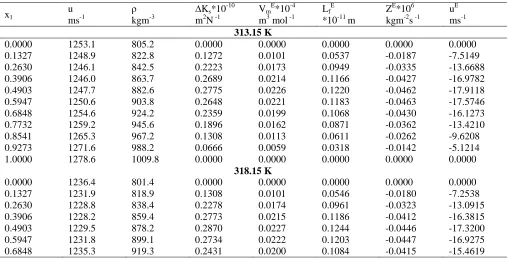
Table 2(b)
Sound velocity (u), Densities (ρ), deviations in isentropic compressibility (∆Ks), excess molar volumes (VmE), excess
free length (LfE), excess acoustic impedance (ZE) and excess sound velocity (uE) at 298.15 to 318.15 K for 1,4-dioxane
(1) +1-hexanol (2) system
x1
u ms-1
ρ kgm-3
∆Ks*10 -10
m2N -1
Vm E
*10-4 m3 mol -1
Lf E
*10-11 m
ZE*106 kgm-2s -1
uE ms-1
313.15 K
0.0000 1253.1 805.2 0.0000 0.0000 0.0000 0.0000 0.0000
0.1327 1248.9 822.8 0.1272 0.0101 0.0537 -0.0187 -7.5149
0.2630 1246.1 842.5 0.2223 0.0173 0.0949 -0.0335 -13.6688
0.3906 1246.0 863.7 0.2689 0.0214 0.1166 -0.0427 -16.9782
0.4903 1247.7 882.6 0.2775 0.0226 0.1220 -0.0462 -17.9118
0.5947 1250.6 903.8 0.2648 0.0221 0.1183 -0.0463 -17.5746
0.6848 1254.6 924.2 0.2359 0.0199 0.1068 -0.0430 -16.1273
0.7732 1259.2 945.6 0.1896 0.0162 0.0871 -0.0362 -13.4210
0.8541 1265.3 967.2 0.1308 0.0113 0.0611 -0.0262 -9.6208
0.9273 1271.6 988.2 0.0666 0.0059 0.0318 -0.0142 -5.1214
1.0000 1278.6 1009.8 0.0000 0.0000 0.0000 0.0000 0.0000
318.15 K
0.0000 1236.4 801.4 0.0000 0.0000 0.0000 0.0000 0.0000
0.1327 1231.9 818.9 0.1308 0.0101 0.0546 -0.0180 -7.2538
0.2630 1228.8 838.4 0.2278 0.0174 0.0961 -0.0323 -13.0915
0.3906 1228.2 859.4 0.2773 0.0215 0.1186 -0.0412 -16.3815
0.4903 1229.5 878.2 0.2870 0.0227 0.1244 -0.0446 -17.3200
0.5947 1231.8 899.1 0.2734 0.0222 0.1203 -0.0447 -16.9275
ISSN: 2319-8753
I
nternational
J
ournal of
I
nnovative
R
esearch in
S
cience,
E
ngineering and
T
echnology
(An ISO 3297: 2007 Certified Organization)
Vol. 3, Issue 7, July 2014
Copyright to IJIRSET www.ijirset.com
14884
0.7732 1239.7 940.5 0.1957 0.0162 0.0886 -0.0349 -12.8908
0.8541 1244.9 961.9 0.1367 0.0113 0.0627 -0.0254 -9.3880
0.9273 1250.6 982.7 0.0716 0.0059 0.0334 -0.0139 -5.1758
1.0000 1257.3 1004.1 0.0000 0.0000 0.0000 0.0000 0.0000
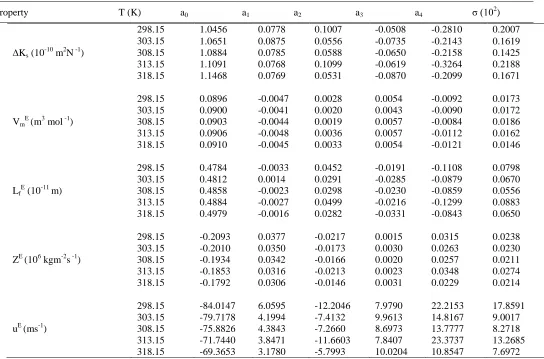
Table 3
Coefficients (ai) and standard deviation (σ) for 1,4-dioxane (1) + 1-hexanol (2)
298.15 1.0456 0.0778 0.1007 -0.0508 -0.2810 0.2007
303.15 1.0651 0.0875 0.0556 -0.0735 -0.2143 0.1619
∆Ks (10 -10
m2N -1) 308.15 1.0884 0.0785 0.0588 -0.0650 -0.2158 0.1425
313.15 1.1091 0.0768 0.1099 -0.0619 -0.3264 0.2188
318.15 1.1468 0.0769 0.0531 -0.0870 -0.2099 0.1671
298.15 0.0896 -0.0047 0.0028 0.0054 -0.0092 0.0173
303.15 0.0900 -0.0041 0.0020 0.0043 -0.0090 0.0172
VmE (m3 mol -1) 308.15 0.0903 -0.0044 0.0019 0.0057 -0.0084 0.0186
313.15 0.0906 -0.0048 0.0036 0.0057 -0.0112 0.0162
318.15 0.0910 -0.0045 0.0033 0.0054 -0.0121 0.0146
298.15 0.4784 -0.0033 0.0452 -0.0191 -0.1108 0.0798
303.15 0.4812 0.0014 0.0291 -0.0285 -0.0879 0.0670
LfE (10-11 m) 308.15 0.4858 -0.0023 0.0298 -0.0230 -0.0859 0.0556
313.15 0.4884 -0.0027 0.0499 -0.0216 -0.1299 0.0883
318.15 0.4979 -0.0016 0.0282 -0.0331 -0.0843 0.0650
298.15 -0.2093 0.0377 -0.0217 0.0015 0.0315 0.0238
303.15 -0.2010 0.0350 -0.0173 0.0030 0.0263 0.0230
ZE (106 kgm-2s -1) 308.15 -0.1934 0.0342 -0.0166 0.0020 0.0257 0.0211
313.15 -0.1853 0.0316 -0.0213 0.0023 0.0348 0.0274
318.15 -0.1792 0.0306 -0.0146 0.0031 0.0229 0.0214
298.15 -84.0147 6.0595 -12.2046 7.9790 22.2153 17.8591
303.15 -79.7178 4.1994 -7.4132 9.9613 14.8167 9.0017
uE (ms-1) 308.15 -75.8826 4.3843 -7.2660 8.6973 13.7777 8.2718
313.15 -71.7440 3.8471 -11.6603 7.8407 23.3737 13.2685
318.15 -69.3653 3.1780 -5.7993 10.0204 10.8547 7.6972
ISSN: 2319-8753
I
nternational
J
ournal of
I
nnovative
R
esearch in
S
cience,
E
ngineering and
T
echnology
(An ISO 3297: 2007 Certified Organization)
Vol. 3, Issue 7, July 2014
Copyright to IJIRSET www.ijirset.com
14885
IV. RESULTS AND DISCUSSION
The values of sound velocities and densities for pure liquids are experimentally measured and are compared with the literature values and they are good agreement with each other as given in the table-1. The experimental data related to ∆Ks,
VmE, LfE, ZE and uE for the binary liquid mixture at different temperatures are given in tables-2 (a), 2 (b). Redlich-Kister
coefficients of the various parameters at different temperatures with respective standard deviations are reported in table- 3.
Deviation in Isentropic Compressibility (∆Ks)
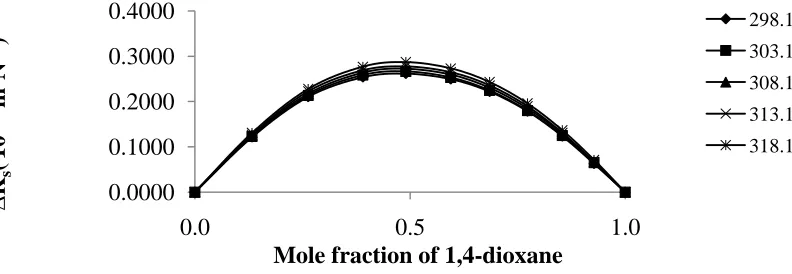
The values of deviation in isentropic compressibility for 1, 4-dioxane + 1-hexanol binary mixture studied at five different
temperatures are given in tables 2 (a), 2 (b).The corresponding plots of deviation in isentropic compressibility against mole
fraction of 1, 4-dioxane are plotted in Fig 1. The ∆Ks plots are more positive at intermediate composition x1 =0.5. The
positive values of ΔKs suggest that the mixture is more compressible than the corresponding ideal mixture. This leads decrease of strength of the interactions between component molecules in the mixture.
Excess molar volume (Vm E
)
Fig.2 shows the excess molar volumes VmE in the case of 1, 4-dioxane +1-hexanol are found to be more positive at x1 = 0.5
at all temperatures studied. The positive values of excess molar volumes suggest that the mixture prefers to have loose structure than compact structure in the solutions [25] i.e. weak intermolecular interactions are present in the mixtures.
0.0000
0.1000
0.2000
0.3000
0.4000
0.0
0.5
1.0
∆K
s
(
10
-10
m
2
N
-1)
Mole fraction of 1,4-dioxane
Fig. 1 - Variation of deviations in isentropic compressibility ∆Kswith mole fraction of
1,4-dioxane + pentanol system at different temperatures
298.15 K
303.15 K
308.15 K
313.15 K
ISSN: 2319-8753
I
nternational
J
ournal of
I
nnovative
R
esearch in
S
cience,
E
ngineering and
T
echnology
(An ISO 3297: 2007 Certified Organization)
Vol. 3, Issue 7, July 2014
Copyright to IJIRSET www.ijirset.com
14886
Excess free length (LfE)
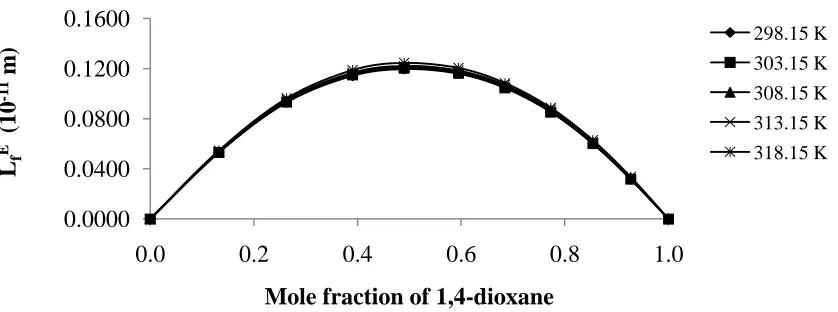
The values of „LfE‟ for 1,4-dioxane +1-hexanol binary mixture studied at five different temperatures are presented in tables
2(a), 2(b) respectively, and there corresponding plots against mole fraction of 1,4-dioxane are shown in Fig. 3 shows
more positive values at x1=0.5over the entire range of composition of 1,4-dioxane at all five temperatures studied.
According to Wankhede [26] the positive values of LfE is an indication of dispersive forces are operating in the liquid
mixtures and it is showing the presence of weak interactions in the mixture .This also reveals the presence of week interactions in these mixtures.
0.0000
0.0100
0.0200
0.0300
0.0
0.2
0.4
0.6
0.8
1.0
V
mE
(10
-4
m
3
m
ol
-1
)
Mole fraction of 1,4-dioxane
Fig. 2 - Variation of excess molar volumes VmE with mole fraction of 1,4-dioxane +
pentanol system at different temperatures
298.15 K
303.15 K
308.15 K
313.15 K
318.15 K
0.0000
0.0400
0.0800
0.1200
0.1600
0.0
0.2
0.4
0.6
0.8
1.0
L
fE
(10
-11
m)
Mole fraction of 1,4-dioxane
Fig. 3 - Variation of excess free length LfEwith mole fraction of 1,4-dioxane + pentanol
system at different temperatures
298.15 K
303.15 K
308.15 K
313.15 K
ISSN: 2319-8753
I
nternational
J
ournal of
I
nnovative
R
esearch in
S
cience,
E
ngineering and
T
echnology
(An ISO 3297: 2007 Certified Organization)
Vol. 3, Issue 7, July 2014
Copyright to IJIRSET www.ijirset.com
14887
Excess Acoustic Impedance (ZE)
Further, the calculated values of excess acoustic impedance (ZE) of binary mixture at all temperatures studied are negative.
The corresponding plots are shown in fig- 4 shows; the excess acoustic impedance becomes more negative at 0.5947 mole
fraction of the binary mixture. The negative values ZE[6,27] suggests that breaking of hydrogen bond in 1-hexanol up to
0.5947 and after that it decreases and hence it leads to close packing of the structure. This shows weak molecular interactions between the components of the mixture exists.
Excess Ultrasonic Velocity (uE)
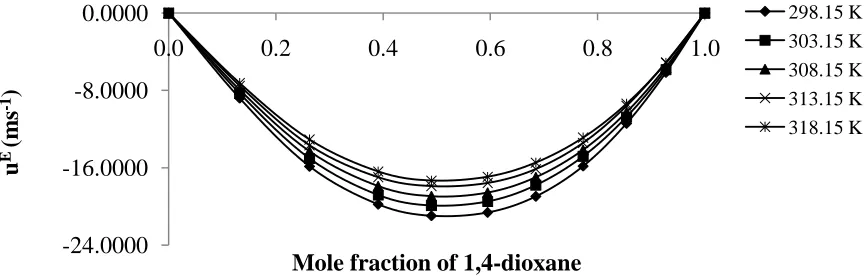
Figs4,5 show that behaviors of ZE and uE support each other both exhibit negative deviations over the entire composition
range of 1,4-dioxane in the mixture at all five temperatures. The negative deviations suggested dispersion forces are
operative in the system. Similar observations are reported by A Ali et al [8] on the binary mixtures 2,2,4-trimethyl pentane
with n-hexane and cyclohexane.
On close observation of Table 2(a), 2(b) the values of ∆Ks and VmE are positive at all temperatures studied. An increase in
∆Ks denotes highly compressible, weakening of inter-molecular interactions i.e., the hetro molecular (1,4-dioxane +
1--0.0600
-0.0400
-0.0200
0.0000
0.0
0.2
0.4
0.6
0.8
1.0
Z
E
(10
6k
gm
-2
s
-1)
Mole fraction of 1,4-dioxane
Fig. 4 - Variation of excess acoustic impedance ZEwith mole fraction of 1,4-dioxane +
pentanol system at different temperatures
298.15 K
303.15 K
308.15 K
313.15 K
318.15 K
-24.0000
-16.0000
-8.0000
0.0000
0.0
0.2
0.4
0.6
0.8
1.0
u
E
(m
s
-1
)
Mole fraction of 1,4-dioxane
Fig. 5 - Variation of excess ultrasonic velocity with mole fraction of 1,4-dioxane + pentanol system at different temperatures
298.15 K 303.15 K
308.15 K
ISSN: 2319-8753
I
nternational
J
ournal of
I
nnovative
R
esearch in
S
cience,
E
ngineering and
T
echnology
(An ISO 3297: 2007 Certified Organization)
Vol. 3, Issue 7, July 2014
Copyright to IJIRSET www.ijirset.com
14888
hexanol) not only disturb the homo molecular (1,4-dioxane molecules), (1-hexanol molecules) interactions in components liquids but also causes a re-arrangement in the geometry of the clusters of molecules in such a way volume of the mixture i.e., excess molar volume would be positive [28]. The sign and magnitude of ∆Ks and VmE play a vital role in assessing the
molecular interactions in the liquid mixtures. In general negative values of ∆Ks and VmE indicates strong interaction in the
mixture which include charge-transfer, diploe-dipole, dipole-induced dipole interactions and interstitial accommodation of the smaller molecules into the spaces created by bigger molecules, while positive signs of these parameters are indicative
of weakening of interactions between the component molecules [29].
Also, the values of ∆Ks & Lf E
(Fig 1,3) are found to be positive over the entire range of mole fraction of 1,4-dioxane in the mixture at all studied temperatures. The sign of excess properties plays a vital role in assessing the compactness or extent of molecular interactions. The various types of interactions that are operating between the molecules are dispersion forces, which should make a positive contribution to excess values and charge transfer, H-bonding, dipole-dipole interaction and dipole-induced dipole interactions expected to make positive contributions. In the present mixture as ∆Ks & LfE are
positive suggesting dispersive forces are present in the mixture [26].
V. CONCLUSION
Sound velocity and density for binary mixture consist of 1,4-dioxane with 1-hexanol system are measured at T=(298.15 to 318.15) K using Anton-Paar. The calculated excess parameters are discussed and concluded the presence of weak dispersion forces in the mixture.
VI. ACKNOWLEDGEMENT
The author (AK) is grateful to the Andhra Loyola College (Autonomous) NAAC re-accredited at „A‟ grade with 3.65/4.00 points, Vijayawada-8. For allowing the author to avail laboratory facilities of the Department of Physics, thank s extended to Dr Ch Srinivasu for giving fruitful discussions and suggestions.
REFERENCES
[1] B. Sambi Reddy, K. Venkateswara Rao, “Measurement and correlation of binary vapor–liquid equilibria of isomeric butanols with 1,4-dioxane”, Fluid Phase Equilibria 264, pp.76-85, 2008.
[2] Bae E, Chah S, Yi J H, “Preparation and Characterization of Ceramic Hollow Microspheres for Heavy-Metal Ion Removal inWaste-Water”, J. Colloid Interface Sci. 230, pp.367-376, 2000.
[3] Lagemann RT and Dunbar W S. J Phys Chem. 49 (1945) 42.
[4] C. M. Romero et al, “Speeds of Sound and Isentropic Compressibilities for Binary Mixtures of a Cyclic Diether with a Cyclic Compound at Three Temperatures”, International Journal of Thermophysics, 27(3) 2006.
[5] D.S. Wankhede, N.N. Wankhede, M.K. Lande, B.R. Arbad, “Densities and ultrasonic velocities of some oxygen containing compounds”, Journal of Molecular Liquids, 138, pp.124-129, 2008.
[6] Anil Kumar K, Srinivasu Ch, Raju KTSS, “Ultrasonic velocities and Excess properties of binary mixture of 1, 4-Dioxane + 1-Butanol at Temperatures between (298.15 and 318.15) K”, Journal of Chemical, Biological and Physical Sciences, 3, No.4, pp.2914-2923,2013.
[7] Anil K. Nain, Prakash Chandra, Jata D Pandey, Swarita Gopal, “Densities, Refractive Indices, and Excess Properties of Binary Mixtures of 1,4-Dioxane with Benzene, Toluene, o-Xylene, m-Xylene, p-Xylene, and Mesitylene at Temperatures from (288.15 to 318.15) K”, Journal of Chemical & Engineering Data, 53, No.11, pp. 2654–2665, 2008.
[8] A Ali, Abida, S Hyder and A K Nain, “ultrasonic, volumetric and viscometric study of molecular interactions in binary mixtures of 2,2,4-trimethyl pentane with n-hexane and cyclohexane at 308 K”, Indian J. Phys. 76 B-5, pp.661-667, 2002.
[9] K. Anil Kumar, Ch. Srinivasu, Sk.Fakruddin, K. Narendra, “Acoustical Behavior of Molecular Interactions in Binary Liquid Mixture Containing 1-Butanol and Hexane at Temperatures 298.15K, 303.15K and 308.15K”, International Journal of Pharmaceutical and Chemical Sciences, 3(1), pp.10-13, 2014.
[10] A. Villares, S. Martın, M. Haro, B. Giner,H. Artigas, “Densities and speeds of sound for binary mixtures of (1,3-dioxolane or 1,4-dioxane) with (2-methyl-1-propanol or 2-methyl-2-propanol) at the temperatures (298.15 and 313.15) K”, J. Chem. Thermodynamics 36, pp.1027-1036, 2004.
ISSN: 2319-8753
I
nternational
J
ournal of
I
nnovative
R
esearch in
S
cience,
E
ngineering and
T
echnology
(An ISO 3297: 2007 Certified Organization)
Vol. 3, Issue 7, July 2014
Copyright to IJIRSET www.ijirset.com
14889
[12] J.A. Riddick, W.B. Bunger, T.K.Sakano. Organic Solvents.Techniques of Chemistry, vol. II, fourth ed., Wiley/Interscience,New York, (1986). [13] Corradini F, Franchini G. C, Marcheselli L, Tassi L, Tosi G, “Densities and Excess Molar Volumes of 2-Methoxyethanol/Water Binary Mixtures”, Aust. J. Chem. 45, pp.1109-1117, 1992.
[14] Ahmad Golzari Oskoei, Jahanbakhsh Ghasemi et al., “Densities and Viscosities for Binary and Ternary Mixtures of 1, 4-Dioxane + 1-Hexanol + N,N-Dimethylaniline from T ) (283.15 to 343.15) K”, J. Chem. Eng. Data 53, pp.343-349, 2008.
[15] S. Rodriguez, C. Lafuente, H. Artigas, F.M. Royo, J.S. Urieta, “Densities, speeds of sound, and isentropic compressibilities of a cyclic ether with chlorocyclohexane, or bromocyclohexane at the temperatures 298.15 K and 313.15 K”, J. Chem. Thermodyn. 31, 139,1999.
[16] Satish Kumar, V.K.Sharma et al., “Thermodynamic and acoustic properties for binary and ternary mixtures of cyclic ethers with industrially important solvents at 308.15 K”, Journal of Molecular Liquids, 155, pp. 8-15, 2010.
[17] Mousumi Das and Mahendra N. Roy, “Studies on Thermodynamic and Transport Properties of Binary Mixtures of Acetonitrile with Some Cyclic Ethers at Different Temperatures by Volumetric, Viscometric, and Interferometric Techniques”, J. Chem. Eng. Data 51, pp.2225-2232, 2006.
[18] Masao Sakurai, “Partial molar volumes for 1,4-dioxane + water”, J. Chem. Eng. Data, 37, pp.492-496, 1992.
[19] Muhammad a. saleh, Shamim akhtar, M. shamsuddin ahmed, “Excess molar volumes and thermal expansivities of aqueous solutions of dimethylsulfoxide, tetrahydrofuran and 1,4-dioxane”, Phys. Chem. Liq. 40(5), pp.621-635, 2002.
[20] Ismael Mozo, Isaías García de la Fuente, et al., “Densities, Excess Molar Volumes, Speeds of Sound at (293.15, 298.15, and 303.15) K and Isentropic Compressibilities at 298.15 K for 1-Butanol, 1-Pentanol, or 1-Hexanol + Dibutylether Systems”, J.Chem. Eng. Data, 53, pp.857-862, 2008.
[19] Angel Pineiro, Pilar Brocos et al, “Ramon Bravo, Refractive Indexes of Binary Mixtures of Tetrahydrofuran with 1-Alkanols at 25°C and Temperature Dependence of n and ρ for the Pure Liquids”, J. Solution Chemistry, 31 No. 5, 369, 2002.
[22] Mehdi Hasan,Ujjan B. Kadam, Apoorva P, “Densities, Viscosities, and Sound velocity Studies of Binary Mixtures of Chloroform with Pentan-1-ol, Hexan-1-ol, and Heptan-1-ol at (303.15 and 313.15) K”, J. Chem. Eng. Data. 51, pp.671-675, 2006.
[23] Javier Vijande, Manuel M. Pineiro, “Density and Surface Tension Variation with Temperature for Heptane + 1-Alkanol”, J.Chem. Eng. Data, 51, pp.778-1782, 2006.
[24] Kamalendra N. Das,M. Habibullah, “Thermodynamic Properties of the Binary Mixture of Hexan-1-ol with m- Xylene at T = (303.15, 313.15, and 323.15) K”, J. Chem. Eng. Data, 54, pp.3300-3302, 2009.
[25] Amalendu Pal and Rekha Gaba, “ Densities, excess molar volumes, speeds of sound and isothermal compressibilities for {2-(2-hexyloxyethoxy) ethanol + n-alkanol} systems at temperatures between (288.15 and 308.15) K” J. Chem. Thermodynamics 40, pp.750-758, 2008.
[26] D S Wankhede et al, “Ultrasonic velocities and refractive indices of binary mixtures of propylene carbonate + n-alkanols” Indian Journal of Pure & Applied physics, 44, pp. 909-916, 2006.
[27] Shashi Singh et al, “Excess Acoustical and Volumetric Properties and the Theoretical Estimation of the Excess Thermodynamic Functions of Binary Liquid Mixtures”, Chinese Journal of Physics, 45(4), pp. 412-424, 2007.
[28] V.D Bhandakar et al, “Ultrasonic Study of Molecular Interactions in Binary Liquid Mixtures: Acrolien & Cinnamaldehyde in Methanol, Cyclohexane & P-Dioxane”, Inidan Journal of Pure & Applied Physics, 41, pp.849-854, 2003.