Vol. 4, Issue 3, March 2015
Security Enhancment on LEACH Protocol
From HELLO Flood Attack in WSN Using
LDK Scheme
Mayur S
1, Ranjith H.D
2P.G. Student, Dept.of ECE, MITE College (Affiliated to VTU, Belagavi), Moodbidri, Karnataka, India1 Assistant Professor, Dept.of ECE, MITE College (Affiliated to VTU, Belagavi), Moodbidri, Karnataka, India2
ABSTRACT:In many wireless sensor network (WSN) applications uses hierarchical routing protocol for routing sensed data to the sink, among them LEACH is the first and most widely used hierarchical distributed clustering protocol in WSN. Security is important in wireless sensor networks as they are prone to various network threats and intrusion. In LEACH, Nodes decides to join a cluster head based on Received Signal Strength (RSS) of receiving HELLO packets from CHs making it vulnerable to HELLO Flood attack. Detection of HELLO Flood attack can be done either cryptographic approach which are less suitable in terms of memory and battery power or non-cryptographic which involves sending the test packet for detection which increases communication overhead as the energy required for transmission of the packet is far more than the energy required for processing/calculation. Based on these facts a non-cryptographic and cryptographic solution for detection HELLO Flood attack is proposed in this paper in which by considering RSS and distance calculation and by comparing both test packet approach is done hence the number of times the test packet is transmitted is greatly reduced and providing security by using location dependent key(LDK) management scheme where it involves loading random set of keys to the nodes prior to deployment, and also LDK doesn’t require any knowledge of node deployment, eventually provides better connectivity and containment of node compromise.
KEYWORDS: wireless sensor network (WSN), LEACH, HELLO flood attack, Received Signal Strength(RSS), Cluster Head(CH), Security, Location Depended Key(LDK).
I. INTRODUCTION
Vol. 4, Issue 3, March 2015
II. RELATEDWORK
Heinzelman, et.al [5] introduced a dynamic, hierarchical clustering protocol for sensor networks, called LEACH (LowEnergy Adaptive Clustering Hierarchy) which minimizes energy dissipation in sensor networks. It is very famous hierarchical routing algorithms for sensor networks which make clusters of the sensor nodes based on the received signal strength. Detection of HELLO flood attack can be cryptography based or non-cryptography based approach here non cryptographic approach way of detecting is RSS (received signal strength) Signal Strength based HELLO Flood Attack Detection and Prevention in Wireless Sensor Networks using AODV protocol.[8]. Geographical information based approach. Coordinate approach with distance calculation. Simple approach with lesser detection time TEST packet Communication overhead[1]. Cryptographical approach where sharing a secret key between any two nodes. Key generated during communication and only reachable node can decrypt [3]. Random key pre-distribution and pair wise key distribution approach for symmetric key cryptography and dynamic cluster formation for different types of attacks[4][10]. A widely used approach for key management is based on the use of symmetric algorithmswhich assume that nodes share prior context before the network operation begins. This prior context is generally in the form of an offline secret key pre-distribution before network deployment. Thus the symmetric keys are loaded on the sensors before deployment. These keys are then used by the nodes after the nodes are deployed in order to set up a secure communication infrastructure for use during the operation of the network. And also based on nodes being deployed with a random set of keys have been disclosed in references [12], [13], [14] and [15]. Several solutions based on pre-deployed keying have been proposed, including approaches based on the use of a global key shared by all nodes [16], approaches in which every node shares a unique key with the base station [17]. Another approach based on idea of leveraging the spatial diversity of sensor nodes in addition to the diversity due to randomly loaded keys depending on their location of sensor node which is done without knowing the knowledge about the deployment or location of sensors[11] .
III. LEACH
Low Energy Adaptive Clustering Hierarchy (LEACH) is a self-organizing, adaptive clustering protocol that utilizes randomization to balance the energy load among the deployed nodes in the network. LEACH assumes that all nodes start with uniform energy distribution and all nodes can communicate directly with the base station. It works in two rounds the set-up and the steady-state. The set-up round is responsible for forming clusters and cluster heads. During this round sensors vote for themselves to be cluster heads at any given time with certain probability based on their energy. Next the cluster head advertises their status to other sensors in the network. Accordingly each sensor node decides the cluster that it wants to belong to by selecting the cluster head that needs the least amount of communication energy. Finally all the nodes are arranged into clusters each cluster head creates a schedule for the nodes in its cluster to avoid collision. This results in the network structure that consists of a base station or sink cluster heads that communicate with the sink and sensor nodes each is recognized by a cluster and communicated with its cluster head that is a single hop to the sink. The steady-state phase is concerned with transferring the data from the sensors in the network to the base station or sink node. During this phase the cluster head collects the data from the sensors in its cluster. Once the data is collected from all nodes in the cluster than the cluster head locally aggregates the data in some way based on the application to remove the unreliable data. Later the cluster head transmits the collected data to the base station. LEACH uses the local processing to reduce global communication and also randomizes the rotation of cluster heads. Therefore it prolongs the network’s life time. On the other hand it is not applicable to large networks and time-critical applications. In addition to this the idea of dynamic clustering brings extra overhead. Furthermore the cluster heads send data to the sink through high power link which make these clusters consume their energy faster.
IV. ATTACKS ON LEACH
Vol. 4, Issue 3, March 2015
a. Selective forwarding attack
A node would always faithfully forward the received messages to its destination. However a malicious node would refuse to forward certain messages and simply drop them ensuring that the message doesn’t reach the intended destination. This is called selective forwarding attack. A simple form of this attack is that the malicious node would act as a black-hole i.e. drops every message packet that arrives to it. But such nodes have the risk that the neighbouring nodes would consider them as dead nodes and would seek another route.Selective forwarding attacks are more effective when the attacker explicitly includes itself in the routing path of the data. Other ways of implementing selective forwarding is by jamming or causing collision on the transmitting information.
b. Sybil attack
In a Sybil Attack, the malicious node illegitimately can presents multiple identities to other nodes in the sensor networks. This is done either by creating new false identities or stealing identities of other nodes in the network. Sybil stack pose significant threats to location-based routing protocol. Therefore a single node may be used many times. This may cause many affects in the network such as increasing traffic, consuming energy, reducing network life time, packet dropping etc.
c. Hello flood attack
Many protocols require broadcasting HELLO packets by the sensor nodes to announce it to the neighboursthereby alerting them that it’s within their transmission range. But an adversary could flood false HELLO packets. Hence the nodes would consider it to be within the range while the adversary may be situated far from it. In such scenarios nodes would be unnecessarily transmitting message and hence draining its energy. Protocols which depend upon exchange of location information between the nodes are likely to be targets of such attack.
V. LOCATION DEPENDENT KEY (LDK)
The network scenario that we consider consists of resource constrained sensor nodes. Nodes can be added to this network at any point in time. The threat model that we consider assumes that the adversaries have very strong capabilities. The only constraint on their capability is that the adversaries will not be able to compromise a node for a small interval initially after the node is deployed. This interval can be of the order of milliseconds and not more than a couple of seconds. After this initial interval an adversary might be able to compromise any node. Once the node is compromised, the adversary has access to all the keying material on the node. Following such node compromise the adversary is able to eavesdrop on all the links that have been secured using the compromised keying material. Here we assume two types of nodes namely the regular sensor nodes as well as special nodes called anchor nodes. The only extra capability that an anchor node needs to have is the ability to transmit at different power levels. In the LDK Scheme, Sn is the number of sensor nodes and Sp is the number of special nodes and the following three phases are executed in their lifetime. These are
Pre-deployment phase
Initialization phase
Communication phase
Vol. 4, Issue 3, March 2015
information they can find out their common keys. Once the nodes have found their common keys they use their Ids to generate a common seed for Hashing functionis used to generate the secure pair-wise communication key which is used for encrypting communication between the sensor nodes. After which the whole process of key initialization takes place again which leads to next-generation of derived keys and a new pair-wise key. It has to be noted that the original key ring still remains with sensor node and is not deleted it is kept encrypted with common key K already loaded in the memory of sensor node and is done to have unique symmetric key between every pair of nodes in the network
VI. FLOW CHART OF PROPOSED METHOD
Vol. 4, Issue 3, March 2015
VII. SIMULATION RESULTS
a. Simulation scenario
Matlab simulator has been used for simulation purpose. A square area of 100m × 100m is considered for simulation experiments. The network topology consists of 100 stationary nodes. Initially, the nodes are randomly placed in fixed position. 1% of total number of nodes may have high transmission, receiving and carrier sensing power, one node is a base station. Various parameters taken for simulation and their values are given in Table 1.
Table 1:parameters used for simulation
b. Results
Survey and Implementation of the flow chart has been conducted without the enhancement of security scheme i.e. detection of HELLO flood based on RSS, distance and test packets approaches are made and respected results have been show below.
Vol. 4, Issue 3, March 2015
Fig 2: RSS based approch for 100th node
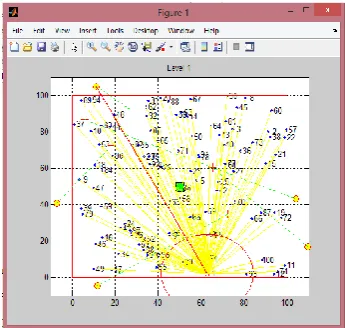
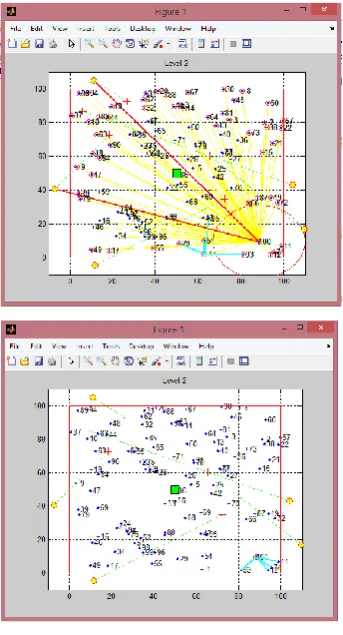
Infig 1&2 shows the calculation of RSS and compared with threshlod RSS (thRSS) of a node is done. if RSS<thRSS is friend orelse its adversary. This is done from 1stnode to 100th node.
Fig 4:distance based approch for 100th node
Vol. 4, Issue 3, March 2015
Fig 5: test packet based approch for 1st node
Fig 6: test paacket based approch for 100th node
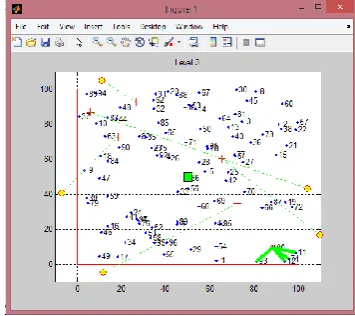
In Fig 5&6 shows packet based filtering this is done by analysing the RSS and also distance coparison which intends to send the test packets to the receiving node shown in green line.this is done for all nodes.
VIII. CONCLUSION
In this proposed worka new security framework for HELLO Flood is implemented and the results are analyzed which proves that it requires less computational power, hence is suitable for sensor networks. The new algorithm is implemented in Matlab by modifying LEACH protocol. HELLO Flood attack is generated by making selected adversary nodes send HELLO message using high transmission power as compared to regular nodes. The proposed approach is effective in improving the performance of the network. It results in lesser detection time & energy for detection and also results in smooth functioning of LEACH Protocol even under HELLO Flood Attack with minimal communication overhead.
REFERENCES
[1] Shikha Magotra, S.; Kumar, K., “Detection of HELLO flood attack on LEACH protocol,” Advance Computing Conference(IACC), 2014 IEEE International , vol., no., pp.193,198, 21-22 Feb. 2014.
[2] Heinzelman, W.R.; Chandrakasan, A.; Balakrishnan, H.; "Energy-efficient communication protocol for wireless microsensor networks," System Sciences, 2000. Proceedings of the 33rd Annual Hawaii International Conference on, vol. 2, pp.10 pp., 4-7 Jan. 2000.
Vol. 4, Issue 3, March 2015
[6] M. A. Vilaa , H. C. Wong ,M. Bern R. Dahab L. B. Oliveira, A. Ferreira and A. A. F. Loureiro “SecLEACH-on the security of clustered sensor networks,” vol.87, pp.2882-2895, December 2007.
[7] Virendra Pal Aishwarya S. Sweta Jain, “Signal Strength based HELLOFlood Attack Detection and Prevention in Wireless Sensor Networks,” International Journal of Computer Applications (0975 – 8887), Vol. 62, January 2013.
[8] A. V. Reddy R. Srinath and R. Srinivasan “Cluster based secure routing protocol for wsn,” Third International Conference on Networking andServices, pp.45, Washington, DC, USA, 2007.
[9] M.Shankar; M.Sridar; M.Rajani; “Performance Evaluation of LEACH Protocol in Wireless Network,” InternationalJournal of Scientific & Engineering Research, vol 3, Issue 1, January-2012.
[10] C.Wang K. Zhang and C.Wang “A secure routing protocol for cluster based wireless sensor networks”
[11] Farooq Anjum,”location dependent key management using random key-predistribution in sensor nodes “NJ 08854 ,2007.
[12] W. Du, J. Deng, Y. Han, and P Varsney. A pairwise key pre distribution system for wireless sensor networks. In In Proceedings of the Tenth ACM Conference on Computer and Communications Security (CCS 2003), pages 42-51, October 2003.
[13] W. Du, J. Deng, Y. S. Han, S. Chen, and P. K. Varshney. A key management scheme for wireless sensor networks using deployment knowledge In INFOCOM, 2004, April 2004.
[14] W. Du, J. Deng, Y. S. Han, P. Varshney, J. Katz, and A. Khalili. A pairwise key pre-distribution system for wireless sensor networks In ACM Transactions on Information and System Security (TISSEC), 2005.
[15] L. Eschenauer and V. Gligor. A key-management scheme for distributed sensor networks, in Proceedings of the 9th ACM conference on Computer and Communications Security, pages 41-47, November 2002.
[16] S. Basagni, K. Herrin, D. Bruschi, and F. Rosti. Secure pebblenet. Proceedings of the 2001 ACM international Symposium on Mobile Ad Hoc Networking and Computing MobiHoc, 2001, October 2001.