Job Performance? (Under the direction of Dr. Mark A. Wilson).
Polychronicity is the attitudinal element of one’s preferences for doing several things at once
while at work. Research involving polychronicity and performance outcomes has shown that polychronicity matters but empirical findings have generally been mixed. This study
by
Gary Igor Travinin
A thesis submitted to the Graduate Faculty of North Carolina State University
in partial fulfillment of the requirements for the Degree of
Master of Science
Psychology
Raleigh, North Carolina 2015
APPROVED BY:
Dr. S. Bartholomew Craig Dr. Adam W. Meade
DEDICATION
BIOGRAPHY
ACKNOWLEDGMENTS
First, I would like to thank and acknowledge the members of my committee: Mark Wilson, Bart Craig, and Adam Meade. Their feedback, guidance, and support in this process have been invaluable. I want to especially thank Mark Wilson for not only allowing me access to his data sample but also never giving up on me despite what I imagine must have been numerous reasons to do so.
Thank you as well to all of the friends in my life who have made every moment of stress bearable and remind me to smile in the face of disaster. There are literally hundreds of actions you may never remember that have helped me through a difficult day. For that I will always be grateful. I especially want to thank Alexandra Mullins and Courtney Williams Olls for their help with the data sample.
The love and support of my family also must be acknowledged. Knowing you were always there if I ever needed anything was an unbelievable support system and I want each of you to know that: Natalie Goldin, Gennady Oklander, and Nadya Bliss.
TABLE OF CONTENTS
LIST OF TABLES ... vi
LIST OF FIGURES ... vii
Polychronicity ...3
Needs-Supplies Person-Job Fit ...4
Fit on Polychronicty and Performance ...5
Personality Variables as Predictors of Polychronicity ...6
Method ...9
Participants ...9
Procedure ...9
Measures ...10
Analysis and Results ...15
Discussion...19
Practical Implications ...22
Limitations and Future Directions ...22
REFERENCES ...24
APPENDICES ...38
Appendix A. Inventory of Polychronic Values (IPV) ...39
Appendix B. Modified Inventory of Polychronic Values ...40
Appendix C. International Personality Item Pool (IPIP)- Conscientiousness ...41
Appendix D. International Personality Item Pool (IPIP)- Extraversion ...42
Appendix E. International Personality Item Pool (IPIP)- Openness to Experience ...43
Appendix F. International Personality Item Pool (IPIP)- Agreeableness ...44
Appendix G. International Personality Item Pool (IPIP)- Neuroticism ...45
Appendix H. Least Preferred Coworker Scale ...46
Appendix I. Overall Performance Measure ...47
Appendix J. Current Performance Measure ...48
Appendix K. Promotion Potential Measure ...52
Appendix L. Civic Virtue, Altruism, & Courtesy ...53
LIST OF TABLES
Table 1. Factor Analysis of Task Performance...30 Table 2. Summary of Intercorrelations, Means, and Standard Deviations ...31 Table 3. Results of Polynomial Regressions of Performance Indicators and NS Fit for
the Construct of Polychronicity ...32 Table 4. The Big Five as Predictors of Preferred Polychronicity, Regressed Separately
...33 Table 5. The Big Five as Predictors of Preferred Polychronicity, Multiple Regression
LIST OF FIGURES
Figure 1. Response surface plot between person-job fit on polychronicity and overall performance ...34 Figure 2. Response surface plot between person-job fit on polychronicity and promotion
potential...35 Figure 3. Response surface plot between person-job fit on polychronicity and
organizational citizenship behavior ...36 Figure 4. Response surface plot between person-job fit on polychronicity and current
A Study of Polychronicity and its Relationship to Personality and Job Performance: Does Person-Job Fit on Polychronicity Predict Multiple Indicators of Job Performance?
We each have unique preferences for how we like to complete work tasks, assignments, and duties but despite our preferences our environment may not always be conducive to our style of work. Hecht and Allen (2005) questioned their readers on how they would approach reading their paper. Would they switch between reading it and performing different tasks or would they finish it in one sitting before moving onto something new? Regardless of your own approach, your work environment or job characteristics may dictate how you end up actually reading the paper through the presence of distractions and other priority demands. If people’s attitudes on how they prefer to do work differ from how their environment allows them to do it, they will experience a sense of incongruity. This
incongruity could negatively impact job-relevant outcomes (Edwards, 1996; Kristof, 1996; Kristof-Brown, Zimmerman & Johnson, 2005; Arthur, Bell, Villado & Doverspike, 2006). The purpose of this study was to test whether congruence or fit on polychronicity, an attitudinal variable regarding one’s preference for performing work, predicted multiple
indicators of job performance.
The focus of the current study relates to the fit between individual preferences for work and the perceived job characteristics present to fulfill them, often referred to as need-supplies fit (Edwards, 1991). More specifically I examined whether fit on measures of preferred polychronicity and job supplies for polychronic behavior were related to higher levels of job performance. This research not only attempted to establish a clearer
(Hecht & Allen, 2005; König and Waller, 2010). Literature on person-job fit has shown that fit between job qualities or demands and relevant dimensions of abilities, knowledge, skills, needs, preferences and values relate to outcomes such as organizational commitment, job satisfaction, intent to quit, and job performance (Edwards, 1996; Kristof, 1996; Kristof-Brown et al., 2005). I also explored a more complete operationalization of job performance in relation to polychronicity. Past research on the relationship between polychronicity and performance has primarily used one measure of job performance (Massey, 2002; Hecht, 2003; Arndt, Arnold, & Landry, 2006; Nonis, Teng & Ford, 2005; Bluedorn, 2007; König and Waller, 2010; Woods, 2014). Taking advantage of a simultaneous promotion
management project conducted by North Carolina State University with a state law
enforcement agency I was be able to assess multiple indicators of job performance including organizational citizenship behaviors and promotion potential. This study was the first to examine person-job fit on polychronicity using supervisory ratings, response surface methodology, and multiple indicators of job performance.
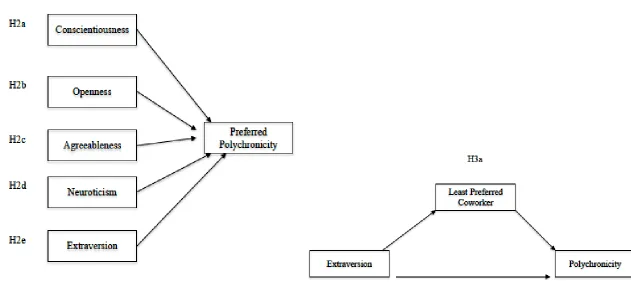
This study also examined the nomological network of polychronicity by exploring the predictive ability of the big five personality variables and the potential mediating effect of being task or relationship oriented. More specifically I examined if the big five are
mediating effect of being task or relationship oriented on the relationship between extraversion and polychronicity.
In order to better understand the examinations within the study I first present an overview of the focal construct of polychronicity as well as its relationship with performance. Secondly I provide a brief review of person-job fit, more specifically the needs-supplies component, and its relationship to performance. I then talk about the relationship between person-job fit on polychronicity and how it may impact job performance. Next, I discuss personality variables as a predictor of polychronicity as well as the possible mediating effect of being relationship oriented. I conclude with a detailed discussion of the sample,
methodology, analysis, results, and implications drawn from this research. Polychronicity
Hall (1959) is credited with first introducing the concept of polychronicity while studying various cultures’ use of time (Slocombe & Bluedorn, 1999; Hecht & Allen, 2005).
There is disagreement in the literature about the definition of polychronicity (Bluedorn, Kalliath, Strube, and Martin, 1999; Conte & Gintoft, 2005; Hecht & Allen, 2005, König & Waller, 2010); I chose to adopt the suggestion of König and Waller (2010), defining polychronicity as the preference or value for doing several things at the same time. This definition “avoids any assumption about the judgments of others by high-polychronicity individuals” and draws an important differentiation between the preference or value for
doing several things (polychronicity) and the observable behavior of doing several things (multitasking) (König & Waller, 2010, p. 175). Unfortunately research examining
(Conte & Jacobs, 2003; Harris & Wiggins, 2008), and no relationship (Payne & Philo, 2002; Turner, Grube, Tinsley, Lee, & O’Pell, 2006), using various measures of performance (e.g.,
self-rated, supervisor ratings, grade point average, simulation tasks). König and Waller (2010) suggested that this disparity in findings may be due to the various interpretations of the construct or that polychronicity may impact performance but only if there is a “fit” between person and job polychronicity levels. The latter explanation drives the research in the current study; this person-job fit research design for examining polychronicity and performance is considered the next frontier for the construct (König & Waller, 2010). Needs-Supplies Person-Job Fit
Edwards (1991) defined needs-supplies person-job fit (NS fit) as the congruence between the desires of a person and the attributes of a job, referring to whether or not the job has the opportunities to satisfy the needs, values, or preferences of the person (Hecht & Allen, 2005). “Needs” refer to the desires, preferences, motives, and goals of the individual while “supplies” refer to the perceived qualities of the job that may fulfill these needs
Fit on Polychronicity and Performance
This study theorized that person-job fit on the needs-supplies component, specifically the opportunities for polychronicity on the job (supplies) and the individual’s preference for
polychronic behavior (needs) will lead to higher levels of job outcomes (Kristof, 1996; Kristof et al., 2005; Edwards, 1996; Slocombe & Bluedorn, 1999; Hecht & Allen, 2005). This fit can occur along a continuum at any point in-between two extremes, polychronic and monochronic fit. Polychronic fit occurs when the person values or prefers to do many things at once and has the opportunities to do so through the job while monochronic fit occurs when the person prefers not to do many things at once and his or her job does not provide
opportunities to do so (Hecht & Allen, 2005). Misfit occurs when one’s preference for
multitasking behavior is different from the opportunities provided by the job (Hecht & Allen, 2005). This misfit may occur in either direction with either too few opportunities (insufficient supplies) or too many opportunities (excess supplies). Consistent with previous research I can hypothesize that excess supplies of polychronicity opportunities will not lead to higher levels of the outcome variables (Slocombe & Bluedorn, 1999; Hecht & Allen, 2005).
performance in relation to fit on polychronicity. Overall results of these three studies are inconclusive with more research needed using response surface methodology, supervisory ratings of performance, industry samples, and more diverse measures of job performance criterion.
Hypothesis 1. Greater needs-supplies person-job fit (congruence) between preferred polychronicity and polychronicity supplies will be related to higher levels of task
performance (H1a), promotion potential (H1b), and citizenship behaviors (H1c) than will misfit or incongruence.
Personality Variables as Predictors of Polychronicity
The secondary aim of this study was to replicate past research in examining the big five as predictors of polychronicity with an industry sample (law enforcement). The literature examining the big five as predictors of polychronicity is small with results largely being inconclusive (König & Waller, 2010; Sanderson, 2013). In her 2013 dissertation, Sanderson conducted a meta-analysis on the small number of studies available examining at least one aspect of the big five and polychronicity and was able to identify statistically significant relationships with extraversion and openness to experience. The current study will explore each variable of the big five and it’s relationship to polychronicity. I also offer a unique contribution by examining a potential mediator between extraversion and polychronicity.
negative relationship has been found by some the research so far is inconclusive or statistically negligible (König & Waller, 2010; Conte & Gintoft, 2005; Conte & Jacobs, 2003; Kantrowitz, Grelle, Beaty, & Wolf, 2012; Sanderson, 2013).
Hypothesis 2a. Conscientiousness will be negatively related to polychronicity (H2a). Openness to experience reflects traits such as being imaginative, cultured, curious, and broad minded (Barrick & Mount, 1991). Generally research examining the big five and polychronicity hasn’t found any statistically significant relationships with openness to
experience (König & Waller, 2010; Conte & Gintoft, 2005; Conte & Jacobs, 2003). Two recent studies did however find evidence for a positive relationship between openness to experience and polychronicity (Kantrowitz et al., 2012; Sanderson, 2013).
Hypothesis 2b. Openness to experience will be positively related to polychronicity (H2b).
Personality traits associated with being courteous, flexible, trusting, forgiving, or tolerant are interpreted as agreeableness (Barrick & Mount, 1991). Haase, Lee, and Banks (1979) noted that polychronicity was related to tolerance for ambiguity as well as an unstructured work environment (Sanderson, 2013). While some research has failed to find any statistically significant relationships between agreeableness and polychronicity (König & Waller, 2010; Conte & Gintoft, 2005; Conte & Jacobs, 2003), others have found partial support for a positive relationship (Kantrowitz et al., 2012; Sanderson, 2013). It is reasonable to assume that polychronic individuals may exhibit higher levels of agreeableness.
research suggests that individuals who are anxious will likely not perform well in
multitasking environments (Oswald, Hambrick, and Jones, 2007, Sanderson, 2013). Despite research failing to establish a statistical link between neuroticism and polychronicity, it seems reasonable to assume those who exhibit high levels of neuroticism will not have polychronic work habits (König & Waller, 2010; Conte & Gintoft, 2005; Conte & Jacobs, 2003, Sanderson, 2013).
Hypothesis 2d. Neuroticism will be negatively related to polychronicity (H2d). Extraversion is often associated with being assertive, talkative, and active (Barrick & Mount, 1991). A degree of being sociable and expressive is also generally considered
indicative of this dimension of the big five (Hogan, 1986). Polychronic individuals are thought to be more relationship oriented rather than task focused (Hall, 1983). Existing research has found support for a positive relationship between extraversion and
polychronicity (König & Waller, 2010; Kantrowitz et al., 2012; Conte & Gintoft, 2005; Conte & Jacobs, 2003).
Hypothesis 2e. Extraversion will be positively related to polychronicity (H2e). Interestingly, Hall’s (1983) suggestion that polychronic individuals are more
relationship-oriented has never been empirically tested (König & Waller, 2010). Sanderson (2013) also called for future research to begin examining moderating and mediating effects between personality variables and polychronicity. The current study explores one style toward being relationship-oriented as a potential mediator of the relationship between extraversion and polychronicity.
Method Participants
The data used for this study was part of an existing promotion management system. Study participants included 330 employees from a regional law enforcement agency. Respondents were primarily male (N= 324) and had been with the organization for an
average of 14.09 years (SD= 4.66). Only complete cases of responses and supervisory ratings were included for analysis resulting in a final sample size of 317 with 10 cases being
removed based on individual polychronicity, 2 on job polychronicity, and 1 for relationship-orientation. A total of 141 immediate supervisors provided ratings for the 317 employees. Supervisors were primarily male (N= 135) with an average tenure of 17.42 years (SD= 3.92) and had reported having worked with the employee they were rating for an average of 5.60 years (SD= 4.49). Nearly all supervisors (92%) indicated that they had “quite a bit” of an opportunity to observe their subordinate’s performance, the highest rating available. Procedure
All testing was completed in one business day. Immediate supervisors provided performance ratings electronically after being prompted via email.
Measures
Preferred polychronicity and job polychronicity supplies. The standard
questionnaire for measuring preferred polychronicity is the inventory of polychromic values (IPV) developed and validated by Bluedorn and colleagues (1999). The IPV was added into the promotion management assessment and completed by subordinates. This measure is typically 10 items and uses a 7-point Likert scale that ranges from 1 (strongly disagree) to 7 (strongly agree). In order to maintain consistency with the definition of polychronicity, I adopted the suggestions of König and Waller (2010) and removed items related to
self-reported multitasking and beliefs that others should work in a multitasking style resulting in a 5-item measure. Cronbach’s alpha for this scale was .83. See Appendix A for the full
measure.
To measure job polychronicity supplies I used a modified version of the IPV from Hecht and Allen (2005), who altered each item to reflect opportunities for polychronic work. Since this scale measures the perceived characteristics of the job and is not intended to
measure personal beliefs about how others should complete work, all 10 items were included. This inclusion is supported by similarly designed past research (Slocombe & Bluedorn, 1999). This measure uses a 7-point Likert Scale and response options range from 1 (strongly disagree) to 7 (strongly agree), with higher scores indicating greater job polychronicity supplies. Cronbach’s alpha for this scale was .85. See Appendix B for the full measure.
assessment completed by subordinates (IPIP; Goldberg, 1999). This measure has 20 items and uses a 7-point Likert Scale. Response options range from 1 (strongly disagree) to 7 (strongly agree) with higher scores indicating greater conscientiousness. Cronbach’s alpha for this scale was .87. See Appendix C for the full measure.
Extraversion. Items for this personality dimension were drawn from the IPIP and were a part of the original management promotion assessment completed by subordinates (IPIP; Goldberg, 1999). This measure has 20 items and uses a 7-point Likert scale. Response options range from 1 (strongly disagree) to 7 (strongly agree) with higher scores indicating greater extraversion. Cronbach’s alpha for this scale was .84. See Appendix D for the full measure.
Openness to experience. Items for this personality dimension were drawn from the IPIP and were a part of the original management promotion assessment completed by subordinates (IPIP; Goldberg, 1999). This measure has 20 items and uses a 7-point Likert scale. Response options range from 1 (strongly disagree) to 7 (strongly agree) with higher scores indicating greater openness to experience. Cronbach’s alpha for this scale was .82. See Appendix E for the full measure.
Neuroticism. Items for this personality dimension were drawn from the IPIP and were a part of the original management promotion assessment completed by subordinates (IPIP; Goldberg, 1999). This measure has 20 items and uses a 7-point Likert scale. Response options range from 1 (strongly disagree) to 7 (strongly agree) with higher scores indicating greater neuroticism. Cronbach’s alpha for this scale was .88. See Appendix G for the full measure.
Least preferred coworker. In order to identify if respondents were relationship or task oriented I used the LPC scale developed by Fiedler, Chemers & Mahar (1984), which was added to the management promotion assessment and completed by subordinates. Normally used in leadership research, the LPC asks the respondent to think of a coworker they work least well with on getting a job done. This measure has demonstrated strong internal consistency and a single factor structure (Rice, 1978). They are then given 18 opposing items (e.g. untrustworthy and trustworthy) and asked to describe this person by assigning an appropriate number for each of the items (e.g. 1= unkind to 8= kind). Higher scores on the LPC suggest that the respondent is relationship-oriented while lower scores indicate the respondent is task motivated or exhibits lower levels of being relationship-oriented. Cronbach’s alpha for this scale was .96. See Appendix H for the full measure.
Task performance. In order to measure task performance two criterion variables completed by supervisors from the management promotion system were combined in order to create a 12-item measure. The North Carolina State University team conducting the
range from 1 (strongly disagree) to 7 (strongly agree) with higher scores indicating greater performance. Cronbach’s alpha for this scale was .95. See Appendix I for the full measure.
Current performance was measured using 8 items reflecting dimensions identified during the work analysis phase of the Management Promotion System. Dimensions were identified using reviews of other police agencies, previous performance dimensions for the law enforcement organization, and results from the work analysis. Ratings were gathered using Overall Task Identified Dimensional Evaluation (TIDE). TIDE ratings are on a 6-point Likert scale from 1 (a great deal) to 6 (absolutely no) when rating how much improvement their promotion candidate needed on the dimension. Higher scores were indicative of high performing candidates. Cronbach’s alpha for this scale was .92. See Appendix J for sample items. A description of each performance dimension can be found below:
Scheduling. This performance dimension measures the ability to effectively assign personnel to tasks and appropriately.
Problem solving. These skills are reflective of identifying problems and their causes, evaluating courses of action, and making decisions.
Coaching performance. This performance dimension indicates the ability to establish procedures to monitor, review, evaluate actions of subordinates and develop
subordinates professionally.
Adaptability. The individual’s ability to adjust to novel information and experiences in a changing environment is measured with this performance dimension.
Written communication. Written communication is the ability to effectively convey expression in writing and relaying information in a concise manner.
Cooperation. This performance dimension reflects the individual’s ability to work well with others from both inside and outside of the organization.
Integrity. Integrity is the degree to which the individual applies the knowledge and values of the organization to all situations.
Promotion potential. A measure of promotion potential was used from the
management promotion system, which was completed by supervisors. Current promotability measures of the law enforcement agency were deemed to be insufficient by the North
Carolina State University team so new items were written using previous literature on promotion potential (de Pater, van Vianen, Bechtoldt, & Klehe, 2009; Harris, Kacmar, & Carlson, 2006; Jawahar & Ferris, 2011; Shaughnessy, Treadway, Breland, Williams, & Brouer, 2011). The measure contains 12 items and uses a Likert scale. Response options range from 1 (strongly disagree) to 7 (strongly agree) with higher scores indicating greater promotion potential. Cronbach’s alpha for this scale was .96. See Appendix K for the full measure.
Organizational citizenship behaviors. In order to measure organizational
citizenship behavior I used a scale from Podsakoff, MacKenzie, Moorman, and Fetter (1990), which was added to the management promotion system and completed by supervisors. This scale was identified as “especially suitable for use in situations in which interpersonal relations, cooperation, and team work are critical issues” (Van Dyne, Graham & Dienesch,
or concerned about the organization), altruism (helping others with organizationally relevant tasks), and courtesy (behaviors that prevent work related problems). The measure contains 5 items each for courtesy and altruism and 4 items for civic virtue. The instrument uses a Likert scale where response options range from 1 (strongly disagree) to 7 (strongly agree) with higher scores indicating greater levels of citizenship behaviors. Cronbach’s alpha for this scale was .96. See Appendix L for the full measure.
Analysis and Results
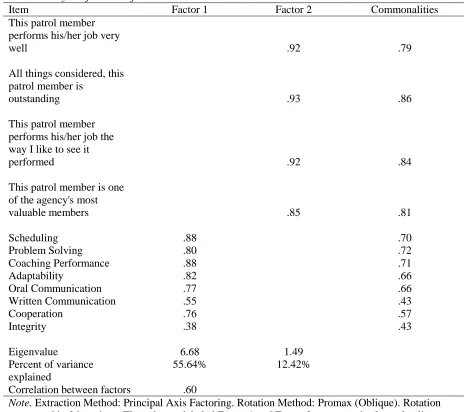
Before computing descriptive statistics, an exploratory factor analysis was run to determine if overall and current performance could be aggregated to create an overall measure of task performance. Please see Table 1 for the full results of the factor analysis. 12 items related to task performance were factor analyzed using principal axis factoring with Promax (oblique) rotation. This rotation method was chosen as I anticipated factors involving performance would be correlated. The analysis yielded two factors that explained 68% of the total variance. Commonality analysis revealed that the proportion of each variables variance explained by the factors was .40 or greater. The first factor explained 56% of the variance and mapped onto the 8 item current performance measure. The second factor explained 12% of the variance and mapped onto the 4 item overall performance measure. Given these
results, I conducted subsequent analysis without aggregating overall and current performance into one measure and instead treating them as separate outcome measures.
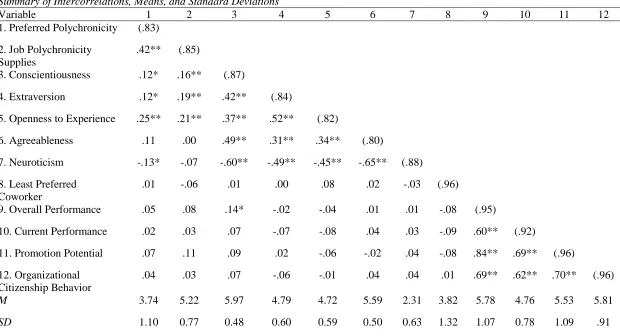
The means, standard deviations, intercorrelations, and reliabilities are presented in Table 2. The sample size was large enough to ensure the normality of error distribution in the outcome variables. For the purposes of linear regression, assumptions of linearity,
be seen in Table 2 each measure demonstrated a Cronbach’s alpha of at least .80, indicating strong internal consistency. Generally speaking the sample reported having high levels of polychronic job opportunities (M= 5.22, SD= .77), conscientiousness (M= 5.97, SD= .48), and agreeableness (M= 5.59, SD= .50). Performance, as rated by supervisors, was generally toward the high end for overall performance (M= 5.78, SD= 1.07), current performance (M= 4.76, SD= .78), promotion potential (M= 5.53, SD=1.09), and organizational citizenship behaviors (OCBs) (M= 5.81, SD= .91).
Hypothesis 1a-1c (with task performance being analyzed at the overall and current level) predicted that person-job fit on polychronicity would correspond to higher levels of job performance outcomes. To test this, four polynomial regressions were conducted with
response surface methodology. This technique addresses many of the weaknesses of difference scores and allows the researcher to obtain a much more complete image of the underlying relationship (Edwards & Parry, 1993; Edwards, 2002; Kristof, 2005). As recommended by Shanock et al. (2010) the analysis began by examining the frequency of discrepancies in the sample. Discrepancy analysis determines the base rate of agreement and disagreement between the two predictor variables (preferred polychronicity and job
polychronicity supplies). Both predictor variables were standardized and discrepancies were counted when the standardized score on one predictor variable was half a standard deviation above or below the other predictor (Fleenor, McCauley, & Brutus, 1996). If such
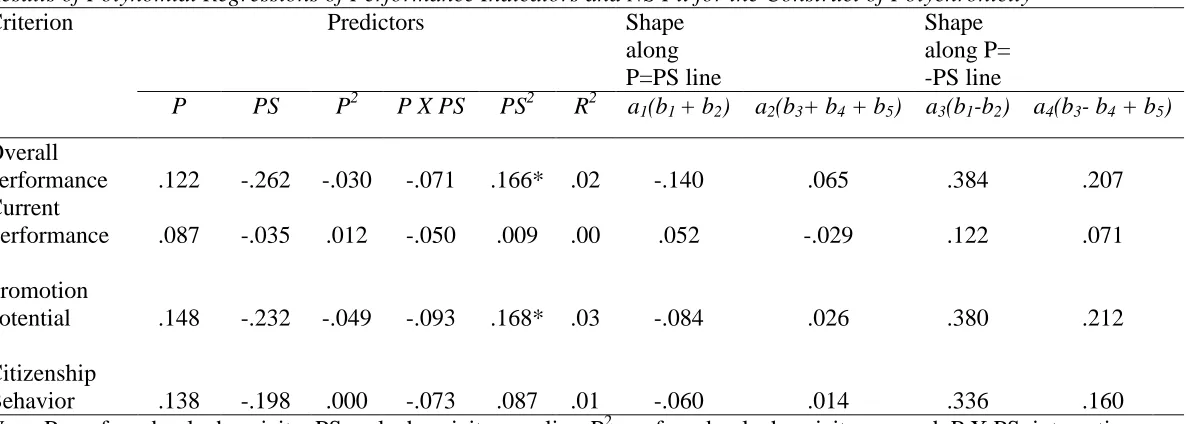
Using SPSS software, I conducted a polynomial regression to calculate the surface values. This was accomplished by regressing each performance outcome variable on five predictor variables: preferred polychronicity, polychronicity supplies, preferred
polychronicity squared, the product of preferred polychronicity and polychronicity supplies and polychronicity supplies squared. For the purposes of the polynomial regression analysis only, I scale-centered the predictor variables (preferred polychronicity and polychronicity supplies) in order to reduce multicollinearity and aid with interpretation (Kristof & Stevens, 2001; Shanock, Baran, Gentry, Pattison & Heggestad, 2010). Table 3 contains the results of the four polynomial regression equations. In each case the squared difference (constrained) model was also tested in comparison, with results showing that polynomial regression
explained more variance in the model, though not significantly. The R2 for each outcome was not significant, which indicated that person-job fit was not related to job performance
outcomes. Hypothesis 1 was not supported.
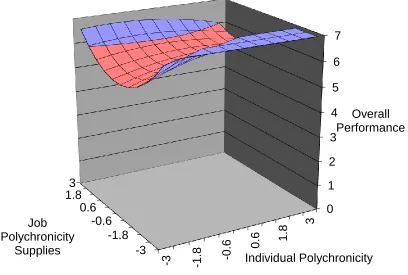
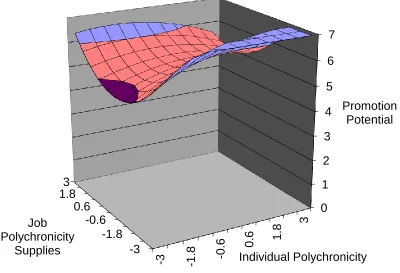
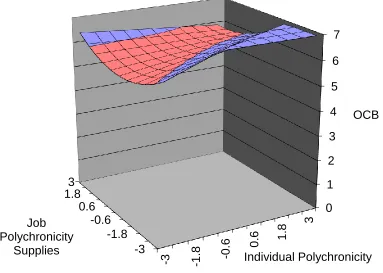
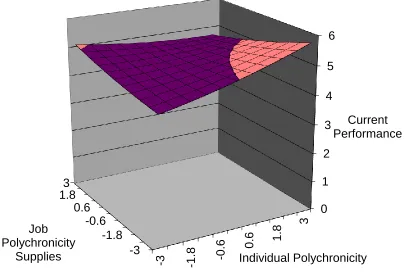
Edwards (2002) cautioned that response surfaces should only be interpreted if a significant R2 is supported. In an effort to be thorough, each response surface was still plotted and slope and curvatures calculated. Response surface analysis indicated that for overall performance (Figure 1), promotion potential (Figure 2), and OCBs (Figure 3) fit
(upward curving). In the case of current performance (Figure 4) the relationship was essentially flat.
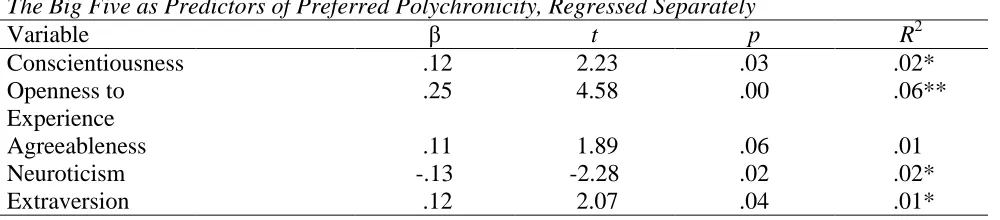
Hypothesis 2a through 2e predicted that the big five would be statistically significant predictors of preferred polychronicity. More specifically, that conscientiousness (2a) and neuroticism (2d) would be negatively related to polychronicity, while openness (2b), agreeableness (2c) and extraversion (2e) would be positively related. In order to test this, polychronicity was regressed against each big five predictor separately. Please see Table 4 for complete results. Conscientiousness was positively related to preferred polychronicity (β= .12, t(315)= 2.23, p= .03), such that higher levels of conscientiousness were associated with greater polychronicity. Hypothesis 2a was partially supported. Openness to experience was positively related to preferred polychronicity (β= .25, t(315)= 4.58, p= .00), such that higher levels of openness were associated with greater polychronicity. Hypothesis 2b was
simultaneously only openness remained significant and positively related to polychronicity (β= .25, t(311)= 3.70, p= .00). Please see Table 5 for full results.
Hypothesis 3a predicted that being relationship oriented would mediate the
relationship between extraversion and polychronicity. In order to test this, both the method proposed by Baron and Kenny (1986) and PROCESS software created by Hayes (2012) was used. Mediation analysis failed at steps 2, 3, and 4 for the Baron and Kenny approach and did not indicate significant indirect effects for the Hayes PROCESS. Both methods failed to show support for mediation, relationship orientation did not contribute to the indirect effect of extraversion on polychronicity. Hypothesis 3a was not supported.
Discussion
The goal of this study was to test the theory of person-job fit on polychronicity and its relationship to multiple indicators of job performance. The relationship between
polychronicity and job performance is not well understood with future research calling for examinations of fit (König & Waller, 2010). Existing research in this area has utilized self-report measures, supervisory ratings with difference score analysis, and single indicators of job performance (Massey, 2002; Hecht, 2003; Woods, 2014). Results from these previous investigations have been largely inconclusive. The current study hoped to contribute to this literature by utilizing supervisory ratings of performance, polynomial regression with response surface methodology, and multiple indicators of performance.
& Allen, 2005). One possible explanation for the lack of findings thus far is that fit on polychronicity may largely be related to attitudinal outcomes (e.g. satisfaction, strain) while fit between multitasking ability and demands may be related to outcomes such as job performance (Kristof-Brown et al., 2005). Polychronicity is the attitudinal element of multitasking or in the other words the preference or value for doing so. The examination of fit on polychronicity should be conceptualized as needs-supplies rather than demands-abilities fit. The former is a more objective concept of fit, specifically between the tasks required by the job and the knowledge, skills, and abilities of the individual (Edwards, 1991). Although König and Waller (2010) warn that researchers must not use the concept of fit “as a panacea for explaining contradictory results”, it is possible an examination of person-job fit
on multitasking ability and demands, rather than polychronicity, could provide stronger models for predicting performance (p. 185).
A second goal of this study was to replicate previous research on the big five personality variables as predictors of polychronicity as well as a unique contribution in whether relationship orientation mediated the effect of extraversion on polychronicity. The study found that four of the big five were significant predictors of polychronicity.
Higher levels of conscientiousness were found to correspond to greater individual polychronicity. This result was somewhat inconsistent with previous findings as this relationship is generally thought to be negative, although overall findings are mixed (Conte & Jacobs, 2003; König & Waller, 2010; Sanderson, 2012). The conceptualization of
favorable relationship with polychronicity in the workplace. Perhaps those that are more conscientiousness prefer to multitask in an effort to work purposefully or meet deadlines.
Hypotheses pertaining to extraversion and neuroticism were confirmed in the current study. Greater levels of extraversion were related to greater individual polychronicity while neuroticism corresponded to lower levels. The findings on extraversion conform to findings in the research (Conte & Jacobs, 2003; Conte & Gintoft, 2005; Kantrowitz et al., 2012). The current study also contributes to the literature by finding a statistically significant relationship between neuroticism and polychronicity. While the directionality of this relationship has generally been supported, most studies report weak relationships (Sanderson, 2012; Conte & Gintoft, 2005; Conte & Jacobs, 2003).
In their review of the literature König and Waller (2010) consistently found that agreeableness and openness to experience had no relationship with polychronicity. Interestingly two recent studies did find partial support for a positive relationship with polychronicity (Kantrowitz et al., 2012; Sanderson, 2013). The current study was unable to replicate these results for agreeableness but did find a positive relationship with openness. Perhaps more surprisingly, when all five personality variables were entered simultaneously into a multiple regression, openness was the only predictor that remained significant. It is important not to over-interpret this finding, but the current study does suggest that openness could be an overlooked correlate with polychronicity.
examining the workplace, the underlying mechanism explaining extraversion’s relationship with polychronicity may be something different such as one’s assertiveness or ability to manage stress.
Practical Implications
The findings from this study suggest that practitioners and supervisors should
cautiously interpret preferences for multitasking when making performance evaluations. The study failed to demonstrate that congruence along this dimension would lead to increased ratings of job performance. Given the increased pace, competing demands, and countless distractors in today’s workplace it seems intuitive for a practitioner to consider
polychronicity fit in the hiring or promotion process. While there is value in this line of thinking with relation to satisfaction and organizational commitment outcomes, the current body of literature along with this study suggests that there is not a defined relationship with job performance (Hecht & Allen, 2005; Slocombe & Bluedorn, 1999).
The secondary implication for practitioners is that when attempting to predict polychronicity, personality matters. The current study replicated findings that suggest that personality variables, such as the big five, could be valid predictors of polychronicity. Supervisors interested in predicting an employee’s or candidate’s relative value for
multitasking as part of promotion or hiring decision should consider personality variables. Limitations and Future Directions
limitation related to the sample was that the study was essentially entirely male with little ethnic diversity, resulting in findings being derived from one demographic group. Taken together, it is likely that generalizing results to the population should be done with caution. A final limitation could be the use of an indirect assessment of fit. This method involves
assessing respondents on both fit predictors of interest. The counter approach is a direct assessment of fit, which asks respondents to assess their level of fit on single questionnaire. While both methods are considered valid, measures of perceived fit have been found to have stronger relationships with a number of outcome variables (Kristof, et al., 2005).
REFERENCES
Arndt, A., Arnold, T. J., & Landry, T. D. (2006). The effects of polychronic–orientation upon retail employee satisfaction and turnover. Journal of Retailing, 82, 319–330.
Arthur, W. r., Bell, S. T., Villado, A. J., & Doverspike, D. (2006). The use of person- organization fit in employment decision making: An assessment of its criterion-related validity. Journal of Applied Psychology, 91(4), 786-801.
Baron, R. M., & Kenny, D. A. (1986). The moderator–mediator variable distinction in social psychological research: Conceptual, strategic, and statistical considerations. Journal of personality and social psychology, 51(6), 1173-1182.
Barrick, M. R., & Mount, M. K. (1991). The big five personality dimensions and job performance: a meta‐ analysis. Personnel psychology, 44(1), 1-26.
Bluedorn, A. C., Kalliath, T. J., Strube, M. J., & Martin, G. D. (1999). Polychronicity and the Inventory of Polychronic Values (IPV): The development of an instrument to
measure a fundamental dimension of organizational culture. Journal of Managerial Psychology, 14, 205–231.
Bluedorn, A. C. (2007). Polychronicity, individuals, and organizations. Research in the Sociology ofWork, 17, 179–222.
Cable, D. M., & DeRue, D. S. (2002). The convergent and discriminant validity of subjective fit perceptions. Journal of applied psychology, 87(5), 875-884.
Chan, D., & Schmitt, N. (2002). Situational judgment and job performance. Human Performance, 15(3), 233-254.
personality dimensions to absence, lateness, and supervisory performance ratings. Human Performance, 16(2), 107-129.
Conte, J. M., & Gintoft, J. N. (2005). Polychronicity, big five personality dimensions, and sales performance. Human Performance, 18(4), 427-444.
De Pater, I.E., van Vianen, A.E.M., Bechtoldt, M.N., & Klehe, U-C. (2009). Employees’ challenging job experiences and supervisors’ evaluations of promotability. Personnel
Psychology, 62, 297-325.
Edwards, J. R. (1991). Person-job fit: A conceptual integration, literature review, and methodological critique. John Wiley & Sons.
Edwards, J. R., & Parry, M. E. (1993). On the use of polynomial regression equations as an alternative to difference scores in organizational research. Academy of Management Journal, 36(6), 1577-1613.
Edwards, J. R. (1996). An examination of competing versions of the person-environment fit approach to stress. Academy of management journal, 39(2), 292-339.
Edwards, J. R. (2002). Alternatives to difference scores: Polynomial regression and response surface methodology. Advances in measurement and data analysis, 350-400.
Fiedler, F. E., Chemers, M. M., & Mahar, L. (1976). Improving leadership effectiveness: The leader match concept. New York: Wiley.
Fleenor, J. W., McCauley, C. D., & Brutus, S. (1997). Self-other rating agreement and leader effectiveness. The Leadership Quarterly, 7(4), 487-506.
French, J. R. P., Jr., Caplan, R. D., & Harrison, R. V. (1982). The mechanisms of job stress and strain. New York: Wiley.
the lower-level facets of several five-factor models. In I. Mervielde, I. Deary, F. de Fruyt, & F. Ostendorf (Eds.), Personality Psychology in Europe, Volume 7 (pp. 7-28). Tilburg, The Netherlands: Tilburg University Press.
Hall, E.T. (1959). The silent language. Garden City, NY: Doubleday. Hall, E. T. (1983). The dance of life. Garden City, NY: Anchor Press.
Harris, K.J., Kacmar, K.M., & Carlson, D.S. (2006). An examination of temporal variables and relationship quality on promotability ratings. Group and Organization
Management, 31, 677-699.
Harris, J. M., & Wiggins, M. W. (2008). Polychronicity and information acquisition in pilot decision making. Journal of Cognitive Engineering and Decision Making, 2, 89–104. Haase, R. F., Lee, D. Y., & Banks, D. L. (1979). Cognitive correlates of polychronicity.
Perceptual and Motor Skills, 49, 271 – 282.
Hayes, A. F. (2012). PROCESS: A versatile computational tool for observed variable mediation, moderation, and conditional process modeling [White paper]. Hecht, T. D., & Allen, N. J. (2003, August). Person-job fit on the dimension of
polychronicity: Examining links with well-being and performance. In Academy of Management Proceedings (Vol. 2003, No. 1, pp. F1-F6). Academy of Management. Hecht, T. D., & Allen, N. J. (2005). Exploring links between polychronicity and well-being
from the perspective of person–job fit: Does it matter if you prefer to do only one thing at a time? Organizational Behavior and Human Decision Processes, 98(2), 155-178.
Inwald, R. E. (1985). Administrative, legal, and ethical practices in the psychological testing of law enforcement officers. Journal of Criminal Justice,13(4), 367-372.
Jawahar, I. M., & Ferris, G. R. (2011). A longitudinal investigation of task and contextual performance influences on promotability judgments. Human Performance, 24(3), 251-269.
Kantrowitz, T. M., Grelle, D. M., Beaty, J. C., & Wolf, M. B. (2012). Time is money: Polychronicity as a predictor of performance across job levels. Human
Performance, 25(2), 114-137.
König, C. J., & Waller, M. J. (2010). Time for reflection: A critical examination of polychronicity. Human Performance, 23(2), 173-190.
Kristof, A. L. (1996). Person-organization fit: An integrative review of its
conceptualizations, measurement, and implications. Personnel psychology,49(1), 1-49.
Kristof-Brown, A. L., & Stevens, C. K. (2001). Goal congruence in project teams: Does the fit between members' personal mastery and performance goals matter?. Journal of Applied Psychology, 86(6), 1083-1095.
Kristof-Brown, A. L., Zimmerman, R. D., & Johnson, E. C. (2005). Consequences of Individuals' Fit at Work: A Meta-Analysis of Person–Job, Person–organization, Person–group, and Person–Supervisor fit. Personnel psychology, 58(2), 281-342. Nonis, S. A., Teng, J. K., & Ford, C. W. (2005). A cross-cultural investigation of time
management practices and job outcomes. International Journal of Intercultural Relations, 29(4), 409-428.
outcome behaviors (Unpublished doctoral dissertation). The Pennsylvania State University, University Park, PA.
Massey, G. A. (2002). A Temporal Dimension of Polychronicity: The Fit Between Individual Polychronicity and Job Polychronicity as it Relates to Job Performance and
Stress (Unpublished doctoral dissertation). Webster University, Webster Groves, MO. Oswald, F. L., Hambrick, D. Z., & Jones, L. A. (2007). Keeping all the plates spinning:
Understanding and predicting multitasking performance. In D. H. Jonassen (Ed.), Learning to solve complex scientific problems.
Payne, S. C., & Philo, J. (2002, April). Identifying those who prefer to do more with less. Paper presented at the 17th annual convention of the Society of Industrial and Organizational Psychology, Toronto, Canada.
Podsakoff, P. M., MacKenzie, S. B., Moorman, R. H., & Fetter, R. (1990). Transformational leader behaviors and their effects on followers' trust in leader, satisfaction, and
organizational citizenship behaviors. The Leadership Quarterly, 1(2), 107-142.
Podsakoff, P. M., & MacKenzie, S. B. (1994). Organizational citizenship behaviors and sales unit effectiveness. Journal of marketing research, 31(3), 351-363.
Rice, R. W. (1978). Psychometric properties of the esteem for least preferred coworker (LPC scale). Academy of Management Review, 3(1), 106-118.
Polynomial regression with response surface analysis: A powerful approach for examining moderation and overcoming limitations of difference scores. Journal of Business and Psychology, 25(4), 543-554.
Shaughnessy, B.A., Treadway, D.C., Breland, J.A., Williams, L.V., & Brouer, R.L. (2011). Influence and promotability: the importance of female political skill. Journal of Managerial Psychology, 26, 584-603.
Shaw, J. D., Duffy, M. K., & Stark, E. M. (2000). Interdependence and preference for group work: Main and congruence effects on the satisfaction and performance of group members. Journal of Management, 26(2), 259-279.
Sobel, M. E. (1982). Asymptotic intervals for indirect effects in structural equations models. In S. Leinhart (Ed.), Sociological methodology 1982 (pp.290-312). San Francisco: Jossey-Bass.
Slocombe, T. E., & Bluedorn, A. C. (1999). Organizational behavior implications of the congruence between preferred polychronicity and experienced work‐ unit
polychronicity. Journal of Organizational Behavior, 20(1), 75-99.
Turner, J.W., Grube, J. A., Tinsley, C. H., Lee, C., & O’Pell, C. (2006). Exploring the
dominant media: How does media use reflect organizational norms and affect performance? Journal of Business Communication, 43, 220–250.
Woods, W. K. (2014). Multitasking in the workplace : a person-job fit perspective (Unpublished Master’s Thesis). Purdue University, West Lafayette, IN. Van Dyne, L., Graham, J. W., & Dienesch, R. M. (1994). Organizational citizenship
Table 1
Factor Analysis of Task Performance
Item Factor 1 Factor 2 Commonalities
This patrol member performs his/her job very
well .92 .79
All things considered, this patrol member is
outstanding .93 .86
This patrol member performs his/her job the way I like to see it
performed .92 .84
This patrol member is one of the agency's most
valuable members .85 .81
Scheduling .88 .70
Problem Solving .80 .72
Coaching Performance .88 .71
Adaptability .82 .66
Oral Communication .77 .66
Written Communication .55 .43
Cooperation .76 .57
Integrity .38 .43
Eigenvalue 6.68 1.49
Percent of variance explained
55.64% 12.42%
Correlation between factors .60
Table 2
Summary of Intercorrelations, Means, and Standard Deviations
Variable 1 2 3 4 5 6 7 8 9 10 11 12
1. Preferred Polychronicity (.83)
2. Job Polychronicity Supplies
.42** (.85)
3. Conscientiousness .12* .16** (.87)
4. Extraversion .12* .19** .42** (.84)
5. Openness to Experience .25** .21** .37** .52** (.82)
6. Agreeableness .11 .00 .49** .31** .34** (.80)
7. Neuroticism -.13* -.07 -.60** -.49** -.45** -.65** (.88)
8. Least Preferred Coworker
.01 -.06 .01 .00 .08 .02 -.03 (.96)
9. Overall Performance .05 .08 .14* -.02 -.04 .01 .01 -.08 (.95)
10. Current Performance .02 .03 .07 -.07 -.08 .04 .03 -.09 .60** (.92)
11. Promotion Potential .07 .11 .09 .02 -.06 -.02 .04 -.08 .84** .69** (.96)
12. Organizational Citizenship Behavior
.04 .03 .07 -.06 -.01 .04 .04 .01 .69** .62** .70** (.96)
M 3.74 5.22 5.97 4.79 4.72 5.59 2.31 3.82 5.78 4.76 5.53 5.81
SD 1.10 0.77 0.48 0.60 0.59 0.50 0.63 1.32 1.07 0.78 1.09 .91
Note. Numbers along the diagonal are Cronbach’s coefficient alpha values. Subordinates provided ratings for preferred and job polychronicity, the big five personality
Table 3
Results of Polynomial Regressions of Performance Indicators and NS Fit for the Construct of Polychronicity
Criterion Predictors Shape
along P=PS line
Shape along P= -PS line
P PS P2 P X PS PS2 R2 a1(b1 + b2) a2(b3+ b4 + b5) a3(b1-b2) a4(b3- b4 + b5)
Overall
performance .122 -.262 -.030 -.071 .166* .02 -.140 .065 .384 .207 Current
Performance .087 -.035 .012 -.050 .009 .00 .052 -.029 .122 .071 Promotion
potential .148 -.232 -.049 -.093 .168* .03 -.084 .026 .380 .212 Citizenship
Behavior .138 -.198 .000 -.073 .087 .01 -.060 .014 .336 .160 Note. P, preferred polychronicity, PS, polychronicity supplies, P2, preferred polychronicity squared, P X PS, interaction of preferred polychronicity and polychronicity supplies and PS2, polychronicity supplies squared. Values under
predictors are unstandardized regression coefficients. R2 values indicate the variance explained by the five predictors entered simultaneously. Values under a1 and a2 indicate the slope and curvature of the line of perfect agreement,
respectively. Values under a3 and a4 indicate the slope and curvature of the line of misfit or incongruence, respectively.
Table 5
The Big Five as Predictors of Preferred Polychronicity, Multiple Regression
Variable B SE B β
Conscientiousness .09 .16 .04
Openness to Experience
.46 .12 .25**
Agreeableness .03 .16 .01
Neuroticism .00 .15 .00
Extraversion -.06 .13 -.03
R2 .06**
Note. df = 311. *p < .05 **p < .01 Table 4
The Big Five as Predictors of Preferred Polychronicity, Regressed Separately
Variable β t p R2
Conscientiousness .12 2.23 .03 .02*
Openness to Experience
.25 4.58 .00 .06**
Agreeableness .11 1.89 .06 .01
Neuroticism -.13 -2.28 .02 .02*
Extraversion .12 2.07 .04 .01*
Figure 1. Response surface plot between person-job fit on polychronicity and overall performance.
-3 -1.8 -0.6 0.6 1.8
3
0 1 2 3 4 5 6 7
-3 -1.8 -0.6
0
.6 1.8
3
Job Polychronicity
Supplies
Overall Performance
Figure 2. Response surface plot between person-job fit on polychronicity and promotion potential
-3 -1.8 -0.6 0.6 1.8
3
0 1 2 3 4 5 6 7
-3 -1.8 -0.6
0
.6 1.8
3
Job Polychronicity
Supplies
Promotion Potential
Figure 3. Response surface plot between person-job fit on polychronicity and organizational citizenship behavior.
-3 -1.8 -0.6 0.6 1.8
3
0 1 2 3 4 5 6 7
-3 -1.8 -0.6
0
.6 1.8
3
Job Polychronicity
Supplies
OCB
Figure 4. Response surface plot between person-job fit on polychronicity and current performance
-3 -1.8 -0.6 0.6 1.8
3
0 1 2 3 4 5 6
-3 -1.8 -0.6
0
.6 1.8
3
Job Polychronicity
Supplies
Current Performance
Appendix A
Inventory of Polychronic Values (IPV)
Instructions: The following questions deal with your individual preferences on how you like to do work. Please indicate the extent to which you agree or disagree with
the following statements.
Strongly Somewhat Slightly Neither Slightly Somewhat Strongly Disagree Disagree Disagree Agree or
Disagree
Agree Agree Agree
1 2 3 4 5 6 7
1. I like to juggle several activities at the same time.
2. I would rather complete an entire project every day than complete parts of several projects (reverse coded).
3. I prefer to do one thing at a time (reverse coded).
4. I seldom like to work on more than a single task or assignment at the same time (reverse coded).
Appendix B
Modified Inventory of Polychronic Values
Instructions: The following questions deal with how your job requires you to do work. In other words, how does the job you hold require you to work regardless of your personal preference?
Strongly Somewhat Slightly Neither Slightly Somewhat Strongly Disagree Disagree Disagree Agree or
Disagree
Agree Agree Agree
1 2 3 4 5 6 7
1. This job demands that I juggle several activities at the same time.
2. On the job, I am required to complete entire projects everyday rather than completing parts of several projects (reverse coded).
3. It is typical of this job to have many tasks to complete.
4. When doing this job, work must be done one thing at a time (reverse coded). 5. This job requires me to complete one task before starting another (reverse coded). 6. On this job, I am required to complete parts of several projects everyday rather than completing an entire project.
7. This job requires people to do many things at once.
8. On the job, I am frequently asked to start new tasks when other tasks have not yet been finished.
9. This job often requires that I spend a little bit of time on several-tasks-moving back and forth from on thing to another.
Appendix C
International Personality Item Pool (IPIP)- Conscientiousness
Please indicate the extent to which you agree or disagree with the following statements.
Strongly Somewhat Slightly Neither Slightly Somewhat Strongly Disagree Disagree Disagree Agree or
Disagree
Agree Agree Agree
1 2 3 4 5 6 7
1. Am always prepared. 2. Pay attention to details. 3. Get chores done right away. 4. Like order.
5. Follow a schedule. 6. Am exacting in my work. 7. Do things according to a plan. 8. Continue until everything is perfect. 9. Make plans and stick to them. 10. Like to tidy up.
11. Waste my time (reverse coded).
12. Find it difficult to get down to work (reverse coded). 13. Do just enough work to get by (reverse coded). 14. Don’t see things through (reverse coded). 15. Shirk my duties (reverse coded).
16. Mess things up (reverse coded).
17. Leave things unfinished (reverse coded).
18. Don’t put my mind on the task at hand (reverse coded). 19. Make a mess of things (reverse coded).
Appendix D
International Personality Item Pool (IPIP)- Extraversion
Please indicate the extent to which you agree or disagree with the following statements.
Strongly Somewhat Slightly Neither Slightly Somewhat Strongly Disagree Disagree Disagree Agree or
Disagree
Agree Agree Agree
1 2 3 4 5 6 7
1. Am the life of the party.
2. Feel comfortable around people. 3. Start conversations.
4. Talk to a lot of different people at parties. 5. Don’t mind being the center of attention. 6. Make friends easily.
7. Take charge.
8. Know how to captivate people. 9. Feel at ease with people.
10. Am skilled in handling social situations. 11. Don’t talk a lot (reverse coded).
12. Keep in the background (reverse coded). 13. Have little to say (reverse coded).
14. Don’t like to draw attention to myself (reverse coded). 15. Am quiet around strangers (reverse coded).
16. Find it difficult to approach others (reverse coded). 17. Often feel uncomfortable around others (reverse coded). 18. Bottle up my feelings (reverse coded).
Appendix E
International Personality Item Pool (IPIP)- Openness to Experience
Please indicate the extent to which you agree or disagree with the following statements.
Strongly Somewhat Slightly Neither Slightly Somewhat Strongly Disagree Disagree Disagree Agree or
Disagree
Agree Agree Agree
1 2 3 4 5 6 7
1. Believe in the importance of art. 2. Have a vivid imagination.
3. Tend to vote for liberal political candidates. 4. Carry the conversation to a higher level. 5. Enjoy hearing new ideas.
6. Enjoy thinking about things. 7. Can say things beautifully. 8. I catch onto things quickly. 9. Get excited by new ideas. 10. Have a rich vocabulary.
11. Am not interested in abstract ideas (reverse coded). 12. Do not like art (reverse coded).
13. Avoid philosophical discussions (reverse coded). 14. Do not enjoy going to art museums (reverse coded).
15. Tend to vote for conservative political candidates (reverse coded). 16. Do not like poetry (reverse coded).
17. Rarely look for a deeper meaning in things (reverse coded).
18. Believe that too much tax money goes to support artists (reverse coded). 19. Am not interested in theoretical discussions (reverse coded).
Appendix F
International Personality Item Pool (IPIP)- Agreeableness
Please indicate the extent to which you agree or disagree with the following statements.
Strongly Somewhat Slightly Neither Slightly Somewhat Strongly Disagree Disagree Disagree Agree or
Disagree
Agree Agree Agree
1 2 3 4 5 6 7
1. Have a good word for everyone.
2. Believe that others have good intentions. 3. Respect others.
4. Accept people as they are. 5. Make people feel at ease. 6. Am concerned about others. 7. Trust what people say.
8. Sympathize with others' feelings. 9. Am easy to satisfy.
10. Treat all people equally.
11. Have a sharp tongue (reverse coded). 12. Cut others to pieces (reverse coded).
13. Suspect hidden motives in others (reverse coded). 14. Get back at others (reverse coded).
15. Insult people (reverse coded).
16. Believe that I am better than others (reverse coded). 17. Contradict others (reverse coded).
18. Make demands on others (reverse coded). 19. Hold a grudge (reverse coded).
Appendix G
International Personality Item Pool (IPIP)- Neuroticism
Please indicate the extent to which you agree or disagree with the following statements.
Strongly Somewhat Slightly Neither Slightly Somewhat Strongly Disagree Disagree Disagree Agree or
Disagree
Agree Agree Agree
1 2 3 4 5 6 7
1. Often feel blue. 2. Dislike myself.
3. Am often down in the dumps. 4. Have frequent mood swings. 5. Panic easily.
6. Am filled with doubts about things. 7. Feel threatened easily.
8. Get stressed out easily. 9. Fear for the worst. 10. Worry about things.
11. Seldom feel blue (reverse coded).
12. Feel comfortable with myself (reverse coded). 13. Rarely get irritated (reverse coded).
14. Am not easily bothered by things (reverse coded). 15. Am very pleased with myself (reverse coded). 16. Am relaxed most of the time (reverse coded). 17. Seldom get mad (reverse coded).
Appendix H
Least Preferred Coworker Scale
Think of the person with whom you can work least well. He or she may be someone you work with now or someone you knew in the past. That person does not have to be the person you like the least but should be the person with whom you had the most difficulty in getting a job done. Describe this person as he or she appears to you by circling the appropriate number for each of the following items.
1. Pleasant 8 7 6 5 4 3 2 1 Unpleasant 2. Friendly 8 7 6 5 4 3 2 1 Unfriendly 3. Rejecting 1 2 3 4 5 6 7 8 Accepting 4. Tense 1 2 3 4 5 6 7 8 Relaxed 5. Distant 1 2 3 4 5 6 7 8 Close 6. Cold 1 2 3 4 5 6 7 8 Warm
7. Supportive 8 7 6 5 4 3 2 1 Hostile 8. Boring 1 2 3 4 5 6 7 8 Interesting
9. Quarrelsome 1 2 3 4 5 6 7 8 Harmonious 10. Gloomy 1 2 3 4 5 6 7 8 Cheerful
11. Open 8 7 6 5 4 3 2 1 Closed 12. Backbiting 1 2 3 4 5 6 7 8 Loyal
13. Untrustworthy 1 2 3 4 5 6 7 8 Trustworthy 14. Considerate 8 7 6 5 4 3 2 1 Inconsiderate 15. Nasty 1 2 3 4 5 6 7 8 Nice
Appendix I
Overall Performance Measure
Please indicate the extent to which you agree or disagree with the following statements. Strongly Somewhat Slightly Neither Slightly Somewhat Strongly Disagree Disagree Disagree Agree or
Disagree
Agree Agree Agree
1 2 3 4 5 6 7
1. This patrol member performs his/her job very well. 2. All things considered, this patrol member is outstanding. 3. This patrol member performs his/her job the way I like to see it performed.
Appendix J
Current Performance Measure
For TIDE ratings respondents were asked if they had observed the subordinate performing each task and then were prompted to rate their overall need for improvement on the dimension (one rating per dimension).
“Compared to the ideal level of performance the for [name of dimension], this patrol member’s performance is in need of __________ improvement.”
A great deal of A considerable amount of A moderate amount of A small amount of Hardly any Absolutely No
1 2 3 4 5 6
Scheduling
1. Assigns court dates to members.
2. Prepares and distributes members' work schedules.
3. Updates schedules in CAD based on weekly activity reports. 4. Notifies Administrative Services of requests for limited duty.
5. Reviews schedules considering fairness, accuracy, and appropriateness of work distribution.
6. Takes into consideration any special events, or campaigns, that may require additional manpower as well as training needs and schedules.
7. Schedules annual equipment certification renewals (e.g., equipment and personnel certification).
8. Attempts to accommodate patrol members' schedules in the event a personal emergency situation arises.
9. Checks schedules and weekly activity forms for accuracy and enters all necessary information in CAD.
10. Participates in coordinating the Patrol's response to critical incidents and the carrying out of special duties.
Problem solving
1. Determines causes and effects of key events and actions and works with employees to determine appropriate solutions and improvements.
2. Implements critical incident plans when necessary.
3. Determines appropriate actions and responds as necessary. 4. Determines need to inform supervisor of unusual incidents.
5. Monitors operations of districts, listens to radio traffic, assesses criticality of activities and determines when troop commander action is necessary.
7. Reviews reports from subordinates and traffic/accident data in order to make decisions about necessary actions.
Coaching performance
1. Communicates with employees on a continuous basis regarding performance.
2. Communicates with employees on a continuous basis regarding issues and concerns. 3. Encourages, motivates, counsels, and gives commendations to members.
4. Encourages, motivates, counsels, and gives commendations to civilian subordinates. 5. Delegates appropriate tasks to subordinates.
6. Sets job performance standards for subordinates.
7. Reviews policies, procedures, and goals set by Strategic Plan with employees, monitoring data and goal progress on a continuing basis.
8. Identifies and develops employees for the next management level.
9. Develops work improvement plans, taking action to correct poor performance and commend exceptional performance.
10. Evaluates members’ performance in key job responsibilities and performance areas, completing performance record.
11. Discusses performance ratings with subordinate.
12. Ensures that all employees have required training and that training is conducted uniformly across employees.
13. Identifies opportunities for “on-the-job” training for employees, providing mentoring and advice as needed (when applicable).
14. Provides training/learning opportunities by coordinating training schedules with the Training Academy and conducting formal "classroom" type training sessions and specialized classes.
15. Identifies training needs of employees in response to performance issues or policy violations.
16. Provides informal training to members who request assistance. 17. Observes performance on an ongoing basis.
18. Discusses performance ratings with subordinate. Adaptability
1. Responds to and assists in critical incident crash activities (e.g., chase that ends in a crash with serious personal injury and/or fatality, crash involving hazardous materials, crash with three (3) or more fatalities, major road closures as a result of a crash, crashes involving law enforcement members, in custody deaths, and member assaults or injuries).
2. Responds to disasters as specified in (law enforcement agency) disaster recovery plans by assisting in evacuations.
3. Maintains a high level of preparedness for critical incidents at all times (e.g., active
shooter, shooting incident, manhunt, natural/manmade disasters, terrorism, civil disturbance). 4. Coordinates, collaborates and participates in disaster response.
5. Monitors environment for potential threats or hazards.