Performance Analysis for Stabilization of Black Cotton
Soil Using Alkali Fly ash
Syed Saba Sulthana
M.Tech, Department of Civil Engineering
ABSTRACT: Infrastructure tasks equivalent to
highways, railways, water reservoirs, reclamation and many others. Require earthfabric in huge quantity. In urban areas, borrow earth is not easy on hand, which needs to behauled from an extended distance. Relatively often, huge areas are protected with incredibly plastic and expansivesoil, which isn't suitable for such rationale. This analysis offers the stabilization of a regionalexpansive soil utilizing alkali-activated fly ash. First the elemental houses of black cotton soil are found out, the fly ash ofdifferent percentages such as 10, 20, 30, 40 and 50% are blended with black cotton soil and premiere amount used to befound out, The activated fly ashes at distinct alkali concentrations zero, 0.5, 1, 1.5 and 2 molarities are used to performtests. Unique Geotechnical residences like Atterberg’s limits, compaction, CBR and UCS of stabilized expansive soilhave been demonstrated. It was once determined that there is a huge growth in Geotechnical residences of expansive soil withthe addition of activated fly ash and the outcome of alkali-activated fly ash is found extra suitable than naturalfly ash mix.
KEYWORDS-Compaction, field tests, fly ash,
laboratory tests, plastic clay, stabilization
I. INTRODUCTION
Geotechnical engineering, especially the treatment and usageof soil (or earth) in construction, is a venerable technicalfield, dating to the beginning of human civilization. Soilstabilization in a wide-ranging sense includes variousmethods used for modifying the properties of soil to improve itsengineering performance. By stabilizing the majorproperties of the soil, i.e., volume stability, strength,compressibility, permeability, durability and dust control isimproved, which makes the soil suitable for use.
There are different methods of stabilization, which includephysical, chemical and polymer methods of stabilization.
Physical methods involve physical processes to improve soilproperties. This includes compaction methods and drainage.Compaction processes lead to increase in water resistancecapacity of soil. Drainage is less common due to the generallypoor connection between method effectiveness and cost. But,compaction is a very common method. Although, it makes soilmore resistant to water, this resistance will be reduced overtime. Chemical soil stabilization uses chemicals andemulsions as compaction aids, water repellents and binders.The most effective chemical soil stabilization is one whichresults in non-water-soluble and hard soil matrix. Polymermethods of stabilization have a number of significantadvantages over physical and chemical methods. Thesepolymers are cheaper and are more effective and drasticallyless dangerous for the environment as compared to manychemical solutions.
and ecological factor. It is the cement for the future use. It helps totransfer the glassy structure of the compact good cemented composite in the chemical process. In case of this mineral in thechemical process powdered alumina-silicate and fly ash mixed with alkaline as an additive and produces products like pastywhich has a capacity of setting and firstly hardening within a short interval of time. Alkali activated fly ash was ecofriendly and has a capacity of good binding so it was used as a stabilizer to increase the strength for the project workbased on the work and the place of work.
II. RELATED WORKS
Fly ash by itself has little cementatiousvalue, but in the presence of moisture it reacts chemically andforms cementatious compounds and attributes to the improvement of strength and compressibilitycharacteristics of soils. It has a long history of use as an engineering material and has beensuccessfully employed in Geotechnical applications.ErdalCokca (2001): Effect of Flyash on expansive soil was studied by ErdalCokca, Flyashconsists of often hollow spheres of silicon, aluminium and iron oxides and unoxidized carbon. Thereare two major classes of flyash, class C and class F. The former is produced from burning anthraciteor bituminous coal and the latter is produced from burning lignite and sub bituminous coal. Both theclasses of fly ash are puzzolans, which are defined as siliceous and aluminous materials. Thus the Flyash can provide an array of divalent and trivalent cations (Ca2+,Al3+,Fe3+etc) under ionized conditionsthat can promote flocculation of dispersed clay particles. Thus the expansive soils can be potentiallystabilized effected by cation exchange using flyash. He carried out investigations using SomaFlyash and Tuncbilek flyash and added it to expansive soil at 0-25%. Specimens with flyash werecured for 7days and 28 days, after which they were subjected to Oedometer free swell tests. And hisexperimental findings confirmed that the plasticity index, activity and swelling potential of the samplesdecreased with increasing percent stabilizer and curing time and the optimum content of flyash indecreasing the swell potential was found to be 20%. The changes in the physical properties andswelling
potential is a result of additional silt size particles to some extent and due to chemicalreactions that cause immediate flocculation of clay particles and the time dependent puzzolanic andself hardening properties of flyash and he concluded that both high –calcium and low calcium class Cfly ashes can be recommended as effective stabilizing agents for improvement for improvement ofexpansive soils.
Pandian et.al. (2002). Studied the effect of two types of fly ashes Raichur fly ash (Class F) andNeyveli fly ash (Class C) on the CBR characteristics of the black cotton soil. The fly ash content wasincreased from 0 to 100%. Generally the CBR/strength is contributed by its cohesion and friction. TheCBR of BC soil, which consists of predominantly of finer particles, is contributed by cohesion. TheCBR of fly ash, which consists predominantly of coarser particles, is contributed by its frictionalcomponent. The low CBR of BC soil is attributed to the inherent low strength, which is due to thedominance of clay fraction. The addition of fly ash to BC soil increases the CBR of the mix up to thefirst optimum level due to the frictional resistance from fly ash in addition to the cohesion from BC soil.Further addition of fly ash beyond the optimum level causes a decrease up to 60% and then up to thesecond optimum level there is an increase. Thus the variety of CBR of fly ash-BC soil mixes can beattributed to the relative contribution of friction or cohesive resistance from fly ash or BC soil,respectively. In Neyveli fly ash also there is an increase of strength with the increase in the fly ashcontent, here, there will be the additional puzzolonic reaction forming cementitious compounds resulting in a good binding between BC soil and fly ash particles
was reduced byabout 50% by the addition of 20% fly ash. The hydraulic conductivity of expansive soils mixed withflyash decreases with an increase in flyash content, due to the increase in maximum dry unit weightwith an increase in flyash content. When the flyash content increases, there is a decrease in theoptimum moisture content and the maximum dry unit weight increases. The effect of fly ash is akin tothe increased compactive effort. Hence the expansive soil is rendered more stable. The undrainedshear strength of the expansive soil blended with flyash increases with the increase in the ashcontent.
“Stabilization of Expansive Soil Using Alkali Activated Fly ash” by Sarat Kumar Das and ParthaSarathiParhi et.al(2013), (6). In this paper suggested that to improve the stabilization of expansive soil by using different materials andmethods, silica and alumina and alkali cations react and form materials in same way sodium and potassium have samemolecular level as natural rocks. To improve mechanical characteristics higher than cement using alkaline activatedmaterials. This explains about the how to improve the stabilization of a soil using fly ash with alkali activated. Fly ash withdifferent alkali percentages and potassium hydroxide and also fly ash ratios tested. Geotechnical properties are also testedto the soil they are Atterberg’s limit, strength and compaction. Finally observed that there was a increase in thestabilization of soil by using activated fly ash.
“Study on Performance of Chemically Stabilized Expensive Soil” by Udayashankar et.al (2012) (7). in this paper it wasreported that Stabilization of Black Cotton Soils Using Fly Ash, Hubballi-Dharwad Municipal Corporation Area,Karnataka, India, it helps in the scenario implementation of construction projects like highway, water tank, air strips andreclamation etc. Continuously growing cities like Hubballi and Dharwad they are tier-2 cities next to Bangalore. Largeamount of Black cotton soil concentrates in this area so by studying the properties of the soil and which method is suitablealso studied. Dandeli fly ash treatment to the Black cotton soil to their index, Geotechnical properties like compaction andstrength are increased. Liquid limit, plastic and
also shrinkage limit are also come under favorable values. By the additionof fly ash shrinkage limit increases and liquid limit and plastic limit decreases. Optimum dry density decreases withincrease in maximum dry density. Finally observed that increased in the values of California bearing ratio and compressivestrength.
“Stabilization of Black Cotton Soils Using Fly Ash” by VenkaraMuthyalu et.al (2012) (8).In this paper it reported thatStudy on Performance of Chemically Stabilized Expensive Soil was reported that black cotton soil is susceptible andvolumetric change in nature by addition of water (water moisture). Soil attributed to the presence of Montmorillonite it hasexpanded lattice. Expansive soil characteristic has been studied by Geotechnical engineers and it was found that how toincrease the stabilization of soil. An electrolyte treated by the soil is the one of the best methods to improve thestabilization of soil. After the influence of electrolyte (potassium chloride) and calcium chloride to the soil increase thestabilization and strength.
III. THE PROPOSED APPROACH
The following steps are adopted for the present study: 1) The soil samples are brought from the site.
2) Basic properties of soil are finding out by conducting suitable test as per code provision and obtained results arecompared with standards.
3) The optimum dosage of fly ash is found out by conducting compaction, CBR and UCS tests.
4) Alkali activated fly ash is then added to the soil in different molarities (2mol) and the CBR, UCS tests areperformed on same, and then results were compared.
IV. EXPERIMENTAL SETUP
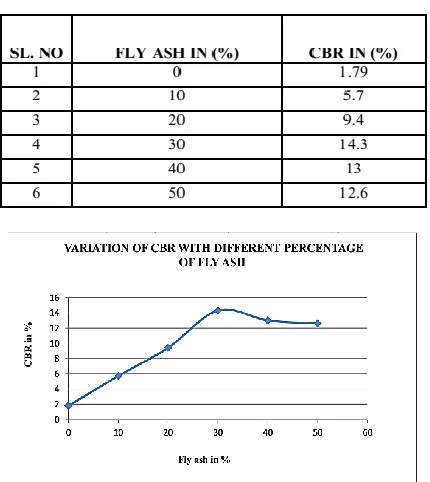
Figure 1Variation of CBR with different percentage of fly ash
Table2. Variation of Atterberg’s limits with KOH
Figure 2 Variation of Atterberg’s limit with additives
Table 3. CBR test results for 2.5 and 5mm penetration for black cotton soil+ AAFA of different
molarities
Figure 3 Variation of CBR with different molarities.
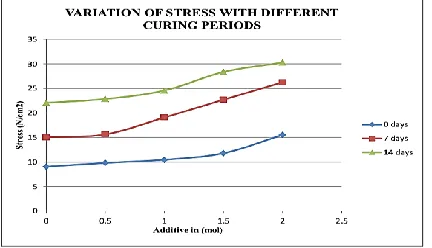
Figure 4 Variation of stress with different curing periods.
V. CONCLUSION
a) From test results it is observed that the moisture content, maximum dry density values increased by 36.36% and12.34 % with the addition of fly ash.
b) For black cotton soil with AAFA the OMC, MDD increased by 36.36% and 20.3% respectively.
The CBR, UCS values increased 698.8%and 90.58% with the addition of fly ash and it increased by 985.47% and174.02% with the addition of Alkali Activated Fly Ash.
c) It can be concluded that, the CBR and UCS values increases drastically with the addition of Alkali Activated Fly ashwhen compared with Fly ash added to the Black Cotton Soil.
REFERENCES
[1] Ashish Mehta, “Stabilization of black cotton soil by Fly Ash”, International Journal of Application or Innovation inEngineering & Management, 2013.
[2] Prashant Hiremath, “Stabilization of Black Cotton Soil using Alkali Activated Fly Ash” International Journal forInnovative Research in Science & Technology, 2016.
[3] Pandian, “Stabilization of Black cotton soil of class-F fly ash as an additive”, Fly Ash India, 2003.
[4] Phani Kumar and Sharma, “The effect of fly ash on engineering properties of expansive soil, Fly Ash India, 2007.
[5] Rajesh Jain and Dharmendra Sahu, “Effect on Engineering properties of Black Cotton Soil by Alkali Content SodiumHydroxide” International Journal for Innovative Research in Science & Technology,2016.
[6] Sarat Kumar Das and Partha Sarathi Parhi, “Stabilization of Expansive Soil Using Alkali Activated Fly ash”, IndianGeotechnical Conference, 2013.
[7] Udayashankar D.Hakari, S.C.Puranik “Stabilisation of Black Cotton Soils Using Fly Ash”, Hubballi-DharwadMunicipal Corporation Area, Karnataka, India, Global Journal of researches in engineering Civil And Structuralengineering,2012.
[8] Venkara Muthyalu P, Ramu K and Prasad Raju G.V.R, “Study on Performance of Chemically Stabilized ExpensiveSoil”, International Journal of Advances in Engineering & Technology, 2012.
[9] Criado M, Fernández-Jiménez A, De la Torre AG,Aranda MAG, Palomo A. An XRD study of the effect ofthe SiO2/Na2O ratio on the alkali activation of fly ash.Cem Concr Res 2007;37:671–9.
[10] Phanikumar, B.R., and Sharma, R. (2007), “VolumeChange Behavior of Fly Ash-Stabilized Clays”, Journalof Materials in Civil Engineering, Vol. 19, SPECIALISSUE: Geochemical Aspects of Stabilized Materials,pp. 67–74.
Bio-data: