Efficient Analysis of Rectangular-Shape Metamaterials Using
P-CBFM/p-FFT Method
Ke Xiao*, Huiying Qi, Sheng Shui Wang, Ying Liu, Liang Ding, and Shun-Lian Chai
Abstract—In this paper, we introduce an efficient algorithm to analyze metamaterials (MTM), which can be finite periodic structures with tight coupling between nearby cells. Firstly, the algorithm, based on method of moments (MoM), uses hybrid volume-surface integral equation (VSIE) to analyze composite dielectric-conductor objects, then, the characteristic basis function method (CBFM) and precorrected-fast Fourier transform (p-FFT) algorithm are combined to accelerate the calculation of equations, based on which, metamaterials composed of connected periodic cells can be analyzed efficiently.
1. INTRODUCTION
Metamaterials are defined as a class of electromagnetic materials which may take artificial structures in form or exist in natural composites, in which, left-handed media, photonic band gap (PBG) materials and anisotropic media have attracted considerable attention in the past one or two decades, these MTMs have been widely utilized in microwave and optical applications including circuit, waveguide and antenna designs.
Many methods based on Floquent’s theorem have been applied to analyze MTMs, where the periodic structures are assumed to be infinitely periodical, then, dispersion relations and Bloch impedance are obtained to describe the characteristics of MTMs. However, infinite periodic structures do not exist, and dimensions of periodic cells are finite. In order to capture the mutual couplings and the fringe effects accurately, full-wave numerical methods should be applied, such as MoM, finite-difference time-domain method (FDTD), and finite element method (FEM). To calculate fields existing in an unbounded region, MoM is usually the preferred choice, because only region with current distribution need be considered, so that fewer unknowns are needed. Among integral equations solved by MoM, hybrid volume-surface integral equation (VSIE) [1] is a popular numerical method to consider composite objects. But to solve a dense matrix equation, the conventional MoM requires O(N3) computational
complexity andO(N2) memory, which is inefficient for electrically large targets.
To render large problems manageable, fast solvers have been utilized to reduce the requirement of memory and CPU time to an extent, such as conjugate gradient fast Fourier transform method (CG-FFT), fast multipole algorithm (FMM) or multilevel fast multipole algorithm (MLFMA), adaptive integral method (AIM) and p-FFT. Among them, when the VSIE together with p-FFT is used, the complexity and memory are on the order of O(N) ∼ O(N1.5) and O(NlogN) ∼ O(N1.5logN), respectively.
However, MTMs are always composite structured materials composed of subwavelength building blocks [2]. When MoM is applied to analyze MTMs, it is difficult to capture the objects using RWG or SWG basis functions with typical dimensions on the order of λ/10∼λ/20. In order to analyze such problems accurately, dense meshes should be applied which may lead to an ill-conditioned problem [3].
Received 26 September 2015, Accepted 22 September 2016, Scheduled 30 October 2016
* Corresponding author: Ke Xiao ([email protected]).
the correction of coupling between nearby cells is not needed to be considered. In [11], Xiao et al. used a near-correction model to describe the interaction between nearby cells of periodic arrays, then finite arrays with dense coupling between cells can be analyzed efficiently and accurately; however, models composed of cells connected with each other without any gaps in both dimensions, as shown in Fig. 1(b), cannot be considered properly [11].
(a) (b)
Figure 1. (a) Periodic structure with gaps between nearby cells. (b) Periodic structure without gaps between nearby cells.
In this paper, an algorithm combining CBFM and p-FFT (P-CBFM/p-FFT) is applied to analyze periodic arrays with no gaps between cells. Because MTMs can be decomposed to periodic sub-wavelength cells with tight coupling between nearby cells, P-CBFM/p-FFT algorithm can be applied to analyze the scattering and transmission characteristics of some typical finite photonic crystal. The results of synthetic study show that the algorithm has good performance in accuracy and efficiency.
2. P-CBFM/P-FFT ALGORITHM TO ANALYZE METAMATERIALS
2.1. Metamaterials Problems
MTMs are always composed of periodic subwavelength cells. Due to coupling between nearby cells, there are two main forms of MTMs as shown in Fig. 1, where Fig. 1(a) shows MTMs with gaps between cells, and Fig. 1(b) depicts MTMs without gaps between cells. Boundary condition between nearby cells should be considered.
2.2. P-CBFM/p-FFT Algorithm
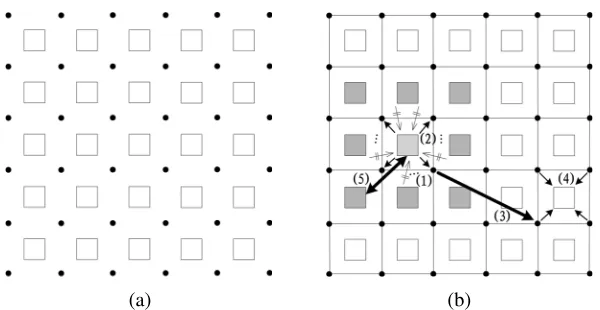
To analyze MTMs composed of periodic cells shown in Fig. 2(a), uniform grids are employed to cover the whole object after being discretized into elements. It should be noted that the positions of grid points are required to be periodic compared to cells. It is suggested to chose less than λ/7 spacing between grid points. For simplicity, only sparse grid points are plotted here.
The common flow of the algorithm can be expressed in a series of steps shown in Fig. 2(b) and listed below.
(a) (b)
Figure 2. (a) Periodic cells in uniform grids. (b) Steps of the P-CBFM/p-FFT algorithm.
from overestimated angles are applied, and singular value decomposition (SVD) is used to derive the CBFs of each cell.
2) Projection: The second step is the construction of the grid projection operator, using which, virtual currents and charges distributed on generated CBFs are projected to auxiliary uniform grid. 3) Convolution: The vector and scalar potentials at uniform grid points are efficiently computed by
Fourier transform method.
4) Interpolation: After potentials on the auxiliary grid are calculated, the virtual potentials on CBFs can be obtained through interpolation.
5) Precorrection: The above process is only accurate for far-field interactions, and for nearby interactions, it is necessary to implement the precorrection on nearby CBFs. For this periodic problem, the procedure can be simplified, as shown in Section 2.4.
At last, the generalized minimum residual method (GMRES) and the incomplete LU factorization with thresholding (ILUT) preconditioner are combined and applied to get the solution of matrix equation.
2.3. Generation of CBFs
When CBFM is applied, we should firstly decompose the whole object into periodic cells as shown in Fig. 1, then CBFs are specially constructed to represent the electromagnetic characteristic of each cell, where plane waves incident from different angles are applied [3].
Consider metamaterials with 2-direction (2-D) periodical cells. The near correction model is applied here to retrieve CBFs [11], as shown in Fig. 3(a), and nine types of basis functions are defined according to their relative positions in the 2-D periodical structure. Then all types of CBFs can be obtained by solving a single small problem as shown in Fig. 3(b) [4] by considering the effects of nearby cells.
2.4. Calculation of Matrix-Vector Multiplication Using P-FFT Algorithm
To consider the scattering of a periodic array with M elements, the number of unknowns for one unit cell is assumed to be Ns. A set of incident plane waves from NP O angles are utilized as excitations, and a response matrix JCBF s can be obtained, of which, the redundant information can be eliminated by using singular value decomposition (SVD) as
JCBF s=LDRT (1)
(a) (b)
Figure 3. (a) Typical basis functions in the periodic structures. (b) Nine kinds of basis functions [11].
the novel generated basis functions (CBFs) and denoted as B (a form of matrix), so the response of mth unit-cell under any excitation can be expressed as
Jm≈BmICm (2)
in which,ICmdenotes the unknown coefficients according to the novel constructed CBFs, andBmdepicts the CBFs matrix ofmth unit-cell. Then, the solution of the original problem can be expressed as
[I]N×1=
⎡ ⎢ ⎢ ⎣
B1 0 · · · 0
0 B2 0 0
..
. 0 . .. ...
0 0 · · · BM
⎤ ⎥ ⎥ ⎦
N×Nc ⎡ ⎢ ⎢ ⎢ ⎣
IC1 IC2
.. .
ICM ⎤ ⎥ ⎥ ⎥ ⎦
Nc×1
(3)
where,N denotes total unknowns of the original problem, whileNc =M×K depicts the sum of CBFs of the equivalent problem.
The matrix equation depending on novel constructed CBFs can be written as⎡
⎢ ⎢ ⎢ ⎣
ZC11 ZC12 · · · ZC1M ZC21 ZC22 · · · ZC2M
..
. ... . . . ...
ZCM1 ZCM2 · · · ZCMM ⎤ ⎥ ⎥ ⎥ ⎦ ⎡ ⎢ ⎢ ⎢ ⎣
IC1 IC2
.. .
ICM ⎤ ⎥ ⎥ ⎥ ⎦= ⎡ ⎢ ⎢ ⎢ ⎣
VC1 VC2
.. .
VCM ⎤ ⎥ ⎥ ⎥ ⎦ (4) where
1) ZCmn denotes the mutual coupling matrix of mth cell and nth cell.
2) [IC] = [ (IC1)T (I2C)T · · · (ICM)T ]T is the unknown coefficients of CBFs of the entire problem. 3) [VC] = [ (VC
1)T (V2C)T · · · (VCM)T ]T is the novel exciting vector related to CBFs, in which
if the original exciting vector tomth cell is Vm, then, the virtual exciting vector to CBFs can be expressed asVmC =BTmVm.
However, it is inefficient to calculate the impedance matrix in Eq. (4) directly by MoM. In order to utilize the periodical features, p-FFT algorithm is applied to calculate the matrix-vector product, and the procedure can be expressed as
ZCmn=SCmHCWCn +PCmn (5)
in which, based on CBFs, WCn is the projection matrix of nth cell, HC the convolution operator, SCm
the interpolation matrix ofmth cell, andPCmn the precorrection operator between cells mand n. They are derived as follows
WCn = WnBn (6)
HC = H (7)
SCm = BTmSTm (8)
where, based on the original basis functions (such as RWG, SWG),Wndenotes the original projection matrix of nth cell, H the convolution operator, Sm the interpolation matrix of mth cell, and Bn the CBFs matrix of nth cell defined in Eq. (2). However, it requires a lot of memory and CPU time to calculate Bn, WnC, SCm and PCmn one by one to different cells, and accordingly, we introduce the procedure as follows for the simplification:
1) At most nine types of Bn are needed to be calculated and saved, shown in the last section; 2) SinceWn and Sm are independent ofnand m, it is only needed to calculateWnC and SCm once; 3) If there are only sparse coupling between nearby cells of the periodical array, it is only needed to
consider the near-field correction between nearby elements in one cell, so PCmn is non-zero only if m = n and is unchangeable with the sequence number. However, if dense coupling exists between nearby cells, near-field correction between them should be considered, which will be further discussed in the next section, and similar to the calculation of CBFs matrixBn, nine types ofPCmn
should be considered.
Using the properties enumerated above, the calculation requirements in projection, interpolation, and precorrection procedures can be reduced efficiently.
2.5. Near-Field Correction between Nearby Cells
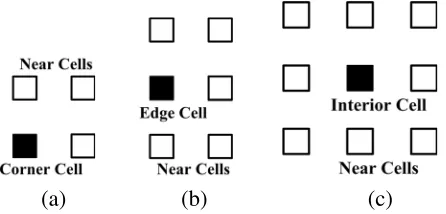
Similar to the generating of CBFs as shown in Fig. 3, near-field correction model to nearby cells can be constructed. To a 2-D periodic array, there are nine types of near-zone interactions between cells according to the relative positions [11] as shown in Fig. 4, where, all the near-cell interactions can be included in Fig. 4(c), hence only 9 types of precorrection operator are demanded to be calculated and stored.
(a) (b) (c)
Figure 4. Nine kinds of near-cell relationship, in which, observation point is in (a) corner cell (4 cases), (b) edge cell (4 cases), and (c) interior cell (1 case).
2.6. Consideration of Periodic Arrays with No Gaps
To consider periodic structures with no gaps between nearby cells, the normal component of electric displacementD should be continuous through the boundary, then SWG basis functions whose common faces located on the boundary should be analyzed particularly. Fig. 5 shows two conjoined tetrahedrons
Tn and Tn, located in periodic nearby cells A and B, respectively, and the common facean is located on the boundary “S” of nearby cells.
Figure 5. SWG defined on the boundary between nearby cells.
Figure 6. Geometry of the 4×4 array.
3. EXAMPLES
Firstly, let us investigate the scattering properties of a 4×4 array located in thex-y plane due to the incidence of plane wave, and the incident angle is along φ= 90◦ and θ = 150◦, with the electric field polarized in x-direction. As shown in Fig. 6, each cell is a mushroom-like structure, with a relative permittivity of the substrate equal to 2.6. Two square patches are mounted on the top and bottom of the substrate, connected by a center-located via. Dimensions of the unit-cell include h = 0.05λ0,
L= 0.3λ0,R= 0.05λ0 (λ0 is the wavelength in vacuum). The calculated results are compared with the
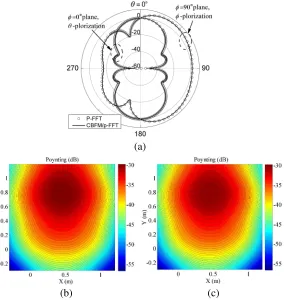
one from p-FFT. The bistatic RCSs are compared in Fig. 7(a), while Fig. 7(b) and Fig. 7(c) compare the magnitudes of Poynting vector in a plane located at a distance ofz= 0.1λ0 above the object. Good
agreements confirm the accuracy of the P-CBFM/p-FFT algorithm for the problem. Additionally, Table 1 shows the resources for the calculation, where, the P-CBFM/p-FFT needs only 3.1% of the p-FFT memory and takes 12.86 minutes of computation time. Additionally, Fig. 8 records the relative errors against the iterative times, in which, the convergence speed of P-CBFM/p-FFT is better than that of p-FFT, and only 7 times are needed for convergence.
Table 1. Resources for the calculation of example I.
Method Number of
unknowns
Per iteration (sec.)
Total memory (Mb)
Total time (min.) P-FFT
12,400 3.91 207.42 23.59
P-CBFM/p-FFT 2.78 6.47 12.86
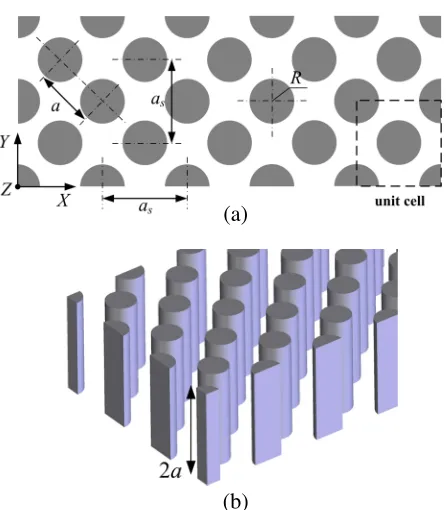
Secondly, we further investigate the scattering of a photonic-crystal superlenz (PSS) presented in [12] and analyze the PSS using algorithm of this paper. Its dimensions are shown in Fig. 9, where a = 0.192λ0, as =
√
(a)
(b) (c)
Figure 7. RCS and magnitude of Poynting vector calculated for array shown in Fig. 6. (a) Bistatic RCSs inx-zplane andy-zplane. (b) Magnitude of Poynting vector calculated by p-FFT. (c) Magnitude of Poynting vector calculated by P-CBFM/p-FFT.
dielectric cylinder is 2a, with a relative dielectric constant equal to 14.
The near-field distribution of a 5×3 (x×y) array is calculated to illustrate the accuracy of the algorithm, as shown in Fig. 10, where the observation plane is located at the plane ofz= 0.42 m. Good agreements are obtained. Then, a 20×4 (x×y) array is analyzed according to the effect of az-axial line source, which is located at a position of (x= 2.7134 m,y=−0.06715 m). Table 2 shows the calculation resources of the two algorithms, where for the 5×3 array with 118,082 unknowns, the P-CBFM/p-FFT yields a memory saving of more than 98%, and the CPU time is reduced to only 8.26% that of the p-FFT method without loss of accuracy. The distinction is more obvious in favor of P-CBFM/p-FFT when the number of unknowns increases.
Table 2. Resources for the calculation of example II.
Method Number of unknowns Total Memory (Mb) Total time (hour)
p-FFT (5× 3 array) 118,082 1,200 3.39
P-CBFM/p-FFT (5× 3 array) 118,082 20.93 0.28
P-CBFM/p-FFT (20× 4 array) 701,760 161.15 2.26
Then, we investigate the field distribution at the planez= 0.2 m. In Fig. 11, the sampled Poynting energy (in dB) is shown, and we can see that in the other side of the array, a focus point exists, which is also the conclusion in [12].
1 2 3 4 5 6 7 8 9 1 0 1 1 1 2 1E-4
1E-3 0.01 0.1 1
p-FFT
P-CBFM/p-FFT
Iterative times
Relative erro
r
Figure 8. Relative error against the iterative times for example I.
(a)
(b)
Figure 9. Geomerty of the PSS. (a) Planform. (b) 3-D view.
(a) (b)
Figure 10. Magnitude of Poynting vector calculated for 5×3 array shown in Fig. 9. (a) Magnitude of Poynting vector calculated by p-FFT. (b) Magnitude of Poynting vector calculated by P-CBFM/p-FFT.
4. CONCLUSIONS
In this paper, an effective algorithm, based on integral equation named VSIE, is provided to analyze typical MTMs. The periodic feature of the MTMs can be utilized to construct the CBFs, and the near interaction part is considered to correct the coupling between nearby cells, so that the dense coupling between nearby cells and the fringe effect can be considered correctly. At the same time, p-FFT solver can be combined to analyze the interactions between CBFs quickly, and the periodicity is applied to construct the projection, interpolation, and precorrection operator of p-FFT. Additionally, the electric displacement is set to be continuous through the boundary between touched cells. Based on the above improvements, MTMs with touched dielectric between nearby periodic cells can be analyzed quickly and accurately. At last, two examples are provided and analyzed, in which the accuracy and efficiency of P-CBFM/p-FFT are demonstrated.
ACKNOWLEDGMENT
This work is supported by the China National “Twelfth Five-Year” Plan for Science & Technology with number #2014BAK12B03.
REFERENCES
1. Sarkar, T. K. and E. Arvas, “An integral equation approach to the analysis of finite microstrip antennas volume-surface formulation,”IEEE Trans. Ant. Propagat., Vol. 38, No. 3, 305–312, 1990. 2. Jin, J. F., S. Y. Liu, Z. F. Lin, and S. T. Chui, “Effective-medium theory for anisotropic magnetic
metamaterials,” Physical Review B, Vol. 80, 115101, 2009.
3. Lucente, E., A. Monorchio, and R. Mittra, “An iteration-free MoM approach based on excitation independent characteristic basis functions for solving large multiscale electromagnetic scattering problems,” IEEE Trans. Ant. Propagat., Vol. 56, No. 4, 999–1007, 2008.
4. Lu, W. B., T. J. Cui, Z. G. Qian, X. X. Yin, and W. Hong, “Accurate analysis of large-scale periodic structures using an effcient sub-entire-domain basis function method,” IEEE Trans. Ant. Propagat., Vol. 52, No. 11, 3078–3085, 2004.
5. Prakash, V. V. S. and R. Mittra, “Characteristic basis function method: A new technique for efficient solution of method of moments matrix equations,” Microwave and Opt. Technol. Lett., Vol. 36, No. 2, 95–100, 2003.
6. Delgado, C., M. F. C´atedra, and R. Mittra, “Efficient multilevel approach for the generation of characteristic basis functions for large scatters,”IEEE Trans. Ant. Propagat., Vol. 56, No. 7, 2134– 2137, Jul. 2008.
7. Bianconi, G., C. Pelletti, R. Mittra, K. Du, S. Genovesi, and A. Monorchio, “Spectral domain characteristic basis function method for efficient simulation of microstrip devices in layered media,” IET Microwaves, Ant. and Propagat., Vol. 6, No. 4, 411–417, 2012.
8. Konno, K., Q. Chen, K. Sawaya, and T. Sezai, “Optimization of block Size for CBFM in MoM,” IEEE Trans. Antennas Propagat., Vol. 60, No. 10, 4719–4724, Oct. 2012.
9. Hu, L., L. W. Li, and R. Mittra, “Electromagnetic scattering by finite periodic arrays using the characteristic basis function and adaptive integral methods,”IEEE Trans. Ant. Propagat., Vol. 58, No. 9, 3086–3090, Sep. 2010.
10. Shao, H., J. Hu, W. C. Lu, H. Guo, and Z. P. Nie, “Analyzing large-scale arrays using tangential equivalence principle algorithm with characteristic basis functions,” Proceedings of the IEEE, Vol. 101, No. 2, 414–422, Feb. 2013.
11. Xiao, K., F. Zhao, S.-L. Chai, J.-J. Mao, and J. L.-W. Li, “Scattering analysis of periodic arrays using combined CBF/p-FFT method,” Progress In Electromagnetics Research, Vol. 115, 131–146, 2011.

![Figure 3. (a) Typical basis functions in the periodic structures. (b) Nine kinds of basis functions [11].](https://thumb-us.123doks.com/thumbv2/123dok_us/1984714.1262373/4.612.167.454.84.217/figure-typical-basis-functions-periodic-structures-kinds-functions.webp)