Agent Based Adapted Semantic Enhanced Web Information
Retrieval Process Analysis
Esther Varma & M. Bhavana Eswar
1Associate Professor, Dept. of CSE Geethanjali College of Engineering and Technology Hyderabad, Telangana, India
2Assistant Professor, Dept. of CSE Geethanjali College of Engineering and Technology Hyderabad, Telangana, India
Abstract—Every user has an individual background and a precise goal in search of information. Although modern methods of information retrieval have enormously improved our ability to find relevant information for distributed environment, it remains the case for the foreseeable future that the best performance can only be obtained by some pre-processing of the documents to be searched. Web Information retrieval system assumes a noteworthy part in retrieving the information from a larger collection of data. The goal of personalized search is to search results to a particular user based on the user’s interests and preferences. Effective personalization of information access involves two important challenges: accurately identifying the user context and organizing the information to match with the particular context. In this paper, the system uses ontology as a knowledge base for the information retrieval process. It is one layer above any one of search engines retrieve by analyzing just the keywords. Here, the query is analyzed both syntactically and semantically. The developed system retrieves the web results more relevant to the users query. The level of accuracy will be enhanced since the query is analyzed semantically. The results are re-ranked and optimized for providing the relevant links. Based on the user’s information access behavior, an ontological profile is created, which is also used for personalization. If the system is deployed for web information gathering, search performance can be improved and accurate results can be retrieved.
Keywords—Agent; Personalization; Semantic web; information retrieval; ranking algorithm
INTRODUCTION
The main purpose of this section is to justify the need for an integrating approach that combines both intelligent agents and personalized semantic web service technologies. The study concentrates on personalized semantic web services and then intelligent agents and multiagent systems which are enumerated and the most pressing problems of agent technology pointed out. A. Personalization using Semantic web: Semantic technologies promise a next generation of semantic search engines. General search engines don‟t take into consideration the semantic relationships between query terms and other concepts that might be significant to the user. Thus, semantic web vision and its core ontology‟s are used to overcome this defect. The order in which these results are ranked is also substantial. Moreover, user preferences and interests must be taken into consideration so as to provide the user a set of personalized results. B. Query Expansion using ontology: Ontology is to create a shareable and agreeable semantic resource over a wide range of agents. The important goal of building ontology is it may serve as an index into a repository
I. LITERATURE REVIEW
Web personalization is understood in various dimensions. One way of doing this is categorization of users based on demographic information provided by the users at the time of selecting the style for personalization. An example of this is Google Personal search through igoogle. This approach requires that the user must exactly know what information is needed prior to searching. The research is also going on to modify the structure of the web documents and make it semantic so that the documents are then retrieved on the basis of the meaning of the query and not the terms present in the query [2]. This approach seems very promising but is a long term project, the acceptability and usability of which depends on the user community. Another way to personalize the search is to classify users on the basis of pre-calculated classes. The classes may be pre-calculated through users browsing history. A classification of the on-line users to one of the predefined classes is typically based on similarity calculation between each predefined pattern and the current session. The current session is assigned to the most similar cluster [6, 8]. Further this approach is modified to accommodate fuzzy classification so as to prevent some users to become outliers [7]. Some authors have constructed user profiles on the basis of modified collaborative filtering with detailed analysis of user‟s browsing history in one day [5]. User profiles are also constructed on the basis of ontology [1]. Some efforts have also been done to refine the search process by re-defining the queries and then submit it to the search engine. Refined queries are then clustered to form user‟s profiles [6]. In this approach also only visiting a page makes it interesting enough to update user profile. Another method to personalize is to discover association among various links accessed by the user through its sessions [3]. Another interesting effort has been done in actual personalization of users‟ interest in which they have considered that every user‟s behavior is different on same search results obtained through same search query [3]. They have used two properties of a document for modeling users i.e. attractiveness and perseverance. They have assumed that these properties depend on the popularity of the document among the similar user community and distance of that document from last selection. Normal user behavior suggests that after a certain no of unattractive documents the user stops navigating the search results. Efforts have also been done to construct user profiles using relevancy between the terms of the queries presented in current session and in earlier sessions [4]. Due to the intelligent agent technologies shortcomings, the inherent need for autonomous software entities in SWS environments, and the promising benefits of having both intelligent agents and (semantic) web services working cooperatively, numerous research projects have been carried out that try to put these two technologies together into integrated frameworks .The author Hendler (2001) proposes a method for describing the way the invocation of services should be done by agents by means of an ontology language. The Semantic Web FRED project (SWF) combines agent technology, ontologies, and SWS in order to develop a system for automated cooperation. The GODO (Goal-Oriented Discoveryfor SWS) system (Go´mez et al., 2006), which is based on a software agent that is located between different
SWS execution environments (e.g. WSMX, METEORS,OWL-S Virtual Machine, etc.) and final users. The authors Buhler and Vidal [10] highlight the passive behavior of web services and propose to wrap them in proactive agents. The problem of this approach is that semantically described web services are not considered at all. Another related solution is the one provided by the „„Agents and Web Services Interoperability Working Group (AWSI WG)”3, which is part of the IEEE FIPA Standards Committee which can handle the fundamental differences between agent technology and web services, that is, the use of different communication protocols (ACL vs. SOAP), service description languages (DF-Agent-Description vs. WSDL) and service registration mechanisms (DF vs. UDDI). With this approach, the so called Agent Web Gateway middleware (Shafiq et al., 2006) facilitates the required integration without changing existing specifications and implementations of both technologies. This category focuses on the overlapping features of the technologies under question. However, we believe that most of the functionality provided by Intelligent Agents and Web Services is complementary, so that each of these technologies must be situated at a different abstraction level. The model proposed here is a frame work for building a user model in addition to explicit & implicit feedback from user and find the relevancy between the terms presented for query and the document using past sessions by user and the contents of the documents. Then the documents with the higher relevance ratio are presented to the user. The current user session data is used to update the user‟s profile for future reference. Two types of parameters are considered for constructing user model: static parameters and dynamic parameters. Static parameters are relevancy of documents with the specific category measured by the popularity of the document. Static parameter used in the model is: Termdocument relevancy which is maintained in a 2-D matrix T. The relevancy calculation done here is based on the occurrence of terms in the document. We have tried to improve upon the modality of updating the matrix. The matrix is updated every with every user session with the browsing patterns of a user and for first „n‟ sessions it keeps on constructing new columns with respect to the terms that relates to a document. Our system proposes a different ranking based on URL. The ranking is query-dependent. The proposed algorithm assigns a score that measures the quality and relevance of a selected set of pages depending on their URL to a given user query. The basic idea is to build a query-specific two dimensional vector table, called a related vector table, and perform URL analysis. The present paper proposes a slightly different ranking based on URL. In our research we use hybrid approach to find ranked webpage.
II. WEB INFORMATION RETRIEVAL PROCESS
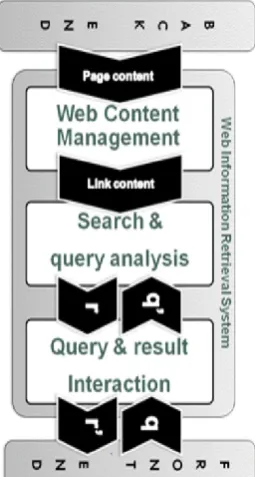
relevant for a user query in a collection of documents. Decades of research in WIR were successful in developing and refining techniques that are solely word-based. With the advent of the web new sources of information became available, one of them being the hyperlinks between documents and records of user behavior. The goal of WIR system in Figure 1. is to satisfy user‟s information need. Unfortunately, characterization of user information need is not simple. User‟s often do not know clearly about the information need. Query is only a vague and incomplete description of the information need.
Figure 1. Web Information Retrieval Process
This study and analysis manuscript is organized as follows: Section 2 gives the related work to this manuscript. Section 3 describes the manuscript goal and Section 4 gives the conclusion and the future work.
III. SEMANTIC ENHANCED INFORMATION RETRIEVAL
The traditional Web Information Retrieval system depends on the comparison of the keyword with the exact match of the words in the document. This method will retrieve the pages that are partial relevant to the user query. Web offers some opportunity to improve the traditional search. One of the ways is with the help of semantic search. Semantic Information Retrieval seeks to improve search accuracy by understanding searcher‟s intent and the contextual meaning of terms as they appear in the searchable data space, whether on the Web or within a closed system, to generate more relevant results. Semantic Enhanced Information retrieval is a solution to the Information retrieval problem because the main goal is to provide the relevant information according to user‟s need and interest. Semantic Information Retrieval is a data-enabled process that is based on three types – first-based on users, second-based on website usage, third-based on software and
hardware. In this paper, gives a review of Semantic Information Retrieval based on data about the user and its process is explained as in Figure 2.
Figure 2. Semantic Web Information Retrieval Process
Semantic Information Retrieval can be applied to the many approaches based on their characteristics and features. We will discuss each of this survey details in summary as follows: In sservice based approach, Semantic Information Retrieval facilitates the development of distributed, service oriented information retrieval system over the heterogeneous internet. It includes network topology structure, service calling process, task allocating and load balancing as well as time-threshold settings. In Context based and user context based approaches, Semantic Information Retrieval cab be implemented as a work that proposes a hybrid approach to content clustering that combines the best of web information retrieval methods and also used the personal preference information of the users modeling a wide range of contexts. In User Profile approach, Semantic Information Retrieval can be done by making use of tag data for evaluating personalized retrieval system involving thousands of users. Analogously to studies involving implicit feedback mechanisms in IR, which have found that profiles based on the content of clicked URLs outperform those based on past queries along, it found that profiles based on the content of bookmarked URLs are
provided. The web pages crawled is checked for relevance based on the domain chosen and indexed. An inverted index based on page ranking is created. In Concept based approach, Semantic Information Retrieval can be done towards identifying relevant pages through Semantic Information Retrieval path analysis and provides an effective personalized web search. This improves web search by providing content and individual based relation between the search query and its relevant web pages. Comprehensive search service always provides Semantic Information Retrieval by considering the varying interests of the user. It provides navigation assistance and the position of each result set to aid the user in selecting the relevant required documents. This is at the cost of increased storage and computational complexity. Use of Ontology annotation knowledge representation methodology and descriptive metadata repository mechanism based on Concept Relevancy Ranking of Link and Page Contents algorithmic approach in Semantic Information Retrieval as a layered model of semantic web provides solution to the problem by providing tools and technologies to enable machine readable semantics in current web contents. It describes the model through ontology development and metadata repository. During the paper, contrasted all the approaches firstly with theoretically and then practically and discover advantages that lead to the Ontology annotation knowledge representation methodology, advantages is: Users could perform more accurate queries while being eliminating more than 90 percent of the irrelevant documents. Semantic Information Retrieval performs better than traditional searching methods in case of semantically meaningful sentences or phrases but will fall short for keyword based search.
IV. PROPOSED APPROACH
In the Semantic Web, Ontological models permit the annotation of Web documents (modeling the representation of information contained in them) and therefore the formulation of more exact queries to retrieve documents. Annotation typically includes instances of concepts from the ontology to represent specific entities recognized in the resources, and afterwards linking this metadata to the resource as its description, a new methodology namely – ontology annotation knowledge representation is introduced to rank the relevant pages based on the domain concepts and keywords rather than keyword.
Proposed approach is the descriptive metadata repository mechanism based on concept retrieval algorithm in Semantic Information Retrieval as a layered model of semantic web provides solution to the problem by providing tools and technologies to enable machine readable semantics in current web contents. It describes the model through ontology development and metadata repository. In this approach-using Ontology based approach in Semantic Information Retrieval; it describes two ontology-domain ontology and service ontology, in order to improve the relevance of the results presented to the user. This approach is applied to Enterprise domain and noted that it makes it possible to improve the precision of research and thus the relevance of the documents returned to the user. Now we describe the components of a
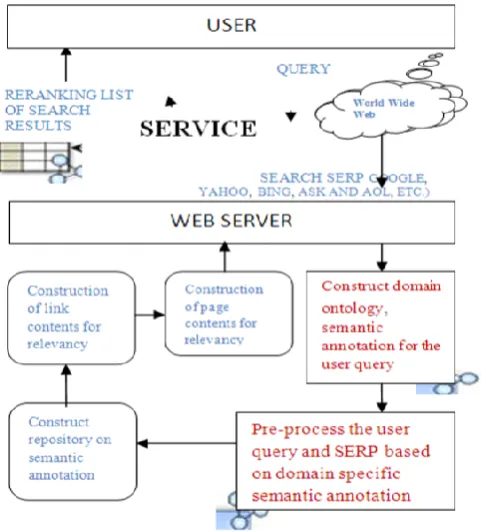
semantic enhanced WIR System functions in the following steps as shown in Figure 3.
Data Set
In this the input data set is Extracted Search Engine Results Page from search engines viz. Google, Yahoo, Bing, Ask And Aol, Etc and output data set is Re-ranked Search Engine Results Page based on Concept Relevancy Ranking of Link and Page Contents Algorithm and initially SERP‟s are extracted based on the user query. Pre-process both user query and SERP for domain ontology and semantic annotation. Root words are extracted from the user query to form a repository. Here the link content and page content of the SERP‟s are checked with repository so that the more relevant pages are retrieved.
Figure 3. Processes in Semantic enhanced Web Information Retrieval
SERP extraction
Based on the user query, Search Engine Results Page (SERP) is retrieved. Pre-process both User Query and Search Engine Results Pages exclusively based on domain ontology and semantic annotation.
Pre-processing
Pre-process user query and extract root words, which are considered for constructing Repository and it is built along with its domain ontology and semantic annotation.
Link content and page content determination
Pre-process and extract the link content[9] and page content keywords for the search engine result pages and compared against the Repository. If match found then corresponding strength is granted each word.
Relevancy calculation
index items of the results to the query. After finding the web pages on the proposed approach[2] relevancy for the particular Search Engine Results Pages against user query is computed by summarizing all the strength of the link contents and page contents by use of damp factor d. The search result page‟s total relevancy is ranked in increasing order.
Re-ranking
Finally re-rank the search results[15][20] on Total relevancy in increasing order. The Top Search Result is the most relevant and bottom is the least relevant for the User query.
V. CONCLUSION
Web Information Retrieval is an important and overwhelming research problem. It provides solutions related to sservice based , Context based ,User Profile, User Context based, Query based, domain specific based vertical search, Concept based, Query expansion and User Relevance, Comprehensive search service, Ontology annotation knowledge representation methodology based on Concept Relevancy Ranking of Link and Page Contents algorithmic approach. The proposed approach gives far better results when compared with the specified traditional search. From the experimental results, it is proved that using the semantic search with text content, most relevant pages are retrieved. This approach was evaluated and verified with different queries, and the relevancy was proved. In evaluating the performance of WIR for distributed environment, it is observed that by using concept relevancy ranking of Link and Page Content algorithm, users could perform more accurate queries while being eliminating more than 90 percent of the irrelevant documents. Due to ever-increasing complexity and voluminous of data, there is needy and certainly a room for further advancements. Further research is going on to refine.
REFERENCE
[1]. Ahu Sieg, Bamshad Mobasher, Robin Burke Ontological User‟s Profiles for Personalized Web Search In Proceedings of Conference of AAAI 2007
[2]. Bettina Berendt, Andreas Hotho, and Gerd Stumme, Towards Semantic Web Mining ISWC 2002, LNCS 2342, pp. 264-278
[3]. Filip Randlinski, Thorsten Joachims Query Chains : Learning from Implicit Feedback. In the Proceedings of KDD‟05 August 21-24 2005
[4]. Jingqiu XU, Zhengyu ZHU, Xiang REN, Yunyan TIAN, Ying LUO Personalized Web search using User Profile,Journal of Computational Information System 2007 [5]. Kazuneri Sugiyama,Kenji Hatano,Masatoshi Yoshikawa Adaptive Web Search based on user Profile Constructed without Any Effort from Users ACM Press 2004 [6]. Kazienko P, Kiewra M (2003) Link Recommendation Method Based on Web Content and Usage Mining. In: the Personalized Web Search: User Modeling Using Implicit Feed Back From Click Through Data
[7]. Maciej Kiewra Iterative Discovering of User;s Preferences Using Web Mining , International journal of Computer Science and Applications Vol. II No. II pp. 57-66
[8]. Mobasher B, Dai H, Luo T, Sun Y, Zhu J (2000) Integrating Web Usage and Content Mining for More Effective Personalization. LNCS 1875 Springer Verlag, 156-176
[9]. Bernes-Lee T., Hemdler Agents and the Semantic Web IEEE Intelligent Systems Journal (march/April 2001) [10]. Paul Buhler and José M. Vidal (2005) Towards Adaptive Workflow Enactment Using Multiagent Systems ,Information Technology and Management Journal , volume 6 pages:61-87
[11]. Jurgen Dorn, Peter Hrastnik, Albert Rainer, Peter Starzacher, “Web Service based meta-search for accomodations”, Journal of IT and Tourism, vol. 10No. 2, 2008
[12]. K Keshamoni, M Tripathi, “DELIBERATION AND EXERTION OF WIRELESS BODY AREA NETWORKS FOR EXCLUSIVE HEALTH CARE SUPERVISION OVER IOT”, 2017.
[13]. K Keshamoni, S Hemanth.”Smart Gas Level Monitoring, Booking & Gas Leakage Detector over IoT” - Advance Computing Conference (IACC), 2017 IEEE , 2017. [14]. Mark J. Carman, Mark Baillie, Fabio Crestani, “Tag Data and Personalized Information retreival”, SSM‟08, ACM, October 30, 2008
[15]. HU Jun, LI Zhi-lu and GUAN Chun, “A Method of Rough Ontology-based Information Retrieval,” IEEE International Conference on Granular Computing, 2008, p. 296-299.
[16]. Jibran Mustafa, Sharifullah Khan and Khalid Latif, “Ontology Based Semantic Information Retrieval,” 4th International IEEE Conference Intelligent Systems, vol. 3, 2008, p. 14-19
[17]. Silvia Calegari and Gabriella Pasi, “Personalized Ontology-based Query Expansion,” International Conference on Web Intelligence and Intelligent Agent Technology, vol. 3, 2008, p. 256-259.
[18]. Jing-Yan Wang and Zhen Zhu, “Framework Of Multi-Agent Information Retrieval System Based On Ontology And Its Application,” Proceedings of the Seventh International Conference on Machine Learning and Cybernetics, 2008,p. 1615-1620.
[19]. Ashok S.O., Vikas Kumar, and Sanjay K. Jena, “An Extended approach to Personalize the web search by measuring the user relevance
[20]. Maurice coyle and Barry Smyth, “Supporting Intelligent Search”, ACM Transactions on Internet Technology, Vol 7-No. 4, October 2007
[21]. Marie-Aude, Aufaure, Rania Soussi, Hajer Baazaoui, “SIRO-On-Line semantic Infolrmation retrieval using Ontologies”, IEEE, 20070