Enhanced Reflection Loss Performance of Square Based Pyramidal
Microwave Absorber Using Rice Husk-Coal
Harsroop Kaur1, *, Gagan Deep2, and Vikas Chawla3
Abstract—Rice husk and coal is an innovation in enhancing the microwave absorption properties of pyramidal microwave absorbers to be used in radio frequency anechoic chambers. An anechoic chamber consists of radar absorbing material (RAM) along its wall; floor and ceiling to eliminate unwanted reflections to create electromagnetically quite environment. To design the pyramidal microwave absorber, coal has been added to rice husk. This innovative material combination has been investigated to determine the best reflectivity performance of pyramidal microwave absorbers. In the commercial market, polyurethane and polystyrene are the most popular foam based material that has been used in pyramidal microwave absorber fabrication. Simulation tool that has been used is CST Microwave Studio. Simulation based comparison of rice husk and combination of rice husk plus coal is done in the frequency range of 0–20 GHz. Chemicals used to intact the powdered form of rice husk and coal are polyester resin, methyl ethyl ketone peroxide (MEKP) and cobalt. Pyramidal microwave absorber has been tested using dielectric probe method and radar cross section method (RCS). Reflection loss performance is tested in the frequency range of 8.2 to 12.4 GHz.
1. INTRODUCTION
Agricultural waste is the waste produced on farm through various farming activities. Residues of crops are materials like leaves, seed pods, stalks and stems left in agricultural fields after the crop has been harvested. Agricultural waste like rice husk, rice straw, sugarcane bagasse, banana leaves, etc. can be used as an alternative for microwave absorber used in the anechoic chamber [1]. Rice husks are the natural sheaths that form on rice grains during their growth and removed as waste during the processing of rice in mills. Every year approximately 120 million tonnes of paddy are produced in India. This gives around 24 million tonnes of rice husk and 4.4 million tonnes of rice husk ash every year [2]. Rice husk is unusually high in ash, which is 92 to 95% silica, highly porous and lightweight, and is traditionally burnt in the field or dumped [3]. Table 1 shows the chemical composition of rice husk [4].
The presence of 35.77% of carbon that occurs naturally in rice husk is responsible for good reflection loss performance for the microwave absorbers. Mixture of rice husk and powdered coal is used as the pyramidal microwave absorber [5]. Figure 1 shows various steps to the development of rice husk-coal pyramidal microwave absorber. Figure 2(a) shows collected rice husk from paddy fields, (b) shows grinded rice husk, (c) shows the mixture of grinded rice husk and coal.
The organic component of coal consists of chemical compounds from carbon, hydrogen, oxygen, sulphur, and nitrogen [6]. Due to 75% of carbon in it, coal is used to enhance microwave properties of rice husk. Table 2 shows weight percentages of chemical compounds present in it naturally.
In order to define physical and chemical properties related to various materials, we need to measure the dielectric properties of the material. By definition, dielectric properties are a measure of the
Received 26 July 2015, Accepted 8 September 2015, Scheduled 9 September 2015
* Corresponding author: Harsroop Kaur ([email protected]).
1 DAV University, Jalandhar, Punjab, India. 2 Electronics and Communication Department, DAV University, Jalandhar, Punjab,
Table 1. Chemical composition of rice husk [4].
Element % Element
Silicon Dioxide 22.24
Carbon 35.77
Hydrogen 5.06
Oxygen 36.59
Nitrogen 0.32
Sulphur 0.02
Table 2. Weight percentages of chemical compounds present in coal [6].
Chemicals Compounds Weight Percentage (%)
Ash 10
Oxygen 8
Hydrogen 5
Nitrogen 1.5
Sulphur 0.5
Carbon 75
Figure 1. Development of rice husk-coal pyramidal microwave absorber.
(a) (b) (c)
Figure 2. (a) Rice husk collected from paddy. (b) Grinded rice husk. (c) Mixture of rice husk and coal.
is a measure of how dissipative or loss of a material is to an external field. The dissipation factor or loss tangent, tanδ is a parameter of a dielectric material that quantifies its inherent dissipation of a electromagnetic energy [8, 9]. The formula of loss tangent is shown below:
tanδ=εr/εr
The reflection loss or reflectivity, R can be expressed as the absorbing performance of the material and is given as:
R= 10 log10(Pr/Pi)
wherePr is the plane wave reflected power density and Pi the plane incident power density.
2. MICROWAVE ABSORBER FABRICATION
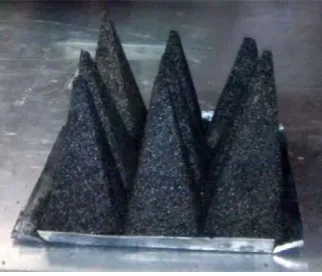
Mostly pyramidal shaped absorbers are used in development of anechoic chambers because they have least amount of open surface area, hence provide maximum microwave absorption [10]. The pyramidal microwave absorber is formed in two parts. The first part is the base part (square based) of 15 cm∗15 cm with the thickness of 2 cm. Second part is the pyramidal shape having square base of 5 cm∗5 cm and height of 13 cm. The pyramidal microwave absorber contains 9 tips per piece. To give shape to the mixed material, moulds are prepared in the sheet metal workshop using aluminium sheet. Figure 4(a) shows the moulds of pyramidal shape. Ratio in which the rice and coal are mixed is 60 : 40. For comparison of the reflection performance of rice husk and the mixture of rice husk and coal, a sample of only rice husk is prepared of the WR 90 waveguide size and is tested using dielectric probe method for its dielectric properties like dielectric constant and tangent loss.
In order to give shape to the absorber, some hardening as well as binding agent is required. As per earlier observations [11], polyester resin is used as binding agent. In this work, cobalt has been used as an accelerator in order to increase the rate of reaction. MEKP is the catalyst added to polyester resins. As the catalyst mixes with the resin, a chemical reaction occurs; creating heat which cures the resin. Cobalt here reduces the gel time and hence enhances the speed of reaction and help in the formation of solid moulds in less time [12, 13]. Figure 3 shows the mixing process to make the rice husks pyramidal microwave absorbers. Preparation of mixture including all the chemicals used is done in a proper composition. For a single pyramid, 45 gms of rice, 30 grams of coal, and 55 grams of polyester resin is added to bind the material together, 0.55 grams of cobalt is added to accelerate the rate of reaction and 1.1 grams of MEKP is added as a catalyst to the reaction.
+ + = Rice husk +
Coal Polyester resin + cobalt Methyl ethyl ketone peroxide Mixed material
Figure 3. The mixing process to make the rice husks pyramidal microwave absorbers.
After preparing the mixture using the composition mentioned above, the mixture is added layer by layer into the moulds and is kept untouched for an hour. The pyramidal shaped absorbers are arranged in a 3×3 array over the 2 cm thick base. Figure 4(a) shows the pyramidal moulds prepared, (b) and (c) show the final mixture prepared and the mixture settled in the moulds respectively. Figure 5 shows 3×3 pyramidal structure with a 2 cm thick base.
3. TESTING METHODS
(a) (b) (c)
Figure 4. (a) Pyramidal moulds. (b) Final mixture. (c) Mixture in the moulds.
Figure 5. 3×3 array of microwave pyramidal structure.
3.1. Dielectric Probe Method
In this method, two co-axial cables are used to calculate the dielectric constant of material under test in the range of 8 to 12 GHz. The sample has to be in the shape that fits exactly inside the WR 90 waveguide. The empty WR 90 Waveguide is inserted between the two port co-axial cables of VNA and then the dielectric constant of air is made to real at value 1. The dielectric probe method is applied for both the samples of rice husk and mixture of rice husk and coal. Figure 6(a) shows WR 90 waveguide and coaxial cables (b) shows Material under test.
After the calibration is done, the material under test is placed inside the WR 90 Waveguide and then it is placed between two ports. Then the calculation for the dielectric constant of the material is performed by the VNA and results are shown along with WR 90 waveguide filled with material under test. Table 3 shows the different values of dielectric constant and tangent loss of rice husk and the mixture of rice husk and coal.
Table 3. Dielectric constant and tangent loss values of rice husk and the mixture of rice husk and coal.
Sample Dielectric Constant Tangent Loss
Rice Husk 1.913503 0.079273
Mixture of rice husk and coal 2.504677 0.08598
3.2. Radar Cross Section Measurement Method
(a) (b)
Figure 6. (a) WR 90 waveguide and coaxial cables. (b) Material under test.
(a) (b)
Figure 7. (a) Set up for the testing of 3×3 pyramidal structure using RCS method. (b) Software set up shown on 50 GHz VNA.
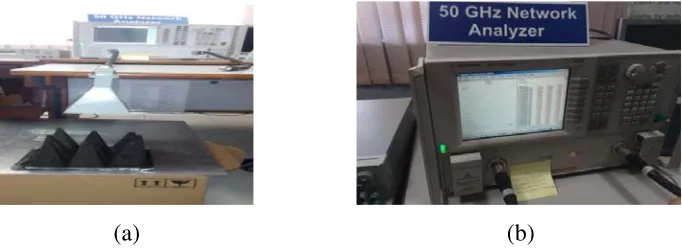
is chosen to correspond to the radar frequency band (8.2 to 12.4 GHz for WR-90 X band Waveguide). X band horn antenna is attached to the probe which is connected to VNA. Firstly, aluminium sheet is kept under the horn antenna to calibrate VNA and then 3×3 arrays of rice husk plus coal is kept over the aluminium sheet under the horn antenna placed at 90 degree above the array as shown in the figure below. Graph of reflection loss v/s frequency is obtained on the screen of VNA. Figure 7(a) shows set up for the testing of 3×3 pyramidal structure using radar cross section method, (b) shows the software setup on VNA.
4. RESULTS AND DISCUSSIONS
Reflection loss results are obtained from RCS Measurement Method. VNA gives a plot for S11against
frequency which gives the reflection loss. Result from the RCS measurement shows a good reflection loss performance as it gives an average value better than−10 dB. Figure 8 shows the tested results of reflection loss performance for 3×3 array in the frequency range of 8.2 to 12.4 GHz as shown by VNA. At four different points of frequencies, reflection loss greater than−40 dB is obtained. This result is equivalent to the conventional foam absorber which shows reflection loss lesser than −50 dB. The average reflection loss of tested sample of rice husk plus coal is around −44 dB in the frequency range of 8–12 GHz with maximum reflection loss at −52 dB at 11 GHz.
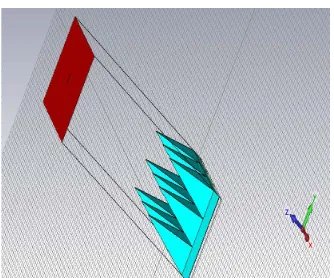
The reflection loss performance of microwave absorbers in the frequency range of 0 to 20 GHz is obtained through CST Microwave Studio. Vector Network Analyser generates a file which comprises of value of dielectric constant at different frequencies in the range of 8.2 to 12.4 GHz. This file is loaded in the CST Microwave studio [15] and then exact reflection constant is calculated by it and is shown as a graph between reflection loss and frequency. Simulation set up is shown in the Figure 9.
Figure 8. Reflection loss performance for 3×3 array in the frequency range of 8.2 to 12.4 GHz as shown by VNA.
Figure 9. Simulation of array in CST Microwave Studio.
Table 4. Reflection loss values of rice husk in 0 to 20 GHz.
S. No Frequency (GHz) Reflection Loss (dB)
1 0 −11.0
2 8 −31
3 8.3 −33
4 9.1 −34
5 10 −34
6 12 −36
7 12.8 −35
8 13.8 −38
9 14 −33
10 15 −35
11 16 −32
12 16.7 −33
13 17.3 −33
14 20 −29
husk and mixture of rice husk and coal, simulation is performed to get two different plots by giving the values of dielectric constant and tangent loss to CST Microwave studio in the frequency range of 0 to 20 GHz. The simulated results of S11 plot obtained for rice husk is shown in Figure 10. Different
Reflection loss values are considered at fourteen frequencies from 0 to 20 GHz for rice husk as shown in Table 4.
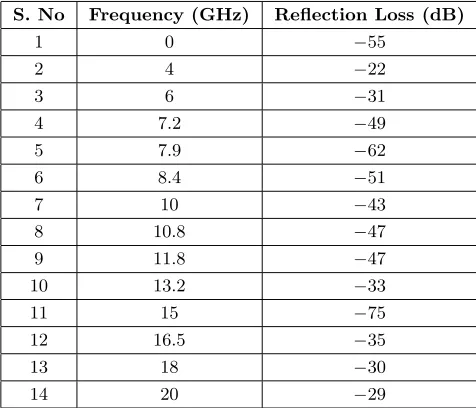
The average reflection loss of rice husk is−31.928 dB from 0–20 GHz. The maximum reflection loss obtained in the plot is −38 dB at 13.8 GHz. Similarly, a plot is obtained for the mixture of rice husk and coal as shown in Figure 11. Different reflection loss values are considered at fourteen frequencies from 0 to 20 GHz for rice husk and coal as shown in Table 5.
Average reflection loss of tested sample of rice husk and coal is−43.5 dB. The maximum reflection loss obtained in the graph is −62 dB at 7.9 GHz. The reflection loss of rice husk is enhanced by
Table 5. Reflection loss values of ‘rice husk and coal’ in 0 to 20 GHz.
S. No Frequency (GHz) Reflection Loss (dB)
1 0 −55
2 4 −22
3 6 −31
4 7.2 −49
5 7.9 −62
6 8.4 −51
7 10 −43
8 10.8 −47
9 11.8 −47
10 13.2 −33
11 15 −75
12 16.5 −35
13 18 −30
14 20 −29
Figure 10. Reflection loss performance of rice husk in 0 to 20 GHz.
5. CONCLUSION
From the reflection loss performance of the mixture of rice husk and coal, it is concluded that coal has the potential to be used as an alternative material in designing the pyramidal microwave absorber. There is a window seen in rice husk plus coal sample from 6–12 GHz where they perform the best giving an average reflection loss of−45 dB. Moreover, using recycled material such as rice husk, landfill waste can be reduced. Also, it can significantly reduce the cost of production of the microwave absorber as compared to using the expensive material like polyurethane and polystyrene. In future, by adding carbon rich materials like iron fillings and graphite, absorption can be further enhanced. Composition of resin, hardener and accelerator can be changed for studying its effect on absorption. Catalysts like Mn, Ni, Fe etc. can be used to see its effect on rate of reaction and reflection properties.
REFERENCES
1. Nornikman, H., P. J. Soh, A. A. A.-H. Azremi, F. H. Wee, and M. F. B. A. Malek, “Investigation of an agricultural waste as an alternative material for microwave absorbers,”PIERS Online, Vol. 5, No. 6, 506–510, 2009.
2. http://www.ricehuskash.com/details.htm, at 8:30 pm dated June 4, 2015.
3. Wee, F. H., P. J. Soh, A. H. M Suhaizal, H. Nornikman, and A. A. M. Ezanuddin, “Free space measurement technique on dielectric properties of agricultural residues at microwave frequencies,”
2009 SBMO/IEEE MTT-S International Microwave & Optoelectronics Conference (IMOC 2009),
183–187, 2009.
4. Nornikman, H., M. F. B. A. Malek, P. J. Soh, A. A. A.-H. Azremi, and S. A. Ghani, “Potential of rice husk for pyramidal microwave absorber design,” The 2nd International Conference of Institution of Engineering and Technology (IET) Brunei Darussalam Network (ICIET 2010), Bandar Seri Begawan, Brunei Darussalam, June 21–23, 2010.
5. Malek, M. F. B. A., E. M. Cheng, O. Nadiah, H. Nornikman, M. Ahmed, M. Z. A. Abd Aziz, A. R. Osman, P. J. Soh, A. A. A.-H. Azremi, A. Hasnain, and M. N. Taib, “Rubber tire dust-rice husk pyramidal microwave absorber,” Progress In Electromagnetics Research, Vol. 117, 449–477, 2011.
6. http://f03.classes.colgate.edu/fsem037-coal/Coal/Default/composition of coal.htm, at 12:20 pm dated June 10, 2015.
7. Nornikman, H., M. F. B. A. Malek, M. Ahmed, F. H. Wee, P. J. Soh, A. A. A.-H. Azremi, S. A. Ghani, A. Hasnain, and M. N. Taib, “Setup and results of pyramidal microwave absorbers using rice husks,”Progress In Electromagnetics Research, Vol. 111, 141–161, 2011.
8. Nornikman, H., M. F. B. A. Malek, P. J. Soh, and A. A. A.-H. Azremi, “Reflection loss performance of hexagonal base pyramid microwave absorber using different agricultural waste material,” 2010 Loughborough Antennas & Propagation Conference, 313–316, Loughborough, UK, November 8–9, 2010.
9. Nornikman, H., M. F. B. A. Malek, P. J. Soh, A. A. A.-H. Azremi, F. H. Wee, and A. Hasnain, “Parametric study of pyramidal microwave absorber using rice husk,”Progress In Electromagnetics Research, Vol. 104, 145–166, 2010.
10. Hasnain, A., M. I. Imran, Z. S. Rohaiza, S. Roslan, A. A. Takiyuddin, A. Rusnani, and A. A. Azremiasia, “Preliminary development of mini anechoic chamber,” Pacific Conference on Applies Electromagnetic Proceedings, 1–5, 2007.
11. Malek, M. F. B. A., E. M. Cheng, O. Nadiah, H. Nornikman, M. Ahmed, M. Z. A. Abd Aziz, A. R. Othman, P. J. Soh, A. A. A.-H. Azremi, A. Hasnain, and M. N. Taib, “Rubber tire dust-rice husk pyramidal microwave absorber,” Progress In Electromagnetics Research, Vol. 117, 449–477, 2011.
12. http://www.netcomposites.com/guide/polyester-resins/8, at 9:00 am dated May 27, 2015.
![Table 1. Chemical composition of rice husk [4].](https://thumb-us.123doks.com/thumbv2/123dok_us/1988449.1263028/2.612.231.389.108.212/table-chemical-composition-of-rice-husk.webp)