Available Online atwww.ijcsmc.com
International Journal of Computer Science and Mobile Computing
A Monthly Journal of Computer Science and Information Technology
ISSN 2320–088X
IJCSMC, Vol. 3, Issue. 12, December 2014, pg.369 – 375
RESEARCH ARTICLE
Comparative Analysis and Performance
Evaluation of MANET Routing Protocols
Abstract:-
(MANETs) is a kind of distribution network system such as the internet World Wide Web social network and in MANET node are mobile and have the freedom to join or leave the network system . A simulation have carried out to evaluate the efficient of event MANET routing protocols (DSR, AODV, DSDV, TORA, FSR, CBRP and CGSR [9].
In this paper we have sure comparative performance analysis of different routing protocol. The number of node increasing random way point mobility and scenario where the node for detail simulation result and analysis a stable routing protocol can be close for specification.
MANET network is a collection of mobile nodes that are dynamically and arbitrarily located in such a manner that the interconnections between nodes are capable of changing on a continual basis. In order to facilitate communication within the network, a routing protocol is used to discover routes between nodes. The primary goal of such an ad hoc network routing protocol is correct and efficient route establishment between a pair of nodes so that messages may be delivered in a timely manner
Keywords- MANET, DSR, AODV, DSDV, TORA, FSR, CBRP, CGSR
I. INTRODUCTION
Mobile Ad Hoc Networks (MANETs) is a kind of distributed network systems such as the Internet, World Wide Web, social networks, and biological systems. It contains mobile nodes that can vary dynamically and freely self-organize into temporary and arbitrary ad- hoc network topologies. It allows people and devices to share the resources seamlessly with no pre-existing communication base station [1]. In MANET, the nodes are mobile and have the freedom to join or leave the network at any time. Efficiency in MANETs is very important from both military and commercial views, here packet delivery and data communications are required [2]. A simulation was carried out to evaluate the efficiency of the seven MANET routing protocols (DSR, AODV, DSDV, TORA, FSR, CBRP and CGSR) using NS2 [3]. The following sections deals with an overview of
Mr. Amit D. Chavhan
ME Sholar
Deptt. Of Computer Sc. & Engg.
BNCOE PUsad
[email protected]
Prof. S.S.Asole
Associate Professor
Deptt. Of Computer Sc. & Engg.
MANET routing protocols, simulation environment, parameters considered in this work, comparison of various routing protocols in terms of efficiency and finally end with results & conclusion.
II. AN OVERVIEW OF MANET ROUTING PROTOCOLS AND RELATED WORK
In the performance evaluation of protocols for an ad hoc network, the protocols should be tested under realistic conditions. This paper is a research in which mobile ad hoc networks are described and some routing protocols are explained. During simulation, different results were given by changing the selected parameters. Firstly we have a technical look at these types of protocols and their specifications [5].
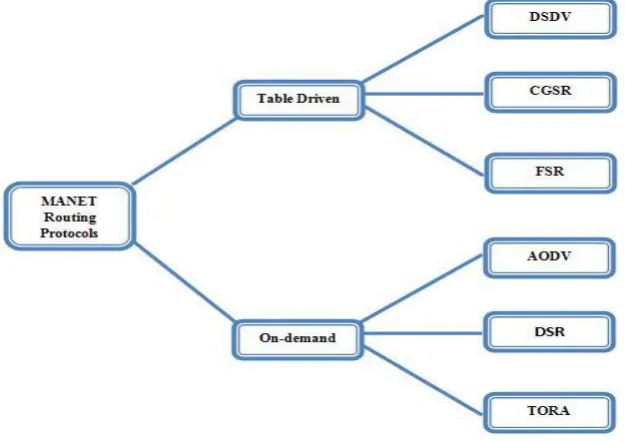
As shown in Figure 1, MANET routing protocols are classified into two types such as table- driven and on-demand [6]. The table-driven, method is being used for alternate updating links and also it can use both the distance vectors and link statuses as used in the fixed networks. In the case of on- demand method other nodes do not update the route and the routes are determined at the origin of the request. The main advantage of using this method is that bandwidth is being used effectively.
Figure 1. Classification of MANET Routing Protocols
A. On-demand protocols
In comparison with table-driven routing protocols, all updated routes are not maintained in each node in this group of protocols; instead, routes are constructed only when it is necessary. When an origin node wants to send something to a destination, it makes a request to the destination for the route detection mechanisms. For this reason, this type of protocol is known as a reactive protocol. This route remains valid until the destination is accessible. This section explains some of the on-demand routing protocols[8]
AODV (Ad-Hoc On-demand Distance Vector Routing Protocol)
(a)Distribution packet among neighbours
(b) Reply to demand
DSR (Dynamic Source Routing Protocol)
It is a simple and an efficient routing protocol designed specifically for use in multi-hop wireless ad hoc networks. This protocol allows the network to be completely self-configuring and self-organizing, without the need for any existing network infrastructure. DSR uses a concept called source routing method in which the source node identifies the complete sequence of nodes through which the data packets will be sent [10].
(a)Distribution of demand packets
(b)Reply packets
TORA Protocol (Temporally-Ordered Routing Algorithm)
The main function of TORA is the centralization of control messages in a very small set of near local nodes. To achieve this mechanism, nodes maintain routing information for the adjacent nodes for some interval. Generally TORA perform three operations such as route formation, route renovation and route cleaning[11].
B. Table-driven protocols
DSDV ( Destination-Sequenced Distance –Vector Routing Protocol)
This protocol is based on the Bellman-Ford classical routing mechanism [8]. Here each mobile node maintains a routing table that includes all accessible destinations, the number of hops necessary for reaching that destination and the sequence of the digits appropriate to that destination. Routing table entries are tagged with sequence of digits which are originated by the destination nodes [14]. This sequence of digits is used to distinguish new routes from old routes and also to determine the creation of a ring. Route updates are transmitted either periodically or immediately after a significant topology change is being detected. DSDV protocol generates a supplementary traffic that adds to the real data traffic. [15]
CGSR Protocol (Cluster head Gateway Switch Routing Protocol)
This protocol is based on the DSDV routing algorithm [16]. Mobile nodes are collected inside packets, and a cluster head is selected. A gateway node is a node in a communication interval between two or more cluster heads. CGSR protocol uses a distributed algorithm which is stable since the cluster heads will change only under two conditions: when two cluster heads come within the range of each other or when a node gets disconnected from any other cluster .In this state, the origin sends the packet to its cluster head; the cluster head sends this packet to the gateway node to which it and the node which is located in the route of destination are connected. The gateway sends the packet to another cluster head and the packet to another cluster head and this action continues until the cluster head receives the destination node of packet. Finally, the destination cluster head sends the packet to the destination node [8].
FSR Protocol (Fisheye State Routing)
FSR protocol is based on the ‘‘fisheye’’ technique of graphic information compression where the technique was used to reduce the size of information required to represent graphical data [17]. In an FSR, an updating message does not include information about all of the nodes. Instead, it exchanges information with the adjacent nodes with a higher frequency more than it does with farther nodes, leading to a decrease in the size of the updating message. Thus, each node has accurate information about its neighbors, and the details and accuracy of the information decrease when the distance between two nodes increases.
III. SIMULATION ENVIRONMENT AND PARAMETERS
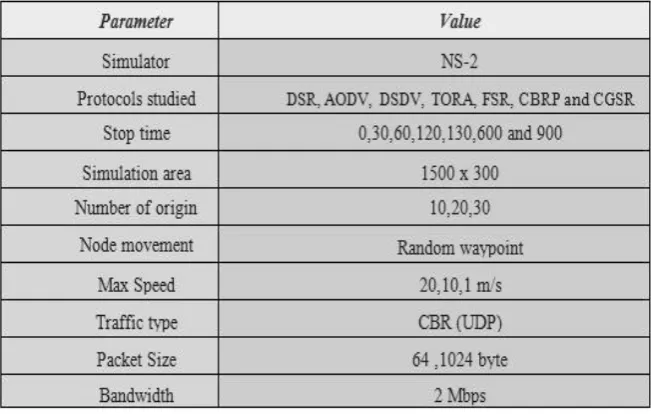
The simulation was performed using NS2 simulator with two values: a maximum speed of 20 m/s (average speed of 10 m/s) and 1 m/s. At first, seven protocols - DSR, AODV, DSDV, TORA, FSR, CBRP and CGSR – have been simulated with a maximum node speed of 20 m/s, followed by a simulation with a maximum node speed of 1 m/s. The basic model parameters that have been used in the simulation given details in this section are summarized in Table 1.
A. Movement Model
In the simulation, nodes move on the basis of the Random Waypoint model [13], so that movement scenarios include a stop time specification. A node moves toward a randomly selected destination in area of 1500×300 sq meters with unsteady speed between zero and its maximum speed. Once the node reaches the destination, it stops for a portion of its stop time (per second) and then selects another destination. This behavior persists throughout the simulation. Each simulation is implemented for 900 s, and the stop times considered in this simulation were 0, 30, 60, 120, 130, and 600 and 900 seconds; a 0 second stop time represents a continuous movement while a 900 second stop time represents a static network. Because the efficiency of protocols is dependent upon the nodes’ movement model, 70 different movement models have been considered for nodes so that for each stop time, 10 different implementations are performed, and two different values have been considered for the maximum node speed. In the following sections, the simulation results with maximum speeds of 20 m/s and average speeds of 10 m/s are shown, along with results obtained from simulations with a maximum speed of 1 m/s, are shown. B. Communication Model For implementing the simulations, the following parameters have been considered: traffic origins with a constant bit rate (CBR); the sending rate equal to 1, 4 and 8 packets per second; the number of origins equal to 10, 20 or 30; and packet sizes of 64 and 1024 bytes. Changing the number of CBR origins is similar to changing the sending rate, and therefore, in these simulations, a constant sending rate of four packets per second has been considered, and three different models have been created with a change in the number of CBR origins between 10, 20 and 30 origins. All communication models are peer to peer, and primary links have been distributed steadily between 0 and 180 seconds. Three communication models (10, 20 and 30 origins) are combined with 70 movement models to form 210 different scenarios for each possible maximum node speed (1 m/s and 20 m/s) [19].
B. Work Methodology
The final aim of this simulation is to measure how the efficiency of routing protocols is affected by topological changes of the network as long as the packets are successfully sent to their destinations. To measure this ability, a basic simulation has been considered that is compared to results obtained from other simulations. In the basic simulation, 50 moving nodes have been placed in a simulation environment of 1500×300 sq meters over 900 seconds of implementation.
C. Movement Model Specification
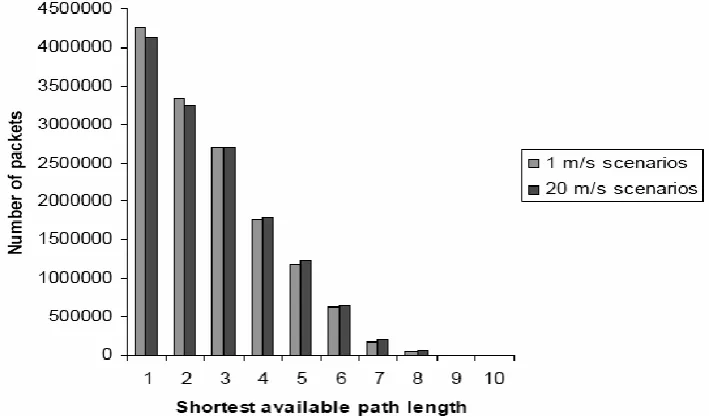
To show the difference between how the models performed on routing protocols, the length of the route of each protocol has been measured for the delivery of packets and the total number of topological changes in each scenario. When each packet is produced, an intermediate mechanism calculates the shortest path between the packet sender and the receiver and places it inside the packet. This value is compared with the number of real hops that the packet has made in reaching the destination. Figure 2 shows the distribution of the shortest paths for all 210 scenarios for node speeds of 1 and 20 m/s. The height of each rod shows the number of packets for each destination, each of which has a definite distance at the time of packet production. On average, the data packets in the simulation should traverse 2.6 hops to reach the destination, and the longest possible distance is a route with 8 hops.
Table 2 shows the average number of link connection changes that occur during the simulation for each stop time. A special scenario arises with lower connection changes for a stop time of 30 s and a speed of 1 m/s than for a stop time of zero seconds
IV. CONCLUSION
In this paper we have studied about MANETs, and discussed some of the most important routing protocols. The results which are obtained from the assessment and comparisons of the efficiency were shown for the seven MANET routing protocols DSR, AODV, DSDV, TORA, FSR, CBRP and CGSR. Different results were given by changing the selected parameters. Based on these results, the DSR and AODV protocols have shown better performance than other protocols. TORA has had the worst result and DSDV has fixed behavior in all scenarios due to its table driven specification. From the detailed simulation results and analysis, a suitable routing protocol can be chosen for a specified network and goal.
REFERENCES:
[1] CHLAMTAC, I., M. CONTI, J. LIU, Mobile Ad Hoc Networking: Imperatives and Challenges, Ad Hoc Networks, Elsevier2003,pp.13-64,DOI: 10.1016/S1570-8705(03) 00013-1
[2] FAPOJUWO, A. O., ,O, SALAZAR, A. B. SEAY, Performance of a QoS based Multiple-route Ad Hoc On demand Distance Vector Protocol for Mobile Ad Hoc Networks, in Proceeding of IEEE Conference CJECE 2004, pp. 149-155.
[3] The Network Simulator - ns-2 [Online] available at http://www.isi.edu/nsnam/ns/ns-build.html#allinone [4] PERKINS, CH. E., Ad Hoc Networking,Addison-Wesley Pub Co Inc, 2008,ISBN: 0321579070
[5] JAYAKUMAR, G, G. GOPINATH, Ad Hoc Mobile Wireless Networks Routing Protocols – A Review, Journal of Computer Science, vol. 3, no. 8, 2007, pp. 574-582.
[6] MISRA, S., S. K. DHURANDHER, M. S.OBAIDAT,A.NANGIA,N. BHARDWAJ, P. GOYAL, S.AGGARWAL, Node Stability-Based Location Updating in Mobile Ad-Hoc Networks, IEEE Systems Journal, vol. 2, no. 2, 2008, pp. 237-247.
[7] DIXIT, S., E. YANMAZ, O. K. TONGUZ, On the Design of Self- Organize Cellular Wireless Networks, IEEE 2005,DOI: 10.1109/MCOM.
[8] BOUKERCHE, A., B. TURGT, N. AYDIN, M. Z. AHMAD, L. BOLONI, D. TURGUT, Routing Protocols in Ad Hoc Networks: A Survey, Computer Networks, vol. 55, issue 13, Elsevier, 2011, pp. 3032-3080, DOI: 10.1016/
[9] SONG, J. H., V. W. S. WONG, V. LEUNG, Efficient On-Demand Routing for Mobile Ad Hoc Wireless Access Networks, IEEE Journal on Selected Areas in Communications, vol. 22, no. 7, 2004. pp. 1374-1383.
[10] GUPTA, A. K., H. SADAWARTI, A. K. VERMA, Performance Analysis of AODV, DSR and TORA Routing Protocols, IACSIT, vol. 2, no 2, 2010, pp. 226-231.
[11] PARK, V., S. CORSON, Temporally-ordered Routing Algorithm Routing Protocol, IETF MANET vol. 03, June 2001.
[12] JIANG, M., J. LI, Y. C. TAY, Cluster Based Routing Protocol (CBRP), IETF MANET, July 1999.
[13] HYYTIA, E., P. LASSILA, J. VIRTAMO, Spatial Node Distribution of the Random Way point Mobility Model with Applications, IEEE Transactions on Mobile Computing, vol. 5, no. 6, 2006, pp. 680-694. [14] MAAN, F., N. MAZHAR, MANET Routing Protocols vs Mobility Models: A Performance Evaluation, in
Proceedings of IEEE Conference ICUFN 2011, pp. 179- 184, DOI: 978-1-4577-1177-0/11
[15] BAMIS, A., A. BOUKERCHE, I. CHATZIGIANNAKIS, S. NIKOLETSEAS, A Mobility Aware Protocol Synthesis for Efficient Routing in Ad Hoc Mobile Networks, Computer Networks, vol. 52. Elsevier, 2008, pp. 130-154, DOI: 10.1016/jcomnet. 2007.09.023.
[16] MURTHY, S., J. G. ACEVES, An Efficient Routing Protocol for Wireless Networks, ACM Mobile Networks and Applications Journal, Special Issue on Routing in Mobile Communication Networks, Oct. 1996, pp. 183-97.
[17] PEI, G., M. GERLA, T. W. CHEN, Fisheye State Routing in Mobile Ad Hoc Networks, In Proceedings of the Workshops ICDCS 2000, Taipei, Taiwan, Apr. 2000, pp. D71- D78.
[18] LIU, Y., J. LAU, A Novel Link State Routing Protocol and TCP Performance Investigation in Ad Hoc Networks, Computer Communications, 2004, pp. 187-196, DOI: 10.1016/S0140-3664(03) 00214-7. [19] PARK, V. D., M. S. VARSON, A Performance Comparison of TORA and Ideal Link State Routing, In
[20] QASIM, N., F. SAID, H. AGHVAMI, Mobile Ad Hoc Networking Protocols Evaluation through Simulation for Quality of Service, International Journal of Computer Science, vol. 36, no. 1, 2009. [21] TUTEJA, A., R. GUJRAL, S. THALIA, Comparative Performance Analysis of DSDV, AODV and DSR
Routing Protocols in MANET using NS2, in Proceedings of Conference ACE 2010 IEEE, DOI 10.1109/ACE.2010.16.