EXTENT OF INTEGRATION OF COMPUTER TECHNOLOGY
INTO TEACHING AND LEARNING OF BIOLOGY IN
SECONDARYSCHOOLSOFRACHUONYOSOUTH
SUB-COUNTY, HOMA-BAY COUNTY, KENYA
GIDEON MAGAK MW AND A
ATHESIS SUBMITTED IN PARTIAL FULFILMENT OF THE REQUIREMENTS FOR AWARD OF THE DEGREE OF
MASTER OF EDUCATION OF
KENYATTA UNIVERSITY
DECLARATION Declaration by the candidate
This thesis is my original work and has not been presented for any academic award at any other University.
.
at~l·b/.d:DJ~
Gideon Magak Mwanda E55/CE/13685/2009
Declaration by the Supervisors
We confirm that this study was carried out by the candidate under our supervision.
~j.1
/
Signature .~ ~"" ...
L.:-
...
DateCoi
L~\.]
P
J.~
Prof. John N. Maundu
Associate professor, Department of Educational Communication and Technology
Kenyatta University
I
Signature,... .. ... ... Date... ~.
J
e:{JS
Prof. Samson M. Muthwii
Associate Professor, Department of Education Communication And Technology
DEDICATION
I dedicate this work to my parents: Father, Josiah Mwanda and my late mother,
ACKNOWLEDGEMENT
The investigator takes great opportunity to appreciate and honour the assistance
received from the supervisors Prof. S.Muthwii of South Eastern Kenya University and Dr. John Maundu of the Department of Educational Communication and Technology, Kenyatta University. The supervisors provided true and genuine
guidance, thus providing the investigator with inspiration to remain focused during
the study. The investigator also sincerely thanks all the Biology teachers and
Principals of the schools which took part inthe study.
The investigator sincerely expresses great thanks to wife and children for providing
TABLE OF CONTENTS
DECLARATION ii
DEDICATION iii
ACKNOWLEDGEMENT iv
TABLE OF CONTENTS v
LIST OF TABLES viii
LIST OF FIGURES ix
CHAPTER ONE: INTRODUCTION 1
1.1 Preamble 1
1.2 Background ~ : 1
1.3Statement of the Problem 5
1.4 Purpose ofthe Study 6
1.5Objectives 6
1.6Research Questions 7
1.7Significance of the Study 7
1.8 Delimitations of the Study 8
1.9 Limitations of the Study 9
1.10 Assumption of the Study 9
1.11 Theoretical Framework 9
1.13 Definition of Key Terms 13
CHAPTER TWO: REVIEW OF LITERATURE 15
2.1 Introduction 15
2.2 Computer Technology for Instruction in Secondary Schools of Kenya 15
2.3 Training Teachers on the Use of Computer Technology 16
2.4 Computer Applications Used in Instructional Process 19
2.4.1 Computer technology in teaching and learning of Biology .'..23 2.5 Research in Utilization of Computer Technology for Instruction 25
2.'7 Teachers' Attitude towards Integration of Computer Technology 29
2.8 Summary of Literature Review 30
CHAPTER THREE: METHODOLOGy 32
3.1 Introduction 32
3.2 Research Design 32
3.3 Variables 32
3.4 Target Population 33
3.5 Sampling Procedures and Sample Size 33
3.6 Data Collection Instruments 33
3.6.1 The questionnaire 34
.3.6.2 Observation check-list 34
3.7 Pilot Testing 35
3.7.1 Validity 35
3.7.2 Reliability 36
3.8 Data Collection Procedures 36
3.9 Data Analysis Procedure 37
3.10 Ethical Considerations 37
CHAPTER FOUR: 39
DATA ANALYSIS, PRESENTATION, INTERPRETATION AND DISCUSSION ... 39
4.1 introduction 39
4.2 Participants Bio-Data 39
4.2.1 Sex of the Participants 40
4.2.2 Ages of the participants 41
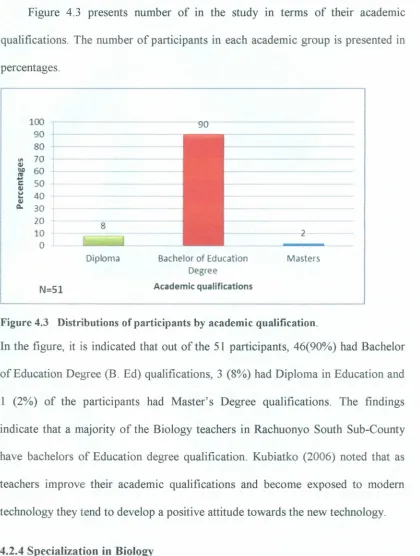
4.2.3 Academic qualification 42
4.2.4 Specialization in Biology 42
4.3 Extent to which Schools are Equipped with Computers 43
4.4.2 Efficiency in utilization ofcomputer knowledge andskills 48
4.5Useof Computer for Teaching and Learning of Biology 50 4.5.1 How frequentlyparticipants utilized computer technology applications 51 4.5.2 Use of computer technology for teaching and learningpurposes 54
4.6 Challenges Biology Teachers facein Integrating Computer Technology into
Instruction Process 56
4.7 Attitude of Teachers towards Integration ofComputer Technology in the Teaching of
Biology 59
SUMMARY OF FINDINGS, CONCLUSIONS AND RECOMMENDATIONS ..62
5.1Introduction 62
5.2Summary of study 62
5.3Summary ofFindings 64
5.3.1 Extent towhichschools are equippedwithcomputers 64 5.3.2Nature ofcomputer knowledge andskills Biology teachers acquired 65 5.3.3 Extent to which Biology teachersusecomputer technology for teaching 65 5.3.4 Challenges onintegration of computer technology 66 5.3.5 Attitude ofBiology teachers towards integration 66
5.4 Implications forPractice 67
5.6Recommendations 68
5.7 Recommendations for Future Research 69
REFERENCES 71
APPENDICES 75
Appendix 1:Teachers' Questionnaire 75
Appendix 3: RESEARCH WORK PLAN 84
LISTOF TABLES
Table 2.1:Candidates' Overal performance in KCSE Biology, in years2008-2012 ... 4 Table 3.1: Sampling frame of the schools participating in the study 33
Table 4.1: Nuniber and location of computers in schools of the study .46
Table 4.2:Computer trainnings 47
Table 4.3:Duration oftrainning and coresponding number of participants .49 Table 4.4:Efficiency in application of computer knowledge and skills 52 Table 4.5:Computer applications and frequency usage by the participants 54
Table 4.6: Frequency usage of computer applications in teaching and learning 57
Table 4.7:Challenges met in integration of computer into teaching and learning..57
Table 4.8:Descriptive statistics of teachers' attitude towards computer integration ..
LIST OF FIGURES
Figure 2.1: Conceptual Framework for Computer Integration into Instruction
process 12
Figure 4.1: percentage of participants by sex... 40
Figure4.2:Percentage of participants by age... 41
Figure 4.3 :Distribution of participants by academic qualification... 42
BEd BOM CAI CAL CDF ICT KCSE KICD KIE KNEC MOE NACOSTI NGO PTA SPSS SMASSE TSC UNESCO ACRONYMS
Bachelor of Education Board of Management
Computer Assisted Instruction Computer Assisted Learning Constituency Development Fund
Information Communication Technology Kenya Certificate of Secondary Education Kenya Institute of Curriculum Development Kenya Institute of Education
Kenya National Examinations Council Ministry of Education
National Commission for Science, Technology and Innovation Non-Governmental Organization
Parents Teachers Associations
Statistical Package for Social Sciences
Strengthening of Mathematics and Science in Secondary Education
Teachers Service Commission
ABSTRACT
CHAPTER ONE: INTRODUCTION
1.1 Preamble
This chapter discusses the study under the following sub headings: Background to
the study, statement of the problem, purpose of the study, objectives, research
questions, significance of the study, delimitations of the study, limitations of the
study, assumptions, theoretical framework, conceptual framework and lastly
definition of keyterms
1.2 Background
Despite many reforms that countries are trying to bring in the education
system, it has become clear that future education reforms should dwell on
promoting knowledge based economies which rely on information technologies,
(Toffler cited in Marsh Il, 1993). In line with changes in the society, the 21SI
century economy requires school graduates to be well conversant with modem
electronic knowledge embracing computer technology and other forms of media so
as to remain competitive in the global employment market.
According to Marsh Il (1993), in the developed countries, service sector
economy accounts for 80% of all job opportunities most of which require use of
various forms of technology. The indication here is, the developing countries,
most of which have not embraced use of computer technology are at risk of being left out of global employment opportunity. However, such countries have
opportunity to improve performance skills and enter into the service sector
instruction and ensure that students have the skills required for the ever
increasingly competitive labour market.
In Kenya, introduction of free secondary education came with an increasing
number of students' enrolment yet the number of teachers remained almost
constant due to teacher employment freeze. But, teachers, few as they are
compared to the students' enrolment, still have to cope-up with the instructional
duties in their charge. Digolo (2005) recognized that achieving quality education in
Kenya is a challenge to education stakeholders. Kenyan education system is
marked with a lot of wastage and poor performance in examinations which need to
be stemmed and improved. Some three aspects of the education system responsible
for the challenges mentioned are: Poor instructional methods due to lack of
instructional materials in schools, overcrowded curriculum denying students
adequate time to grasp basic principles and concepts learned and lastly, over
enrolment leading to overcrowded classrooms where teachers cannot provide
students with individualized attention. Consequently, there is need for a change in
methods of instruction to include use of strategies which can increase learner
participation in the learning process. So in such a scenario, secondary schools will
be better placed if they embrace computer technology in management and delivery
of instructional duties.
According to Roblyer (2006), use of computer technology can improve
quality of instruction by increasing learner participation and by assisting teachers
in the complex task of managing and supporting instructional programs in schools.
For instance, with computer technology, teachers can bring events of far distance
keep and retrieve information records, communicate with parents and even carry
out assessment of learning with ease and speed with a computer.
Newby et ai, (2011), also suggest that when teachers effectively integrate
computer into classroom teaching and learning, the speed of the management of
students' data, search for information and presentation of learning materials IS
greatly increased.
The introduction of computer for teaching and learning in Kenya is
currently an ongoing process and is supported by key policy documents For
example; Sessional Paper number 1 of 2005 on a Policy Framework for Education,
Training and Research; Kenya Vision 2030 and Kenya Education Commission
Report on Totally Integrated Quality Education and Training. (TIQET), Koech
1999).
Considering teaching and learning of Biology as a subject in Kenya, the
syllabus in secondary school is greatly compressed to include many topics that
require more time allocation to be learned at high cognitive skills, while time for
syllabus coverage is always shortened due to ever increasing school programs.
Consequently Biology has been poorly performed in National Examinations. The
extent of the poor performance is evident in the results presented in Table 1. Table
1 gives a brief analysis of students' performance in KCSE Biology examinations
Table 1: Candidates' overall performance in KCSE Biology, in years 2008-2012
Year 2008 2009 2010 2011 2012
No.of candidates 234,975 299,302 317,135 363,817
Maximum score 200 200 200 200
Mean raw score 60.64 54.29 58.39 64.87 % mean score 30.32 27.15 29.20 32.44 Standard Deviation 29.12 28.8 30.44 30.05
389,523 200 52.41
26.21 29.43 Source: Kenya National Examination Council KCSE Reports.
In Table 1,it is indicated that the percentage mean score for Biology in the
five-year period under consideration is below 50%. Also indicated is high standard
deviation as a characteristic of the results which is further evidence of poor
perfonnance. Focusing on Biology performance in Homa-Bay County, Biology
performance in year 2010 can be taken as an example to indicate the state of
performance in KCSE. In the year 2010, 195 secondary schools presented
candidates for KCSE examinations in Homa-Bay county and only 26 of the
schools managed to obtain a mean score of 6.4 and above in Biology. In the same
examination out of the 195 schools, 169 failed to obtain a mean score of 4.5 in
Biology. The results imply, the Biology mean grade for the 169 schools of Homa-
.
Bay county that year was D+ and below. The Homa-Bay County result also
indicate that just like in the national KCSE performance in Biology, most schools
in the County also achieve low mean grades inBiology in the examinations.
According to Poole (1997), poor performance in sciences can be solved by
use of computer for instruction. Poole (1997) also emphasizes that use of computer
simulations enable students to enjoy more effective interactive experiences in
learning that students not using computer technology will miss. Similarly, Neo
learning science by stimulating their thinking processes. Students make use of their
creativity well as they become actively engaged in the computer. It is therefore possible to reason that integrating computer technology into teaching and learning
of Biology can improve learners' understanding of Biological concepts and hence
increased performance in examinations.
Most of the Biology teachers did not receive computer training during
pre-service training but have acquired the knowledge and skills on computer
technology from a few episodic in-service exposures like the ones organized bythe
Ministry of Education through Strengthening of Mathematics and Science in
Secondary Education (SMASSE), Ministry of Education sponsorship on ICT to
schools or through self-initiative arrangements. However, Ivers (2003), states that:
"Knowing how to use afew programs on the computer, however, does not necessarily mean knowing how to use the computer for instruction or as a teacher productivity tool. Awareness of how the computer can be used to support teacher and student needs iskey...p.1 "
1.3 Statement of the Problem
The Ministry ofEducation (MOE), through SMASSE Program, has embarked ona
countrywide training program of secondary school mathematics and science
teachers on how to use computer technology for instruction. In Rachuonyo South
Sub-County, inaddition to the SMASSE training, MOE selected and provided five
secondary schools with funds through Economic Stimulus Package to build ICT
infrastructure and to improve capacity-building of teachers in the selected schools
on integration of computer technology in teaching and learning (Ref. MOE I ICT
4EI AI 114 dated 12thApril 2011). Further, on computers, a number of schools in
other means like: Procuring the computers using centre of excellence funds given
to the schools by the MOE, C.D.F grants or by use of P.T.A funds. Some schools
in the District have also received computers as donations from well-wishers.
Despite all the effort put to highlight the importance of integrating computer into
theinstruction process, the use of computer technology for instruction insecondary
schools of Rachuonyo South Sub-County is still minimal. Therefore, there was
need to investigate on extent of integration of computer technology into instruction
process and torecommend appropriate measures to be taken to facilitate effective
integration of thetechnology into instruction process.
1.4 Purpose of the Study
The purpose of this study was to fmd out the extent to which Biology teachers
integrate computer technology into the teaching and learning process.
1.5 Objectives
The study wasguided bythe following objectives.
1) To determine the extent to which secondary schools in Rachuonyo South
Sub-County are equipped with Computers.
2) To establish the nature of computer knowledge and skills Biology teachers in
Rachuonyo South Sub-County have.
3) To establish the extent to which Biology teachers use computer technology
applications for teaching.
4) To find out the challenges Biology teachers face in integrating computer
5) To determine the attitude of Biology teachers towards integration of computer
technology into teaching and learning process.
1.6 Research Questions
The study was guided by the following questions:
1) To what extent are the secondary schools in Rachuonyo South Sub-County
equipped with computers?
2) What computer knowledge and skills do Biology teachers in Rachuonyo
South Sub-County have?
3) To what extent do the Biology teachers use computer technology
applications in teaching?
4) What challenges do Biology teachers face in integrating computer
technology into the teaching and learning process?
5) What is the attitude of Biology teachers towards integration of computer
technology into teaching and learning process?
1.7 Significance of the Study
The findings of this study have the following significance in the field of
Education. First, the apparent lack and inaccessibility of computers in most schools
can be used as abasis for resource mobilization for more computers in the schools.
Two, Teachers Service Commission (TSC) can use the fmdings concerning
teachers' levels of training and ability to use computer applications as guideline to
carry out its constitutional mandate of in-servicing teachers. Second, Kenya
Institute of Curriculum Development (KICD) can focus attention on the challenges
can integrate computer into teaching and learning of Biology. Third, school
principals and school Board of Managements (BOM) can use the research findings
to organize internal in-service courses for teachers' in their respective schools if
the teachers need skills improvement or attitude change. Fourth, school principals
and (BOM) can use the findings to provide more computer technology facilities in
schools to encourage integration of computer into the teaching and learning
process. Fifth, Teachers can use fmdings of the study to formulate internal policies
toguide effective use of computers in their respective departments. The fmdings of
the study will also contribute to filling the knowledge gaps in integration of
computer technology assisted learning in developing countries. Lastly, integration
of computer technology into the teaching and learning process will increase
innovative ways in which teachers search, organize and present learning materials
to promote learner participation in knowledge construction thereby promoting
constructivist theory of learning.
1.8 Delimitations of the Study
The study was confmed to secondary schools of Rachuonyo South
Sub-County, Homa- Bay County, Kenya. Only Biology teachers in the secondary
schools supplied with electricity participated in the study. Analysis of the research
data has been confmed to use of descriptive statistics. E-learning, virtual learning
and social media applications like;face book, twitter and Skype are also computer
based and can be used for instructional purposes but were not considered in the
study.The study focused only on use of computer technology as a productivity tool
to help a teacher or leaner to search,prepare and present learning materials and not
broken down into sub-groups. For example the data were not analysed on thebasis
of sex of the participants or nature of school as single sex or mixed sex, but was
analysed to reveal the ability of the Biology teachers to utilize computer
technology and how frequently the teachers use computer for instruction.
1.9 Limitations of the Study
Since only teachers in schools supplied with electricity were the ones' who
participated, some Biology teachers with good computer knowledge and skills but
were teaching inschools with no electricity were left out of the study. Some of the
Biology teachers in the schools sampled were untrained and did not take part in the
study thereby leading to further reduction in the percentage of the teachers who
participated.
1.10 Assumption of the Study
The study assumed that if the Biology teachers had excellent computer
knowledge and skills and school environments also provide optimum opportunity
for computer technology utilization, then the frequency of teachers integrating
computer technology into instructional process would be 100%.
1.11 Theoretical Framework
The study was based on social constructivist learning theory espoused by
Vygotsky (1987 as cited in Palincsar, 2005). Social constructivist learning theory
states that knowledge is constructed by individuals as they interact with other
compare the past and present expenences. In order for students to effectively
construct knowledge, teachers, must create collaborative learning environment
where there are both means and opportunity to construct new understandings by
assembling experiences from different sources. Collaborative sharing of experience
enables students to explore their knowledge and continuously refine it by putting
their ideas to work in the context of solving realistic problems. One way of
providing a collaborative learning environment is to promote computer integration
into the teaching and learning process. Integrating computer into the teaching and
learning process provides teachers and learners with opportunity to interact with
each other, friends and the learning environment in many ways by using different
computer applications. When teachers and students actively search for information
stored in computer databases, they get access to other peoples work and even
create their own interpretation and meaning of the information retrieved. Biology
as a subject has many concepts, terminologies procedures and methods that
teachers and students can learn best only through inquiry based activities.
According to Ivers (2003), constructivist learning apart from advocating for
knowledge creation by the learner, also puts emphasis on student inquiry, problem
solving, reflection and critical thinking. Indeed, making use of various computer
technology applications such'as;word processors, databases, telecommunications,
multimedia, graphics and power point for teaching and learning support
constructivist learning theory. Computer word processor for example enables
teachers and students to write and edit texts. Editing provides room for reflection
on work done. Writing and editing using computer also make learning whole,
students whoare far distance apart can communicate byusing computer internet to
share and discuss ideas. Similarly information stored in computer data bases can be
retrieved and shared by teachers and students thus extending collaboration and
sharing of ideas beyond confmes'of the classroom. In this study, it is envisaged
that having good knowledge and skills on use of different computer applications
would motivate teachers to integrate computer technology into the teaching and
learning process thereby promoting constructivistlearning theory.
1.12 Conceptual Framework
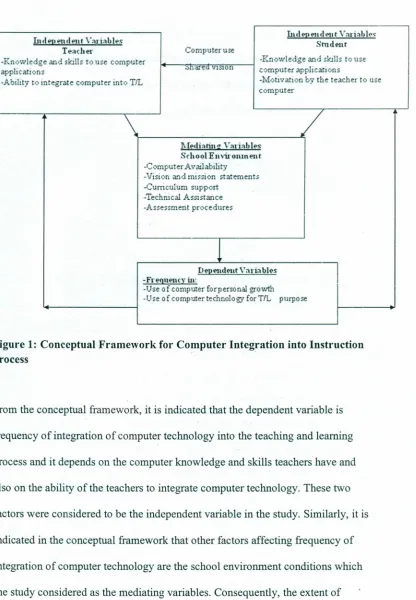
From the conceptual frame work outlined, it is indicated that the
independent variable of the study is the integration of computer technology into
instruction process. The variable comprises of teachers knowledge and skills to use
computer applications and teachers knowledge in planning and teaching Biology
lessons. The dependent variable is effectiveness of the learning process in
Biology. The aspects of effective learning achieved include; collaborative learning,
active learning, knowledge construction and high order learning. School
environmental factors which influence the frequency of use computer technology
like; computer availability, school vision and mission statements, availability of
technical support and school curriculum support formed the intervening variables
Computer use In dE'IH>lldI'llt\':u'i~bll'''
Tl'aeher
-Knowledge and skills touse computer applications
-Ability tointegrate computer into TIL
;,nareu vrsion
\
r---~---~
./
l\It'fIi:'lt1.JI" \'m'jabl(>:;School E11vir onm ent -Computer Availability
-Vision and rmssien statements -Curriculum support
-Technical Assistance -Assessment procedures
1
DepelldE'lltY;n-i;)blE'S
l
-Fregul'llcy in:
-Useofcomputer forpersonal growth -Use ofcomputer technology forTIL purpose
Figure 1: Conceptual Framework for Computer Integration into Instruction process
From the conceptual framework, it is indicated that the dependent variable is
frequency of integration of computer technology into the teaching and learning
process and it depends on the computer knowledge and skills teachers have and
also on the ability of the teachers to integrate computer technology. These two
factors were considered to be the independent variable in the study, Similarly, it is
indicated in the conceptual framework that other factors affecting frequency of
integration of computer technology are the school environment conditions which
the study considered as the mediating variables. Consequently, the extent of
depend on the nature of computer training the Biology teachers will have received
and also on the availability of computers in the schools, mission and vision
statements of the school, curriculum support systems and technical assistance
teachers get concerning use of computer technology
1.13 Definition of Key Terms
For proper understanding of the key terms used m the study, operational
definitions of the terms are given below:
Attitude
The term attitude refers to the opuuon, feelings and values that teachers and
students have on use of computer technology to assist in the teaching and learning
process.
Computer Applications
In this study, computer applications refer to the computer software packages used
by teachers and students as productivity tools, which include: word processors,
graphic tools, databases, spreadsheets, presentations, telecommunication and
multimedia.
Computer as a Productivity Tool
Computer serves as a productivity tool to assist teacher and students to perform
various tasks using the following computer software applications; word processors,
graphics, databases, spreadsheets, presentations, multimedia and
Computer Technology
In this study, computer technology refers to computer hardware, computer
software and other related machines connected to the computer which can be used
by teachers and students as productivity tools. It also refers to the knowledge and
skills a person must have to use a computer and other computer related machines
or devices.
Integration of Computer Technology
In this study, integration of computer technology means making use of different
computer technology applications by Students and Teachers to facilitate teaching
CHAPTER TWO: REVIEW OF LITERATURE
2.1 Introduction
This chapter contains a brief discussion of review of literature related to
utilization of computer technology under the following sub-sections: Computer
technology for instruction in secondary schools of Kenya, training teachers on the
use of computer technology, computer applications used inthe instruction process,
computer technology in teaching and learning of Biology, research on utilization of
computer technology for instruction, challenges in utilization of computer
technology for instruction and lastly teachers attitude towards integration of
computer technology into instructional process.
2.2 Computer Technology for Instruction in Secondary Schools of Kenya
The idea of integrating computer technology in the teaching and learning in
secondary schools in Kenya cannot be seen as far-fetched. Currently the
Government of Kenya has rolled out computer for school's program, which started
with five selected secondary schools in every District given financial assistance to
build a computer room, buy computers and to give teachers induction causes on
how to use computer for instruction (Ref. MOE1lCT 4EIAlII 4 dated
iz"
April2011). At the same time, some other schools in Kenya also acquired computers
through different ways in order to improve their services by use of technology.
Mugoh (2007) found that, in secondary schools, the computer technology is used
in two different ways. One, computers have been introduced as a subject of study,
that is computer science subject, which is taught and examined by the Kenya
Two, computer has been introduced in schools with the intension of supporting
teaching and learning functions. In this second approach, computer technology is
used to support teaching and leaming by either being used as a teacher to present
the learning material in total like in the case of Computer Assisted Instruction
(CA!) and Computer Assisted Learning (CAL) or the computer is used as a
productivity tool to assist teachers and students in searching, preparing and
presenting content to be leamt. Either way, final decision on how computers are
used in a school is left mostly in the hands of teachers who have always found it
difficult to decide which route to take. On such crossroads, computers are lying
idle or not under proper use in many schools. This study was confined to
investigate on use of computer as a productivity tool and on the teachers' ability to
utilize different computer applications.
2.3 Training Teachers on the Use of Computer Technology
According to World Bank (2003), computer can bring changes in
pedagogical approaches resulting into improved student learning and learning
outcomes. But this however, will only happen if computers are brought to
classrooms, where teachers have been effectively trained on how to use computer
technology. Formulation of clear policies and guidelines focusing on change of
teachers andstudents attitude towards using computer is necessary. Several studies
(World Bank, 2003; Ivers, 2003; Newby et al., 2011 and Slavin, 2009) have all
emphasized thatcomputer training should focus on new ways on how people leam.
The new ways of learning are characterized with learner centeredness, knowledge
rich and cooperative in nature. Again for the training to be effective, time and
change and attainment of good skills for instructional use. Phelps & Ellis (2002),
suggest that the training program objectives should also consider use of computer
for instruction which is more to do with an approach to ways of learning and
working than acquisition of a set of skills on computer applications. It should be
clearly pointed out that the use of computer technology for teaching and learning
cannot replace the teacher as he or she has to purposively plan for effective
utilization of computer in the classroom. In essence, the focus should be on
learning strategies to make the teacher compliant with the rapid technological
development in the teaching profession. Ivers (2003), states that teachers have
opportunity to learn computer through internet, workshops, college training andi
n-service program. But they may not get enough experience and so "follow up and
support are necessary to ensure that teachers feel comfortable using technology for
themselves andwith their students ... p.I7."
Phelps and Ellis (2002), Watson, (200 I) have noted that training of teachers at both
pre service' and in- service levels can adapt two approaches. Which are:
Competency-based approach and Capability-based approach. Competency based
training, emphasizes pre specified learning objectives and attainment of clearly
specified skill levels bythe participants or teachers. This is the approach which has
been used in training teachers on computer technology in Kenya, both at pre
-service and in-service training levels. The approach is skills based, directive in
nature and participants are led through a series of step by step instructions that
focus on only one computer application. Consequently, many teachers finish
programs with a huge gap between perceived computer competency and ability to
computer anxiety and low computer self-efficacy. It is necessary that training
provided to teachers should adapt the capability based approach which can
guarantee teachers all round quality and ability in computer knowledge and skills.
Teachers can then learn more on computer experientially through self-exploration.
Phelps and Ellis (2002) further add that the cumulative duration of training should
be long enough to allow for good skills acquisition. This is because computer
technology is ever changing and teachers can no longer rely on a few days or
weeks workshops and seminars to provide the knowledge and skills required for
instructional use. As at the time of undertaking the study, there was no evidence
that secondary school Biology teachers used computer technology for the purposes
of teaching and learning. The study therefore sought to establish the extent to
which Biology teachers in Rachuonyo South Sub-County used computer for
instruction purposes.
Lastly, according to Venezky and Davis (cited in World Bank 2003),
training in computer technology should include other people in the school like the
Principal and supporting staff members as they have a big role to play in
promoting change in the learning culture to be created in the schools. This study
investigated the capability of Biology teachers in utilizing different computer
technology applications for personal growth and for instructional purposes. This
line of investigation was aimed at revealing if the Biology teachers have sufficient
computer knowledge and skills to effectively integrate computer into instruction
2.4 Computer Applications Used in Instructional Process
Computer applications used for instructional purposes considered in this study are the computer productivity tools. The computer applications are called
productivity tools because they serve to assist teachers and students to prepare
work efficiently and effectively. Seven computer applications used by teachers and students are cited in Newby et al. (2011) and herein is a discussion of how each of
the applications are used in the instructional process. The computer applications
are: Word processors, Graphic tools, Spreadsheets, Databases, Presentations
software, Multimedia and Hypermedia software andTelecommunication tools.
Word processors are applications that can allow users to type, edit, revise, format, store, retrieve and print text. Word processors also provide users with spellcheckers in addition to allowing users to present graphs and tables.
Preliminary discussion with teachers shows that this is the package they are mostly acquainted with. Tomei (2003) asserts that, "studies reveal that students, who use word processing packages, write more, revise more and develop a better attitude towards writing process ... p. 30". This probably occurs because computer provides
the students with quick means to revise their work leading to improved motivation to continue making trials.
Graphic tools enable users to handle information in pictorial form. Drawings, charts, graphs, animated figures or photographic representations are all called graphics. Teachers can use this tool to draw lines, curves, circles, polygons and to cut and to paste these designs in different places to make signs of class
computers to draw graphs during lessons were more effective in drawing graphs,
identifying trends in graphs and interpreting graphs than students who did not use
computer. Students who use computer to draw graphs are able to move, think and make corrections faster enabling them to transfer concepts to other learning
situations.
According to Newby et al. (2011), spreadsheets are general purpose
calculation tools which can perform statistic work and draw graphs. They have
formulae and can perform various kinds of calculations and operations on the data
entered. For classroom instruction, teachers can use these tools to demonstrate
complex calculations to class and produce data table. Students use spreadsheet to
produce data set in table form and sometimes for simulations and hypothesis
testing.
According to Devito (2003) Databases are collections of information. Computer
databases are capable of storing large amount of information which is easy to
maintain easily searched for and retrieved for use. Inclassroom teaching, teachers
use this tool to build a huge collection of tests, quiz questions, book references,
lesson objectives, lesson plans and teaching techniques for specific topics. Many
studies (Ivers,2003; Simonson and Thomson, 1994; Cepni, Tas, &Kose, 2006
and Poo1e, 1997) revealed that use of computer databases allow the users to enter,
store, update, access and manipulate the data bases with great flexibility thereby
motivating the users to do more research and in the process learn more computer
skills.
According to Newby et al. (2011), presentation software allows users to
other productivity tools, presentations allow easy entry, edit and presentation of
materials. Most common computer presentation tools are PowerPoint and keynote.
Sorgo et al. (2009) compared the frequency of use, perceived importance and
proficiency of computer application packages use among secondary school
teachers of Slovenia. They found that, even though most teachers perceived
presentation software (PowerPoint) to be of greatest importance in classroom
instruction, the same teachers actually use it less for instruction as compared to
Word Processors, Internet and E-mail tools in that order. This implies, teachers'
have strong belief that computer should be used only to supplement the work in
classroom and not the primary means to present the material to be learned.
Multimedia and Hypermedia packages are also called authoring software.
Multimedia simply means using multiple media to present information. It therefore
involves a computer integrating its own technical use of a variety of media formats
e.g. still pictures, sound, texts, animations and video in a single presentation or
product. Hypermedia refers to linked media or interactive media. According to Tomei (2003), it is "using a computer to input, manipulate, and output graphics,
sound, text, and video as part of a hypertext system ... p.57". Teachers can use the
authoring software to create interactive media, teaching materials to develop
information website and to create teaching portfolio. Students can use the software
to create multimedia report or projects and to create interactive materials for other
students to asses. Newby et al. (2010), states that the two tools have made it easy
"to record digital videos, edit and even create digital video files ... p.I77". Tomei
(2003) also report a meta-analysis study by Najjar which found that more learning
traditional classroom lectures. Another interesting finding of the study was that
learning took less time when multimedia instruction was used. Use of hypermedia
in instruction provides room for constructivist learning since the learner is actively
in control of the learning process.
Telecommunication tools allow computer users to communicate with one
another. These tools include Internet, E-mail, Instant Messaging and World Wide
Web (www), Face book and Tweeter. Internet is a vast collection of computer network that links many computers and many millions of people. Cornelius
-White and Harbaurgh (2010) describe the internet as; "a wonderful educational
resource for teachers and students and is an authentic environment in which
inquiry based learning occurs ...p. 125". According to Geisert and Futrell (2000),
Web interaction is a way of constructivist learning where learners create their own
meaning through social interaction. Social interaction occurs when students are
exposed to other students' and teachers' work posted in school websites, on e-mail
address and on different internet sites. In summary, Slavin (2009), found that of all
the seven computer applications, only three applications, namely; word processors,
spreadsheets and presentation software's are the ones most commonly used for
instruction purposes. With the existence of many computer hardware and software
applications, Biology teachers have opportunity to improve teaching and learning
through use of computer technology. This study considered the existence of many
computer hardware and software applications and chose to investigate on how
frequently teachers make use of the seven computer productivity tools personal
2.4.1 Computer technology in teaching and learning of Biology
In a Biology class, all the seven computer application tools can be
effectively put into use by the teacher and students. Word processors are used bya
teacher to prepare lesson plans, handouts, worksheets and other functions like
writing internal memos to other teachers. The graphic tools become handy for the
teachers and even students in construction of diagrams like concept map, food
chains and food webs. Mintzes et al.(2000), has indicated that concept maps serve
as advanced organizers when presented at the beginning of a lesson or topic. The
concept maps can be drawn in virtually alltopics in Biology such as classification,
Ecology; Gaseous Exchange and in many other topics. Biology teachers can use
data bases to build a collection of test items from past examination papers and to
use in future revision exercises. Biology teachers can use spreadsheets to work out
students' average marks from a series of tests done during a school term or
calendar year. Presentations become handy to teachers to present lectures and students to present discussion reports using PowerPoint slides.
Multimedia application tools canbeused to present simulation programs in
Biology lessons. Computer simulations allow control of multiple variables in real
or imaginary events. According to Slavin (2009) multimedia approach enhances
students learning because texts and visuals are used to support each other.
Processes like osmosis and active transport can be abstract to students when taught
theoretically but with simulations, the concept behind the process becomes clearer.
Newby et al. (2011), state that use of simulations promote application. of
information, thinking and problem solving skills in students. Ivers (2003) also
reflection and process learning ... p.81". These aspects seem rare in Biology
classroom but are necessary in effective teaching and learning situation. Several
researchers have considered the significance of multimedia applications in
different ways. Wolfe (cited in Ivers, 2003), opines that multimedia projects help
students construct knowledge making the subject matter more meaningful and
motivating to learn. According to Roblyer (2006) multimedia can be effectively
used for teaching and learning of students at all levels of education
Computer games add value and fun to learning Biology. A computer game
can be of any concept studied in Biology like feeding relationships in an
ecosystem and may require students to acquire logical thinking to solve puzzles.
These games are produced using the multimedia package. According to Ivers
(2003), there aretwo types ofinstructional games andit is the responsibility of the
teacher to decide which one to choose for his or her class between the two. The
two typesare; one, instructional games that engage students in high order thinking
by involving them in research, problem solving and evaluation of data and two,
those that focus learning on low order skills for example computer packages that
test students on recall ofwhat had been learned earlier. The two types ofcomputer
games are effective in learning depending on the class level of the learners and
objectives of the lesson.
When it comes to telecommunication packages Slavin (2009) cites studies
by (Lewin, 2001; Means, 2000/ 2001 and Havens, 2003) which found out that
students can use internet facilities to create international projects, carry out
cooperative projects with other schools and even create school's web pages.
journals posted on the internet. From internet, teachers can locate technology,
integrated lesson plans already prepared for use, thereby saving them from long
hours of planning and writing down lesson plans. Telecommunication tools also
allow Biology teachers to connect to peers in far locations for consultations
through E-mail. Aware that there are different computer applications that can be used for instruction purposes and also aware that teachers have different interests,
knowledge and skills in using the applications, this study investigated how
frequently teachersuse the computer applications for some specified teaching and
learning purposes.
2.5 Research in Utilization of Computer Technology for Instruction
Slavin (2009) states that computer is effective for learning when students
are in small groups and learning cooperatively. Such students register improved
achievement outcomes. Slavin also reported that globally, many schools rarely use
computers for basic instruction and that was found to be common even ill
technology rich countries and technology rich schools. Interestingly in such
schools, computers were not used most of the day andthat only a very tiny portion
of eachstudent's academic time is devoted to computer use.
Similarly, Mugo (2007) also found that in many schools in Kenya,
computers are not used for instructional purposes but to teach computer studies
curriculum. In some other schools, computers have been used only to teach
computer literacy to give students hands-on experience but not to achieve main
instructional objectives.
Nyaga (2011) compared CAI and conventional methods of instruction in
more effective than conventional methods of instruction if properly implemented
with Government policy to enforce it.The study also revealed that science teachers are not adequately trained to integrate computer into teaching and learning process.
Consequently teachers shy off from using computer in classroom situation.
The frequency of computer usage including extent of integration of
computer technology to support teaching and learning seems to be low in many
schools in Kenya and probably other countries. With that in mind, this study
investigated on the frequency of computer use among Biology teachers for
personal growth and for instructional purposes.
2.6 Challenges in Utilization of Computer Technology for Instruction
With the advent of computer technology, coupled with development of
many software applications associated with a computer, teachers are now having
easy time to plan, design and implement their instructional strategies. The
computer software applications are user friendly and currently used in many
educational institutions for a variety of instructional purposes. In instruction
process, computers have been used both as a teacher and as assistant (Newbyet al.,
2011). As a teacher, the computer presents the instructional material or activities to
be learned just like a teacher would do in class. But as an assistant, the computer
serves a teacher or a student as a productivity tool to help him or her in performing
different tasks such as writing, drawing, presenting information, communicating
with others etc.However against all the advantages.of a computer, use of computer
technology in either way has challenges to be surmounted before success can be
achieved. This study was delimited to the use of computer technology as a
There are many challenges inthe use of computer technology in educational
institutions, however in this piece of work, the first challenge already registered is
lack of policy guidelines on how schools should acquire and use the computer
technology. Ng et al. (2010) identified lack of policy guideline as the main
problem that led to variations in nature and extent of ICT integration in countries
of the Asia Pacific region. In their study, Ng et al. found that in Philippines', due to lack of clear guide lines, the bulk of ICT funding was directed to acquisition of
hardware and not teacher training on ICT integration. Similarly in Kenya, Nyaga
(2011) found lack of government policy to guide ICT use in secondary schools as a
key factor responsible for haphazard implementation of ICT in schools. In deed
schools acquire computers before they plan what to do with the computers. Despite
all these drawbacks, teachers are under pressure from TSC and other stakeholders
in education to integrate computer technology into teaching and learning process.
Consequently, teachers attempt to integrate computer into instruction process, has
resulted in a great variation in the way integration of computer technology into
instruction process is done in different secondary schools. There are no policy
guidelines on the following aspects of computer utilization in schools: How
schools should prepare the infrastructure for computer technology for instance
nature of classroom buildings, what type of computer hardware and software
facilities to acquire, how to train baseline personnel (teachers, students and
technicians) and sustainability of computer technology integration into instruction
in schools and lastly financial implications for computer recurring budget costs.
Other challenges in integration of computer technology already identified in
skills (sorgo, 2010; Buabeng-Andoh, 2012). This factor has led to slow pace of
utilization of computer technology in schools because teachers cannot effectively
use different computer applications like graphic tools, databases, presentations etc.
Two, lack of enough computers in schools (Sorgo, 2010; Nyaga, 2011). Some
schools have few computers which are mostly used as "typewriters" to type letters
or examination papers. In some schools the computers are adequate in number but
are located in a computer laboratory where they are used specifically to teach
computer science and not for general instruction. Three, lack of consistency in
belief and way of utilizing computer technology (Eugene, 2006). Teachers
perceive use of computer technology as important in the instructional process but
only few teachers regularly integrate it into the process. Eugene contends that the
inconsistency can be due to the following four reasons: One, lack of enough
computers; two, lack of the accessory computer technology machines i.e. the
projector for presentations; three, teachers lack adequate computer knowledge and
skills and lastly insufficient support from the administration. A fourth challenge
concerns attitude of Biology teachers towards integration of computer technology.
Newby et at. (2011) "asserts that integrating technologies into the instructional
fabrics of teaching and learning ...requires commitment, focus, and resources from
multiple stakeholders...p.270". Such demands may make old aged teachers to be
complacent andcontinue with old instructional methods they are used to.
The challenges of fmancial implications are expected in many schools.
Procurement and maintenance of computer technology hardware and software
come with costs which schools must be prepared to meet before they can introduce
2.7 Teachers' Attitude towards Integration of Computer Technology
According to Zacharia (2003), the instructional strategy chosen by a teacher
depends on his or her attitude towards different methods available. Zacharia
defmes attitude as 'mental concept that depicts favorable or unfavorable feelings
towards a person, group, policy, instructional strategy or particular discipline'.
Zacharia and Anderson (cited in Zacharia, 2003), found that many science teachers
think that computer simulation support new instructional approaches to learning
like; cooperative learning, hands-on activities and constructivist approach to
learning. Further, teachers also think that computer simulation can successfully
contribute to development of positive attitude towards science amongst students.
However, even though many teachers ate positive that use of computers
can increase learning outcomes, Ivers (2003), report that some teachers who have
received training on computer technology still think they are ill-prepared to
integrate computer into the classroom learning. The fear might be emanating from
the nature of training the teachers received. For instance if teachers received only
few weeks of uncoordinated training that did not focus on how to integrate
computer into the teaching and learning process, such teachers will feel ill
prepared. With this information about teachers in ability to effectively integrate
computer into teaching and learning, this study was designed to investigate on the
nature of computer training the Biology teachers of Rachuonyo South Sub-County
received and the attitude of the teachers towards integration of computer
2.8 Summary of Literature Review
The literature looked at computer technology for instruction in secondary schools
in Kenya, the need to train teachers on the use of computer technology, thevarious
computer applications used in instructional processes, how teachers utilized
computer technology for instruction, challenges in utilization of computet
technology for instruction and the attitude towards integration of computer
technology.
From the literature review, the Government of Kenya, through the computer for
schools program encourages use of computers in schools for learning and training
and thus computers had been availed to some schools. Consequently, the World
Bank (2003) has encouraged accessibility of computers and adequate training of
teachers and students on the integration of computer assisted technology for
training and learning purposes. The literature also highlighted that computer
applications used for instructional processes include word processors, graphic
tools, spreadsheets, data base, presentations, multi-media and hypermedia and
telecommunication tools (Poole, 1997;Devito, 2003; Tomei, 2003)
While the reviewed literature only indicate the commitments of the government of
Kenya in promoting computer use in teaching and learning, this study reveals the
extent to which schools in Rachuonyo South Sub-Counties are equipped with
computers for teaching and learning, the knowledge and skills in computer
applications in the context of the Sub-County, Use of computer assisted learning
and training among the Biology teachers in the Sub-County, The challenges faced
as the attitude of the teachers towards integration of computer assisted training and
CHAPTER THREE: METHODOLOGY
3.1 Introduction
This chapter presents an overview of the study under the following aspects;
research design, study area, target population, sampling procedures and sample
size, datacollection instruments, pilot testing and lastly data collection procedures.
3.2 Research Design
The study was a descriptive survey design involving collection of data from
a population sample by use of a questionnaire and an observation check-list. According to Fraenkel and Wallen (2006), the major purpose of a survey is to
describe the characteristics of a population about a particular topic or issue. In this
study, the design allowed the researcher to gather information about secondary
school Biology teachers' ability to make use of different computer technology
applications and the teachers' ability to integrate computer technology into
teaching and learning process. The design also allowed the researcher to obtain
information on number of computers which are available in schools and
accessibility of the computers to teachers.
3.3 Variables
The study considered teachers knowledge and skills ill computer
applications and ability to integrate computer technology into teaching and
learning process as the independent variables. Frequency usage of computer
technology applications for personal growth and for teaching and learning
computer availability, VISIOnand mISSIOnstatements, availability of technical
assistance and curriculum support formed the intervening variables of the study.
3.4 Target Population
Although Rachuonyo South Sub-County consisted of 60 registered
secondary schools with 80 trained Biology teachers, the target population
comprised only those schools with electricity supply which is necessary for
computer use.These were 15 schools with 56 Biology teachers.
3.5 Sampling Procedures and Sample Size
All the 15 schools were considered as a manageable number and therefore
were purposively sampled for the study. Similarly, all the 6 teachers were also
purposively sampled to participate in the study.
Table 3.1 indicates nature of the sampling frame in terms of sub-counties
considered in the study, nature of schools which participated, number of the
schools and the number of Biology teachers who participated from each category
ofschool.
Table 3.1: Sampling frame of the schools participating in the study
SCHOOLS NUMBER NUMBER OF TEACHERS
Boys
Girls
Mixed
4
5
6
25
13
18
Total 15 56
3.6 Data Collection Instruments
Data for the study were collected using two instruments namely,
3.6.1The questionnaire
The questionnaire (Appendix 1) was filled by Biology teachers who
participated in the study. The questionnaire had three sections as;sections A, Band
C. Section A sought for teachers' bio-data information pertaining to age, sex, academic qualifications and an indication of specialization in Biology as minor or
major subject area. Section B of the questionnaire had four items .The first item
required participants to provide information pertaining to training knowledge and
skills they had on various computer technology applications, duration of the
training and indication of effectiveness of the training. The second item, required
participants toprovide information on how frequently they made use of different
computer technology applications. The third item required the participants to
provide information on how often they use computer applications to achieve
specified teaching and learning activities. In responding to the second and third
items, participants made their choice from any of the following options given;
Daily (D), Weekly (W), At least Once a Term (AOT) and Not used at All (NA).
The last item in this section required the participants to provide information on
challenges Biology teachers face on integration of computer technology into
teaching and learning process. The item had eight parts and participants were
required to make choices from any of the eight parts by use of a tick. Section C of the questionnaire had four items measuring attitude of the participants towards
integration of computer into the teaching and learning process. The items were
organized in Likert attitude scale format and participants responded by choosing
from: Strongly Agree, Agree, Undecided, Disagree and Strongly Disagree (see
Appendix 1)
3.6.2 Observation check-list
The observation schedule (Appendix 2) was filled bythe researcher and it
knowledge and skill m using different computer applications through
demonstration of the skills to the researcher. Section B of the check list was
structured to enable the researcher to observe and record the computer and
computer related facilities in schools participating in the study. The check-list was
filled by the researcher on the day he presented the questionnaires to the teachers
in their various schools.
3.7 Pilot Testing
According to Dawson (2007), a questionnaire is pilot tested to find out if it
is giving the results expected of it. The two instruments, the questionnaire and the
observation check list were pilot tested on a purposive sample of four Biology
teachers with computer literacy and serving in different schools in Rachuonyo
South Sub-County. The four teachers were informed of the pilot test before they
responded to the questionnaire. The four teachers also demonstrated their
knowledge and skills in using computer applications to the researcher as he
observed the demonstrations. After observing and recording the teacher
demonstrations, the researcher proceeded to record the computer technology
facilities in the schools.
3.7.1 Validity.
The questionnaire and the observation check-list were prepared by the researcher
and given to two ICT experts to read through and identify any ambiguities ill
wordings, structure of the instruments and nature of the items in order to establish
the content validity of the instruments. Based on the ICT experts' advice, question
items which were not clear were either deleted from the questionnaire or modified
appropriately. Wellington (2003), also suggests that response rate to questionnaires
can be improved by putting more care in design, presentation and administration of
3.7.2 Reliability
In order to increase reliability of the questionnaire, items in the instrument were
structured to elicit different dimensions of responses from the participants.
Shaughnessy, Zechmeister &Zechmeister (2003) states that having many items in
a questionnaire increases reliability of an instrument. When results of the pilot test
were analysed by comparing responses of different participants, it revealed
consistency in the responses participants gave to various items in the questionnaire
thus indicating the instrument was reliable.
Only the researcher self-recorded the observation check list and r~sponses as the
participants demonstrated skills on use of different computer applications so as to
ensure consistency in therecorded in formation
3.8 Data Collection Procedures
The researcher visited all the sampled schools and gave out questionnaires only to
trained Biology teachers who also demonstrated their skills in using different
computer applications. The researcher observed and recorded the observation
check list by rating the participants' knowledge and skills ineach of the application
demonstrated on a three point scale as; excellent, good or fair. After the
demonstrations, the researcher visited various rooms in the schools to confmn
presence and location of computer technology facilities. In cases where Biology
teacher(s) were absent from school for a short duration of one or few days, the
researcher left questionnaires to be filled by the teachers. However, researcher
revisited the schools to collect the questionnaires and also to have the teachers
3.9 Data Analysis Procedure
Data collected in the study was analysed using the Statistical Package for Social Sciences (SPSS). All the participants' responses in the questionnaire were keyed into the computer and similarly information contained in the observation checklist
was also keyed in. Since the study was descriptive survey by design, the data was
analysed by use of descriptive statistics. Information from part A of the
questionnaire dealing with participants Bio-data was analysed in frequencies and percentages and presented in pie charts. The frequency of responses by the participants to items in part B of the questionnaire were turned into percentages
and presented inform of tables. Items in part C of the questionnaire concerning
participants attitude towards integration of computer technology was analysed by working out the percentage of participants who responded at different points of the
scale foreach item.
Items in part Aof the observation check list required the participants to respond in three different ways as: Excellent, good and fair. In analysing this item, the
number of participants who responded for each of the computer applications at each of the three categories was converted into percentages and presented in a table. Finally, items in part Bof the observation checklist was analysed by simply presenting the data inform of frequency or number of computer facilities located at
different places ina school.
3.10Ethical Considerations
sought permissron to carry out the study. After getting perrmssion from the
principals, the researcher met the Biology teachers to inform them of the study,
assure them of confidentiality in treatment of their responses and to create a good
CHAPTER FOUR:
DATA ANALYSIS, PRESENTATION, INTERPRETATION AND DISCUSSION
4.1 introduction
This chapter presents results, interpretation and discussion of results of the study.
The presentation of analysed results, interpretation and discussion of the results has
been organized in six sections. First section presents and discusses the
participants' bio-data in terms of sex, age and academic qualifications. Second
section discusses results of first objective of the study concerning extent to which
secondary schools were equipped with computers. Third section presents and
discusses results of objective two of the study concerning nature of computer
knowledge and skills the Biology teachers' had. Also covered in this section is the
duration of time taken by the participant to train in using computer technology
applications. The fourth section presents and discusses results of objective three of
the study dealing with utilization of computer technology applications in teaching
Biology. Fifth section presents and discusses results of objective four of the study
concerning challenges teachers faced in integrating computer technology into the
teaching of Biology. The last section presents and discusses results of objective
five of the study dealing with attitude of teachers towards integration of computer
technology intothe teaching ofBiology.
4.2 Participants Bio-Data
The participants bio-data considered in the study are; participants sex, age and
4.2.1 Sex of the Participants
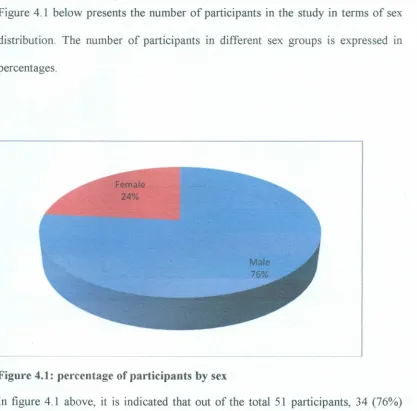
Figure 4.1 below presents the number of participants in the study in terms of sex
distribution. The number of participants in different sex groups is expressed in
percentages.
Figure 4.1: percentage of participants by sex
In figure 4.1 above, it is indicated that out of the total 51 participants, 34 (76%)
were males, while 12 (14%), were females. This indicated that most of the teachers
4.2.2 Ages of the participants
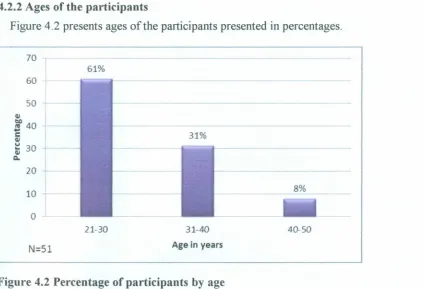
Figure 4.2 presents ages of the participants presented in percentages.
70 61% 60 50 GI
rt
40•..
C GI ~ 30 GI Q. 20 10o
N=51 31% 8%21-30 31-40
Age in years
40-50
Figure 4.2 Percentage of participants
byage
In the figure it is indicated that out of the 51 teachers who participated in the study
31(61%) were in the age bracket of20-30years, while 39% were in the age bracket
31 years and above. This shows that most of Biology teachers in Rachuonyo South
Sub-County are below 31 years old.
According to Kubiatko (2006), modern technology is hardly "understandable
to older teachers ... p.45". Integration of computer technology into teaching and
learning process in Kenya can be considered as a modern technology to most
teachers, even those young in age, considering the fact that most of the serving
teachers never had opportunity to attend classes where computer technology was
integrated into the teaching and learning process. Most of the Biology teachers in
Rachuonyo South Sub-County are young in age and possibly in service, probably
indicating immense potentiality of the teachers to accept and cope up with the idea