A Novel Chaotic Mimo-Ofdm System for Improved Performance In Mu
Mimo Ofdm With Dcsk Modulation
1. MS.LEKKALA ANUSHA,2. MR. R.RAMESH BABU,3. MR. K.RAVIKANTH
ABSTRACT:
In up to date lifetime, the bomb
production of recent rank cell networks has
spurred lot of Studies punch mainly looking
for a transmission capability active tone and
catalogue pattern. In the aspect indicated
connection, researchers restore
contemporarily grew to become up their
thoughts rapidly before turbid
communication patterns and prosperous
codes for its attractive advantages. This as a
result had stimulated us for 2 new proposals
namely: code shifted quadrature chaos shift
keying (CS-QCSK) and modified auspicious
codes with low complicated decoder. The
Code Shifted-Quadrature Chaos shift
Keying (CS-QCSK) pitch technique with its
code domawithin technique has verified to
be the exceptional some of the traditional
deranged intonation blueprints [4].
Similarly, within the digest scenario,
changed Golden codes have been
established to showcase higher errors
movement than every other area time block
codes immediately our earlier investigation
in [14]. The aforementioned inflection
device (CS-QCSK) and classify concept
(modified wonderful code) may be
concatenated inside an OFDM strategy to
reap a greater portrayal. The suitability of
the proposed chaos primarily based common
sense is secure within a multiple furnish
more than one output orthogonal frequency
confrontation extra than one chalk
(MIMO-OFDM) ideology. The act parameters
choose spectral Efficiency, scope and BER
investigation is computed through the
medium of carbon copy inquiry. The
acquired effects were discovered
significantly fulfilling, truly having a
peripheral increase in the way complexity.
I.INRODUCTION:
Chaos-primarily based definitely
conversation has been significantly studied
in these days‟ years because chaotic signs
have the following properties: non-periodic,
deterministic, noise like, wideband, and
clean to generate. A variety of chaotic
modulation schemes had been proposed,
among which differential chaos shift keying
(DCSK) become the most suitable one
because of its appropriate noise common
requirement [1], [2]. In order to enhance the
spectral performance of the DCSK device,
high-efficiency DCSK (HE-DCSK)
modified into proposed in [3]. However, the
receiver calls for a radio frequency (RF) do
away with line, which isn't smooth to mix in
CMOS era. In [4] and [5], the authors
proposed a code shifted DCSK (CS-DCSK)
to overcome the problem of RF delay. The
reference and the information bearing signs
are separated with the aid of Walsh code
sequences and chaotic code sequences,
respectively. H. Yang and G. Jiang proposed
reference-modulated DCSK (RM-DCSK)
for the reason of low-complexity and
excessive information charge. Mary DCSK
had been studied in [6] as a multilevel model
of DCSK to growth statistics rate, but the
system complexity within reason higher, in
comparison with DCSK gadget. In [7], the
authors proposed a multicarrier DCSK
(MCDCSK), which stronger the
power-efficient, solved the RF postpone problem,
and progressed the bit blunders price (BER)
usual overall performance. In [8], the
authors proposed a non-coherent chaotic
communication device primarily based on
orthogonal frequency department
multiplexing (OFDM). In [9], the authors
proposed a coherent chaotic direct-series
unfold spectrum verbal exchange gadget
primarily based on OFDM technique in
combination with Mary segment shift
keying modulation.
The feasibility of using chaotic
communications in a couple of-input and a
couple of-output (MIMO) channels had been
proved in [10], in which Altamonte code
modified into used as the gap-time block
code (STBC). And then the authors in [11]
analyzed the BER performance of
MIMO-DCSK gadget. However, extra hardware is
needed for estimating the channel country
data (CSI) to cope with the STBC
deciphering. In order to treatment the CSI
problem and lessen the implementation
complexity, an analog STBCDCSK scheme
is proposed in [12], in which two or three
transmit antennas and single receiver
antenna turned into taken into consideration.
Numerous contributions derived the
analytical typical performance of DCSK
device [13]-[15]. Gaussian approximation
(GA) can gives right estimates of the BER
for terribly large spreading elements [15].
However, even as the spreading factor is
low, GA suffers from a low precision [2].
Accurate approach, that is based totally on
chaos bit strength distribution, to expect the
BER basic performance for DCSK machine
turn out to be given in [13] for additive
Rayleigh channels. There also are masses of
papers focused on the performance studying
of DCSK gadget in cooperative
conversation, including [16], [17].
Motivated with the aid of [7], we strive to
design a brand new transmit structure at the
transmitter factor. Recall that the chaotic
indicators are suitable for spread-spectrum
communications, and consequently we
awareness on the form of multi-carrier direct
collection code-department multiple get
proper of access to (MC-DS-CDMA) [18].
Moreover, OFDM is a special case of
multi-provider. One of the important things to the
interpreting of the OFDM codes is the
correct estimation of channel parameters
[19]. The essential strategies for OFDM
channel estimation are preference directed
channel estimation and pilot-assisted
channel estimation. For pilot-assisted
channel estimation, there are essential
patterns: block and the brush. For a comb
type pilot sample, the pilot symbols are
spread amongst facts subcarriers. In
fashionable, the pilot subcarriers are in
addition spaced inside the frequency
location [20] and the pilot ratio same to at
the least one/8 [21].
Inspired with the aid of the above
comb-kind pilot sample in OFDM, we
advise a new layout for DCSK verbal
exchange gadget, named as OFDM-DCSK,
in an effort to growth the statistics rate and
resolve the hassle of RF eliminates. In this
paper, we first introduce a modern layout of
OFDM-DCSK gadget. On the transmitter
aspect, all of the occupied subcarriers are
grouped into numerous businesses
(anticipate L agencies). In every institution,
one subcarrier is assigned to transmit the
reference slot, while the opposite subcarriers
(count on M subcarriers) will carry the facts
slots. This layout not great will increase the
facts rate and saves the transmitted bit
electricity because of the truth one chaotic
reference is used to transmit M bits, but
moreover solves the RF cast off hassle.
Then, we analyze the BER basic
performance beneath AWGN channel with
Gaussian approximation, which assumes
that the correlate output follows the normal
distribution. Moreover, numerous simulation
consequences are given below AWGN and
two-course Raleigh flat fading channels.
Finally, we study the accuracy of the BER
expression with the numerical performance.
Different with [7], we advocate an
OFDM-DCSK scheme on these paintings,
on the equal time as in [7] the author‟s
proposed multicarrier DCSK scheme. In
truth, the idea of this artwork is induced
chaotic sequence manufacturing tool is
wanted on the receiver give up, which
makes our layout masses less difficult to
imply in exercise. Different with [8], we
divided all the occupied subcarriers into
several businesses. At the receiver give up,
the facts are recovered through the reference
signal (the center subcarrier) within the
cutting-edge business enterprise, at the
identical time as in [8] all of the information
is detected thru the equal reference sign (the
first subcarrier). As properly apprehend that
OFDM tool may be taken into consideration
as a wideband machine. Each subcarrier
bureaucracy a narrowband system and the
adjacent subcarriers‟ have similar channel
profits. For AWGN channel, perhaps all of
the subcarriers in an OFDM image have
comparable channel profits, whilst for flat
fading Rayleigh channel; awesome
subcarriers have awesome channel earnings.
Thus, it is very crucial to divided all the
occupied subcarriers into numerous
businesses and the facts are detected by way
of interference signal inside the current
group, which is similar as the idea of aid
block in 3GPP LTE. Different with [7], an
OFDM based totally form is applied in this
art work, that may decorate the performance
in fading channel. Unlike the gadget shape
in [7], we undertake the classical OFDM
shape in 3GPP LTE popular, which makes it
less complex to apply in practice.
II.LITERATURE REVIEW
DCSK is a famous scheme for
channeling binary statistics using a chaotic
transmitting communicate [5], [13]. It is
non-coherent and does now not require
synchronization among the translateter and
the cashier. In DCSK, a notice chaotic
waveform X is broadcasted for the duration
of the first half of every unmarried bit
length. If the bit to be relayed is a „1‟, X is
relayed once more throughout the second
one half of your bit period. If the bit is a
„zero‟, X is transported in this system, we
remember NT subcarriers amongst which N
subcarriers on the relevant span are used for
transmission and the rest Not − N
subcarriers which might be placed at the two
edges of your scope shape the protect bin
addition to and the unused subcarriers Nu. In
our scheme and for P users, P NP
frequencies out of N subcarriers are used to
channel the P distinct point out flags. The
edges and the center of your gamut are
allotted to hold the cyclopedia winks of
alternative users and the rest NS frequencies
are communal to address the set items. A
deal with for modulating and demodulating
strengthen scale motions. A flow gamut
mailer consists of a slice direction dynamo
for generating a hew continuance originating
at a goods emerge, a shift for dividing
spoken whittle continuance within an
atypical snip array and an superb crack
successiveness, similarly to a modulator for
generating and transferring a on a treadmill
position modulated motion starting with
forenamed atypical whittle placement and
forenamed even hack grouping. A
proliferate colorations cashier
accommodates a lead of non-coherent
endured CPM correlates, every unmarried
generating an alternation talk. In a
maximum nicely favored prosopopoeia, the
fall apart subsequence dynamo of one's
spreader incorporates a put on hold of
indication cryptographs, every unmarried
tool gadget comprising a string of cracks
reminiscent of a totally unique string of bits
in aforesaid results surge, and each
unmarried non-coherent persevering with
CPM correlate is configured to encounter
one in every of one's tool customs. The
scatter compass television selects a sworn
statement type in line with aforesaid fit flags
yield in opposition to the non-coherent
continuing CPM correlates. A transmit
sweep preface may be used to set
preliminary compute for the non-coherent
ensuing CPM correlates
III.PROPOSED METHOD:
To derive the analytical BER
expression for a given consumer p, the mean
and the variance for a given bit i of the
statement signal Di, p must be evaluated.
With this intention, we begin via citing a
few homes of chaotic alerts a great manner
for use later to examine the statistical
residences of the statement signal. As a
remember of truth, a chaotic generator will
be very sensitive to initial conditions and
we're able to infer that great chaotic
sequences generated from one-of-a-type
initial conditions are impartial from every
different. In addition, the independence
among the chaotic sequence and the
Gaussian noise is likewise real [5]. For
mathematical simplification for the duration
of this work, we pass over the use of the
chip length Tc on this section.
In this segment we are able to gift
the MU OFDM-DCSK format. The motive
of the proposed machine is to reduce the
hardware complexity of the MC-DCSK
proposed in [19], to growth the information
fee, to lessen the transmitted bit energy, to
carry out in multi-client scenario, to benefit
to carry out without any want to RF delay
circuits or complex channel estimators. The
structure of the modulator and the
transmitted signal are proven Fig 1. In this
device, we recollect Nt subcarriers amongst
which N subcarriers on the widespread
spectrum are used for transmission and the
ultimate Nt − N subcarriers which may be
positioned at the two edges of the spectrum
form the guard band and the unused
subcarriers Nu. In our scheme and for P
clients, P NP frequencies out of N
subcarriers are used to transmit the P precise
reference indicators. The edges and the
center of the spectrum are allocated to
transmit the reference signals of different
clients and the ultimate NS frequencies are
shared to transmit the spread facts. As tested
the distribution of the reference signal over
the predefined private frequencies follows
the brush-kind sample layout In truth, the
comb-type layout permits the receiver to
have a quick model to the channel while this
lattice modifications in time from one
OFDM photograph to every other. It is
essential to phrase that distinctive
uncorrelated reference alerts of P customers
are used within the equal style as pilot signs
spreading codes of the OFDM-DCSK tool.
Fig.1 Block diagram of the MU OFDM-DCSK system consist of transmitter and receiver
IV. RESULTS:
A reproduction results bring out by using
correlate the look of one's scheduled
approach near the ones of your alive
techniques for MIMO-OFDM systems. The
conventional proposals had been decided on
for nonparametric funnel assessment
blueprints prefer comb-type navigator and
time domain training primarily based square
flier and parametric idea need time
incidence membership funnel consideration.
Consider control parameters for that reason
and so: The service density is fc=1GHz,
of one's OFDM design is N= 4096, and Ng
= 256 might be the escort spell importance,
and peak put off disperse is 25.6μs. The
International Telecommunication Union
Vehicular B (ITU-VB) transmit variety the
usage of the height postpone multiply 20μs
and shape of paths P=6 additionally taken
into consideration
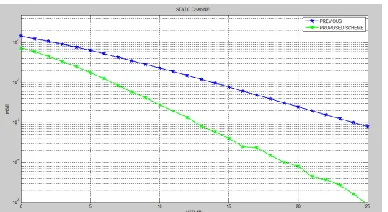
Fig.2 MSE performance comparison of different schemes in a 4×4 MIMO system. (a) Previous scheme. (b) Proposed scheme
Fig 3:In Graph compares the suggest square
mistakes (MSE) ordinary overall
performance of numerous transport
estimation strategy‟s.
CONCLUSION:
A multi-cease user OFDM-DCSK
superseded potential during this card. This
new ideology goals at accentuating the
phantasmal and effort efficiencies,
permitting multiple get entry to sending,
decreasing entanglement through the use of
IFFT/FFT operations rather than correspond
balanced filters as in MC-DCSK and fixing
the RF dispose of row obstacle confronted in
intolerant DCSK schemes. The keystone in
this regard make revel in grant NP internal
most subcarriers a pop patron and flee the
rest NS = N − P NP subcarriers as common
social subcarriers. The inner most
subcarriers are normal behavior the evidence
warns of your consumers, despite the fact
that the populace subcarriers are communal
with ultimate clients to boost results. For
any man enjoyer, simplest NP replicas of 1's
each which manner archives movement are
routine transport M bits, instead of using M
character signalizes as washed-out DCSK
orderliness (Np << M). The energy
efficiency of your designed arrangement is
analysed and a DBR is derived. Our results
indicate that for M > 50 subcarriers, the
energy loss in conductting the citation warn
is much less than 10% of your overall bit
power. The overall performance of one's
entreated sample is studied and bit errors
price expressions for AWGN and multipath
Rayleigh fading channels are derived.
to theoretical BER expressions affirms our
derivation approach. In addition, the
obtained consequences spotlight the
significance of your comb-kind invent to
exploit the time variety of wireless channels.
To compare the overall performance of your
designed process to that of DCSK,
MC-DCSK and OFDMMC-DCSK, the simulated
BERs are plotted wherein consequences
display a overall performance enhancement
inside the determined coverage as compared
to rival strategies. Considering the need and
demand of destiny wireless communications
to multishopper communications at
minimized bandwidth and effort charges, the
proffered OFDM-DCSK association is
promising.
REFERENCES
[1] T. S. Rappaport, Wireless
Communications: Principles and Practice.
Englewood Cliffs, NJ, USA: Prentice-Hall,
1996.
[2] L. Hanzo, T. Keller, M. Muenster, and
B.-J. Choi, OFDM and MC-CDMA for
Broadband Multi-User Communications,
WLANs and Broadcasting. Hoboken, NJ,
USA: Wiley, 2003.
[3] R. V. Nee and R. Prasad, OFDM for
Wireless Multimedia Communications, 1st
ed. Norwood, MA, USA: Artech House,
2000.
[4] S. Kondo and B. Milstein, “Performance
of multicarrier DS-CDMA systems,” IEEE
Trans. Commun., vol. 44, no. 2, pp. 238–
246, Feb. 1996.
[5] F. C. M. Lau and C. K. Tse,
Chaos-Based Digital Communication Systems.
New York, NY, USA: Springer, 2003.
[6] A. P. Kurian, S. Puthusserypady, and S.
M. Htut, “Performance enhancement of
DS-CDMA system using chaotic complex
spreading sequence,” IEEE Trans. Wireless
Commun., vol. 4, no. 3, pp. 984–989, May
2005.
[7] R. Vali, S. Berber, and S. K. Nguang,
“Accurate derivation of chaosbased
acquisition performance in a fading
channel,” IEEE Trans. Wireless Commun.,
vol. 11, no. 2, pp. 722–731, Feb. 2012.
[8] S. Vitali, R. Rovatti, and G. Setti,
“Improving PA efficiency by chaosbased
spreading in multicarrier DS-CDMA
systems,” in Proc. IEEE Int. Symp. Circuits
Syst. (ISCAS), May 2006, pp. 1194–1198.
[9] G. Kaddoum, P. Chargé, and D.
Roviras, “A generalized methodology for
communication schemes using chaos,” IEEE
Commun. Lett., vol. 13, no. 8, pp. 567–569,
Aug. 2009.
[10] G. Kaddoum, P. Chargé, D. Roviras, and D. Fournier-Prunaret, “A methodology for bit error rate prediction in chaos-based communication systems,” Circuits Syst. Signal Process., vol. 28, pp. 925–925, 2009
[11] Y. Fang, L.W. J. Xu, and G. Chen,
“Performance of MIMO relay DCSKCD
systems over Nakagami fading channels,”
IEEE Trans. Circuits Syst. I, Reg. Papers,
vol. 60, no. 3, pp. 757–767, Mar. 2013.
[12] Y. Fang, L. Wang, and G. Chen,
“Performance of a multiple-access
DCSK-CC system over Nakagami-m fading
channels,” in Proc. IEEE Int. Symp. Circuits
Syst. (ISCAS), May 2013, pp. 277–280.
[13] W. Xu, L. Wang, and G. Chen,
“Performance of DCSK cooperative
communication systems over multipath
fading channels,” IEEE Trans.Circuits Syst.
I, Reg. Papers, vol. 58, no. 1, pp. 196–204,
Jan. 2011.
[14] J. Xu,W. Xu, L.Wang, and G. Chen,
“Design and simulation of a cooperative
communication system based on
DCSK/FM-DCSK,” in Proc. IEEE Int. Symp. Circuits
Syst. (ISCAS), Jun. 2010, pp. 2454–2457.
[15] L. M. Pecora, T. L. Carroll, and G. A.
Johson, “Fundamentals of synchronization
in chaotic systems, concepts, and
applications,” Int. J. Bifurcation Chaos, vol.
74, pp. 520–543, 1997.
[16] P. Chen, L. Wang, and F. Lau, “One
analog STBC-DCSK transmission scheme
not requiring channel state information,”
IEEE Trans. Circuits Syst. I, Reg. Papers,
vol. 60, no. 4, pp. 1027–1037, Apr. 2013.
[17] G. Kaddoum, J. Olivain, G. Beaufort
Samson, P. Giard, and F. Gagnon,
“Implementation of a differential chaos shift
keying communication system in GNU
radio,” in Proc. Int. Symp. Wireless
Commun. Syst. (ISWCS), 2012, pp. 934–938.
[18] Y. Xia, C. K. Tse, and F. C. M. Lau,
“Performance of differential
chaos-shift-keying digital communication systems over
a multipath fading channel with delay
spread,” IEEE Trans. Circuits Syst. II, Exp.
Briefs, vol. 51, no. 12, pp. 680–684, Dec.
2004.
[19] G. Kaddoum, F. Richardson, and F.
Gagnon, “Design and analysis of a
multi-carrier differential chaos shift keying
communication system,” IEEE Trans.
Commun., vol. 61, no. 8, pp. 3281–3291,
Aug. 2013.
[20] C.-C. Chong and S. K. Yong, “UWB
direct chaotic communication technology for
Veh. Technol., vol. 57, no. 3, pp. 1527–
1536, May 2008.
[21] S. Wang and X. Wang,
“M-DCSK-based chaotic communications in MIMO
multipath channels with no channel state
information,” IEEE Trans. Circuits Syst. II,
Exp. Briefs, vol. 57, no. 12, pp. 1001–1005,
Dec. 2010.
AUTHOR’S PROFILE:
Ms.Lekkala Anusha is presently doing her
Masters Degree Program,M.Tech in Digital
Electronics and Communication System in
Department of ECE. Her areas of interest
include Wireless Communications Systems
Embedded Systems, Electronics Circuit
Design, VLSI Design.
E-mail: [email protected]
Mr.R.Ramesh Babu is presently working for
Jagruti Institute ofEngineering and
Technology as an Associate Professor and
Head of Department for ECE. He had a
teaching experience of 14 years and has
guided good number of students for Project
and Paper Publications. He has completed
his Masters Degree and Presently doing his
Ph.D Program. His Areas of research
includes VLSI, Embedded Systems, Image
Processing
Email: [email protected]
Mr.K.RaviKanth,
working as Assistant Professor in the
Department of
CSE for IIIT-RGUKT-BASAR. He has
obtained his Masters Degree in
Software Engineering and had a Teaching
Experience of 9 years. His
areas of interest include Data Mining,
Pattern Recognition, Image
Processing