ISSN 2348 – 7968
180
Protective Coating for Wooden Structures
Boris Belashev1, Vera Ilyina1 and Viktor Bolondinskiy2
1
RAS, Karelian Research Center /Institute of Geology, Petrozavodsk, 185910, Russia
2
RAS, Karelian Research Center /Institute of Forest, Petrozavodsk, 185910, Russia
Abstract
The production technology and properties of decorative coating, protecting wood from flammability and rotting, are described. Liquid silicate glass is used as a binder and diatomite as a filler and pigment. The coating is fire- and bio- efficient, resistant to moisture and acids. The coating is easy to produce. It dries rapidly and has a varied color palette.
Keywords: protective coating,, liquid glass, diatomite, fire-resistant efficiency, bio-resistance, adhesion, moisture resistance.
1. Introduction
Wood is a natural durable, easily treated material. However, the rotting and inflammability of wooden structures decrease their durability and reliability. Decreasing the inflammability and increasing the bio-resistance of wood are essential in various economic activities, e.g. conservation of wooden architectural monuments. Wooden monuments, located in remote areas, are damaged by lightning, fires, unfavorable climate and human activities.
Coating which protects wood from inflammation and rotting and makes it aesthetically attractive is described. The goal of our project is to study the protective and technological properties of the coating. The properties of the coating depend largely on its composition. The known liquid silicate glass was used as a binder for the coating. Diatomite, which is amorphous siliceous rock of sedimentary origin, acts as a filler and pigment. The coating easy applied to the surface of a product solidifies rapidly forming a protective film. The natural colors of diatomite or the colors acquired upon treatment allow to create a variety of tints of the coating.
2. Composition and properties of coating
constituents
Liquid silicate glass commonly use for fire-proof paints. When mixed with filler and pigment, this glass forms homogeneous consistency, which creates over the surface of the product a solid layer. Potassium liquid glass use more commonly than sodium glass, because less salt is formed on its surface in a humid environment. To make the product less inflammable, fire-proof fillers, whiting, color pigments and special additives are added to the paint. Vermiculite, perlite, talc, kaolin wool and asbestos filaments are common fillers. The compositions of well-known fire-resistant paints are shown in Table1 [1].
Table 1. Technical specifications of fire-resistant paints
Paint Silicate- vermiculite
Silicate- asbestos
Silicate- clay
Silicate- perlite Composition Liquid
potassium glass, titanium whiting, ground
vermiculite
Liquid glass, asbestos,
short-filament
talc, whiting
Liquid glass, ground
brick, clay
Liquid glass, swollen
perlite, kaolin wool
filaments
Consumption, kg / m2
1 1 1.5 1.2
Thickness,
mm ~1 ~1 ~1 1
Fire resistance
limit, min 45 30 30 30
ISSN 2348 – 7968
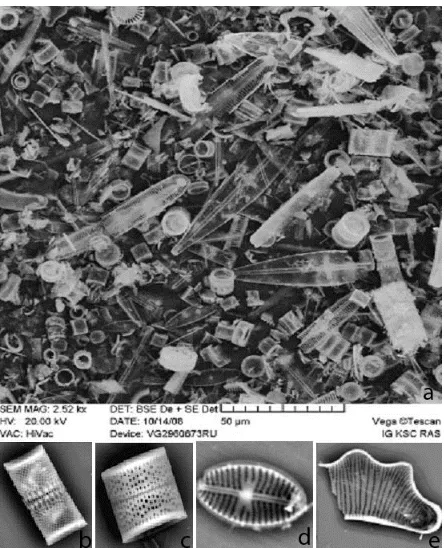
181 Fig. 1 Electron image of the sedimentary rock of diatomite (а) and
some of its constituent species: b, c - Aulacoseira italica var. valida, d — Cocconeis sp., e - Eunotia polygliphis.
128 high-quality diatomite deposits and manifestations been prospected in Karelia. Their average thickness is 2-3 m and in some water bodies 6-8 m [2, 3].
Natural diatomite, containing 80-85% moisture, is a brown, white, cream or orange-colored gelatinous mass. The composition, structure, physicochemical properties and applications of diatomites are discussed in [3-6]. Most diatomite grains are 15-20 μm in size. Grains having sizes 100-1000 μm, are formed by agglomeration of particles. Quartz and feldspar grains, 0.015 – 0.2 mm in size, occur as mineral impurities. Some of them are brown in color. The presence of organic impurities is set up by the exothermal peaks on the derivatograms of diatomite near 285оС, which attributed to the decomposition of impurities and the oxidation of Fe+2. Diatomite impurities are removed by roasting the samples in a muffle furnace at 700оС for 1.5 hours, using magnetic separation and leaching by boiling in 5% hydrochloric acid for 1 hour.
Diatomite is typically has an amorphous porous structure. As the holes in its valves are about 100 nm in size, diatomite could be considered a biogenic nanomaterial. Because of its high porosity diatomite has a small specific gravity , although the X-ray density of the silica of the diatomite valves is similar to that of amorphous quartz (2300 kg/m3). The size,
shape and pores of diatomite particles are determine the specific surface – a characteristic, which controls the behavior of powders in technological processes. The low thermal conductivity of diatomite (0.07-0.10 Wt/(m·K) is essential for the fire-resistant coating.
To produce such a coating, brown-colored D0-diatomite samples from Lake Tedrilampi, located in the Muezersky District, and white D1-diatomite samples from a small nameless lake, 2 km from Lake Tungozero, Louhi District, were used as a filler and pigment. The samples differed in species composition, the degree of preservation, the number of valves in 1 gram of sediment, physicochemical properties and the presence of organic and mineral impurities. After thermal treatment at 700оС, the brown D0-diatomite sample became orange. The chemical compositions of the diatomite samples are shown in Table 2 and their some physicochemical properties in Table 3.
Table 2. Chemical composition of diatomite samples, mas.%.
Sample D0 D1
700оС HCl Initial 700оС HCl
SiO2 70.46 86.02 88.28 76.20 88.86 91.2
TiO2 0.05 0.06 0.05 0.1 0.08 0.05
Al2O3 1.96 2.29 2.38 3.82 4.32 4.43
Fe2O3 2.27 2.05 0.09 0.22 0.13 0.07
MgO 0.62 1.38 1.62 0.25 0.41 0.92
CaO 0.43 0.51 0.58 0.28 0.37 0.43
Na2O 0.19 0.24 0.76 0.33 0.29 0.08
K2O 0.14 0.18 0.33 0.27 0.19 0.03
Igniton
loss 23.88 7.27 5.91 18.53 5.35 2.79
Table 3. Physicochemical properties of diatomites.
Sample D0 D1
Volume mass, g/cm3 0.45 0.19
Specific surface after HCl
treatment, m2/g 14.8 123
Thermal conductivity, Wt/(m K) 0.10 0.07
True density, g/cm3 3.4 2.3
Total Fe,% 0.09 0.07
Ignition loss 8.5 3.22
Colour after treatment Orange White
ISSN 2348 – 7968
182
3. Coating production technology
To prepare the fire-resistant coating, diatomite in the amount of 17 – 70 mas. % was weighed and placed into a mixer, where liquid glass, in the amount of 30 – 83 mas.%, was poured [7]. The solution was mixed until a mass, homogeneous in color, was obtained. Then this mass were applied with a roller or brush on the surface of the product and were dried. The coating was spread over the wooden, ceramic or concrete surface as a smooth layer. The consumption of the coating was 0.154 – 0.308 kg/m2, the coating thickness being 0.01-02 mm.
4. Coating testing methods
The fire-resistance of the coating on the base of developed composition was tested using the “fire tube” method [8]. A previously weighed sample was placed on a holder into the center of a steel tube with an internal diameter of 50 mm and a length of 165 mm. A burner was mounted under the sample. The height of its flame was controlled in the interval of 15-25 cm. After the ignition of the sample the burner was removed and fixed the time of independent sample burning. The mass loss of the sample was estimated by additional weighing.
The adhesion of the coating was assessed using the reticulate notch method [9], assuming that result of test is the adhesion value in points, corresponds to the majority of coincident values at all the surface sites of the samples. The values that differed in less than one point were considered coincident.
The time and degree of drying were calculated at (20 ± 2) °С and a relative air humidity of (65 ± 5) % on three samples spaced at least 20 mm apart [10]. The moisture resistance of the coating was estimated from the mass loss of the samples after they stayed in a humid medium.
Exploitation time was determined using an accelerated method [11]. The consumption of the coating per square meter was measured experimentally [12]. Acid resistance class was determined in accordance with ASTM С 283-54 International Standard [13]. The thermal conductivity
coefficient of the coating was measured using an IТEМ
-1М instrument [14].
The mold fungus resistance of the coating [11] was tested at V. L. Komarov Botanical Institute, RAS, in St. Petersburg by Senior Researcher E. V. Bogomolova using spores infected by water suspension without adding nutrients and spores infected by water suspension with addition of sugar and mineral substances. Czapek’s nutrient medium was selected as an additive [15]. The
viability of the fungus spores on the coating was assessed using the replication method [16].
The bio-resistance of the coating was checked in a real environment. Observation of the coated and control samples (7-10 mm thick pine planks) was conducted in the basement of a house infected with the fungi Serpula lacrymans (weeping Serpula) and Coniophora puteana (cellar fungus, stinky Coniophora) [17].
5. Results of the tests
The fire-resistance of the coating is shown in Figure 2 and in Table 4. The figure shows an uncoated control sample kept in the burner flame for 1 minute and a coated sample kept in the flame for 10 minutes (b). The mass loss of the coated sample was 0.34-0.55 %. The mass loss of no more than 9% corresponds the high fire resistance of the coating [8].
Fig.2. Results of the testing of a control sample and a coated sample in a fire tube after keeping the control sample in the flame for 1 minute and the
coated sample for 10 minutes.
Table 4. Properties of fire-resistant coatings.
Sample no. 1 2 3 4
Adhesion to wooden surface, points 1 1 1 2 Mass loss upon inflammation, % 0.55 0.50 0.34 10
Non-flammability group 1 1 1 2
Drying time, min. 15 10 17 6-12 hrs
Moisture resistance, mass loss, % 1.7 2.2 2.5 -
Acid resistance, ASTM С 283-54
class AA A AA -
The numbers 1-3 are coated samples and number 4 is coating prototype [18].
ISSN 2348 – 7968
183 has shown that the edges of the notches are smooth and
display no signs of flaking. Flaking took place after the samples were kept in a humid medium for one month. This is not surprising because the samples were not impregnated prior to coating. The coating is moisture-resistant. The mass loss upon moisture impregnation of the samples is 1.7-2.5%. The coating corresponds to class AA in chemical resistance.
The coating resists the overgrowing of the wood with mold fungi. In the absence of organic contamination the coating
is of PG0Х1-PG0Х2 fungus resistance classes. Weak fungicidal activity, indicated by the emergence of scarce small mold fungus colonies, was displayed by one of the four samples analyzed.
Figure 3 shows samples infected with fungi in a real environment. In the absence of light and at high above-ground air and soil humidity the fungi Serpula lacrymans and Coniophora puteana rapidly destroyed the wood of the control samples. After a week they had white spots which passed into silvery interweaving and growing fruit bodies. The surface of the coated samples remained clean for a long time, but after a month some white spots on it were noticeable.
Fig.3. Photos of control (top) and coated (bottom) samples after keeping them for one month on the earth floor in a zone affected by the fungi
Serpula lacrymans and Coniophora puteana: а) upward surfaces, b)
surfaces near the ground.
The natural colors of diatomite and those obtained by treatment can easily add various tints to the coating .
6. Conclusion
The coating developed for wooden structures has a high fire, moisture and fungus resistance. It contains no toxic components and can be produced in various colors. The use of diatomite as a filler improves the properties of the coating in comparison with common fillers because of its high silicon dioxide and low iron content, high dispersion, amorphous structure, the presence of pores and low density and thermal conductivity.
The application of diatomite is economically efficient because it has a finely disperse structure and thus needs no expensive crushing, displays a variety of colors and can be used as a filler and pigment. As diatomite has a porous structure, extra additives could be added in smaller concentrations and protection against external effects is provided.
The coating is easy to produce. It is readily applied to wooden surfaces, dries rapidly and protects wooden products against fire, atmospheric precipitation, moisture and rot.
Acknowledgments
The authors thank E. V. Bogomolova Senior Researcher of V. L. Komarov Botanical Institute, Russian Academy of Sciences in St. Petersburg for their help in testing the fungicidal properties of the protective coating.
References:
[1]. Liquid glass-based protective paints. mail/ ru: http:// kraski4yo.ru/articles/_antifire/_glasspaint_print.html.
[2]. I. N. Demidov, Т. S. Shelekhova Diatomites of Karelia. Petrozavodsk. 2006.
[3]. V. Ilyina, B. Belaschev, O. Bukchina. “Biogenic diatomites of Karelia” in the ХIХ International Symposium on Environmental Biogeochemistry, University of Hamburg, Germany, 2009,p.32.
[4]. V. Ilyina, B. Belashev “Experience of study of diatomites” in the 15th International Multi-disciplinary Sceintific Geoconference SGEM, Bulgaria, 2015, Vol II, pp.229-233.
[5]. S. Ivanov, А.Belyakov “Diatomite and its applications ",
Glass and ceramics, No. 2, 2008, pp. 18-21.
ISSN 2348 – 7968
184
[7]. V.P Ilyina., B.Z. Belashev “Composition for the production of fire-resistant coating”, Patent No. 2435810 RF, MPK СО4В
33/132 published 10.12.2011, Bull. No.34, http://www. freepatent.ru/ patents/2435810.
[8]. Interstate standard GOST 16363-98. Fire-protective means for wood. Methods for assessment of fire-protective properties http://dokipedia.ru/document/5137858.
[9]. “Varnishes and paints. Method for estimation of the time and degree of drying”, Interstate standard GOST 19007-73, http://www. yondi.ru/inner_c_article_ id_1233.phtm.
[10]. “Varnishes and paints. Adhesion determination methods ”, Interstate standard GOST 15140-78, zmk-s.ru/sites/default/files/ field/ gost/gost_15140.pdf.
[11]. “Integrated corrosion and ageing protection systems. Varnish and paint coatings. General requirements and methods for high-speed testing of resistance to climatic factors”.
Interstate standard GOST 9.401-91,
http://www.znaytovar.ru/gost/2/ GOST
_940191_ESZKS_Pokrytiya_la.html.
[12]. “Varnishes and paints. Method for determination of the mass fraction of volatile, non-volatile, solid and film-forming substances”, Interstate standard GOST 17537-72, http://www.domastroim.su/gost/kraski/ custom_doc_ 1367.html. [13]. “ASTM C 283-54”, International standard, https://www. google.ru/?gws_rd=ssl#newwindow=1&q=ASTM+c+283-54+
[14]. “IТEМ-1М thermal conductivity meter”, http://www.ts-yug.ru/catalog.php?id=1111& item=142902.
[15]. S. М. Semyonov Laboratory media for acynomycetes and
fungi. М.: Agropromizdat, 1990.
[16]. Practical manual on microbiology: Р 85 Teaching aid, М.:
MGU Publishers.1995.
[17]. Bondartsev А.S. Manual for determination of cellar fungi. М.-L.: Izd-vo AN SSSR, 1956.
[18]. V.Е. Reicher, I.R.Fishman, “Composition for the production of fire-resistant coating”, Patent No. 2148066 RU,
MPK С09D5/18, published 27.04.2000, http://ru-patent. info/ 21/45-49/2148066.html.
Boris Belashev , doctor of engineering, specialist in material science, mathematical modeling, geophysics, Leader Researcher of Institute of Geology of Karelian Research Center of Russian Academy of Sciences, member of Russian Mineralogy Society, has more than 150 publications.
Vera Ilyina, doctor of engineering, specialist silicate materials, the use of rock in ceramics and glass materials, Senior Researcher of Institute of Geology of Karelian Research Center of Russian Academy of Sciences, has more than 100 publications and patents.