QCD@Work 2018
Extra Quarks and Bileptons in BSM Physics in a
331
Model
ClaudioCorianò1,*,AntonioCostantini1,**
1Dipartimento di Matematica e Fisica "Ennio De Giorgi", Università del Salento and INFN-Lecce,
Via Arnesano, 73100 Lecce, Italy
Abstract. We describe some salient features of the 331F (Frampton-Pisano-Pleitez)
bilepton model, in which the constraints of anomaly cancelation require the number of generations to be three. In a class of six models, four of which characterised by aβ pa-rameter describing the embedding of the hypercharge in theS U(3)Lsymmetry, a specific
choice forβallows bileptons in the spectrum, i.e. vectors and scalars of lepton numbers ±2. At the same time the model allows exotic quarks, with the third quark generation treated asymmetrically respect to the other two. Bileptons generate specific signatures in the form of multilepton final states in Drell-Yan like processes, with and without associ-ated jets, which can be searched for at the LHC.
1 Introduction
At the beginning of June 2018 the ATLAS collaboration reported the measurement of the coupling of the top quark to the Higgs boson [1]. At the same time the CMS collaboration published the results of a similar analysis [2]. From their common results it is established that the coupling of the top quark to the Higgs boson is compatible with the prediction of the Standard Model (SM), confirming that the mechanism of mass generation of the heaviest known quark is similar to that of the lighter ones [3, 4]. These findings secure the mechanism of spontaneous symmetry breaking (SSB) - induced by a scalar sector and associated Yukawa couplings - as a general feature of the SM. If we consider BSM (beyond the SM) models, in particular models with multiple SSB steps, by the same token, it is natural to expect that extra fermionic states will be generated, widely distributed in their mass. Their charges are directly linked to the underlying patterns of anomaly cancellation, which, in some cases, take to electric charges which differ by those typical of the three generations of the SM, and are classified as
exotics.
2 GUT’s and 331’s
The idea that the gauge symmetry (S U(3)C×S U(2)L×U(1)Y ≡321) of the SM is part of a larger one
has been pursued since the 70’s, after that it was noticed that the unification of the gauge couplings could be achieved, provided that the underlying gauge group wassimpleor a product ofsimplefactors
q
B−−
¯
q
hi
B++
(a)
q
B−−
¯
q
V0
B++
(b)
q
B−−
Q
¯
q
B++
(c)
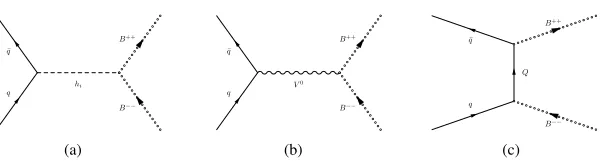
Figure 1.Typical contributions to events with two doubly-charged bosons in the final state and no extra jets. (a) and (b): contributions due to the mediation of a scalar (a) and a vector (b) boson. (c): t-channel exchange of exotic quarksQ.B±denotes either a vector (Y±) or a scalar (H±) bilepton.
(see [7] for an overview). Such symmetries with multiple simple groups can be obtained by the
sequential breakings of simple groups of higher rank, most notably withinE6andS O(10) scenarios
realized at a large scale, the grand unification scale or GUT. Among these, we mention the left-right symmetric model (S U(3)C×S U(2)L×S U(2)R×U(1)B−L) which can be derived from the breaking
ofS O(10). Other examples are models based onS U(3)c×S U(3)L, later extended by an extraU(1)X
in order to get the correct fermion masses. Tree level considerations on the structure of the couplings on the 331 models suggest that the breaking 331→321 could take place at the TeV scale, rather than at the usual GUT scale of 1013−1015GeV, which has been the motivation for studying such class of
models, especially in the flavour sector ( see [12, 13]). There are various realization of such models since the embeddings of 321 into 331 can be quite different.
3
S U
(3)
c×
S U
(3)
L×
U
(1)
X: exotics in the Frampton-Pisano-Pleitez model
The gauge structure of the 331F model of [5, 6] isS U(3)c×S U(3)L×U(1)X, with the fermions in
the fundamental ofS U(3)carranged into triplets ofS U(3)L. The three families of quarks are treated
asymmetrically with respect to the weakS U(3) (S U(3)L), with the first two families given by
Q1=
uL
dL
DL
, Q2=
cL
sL
SL
, Q1,2∈(3,3,−1/3) (1)
underS U(3)c×S U(3)L×U(1)X, whereas the third family is
Q3=
bL
tL
TL
, Q3∈(3,¯3,2/3). (2)
D,S andTare extra (exotic) quarks. In this respect, the number of generations is underwritten by
the contraints of anomaly cancellation, which single out this model as unique respect to the general class of BSM scenarios. The lepton sector is assigned to the representation ¯3 of the same gauge group. Universality is instead respected in the lepton sector, where the three lepton generations are ordinarily arranged into triplets ofS U(3)L,
l=
eL
νL
ec
R
QCD@Work 2018
withec
R = iσ2e∗R. The presence of exotic particles in the spectrum of the 331 model is due to the
specific embedding of the hyperchargeYin theS U(3)L×U(1)Xgauge symmetry, which is defined by
Y3=βT8+X1 Y¯3=−βT8+X1 (4)
for the3 and the ¯3representations ofS U(3)L, respectively, with generatorsTi = λi/2 (i =1, . . .8),
corresponding to the Gell-Mann matrices, andT8=diag
1
2√3(1,1,−2)
. The charge operator is given by
Qem,3 =Y3+T3 Qem,3¯ =Y¯3−T3 (5)
in the fundamental and anti-fundamental representations of of S U(3)L, respectively, where
T3=diag
1
2(1,−1,0)
.
4 Family embedding with exotics
If we choose theS U(2)L×U(1)Yhypercharge assignments of the SM as
Y(QL)=1/6, Y(L)=−1/2, Y(uR)=2/3, Y(dR)=−1/3, Y(eR)=−1 (6)
and denote byqXtheU(1)Xcharges, the breaking of the symmetryS U(3)L×U(1)X →S U(2)L×U(1)Y,
for the3ofS U(3) is
(3,qX)→
2, β
2√3+qX
+
1,−√β
3 +qX
, (7)
and for the¯3
(¯3,qX)→
2,− β
2√3 +q
X
+
1,+√β
3+q
X
. (8)
TheX-charge is fixed by the condition that the first two components of theQ1andQ2 triplets carry
the same hypercharge as the quark doubletsQL=(u,d)Lof the Standard Model, yielding
qX = 1
6−
β
2√3. (9)
The minimal version of the 331Fmodel, in our conventions, is obtained byβ= √3, resulting in
Qem(Q1,2)=diag(2/3,−1/3,−4/3), (10)
with two exotic quarksDandS of charge -4/3 whereas
Qem¯3(Q3)=diag
−13,2
3, 5 3
. (11)
The exotic quarkT carries electric charge 5/3. For the leptons we have the ususal charge assignments
and the three generations are treated symmetrically with
Qem(l)=diag(−1,0,1). (12)
Both left- and right-handed components of the SM leptons are fitted into the sameS U(3)Lmultiplet.
The condition of absence of colorless fractionally charged fermions fixes the value ofβto 4 possible values (±√3,±1/√3), of which the FPP model is one, plus two additional models. The first is a
flipped 331 version [8], with all the quarks in the same representation and the leptons in different
ones; while the second is embedded inE6and there is family replication for both leptons and quarks.
q g q V0 g g q Y++ Y−− (a) q g q g g V0 q Y−− Y++ (b) q g ¯ q g q ¯ Q Y++ Y−− ¯ q (c) g q q h q q g Y−− Y++ (d) g g ¯ q g Q ¯ Q Y++ Y−− q (e) g g ¯ q g q h ¯ q Y−− Y++ (f) g g ¯ q g q V0 ¯ q Y−− Y++ (g)
Figure 2.Bilepton signal from quark-gluon fusion and gluon-gluon fusion.
5 The scalars of
331
FThe scalars of the 331F model, responsible for the electroweak symmetry breaking (EWSB), come in
three triplets ofS U(3)L
ρ= ρ++ ρ+ ρ0
∈(1,3,1), η=
η+ η0 η−
∈(1,3,0), χ=
χ0 χ− χ−−
∈(1,3,−1). (13)
The breakingS U(3)L×U(1)X →U(1)emis obtained in two steps. The vacuum expectation value
of the neutral component ofρcauses the breaking fromS U(3)L×U(1)X toS U(2)L×U(1)Y. Then
the usual spontaneous symmetry breaking mechanism fromS U(2)L×U(1)Y toU(1)em is obtained
through the vevs of the neutral components ofηandχ. Exotic quarks play an important role in the production of vector bileptons (B±) inqq¯ annihilaton channels, as shown in Fig. 1. Compared to an ordinary Drell-Yan process where the coupling of the final state leptons to the intermediate gauge bosons is direct, in this case it is mediated by the bilepton pairs, each decaying to same sign leptons with a distinct signature of multi-lepton final states. At the same time, respect to an ordinary Drell-Yan process, an extra contribution is generated by at-channel exchange of an exotic quark (Q) at Born level (Fig. 1 c). Amplitudes with no associated jets can be generated also via the sextet scalars, by replacingY±withH±.
5.1 The triplet sector
Coming to the electroweak SSB mechanism, this is realised in the 331Fmodel by giving a vev to the
neutral component of the tripletsρ,ηandχ, with Yukawa interactions
LqYuk,triplet. =y1dQ1η∗dR+y2d Q2η∗sR+y3d Q3χb∗R
+y1uQ1χ∗u∗R+y2uQ2χ∗c∗R+y3u Q3ηt∗R (14)
QCD@Work 2018
whereyid,yiuandyiEare the Yukawa couplings for down-, up-type and exotic quarks, respectively. The
masses of the exotic quarks are related to the vev of the neutral component ofρ=(0,0, vρ). In this case the invariants are, in their representation content,
Q1ρ∗D∗R,Q1ρ∗S∗R ∼ (3,3,−1/3)×(1,¯3,−1)×(¯3,1,4/3)
Q3ρTR∗ ∼ (3,¯3,2/3)×(1,3,1)×(¯3,1,−5/3), (15)
which induce the breakingS U(3)c×S U(3)L×U(1)X → S U(3)c×S U(2)L×U(1)Y. If the relation
yiE ∼ 1 is satisfied, usingvρ vη,χ, it is clear that the masses of the exotics areO(TeV), which is of particular interest for searches of such states at the LHC. Notice that the model has the appealing feature that the condition of reality of the gauge couplings sets a constraint on the location of the extra vacua, which is limited to the TeV region.
5.2 The sextet sector
The triplet sector is not sufficient to account for the masses of the leptons of the SM. This is the reason
for introducing a scalar sextet. A typical Dirac mass term for the leptons in the SM is associated with the operator ¯lLHeR, withlL = (veL,eL) being the S U(2)L doublet. The representation content
is (¯2,1/2)×(2,1/2)×(1,−1) (forl,H andeR, respectively) in S U(2)L×U(1)Y. In the 331 theL
andRcomponents of the lepton (e) are in the same multiplet and therefore the identification of an S O(1,3)×S U(3)Lsinglet needs two leptons in the same representation. The flavour structure of the
Yukawa terms is given by the trilinear terms
LlYuk,triplet = Gηablia·lbjη∗ki jk+h.c. (16)
wherea andbare flavour indices whilei,j,kbelong to the 3 ofS U(3)L. Some considerations on
the gauge charges and fermion statistics of this interaction imply thatGη
abis antisymmetric in flavour
space and as such it is not sufficient to account for the masses of all the leptons. This problem is
overcome by the introduction of a scalar sector, sextet ofS U(3)L, denoted asσ
σ=
σ++
1 σ+1/
√
2 σ0/√2
σ+
1/
√
2 σ01 σ−2/√2
σ0/√2 σ−2/√2 σ−−2
∈(1,6,0), (17)
leading to the Yukawa term
LlYuk,sextet. =Gσablai ·lbjσ∗i,j, (18)
withGσ
ab which is symmetric in flavour space. This allows to singlet out the representation 6 of
S U(3)L, contained inlia·lbj, by combining it with the flavour-symmetricσ∗, i.e. ¯6. Multi-lepton final
states are a specific feature of the model generated by the decay of doubly charged vectors and scalars.
6 Quark exotics in Drell-Yan like distributions
We show in Fig. 2 the amplitudes involved in the analysis of bileptons with associated jets in the final state. Each exotic (Q) and non exotic (q) quark contributions interfere in the production of the intermediateY±. In Drell-Yan, as usual, thep
T (transverse momentum) distributions of a lepton pair
(more complex) generalization of that process, with the totalpTof the 4 leptons from the decay ofY±
vectors balanced by those of the two extra jets. The number of amplitudes which contribute to such final states is quite large and results have been presented in [10], to which we refer for more details. Such processes can equally be generated by a pair ofH±states if the contribution of the scalar sextet is included.
The inclusion of the sextet representation in the potentialV(ρ, η, χ, σ) enlarges the number of physical
states in the spectrum, allowing a richer scenario. In fact we now have, after electroweak SSB five scalar Higgses, three pseudoscalar Higgses, four charged Higgses and three doubly-charged Higgses. For instance, the physical doubly-charged Higgs states are expressed in terms of the gauge eigenstates and the elements of the rotation matrix RCas [11]
H++
i =R2i1Cρ+++R2i2C(χ−−)∗+R2i3Cσ++1 +R2i4C(σ−−2 )∗. (19)
In [10] the study has been focused only on processes involving intermediate vectors rather than scalars, by considering benchmark points where the scalar bileptons are much heavier than the vector ones. In [11], on the other hand, the study has been focused on the Drell-Yan like contributions shown in Fig. 1, which provide the golden plated mode for the study of bileptons at the LHC. In this second study theH±andY±states have been chosen to be close in mass. In this case the analysis has been focused on observables of the final state leptons which may allow to distinguish between processes mediated either by theY± or by the H±. Setting a distinction between the scalar (H±) and vector (Y±) contributions to the 4-lepton channel is an important experimental challenge, since searches for doubly-charged scalars are performed in a model-independent way, which differ from the scenario
offered by this specific model, due to the presence of vector bileptons. This and the presence of exotics
are peculiarities of the model which we hope will be addressed in direct experimental searches at the LHC.
7 Conclusions
In the class of models models with a 331 symmetry, the FPP model has a special status. It carries specific signatures in the form of scalar and vector bileptons which can be searched for at the LHC. Drell-Yan like processes are the golden plated modes for the discovery of such realizations. We have briefly overviewed their spectra and the the specific embedding of the hypercharge in theS U(3)L
symmetry which take to exotic quarks in the spectrum. The asymmetric treatment of the 3 genera-tions is a crucial signature of many 331 models, in which the number of families is underwritten by the cancellation of the gauge anomalies. At the same time, they are constrained to lay at the TeV scale.
Acknowledgements
We thank Paul Frampton and Gennaro Corcella for collaborating to this analysis. This work is partially supported by INFN of Italy under Iniziativa Specifica QFT-HEP.
References
[1] M. Aaboudet al.[ATLAS Collaboration], Phys. Lett. B784(2018) 173.
[2] A. M. Sirunyanet al.[CMS Collaboration], Phys. Rev. Lett.120(2018) no.23, 231801.
[3] M. Aaboudet al.[ATLAS Collaboration], arXiv:1808.08238 [hep-ex].
[4] A. M. Sirunyanet al.[CMS Collaboration], arXiv:1808.08242 [hep-ex].
QCD@Work 2018
(more complex) generalization of that process, with the totalpT of the 4 leptons from the decay ofY±
vectors balanced by those of the two extra jets. The number of amplitudes which contribute to such final states is quite large and results have been presented in [10], to which we refer for more details. Such processes can equally be generated by a pair ofH±states if the contribution of the scalar sextet is included.
The inclusion of the sextet representation in the potentialV(ρ, η, χ, σ) enlarges the number of physical
states in the spectrum, allowing a richer scenario. In fact we now have, after electroweak SSB five scalar Higgses, three pseudoscalar Higgses, four charged Higgses and three doubly-charged Higgses. For instance, the physical doubly-charged Higgs states are expressed in terms of the gauge eigenstates and the elements of the rotation matrix RCas [11]
H++
i =R2i1Cρ+++R2i2C(χ−−)∗+R2i3Cσ++1 +R2i4C(σ−−2 )∗. (19)
In [10] the study has been focused only on processes involving intermediate vectors rather than scalars, by considering benchmark points where the scalar bileptons are much heavier than the vector ones. In [11], on the other hand, the study has been focused on the Drell-Yan like contributions shown in Fig. 1, which provide the golden plated mode for the study of bileptons at the LHC. In this second study theH±andY±states have been chosen to be close in mass. In this case the analysis has been focused on observables of the final state leptons which may allow to distinguish between processes mediated either by theY± or by the H±. Setting a distinction between the scalar (H±) and vector (Y±) contributions to the 4-lepton channel is an important experimental challenge, since searches for doubly-charged scalars are performed in a model-independent way, which differ from the scenario
offered by this specific model, due to the presence of vector bileptons. This and the presence of exotics
are peculiarities of the model which we hope will be addressed in direct experimental searches at the LHC.
7 Conclusions
In the class of models models with a 331 symmetry, the FPP model has a special status. It carries specific signatures in the form of scalar and vector bileptons which can be searched for at the LHC. Drell-Yan like processes are the golden plated modes for the discovery of such realizations. We have briefly overviewed their spectra and the the specific embedding of the hypercharge in the S U(3)L
symmetry which take to exotic quarks in the spectrum. The asymmetric treatment of the 3 genera-tions is a crucial signature of many 331 models, in which the number of families is underwritten by the cancellation of the gauge anomalies. At the same time, they are constrained to lay at the TeV scale.
Acknowledgements
We thank Paul Frampton and Gennaro Corcella for collaborating to this analysis. This work is partially supported by INFN of Italy under Iniziativa Specifica QFT-HEP.
References
[1] M. Aaboudet al.[ATLAS Collaboration], Phys. Lett. B784(2018) 173.
[2] A. M. Sirunyanet al.[CMS Collaboration], Phys. Rev. Lett.120(2018) no.23, 231801.
[3] M. Aaboudet al.[ATLAS Collaboration], arXiv:1808.08238 [hep-ex].
[4] A. M. Sirunyanet al.[CMS Collaboration], arXiv:1808.08242 [hep-ex].
[5] P. H. Frampton, Phys. Rev. Lett.69(1992) 2889. [6] F. Pisano and V. Pleitez, Phys. Rev. D46(1992) 410
[7] R.M. Fonseca, M. Hirsch, Phys. Rev.D94, 115003 (2016),1607.06328
[8] R. M. Fonseca and M. Hirsch, JHEP08, 003 (2016)
[9] L. A. Sánchez, W. A. Ponce and R. Martinez, PhysRevD64, 075013 (2001)
[10] G. Corcella, C. Corianò, A. Costantini, P.H. Frampton, Phys. Lett.B773, 544 (2017) [11] G. Corcella, C. Corianò, A. Costantini, P.H. Frampton, Phys. Lett.B785, 73 (2018) [12] A.J. Buras, F. De Fazio, J. Girrbach, M.V. Carlucci, JHEP02, 023 (2013)