Efficient Signatures of Knowledge and DAA in the Standard Model
David Bernhard, Georg Fuchsbauer and Essam Ghadafi
University of Bristol, UK.
{bernhard,georg,ghadafi}@cs.bris.ac.uk
Abstract. Direct Anonymous Attestation (DAA) is one of the most complex cryptographic protocols deployed in practice. It allows an embedded secure processor known as a Trusted Platform Module (TPM) to attest to the configuration of its host computer without violating the owner’s privacy. DAA has been standardized by the Trusted Computing Group.
The security of the DAA standard and all existing schemes is analyzed in the random oracle model. We provide the first constructions of DAA in the standard model, that is, without relying on random oracles.
As a building block for our schemes, we construct the first efficient standard-model signatures of knowledge, which have many applications beyond DAA.
Keywords. DAA, group signatures, signatures of knowledge, standard model.
1
Introduction
Direct Anonymous Attestation (DAA) is a protocol for a secure embedded processor known as a Trusted Platform Module (TPM) to authenticate itself and sign messages attesting to the state of its host while preserving the privacy of its owner. The first DAA protocol by Brickell, Camenisch and Chen [13] was standardized in 2004 by the Trusted Computing Group (TCG) [45] as the TPM 1.2 standard; since then millions of TPMs have been shipped with personal computers. In DAA a party owning a TPM can join a group and then sign messages as a member of this group. A DAA signature is created on a pair consisting of the message and abasename, which can be thought of as an identity of the verifier for which the message is intended. Messages signed by the same user under the same basename are linked: a verifier can trace which signatures using his basename were signed by the same user. Apart from this however, signatures are anonymous: two verifiers comparing signatures under their respective basenames cannot tell if a signature under one basename was produced by the same user as another signature under a different basename. Many subsequent papers [14–17, 23–28] have advanced the state of the art in two areas. First, since the discovery of cryptographic applications of bilinear pairings over elliptic curves, authors have proposed more efficient pairing-based DAA protocols, first in the symmetric then in the asymmetric setting. Secondly, the security model for DAA has evolved and improved over the years. The first schemes used a simulation-based model. Starting with Brickell, Chen and Li in 2009 [14], recent papers have switched to game-based models to analyze security of DAA protocols. In this paper, we use the most recent security model by Bernhard et al. [6].
All previous DAA schemes rely on the random-oracle heuristic [30, 4] to reason about their security. However, a series of papers starting with Canetti, Goldreich and Halevi [19] shows that it is impossible to implement a random oracle securely. Since a security “proof” requiring random oracles rests on an assumption known to be unachievable, it is nowadays common practice to strive for provably secure constructions in thestandard model, where one does not rely on a random oracle. There, numerous computational assumptions have been proposed and their relative merits are hard to assess. Efficient standard-model protocols often use complex assumptions such as “strong” or interactive assumptions. We construct two standard-model DAA protocols in this paper. The first relies on non-interactive as-sumptions only. Our second protocol, while still in the standard model, uses some components whose security is based on interactive assumptions from the literature to achieve greater efficiency.
A Blueprint for DAA. Our DAA scheme is in the model of Bernhard et al. [6], who argued that all existing DAA schemes follow the same “blueprint” and are built from the same three basic building blocks. We will seek to follow this blueprint in our DAA constructions and explain where it is necessary to make changes.
signed. The blindness property also ensures that signatures cannot be linked to their signing sessions. This is captured via a game where the adversary freely chooses a pair of messages and then asks the honest user to request signatures on those two messages in an order unknown to him. If both signing sessions complete successfully, the adversary gets the two final signatures and wins if he successfully tells with a probability non-negligibly greater than 1/2 the order in which the messages were signed. RwBS are weaker in the sense that blindness only holds for signers that never see the messages to be signed in the first place: the user may pick a message at random, run the blind-signing protocol and the signer should not be able to discover the message.
The second building block for DAA is a Linkable Indistinguishable Tag (LIT). This tag is similar to a message authentication code but is deterministic and requires different security properties. LITs are linkable in the sense that it is easy to tell if two tags were made with the same signing key on the same data (in fact these two tags will be identical) but given two tags on different data, it is hard to tell whether or not they were produced with the same signing key.
The final building block is a Signature of Knowledge (SoK). A SoK enables signing of messages like a digital signature, but does so w.r.t. an arbitrary NP statement, whose witness serves as the signing key.
In DAA users can join groups and then produce signatures that can be verified as coming from a group member, but they cannot be traced to the signer. To join a group, a user chooses a key and obtains a RwBS as a credential on his key. To sign a message under a basename, the user first randomizes his credential and produces a LIT under his key on the basename. He then makes a SoK on the message proving knowledge of a key on which the randomized credential and the LIT verify.
The security model in [6] considers pre-DAA schemes, which are fully functional DAA schemes in which the TPM handles the whole user-side computation without delegating non-security-critical operations to its host computer. This delegation and its security analysis can then be handled separately from that of the scheme itself. In effect, the computations and data that a TPM can safely delegate to its host in the existing schemes are exactly the ones that the adversary controls in the pre-DAA security model. We will construct and analyze a standard-model pre-DAA scheme; delegation to the host can then be realized securely with any of the methods described in the security model from [6] (as delegation operations are independent of a random oracle).
LIT in the Standard Model. A LIT is a deterministic tag under a key on a basename, which should look random, so that tags under different keys are indistinguishable. This property is trivially achievable by using a random oracle. Like Verifiable Random Functions (VRF) [43], LITs are a lot harder to construct in the standard model, in particular for large input spaces. LITs are a somewhat stronger primitive than VRFs, and we do not know of any large-domain VRF that would yield an LIT. We discuss LITs and their relation to VRFs in greater detail in Sect. 4.3.
For DAA, we believe that it is reasonable to postulate that the number of possible basenames is polynomial in the security parameter. While the set ofmessageswhich users can sign must be large, the number of possible verifiers (corresponding to basenames) will be efficiently enumerable. For polynomial-size domains, we construct a standard-model LIT using the VRF by Dodis and Yampolskiy [29]. In addition, we show how a standard-standard-model LIT for a large basename space could be constructed at the cost of using an interactive assumption. This LIT can then be used in our generic construction, leading to a DAA scheme with large basename spaces, which satisfies thus the full model of [6].
Our Contribution. We present the first constructions of DAA in the standard model. Our paper contains two such constructions: the first in Sect. 5 avoids not only random oracles but also interactive assumptions; the second in Sect. 6 is still in the standard-model and its efficiency exceeds that of the best standard-model instantiations of comparable primitives, such as group signatures.
We start by constructing the first efficient standard-model signatures of knowledge. While SoKs exist for all NP statements [20], these generic constructions are highly inefficient. Our realization is based on Groth-Sahai (GS) proofs [36], which are the only known efficient standard-model Non-Interactive Zero-Knowledge (NIZK) proof systems.
GS proofs can be set up to offer either of two properties known assimulationandextractionbut not both at once, yet this is precisely what is required in the security model for SoK. This is in contrast to the ROM where proof systems typically offer both of these properties simultaneously. Making a SoK out of GS proofs is thus a non-trivial matter that we deal with in detail in Sect. 3. We revert to a known technique, used e.g. in [35]: the signer proves that she knows a witness to the actual statementorthat she knows a signature on this statement under a public key included in the public parameters. The corresponding secret key can then e used to simulate signatures without knowing a witness.
GS proofs only allow the extraction of group elements rather than group exponents, as was common in ROM DAA schemes. Together with forgoing random oracles, this places restrictions on the type of LITs and RwBSs we can use and in particular excludes all previous constructions. Finally, all this needs to be done as efficiently as possible. We stress that we cannot hope to compete for efficiency with instantiations in the ROM, as there, pseudorandomness (for the LIT) and simulation-extractable NIZKs (used to construct the SoK) come essentially for free.
We construct two new standard model RwBSs. The first construction is based on Abe et al.’s signature scheme [1], which we use in our first DAA construction to certify group members’ keys upon joining. We make use of its partial randomizability which allows us to include parts of the certificate in the clear in a DAA signature and prove knowledge of the remainder. In our second DAA construction we deploy a new RwBS scheme, which is compatible with GS proofs and satisfies the full model from [6]. We derive it from a recent signature scheme by Ghadafi [32]. By using a novel approach, we moreover show how to avoid expensive SoKs and rely directly on standard GS proofs instead.
As a last building block we derive a standard-model LIT, based on the VRF of Dodis and Yampolskiy [29]. Basing it on a non-interactive assumption, it requires a basename space that has polynomial size. However, if one is willing to assume an interactive assumption, the LIT would be secure even for exponential-sized basename spaces.
2
Preliminaries
Notation. A bilinear group is a tupleP = (p,G1,G2,GT, e, P1, P2)wherepis a prime,G1,G2,GT are groups of orderp;P1, P2are generators ofG1andG2respectively andeis a non-degenerate bilinear mapG1×G2→GT (i.e.,
e(P1, P2)generatesGT and for anyQ1 ∈ G1, Q2 ∈G2, x, y ∈Zp : e([x]Q1,[y]Q2) = e(Q1, Q2)xy). We assume
that the operations in all groups are efficiently computable and write[x]Pto denote thex-fold composition of a group elementPwith itself. We useasymmetricbilinear groups (which are more efficient), meaning that there are no known efficiently computable homomorphisms fromG1toG2or vice versa. We letG×:=G\ {0G}.
2.1 Hardness Assumptions
Our schemes rely on different assumptions from the literature, all of which are stated here.
Definition 1 (SXDH Assumption).Fori= 1,2, we have: given(Pi,[a]Pi,[b]Pi)for randoma, b←Zp, it is hard to distinguish[ab]Pifrom a random element ofGi, i.e. the DDH assumption holds in both groupsG1andG2.
Definition 2 (CDH+ Assumption[21, 7]).Given(P1, P2,[a]P1,[b]P1,[a]P2)it is hard to compute[ab]P1. This is identical to CDH in symmetric bilinear groups.
Definition 3 (q-SDH Assumption[10]).Given(P1,[x]P1. . . ,[xq]P1, P2,[x]P2)forx←Z×p, it is hard to output a pair(c,[x+1c]P1)∈Zp×G1for an arbitraryc∈Zp\{−x}.
Definition 4 (q-DDHI Assumption[8, 2]).Given(Pi,[x]Pi,[x2]Pi, . . . ,[xq]Pi)wherex←Z×p it is hard to distin-guish[1x]Pifrom a random element ofGi. Hereican be either1or2.
Definition 5 (q-SFP Assumption [1]).GivenGZ, FZ, GR, FU ∈ G2,(A,A˜),(B,B˜) ∈ G1 ×G2 and q random
tuples(Z, R, S, T, U, V, W)each satisfying
e(A,A˜) =e(Z, GZ)e(R, GR)e(T, S) e(B,B˜) =e(Z, FZ)e(U, FU)e(W, V)
it is hard to find another such tuple for whichZis neither1nor equal to any of the givenZ-values.
Definition 6 (DH-LRSW Assumption[32]).Given([x]P2,[y]P2)for a random(x, y)←Z2pand an oracle that on input a pair(M1, M2)∈G1×G2of the form1([m]P1,[m]P2)for somem∈Zppicks a randoma←Zpand outputs a DH-LRSW tuple of the form([a]P1,[ay]P1,[ay]M1,[ax]P1+ [axy]M1), it is hard to compute([m0]P1,[m0]P2)that was never queried to the oracle and a corresponding DH-LRSW tuple.
1
2.2 Groth-Sahai Proofs
Groth-Sahai (GS) proofs [36, 37] are non-interactive zero-knowledge proofs (NIZK) in the common reference string (CRS) model. We will use GS proofs that are secure under the SXDH assumption (which as noted by [33] yields the most efficient instantiation of the proof system) and that prove knowledge of witnesses to pairing-product equations. These are equations of the form
n
Y
j=1
e(Aj, Yj) m
Y
i=1
e(Xi, Bi) m
Y
i=1
n
Y
j=1
e(Xi, Yj)γi,j = M
Y
`=1
e(G`, H`) (1)
(the variables are underlined, all other values are constants). The language for these proofs is of the form L := {statement| ∃witness:E(statement,witness)holds}whereEis a set of pairing-product equations.
The GS proof system is formally defined by a tuple of algorithms
(GSSetup,GSProve,GSVerify,GSExtract,GSSimSetup,GSSimProve) .
GSSetuptakes as input the description of a bilinear groupPand outputs a binding reference stringcrsand an extraction keyxk.GSProvetakes as input a set of equationsstatement, the stringcrsand a witness, and outputs a proofΩfor the satisfiability of the equations. For ease of notation, we write GSProve(crs,{witness} : statement ∈ L). We writeGSProveZKif the proof to be produced is zero-knowledge, whereas we writeGSProveWI if it is only witness
indistinguishable.GSVerifytakes as input a set of equations, a stringcrsand a proofΩand outputs1if the proof is valid or0otherwise.
GSExtracttakes as input a binding reference stringcrs, the extraction keyxk and a valid proofΩ, and outputs the witness used for the proof.GSSimSetuptakes as input a bilinear groupP and outputs ahidingstringcrsSimand
a trapdoor keytrthat allows to simulate proofs. GSSimProvetakes as inputcrsSim, a statement and the simulation
trapdoortrand produces a simulated proofΩSim without a witness. The distributions of stringscrsandcrsSim are
computationally indistinguishable and simulated proofs are indistinguishable from proofs generated by an honest prover. The proof system has the following properties:
• Prefect Completeness:On a correctly generated reference stringcrsand a proofΩoutput byGSProveon a valid witness, the algorithmGSVerifyalways accepts.
• Perfect Soundness:On a correctly generated crs, it is impossible to generate a proof unless the equations are satisfiable; moreover,GSExtractextracts a witness for satisfiability.
• Composable Witness-Indistinguishability:The CRScrsoutput byGSSetupis computationally indistinguish-able from the CRScrsSimoutput byGSSimSetup. Moreover, for any PPT adversariesAthat is given(crsSim,tr)
and is allowed to choose any statementyand two witnessesw0andw1for the statementy, we have
Prb← {0,1};Ω←GSProve(crsSim, wb, y);b0← A(Ω) :b=b0∧(w0, y)∈R∧(w1, y)∈R
= 1
2+ν(λ) .
• Composable Zero-Knowledge:Again, the CRScrsoutput byGSSetupis computationally indistinguishable from the CRScrsSimoutput byGSSimSetup. Moreover, we have for all PPT adversariesAthat
Pr
(crsSim,tr)←GSSimSetup(P); (w, y)← A(crsSim,tr);
Ω←GSProve(crsSim, w, y) :A(Ω) = 1
= Pr
(crsSim,tr)←GSSimSetup(P); (w, y)← A(crsSim,tr);
Ωsim ←GSSimProve(crsSim,tr, y) :A(ΩSim) = 1
,
where(w, y)output byAmust satisfy(w, y)∈R.
2.3 Direct Anonymous Attestation: The pre-DAA Model
The syntax and security model for pre-DAA were defined in [6]. A pre-DAA scheme consists of a tuple of algorithms
Setup,GKg,UKg,hJoin,Issi,GSig,GVf,IdentifyT,IdentifyS,Link
.
Setup(1λ) takes as input the security parameterλand outputs common public parametersparam.
GKg(param) takes as inputparamand outputs a pair(gmpk,gmsk)of public/secret keys for the group issuer. The space of group issuer secret keysgmskis denoted byGMSK.
UKg(param) takes as inputparamand outputs a secret keyskfor a user. The space of such keys is denotedSK.
hJoin(ski,gmpk),Iss(gmsk,gmpk)i are the user- and issuer-side procedures for an interactive protocol by means of which a user joins a group. The user takes a secret keyski and the issuer’s public keygmpkas input, whereas the issuer has as input a key pair(gmpk,gmsk). For the uniqueness property of transcripts, we refer to the user’s random coins in this protocol asRUand the issuer’s asRI. If this protocol completes successfully, the user obtains a group signing keygsk. We assume without loss of generality that a group signing key thus obtained contains the group manager public keygmpk.
GSig(gski,ski, m,bsn) is the signing algorithm. It takes as input a group signing keygski, a user secret keyski, a messagemand a basenamebsnand it outputs a signatureσon the messagemunder the basenamebsn.
GVf(gmpk, σ, m,bsn) is the verification algorithm. It takes as input the group public keygmpk, a signatureσ, a mes-sagemand a basenamebsn. It returns1if the signature verifies with respect to these parameters, otherwise0.
IdentifyT(gmpk,T,ski) is a transcript tracing algorithm. It is used mainly in the security model rather than the actual
DAA protocol, although it could be used to trace dishonest users who reveal their secret key. This algorithm takes as input the group public key gmpk, a transcriptT of a join/issue protocol execution and a secret keyski and outputs1if this transcript could have been produced by a honest user with secret keyski, otherwise0.
IdentifyS(gmpk, σ, m,bsn,ski) is a signature tracing algorithm. Like the transcript tracing algorithm, its use is in the
security model and possibly to trace dishonest users. Its inputs are the group public keygmpk, a signatureσ, a messagem, a basenamebsnand a secret keyski. It outputs1if the signatureσcould have been produced by a honest user with the secret keyskiprovided.
Link(gmpk, m0, σ0, m1, σ1,bsn) is the linking algorithm. Its inputs are a group public keygmpk, two messages and
signaturesm0, m1, σ0, σ1and a basenamebsn. The linking algorithm outputs1if both signatures were produced
by the same user on their respective messages, under the basenamebsn, otherwise0.
2.4 Security Definitions of pre-DAA
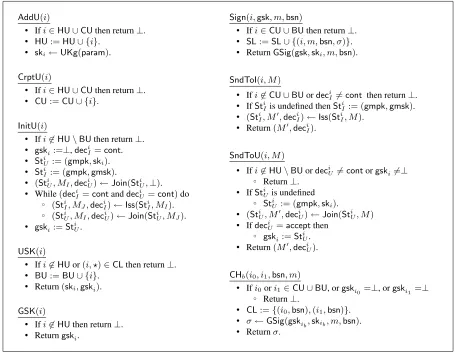
We briefly present the formal definitions of pre-DAA scheme security [6]. All oracles (and the underlying experiments) maintain the following global lists: a listHUof initially honest users, a listCUof corrupted users which are controlled by the adversary, a listBUof “bad” users which have been compromised (these are previously honest users which have since been corrupted), a listSLof queries to the signing oracle, and a listCLof queries to the challenge oracle. All the lists are assumed to be initially empty. The listsCLandSLare used to restrict the two relevant oracles so that one cannot trivially win the anonymity or non-frameability games, respectively.
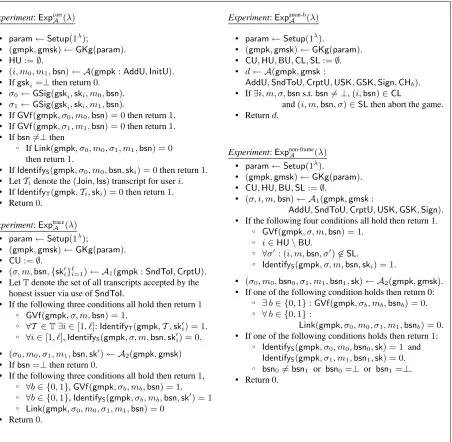
The oracles are given in Fig. 1 and the security games in Fig. 2.
Correctness of Linking. TheLinkalgorithm is supposed to indicate whether two signatures were produced by the same user on the same, non-empty basename. We require that ifLink(gmpk, m0, σ0, m1, σ1,bsn)outputs1then the following must hold:bsnis not empty and both signatures verify with respect tobsni.e.GVf(gmpk, σ0, m0,bsn) = 1
andGVf(gmpk, σ1, m1,bsn) = 1.
Uniquely Identifiable Transcripts. In some of the security games, a formal definition is required for the property that a signature was produced by a certain user. The anonymity game ensures that no one can exploit this property but it must be defined nonetheless.
The solution chosen for the security model in [6] is that each execution of the join/issue protocol and each signature is bound in a mathematical way to a user secret key, i.e. there is a function that takes a transcript or signature and a key and tells if this object was created with the given key. These functions are calledIdentifyTandIdentifySrespectively.
AddU(i)
• Ifi∈HU∪CUthen return⊥. • HU:=HU∪ {i}.
• ski←UKg(param).
CrptU(i)
• Ifi∈HU∪CUthen return⊥. • CU:=CU∪ {i}.
InitU(i)
• Ifi6∈HU\BUthen return⊥. • gsk
i:=⊥,dec i I=cont.
• Sti
U:= (gmpk,ski).
• Sti
I:= (gmpk,gmsk).
• (Sti
U, MI,dec i
U)←Join(St i U,⊥).
• While(deci
I=contanddeciU=cont)do
◦ (StiI, MJ,deci
I)←Iss(StiI, MI).
◦ (Sti
U, MI,dec i
U)←Join(St i U, MJ).
• gsk
i:=St i U. USK(i)
• Ifi6∈HUor(i, ?)∈CLthen return⊥. • BU:=BU∪ {i}.
• Return(ski,gsk
i). GSK(i)
• Ifi6∈HUthen return⊥. • Returngsk
i.
Sign(i,gsk, m,bsn)
• Ifi∈CU∪BUthen return⊥. • SL:=SL∪ {(i, m,bsn, σ)}. • ReturnGSig(gsk,ski, m,bsn).
SndToI(i, M)
• Ifi6∈CU∪BUordeci
I6=cont then return⊥.
• IfSti
Iis undefined thenStiI:= (gmpk,gmsk).
• (Sti
I, M
0
,deciI)←Iss(St i I, M).
• Return(M0,deci
I).
SndToU(i, M)
• Ifi6∈HU\BUordeci
U6=contorgski6=⊥
◦ Return⊥. • IfSti
Uis undefined
◦ Sti
U:= (gmpk,ski).
• (Sti
U, M
0
,deciU)←Join(St i U, M)
• Ifdeci
U=acceptthen
◦ gsk
i:=St i U.
• Return(M0,deci
U).
CHb(i0, i1,bsn, m)
• Ifi
0ori1∈CU∪BU, orgski0 =⊥, orgski1 =⊥
◦ Return⊥. • CL:={(i
0,bsn),(i1,bsn)}.
• σ←GSig(gsk
ib,skib, m,bsn).
• Returnσ.
Fig. 1.Oracles used in the security games for a pre-DAA scheme
Definition 7. LetGMSKandSKbe the spaces of all possible issuer and user secret keys, respectively. Also, letRI andRUbe the spaces of randomness used by the issuer and the user in theJoin/Issprotocol, respectively. A pre-DAA scheme hasuniquely identifying transcriptsif there exists a predicate
CheckT :{0,1}∗×GMSK×SK×RI×RU → {0,1}
such that the following holds:
• Suppose both parties are honest and run(Join,Iss)with inputsskandgmsk, and randomnessrU andrI, respec-tively. Then the resulting transcriptT satisfiesCheckT(T,gmsk,sk, rI, rU) = 1.
• For all (possibly dishonest) protocolsJoin0interacting withIssproducingT, if the issuer accepts then there is at most one valuesk ∈SK(but possibly many values ofrU) such that we haveCheckT(T,gmsk,sk, rI, rU) = 1. Heregmskis the issuer’s input andrI his random coins; as the user-side algorithm may be dishonest, we let it take arbitrary input.
Security Requirements. Security of pre-DAA consists of the following requirements whose formal security games are given in Fig. 2.
Experiment:ExpcorrA (λ) • param←Setup(1λ);
• (gmpk,gmsk)←GKg(param). • HU:=∅.
• (i, m0, m1,bsn)← A(gmpk:AddU,InitU). • Ifgsk
i=⊥then return0.
• σ
0←GSig(gski,ski, m0,bsn).
• σ1←GSig(gsk
i,ski, m1,bsn).
• IfGVf(gmpk, σ
0, m0,bsn) = 0then return1.
• IfGVf(gmpk, σ1, m1,bsn) = 0then return1. • Ifbsn6=⊥then
◦ IfLink(gmpk, σ0, m0, σ1, m1,bsn) = 0 then return1.
• IfIdentify
S(gmpk, σ0, m0,bsn,ski) = 0then return1.
• LetT
idenote the(Join,Iss)transcript for useri.
• IfIdentify
T(gmpk,Ti,ski) = 0then return1. • Return0.
Experiment:ExptraceA (λ) • param←Setup(1λ);
• (gmpk,gmsk)←GKg(param). • CU:=∅.
• (σ, m,bsn,{sk0
i}`i=1)← A1(gmpk:SndToI,CrptU).
• LetTdenote the set of all transcripts accepted by the honest issuer via use ofSndToI.
• If the following three conditions all hold then return1 ◦ GVf(gmpk, σ, m,bsn) = 1.
◦ ∀T ∈T∃i∈[1, `]:Identify
T(gmpk,T,sk0i) = 1.
◦ ∀i∈[1, `],Identify
S(gmpk, σ, m,bsn,sk0i) = 0.
• (σ
0, m0, σ1, m1,bsn,sk0)← A2(gmpk,gmsk)
• Ifbsn=⊥then return0.
• If the following three conditions all hold then return1, ◦ ∀b∈ {0,1},GVf(gmpk, σb, mb,bsn) = 1. ◦ ∀b∈ {0,1},Identify
S(gmpk, σb, mb,bsn,sk0) = 1 ◦ Link(gmpk, σ
0, m0, σ1, m1,bsn) = 0
• Return0.
Experiment:Expanon-A b(λ) • param←Setup(1λ).
• (gmpk,gmsk)←GKg(param). • CU,HU,BU,CL,SL:=∅. • d← A(gmpk,gmsk:
AddU,SndToU,CrptU,USK,GSK,Sign,CHb). • If∃i, m, σ,bsns.t.bsn6=⊥,(i,bsn)∈CL
and(i, m,bsn, σ)∈SLthen abort the game. • Returnd.
Experiment:Expnon-frameA (λ) • param←Setup(1λ).
• (gmpk,gmsk)←GKg(param). • CU,HU,BU,SL:=∅.
• (σ, i, m,bsn)← A1(gmpk,gmsk:
AddU,SndToU,CrptU,USK,GSK,Sign). • If the following four conditions all hold then return1.
◦ GVf(gmpk, σ, m,bsn) = 1. ◦ i∈HU\BU.
◦ ∀σ0: (i, m,bsn, σ0)6∈SL. ◦ Identify
S(gmpk, σ, m,bsn,ski) = 1. • (σ
0, m0,bsn0, σ1, m1,bsn1,sk)← A2(gmpk,gmsk).
• If one of the following condition holds then return 0: ◦ ∃b∈ {0,1}:GVf(gmpk, σb, mb,bsnb) = 0. ◦ ∀b∈ {0,1}:
Link(gmpk, σ0, m0, σ1, m1,bsnb) = 0.
• If one of the following conditions holds then return1: ◦ IdentifyS(gmpk, σ0, m0,bsn0,sk) = 1 and
IdentifyS(gmpk, σ1, m1,bsn1,sk) = 0.
◦ bsn06=bsn1 or bsn0=⊥ or bsn1=⊥. • Return0.
Fig. 2.Security experiment for correctness, anonymity, traceability and non-frameability
For any adversaryAand anyλ∈N, we defineAdvcorrA (λ) := Pr[Exp corr
A (λ) = 1]and say the scheme iscorrectif
AdvcorrA (λ) = 0for all adversariesA.
• Anonymity:An adversary, who may control the group issuer, cannot distinguish which of two users of his choice signed a message as long as he cannot trivially decide this using the linking property. This is formulated by the gameExpanonA (λ)in Fig. 2.
For an adversaryA,λ∈N, we defineAdvanonA (λ) :=Pr[Expanon-0A (λ) = 1]−Pr[Expanon-1A (λ) = 1]
and say the
scheme isanonymousifAdvanonA (λ)is negligible inλfor all probabilistic polynomial-time (PPT) adversariesA.
For an adversaryAandλ∈Nwe defineAdvtraceA (λ) := Pr[Exp trace
A (λ) = 1]and say the scheme istraceableif
AdvtraceA (λ)is negligible inλfor all PPT adversariesA.
• Non-frameability:No adversary, who may even control the group issuer, can frame an honest user by claiming that he signed a message if he never did. This game is again split into two subgames to deal with framing a user by creating a signature that traces to his key or one that links to a previous signature created by the user in question. For an adversary A andλ ∈ N we define AdvAnon-frame(λ) := Pr[Expnon-frameA (λ) = 1]and say the scheme is non-frameableifAdvnon-frameA (λ)is negligble inλfor all PPT adversariesA.
3
Efficient Signatures of Knowledge without Random Oracles
LetLbe anNP language, defined by a polynomial-time computable relationRasL={x| ∃w: (x, w)∈ R}. We callxastatement inL andwwith(x, w) ∈ R awitnessforx. Asignature of knowledge(SoK) forLconsists of the following three algorithms:SoKSetuptakes a security parameter 1λ and outputs parameterspar. If(x, w) ∈ R
thenSoKSign(par, R, x, w, m)outputs a signatureσon the messagemw.r.t. statementx. The signature is verified by SoKVerify(par, R, x, m, σ)which outputs0or1. Signatures produced bySoKSignon inputsparoutput bySoKSetup, and any(R, x, w, m)such that(x, w)∈Rshould be accepted bySoKVerify. The (game-based) security definition for SoK, calledSimExt security, was introduced in [20] and requires the following:
• Simulatability:There exists asimulatorwhich can simulate signatureswithouthaving a witness for the statement. The simulator consists of the algorithmsSoKSimSetupandSoKSimSign: the former outputs parameters together with a trapdoor trand the latter outputs signatures on input(par,tr, R, x, m). It is required that no adversary can distinguish the following two situations: (1) It is given paroutput bySoKSetup and access to aSoKSign oracle; or (2) it is given paroutput bySoKSimSetupand an oracleSoKSimthat on input(R, x, w, m)outputs SoKSimSign(par,tr, R, x, m)if(x, w)∈R.
• Extraction:There exists an algorithmSoKExtractsuch that if an adversary, givenpar←SoKSimSetupand an oracleSoKSimas above, outputs a tuple(R, x, m, σ), we have the following: ifSoKVerify(par, R, x, m, σ) = 1 and the adversary never queried(R, x, w0, m), for anyw0, to itsSoKSimoracle thenSoKExtractextracts a witness forxfromσwith overwhelming probability.
Chase and Lysyanskaya [20] offer a generic construction satisfying the above model, but it is inefficient due to the use of general Zero-Knowledge (ZK) proofs. The first efficient non-interactive ZK proofs without random oracles were introduced by Groth and Sahai [36]; however these proofs only apply to a restricted language. We will use their results to construct the first efficient signatures of knowledge in the standard model for the same language, namely satisfiability of sets of Pairing-Product Equations (PPE) (for which Groth-Sahai proofs areproofs of knowledge). Attempting to construct SoKs which satisfy SimExt security using GS proofs, we face the following dilemma: if we generate a regular Common Reference String (CRS) usingGSSetupthen this leads to sound proofs and we can use GSExtractto extract a valid witness from a correct proof. However, in order to simulate GS proofs, we need to set up the CRS viaGSSimSetup. As such proofs are information-theoretically independent of the witnesses, we cannot extract anymore.
In order to achieve simulatability and extractability at the same time, we revise the approach to simulatability using a well-known trick that has also been employed in the context of PPEs by Groth [35]. We include in the CRS a verification key for an appropriate signature scheme and then require the prover to prove the following modified statement: to know a witness for the original statementor to know a signature on the original statement and the message to be signed, under the key contained in the CRS.
Choosing the Signature Scheme. We need to prove knowledge of a valid signature using GS proofs. We thus require a scheme whose signatures consist of group elements and whose validity is verified by evaluating PPEs.
In order to not rely on any additional assumptions other than those already required by Groth-Sahai proofs, an optimal candidate would be Waters’ signatures [46], which are secure under the computational Diffie-Hellman (CDH) assumption. (Their main drawback is a long public key, which will result in long parameters for our SoK.) Since these signatures were defined oversymmetricbilinear groups (whereG1=G2), they would limit the language to statements
over such groups. Using the Groth-Sahai instantiation under thedecision-linear assumption[11], which implies CDH, we would thus get signatures of knowledge for the same statements and under the same assumption as Groth-Sahai proofs.
To allow for a more general class of statements, we use the following generalization of Waters signatures to asymmetric groups, used by [21, 7]:
Parameter Generation. Given a bilinear groupP, to sign messages of the formm = (m1, . . . , mN) ∈ {0,1}N, choose(Q, U0, . . . , UN)←GN1+2.
Key Generation. Choose a secret keysk←Zpand define the public verification key asvk:= [sk]P2.
Signing. To sign(m1, . . . , mN)using keysk, choose a randomr←Zpand output
W1:= [sk]Q+ [r](U0+PN
i=1[mi]Ui), W2:= [−r]P1, W3:= [−r]P2
.
Verification. Check whether e(W1, P2)e(U0+PN
i=1[mi]Ui, W3) =e(Q,vk) and e(W2, P2) =e(P1, W3).
This construction is unforgeable under chosen-message attack under the CDH+assumption. In order to sign arbitrary
messages, we assume a collision-resistant hash functionH:{0,1}∗→ {0,1}N (for a suitableN).
Disjunctions of Pairing-Product Equations. Groth [35] shows how to express disjunctions of sets of PPEs as a new set of PPEs. The idea is the following: introduce a “selector equation” of the forme(P1, S+T −P2) = 1, which can only be satisfied if eitherSorT are different from 0. Setting one of them to 0 will enable us to simulate one clause of the disjunction: for each variableXi, Groth introduces an auxiliary variableXi0 and adds the equation
e(Xi −Xi0, S) = 1, which is satisfied ifS = 0, meaning we can set Xi0 to 0 in order to simulate. On the other hand, when simulating the other clause by settingT = 0, we must haveS =P2to satisfy the selector equation, and furthermoreXi =Xi0. This guarantees soundness, as we need to have a satisfying witness for at least one clause.
We choose a more efficient approach inspired by that from [36]. In order to simulate equations of the form (1), it suffices to replace the constants G` by auxiliary variables G0`, as then, setting all variables to 0 is a satisfying assignment for (1). Now it only remains to ensure that a signer without the trapdoor is forced to setG0`toG`, which is done by adding equationse(G`−G0`, S) = 1, whereScan only be set to 0 when the prover knows a signature under the public key from the CRS.
With this intuition we now define our signature of knowledge of a satisfying witness of a set of pairing-product equations. Regarding the Chase-Lysyanskaya definition, we have fixed the relationRto be the set of all pairs (Ek)K
k=1,
((Xi)mi=1,(Yj)nj=1)
such that((Xi),(Yj))∈Gm1 ×Gn2 satisfiesEkfor all1≤k≤K.
3.1 A Concrete Construction of Signatures of Knowledge without Random Oracles
Setup. On inputP, run(crs,xk)←GSSetup(P)and choose parameters(Q, U0, . . . , UN)←GN1+2 and a key pair
for Waters signatures: chooset← Zpand setT := [t]P2.SoKSetupoutputspar:= (crs,(Q, U0, . . . , UN, T)), whereasSoKSimSetupadditionally outputs(xk, t)as an extraction/simulation trapdoor.
Signing. LetE:= (Ek)Kk=1be the set of equations representing the statement w.r.t. which we sign, whereEkis
n
Y
j=1
e(Ak,j, Yj) m
Y
i=1
e(Xi, Bk,i) m
Y
i=1
n
Y
j=1
e(Xi, Yj)γk,i,j = Mk Y
`=1
e(Gk,`, Hk,`) , (Ek)
(i) Modified equations. For all1≤k≤K
Qe(A
k,j, Yj)Qe(Xi, Bk,i)Qe(G0k,`, Hk,`)
Q Qe(X
i, Yj)γk,i,j = 1 .
(ii) Selector equations. For all1≤k≤K,1≤`≤Mk :e(Gk,`−G0k,`, T −T
0) = 1.
(iii) Signature-verification equations.
e(W1, P2)e(U0+P
N
i=1[hi]Ui, W3) =e(Q, T0) e(W2, P2) =e(P1, W3) .
To sign a message m ∈ {0,1}∗ under par := (crs,(Q, U0, . . . , U
N, T)) for the statement E using witness ((Xi),(Yj))proceed as follows:
• SetT0 =W1=W2=W3:= 0andG0
k,`:=Gk,`, for allkand`.
• Computeh= (h1, . . . , hN) :=H(Ekm)∈ {0,1}N, whereEis an encoding of the original equations. • The SoK is a GS proof (of knowledge)Σof satisfiability of the set of equationsE0, using as witness
(T0, W1, W2, W3, X1, . . . , Xm, Y1, . . . , Yn, G01,1, . . . , G0K,MK) . (2)
Verification. To verify a signature of knowledgeΣonmfor the statementEunderpar:= (crs,(Q, U0, . . . , UN, T)), verify that Σ is valid under crs on the statement E0 for the values Ak,j, Bk,i, Gk,`, Hk,` andγk,i,j from the description ofE, valuesTand(Q, U0, . . . , UN)fromparandhdefined asH(Ekm).
Theorem 1. The above is a signature-of-knowledge scheme satisfying SimExt security for the language of sets of (simulatable) pairing-product equations.
Proof sketch.To simulate a signature without knowing a witness, one uses the trapdoortto make a signature(W1, W2, W3)on(h1, . . . , hN) :=H(Ekm), and setsT0=T and all remaining witnesses componentsXi=Yj =G0k,` := 0, which is easily verified to satisfyE0. Simulatability then follows from witness indistinguishability of GS proofs.
For “Extraction”, consider an adversary that has never queried a signature for a pair(E, m), but outputs a SoKΣ
for it. By soundness of GS proofs, usingxkwe can extract fromΣa witness forE0 of the form (2). We must have
T0 6= T, as otherwise(W1, W2, W3)would be a forgery on(Ekm)(which was never queried to the simulator) by equations (iii) ofE0. Together with equations (ii) ofE0,T0 6=T implies thatG0
k,` =Gk,`for allk, `, and therefore, by (i),((Xi),(Yj))is a witness for the original equationE. We have thus extracted a witness for the statementE.
Note that to reduce the parameter size, but relying on stronger (“q-type”) assumptions, we could use any of the structure-preserving signatures defined by Abe et al. [1] instead of Waters signatures.
4
New Building Blocks
4.1 Partially Weak Blind Signatures
Bernhard et al. [6] introduce Randomizable Weakly Blind Signatures (RwBS) as one of the building blocks for DAA. These are similar to blind signatures [22, 39, 44] except that blindness has to hold only against adversaries that never get to see the message they signed, that is, a signature should not be linkable to its issuing session. Moreover, random-izability means that given a signature, anyone can produce a fresh signature on the same message.
Definition 8. A randomizable blind signature schemeBS(with a two-move signature request phase) consists of six probabilistic polynomial-time algorithms
BS:= (BSSetup,BSKeyGen,BSRequest,BSIssue,BSVerify,BSRandomize) .
The syntax of these algorithms is defined as follows; all algorithms (barBSSetup) are assumed to take as implicit input a parameter setparamBSas output byBSSetup.
• BSSetup(1λ)takes as input a security parameterλand outputs a parameter setparam
BS, assumed to contain a
BSKeyGen(paramBS)
• GR, FU←G×
2, a, b←Z
×
p.
• Fori= 1, . . . , k:
ci, di←Z×p, Gi:= [ci]GR, Fi:= [di]FU.
• cZ, dZ←Z×
p, GZ:= [cZ]GR, FZ:= [dZ]FU.
• Pick(A
0, A1,A˜0,A˜1)randomly such thate(A0,A˜0)e(A1,A˜1) =e([a]P1, GR).
• Pick(B0, B1,B˜0,B˜1)randomly such thate(B0,B˜0)e(B1,B˜1) =e([b]P1, FU). • sk:= (a, b, cz, dz,(ci, di)k
i=1).
• pk:= (GZ, FZ, GR, FU,(Gi, Fi)k
i=1, A0, A1,A˜0,A˜1, B0, B1,B˜0,B˜1).
• Return(sk,pk).
BSSign(M= (Mi)k
i=1∈Gk1)
• z, r, t, u, w←Z×
p.
• Z:= [z]P
1, R:= [r−czz]P1Pki:=1[−ci]Mi, S:= [t]GR, T := [(a−r)/t]P1,
U := [u−dzz]P1Pki:=1[−di]Mi, V := [w]FU, W:= [(b−u)/w]P1.
• σ:= (Z, R, S, T, U, V, W). • Returnσ.
BSVerify(pk, σ,M)
• Parseσas(Z, R, S, T, U, V, W),Mas(Mi)k
i=1.
• Parsepkas(GZ, FZ, GR, FU,(Gi, Fi)k
i=1, A0, A1,A˜0,A˜1, B0, B1,B˜0,B˜1).
• Return 1 if the following equations hold or 0 otherwise: ◦ e(Z, GZ)e(R, GR)e(T, S)Q
ie(Mi, Gi) =e(A0,A˜0)e(A1,A˜1)
◦ e(Z, FZ)e(U, FU)e(W, V)Q
ie(Mi, Fi) =e(B0,B˜0)e(B1,B˜1)
Fig. 3.The structure-preserving AHO signature from [1].
• BSKeyGen(param
BS)takes as input the system parameters and outputs a pair(pkBS,skBS)of public/secret keys
for the signer.
• (BSRequest0,BSIssue1,BSRequest1)is an interactive protocol run between a user and a signer. The user goes first by callingBSRequest0(m,pkBS)to obtain a valueρ0and some state informationSt0R(which is assumed to containm). Then the signer and user execute, respectively,
(β1,St1I)←BSIssue
1
(ρ0,skBS) and (σ,St1R)←BSRequest
1
(β1,St0R) ,
whereσis a signature on the original messagem(or the abort symbol⊥). We write
σ← BSRequest(m,pkBS)⇐⇒BSIssue(skBS)
for the output of correctly running this interactive protocol on the given inputs. • BSVerify(m, σ,pk
BS)is the public signature verification algorithm, which outputs1ifσis a valid signature onm
and0otherwise.
• BSRandomize(σ)is given a signatureσon an unknown messagemand produces another valid signatureσ0 on the same message.
The blind signature scheme iscorrectif signatures verify when both parties behave honestly, i.e. for all parameter sets output byBSSetupwe have
Pr [ (pkBS,skBS)←BSKeyGen(paramBS), m← M,
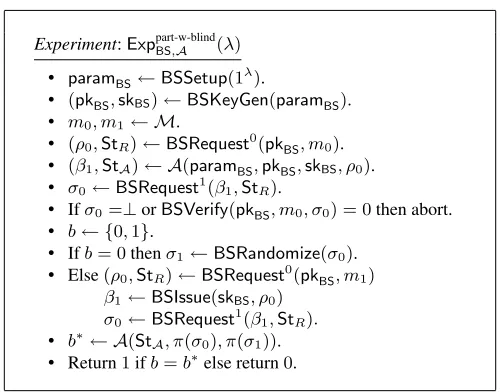
Experiment:Exppart-w-blindBS,A (λ)
• param
BS←BSSetup(1
λ ). • (pk
BS,skBS)←BSKeyGen(paramBS). • m0, m1← M.
• (ρ
0,StR)←BSRequest0(pkBS, m0).
• (β
1,StA)← A(paramBS,pkBS,skBS, ρ0).
• σ
0←BSRequest1(β1,StR).
• Ifσ
0=⊥orBSVerify(pkBS, m0, σ0) = 0then abort.
• b← {0,1}. • Ifb= 0thenσ
1←BSRandomize(σ0).
• Else(ρ0,StR)←BSRequest0(pk BS, m1) β1←BSIssue(skBS, ρ0)
σ0←BSRequest1(β1,StR).
• b∗← A(StA, π(σ
0), π(σ1)).
• Return1ifb=b∗else return0.
Fig. 4.The partial weak blindness game.
In addition, randomizing a signature should result in a valid signature, i.e. for all parameter sets output bySetupBS and key pairs(pkBS,skBS)output byBSKeyGenwe have for allmandσ
BSVerify(m, σ,pkBS) = 1 =⇒ BSVerify(m,BSRandomize(σ),pkBS) = 1 .
For our first construction of DAA we need a standard-model signature which is secure under non-interactive assumptions. In addition, to work with our signatures of knowledge, it is required to bestructure-preserving: the signatures and the messages it signs must be group elements and the verification equations must be pairing-product equations.
We use a signature scheme by Abe et al. [1] signing vectors of group elements, which we call AHO after its authors, presented in Fig. 3. (We have transposedG1andG2, since our messages are inG1rather than inG2as in [1].)
Its security relies on theq-SFP assumption (see Sect. 2.1). Abe et al. show that the six elements(R, S, T, U, V, W)of an AHO signature can be randomized. (We are not aware of a fully randomizable structure-preserving scheme based on non-interactive assumptions.)
This randomizability is useful, since we show that if the signer is given parts of a (partial) randomization of a signature he issued earlier then this does not reveal anything about the message. This means that, when used as a certificate for DAA, we only need to hide part of the certificate in a DAA signature to guarantee anonymity. We therefore relax the notion of weak blindness from [6] topartial weak blindnessdefined w.r.t. a projection functionπ. In the security game the signer gets the projection of a (partial) randomization of a signature and should not be able to tell whether it is from a signature he issued or a signature on a random message.
Definition 9 (Partial Weak Blindness).A blind signature scheme consisting of(BSSetup,BSKeyGen,hBSRequest,
BSIssuei,BSRandomize,BSVerify)has (perfect) partial weak blindnesswith respect to a projection function π if no efficient (unbounded) adversary can win the gameExppart-w-blindBS,A in Fig. 4 with advantage non-negligibly greater than1/2.
We show that for an appropriate projection function the AHO signature is actually a partially weak blind signature, whereBSRequestsimply sends the message in the clear andBSIssueis defined asSign.
Lemma 1. The AHO signature scheme as a blind-signature scheme has partial weak blindness under the projection functionπ(Z, R, S, T, U, V, W) = (S, T, V, W).
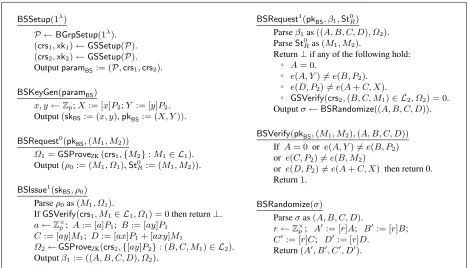
BSSetup(1λ)
P ←BGrpSetup(1λ).
(crs1,xk1)←GSSetup(P).
(crs2,xk2)←GSSetup(P).
OutputparamBS:= (P,crs1,crs2).
BSKeyGen(paramBS)
x, y←Zp;X := [x]P2;Y := [y]P2.
Output(skBS:= (x, y),pkBS:= (X, Y)).
BSRequest0(pk
BS,(M1, M2))
Ω1=GSProveZK(crs1,{M2}:M1∈ L1).
Output(ρ0:= (M1, Ω1),St0R:= (M1, M2)).
BSIssue1(skBS, ρ0)
Parseρ0as(M1, Ω1).
IfGSVerify(crs1, M1∈ L1, Ω1) = 0then return⊥. a←Z×p; A:= [a]P1; B:= [ay]P1
C:= [ay]M1; D:= [ax]P1+ [axy]M1
Ω2←GSProveZK(crs2,{[ay]P2}: (B, C, M1)∈ L2).
Outputβ1:= ((A, B, C, D), Ω2).
BSRequest1(pk
BS, β1,St0R)
Parseβ1as((A, B, C, D), Ω2).
ParseSt0Ras(M1, M2).
Return⊥if any of the following hold: ◦ A= 0.
◦ e(A, Y)6=e(B, P
2).
◦ e(D, P
2)6=e(A+C, X).
◦ GSVerify(crs2,(B, C, M1)∈ L2, Ω2) = 0. Outputσ←BSRandomize((A, B, C, D)).
BSVerify(pkBS,(M1, M2),(A, B, C, D))
If A= 0 or e(A, Y)6=e(B, P2)
or e(C, P2)6=e(B, M2)
or e(D, P2)6=e(A+C, X) then return 0.
Return1.
BSRandomize(σ)
Parseσas(A, B, C, D).
r←Z×p; A
0
:= [r]A; B0:= [r]B;
C0:= [r]C; D0:= [r]D. Return(A0, B0, C0, D0).
Fig. 5.A RwBS construction from the NCL signature scheme
the original signature and gets(S, T, V, W)of a randomization thereof. Since for every tuple(Z, S, T, V, W)and for every message vectorM there exist exactly one pair(R, U)that satisfies the verification equations, the message is information-theoretically hidden from the adversary.
In our DAA construction we can thus give the part (S, T, V, W)of a (randomized) certificate in the clear (and prove knowledge of the remaining components) and still satisfy anonymity.
4.2 A Fully Randomizable Weakly Blind Signature Scheme for Group Elements
In order to provide a more efficient DAA scheme, we give a fully randomizable weakly blind signature satisfying the original definition of [6]. Ghadafi [32] presents a signature scheme called NCL, which is effectively a structure-preserving variant of CL-signatures [18], based on a variant of the LRSW assumption [42], given in Sect. 2.1.
Messages of the scheme are pairs of the form([m]P1,[m]P2)∈G1×G2(cf. Footnote 1, on p. 3). The secret and
verification keys are of the form(x, y)∈Z2pand([x]P2,[y]P2), respectively, and a signature on a message(M1, M2) is a 4-tuple
A:= [a]P1, B:= [y]A, C := [ay]M1, D:= [x](A+C)
for a random a ← Z×p. The verification equations are A 6= 0, e(B, P2) = e(A, Y), e(C, P2) = e(B, M2), e(D, P2) =e(A, X)e(C, X) ande(M1, P2) =e(P1, M2).
A signature is fully randomizable by choosinga0 ← Z×p and settingA0 := [a0]A,B0 := [a0]B,C0 := [a0]C,
D0 := [a0]D. Moreover, observe that to compute a signature on a message(M1, M2), onlyM1is required, whereas verification of the signature could be done usingM2only. A first idea, which turns out to work, to construct a weakly blind signature from NCL, would be to defineBSRequestas only sendingM1.
signing oracle. InBSRequestthe user makes thus a NIZK of knowledge ofM2corresponding toM1. The NIZKs use different CRSs (as we use different properties in the reductions) and can be efficiently implemented using Groth-Sahai proofs. We show that the resulting blind-signature scheme satisfies weak blindness under DDH inG1.
The construction is provided in Fig. 5 using the following languages:
L1 :
˘
(M1, M2) : e(P1, M2) =e(M1, P2)
¯
L2 :
˘
((B, C, M1), B2) : e(P1, B2) =e(B, P2) ∧ e(M1, B2) =e(C, P2)
¯
Theorem 2. Under the SXDH and the DH-LRSW assumption the scheme in Fig. 5 is an unforgeable weakly blind signature scheme as defined in [6], with message spaceM:={([m]P1,[m]P2)|m∈Zp}.
Proof. The following two lemmas prove Theorem 2.
Lemma 2. If the DH-LRSW assumption holds, theGS proof system used inRequest0BS is sound and theGSproof system used inIssue1BSis zero-knowledge then the above scheme is unforgeable (as defined in [6]). More formally, if Ais an adversary against the unforgeability of the scheme, then there exist adversariesB1,B2 andB3 against the
DH-LRSW assumption, the soundness of theGSproof system used inRequest0BSand the zero-knowledge property of
theGSproof system used inIssue1BS, respectively such that
AdvBSforge,A(λ)≤AdvBDH1-LRSW(λ) +AdvSoundnessGS,B2 (λ) +AdvZKGS,B3(λ) +AdvSXDHB4 (λ) .
Proof. The GS CRS crs1 is instantiated in the binding setting yielding perfectly sound proofs, whereas the CRS
crs2 is instantiated in the hiding setting yielding perfectly witness-indistinguishable/zero-knowledge proofs. By the
perfect soundness ofGSproofs in the binding setting we have thatAdvSoundnessGS,B2 (λ) = 0. Also, by the perfect
zero-knowledge ofGSproofs in the hiding setting we have thatAdvZKGS,B
3(λ) = 0. Also, note that by the hardness of the
SXDH assumption, the adversary has a negligible advantage in telling apart a binding CRS from a hiding one and therefore this only negligibly changesB3’s success probability. The details of the reduction to the security of the
SXDH assumption is given in [37] and hence we skip it.
Now we turn to show how adversary Acan be used to construct an adversaryB1 which breaks the DH-LRSW
assumption. Let(X, Y)beB1’s input which it passes toAas the public key of the scheme. The CRScrs1is chosen
to be a binding CRS whilecrs2is chosen to be a hiding CRS. AlgorithmAproceeds to make a series of oracle calls
to the blind signature issuer. To obtain a valid tuple (A, B, C, D)for a challenge(M1, Ω1), algorithmB1 extracts
the witness M2 from theGSproof Ω1 and then it forwards (M1, M2)to its DH-LRSW oracle to obtain the tuple
(A, B, C, D). AlgorithmB1also uses the CRScrs2to produce a simulated proofΩ2. By the perfect zero-knowledge
property ofGSproofs we have that real proofs are indistinguishable from simulated proofs. AlgorithmB1now returns
(A, B, C, D, Ω2)toA.
Eventually,Awill terminate with a tuple
(((M1,1, M1,2), σ1), . . . ,((Mk+1,1, Mk+1,2), σk+1))
for the forgery game. IfAis successful in winning its game then all entries verify, and thereforeΩ2,ifori= 1, . . . , k+ 1are all correct DH-LRSW-tuples for the entries(Mi,1, Mi,2). The oracle was called at mostktimes (orAwould not
have won) yet there arek+ 1distinct messages with valid signatures inA’s output. By looking at the oracle log, we can identify a validNCLsignature that was never queried to the DH-LRSW oracle and output it. ThereforeB1breaks
the DH-LRSW assumption with the same advantage asAhas of creating a forgery. ut
Lemma 3. If the DDH assumption holds in groupG1, theGSproof system used inRequest0BSis zero-knowledge and
theGS proof system used inIssue1BSis sound then the above scheme satisfies the weak blindness property (defined in [6]). More formally, if Ais an adversary against the weak blindness property of the scheme, then there exist adversariesB1,B2 andB3against the DDH assumption in groupG1, the zero-knowledge property of theGSproof
system used inRequest0BSand the soundness of theGSproof system used inIssue
1
BS, respectively such that
Proof. In the game, we choosecrs1as a hiding CRS while the CRScrs2is chosen to be binding. By the perfect
zero-knowledge property ofGSproofs in the hiding setting we have thatAdvZKGS,B2(λ) = 0. Also, by the perfect soundness
ofGSproofs in the binding setting we have thatAdvSoundnessGS,B3 (λ) = 0.
Also, by the hardness of the SXDH assumption, the adversary has a negligible advantage in telling apart a binding CRS from a hiding one and therefore this only negligibly changesB2’s success probability. Again, the details of the
reduction to the security of the SXDH assumption is given in [37] and hence we skip it.
We now turn to show how adversaryAagainst the weak blindness property, whose aim is to distinguish a reran-domisation of a signature he has seen earlier from a fresh signature on a new message, can be used to construct an adversaryB1 that breaks the DDH assumption in groupG1. Let(R = [α]P1, S = [β]P1, T = [γ]P1)be the input
to adversaryB1, where(α, β)are independent uniform random elements ofZp, and eitherγ =αβ, orγ is also an independent uniform random element ofZp. The goal of algorithmB1is to determine which of the two possibilities
has been given to it.
Algorithm B1 picks a secret key skBSfor the blind signature scheme by selecting x, y ← Zp and passes it to algorithmA. Then algorithmB1requests a blind signature on the message(M1, M2) = ([α]P1,[α]P2), by passing
the elementRalong with a simulated proofΩ1(since it does not know the component[α]P2) toAas the message
ρ0in the Request phase. AlgorithmAwill then respond with a tuple((A, B, C, D), Ω2). By checking the proofΩ2
algorithmB1is guaranteed that the value(A, B, C, D)returned is a valid signature on(M1, M2).
To produce the challenge forA, algorithmB1now forms the challenge
(A∗, B∗, C∗, D∗) := (S,[y]S,[y]T,[x]S+ [xy]T)
and passes back toAthe pair of tuples(A, B, C, D)and(A∗, B∗, C∗, D∗). Since(A, B, C, D)is a valid signature
on(M1, M2), we claim that ifT = [αβ]P1, the challenge will be identically distributed to the weak blindness game
whereb= 0; whilst ifT = [γ]P1, the challenge will be identically distributed to the weak blindness game withb= 1.
In other words, AlgorithmB1 will solve DDH with essentially the same advantage as that of Aagainst the weak
blindness game. This is done as follows:
• If γ = αβ: In the weak blindness game, A first sees[m]P1 for some uniformly random message m. In our game, he sees[α]P1whereαis uniformly random, hence the distribution is identical. Since we have a proof that (A, B, C, D)are computed correctly, there is some valuea∈Z∗psuch thatA= [a]P1,B= [ay]P1,C= [ayα]P1 andD= [ax(1 +yα)]P1.
A re-randomization of(A, B, C, D)has the form([r]A,[r]B,[r]C,[r]D)for somer ← Zp, whereas the tuple we sent was of the form ([β]P1,[yβ]P1,[yαβ]P1,[xβ+xyαβ]P1). We substitute r = β/a in and note that becauseβis independent of everything else and uniformly random,ris also uniform inZp. Thus, the challenge is also a correct NCL signature on the message([α]P1,[α]P2). This exactly corresponds to caseb = 0of the weak-blindness game.
• Ifγis random: Here we argue identically up to the point where we send our tuple. This will be([β]P1,[yβ]P1, [yγ]P1,[xβ+xyγ]P1)and we substituteδ =γ/β getting([β]P1,[yβ]P1,[βyδ]P1],[βx(1 +yδ)]P1). Because γ is independent and uniformly distributed, δis also uniformly distributed. Therefore, we have a correct NCL signature on the message([δ]P1,[δ]P2)which corresponds to caseb= 1.
4.3 Linkable Indistinguishable Tags
The second building block introduced to construct DAA schemes generically in [6] is aLinkable Indistinguishable Tag (LIT). These tags are similar to Message Authentication Codes (MACs); however, they have additional and stronger security requirements. LIT schemes are defined w.r.t. a one-way functionPK()such that a tag created with a secret keyskcan be verified givenPK(sk)rather thansk. Thus,PK(sk)can be thought of as a public key for the tag. A LIT scheme is defined by the following algorithms. We have made one small change to the definition of [6] in that we allow the key generation algorithm to depend on global parameters, such as a bilinear group, and we generate these parameters with a new algorithmGlobalSetup. The LITs presented in the cited paper actually also depend on such parameters.
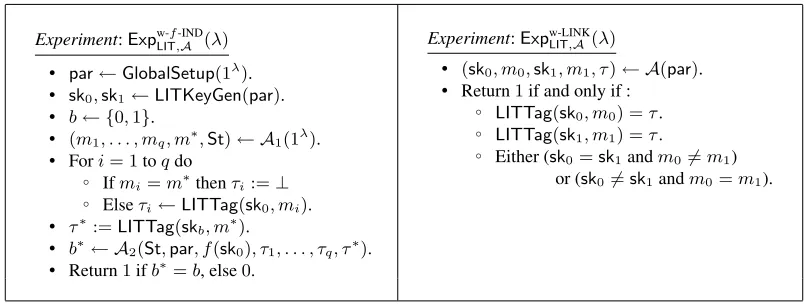
Experiment:Expw-LITf,-INDA (λ)
• par←GlobalSetup(1λ). • sk
0,sk1←LITKeyGen(par).
• b← {0,1}. • (m
1, . . . , mq, m∗,St)← A1(1λ).
• Fori= 1toqdo
◦ Ifmi=m∗thenτi:=⊥ ◦ Elseτi←LITTag(sk
0, mi).
• τ∗:=LITTag(skb, m∗). • b∗← A
2(St,par, f(sk0), τ1, . . . , τq, τ∗).
• Return1ifb∗=b, else0.
Experiment:Expw-LINKLIT,A(λ)
• (sk0, m0,sk1, m1, τ)← A(par). • Return1if and only if :
◦ LITTag(sk
0, m0) =τ.
◦ LITTag(sk1, m1) =τ. ◦ Either (sk
0=sk1andm06=m1)
or (sk06=sk1andm0=m1).
Fig. 6.Security games for indistinguishability (left) and linkability (right) of LIT.
• LITKeyGen(par)takes global parameterspar(such as a bilinear group) and outputs a secret keysk. (From now on we implicitly assumepar.)
• LITTag(sk, m)is deterministic, takes as input a secret keyskand messagem, and outputs a tagτ.
• LITVerify(PK(sk), m, τ)is given the image ofskunderPK, a messagemand a tagτand checks whetherτis a valid tag on the messagemw.r.t.sk, outputting 1 or 0.
Security. Besides correctness, [6] define the notions linkability and indistinguishability, of which we will only require relaxations. A LIT is weakly linkableif the following holds: if two tags are identical then they are either w.r.t. the same key and the same message, or both keysandboth messages are different. In particular, two tags under different keys on the same message (or under the same key on different messages) must be different. Weak linkability was used implicitly in [6]. We formalize it by experimentExpw-LINKLIT,A (λ)in Fig. 6 and say a LIT scheme isweakly linkableif the advantageAdvw-LINKLIT,A (λ) := Pr[ExpLITw-LINK,A (λ) = 1]is a negligible function ofλfor any PPT adversaryA.
For a LITf-indistinguishabilityis defined w.r.t. a one-way functionfand states that no adversary, having access to aLITTag(sk,·)oracle, can distinguish a tag on a message of his choice (for which he did not query the oracle) from a tag produced under a different random key. This should hold even if the adversary is given the imagef(sk)of the secret key in question. We weaken this property by requiring that the adversary submit all the oracle queries and announce the message to be challenged onbeforeseeing the parameters and the one-way image. This is formalized by Expw-LITf,-INDA (λ)in Fig. 6 and a LIT scheme isweaklyf-indistinguishableifAdvw-LITf,-INDA (λ) :=2·Pr[Exp
w-f-IND
LIT,A (λ) = 1]
−1is negligible inλfor any polynomial-time adversaryA.
Small message spaces. If the size of the message space is polynomial in the security parameter then f -indistin-guishability defined by [6] is implied by its weak version: assuming an adversary A breaking the standard no-tion, we construct an adversaryB breaking the weak notion as follows: Let{m1, . . . , m`} be the message space, with ` = poly(λ). Then B randomly picks i ← {1, . . . , `} and outputs its queries and the challenge as (m1, . . . , mi−1, mi+1, . . . , m`, m∗ :=mi). With non-negligible probabilityAwill ask to be challenged onmi, in which caseBcan simulate allTagqueries and useAto break weakf-indistinguishability.
LITKeyGen(P)
Returnsk←Zp.
LITTag(sk, m)
Ifm=−skthen return⊥. Returnτ:= [sk+1m]P1.
LITVerify(PK(sk), m, τ)
Ife(τ,PK(sk) + [m]P2) =e(P1, P2)
then return 1, else return 0.
Fig. 7.TheWBB-based Linkable Indistinguishable Tag (WBB-LIT).
using the ideas discussed in the note on small message spaces above. We define our LIT as the VRF from [2] and use the first part of their proof of pseudorandomness of VRFs to prove weakf-indistinguishability w.r.t.f(sk) := [sk]P1.
Theorem 3. The WBB-LIT in Fig. 7 is a LIT forPK(sk) := [sk]P2. It is weakly linkable and satisfies weak f -indistinguishability forf(sk) := [sk]P1if the DDHI assumption holds in groupG1.
Since it is impossible to haveτ=LITTag(sk0, m0) =LITTag(sk1, m1)with (sk0=sk1andm06=m1) or (sk06=sk1
andm0 = m1), weak linkability holds unconditionally. Weak f-indistinguishability is proved analogously to the pseudorandomness property of the VRF under theq-DDHI assumption (see [29, Theorem 2]).
LIT vs. VRF. To construct a LIT which is not only weakly indistinguishableand which supports large domains, a natural approach would be to consider large-domain VRFs. There have been several such schemes in the recent literature including the cascade construction of Boneh et al. [12] to increase the domain of the Dodis-Yampolskiy VRF [29], the BCKL construction [2] applied to the Dodis-Yampolskiy VRF [29] and the Hohenberger-Waters VRF [38].
Unfortunately, all of the abovementioned schemes violate the weak linkability requirement for LITs, as it is easy to find for example sk0 6= sk1 andmsuch that LITTag(sk0, m) = LITTag(sk1, m). While in the random-oracle
model pseudorandomness is trivial to achieve, resulting in a simple ROM-LIT construction in [6], it is not clear how to construct fully indistinguishable LITs for large basename spaces without resorting to interactive assumptions (see Sect. 7). VRFs are already hard to construct, but due to its strong security requirements (an adversary must be unable to find tag collisions even if he can choose both the keys and the messages) LITs seem even harder.
5
A Generic Construction of pre-DAA in the Standard Model
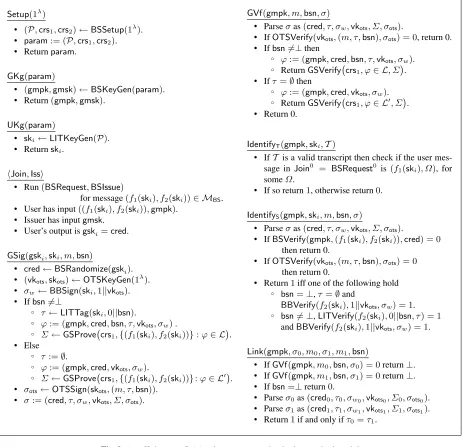
Our first construction of pre-DAA uses AHO signatures (Sect. 4.1) as partially weakly blind signatures, the VRF from [2] as LIT given in Fig. 7 (which has the form of weak Boneh-Boyen signatures [9]) and Waters signatures [46] implicitly for the signatures of knowledge, which are themselves Groth-Sahai proofs [36]. The setup algorithm outputs a bilinear group and parameters for the SoK (consisting of a CRS for GS proofs and parameters and a verification key for Waters signatures).
To generate a group key pair, the issuer creates an AHO signature key pair(gmsk,gmpk). To join a group, a user creates a LIT keyskand runs the AHO signature request algorithm from the last section on the messageF1:= [sk]P1; the issuer replies using the AHO signing algorithm to produce a credentialcredonF1.
To make a DAA signature on a messagemunder a basenamebsn, a user first (partially) rerandomizes his AHO signaturecredand then splits it into a public partcredP and a partcredHwhich he will include in the witness for the SoK. Next, he creates a LIT tagτ :=LITTag(sk,bsn)using his key on the basename. He then computes a signature of knowledgeΣon the messagebsnkmproving knowledge of (a function of) a LIT keyskand the hidden part of an AHO signaturecredHsuch that the tag and the AHO signature both verify with respect to this key. The DAA signature isσ:= (credP, τ, Σ).
We formalize the above. The language of the SoK needs to be a pairing-product equation as in (1) with wit-nesses inG1 andG2. Rather than proving knowledge ofsk, the witness will be F1 := [sk]P1 andF2 := [sk]P2.
![Fig. 3. The structure-preserving AHO signature from [1].](https://thumb-us.123doks.com/thumbv2/123dok_us/7887091.1308661/11.612.129.476.74.392/fig-structure-preserving-aho-signature.webp)