_____________________________________________________________________________________________________
*Corresponding author: E-mail: [email protected];
www.sciencedomain.org
Technological Tools for Observational Evaluation -
the Experience with the Software for Functional
Evaluation Scale for Duchenne Muscular Dystrophy
– A Pilot Study Software for Observational
Evaluation
Priscila Santos Albuquerque
1*, Fatima Aparecida Caromano
1,
Mariana Callil Voos
1,
Francis Meire Favero
2and Thiago Saikali Farcic
11
Physiotherapy and Behavior Laboratory, Medical School, University of São Paulo, São Paulo (SP), Brazil.
2
Paulista University, São Paulo (SP), Brazil.
Authors’ contributions
All authors of this work contributed to the study. Authors PSA, FAC and TSF developed the software based on the functional assessment scale for people with Duchenne muscular dystrophy and later, along with authors MCV and FMF wrote the article, translated and provided the revisions. All authors read and approved the final manuscript.
Article Information
DOI: 10.9734/BJMMR/2016/27482
Editor(s):
(1) Valeria Denninghoff, Molecular Pathology and Molecular Onco-Hemathology laboratory, University Institute CEMIC, Argentina. (2)Chan Shen, Department of Biostatistics, MD Anderson Cancer Center, University of Texas, USA.
Reviewers:
(1) Maricela Rodriguez, Instituto Mexicano Del Seguro Social, Mexico. (2)Qing Ke, Zhejiang University, Hangzhou, China. (3)Pradnya Dhargave, National Institute of Mental Health and Neuro Sciences, Bangalore, India. (4)Luz Berenice López Hernandez, Institute for Social Security of State Workers, Mexico City, Mexico. Complete Peer review History:http://sciencedomain.org/review-history/15411
Received 3rd June 2016 Accepted 7th July 2016 Published 16th July 2016
ABSTRACT
Systematic observation is an indispensable tool in clinical neurology evaluation, but data organization and record are extensive and time-consuming, requiring method and training. Reliable scales facilitate this task and technology can be decisive in the implementation of observational data routines. In this study, we aimed to show the experience of a software development to
optimize the application of a clinical observational scale. For this proposal it was necessary to consider the needs of the target population, text and image storing and reports generation, using computers with basic configuration, questionnaires and the measurement of time. The software allowed significant reduction in evaluation time and favored the cost-benefit of the task. The proposed methodology was adequate for this type of study.
Keywords: Software; FES-DMD; muscular dystrophy duchenne; disability evaluation; health technology assessment.
1. INTRODUCTION
The systematic observation and analysis of functional activities is part of clinical routine, especially in neurology. Registering observations, with detailed and accurate method requires lot of time. Besides, the amount of information on a single report makes the comparison between assessments confusing and doubtful [1].
With this reality in mind and experiencing difficulties with data collection from patients with Duchenne muscular dystrophy (DMD), using evaluation sheets of FES-DMD (Functional Evaluation Scale for Muscular Duchenne Dystrophy) we realized that the operationalization of this task was required [2-5].
Especially for DMD, the increasing number of therapeutic approaches imposed the need for validated outcome measures in clinical trials to assess motor function [1-3]. The knowledge about the functional activity of the patient is critical in determining the success of clinical decision making, treatment planning, intervention and evaluation of results [6].
Several functional tests have been developed in recent decades, but only a few has been demonstrated as reliable and responsive [7]. Functional assessment scales are necessary to describe the capabilities of the patient [7,8,9]. The Functional Evaluation Scale for Duchenne Muscular Dytrophy (FES-DMD) provides the description and quantification of compensatory movements. The functional activities are divided in phases to provide more detailed description [10].
The scale assesses seven functional activities. Some of them were previously used in the development of Vignos & Archibald scale. The functional activities are sitting and standing from the chair, sitting and standing from the ground, going up and down stairs and walking for 10
meters. Registering timed performance is also proposed by the scale. The scale showed good reliability in all domains [1,10].
The analysis of FES-DMD responsiveness indicated that a period of 6 months was ideal for reassessment [7,10]. The scale has forms to be filled during systematic observation and recording of activities and requires the sum of scores obained in each phase and sub-phase of the four domains (seven activities). The sum of the score of domains provides the final score. As others scales, FES-DMD is time demanding [2,3,4,5].
Therefore, a software was developed to facilitate the scale application and to generate reports with scores and timed performance of each activity automatically. Softwares must be easy to use and enable self-learning, which is known as usability. Usability is evaluated by research methods that evaluate how much it is understood (learned by deductions) and useful for clinical practice [11].
Usability refers to how quickly users can learn how to use something, to their efficiency when using and memorizing its characteristics, their level of proneness to error and enjoyment. The assessment of technical problems can be part of the software construction, when the authors depend on expert analysis [12-15].
Based on studies about usability in real environments and in the medical field, valuation methods of an instrument are organized. Task analysis, interviews or questionnaires about the manual understanding, its use and analysis of resolution routine problems are part of usability testing [16-20].
1.1 Objective
2. METHODS AND RESULTS
This study is divided into two parts, the development of software and the analysis of its usability, according to medical and computer science methods. As the previous step affected the later, the results are presented as the method progresses.
2.1 Software and Manual Development
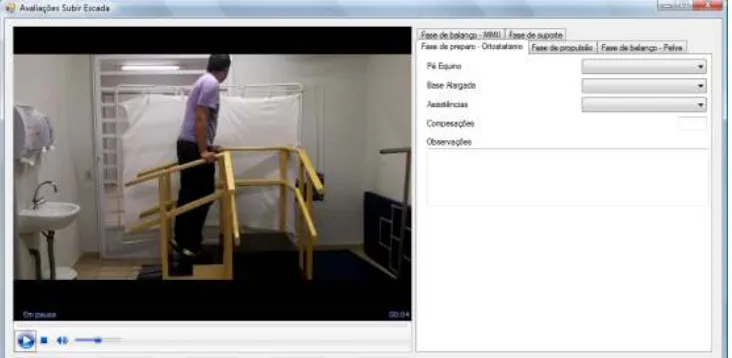
The use of the FES-DMD implies to record the patient performing functional activities for systematic observation and filling forms. Therefore, the software should allow simultaneous viewing of the film and one of the forms, on the same screen. The forms to be filled via software were maintained exactly as the original versions. To make it even easier, we chose the manual control of the film so the evaluator could pause and restart the video whenever necessary (Fig. 1).
We developed a digital instrument compatible with the basic technology of computers, to provide accessing. The software was built with the following technical specifications: Visual Basic language. Net, database SQL Server Compact, Platform Windows XP sp3 or higher, supporting hardware, screen with a resolution of 1024x768 pixels and WMV / MP4 video format.
The report generated by the software allows the examiner to modify the number of functional activities. It includes the number of observed compensatory movements, the sum of the scores of phases and subphases, the score on each
domain and the total score (sum of the four domains) of FES-DMD.
The software was set for unlimited users and patients. We were worried about data security; therefore, we chose to include user access passwords and system administrator. Finally, the manual was developed. The software was named FES-DMD-DATA.
2.2 Preparation of Hypothetical Cases for Software Testing
As proposed by the method of evaluation of medical technological tools, two simulated clinical cases were filmed to assess the usability of the software by the referees and specialized physiotherapists.
In order to avoid exposure of people with DMD, a physiotherapist with 10 years experience in functional assessment of patients with neuromuscular diseases performed the tasks, simulating adolescent walkers in two films. This practice was based on the Objective Structured Clinical Examination - OSCE and the Accreditation Council of Graduate Medical Education and the American Board of Medical Specialties [21].
2.3 Submission to Referees and Usability Testing with Target Population
According to the software usability measurement inventory [14] five referees (physiotherapists) were selected to assess the technical quality of the software according to Fehring scoring model for expertise [22].
The referees received the software named FES-DMD-DATA (and its manual), the movies and a basic notebook. After reading the manual and familiarizing with the software, the referees started the evaluation of the simulated case. Finally, referees answered a questionnaire about the software, with scores according to the Likert model [23]. The questionnaire had questions covering the aspects of quality, applicability in clinical practice and suggestions for improving the instrument. This questionnaire was also used for software evaluation by the specialized physical therapists.
The grades and suggestions from the reviewers were organized and, considering this information, adjustments were made in the software prototype and in its manual, to obtain the final version.
As a result, we found that 3 of the 5 referees considered the software as having excellent visualization and quality and that it was easy to use. Suggestions about the screen illumination, font size, film control and visualization systems and layout were incorporated into the software before the usability test. Regarding the manual, the referees suggested only a few adjustments in the text, the revision of two technical terms and changing the font size. The design and text were kept.
The implementation of the software to allow the comparison of different evaluations and to display the results in graph format, as well as the translation of the instrument to English and Spanish were suggested by the referees. This will be done in future versions. Two of the reviewers, even with the use of the software, stated that the application of FES-DMD was still very complex and was not feasible in clinical practice. However, we believe that these statements do not invalidate its use in research. As in the case of other scales, the domain of interest can be used isolatedly to monitor specific activities. Compensatory movements can be used as biomarkers of functional evolution [2,3,4,5].
In order to test the software usability, fifteen physiotherapists specialized in pediatric neurology participated. They had no prior knowledge of the scale or software, according to expert criteria of Fehring [23]. On the first day they evaluated a simulated clinical case (film) using the printed version of FES-DMD (and its manual). They used a stopwatch to measure the timed performance on each activity. On the
second day, they assessed another simulated case, using FES-DMD-DATA software (and its manual). The timed performance on each activity was recorded by the sofware. The cases assessed by FES-DMD and FES-DMD-DATA were randomized among physical therapists. E.g. seven physical therapists assessed case 1 with FES-DMD on the first day and eight assessed case 2 with FES-DMD on the first day. Both cases had similar complexity.
The time physiotherapists needed for evaluating each case was also measured. After the second evaluation, physiotherapists answered the same questionnaire applied to referees. Two physiotherapists suggested the use of a faster version. Three physiotherapists reported a problem to access commands and two had some difficulty installing the software. There were no complaints about the manual.
From 15 physiotherapists, 13 believed that the software facilitated the application of FES-DMD. Eight considered it was feasible in clinical practice, making it clear that the problem was that the scale was extense. Five stated that the use of all activities in the clinical evaluation would be very time demanding. They suggested that some information about the analysis of specific domains (going up or down stairs, sitting or rising from a chair, walking for 10 meters and sit and rising from the floor) could be included on the manual.
2.4 Time Spent during FES-DMD
Application
A Student´s T Test compared the time required by physical therepists for assessing a case with the paper and pencil forms of FES-DMD and the digital forms of FES-DMD-DATA. There was a significant reduction in time when the software was used (p <0.001). The mean time of assessments with FES-DMD was 50 minutes and the mean time of assessments with FES-DMD-DATA was 26 minutes.
Considering the time of recording the patient, which is about 15 minutes, the complete assessment procedure, considering recording and reporting of a patient takes around 40 minutes with FES-DMD-DATA.
3. DISCUSSION
evaluation by systematic observation, we took a relevant step proposing the software. FES-DMD-DATA allows data collection associated and stores a bank of images and reports.
The transition to digital media is urgent. This reality is well explored and used in the medical computing area, which is a scientific field in constant development, dedicated to research and clinical practice in health care. Among the applications of this new area of knowledge is the database to support clinical decision making. These actions can only be performed if acquisition, storage and analysis are digitalized.
This new field of activity can be useful in different areas of research, including physiotherapy. However, the information systems are still little diffused [24,25]. The evaluation protocols must be less tiring and less time-consuming. Observing, registering, grouping information and writing long reports can take long times. Besides, digitalized information may be less difficult to compare when the patient returns for reassessment.
It is necessary to sum efforts in the areas of health and information to enable new offerings of technological tools, according to the needs of the health professionals. This action will favor information exchange between professionals, in a measurable, comparable and standardized way. The method used to develop the software in this study can be a good model for future projects involving the digital versions of usual scales, either with the use of a bank of films or photographs, displaying images and forms simultaneously. Although extensive, FES-DMD can be filled by physiotherapists specialized in neurology. The revision of the scale to simplify and to stimulate the use is required.
This study demonstrated that the use of a digital system significantly decreased the time of assessment. However, this is not only a matter of time, but also a matter of organization and work optimization. Therefore, the cost versus benefit is very good, as well as the visual feedback available for the therapist and the patient.
The methodology used to evaluate the software was feasible for this study, and can be considered for future studies with similar characteristics. Our experience showed that FES-DMD-DATA was easy to use, and had a well understood layout and language. Subsequent adjustments will be done in future versions, which will be developed considering the
reports of users needs. For instance, as suggested by the reviewers, future version will allow the comparison of the same patient on distinct assessments and display the results in graph format. The software will be translated to English and Spanish languages.
Future studies should evaluate the usability of the software by undergraduate students in the health area. The investigation of the effects of this type of tool to teach the practice of functional assessment may improve teaching-learning techniques. The future version of FES-DMD-DATA will allow systematic observation of specific activities and data analysis by comparing the same patient in different periods.
4. CONCLUSION
The software FES-DMD-DATA facilitated collecting, measuring, archiving, organizing text and image data and generating reports. The software reduced the time of clinical evaluation. During the process of creating technological tools it is essential to consider the needs of the target population. In the present study, physical therapists who worked with neurological assessment and treatment participated and positively evaluated the software. The possibility of installing and using the software in computers with simple configuration was considered of great importance.
CONSENT
It is not applicable.
ETHICAL APPROVAL
All authors hereby declare that all experiments have been examined and approved by the appropriate ethics committee and have therefore been performed in accordance with the ethical standards laid down in the 1964 Declaration of Helsinki.
COMPETING INTERESTS
Authors have declared that no competing interests exist.
REFERENCES
Functional Evaluation Scale for Duchenne Muscular Dystrophy; 2015.
2. Fernandes LA, Caromano FA, Hukuda ME, Escorcio R, Carvalho EV. Elaboration and reliability of functional evaluation on going up and downstairs scale for Duchenne muscular dystrophy. Rev Bras Fisioter. 2010;14(6):518-26.
3. Escorcio R, Caromano FA, Hukuda ME, Fernandes LA. Development of an evaluation scale for sitting and standing from the ground for children with Duchenne muscular dystrophy. J Mot Behav. 2011;43(1):31-6.
4. Hukuda ME, Escorcio R, Fernandes LA, DE Carvalho EV, Caromano FA. Evaluation scale development, reliability for sitting and standing from the chair for Duchenne muscular dystrophy. J Mot Behav. 2013;45(2):117-26.
5. Carvalho EV, Hukuda ME, Escorcio R, Voos MC, Caromano FA. Development and reliability of the functional evaluation scale for duchenne muscular dystrophy, gait domain: A pilot study. Physiother. Res. Int; 2014.
DOI: 10.1002/pri. 1605
6. Fernandes LAY, Caromano FA, Blascovi-Assis SM, Hukuda ME, Voos MC, Carvalho EV. Relationship between the climbing up and climbing down stairs domain of the FES-DMD, the score on the vignos scale, age and timed performance of functional activities in boys with Duchenne muscular dystrophy. Braz J Phys Ther. 2014;18(6):513-520.
7. Martini J, Hukuda ME, Caromano FA, Favero FM, Fu C, Voss MC. The clinical relevance of timed motor performance in children with Duchenne muscular distrophy. Physioth Theory Prac; 2014. DOI: 10. 3109/09593985.2014.989294 8. Voos MC, Martini J, Caromano FA.
Progression of timed performance and compensatory movements on locomotion tasks (10 m walking and climbing up and down steps) in children with Duchenne muscular dystrophy. CISCA; 2015.
9. Favero FM, Tozzo IPO, Voos MC, Caromano FA, Oliveira ASB. Correlation between the time on 10 meters and the patient with motor function measure Duchenne muscular dystrophy. CISCA; 2014.
10. Hukuda ME, Caromano FA, Carvalho EV, Voos MC. Responsiveness of the unctional evaluation scale for Duchenne muscular
dystrophy domain: 1: Sitting and rising from the chair. XX Internacional Congress of World Muscle Society; 2015.
11. Souza JA, Pasinato F, Basso D, Corrêa ECR, Silva AMT. Biofotogrametria confiabilidade das medidas do protocolo do software para avaliação postural (SAPO). Rev. Bras. Cineantropom. Desempenho Hum. (Online) Florianópolis July/Aug. 2011;3(4).
12. Meldrum D, Glennon A, Herdman S, Murray D, Mcconn-Walsh R. Virtual reality rehabilitation of balance: Assessment of the usability of the Nintendo Wii® Fit Plus. Disabil Rehabil Assist Technol. 2012;7(3):205-10.
13. Mountain G, et al. Developing and testing a telerehabilitation system for people following stroke: Issues of usability. Journal of Engineering Design. 2010;(21): 223-236.
14. Kirakowski J, Corbett M. The software usability measurement inventory. BJET. 1993;(24):210-212.
15. Nielsen MA, Chuang IL. Quantum computation and quantum information. Cambridge: Cambridge University Press; 2000.
16. Nielsen J. Usability engineering. AP Profissional. Mountain View; 1993.
17. Nielsen J, Robert LM. Usability inspection methods. United States of America; 1994. 18. Santos BS, Teixeira L, Teixeira B, Lucas
C, Pacheco D, Cunha J, et al. Avaliação de usabilidade de alguns aspectos de um serviço integrado no portal ua. Revista do DETUA. 2013;(15):15-20.
19. Squires D, Preece J. Predicting quality in educational software: Evaluating for learning, usability and the synergy between them. Interacting with computers .1999;(11):467-483.
20. Liljegren E. Usability in a medical technology context assessment of methods for usability evaluation of medical equipment. International Journal of Industrial Ergonomics. 2006;(36):345-352. 21. Harden RM, Stevenson M, Downie WW,
Wilson GM. Assessment of clinical competence using an objective structured clinical examination (OSCE). Br Med J. 1975;(22):447-451.
Conference. Philadelphia: Jb Linppincott; 1994.
23. Likert RA. Technique for the measurement of attitudes. Archives of Psychology. 1932;140-145.
24. Letterie GS. Medical education as a science: The quality of evidence for
computer-assisted instruction. Am J Obstet Gynecol. 2003;188(3):849-5,57.
25. Brazier J, Usherwood T, Harper R, Thomas K. Deriving a preference-based single index from the UK SF-36 health survey. J Clin Epidemiol. 1998;51(11): 1115-28.
_________________________________________________________________________________
© 2016 Albuquerque et al.; This is an Open Access article distributed under the terms of the Creative Commons Attribution License (http://creativecommons.org/licenses/by/4.0), which permits unrestricted use, distribution, and reproduction in any medium, provided the original work is properly cited.
Peer-review history: