Eperio: Mitigating Technical Complexity in Cryptographic
Election Verification
∗Aleksander Essex
University of Waterloo
[email protected]
Jeremy Clark
University of Waterloo
[email protected]
Urs Hengartner
University of Waterloo
[email protected]
Carlisle Adams
University of Ottawa
[email protected]
Abstract
Cryptographic (or end-to-end) election verification is a promis-ing approach to providpromis-ing transparent elections in an age of electronic voting technology. In terms of execution time and software complexity however, the technical requirements for conducting a cryptographic election audit can be prohibitive. In an effort to reduce these requirements we present Eperio: a new, provably secure construction for providing a tally that can be efficiently verified using only a small set of primi-tives. We show how common-place utilities, like the use of file encryption, can further simplify the verification process for election auditors. Using Python, verification code can be ex-pressed in 50 lines of code. Compared to other proposed proof-verification methods for end-to-end election audits, Eperio low-ers the technical requirements in terms of execution time, data download times, and code size. As an interesting alternative, we explain how verification can be implemented using True-Crypt and the built-in functions of a spreadsheet, making Epe-rio the first end-to-end system to not require special-purpose verification software.
1
Introduction
Voting and cryptography make strange bedfellows. One has been the manifest duty of the members of free so-cieties since antiquity. The other is a specialized and mostly recent discipline of mathematics. As such, de-signing acryptographically verifiable electionis as much of a technical pursuit as it is a negotiation between sci-entists and citizenry.
In the experience of ourselves and others, crypto-graphic election verification has faced criticism and re-sistance engendered by an ostensible lack of understand-ability as a result of the use of cryptography. We there-fore consider improving understandability among the general public a critical direction of research and that as a step in this direction, we must examine approaches
∗An extended abstract of this paper appeared at Electronic Voting
Technology/Workshop on Trustworthy Elections 2010.
to reduce the technical complexity of implementing and conducting cryptographic election audits.
In this paper we present Eperio, a protocol for crypto-graphic election verification with this goal in mind. In its basic form, verifying an election with Eperio involves an auditor downloading a set of encrypted audit files from an election website, opening a subset of them by enter-ing a password and comparenter-ing the files to one another for consistency using a spreadsheet application or small software script. We believe this can greatly simplify the typically in-depth technical component of cryptographic election verification, especially relative to related sys-tems.
We approach the design of Eperio in two related set-tings. Firstly, the system should be secure under standard computational assumptions, while using cryptographic primitives that are simple and efficient. Secondly, the verification software of the desired system should be implementable, wherever possible, using either familiar software tools, or custom open-source software with an emphasis on compact code size.
Contributions The contributions of this paper include:
• The Eperio cryptographic election verification pro-tocol and a proof of its security,
• A proposal for implementing cryptographic com-mitments using symmetric-key encryption,
• A software implementation of the Eperio system, which includes,
– An election verification script written in 50 lines of Python,
– An election verification procedure using True-Crypt and OpenOffice Calc spreadsheet appli-cation as an alternative to an automated script,
lines of software than other recently deployed crypt-ographic election verification systems.
2
Challenges and Approaches to Voting
with Electronics
Electronic vote-counting methods have become increas-ingly prominent. By 2006, less than 1% of the United States voting-age population still voted by hand-counted paper ballot, with over 88% of the votes being tal-lied either by optical-scan, or some other form of elec-tronic ballot tabulation [22]. However, software execu-tion is not inherently observable, which has generated widespread concern over its use in elections. Further-more, beginning in 2004 with Kohno et al. [33], in-dependent reviews have continued to uncover serious security vulnerabilities in widely-used commercial sys-tems; vulnerabilities that allow, among other things, un-detectable tally manipulation if an attacker gains ac-cess to the system under reasonable threat scenarios. Recent studies have examined systems by ES&S [5], Premier/Diebold [11, 12], Sequoia [4, 10], and Hart-InterCivic [11, 29].
In response, a return to hand-counted paper ballots has been suggested; however tallying by hand can be time-consuming for the long, multi-contest ballots common in many US precincts. Furthermore, while offering greater transparency than electronic voting, full confidence in an election result would require observing the process end-to-end, which is a large time-commitment, extends to only a single polling place, and is nullified if the bal-lots are recounted at a later date. We seek a solution that offers full confidence for all precincts and whose audit can be conducted at any convenient time after the elec-tion using commonplace computer software.
Our solution rests in cryptographic election verifica-tion, which allows voters, and other public organizations, to audit electionresultsthrough the addition of three spe-cialized components in the election process: an enhanced ballot, a privacy-preserving vote receipt, and a crypto-graphic proof of robustness. Through these components, a voter can be convinced that their vote was counted without being able to reveal to anyone how they voted.
Over two decades after the seminal groundwork was laid by Chaum [14], Benaloh [7] and others, crypto-graphic election verification has been used in real elec-tions with binding results. An early Internet voting sys-tem to use cryptographic verification was RIES, used in a parliamentary election for about 70,000 absentee ballots in 2004 in the Netherlands [28]. In 2007, a university election in Canada used the optical-scan system Punch-scan for 154 voters [24]. In 2009, the Internet system Helios was used in a university election in Belgium for
5,142 registered voters [2], and in a university election in the United States for 567 voters.1 In 2009, the optical scan system Scantegrity was used in a municipal election in the United States for 1,722 voters [13].
Despite these important milestones, cryptographic voting is often criticized, among other things, for being difficult to implement and conduct. The recent munici-pal election in the United States provides a good exam-ple: the two independent auditors of that election each wrote several hundred lines of software code to pore over the two and a half gigabytes of cryptographic au-dit data.2 Many systems in the literature employ ad-vanced cryptographic primitives and techniques not typ-ically found in standard software libraries. This often re-sults in the cryptographic software components of such protocol needing to be custom coded, and has pointed us toward being less reliant on custom implementations.
Is simplicity central to the acceptance of cryptographic voting? On the one hand, there are examples of the gen-eral population accepting cryptography without under-standing the protocols that enable it (e.g., online bank-ing or wireless network privacy). It is also the case that some citizens do not fully appreciate current voting pro-cedures (e.g., statistical recounts or ballot counterfoils) used to add some level of election integrity.
We contend thatuniversal verification—the ability of anyone to participate in the election audit—is fundamen-tal to the spirit of cryptographic election audits, and that lowering the technical complexity of the audits follows in that spirit.
2.1
End-to-End Election Verification
Eperio implements what the United States Election As-sistance Commission defines asend-to-end (E2E) verifi-cation[44]. We consider E2E verification to be the con-junction of two properties: voter verifiable robustness and ballot secrecy. The notation of robustness requires that proof, or strong evidence, is made available to any voter that his/her voting intent is included, unmodified, in the election outcome. Simultaneous to this proof, ballot secrecy should maintain anonymous association between a voter and his/her voting intent. The security guarantees of these properties range from computational to uncon-ditional (with robustness and ballot secrecy never being simultaneously unconditional). For the purposes of this paper we pursue robustness and privacy in a computa-tional setting.
As a formal definition of ballot secrecy, Benaloh and Tuinstra define receipt-freeness as the property that a
1http://princeton-helios.appspot.com 2Software and audit results available online at
http://github.com/benadida/scantegrity-audit/
voter is not able to provide useful information about their vote after it is cast [9]. This definition is strengthened by Moran and Naor to account for an adversary that in-teracts with the voter before and after casting [34]. An even stronger notion,coercion resistance, is possible to achieve in remote and Internet voting settings [31].
With regards to robustness, a prevalent model for E2E voter verifiable robustness is to ensure three sequen-tial properties. Firstly an auditor must be able to be convinced that if a voter were to attempt to obfuscate their vote, it would be obfuscated correctly (Marked-as-Intended). Secondly a voter must be able to be convinced that the obfuscation of their vote is included in a collec-tion of obfuscated votes (Collected-as-Marked). Finally an auditor must be able to be convinced that the collec-tion of obfuscated votes is properly deobfuscated, pro-ducing a self-consistent and correct tally (Counted-as-Collected). When these properties are individually and simultaneously shown to hold on the same data set we say the election wasCounted-as-Intended.
E2E Ballot and Receipt In addition to being a means for a voter to register their vote, an E2E ballot provides a means for generating a privacy-preserving receipt of their vote. The literature proposes several methods for obfuscating a ballot to create an E2E ballot receipt such as encrypting a reference to the candidate and retain-ing only the ciphertext (e.g.,[1]), applying a randomized permutation to a canonical list of candidates and retain-ing only the position marked (e.g.,[17]), substituting a randomized code for each candidate and retaining just the code (e.g.,[16]), and splitting the vote into random-ized partial shares and retaining only one of the shares (e.g.,[39]).
Although randomized candidate orderings are not le-gal in all jurisdictions, its simplicity facilitates our dis-cussion. In this paper we will consider a ballot to be a paper ballot similar to the Prˆet `a Voter system [17] in which the list of candidates is independently shuffled on each ballot. To use this ballot style, a voter first locates their preferred candidate and marks the associated posi-tion. The voter then tears off just the marks (Figure 1 illustrates this), which is scanned and then retained as a receipt. The candidate list is shredded by the voter be-fore leaving the polling place. We refer to each position (bubble) on the ballot that can be marked as a unique markable region (UMR). Adapting Eperio to accommo-date a range of ballot styles (both paper and electronic) we leave for future work.
2.2
Election Auditors (A Who’s Who)
At first glance it may seem necessary for average vot-ers to undvot-erstand the underlying cryptographic protocol
in order to meaningfully participate. Although ideally every participant would possess such a knowledge base, realistically we see it as acollaboration between three user types: voter, election auditor and protocol analyst, each of which is associated with different knowledge and technical requirements.
Voter A voter is someone who casts a ballot (and re-ceives a receipt) in an election. The primary respon-sibility of a voter with regard to E2E verification is to substantiate their contribution to the election using their ballot receipt. At a technical level this requires a voter to confirm the election’s audit dataset is consistent with their ballot receipt. Conceptually they should be aware of the E2E properties and what role checking their receipt plays in the broader verification process. A voter may also participate as an election data auditor and/or proto-col analyst, or delegate it to someone they trust. Alterna-tively they may choose to ignore the verification process altogether.
Election Data Auditor An election data auditor under-takes to substantiate the outcome of aparticularelection using the E2E protocol and the public audit dataset for that election. At a technical level they must be able to perform each of the audits either by using existing veri-fication software, or by creating it themselves based on a protocol specification and be able to interpret the re-sults. If using existing verification software, they must trust its correctness (or review the source code). They must understand the technical details of each audit and be convinced, at a high level, that the protocol is sound (i.e., convincing).
Protocol Analyst The role of the protocol analyst is to substantiate the security properties of the E2E protocol to the voters and elections auditors. They must poses sufficient expertise to decide at a formal level whether the protocol is complete, sound and secret.
As we demonstrate in section 7, Eperio simplifies the technical requirements of the election data auditor through smaller data and code sizes, execution times, and wider implementation options.
3
The Eperio Protocol
more efficient, cryptographic commitment scheme. It also facilitates interesting implementation options such as cryptographic commitments based on file-encryption and E2E verification in a spreadsheet.
As an intuition of this structure consider several ballot boxes, each of which contains a photocopy of each ballot cast in an election. If you shake one of the ballot boxes, the ballots will land with and ordering that is random and independent of the other boxes. However if you were to open that box and tally up the ballots, it will still pro-duce the same winner as all the other boxes. In this way, verifying an election tally with Eperio constitutes prov-ing that each such ballot box is a shuffled copy of (i.e., is isomorphicto) every other box.
This physical analogy is inherited from Aperio, a non-electronic, non-cryptographic E2E protocol upon which Eperio is based [23]. Aperio achieves the E2E proper-ties based on physical security assumptions which, in the following sections, we will translate into a cryptographic setting.
3.1
Protocol Sketch
As a brief overview of the protocol, a set of trustees will jointly generate a table with three columns. The first column will contain a unique reference for each mark-able region (e.g., optical scan bubble) on each ballot in the election. The second column will indicate whether a given region was marked or not marked (or alternatively if the ballot was selected for an audit). Finally the third column will contain the candidate/choice associated with each markable region.
The rows of this table are randomly shuffled (analo-gous to shaking a ballot box). It is easy to see that if the first two columns are revealed, the information should correspond to the set of all of the receipts in the elec-tion. If the last two columns are revealed, the information should correspond to the final tally. If all three columns are revealed (or the contents of an unrevealed column are implied through some functional dependency), then bal-lot secrecy is compromised. The Eperio protocol proves the correct formation of all three columns by only reveal-ing the information implied in two of the three columns. It uses a composition of cut-and-choose and random audit techniques inspired by randomized partial check-ing [30].
3.2
Entities
The Eperio protocol relies on the following entities, which are standard in most E2E voting systems:
• A set of n election trustees (or the prover), P, tasked with generating a verifiable tally. P is
as-sumed to be a set of mutually distrustful and non-collusive trustees. However the protocol can toler-atet ≤ n−1
2 trustees who collude or refuse to
par-ticipate.
• The set of authenticatedvoterswho cast ballots in the election.
• The first set of verifiers, V1, who verify that
their receipts were collected correctly (Collected-as-Marked). V1 are either voters, or auditors that
were given access to a copy of a voter’s receipt.
• The second set ofverifiers,V2, who verify that the
ballots are printed correctly (marked-as-intended).
V2are either voters or auditors who went in person
to obtain a ballot to audit.
• The third set of verifiers,V3, who verify that the
tally is computed correctly from the collected re-ceipts (Counted-as-Collected).V3can include
any-one in any location with access to the election data.
• A maliciousadversarial prover,P0, who will at-tempt to convince the verifiers that an incorrect tally is correct.
• A maliciousadversarial verifier,V0, who will at-tempt to break voter privacy and determine which candidate was selected on a given receipt (or any non-negligible information about this selection).
3.3
Functions
The Eperio protocol requires a set of standard functions from the cryptographic literature: a threshold key agree-ment modeled after the one due to Pedersen [37], a cryptographically secure pseudorandom number genera-tor (PRNG), a perfect shuffle algorithm, a message com-mitment scheme (either perfectly binding or perfectly hiding), and a public coin (or random beacon) to gen-erate non-interactive challenges.
3.3.1 Distributed Key Generation/Reconstruction
◦ (y1, . . . , yn, κ)←DKG(n, t, l, f1, . . . , fn) ◦ κ←KeyRec(y1, . . . , yt+1)
DKGaccepts from each of thentrustees a polyno-mial of degreet,fi, with coefficients of bit-lengthl.
The coefficients are summed together, mod 2l, to
produce a new polynomialfˆ. Each trusteeireceives
yi = ˆf(i)as their share and the valueκ = ˆf(0)
forms a shared secret of bit-lengthl.tshould be set such thatn≥2t+ 1.KeyRecaccepts at leastt+ 1 shares, y1, . . . , yt+1, from a subset of the trustees
and outputs the shared secretκ.
3.3.2 Pseudorandom Number Generation
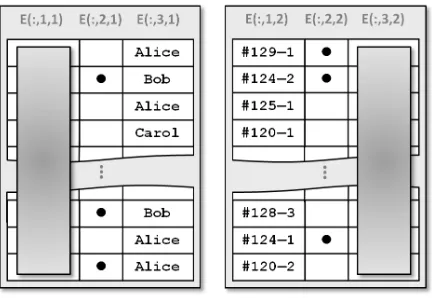
Figure 1:Left: E2E-enabled optical scan ballots.Each ballot consists of a unique serial number, a candidate list printed in an independent random order, and a perfora-tion between the optical scan ovals and the candidate list. Upon marking the ballot, the candidate list is de-tached and shredded. The remaining piece is scanned and granted as a receipt. Because the candidate order-ings are independent across ballots, knowing the mark position alone does not reveal how a voter voted.Right: Eperio table. Each optical scan oval (referenced by a serial number and absolute position), its mark-state (marked or unmarked) and the corresponding candidate name are recorded in a randomly assigned row.
PRNG is a stateful function which takes as input the shared secret, κ, as a seed and returns l new pseudo-random bits each time it is invoked. For simplicity, we omitlif the size of the output is clear from the context.
3.3.3 Permutation
◦ π(Wi)←Permute(w1, . . . , wu,Π) ◦ π(Wi)←PermuteBlock(w1, . . . , wu, s,Π)
Permuteaccepts as input a listWi ofuelements
and a number, Π = O(ulog(u)), of random bits sufficient to perfectly shuffle the list3 and returns a list containing elementsw1, . . . , wu in permuted
order. For someswhich dividesu,PermuteBlock
appliesPermuteindependently to each of theu/s
non-overlapping sub lists inWi.
3.3.4 Commitment
◦ c←Commit(m, r)
◦ {0,1} ←Reveal(c, r, m)
3Generating a random integer from random bits is non-deterministic
when the integer is not a perfect power of 2. Perfect shuffling algo-rithms, like Fisher-Yates, require random integers. An upper bound on theexpectednumber of bits is2(log2u!).
Committakes as input an arbitrary length message
mand a random factorr. It outputs a commitment to the messagec. Revealaccepts valuesm, r, and
c, and outputs 1 iffc is a valid commitment tom
andr. Otherwise it outputs 0.
3.3.5 Public Coin Toss
◦ {0,1} ←PublicCoin()
PublicCoin returns a uniformly random bit. The output should be unpredictable prior to being in-voked and verifiablea posteriori.
3.4
Lists and Tables
The Eperio protocol relies on a particular data structure, called the Eperio table, which is constructed from a set of private inputs by the trustees. The Eperio table is a novel data structure and the primary contribution of this paper. It is shown in Figure 1 with a permutation-style ballot, which we use to illustrate the protocol.
To facilitate clarity, we also denote some intermediate lists and tables used in its construction. We use a bold typeface to denote ordered lists and tables, and a script typeface to denote unordered sets.
The following list and set are public inputs to the sys-tem decided on prior to the election.
UMR List: Uis the list of eachunique mark-able region(UMR) for thescandidates on each of the b ballots. Elements are en-coded as a ballot serial number and a posi-tion, and are listed in ascending order. The length of the list isu=s·b.
Candidate/Selection Roster: S is the set
of selections or candidates to appear on the ballot, for each contest. Elements are encoded as a character string of arbitrary length. The size of the set iss. Without loss of generality, we assume a single con-test.
These are used by the trustees, in conjunction with the functions defined above, to create the following private list.
Candidate/Selection List: S ← U×S is
the list of candidates for each position on a ballot composed by randomly selecting, without replacement per ballot, an element fromS. It is ordered byU. The length of
The marks list will denote the final status of a markable region. It is empty prior to the election and is provided as a public input to the system after every ballot has been cast.
Marks List: M is the list of marks corre-sponding to each markable region inU. El-ements include marked (1), unmarked (0), and print audited (-1). The length of the list isu.
The concatenation of these three lists defines a table that collects all the private information of the election.
Print Table: Pis a table formed by joining U,M, andS. The dimensions of the table areu×3.
A proof of election integrity subsumes a proof that the relations between each list inPis consistent with a uni-versal view of the election. Pairwise, a correctU-M rela-tion implies ballots were collected as marked (Collected-as-Marked), a correctU-Srelation implies ballots were printed correctly (Marked-as-Intended), and a correctM
-Srelation implies the ballots were counted as collected (Counted-as-Collected). Note that revealingP(i,j) for
alli andj is sufficient, under our assumptions, for in-dependently verifying the correctness of the tally. Un-fortunately, this trivial approach would also destroy the privacy preserving property of the ballot receipt—in con-junction withP, receipts would provide proof of which candidate was selected. Instead, we require a non-trivial approach that can both establish integrity and preserve ballot secrecy.
The Eperio table is a data structure that, with a set of queries, can prove the correct formation ofPwhile maintaining the same level of privacy provided by only revealing the list of receipts and the final tally. Specifi-cally, it is a collection ofxinstances ofPthat have been independently shuffled row-wise. By revealing portions of and relations on this structure, we will show that a complete and robust proof of integrity can be established with this minimal disclosure.
Eperio Table: E is a table formed by x in-stances ofP, each of them independently shuffled row-wise. The dimensions of the table areu×3×x.
3.5
Protocol
We now outline the protocol for generating an Eperio ta-ble and the various outputs required for proving it en-codes a correct tally. The focus of this paper is on the protocol for verifying this proof, which is orthogonal to
the issue of how the data is generated. However the se-curity proof we provide in the next section encompasses the generation of the data, and so we give it considera-tion. The first three steps of the protocol are conducted prior to the election: initial setup, generating the Epe-rio table, and generating the commitments to the EpeEpe-rio table. These steps are performed with a blackbox com-putation(for more on this primitive, see Section 5).
3.5.1 Initial Setup
The setup assumes that a list of candidates, S, is
avail-able as well as the number of ballots,b, to be used in the election. The first task is for the trustees to generate an election secret and receive shares of this secret.
◦ (y1, . . . , yn, κ)←DKG(n, t, l, f1, . . . , fn)
3.5.2 Generate Eperio table
Next, the trustees generate the Eperio table E. U is formed by listing the ballot and position numbers in or-der. To formS, the candidate list is repeatedbtimes and then randomly permuted on a ballot-by-ballot basis.
◦ ΠS←PRNG(κ)
◦ Si←PermuteBlock(Sb, s,ΠS)
TablePis created by placingU,M, andSbeside each other in columns. M is initially empty, but in future meetings will include the marks recorded during the elec-tion.Pis used to print the ballots. We use the symbol: to denote an entire vector within a matrix.
◦ P(:,1)←U ◦ P(:,2)←M ◦ P(:,3)←S
Finally,xindependent row-wise shufflings ofPare gen-erated. Each shuffled instance ofPis stored in the Eperio table,E(i,j,k).
◦ Fork= 1tox,
◦ ΠE ←PRNG(κ)
◦ E(:,1,k)←Permute(P(:,1),ΠE) ◦ E(:,2,k)←Permute(P(:,2),ΠE) ◦ E(:,3,k)←Permute(P(:,3),ΠE)
We define, for future use, the following function. It en-capsulates all the steps in this ‘generate Eperio table’ sec-tion.
◦ E←GenE(κ)
3.5.3 Generate Commitments
the E(:,1,k) andE(:,3,k) columns. This requires x×2
commitments. The random factors for these commit-ments are stored in anx×2tableR. The resulting com-mitment is stored in the corresponding tableC.
◦ Fori= 1to2,j= 2i−1, andk= 1tox,
◦ R(i,k)←PRNG(κ)
◦ C(i,k)←Commit(E(:,j,k),R(i,k)) ◦ PublishC
Note that2i−1is simply the mapping{1→1,2→3}, used to denote that commitments to the first and third columns ofEare stored, respectively, in the first and sec-ond rows ofC.Cis published to the bulletin board.
3.5.4 Voting
Registered and authenticated voters are issued a paper ballot with a randomized candidate list according toP. After marking the ballot, the candidate list is detached and destroyed (e.g.,placed in to a paper shredder). The remaining strip is scanned by an optical scanner and the strip is retained by the voter as a receipt. The optical scanners will record for each ballot which position was marked, as well as the ballots that were print audited. Af-ter the election, these are placed into the listM. Without knowingP(:,3), this information does not reveal which
candidate was voted for and can be published.
◦ PublishM
3.5.5 Compute Tally
At least t + 1 trustees submit their election secrets to the blackbox computation, which regenerates the key and the Eperio table. This time, the completed marks list is shuffled along with the rest of the table.
◦ κ←KeyRec(y1, . . . , yt+1) ◦ E←GenE(κ)
For each instance x, they publish the corresponding marks list. Each of these lists is a shuffled version of the originalM.
◦ Publish:E(:,2,:)
Finally, a tally is computed from anyE(:,2,k)andE(:,3,k)
pair of columns, and the list of totaled values for each candidate, denotedτ, is published. This can be consid-ered anasserted tally, as the purpose of E2E verification is to prove that this tally is correct.
3.5.6 Generate the Linkage List
To ensure that the Eperio table is consistent with what ac-tually appears on the printed ballots in the election, veri-fiers have the ability to keep an issued ballot for purposes of auditing its printing. If a ballot was chosen to be print
audited and the first position contained candidate Bob, then a row corresponding to this markable region will exist inE at an unknown row. The row will be differ-ent for each instance. If the ballot is printed correctly, each corresponding row in each instance should contain Bob in the third column. The print auditor would like assurance of this fact.
However since commitments to only entire columns E(:,1,k)andE(:,3,k)exist, this fact cannot be directly
re-vealed without revealing both columns for a given in-stance. Doing this would reveal which candidate was selected for every receipt and cannot be pursued. In-stead, the election trustees will indirectly establish this fact. The trustees assert the row number,a, in each in-stance corresponding to every audited markable region. Which markable regions are audited is contained in the marks list,M, with -1 recorded for that entry. The list of asserted row numbers is called the linkage list,L, and it is made public.
◦ fori= 1touandk= 1tox:
◦ ifMi=-1:
◦ Find:as.t.E(a,1,k)=Ui ◦ L(i,k)←a
3.5.7 Audit Challenge and Response
After the tally has been posted, the trustees prove to an independent auditor that the tally was calculated cor-rectly. They do this through a cut-and-choose protocol. First the trustees regenerate the election secret and the Eperio table.
◦ κ←KeyRec(y1, . . . , yt+1) ◦ E←GenE(κ)
Next, they invoke the public coin toss function to gener-ate one flip for each of thexinstances.
◦ fork= 1tox:
◦ z←PublicCoin()
◦ Zk←z
◦ Publish:R(z+1,k) ◦ Publish:E(:,2z+1,k)
Each flip is recorded inZk. Depending on the flip, they
either reveal the first two or last two columns in each instance. Recall that E(:,2,:) was published previously.
This is illustrated in Figure 2.
3.6
Verification
Figure 2:Auditing Eperio table instances. Two exam-ple instances of the Eperio table during auditing. Each instance alleges to contain the same information, but in an independently shuffled order. Left:E(:,3,1)was challenged (then revealed), allowing verifiers to tally the election. Right: E(:,1,2)was challenged (then re-vealed) allowing voters to check their receipts. The grey bars symbolize cryptographic commitments that will re-main unopened to protect ballot secrecy.
who check their receipts (or provide a copy to some-one they delegate to check on their behalf). If the re-ceipt corresponds to ballot numberband containss po-sitions that are either marked (1) or unmarked (0), the auditor should check that the status of each positioni
on the receipt matches the status recorded atMj, where j=s(b−1) +i.
The second set of verifiers,V2, should check the
link-age list against their print audited ballots. Leta=L(i,k)
for an i on their ballot and an instancek. Depending on the random coin for instancek,V2should check that
E(a,1,k)matches the associated markable region on the
ballot orE(a,3,k)matches the associated candidate. They
should do this for allion their print audited ballot and eachkin the election.
These two audits establish that the reported marks cor-respond to what appeared on voter’s completed ballots and that what appears on the ballot corresponds to what is in the pre-committed Eperio table. The final step is to ensure that the asserted tally, τ, corresponds to the marks. Recall that for each of thexinstances, a random coin was flipped to reveal valuez ∈r {0,1}. The third set of verifiers,V3, should do the following.
◦ fork= 1tox:
◦ z←Zk
◦ CheckReveal(C(z+1,k),R(z+1,k),E(:,2z+1,k)) ◦ Ifz= 0:
◦ Check{E(:,1,k),E(:,2,k)} ∼={Ui,Mi} ◦ Ifz= 1:
◦ Check{E(:,2,k),E(:,3,k)} ∼=τ
Here ∼= means that the two pairs of tables are isomorphic—i.e.,they are a permuted representation of the same information.
4
Security
In this section, we summarize the main results of our se-curity proof. See Appendix A for details. Given a tran-script of the entire protocol, the asserted tally can be ei-ther accepted or rejected. If the asserted tally is correct, the decision will always be to accept (completeness). If the asserted tally is not correct, the decision will be to re-ject with a high probability (soundness). Finally, the out-puts do not provide any information that can be used by a computationally bounded adversary to determine any non-negligible information about which candidate was voted for by any voter (computational secrecy).
LetPbe an unbounded prover (the election authority) andV be a PPT-bounded verifier. Either entity may em-ploy a malicious strategy and we denote this with a prime (P0,V0). Recall thatτ represents the asserted tally and letρbe the asserted receipts.
Soundness The soundness of Eperio relies on two as-sumptions:
1. The function Commit(m, r) is perfectly binding. That is, for any m1 such that Commit(m1, r1) = c1, there does not exist anyr2andm2 6=m1 such thatReveal(c1, r2, m2) = 1.
2. The function PublicCoin() is perfectly unpre-dictable before invocation.
Letb0
rbe the number of modified ballot receipts, and
0≤p1≤1represent the fraction of voters who conduct
a receipt check. Letb0pbe the number of misprinted bal-lots, and0 ≤ p2 ≤ 1be the fraction of ballots that are
print audited. Recall there arexinstances are inE(:,:,k),
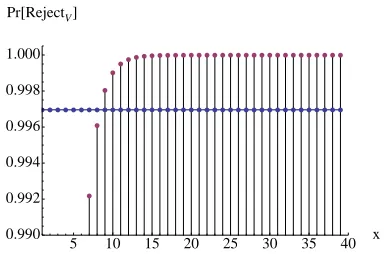
for1 ≤k≤x. Given the above assumptions hold, it is proven (in the Appendix) that the probability ofV reject-ing a malformed transcript fromP0is:
Pr[REJECTP0,V] = min[(1−(1−p1)b
0 r),
(1−(1−p2)b
0
p)(1− 1
2x)].
Computational Secrecy The secrecy of Eperio relies on the following assumptions:
1. The maximum number of colluding trustees ist. 2. At least one trustee submits to DKGan fi drawn
3. All outputs are computed with a blackbox.
4. Any polynomial-sized output fromPRNG(κ) pro-vides no non-negligible advantage to a PPT-bounded adversary in guessing eitherκ, the next bit in the output, or any unobserved previous bit. 5. The functionCommit(m, r)is semantically secure
and computationally hiding. That is, given either
c1=Commit(m1, r1)orc2=Commit(m2, r2)for any chosenm1andm2, a PPT-bounded adversary should have no non-negligible advantage in guess-ing which message was committed to.
Let A4 and A5 be the advantage specificied in
as-sumptions 4 and 5. Given all of the asas-sumptions hold, we prove (in the Appendix) that the advantage ofP0 recov-ering non-negligible information about any voter’s selec-tion given the full transcript as opposed to just the final tally is:
|Pr[RecoverSel(ViewV0(ρ, τ,C,L,E(:,2,:),Rz) = 1]− Pr[RecoverSel(ViewV0(τ)) = 1]| ≤
A4+A5.
Additional Claims In addition to the above proofs, we also show that Eperio is complete and can be modified to have everlasting privacy (i.e.,V is unbounded andP is PPT-bounded).
5
Practical Primitives
In this section, we revisit a few of the cryptographic primitives needed in Eperio. In particular, we are inter-ested in options that allow for useful deployment options.
Blackbox Computation The Eperio protocol requires the generation of the Eperio table to be done using a blackbox computation. While in theory, the task per-formed by the blackbox could be made into a multiparty computation (where only privacy is required as correct-ness is provided by Eperio), we instead propose the use of a semi-trusted computer. It is semi-trusted in the sense of only providing private evaluation of functions; the correctness can be determined through the audit. That said, mechanisms are provided to encourage correct eval-uation. To this end, we assume disclosed source code for the functions to be evaluated is provided in advance and some attestation mechanism is available to ensure it is the same code running on the computer.
All tasks performed by the trustees can be accom-plished by regenerating the Eperio table, and the regener-ation of this table can be accomplished through a thresh-old of secret shares from the trustees. Therefore the
com-puter should not have any persistent memory and its in-ternal state should be purged after the outputs have been published. While this assumption may seem strong, in each of the recent occasions where end-to-end verifiable voting systems were used in real-life binding elections, semi-trusted computers were deployed: e.g.,Punchscan at the University of Ottawa [24], Helios at Universit´e Catholique de Louvain (for key generation from the de-scription in their paper) [2], and Scantegrity at Takoma Park, MD [16].
Cryptographic Commitment We are interested in us-ing symmetric-key file encryption as a commitment func-tion for its speed, simplicity and widespread availabil-ity of software implementations. For Eperio, this means putting the columns of the Eperio table into individuals files, encrypting them under a randomly chosen key, and posting the encryption as a commitment. To open the commitment, the encryption key is revealed and the file can be decrypted. While our implementation of Eperio can be easily modified to work with any standard com-mitment function, we use this approach to simplify the experience for voters who want to verify the proof for themselves. File encryption utilities are readily available, easy to use, and the commitment has message recovery.
Let E be a pseudorandom permutation (PRP):
{0,1}k× {0,1}m→ {0,1}m. LetMbe a message ofL m-bit blocks and letIV be a randomm-bit initialization vector. DefineEto be the cipher block chaining (CBC) mode of encryption that encryptsM =m1, . . . , mL
un-derk-bit keyKandm-bitIV.Eis defined as:c0=IV
and ci = E(K, ci−1 ⊕ mi). Assume M is exactly L· mbits long andk = m. LetD be its inverse de-cryption function applied to C = c0, . . . , cL underK: M =D(K, C).
Theorem 1: As defined,E is indistinguish-able under a chosen plaintext attack (CPA). [6]
Conjecture 2: As defined, D behaves like a pseudorandom function with respect to collisions when C is held constant (note the difference from standard assumptions on M and C with a fixed K). That is,
M ← DC(K) has random collisions for
a fixedCand a variableK.
Theorem 3: Define acommitment with mes-sage recovery function as (c,IV) ←
MkM is a redundancy function.4 Define
M0 ← Reveal(C, K) = D(K, C). M0
is only accepted whenM0 has the correct formMkf(M)for someM. We show that such a commitment is computationally hid-ing under Theorem 1 and statistically bind-ing under Conjecture 2.
We omit a proof of Theorem 3 here but it is included in the full version of the paper. Because the commit-ment has message recovery, itsReveal function differs slightly from the commitment used earlier. We have demonstrated a very specific statistically hiding commit-ment function that can be constructed from a block ci-pher, assuming conjecture 1 holds. We model this ideal functionality in the real-world with AES-128-CBC in the next section.
Public Coin Toss Voting systems often require the use of a public coin for the purposes of fairly implement-ing the cut-and-choose aspect of the audits. In the case of conventional voting, it is used to select precincts for manual recounts. Corderoet al. suggest a protocol us-ing dice [21]. Clark et al. note that dice outcomes are only observable by those in the room, and suggest a protocol for auditing E2E ballots using stock market prices [18], which has recently been given a more formal analysis [19]. This was suggested earlier by Waters et al. outside of the voting context [42]. A further alter-native is to use the Fiat-Shamir heuristic [26], which is secure in the random oracle model. However, a require-ment for Fiat-Shamir is that the challenge space is large. In our case, the number of challenge bits is the same as the number of proof instances—for 10 or 20 instances, Fiat-Shamir is not secure. Thus, we use the stock market protocol. The output from a statistically-sound PRNG is seeded with a random extraction of a pre-selected port-folio of closing stock prices. Evaluation of challenges occurs at least a full business day after the audit data has been committed to [19].
6
Implementation
Election Generation Tool The hardware/OS platform design of the election generation software tool follows directly from previous systems [2, 16, 24] whereby a diskless, stand-alone computer is booted from a Linux live-CD. The Eperio election generation software is then loaded via a USB-key after being certified by external ex-perts. Election data is generated and written back on to the USB sticks, at which point the computer is shut down
4We thank and acknowledge Ronald L. Rivest for suggesting this
redundancy function for creating a binding commitment from a block cipher. Any errors in the analysis are our own.
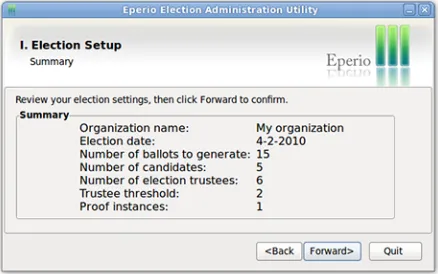
Figure 3: Election generation wizard. Trustees are guided through the complete process of selecting elec-tion parameters and setting up strong passwords prior to generating ballots and cryptographic audit data.
(it and the live-CD are then optionally placed beyond use). The election generation software itself is separated in to graphical user-interface, and cryptographic/back-end components. The primary cryptographic operations (i.e., file-encryption based commitments) were realized using function calls to OpenSSL. We implemented the election generation tool in Python using the GTK+ GUI library, which is a standard to most GNOME Linux live-CD distributions. The graphical layout consists of a multi-panel “wizard” work flow (shown in figure 3) to in-crementally guide election trustees through parameter se-lection and password input. Unlike the Punchscan/Scant-egrity software implementation, which requires some initial system configuration, the Eperio trustee interface software is intended to be self-contained and runnable directly following a live-CD boot. A specification of the audit data is given in Appendix C.
Bulletin Board The implementation of secure public, append-only bulletin boards is an open area of research. In its simplest form, the bulletin board consists of signed election audit data available on a public FTP server ad-ministered by the election authority, and which is closely monitored and archived/mirrored by any interested party. Mirroring of audit data can be an important peer-service provided between verifiers since the election authority may maliciously attempt to modify commitment data throughout the course of the election. It also ensures long-term archiving of the audit data, which may oth-erwise might be removed following the election.
performs the audits on them. We implemented proofs of theMarked-as-IntendedandCounted-as-Collected prop-erties in a compact fifty (50) lines of Python code (see Appendix D). As will be discussed in the following sec-tion, this represents the smallest implementation of a ver-ification interface relative to other major released imple-mentations by an order of magnitude. We tested this implementation on Ubuntu 7.10 (Python 2.5) and 9.10 (Python 2.6) as well as on Mac OSX Leopard and found that it could be executed without additional installation or configuration. Verifiers using Windows would be re-quired to install Python and OpenSSL, or as an alterna-tive, they could be directed to burn and boot Linux live CD. With the verification scripts on a USB key the en-tire audit can be completed without actually installing or configuring software on a verifier’s machine.
Verification using Spreadsheets An interesting alter-native to writing a custom codebase is to use a spread-sheet that can import a CSV file as a workspread-sheet. We be-lieve that spreadsheets can help broaden the appeal of E2E verification, given many citizens who are not ac-customed to reading/writing/running codedouse spread-sheets. Spreadsheets have grown to become one of the most familiar computer applications, capturing a di-verse cross-section of users in government, enterprise, and consumer sectors. They are also widely available: OpenOffice.org, a freely-downloadable open-source of-fice productivity suite (which includes the Calc spread-sheet application), reports over a hundred million down-loads.5
We have developed a set of simple manual verifica-tion steps using TrueCrypt and OpenOffice Calc. As an overview of this implementation, the user manually copies and pastes the revealed encryption keys into the TrueCrypt volume password dialog to mount the en-crypted volume. The unenen-crypted CSV file can now be loaded directly in to the spreadsheet program as a work-sheet. The verifier can then complete the audit using only simple spreadsheet operations (COPY, PASTE, SORT, etc). A full set of directions are given in Appendix E. As an alternative to manual verification, most spreadsheet applications integrate power macro/scripting languages that could automate the audit checks.
Spreadsheets as an all-in-one election audit tool?
Although many spreadsheets support basic file-encryption, cases of improper implementation (as in [43]) have led to a general distrust of spreadsheets as an encryption service. We observed that OpenOffice’s file encryption leaks partial information about a file’s contents by storing an unencrypted/unsalted hash of the
5http://stats.openoffice.org
first 1024 bytes of the compressed spreadsheet6, making it unsuitable as an implementation of the commitment scheme proposed in section 5. Indeed it is not clear whether any of the major contemporary spreadsheet applications would be suitable for implementing file-encryption based commitments. Nevertheless, the prospect of an “all-in-one” election verification tool already installed on most voters’ computers is an intriguing one.
7
Performance Comparison
Let us examine the technical requirements of election au-dits by comparing Eperio to several other major imple-mentations. For space reasons we restrict our compar-ison to recent systems that have been deployed in bind-ing elections, specifically Punchscan, Prˆet `a Voter, Helios and Scantegrity II. As outlined in section 3, Eperio uses a cut-and-choose protocol to verify the correctness of the ballot data structure. Through the use of thelinkage-list construct for print auditing, and the symmetric-key com-mitment scheme outlined in section 5, the protocol al-lows for the commitment of entire columns, causing the number of required symmetric-key block operations to grow with the number of voters/candidates divided by the block size. The compactness of the verification pro-cess follows from it: verification involves running a file-decryption utility, followed by a sort and comparison of columns with the asserted outcome.
Both Punchscan [38] and Scantegrity [16] rely on a similar cut-and-choose protocol to audit their respective data structures, but utilize a particular commitment and print-audit scheme that requires each table element to be committed to separately resulting in a much larger dataset and number of symmetric-key operations. Un-like Eperio and Scantegrity however, Punchscan encodes ballot information in a way that is mostly invariant to the number of candidates, resulting in some savings in terms of data/number of overall block operations, although it requires additional ballot commitments as a result of its particular ballot style. Punchscan was first deployed during University of Ottawa Graduate Students Associ-ation’s (GSA ´ED) annual general election in 2007 [24]. This election dataset (denotedGSAED07in table 2) and verification source code (written in C#) are available on-line.7Scantegrity was deployed during the 2009 Takoma Park municipal election (supra. note 2). This election dataset (denotedTAKOMA09in table 2) and verification source code (Python and JAVA) are also available online (supra. note 3). We used the Python implementation to produce timing results in table 2.
6Open Document Format for Office Applications (OpenDocument)
v1.2
System Mod Exp. Mod Mult. Symm. key ops Data(B) LOC(approx)
Eperio – – 3iv(log(2v) + 2)/16 6iv(log(2v) + 2) + 16i 50
Scantegrity – – 7.5civ 168civ 1000
Punchscan – – 7.5iv+ 9v 168iv+ 224v 2000
Prˆet-´a-voter 1.5itv – itv 288itv+ 192v 1000
Helios v2. 9cv+ct 9cv 2.5cv 2064cv 1500
Table 1: Technical requirements for election verification: comparison of Eperio with other implementations for cryptographic audits involvingvvoters,ccandidates,ttrustees andiproof instances.
Prˆet `a Voter [17], also an E2E mechanism for optical-scan elections, uses randomized-partial checking of the correct behaviour of nodes in a decryption mixnet [30]. Each election trustee separately maintains two mix nodes in this network, and auditing the mixnet involves verifying the public-key decryption of half of the cipher-texts emanating from a given mix node. The number of public-key operations a verifier must perform therefore is the number of trustees times the number of voters. Au-diting ballot printing also involves decryptions propor-tional to the number of trustees. Prˆet `a Voter differs from Eperio, Punchscan and Scantegrity in that it does not pre-commit to cryptographic ballot forms—they can be gen-erated (and audited) on-demand. This allows only voted ballots to have to be decrypted by the mixnet, but the print audit still requires more ballot forms be printed than actually voted upon. Prˆet `a Voter was deployed in 2007 for the University of Surrey Students’ Union (USSU) Sabbatical Elections. The audit dataset (USSU07) is not currently available online. The verification interface was written in JAVA.8
Helios v2. [2] is an E2E mechanism for remote vot-ing that uses homomorphic tallyvot-ing (i.e., tallyvot-ing under encryption) to protect voter privacy. To ensure the tally is correct, a zero-knowledge proof of correctness accom-panies the encryption of each candidate on each ballot in the election. Likewise, a proof of decryption accompa-nies the final tally. The primary computational require-ment of Helios election verification comes from auditing the inputs—each ballot requires 4 modular exponentia-tions per candidate. The Helios verification interface was written in Python.9 Helios v2. was deployed in 2009 in an election at Universite Catholique de Louvain. The the election dataset (UCL09) is not currently available on-line. Timing analysis of a reference election of the origi-nal implementation, Helios v1., is presented in [1] and is denoted in table 2 asHELv1REF.
Audit dataset size For an election involving v vot-ers, c candidates, t trustees and i proof instances, Ta-ble 1 expresses each system in terms of the number of modular exponentiations, modular multiplications, and
8http://www.pretavoter.com 9http://www.heliosvoting.org/
symmetric-key block operations required during the ver-ification process, along with the size of the audit dataset (bytes) and contributed software lines of code (LOC) of the respective implementation. In the case of paper-ballot systems, we include an additional 0.5v paper-ballots for the print audit. In the case of systems with pre-committed ballots, an additional 0.5v ballots are included to account for spoilage. Although the execution and data complexities of the systems are all linear in the election parameters, Eperio’s performance advantage stems from its smaller constant factor.
Timing Basic timing analysis of election verification on available data is presented in Table 2. Our test plat-form was a 1.8GHz dual-core HP laptop running Ubuntu Linux 9.10. Eperio timings were performed on data sim-ulatingequivalently sized elections.
Comparing execution times of the Eperio verification script relative to three other systems (Punchscan, Scant-egrity, Helios) on three election datasets shows Eperio significantly faster in time-to-verify. As a concrete ex-ample, using the Punchscan verification tool to audit the 2007 Punchscan election in [24], it took us 75 seconds to complete, while an equivalently sized election run with Eperio took us 9 seconds.
The timing result for the Scantegrity audit on the TAKOMA09dataset includes several audits relating to the Scantegrity II ballot and voting method of the specific election that we did not replicate, suggesting that a more precise timing analysis would produce a smaller margin.
Code size: is less really more? Table 1 lists the ap-proximate code size of published verification software showing Eperio having a significantly smaller code base than related systems. As a performance metric however, software lines of code (LOC) is limited. There is debate as to how code lines should be counted, as well as which components to even include. It also does not take into account whether more efficient implementations could be created. Setting these questions aside, are small code bases important for E2E audit software?
Election Scantegrity Punchscan Helios Eperio
TAKOMA09 1127s – – 162s
GSAED07 – 75s – 9s
HELv1REF – – 14400s 1s
Table 2:Time to verify election audit dataset. Eperio times are for simulated datasets of equivalently sized election.
engaging a wider audience.
8
Related Work
Throughout the 1980s and 1990s, many protocols for cryptographic voting were proposed, the majority based on either mix networks, originating with Chaum [14], or additive homomorphic encryption, originating with Be-naloh and Tuinstra [9]. The first generation of mixnet protocols appeared before techniques for provably cor-rect mixing were known, including a well-studied pro-tocol by Fujioka et. al[27], while second generation protocols, originating with Sako and Killian [40], use a correctness proof.
Recently, implementation issues are given more con-sideration. VoteHere [36] and Votegrity [15] are early electronic systems where voters do not need to per-form traditional cryptography, while VoteBox [41] al-lows voters to obtain an encrypted ballot from an un-trusted machine using a cut-and-choose protocol due to Beneloh [8]. Prˆet `a Voter [17], Punchscan [38], Scratch & Vote [3], ThreeBallot [39], and Scant-egrity [16] are examples of systems that use paper bal-lots, require no cryptography for vote capture, and offer a privacy preserving receipt to each voter. Civitas [20] is an internet system based on a protocol by Juelset al.[31] for high coercion elections, while Helios is designed for low coercion internet elections [1].
The cryptographic proofs in these systems use a va-riety of approaches, including zero-knowledge proofs, cut-and-choose protocols, and randomized partial check-ing [30]. Eperio is perhaps closest to Scantegrity, which also breaks election data into markable regions and uses a blackbox computation. However Eperio uses a more compact data structure, no pointers, and commits to data at a lower level of granularity than Scantegrity.
9
Future Work
This paper presented an E2E protocol in with single-party privacy assurance. Future work will be aimed at providing similar ease of verification but with multi-party construction of the Eperio table. We also focused on an E2E ballot style with randomized candidate or-dering. Integration of Eperio with code-based ballots,
specifically those with the subtle non-repudiation prop-erties of the Scantegrity II ballot are of interest. Also, this paper considered plurality elections, however vot-ing methods, such assingle transferable vote(STV) and instant run-off voting(IRV) provide unique privacy chal-lenges not addressed by the basic Eperio data table. Fi-nally, and in many ways most pertinent, a formal usabil-ity study of election verification relative to other systems would be provide valuable feedback regarding the direc-tion of this work.
10
Conclusion
The contemporary verification process for electronic voting is deficient. Independent security reviews are generally rare, time-constrained affairs subject to non-disclosure. While we advocate greater transparency for existing election technology, we also contend that end-to-end verification offers a distinct advantage: verifica-tion becomes a task of checking elecverifica-tiondatanot soft-ware and equipment. This may appear to simply shift the problem: the prevailing methods for verifying E2E election data is with software. However it is not a simple shift. In nearly all E2E systems, the verification code is smaller than the hundreds of thousands of lines of code in a modern DRE.
With Eperio, the software is muchsmaller—four or-ders of magnitude smaller—and verification can even be performed manually without any custom software. By making verification more accessible to voters, we con-tend that Eperio is an important democracy enhancing technology.
Acknowledgment
The authors would like to thank Ron Rivest, David Chaum, and Richard Carback, Douglas W. Jones and the anonymous reviewers for helpful feedback. The authors acknowledge the partial support of this research by the Natural Sciences and Engineering Research Council of Canada (NSERC).
References
[2] B. Adida, O. de Marneffe, O. Pereira, and J.-J. Quisquater. Elect-ing a university president usElect-ing open-audit votElect-ing: analysis of real-world use of Helios.EVT 2009.
[3] B. Adida and R. L. Rivest. Scratch & Vote: self-contained paper-based cryptographic voting.WPES 2006.
[4] A. W. Appel, M. Ginsburg, H. Hursti, B. W. Kernighan, C. D. Richards, G. Tan, and P. Venetis. The New Jersey voting-machine lawsuit and the AVC Advantage DRE voting machine.EVT 2009.
[5] A. Aviv, P. Cerny, S. Clark, E. Cronin, G. Shah, M. Sherr, and M. Blaze. Security evaluation of ES&S voting machines and elec-tion management system.EVT 2008.
[6] M. Bellare, A. Desai, E. Jokiph, and P. Rogaway. A concrete se-curity treatment of symmetric encryption: an analysis of the DES mode of operation.FOCS 1997.
[7] J. Benaloh. Verifiable secret-ballot elections. PhD thesis, Yale University, 1987.
[8] J. Benaloh. Simple verifiable elections.EVT 2006.
[9] J. Benaloh and D. Tuinstra. Receipt-free secret-ballot elections.
STOC 1994.
[10] M. Blaze, A. Cordero, S. Engle, C. Karlof, N. Sastry, M. Sherr, T. Stegers, and K.-P. Yee. Source code review of the Sequoia voting system.State of California’s Top to Bottom Review, 2007.
[11] K. Butler, W. Enck, H. Hursti, S. McLaughlin, P. Traynor, and P. McDaniel. Systemic issues in the Hart InterCivic and Premier voting systems: reflections on project everest.EVT 2008.
[12] J. A. Calandrino, A. J. Feldman, J. A. Halderman, D. Wagner, H. Yu, and W. P. Zeller. Source code review of the Diebold voting system.State of California’s Top to Bottom Review, 2007.
[13] R. Carback, J. Clark, A. Essex. et al. Scantegrity II Municipal Election at Takoma Park: The First E2E Binding Governmental Election with Ballot Privacy.USENIX Security, 2010.
[14] D. Chaum. Untraceable electronic mail, return addresses, and digital pseudonyms.Communications of the ACM, 24(2), 1981.
[15] D. Chaum. Secret-ballot receipts: true voter-verifiable elections.
IEEE Security and Privacy, 2(1), 2004.
[16] D. Chaum, R. Carback, J. Clark, A. Essex, S. Popoveniuc, R. L. Rivest, P. Y. A. Ryan, E. Shen, and A. T. Sherman. Scantegrity II: end-to-end verifiability for optical scan election systems using invisible ink confirmation codes.EVT 2008.
[17] D. Chaum, P. Y. Ryan, and S. A. Schneider. A practical, voter-verifiable, election scheme.ESORICS 2005.
[18] J. Clark, A. Essex, and C. Adams. Secure and observable auditing of electronic voting systems using stock indices. IEEE CCECE 2007.
[19] J. Clark and U. Hengartner. On the use of financial data as a random beacon.EVT/WOTE 2010.
[20] M. R. Clarkson, S. Chong, and A. C. Myers. Civitas: toward a secure voting system.IEEE Symposium on Security and Privacy 2008.
[21] A. Cordero, D. Wagner, and D. Dill. The role of dice in election audits.WOTE 2006.
[22] Election Data Services Inc. Voting equipment summary by type as of 11/07/2006. 2006.
[23] A. Essex, J. Clark, and C. Adams. Aperio: High Integrity Elec-tions for Developing Countries Towards Trustworthy Elections. Lecture Notes in Computer Science, vol. 6000, 2010.
[24] A. Essex, J. Clark, R. T. Carback, and S. Popoveniuc. Punchscan in practice: an E2E election case study.WOTE 2007.
[25] Federal Constitutional Court of Germany. Judgement 2 BvC 3/07, 2 BvC 4/07, Verfahren ¨uber die Wahlpr¨ufungsbeschwerden, 2009.
[26] A. Fiat and A. Shamir. How to prove yourself: practical solutions to identification and signature problems.CRYPTO ’86.
[27] A. Fujioka, T. Okamoto, and K. Ohta. A practical secret voting scheme for large scale elections. InASIACRYPT ’92.
[28] E. Hubbers, B. Jacobs, and W. Pieters. RIES: Internet voting in action.COMPSAC 2005.
[29] S. Inguva, E. Rescorla, H. Shacham, , and D. S. Wallach. Source code review of the Hart InterCivic voting system. State of Cali-fornia’s Top to Bottom Review, 2007.
[30] M. Jacobsson, A. Juels, and R. L. Rivest. Making mix nets robust for electronic voting by randomized partial checking. USENIX Security Symposium 2002.
[31] A. Juels, D. Catalano, and M. Jacobsson. Coercion-resistant elec-tronic elections.WPES 2005.
[32] J. Katz. Universally composable multi-party computation using tamper-proof hardware.EUROCRYPT ’07
[33] T. Kohno, A. Stubblefield, A. D. Rubin, and D. S. Wallach. Anal-ysis of an electronic voting system.IEEE Symposium on Security and Privacy 2004.
[34] T. Moran and M. Naor. Split-ballot voting: Everlasting privacy with distributed trust.CCS 2007.
[35] T. Moran and G. Segev. David and Goliath commitments: UC computation for asymmetric parties using tamper-proof hard-ware.EUROCRYPT ’08.
[36] C. A. Neff. Practical high certainty intent verification for en-crypted votes. Technical report, VoteHere, 2004.
[37] T. P. Pedersen. A threshold cryptosystem without a trusted party.
EUROCRYPT ’91.
[38] S. Popoveniuc and B. Hosp. An introduction to Punchscan.
WOTE 2006.
[39] R. L. Rivest and W. D. Smith. Three voting protocols: Threebal-lot, VAV, and Twin.EVT 2007.
[40] K. Sako and J. Kilian. Receipt-free mix-type voting scheme: a practical solution to the implementation of a voting booth. EU-ROCRYPT ’95.
[41] D. R. Sandler, K. Derr, and D. S. Wallach. VoteBox: a tamper-evident, verifiable electronic voting system. USENIX Security Symposium 2008.
[42] B. Waters, A. Juels, J. A. Halderman, and E. W. Felten. New client puzzle outsourcing techniques for DOS resistance. CCS 2004.
[43] H. Wu. The misuse of RC4 in Microsoft Word and Excel. Cryp-tography ePrint Archive, 2005/007, 2005.
A
Security Proof
In this section, we prove that Eperio iscomplete,sound, andcomputationally secret. Given a transcript of the en-tire protocol, the asserted tally can be either accepted or rejected. If the asserted tally is correct, the decision will always be to accept (completeness). If the asserted tally is not correct, the decision will be to reject with a high probability (soundness). Finally, the outputs do not pro-vide any information that can be used by a computation-ally bounded adversary to determine any non-negligible information about which candidate was voted for by any voter (computational secrecy).
To maintain consistency with the literature, we will denote the trustees as the prover (P), who we initially consider unbounded in computation power. The three types of verifiers (V) are considered to be bounded to probabilistic polynomial time (PPT). These bounds are used to demonstrate unconditional integrity, and are lat-ter reversed for a brief consideration of everlasting pri-vacy. Either entity may employ a malicious strategy and we denote this with a prime(P0,V0).
The Eperio verification protocol is challenge-response. The print audit uses aninteractive challenge where verifiers choose which ballots at random to check that the correspondence between ballot positions and candidates is consistent with the committedEtable. The receipt check also uses aninteractive challengewhere a random fraction of voters will choose to check that the correspondence between ballot positions and marks is consistent with the published marksE(:,2,:). Finally the
tally audit uses apublic coin challengewhere the prover is asked to reveal eitherE(:,1,x)orE(:,3,x)for a givenx.
LetΩrepresent the description of an election; a map-ping between each ballot and the candidate who was voted. Consider the pairhE,Ri, an Eperio table and the random factors used in committing to it. These two items are sufficient for generating all the other data structures needed in the verification protocol. DenoteE as the set of allhE,Ripairs that would correctly encodeΩ, andE¯
as the set of all other pairs.
A.1
Completeness
An abbreviated transcript of the verification protocol fol-lows:
P → V: C Commitment
P ← V: M Challenge
P → V: ρ,L,E(:,2,:),τ Response P ←Coin: Z Challenge
P → V: Rz Reveal
Recall thatτrepresents the asserted tally and letρbe the asserted receipts. AssumeE∈ E forΩ. IfP andV
behave honestly and follow the protocol outlined in the
previous section, thenτ,ρandLwill also be consistent withΩand the three verifications performed byV will succeed with certainty.
It may be worthwhile to note that V’s acceptance is conditional on many things beyondτ. IfPwere to com-mit to wrong values and reveal marks in the wrong po-sition, but still report the correctτ, the proof will be re-jected. We do not classify this as a true negative error as we are determining whether the proof is acceptable.
A.2
Soundness
We now consider whether V will ever accept a proof whenE∈E¯. If the probability of rejecting a false proof is much greater than 1/2, we say Eperio is sound. The soundness of Eperio relies on two assumptions:
1. The function Commit(m, r) is perfectly binding. That is, for any m1 such that Commit(m1, r1) = c1, there does not exist anyr2andm2 6=m1 such
thatReveal(c1, r2) =m2.
2. The function PublicCoin() is perfectly unpre-dictable before invocation.
Let tr(P0(E,Ω),V(M,Z))(α) denote a transcript of a proof given by a malicious prover with private informa-tionE(i,j,k)andΩto an honest verifier with challenges
MandZ. The proof concerns some public information
α. We shorten the notation totr(P0,V)(α). Given a tran-script,V will decide in PPT-time to eitherACCEPT or REJECTthe transcript as a valid proof.
The logic ofV’s strategy in terms of the three types of verification is as follows,
ACCEPTV(tr(P0,V)(C,L, ρ, τ,E(:,2,:),Rz)) ←
ACCEPTV1(tr(P0,V)(ρ)) ∩
ACCEPTV2(tr(P0,V)(C,L,Rz)) ∩
ACCEPTV3(tr(P0,V)(C, ρ, τ,E(:,2,:),Rz)). (1)
We prove the soundness of the three right-hand deci-sions independently and then consider the implication of their conjunction. Since the proof protects against very strong adversaries, we also remark on what a real world adversary may want to achieve as it relates to each proof.
Receipt Check First consider the verification that the asserted receipts,ρ, match the physical receipts retained by the voters: ACCEPTV1(tr(P0,V)(ρ)). This check does
A malicious prover has a binary choice at this stage: to assert a correct valueρor an incorrectρ0. Ifρ0 is as-serted, the transcript’s acceptablity decreases in propor-tion to the number of voters verifying their receipts. Let
b0r be the number of modified ballot receipts inρ0, and 0 ≤ p1 ≤ 1 represent the fraction of voters who
con-duct a receipt check. Further assume the distribution of
b0rand the ballots associated withp1are independent. In this case, the probability of rejecting an incorrect tran-script is tightly approximated by:
Pr[REJECTP0,V
1] = (1−(1−p1)
b0r).
(2)
In terms of real-world adversaries, this verification step is very important. A malicious set of trustees could use such an attack to explicitly move votes from one can-didate to another inρ. This result can be generalized to any voting system where voters check the inclusion of their obfuscated votes. Increasing certainty in the tally proof can often be made exponential in some chosen pa-rameter (as we will show is the case with Eperio), but this certainty will at some point overtake the certainty that the inputs are correct, which are fixed byp1and
in-variant to the security parameter of the system. Since the soundness of the overall system rests in the weakest link—increasing the certainty of the tally does not nec-essarily add security overall! Further attention should be paid to methods for increasing partition in the receipt check, or introducing mechanisms to capture all the re-ceipts. The only system we are aware of to address this is VoteBox, which includes their earlier AUDTITORUM
protocol that could capture all receipt information [41].
Print Audit Next consider tr(P0,V)(C,L,Rz) which is used to determine if the linkage list, L, implies that the ballots were printed in a way that is consistent with the binary relation R(E(i,1,k),E(i,3,k)) for alli and k.
These values are committed to inCand the partial rela-tionE(i,2z+1,k)is opened byRz.
If a malicious prover misprintsb0
p ballots, and0 ≤ p2≤1is the fraction of ballots that are print audited, the
probability of a modified ballot being selected for audit is1−(1−p2)b0p. There are different ways to misprint a
ballot, however any surjective modifications are trivially detectable. Consider a misprinted ballot to be one that bijectively swaps the order of some candidates.
P0could escape detection by decommiting to the mis-printed value, however we assume this is impossible by soundness assumption 1. Instead,P0must assert whichi inE(i,j,k)matches the printed ballot. For a givenk,P0
could chooseisuch thatE(i,1,k)is correct, and will
es-cape detection if the coin flip is 0 but be detected ifz= 1. Alternatively, the prover could choose the row such that
E(i,3,k)is correct, and will escape detection ifz= 1but
be detected ifz = 0. Given the second soundness as-sumption,P0cannot predictzto a probability better than 1/2for each instance1≤k≤x. In this case,
Pr[REJECTP0,V2] = (1−(1−p2)b
0
p)(1− 1
2x).(3)
In our estimate, a real-world adversary is unlikely to gain from misprinting ballots. The attack would begin with some prior knowledge of the expected distribution of votes—e.g., pre-election polls showing another can-didate leading or an expected bias for a given precinct— and would involve mapping the leading candidate’s votes to the adversary’s preferred candidate and the least pre-ferred candidate to the main competitor. With x = 20 and 5% of ballots being print audited, the election au-thority can be 99% certain that no more than 89 ballots were misprinted and 50% certain that no more than 13 were. With 20% checked, no more than 20 ballots were misprinted with 99% certainty and no more than 3 with 50% certainty. While a 99% detection rate tolerates a fairly high number of misprinted ballots, this attack is marginalized by the observation that a successful exe-cution will only probabilistically gain votes for the at-tacker. For example, if working from poll data showing a 51-49% split between two candidates, misprinting 89 ballots will on average only net the attacker 2 votes.
Tally Audit Finally consider the verification that the now validated receipt list, ρ, implies that the asserted tally, τ, is correct. The partial relation E(i,2z+1,k) is
opened by R(z+1,j) and can be considered along side
E(:,2,:)). Ifz= 0, this pair of values should matchρ. If z = 1, the pair should matchτ. Thus our consideration isACCEPTV3(tr(P0,V)(C(i,j), ρ, τ,E(:,2,:),R)).
If E(:,2,:) is correct, then the tally produced by any
E(i,3,k)is also correct. However ifE(:,2,:)is not correct,
it is possible forP0to assert a tallyτ0that is incorrect and acceptable toV. For a givenk,P0could chooseE
(:,2,:)
to matchτ, and will escape detection if the coin flip is 0 but be detected ifz= 1. Alternatively,P0could choose E(:,2,:) to matchτ0, and will escape detection ifz = 1
but be detected if z = 0. Given the second soundness assumption, P0 cannot predictz to a probability better than1/2for each instance1≤k≤x. In this case,
Pr[REJECTP0,V
3] = (1−
1
2x). (4)