c
Owned by the authors, published by EDP Sciences, 2018
Fermilab muon
g
-2 experiment
Tim Gorringe1,aon behalf of the Fermilab muong-2 collaboration.
1Department of Physics and Astronomy, University of Kentucky, Lexington, KY, 40502, USA
Abstract.The Fermilab muong-2 experiment will measure the muon anomalous magnetic momentaµto 140 ppb – a four-fold improvement over the earlier Brookhaven experiment. The measurement ofaµis well known as a unique test of the standard model with broad sensitivity to new interactions, particles and phenomena. The goal of 140 ppb is commensurate with ongoing improvements in the SM prediction of the anomalous moment and addresses the longstanding 3.5σdiscrepancy between the BNL result and the SM prediction. In this article I discuss the physics motivation and experimental technique for measuringaµ, and the current status and the future work for the project.
1 Introduction
These are interesting times in physics. With dark matter and dark energy being thought to comprise about 95% of the universe’s mass, the standard model of particle physics seems astonishingly incomplete. Unfortunately – despite enormous efforts at high energy colliders, in deep
under-ground searches, and elsewhere – no definitive evidence of new interactions, particles or phenomena has been found in any sub-atomic experiments.
It is nearly 20 years ago that the BNL 821 collabora-tion reported its now celebrated 540 ppb measurement [1] of the muon anomalous magnetic moment,aµ. The BNL
result and SM prediction were found to differ by roughly
3.5 σ. This discrepancy has survived experimental and theoretical scrutiny and today remains the most tantaliz-ing and persistent hint from sub-atomic experiments of physics beyond the standard model.
In this article I will describe the new Fermilab muon g-2 experiment [g-2] – the direct descendant of BNL 8g-21. The Fermilab experiment is designed to determine the muon anomalyaµto an unprecedented 140 parts-per-billion
pre-cision. Such precision will provide a unique test of the standard model and offer a broad sensitivity to new physics
that complements other efforts at the energy, intensity and
cosmic frontiers. Most importantly, it addresses the long-standing discrepancy between the SM prediction and the BNL experiment and – whether it confirms or refutes this discrepancy – will surely have broad impact and enduring value in nuclear, particle and astrophysics.
In what follows I offer an experimentalist’s perspective
on the physics interest, discuss the techniques exploited in the anomaly’s measurement, and provide the current status and future work of the project.
Note an alternative measurement of the muon anomaly – employing a novel source of polarized muons and diff
er-ae-mail: [email protected]
ent approach to muon storage – is being pursued by the J-PARC E34 experiment [3]. It is described elsewhere in the conference proceedings.
2 Physics motivation
While collider experiments offer exceptional access to
in-teractions and particles that lie within their energy range, the precision measurement of fundamental quantities of-fers opportunistic windows on new physics that’s capable of reaching to much higher energy scales. In particular – through the subtle effects of quantum fluctuations – the
muon magnetic moment is a unique portal to new phenom-ena at collider energies and beyond.
The muon anomaly aµ is important because it’s
cal-culable and measurable with extraordinary precision; thereby offering both an exacting test of the standard
model and a sensitive probe of any new physics (for de-tails see Refs. [4, 5]). The BNL result [1] of
aexpµ =(116 592 089±63)×10−11 (1)
has been one of the most-cited measurements of the past twenty years. Despite the intense theoretical and experi-mental scrutiny the longstanding discrepancy between the SM prediction and the BNL result has only strengthened over the years since the experiment.
Presumably all forces of nature – both known and un-known – give contributions to aµ. Within the standard
model the muon anomaly aµ receives contributions from
QED loops involving electrons and photons, electroweak loops involving W, Z and Higgs bosons, and hadronic loops involving quarks and gluons,
aS M
µ =aµQED+aµEW+ahadµ . (2)
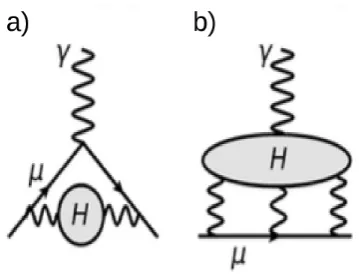
Figure 1. Feynman diagrams for a) the leading-order hadronic vacuum polarization contribution and b) the hadronic light-by-light scattering contribution.
overwhelming uncertainty in calculatingaS M
µ arises from
hadronic vacuum fluctuations and how quarks and gluons dress the muon magnetic moment (see Fig. 1). As is dis-cussed elsewhere in these conference proceeding, the most recent updates for the leading-order hadronic contributions ahad:LO
µ of 6922±25, 6926±33 and 6881±41×10−11from
the Teubneret al., Davieret al.and Jegerlehner [6–8] have lowered the uncertainties by roughly 25-50% over earlier estimates [9–11]. By comparison the uncertainties in the QED contribution, 0.08×10⁻¹¹[12], and the electroweak
contribution, 1.0×10⁻¹¹[13], are completely negligible.
The largest uncertainty in the hadronic term arises from the leading-order hadronic vacuum polarization term ahad:LO
µ . Since ahadµ :LO isn’t yet calculable with sufficient
accuracy, its value is evaluated via dispersion relationships from an energy-weighted integral of the measurede+e−→ hadrons cross section. The energy-weighting emphasizes the low-energy region that is dominated by theρandω
resonances and thee+e− →2πchannel. Recent estimates ofahad:LO
µ have benefited from new measurements and new
analyses ofe+e−data as well as more sophisticated treat-ments of the correlated systematic errors between thee+e− datasets. At present the uncertainty inahad:LO
µ is dominated
by the systematic errors in the experimental results for the variouse−e+ → ππchannel. The relevant data were ob-tained using initial-state radiation and energy-scan tech-niques and – while generally in agreement – there remains tension between BaBar data and other data at energies just above theρ,ωresonances.
The other important contribution to the hadronic un-certainty is the hadronic light-by-light term ahLBL
µ . For
many years the estimation ofahLBL
µ was limited to specific
models of the hadronic loop in the four-photon vertex with the so-called “Glasgow consensus”ahLBL
µ =(105 ± 26)×
10−11 emerging as the accepted value for the hadronic
light-by-light contribution. One new approach, using lat-tice QCD, offers the prospect of a first-principles
calcu-lation ofahLBL
µ at the 10% level. Another new approach,
using dispersion relations, offers the prospect of a
data-driven extraction ofahLBL
µ by relating the quantity to pion
form factor andγ∗γ∗→ππscattering data.
The effort to determineahadµ was discussed in great
de-tail at this conference and represents a remarkable triumph of combined theoretical and experimental labor. Many talks spotlighted the continuing push to better quantify the hadronic corrections and associated uncertainties with the-oretical tools including dispersion relations, lattice QCD, effective theories and hadronic models as well as ingenious
new experimental ideas. The SM prediction foraµis
cur-rently known to about 400 ppb – to bring this uncertainty on par with experimental goals will need a roughly 0.2% determination of the hadronic vacuum polarization term and a roughly 10% determination of the hadronic light-by-light term.
Using the recent updates for the hadronic correction, the differences inaµbetween the BNL result and the SM
prediction areaexpµ −aS Mµ =(288±80), (281±73), and
(313±77)×10−11[6–8]; a discrepancy of 3.6 to 4.1σ. To
set the scale – this discrepancy is roughly twice the entire contribution of electroweak effects – these effects mostly
arising from one-loop diagrams involving virtual W and Z bosons.
New physics will typically make contributions toaµ
from one-loop diagrams at scales of O(Cm2
µ/M2) where
CandM are the coupling constant and the mass scale of the new interaction. For couplings of orderO(1) the dis-crepancy would imply multi-TeV mass scales. By com-parision, for electroweak-scale couplingO(α/4π) it would
imply a sub-TeV mass scale and for milli-scale couplings O(10−3) it would imply a GeV mass scale.
The anomalous magnetic moment represents a uniquely inclusive probe of new physics that nicely com-plements the specific sensitivities of collider experiments, underground searches,etc. Indeed the BNL result has ma-jor consequences for many SM extensions including extra Higgs, supersymmetric partners and dark photons, in some cases it pushing practitioners into small corners of model space. If new physics is discovered elsewhere the muon anomaly will surely play an important role in interpreting the signal. And - if new physics isn’t discovered elsewhere – the anomaly is then the wide net to catch new physics.
3 Experimental technique
As mentioned, the Fermilab muon g-2 experiment [2] is
designed to measureaµto 140 ppb precision, a goal
com-mensurate with anticipated improvements in the present knowledge of the hadronic contributions from new e+e− data and theoretical advances.
The Fermilab experiment will use the same basic tech-nique as the earlier BNL experiment. It involves injecting fills of polarized muons with magic momenta 3.094 GeV/c
into the 1.54 T magnetic field of the 7.1 m radius storage ring. Within the ring the muons orbit at the cyclotron fre-quencyωcand their spins rotate at the Lamor frequency
ωs. Ifaµwas zero –i.e.muons were Dirac particles with
Figure 1. Feynman diagrams for a) the leading-order hadronic vacuum polarization contribution and b) the hadronic light-by-light scattering contribution.
overwhelming uncertainty in calculatingaS M
µ arises from
hadronic vacuum fluctuations and how quarks and gluons dress the muon magnetic moment (see Fig. 1). As is dis-cussed elsewhere in these conference proceeding, the most recent updates for the leading-order hadronic contributions ahad:LO
µ of 6922±25, 6926±33 and 6881±41×10−11from
the Teubneret al., Davieret al.and Jegerlehner [6–8] have lowered the uncertainties by roughly 25-50% over earlier estimates [9–11]. By comparison the uncertainties in the QED contribution, 0.08×10⁻¹¹ [12], and the electroweak
contribution, 1.0×10⁻¹¹[13], are completely negligible.
The largest uncertainty in the hadronic term arises from the leading-order hadronic vacuum polarization term ahad:LO
µ . Since ahadµ :LO isn’t yet calculable with sufficient
accuracy, its value is evaluated via dispersion relationships from an energy-weighted integral of the measurede+e−→ hadrons cross section. The energy-weighting emphasizes the low-energy region that is dominated by theρandω
resonances and thee+e−→2πchannel. Recent estimates ofahad:LO
µ have benefited from new measurements and new
analyses ofe+e−data as well as more sophisticated treat-ments of the correlated systematic errors between thee+e− datasets. At present the uncertainty inahad:LO
µ is dominated
by the systematic errors in the experimental results for the variouse−e+ → ππchannel. The relevant data were ob-tained using initial-state radiation and energy-scan tech-niques and – while generally in agreement – there remains tension between BaBar data and other data at energies just above theρ,ωresonances.
The other important contribution to the hadronic un-certainty is the hadronic light-by-light term ahLBL
µ . For
many years the estimation ofahLBL
µ was limited to specific
models of the hadronic loop in the four-photon vertex with the so-called “Glasgow consensus”ahLBL
µ =(105 ± 26)×
10−11 emerging as the accepted value for the hadronic
light-by-light contribution. One new approach, using lat-tice QCD, offers the prospect of a first-principles
calcu-lation ofahLBL
µ at the 10% level. Another new approach,
using dispersion relations, offers the prospect of a
data-driven extraction ofahLBL
µ by relating the quantity to pion
form factor andγ∗γ∗→ππscattering data.
The effort to determineahadµ was discussed in great
de-tail at this conference and represents a remarkable triumph of combined theoretical and experimental labor. Many talks spotlighted the continuing push to better quantify the hadronic corrections and associated uncertainties with the-oretical tools including dispersion relations, lattice QCD, effective theories and hadronic models as well as ingenious
new experimental ideas. The SM prediction foraµis
cur-rently known to about 400 ppb – to bring this uncertainty on par with experimental goals will need a roughly 0.2% determination of the hadronic vacuum polarization term and a roughly 10% determination of the hadronic light-by-light term.
Using the recent updates for the hadronic correction, the differences inaµbetween the BNL result and the SM
prediction areaexpµ −aS Mµ =(288±80), (281±73), and
(313±77)×10−11[6–8]; a discrepancy of 3.6 to 4.1σ. To
set the scale – this discrepancy is roughly twice the entire contribution of electroweak effects – these effects mostly
arising from one-loop diagrams involving virtual W and Z bosons.
New physics will typically make contributions toaµ
from one-loop diagrams at scales of O(Cm2
µ/M2) where
CandM are the coupling constant and the mass scale of the new interaction. For couplings of orderO(1) the dis-crepancy would imply multi-TeV mass scales. By com-parision, for electroweak-scale couplingO(α/4π) it would
imply a sub-TeV mass scale and for milli-scale couplings O(10−3) it would imply a GeV mass scale.
The anomalous magnetic moment represents a uniquely inclusive probe of new physics that nicely com-plements the specific sensitivities of collider experiments, underground searches,etc. Indeed the BNL result has ma-jor consequences for many SM extensions including extra Higgs, supersymmetric partners and dark photons, in some cases it pushing practitioners into small corners of model space. If new physics is discovered elsewhere the muon anomaly will surely play an important role in interpreting the signal. And - if new physics isn’t discovered elsewhere – the anomaly is then the wide net to catch new physics.
3 Experimental technique
As mentioned, the Fermilab muon g-2 experiment [2] is
designed to measureaµto 140 ppb precision, a goal
com-mensurate with anticipated improvements in the present knowledge of the hadronic contributions from new e+e− data and theoretical advances.
The Fermilab experiment will use the same basic tech-nique as the earlier BNL experiment. It involves injecting fills of polarized muons with magic momenta 3.094 GeV/c
into the 1.54 T magnetic field of the 7.1 m radius storage ring. Within the ring the muons orbit at the cyclotron fre-quencyωcand their spins rotate at the Lamor frequency
ωs. Ifaµwas zero –i.e.muons were Dirac particles with
g-factorg ≡ 2 – the two frequencies would be identical. However, for a non-zero anomalous magnetic moment the
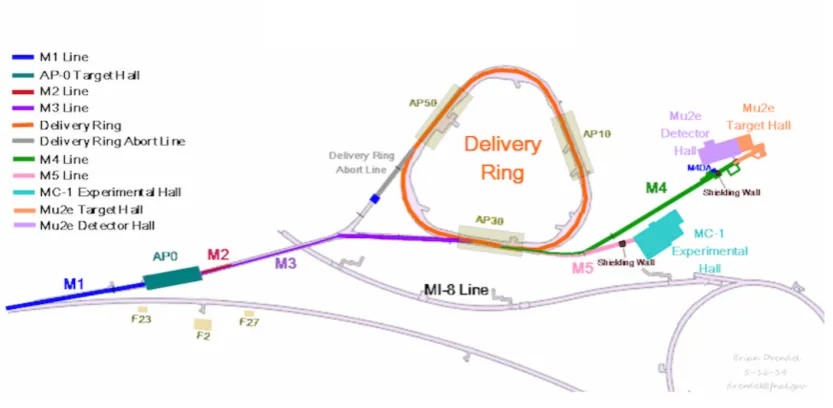
Figure 2. Schematic of Fermilab muon campus showing the M1 line for 8 GeV proton delivery, the AP0 production target for pion production, the M2/M3 lines for 3.11 GeV/c pion collection and 3.09 GeV/c muon capture, the delivery ring for separating muons, pions and protons, the M5 line for beam delivery to theg-2 experiment, and the line M4 for beam delivery to the Mu2e experiment.
two frequencies differ byωa ≡ωs −ωc where
ω
a=
m
q
[
a
µB
−
(
a
µ−
1
γ
2−
1
)
β
×
E
/
c
]
,
(3)
is the so-called anomalous precession frequency. At the magic momentum 3.094 GeV/c – where γ = 29.3 – the term in Eqn. 3 involving the electric field vanishes. Thus measurement of ωa and B, and knowledge ofq and m,
together permit the determination of aµ. One attractive
feature of the experimental technique is the direct mea-surement of the anomalous part of the magnetic moment arising from vacuum fluctuations.
In practice, the experiment involves precisely measur-ing two frequencies; the muon anomalous precession fre-quencyωathat was introduced above and a proton Lamor precession frequencyωpfor the B-field determination.
At the magic momentum the muons have a time-dilated lifetime of 64.4µs and their spin advances about one extra turn for every thirty orbits of the storage ring. The frequency ωa can be obtained from its sinusoidal modulation of the time distribution of the positrons emit-ted in the muon decays. The positrons are detecemit-ted by calorimeters that are located on the inner circumfer-ence of the storage ring (the positrons have lower mo-menta than stored muons and spiral inwards). The ori-gin of the ωa-modulation is the self-analyzing nature of
the muons,i.e.the high energy decay positrons are pref-erentially emitted along the muon spin direction. When the positron emission is directed along the muon orbit the Lorentz boost yields higher-energy positrons. When the positron emission is directed opposite the muon orbit the Lorentz boost yields lower-energy positrons. Conse-quently, the lab-frame energy of emitted positrons oscil-lates sinosoidally with frequencyωa. Thus, by measur-ing either the integrated positron energy versus time or the
high-energy positron counts versus time, the frequencyωa
is extractable.
The relevant B-field in Eqn. 3 is the magnetic field av-eraged over the muon beam distribution. A combination of fixed NMR probes and movable NMR probes are used to measure the proton Lamor frequencyωpin the storage ring
magnetic field. Nearly 400 fixed probes are distributed around the ring’s circumference at locations either just above or just below the vacuum vessel. Additionally, 17 movable probes are mounted to a trolley that can circum-navigate the vacuum vessel interior in dedicated, beam-off,
trolley runs. A special NMR probe is used for the 20 ppb absolute calibration of the entire NMR system. This sys-tem – together with accompanying measurements of the spatial distribution of the stored beam – thereby enables the determination of the beam-weighted, Lamor frequency
ωp.
From the determination of the muon’s anomalous fre-quency, ωa, and the proton’s Lamor frequency, ωp, the
anomalyaµis extracted via
aµ=
ωa/ωp
µµ/µp − ωa/ωp (4)
whereµµ/µpis the muon-to-proton magnetic moment
ratio. The quantityµµ/µpis needed as the frequencyωais
proportional to the muon’s anomalous magnetic moment whereas the frequencyωp is proportional to the proton’s
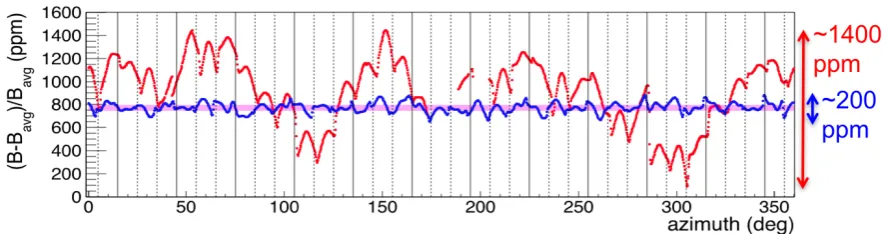
Figure 3.Azimuthal variation of the 1.45 T magnetic field of the storage ring during the shimming program. The red curve indicates the field variation in October 2015 and the blue curve indicates the field variations in June 2016. The shimming program untimately achieved a uniformity of±50 ppm (the pink band).
4 Experiment status
The Fermilab muon campus is shown in Fig. 2. A number of existing components of Fermilab’s accelerator complex are being reused to deliver fills of polarized, magic mo-mentum muons to theg-2 storage ring. Protons bunches are first accelerated to 8 GeV using the booster ring. These bunches are then dispatched via the recycler ring to the AP0 target facility which is now repurposed as a pion source. Existing transfer lines are tuned to collect the 3.11 GeV/c pions from proton spallation and capture the
3.094 GeV muons fromπ→µνdecay. Lastly the recycler ring – now renamed the delivery ring – is used to separate in time the muons from pions and protons with the muons then being directed to theg-2 storage ring via a newly-built
transfer line. The design eliminates the prompt “flash” of pions and protons and – based on simulations and mea-surements – is expected to a yield an incident rate of 5-10×104µ+per fill.
The Fermilab g-2 experiment is reusing the 1.45 T
superconducting storage ring constructed for the earlier Brookhaveng-2 experiment –i.e.involving relocating the storage ring from Upton, NY to Batavia, IL. The move, which included transporting the 15 m-diameter supercon-ducting coils and 650-ton steel yoke, was completed in 2013. The coils were shipped by barge – first south down the Atlantic coast and north up the Mississippi river – on a one-month, 3200-mile journey. The reassembly of the storage ring in the experimental hall of the newly con-structed MC-1 building was completed in 2014. Two ma-jor milestones – cooling-down the superconducting coils and powering-up the main magnet – were achieved in 2015.
During the period 2015-16 the meticulous process of shimming the ring magnet to reach the required uniformity of magnetic field was carried out (see Fig. 3). This inter-ative procedure progressed from the coarse adjustment of large pole pieces to the fine adjustment of tiny shimming wedges and greatly benefited from modern real-time mea-surement of field strengths versus shimming adjustments. Ultimately, the procedure led to a±50 ppm field mity – about a four-fold improvement in the field unifor-mity over the BNL experiment.
In addition to the 5172 A main magnet for the 1.45 T magnetic field the storage ring incorporates a supercon-ducting inflector, three pulsed kickers, and four electro-static quadrupoles. The superconducting inflector and pulsed kickers are together responsible for channeling the injected muons onto the central orbit of the storage ring. The electrostatic quadrupoles provide the vertical confine-ment of stored muons.
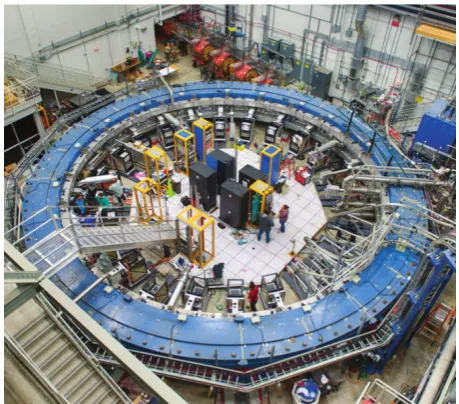
Over the past year various new or refurbished detec-tor packages have been installed. These packages include the twenty four electromagnetic calorimeters and the asso-ciated laser calibration system for the precision measure-ment of the positron time and energy distribution as well as vacuum straw trackers for positron tracking and in-vacuum scintillating fibers for muon tracking. A further detector package – comprising a plastic Cerenkov counter and scintillating fiber arrays – was installed to provide time and profile measurements of the beam upstream of the su-perconducting inflector. The full assembly of the muon storage ring and various detector packages are shown in Fig. 4.
Each calorimeter comprises a 6 ×9 segmented ar-ray of 2.5 ×2.5 ×14 cm3 PbF2 crystals [14, 15]. The
Cerenkov light from each crystal is detected by commer-cial silicon photomultipliers (SiPMs), amplified by cus-tom charge-sensitive amplifiers, and digitized by cuscus-tom, 12-bit, 800 MSPS waveform digitizers. The continuously digitized traces from every crystal of every calorimeter are readout and processed by a 20 GB/s, 100 TFlop data
read-out and real-time processing system.
The first engineering run of the muon beam, stor-age ring and various detector systems was conducted in June, 2017. On May, 27 the first signals from a fill were recorded by the electromagnetic calorimeters and the straw trackers. On June, 7 the first evidence of “many-turn” storage of a fill was recorded by the electromag-netic calorimeters and the in-vacuum scintillating fibers. By June, 10 the first positron time distribution or so-called “wiggle plot” showing the time-dilated lifetimeγτµ
Figure 3.Azimuthal variation of the 1.45 T magnetic field of the storage ring during the shimming program. The red curve indicates the field variation in October 2015 and the blue curve indicates the field variations in June 2016. The shimming program untimately achieved a uniformity of±50 ppm (the pink band).
4 Experiment status
The Fermilab muon campus is shown in Fig. 2. A number of existing components of Fermilab’s accelerator complex are being reused to deliver fills of polarized, magic mo-mentum muons to the g-2 storage ring. Protons bunches are first accelerated to 8 GeV using the booster ring. These bunches are then dispatched via the recycler ring to the AP0 target facility which is now repurposed as a pion source. Existing transfer lines are tuned to collect the 3.11 GeV/c pions from proton spallation and capture the
3.094 GeV muons fromπ→µνdecay. Lastly the recycler ring – now renamed the delivery ring – is used to separate in time the muons from pions and protons with the muons then being directed to theg-2 storage ring via a newly-built
transfer line. The design eliminates the prompt “flash” of pions and protons and – based on simulations and mea-surements – is expected to a yield an incident rate of 5-10×104µ+per fill.
The Fermilab g-2 experiment is reusing the 1.45 T
superconducting storage ring constructed for the earlier Brookhaveng-2 experiment –i.e.involving relocating the storage ring from Upton, NY to Batavia, IL. The move, which included transporting the 15 m-diameter supercon-ducting coils and 650-ton steel yoke, was completed in 2013. The coils were shipped by barge – first south down the Atlantic coast and north up the Mississippi river – on a one-month, 3200-mile journey. The reassembly of the storage ring in the experimental hall of the newly con-structed MC-1 building was completed in 2014. Two ma-jor milestones – cooling-down the superconducting coils and powering-up the main magnet – were achieved in 2015.
During the period 2015-16 the meticulous process of shimming the ring magnet to reach the required uniformity of magnetic field was carried out (see Fig. 3). This inter-ative procedure progressed from the coarse adjustment of large pole pieces to the fine adjustment of tiny shimming wedges and greatly benefited from modern real-time mea-surement of field strengths versus shimming adjustments. Ultimately, the procedure led to a±50 ppm field mity – about a four-fold improvement in the field unifor-mity over the BNL experiment.
In addition to the 5172 A main magnet for the 1.45 T magnetic field the storage ring incorporates a supercon-ducting inflector, three pulsed kickers, and four electro-static quadrupoles. The superconducting inflector and pulsed kickers are together responsible for channeling the injected muons onto the central orbit of the storage ring. The electrostatic quadrupoles provide the vertical confine-ment of stored muons.
Over the past year various new or refurbished detec-tor packages have been installed. These packages include the twenty four electromagnetic calorimeters and the asso-ciated laser calibration system for the precision measure-ment of the positron time and energy distribution as well as vacuum straw trackers for positron tracking and in-vacuum scintillating fibers for muon tracking. A further detector package – comprising a plastic Cerenkov counter and scintillating fiber arrays – was installed to provide time and profile measurements of the beam upstream of the su-perconducting inflector. The full assembly of the muon storage ring and various detector packages are shown in Fig. 4.
Each calorimeter comprises a 6 ×9 segmented ar-ray of 2.5 ×2.5 ×14 cm3 PbF2 crystals [14, 15]. The
Cerenkov light from each crystal is detected by commer-cial silicon photomultipliers (SiPMs), amplified by cus-tom charge-sensitive amplifiers, and digitized by cuscus-tom, 12-bit, 800 MSPS waveform digitizers. The continuously digitized traces from every crystal of every calorimeter are readout and processed by a 20 GB/s, 100 TFlop data
read-out and real-time processing system.
The first engineering run of the muon beam, stor-age ring and various detector systems was conducted in June, 2017. On May, 27 the first signals from a fill were recorded by the electromagnetic calorimeters and the straw trackers. On June, 7 the first evidence of “many-turn” storage of a fill was recorded by the electromag-netic calorimeters and the in-vacuum scintillating fibers. By June, 10 the first positron time distribution or so-called “wiggle plot” showing the time-dilated lifetimeγτµ
and anomalous precession frequencyωawas reconstructed from the high energy positron hits in the electromagnetic calorimeters (see Fig. 5).
Figure 4. The 7.1 m radius, 1.45 T field, muon storage. The muons are injected at the top-left of the storage ring and the positrons are detected by the twenty four calorimeters abutting the ring’s inner circumference.
The run permitted a number of studies of muon deliv-ery and muon injection that currently are informing our ef-forts to optimize muon storage. Efficient storage requires
careful focusing of the beam through the narrow aperture of the inflector, careful timing of the kicker pulsing that displaces particles onto the ring’s orbit, and careful opti-mizing of the electrostatic quadrupoles to provide vertical confinement and avoid beam resonances. The run repre-sented a major milestone in advancingg-2 to data-taking.
5 Experiment future
The goal of determiningaµto 140 parts-per-billion
preci-sion requires improved measurements of the muon anoma-lous frequencyωa and the proton Lamor frequencyωpin comparison to the Brookhaven experiment.
Concerning ωp, we require a roughly three-fold
re-duction in systematic uncertainties from 170 ppb in the Brookhaven experiment to 70 ppb in the Fermilab experi-ment. This frequency is a weighted average over the muon azimuthal and transverse distributions in the storage ring. Better determinations of the stored muon distribution us-ing the new positron trackus-ing detectors and the magnetic field variation using the refurbished NMR trolley – along with aforementioned improvements in the field uniformity from the shimming program – are parts of accomplishing this goal.
Concerningωa, we require both a twenty-fold increase
in detected positrons and a three-fold reduction in system-atic uncertainties in comparision to BNL 821. The new Fermilab muon campus is the keystone in the twenty-fold increase in the positron statistics. The latter is achieved by increasing the fills per second of the storage ring, increas-ing the muons per fill in the storage rincreas-ing, and extendincreas-ing running time. At time of writing, the push from the low
Figure 5. The wiggle plot of the positron time distribution from the June 2017 commissioning run showing the time-dilated muon lifetimeγτµ, anomalous precession frequencyωa, and “best fit” curve.
fill rate, low muon rate, engineering run to high fill rate, high muon rate, production running is new underway.
To achieve the goals forωa systematics the
collabo-ration built the new detector, electronics and acquisition system for theωameasurement. The system was designed
to handle the increased rates at Fermilab and also mini-mize biases in the extraction of the anomalous frequency
ωafrom the positron time distribution. The measurement
requires extraordinary stability of the detectors and the electronics over the 700µs measurement periods follow-ing the muon beam injection as the positron rates decrease by about four orders-of-magnitude. Serious concerns in-clude pulse pileup, gain changes and pedestal drifts during the measurement periods.
One part of reducing systematics is the readout elec-tronics and acquisition system that facilitates different
ap-proaches to determining ωa. One category of recorded data – the T-method datset – consists of chopped islands of consecutive samples that are triggered by an above-threshold signal. This dataset is used to construct the time distribution of high energy positrons hits by fitting the in-dividual crystal pulses and clustering into reconstructed positron hits. Another category of recorded data – the Q-method dataset – consists of periodic flushes of fill-summed histograms of the 700 µs contiguous traces of
ADC samples. This dataset is used to construct the time distribution of the integrated positron energy without the fitting of individual crystal pulses and clustering into re-constructed positron hits. The two datasets incur different
systematic dependencies from pulse pileup, gain changes and pedestal shifts and act as “multiple experiments” for measuringωa.
5-10×the BNL statistics by summer 2019, and 20×the BNL statistics by summer 2020.
6 Acknowledgments
The author would like to thank the organizers of the FCCP2017 workshop for a wonderful meeting. The author would also like to thank his Fermilab muong-2 collabora-tors and the finanicial support of the U.S. National Science Foundation grant PHY-1503552.
References
[1] G. W. Bennett et al. [ Muon G-2 Collaboration ], “Final Report of the Muon E821 Anomalous Mag-netic Moment Measurement at BNL,” Phys. Rev.D73, 072003 (2006). [hep-ex/0602035].
[2] J. Grange et al. [Muon g-2 Collaboration], “Muon (g-2) Technical Design Report,” arXiv:1501.06858 [physics.ins-det].
[3] M. Otani [E34 Collaboration], “Status of the Muon g-2/EDM Experiment at J-PARC (E34),” JPS Conf. Proc. 8, 025008 (2015).
[4] J. P. Miller, E. de Rafael and B. L. Roberts, “Muon g-2: Review of Theory and Experiment,” Rept. Prog. Phys.70, 795 (2007).
[5] T. P. Gorringe and D. W. Hertzog, “Precision Muon Physics,” Prog. Part. Nucl. Phys. 84, 73 (2015) [arXiv:1506.01465 [hep-ex]].
[6] K. Hagiwara, A. Keshavarzi, A. D. Martin, D. Nomura and T. Teubner, “g-2 of the muon: status report,” Nucl. Part. Phys. Proc.287-288, 33 (2017).
[7] M. Davier, A. Hoecker, B. Malaescu and Z. Zhang, “Reevaluation of the hadronic vacuum polarisation con-tributions to the Standard Model predictions of the muon g-2 and alpha(mZ) using newest hadronic cross-section data,” arXiv:1706.09436 [hep-ph].
[8] F. Jegerlehner, “Muon g-2 Theory: the Hadronic Part,” arXiv:1705.00263.
[9] M. Davier, A. Hoecker, B. Malaescu and Z. Zhang, “Reevaluation of the Hadronic Contributions to the Muon g-2 and to alpha(MZ),” Eur. Phys. J.C71, 1515 (2011). Erratum-ibid.C72, 1874 (2012).
[10] K. Hagiwara, R. Liao, A.D. Martin, D. Nomura and T. Teubner, “(g-2)µ and alpha(M2Z) re-evaluated using
new precise data,” J. Phys.G38, 085003 (2011). [11] F. Jegerlehner, R. Szafron, “ρ0−γmixing in the
neu-tral channel pion form factorFe
πand its role in
compar-inge+e−withτspectral functions,” Eur. Phys. J.C71,
1632 (2011). [arXiv:1101.2872 [hep-ph]].
[12] T. Aoyama, M. Hayakawa, T. Kinoshita and M. Nio, “Tenth-Order QED Contribution to the Electron g-2 and an Improved Value of the Fine Structure Constant,” Phys. Rev. Lett. 109 (2012).
[13] C. Gnendiger, D. Stockinger and H. Stockinger-Kim, “The electroweak contributions to (g−2)µafter
the Higgs boson mass measurement,” Phys. Rev.D88
(2013) 053005.
[14] A. T. Fienberg et al., “Studies of an array of PbF2 Cherenkov crystals with large-area SiPM
read-out,” Nucl. Instrum. Meth. A 783, 12 (2015). arXiv:1412.5525 [physics.ins-det]].
[15] J. Kasparet al., “Design and performance of SiPM-based readout of PbF2crystals for high-rate, precision