O R I G I N A L R E S E A R C H
Voltage-dependent calcium channel
α
2
δ
1 subunit
is a speci
fi
c candidate marker for identifying
gastric cancer stem cells
This article was published in the following Dove Press journal: Cancer Management and Research
Ziran Zhang1
Wei Zhao2
Xiaoting Lin1
Jing Gao1
Zhiqian Zhang2
Lin Shen1
1Key Laboratory of Carcinogenesis and
Translational Research (Ministry of Education/Beijing), Department of Gastrointestinal Oncology, Peking University Cancer Hospital and Institute, Beijing, People's Republic of China;2Key
Laboratory of Carcinogenesis and Translational Research (Ministry of Education), Department of Cell Biology, Peking University Cancer Hospital and Institute, Beijing, People’s Republic of China
Purpose: Cancer stem cells (CSCs) are a subpopulation of cancer cells with self-renewal property and responsible for tumor malignancy, progression and drug resistance. Researches on CSC-specific markers in gastric cancer remain limited. Our current study explored the expression of voltage-dependent calcium channel α2δ1 subunit and the potential of using
α2δ1 as a CSC marker in gastric cancer. We also compared the specificity ofα2δ1 and CD44 in identifying gastric cancer stem cells (GCSCs).
Materials and methods: Expression ofα2δ1 was analyzed in gastric cancer cell lines, patient-derived xenograft (PDX) models and clinical samples of malignant ascites of gastric cancer patients.α2δ1+gastric cancer cells were isolated from gastric cancer cell lines. CSC properties ofα2δ1+gastric cancer cells were then verified by subsequent tests both in vitro and in vivo.
Results:The expression level ofα2δ1 was found to differ drastically among gastric cancer cell lines, PDX models and clinical samples of malignant ascites.α2δ1+gastric cancer cells sorted from HGC-27 and SGC-7901 cell lines demonstrated significant self-renewal proper-ties, including tumorigenic capacity, sphere-formation capacity and asymmetric differentia-tion potential. Knockdown ofα2δ1 inα2δ1+HGC-27 significantly inhibited CSC properties and rendered HGC-27 more sensitive to chemotherapy. Flow cytometry showed thatα2δ1+ gastric cancer cells accounted for a small fraction of CD44+ gastric cancer cells. Isolated CD44+α2δ1+ HGC-27 cells displayed more significant tumorigenic capacity and sphere-forming capacity compared with their CD44+α2δ1−counterparts.
Conclusion: α2δ1+gastric cancer cells possessed CSC properties.α2δ1 could be a proper marker in identifying GCSCs with superior specificity than CD44. The combination ofα2δ1 and CD44 could be used to identify GCSCs with improved accuracy. Knockdown ofα2δ1 combined with chemotherapy displayed higher therapeutic efficacy on gastric cancer cells, suggesting thatα2δ1 could be a potential target for anticancer treatment.
Keywords:α2δ1, gastric cancer, cancer stem cell, HGC-27
Introduction
Gastric cancer is the fourth most common malignant tumor and the third leading cause of cancer-related mortality worldwide, with an estimated 1.3 million new
cases in 2015.1Approximately 75% of all patients diagnosed with gastric cancer are
at advanced stages. Up to now, conventional cytotoxic chemotherapy has been the major treatment for advanced gastric cancer. Unfortunately, the prognosis for patients with advanced gastric cancer remains gloomy, with median survival time
Correspondence: Zhiqian Zhang Key Laboratory of Carcinogenesis and Translational Research (Ministry of Education), Department of Cell Biology, Peking University Cancer Hospital and Institute, Fu-Cheng Road 52, Hai-Dian District, Beijing 100142, People’s Republic of China
Tel +86 108 819 6792 Fax +86 108 819 6792 Email [email protected] Lin Shen
Key Laboratory of Carcinogenesis and Translational Research (Ministry of Education/Beijing), Department of Gastrointestinal Oncology, Peking University Cancer Hospital and Institute, Fu-Cheng Road 52, Hai-Dian District, Beijing 100142, People’s Republic of China Tel +86 108 819 6561
Fax +86 108 819 6561 Email [email protected]
Cancer Management and Research
Dove
press
open access to scientific and medical research
Open Access Full Text Article
Cancer Management and Research downloaded from https://www.dovepress.com/ by 118.70.13.36 on 20-Aug-2020
of <1 year, mainly due to tumor metastatic, relapse and drug resistance.1–3The cancer stem cell (CSC) theory has brought new hope to this situation.
CSC is defined as a small subset of cancer cells with self-renewal property and could differentiate asymmetrically into daughter CSC to maintain its population as well as into non-CSC to form the bulk of the tumor.4CSCs are highly invasive and are responsible for metastasis, drug resistance and relapse. Therefore, novel treatment targeting CSCs has the potential to revolutionize cancer treatment. Numerous studies have suc-ceeded in identifying gastric cancer stem cell (GCSC) with various molecular markers including CD44, aldehyde dehy-drogenase (ALDH), CD90, Sca-1, EpCAM, ABCG-2, Lgr5, Villin and MIST-1.5–15However, there are still limitations due
to poor specificity of these markers. For example, ALDH,
Lgr5 and EpCAM were also found to be expressed in normal gastric stem cells, while CD44 was reported sometimes to be expressed in cancer cells without significant CSC properties.-16,17
Thus, it is necessary to seek for more specific GCSC
markers in order to develop treatment safely targeting GCSC.
α2δ1 is a subunit of the voltage-dependent calcium
channel complexes expressed on cell membrane. Zhao et
al have reported the expression of α2δ1 in a population
of primary hepatocellular carcinoma (HCC) cells with CSC properties. They generated a new monoclonal
anti-body 1B50-1mAb that could specifically bind to α2δ1
and suppress tumor growth by blocking the MAPK path-way through the inhibition of ERK functions. The target
of 1B50-1mAb is the isoform 5 ofα2δ1, which is found
to be expressed exclusively in HCC stem cells, whereas none was expressed in normal hepatic stem cells. Moreover, combined treatment using 1B50-1mAb and
chemotherapy led to more significant tumor decrease in
HCC patient-derived xenograft (PDX) models than using
chemotherapy alone.18 In another more recent study, Yu
et al identified small cell lung cancer (SCLC) cells with
CSC properties using α2δ1 as the marker and further
confirmed that α2δ1+ SCLC cells are closely related to
chemoresistance. Also, combination of 1B50-1mAb and
chemotherapy demonstrated significant therapeutic effect
in originally chemoresistant SCLC PDX model.19 These
previous studies provide evidence that α2δ1 may be a
suitable biomarker for identifying CSCs in various solid tumors and a potential target for anticancer treatment.
There have been no reports about α2δ1 expression in
gastric cancer.
We hypothesized thatα2δ1 might play a similar role in gastric cancer. To test our hypothesis, we analyzed the
expression of α2δ1 in different gastric cancer cell lines, cancer PDX models and clinical samples of malignant ascites collected directly from gastric cancer patients. We further tested the CSC properties of α2δ1+gastric cancer cells using a series of assays both in vitro and vivo. Also, we conducted initial tests about the potential therapeutic effect ofα2δ1 inhibition.
Materials and methods
Cell lines, animals and clinical samples
The expression ofα2δ1 and CD44 was analyzed in human
gastric cancer cell lines HGC-27, SGC-7901, BGC-823, MGC-803, MKN-45, MKN-74, MKN-28, AGS and NCI-N87. HGC-27, SGC-7901, BGC-823, MGC-803, MKN-45, MKN-74, MKN-28 and AGS were purchased from Peking Union Medical College, Beijing, China. NCI-N87 was provided by You-yong Lv, PhD (Peking University Cancer Hospital and Institute). HGC-27, SGC-7901, BGC-823, MGC-803, MKN-45, MKN-74, MKN-28 and AGS cells were cultured in the RPMI-1640 medium supplemen-ted with 10% FBS (Gibco-BRL, Gaithersburg, MD, USA) and 100 U/mL penicillin (Gibco-BRL) and 100 mg/mL streptomycin (Gibco-BRL). NCI-N87 were cultured in the DMEM (Gibco-BRL) supplemented with 10% FBS (Gibco-BRL), 100 U/mL penicillin (Gibco-BRL) and 100 mg/mL streptomycin (Gibco-BRL). Cells were incubated
in a humidified incubator (37°C) supplemented with
5% CO2.
The gastric PDX models were previously established in our laboratory through inoculation of fresh fragments of
gastroscopy biopsies in NOD/SCID mice.21 The NOD/
SCID female mice (aged 4–6 weeks, weighing 18–21 g)
involved in our current research were purchased from Beijing HFK Bio-Technology Co. Ltd. (Beijing, China). All mice were raised in the specific pathogen free animal labora-tory of Peking University Clinical Cancer Hospital Animal Center. All animal experiments were performed under sterile conditions and in accordance with the National Institutes of Health Guide for the Care and Use of Laboratory Animals with protocols approved by the Animal Care and Use Committee of Peking University Cancer Hospital.
The ascites samples were collected directly from gas-tric cancer patients receiving treatment at our department. All patients had been pathologically diagnosed with malig-nant ascites due to gastric cancer. Fresh ascites were collected in sterile test tubes and centrifuged within 2 hrs at 1,000 rpm for 10 mins at 4°C. The cell pellet was
Cancer Management and Research downloaded from https://www.dovepress.com/ by 118.70.13.36 on 20-Aug-2020
resuspended in 4 mL PBS and carefully transferred to a 15
mL test tube containing 3 mL Ficoll–PaqueTMPLUS
iso-lation media (Amersham Biosciences, Piscataway, NJ, USA). After centrifugation at 1,500 rpm for 30 mins at
18–20°C, the upper layer was removed and the second
layer containing tumor cells was transferred to another test tube. The tumor cells were washed through the addi-tion of 6 mL PBS and centrifuged at 800 rpm for 10 mins
at 18–20°C. Finally, the upper layer was removed and the
tumor cell pellet was used in further experiments. All patients had signed written informed consent form before we collected the clinical samples. Acquisition and use of these samples were approved by the Ethics Committee of Beijing Cancer Hospital.
Antibody labeling,
fl
ow cytometry analysis
and
fl
ow cytometry sorting
The cells were collected and suspended at 1×10⁶ cells/
mL in PBS. Fluorescent-labeled monoclonal antibodies were added to the samples at the concentrations recom-mended by the manufacturers. After washed using PBS,
the labeled cells were analyzed using flow cytometry
BD AccuriTM C6(BD Biosciences, Bedford, MA, USA)
and sorted using fluorescence-activated cell sorting
(FACS) BD AriaⅡ (BD Biosciences). The antibodies
included allophycocyanin-conjugated mouse anti-human CD44 (Miltenyi Biotec, Bergisch Gladbach, Germany),
phycoerythrin-conjugated mouse anti-human CD326
(EpCAM) (Miltenyi Biotec) and their corresponding IgG isotypes (Miltenyi Biotec). Detailed information of
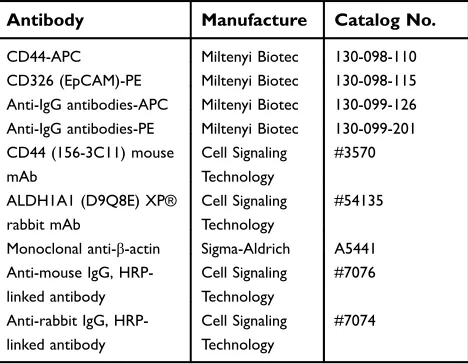
antibodies is listed in Table 1. The 1B50-1 monoclonal
antibody and the corresponding IgG isotype were
pro-vided by Zhiqian Zhang, PhD (Laboratory of
Carcinogenesis and Translational Research, Department of Cell Biology, Peking University Cancer Hospital and Institute). Both of the 1B50-1 monoclonal antibody and
the corresponding IgG isotype were labeled with fl
uor-escein using Lightning Conjugation Kits (Innova
Biosciences Ltd, Cambridge, UK) following the manu-facturer's protocol.
Sphere-formation assays
The sorted cells from HGC-27 and SGC-7901 cell lines were counted and mixed with the DMEM/F12 (Invitrogen,
Grand Island, NY, USA) supplemented with B27
(Invitrogen), 20 ng/mL epidermal growth factor, 20 ng/
mL basicfibroblast growth factor (Peprotech, Rocky Hill,
NY, USA), 10 ng/mL hepatocyte growth factor
(Peprotech) and 1% methylcellulose (Sigma-Aldrich, St. Louis, MO, USA). Then, the mixture was seeded in semi-suspension and was cultured in Ultra Low Attachment 96-well plates (Corning Incorporated Life Sciences, Acton,
MA, USA) with 100 cells/well. After incubation of 2–3
weeks, the number of spheres was counted and recorded under a stereomicroscope (Olympus, Tokyo, Japan). The frequency of sphere formation was calculated.
Tumorigenicity assay
The sorted cells from HGC-27 and SGC-7901 cell lines were suspended in PBS and mixed with Matrigel (BD Biosciences, Bedford, MA, USA) at a ratio of 1:1. The mixture was transplanted subcutaneously into the back
of NOD/SCID mice (aged 4–6 weeks, weighing 18–21
g) bilaterally, with α2δ1+ and α2δ1− cells at each side. Tumor formation was observed weekly, and the fre-quency of tumor formation was calculated.
Differentiation assays
The sorted cells from HGC-27 and SGC-7901 cell lines
were reanalyzed by flow cytometry BD AccuriTM C6
(BD Biosciences) to reassure the accurate measurement
of the frequency of α2δ1 expression. Then, the sorted
cells were counted and cultured separately in
RPMI-1640 supplemented with 10% FBS and 1% penicillin/
streptomycin at 37°C under 5% CO2. After 2 weeks,
the cells were collected and the frequency of α2δ1
expression was reanalyzed byflow cytometry.
Table 1Antibody information used in this study is summarized
Antibody Manufacture Catalog No.
CD44-APC Miltenyi Biotec 130-098-110 CD326 (EpCAM)-PE Miltenyi Biotec 130-098-115 Anti-IgG antibodies-APC Miltenyi Biotec 130-099-126 Anti-IgG antibodies-PE Miltenyi Biotec 130-099-201 CD44 (156-3C11) mouse
mAb
Cell Signaling Technology
#3570
ALDH1A1 (D9Q8E) XP® rabbit mAb
Cell Signaling Technology
#54135
Monoclonal anti-β-actin Sigma-Aldrich A5441 Anti-mouse IgG,
HRP-linked antibody
Cell Signaling Technology
#7076
Anti-rabbit IgG, HRP-linked antibody
Cell Signaling Technology
#7074
Abbreviation:APC, allophycocyanin; PE, phycoerythrin; FITC,fluorescein isothio-cyanate; IgG, Immunoglobulin G; mAb, monoclonal antibody; ALDH, aldehyde dehydrogenase; HRP, horseradish peroxidase.
Cancer Management and Research downloaded from https://www.dovepress.com/ by 118.70.13.36 on 20-Aug-2020
Transwell assays
The transwell assays were conducted using BD
BioCoat™ Matrigel™ Invasion Chamber (BD
Biosciences). The sorted α2δ1+ and α2δ1− HGC-27
cells were suspended in serum-free RPMI-1640 and placed separately on the upper layer of the inserts with permeable membrane. The lower chambers con-tained RPMI-1640 supplemented with 10% FBS. The
cells were then incubated at 37°C under 5% CO2for 24
hrs. After the incubation period, the cells that had
migrated through the membrane werefixed and stained
and then counted under a stereomicroscope (Olympus).
Western blot analysis
Gastric cancer cells were collected and lysed using cell lysis buffer (Cell Signaling Technology, Danvers, MA,
USA) and quantified using a bicinchoninic acid assay
(Applygen, Beijing, China). Lysates were resolved on 12% SDS-PAGE gels and electroblotted onto nitrocel-lulose membranes. Primary antibodies including 1B50-1 mAb, CD44 mAb (Cell Signaling Technology), ALDH1A1 mAb (Cell Signaling Technology) and
anti-β-actin (Sigma-Aldrich, St. Louis, MO, USA)
were added and incubated overnight at 4°C. Then,
secondary antibodies (Cell Signaling Technology)
including horseradish peroxidase-labeled anti-rabbit IgG or anti-mouse IgG were added and incubated for 2 hrs at room temperature. The bands were visualized using enhanced chemoluminescence and photographed
with a Fujifilm Dark Box.
The 1B50-1 mAb was provided by Zhiqian Zhang, PhD (Laboratory of Carcinogenesis and Translational Research, Department of Cell Biology, Peking University Cancer Hospital and Institute).
Antibodies used in this study are summarized inTable 1.
Statistical analysis
Statistical analysis was performed with SPSS 21.0
soft-ware(IBM, Armonk, NY, USA). The significance of
differences was determined with Student’s t test or a
χ2
test. The tumorigenic frequency and the comparison between different groups were calculated based on extreme limiting dilution analysis using the web tool
at http://bioinf.wehi.edu.au/software/elda/(Hu and
Smyth, 2009).36 p-value <0.05 was considered
statisti-cally significant.
Results
Expression levels of
α
2
δ
1 in gastric
cancer cell lines, PDX models and clinical
samples of malignant ascites from gastric
cancer patients
We first analyzed the expression of α2δ1 in nine gastric
cancer cell lines (HGC-27, SGC-7901, MKN-45, MKN-74, MKN-28, AGS, BGC-823, MGC-803 and NCI-N87) using
flow cytometry. As shown inFigure 1A,BandTable 2,α2δ1 was found to be expressed at different levels in the tested gastric cancer cell lines. Of the tested cell lines, expression level ofα2δ1 was found to be very low or undetectable in six of the cell lines, whereas it was found to be very high in cell line HGC-27, which is the only undifferentiated cell line among all the nine tested cell lines.20 We also investigate the expression ofα2δ1 in the nine gastric cancer cell lines by Western blotting. As shown inFigure 1C,α2δ1 was found to be highly expressed in HGC-27 cell line and very lowly expressed or not expressed in the other tested gastric cancer cell lines.
To investigate the expression ofα2δ1 in gastric cancer tumors, we then analyzed the tumor samples of six differ-ent gastric cancer PDX models previously established in our laboratory byflow cytometry.21 Similarly,α2δ1 were found to be expressed at different levels ranging from 4.4% to 31.4% in the tested PDX models, as shown in Figure 1D.
To further investigate the expression ofα2δ1 in clinical sample of gastric cancer patients, we collected samples of malignant ascites from ten different gastric cancer patients with widespread metastasis and isolated the tumor cells from each clinical sample following the procedure described above, and then we analyzed the expression of
α2δ1 in the isolated tumor cells by flow cytometry. The
results showedα2δ1 expressed at different levels in clin-ical samples ranging from 0.1% to 30% among the ten
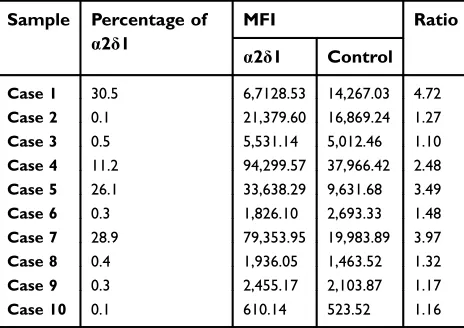
ascites samples, as shown inFigure 1EandTable 3.
α
2
δ
1
+gastric cancer cells possess highly
self-renewal property
GCSC is known closely related to various malignant char-acteristics including poor differentiation, metastasis and chemoresistance.12,22The results thatα2δ1 was especially highly expressed in the undifferentiated cell line HGC-27 and was present in clinical samples of patients with
Cancer Management and Research downloaded from https://www.dovepress.com/ by 118.70.13.36 on 20-Aug-2020
metastatic and chemoresisted gastric cancer led us to
spec-ulate whether α2δ1 is associated with GCSC. Therefore,
we performed a series of assays to evaluate the correlation
betweenα2δ1 expression and the self-renewal property in
gastric cancer cells.
We first tested the tumorigenic capacity of α2δ1+
gastric cancer cells in vivo. The purified α2δ1+ and
α2δ1− cells from HGC-27 and SGC-7901 cell lines
were inoculated subcutaneously into NOD/SCID mice
with limiting dilution (Figure 2A, Table 4). Results
103 0 200 400 600 700 104 105 106 107.2 103 0 200 400 600 700 104 105 106 107.2 102.9 0 200 400 600 700 104 105 106 107.2 102.8 0 200 400 600 700 104 105 106 107.2 101 0 200 400 600 700 102 103 106 105 104 107.2 102 0 200 400 600 700 103 105 104 106 107.2 103 0 200 400 600 700 104 105 1B50-1-FITC
A
B
C
D
E
1B50-1-FITC 1B50-1-FITC EpCAM-PE EpCAM-PE PDX1 Q4-UL 55.0% Q4-UR 31.4% Q4-LL 11.8% Q4-LR 1.9% Q2-UL 83.4% Q4-UR 13.5% Q4-LL 3.0% Q4-LR 0.1% Q5-UL 72.8% Q5-UR 10.1% Q5-LL 16.9% Q5-LR 0.3% Q1-UL 72.7% Q1-UR 7.2% Q1-LL 19.6% Q1-LR 0.4% Q1-UL 79.2% Q1-UR 5.4% Q1-LL 15.2% Q1-LR 0.2% Q1-UL 71.7% Q1-UR 4.4% Q1-LL 23.8% Q1-LR 0.1%PDX2 PDX3 PDX4 PDX5 PDX6
Cell count 106 107.2 103 0 200 400 600 700 104 105 106
107.2 103
0 200 400 600 700 104 105 106 107.2 103 0 200 400 600 104 105 106 107.2 103 0 200 400 600 104 105 106
107.2 103
0 200 400 600 104 105 106 107.2 102 0 200 400 600 700 104 103 105 106 107.2 102 0 200 400 600 700 104 103 105 106
107.2 101
0 200 400 600 700 103 102 105 104 106 107.2 102.2 0 200 400 600 800 104 103 105 106 107.2 102 0 200 400 600 700 104 103 105 106 107.2 102.7 104
105 106 107 10 2 10 3 10 4 10 5 10 6 10 7.2
101 102 104 103 106 105 107.2 10 1 10 2 10 4 10 3 10 5 10 6 10 7.2
101102 104 103 106 105 107.2 10 1 10 2 10 4 10 3 10 5 10 6 10 7.2
101 102 104 103 106 105 107.2 10 1 10 2 10 4 10 3 10 5 10 6 10 7.2
101 102 104 103 106 105 107.2 10 1 10 2 10 4 10 3 10 5 10 6 10 7.2
101 102 104 103 106 105 107.2 10 1 10 2 10 4 10 3 10 5 10 6 10 7.2 103 0 200 400 600 700 104 105 106 107.2 102.6 0 200 400 600 700 104
105 106 107.2
Figure 1Expression levels ofα2δ1 were different in gastric cancer cell lines, PDX models and ascites samples. (A) Representative images illustrating the expression ofα2δ1 in HGC-27 cell line, MKN45 cell line and ascites sample (Case 1) detected using confocal microscope. Merged images showedα2δ1 expressed on the cell membranes of cells. (B) Flow cytometry analysis showedα2δ1 expressed differently in nine gastric cancer cell lines. (C) Western blotting analysis was conducted to investigate the expression ofα2δ1 in gastric cancer cell lines. Results showedα2δ1 expressed at different levels in the nine tested cell lines. (D) Flow cytometry analysis showedα2δ1 expressed differently in six gastric cancer cell PDX models. (E) Flow cytometry analysis showedα2δ1 expressed differently in 10 clinical samples of ascites of gastric cancer patients (Cases 1–10). Scale bar: 100 µm.
Abbreviations:PDX, patient-derived xenograft; FITC,fluorescein isothiocyanate; PE, phycoerythrin.
Cancer Management and Research downloaded from https://www.dovepress.com/ by 118.70.13.36 on 20-Aug-2020
showed that as few as 100 α2δ1+ HGC-27 cells could
trigger tumor formation infive out of eight of the
inocu-lated mice, whereas the α2δ1− HGC-27 cells formed
tumor only occasionally (two of eight) within the same observation period. When inoculated with 1,000 cells,
α2δ1+ cells triggered tumor formation in seven of eight
inoculated mice for HGC-27 and in six out of nine
inocu-lated mice for SGC-7901, whereas their α2δ1−
counter-parts only triggered tumor formation in two of eight mice for HGC-27 and two of nine mice for SGC-7901. These observations suggested thatα2δ1 defined a subpopulation of gastric cancer cells with highly tumorigenic capacity in vivo. We then sorted α2δ1+ and α2δ1− cells from the tumors formed previously by theα2δ1+ cells in thefirst generation and performed subsequent transplantation
assays. The results showed that the α2δ1+ cells success-fully initiated tumor formation in the subsequently
trans-planted mice with high frequency, whereas the α2δ1−
cells remained extremely lowly tumorigenic (Figure S1,
Table S1). These results indicated that α2δ1+ cells pos-sessed self-renewal property in vivo.
We also performed the sphere-formation assays in vitro
with the purifiedα2δ1+cells from HGC-27 and SGC-7901
cell lines. As shown in Figure 2B,α2δ1+ cells displayed
significant sphere-forming capacity, whereas their
corre-sponding α2δ1− counterparts displayed extremely low
sphere-forming capacity. It was important to note that the
α2δ1+ cells sorted from the sphere formed previously
continued to display similarly high sphere-forming capa-city after subsequent propagation, demonstrating self-renewal capacity in vitro. Again, their sortedα2δ1− coun-terparts formed spheres at extremely low frequency after subsequent propagation.
These results suggested thatα2δ1+subpopulations dis-played self-renewal capacity both in vitro and in vivo.
α
2
δ
1
+gastric cancer cells possess
differentiation potential and invasiveness
Another important characteristic of CSC is the differentia-tion potential. We purifiedα2δ1+ cells from HGC-27 and SGC-7901 cell lines. After cultured in vitro for 2 weeks,
the percentage of α2δ1+ cells decreased to 95.2% for
HGC-27 and 0.8% for SGC-7901, similar to that of the unsorted parental cells. We also purifiedα2δ1−cells from HGC-27 and SGC-7901 cell lines and cultured the sorted cells under the same condition for 2 weeks. It is notable
that the percentage of α2δ1+ remained extremely low in
the postcultured α2δ1− cells for both cell lines. These
results are shown in Figure 2C. This indicated that the
α2δ1+ gastric cancer cells could differentiate into α2δ1− cells but notvice versa.
We also compared the invasive capacity of purified
α2δ1+ cells and α2δ1− cells with the transwell assay.
The isolated α2δ1+ and α2δ1− cells from HGC-27 were
cultured separately in the transwell chambers for 24 hrs. After incubation, the cells that had migrated through the membrane were stained and counted. As shown in Figure 3, the isolated α2δ1+ HGC-27 cells presented
more significant invasiveness than their α2δ1−
counterparts.
Table 2 Expression levels of α2δ1 and CD44 are analyzed in gastric cancer cell lines
Cell lines Percentage of positive cells
α2δ1 CD44
AGS 0.1–0.5 90.0–92.5
BGC-823 0.1–0.3 91.2–95.0 HGC-27 89.7–95.2 90.2–98.4 MGC-803 0.1–0.4 87.4–8-96.9
MKN-28 0.3–0.6 93.1–93.3
MKN-45 0.0–0.3 96.9–97.0
MKN-74 0.1–0.5 0.1–0.4
NCI-N87 0.1–0.3 87.0–93.2 SGC-7901 0.7–1.1 91.8–95.7
Table 3 Ratio of MFI between α2δ1 versus control in ascites samples of gastric cancer patients
Sample Percentage of α2δ1
MFI Ratio
α2δ1 Control
Case 1 30.5 6,7128.53 14,267.03 4.72
Case 2 0.1 21,379.60 16,869.24 1.27
Case 3 0.5 5,531.14 5,012.46 1.10
Case 4 11.2 94,299.57 37,966.42 2.48
Case 5 26.1 33,638.29 9,631.68 3.49
Case 6 0.3 1,826.10 2,693.33 1.48
Case 7 28.9 79,353.95 19,983.89 3.97
Case 8 0.4 1,936.05 1,463.52 1.32
Case 9 0.3 2,455.17 2,103.87 1.17
Case 10 0.1 610.14 523.52 1.16
Notes:Ratio is calculated as MFI ofα2δ1/MFI of control. Abbreviation:MFI, meanfluorescence intensity.
Cancer Management and Research downloaded from https://www.dovepress.com/ by 118.70.13.36 on 20-Aug-2020
α
2
δ
1 is more speci
fi
c than CD44 in
de
fi
ning gastric CSCs
In order tofind out the possible relationship betweenα2δ1 and the conventional GCSC marker CD44, we analyzed the expression ofα2δ1 and CD44 in the nine gastric cancer
cell lines mentioned above using flow cytometry. As
shown inFigure 4AandB, unlike the differential
expres-sion ofα2δ1, CD44 was found highly expressed in eight of
the nine tested cell lines, and the percentage of CD44+
fraction of those cell lines accounts for >90%.
Interestingly, further analysis showed the α2δ1+ fraction
of those cell lines accounts for a small part of the CD44+
fraction. This led us to propose thatα2δ1 might be more
specific than CD44 in defining GCSC population.
In an initial attempt to test our hypothesis, we performed sphere-formation assays in vitro and
com-pared the sphere-forming capacity of purified CD44+
α2δ1+ fraction and CD44+ α2δ1− fraction of HGC-27
(Figure 4C). Sphere-formation assays showed CD44+
α2δ1+ cells displayed significantly higher
sphere-form-ing capacity compared to their CD44+ α2δ1−
counter-parts. Furthermore, the descendant generations of
0 α2δ1 -
α2δ1-A
B
C
Sphere numbers/well α2δ1+ Sphere numbers/well
α2δ1-α2δ1+
α2δ1+
α2δ1-α2δ1+
α2δ1+
α2δ1-2/8
2/8 7/8
5/8
2/9
1/8 6/9
3/8 α2δ1+
α2δ1
-α2δ1-HGC-27 1stGeneration 2ndGeneration α2δ1-SGC-7901 1stGeneration 2ndGeneration
α2δ1+ 10
100 cells
1000 cells
α2δ1-α2δ1+
α2δ1-α2δ1+
100 cells
1000 cells
100 cells
1000 cells
100 cells
1000 cells
20 30 40
0 10 20 30 40 50
Cell count Cell count
1B50-1-FITC IgG-isotype 1B50-1-FITC IgG-isotype α2δ1 103
1002
200
400
600
700
0
200
400
600
800
104 105
106 107.2 103
104 105
106 107.2 0
200
400
600
800
103 104
105 106
107.20
200
400
600
800
103 104
105 106
107.2 103 102
0
200
400
600
700
0
200
400
600
800
104 105
106 107.2
103 104
105 106
107.2
0
200
400
600
800
103 104
105 106
107.2
0
200
400
600
800
103 104
105 106
107.2
Figure 2α2δ1+HGC-27 andα2δ1+SGC-7901 cells displayed cancer stem cell properties. (A) Comparison of tumor formation frequency of purifiedα2δ1+andα2δ1−cells in NOD/SCID mice.α2δ1+
cells displayed significant tumorigenic capacity. (B) Comparison of sphere-formation frequency of purifiedα2δ1+
andα2δ1−cells in vitro.α2δ1+ cells displayed significant sphere-forming capacity.α2δ1+cells sorted from the sphere formed previously continued to display high sphere-forming capacity after subsequent propagation. (C) Comparison of differentiation potential ofα2δ1+
andα2δ1−cells in vitro. Purifiedα2δ1+
cells were cultured in vitro for 2 weeks, and the percentage of
α2δ1+cells decreased to the value similar to that of the unsorted parental cells. Purifiedα2δ1−cells were cultured in vitro under the same condition for the same period, and the percentage ofα2δ1+
cells remained extremely low in the post-culturedα2δ1−cells. *p<0.05. Scale bar: 100 µm. Abbreviation:FITC,fluorescein isothiocyanate.
Table 4α2δ1+HGC-27 andα2δ1+SGC-7901 cells possess highly tumorigenic capacity
Group Tumor formation (tumor
formed/mice injected)
Frequency of tumorigenic cells (95% CI) p-Value
Cells inoculated
102 103
α2δ1+HGC-27(A) 5/8 7/8 1/271 (1/639–1/115) 0.0006 (A vs B)
α2δ1−HGC-27(B) 2/8 2/8 1/1,903 (1/5,342–1/678)
α2δ1+SGC-7901(C) 3/8 6/9 1/657 (1/1,382–1/312) 0.0177 (C vs D)
α2δ1−SGC-7901(D) 1/8 2/9 1/2897 (1/9,210–1/912)
Notes:The tumorigenic frequency and the comparison of the frequencies between different groups was calculated based on extreme limiting dilution analysis using the web tool at http://bioinf.wehi.edu.au/software/elda/(Hu and Smyth, 2009).36
p-value <0.05 was considered statistically significant.
Cancer Management and Research downloaded from https://www.dovepress.com/ by 118.70.13.36 on 20-Aug-2020
CD44+ α2δ1+ cells showed similarly high sphere-form-ing capacity after subsequent serial propagations.
Knockdown of
α
2
δ
1 in
α
2
δ
1
+gastric
cancer cells inhibits the CSC capacity
To further explore the correlation betweenα2δ1 and CSC
properties in gastric cancer, we sorted α2δ1+ cells from HGC-27 cell line by FACS. Then, we performed RNAi
experiments using the purified α2δ1+ HGC-27 cells to
knock down α2δ1 and evaluated the subsequent effects.
Western blot analysis was used to validate that α2δ1
expression was significantly reduced while CD44
expres-sion remained unchanged at high level, as shown inFigure
5A. Then, we compared the sphere-formation frequency
and the tumor-formation frequency ofα2δ1 knocked-down
HGC-27 cells and α2δ1+ HGC-27 cells. The results
showed that both of the sphere-formation capacity in
vitro and the tumorigenic capacity in vivo were signifi
-cantly inhibited in HGC-27 cells after α2δ1 knockdown,
indicating the decreased self-renewal property, as shown in Figure 5B,C, and Table 5.
In addition, we treatedα2δ1 knockdown HGC-27 cells
andα2δ1+HGC-27 cells with cytotoxic drug cisplatin sepa-rately and evaluated their viability with apoptosis assays. As
a result, enhanced apoptosis was observed inα2δ1
knock-down HGC-27 cells compared with α2δ1+ HGC-27 cells
when treated with cisplatin at the same concentration, indi-cating thatα2δ1 knockdown renderedα2δ1+HGC-27 cells more sensitive to cisplatin, as shown inFigure 5D.
0
α2δ1- α2δ1+ 10 20 30 40 50 Cells invaded
Figure 3α2δ1+
HGC-27 cells presented more significant invasiveness thanα2δ1−HGC-27 cells. Comparison of invasiveness ofα2δ1+
andα2δ1−HGC-27 cells using the transwell assays. The purifiedα2δ1+
andα2δ1−HGC-27 cells were cultured separately in the transwell chambers for 24 hrs. The cells that had migrated through the membrane were stained and counted.α2δ1+
HGC-27 cells displayed more invasiveness than theirα2δ1−counterparts.*p<0.05.
0
α2δ1-Sphere numbers/well α2δ1+
10 20 30 40 50
A
B
C
Q3-UL 6.3% Q3-UR 93.6% Q3-LL 0.1% Q3-LR 0.0% Q3-UL 94.7% Q3-UR 0.9% Q3-LL 4.2% Q3-LR 0.2% Q1-UL 99.9% Q1-UR 0.0% Q1-LL 0.0% Q1-LR 0.0% 103 104 105 106 107.2 10 2 10 1 10 3 10 4 10 5 10 6 10 7.2 Q2-UL 0.2% Q2-UR 0.1% Q2-LL 99.6% Q2-LR 0.1% 103 104 105 106 107.2 10 2 10 1 10 3 10 4 10 5 10 6 10 7.2 Q1-UL 92.7% Q1-UR 0.5% Q1-LL 6.8% Q1-LR 0.0% 103 104 105 106 107.2 10 2 10 1 10 3 10 4 10 5 10 6 10 7.2 Q4-UL 94.4% Q4-UR 0.3% Q4-LL 5.3% Q4-LR 0.0% 103 102 103 104 105 106 107.2 10 2 10 1 10 3 10 4 10 5 10 6 10 7.2 Q1-UL 94.7% Q1-UR 0.3% Q1-LL 4.9% Q1-LR 0.0% 103 104 105106 107.2
10 2 10 1 10 3 10 4 10 5 10 6 10 7.2 Q1-UL 95.2% Q1-UR 0.2% Q1-LL 4.6% Q1-LR 0.0% 103 104 105
106 107.2
10 2 10 1 10 3 10 4 10 5 10 6 10 7.2 Q3-UL 91.6% Q3-UR 0.4% Q3-LL 8.0% Q3-LR 0.0% 103 102 103 104 105 106 107.2 10 2 10 1 10 3 10 4 10 5 10 6 10 7.2 103 104 105 106 107.2 10 2 10 1 10 3 10 4 10 5 10 6 10 7.2 102.9 104 105 106 107.2 10 2 10 1 10 3 10 4 10 5 10 6 10 7.2 α2δ1- α2δ1+
Figure 4α2δ1 is more specific than CD44 in identifying gastric cancer stem cells. (A) Coexpression analysis ofα2δ1 and CD44 in gastric cancer cell lines byflow cytometry.
α2δ1+
cells account for a fraction of CD44+
cells. (B) Coexpression analysis ofα2δ1 and CD44 in HGC-27 and MKN-45 cell lines by confocal microscope. (C) Comparison of sphere-formation frequency of purifiedα2δ1+
CD44+
andα2δ1−CD44+
HGC-27 cells in vitro.α2δ1+ CD44+
cells displayed significantly higher sphere-forming capacity compared with theirα2δ1−CD44+
counterparts. *p<0.05.
Abbreviations:FITC,fluorescein isothiocyanate; APC, allophycocyanin.
Cancer Management and Research downloaded from https://www.dovepress.com/ by 118.70.13.36 on 20-Aug-2020
Discussion
There is now accumulating evidence supporting the existence of CSC in various types of tumors including gastric cancer.5,23–29 In our current study, we are the
first to analyze the expression of α2δ1 in gastric cancer cell lines, PDX models and clinical samples of malig-nant ascites from gastric cancer patients, and further
investigate the relationship between α2δ1 and GCSC.
We find out for the first time that the expression level
of α2δ1 varies drastically in gastric cancer and that the
α2δ1+ subpopulation of gastric cancer cells possessed
CSC properties. Moreover, through comparison of the different biological characteristics of CD44+α2δ1+ and
CD44+ α2δ1− cells, we find that α2δ1 is more specific than CD44 in identifying GCSC.
α2δ1 is a subunit of the voltage-dependent calcium
channel complex expressed on cell membrane. It has been verified in other studies that α2δ1 could be used to identify subpopulations of cancer cells with CSC
proper-ties in HCC and SCLC.18,19 In our current research, we
sortedα2δ1+andα2δ1−cells from HGC-27 and SGC-7901 cell lines using FACS and compared their sphere-forma-tion capacity in vitro and tumorigenic capacities in vivo.
Our results showed that α2δ1+ subpopulation of gastric
cancer cells demonstrated both significantly high effi
-ciency of sphere formation in vitro and high efficiency of
0
0
Concentration of CDDP ( μM)
Cell viability (% control)
HGC27-NC
A
C
D
B
HGC27-Shα2δ1
0
0.25 0.5 1 2 4 8
20 40 60 80 100 120
Shα2δ1
Sphere numbers/well
NC
Shα2δ1
100 cells
100 cells
Shα2δ1
CD44
β-actin ALDH1A1 α2δ1
Shα2δ1
Shα2δ1 NC
8/8
3/8 NC
NC
Shα2δ1 NC
NC
10 20 30 40 50
Figure 5Knockdown ofα2δ1 inhibited cancer stem cell properties ofα2δ1+
HGC-27 cells. (A) Western blotting showed the difference ofα2δ1, CD44 and ALDH expression between unmediatedα2δ1+HGC-27 cells (NC) and shα2δ1 HGC-27 cells.α2δ1 was confirmed downregulated in shα2δ1 HGC-27 cells, while CD44 and ALDH remained at the same level. (B) Comparison of tumor-formation frequency of unmediatedα2δ1+
HGC-27 cells (NC) and shα2δ1 HGC-27 cells in NOD/SCID mice. The tumorigenic capacity was significantly inhibited afterα2δ1 was knocked down. (C) Comparison of sphere-formation frequency of unmediatedα2δ1+HGC-27 cells (NC) and shα2δ1 HGC-27 cells in vitro. The sphere-formation capacity was significantly inhibited afterα2δ1 was knocked down. (D) Comparison of IC50between unmediatedα2δ1+ HGC-27 cells (black) and shα2δ1 HGC-27 cells (red) when treated with cisplatin. *p<0.05.
Abbreviation:NC, negative control; CDDP, cisplatin.
Table 5The tumorigenic capacity ofα2δ1+HGC-27 cells are inhibited afterα2δ1 knockdown
Group Tumor formation (tumor formed/mice
injected)
Frequency of tumorigenic cells
(95% CI) p -Value
α2δ1+HGC-27 8/8 1/1 (1/86–1/1) 0.0023
Shα2δ1HGC-27 3/8 1/213 (1/667–1/67.9)
Notes:The tumorigenic frequency and the comparison of the frequencies between different groups was calculated based on extreme limiting dilution analysis using the web tool at http://bioinf.wehi.edu.au/software/elda/ (Hu and Smyth, 2009).36
p-value <0.05 was considered statistically significant.
Cancer Management and Research downloaded from https://www.dovepress.com/ by 118.70.13.36 on 20-Aug-2020
tumor formation in vivo, whereas α2δ1− cells formed
sphere or tumors at extremely low efficiency under the
same condition. In addition, the transwell assay results
showed that α2δ1+ HGC-27 cells were much more
inva-sive thanα2δ1− HGC-27 cells. These results indicate the level ofα2δ1 expression defines a subpopulation of gastric cancer cells demonstrating both highly tumorigenic capa-city and invasiveness, which are two of the reported key properties of CSC.30,31It is notable that the
sphere-forma-tion capacity and tumorigenic capacity of α2δ1+ cells
expanded in subsequent propagation in vitro and serial transplantation in vivo, demonstrating self-renewal prop-erty both in vitro and in vivo, which has been established as a golden standard in identifying CSC.29,32,33Moreover, knockdown ofα2δ1 in α2δ1+ HGC-27 cells led to
drasti-cally decreased efficiency of sphere formation or tumor
formation, further indicating that the expression ofα2δ1 is closely correlated with CSC properties.
Another important property of CSC is the differen-tiation capacity. Previous studies have demonstrated that CSCs undergo symmetric division to maintain the CSC population while at the same time undergo asymmetric division into non-CSC to expand the bulk of tumor, but
non-CSC seldom differentiate into CSC.29,34,35 Our
results showed that after being cultured in vitro in
RPMI-1640 supplemented with 10% FBS, purified
α2δ1+ cells from HGC-27 and SGC-7901 cell lines
gave rise to both α2δ1+ and α2δ1− descendant cells,
but not vice versa. This is consistent with the differen-tiation capacity of CSC.
Taken together, our results above confirmed thatα2δ1
expression defines a subpopulation of cancer cells with
CSC properties in gastric cancer and could be used as a biomarker for identifying GCSC.
A number of molecules have been reported by previous researches as suitable markers for identifying GCSC, including CD44/CD44v, CD133, ALDH, Sca-1, Lgr5,
MIST-1 and Bmi-1.5–15 However, there have been
con-cerns about the specificity of these reported GCSC
mar-kers. Therefore, it is necessary to seek additional marker or combined panels of markers that may improve the accuracy of identifying GCSC. In our current study, we
analyzed the coexpression of α2δ1 and CD44
simulta-neously and found that α2δ1+ gastric cancer cells
accounted for a subpopulation of CD44+ gastric cancer
cells. Further results of sphere-formation assays showed
that CD44+α2δ1+ HGC-27 cells formed sphere with
sig-nificantly higher efficiency than their CD44+ α2δ1−
counterpart, indicating that the α2δ1+ subset of cells
might be responsible for the sphere-formation capacity
and CSC properties of the CD44+ gastric cancer cells.
This suggests that α2δ1 might be a better and more
spe-cific marker than CD44 in identifying GCSCs, or α2δ1 in
combination with CD44 could be used to improve the accuracy in identifying GCSC populations.
In previous studies, the therapeutic potential of a new monoclonal antibody 1B50-1 generated by Zhao et al,
which recognized the isoform 5 of α2δ1 subunit, had
been demonstrated on HCC.18 Zhao et al demonstrated
that treatment of 1B50-1mAb or silencing ofα2δ1 reduced
the CSC properties of HCC cells via induction of cellular apoptosis. Moreover, compared with treatment of che-motherapy alone, treatment of 1B50-1mAb combined
with doxorubicin led to more significant tumor reduction
in HCC PDX models.18In another study, Yu et al reported
that the combined treatment of 1B50-1mAb and motherapy resulted in partial response in originally
che-moresistant SCLC PDX model.19 These studies suggest
α2δ1 could be a potential target for novel anticancer ther-apy targeting CSC. In our research, we evaluated the effect
of α2δ1 knockdown in α2δ1+ HGC-27 cells. The results
showed that theα2δ1 knockdown inα2δ1+HGC-27 led to
significantly decreased sphere-forming capacity and
tumorigenic capacity, indicating an inhibition of CSC
properties. Moreover,α2δ1 knockdown rendered HGC-27
cells more sensitive to cisplatin in vitro, suggesting that
α2δ1 knockdown might mimic the effect of 1B50-1mAb
binding and improve the therapeutic effect of chemother-apy in gastric cancer cells.
One of the limitations of our current study is that the analysis and assays mainly focused on gastric cancer cells. Further experiments with clinical samples may provide a more comprehensive view of the actual function of GCSC in patients. Moreover, further explorations into the
mole-cular mechanism of α2δ1 in regulating CSC properties
may provide a deeper understanding of howα2δ1
partici-pate in tumor initiation, metastasis, chemoresistance and relapse of gastric cancer. Expansion of the size of clinical samples may also provide additional information about the possible clinical significance ofα2δ1 in gastric cancer.
Conclusion
Our current study was the first to confirm that α2δ1+
gastric cancer cells possessed CSC properties and that
α2δ1 could be used as a marker for identifying GCSC
Cancer Management and Research downloaded from https://www.dovepress.com/ by 118.70.13.36 on 20-Aug-2020
with higher specificity than CD44. The combination of
α2δ1 and CD44 could be used to identify GCSC more
accurately. Knockdown of α2δ1 sensitized HGC-27 cells
to cisplatin, suggestingα2δ1 might be a potential target for anticancer treatment.
Acknowledgments
We thank Huirong Ding, Zhihua Tian and Lina Wu from the Central Laboratory, Key Laboratory of Carcinogenesis and Translational Research (Ministry of Education), Beijing Cancer Hospital and Institute for their technical assistance.
Disclosure
The authors report no conflicts of interest in this work.
References
1. Wagner AD, Syn NL, Moehler M, et al. Chemotherapy for advanced gastric cancer.Cochrane Database Syst Rev.2017;8:CD004064. 2. Guggenheim DE, Shah MA. Gastric cancer epidemiology and risk
factors.J Surg Oncol.2013;107(3):230–236. doi:10.1002/jso.23262 3. Van Cutsem E, Sagaert X, Topal B, Haustermans K, Prenen H.
Gastric cancer. Lancet. 2016;388(10060):2654–2664. doi:10.1016/ S0140-6736(16)30354-3
4. Pattabiraman DR, Weinberg RA. Tackling the cancer stem cells -what challenges do they pose? Nat Rev Drug Discov. 2014;13 (7):497–512. doi:10.1038/nrd4253
5. Takaishi S, Okumura T, Tu S, et al. Identification of gastric cancer stem cells using the cell surface marker CD44.Stem Cells.2009;27 (5):1006–1020. doi:10.1002/stem.30
6. Qiao XT, Ziel JW, McKimpson W, et al. Prospective identification of a multilineage progenitor in murine stomach epithelium.Gastroenterology.
2007;133(6):1989–1998. doi:10.1053/j.gastro.2007.09.031
7. Richard V, Nair MG, Santhosh Kumar TR, Pillai MR. Side population cells as prototype of chemoresistant, tumor-initiating cells.Biomed Res Int.2013;2013:517237. Epub 2013 Nov 4. doi:10.1155/2013/517237. 8. Siddique HR, Saleem M. Role of BMI1, a stem cell factor, in cancer
recurrence and chemoresistance: preclinical and clinical evidences.
Stem Cells.2012;30(3):372–378. doi:10.1002/stem.1035
9. Varga J, Greten FR. Lifting the mist on gastric stem cells.Cell Stem Cell.2016;18(1):7–9. doi:10.1016/j.stem.2015.12.008
10. Leushacke M, Tan SH, Wong A, et al. Lgr5-expressing chief cells drive epithelial regeneration and cancer in the oxyntic stomach.Nat Cell Biol.2017;19(7):774–786. doi:10.1038/ncb3450
11. Zhao Y, Feng F, Zhou YN. Stem cells in gastric cancer. World J Gastroenterol.2015;21(1):112–123. doi:10.3748/wjg.v21.i1.112 12. Park JW, Park JM, Park DM, Kim DY, Kim HK. Stem cells antigen-1
enriches for a cancer stem cell-like subpopulation in mouse gastric cancer.
Stem Cells.2016;34(5):1177–1187. doi:10.1053/j.gastro.2007.09.031 13. Rassouli FB, Matin MM, Saeinasab M. Cancer stem cells in human
digestive tract malignancies. Tumour Biol. 2016;37(1):7–21. doi:10.1007/s13277-015-4155-y
14. Hoffmann W. Current status on stem cells and cancers of the gastric epithelium. Int J Mol Sci. 2015;16(8):19153–19169. doi:10.3390/ ijms160819153
15. Nguyen PH, Giraud J, Chambonnier L, et al. Characterization of biomarkers of tumorigenic and chemoresistant cancer stem cells in human gastric carcinoma.Clin Cancer Res.2017;23(6):1586–1597. doi:10.1158/1078-0432.CCR-15-2157
16. Qiao XT, Gumucio D. Current molecular markers for gastric pro-genitor cells and gastric cancer stem cells.J Gastroenterol.2011;46 (7):855–865. doi:10.1007/s00535-011-0413-y
17. Wang T, Shigdar S, Gantier MP, et al. Cancer stem cell targeted therapy: progress amid controversies. Oncotarget. 2015;6 (42):44191–44206.
18. Zhao W, Wang L, Han H, et al. 1B50-1, a mAb raised against recurrent tumor cells, targets liver tumor-initiating cells by binding to the calcium channelα2δ1 subunit.Cancer Cell.2013;23(4):541– 556. doi:10.1016/j.ccr.2013.02.025
19. Yu J, Wang S, Zhao W, et al. Mechanistic exploration of cancer stem cell marker voltage-dependent calcium channelα2δ1 subunit-mediated che-motherapy resistance in small-cell lung cancer. Clin Cancer Res.
2018;24(9):2148–2158. doi:10.1158/1078-0432.CCR-17-1932 20. Akagi T, Kimoto T. Human cell line (HGC-27) derived from the
metastatic lymph node of gastric cancer. Acta Med Okayama.
1976;30(3):215–219.
21. Zhu Y, Tian T, Li Z, et al. Establishment and characterization of patient-derived tumor xenograft using gastroscopic biopsies in gastric cancer.Sci Rep.2015;5:8542. doi:10.1038/srep08542
22. Singh SR. Gastric cancer stem cells: a novel therapeutic target.
Cancer Lett.2013;338(1):110–119. doi:10.1016/j.canlet.2013.03.034 23. Clarke MF, Dick JE, Dirks PB, et al. Cancer stem cells–perspectives on current status and future directions: AACR workshop on cancer stem cells.Cancer Res.2006;66(19):9339–9344. Epub 2006 Sep 21. doi:10.1158/0008-5472.CAN-06-3126.
24. Chiba T, Miyagi S, Saraya A, et al. The polycomb gene product BMI1 contributes to the maintenance of tumor-initiating side popula-tion cells in hepatocellular carcinoma. Cancer Res. 2008;68 (19):7742–7749. doi:10.1158/0008-5472.CAN-07-5882
25. Bonnet D, Dick JE. Human acute myeloid leukemia is organized as a hierarchy that originates from a primitive hematopoietic cell.Nat Med.1997;3(7):730–737.
26. Zeppernick F, Ahmadi R, Campos B, et al. Stem cell marker CD133 affects clinical outcome in glioma patients.Clin Cancer Res.2008;14 (1):123–129. doi:10.1158/1078-0432.CCR-07-0932
27. Cao L, Zhou Y, Zhai B, et al. Sphere-forming cell subpopulations with cancer stem cell properties in human hepatoma cell lines.BMC Gastroenterol.2011;11:71. doi:10.1186/1471-230X-11-93
28. Lv C, Li F, Li X, et al. MiR-31 promotes mammary stem cell expansion and breast tumorigenesis by suppressing Wnt signaling antagonists.Nat Commun.2017;8(1):1036. doi:10.1038/s41467-017-01059-5
29. de Sousa e Melo F, Av K, Jm H, et al. A distinct role for Lgr5+stem cells in primary and metastatic colon cancer. Nature. 2017;543 (7647):676–680. doi:10.1038/nature21713
30. Batlle E, Clevers H. Cancer stem cells revisited.Nat Med.2017;23 (10):1124–1134. doi:10.1038/nm.4265
31. Talukdar S, Emdad L, Das SK, Sarkar D, Fisher PB. Evolving strategies for therapeutically targeting cancer stem cells. Adv Cancer Res.2016;131:159–191.
32. Singh SK, Clarke ID, Terasaki M. Identification of a cancer stem cell in human brain tumors.Cancer Res.2003;63(18):5821–5828. 33. Hansford LM, McKee AE, Zhang L, et al. Neuroblastoma cells
isolated from bone marrow metastases contain a naturally enriched tumor-initiating cell. Cancer Res. 2007;67(23):11234–11243. doi:10.1158/0008-5472.CAN-07-0718
34. Yan Y, Zuo X, Wei D. Concise review: emerging role of CD44 in cancer stem cells: a promising biomarker and therapeutic target.Stem Cells Transl Med.2015;4(9):1033–1043. doi:10.5966/sctm.2015-0048 35. Rosen JM, Jordan CT. The increasing complexity of the cancer stem
cell paradigm. Science. 2009;324(5935):1670–1673. doi:10.1126/ science.1171837
36. Hu Y, Smyth GK. ELDA: extreme limiting dilution analysis for comparing depleted and enriched populations in stem cell and other assays. J Immunol Methods. 2009;347(1–2):70–78. doi:10.1016/j. jim.2009.06.008
Cancer Management and Research downloaded from https://www.dovepress.com/ by 118.70.13.36 on 20-Aug-2020
Supplementary material
Cancer Management and Research
Dove
press
Publish your work in this journal
Cancer Management and Research is an international, peer-reviewed open access journal focusing on cancer research and the optimal use of preventative and integrated treatment interventions to achieve improved outcomes, enhanced survival and quality of life for the cancer patient.
The manuscript management system is completely online and includes a very quick and fair peer-review system, which is all easy to use. Visit http://www.dovepress.com/testimonials.php to read real quotes from published authors.
Submit your manuscript here:https://www.dovepress.com/cancer-management-and-research-journal
α2δ1-α2δ1+
100 cells 1000 cells
Figure S1α2δ1+HGC-27 cells displayed significant tumorigenic capacity after subsequent transplantation.α2δ1+andα2δ1−HGC-27 cells were isolated from the tumors formed previously by theα2δ1+
cells in thefirst generation and inoculated subcutaneously into NOD/SCID mice with limiting dilution. As few as 100α2δ1+
HGC-27 cells successfully initiated tumor formation in NOD/SCID mice, whereas theirα2δ1−cell counterparts remained extremely lowly tumorigenic within the same observation period.
Abbreviation:NOD/SCID, nonobese diabetic-severe combined immune deficient.
Table S1α2δ1+HGC-27 cells displayed significant tumorigenic capacity after subsequent transplantation
Group Tumor formation (tumor
formed/mice injected)
Frequency of tumorigenic cells (95% CI) p-Value
Cells inoculated
102 103
α2δ1+HGC-27(A) 3/5 4/5 1/360 (1/988–1/131) 0.0024 (A vs B)
α2δ1−HGC-27(B) 0/5 1/5 1/4,983 (1/35,191–1/706)
Notes:The tumorigenic frequency and the comparison of the frequencies between different groups was calculated based on extreme limiting dilution analysis using the web tool at http://bioinf.wehi.edu.au/software/elda/ (Hu and Smyth, 2009).36p-value <0.05 was considered statistically significant.
Cancer Management and Research downloaded from https://www.dovepress.com/ by 118.70.13.36 on 20-Aug-2020