International Journal in Physical & Applied Sciences
http://www.ijmr.net.in email id- [email protected]
Page 64
STUDIES OF ANIONIC SURFACTANTS IN THE PRESENCE OF ADDITIVESSandeep Kumar, Dinkar Malik, Punam Yadav Department of Chemistry, M. S. College, Saharanpur U. P.
Corresponding Address: Dr. Dinkar Malik, 1800/1 Mission Compound Saharanpur
ABSTRACT
Surface tension of anionic surfactants, potassium dodecyl sulphate, sodium dodecyl sulphate,
sodium dodecyl benzene sulphonate (KDS, NaDS and NaDBS) in presence of urea (0.5M) in 2.5%
alkanol-water systems at different temperature (30-45ºC) were measured using Agla micrometer
syringe. The CMC values of anionic surfactants increased with the addition of urea, monohydric
alcohols (methanol, propanol and butanol) water systems at different temperature. Various
thermodynamic parameters have been reported.
Keywords: Potassium dodecyl sulphate (KDS); Sodium dodecyl benzene sulphonate (NaDBS); Sodium
dodecyl sulphate (NaDS); Critical micelle concentration (CMC); Surface Tension .
Introduction :
The micelle formation in an aqueous solution is known to be affected by inorganic additives and
there have been many investigations concerning the effects of organic additives on the CMC of
anionic surfactants. Bahadur et. al. (1982-83) noticed the effect of organic additives on the micellar
behaviour of ionic and non-ionic surfactants in water has been well studies by some authors with the
outcome that aliphatic alcohols have been of particular interest. Enea et. al. (1982) studied the use
of urea as a denaturant of proteins is well known. Khuarski et. al. (1984) observed that the presence
of urea and its derivatives modifies the properties of aqueous solutions. Two different mechanisms
have been proposed to explain action of urea on aqueous solutions. One is that urea acts as a water
structure breaker (indirect mechanism). The other is that urea participates in the solvation of
hydrophobic chains in water by replacing some water molecules in the hydration shell of the solute
(direct-mechanism). Kabir-ud-din et. al. (1996) reported that critical micelle concentrations (CMC) of
ionic and non-ionic surfactants significantly increase with the addition of urea in aqueous solutions.
Asakawa et. al. (1995) studied the action of urea in aqueous solution showed that urea had a
negligible influence on the water structure. Bahadur et. al. (2003) observed the effect of polymer as
additives on sodium dodecyl sulphate. Abdul- Rahem et. al. (2009) noticed the physiochemical
properties of hydroxyl mixed ether HMEn surfactants and their interaction with sodium dodecyl
International Journal in Physical & Applied Sciences
http://www.ijmr.net.in email id- [email protected]
Page 65
of anionic surfactants. Parekh et. al. (2011) studied that anionic-cationic surfactants systems ofsodium dodecyl trioxyethylene sulfate with cationic Gemini surfactants. Patel et. al. (2009) observed
that micellization of sodium dodecyl sulfate and polyoxyethylene dodecyl ether in solution. Varade
et. al (2005) noticed that miceller behaviour of mixture of sodium dodecyl sulfate and
dodecyldimethylamine oxide in aquous solution. Bharatiya et. al (2009) observed that urea induced
demicellazition of pluronic L-64 in water. Kumar et. al (2014) studied that effect of urea and
monohydric alcohol on the micelle formation of anionic surfactants at different temperature.
Experimental Procedure:
Materials:
Extra pure sodium dodecyl sulphate (B.D.H.) after recrystallization was used for the preparation of
potassium dodecyl sulphate (KDS). Potassium dodecyl sulphate was prepared by direct metathesis.
After recrystallization, it was used for physical properties. Sodium dodecyl benzene sulphonate was
purchased from Loba Chemie Pvt. Limited, Mumbai, India. Methanol, propanol and butanol were all
B.D.H. Laboratory reagent while urea was purchased from Merck (Merck Schuchardt OHG,
Germany). Triple distill water obtained from all pyrex glass assembly was used throughout studies.
Measurement:
Alcohol-water mixtures (2.5%) of several composition of urea (0.5M) were prepared by mixing
requisite quantity of alcohol in water. Stock solution of surfactants was prepared by weighing. The
surface tension(γ) measurements of surfactant solutions were made by Agla micrometer syringe
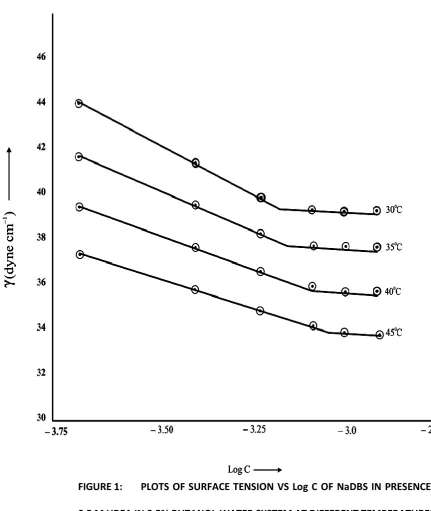
(Burroughs Wellcome Co. Ltd. England). The CMC values were determined at the breakpoint of
nearly two straight line portion in the γvs. log C plots. The CMC of the surfactants in the presence of
urea, monohydric alcohols in water at different temperature range (30-45ºC).
Results:
The surface tension (γ-values) in the presence of urea (0.5M) in 2.5% alkanol-water systems
at different temperatures (30-45oC) were measured using Agla micrometer syringe (Burroughs
Wellcome Co. Ltd. England) . Studies however could not be made for higher concentrations of
alkanols due to their low solubilityof KDS, NaDS and NaDBS in the presence of urea (0.5M) in 2.5%
alkanol-water systems. The CMC values of KDS, NaDS, NaDBS in pure water are reported in Table (1).
The CMC values of KDS, NaDS, NaDBS in the presence of urea (0.5M) in 2.5% alkanol-water systems
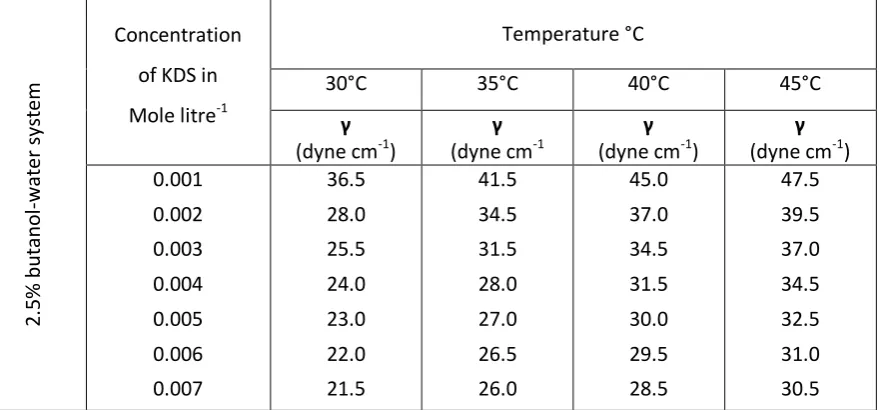
at different temperatures (30-45oC) are reported in Table (2). The γ-values of KDS, NaDS and NaDBS
using 0.5M urea in 2.5% butanol-water system at different temperatures (30-45°C) are reported in
International Journal in Physical & Applied Sciences
http://www.ijmr.net.in email id- [email protected]
Page 66
concentration which may be due to increasing tendency to form aggregates with increasingsurfactants concentration.
The decrease in γ-values in presence of urea at different temperatures and in different
alkanol-water systems studied may be explained as:
1. Effect of temperature: Increased kinetic energy tends to overcome net attractive forces of bulk
liquid such that cohesive forces between water molecules are decreased which ultimately favours
aggregation with increasing surfactants concentration. The decrease in surface tension with
temperature is due to the expansion of surface
2. Effect of alkanols: The addition of alcohols show a decrease in surface tension for a given
surfactant concentration which may be due to increase in size of the micelle as alcohol is also
incorporated in to the micelle. These observations are in close agreement with literature.
3. Effect of urea: The lowering in γ-valueswithincreasing concentration of urea may be explained in
terms of strengths of cohesive forces. Stronger hydrophobic interactions produces higher cohesive
forces for urea due to effective caging of bulk water around them .Hence it develops higher
integrated molecular forces among urea with stronger adhesion with glass.
The plots of γ vs. log C (Fig 1) for each system suggest the CMC values which are in close
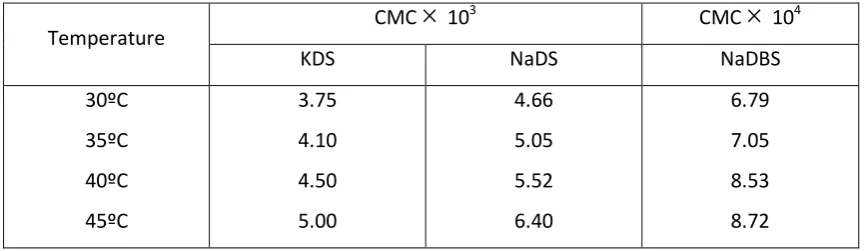
agreement with those obtained by conductivity data reported in Tables (1-2). Table 2 reveals that
CMC values of KDS, NaDS and NaDBS in the presence of 0.5 M urea in 2.5% butanol-water system
increase with increase in temperatures. An increase in temperature would have been expected to
increase the CMC value since the kinetic energy of the monomers would have been raised which
International Journal in Physical & Applied Sciences
http://www.ijmr.net.in email id- [email protected]
Page 67
FIGURE 1: PLOTS OF SURFACE TENSION VS Log C OF NaDBS IN PRESENCE OF0.5 M UREA IN 2.5% BUTANOL-WATER SYSTEM AT DIFFERENT TEMPERATURES.
The standard Gibbs energies of micellization (∆Go), in presence of urea (0.5M) and 2.5%
butanol-water system at different temperatures (30-45ºC) were calculated from equation (1) for
KDS, NaDS and NaDBS and are given in Table (5).
G0
International Journal in Physical & Applied Sciences
http://www.ijmr.net.in email id- [email protected]
Page 68
The standard enthalpy change of micellization (
H
o) per mole of monomer of KDS, NaDSand NaDBS were calculated from linear plots of log CMCx vs. 1/T (Fig 2) using equation (2) and are
14.11, 16.23, 16.39 kJ/mole respectively.
o
x
log CMC
2.303
H
C
RT
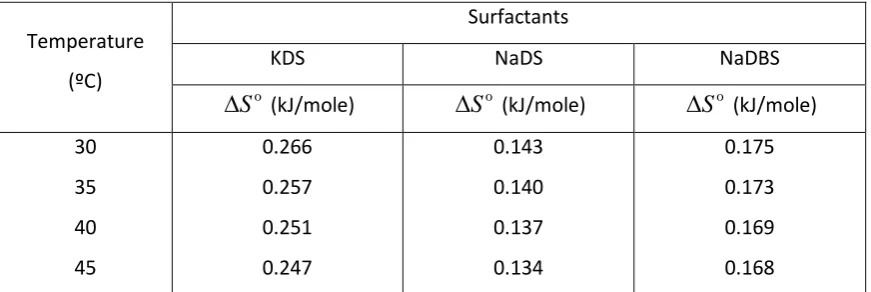
….(2)The standard entropies of micellization
(
S
o)
, in presence of urea (0.5 M) and 2.5%butanol-water system at different temperatures (30-45ºC) for KDS, NaDS and NaDBS were calculated
from equation (3) and are given in Table (6)
o o
o
H
G
S
T
International Journal in Physical & Applied Sciences
http://www.ijmr.net.in email id- [email protected]
Page 69
FIGURE 2: PLOTS OF Log CMCX VS4
1
×10
T
OF SURFACTANTS IN PRESENCE OF 0.5 M UREAIN 2.5% BUTANOL-WATER SYSTEM AT DIFFERENT TEMPERATURES.
Discussion:
The highly structured tetrahedral arrangement of water molecules in the liquid state would
have to be disrupted by the addition of any solute. When alcohols are added into water, some
hydrogen bonds must be broken and new hydrogen bond between water and alcohols would be
formed. But the hydrogen bonds formation between water and alcohol does not seem very tangible
because in liquid alcohol the tendency for OH---Obond formation is likely to be as strong as in
water, though such hydrogen bonds cannot comprise an isotropic net work filling the entire solvent
space due the presence of alkyl side chains.
In fact the lowering of CMC of surfactants by the small addition of alcohols may be due to
their direct action on water structure and the subsequent addition may cause secondary effects such
as their solubilization in micelle and decrease of hydrophobic effect. This further supports the view
that the formation of the cavity of more ordered water molecules is favored by the long
hydrocarbon chain of the alcohols. In the presence of such a cavity a decrease in CMC is not
unexpected. The role of water cavity in the micelles formation has been further verified by studying
the effect of urea on CMC. Urea is a strong water structure breaker, in presence of alcohols it may
destroy the cavity of ordered water structure. It is, therefore, expected that the CMC should
increase with the increase in the concentration of urea.
These results indicate that the addition of urea results in the breaking of water structure
even at the concentration of alcohols where it is expected to be more ordered. This partition of
additive between the solution and the micelles may be sensitive to the structure of the urea (polar
International Journal in Physical & Applied Sciences
http://www.ijmr.net.in email id- [email protected]
Page 70
The inclusion of alcohol molecules into the surfactant micelle is clearly reflected from thedecrease in slopes above the CMC. It is also clear that the inclusion effect is stronger for alcohols
with larger alkyl chain which brings about the reduction of the surface- charge density on the
micelle.
The presence of urea in the soap solutions breaks the hydrogen- hydrogen bonds, thereby
weaking the cohesive forces existing between the water molecules. The ‘pushing out’ tendency for
the hydrophobic portion is thus lessened with the result that larger proportion of single soap
molecule can remain in solution. Micelle formation would, therefore take place at higher soap
concentration.
Table 1: CMC values for KDS, NaDS and NaDBS in pure water at different temperatures (30-45ºC).
Temperature CMC x 10
3
CMC x 104
KDS NaDS NaDBS
30ºC
35ºC
40ºC
45ºC
8.53
9.00
9.25
9.50
8.35
8.50
8.65
8.80
10.0
12.5
13.8
15.0
Table 2: Values of CMC for KDS, NaDS and NaDBS in presence of urea (0.5 M) and 2.5%
butanol-water system at different temperatures (30-45ºC) obtained by γ vs. log C plots.
Temperature CMC
103
CMC
104KDS NaDS NaDBS
30ºC
35ºC
40ºC
45ºC
3.75
4.10
4.50
5.00
4.66
5.05
5.52
6.40
6.79
7.05
8.53
International Journal in Physical & Applied Sciences
http://www.ijmr.net.in email id- [email protected]
Page 71
Table 3: Values of surface tension (γ) for KDS in the presence of urea (0.5 M) and 2.5%butanol-water system at different temperatures (30-45°C).
Table 4: Values of surface tension (γ) for NaDS in the presence of urea(0.5 M) and 2.5%
butanol-water system at different temperatures (30-45°C).
2. 5% b u tan o l-wat er sy st em Concentration
of KDS in
Mole litre-1
Temperature °C
30°C 35°C 40°C 45°C
γ (dyne cm-1)
γ (dyne cm-1
γ (dyne cm-1)
γ (dyne cm-1) 0.001 0.002 0.003 0.004 0.005 0.006 0.007 36.5 28.0 25.5 24.0 23.0 22.0 21.5 41.5 34.5 31.5 28.0 27.0 26.5 26.0 45.0 37.0 34.5 31.5 30.0 29.5 28.5 47.5 39.5 37.0 34.5 32.5 31.0 30.5 2 .5 % b u tan o l-wat er sy st em Concentration of
NaDS in Mole
litre-1
Temperature °C
30°C 35°C 40°C 45°C
γ (dyne cm-1)
γ (dyne cm-1
γ (dyne cm-1)
International Journal in Physical & Applied Sciences
http://www.ijmr.net.in email id- [email protected]
Page 72
Table 5: Thermodynamic parameters for KDS, NaDS and NaDBS in the presence of urea (0.5 M) and2.5% butanol-water system at different temperatures (30-45°C).
Temperature
(ºC)
Surfactants
KDS NaDS NaDBS
-∆Go (kJ/mole) -∆Go (kJ/mole) -∆Go (kJ/mole)
30
35
40
45
30.97
29.47
28.47
28.96
27.0
26.99
26.95
26.65
36.75
37.12
36.77
37.11
Table 6: Thermodynamic parameters for KDS, NaDS and NaDBS in the presence of urea (0.5M) and
2.5% butanol-water system at different temperatures (30-45°C).
Temperature
(ºC)
Surfactants
KDS NaDS NaDBS
o
S
(kJ/mole)
S
o (kJ/mole)
S
o (kJ/mole)30
35
40
45
0.266
0.257
0.251
0.247
0.143
0.140
0.137
0.134
0.175
0.173
0.169
International Journal in Physical & Applied Sciences
http://www.ijmr.net.in email id- [email protected]
Page 73
References1. Bahadur P, Gupta A, Goswami AK. Studies on the conductance behaviour of anionic surfactants in polar solvents. Tenside Surf. Deterg, 1982, (19), 88-92
2. Bahadur P, Gupta A, Bahadur P. Studies on viscocity behaviour of anionic surfactants in polar solvents. Tenside Surf. Deterg.1983, (20), 142-144.
3. Enea O, Jolicoeur J. Heat capacities and volume of several oligopeptides in Urea-water mixtures at 25ºC. Some implications for protein unfolding, J. Phys. Chem; 1982, (86), 3870
4. Khuarski RA, Rossky PJ. Molecular dynamics study of solvation in Urea-water solution. J. Am. Chem. Soc; 1984, (106), 5786
5. Kabir-ud-Din, Kumar S, Aswal VK, Goyal PS. Effect of salt and organic additives on micellar aggregation of sodium dodecyl sulphate, J. Chem. Soc, Faraday Trans. 1996, (92), 2413
6. Asakawa T, Hashikawa M, Amoda K, Miyagishi S. Effect of urea on micelle formation of fluorocarbon surfactants, Langmuir . 1995, (11), 2376
7. Bahadur P, Chand M. Studies on polymer surfactant interactions and the effect of electrolyte and temperature. Tenside Surf. Det. 2003, (2), 105
8. Abdel-Rahem R, Ayesh AS. Physicochemical properties of hydroxyl ether HMEn surfactants and their interaction with sodium dodecyl sulfate SDS. Tenside Surf. Det. 2009, (2), 105
9. Cohen L, Sato F, Sanchez E. Effect of calcium ions concentration on the foaming power of anonic surfactants. Tenside Surf. Det. 2009, (6), 352
10. Parekh P, Varade D, Parikh J, Bahadur P. Anionic-cationic surfactants systems: miceller interactions of sodium dodecyl trioxyethylene sulfate with cationic Gemini surfactants. Colloids surfaces A, 2011, (385), 111-120
11. Patel T, Gosh G, Aswal VK, Bahadur P. Micellization of sodium dodecyl sulfate and polyoxyethylene dodecyl ether in solution. Colloids. Polym. Sci. 2009, (287), 1175-1181 12. Varade D, Joshi T, Aswal VK, Goyal PS, Hassan PA, Bahadur P. Miceller behaviour of
mixture of sodium dodecyl sulfate and dodecyldimethylamine oxide in aquous solution. Colloids. Surfaces A, 2005, (259), 103-109
13. Bharatiya B, Guo C, Ma JH, Kubota O, Nakashima K, Bahadur P. Urea induced demicellazition of pluronic L-64 in water, Colloids Polymer Science, 2009, (287), 63-71 14. Kumar S, Yadav P, Malik D, Malik V. Effect of urea and butanol on the micelle formation
of anionic surfactants at different temperature, Ind. J. Sci, 2014, (21), 8-14
15. Kumar S, Yadav P, Malik D, Malik V. Effect of temperature on the micelle formation of anionic surfactants in the presence of different concentration of urea, International J of Therotical and Applied Sci, 2014, (6), 49-55
16. Kumar S, Yadav P, Malik D, Malik V. Physico chemical properties of anionic surfactants in the presence of urea and monohydric alcohol at different temperature, Indian Streams Reseach Journal, 2014, (4), 01-10