University of South Carolina
Scholar Commons
Theses and Dissertations
2016
The Prepared Flute: A Survey of its History,
Techniques, and Repertoire
Stacey Lee Russell
University of South Carolina
Follow this and additional works at:https://scholarcommons.sc.edu/etd Part of theMusic Performance Commons
This Open Access Dissertation is brought to you by Scholar Commons. It has been accepted for inclusion in Theses and Dissertations by an authorized administrator of Scholar Commons. For more information, please [email protected].
Recommended Citation
Russell, S. L.(2016).The Prepared Flute: A Survey of its History, Techniques, and Repertoire.(Doctoral dissertation). Retrieved from
The Prepared Flute: A Survey of its History, Techniques, and Repertoire
by
Stacey Lee Russell
Bachelor of Music Education Cedarville University, 2007
Master of Music Wright State University, 2011
________________________________________________
Submitted in Partial Fulfillment of the Requirements
For the Degree of Doctor of Musical Arts in
Music Performance
School of Music
University of South Carolina
2016
Accepted by:
Jennifer Parker-Harley, Major Professor
Michael Harley, Committee Member
John Fitz Rogers, Committee Member
Phillip Bush, Committee Member
ii
© Copyright by Stacey Lee Russell, 2016
iii
ACKNOWLEDGEMENTS
Warmest thanks to my supervisor, teacher and mentor Dr. Jennifer
Parker-Harley for her guidance, encouragement, and dedication in helping me produce this
document. Her many hours of proofreading, planning, and excitement were priceless. I
am grateful to my committee members, Dr. Michael Harley, Dr. John Fitz Rogers, and
Mr. Philip Bush for their expertise, support, and inspiration.
I have been immensely blessed to have Steve and Carol Russell as my parents,
and Stephanie Russell as my sister. Their ever-present love, faith, and belief in my
dreams gave me the courage to pursue my goals. Thank you to John Holloway for his
wisdom, and for always challenging me.
Lastly, this research document would not have been possible without the
unending love and support of my dog, Kiwi. The best way to write a dissertation is with a
iv
ABSTRACT
Beginning with Varese’s Density 21.5 in 1936, composers have been
experimenting with extended techniques to expand the flute’s range of sound. In an
attempt to increase the timbral possibilities of the instrument, contemporary
composers are writing for the prepared flute: adding objects on or inside the flute, or
subtracting parts of the flute to alter its sound.
This is the first written document to focus on the prepared flute. Deborah
Fethers, in her major project discussing contemporary flute design in 2005, mentions
the use of prepared flute by Michael Pestel, and states that “to my knowledge the only
use of such ‘preparation’ of a flute is by Pestel” (Fethers). My research shows that there
are, in fact, numerous other examples of composers’ use of preparations when writing
for the flute, and this document serves to compile those examples. With compositions
for prepared flute written as early as the 1980s, the flute community is in need of a
detailed account of the pieces available, how to tackle the technical intricacies, and a
reference for composers to consult. As the above quote indicates, most musicians in the
flute community are unaware that the prepared flute genre exists, let alone know the
major players involved in this area.
Limitations of this study include the difficulty to obtain copies of all pieces
v
Correspondence from the composers is deficient, due in part to language and location
barriers or lack of response.
This document presents the history of the prepared flute through the
examination of ten pieces, and discusses objects commonly used to prepare the
instrument. In addition, this project involved commissioning a new work for prepared
flute and prepared piano, a combination lacking in current repertoire. The preparations
for the flute provide new realms of sound possibilities for the instrument, offer new
avenues for composing unpredictable music, and inspire new chamber music that
includes prepared flute. With greater awareness of prepared flute, the author hopes
that more flutists will become aware of the possibilities, composers will be inspired to
add to the idiom, and audiences will be inspired by the music that results.
Also included in this document are tables that list repertoire and preparations
specific to each piece, and two appendixes that provide listening possibilities and
locations to purchase the compositions mentioned in this document. Finally, my website
(www.staceyleerussell.com) includes a section dedicated to new pieces for prepared
vi
TABLE OF CONTENTS
ACKNOWLEDGEMENTS ... iii
ABSTRACT ... iv
LIST OF TABLES ... viii
LIST OF FIGURES ... ix
CHAPTER 1: BACKGROUND ON PREPARING INSTRUMENTS ... 1
1.1 HISTORY OF PREPARED PIANO... 1
1.2 HISTORY OF PREPARING OTHER INSTRUMENTS ... 4
1.3 CONCLUSION ... 12
1.4 HISTORY OF THE PREPARED FLUTE ... 14
CHAPTER 2: HOW TO PREPARE THE FLUTE ... 18
2.1 UNDER/ON THE KEYS ... 18
2.2 INSIDE THE TUBE ... 22
2.3 SUBTRACTION OF PARTS ... 27
2.4 ADDITION OF PARTS FROM OTHER INSTRUMENTS ... 29
2.5 VISUAL/THEATRICAL ... 30
2.6 CONCLUSION ... 33
CHAPTER 3: A SURVEY OF COMPOSITIONS FOR PREPARED FLUTE ... 35
3.1 HUNGARY ... 35
3.2 POLAND ... 61
3.3 NETHERLANDS ... 69
3.4 SWEDEN ... 74
3.5 GREECE ... 76
vii
3.7 UNITED STATES OF AMERICA ... 76
3.8 SOUTH KOREA ... 77
3.9 JAPAN ... 79
CHAPTER 4: THE PREPARED FLUTE OF TODAY: GREYTUDES BY ISAAC BROCKSHUS ... 84
4.1 BACKGROUND ... 84
4.2 ISAAC BROCKSHUS ... 84
4.3 THE COMPOSITION ... 85
4.4 CHALLENGES ... 101
4.5 CONCLUSION ... 102
SUMMARY AND FINAL CONCLUSION... 104
REFERENCES ... 106
APPENDIX A: DISCOGRAPHY ... 112
viii
LIST OF TABLES
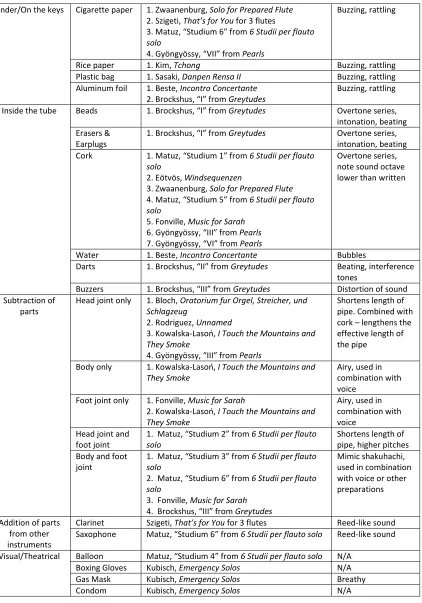
Table 1.1: Instrumentation, compositions, and objects ... 13
Table 2.1: Prepared objects, compositions that use them, and the resulting sound ... 34
ix
LIST OF FIGURES
Figure 1.1 Clarinet with vinyl tube ... 5
Figure 1.2 Letter corners used to prepare a cello ... 8
Figure 1.3 Plastic plug ... 8
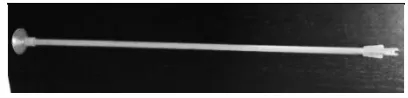
Figure 2.1 Dart with suction cup ... 26
Figure 2.2 Buzzer ... 27
Figure 3.1 Example of time indicators in “Studium 1.” ... 42
Figure 3.2 Position of fingers for “Studium 2.” ... 44
Figure 3.3 Positive and negative percussive effects in “Studium 2.” ... 45
Figure 3.4 Irregular key signature in “Studium 4.” ... 47
Figure 3.5 Brutal double tonguing. ... 49
Figure 3.6 Blowing up the balloon. ... 49
Figure 3.7 Double trills. ... 51
Figure 3.8 The addition of a saxophone mouthpiece. ... 54
Figure 3.9 Fermata. ... 60
Figure 3.10 Trumpet embouchure. ... 61
Figure 3.11 Directions on submerging the head joint. ... 67
Figure 3.12 The use of vowels in flute preparation. ... 68
Figure 3.13 Percussive sounds. ... 68
Figure 3.14 Written quarter tones possible through cork preparation. ... 71
Figure 3.15 Extended techniques in Solo for Prepared Flute ... 73
Figure 3.16 The use of a vinyl tube in the foot joint. ... 75
Figure 3.17 Tchong duet between prepared flute and court daegum ... 79
x
Figure 4.1 Greytudes I, demonstration of flute angle. ... 88
Figure 4.2 Greytudes II “trill” indication for stoppers. ... 94
Figure 4.3 Greytudes II, angle of the flute. ... 95
Figure 4.4 Greytude III the Buzz Saw. ... 98
Figure 4.5 Greytudes III the Incinerator, adding flutter tonguing. ... 98
1
CHAPTER 1
BACKGROUND ON PREPARING INSTRUMENTS
The inspiration to prepare the flute begins with early piano preparations. In fact,
the motivation to prepare any instrument starts with Henry Cowell.
1.1 HISTORY OF PREPARED PIANO:
The beginning of piano preparation can be traced back to composer John Cage.
In 1936 he studied with Henry Cowell, composer of Aeolian Harp (ca. 1923) and The
Banshee (1925), piano works that feature extended techniques. Cage took inspiration
from the innovations of Cowell, who stroked, rubbed, and strummed the piano strings in
unique ways.1 Cage then moved to Seattle in 1938, and was soon commissioned by the
Seattle dance community. Bacchanale, which was choreographed by Syvilla Fort,
premiered in April of 1940 at the Repertory Playhouse. Cage originally intended to score
the music for percussion ensemble, but the stage at the Playhouse had insufficient
space to fit the group. Instead, he only had room for a single piano. Inspired by his
studies with Cowell, Cage first chose to place a pie plate on the piano strings, and
experimented with nails.2 The “prepared piano” transformed the instrument into a
“percussion orchestra of original sound and the decibel range of a harpsichord directly
1 Joel Sachs, Henry Cowell: A Man Made of Music, (New York: Oxford University Press, 2012), 148.
2 “How the Piano Came to be Prepared,” John Cage Trust, accessed May 6, 2016,
2
under the control of a pianist’s fingertips.”3 He achieved these new sonorities by
inserting screws, nuts, bolts and other objects into the strings.
In a lecture entitled “The Future of Music: Credo,” Cage stated “I believe that the
use of noise to make music will continue and increase until we reach a music produced
through the aid of electrical instruments which will make available for musical purposes
any and all sounds that can be heard.”4 Cage also believed that sound is a spectrum, and
he wanted to provide composers a larger range of sound possibilities.5 The preparation
of the piano provides one avenue to achieve this desire. Cage’s most successful work for
prepared piano is Sonatas and Interludes (1946-1948).
Current piano preparations find their roots in the innovations of the past.
Incontro Concertante (2010-2012) by Swedish composer Ansgar Beste, calls for the
preparation of other instruments, and the composer seeks to explore “sustainability”
and “musical innovation beyond technology.”6 There is value in invention that can exist
without the reliance on technological innovations. Incontro Concertante is written for
prepared piano and prepared trio: prepared flute, prepared clarinet, and prepared cello.
The preparations for the clarinet and cello are discussed later in this chapter, and the
preparations for the flute are discussed in Chapter 3.
3 John Cage and Élise Patton, Confessions D’un Compositeur, (Paris: Éd. Allia, 2013), 11.
4 John Cage, Silence: Lectures and Writings, (Middletown, Conn: Wesleyan University Press, 2011).
5 Ibid.
6 “Bio,” Ansgar Beste – Composer-Researcher, accessed January 24, 2016,
3
To prepare the piano, Beste uses 10 large wooden clothespins, 18 insulated
metal alligator clips, and 60 metal blind rivets. From A2 to F-sharp1, each wooden
clothespin is clipped on the beginning of the string, in front of the hammer. The metal
alligator clips are fastened onto the strings in a zigzag pattern: directly behind the
hammer, behind the metal frame, and in front of the hammer and metal frame. The
metal blind rivets stand together in a line, and are wedged between strings two and
three. The rivets on the strings with dampers are located in front of the metal frame,
and directly in front of the bridge. The rivets on the strings without dampers are located
at the level of hammers.7 Beste’s goals in composing are: “innovative sounds that bring
music history forward, structuring of these sounds to clear processes as well as
theatricality that enhances the live experience of music to a more holistic sensory
perception.”8 The piano creates noises that sound like explosions, guerros, and breaking
strings.9
In conclusion, the prepared piano has evolved in many ways in the last hundred
years. It all began with Henry Cowell, who played inside the piano. Henry Cowell
inspired John Cage, who took this idea even further, using screws, bolts, and other
objects to create percussive effects. Of the composers currently writing for prepared
piano, Ansgar Beste’s piece for prepared piano, accompanied by prepared trio,
showcases new ideas on the topic. With objects like clothespins, alligator clips, a
7 Ansgar Beste, Incontro Concertante, (Babel Scores, 2010).
8 “Bio,” Ansgar Beste – Composer-Researcher, accessed January 24, 2016,
4
“clusterboard,” and other “sustainable” innovations, Beste continues to add more layers
to the prepared piano idiom, and the prepared chamber music idiom.
1.2 HISTORY OF PREPARING OTHER INSTRUMENTS
Piano and flute are not the only instruments that can be prepared. In fact, all
instruments can be prepared in some way. “Preparing” an instrument means adding
objects on or inside the instrument, or subtracting parts to alter the sound. The
possibilities for instrument preparation are endless. Instruments discussed in this study
are prepared with paper, plastic/celluloid, metal, rubber, wood, water, and other
materials. In addition, parts of the instrument can be removed, or parts added from
other instruments.
1.2.1 Clarinet:
Composers have prepared the clarinet by adding aluminum foil. The foil is
generally used to cover the bell, resulting in a consistent buzz sound. An example of this
preparation is Ansgar Beste’s Incontro Concertante. The aluminum foil is used to cover
the upper keys of the clarinet, while all keys and holes from the C hole remain free.1011
Beste’s work employs the use of water through a vinyl tube/garden hose and a
large conical jar, slightly filled with water, seen in Figure 1.1. The tube is inserted into
the bell as far as necessary to not slide out of the instrument. Beste suggests that the
performer protect the bell against any splashing by wrapping a piece of plastic foil
10 Ansgar Beste, Incontro Concertante, (Babel Scores, 2010).
5
around the bell and securing it with a rubber band. At the indicated time in the score,
the performer inserts the end of the vinyl tube/garden hose into the jar without
touching the jar. Beste suggests that the jar can be placed on a music stand or on a
cardboard box.12 The exhalation of air through the vinyl tube into the jar creates a
bubbling sound.
Figure 1.1 Clarinet with vinyl tube13
1.2.2 Saxophone:
Metals such as aluminum and tin foil are used to prepare the saxophone in a
manner similar to the clarinet. Giacinto Scelsi’s song cycle Canti del Capricorno, prepares
the saxophone using aluminum foil.14 Tin foil, however, is a slightly heavier material
than aluminum foil. The vibrations from the tin foil, in combination with specific
extended techniques such as multiphonics, cause vibrations that create a rattling or
12 Ansgar Beste, Incontro Concertante, (Babel Scores, 2010).
13 Ibid.
14 Susan Laverne Fancher, “The Saxophone in the Music of Giacinto Scelsi (1905—1988)” (D.M. diss.,
6
buzzing sound.15 An example of this preparation is Allan Gravgaard Madsen’s
Schattenschwarz (2013) for prepared saxophone quartet.1617
1.2.3 Bassoon:
Plastic has been used to prepare the bassoon. Microtonal composer Johnny
Reinhard’s piece entitled ZANZIBAR (1993), for solo prepared bassoon, creates new
timbres on the bassoon with the use of an unconventional object, a ping pong ball, as
well as the removal of parts of the instrument.18 The composition, with the help of the
preparations, transports the audience to an African safari.19
1.2.4 Violin:
Paperclips can be attached to the strings of a violin to create white noise,
metallic sounds, and sounds of breaking strings. Matthias Pintscher’s Study IV for
Treatise on the Veil is written for a prepared string quartet.20 All four instruments are
prepared with paperclips attached near the bridge of each instrument.21 Keeril Makan’s
Mu requires the violin to be prepared with two paperclips attached between the bridge
and the fingerboard.2223
15 Appendix A.
16 “Biography Allan Gravgaard Madsen,” accessed January 22, 2016, http://www.agm.dk/biography/.
17 Appendix A.
18 “Bassoonist Johnny Reinhard,” Cdbaby, accessed February 13, 2016,
https://www.cdbaby.com/m/cd/vieruspbrs. 19 Appendix A.
20 Appendix A.
21 “Programme Notes,” accessed March 23, 2016, http://www.worldisnow.co.uk/pintscher.html
22 Alexandra Matloff, “Focusing on the Present: Incorporating Contemporary American Solo Works in the
7
1.2.5 Viola:
Objects can be placed between the strings as well as attached to the strings.
David Ernst’s Rounds for prepared viola involves placing strips of paper between the
strings.24 This preparation produces a buzzing sound.
1.2.6 Cello:
Ansgar Beste prepares the cello with letter corners, a bamboo knitting needle,
and Styrofoam eggs in Incontro Concertante, seen in Figure 1.2. Letter corners are
attached to cello strings to create a buzzing or gong-like sound. A bamboo knitting
needle is woven above and below the strings. Two Styrofoam eggs are attached by
wedging the center of one egg between strings one and two, and the other egg between
strings three and four. Both eggs should be located exactly between the end of the
fingerboard and the bridge. Beste provides an alternative to the Styrofoam eggs, if the
“complex overtone spectrum of the sound distortion generated by the Styrofoam feels
unbearable for the cellist’s ears.”25 Instead, a large plastic plug can be woven between
the strings, seen in Figure 1.3.2627
24 Patricia Strange, The Contemporary Violin: Extended Performance Techniques, (Scarecrow Press, 2003).
25 Ansgar Beste, Incontro Concertante, (Babel Scores, 2010).
26 Ibid.
8
Figure 1.2 Letter corners used to prepare a cello28
Figure 1.3 Plastic plug29
1.2.7 Harp:
The preparation of the harp by composers and performers has a long history.
There are many possibilities for harp preparation, such as paper in the strings, felt/cloth
in the strings, a tuning fork, hair clips, erasers, prepared pedals, wooden objects in
strings, and paperclips. Paper can be threaded between the strings or wrapped around a
string of the harp. This typically produces a snare drum sound effect, buzzing sound, and
pinched harmonic timbres.30 Charles Rochester Young’s The Song of the Lark (1989) for
harp and flute, employs the use of paper between the strings of the harp, producing a
snare drum effect, to portray a lark ascending into the sky. Felt or cloth can be used in a
28 Ansgar Beste, Incontro Concertante, (Babel Scores, 2010).
29 Ibid.
30 “Harp Notation,” Accessed January 22, 2016,
9
similar manner, and the harp produces a muted tone, varied by the thickness of the
cloth.3132
Typical metal preparations for the harp involve the use of paperclips, hair clips,
and tuning forks. Paperclips can be attached to the strings of the harp to create a
gong-like sound, and suspended paperclips produce a buzzing sound. Hair clips are clipped
tightly to a string between the teeth of the clip. The result of this preparation resembles
that of the paperclip, creating a gong-like sound. A metal tuning fork can be suspended
on a string close to the soundboard. The rattling strings will create a metallic buzzing
sound. 33
Erasers are used occasionally in the preparation of the harp. Erasers can be
placed between two strings and rest on the soundboard. This technique produces a
muted sound, much like the result of the felt placement.34
Wooden objects can be inserted between the strings of the harp, and can be hit
with a mallet, or pulled with the fingers. Objects such as honey spoons are ideal because
they contain slots that keep the objects in place. This process changes the overtone
spectrum of the strings, producing a gong-like sound.35
31 Ibid.
32 Appendix A.
33 “Harp Notation,” Accessed January 22, 2016,
http://sites.siba.fi/en/web/harpnotation/manual/prepared-harp. 34 Ibid.
10
1.2.8 Trumpet:
Rubber is also used to prepare instruments in a new way. Fisher Tull’s
Chromutations for Solo Trumpet, an unpublished work, states that a Harmon mute
should be “prepared with a latex balloon or condom placed over the stem of the
mute.”36 A possible ending of the piece involves popping the balloon while playing, by
way of a pin.37
The subtraction of instrumental parts alters the sound of the instrument without
the addition of objects. Tull also calls for the third valve slide of the trumpet to be
removed in Chromutations for Solo Trumpet. The performer should play in a normal
manner, and direct the sound through the open slide.38 Robert Erickson’s Kryl (1977),
requires that the instrument be performed with the first slide removed. The effect
changes the timbre coming from the bell, as well as pitches coming from the open first
valve. The tone is less focused, with more flexibility in intonation.39 This creates an
“effortless hocket between two timbral systems.”40
1.2.9 Trombone:
Polish composer and musicologist Ewa Fabiańska’s Miniatures Sonoristiques was
written for prepared trombone in 2011. Structured in seven segments, each part calls
36 Alan James Wenger, “The Solo Compositions for Trumpet of Fisher Aubrey Tull,” (D.M.A. diss.,
University of North Texas, 2002). 37 Ibid.
38 Ibid.
39 Appendix A.
40 Daniel Craig Keberle, “The Use of the Trumpet in the Music of Robert Erickson,” (D.M.A. diss., Arizona
11
for a different way to prepare the instrument. These preparations include the use of
mutes, playing on separate parts of the instrument (like the mouthpiece), singing and
playing, the removal of certain pieces (removing the tube of the F attachment valve),
and ‘percussion effects.’41 The performer is called to arrange the segments in any order
that he or she chooses, as well as take rhythmic liberty and improvise.42 This piece arose
from a collaboration between Fabiańska and her husband Wojciech, who both desire to
create repertoire for the trombone that includes the preparation of that instrument.43
1.2.10 Tuba:
Aus Verstreutem ein Ganzes, 1992, was composed by Lutz Glandien, a German
avant garde composer and musician. Translated as “making a whole of the scattered,”
this composition is written for prepared tuba. Aus Verstreutem ein Ganzes is based on
the works of visual artist Erika Stürmer-Alex, who was known for her collage
technique.44 Stürmer-Alex’s pieces were created from objects found in streets, junk
yards, and demolished houses, to make a unified whole. Aus Verstreutem ein Ganzes for
tuba and tape uses the sound of 66 percussion instruments, sampled and distributed on
the keyboard keys. Tubist Michael Vogt was given the accompanying tape, and asked to
41 Appendix A.
42 Ewa Fabiańska, Miniature sonoristiques: na puzon preparowany solo, (Kraków: Polskie Wydawnictwo
Muzyczne, 2011).
43 “Estonian Music Days,” Robert Hugill, accessed March 30, 2016,
http://www.planethugill.com/2015/04/estonian-music-days-day-two.html
44 Erika Stürmer-Alex, an artist born in Wriezen in 1938, is the co-founder of “terminal moraine-artists
12
improvise to it. He was then instructed to take his tuba apart so parts of his instrument
were exchanged with parts of other instruments.45
British composer Melvyn Poore composed Tubassoon, for prepared tuba and
amplification.46 In this piece, “the four valve slides are removed and the apertures close
miked and individually routed to surround the audience.”47 In addition to the removal of
parts of the instrument, a bassoon reed is used for the performance of this work.
1.3 CONCLUSION:
Most orchestral instruments have repertoire that involves preparation. However,
finding more than one piece, or detailed information about those pieces is difficult. The
preparation of instruments is a relatively new technique, as the earliest works for a
prepared instrument other than the piano dates back to the 1960s. This technique is
could become more common in the future, as composers continually strive for ways
that instruments can make more, and more unusual, sounds. Conversely, perhaps
during the age of technological innovation, electronic modification will predominate.
45 “Aus Verstreutem Ein Ganzes,” Lutz Glandien, accessed January 22, 2016,
http://lutzglandien.com/ref/verstreut-te.htm. 46 Appendix A.
13
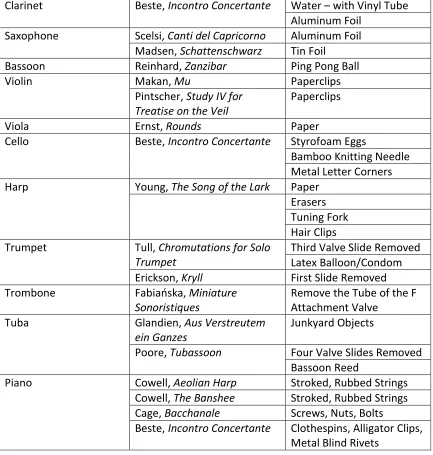
Table 1.1 Instrumentation, compositions, and objects.
Clarinet Beste, Incontro Concertante Water – with Vinyl Tube
Aluminum Foil
Saxophone Scelsi, Canti del Capricorno Aluminum Foil
Madsen, Schattenschwarz Tin Foil
Bassoon Reinhard, Zanzibar Ping Pong Ball
Violin Makan, Mu Paperclips
Pintscher, Study IV for Treatise on the Veil
Paperclips
Viola Ernst, Rounds Paper
Cello Beste, Incontro Concertante Styrofoam Eggs
Bamboo Knitting Needle Metal Letter Corners
Harp Young, The Song of the Lark Paper
Erasers Tuning Fork Hair Clips
Trumpet Tull, Chromutations for Solo
Trumpet
Third Valve Slide Removed Latex Balloon/Condom
Erickson, Kryll First Slide Removed
Trombone Fabiańska, Miniature
Sonoristiques
Remove the Tube of the F Attachment Valve
Tuba Glandien, Aus Verstreutem
ein Ganzes
Junkyard Objects
Poore, Tubassoon Four Valve Slides Removed
Bassoon Reed
Piano Cowell, Aeolian Harp Stroked, Rubbed Strings
Cowell, The Banshee Stroked, Rubbed Strings
Cage, Bacchanale Screws, Nuts, Bolts
Beste, Incontro Concertante Clothespins, Alligator Clips,
14 1.4 HISTORY OF THE PREPARED FLUTE:
Flutist and composer István Matuz is the pioneer of the prepared flute. Born in
1947, he grew up in Nagykőrös, Hungary under the communist regime’s new
educational system. His flute instruction was primarily based on pieces by contemporary
Hungarian composers. Matuz believes that this instruction sparked his interest in new
music.48
After studying at the State School of Music, Matuz graduated from the Liszt
Academy in 1970. By this point, he had developed many close relationships with the
composition students at the academy and had several pieces dedicated to him. In 1972,
he began his graduate work at the Conservatoire Supérieur de Musique in Brussels.
Matuz opted to take courses in acoustics, an area that sparked his interest. Through
these courses, he became acquainted with Pierre Boulez, and eventually showed Boulez
the extended technique system that he started to develop.49 Boulez later offered Matuz
a scholarship to study at the Institut de Recherche et Coordination Acoustique Musique
(IRCAM) in Paris.50
Matuz’s extensive studies led him to believe that acoustics should be an
important part of a flutist’s education. He believed that flutists should use the
48 Izabella Budai, “The Flutist as Co-Creator: Composer-Performer Collaboration in the Flute Music of
Hungary” (DMA diss., University of Toronto, 2014), 17.
49 Matuz’s extended technique system was a categorization of extended techniques, quarter tone
fingerings, and effects (Izabella Budai, “The Flutist as Co-Creator: Composer-Performer Collaboration in the Flute Music of Hungary” (DMA diss., University of Toronto, 2014)).
50 Izabella Budai, “The Flutist as Co-Creator: Composer-Performer Collaboration in the Flute Music of
15
knowledge of acoustics to understand their instrument completely, including basic
acoustic concepts of vibrations, difference tones, and the overtone system. This is
especially true if they are planning to teach extended techniques. Understanding how a
technique actually works helps the flutist perform the technique better, as well as
articulate the concept more clearly to students. Flutist Ákos Dratsay remarked that one
could hear a significant difference in Matuz’s playing because he carried with his sound
the knowledge of the instrument.51
Matuz later became assistant professor at the Brussels Conservatoire Supérieur.
As the first flutist to be associated with the New Music Studio, whose members included
composer Peter Eӧtvӧs, Matuz was deeply indebted to their influences.52 The symbiotic
relationship between Matuz and Eӧtvӧs resulted in many contributions to the new
music scene in Hungary. Windsequenzen, written by Eӧtvӧs, is one of the earliest works
written for prepared flute, and was a result of the collaboration between Matuz and
Eӧtvӧs.
In addition to his own compositions, Matuz’s experiments have influenced other
flutists and composers. That’s for You for three flutes, written by István Szigeti, was a
commissioned work and direct result of Matuz’s influence, and was performed by Matuz
and composer and flutist Zoltán Gyӧngyӧssy.53 The second movement of this work
51 Izabella Budai, “The Flutist as Co-Creator: Composer-Performer Collaboration in the Flute Music of
Hungary” (DMA diss., University of Toronto, 2014), 19-20, 22.
52 Founded in 1970, the New Music Studio was created to unite performers, creators, and receivers of
new music, and to bring Western music to the Hungarian audience that was not supported by the
mainstream. Other members included Zoltán Jeney, László Sáry, László Vidovszky, Péter Eötvös and Zoltán Kocsis (Budai, “The Flutist as Co-Creator.” p. 15-16).
16
includes an idea Matuz had experimented with: using cigarette paper and a clarinet
mouthpiece in place of the flute head joint.54 Gyӧngyӧssy’s later work, Pearls 2011,
which employs the use of cigarette paper and corks, was greatly influenced by Matuz’s
experiments with prepared flute.
Sadly, Matuz’s very innovative ideas took many years for flutists and Hungarian
society to accept. Opposition faced him at every turn. In fact, it was not until 1994,
when the Hungarian Flute Society awarded Matuz the Doppler Prize, that he felt
accepted by the flute community.55 In an interview to Muzsika, Gyӧngyӧssy stated that
flutists in the 21st century still have not embraced the need for knowledge of acoustics,
and the science behind their instrument.5657 Matuz knew the acoustical principles
behind the preparations that he chose for the flute. He knew what the hypothetical
effect would be on the instrument before testing the theory. In fact, he may have
chosen materials and placements based on these principles.
Matuz is an important figure in the history of the flute, for he transformed the
way the instrument can be used. With over 130 flute compositions to date, some of
which involve prepared flute, he has expanded the flute repertoire immensely. His most
significant prepared flute collection is the 6 Studii per flauto solo. He inspired the
formation of the Hungarian flute community, later known as the Hungarian Flute
54 Izabella Budai, “The Flutist as Co-Creator: Composer-Performer Collaboration in the Flute Music of
Hungary” (DMA diss., University of Toronto, 2014), 16-17, 146. 55 Other recipients include James Galway and Imre Kovács. (Ibid, 28).
56 Muzsika is a Hungarian monthly magazine about classical music.
57 Izabella Budai, “The Flutist as Co-Creator: Composer-Performer Collaboration in the Flute Music of
17
Society, because of his innovations and ability to stimulate the community with interests
in contemporary music. His method of systemization of extended techniques, inspired
by Bruno Bartolozzi’s book New Sounds for Woodwind, provides a new realm of sound
possibilities on the flute. The systemization is a great reference for composers. Finally,
he is a role model for younger flutists, who follow his example of working with living
composers and exploring extended techniques.58
18
CHAPTER 2
HOW TO PREPARE THE FLUTE
Flute preparation involves the use of many objects of varying materials, used
with a wide range of purposes. The objects discussed in this chapter are organized by
their placement on the flute to more easily draw connections to the effects of the
specific preparations. These locations include under/on the keys, inside the tube,
subtraction of parts, addition of parts from other instruments, and visual/theatrical.
Table 2.1, located at the end of the chapter, provides concise information on the
information discussed in this chapter. Compositions that employ these objects will be
mentioned, followed by a more detailed discussion of these pieces in Chapter 3.
2.1 UNDER/ON THE KEYS:
2.1.1 Cigarette Paper
The addition of cigarette paper transforms the flute into a percussive
instrument. The vibration of the paper produces a buzzing, rattling, or snare-drum-like
sound. Composers frequently employ this preparation to mimic the sound of
non-Western instruments, such as the shakuhachi or membrane flute. Some compositions
19
for Prepared Flute, István Szigeti’s That’s for You, István Matuz’s “Studium 6” from 6
Studii per flauto solo, Zoltán Gyӧngyӧssy’s “VII” from Pearls, and Jin Hi Kim’s Tchong.
Adding cigarette paper is one of the most common preparations of the flute.
Available in a range of brands, materials, shapes, sizes, colors and flavors, it is up to the
flutist to select the best option for the composition or performance space. More
commonly referred to as rolling paper, these products can be purchased anywhere that
sells cigarettes: gas stations, convenience stores, et cetera, as well as online retailers.
Typical brands include “ZigZag,” “OCB,” and “EZWIDER.”
The materials available for “rolling paper” include flax, rice, organic, cellulose
transparent, and hemp. The disadvantage of using the paper made from hemp is that it
is thicker than most of the other rolling papers. The thicker the material, the slower the
material will vibrate. The shape and size varies, although these differences do not affect
the flutist. The flutist will need to trim whichever paper is selected. The color choice
may provide an additional level to the visual aspect of the performance. The flutist has
the opportunity to experiment with many different materials to help produce the
desired sound.
Cigarette paper is typically placed under the A key of an open-hole flute. A
rubber band can be placed on either side of the key to keep the paper in place. Adhesive
tape can also be used to secure the paper. The size and shape of the paper determines
the best method of attachment. It is important that the paper does not reach up into
20
depending on where the paper is located. The rods can be avoided by cutting the top of
the paper into an arc. It is important that all ends of the paper are fastened to the flute
to avoid migration and affecting other keys.
The cigarette paper is activated when only the ring of the key is depressed. The
air will escape from the first open hole, which makes the paper vibrate. The middle
finger must be slid backward to uncover the tone hole. This action places the fourth
finger at an awkward position to cover its tone hole. To fix this problem, a plug can be
placed in the G key to keep the hole covered. A plugged G key can allow the flutist to
place the fourth finger comfortably, without the worry of covering the tone hole
completely. If a plug is used, the flutist should make sure that the composition does not
require quarter tones, glissandos, or other techniques that use an open G tone hole.
Because the paper is thin, it wears out quickly. The same paper should not be
used for multiple practice sessions or performances. When the paper loses its integrity,
it becomes very difficult to produce any sound.
2.1.2 Plastic bag
A piece of plastic bag can be used in a similar fashion to cigarette paper. The
plastic bag is an alternative material that will vibrate to produce a sound. Plastic bags
come in various colors, thicknesses, and textures. A flat piece of plastic bag will produce
a different sound than a more crinkled piece of plastic bag. The flutist is encouraged to
21
Like the cigarette paper, the piece of plastic bag is placed under the A key on an
open hole flute. The G key can be plugged to keep the hole closed in a similar fashion as
when using cigarette paper. Similar in durability to the cigarette paper, the plastic bag
becomes wet during prolonged use, so a new piece must be used for every practice
session or performance.
The plastic bag mimics the sound of the Chinese membrane flute, dizi, and
produces a buzzing sound that is rich and penetrating.59 Composer Ryojun Sasaki mimics
the dizi in Imagination Linkage II.
A buzzing sound can also be created by removing the thumb key of the flute, and
using cling film to cover the tone hole. The thumb key is easily removed because it only
has a single rod holding it in place.60
2.1.3 Aluminum foil
The desire to create percussive sounds on the flute has increased dramatically
over the past 30 years. Recent extended techniques to achieve this sound include key
clicks and slaps, tongue rams, and beat-boxing. The use of aluminum foil provides
another avenue to produce alternative percussive sounds on the flute. In addition to
using the foil to close the tube at one end, aluminum foil can also be placed on top of
59 The dizi is a Chinese transverse flute constructed from bamboo. The top of the tube is closed with a
cork and open at the bottom. The instrument consists of a blow hole, membrane hole, and six finger holes. The membrane hole is covered with a dimo, or a thin piece of bamboo skin, and attached with a sticky substance, such as peach sap (“Di,” Grove Music Online. Oxford Music Online, accessed March 5, 2016).
60 Trevor Wye, Fantastic Flutes!: 60+ Things You Can Do with Flutes. Laggan Bridge: Spartan Press, 2011,
22
the keys on the flute. This will create a buzzing or rattling sound, akin to a snare drum. It
is important to use flat, unused aluminum foil, as the crinkled foil creates a weaker
buzzing effect. Composer Ansgar Beste uses aluminum foil as a percussive device in his
piece, Incontro Concertante.
2.2 INSIDE THE TUBE:
The addition of moving objects inside the flute requires that the instrument be
closed off at the foot joint so that the objects will not fall out. To accomplish this, the
end of the foot joint should be closed off with aluminum foil or another durable
material. A rubber band should be used to ensure that the closing material remains in
place throughout the performance. Aluminum foil, in particular, provides the thickness
and strength necessary to not puncture when objects hit it. With a thickness of less than
0.2 millimeters, the aluminum foil is still strong enough to withstand the weight of
objects. It also adds a percussive effect to the music when the objects hit the foil, as
opposed to a more cushioned or lighter weight material, such as cigarette paper.
2.2.1 Beads
Issac Brockshus’s composition, Greytudes, is the only composition known to the
author that employs the use of beads in flute preparation, creating the sound of a rain
stick. Beads or other plastic objects can be placed directly inside the flute. Beads of any
material can be used, as long as they are not sharp in any way. Testing the beads inside
23
Rough or sharp beads could scratch the inside of the tube and cause permanent damage
to the flute.
The beads will travel from one end of the flute to the other, depending on the
position of the flute. Gravity causes the beads to move, and the angle of the flute will
determine the speed the objects will travel. An object with lighter density would be
affected by the air more than the beads.
Insertion of beads into the foot joint will not change the sound. The movement
of the beads, however, will affect the sounds produced by the flute. The beads interrupt
the air stream, causing the pitches to change octaves, intonation, and timbre. In
addition, when the beads are located in the head joint, the overtone series is affected,
and only high sounds can be produced.
2.2.2 Erasers and earplugs
Used in a similar fashion as the beads, erasers and earplugs are inserted into the
flute as moving objects inside the tube. While the foot joint is closed with aluminum foil
or other material, the erasers and earplugs are free to travel from one end of the flute
to the other depending on the positioning of the flute. Static placement of these objects
only affects the sound when they are located in the head joint. With regard to the
beads, static placement can only occur when the flute is held with the foot joint raised
above the head joint, and kept in that position. Like beads, the erasers and earplugs will
24
It is important to keep in mind that erasers and some earplugs are uneven in
shape, and can create obstructions inside the flute. These jams are difficult to fix while
in a performance. For this reason, only a small number of these objects should be used
at one time. Unique to his composition, Isaac Brockshus writes for the addition of
erasers and earplugs in his piece, Greytudes.
2.2.3 Cork
Besides paper, the other most common material to prepare the flute is cork,
made from the bark of an oak tree. “One cubic inch of cork consists of not less than 200
million completely enclosed air cells. These cells give cork the attributes of resilience,
durability, moisture resistance, thermal insulation and acoustic insulation.”61 The
density of cork contrasts with a chunk of paper or other material that could be used to
close off the tube. Wine corks or cork stoppers come in many sizes. The cork can be cut
in the direction of the pores or cut at an angle. “Poreless” stoppers can be found in
many of the cheaper wine bottles. These stoppers are typically smaller in width and
easier to cut.
It is difficult to find a wine cork small enough to use in the flute without some
alteration beforehand. Corks can be whittled down in size with a knife, but it is next to
impossible to maintain roundness and smoothness. Sandpaper can be used to smooth
the cork. The unevenness will affect the sound of the flute, because the cork will not
61 “Frequently Asked Questions,” WE Cork, accessed March 5, 2016,
25
seal off the tube completely. Wine corks also come in different textures or levels of
breathability.
Corks can be used in many ways and positioned in various locations on the flute.
First, a piece of cork can be used to ensure that a specific key remains closed. For
example, cork can be wedged underneath the original cork on the D-sharp key. This
action prevents the key fromopening until the added cork is removed. Second, cork can
be placed inside the head joint or foot joint to affect the sound of the flute. Depending
on the placement, the cork can change or influence the overtone series of the flute, or
cause notes to either not sound or sound an octave lower than written. Composer Péter
Eötvös suggests that the use of modeling clay, instead of the use of a wine cork,
improves overall intonation.62
Compositions that require the use of cork include Jos Zwaanenburg’s Solo for
Prepared Flute, István Matuz’s “Studium 1” and “Studium 5” from 6 Studii per flauto
solo, Zoltán Gyӧngyӧssy’s “III” and “VI” from Pearls, Péter Eӧtvӧs’s Windsequenzen, and
John Fonville’s Music for Sarah.
2.2.4 Water
One end of a vinyl hose can be inserted into the body and foot joint of the flute,
and the other end placed into a container of water. This means that no water is running
through the flute, only air from the flute is channeled into the water through the hose.
62 Izabella Budai, “The Flutist as Co-Creator: Composer-Performer Collaboration in the Flute Music of
26
This process can create dripping or bubbling noises. Again, the size of container and
level of water will affect the sounds produced by the flute. The use of a microphone is
suggested to ensure that the water noises are audible. Compositions that require the
use of water include Ansgar Beste’s Incontro Concertante, which uses a vinyl hose for
both the clarinet and flute.
2.2.5 Darts
Darts with suction cups at the end can be positioned inside the flute to prepare
the instrument, seen in Figure 2.1. Depending on the placement of the darts, the object
will produce beating or interference tones at certain notes throughout the spectrum.
This result is because the dart parts the air blown through the tube.
Figure 2.1 Dart with suction cup
It is difficult to insert the darts into the flute because of the suction cups. The
cups tend to pop off the end of the dart easily, especially if it has been used previously
during practice or performance. Fastening the suction cup to the dart with tape and
rubber bands is moderately effective. Electrical tape is the most effective way to ensure
the position of the cups remains the same.
The performer must be careful when placing the darts inside the flute. The
suction cup is bigger than the tube, the cup bends and curls to fit inside the tube. Open
27
damage the keys, especially if a key is closed on top of a suction cup. Issac Brockshus
uses two darts in his piece, Greytudes.
2.2.6 Buzzers
Buzzers can be added to the body and foot joint of the flute to distort the sound,
seen in Figure 2.2. Found inside a children’s toy, the buzzer consists of a rubber plug and
a reed-like mechanism that produces sound when air is blown through it. When used
without the head joint, the flute can mimic the sound of a crying child, electric guitar, or
siren with the change of air direction and speed. In contrast, when the buzzer is used in
the foot joint, the buzzer is only activated when the flutist plays a low B3. Issac
Brockshus uses two buzzers in his piece, Greytudes.
Figure 2.2 Buzzer
2.3 SUBTRACTION OF PARTS
2.3.1 Head joint only
The head joint of the flute can be used separately from the rest of the
instrument to produce different sounds. Justyna Kowalska-Lasoń uses only the head
28
in and out of the water while blowing creates sounds like a siren. This motion is similar
to inserting a finger in and out of the head joint to change the sound. The size of
container and level of water will change the sounds produced by the head joint. Other
examples include Augustyn Bloch’s Oratorium fur Orgel, Streicher, und Schlagzeug,
Mauricio Rodriguez Unnamed, and Zoltán Gyӧngyӧssy, “III” from Pearls.
2.3.2 Body only
The body of the flute is sometimes used alone or without the head joint or foot
joint in compositions. The body of the flute alone creates new sounds when used with
extended techniques. For example, in …I Touch the Mountains and They Smoke....,
Kowalska-Lasoń has the flutist yell and sing into the body of the flute, changing the
sound.
2.3.3 Foot joint only
The foot joint is used in a similar fashion as the body, requiring the employment
of extended techniques. Examples of pieces that require the use of only the foot joint
include Fonville’s Music for Sarah, and Kowalska-Lasoń …I Touch the Mountains and
They Smoke...
2.3.4 Two parts only
Composers frequently use only two parts of the flute in their compositions. The
29
instrument, much like the piccolo. István Matuz uses this technique in “Studium 2” from
6 Studii per flauto solo.
The body and foot joint of the flute can be used independently from the head
joint. This combination helps to mimic the sound of the shakuhachi when positioned
vertically in front of the body. Matuz’s “Studium 3” from 6 Studii per flauto solo and
Fonville’s Music for Sarah employs this combination to imitate the Japanese flute.
This setup of the flute can also be used in combination with objects placed on or
inside the flute. For example, Brockshus uses the body and foot joint in combination
with the insertion of buzzers in the third movement of Greytudes.
2.4 ADDITION OF PARTS FROM OTHER INSTRUMENTS
The preparation of the flute is not limited to the addition of objects or the
removal of parts of the flute. In fact, parts from other instruments can be added to the
flute to alter the sound. The only limitation of this idea is the size of the part.
2.4.1 Clarinet Mouthpiece
A clarinet mouthpiece can fit into the top of the body of the flute. The flute is
held vertically in front of the performer, and is played like a clarinet. The flute performer
should experiment with different thicknesses of reeds to produce the easiest sound. An
30
2.4.2 Saxophone Mouthpiece
Similar to the clarinet mouthpiece, a saxophone mouthpiece can fit into the
body of the flute. The flute is held in the same way as the above preparation, and the
most accessible reed should be chosen. Matuz uses this preparation in “Studium 6”
from 6 Studii per flauto solo.
2.5 VISUAL/THEATRICAL
Although most flute preparations change the sound of the flute, some are purely
for visual purposes. A balloon can be attached to the end of the flute, and is expanded
by blowing air through the mouthpiece of the flute. A small balloon is preferable,
because a larger balloon requires more air and more time to blow up the balloon. The
longer the balloon takes to inflate, the more cranial pressure for the flutist when the
balloon is expanded. To attach the balloon, the open end should be placed around the
outside of the bottom part of the foot joint. The balloon may detach from the flute
throughout the blowing process, so a rubber band can be placed around the open end
of the balloon. A centimeter of the balloon should be attached to the foot joint. The
flutist must stretch the balloon before placement. This is important because the balloon
will inflate more easily if it has been stretched or expanded previously.
The balloon will only expand when all keys are covered and the flutist blows
directly into the mouthpiece. In addition, the balloon will lose air when the flutist stops
blowing or breathes. To solve this problem, the flutist must maintain the air pressure by
31
through the nose, and begin blowing again. The performer’s cheeks remain expanded
through this process. An alternative to maintaining the air pressure is to close the tone
hole with the lips while inhaling through the nose.
The result of the balloon preparation can end in either the bursting or deflation
of the balloon. Both results are equally valid, and provide different sounds and visual
effects. The flutist can deflate the balloon by releasing the tongue from its placement on
the tone hole, and the removal of fingers from the keys.
The composer or performer may wish to keep the balloon addition a surprise. In
this case, the balloon can be pushed up inside the foot joint after attachment. The
cleaning rod of the flute can be used to gently guide the balloon inside the foot joint.
The balloon must not come up through any key holes in the foot joint. The balloon can
easily appear by fingering a low B and blowing forcefully. Then the balloon can begin to
inflate. For the most part, the balloon does not affect the overall sound of the flute. The
highest register, however, is affected by this preparation. The pitches and overtones are
lowered significantly when the balloon is inside the flute. István Matuz uses a balloon as
a visual preparation to the flute in “Studium 4” from 6 Studii per Flauto Solo, and will be
discussed in greater detail in Chapter 3.
Another visual preparation for the flute include Trevor Wye’s “iFlute.” Besides
the unique material of the flute (acrylic or plastic), high intensity L.E.D. lights are linked
to proximity switches and attached to thirteen keys of the instrument. To create this
32
in with adhesive. Two bright LEDs can replace the stopper of the flute, set into a cork,
and face down the tube. This will light up the whole flute. A LED can also be placed in
the foot joint, facing up the tube. Adding a circuit to the instrument will allow the LEDs
to change color, and turn on and off when the flute is moved up and down. 6364
Perhaps one of the most inventive theatrical preparations for the flute is
Christina Kubisch’s Emergency Solos fur Flote solo und Objekte.65 In Emergency Solos, or
“solos in a state of emergency,” objects are used in different contexts to display an artist
struggling with his instrument. Boxing gloves, thimbles, and a gas mask are selected by
Kubisch to convey the struggle between the role of a woman on stage, and her dual role
as a sexual object. The final product attempts to display how Kubisch sees herself as a
female performer. For example, the boxing gloves demonstrates the struggle a musician
feels when fighting or struggling with their instrument.66
“It’s So Touchy,” the first solo in the set, requires the performer to wear thimbles
on the fingers. A play on the role of a housewife, the thimbles restrict the freedom of
movement and success of the performer. The duties of a housewife are put on display in
stark contrast with the virtuosity of the performer. The thimbles create percussive
63 L.E.D. lights stands for Light-Emitting Diode.
64 Trevor Wye, Fantastic Flutes!: 60+ Things You Can Do with Flutes. Laggan Bridge: Spartan Press, 2011.
65 Appendix A.
66 Schnebel, Dieter, Christina Kubisch, Manos Tsangaris, Hans-Karsten Raecke, Sven-Åke Johansson, Paul
33
sounds when rubbed on the metal of the flute. The thimbles become stuck in between
the keys by the end of the piece.67
The second solo, “Weekend,” calls for only the body and foot joint of the flute.
The flutist must wear a gasmask without filter during performance. The flute is inserted
through the opening of the mask, and breathe through the flute body for the entire
composition. The resulting sounds create raspy, breathy noises. Perhaps associated with
the Vietnam War or other conflicts, the breaths are measured in the composition.68
“Erotica,” the third solo in the set, uses a condom over the end of the flute head
joint, and the flutist breathes through the mouthpiece. The condom inflates and
collapses with the inhalation and exhalation of the flutist. The end of the solo is marked
by the bursting of the condom.69
2.6 CONCLUSION
The size of the flute is the only limitation for possible flute preparations. The use
of metal products is lacking in the prepared flute toolbox, perhaps due to its destructive
nature. Many current flute preparations provide new ways for the flute to be used as a
percussive instrument, while others alter the timbre, mimic the sound of a non-Western
instrument, obstruct the air stream to cause beating, and create novel visual effects to
make comments on politics and gender roles.
67 Ibid.
68 Ibid.
34
Table 2.1 Prepared objects, compositions that use them, and the resulting sound.
Under/On the keys Cigarette paper 1. Zwaanenburg, Solo for Prepared Flute 2. Szigeti, That’s for You for 3 flutes
3. Matuz, “Studium 6” from 6 Studii per flauto
solo
4. Gyӧngyӧssy, “VII” from Pearls
Buzzing, rattling
Rice paper 1. Kim, Tchong Buzzing, rattling
Plastic bag 1. Sasaki, Danpen Rensa II Buzzing, rattling Aluminum foil 1. Beste, Incontro Concertante
2. Brockshus, “I” from Greytudes
Buzzing, rattling
Inside the tube Beads 1. Brockshus, “I” from Greytudes Overtone series, intonation, beating Erasers &
Earplugs
1. Brockshus, “I” from Greytudes Overtone series, intonation, beating Cork 1. Matuz, “Studium 1” from 6 Studii per flauto
solo
2. Eӧtvӧs, Windsequenzen
3. Zwaanenburg, Solo for Prepared Flute 4. Matuz, “Studium 5” from 6 Studii per flauto
solo
5. Fonville, Music for Sarah 6. Gyӧngyӧssy, “III” from Pearls 7. Gyӧngyӧssy, “VI” from Pearls
Overtone series, note sound octave lower than written
Water 1. Beste, Incontro Concertante Bubbles
Darts 1. Brockshus, “II” from Greytudes Beating, interference tones
Buzzers 1. Brockshus, “III” from Greytudes Distortion of sound Subtraction of
parts
Head joint only 1. Bloch, Oratorium fur Orgel, Streicher, und
Schlagzeug
2. Rodriguez, Unnamed
3. Kowalska-Lasoń, I Touch the Mountains and
They Smoke
4. Gyӧngyӧssy, “III” from Pearls
Shortens length of pipe. Combined with cork – lengthens the effective length of the pipe
Body only 1. Kowalska-Lasoń, I Touch the Mountains and
They Smoke
Airy, used in combination with voice
Foot joint only 1. Fonville, Music for Sarah
2. Kowalska-Lasoń, I Touch the Mountains and
They Smoke
Airy, used in combination with voice
Head joint and foot joint
1. Matuz, “Studium 2” from 6 Studii per flauto
solo
Shortens length of pipe, higher pitches Body and foot
joint
1. Matuz, “Studium 3” from 6 Studii per flauto
solo
2. Matuz, “Studium 6” from 6 Studii per flauto
solo
3. Fonville, Music for Sarah 4. Brockshus, “III” from Greytudes
Mimic shakuhachi, used in combination with voice or other preparations
Addition of parts from other instruments
Clarinet Szigeti, That’s for You for 3 flutes Reed-like sound Saxophone Matuz, “Studium 6” from 6 Studii per flauto solo Reed-like sound
Visual/Theatrical Balloon Matuz, “Studium 4” from 6 Studii per flauto solo N/A Boxing Gloves Kubisch, Emergency Solos N/A
Gas Mask Kubisch, Emergency Solos Breathy
35
CHAPTER 3
A SURVEY OF COMPOSITIONS FOR PREPARED FLUTE
The compositions for prepared flute in this chapter are grouped according to the
composer’s country of origin. Clear links are found between composers who are writing
in similar geographic locations for the prepared flute. In most cases, these composers
know and are influenced by each other. Matuz and his colleagues, in particular, have the
greatest impact on the literature for prepared flute. Table 3.1, located at the end of the
chapter, provides concise information on the information discussed in this chapter.
EUROPE:
3.1 HUNGARY
Péter Eӧtvӧs (b. 1944), a Hungarian conductor, professor and composer, was
born in Odorheiu Secuiesc/Székelyudvarhely, Szeklerland, Transylvania. He attended
and received degrees from Budapest Academy of Music and Hochschule für Musik in
Cologne. He conducted the inaugural concert of IRCAM in Paris, at the invitation of
Pierre Boulez. Eӧtvӧs has conducted and worked with the BBC Symphony Orchestra,
Berlin Philharmonic Orchestra, Cleveland Orchestra, London Philharmonia, Munich
36
Orchestra in Vienna, and many other orchestras.70
The compositional output of Péter Eӧtvӧs is quite vast, encompassing works for
opera, music theatre, vocal ensemble, orchestra, chamber orchestra, instrumental
chamber music, electronic music, and portrait-film and documentary-film scores. He has
included the flute in many of his compositions for ensembles, but has written only one
piece for flute alone, entitled Cadenza, which was premiered in Cologne.71
Eӧtvӧs was part of the New Music Studio in Hungary in the 1970s, a group which
consisted of active composers including Zoltán Jeney, Laszlo Vidovszky and Zoltán
Kocsis. The New Music Studio, established in 1970, was the first Hungarian avant-garde
workshop. 72 Eӧtvӧs is a kindred spirit of István Matuz, who is the pioneer of the
prepared flute genre. The two composers met at the Film Studio in Budapest in the
1960s and found a common interest in the acoustic principles of sound. Eӧtvӧs’
chamber piece, Windsequenzen, 1975, was a result of their friendship and collaboration.
Matuz holds this composition in very high regard, and issued a warning for flute players
who attempt to perform it. In a recent interview, he said that “this work demands the
most exceptional instrumental technique and musicianship from the performer. We
70“Péter Eötvös,” accessed January 24, 2016, http://eotvospeter.com/biography.
71 Ibid.
72 During the time of transition from socialism to capitalism, the performances of the works of Hungarian
37
recommend that only those flutists embark on learning and performing it who can
approach a masterpiece with purity and true artistic humility.”73
During one of their many meetings, Matuz was excited to show Eӧtvӧs one of his
new discoveries that involved the use of a wine cork. When the wine cork was placed in
the end of the flute, closing off one end of the flute, two results took place. The first
discovery was that the lowest note, B1, sounded an octave lower than written. The
inserted cork caused the note to sound an octave lower because the sound waves were
forced to travel back and forth four times, doubling the length of the tube, according to
Matuz. The second discovery was that only the odd overtones from the harmonic series
could be produced. “The constraint of the closed end [of the tube] prevents the column
from producing the even harmonics.”74 Clarinets, for example, have a closed cylinder at
one end, resulting in the elimination of even harmonics in the tone, especially the lower
register.
“Windless,” the first movement of Windsequenzen, is written for flute with cork,
and was inspired by conversations and discoveries with Matuz.75 Eӧtvӧs changed
instrumentation, added and subtracted movements, as well as other alterations which
resulted in many versions of Windsequenzen. The final form of Windsequenzen was
published in 2002. One reason for the second edition was to make it more manageable,
73 Izabella Budai, “The Flutist as Co-Creator: Composer-Performer Collaboration in the Flute Music of
Hungary” (DMA diss., University of Toronto, 2014), 16, 168-169.
74 “Closed Cylinder Air Column,” HyperPhysics, accessed March 21, 2016,
http://hyperphysics.phy-astr.gsu.edu/hbase/waves/clocol.html#c1.
75 Izabella Budai, “The Flutist as Co-Creator: Composer-Performer Collaboration in the Flute Music of
38
due to the extreme technical demands on the flutist in the first version. The first
movement, “Windless,” written for flute and bass drum, most directly results from the
relationship between Eӧtvӧs and Matuz. Eӧtvӧs has said that this piece would not exist
without Matuz.76
The 1975 version of Windsequenzen is written for flute, bass drum, English horn,
tuba, reed organ, and synthesized wind sound. The flute is prepared with a cork in the
first movement; other movements utilize numerous passages with quarter tones and
other techniques. According to Budai, because of Matuz’s ability to control pitch, he
could produce precise difference tones against the reed organ. He achieved this through
microtonal fingerings, developed over months of trials. He created a table with his
findings, and the result was approximately 230 different fingerings. The substantial
number of fingerings is due to the fact that some notes have five or six different
fingering options in order to play seamlessly between other notes.77 Eӧtvӧs withdrew
the 1975 and 1989 versions of this work.
The final version of Windsequenzen, written in 2002, provided many changes
from the 1975 edition. The piece became a suite with eight movements. The
instrumentation was slightly different, with the addition of an oboe, two clarinets
instead of the reed organ, bass clarinet, double bass, tuba, accordion and bass drum.
Because the fingering system Matuz developed was entirely too complicated for the
typical flute player, coupled with the fact that Eӧtvӧs wanted the piece to be more
76 Ibid.