University of South Carolina
Scholar Commons
Theses and Dissertations
2016
The Relationship between Peer-Self Concept and
Academic Self-Concept in Elementary Students: A
Person-Oriented Perspective
Catherine Jorgensen Snyder University of South Carolina
Follow this and additional works at:https://scholarcommons.sc.edu/etd Part of theEducational Psychology Commons
This Open Access Dissertation is brought to you by Scholar Commons. It has been accepted for inclusion in Theses and Dissertations by an authorized administrator of Scholar Commons. For more information, please [email protected].
Recommended Citation
The Relationship between Peer-Self Concept and Academic
Self-Concept in Elementary Students: A Person-Oriented Perspective
by
Catherine Jorgensen Snyder
Bachelor of Science Michigan State University, 1982
Master of Arts
The University of Akron, 1988
Submitted in Partial Fulfillment of the Requirements
For the Degree of Doctor of Philosophy in
Educational Psychology and Research
College of Education
University of South Carolina
2016
Accepted by:
Christine DiStefano, Major Professor
Matthew Irvin, Committee Member
Robert Johnson, Committee Member
Kate Niehaus, Committee Member
DEDICATION
To my husband Tim, who not only knew what a formidable task I had undertaken,
but also knew how to gently push me forward. Believe me, I noticed that you never once
asked me when I would finally be finished! I am grateful for your support both
emotionally and financially, as I could not have done it without you.
Also, to my parents, Ken and Sharon, who instilled in me the resolve and stamina
ACKNOWLEDGEMENTS
I would like to acknowledge all the hard work and dedication my committee
members contributed in helping this dissertation come to fruition. I appreciate all the
insightful feedback and the hours spent reviewing this manuscript and the accompanying
data. I feel lucky to have had the opportunity to learn from all of you.
Special thanks go out to my committee chair, Dr. Christine DiStefano. Her sense
of humor in class was always something to look forward to. Yet, it was her belief in me
that kept me going through the design dilemmas, data runs, and countless edits. I am
grateful for her calming spirit and endless support as I have trudged through the
ABSTRACT
Self-concept is one of the most researched constructs in educational psychology
(Marsh, Xu, & Martin, 2012). It has been established that there are different domains of
self-concept which fall into two main categories, academic and non-academic
(Shavelson, Hubner, & Stanton, 1976). Unfortunately, little research has been conducted
on the non-academic areas of concept and little is known about how social
self-concept interrelates with academic self-self-concept. The focus of this study was to contribute
to the research base by investigating the relationship between a facet of nonacademic
self-concept, namely peer self-concept, and achievement self-concept among elementary
students.
The current research utilized person-oriented methodology to study peer
self-concept. A nationally representative sample of students in elementary school (from the
NCES ECLS-K database) was followed to examine changes in perceived academic and
peer self-concept over the course of two years (from grades three through five). Latent
class and latent transition analyses (person-oriented research approaches) were conducted
to determine intra-individual changes in academic and peer self-concept over time and
Results of the latent class analysis revealed that students with positive peer
self-concept tended to have positive self-self-concept in reading, math, and other school subjects.
Latent transition analysis showed that most students move to the next higher latent class
over time, reflecting improvements in self-concept. The domain of academic self-concept
that appeared to vary the most over time was that of math. Implications for school and
classroom interventions and areas for further research are discussed.
TABLE OF CONTENTS
DEDICATION ... iii
ACKNOWLEDGEMENTS ... iv
ABSTRACT ...v
LIST OF TABLES ...x
LIST OF FIGURES ... xii
CHAPTER I:INTRODUCTION ...1
Importance of Self-Concept ...2
Contributions of the Current Study to Self-Concept Research ...5
CHAPTER II:REVIEWOFTHELITERATURE ...12
Historical Origins of Self-Concept ...12
The Structure of Self-Concept ...14
Existing Research Related to Peer and Social Self-Concept ...16
Peers Influence on Achievement Motivation ...19
Self-Concept as a Theoretical Framework ...21
Academic and Social Self-Concept Research Relevant to the Current Study ...22
Person-Oriented Perspective and Research Methodology ...27
Longitudinal Cluster and Latent Class
Cluster Analysis ...38
Appropriate Methodology for Addressing the Research Questions ...41
Study Objectives and Research Questions ...42
CHAPTER III:METHOD ...44
Dataset ...44
Sampling Procedures ...45
Participant Characteristics and Sample Size ...47
Measures ...48
Research Questions Operationalized ...56
Data Analysis ...58
Establishing the Measurement Model ...62
Latent Profile and Latent Transition Methodology ...63
CHAPTER IV:RESULTS ...67
Descriptive Statistics ...67
Inferential Statistics ...70
Testing for Measurement Invariance ...83
Generating Factor Scores ...83
Latent Profile Analysis: Cross-Sectional Results ...91
Covariate Analyses ...109
Latent Transition Analysis ...111
Conclusions ...121
Differences between Peer and Academic Self-Concept Constructs ...122
Developmental Changes in SDQ-I Measures ...124
Contributions from Person-Oriented Methodology ...125
Findings from Latent Profile Analysis ...126
Latent Class Membership by Demographic Category ...128
Longitudinal Changes in Self-Concept ...129
How the Study Results Answer the Research Questions ...131
Contributions from the Current Study ...134
Limitations ...136
Areas for Future Research ...138
Conclusion ...140
REFERENCES ...141
APPENDIX A–Self-Description Questionnaire-I Items Used in Grades 3 and 5 ...170
LIST OF TABLES
Table 3.1. Percent of Students in Exploratory
and Confirmatory Samples ...48
Table 3.2. ECLS-K Modified Self-Description Questionnaire Scale Reliabilities (SDQ I) --Grades 3, and 5. ...51
Table 3.3. ECLS-K Modified Self-Description Questionnaire (SDQ I) Scale Range, Weighted Means and Standard Deviations--Grades 3 and 5 ...52
Table 3.4. ECLS-K Math and Reading IRT Scale Range, Means, and Standard Deviations--Grades 3, and 5. ...54
Table 3.5. Description of Variables ...55
Table 4.1.Measures of Socioeconomic (SES) Status ...67
Table 4.2. Descriptive Statistics: Reading and Mathematics IRT Scores ...68
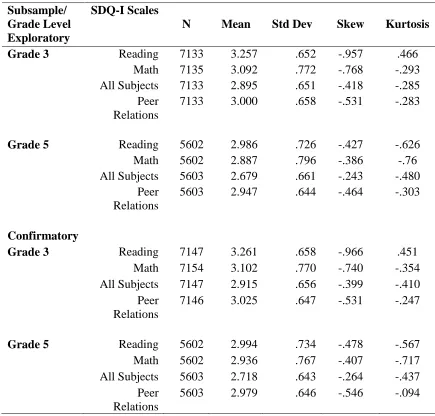
Table 4.3. Descriptive Statistics: SDQ-I Scales of Perceived Interest and Competence Measures ...69
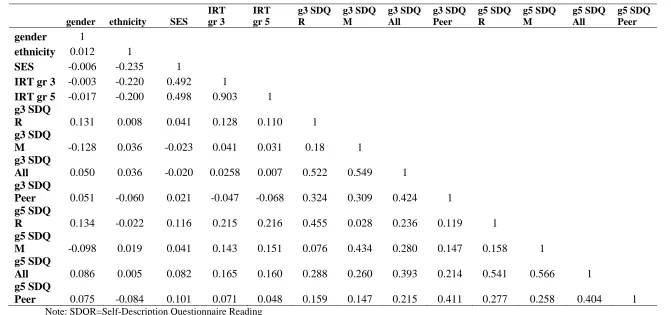
Table 4.4. First-Order Pearson Correlation Coefficients between Measures ...72
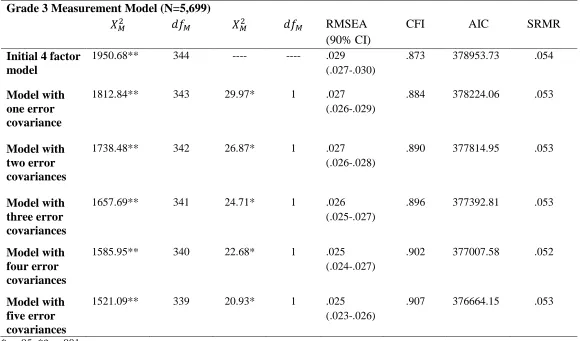
Table 4.5. Confirmatory Factor Analysis Fit Information for the SDQ-I Scale (MLR Estimator), grade 3 ...76
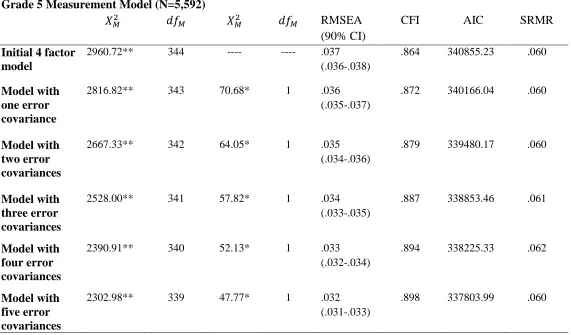
Table 4.6. Confirmatory Factor Analysis Fit Information for the SDQ-I Scale (MLR Estimator), grade 5 ...77
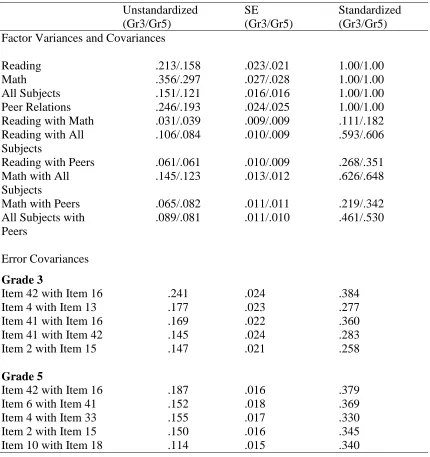
Table 4.7. Factor Variance/Covariance and Error Covariances from Final Measurement Model (MLR Estimator), ...81
Table 4.8. Skew and Kurtosis Values for Regression-Based Factor Scores ...84
Table 4.10. Model Fit and Class Probabilities-Exploratory
Sample, grade 3 ...101
Table 4.11. Model Fit and Class Probabilities-Exploratory
Sample, grade 5 ...102
Table 4.12. Model Fit and Class Probabilities-Confirmatory
Sample, grade 3 ...103
Table 4.13. Model Fit and Class Probabilities-Confirmatory
Sample, grade 5 ...104
Table 4.14. N-size & Latent Class Probabilities for Most
Likely Class Membership ...106
Table 4.15. Means for Final Class Solutions with Covariates and Variances Freely Estimated...107
Table 4.16. Classification Accuracy-Conditional Probabilities ...109
Table 4.17. Logistic Regression Coefficients and Log Odds
for Covariates, Grade Three ...109
Table 4.18. Logistic Regression Coefficients and Log Odds
for Covariates, Grade Five ...110
Table 4.19. Alternate LTA Measurement Models for
Grade Five, Fit Statistics (N=4703) ...114
Table 4.20. Cross-Sectional Class Representation from LPA Results ...114
Table 4.21. Cross-Sectional Class Representation from
LPA Results (N=4703) ...115
Table 4.22. Longitudinal Class Proportions from LPA* (N=4703) ...116
Table 4.23. Longitudinal Proportions for Latent Class Patterns from
LTA Results* (N=4703) ...117
Table 4.24. Latent Transition Probabilities Based on the
Estimated LTA Model (N=4703) ...117
Table 4.25. Relationship between Classes and IRT Scores over Time ...119
Table 4.26. Wald Difference Test Results, LTA with Distal
LIST OF FIGURES
Figure 1.1 Structure of self-concept. ...13
Figure 2.2 An elaboration of Marsh and Shavelson's (1985) revision to academic self-concept ...15
Figure 2.2 Hypothesized model of social self-concept ...16
Figure 3.1 Measurement model for grade 3 and grade 5 SDQ-I ...64
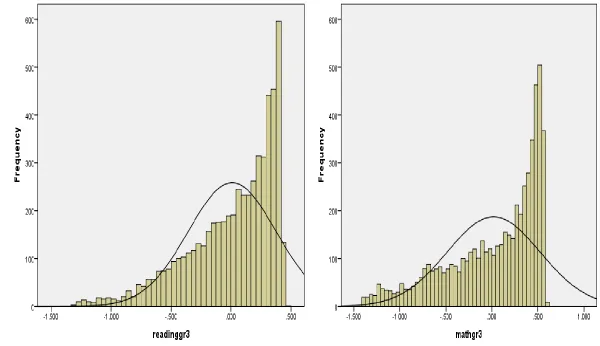
Figure 4.1 Grade 3 Reading factor scores ...86
Figure 4.2 Grade 3 Math factor scores...86
Figure 4.3 Grade 3 All Subjects factor scores ...87
Figure 4.4 Grade 3 Peer Relations factor scores ...87
Figure 4.5 Grade 5 Reading factor scores ...88
Figure 4.6 Grade 5 Math factor scores...88
Figure 4.7 Grade 5 All Subjects factor scores ...89
Figure 4.8 Grade 5 Peer Relations factor scores ...89
Figure 4.9 Latent profile analysis results for grade three ...107
Figure 4.10 Latent profile analysis results for grade five ...108
Chapter I
Introduction
Understanding the factors that motivate individuals academically has been a quest
for educators since William James and John Dewey identified the learner as an active
force in the educational process (see Dewey, 1929; James, 1926). Since this pioneering
research, many established motivational theories have been applied to education in an
attempt to explain differences in achievement. These theories have, for example, focused
on students’ expectancies for academic success (e.g., self-efficacy theory; Bandura, 1986
and expectancy-value theory; Eccles, 1983; Eccles & Wigfield, 2002; Wigfield & Eccles,
2000), perceived competence (e.g., Kaplan & Midgley, 1997; Cocks & Watt, 2004),
achievement goals (e.g., Ames, 1992; Nichols, 1984; Ford & Nichols, 1991),
self-determination (e.g., Deci & Ryan, 1985, 2000; Ryan & Deci, 2000, 2009) and academic
interest (e.g., Hidi, 2000; Schiefele, 2004; Silvia, 2005). Numerous studies using these
theories have found that student motivation could be influenced by factors internal to the
student (e.g., traits, drives, expectancies, values), as well as those which are external
(e.g., rewards, social approval, expectations, environmental constraints).
Self-concept is one of the oldest and most studied constructs in educational
psychology, addressing both cognitive and social domains. However, the focus of
self-concept research has been largely one-sided, primarily addressing academic self-self-concept
While social self-concept was a major subdivision of the original model proposed by
Shavelson, Hubner, and Stanton (1976) and refined by Marsh and Shavelson (1985), it
has not received much consideration since then. In fact, social self-concept was not fully
described or investigated for construct validity until Byrnes and Shavelson’s 1996
research, 20 years later. Furthermore, there has been very little research on the peer
self-concept subdomain. In fact, through a comprehensive literature search, only one study
was found that specifically addressed peer self-concept. Accordingly, the overarching
aim of the current study was to examine the relationship between peer and academic
self-concept and how peer self-self-concept interfaces with academic self-self-concept to influence
academic achievement. Toward this end, a longitudinal, secondary data analysis of the
large-scale ECLS-K data was conducted. In particular, this research examined measures
of academic and peer self-concept in concert with math and reading achievement data for
students in grades three through five.
Importance of Self-Concept
Self-concept is a multi-dimensional construct that recognizes the importance of
both academic and nonacademic (i.e., social, emotional, physical) factors for influencing
motivation (Byrne, 2002; Byrne & Shavelson, 1986; Marsh, Parker, & Barnes, 1985;
Marsh & Shavelson, 1985; Marsh, Smith, Barnes, & Butler, 1983; Marsh et al., 2012;
Shavelson et al., 1976). Shavelson et al. (1976) envisioned self-concept as a
multi-dimensional cognitive construct that included “self-perceptions that are formed thorough
experience with and interpretations of one’s environment.” They noted that these
perceptions are strongly influenced by evaluations made of one’s behaviors by significant
actions and then our actions influence our self-concept in a continuous circular cycle.
Self-concept has been extensively researched and validated, as a way to understand
student motivation to achieve academically (Marsh et al., 2012; Wylie, 1961, 1974,
1979).
Marsh and Craven clarified the distinction between self-concept and self-esteem
in their 2006 publication. They noted that self-concept can be broken down into specific
components which directly relate to outcomes like achievement. In contrast, self-esteem
is a global construct much the same as general self-concept (the top level of the
hierarchy). There have also been studies conducted to differentiate self-concept from
Albert Bandura’s concept of self-efficacy (1986). The main focus of self-efficacy rests on
the individual’s perception of their ability to accomplish a task and how this information
is used to set goals, monitor performance, and adjust behavior. Research findings have
shown that academic concept actually influences a student’s specific feelings of
self-efficacy. Bong and others concluded that self-concept is heavily based on social
comparisons while self-efficacy is more competency-based and context-specific.
Research also found that self-concept is a better predictor of affect, while self-efficacy is
better for predicting actual achievement (Bong, 1998; Bong & Clark, 1999; Bong &
Skaalvik, 2003; Ferla, Valcke, & Cai, 2009; Marsh, Dowson, Pietsch, & Walker, 2004;
Marsh, Walker, & Debus, 1991).
Self-concept has been found to be an important construct for describing and
understanding individual’s beliefs and behaviors. Not only is it an important factor in
decision-making and goal-directed behavior, but it is also a desirable outcome on its own.
self-concept and have confidence in their ability (Marsh & Craven, 2006; Marsh et al.,
2012; Shavelson et al., 1976). In fact research has shown that self-concept predicts
academic achievement even beyond SES and prior achievement (Marsh, 1990a, 1993;
Marsh, Byrne, & Yeung, 1999; Marsh & Craven, 1997, 2006). Most research on
academic self-concept has involved some examination of academic achievement
outcomes. Marsh and Martin (2011) summarized the cyclical relationship between
achievement and academic self-concept. They found from reviewing numerous research
studies that higher academic self-concept led to improvements in achievement and that
the resulting gains in achievement further fueled higher academic self-concept.
Additional research has supported the conclusions drawn by Marsh and Martin and have
found even stronger relationships between domain-specific self-concept and
corresponding achievement measures (Marsh et al., 2012; Marsh et al., 1999; Marsh &
Craven 2006; Marsh, Hau, & Kong, 2002; Marsh & O’Mara, 2008; Pinxten, De Fraine,
Van Damme, & D’Haenens, 2010).
Results have also been consistent in finding that academic achievement measures
are un-related to nonacademic domains of self-concept (Arens, Yeung, Craven, &
Hasselhorn, 2011; Marsh & Craven, 2006; Marsh & O’Mara, 2008; Marsh et al., 1985;
Marsh, Parker et al., 1983; Marsh & Shavelson, 1985; Marsh, Smith, & Barnes, 1984;
Marsh et al, 2012; Pinxten et al., 2010; Shavelson & Bolus, 1982). However, all of this
research was conducted using variable-oriented methodology. It is the aim of this study to
revisit the relationships between achievement and peer self-concept by using a
person-oriented approach. Given the consistent results found on the influence of social
peers will have a positive impact on achievement motivation. For example, Kathyrn
Wentzel found in her research that socially competent students were also higher
achieving. Her research consistently found that social responsibility (being dependable,
following rules, getting assignments done on time) distinguished low achieving from high
achieving students. Specifically, Wentzel found that socially responsible students have
positive interactions with other students and teachers that enhance learning (Wentzel,
1989, 1991a, 1993, 2009; Wentzel & Watkins, 2002).
Contributions of the Present Study to Self-Concept Research
As previously mentioned, self-concept has been one of the most studied
constructs of self-perception. However, little research has been conducted on the
nonacademic domains of concept. There has been even less research in the peer
self-concept subdomain. The literature search undertaken as part of this dissertation, found
only one study that specifically addressed peer self-concept.
This study goes beyond simply addressing the neglected area of peer self-concept,
by also focusing on students in the upper grades of elementary school, grades three
through five. In the limited research that has considered both perceptions of academic and
social competence, most work has been done in middle school, grades six through nine
(Ferla et al., 2009; Goodenow, 1993; Hamm & Faircloth, 2005; Kindermann, 1993, 2007;
Kindermann & Skinner, 2009; Ryan, 2001; Wentzel, 1991a, 1991b, 1996, 1997).
Research on the mid- to late-elementary school age group is informative for two
important reasons. First, it provides information about students’ perceptions of their
competence in peer relationships, at this stage of development. Many researchers have
adolescence, but little research has been conducted to investigate the relationships
between peers in the middle years of elementary school (Altermatt, 2011; Dowson &
McInerney, 2001; Hamm & Faircloth, 2005; Hamm & Zhang, 2010; Higgins, 2007;
Kindermann, 1993, 2007; Molloy, Gest, & Rulison, 2011; Oberle &Schonert-Reichl,
2013; Schunk & Meece, 2006; Steinberg, Brown, & Dornbusch, 1996; Véronneau &
Dishion, 2011; Wentzel, 2003, 2005, 2009). Also, researchers studying the hierarchical
nature of academic self-concept have found that it begins to differentiate into separate
subject area domains beginning at fifth grade (Marsh Parker et al., 1983; Marsh, Smith et
al., 1984; Marsh, Tracey, & Craven, 2006). A couple of studies were done with students
from kindergarten to second grade (Marsh, Craven, & Debus, 1991, 1998; Marsh, Ellis,
& Craven, 2002) but there is no research on domain specificity between second and fifth
grades. Therefore, the present study’s emphasis on grades three through five affords a
more complete developmental perspective related to changes in the structure of academic
self-concept as children mature.
Existing research on self-concept has almost exclusively relied upon methodology
that compares individuals using summary scores (e.g., means). This variable-oriented
approach, focuses on the relationships between measures (i.e., group differences,
inter-correlations). While there may be advantages to this approach, a deficit is that the
variables are assumed to have the same impact across all unique individuals. So, instead
of looking for changes in cognitions and abilities in individuals over time,
variable-oriented research focuses on making comparisons between groups (inter-individual
analyses). Variable-oriented approaches involve traditional methodology such as
analytical approaches, they have been limited to variable-oriented approaches like
confirmatory factor analysis, multi-level modeling, or structural equation modeling
(Arens et al., 2011; Ireson & Hallam, 2009; Lindner-Muller, John, & Arnold, 2012;
Marsh, Ellis et al., 2002; Marsh et al., 2006; Marsh, Trautwein, Lüdtke, Köller, &
Baumert, 2005). To better understand individual differences, research investigations
conducted with a person-oriented approach are warranted.
A review of the literature found three studies that used latent variable,
person-oriented methodology when studying self-concept (De Fraine, Van Damme, & Onghena,
2007; Marsh, Ludkte, Trautwein, & Morin, 2009; Van de Schoot & Wong, 2012). These
studies each used a slightly different latent variable methodology (i.e., Bayesian latent
class analysis, latent profile analysis, and multilevel latent growth analysis, respectively).
The Marsh et al. (2009) study was the only one to investigate the possibility that
latent profiles could better describe the complexity of self-concept. This study aimed to
determine whether differences in self-concept profiles could be explained as qualitative
differences (students have different shaped profiles of self-concept over a number of
domains) or quantitative differences (students have more or less self-concept with similar
profile shapes). Through latent profile analysis, Marsh and colleagues found that both
qualitative and quantitative differences occurred between different profiles. Their results
highlighted the importance of both the level of self-concept in addition to the differential
importance of domains for individual students.
Unfortunately, there were some weaknesses with the Marsh study. It did not
include any measure of social or peer-self-concept. Also, the self-concept instrument that
There was no validity or reliability evidence reported on these new scales. In addition,
this investigation was not longitudinal, so it did not provide any information about
changes in classes or profiles over time.
Both the Van de Schoot & Wong (2012) and the De Fraine et al., (2007) studies
were conducted with samples of Dutch students using adapted self-concept instruments.
The De Fraine et al., study only looked at academic self-concept as it related to Dutch
language achievement. Van de Schoot and Wong (2012) examined global self-concept
and 12 domain-specific areas of self-concept among young Dutch adults. Three of these
specific areas of self-concept appeared to have some relevance to peer self-concept:
social acceptance, close friendships, and romantic relations. However, the results of this
study were inconclusive in that researchers found that men and women with highly
delinquent behaviors formed two groups, one with high self-concept and another with
low self-concept. The same results were obtained for men and women with no evidence
of delinquent behaviors, some had high self-concept and others had low self-concept.
While both of these Dutch studies were informative, it is not known how their results
might generalize to other countries.
The fact that the research on self-concept is dominated by variable-oriented
methodology makes it difficult to gain a clear understanding of the complexities that play
out between student perceptions of their competence with respect to academic and peer
relationships during individual development (Bergman & Trost, 2006; Sterba & Bauer,
2010). Research in developmental science has emphasized that investigations should look
at the sum total of the complex interactions within the biological, behavioral, cognitive,
examining the sum total of complex interactions within subsystems can be undertaken
within each of these areas and/or across them in order to clarify how the constituent parts
work together during the course of development (Bergman & Magnusson, 1997;
Bergman, Magnusson, & El-Khouri, 2003; Bergman & Wangby, 2014; Molenaar, 2004;
von Eye & Bogat, 2006). However, such complexities cannot be adequately modeled
within the constraints of variable–oriented research methodologies. Instead the
interactionist focus of person-oriented research methodologies is more appropriate, as
these techniques allow researchers to model unique relationships within individuals in
terms of cognitive and social perceptions as well as belief and motivational subsystems.
Research in developmental science also emphasizes that research methodology
must be logically tied to the study’s problem of interest. When the aim is to further an
understanding of the complexities of human behavior then the methodology must be
holistic and interactionist (Bergmann and Trost, 2006; Raufelder, Jagenow, Hoferichter,
& Drury, 2013; Sterba & Bauer, 2010). For the current study, the problems of interest are
the development of peer self-concept and its relationship with academic self-concept over
time. The research questions address changes in the students’ perceptions of peers and
academic competency as children age and progress from one grade level to another.
These study objectives require a person-oriented approach in order to understand how the
complex interactions differ for individuals.
An additional weakness of extant research related to perceptions of cognitive and
social competence and their relative impact on achievement motivation is the scarcity of
true longitudinal research designs. Studies have often covered just the time period of a
2007; Kindermann & Skinner, 2009; Ryan, 2001). It has only been common for
researchers to include multiple years of data in their designs when studying reciprocal
effects of self-concept (Guay, Marsh, & Boivin, 2003; Marsh, Hau et al., 2002; Marsh &
O’Mara, 2008; Pinxten et al., 2010). Using cross sectional data makes it difficult to
model developmental changes in academic and peer self-concept (Arens et al., 2011;
Marsh & Ayotte, 2003). Without multiyear longitudinal designs, the ability to
demonstrate causation is compromised (Schneider, Carnoy, Kilpatrick, Schmidt, &
Shavelson, 2007). Results from short-term longitudinal and cross-sectional analyses may
be determined by the nuances present in the particular sample selected for study. For
research to be able to demonstrate causation, it is recommended that designs include
multiple measures to represent the latent constructs and that the analyses extend over
multiple time periods (Kirk, 2013; Kline, 2011; Marsh & Martin, 2011). Even
person-oriented methodologies benefit from incorporating a longitudinal component so that the
analyses are not simply identifying clusters of individuals underlying a set of data at a
single point in time.
For educators, it is equally important to understand changes occurring within a
child over the course of time as it is to understand the differences between students.
There are a number of ways in which this study will help advance knowledge about
students’ perceptions of their interest and competence with peer relationships and how
this relates to their academic achievement. First, by using person-oriented analyses it will
be possible to model the complex interactions students are faced with from internal
cognitions and perceptions of their interpersonal competencies. In addition, knowledge of
experiences to maximize benefit to individual students. For some students this may mean
establishing time during the school day to cultivate peer relationships. Peer tutoring and
peer-led learning groups may be another beneficial intervention. Finally, using Marsh and
Shavelson’s (1985) multi-dimensional self-concept as a guiding framework will have a
simple benefit; it will make it easy to communicate research results and their implications
Chapter II
Review of the Literature
This chapter will provide an overview of self-concept as a motivational construct.
As part of this summary, areas where there are gaps in the existing literature base will be
highlighted. A brief overview of person-oriented methods and corresponding latent class
techniques will also be provided to set the stage for the methodology used in the current
study.
Historical Origins of Self-Concept
The development of the Marsh/Shavelson model (1985) of multidimensional
self-concept was an outgrowth of a disorganized smattering of research on the construct,
much of which is detailed by Barbara Byrne, Shavelson and colleagues, and Ruth Wylie
(Byrne, 1996; Shavelson et al., 1976; Wylie, 1961, 1974, 1979). These authors’ critiques
of the then current research were, that there was no consistent operational definitions of
self-concept and that the methodological approaches to studying the construct were
flawed (i.e., lack of appropriate measurement instruments, and failure to test for
alternative interpretation of results). These critiques spurred Richard Shavelson and
colleagues (1976) to establish a standardized definition of the construct of self-concept.
Organized research followed and led to the development of the full multidimensional,
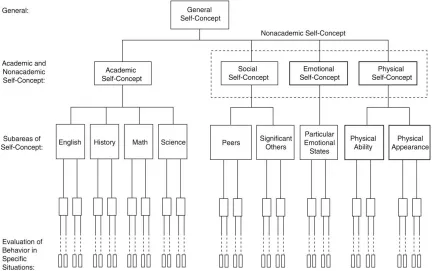
The hierarchical structure of the Marsh/Shavelson model starts with an
all-encompassing perception of the self, known as the global self-concept. This overarching
construct is then broken down into two distinctly separate branches: academic and
non-academic self-concepts. Both of these divisions are then further differentiated. Academic
self-concept is broken down into specific content-related domains such as math and
science. Non-academic self-concept is further separated into three major areas: social,
emotional, and physical self-concept. Each of these three areas is further differentiated as
shown in the full multidimensional, hierarchical model in Figure 2.1.
Figure 2.1. Structure of self-concept. (From "Self-Concept: Validation of Construct Interpretations" by R. J. Shavelson, J. J. Hubner, & J. C. Stanton, Review of Educational Research, 1976,46, 407-441. Copyright 1976 by the Review of Educational Research,
Reprinted by permission.)
The Structure of Self-Concept
Research aimed at testing the construct validity of the Shavelson model with its
differentiated, hierarchical structure led to a couple of key refinements to the original
1976 model. The first refinement grew out of research into the existence of a single
higher-order factor. Results from a number of studies showed that there was little
correspondence between math and verbal self-concept, pointing to the possibility of two
or more distinct areas of academic self-concept. Newly developed covariance structure
modeling analyzed the structures of student self-report responses and tested alternatives
to the single, general self-concept factor (Byrne & Shavelson, 1986; Marsh & Hocevar,
1985; Marsh & Shavelson, 1985; Marsh, Byrne, & Shavelson, 1988; Marsh 1990b;
Shavelson & Marsh, 1986). Results from these studies concluded that for academic
self-concept the hierarchical model structure could be more accurately represented with two
higher order factors. The refined Marsh/Shavelson model (Marsh & Shavelson, 1985),
shown in Figure 2.2, is believed to provide a more accurate representation of academic
self-concept. Here specific domains are paired with the corresponding broader academic
factors. The dotted lines indicate crossover subject areas that relate to both math and
verbal skills.
The second refinement to the original Shavelson model involved the nonacademic
portion of self-concept, specifically social self-concept. This portion of the original
Shavelson model was admittedly rudimentary. Byrne and Shavelson (1996) undertook
Figure 2.2. An elaboration of Marsh and Shavelson's (1985) revision to academic self-concept (that includes a wider variety of specific academic facets). From "A Multifaceted Academic Self-Concept: Its Hierarchical Structure and Its Relation to Academic
Achievement" by H. W. Marsh, B. M. Byrne, & R. J. Shavelson, 1988, Journal of
Educational Psychology, 80, p. 366-380. Copyright 1988 by the American Psychological Association. Reprinted by permission.)
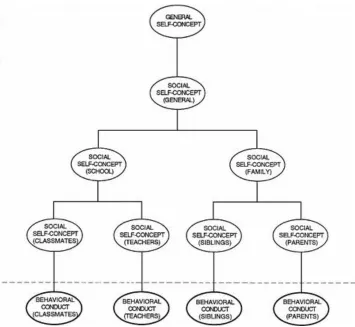
The resulting expanded model, see Figure 2.3, breaks general social self-concept
into both school and family facets. These two facets are further specified to differentiate
between classmates and teachers under school social self-concept and siblings and
parents under family social self-concept.
Below the dotted line in the model are the actual behaviors corresponding to that
specific social context. Byrne and Shavelson believed that behaviors partially determined
an individual’s self-concept in an area, in line with Shavelson’s definition of self-concept
as self-perceptions related to interactions within a specific social context (Marsh et al.,
Figure 2.3. Hypothesized model of social self-concept. From "On the Structure of Social Self-Concept for Pre-, Early, and Late Adolescents: A Test of the Shavelson, Hubner, and Stanton (1976) Model” by B. M. Byrne, & R. J. Shavelson, 1996, Journal of Personality and Social Psychology, 70, p. 599-613. Copyright 1996 by the American Psychological Association. Reprinted by permission
Existing Research Related to Peer and Social Self-Concept
In order to identify the research related to peer self-concept that has already been
conducted, a comprehensive literature search was conducted by the author (i.e., Google
Scholar, Eric, PsychInfo, and Web of Science). Unfortunately, only a handful of studies
were returned and just one actually addressed peer self-concept. As a follow-up,
general self-concept research related to peer relationships. The results of these additional
searches turned up only a few more publications, showing that additional research in this
area is warranted.
Connolly and Konarski (1994) authored the only peer-reviewed study related to
peer self-concept as a construct. Through the use of Harter’s Self-Concept Profile for
Adolescents (SCPA, 1988) the authors conducted a CFA and identified a 3-factor model
of peer self-concept. They concluded that the resulting factor structure provided evidence
that peer self-concept is multi-dimensional and consists of facets related to three distinct
groups: (1) peers, (2) close friends, and (3) romantic relationships. The authors then used
hierarchical multiple regression and correlational analysis to relate the three different
factors of peer self-concept to self-report responses about students’ experiences with
peers, friends and romantic others. They concluded that since correlations were highest
between corresponding groups (e.g., experiences with a large peer group will contribute
to peer self-concept but not close friend or romantic relationship self-concept) that this
served as evidence that peer self-concept is multi-dimensional and that differentiation
occurs as students have different types of experiences with others. However, the study
was cross-sectional, thus directionality could not be established, nor could it be proven
that differentiation occurred in peer self-concept over time. While Connolly and
Konarski’s research worked to define the construct of peer self-concept, it did not attempt
to show how this domain interfaces with academic self-concept domains. There was also
no attempt to relate peer self-concept to any educational outcomes.
A similar study to that conducted by Connolly and Konarski was undertaken on
the structure of social self-concept through the use of cross-lagged panel analysis in their
2012 research. The authors found that two facets of social self-concept could be clearly
differentiated in their model, contact and empathy. Lindner-Muller and colleagues found
these construct distinctions existed in children as young as second grade.
How peer factors relate to general self-concept. A number of the studies
recovered through the literature search looked at general self-concept as an outcome of
peer-related interventions such as: reciprocal peer tutoring (Fantuzzo, Davis, & Ginsburg,
1995), and peer-assisted learning (Ginsburg-Block, Rohrbeck, & Fantuzzo, 2006). Other
studies looked at different characteristics of peers and how these related to general
self-concept. Peer academic reputation (Gest, Rulison, Davidson, & Welsh, 2008), same-sex
and opposite-sex peer relationships (Hay & Ashman, 2003), isolated peer status
(Lawler-Prince & Grymes, 1990), peer acceptance (Obiakor, Stile, & Muller, 1987), peer and
self-ideals (Grymes & Lawler-Prince, 1993), and parent-adolescent relationship quality’s
impact on peer relations (Dekovic & Meeus, 1997) were all examined for their impact on
general self-concept.
Social self-concept research. While outside of the focus of the current study,
there were some pertinent results from the literature search found within the broader
domain of social self-concept. One of these studies found that social self-concept
(operationalized by the SDQ-III scales of Same-Sex and Opposite-Sex Relations)
increased as a result of a summer program for gifted students (Rinn, 2006). Others found
differences in social self-concept between hearing and hearing-impaired students and
Arif & Yousuf, 2010). These studies examined social self-concept specifically, instead of
looking at general self-concept as a result of social groupings or interventions.
The studies detailed above, investigated social self-concept or the impact of
peer-related interventions on general self-concept and found that self-concept could be
increased based on interpersonal relationships. For example, general self-concept
increased in situations where students had positive relationships with parents and when
they were accepted by others in the school.
Peers Influence on Achievement Motivation
There is a large body of research on the impact that peers have on each other with
respect to achievement and motivation. While the details are beyond the scope of this
review, a brief summary of what is known about peer influences in the classroom is
beneficial.
Peer relationships have the potential to affect the academic achievement of
students when peers serve as comparative referents. Students not only learn effective
ways to complete tasks from peers but simply observing peers’ performances can change
students’ ability beliefs and expectancies (Bandura,1986, 1989, 1997, 2012; Bouchey &
Harter, 2005; Fan, 2011; Freiberger, Steinmayr, & Spinath, 2012; Schunk, 1987, 1995;
Schunk & Meece, 2006; Schunk & Zimmerman, 1997; Wentzel, 1993, 2009). Peers also
impact school performance by clarifying instructions, providing assistance, and sharing
effective learning strategies (Lim & Kim, 2011; Molloy et al., 2011; Wentzel, 1991a,
1993, 2003, 2009). Peers encourage others to try new skills and follow classroom rules
(Bandura, 1986, 1997; Hamm & Faircloth, 2005; Han, Hu, Liu, Jia, & Adey, 2013; Lim
2011; Wentzel, 2003, 2009; Wentzel & Watkins, 2002). Peers self-select into groupings
based on the ability level of the group and then adopt academic values from the group
which become part of the their identity (Darensbourg & Blake, 2014; Dowson &
McInerney, 2001; Eccles, 2005; Hamm, Schmid, Farmer, & Locke, 2011; Kindermann,
1993, 2007; Kindermann & Skinner, 2009; Masland & Lease, 2013; Osterman, 2001;
Ryan, 2001; Steinberg et al., 1996; Van Ryzin, Gravely, & Roseth, 2009; Véronneau &
Dishion, 2011; Wentzel, 1993, 2005, 2009; Wentzel & Asher, 1995). Peers impact
student motivation through caring peer relationships where students strive to perform
academically when their close friends value achievement (Altermatt, 2011; Baker, 2006;
Deci & Ryan, 2008; Dowson & McInerney, 2001; Fan, 2011; Finn, 1989; Goodenow,
1993; Goodenow & Grady, 1993; Connell & Wellborn, 1991; Diseth & Samdal, 2014;
Han et al., 2013; Martin & Dowson, 2009; Molloy et al., 2011; Oberle &
Schonert-Reichl, 2013; Osterman, 2001; Ryan & Deci 2000; Skinner, Wellborn, & Connell, 1990;
Van Ryzin et al., 2009; Wentzel, 1996, 2003, 2005, 2009; Wentzel et al., 2012; Wentzel
& Caldwell, 1997; Wentzel & Watkins, 2002; Wentzel & Wigfield, 1998). Peer
expectations, values, and goals are adopted from others through a desire to please and fit
in, especially as children near adolescence (Cocks & Watt, 2004; Darensbourg & Blake,
2014; Fan, 2011; Liem, Lau, & Nie, 2008; Hamm et al., 2011; Masland & Lease, 2013;
Ryan, 2001; Wigfield, Tonks, & Klauda, 2009). Peers’ levels of social competence
impact their engagement and achievement (Wentzel, 1989, 1991a, 1991b, 1993, 1996,
1997, 1998, 2009; Wentzel et al., 2004, 2010; Wentzel & Watkins, 2002). As a whole,
this body of research has established that peer-related factors can influence student
is surprising, given all the research conducted on peer influences, that research involving
the peer self-concept domain remains lacking.
Self-Concept as a Theoretical Framework.
The present study will use multi-dimensional self-concept as a theoretical
framework for examining the association between perceptions of interest and competence
in academic areas and peer relationships. As part of the study it will be possible to
examine whether profiles of peer and academic self-concept change over time and if
these changes are accompanied by changes in academic achievement. This information
will add to current research by modeling complex interactions between student
perceptions of their interest and competency in academic and social areas. The use of
multi-dimensional self-concept as a theoretical framework is appropriate in that it
recognizes not only students’ academic perceptions but also their perceptions of
relationships with peers in the school.
There are other benefits to using the Marsh/Shavelson model (1985) as a
theoretical framework for the current study. This model was instrumental in focusing
research on the development of measurement instruments tailored to assessing the
concept domains. Herbert Marsh and Susan Harter both developed a number of
self-report instruments for use in assessing self-concept in individuals across the
developmental spectrum, (Self-Description Questionnaire-SDQ; Marsh 1990d, 1990e,
1990f; SPPC-Self-Perception Profile for Children; Harter, 1985; The Perceived
Competence Scale for Children; Harter, 1982). Prior to the development of these scales
subjected to reliability and validity studies (Self-Concept of Ability, Brookover, Thomas,
& Paterson, 1964; Affective Perception Inventory, Soares & Soares, 1979).
The family of Self-Description Questionnaires (SDQ’s) have firmly established
reliability and validity and have been the measurement tools used in many studies on the
construct of self-concept (Berndt & Bergy, 1996; Marsh, 1984; Marsh, Barnes, Carins, &
Tidman, 1984; Marsh & O’Neill, 1984; Marsh et al., 1985; Marsh, Relich, & Smith,
1983; Marsh, Smith et al., 1983) including the research utilizing NCES’s ECLS-K data
files (Kim, Schwartz, & Cappella, 2014; Froiland & Oros, 2014; Niehaus & Adelson,
2013, 2014). The Self-Description Questionnaire-I (SDQ-I) was used as the primary
measurement instrument for this study (Marsh 1988, 1990d, 1990e, 1990f). It should be
noted that specific details about the technical qualities of the SDQ-I scale can be found in
Chapter III.
Academic and Social Self-Concept Research Relevant to the Current Study
Kathyrn Wentzel and Allan Wigfield found that different types of goals, both
academic and social, interacted and jointly influenced achievement motivation (see
Wentzel & Wigfield, 1998). They concluded that a single goal framework was inadequate
for describing student motivation in schools. Others have supported their findings and
have determined that socially-derived goals (e.g., receiving acceptance from others, being
a valuable part of a peer group), work in concert with academic goals to impact both
students’ feelings of social competence and academic performance (Dowson &
McInerney, 2001; Hijzen, Boekaerts, & Vedder, 2006; Wentzel 1989, 1991a, 1991b,
1996, 1998; Wentzel, Baker, & Russell, 2012; Wentzel, Barry, & Caldwell, 2004;
2012). However, few studies of academic self-concept also consider the influence of
social or peer self-concept. The aim of the current study is to investigate these
relationships. To this end, some of the research that has been conducted with academic
self-concept is relevant and is detailed in the following sections.
Development of self-concept in children. When self-report responses on the
SDQ from students at different ages became available, tests of construct validity and
invariance at different ages began to emerge (Marsh, Parker, et al., 1983; Marsh, Relich,
et al., 1983; Marsh, Smith, et al., 1983; Marsh & Shavelson, 1985; Shavelson & Bolus,
1982). Conflicting results were found when looking at differentiation of academic
self-concept by developmental age. Shavelson and Bolus (1982) found that over a six-month
time lag self-concept measures remained stable at both global and domain-specific levels
of the hierarchy. These finding resulted from a study of a study of 130 7th and 8th grade
students. However, their results were not in agreement with research from Marsh, Smith
et al. (1983) and Marsh, Parker et al., (1983), who found that specific academic
self-concept dimensions did change, even in preadolescents. Marsh and colleagues concluded
that only global self-concept was stable. Both of these studies were conducted on students
in the fifth grade. Only the Marsh, Smith et al., study used repeated testing with a similar
six-month time lag as used with the Shavelson and Bolus study. This dissertation will
attempt to add to this research base in hopes of finding more consistency in results
through the use of a two-year longitudinal assessment of academic and peer self-concept
on the same students.
Across many studies, research results have agreed that self-concept is more global
children mature (Marsh, 1990a; Marsh & Hocevar, 1985; Marsh & Shavelson, 1985). The
hierarchical structure of academic self-concept appears to become weaker with age, as
the influence from global self-concept weakens and there is more influence from domain
specific areas (Marsh, Parker, et al., 1983; Marsh, Relich, et al., 1983; Marsh, Smith, et
al., 1983). Research has indicated that the differentiation of self-concept into more
subject-specific domains starts to occur at grade five. However, there has not been
research conducted on students between grades two and grade five. The current study will
contribute to knowledge about how and when development of more differentiated
domains of self-concept occurs.
Byrne and Shavelson (1996) applied correlational multi-trait, multi-method
(MTMM) analyses to study the structure of social self-concept. Through these analyses
they found that social self-concept was also multidimensional and hierarchical, becoming
more differentiated as children matured. The Byrne and Shavelson study was the only
study investigating the hierarchical structure of social self-concept over time, beyond
research conducted for social self-concept scale development (see Berndt & Bergy,
1996). Then in 2012, the Lindner-Muller et al., study examined changes in the factor
structure of social self-concept finding that this broad domain could be broken down into
subdomains of empathy and contact. This study involved the use of a German self-report
instrument with German students. It is not clear whether these results would transfer to
another culture.
A similar line of research involved looking at bias in student self-concept with
maturation. Marsh and Craven (1997) found that as children aged they evidenced a more
learn to self-evaluate more realistically, their self -concepts become more differentiated
and the correlations between different domains dramatically decreases. Byrne and
Shavelson (1996) also found that younger children overinflate their self-concept, in the
same way that they do their academic competency. That is, young children feel good
about themselves and their performances in every aspect of their lives (Berndt & Bergy,
1996; Harter, 1983, 1988; Lindner-Muller et al., 2012; Marsh et al., 1998; Wigfield &
Eccles, 2002). Researchers have also found that students’ achievement expectations
become more accurate as they mature (Schunk, 1995; Schunk & Meece, 2006; Schunk &
Pajares, 2009; Schunk & Zimmerman, 1997).
The current investigation will fill a void in the research base by studying the latent
class structure of both academic and peer self-concept across a two-year period (from
grades three to grade five) with the use of a more appropriate person-oriented
methodology. This design will afford examination of the relationship between student’s
peer and academic self-concepts and how these change as students mature.
Reciprocal effects model (REM) and causal ordering. Another area of research
relevant to the current study is one addressing the reciprocal relationship between
self-concept perceptions and achievement performance. Issues of causal ordering between
self-concept beliefs and academic achievement behaviors have been researched by many,
even before the Shavelson et al., model (1976). The classic discussion from Calsyn and
Kenny (1977) noted two different theoretical postulates: the self-enhancement model and
the skill development model. The self-enhancement model stated that evaluations of
significant others shape our self-concept of academic ability. It is this self-concept that
to change achievement, one’s self-concept would need to be bolstered. In contrast, the
skill development model argues that self-concept is a direct consequence of one’s
academic ability and achievement. This model implies that to improve achievement
performance, academic skills need to be improved. These improved abilities would
heighten confidence and self-concept, which would further improve academic
performance. The differences between these two theories has fueled flurries of research,
continuing to the current day (Marsh, 1990b; Marsh, Byrne, & Yeung, 1999; Marsh &
Craven, 2006; Marsh, Hau et al., 2002; Marsh & Martin, 2011; Marsh & O’Mara, 2008;
Marsh et al., 2005; Marsh & Yeung, 1997, 1998; William & Williams, 2010).
Marsh conducted an early study, using panel analysis, aimed at finding the
relationship between academic self-concept and GPA (1990b). The results of this study
indicated that neither academic self-concept nor achievement was the causative factor.
Instead he found that they were mutually reinforcing and reciprocally related. As a result
he termed this cyclical effect the reciprocal effects model (REM). Guay, Marsh, and
Boivin (2003) contributed to the refinement of the theory when they tested the reciprocal
effects model with three different age cohorts and found that reciprocal effects were
invariant. Their results debunked the original claim that the prevalence of skill
development or self-enhancement models vary with the age of the student. Guay and
colleagues found that the key to the relationship between academic self-concept and
achievement is that there must be a match in domain specificity between the achievement
measure and the self-concept indicator.
One of the largest efforts to test the generalizability of the reciprocal effects
same cyclical effects between self-evaluations and performance and termed this
“reciprocal determinism” in his social cognitive theory (1986). To determine how
widespread the reciprocal effects were, Williams and Williams (2010) tested the
relationship between self-efficacy and performance in math with an SEM feedback loop
model. Their results showed that reciprocal determinism was confirmed in 30 out of 33
different countries, making it a consistent phenomenon across cultures.
Person-Oriented Perspective and Research Methodology
One of the limitations inherent in much of the research that has been conducted on
motivation is that studies have largely been variable-and not person-oriented. Instead of
looking for changes in individual cognitive abilities, behaviors, and other characteristics
over time (intraindividual), variable-oriented research focuses on either making
comparisons between groups (e.g., ANOVA) or finding inter-individual relationships
between predictors and dependent variables (e.g., regression, correlation).
Variable-oriented approaches focus on the relationships between variables (i.e.,
group differences, prediction of outcomes, inter-correlations between measures) that are
largely assumed to be the same across all unique individuals. To obtain a clear
understanding of the unique social and environmental factors impacting the development
of academic achievement, it is necessary to follow an interactionist research focus.
Instead of assuming that relationships between variables impact all individuals in the
same way, an ecological fallacy, research should focus on the complex, more
individualistic relationships within individual motivational systems. To achieve this level
of in-depth investigation, person-oriented research is necessary. Person-oriented research
explain constructs. People are grouped into classes based on characteristics that they have
in common with others. These characteristics distinguish those within the group from
people outside the group. In essence, person-oriented methodologies minimize intragroup
(within-group) differences and maximize intergroup (between-group) differences.
For example, when looking at student learning, there is a group of students who
excel when math problems are presented with hands-on manipulative tools. Then there
are others who excel by memorizing formulas. Both groups could have the same test
scores, but approach the learning task in very different ways. Looking at grouping
students by test scores assumes that they all learn in the same manner, simply because
they have the same final score. In fact, there are very large differences in the learning
strategies and processes that people with the same test score display. Uncovering these
underlying differences is instructive in understanding the complexities of learning and
motivation.
Besides failing to acknowledge the importance of complex interactions within and
between individuals, the variable-oriented approach fails to recognize the significant
relationship between the parts and the larger whole. Higher order interactions of
behaviors and processes are simplified or wholly disregarded. Instead the
variable-oriented approach primarily focuses on linear relationships across people. Even with
model-based techniques (i.e., structural equation modeling) researchers focus on
reproducing lower level relationships (mean structures and variance-covariance matrices)
instead of attending to higher-order complex interactions (Bergman & Trost, 2006; Sterba
In contrast, person- oriented research looks at holistic and interactionist
development specific to the individual (Bergman & Magnusson, 1997; Bergman & Trost,
2006). These methods examine the complex relationships within and/or between the
person’s behavior, goals, values, and the environmental context as well as how these
relationships change over time (e.g., latent class growth analysis, cluster analyses, latent
transition, latent Markov models, and pattern analysis approaches). Not only do these
complex interactions involve the environment, they also involve other people with their
own complexities. When studying human development, a holistic focus with supporting
methodology should guide both research activities and interpretation of results.
Multifaceted person-oriented research not only aids in understanding complex patterns of
behavior but also provides a common terminology for communicating and furthering
research (Bergman, 1998; Bergman & Magnusson, 1997).
Assumptions of the person-oriented approach. The centerpiece of the
person-oriented approach is the state of the system and how it changes over time. This approach
adheres to five basic assumptions: (1) the state is unique to the individual, (2) the state is
a complex interaction of many factors, (3) states are characterized by having a
meaningful structure that shows growth and differences between individuals, (4)
processes occur as patterns in an orderly fashion, and (5) there are a small number of
actual observed patterns. The fact that there are only a relatively small number of
behavior patterns that are actually utilized, leads to stability in the system (Bergman &
Magnusson, 1997). These assumptions apply both between different individuals and
Person-oriented approaches to research look to find differences between people in
a population and find meaningful groups within this population that contain individuals
who are similar. These similarities are discovered from their responses to survey or test
items, or other measures of observed behavior. Critics of the person-oriented approach
focus on the fact that the data being used still consists of variables. However, in
person-oriented approaches variables serve only as building blocks for creating profiles and the
variables have no significant meaning by themselves without considering how they
interface with other variables. Thus, several focal variables are used all together at the
same time and the resulting profile is what is used in ensuing analyses (Bergman &
Magnusson, 1997; Bergman & Trost, 2006).
For this research study, the following definitions for person-and variable-oriented
approaches will apply. Variable-oriented approaches will include methods which are
based on relations between variables and the use of linear statistical models (e.g.,
ANOVA, MANOVA, regression techniques, SEM). The use of more sophisticated
longitudinal models like panel, time-series, cross-lag, and analysis of difference scores
are also variable-oriented since they view individuals as interchangeable units, ignoring
their unique multivariate makeup. Person-oriented approaches differ in that they examine
all variables or measures as interrelated components forming a profile, which is the unit
of analysis. Person-oriented methodologies include cluster, latent class, latent transition,
and latent profile analyses (Bergman & Magnusson, 1997; Bergman & Trost, 2006).
These methods consider characteristics of the individual when creating profiles, and
Different Person-Oriented Research Approaches
There are a number of different person-oriented methods for determining unique
individual profiles. Two different approaches, cluster analysis and latent class cluster
analysis, have been commonly used to examine intraindividual changes and variations
within dynamic environmental and social systems. Both of these approaches concentrate
on categorizing or classifying individuals based on a profile of multivariate
characteristics in an attempt to better understand commonalities and differentiation in
personal characteristics.
Cluster analysis (CA). This data reduction technique is similar to factor analysis
and focuses on creating smaller homogeneous groups from a larger data set of individual
responses (Aldenderfer & Blashfield, 1984; DiStefano, 2012; DiStefano & Mîndrilă,
2013). Cases within a cluster are very similar with respect to a specific characteristic and
are different from the cases that are outside of the cluster. Multivariate response profiles
are used to identify like cases, which are then used to create the clusters. Proximity or
distance measures (Euclidean and Mahalanobis’ distances) are used to evaluate how
dissimilar two cases are from each other across a set of variables.
A number of algorithms have been developed to use dissimilarity information to
form clusters, with final results dependent on the procedures used (see DiStefano, 2012
for a discussion of these techniques). With cluster analysis the challenge lies in finding
the appropriate number of homogenous groups for the data and then interpreting the
underlying construct. Both demographic characteristics of grouped cases and cluster
centroid information aid in interpretation of clusters. Internal and external validation
the specific data set. However, even with these procedures in place, identification and
validation of clusters is largely a subjective judgment since there are no statistical
significance tests for the adequacy of cluster solutions.
Since variables from any type of measurement scale can be used for forming
clusters, it is critical that the researcher selects variables that are relevant and well
represent the research questions. In addition, the variables used must be independent and
uncorrelated. One of the major drawbacks of cluster analysis is that since the variables
are observed, they are tied to their scale and need to be on same metric level. Variables
can be standardized to allow comparisons but this can mask the very uniqueness that is
most useful and relevant in creating groupings. In fact, researchers can obtain wholly
different results when using standardized instead of raw, scale-dependent values for
variables (DiStefano, 2012; DiStefano & Mîndrilă, 2013). Another drawback is that the
clustering distance measures are influenced by differences in variability across the
relevant variables, as well as the differences in height between profiles. Variables with
larger variance can exert undue influence on the final distance calculations.
Latent class cluster analyses (LCCA). Another statistical method that identifies
subsets of individuals with similar responses to multivariate data elements is latent class
cluster analysis. For examining developmental, intraindividual change, both LCCA and
CA can be used either alone or in sequence as person-oriented research approaches
(Bergman et al., 2003).
As with cluster analysis the number of distinct groups underlying the data is
unknown. However with LCCA, groupings are based on unobserved, latent categories,
free of measurement error and is the only element that causes the observed variables to be
related to each other. Therefore, when latent class membership is removed, randomness is
all that remains (Collins & Lanza, 2010). This is the essence of the local independence
assumption (see “Assumptions” below).
LCCA is similar conceptually to factor analysis in that it undertakes data
reduction through focusing on larger unobserved constructs. Factor analysis examines
relationships between continuous, normally-distributed variables through correlations. In
contrast, LCCA looks at structural relationships by examining qualitative differences
between cases (taxonomies) in terms of categorical variables.
Assumptions of LCCA. The assumptions for CA and LCCA are similar, the
variables must be independent and uncorrelated. Beyond this common assumption,
LCCA assumes each case has a specific probability distribution for membership in the
latent class. Students are classified in classes they are most likely to be affiliated with, yet
the classification is based on probability, and thus, is not fully certain (Collins & Lanza,
2010; DiStefano, 2012; DiStefano & Mîndrilă, 2013). Finally, LCCA assumes local
independence (i.e., that the indicators within a class are independent of each other and the
latent class explains all the observed relationships between the indicators) and that the
variables within a latent class are all uncorrelated.
Latent Class Cluster Analysis includes both Latent Class (LCA) and Latent
Profile (LPA) analyses. The distinction is that latent class analysis involves only
categorical observed measures while LPA deals with continuous data. These models are
flexible and accommodate a mixture of variables from different measurement scales,
Benefits of LCA. Latent class analyses categorize cases based on a statistical
model which describes the population. This model groups individuals based on their
similarity with respect to a latent variable. With LCA the measurement error inherent in
observed variables is partitioned into residual variance.
LCA models use a top down approach (DiStefano & Mîndrilă, 2013) where the
expected distribution of the data is first described and then probabilities that cases are
members of the different latent classes are determined. LCA, does not rely on the use of
distance measures between cases. Cluster analysis, in contrast, uses a bottom up approach
that looks for similarities in cases (through distance measures) and then tries to find
corresponding explanations for the data.
Additional benefits from using LCA are that these model-based clustering
methods support the use of statistical significance testing (Chi-square referenced) and fit
indices for finding the optimal solution. Finally, LCA also allows the inclusion of
covariates when predicting individual’s latent class membership, supports modeling
change over time in the latent class structure (latent transition analysis), and can be used
to predict related outcomes or additional similarities among cases within the groupings.
Model Restrictions. Latent class methods allow flexibility in deciding which
parameters to estimate. This makes it possible to test a large number of different solutions
and to allow solutions that have unequal variances between indicators or groups. Being
able to impose restrictions on the number of parameters to be estimated also facilitates
model identification by ensuring there is sufficient available information. Since LCA
models have the flexibility to free restrictions on parameter equalities, they can achieve