vision algorithms for the control of an
autonomous horticultural vehicle
J B Southall
A dissertation submitted in partial fulfillment
of the requirements for the degree of
Doctor of Philosophy
of the
University of London.
Department of Computer Science
University College London
ProQ uest Number: U 643391
All rights reserved
INFORMATION TO ALL U SE R S
The quality of this reproduction is d ep en d en t upon the quality of the copy subm itted. In the unlikely even t that the author did not sen d a com plete manuscript
and there are m issing p a g e s, th e se will be noted. Also, if material had to be rem oved, a note will indicate the deletion.
uest.
ProQ uest U 643391
Published by ProQ uest LLC(2016). Copyright of the Dissertation is held by the Author. All rights reserved.
This work is protected against unauthorized copying under Title 17, United S ta tes C ode. Microform Edition © ProQ uest LLC.
ProQ uest LLC
789 East E isenhow er Parkway P.O. Box 1346
Economic and environmental pressures have led to a demand for reduced chemical use in crop
production. In response to precision agriculture techniques have been developed that aim to increase the efficiency of farming operations by more targeted application of chemical treat
ment. The concept of plant scale husbandry (PSH) has emerged as the logical extreme of preci
sion techniques, where crop and weed plants are treated on an individual basis. To investigate
the feasibility of PSH, an autonomous horticultural vehicle has been developed at the Silsoe Re
search Institute.
This thesis describes the development of computer vision algorithms for the experimental
vehicle which aim to aid navigation in the field and also allow differential treatment of crop
and weed. The algorithm, based upon an extended Kalman filter, exploits the semi-structured
nature of the field environment in which the vehicle operates, namely the grid pattern formed by
the crop planting. By tracking this grid pattern in the images captured by the vehicle’s camera
as it traverses the field, it is possible to extract information to aid vehicle navigation, such as
bearing and offset from the grid of plants. The grid structure can also act as a cue for crop/weed
discrimination on the basis of plant position on the ground plane. In addition to tracking the grid
pattern, the Kalman filter also estimates the mean distances between the rows of lines and plants
in the grid, to cater for variations in the planting procedure.
Experiments are described which test the localisation accuracy of the algorithms in off
line trials with data captured from the vehicle’s camera, and on-line in both a simplified test
bed environment and the field. It is found that the algorithms allow safe navigation along the
rows of crop. Further experiments demonstrate the crop/weed discrimination performance of
the algorithm, both off-line and on-line in a crop treatment experiment performed in the field
Acknowledgements
Sincere thanks must go to my two supervisors, Bernard Buxton at UCL and John Marchant at
the Silsoe Research Institute, for their advice, encouragement and enthusiasm that has made the
last three years as enjoyable as they have been educational. Danny Alexander read much of this
thesis in draft form, and I thank him for his comments and pertinent questions. Simon Arridge
and S0ren-Aksel S0rensen at UCL, and Andy Frost and Robin Tillett at Silsoe have participated
actively in the various committees set up to monitor my progress over the last three years, and
their comments have been most helpful.
This project would not have been possible without the contributions of a number of people
at the Silsoe Research Institute. Tony Hague has been responsible for the design and develop
ment of the sensing and estimation systems on the autonomous vehicle that the work in this thesis
is centred upon, and it is safe to say that without his efforts the on-line demonstrations presented
here would not have been possible. I also thank Tony for many conversations on the practical
use of Kalman filters, and much of my understanding of the subject is down to him. Ian Jeffs
and Chris Slatcher supervised the growth of the cauliflowers used in experiments throughout this
thesis, and Bob Warded took the photographs of the treated crop seen in chapter 8. His patience
in assembling the mosaics by hand is much appreciated. Simon Miles, John Butler and John
Richards provided much assistance in putting together all manner of bits and pieces of experi
mental equipment.
The members of the image analysis group at Silsoe made me particularly welcome during
my stay in the lab, and I thank them all for their friendship, advice and library code. Dickson
Chan and Robin Tillett risked eye and wrist strain to produce the HUMAN2 and HUMAN3 data
sets seen in chapter 5. Both Tony and John helped me out with field measurements, and John’s
skills as an impromptu milliner saved me from sun-stroke on more than one occasion.
Without the help of my family, my time at university would have been a great deal harder.
So, Mom, Dad and Rachel, thanks for eight years of ’phone calls and visits, and most of all for
supporting me in everything I’ve done for longer than I can remember.
LOPEX plant spectra data set. The LOPEX data set was established during an experiment con
ducted by the TDP Unit of the Space Applications Institute/Joint Research Centre of the Euro
pean Commission (Ispra). The q h u l l program from the Geometry Centre at the University of
Minnesota was used in the production of the MRROC curves in chapter 8.
Contents
1 Introduction 14
1.1 Autonomous vehicles... 15
1.1.1 Indoor ro b o ts ... 16
1.1.2 Outdoor v e h icles... 17
1.1.3 Agricultural Vehicles... 19
1.2 The Silsoe autonomous vehicle project... 20
1.2.1 Localisation... 21
1.2.2 Plant recognition... 22
1.2.3 The aims and contributions of this thesis... 24
1.3 Thesis o u tlin e ... 25
2 Image processing in the field environment 27 2.1 The semi-structured field environment... 27
2.1.1 Model based tracking in machine v isio n ... 28
2.1.2 Active contour m o d e ls ... 29
2.1.3 Point distribution m odels... 30
2.1.4 Rigid m o d e ls... 32
2.1.5 Flexible te m p la te s ... 33
2.2 Modelling and viewing the grid structure... 33
2.2.1 Perspective imaging of the grid structure ... 35
2.3 Image processing... 36
2.3.1 Thresholding IR im a g e s ... 38
2.3.2 Evaluation of the segmentation alg o rith m ... 38
2.3.3 Image sequences and ground tr u th ... 42
2.3.4 Segmentation experiments - algorithms and measurements ... 43
2.3.5 Segmentation experiments - re s u lts ... 45
2.3.7 Feature extraction... 52
2.3.8 Problems with feature extraction... 53
2.3.9 Image processing - summary... 57
2.4 S u m m a ry ... 57
3 Tracking and estimation with Kalman filters 59 3.1 The Kalman f ilte r ... 60
3.1.1 Filter equations and derivation . ... 62
3.2 The extended Kalman filte r... 66
3.3 Practicalities - initialisation and data association ... 68
3.4 Controllability and observability... 69
3.4.1 Controllability and observability in LTI systems... 69
3.4.2 C ontrollability... 70
3.4.3 Observability... 70
3.4.4 Implications for Kalman filtering... 71
3.4.5 C ontrollability... 72
3.4.6 Observability... 73
3.5 Corruptibility, observability and the EKF ... 73
3.6 S u m m ary ... 76
4 Process and observation models for crop grid tracking 77 4.1 State evolution m o d el... 78
4.1.1 The model with fixed grid param eters... 79
4.1.2 The model with estimated grid parameters... 80
4.1.3 Forward distance estim ation... 80
4.1.4 Forward distance estimation with fixed grid parameters... 81
4.1.5 Forward distance estimation with estimated grid p aram eters... 81
4.2 Observation m o d e l ... 82
4.2.1 The matrix of partial derivatives hx(jt)... 83
4.2.2 Partial derivatives matrix with fixed grid p a ra m ete rs... 83
4.2.3 Partial derivatives matrix with estimated grid param eters... 84
4.2.4 The partial deriv ativ es... 84
4.2.5 Observation noise... 85
4.3 Alternative filter formulations ... 86
Contents 7
4.3.2 The parallel update f il te r ... 87
4.3.3 Equivalence of update schemes ... 88
4.4 Corruptibility of the crop grid tracker ... 90
4.4.1 Corruptibility with fixed grid parameters ... 90
4.4.2 Corruptibility with estimated grid param eters... 91
4.5 Observability of the crop grid tracker... 93
4.5.1 Observability with fixed param eters... 93
4.5.2 Observability with estimated parameters... 94
4.6 The on-line vision system ... 95
4.6.1 The data compression filter... 98
4.6.2 Observability of the on-line s y s te m ... 100
4.6.3 Estimating f and
I
o n - li n e ... 1004.7 S u m m a ry ... 101
5 Off-line and test-bed navigation trials 102 5.1 Off-line ex p erim en ts... 103
5.1.1 Tracking with fixed grid parameters (A U T O )... 104
5.1.2 Tracking whilst estimating grid parameters (A U T 02)...I l l 5.2 Test-bed experim ents... 121
5.2.1 R e s u lts ...123
5.3 S u m m a ry ... 125
6 Initialisation and data association 129 6.1 The initialisation algorithm ... 130
6.2 Data association and validation... 133
6.2.1 Feature validation...135
6.2.2 Implications for filter implementation...136
6.3 S u m m a ry ... 137
7 Image segmentation 139 7.1 The image segmentation algorithm ... 140
7.1.1 Size f ilte r in g ... 140
7.1.2 Feature clustering ...142
7.1.3 Classification summary...145
7.2.1 The maximum realisable ROC curve... 146
7.2.2 Parameter selection...147
7.3 Segmentation experim ents... 150
7.3.1 Segmentation of ground truth plant matter fe a tu re s ...150
7.3.2 Segmentation of real im a g e s...152
7.4 S u m m ary ... 155
8 Field trials 158 8.1 Position estim atio n ... 158
8.1.1 Experimental r e s u lts ...161
8.2 Crop treatment ... 162
8.2.1 Experimental r e s u lts ...166
8.3 S u m m ary ... 171
9 Conclusions 172 9.1 Localisation... 173
9.2 Plant tre a tm e n t... 174
9.3 Further work ... 175
Bibliography 177
Appendices 189
A The Hough transform row tracker 189
B The matrix inversion lemma 193
List of Figures
1.1 The Silsoe autonomous horticultural v eh icle... 21
1.2 Vehicle control and navigation architecture ... 22
1.3 The crop row s tru c tu re ... 23
2.1 The grid planting pattern as captured from the vehicle camera... 28
2.2 A flexible template model of the human e y e ... 33
2.3 The grid m o d e l... 34
2.4 The camera and world co-ordinate systems... 35
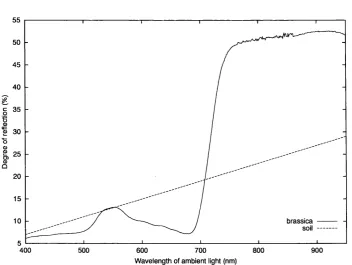
2.5 Reflectance of plant matter and so il... 39
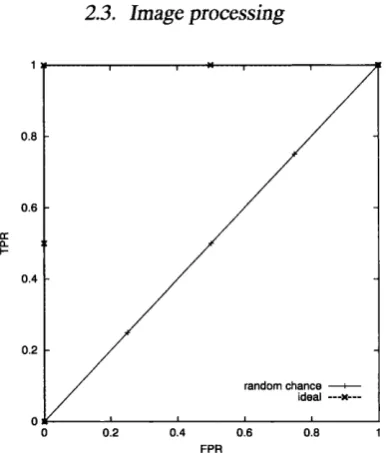
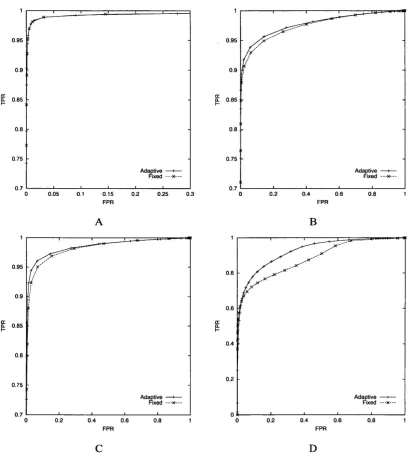
2.6 The ideal and random chance ROC c u rv e s... 42
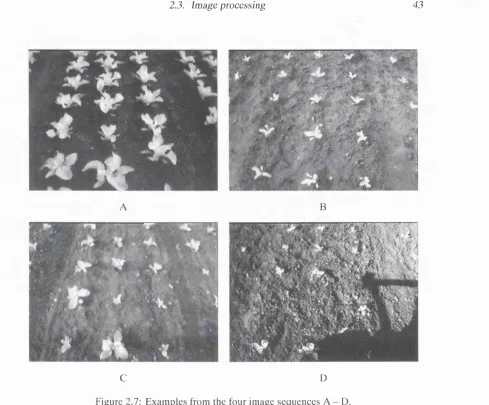
2.7 Examples from the four image s e q u e n c e s... 43
2.8 An image and its plant matter mask ... 44
2.9 The effect of border pixels on classifier performance ... 46
2.10 Experimental results, data sets A - D ... 47
2.11 Example segmentation for sequence A ... 50
2.12 Example segmentation for sequence B ... 51
2.13 Example segmentation for sequence C ... 51
2.14 Example segmentation for sequence D ... 51
2.15 Example segmentation for sequence D with revised cost ra tio ... 52
2.16 An example of chain-coding... 53
2.17 Large plants merge into a single f e a tu r e ... 54
2.18 A plant fractures upon thresholding ... 55
2.19 Projection errors and the virtual ground p l a n e ... 56
4.1 The grid m o d e l... 78
4.2 A comparison between a corruptible and partially incorruptible estimator . . . 92
4.3 Network topologies... 96
5.1 Trajectories of the state variables for sequence 1 ... 105
5.2 Trajectories of the state variables for sequence 2 ... 106
5.3 A scatter p l o t ... 108
5.4 The Y estimates from AUT02 and SEMI2 for sequence 1 ... 112
5.5 The Y estimates from AUTO and SEMI for sequence 1 ... 113
5.6 Estimated and measured f and / for the first sequence... 113
5.7 Estimated and measured f and
I
for the second s e q u e n c e ... 1145.8 Estimates from AUTO and A U T 0 2 ...115
5.9 State trajectories whilst estimating the grid parameters, sequence 1 ... 118
5.10 State trajectories whilst estimating the grid parameters, sequence 2 ... 119
5.11 The vehicle in the test-bed environm ent... 122
5.12 The perpendicular offset h ... 123
5.13 Navigation trials... 127
5.14 Estimate uncertainties... 128
6.1 Sampling along a ro w ...131
6.2 A real image sample ... 131
6.3 Comparison of human and automatic assessment of row o f f s e t ...132
6.4 A validation g a t e ... 135
6.5 Order of data incorporation... 137
6.6 Parallel validation... 137
7.1 Blob size h isto g ram s... 141
7.2 The construction of the clustering region Sassoc... 143
7.3 Segmentation schematic ... 145
7.4 Two classifiers and a line in ROC s p a c e ... 146
7.5 A maximum realisable ROC c u rv e ... 147
7.6 MRROC curves for ground truth plant matter segm entations... 149
8.1 Measuring the plant and trail positions... 160
8.2 Navigation trials... 163
8.3 Spray measurement... 165
8.4 Spray treatment results, part o n e ... 168
8.5 Spray treatment results, part t w o ... 169
List o f Figures 11
8.7 Weed identification, example tw o ... 170
A .l The camera and world plane co-ordinate s y s te m s ... 189
A.2 The crop as seen by the cam era...190
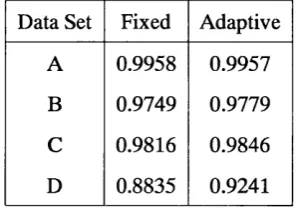
2.1 Area underneath ROC curves... 46
2.2 Threshold gains a for each image s e q u e n c e ... 50
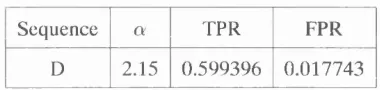
2.3 Threshold gain, TPR and FPR for sequence D ... 52
5.1 Root mean-square differences on the estimate, sequence 1 ... 109
5.2 Root-mean square differences on the Y estimate, sequence 1 ... 109
5.3 Root-mean square differences on the $ estimate, sequence 1 ... 109
5.4 Root mean-square differences on the estimate, sequence 2 ... 110
5.5 Root-mean square differences on the Y estimate, sequence 2 ... 110
5.6 Root-mean square differences on the ^ estimate, sequence 2 ... 110
5.7 Filter estimate standard deviations for sequence 1 ... I l l 5.8 Filter estimate standard deviations for sequence 2 ... I l l 5.9 The hand-measured sequence means of f and Ï ... 114
5.10 Root mean-square differences on the tx estimate, sequence 1 ... 115
5.11 Root-mean square differences on the Y estimate, sequence 1 ... 115
5.12 Root-mean square differences on the ^ estimate, sequence 1 ... 116
5.13 Consistency measures on estimates of f, sequence 1 ... 116
5.14 Consistency measures on estimates of /, sequence 1 ... 116
5.15 Root mean-square differences on the tx estimate, sequence 2 ... 116
5.16 Root-mean square differences on the Y estimate, sequence 2 ... 117
5.17 Root-mean square differences on the ^ estimate, sequence 2 ... 117
5.18 Consistency measures on estimates of f, sequence 2 ... 117
5.19 Consistency measures on estimates of /, sequence 2 ... 117
5.20 Estimated standard deviations, sequence 1 ... 121
5.21 Estimated standard deviations, sequence 2 ... 121
5.22 Error measures ...124
List o f Tables 13
7.1 The area under MRROC curves ... 148
7.2 Operating points for the size filtering and clustering algorithm s... 149
7.3 TPR and FPR for the operating points selected... 150
7.4 TPR and FPR comparison ... 151
7.5 Run A segmentation results... 153
7.6 Run B segmentation results...153
7.7 Run C segmentation results...154
7.8 Run D segmentation results...154
7.9 TPR and FPR ratios for the correctly identified plant matter p i x e l s ...155
8.1 Error measures for outdoor navigation...162
8.2 Measured and estimated forward d is ta n c e ...164
Introduction
In 1731, Jethro Tull published his book The New Horse Hoeing Husbandry that contained, amongst other innovations, the designs for a device that would lead to the mechanisation of agri
culture. This device was the seed drill, that allowed more orderly and reliable planting of crop
than the traditional broadcasting technique. In broadcasting, the seeds are scattered randomly
across the surface of the soil. Seed drilling deposits the seed on the earth in a regular row and
presses it into the soil where it is more likely to be nourished and is protected from wind, rain
and wildlife. The regular spacing of the rows ensures that the crop plants have approximately
equal volumes of soil from which they can extract nutrients and sufficient access to sunlight, so
each plant grows at a similar pace to its neighbours, and all will be ready for harvest at the same
time.
In addition to its agronomic benefits, the orderly arrangement of crop ensured by the seed
drill paved the way for large scale use of agricultural machines. When seeds were sown by
broadcasting, the resulting irregular positioning of the crop plants meant that weed control had
to be performed by manual hoeing of the field around the plants. Crops planted using the seed
drill grew in rows, which meant that a hoe could be drawn by a horse in straight lines between the
crop rows. Horses were gradually replaced by tractors, and for many crops, mechanical weeding
using a hoe has been replaced by chemical treatment for weed and disease control. Currently,
approximately ^460 million are spent annually on 23,000 tonnes of agro-chemicals in the UK
alone. A rise in consumer interest in organic farming, together with recent controversy over food
crops that have been genetically modified to resist herbicides used in weed control, has led to
pressure to reduce the amount of agro-chemical used in our farms.
Precision agriculture is a concept developed in response to these pressures, where new tech
nology is exploited to achieve the most efficient use of agro-chemicals as possible. Instead of
taking an approach where all of a field is treated with a fertiliser, fungicide or herbicide, the pre
1.1. Autonomous vehicles 15
the field, according to local requirements. For instance, if a particular region of field was known
to be vulnerable to weed infestation, then more herbicide would be directed toward that region
than to other parts of the same field. The logical extreme of the precision agriculture approach is
the treatment of individual plants. This approach is known as plant scale husbandry (henceforth PSH), and its aim is to direct treatment precisely, with no waste of fertiliser on weeds or soil, or
herbicide on crop [THM96, HMT97b]. The technique may even pave the way to larger scale
organic farming, with precisely guided mechanical weed control.
For PSH to be economically feasible, the treatment systems will almost certainly require
autonomy from direct human supervision. Hague et al [HMT97a] estimate that for precise spray treatment of individual plants, a vehicle carrying the treatment system would be limited to a max
imum speed of approximately lm s~^. This limit is imposed by both real-time computational constraints and physical constraints relating to the time taken to activate a spray treatment sys
tem, and for the spray to reach the plant. Employing a farm worker to drive a vehicle at such
a low speed would be prohibitively expensive, which has prompted scientists at the Silsoe Re
search Institute^ to develop an autonomous horticultural vehicle as a test-bed for experiments in
PSH.
This thesis reports the development and testing of computer vision algorithms designed to
aid both navigation and treatment scheduling for the Silsoe vehicle. The remainder of this intro
duction reviews related work in mobile robotics and provides more detail on the Silsoe vehicle
application, before we outline the contributions presented in this thesis and preview the contents
of the next eight chapters.
1.1 Autonomous vehicles
One of the earliest applications in computer vision was that of autonomous vehicle navigation
in the SHAKEY project which ran at the Stanford Research Institute from 1966 - 1972 [Nil69].
SHAKEY was a mobile robot equipped with bump sensors, a laser triangulation range-finder
and a camera, and was used as a platform for artificial intelligence research into topics such as
object recognition, navigation and path planning in a well-structured indoor environment. Since
this early work, a great deal of research has been performed with autonomous robot vehicles,
and we review some of it below. The work has been partitioned into three categories: indoor
robots, outdoor vehicles and agricultural vehicles. In each case, we concentrate on solutions
which require little or no modification to the system’s working environment.
1.1.1 Indoor robots
Much of the research conducted into mobile robot navigation has concentrated on indoor ap
plications. The typical scenario is a well-structured indoor space such as an office [SGH"^97],
museum [DFBT99], or factory [BDWH+90]. In these situations, the challenges are localisa
tion, obstacle avoidance and path planning. In our horticultural application, only localisation
is of interest at the moment. Path planning is straightforward as the vehicle must simply fol
low the rows of crop and execute turns at the end of each row to progress to the next. Obstacle
avoidance is not of concern because any evasive action taken in the field is likely to cause dam age to the valuable crop, but obstacle detection will be important in any commercial system to bring the vehicle to a safe halt and prevent accidental damage to the horticultural vehicle (or the
obstruction), and then to alert the farmer that there is something unexpected in the field.
Localisation, the ability to determine one’s position relative to a co-ordinate frame, is vital
for the success of PSH, where the horticultural vehicle must navigate safely in the field and tar
get plant matter for treatment. Many successful mobile robot localisation systems combine both
proprioceptive, or dead-reckoning, information with external views of the world. The combina
tion of the internal and external sensing modalities helps compensate for the weaknesses in each.
The readings from dead-reckoning sensors such as wheel odometry, accelerometers and gyro
scopes are prone to drift, and position estimates from such measurements alone tend to become
increasingly biased away from the true value as the sensor drift increases with time. External
sensors such as sonar, infra-red laser ranging devices and computer vision are prone to outliers
and missing readings, so estimates based upon these alone may be unstable. The combination
of the two sensing modalities corrects for drift in the dead reckoning and allows inappropriate
external sensor readings to be filtered out of the position estimate.
Many successful robots have been constructed using this mixture of sensors. Brady
et al [BDWH+90] describe an incarnation of the Oxford AGV project, designed for moving pallets around factory floors. In their test system odometry is married with a ring of sonar rang
ing devices. The sonar sensors are used to detect range to walls and comers of a room, and these
are matched, where appropriate, to an a priori map of the factory environment [LDW91a]. Sub sequently the methods were transferred to another vehicle [HGB97], where a scanning infra-red
laser was incorporated into the estimation system to provide bearing information to a number
of bar-code targets placed in the robot’s environment from which the robot’s position can be
triangulated^. An overview of the AGV project is given in the book edited by Cameron and
1.1. Autonomous vehicles 17
Probert [CP94].
Crowley [Cro89] describes a sonar-based robot localisation algorithm that bears some sim
ilarity to that of Leonard and Durrant-Whyte [LDW91a], although the features they extract from
the sonar scans differ. Crowley fits line segments to the range readings, whilst Leonard and
Durrant-Whyte search for regions of constant depth (RCDs). RCDs occur “naturally” in sonar
scans, and are typically caused by concave comers in the environment.
The projects mentioned above use pre-determined maps of the environment and the robots
localise themselves with respect to these maps. A more difficult problem is simultaneous map-
building and localisation in unknown environments, which has been attacked using sonar by
Leonard and Durrant-Whyte [LDW91b] and Rencken [Ren93], and with computer vision by
Faugeras and co-workers [AF89, AF88, DF90], Harris [Har92a] and, lately, Davison [Dav98].
All of these approaches [HGB97, LDW91a, Har92a, AF89, Dav98], be they with a priori maps or not, have two common traits. The first is the use of what Leonard and Durrant-Whyte
call geometric beacons as reference points in the world. These beacons may be artificial targets such as the bar-codes read by the laser scanner [HGB97], or distinctive features in the sensed
data, such as RCDs in the sonar scans [LDW91a], comer features in images [Har92a], 3D points,
lines or planes [AF89] or image regions detected by an interest operator [Dav98]. In our horti
cultural application, the regular pattem formed by the crop in the ground is a natural and reliable
beacon that may be used as an aid for localisation.
The second common feature of the work presented above is the use of the Kalman filter al
gorithm to estimate vehicle position and, in the map building applications, beacon position. The
Kalman filter is a recursive estimation algorithm based upon a predict-correct cycle. A model of
the vehicle’s kinematics is used to predict the vehicle’s position after motion has occurred, and a combination of dead-reckoning and extemal measurements are used to correct the predicted position estimate. The Kalman filter algorithm is used in the Silsoe vehicle as outlined below,
and will be treated in greater depth in chapter 3.
1.1.2 Outdoor vehicles
As we have seen, there are valuable lessons to be leamt from indoor navigation schemes, but
there are several additional challenges for autonomous vehicles that operate outdoors. Inside
buildings, the floor is smooth enough that smooth planar motion with no pitch or roll and little
vibration may be assumed, artificial lighting is reasonably constant, and man-made objects typi
cally provide strong features that may be extracted relatively easily from images or sonar scans.
Outside, especially off-road, the ground plane is less reliably flat, there are fewer man-made fea-
tures, so features extracted from images may be less persistent throughout an image sequence,
and there is no control over natural lighting.
Outdoor vehicles may be separated from those that operate in man-made surroundings, such
as Durrant-Whyte’s automated port container vehicle [DW96] and the many autonomous road
vehicles developed in Germany [Dic98], the USA [TJP97] and Japan [Tsu94], and those vehicles
that operate off-road, such as the AutoNav system [BLD+98], or Camegie-Mellon University’s
various off-road vehicles [LRH94] and the NASA Mars microrover [MS97]. Agricultural vehi
cles are discussed separately in a section below.
The automated highways system (AHS) project has been the focus of much research in
the United States [TJP97, BPT98, MM97]. The AHS project aims to reduce road accidents
and increase traffic flows by placing vehicles under partial or total computer control. The
work at Camegie-Mellon has largely concentrated on problems such as road following and
lane-changing for both automatic vehicle control and driver assistance [TJP97, BPT98]. Such
an emphasis on lateral position estimation and control is typical of much research conducted
into autonomous road vehicles [THKS88, TMGM88, DM96], although McLauchlan and Malik
[MM97] describe a stereo vision system for longitudinal control. In their application, the vehi
cle is part of a “platoon”, a line of cars travelling in close proximity at high speed, and computer
control is required to prevent collision in a situation where human reaction times are too long.
The lateral position sensing in the platoon application is performed by electro magnetic “pick
ups” that sense the position of magnetic nails driven into the road surface at regular intervals. A
full, recent review of road transport automation world-wide is provided by Masaki [Mas98].
Off-road vehicles have a less straightforward sensing task. Road vehicles may take advan
tage of lane markings and road surface modifications (such as magnetic nails) to aid steering
and navigation, whereas off-road autonomous vehicles must determine safe routes for travel in
a much less constrained environment. Dead-reckoning is much more difficult off-road, where
odometry is particularly prone to inaccuracies caused by wheel-slip, and vibration of the vehicle
as it traverses rough terrain adds noise to inertial sensor readings.
Once again, Camegie-Mellon University are leaders in this field, and have developed a
number of off-road vehicles, amongst them the Navlab II vehicle [LRH94] equipped with odom
etry and inertial sensors for position estimation, and a laser range finger for obstacle detection.
Stentz and Hebert describe goal-driven navigation [SH95] where the vehicle is provided with a
map showing its start position and a goal to reach. The vehicle autonomously identifies steerable
routes, marking cells in the map as untraversable, high-cost or traversable depending on whether
1.1. Autonomous vehicles 19
It has been demonstrated at speeds of approximately 2ms~^ over distances of l.ik m .
A second off-road vehicle developed at CMU is the Nomad planetary rover, also equipped with odometry, inertial sensing and a laser range-finder [MSAW99]. In addition to these sensors
it has a differential global positioning system (D-GPS) capability which enabled it to success
fully explore large regions of the Antarctic on an autonomously derived route passing through a
number of human demanded way-points. Carrier-phase D-GPS uses a base station in conjunc
tion with the GLONASS satellite array to derive position estimates, and can be accurate within
a few millimetres, but is very expensive and can suffer from problems with satellite occlusion in
built-up areas, and if communication with the base station is lost, then the system fails, Nebot
and Durrant-Whyte also demonstrate an outdoor autonomous vehicle equipped with a D-GPS
system [NDW99],
Perhaps surprisingly, for our horticultural application we can learn more from the road ve
hicles than those designed for off-road use. The problem of following the rows of crop is closer
to road lane-following than less constrained off-road navigation. For treatment purposes, how
ever, we require precise forward distance estimates, so will be more concerned with longitudinal
direction estimation and control than the autonomous road vehicles research community have
tended to be.
1.1.3 Agricultural Vehicles
The demands of precision agriculture have lead to a number of prototype autonomous agricul
tural vehicles. Yoshida et al [Y0188] describe a vision system for a wheat harvesting vehicle that can follow the border between the stubble left by crop that has been harvested and the un
cut crop. They also detail a system for guidance of a robot in a paddy field, where the vehicle
is guided along the rows of plants by laser and detects the end of each row by locating a target
with an ultrasonic sensor. No details of the accuracy of location estimates or control are given
for either of the two systems.
Another automated harvesting machine, the Demeter automated forage harvester [OS97]
has been developed in the US. Again, they use the line between cut and uncut crop for vehicle
guidance, and are able to use vision to detect the end of the crop rows. No quantitative results
for localisation precision are given, but the harvester has been demonstrated by cutting over 60
acres of alfalfa hay at speeds of 4.5 kilometres per hour (human operators typically drive har
vesters between 3 and 6 kph). The authors intend to integrate a D-GPS receiver into the system
to increase the reliability of the system for cases where the vision algorithms may fail.
Billingsley and Schoenfisch [BS97] demonstrate an automatic guidance system that uses
Silsoe vehicle). They detect plant matter in colour perspective images of the field collected from
a camera mounted on their tractor, and use regression techniques to fit lines to the crop rows, and
determine the vanishing point of the parallel rows in the image. This information is then used to
provide steering information for the vehicle. They claim that their system is able to steer with
an accuracy of ±2cm with respect to the crop rows, although these figures are obtained from a
test where the vehicle followed a line of white tape along a dark floor.
The agricultural systems outlined above concentrate on guidance for steering control, esti
mating offset and bearing angle to a line, be that line the crop rows [BS97] or the edge of har
vested crop [OS97]. This is a vital component of an autonomous plant scale husbandry system if
it is to navigate along the field without damaging the crop, but we also require accurate longitu
dinal position estimation to allow precise direction of treatment to individual plants. Differential
global positing system receivers are becoming popular in precision agriculture systems [Sta96]
for directing spatially variable field operations^, and they can sense position with an accuracy
of a few millimetres [MF96]. McLellan and Friesen [MF96] claim that accuracy within the re
gion of 2cm will be required for some agricultural operations. However, D-GPS with such high
accuracy is still very expensive and has additional problems such as the relatively infrequent
availability of readings (1 Hz), and can be prone to problems such as satellite dropout, or loss
of communication with the local base station. It was decided not to use D-GPS for navigation
of the Silsoe vehicle, and that longitudinal position would be estimated by dead-reckoning.
1.2 The Silsoe autonomous vehicle project
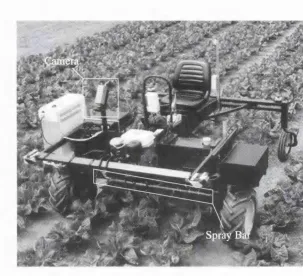
The Silsoe autonomous horticultural vehicle, pictured in a field of cauliflowers in figure 1.1, has
been under development since late 1993 as a platform for the investigation of precise crop and
weed treatment[TMH96]. The vehicle platform started life as a commercially produced manu
ally controlled lightweight agricultural tool carrier, and has been fitted with computer hardware
and sensors (a camera, wheel odometers and accelerometers) to allow autonomous operation in
the field, and a rudimentary treatment system, the spray bar labelled in figure 1.1, for PSH exper
iments. Computing power has been provided by two systems. From 1993 until 1998, processing
was performed by a network of transputers hosted by a laptop PC. In the Winter of 1998/1999,
this rather out-moded hardware was replaced with a single processor Intel Pentium-II system
mnning the Linux operating system, although some transputer hardware has been retained to
perform data collection from the dead-reckoning sensors.
1.2. The Silsoe autonomous vehicle project 21
Figure 1.1: The Silsoe autonomous horticultural vehicle.
The new work presented in this thesis, started in 1996, extends the capability of the vehi
cle’s com puter vision system, and has built on a considerable volume o f previous effort invested
in developm ent of the vehicle [HT96, MB95, Mar96, PSM97, BM96, SPMB96, RWBM96,
HMT97aJ. The remainder of this section gives details of the autonom ous vehicle and identifies
the problems that the work presented later in this thesis aim to solve.
For autonomous operation, the Silsoe vehicle requires two basic capabilities. The first is
localisation, and the second is the ability to discriminate between the crop, weed and soil. Lo
calisation with respect to some co-ordinate system is required if the vehicle is to navigate itself
in a field of crop, and discrim ination is necessary for the differential treatment of crop, weed and
soil demanded by PSH. We shall treat the two capabilities separately below.
1.2.1 Localisation
Hague and Tillett [HT96] presented the vehicle control and navigation architecture, an amended
and simplified version of which is illustrated in figure 1.2. Many authors are concerned with esti
mating vehicle position relative to an absolute cartesian frame of reference [LDW91a, SSDW95,
BDW H+90], but Hague and Tillet [HT96] argue that a more natural co-ordinate system for op
eration of the Silsoe autonomous vehicle is one that defines position relative to the rows of crop
whose treatment is the focus o f the PSH. The position estimator in figure 1.2, which is a Kalman
position of the vehicle with respect to the central row of crop plants and the bearing angle of the
vehicle with respect to the central row.
Motor drive signals
-Positional feedback demanded drive
velocities
estimated position error
odometers
accelerometers
vision data wheel velocity control
Path tracking control
Position estimation
Figure 1.2; Vehicle control and navigation architecture.
Odometers and accelerometers are used to generate dead-reckoning estimates of the ve
hicle’s position, velocity and acceleration, with periodic drift correction to the lateral offset
and bearing estimates provided by the computer vision system. The vision system designed by
Marchant and Brivot [MB95], described in detail in appendix A, uses the Hough transform tech
nique [Pra91] to fit a template of the crop row structure to the image, which yields the vehicle’s
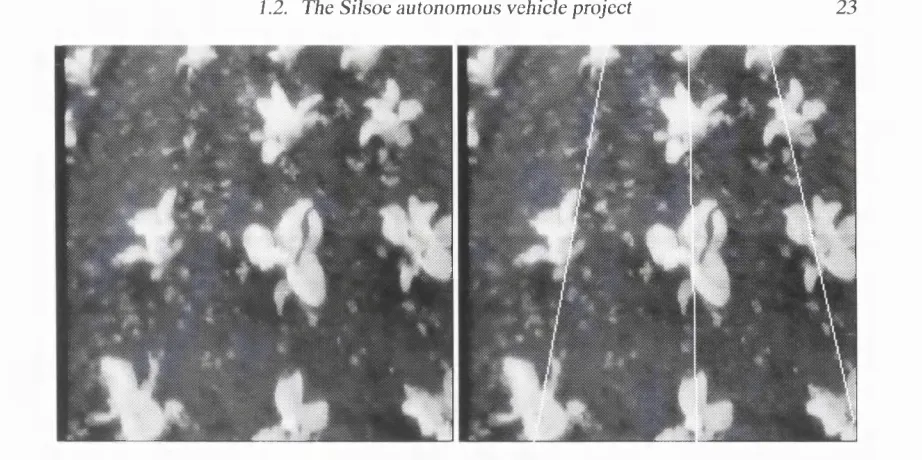
lateral offset and bearing relative to the rows. An input image and the fitted row model are pic
tured in figure 1.3. A small number of navigation trials performed by Hague et al [HMT97a] and Hague and Tillett [HT96], both in a test-bed environment and in a field of real crop, show that
error in the estimate of lateral offset is of the order of 8 - 20 m m . Forward position estimates have not been assessed.
The localisation system described above is used only when the vehicle is navigating along
the crop row. At the end of a bed of crop, where a bed is three parallel rows as pictured in fig
ure 1.3, the vehicle must turn and start following the neighbouring bed. The end of each bed
is detected semi-automatically ; the vehicle is given the approximate length of the bed and uses
its estimate of forward motion, and the number of plant matter features detected by image pro
cessing to judge when the vehicle has reached the end of the bed. The vehicle then executes a
pre-programmed turn under dead-reckoning control so that it is in approximately the correct po
sition to travel along the next bed, the vision system starts up again and visually aided tracking
re commences [HMT97a].
1.2.2 Plant recognition
In addition to localisation, a vehicle that performs PSH requires the capability to differentiate be
1.2. The Silsoe autonomous vehicle project 23
Figure 1.3: The crop row structure. Left: a view of the field from the vehicle’s camera. Right:
the crop rows as located by the Hough transform algorithm due to M archant and Brivot [MB95 ].
and Marchant [BM96] propose candidate algorithm s to separate crop, weed and soil pixels in
monochrome images such as that seen in figure 1.3. The algorithm s use a mixture of hystere
sis thresholding of the pixel grey-levels, techniques from mathematical morphology and grey-
level gradient information. Although they showed promise in off-line trials performed on a desk
top workstation with image sequences captured from the vehicle’s camera, the algorithms have
proved unstable in on-line operation, and are sensitive to changes in illum ination and also to the
size of the crop plants and weeds [ Mar99].
Sanchiz et al [SPMB96] and Reynard et at [RWBM96] present algorithm s for tracking in
dividual crop plants as the vehicle traverses the field. Both algorithm s have been demonstrated
off-line on sequences captured from the vehicle, but have not been implemented for on-line use.
Sanchiz et al model each crop plant as a cluster of “blobs” extracted from the grey-level
image by thresholding, and track the clusters to determine both the motion of the vehicle and
the position of the plants with respect to the vehicle. The algorithm assumes that only image
features that correspond to crop are given to the clustering algorithm , and relied on the method
of Brivot and Marchant [BM96] to correctly provide these features.
Reynard et al ( RWBM96] model the crop plants using contour models [CB92] and demon
strate the robustness of their tracking algorithm to temporary occlusion, as may be caused by
shadows. No method of initialising contours to track particular plants was given, so again, the
1.2.3 The aims and contributions o f this thesis
The work presented in this thesis aims to extend the capability of the autonomous horticultural
vehicle by introducing a vision algorithm that models the crop pattem as a grid of crop plants rather than a set of rows of plants. We aim to show that this seemingly small change leads to two principal advances:
1. Forward distance estimates may be obtained by a vision algorithm that tracks the crop grid
model. In the original autonomous vehicle navigation system, estimates of forward dis
tance are generated by dead-reckoning alone, and the row model used in the Hough trans
form vision algorithm does not permit estimation of forward motion. Dead-reckoning sys
tems are prone to accumulating errors that lead to biased position estimates, and problems
with wheel-slip can lead to unreliable odometer measurements in the field. It is hoped that
the addition of vision estimates of forward distance will correct for dead-reckoning bias.
2. The crop grid model may be used as an aid for discriminating between crop and weed
plants. For reasons we shall outline in chapter 2, discriminating between crop and weed
plants with image processing techniques is a much harder problem than extracting both
weed and crop features from the images. However, if we are successfully tracking the
crop grid, then image features that support the estimate of grid position may be assumed
to be crop plants, and the remainder weeds.
The contributions made toward the autonomous vehicle project by this thesis are centred
upon the development of an algorithm that tracks the crop grid model through image sequences
using an extended Kalman filter. In addition to the advantages offered by a grid model over the
row model, the use of the extended Kalman filter algorithm, described in detail in chapter 3,
allows a more natural integration of the vision system with the vehicle’s position estimator than
was achieved with Marchant and Brivot’s Hough transform algorithm. Furthermore, the Hough
transform algorithm produces quantised estimates of vehicle position, whereas the Kalman filter
tracker provides continuously valued output.
In addition to the full development of two alternative grid tracking algorithms, a method
for crop/weed discrimination is developed that clusters image features under the constraint that
they support the crop grid model. The use of this algorithm leads to the segmentation of im
ages into regions of crop, weed and soil. The classified image features may be used to guide the
application of treatment.
Each algorithm is implemented for off-line testing on a desk-top workstation, and perfor
1.3. Thesis outline 25
part of the closed loop control of the autonomous vehicle. The off-line and on-line implementa
tions differ for practical reasons, and these differences are discussed fully before both tracking
and segmentation algorithms are demonstrated in the field with real crop.
On a more theoretical note, we discuss the implications of the control theoretic concepts of
observability and controllability for systems whose state is estimated by Kalman filters. A novel
test for the observability of an extended Kalman filter is derived and the concept of “corruptibil
ity” introduced, which is analogous to controllability for systems with stochastic inputs.
1.3 Thesis outline
The development and testing of the tracking and segmentation algorithms is broken down into
seven chapters. The first of these, chapter 2, introduces the crop grid model and discusses the
perspective imaging of the crop through the vehicle’s camera. Two thresholding algorithms are
proposed for extracting plant matter features fi’om the image data, and their performance com
pared across a set of test images using receiver operating characteristic analysis, which also aids
the selection of an operating point for the preferred thresholding algorithm.
The recursive Kalman filter estimation algorithm, and the related extended Kalman filter,
are discussed in chapter 3. We define and discuss the issues of controllability and observability
and their implications for Kalman filtering. Corruptibility is defined, and a novel test for the
observability of extended Kalman filters derived.
The details of the extended Kalman filters implemented in this thesis are given in chapter 4.
The process and observation models for the off-line implementations are given, and the transfer
to the on-line system discussed. The filters are analysed in terms of their corruptibility and ob
servability. The off-line tracking algorithms are demonstrated in chapter 5, together with initial
navigation trials of the on-line system in a simplified indoor test-bed environment.
In chapter 6, we address two practicalities that are important when using extended Kalman
filters: initialisation and data association. The extended Kalman filter is a recursive algorithm
where the latest estimate of the state of a process is a combination of the previous estimate and
some measurements of the process of interest. The purpose of filter initialisation is to ‘boot
strap’ the recursion with an initial estimate of the vehicle’s location relative to the crop grid that
will subsequently allow successful tracking. Data association techniques are required to extract
appropriate features from the image data to use in estimating the crop grid position. Feature
validation is also discussed.
Whilst chapters 4 and 5 concentrated on the use of the crop grid model as a cue for naviga
rithm is tested on image sequences captured from the vehicle at different stages of crop growth
and in differing weather conditions.
Two final experiments are presented in chapter 8, where the navigation and crop/weed dis
crimination algorithms are tested on a bed of real crop. Quantitative analysis of the on-line sys
tem’s navigation performance and spray treatment precision is given, and a qualitative analysis
of crop/weed discrimination.
We close with chapter 9, which reviews the results of our experiments and discusses their
Chapter 2
Image processing in the field environment
In chapter 1, we introduced the Silsoe autonomous vehicle project as a test-bed for experiments
in plant scale husbandry. The vehicle is equipped with a computer vision algorithm that uses
a model of the rows of crop plants [MB95], in conjunction with a dead-reckoning estimator, to
provide localisation information that allows the vehicle to navigate along the rows of crop plants
in the field. In this thesis, we propose that using a crop grid model allows additional localisation
information to be derived from the images (in the form of forward distance estimates) and also
aids crop/weed discrimination.
In this chapter, we review modelling techniques in computer vision to help us specify a
model of the crop grid structure. The crop is viewed through a camera mounted on the front of
the vehicle, and the perspective imaging of the scene is discussed, and formulae are presented
which relate the ground plane position of the crop grid to the locations of crop plants in the image.
We also discuss the processing of the images captured by the camera. To locate the crop grid
model, it is necessary to extract the crop plant features from the image. In plant scale husbandry,
we aim to treat weeds as well as (but in a different manner to) crop, so it is necessary to extract
all plant matter from the image. Two grey-level thresholding algorithms are proposed for this
purpose, and their performance on images collected from the vehicle is analysed using receiver
operating characteristic curves. This method allows both overall performance comparison and
a solution to the problem of operating point selection.
2.1 The semi-structured field environment
As noted in chapter 1, the field environment in which the autonomous vehicle operates contains
a natural “beacon” to navigate by in the form of the crop grid planting pattern. For agronomic
reasons the crop, which in the examples given throughout this thesis is cauliflower, is planted in
a grid structure which allows each individual plant space to grow and access to a region of soil
transplant them into the soil at a later date. This planting process is performed mechanically by
a transplanter, which places the seedlings on an approximately regular grid, a perspective view
of which can be seen in figure 2.1. This approximate structure, imposed on the world by the crop
planting can serve as a cue for the two aims of vehicle control:
Navigation: the structure provided by the crop grid pattern may be used as a beacon to
localise the vehicle relative to the crop. This localisation serves as an aid to the dead-
reckoning system for vehicle navigation.
Treatment: the knowledge that crop plants are arranged in this grid structure may be used
to discriminate between crop and weeds. Crop plants should lie within the grid structure
where they were planted, whilst weeds will usually grow elsewhere, both because they
tend to grow at random and because they will not thrive if germinating close to a well
established seedling.
Figure 2.1: The grid planting pattern as captured from the vehicle camera.
The image in figure 2.1 has been taken from a sequence captured from the camera mounted on the
vehicle. By using models of the grid structure and the motion o f the vehicle, this grid structure
will be tracked as the vehicle traverses the field. The following sections discuss object m odelling
in machine vision, whilst the problem of tracking receives attention in chapter 3.
2.1.1 Model based tracking in machine vision
Model based tracking is a powerful method of reducing the computational load on an image-
processing system. Rather than analysing all of a static image and categorising each object in it
separately, a model-based tracker aims to ‘lock o n ’ to a specific object or objects in an image se
2.1. The semi-structured üeld environment 29
object(s) to track it (them) throughout the sequence. Several different types of model have been
proposed [Har92b, CTCG92, YCH89, Low90, BCZ93] with varying degrees of flexibility and
rigidity, and it is important that an appropriate one is chosen, in order to capture the variability
within the class of shapes modelled without introducing extraneous degrees of freedom. Sub
sequent sections review different modelling schemes that are popular in machine vision whilst
bearing in mind that the task at hand is to model the grid structure of the crop planting pattern.
2.1.2 Active contour models
A popular technique used in many tracking applications in machine vision is based upon the ac
tive contour model (ACM). Originally proposed by Kass et al [KWT87], the ACM, or “snake”, is a string of control points, coupled by an elastic material having tension and stiffness properties,
which performs a local search in an image for features such as edges. In its original formulation,
the snake is said to have converged when the “forces” caused by the internal stiffness and tension
balance those derived from the edge features in the image. A drawback of the snake algorithm
is that it requires a good initial configuration close to the required edge, otherwise it will simply
relax to a straight line. The original tracking mechanism for the snake relied on small inter-frame
motion. The predicted position of the snake in the next image of a sequence was simply the posi
tion at which the snake had converged in the current image. Later, more sophisticated predictive
motion models were incorporated into the tracking mechanism [TS92, Bau96].
The idea of joining the ends of the contour to form a closed loop, or “balloon” with an added
pressure force was then proposed [SWHB90, Coh91]. The pressure force makes the balloon
expand until it meets a strong edge, so the initial position is no longer so critical. Also, owing to
the internal smoothing forces, the balloon will ignore weak edges that may be caused by image
noise. A further development of the balloon model is the statistical snake. This is an active
region model (ARM) [IP94], which allows adaptive control of the pressure force to encourage
the snake expand or contract in order to surround regions of an image conforming to a statistical
model. This particular technique has been successfully applied to segmentation and tracking
of road and track regions using statistical colour models [Ale98] and also to colour and texture
segmentation [ZLY95].
The ACM incorporates a very simple shape model where the object of interest is a smoothly
bounded region of the image enclosed by a perimeter of edge features. Such a model is sensi
tive to clutter in the image. A more robust tracker that is less sensitive to clutter could be re-
ahsed if the shape of the contour were further constrained to be specific to a particular class of
objects. Curwen and Blake [CB92] describe such a method, where a B-spline ACM^ (or “dy-
namic contour”) is coupled to a template such that, in the absence of image forces, the contour’s
shape is that of the template. This biases the contour to lock on to shapes in the image that are
similar to the template. The models are permitted to deform under affine transformations, and a
Kalman filter (see chapter 3) is used to track the contour position over time (similar motion mod
els and tracking schemes have been proposed by Baumberg for more regular ACMs [Bau96]).
This method was demonstrated to run in real-time on a small network of transputers. Since
publication of the original work [BCZ93], the method has been developed extensively to in
corporate features such as learning the dynamics of the object from training sequences [BIR94],
and also differentiating between changes in object shape in the image that are caused by actual
change of the object shape and apparent changes owing to object motion and change of view
point [RWBM96]. A further development is the C O N DENSA TIO N algorithm [IB96] used as the
estimation mechanism in place of the Kalman filter. The strength of the c o n d e n s a t i o n algo
rithm is that, unlike the Kalman filter which is restricted to the uni-modal Gaussian, it has the
ability to handle multi-modal probability densities, thus enabling multiple hypotheses to be prop
agated through the tracking process. In particular, the capacity to maintain multiple hypotheses
increases the robustness of the tracking process. For example, if the tracker becomes distracted
by clutter in an image, a uni-modal tracker can fatally lose track because its single hypothesis al
lows only one object position to be represented. A multi-modal model, however, allows both the
clutter positions and true object position to be represented, and when the clutter is found not to
satisfy the dynamics of the model, then the true object mode will re-assert itself via propagation
of the distribution through the state evolution model.
Although active contour models have been used for tracking individual plants [RWBM96],
and despite their success in many practical vision systems, active contour models and active re
gion models are not natural candidates for the application at hand, which is tracking the position
of the structure formed by a group of plants. When used to track the outline of an object, the
ACM fits its control points to features (typically edge segments) and presents an interpolated
outline of the object. The ACM method is not well suited to the crop grid tracking application
of interest to this thesis, because the structure to be tracked is not a region or object enclosed by
a boundary, but rather a set of individual crop plant positions.
2.1.3 Point distribution models
The point distribution model (PDM) [CTCG92] represents an object by the position of a set of,
say n, landmark points derived from distinguishing features on its boundary or interior. The model is trained on several images, where landmarks have been specified by hand, which aim
2.1. The semi-structured ûeld environment 31
to represent typical variations in the object’s appearance. This is usually performed by aligning
the training images using a Procrustes procedure [CTCG92] and carrying out a principal com
ponents analysis on the distribution of the aligned landmark points obtained from the training
images. This determines the mean shape of the object together with vectors describing its statis
tically independent principal models of variation. Only the most significant modes are retained
in the model and those accounting for little variation are ignored in order to limit the number of
model parameters, thereby increasing efficiency and avoiding over-fitting problems.
When coupled with an image feature search strategy, the FDM is known as an Active Shape
Model (ASM). The feature search strategy is a method for fitting the model to a new instance of
the object in an image. In fact, the original ASM paper [CT92] was subtitled “Smart Snakes”,
highlighting the similarities between the ASM and ACMs discussed above, as both can be re
garded as a collection of landmark or control points on an object whose positions are influenced
by various “forces”. In an ACM, the control points are connected by elastic forces and there is
no shape specificity. In the ASM formulation, the landmark point positions are coupled by the
statistics underlying the FDM, which permits only certain modes of shape deformation. Since
it allows the object shape to vary and since the variability may be learnt from example training
data, active shape models have been used in the tracking of many types of biological objects,
such as hands [Hea95], pigs [TOM97], fish [MT97] and flocks of ducks [SBT97]. With its abil
ity to cope with deformations, the FDM/ASM is especially well suited to modelling the changes
of shape caused by object flexibility, but it has also found application in fitting a generic model
of an object to particular types. For example. Ferryman et al [FWSB95] construct a generic car model with basic features such as bonnet and boot of variable size and shape, and then train it
on several different models of car, and use the resulting FDM in a system to lock on to and track
any type of car present in the scene.
Another option would be to use the FDM for the crop grid tracking problem with land
mark points taken as the plant positions, but some care must be taken with the model construc
tion. The Frocrustes alignment procedure described by Cootes et al [CTCG92] uses a similarity ransform (planar translation and rotation) to align the training shapes before the principal com
ponents analysis is performed. In our application, where we image the crop in perspective, a
different transformation is required. Chatteijee and Buxton [CB98] use an affine transformation
in the Frocrustes alignment of examples of the outlines of drivable regions that have been ex
tracted from images of unsurfaced country lanes. Although such an approach has not been taken
in this thesis, it might be possible to use the perspective projection in an alignment scheme prior
variation in the usual manner. Chatteijee and Buxton also make the observation that the affine
transformations between road surface and camera are not entirely random, because they are de
termined, by driver action, to keep the vehicle on the road. To capture this systematic variation
they also performed PCA on the transformations [CB98].
2.1.4 Rigid models
The planting pattern is an example of man-made structure imposed on the world. The tracking of man-made objects has been the focus of much attention [Ste89, Low90, Har92b]. Such ob jects are often rigid or have simple mechanical internal degrees of freedom and may usually be
represented by CAD-like models. Stephens [Ste89] used a Hough transform method to track an
object grasped by a robot arm. A full 3D model of the object was constructed, together with
a look-up table to indicate which features (points on the object’s edges) should be seen from
particular viewpoints. Although the pose estimates generated by the algorithm were noisy, the
system was quite successful in dealing with occlusions and cluttered backgrounds. It should be
noted that by its nature the resolution of any Hough transform pose estimator is limited by the
quantisation of the Hough accumulator, and also that Stephens’ system had no means of cap
turing the dynamics of the model. The assumption was that there was little inter-frame motion
and that the edge positions could be found in successive frames by local search from their previ
ous locations. Lowe [Low90] extracted edge segments from the whole image and a non-linear
minimisation procedure was used to fit a 3D model onto the image. In this case, both rigid ob
jects and articulated objects with rigid subcomponents were modelled, although no quantitative
analysis of the results was given.
The RAPiD algorithm [Har92b] uses similar models to those of Stephens [Ste89] (points on
object edges, with view graphs to predict occlusions for certain poses) to track aircraft and other
objects. The tracking method employed here is the Kalman filter, and the algorithm produces
high quality pose estimates in image sequences of both real and model objects. The Kalman
filter yields continuous (i.e. unquantised) pose estimates, and also a measure of uncertainty on
the estimate.
Both the RAPiD algorithm and Stephens’ Hough transform method are designed for rigid
objects of ideal shape. The crop grid pattern may be regarded as a rigid structure, because once
the crop is planted it is fixed in position. However, the feature points (i.e. the crop plants) should
be allowed to occupy non-ideal positions owing to the variability in the planting process. Any
model of the grid structure should allow for this uncertainty on individual plant positions, which
2.2. Modelling and viewing the grid structure 33
2.1.5 Flexible templates
The flexible template [YCH89] is a relatively simple idea. A parameterised model of the object
of interest is constructed, and the parameters are varied so as to fit the model to the image. Yuille
et al [YCH89] introduced the deformable template and applied it to extracting features such as the eyes and mouth from images of human faces. Figure 2.2 illustrates their template for the
eye. All of the labelled parameters are allowed to vary in a scheme which minimises a poten
tial energy defined from the goodness of fit of the model to the image. The model of the crop
Xe
Xc
-P2
Figure 2.2: A flexible template model of the human eye (adapted from Yuille et al [YCH89]).
grid structure presented below bears similarities to both a rigid model and a flexible template,
depending on whether or not its parameters are allowed to vary.
2.2
Modelling and viewing the grid structure
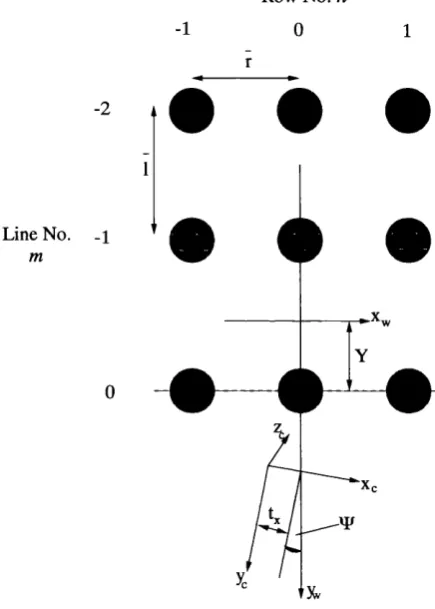
The model of the crop grid pattern is depicted in figure 2.3, where the black circles represent
the ground plane positions of the set of cauliflowers currently in the field of view of the camera.
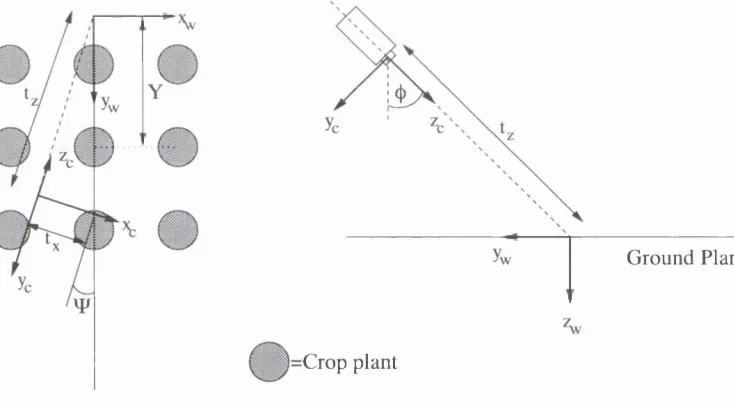
The figure also shows two sets of axes; Vw) is the world co-ordinate frame with the world z axis, z^, projecting into the page, and {xc,yc, Zc) are axes which belong to a co-ordinate system attached to the camera mounted on the vehicle, with describing the camera’s optic axis. Figure
2.4 shows an alternative view that clarifies the relationship between the two co-ordinate frames.
The crop is assumed to lie on the ground plane = 0, and the y^j axis runs through the central row of crop in the field of view. Errors arising from the assumption that the crop lies in the
ground plane are discussed in section 2.3.8 below.
It should be noted that the world co-ordinate frames are local to the vehicle co-ordinate sys
and crop treatment are carried out by the vehicle, so it is sensible to describe the locations of the
crop and weed in a co-ordinate system relative to the treatment system. As the vehicle moves
across the field, the world axis Xyj axis moves in direct proportion to the distance travelled along the crop rows. A set of co-ordinates is marked on the diagram which specifies the position of
Row No. n
- 1 0 1
r
Line No. _i
Figure 2.3: The grid model.
the vehicle relative to the crop. These co-ordinates are the offset of the optic axis from the
central row of crop, the vehicle’s bearing relative to the central row of crop, and V, which is the offset between the world axis and the bottom-most crop plant in the current image. Y is the co-ordinate which anchors the grid to the vehicle’s co-ordinate system. Two grid param
eters, the mean inter-row spacing f and inter-line spacing
I
(figure 2.3) are used in conjunction with indices m and n to generate the world co-ordinates of the individual plants, as shown in equations 2.1 and 2.2.Xyj = n x f , (2.1)
yyj = m X I -\-Y- (2.2)
Marchant and Brivot [MB95] (appendix A) presented equation 2.1 in their work on using a
Hough transform to track the row structure. As noted in chapter 1, their algorithm modelled