Volume 8, No. 3, March – April 2017
International Journal of Advanced Research in Computer Science RESEARCH PAPER
Available Online at www.ijarcs.info
ISSN No. 0976-5697
Improvisation of QoS using DBPQ for Queuing Technique in Vo-MAN Network
Dr. Uppu Ravi Babu
Professor, Department of CSE, Narsimha Reddy Engineering College, TS, India
Abstract: Voice over Internet Protocol (VoIP) could present excellent services through Mobile Ad hoc Networks (MANETs) platform. It could cover a lot of purpose scenario assortment from safety to comfort in quality of services, the approach is based Improvisation of QoS using DBPQ for queuing technique in VO-MAN(VOIP+MANET) related services. Queuing has become a popular technology for voice statement from side to side internet. Mobile Adhoc Networks (MANETs) presents a high-quality stage for the fast consumption of VoIP service in many request scenario. MANETs provide a significant difficulty that makes the broadcast of real - time application like VoIP a great challenge due to Quality of Service (QoS) requirements. This paper examines the performance of queuing methods in MANets carrying VoIP traffic. Through a simulation study we investigate and assess QoS indicators such as delay, Jitter, Packet Delivery Ratio (PDR) and throughput. In the existing methods the queuing has been performed based on the analysis report which has its drawbacks with mobile nodes. Hence a QoS based intelligent queue technique called DBPQ (Distance Based Priority Queue) has been proposed to analyze the performance of mobile models illustrate a travel pattern of the nodes. This paper proposes a method to evaluate and implement the DBPQ for the improvement of QoS in VoIP. The main objective of this paper is to allocate the bandwidth as per distance calculation by using RSSI algorithm concept in to undertake a fundamental investigation to enumerate the impact of various queuing mechanism for VoIP (QoS) using DBPQ for queuing technique in Vo-MAN (VoIP+MANet) network
Keywords: VoIP, QoS, RED, RSSI, DBPQ, Vo-MAN
I. INTRODUCTION
The present developed advancement in packet switching networks, VoIP (Voice over Internet Protocol) has become an industry desired technology over Public Switching Telephone Networks (PSTN) for voice communication because of its cheap cost [1] [2] [3]. VoIP allows making international calls during VoIP by only for the data usage acts a huge advantage. Although, there are enormous return to using VoIP there are a number of recognized issue such as, packet loss, jitter and latency moving the Quality of Service (QoS) as the connection is well-known through the internet? This paper analyses how a VoIP network is built (in NS2.35) and testing has been carried out for different queuing techniques to evaluate the QoS metrics. Network Simulator (ns2) is use to run some simulations, we have established for excising queuing method there is some drawback due to defeat those drawback we have proposed a new queuing algorithm is called Distance Based Priority Queue (DBPQ).For this research we are using NS2 to implement our VoIP network on either side of two routers..
QoS VoIP is careful Advantages because of
• utilize ease of use of Internet to make phone calls using normal, readily available computer parts, hence low cost
• VoIP allows to put together different web services like calling a retail organization while from your computer to make product inquiries Due to the vast amounts of codec’s available for VoIP networks, voice data may be transmitted at rates dissimilar from the standard 64kbps, including changeable bit rates, hence possibility for greater bandwidth efficiency.
II. RELATED WORKS
Wherever MANET (Mobile Ad-hoc network) are independent networks consisting of two or more mobile nodes ready with wireless communication and hence are self-configuring infrastructure less network. The infrastructure, flexibility and low cost are the main description of MANETs. While in the traditional wireless concept mostly single-hop
communication is used (from the base station to the user and vice versa).MANETs allows communication not only between a base station and its users, but also directly between individual users. Hence, within a local region multiple transmissions might take place concurrently.
Distance Based Priority Queuing Protocol
MANET applications are concerned by transmit voice connecting system entity. Applications like tele-emergency system need voice message in remote areas and disaster struck zones which lacks telecommunication infrastructure [4] [5] [6]. Hence DBPQ for voice announcement is needed but however, Multi-hop voice delivery through MANET is challenging, as it must offer QoS provisioning by efficiently treatment limits of node speeds, unreliable connectivity, rapid topology change and a disjointed network. Main confront in designing MANET is to give good delay performance, and handling packet losses [8] [9] [20].
VOMAN Distance Vector Algorithm
VOMAN (VOIP+MANET vector routing) is similar to AODV provides loop free routes even while repairing broken links. The AODV protocol does not need global broken up routing advertisement [11] [17], hence the command on the whole bandwidth available to the mobile nodes is noticeably less than in those protocols that do compel such commercial.
In arrange to make the simulation more sensible as in the real world, the environment traffic is added. The simulation is opening with UDP (User Datagram Protocol), and Transmission control Protocol (TCP). To contain improved sympathetic of the variation among the VoIP on hyper and wireless system, package loss, throughput, delay and jitter are measured and analyzed in sense of VOMAN distance vector algorithm [12] [13].
information and does not participate in any periodic routing table exchanges. The previous node provides its services as an intermediate forwarding station to uphold connectivity connecting two other nodes. DBPQ relies on with dynamism establishing route table entries at intermediate nodes [7] [10].
QUALITY OF SERVICES (QoS)
1. Performance Calculations
THROUGHPUT: Throughput is the standard speed of successful information get ahead of in excess of a communication channel. It is calculated in bytes/sec. For example, from client Node 0 to client Node 1, both clients connect to server Node 1 and Node 2, the throughput of VOMAN refers to the total amount of voice information move between Node 0 and Node 1. Immediate Throughput=bytes (received in description node) over one second.
The immediate throughput will make a graph presentation the amount of in order received by the destination node over each second [16] [19]. This is helpful for assess the immediate things of the environment traffic on the pre-existing VoIP traffic.
The standard throughput will create a single value presentation the average throughput for the whole duration of the simulation. The formula is as following:
Overall Throughput=sum numeral of bytes established in description node.
DELAY: When the number of packets in the buffers grows larger than the buffer sizes results in congestion that creates delay between two communicating nodes. Transmission delay, also known as store and forward delay, is experienced once all packets are received at a router and forwarded to the next router.
Transmission delay = L/R ms
Where, L is the packet length in bits is the link bandwidth between two routers in bits/second.
JITER: Jitter is the time difference between packets arriving at a receiving node. This delay affects voice streams, causing discontinuities between expected arrival times. To compensate for this phenomenon of delay, a payout buffer is used to smooth out the voice stream
III. QUEUINGMECHANISMS
Single Server Queue Mechanism:
Throughput for drop tail queue in MANET environment with 20 nodes Queue: The mechanism in which the data correspondence is kept or drop forms the queues. In queuing, a table of the correspondence is required, present should be a method on which an alternative that which packet is to be kept and which is to be drop. Single-sever service node consists of a server plus its queue. The issue related to the efficiency is of great significance. When hundreds and thousands computer are connected to each other, their all-around message is with unexpected outcomes and most of the time, these complexity lead into the weak competence of the system and unknown know what the cause some of the competence problems are created due to excess use of the three resources [14] [26]. If rapidly there is excess traffic through the router, congestion is twisted. Queuing algorithms which are implementing in NS2 software and compared are FIFO, RED, and SFQ, PQ [15] [25].Maintaining the Integrity of the Specifications
IV. QUEUE MANAGEMENT ALGORITHMS
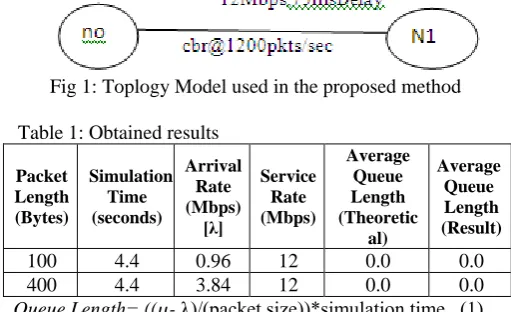
[image:2.595.305.561.133.289.2]Topology: the proposed method uses peer-peer topology and the topology used in this proposed method shown in figure 1. The results obtained in this topology are listed out in table 1. For calculating the queue length the equation 1 is used.
Fig 1: Toplogy Model used in the proposed method
Table 1: Obtained results
Packet Length (Bytes) Simulation Time (seconds) Arrival Rate (Mbps) [λ] Service Rate (Mbps) Average Queue Length (Theoretic al) Average Queue Length (Result)
100 4.4 0.96 12 0.0 0.0
400 4.4 3.84 12 0.0 0.0
Queue Length= ((µ- λ)/(packet size))*simulation time (1)
Since this is a steady bit speed source
• If λ1 <μ2, following that the queue detachment end to
end will be nothing (i.e. queue is unutilized). This is since the packets are approaching at a steady rate (there is no burrstones) and the speed at which the packet are being service is faster than the tempo at which they turn up [18].
• When λ >μ, packet carry on to arrive at a steady rate but cannot be serve by the link at that speed. So, more and more packet keeps getting pushed into the queue. Hence, the size of the queue is directly relative to the difference in packet generate and service per unit time. And it also increase with the simulation time [26].
Rebounded FIFO Mechanism: First in First out concept is a simple queue organization algorithm: it sets a predefined value for the utmost length of the queue and when this worth is reached, new packets are surplus, until the next empty cushion space to believe original packets .what time using the First in First Out Tail mechanism, all the packet in the move are treat identically, in spite of the type of transfer which it belongs Packet loss will cause the source to reduce the number of TCP packets sent before receiving the acknowledgment. The throughput of the given TCP assembly will then reduce, until the transmitter start again to be given acknowledgments and begin increasing the size of its jamming window.
the basic version. The versions WRED (Weighted RED) and RIO (RED with In and Out),
Modified STOCHASTIC FAIR QUEUING (SFQ): It is customized type of FQ by the aim of remove its limits as this method reduce the number of necessary queues. One of the most significant drawbacks of this technique is unfair performance with the flows collide with other flows. Thus, as the name reveal, fair is guaranteed as stochastically [15] [25]. It is suitable for employ in elevated pace processor system that covers a wide variety of CPU, memory and justice trade-offs. It offers elegant degradation under overload and sudden failure [27] [28].
[image:3.595.36.285.231.601.2]The comparative study of the three queuing algorithms is listed out in table 2.
Table 2: Comparison of queuing algorithms Queuing
algorithms used
Traffic
patterns Parameters Conclusion
RED &Drop tail
TCP Packet drop
RED is better than Drop tail and DFT in dropping more number of packets.
CBQ, SFQ, DRR, FQ, RED, Droptail
TCP UDP
Packet drop
FQ and SFQ are best as they deliver maximum number of packets, there is no change in case of DRR, Droptail and RED drop max. Packets
Droptail, FQ, SFQ, DRR, RED
TCP UDP
Buffer size Attack intensities
Droptail and RED
gives best performance for buffer size 60. FQ, SFQ and DRR are not affected. SFQ is best against attack intensities for buffer size 60.
Droptail, RED, SFQ, FQ, DRR
CBR FTP
Throughput End-to-end
FQ gives maximum
throughput and RED is worst. FQ gives maximum delay, RED gives
QUALITY OF SERVICES PARAMETERS
1 Throughput: Throughput is a measure of the date rate (bits per second) generated by the application and is equal to the total data transferred divided by the total time it took for the transfer [6] [8]. Theoretical value of throughput for fixed 75 Mbps per channel (in a 20 MHz channel using 64QAM ¾ code rate) and its practical value is around 45 Mbps/channel. The results of the through put is shown in table 3.
2 Minimum Average Delay or latency: Average Delay measures the average one way latency observed between transmitting an event and receiving it at each sink node. Stoppage is the occasion taken by the packet to crossways from the basis to the purpose. The main source of delay can be further categorized as source-processing delay,
propagation delay, network delay and purpose processing delay [17].
3 Various Jitter or Delay variation: Jitter is distinct as an arithmetical difference of the RTP data packet inter-arrival time. It is the difference in the time among packet incoming. In the Real Time Protocol, jitter is calculated in timestamp units [23] [24]. For instance, if you broadcast audio sampled at the standard 8000 Hertz, the unit is 1/8000 of a second. Delay difference is the difference in the holdup introduce by the components along the message path. Jitter is commonly used as an pointer of constancy and stability of a network [29].
Table 3: Throughput results in the proposed method No. of Nodes G.711 G.723 G.729
2 125.54 25.18 45.65
4 220.31 46.51 80.11
6 357.79 69.63 129.56
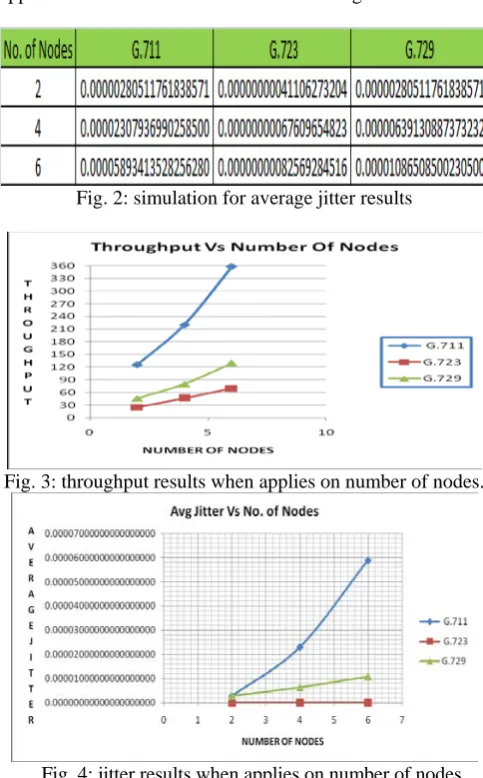
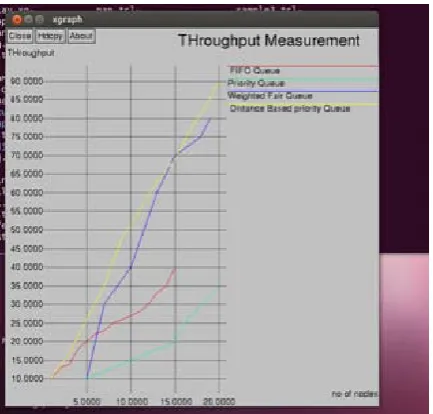
This kind of behavior is observed because when the number of nodes increases, the number of packets being transmitted also increases. G.711 codec has the highest throughput as a result of highest packet size. The next higher throughput is for G.729. The G723 codec has the lowest throughput [21] [22]. The simulation for average jitter is shown in figure 2 and graphical representation of the throughput is shown in figure 3. The graphical representation of jitter results when it applies on N number of nodes is shown in figure 4.
Fig. 2: simulation for average jitter results
[image:3.595.307.549.382.771.2]Fig. 3: throughput results when applies on number of nodes.
Quality of Service (QoS) parameters is observed for VoIPv4 and VoIPv6.
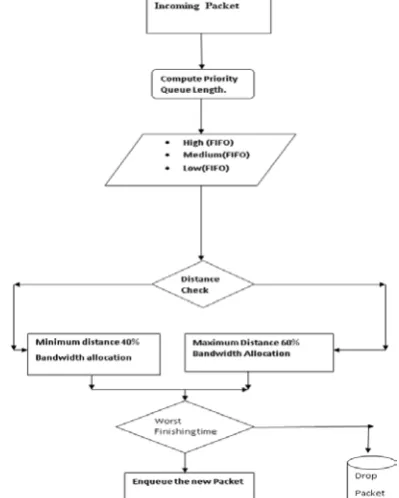
DISTANCE BASED PRIORITY QUEUE DESCRIPTION It can be used in an environment of the Tele-emergency cases. This Queue consists of two stages. In first stage, priority level decision depends on priority levels and in second stage, the Distance Metrics Calculations are taken place in which the bandwidth will be allocated adaptively according to the distance parameter, ie .. Bandwidth will be allocated with the long and short distance respectively.
[image:4.595.42.285.216.401.2]Distance Based Priority Queue: The distance based priority queue is shown in figure 5
Fig. 5: Distance Based priority queue
The advantages of DBPQ are Efficient queuing Techniques for handling the dates in Tele-Emergency Cases and High Throughput. But DBPQ has some limitations. Those are Time Delay for the Bandwidth Allocation, Application and Used in real time application as VoIP. The flowchart of DBPQ is shown in figure 6.
Fig. 6: Flow chart of the DBPQ
DBPQ Implementation with RSSI
Mathematical derivation for Distance Based Priority Queue To calculate the distance using RSSI(Received Signal Strength Indication)To determine the distance between transmitter and a receiver node which is short and long to allocate the bandwidth as per priority and distance.
RSSI is generic radio receiver technology metric.
The distance using RSSI can be calculated using the FRIIS transmission formula
Where
, ,
, ,
and
i.e., To calculate distance between two nodes by receiving signal using equation 4.
Where Node A and node B are considered to be in
communication of MANET. Let us assume i as the centre of coordination system
To classify the conditions of positioning as High
Medium Low
• d< : Bandwidth allocation is 40% • d> : Bandwidth allocation is 60%
i defines its system of local coordinates x-axis line(ip)
y-axis line(iq)
nodei is centre of the system ix=0, iy=0
P is the node axis of
q is locater coordinate axis
where,
Using the theorem of "Al-Kashi"
[image:4.595.57.257.510.759.2]The reference system of the proposed method is shown in figure 7 and The system of localization local diagram is shown in figure 8.
the following formula
The calculation coordinates is
a
For b, coordinates
[image:5.595.313.556.47.677.2]b
Fig. 8: The system of localization local
The results of the RREQ(Rout Request), RREQ(Rout reply) is listed out in table 4
Table 4:Results of the RREQ RREQ’s
source
RREQ’s destination
Time Distance Distance/ Pr 7 0 0,00128055 165,397 317,654 8 0 0,00128093 277,895 897,138 3 0 0,001281 299,47 1041,43 17 0 0,00128117 351,078 1430,93 15 0 0,00128119 356,321 1474,36 19 0 0,00128119 358,238 1490,13 0 8 0,00301585 277,731 896,079
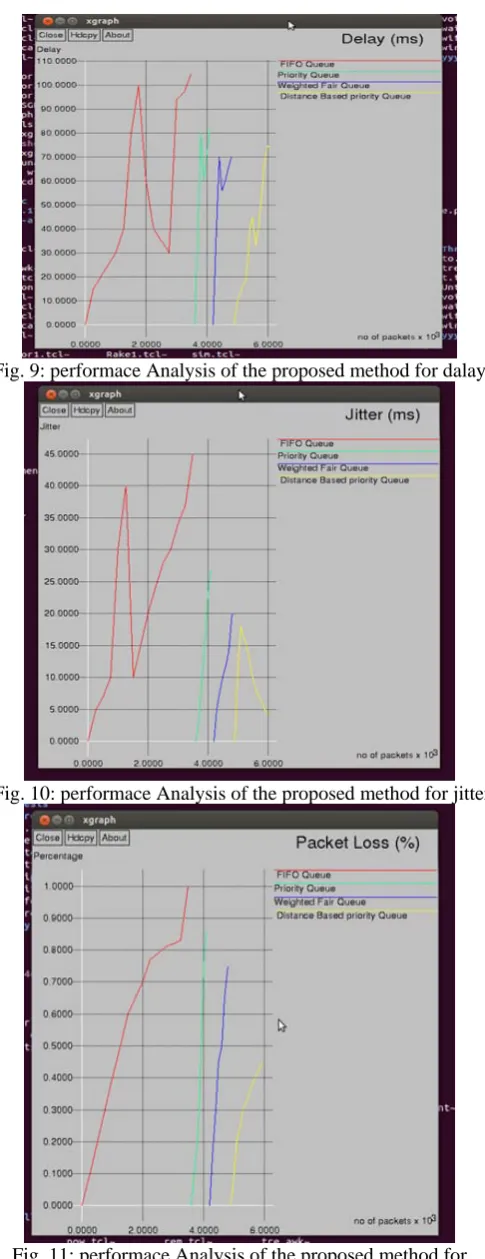
PERFORMANCE ANALYSIS: The performace Analysis of the proposed method for dalay is shown in figure 9 and the performace analysis of the proposed method for jitter in shown in figure 10, the performce analysis of the proposed method when packet loss is shown in figure 11 and the performce analysis of the proposed method of throughput is shown in figure 12
Fig. 9: performace Analysis of the proposed method for dalay
Fig. 10: performace Analysis of the proposed method for jitter
[image:5.595.37.273.58.416.2]Fig. 12: performace Analysis of the proposed method for throughput
V. CONCLUSION
In this proposed DBPQ queue technique has been implemented using RSSI algorithm. The performance evolution has been made with respect to QoS performance metrics such as delay, throughput packet loss, and jitter. The performance analyses were conducted comparing with FIFO, PQ, WFQ,SFQ. According to simulation result DBPQ gives better result in case of throughput, jitter, and packet loss. As a feature work the node energy level should be tested and increased to avoid delay performance. In the result scenario Improvisation of QoS using DBPQ for queuing technique in Vo-MAN network has been simulated in network simulator
VI. REFERENCES
[1] Hesham N. Elmahdy , Mohamed H. N. Taha , “ The Impact of Packet Size and Packet Dropping Probability on Bit Loss of VoIP Networks ”, Paper in ICGST-CNIR Journal, Volume 8, Issue 2, January 2009
[2] HaniyehKazemitabar, Sameha Ahmed, KashifNisar, Abas B Said, Halabi B Hasbullah , “A Survey on Voice over IP over Wireless LAN” ,Paper in World Academy of Science, Department of Computer andInformation Sciences, University Technology, Malaysia , 2010 .
[3] Greg S. Tucker, “Voice over Internet Protocol (VoIP) and Security”, Paper in SANS Institute, October 2004.
[4] Gouda I. Salama, M. ElemamShehab, A. A. Hafez, M. Zaki,“Performance Analysis of Transmitting Voice over Communication Links Implementing IPSec ” , Paper in 13th International Conference on Aerospace Sciences and Aviation Technology (ASAT), Military Technical College, Cairo, Egypt , May 2009.
[5] Qinxia (Alice) He "Analyzing the Characteristics of VoIP Traffic”,ThesisMsc, Department of Computer Science, University of Saskatchewan, Canada, July 2007
[6] FuratNidhalTawfeeq,“Network Congestion and Quality of Service Analysis Using OPNET”, Thesis, Department of Information Engineering, Al-Nahrain University, March 2009..
[7] Jishu Das Gupta, “Performance Issues for VoIP in Access Networks”, Thesis Msc, Department of Mathematics and Computing Faculty of Sciences, University of Southern Queensland, 2005.
[8] EmadAboelela , “Networks Simulation Experiments Manual” ,Book, 3rd Edition , April ,2003 .
[9] Tommy Svensson, Alex Popescu, “Development of Laboratory Exercises Based on OPNET Modeler”, Thesis, Department of Electrical Engineering, Blekinge Institute of Technology, June 2003.
[10] Di Wu, “Performance Studies of VoIP over Ethernet LANs”,Thesis, Department of Computer andInformation, Auckland University of Technology, 2008.
[11] KeerthiPramukhJannu ,RadhakrishnaDeekonda , “OPNET Simulation of Voice over MPLS with Considering Traffic Engineering “ Thesis , Department of Electrical Engineering , Blekinge Institute
[12] Berry Schoenmakers (1999), A simple publicly verifiable secret sharing scheme and its application to electronic voting, CRYPTO 99 vol 1666 of lecture notes in Computer science, Springer-verlag, 1999, pp 148-164
[13] [13]Binod Vaidya, Joel J.P.C.Rodrigues and HyukLim,Secure multimedia streaming over multipath wireless Ad hoc network: Design and Implementation.
[14] [14]D.Butcher, X.Li, and J.Guo (2007), Security challenge and defense in VoIP infrastructures, IEEE trans. Systems, man and cyberneticspart c: Applications and reviews, 37(6), pp 1152-1162.
[15] E.Gustafsson,G.Karlsson (Apr 1997), A literature survey on traffic dispersion, IEEE networks.
[16] Hanoch, Levy, Haim, Zlatokrilov, the effect of packet dispersion on voice applications in IP networks, IEEE / ACM transactions on networking.
[17] Hong Li and LorneMason, Multipath routing with adaptive playback scheduling for voice over IP in service overlay networks.
[18] HousamAlAllouni,AlaaEldinRohiem,MohammedHashemAbd El-Aziz ahmed,Ali El-Moghazy (March 2009), VoIP Denial of Service Attacks Classification and Implementation, 26th National radio science conference.
[19] Hugo Krawczyk, ”secret sharing made short” (1998), Springerverlag. HuiTian, KeZhou,HongJiang,JinLiu,Yongfeng Huang, Dan Feng, ”An M-sequence based steganography model for voice over IP”, publication in the IEEE ICC 2009 proceedings.
[20] D.B.Johnson, D.A.Maltz, Y.C.Hu, J.G.jetcheva (Nov 2001), The dynamic source routing protocol for mobile ad hoc networks.
[21] JoongMan Kim, SeokUng Yoon, HyunCheolJeong, YooJae Won (2008), “Implementation and Evaluation of SIP-based Secure VoIP Communication System”, IEEE/IFIP International Conference on Embedded and Ubiquitous Computing.
[22] Joongmankim, seokungyoon, yoojae won, jaeil lee (2007), VoIP secure communication protocol satisfying backward compatibility, second International conference on systems and networks communications, IEEE.
[23] Kevork R. Piloyan, VaheNerguizian (2006), Novel Architecture for Routing Packetized Voice over Existing Internet Infrastructure without Using the Internet Protoco”, IJCSNS-International Journal of Computer Science and Network Security, 6(7B).
[24] S.J.Lee and M.Gerla (2001), Split Multipath routing with maximally disjoint paths in ad hoc networks, Proceedings of International Conference on Communications, 10, pp 3201-3205
[25] Dr. Hussein A Mohammed, Dr.Adnan Hussein Ali (2013), The Affects of Different Queuing Algorithms with in the Router on QoS VoIP application using OPNET.Published in (IJCNC – Vol : 5 January 2013)
[26] Mehaswari ,K.Punithavalli (2011) Design and Implementation of multipath routing approach for secured and reliable data delivery over VoIP.Publication in (IJAER- Vol:2 / 2011).
[27] SUZ, A., ELBATSH, K. A., MAC, E. Gradient RSSI filter and predictor for wireless network algorithms and protocols. Network Protocols and Algorithms, 2010, vol. 2, no. 2, p. 1–26.
Architectures,Methods and Tools DSD 2007. Aug. 2007, p. 471-478, doi:10.1109/ DSD.2007.4341511
[29] N. Enneya, K. Oudidi and M. Elkoutbi “Network Mobility in Ad hoc Networks”, Computer and Communication Engineering,